



Abstract
The agricultural sector offers a unique opportunity to examine the topic of climate change because agriculture is more susceptible to climate disruptions than many other industrial sectors. Based on the analysis of the survey data and in-depth interviews with specialty-crop producers in California, New York, Pennsylvania, and Washington, we test the capacity of ecological modernization and treadmill of production perspectives to explain how resource-intensive producers recognize water availability and climate change as threats to their operation’s economic viability. We find that producers in capitalist markets recognize natural resource problems; however, they fail to respond to climate change beyond natural resource problems. We also find that local markets play a positive role in raising environmental awareness of producers. Finally, our finding on the association between the perceptions of water availability and climate change goes beyond the treadmill of production dualism that only theorizes the impacts of economic factors on the environment.
Keywords
Introduction
Agriculture offers a unique opportunity to examine the topic of climate change because the agricultural sector is more susceptible to climate change than many other sectors. Research indicates that agriculture has increasingly been affected by weather disruptions linked to climate change over the past four decades (Arbuckle et al., 2013; Beddington et al., 2012; Prokopy et al., 2015). Farmers often experience these unpredictable weather patterns as water scarcity, in the form of droughts, and water abundance, in the form of flooding. Agriculture is also one of the major contributors to water depletion (Bates, 2008; Karl, 2009) and greenhouse gas emissions (Intergovernmental Panel on Climate Change, 2014). Therefore, current agricultural practices exacerbate problems related to climate change, as agricultural systems are negatively affected by climate change.
In this study, we examine whether agricultural producers perceive natural resource problems and climate change as distinct, even though scientific findings point to a direct connection. Despite the threat to agriculture, producers do not necessarily acknowledge that climate change is occurring, or that it is caused by humans. Prokopy et al. (2015) found that farmers in the Midwestern United States and California realize that climate change is occurring. However, the majority of those farmers do not acknowledge that climate change is the result of human activities or that it is a threat to agriculture.
If agricultural producers and other economic actors perceive climate change and resource problems (water availability in our case) differently, it is important to explain the underlying socioeconomic factors and market structures that lead to this divergence. The topic of climate change in the United States (U.S.) has emerged as a contentious issue in a polarized political climate, since ideological differences emerge as influential factors that are distinct from socioeconomic factors (McCright & Dunlap, 2011). Therefore, studies on the perception of climate change typically do not examine how economic activity and market participation influence people’s perception of climate change. We explore whether agricultural producers are likely to recognize water availability problems as an immediate threat to their operations in the form of physical and economic damage. Furthermore, we explore whether the farmers consider climate change a threat because they experience it indirectly through weather disruptions and water availability problems, as climate change may seem more abstract to producers than water availability problems.
We consider the utility of two theories in our study: ecological modernization (EM) and treadmill of production (TP). EM assumes that economic actors have an ecological rationality (McLaughlin, 2012) and that they value the sustainability of natural resources, if those resources become a cost of production in capitalist markets (Mol & Spaargaren, 1993). Although EM re-cognizes the sustainable use of natural resources by economic actors, it does not explain how those actors respond to a broader environmental problem that surpasses natural resource scarcity. The TP theory goes beyond EM by explaining why economic actors tend to ignore broader environmental problems, such as climate change. According to TP, producers operating in a capitalist economy continually exploit natural resources and generate environmental problems. However, they fail to respond to those environmental problems due to the short-term capitalist growth imperative (Gould, Pellow, & Schnaiberg, 2008).
TP studies on agricultural production identify the capitalist markets as the structural cause of an ecological crisis (Obach, 2007; Schewe & Stuart, 2017; Ward, 1993); however, they have yet to offer an alternative market structure as a solution in practice. Food system studies show that farmers in local markets aim to address environmental and social sustainability issues in their production systems (Bell, 2010). We aim to address the TP limitation for an alternative market structure by exploring whether local markets function as a mechanism for connecting resource problems and environmental problems.
Another limitation of TP that we address in our study is how exposure to resource problems might change economic actors’ perception. Since the main focus in TP studies has been the influence of capitalist markets on the environment, these studies do not consider how exposure to problems might increase the chances of recognizing and responding to an environmental problem (Moore, 2017). We consider whether agricultural producer experiences of water scarcity increase the chances of recognizing and responding to climate change.
Our analytical framework tests the main tenets of EM and TP. Based on the analysis of thein-depth interview and survey data from specialty-crop producers in California, New York, Pennsylvania, and Washington, we examine whether agricultural producers recognize that they are vulnerable to both water availability and climate change. We focus on fresh-apple and wine-grape producers because specialty crops are more susceptible to the impacts of climate change than are staple crops. Because water scarcity linked to climate change has had more pronounced negative economic effects on producers in the U.S. West (Howitt, MacEwan, Medellín-Azuara, Lund, & Sumner, 2015; MacDonald, 2010). California and Washington adopted statewide strategic plans that address the impacts of climate change on agriculture. We account for regional variation in our analytical framework to explain the impact of regional policies at the state level that comprise a significant guideline for producers. We also pay close attention to how socioeconomic dynamics, including scale of operation, labor needs, and market characteristics, influence producer perceptions of water availability and climate change. In our analytical framework, we adopt a mixed methods approach where we use qualitative interviews to support the interpretation of the regression models.
Conceptual Framework
Ecological Modernization as a Natural Resource–Focused and Reformist Approach
EM theory offers an optimistic perspective on the capacity of modern technologies and scientifically informed regulations to internalize environmental costs in capitalist markets (Mol & Spaargaren, 1993). According to this theory, economic actors will increase production efficiency and depend less on natural resources, if they adopt modern technologies. Therefore, economic actors account for the economic costs of environmental problems, as “the economisation of ecology . . . leads to an ecologisation of the economy” (Mol & Spaargaren, 1993, p. 437).
We test the EM assumption that economic actors will necessarily recognize the link between resource inputs and broader environmental problems. According to Mol (2002), “‘conventional’ environmental problems such as surface water pollution, solid waste, local and regional air pollution, and noise are, or at least have been until the mid-1990s, the more typical objects of ecological modernization studies” (p. 98). Mol suggests that the topical difference in the environmental problems analyzed (natural resource problems vs. broader environmental problems) is one of the dividing lines between EM and critical environmental studies. Indeed, EM scholars typically focus on the political regulation and economic practices of natural resource efficiency (e.g., Frouws & Mol, 1997; Huber, 2000, 2008; Korhonen, 2008; Mol, 1999, 2006). The regulatory dimension of EM tends not to be informed by political sociology, since the political institutions around environmental and economic issues are undertheorized in EM literature (Buttel, 2000).
EM scholars advocate a reformist approach to institutional change to distinguish themselves from neo-Marxist approaches (Frouws & Mol, 1997; Mol, 1999, 2002). Huber (2000) dismisses the calls for radical structural transformation (e.g., the egalitarian redistribution of ecological and economic goods and harms) as impractical and unrealistic. Although a narrow and reformist approach to natural resource problems may be more conducive to policy applications, EM critics note that this approach does not provide a comprehensive theoretical framework for the connections between natural resource efficiency and environmental problems. York and Rosa (2003) contend that EM does not explain whether increasing resource efficiency contributes to the mitigation of a broad environmental problem, such as the climate change. Langhelle (2000) claims that sustainable development is conceptually more comprehensive than the EM framework, since sustainable development is based on the interdependence between environmental sustainability and social sustainability. In a similar vein, Jänicke (2008) contends that a few market-based win-win policy solutions will not go far enough to solve long-term environmental problems. Finally, Horlings and Marsden (2011) point to the importance of local production and market structures in sustainable agricultural systems that the conventional EM perspective considers a radical change. In line with what Horlings and Marsden argue, our study explores whether local markets as alternative structures might influence producers to recognize the links between climate change and resource problems.
Treadmill of Production Critique of Ecological Modernization
TP is an early and still prominent neo-Marxist perspective on how capitalist economies generate environmental problems, as well as social ones (Foster, 2005; Gould et al., 2008; Rudel, Roberts, & Carmin, 2011; Schnaiberg, 1980). TP criticizes EM claims that the exploitation of natural resources diminishes when resource-efficient technologies decouple production from resources (Mol, 2002, 2006). TP proponents contend that this approach fails to recognize the Jevons paradox built into the capitalist production system; the capitalist growth imperative forces producers to increase production, thus, compounding environmental harms (Clark & York, 2005; Prudham, 2009).
Although agriculture is one of the most affected economic sectors, agricultural producers in industrialized nations are not likely to recognize the threat of climate change (Perrow & Pulver, 2015). According to the research note by Arbuckle et al. (2013), the majority of soybean and corn farmers in the Midwest perceive climate change as real, but only one third believes it to be anthropogenic. Another key finding by Arbuckle et al. is that only those who believe that climate change is anthropogenic are willing to support and participate in climate adaption and mitigation efforts. Meanwhile, studies on Iowa farmers (Arbuckle, Morton, & Hobbs, 2013, 2015) reveal that the majority did not consider climate change to be an important threat to their operations. In Yolo County, California, Niles, Lubell, and Haden (2013) and Haden, Niles, Lubell, Perlman, and Jackson (2012) found that only a small majority of farmers considered climate change as a threat to agriculture, and they reported low levels of concern about water availability.
Our four-state study covers more area than previous studies using survey data on farmers’ perceptions of resource availability and climate change (i.e., Arbuckle, Morton, et al., 2013; 2015; Arbuckle, Prokopy, et al., 2013; Haden et al., 2012; Niles et al., 2013). In the analysis section, we compare the responses to survey items in these studies to the responses in our survey to validate our findings. Furthermore, the large geographical coverage gives us the ability to make a regional comparison in farmers’ perceptions that the previous studies lack. Another strength of our study is its focus on specialty-crop producers. Although the crop yields in irrigated specialty-crop production have not been as affected as in the Midwestern rainfed corn and soybean production (Ortiz-Bobea, Knippenberg, & Chambers, 2018), climate change has limited the water resources for irrigation in the U.S. West (Howitt et al., 2015; Snover, Mauger, Binder, Krosby, & Tohver, 2013), and it has affected the quality of specialty crops (Ahmed & Stepp, 2016). Considering the regional differences and irrigation dependency of specialty crops, we suspect that the respondents in our study will reflect a higher level of concern over climate change and water availability than those in previous studies.
TP studies on agriculture, aquaculture, and the environment draw attention to the capitalist market dynamics to explain farmers’ reluctance to act on resource and environmental problems. Early TP studies criticizing agricultural development pointed to the capitalist growth imperative that deterred conventional farmers from sustainability practices, even in the face of rising societal awareness of environmental problems (e.g., Konefal & Mascarenhas, 2005; Ward, 1993; Wilson, 2001). TP studies focused on the environmental impacts of specific sectors, such as commercial fishing (Clausen & Clark, 2005), intensive hog farms (Novek, 2003), and large-scale organic farming (Obach, 2007). More recently, Stuart, Schewe, and McDermott (2012) and Schewe and Stuart (2017) studied how high-yield corn producers in Michigan increase their nitrogen fertilizer use and how this market competition constrains the climate change mitigation efforts.
The TP thesis about the capitalist growth imperative and environmental problems leads us to question if this phenomenon varies with different types of markets. From a TP perspective, small-scale producers are more likely to have environmental values and practices than on large-scale producers (Gould et al., 2008). However, TP does not consider the role of local markets in environmental values and practices, which is a dynamic that is important to our study. Research indicates that consumers engage local markets because they believe that they are better able to express their values in support of environmental and social justice (Guptill, Copelton, & Lucal, 2017; Wolf, Spittler, & Ahern, 2005). Therefore, l markets provide an alternative market structure to capitalist international markets (Ericksen, 2008). As producers target local markets, they are more likely to acknowledge the ecological burden of their productive activities, and they aim for long-term social and environmental sustainability (Bell, 2010; Horlings & Marsden, 2011; O’hara & Stagl, 2001). By contrast, producers participating in national and international markets are not likely to pursue more than economic growth. In light of the research on local markets and perception of environmental problems, we expect that producers who prioritize local markets will have a higher level of concern for climate change than other producers.
Overcoming the Economy–Ecology Duality in Treadmill of Production
Moore (2017) argues that critical perspectives, including TP, need to revise the duality between economic activities and the nature where the former destroys the latter. As social scientists study this relationship, the duality leads to linear explanations that neglect temporal and spatial variance. Consistent with Moore’s criticism, we consider whether exposure to resource problems is one of the primary factors in the perception of environmental problems beyond capitalist markets.
Recent research indicates that communities, unless they are exposed to the direct impacts, neither recognize nor take preventive measures for an environmental problem (Carmin et al., 2015). A case study by Keogh, Apan, Mushtaq, King, and Thomas (2011) of a community in rural Australia explains how communities take adaptation measures for climate change. They find that individual households feel responsible for adaptation to future flooding events in the absence of effective public policies. Their study also indicates that previous exposure to environmental problems is a key factor in the awareness of climate change. Following that study, we explore whether water availability as a symptom of climate change influences the perception of climate change for producers.
The relationship between perceived problems and potential responses in our study is complicated by the regional and political contexts where economic actors operate. Agricultural producers may recognize and respond to resource problems because it affects their production system. But they might not necessarily recognize this problem as connected to climate change because they perceive climate change as abstract and only indirectly connected to their production systems. Beyond exposure to resource problems, this divergence might be taking place because individual perception is affected by political and social messaging (Houser, Stuart, & Carolan, 2017). This is consistent with the finding that communities do not necessarily act on environmental risks, even though they become aware of their existence (Wolf, 2011). In our study, we explore the implications of the political and regional contexts, as we compare the U.S. East with the U.S. West. Since the impacts of climate change have been more severe in the U.S. West, California and Washington state governments adopted strategic plans on climate change and agriculture in 2009 (California Natural Resources Agency, 2009; Washington State Department of Agriculture, 2009). By comparing regions, we are emphasizing the importance of policies in the economic actors’ perceptions of environmental problems. Therefore, we inquire whether producers in the U.S. West have a stronger concern over climate change and water than those in the U.S. East.
Data
We conducted key-informant interviews to develop a survey for fresh-apple and wine-grape producers in California, New York, Pennsylvania, and Washington. These four states are major fresh-apple producers (U.S. Department of Agriculture, 2014). Washington and New York are the top two apple producing states in the United States, and Pennsylvania and California are fourth and fifth, respectively (U.S. Department of Agriculture, 2018). All four states also produce wine grapes. California is the largest grape producing state in the U.S., followed by Washington and New York, and Pennsylvania is the fifth largest. In grape utilization for wine production, California is first, Washington is second, New York is fourth, and Pennsylvania is fifth (National Agricultural Statistics Service, 2017). 1
In addition to choosing the states of major fresh-apple and wine-grape production, we also wanted to compare the U.S. West and the U.S. East, because these two regions have different environmental conditions and political regulations. Fresh-apple production in the U.S. East relies on rainwater, and specialty-crop producers in the U.S. West often use irrigation. Furthermore, the environmental regulations around climate change and agriculture were different in these two regions at the time of our survey. When the survey was conducted in 2016, State Departments of Agriculture in California and Washington had already been implementing climate change strategic plans for 7 years, but New York and Pennsylvania did not have a policy plan before 2017 (Clean Energy for Agriculture Task Force, 2017; Pennsylvania Department of Conservation and Natural Resources, 2018).
The key-informant interviews consisted of 46 face-to-face, semistructured, in-depth interviews and one focus group with fresh-apple and wine-grape producers. We contacted our key informants with the help of the representatives of the same institutions who helped us collect the list of producers (see below). The average length of the interviews is 40 minutes. Based on these interviews, we tested the validity of the survey items and further developed the survey. During the interviews, we asked the respondents to answer some of the questions we asked in the survey (see Table A1). We also asked respondents an open-ended question on whether they could elaborate their responses to survey items. The preliminary analysis of the open-ended responses on water availability and costs indicated that producers made a connection between water, as a natural resource, and climate change, as an environmental problem. To follow up on this preliminary qualitative finding, we included survey items on producers’ perception on climate change and adaptation in our quantitative surveys to statistically test the relationship between water availability and climate change.
To generate the population for our survey sample in Washington, New York, and Pennsylvania, we collected the lists of producers from grower organizations and university extension services. In California, county offices of the Department of Agriculture shared the publicly available contact information for apple and grape producers. In Washington, we separately contacted Washington State University Extension Services for their lists of producers. In New York and Pennsylvania, we accessed the list of apple producers with the help of extension services at Cornell University and the Pennsylvania State University. However, due to the small number of grape producers and confidentiality concerns in New York and Pennsylvania, extension staff members chose to send the survey invitation to producers, rather than give us their lists.
We designed the sample according to the proportion of the numbers of producers in the 2012 Census of Agriculture. We aimed to have 1,200 producers for each crop, and we sampled within these groups according to the proportion of their numbers in separate states. This method of stratified random sampling is a common method, when researchers aim for proportional representation across different groups (Groves et al., 2009). We sampled 1,200 apple producers from all four states. We were able to sample only 969 grape producers, nearly all from California and Washington, because there are substantially fewer wine-grape producers in New York and Pennsylvania. However, a low response rate for grape producers from these two states does not create a bias in our sample for two reasons. First, the number of grape producers in California and Washington represents 90% of all grape producers within four states (U.S. Department of Agriculture, 2014). Second, we include the type of commodity (apple/grape) and the region (East/West) in our regression models as control variables to prevent bias caused by sampling error (Groves et al., 2009).
The Social and Economic Sciences Research Center at the Washington State University administered the survey, which combined mail and web surveys, along with phone and mail reminders to increase response rates. We received a total of 661 responses out of 2,169 contacts, giving us a total response rate of 31%. The response rate is 32% for grape producers and 29% for apple producers. This is considered a very good response rate for agricultural producers.
Methods, Variables, and Hypotheses
We are using a mixed methods framework in our analysis and interpretation of results. We use the qualitative interviews with key informants to develop our survey tool and then validate the findings from our quantitative surveys. This approach to mixed methods is defined as the “validating quantitative data model,” a form of triangulation design. Here, the qualitative instruments are used in combination with the quantitative analysis tools: the qualitative data analysis and the quantitative data analysis are conducted separately, and the qualitative results are used to validate the interpretation of quantitative results (Creswell & Clark, 2007, p. 63). In our study, the weight of the analysis lies with quantitative data, while qualitative data play an auxiliary role. We use the representative quotations from the interviews in the discussion of the quantitative results.
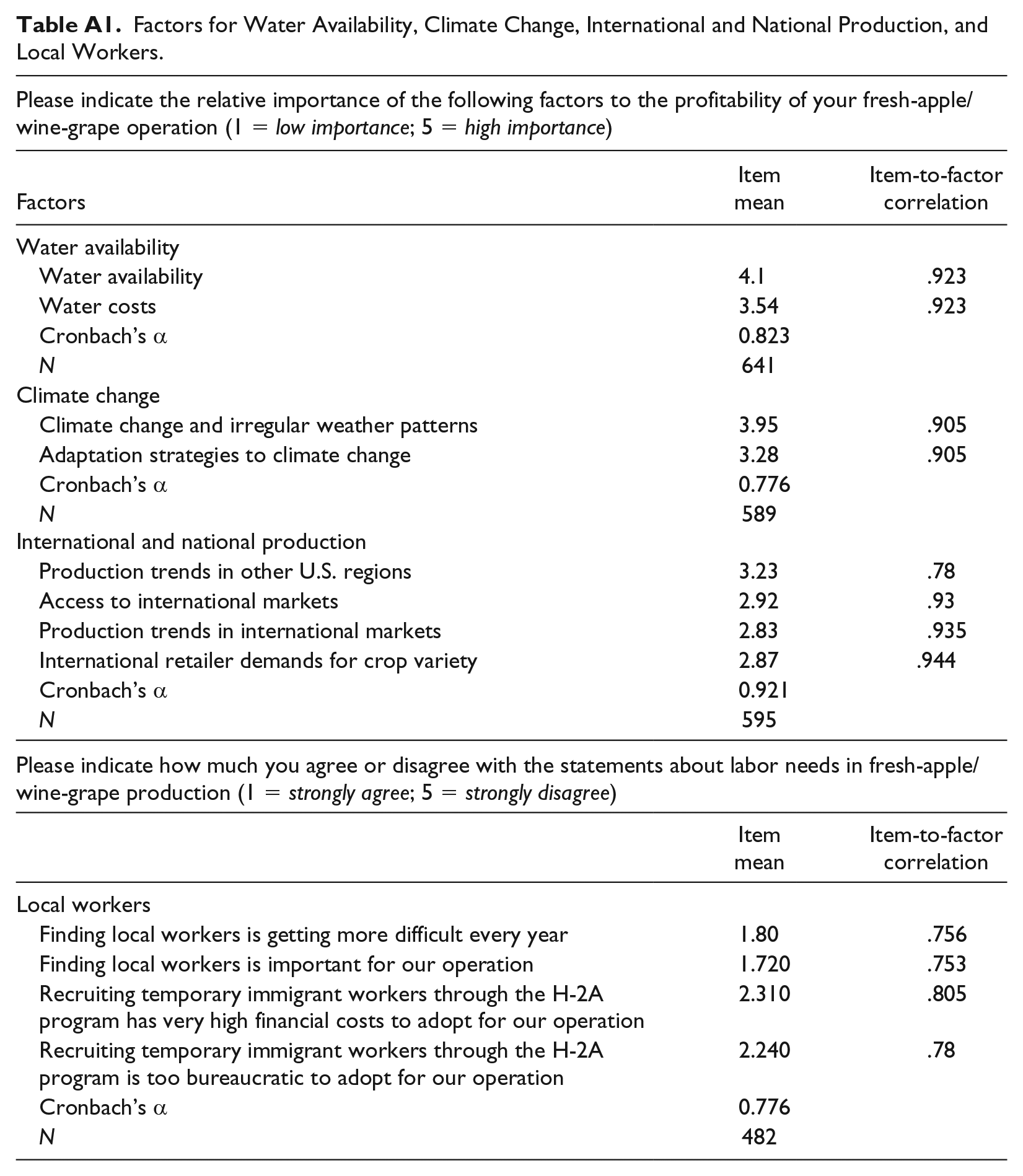
The first dependent variable in our survey data analysis is a measure of water availability for producers. We asked two Likert-type scale questions on producers’ perceptions of water availability and water price. We combine them into one variable using a regression factor score. As is the case for all the factors used in our models, this factor has a mean of 0 and a standard deviation of 1 (see Appendix Table A1). Regression-based factors are frequently used to measure conceptual constructs from different survey items in Likert-type scales (DiStefano, Zhu, & Mindrila, 2009; Groves et al., 2009). With this variable, we are measuring the importance of resource availability that producers perceive, which is a tangible production problem. The second dependent variable measures producers’ perceptions of climate change. We use two Likert-type scale items, one measuring the importance of climate change and the other measuring the importance of adaptation strategies. Both factors created for these dependent variables have high internal reliability. By separately analyzing the importance of water availability and climate change, we are distinguishing between the natural resource availability and a broader environmental problem. Furthermore, we are testing whether the economic scale and technological practices have a stronger association with a natural resource problem or with a broader environmental problem.
EM and TP emphasize economic scale, labor needs, and technology adoption. For economic scale, we are using total acreage in operation and annual revenue. We took the natural log of total acreage in operation. We then created three categories for operation size based on annual revenue, which are consistent with the U.S. Department of Agriculture (2014) classifications. Our focus is on the differences among small operations (below $100,000; our reference category), medium-sized operations (between $100,000 and $499,000), and large operations ($500,000 and higher). The expected relationship is that economically larger operations are more likely to recognize the importance of natural resource problems. However, following the TP theory, we do not expect the economic scale to have an impact on the perceived importance of climate change.
We use reliance on labor as another indicator of production scale. We distinguish between operations that rely on local workforce and operations that rely on documented (H-2A) immigrant labor. Both immigrant and local workers are important for U.S. agriculture. However, large-scale producers are more likely to rely on immigrant workers in large crews (National Center for Farmworker Health, Inc., 2017; Trupo, Alwang, & Lamie, 1998). Consistent with the TP approach, we expect operations with a high reliance on immigrant labor to be more dependent on a reliable supply of natural resources than producers who rely on local labor. For the reliance on local labor, we created another regression factor score (Appendix Table A1), and for the importance of immigrant workers, we turned the 5-point Likert-type scale into a binomial indicator. 2
Technology adoption is an important factor because it indicates the level of capital-intensive production. The EM perspective suggests that technologically advanced producers are more sensitive to natural resource problems, since they aim to maximize efficiency in labor and resource use. As the antithesis, the TP theory associates capital-intensive production with more environmental harm and lower environmental awareness. If producers adopted one type of technology from a variety of survey items, 3 we coded them as 1; if they have not adopted any, they are coded as 0. We expect technology adoption to increase the perceived importance of natural resources but not environmental awareness.
Consistent with the TP literature on the systemic change in economic institutions and the local food systems findings, we expect that the types of markets that producers participate in will be associated with their perceptions of climate change. We expect that producers in local markets will attach higher importance to climate change and adaptation strategies than other producers. We created a regression factor to measure the producer reliance on international and national markets, composed of four survey items (Appendix Table A1). The indicator for the variable on local markets is binomial, and it is transformed from a survey item asking respondents about the importance of proximity to domestic markets. 4 In the factor analysis of the national and international markets indicator, the local market indicator stood apart from the other survey items, which further justifies our construction of the market indicators.
Control Variables
First, we control for the primary crop produced. Our sample has an almost equal distribution between the crops, with 47% grape producers (Table 1). We control for region because the U.S. West has been experiencing more severe droughts and extreme weather patterns than the U.S. East, and California and Washington adopted strategic plans for climate change over the past decade that would influence the producer perceptions. About 80% of our respondents are from California and Washington. Finally, we account for the gender of our respondents, since past studies reveal that women prioritize environmental problems more than men (Dietz, Kalof, & Stern, 2002). Twelve percent of our respondents is female.
Descriptive Statistics for Dependent and Independent Variables.

We use the multiple imputation method to account for missing data in regression models (Groves et al., 2009). Our tests indicate that the cases with missing data do not contain structural bias. We use ordinary least squares regression models because our dependent variables are continuous regression factor scores. We present the pooled results of the regression models after the imputation of the missing data.
Quantitative Results From Survey Data Analysis
Bivariate Analysis
Table 2 shows the bivariate relationships between the survey items used for the construction of the dependent variable factors and the binomial indicators for independent variables. The bivariate t tests aid in interpreting the relationships in the subsequent multivariate regression models.
t Tests for the Group Means of Water Availability, Water Costs, Climate Change, and Climate Change Adaptation by Independent Variables.

Note. (1) The relative importance of the factors to the profitability of fresh-apple/wine-grape operation (1 = low importance; 5 = high importance).
p < .05. **p < .01. ***p < .001.
The two survey items used for the importance of water as a natural resource (water availability and water cost) show statistically significant variation by independent variables. On average, water availability has a higher importance than water costs for all producers. However, the difference for both items between the two regions is noticeable; the Western producers reported a significantly higher level of perceived importance for both indicators (4.39 for water availability and 3.84 for water cost). Although climate change does not demonstrate a significant difference between the regions, climate change adaptation, despite a relatively low importance on average, shows a similar difference to that of water availability (3.39 in the West and 2.83 in the East). These preliminary findings point to the significance of spatial variance, and they hint at the importance of natural resource issues in the perception of environmental problems.
Producers who attach higher importance to immigrant workers and those who adopt technology in their operations are more likely to prioritize water availability and water cost than other producers. However, the difference between those groups is smaller and not statistically significant for climate change adaptation. These bivariate findings lend preliminary support to our argument that economic actors are likely to recognize natural resource problems but not necessarily critical environmental problems.
Finally, respondents who prioritize proximity to domestic markets rate water and climate change indicators higher than others. Furthermore, the differences in climate change and adaptation between the groups is larger for this indicator (4 vs. 3.7 and 3.5 vs. 2.8, respectively) than they are for other indicators.
Multivariate Regression: Water Availability as Dependent Variable
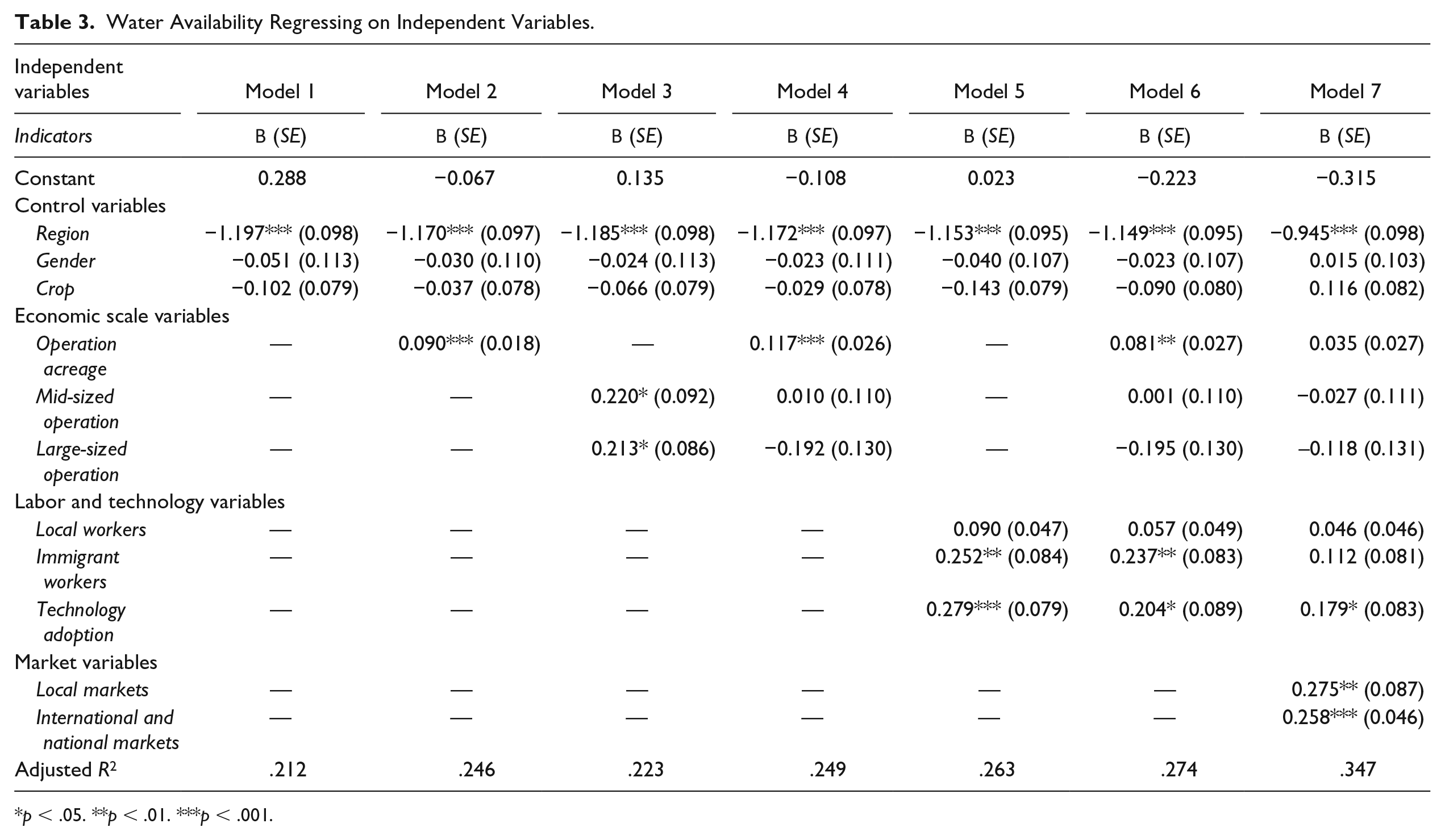
The first model shows the association between the importance of water for operations and the control variables (Table 3). The negative and statistically significant relationship between the region variable and water availability (−1.197; p < .000) shows that the producers in the West are more likely to emphasize the importance of water. This model, which only includes the control variables, explains about 21% of the variance in the dependent variable.
Water Availability Regressing on Independent Variables.
p < .05. **p < .01. ***p < .001.
Models 2, 3, and 4 focus on the relationship between the economic size of operations and water availability. Models 2 and 3 separately demonstrate the impact of the acreage and the annual revenue, whereas Model 4 accounts for all the indicators regarding economic scale. Although both indicators are statistically significant and positively associated with the dependent variable in Models 2 and 3, acreage has a stronger statistically significant association in Model 4 that includes both variables (.117; p < .001). These results show that the larger economic scale of an operation contributes to the perception of water as an important resource. With the inclusion of both variables, Model 4 explains 25% of the variance in the dependent variable.
Models 5 and 6 show that large operations that adopt enhanced technologies for production and rely on immigrant workers have a positive and statistically significant association with water availability. With the inclusion of market variables in Model 7, the statistical significance of the associations for economic scale and workforce are suppressed. In this model, international and national markets and local markets have strong, positive associations (.258; p < .001, and .275; p < .01, respectively). This indicates that natural resource issues are important for producers in both markets. Furthermore, technologically advanced operations still attribute higher importance to water availability. Model 7 explains 35% of the variance in the dependent variable.
Multivariate Regression: Climate Change as Dependent Variable
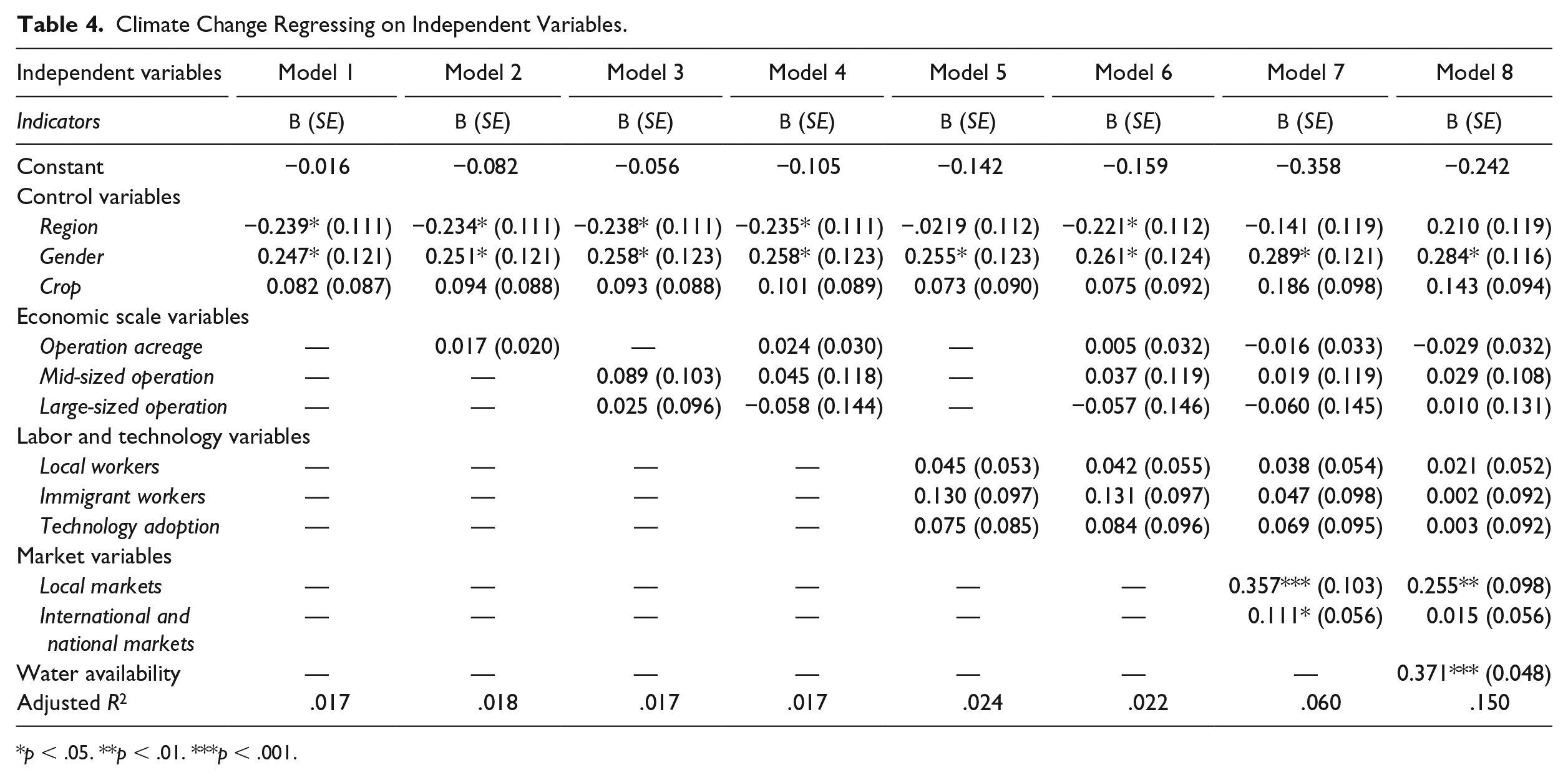
We design the models on climate change in the same way as we did with the models on water availability. The only difference is Model 8 (Table 4) where we used water availability as an additional independent variable.
Climate Change Regressing on Independent Variables.
p < .05. **p < .01. ***p < .001.
In the first six models, the only statistically significant indicators are those for region and gender. Producers in the West and female respondents are more likely to consider climate change an environmental problem affecting economic actors. In Model 7, local markets and international and national markets are statistically significant and positively associated with the dependent variable. However, when we include the variable for water availability in the final model (Model 8), the influence of international and national markets is suppressed. Women, producers who target local markets, and producers who perceive water availability as an important factor attribute higher importance to climate change and adaptation than others. Water availability has the strongest association in this model. This suggests that producers interpret climate change through the natural resource problem of water availability. All independent variables combined explain 15% of the variance in the dependent variable.
Discussion of Quantitative Findings and Key-Informant Interviews
Water Availability Models
Our findings on water availability in the first set of regression models (Table 3) indicate that economic scale, labor, technology, and geographic factors are useful in explaining the importance of water as a natural resource. Large-scale producers are more likely to be concerned about water as a natural resource. This is also supported by the findings that producers who rely on immigrant workers and efficiency-improving technologies are more concerned about water. Furthermore, producers in international and national markets, as well as those in local markets, consider water availability important. These findings support EM since it predicts that threats to resource inputs and engagement in competitive markets heightens awareness of natural resource issues.
Our key-informant interviews help us make sense of these findings. Producers in national and international markets feel the pressure to increase their production, even though their production methods are becoming more efficient. Although EM correctly predicts that large-scale producers value water availability, since they rely on this resource more than smaller producers, the perceived importance of water does not ameliorate those producers’ increased exploitation of resources. A large apple producer from Pennsylvania explained, “Water availability is becoming more and more important to us for the simple reason that we’re putting in more dwarf rootstocks. We’ve been blessed in the area to have abundant rainfall . . . .” As producers increase their production to compete with other economic actors, they put more pressure on natural resources, supporting the TP perspective. Furthermore, the use of a more resource-efficient variety does not necessarily reduce the dependency on water resources, as the Jevons paradox predicts.
In all water availability models, regional differences emerged as an important factor, which helps us understand the spatial variance in the experience of resource problems. Producers in the West are more likely to be concerned about water as a resource. A producer from Pennsylvania explained that Eastern producers have an environmental advantage over the Western producers: “The only way [Washington producers] can grow apples out there is with water irrigation. They can’t grow any other way. I think that’s a huge part with us. We get natural rainwater . . . .” The difference between the West and the East can also be seen in the bivariate analysis of water availability and water costs, two survey items that constitute the factor for the dependent variable. This finding supports Moore’s (2017) criticism of TP for failing to recognize spatial differences in the environmental conditions and economic systems.
Besides the theoretical implications of the findings on regional differences, it is important to compare the descriptive results with those in previous studies. In the bivariate analysis, we find that Western producers attach a high importance to water (see Table 2). However, California farmers in Haden et al. (2012) do not report a high level of concern over water resources (around 2.5 on a 4-point Likert-type scale). The difference between our study and Haden et al. has two potential explanations. The first explanation is that the California respondents in our study are specialty-crop producers who rely on irrigation, as Haden et al.’s study surveys all farmers in one county. Another explanation is that Haden et al.’s survey was conducted before the 2015 drought in California, while our survey was conducted shortly after. The experience of drought might have increased the overall concern about water resources as previous studies demonstrated (e.g., Keogh et al., 2011).
Climate Change Models
The regression models on the perception of climate change and adaptation (Table 4) test the influence of the same set of independent variables and the perception of water availability. In these models, we found that women and producers in local markets attribute higher significance to climate change. These variables remained statistically significant after accounting for the perceived importance of water availability. EM does not provide an explanation for these results since economic scale, technology adoption, and participation in national/international markets do not significantly influence the perceptions of climate change and adaptation. On the contrary, the findings lend support to TP. Although large-scale producers in national and international markets put more pressure on natural resources, they do not necessarily recognize the broader environmental problem.
An important finding in the regression models on climate change perception is that producers in local markets are more likely to prioritize climate change as an environmental problem. Local markets as alternative socioeconomic structures tend to be geared toward the needs of the local communities and ecology (Ericksen, 2008; Hinrichs, 2000). This is because while producers in local markets may be motivated by more than just profits, they may also consider the long-term sustainability of communities and their ecology. This difference in concern distinguishes these economic actors from those embedded in international and national markets. As a structural solution, the finding on local markets provides an important contribution to the TP approach, since TP only explains the role of capitalist markets in ecological decline, and it does not have a proposal for an alternative market structure in practice.
Our finding on the association between the perception of water availability, as a natural resource problem, and climate change, as an environmental problem, goes beyond the conventional TP dualism that only theorizes the impacts of economic factors on socioecological dynamics (Moore, 2017). Here, we find that producers who recognize a natural resource problem are more likely to recognize and act on the broader environmental problem.
Our in-depth interviews with key informants support our finding on the relationship between water availability and the perceived impacts of climate change in the long run. A grape producer from Washington highlighted this connection: For the season, so we are completely and totally dependent on the irrigation systems we have. Now you saw the big river running through here. We have the Columbia River and we have very good water availability; so, that’s what helps us to grow some top-notch wine grapes. So, in that regard, it’s very important; but am I scared year to year about it?
Here, the dependency on water as a resource for irrigation underlies the perception of its sustainability in the long term, revealing that producers recognize the impending impacts of climate change. Another Washington producer, mainly producing fresh apples, emphasized what awaits them in the long term if producers keep overexploiting the natural resources: We’re a desert, and water is an issue, and could be [an issue] in a year if you’re on junior water rights. I’m in the Yakima Basin. So, we’re trying to figure it out, because they’ve overallocated water in the Yakima Basin. So, there are people who want their water and natural spring flows, or whatever. So, yes, it certainly is a thought that needs to be in your mind, if you’re a leader to be aware of that. If you’re just somebody that doesn’t care, you’re just farming, and it’s whatever, it is what it is. But, if you’re looking at it 10-20 years down the road, yeah, it’s an issue.
As the Washington producers consider the threat of water scarcity, California producers have long been experiencing it. A California apple producer explained how direct exposure to drought forces producers to adapt to climate change: “We’re pretty much forced now to plant seedling rootstock, because we don’t have water. We dry farm pretty much everything.” Another apple producer in Pennsylvania emphasized the connection between the long-term impacts of climate change on water availability and climate change adaptation: Water availability is important, water costs is [sic] somewhat [important]. . . . We don’t have to pay for any water, but, if we want to have water for irrigation . . . . Right now, I’m building an irrigation pond—that’s a half a million dollars. So, how significant is that? Well, this year it’s significant. But that’ll be a hundred-year project, it will be here for a hundred years, maybe more.
The quotation from the interview with the Pennsylvania apple producer above also helps with explaining the regional differences in climate change. In our models on climate change, regional differences are statistically significant before introducing market and water availability variables (Table 4; Models 1-6). Western producers have a higher level of concern than the Eastern producers. This finding has two potential explanations. The first explanation is that the producers in the West have been experiencing the resource impacts of climate change for several years. The second explanation is that the state governments in the West already had adopted strategic plans that exposed producers to information on the relationship between climate change and natural resources. These two potential explanations are supported by the introduction of water availability as an independent variable (Model 8): the association between the perception of water availability and perception of climate change is statistically significant, and the region variable is not statistically significant. If economic actors are exposed to information on, or impacts of, climate change, they are more likely to recognize climate change, regardless of their region. In the case of the apple producer in Pennsylvania above, his awareness of water issues led him to adapt to the future impacts of climate change by building an irrigation pond.
Comparing the descriptive results for the importance of climate change in our study with those in previous studies is important to understand the differences in target populations, as well as the intensifying symptoms of climate change. Iowa farmers (Arbuckle et al., 2015) and farmers in Yolo County, California (Haden et al., 2012) overall report lower levels of concern over climate change (between 3 and 3.5 on a 5-point Likert-type scale) than the respondents in our study (close to 4 on a 5-point Likert-type scale; see Table 2). The difference in the level of concern can be explained with the same dynamics we suggested in the previous comparison on concern over water: (1) specialty-crop producers are very dependent on irrigation and (2) producers are susceptible to the intensifying impacts of climate change.
Considering climate change adaptation as a separate survey item, we find a significant difference between the West and the East. The specialty-crop producers in the West rated the importance of adaptation strategies similar to Iowa farmers (Arbuckle et al., 2015) and farmers in Yolo County (Haden et al., 2012), around 3.5 on a 5-point Likert-type scale. However, producers in the East rated adaptation strategies significantly lower than the Western producers (2.8 on a 5-point Likert-type scale). This finding demonstrates the importance of a regional comparison, and it supports our previous finding that Eastern producers assign lower importance to water availability than Western producers. Furthermore, this finding supports the connection between water availability concerns and climate change, along with the findings from the in-depth interviews and regression models.
Conclusion, Limitations, and Future Studies
We tested the capacity of EM and TP to explain how producers perceive natural resource problems and how they respond to environmental problems. Our findings on the specialty-crop producer perceptions of water availability support the EM explanation of how resource-intensive producers recognize and respond to resource problems. However, this approach fails to provide an explanation for broader environmental concerns beyond conceptualizing them as an aggregation of multiple resource availability problems. Our findings provide an explanation for this phenomenon: those who experience or are aware of a resource problem are more likely to see a connection between water availability and the more abstract problem of climate change. However, this does not necessarily mean that the producers will respond to that broader environmental problem. Conceptualizing environmental problems as the aggregation of resource input problems will not provide a foundation for their adequate management.
TP is better at explaining the failure of producers to recognize and to respond to environmental problems. This perspective recognizes that producers face a short-term capitalist growth imperative that limits their capacity to recognize environmental problems beyond their immediate resource needs. TP acknowledges that substantial structural market and policy changes are needed to provide adequate incentives for environmentally sound production methods. However, TP lacks a proposal for an alternative market structure in practice. We propose that local markets have the potential to change producer priorities regarding social and environmental sustainability. Furthermore, TP needs to account for exposure to the impacts of environmental problems. Our results indicate that awareness of, or exposure to, water problems influences the perception of climate change. Here, the important question is whether a capitalist economy has the luxury of waiting for the actors to adapt to climate change after they are exposed to the harms.
The limitations in our study offer future venues for research. Previous studies on farmer perceptions of climate change (e.g., Arbuckle et al., 2015; Haden et al., 2012; Niles et al., 2013) surveyed producers without distinguishing between types of production, whereas the target population in this study is wine-grape and fresh-apple producers. The selection of only two crops might be considered a limitation. However, the comparison of responses in our study with those in previous studies demonstrates that the irrigation-dependent nature of these two crops is associated with a strong concern over water and the future impacts of climate change. Since the nature of resource dependency and vulnerability to climate change vary by the type of production (Ortiz-Bobea et al., 2018), future studies would benefit from accounting for the type of producers in their perception of climate change and adaptation.
Another important variable for future studies on climate change perceptions is regional differences. Previous studies on agriculture and climate change perception are focused on a single county or state. And Prokopy et al. (2015) emphasize that surveys on climate change perception would benefit from standardized survey items to compare different regions. In our survey, specialty crop producers in four states that are representative of the East and the West answer the same survey items that enables us to analytically compare regional dynamics. The analysis of our key-informant interviews and survey responses reveal regional differences in policy, environmental conditions, and perceptions of climate change and adaptation (see Table A1). Therefore, future studies would benefit from expanding the geographical scope of study.
The role of local markets in the perception of environmental problems is another area that needs more quantitative inquiry. Our finding on local markets can be further expanded with a study on how participation in local markets encourages producers to mitigate and adapt to environmental problems. The socioeconomic dynamics in local markets as emerging alternative structures call for more elaborate empirical and theoretical approaches in socioecological studies.
Footnotes
Appendix
Factors for Water Availability, Climate Change, International and National Production, and Local Workers.
| Please indicate the relative importance of the following factors to the profitability of your fresh-apple/wine-grape operation (1 = low importance; 5 = high importance) | ||
|---|---|---|
| Factors | Item mean | Item-to-factor correlation |
| Water availability | ||
| Water availability | 4.1 | .923 |
| Water costs | 3.54 | .923 |
| Cronbach’s α | 0.823 | |
| N | 641 | |
| Climate change | ||
| Climate change and irregular weather patterns | 3.95 | .905 |
| Adaptation strategies to climate change | 3.28 | .905 |
| Cronbach’s α | 0.776 | |
| N | 589 | |
| Please indicate the relative importance of the following factors to the profitability of your fresh-apple/wine-grape operation (1 = low importance; 5 = high importance) | ||
| Factors | Item mean | Item-to-factor correlation |
| International and national production | ||
| Production trends in other U.S. regions | 3.23 | .78 |
| Access to international markets | 2.92 | .93 |
| Production trends in international markets | 2.83 | .935 |
| International retailer demands for crop variety | 2.87 | .944 |
| Cronbach’s α | 0.921 | |
| N | 595 | |
| Please indicate how much you agree or disagree with the statements about labor needs in fresh-apple/wine-grape production (1 = strongly agree; 5 = strongly disagree) | ||
| Item mean | Item-to-factor correlation | |
| Local workers | ||
| Finding local workers is getting more difficult every year | 1.80 | .756 |
| Finding local workers is important for our operation | 1.720 | .753 |
| Recruiting temporary immigrant workers through the H-2A program has very high financial costs to adopt for our operation | 2.310 | .805 |
| Recruiting temporary immigrant workers through the H-2A program is too bureaucratic to adopt for our operation | 2.240 | .78 |
| Cronbach’s α | 0.776 | |
| N | 482 | |
Declaration of Conflicting Interests
The author(s) declared no potential conflicts of interest with respect to the research, authorship, and/or publication of this article.
Funding
The author(s) disclosed receipt of the following financial support for the research, authorship, and/or publication of this article: This research was sponsored by the National Institute of Food and Agriculture under the Specialty Crop Research Initiative (Grant No. 2012-51181-19878; Project No. INDW-2012-01537).
