



Abstract
Although grassroots initiatives in the renewable energy transition are flourishing, their embeddedness in local contexts challenges their capacity to spread their impact on a broader scale. Certainly, while scaling up has been described as difficult to combine with local embeddedness, little is known on the specific nature of the tensions involved in combining the two. Studying a federation of citizen renewable energy (RE) cooperatives in the south of France, we show that the engagement in a scaling-up process at a regional level generates three main kinds of tensions associated with specific dimensions of local embeddedness: natural, cultural, and political. We emphasize how these dimensions are likely to be threatened when the federation engages the cooperatives in a rapid scaling-up dynamic in which the drive to industrialize projects and find funding is dominant. We acknowledge the effects of these tensions on grassroots sustainability initiatives and collective organizing processes.
Keywords
Introduction
As fossil fuel energies remain powerful drivers of greenhouse gas emissions in the global economy, the adoption of sustainable forms of energy production has become increasingly crucial (York & Bell, 2019). Alongside national prospective scenarios for transitioning to carbon neutrality by 2050, grassroots initiatives have flourished to tackle this “grand challenge” through the voluntary collective action of local groups and communities. These have gained traction and visibility in recent years, particularly in Europe (Hokenos, 2021; Wierling et al., 2018). A lively stream of research has developed to account for this phenomenon in various countries including not only Spain (Cuesta-Fernandez et al., 2020), the United Kingdom (Seyfang et al., 2014; Wokuri, 2021), France (Ranville & Vernay, 2021), Germany (Ahlemeyer et al., 2022; Punt et al., 2022), Denmark, Sweden, and the Netherlands (Kooij et al., 2018) but also the United States (Grimley et al., 2022) or South Korea (Park & Yun, 2021).
The localized, socially embedded nature of grassroots initiatives has proved fertile ground for imagining alternatives both to the state-governed, centralized modes of production historically established for energy production at national levels and to the capitalist forms that prevail in the global market economy (Chowdhury et al., 2021; Gibson-Graham, 2003; Parker et al., 2014; Wokuri, 2021). Grassroots sustainability initiatives (Moser & Bader, 2023) have generally been viewed as being deeply embedded in the fabric of places and the social relations of production and consumption and regarded as “spaces of hope” for addressing sustainability challenges (Zhong et al., 2022).
At the same time, as the imperatives of an ecological transition have become more urgent, these grassroots initiatives are facing tensions inherent to a choice of “eco-localism,” that is, “a model of place-based economics that rejects large-scale, place-less rational economic models upon which the current global economic order is built” (based on Curtis, 2003, in Ganesh & Zoller, 2014, p. 236), to tackle the grand challenges of ecological transition on a broader scale (Barnett et al., 2020; Mair & Seelos, 2021). Although the literature has shown that embedded initiatives have a preference for scalability based on swarming practices or local replication of their actions (scaling out or scaling across) or on mind-changing initiatives (scaling deep), pressures for scaling up are pervasive (Riddell & Moore, 2015). Indeed, for many initiatives, the route to greater impact implies changing “the rules of the game” and acting at a broader scale through collective forms of organization and partnerships (Westley et al., 2014). Scaling up—understood as an attempt to shift scale to produce greater impact across societal levels (Geels & Schot, 2007; Schiller-Merkens, 2020)—is a pressing challenge for grassroots initiatives and a key condition for their sustainability (Hossain, 2018).
While upscaling processes are often seen as an essential element that contributes to societal transformation (Augenstein et al., 2020), many studies have underlined the challenges that scaling up might raise for grassroots sustainability initiatives that simultaneously aim to enhance their impact and retain the fundamental features of their local embeddedness (e.g., Ometto et al., 2019; Shaw et al., 2018; Van Lunenburg et al., 2020). However, little is known about the specific tensions at hand between these two objectives. This question should be investigated, to better understand what local initiatives may have to lose, and how and when they engage in a scaling-up project. Our paper thus attempts to unpack this tension and to advance knowledge on “what might be damaged” in terms of local embeddedness when grassroots initiatives scale up (DeSantola & Gulati, 2017; Vickers & Lyon, 2014). We thus study the following research question: “What are the tensions on local embeddedness created by a logic of scaling up and their effects on grassroots initiatives?” We look at how these tensions between scaling up and local embeddedness develop when grassroots initiatives join a regional-scale federation, which involves new, higher-level coordination and the intervention of new actors and institutions beyond the prefigurative initiatives of alternative organizing that already exist (Schiller-Merkens, 2020).
In the first theoretical section, we explore the stakes of scaling up for grassroots sustainability initiatives and the implications in terms of local embeddedness. We highlight the potentially strong constitutive tensions that may exist for them between scaling up and local embeddedness when these initiatives join forces in a collective dynamic. We adopt an extended definition of local embeddedness that enriches the idea of locality by embracing various dimensions linked to the consideration of reciprocal relations between humans and more-than-human forms of life (Tsing, 2013) when grassroots initiatives are expanded. We explore the constitutive tensions in the second section via a longitudinal 1-year case study (May 2021 to May 2022) based on participant observation. The study involved a project to scale up renewable energy (RE) production via FEDCOOP, a federation of cooperatives designed, funded, and staffed in view of bringing together, at the regional level in France, eight grassroots cooperatives that had been established in smaller local territories.
Our results show that engaging in a regional-level scaling-up process generates three main forms of tensions associated with specific dimensions of a local embeddedness: natural, cultural, and political. We emphasize how the dimensions of a local embeddedness can be threatened when the federation engages the cooperatives in a rapid scaling-up dynamic in which the search to industrialize projects and financing is dominant. We acknowledge the effects of these tensions on the participation of grassroots initiatives in the collective organizing processes. Our contribution to literature is based on a fine-grained characterization of what locally embedded grassroots sustainability initiatives may lose when they engage in a scaling-up project based on the three key dimensions of nature, culture, and politicality. We show how these dimensions are put in tension when grassroots initiatives join a time-restrained scaling-up project and highlight how they impact the collective processes at hand. We conclude by discussing the commensurability of scaling-up projects for local initiatives and the ways of resisting that may be needed at a macro-level to favor the different dimensions of embeddedness while producing social change (Riddell & Moore, 2015).
Theoretical Section
Grassroots Sustainability Initiatives in Search of Scalability: The Case of the RE Transition
Grassroots sustainability initiatives refer to a broad range of community-led initiatives that help solve sustainability problems in our societies (Moser & Bader, 2023). Acting as transition pioneers (Gernert et al., 2018), these initiatives help address today’s grand challenges while relying on ways of organizing compatible with socio-ecological needs (Ergene et al., 2021). They seek to promote democratic and sustainable forms of organizing economic activities (Alvesson & Willmott, 1992; Zanoni et al., 2017), adhering to criteria that diverge from those of mainstream institutions and putting their core social values into practice (Gibson-Graham, 2006).
Grassroots initiatives in the RE transition are flourishing in Europe (Blanchet, 2015; Oteman et al., 2017). The concept of “grassroots initiative” is derived from the grassroots innovation literature, which defines grassroots innovations as networks of activists and organizations generating novel bottom-up solutions for sustainable development; solutions that respond to the local situation and the interests and values of the communities involved (Martin & Upham, 2016; Seyfang et al., 2010). These grassroots initiatives tend to build new forms of “community energy,” defined “as projects where communities (of place or interest) exhibit a high degree of ownership and control and are benefiting collectively from the outcomes” (Seyfang et al., 2013, p. 978). Community energy is nowadays a sector in which various organizational forms coexist, such as energy cooperatives, collective associations under private law, local shares in energy infrastructure, and approaches to municipal ownership of energy grids and power plants (Becker et al., 2017).
Some recent studies (Seyfang & Haxeltine, 2012) have begun exploring the role that a community energy approach may play in accelerating the transition toward clean energy. However, little is known about how community energy could scale up and promote a change in the dominant way of energy production (Ruggiero et al., 2018).
The strategic choices that grassroots sustainability initiatives may face in attempting to curb capitalist growth and its social and environmental legacies thus raise questions as to their possible and desirable scalability (Tsing, 2017). Indeed, although some grassroots sustainability initiatives may view themselves as self-contained niches and remain averse to any form of expansion (Augenstein et al., 2020), many seek to embody and promote a broader social transformation toward more sustainable ways of producing, consuming, working, etc. Such grassroots initiatives thus face the issue of devising ways of expanding their social-political project (Westley et al., 2014). While upscaling processes are often seen as an essential element of societal transformation, however, upscaling itself remains a fuzzy concept (Augenstein et al., 2020).
A flourishing literature offers rich insights into the many forms that scalability might take for grassroots sustainability initiatives. Westley et al. (2014) differentiate between two kinds of scaling: “scaling out,” where an organization attempts to affect more people and cover a larger geographic area through swarming and indirect diffusion, and “scaling up,” where an organization aims to expand its output and outreach so as to directly tackle the needs of anyone who might benefit from the social innovation they offer. 1
Yet pressures for scaling up remain pervasive (Riddell & Moore, 2015), and sometimes inevitable, for grassroots sustainability initiatives (Shaw et al., 2018). Although the social entrepreneurship literature has defined scaling up as a process of spatial expansion and quantitative growth by which an enterprise is reaching out to more beneficiaries (André & Pache, 2016), the social movement perspective (Schiller-Merkens, 2020)—adopted in this research—is not restricted to intra-organizational dimensions and also relates to inter-organizational endeavors for a broader societal change. This implies taking into account the collective actions among diverse sets of actors aimed at influencing political agendas (Van Lunenburg et al., 2020). In this context, “scaling up” is “understood as a vertical form of scaling, based on the understanding that many social-ecological problems are embedded in law, policy and institutions” and that transformations require organizational changes at a higher level (Nicol, 2020, p. 3). In such perspective, scaling up also encompasses an opportunity to pool collective resources and to secure grassroots initiatives at a larger geographical scale via some forms of vertical integration or coordination. Scaling up thus often implies the intervention of new actors, since an “upward scale shift depends on support by political, rule-setting institutions as they provide activists with important resources for broader mobilization and change” (Schiller-Merkens, 2020, p. 13). Hence, scaling up often involves building up a “meta-organization” such as a “cooperative of cooperatives” to coordinate or broker between various local initiatives involved in a project. In such context, the project of scaling up should be approached as an inherently contentious collective action involving struggles over how social changes should be realized (Ilten, 2019).
If tackling sustainability issues thus requires a set of multilevel responsibilities whereby actors at different scales are closely and contentiously connected (Shaw et al., 2018), scaling up can be questioned for its capacity to factor in the hyperlocal relations that connect practices to localities (Tsing, 2013) and for the associated risks of altering the political project of grassroots initiatives. Along such lines, upscaling processes have been criticized for their risks of mission drift (Ometto et al., 2019), multiscalar tensions (Shaw et al., 2018), and the grassroots initiatives’ loss of control and capacity (Augenstein et al., 2020). In particular, scaling up challenges the relationships that grassroots initiatives may have to “growth,” which is often considered as necessary to enhancing the social change associated with their initiatives but is also shaped by complex relational processes and tensions in relation to embeddedness (DeSantola & Gulati, 2017; Vickers & Lyon, 2014). In this context, it is crucial to understand how scaling up affects the local embeddedness of grassroots sustainability initiatives, especially when engaging with policy makers and larger organizations (Gernert et al., 2018), a choice that grassroots initiatives may have to make in the face of funding scarcity, at the cost of the departure of community members or a lack of practicality at a larger scale due to their rootedness in a specific community (Hossain, 2018).
Although tensions between scaling up and local embeddedness have been recognized, little is known about what grassroots sustainability initiatives might actually lose during a scaling-up process. This question is particularly acute for grassroots initiatives in the RE transition, as they face strong structural constraints when developing energy projects, need substantial resources to sustain their activity (Becker et al., 2017), and often rely on intermediary organizations to foster and support experimentation and niche growth at a broader scale (Lampinen et al., 2019).
Tensions in Scaling up Grassroots Initiatives: Exploring the Local Embeddedness Concept
The literature on sustainability initiatives acknowledges differences in the degree to which social enterprises might be socially embedded in their locality and hence be amenable to expansion beyond the local scale (Bauwens et al., 2020; Smith & Stevens, 2010; see also Kim and Kim, 2022; Lam et al., 2020; Moore et al., 2015). The reasons for these differences have often been linked to the social values established at the founding of a project and to the preferences of entrepreneurs for idiosyncratic versus more systematic forms of social value creation (Smith and Stevens, 2010). However, the concept of local embeddedness itself lacks a clear characterization, leaving us with a limited understanding of what exactly is at stake when grassroots initiatives resist scaling up.
To fill this gap, we argue that greater attention should be paid to the conceptual foundations established by Polanyi (1944/2001) in The Great Transformation, that is, to his political reading of embeddedness. For Polanyi, embeddedness means that the economy is not autonomous, as implied by classical economic theory and its legacy in management sciences, but that it is subordinated to politics, religion, and social relations, or, in other words, to society (Block, 1944/2001). The Polanyian perspective further acknowledges the destructive effects of a disembedded economy not only on society but also on the environment. In a “market society” governed by the search for profit, where the cultural institutions allowing for reciprocity and redistribution would no longer govern economic exchanges, “nature would be reduced to its elements, neighborhoods and landscapes defiled, rivers polluted, military safety jeopardized, the power to produce food and raw materials destroyed” (Polanyi, 1944/2001, p. 76). Hence, the Polanyian meaning of embeddedness conveys a holistic and ethical perspective of the economy that has been underscored in subsequent conceptual elaborations of embeddedness in economic sociology, where the concept is equated with the existence of social relations (Granovetter, 1985) or with a broader set of cognitive, cultural, structural and political dimensions (Zukin & DiMaggio, 1990), without particular reference to the questions of reciprocity, redistribution, and the destructiveness of the market economy.
Although such conceptual foundations provide us with a political perspective suited to the study of grassroots projects, the geographical scope of embeddedness remains implicit in The Great Transformation, since Polanyi gave no explicit explanatory power to space in his thesis (Hess, 2004). Embeddedness has often been considered as being “local” in subsequent Polanyian-inspired research on the grounds that spatial proximity would favor reciprocal or redistributive forms of social relations. For Lewis et al. (2002), however, this may result in “spatial fetishization” since trust and shared values have been shown to expand through space, most notably in diasporic networks and fair-trade networks where reciprocal forms of exchange have been developed beyond borders (Hess, 2004; Raynolds, 2000). Yet, the cultural elements of such networks remain strongly linked to a form of locality both in the countries of origin of diasporic networks and in the places of origin of fair-trade products. This would indicate that the place-basedness of reciprocal linkages might not be completely ruled out. Furthermore, while these networks expand beyond borders, they also share the characteristics of remaining on a small scale in the forms of production they develop. From this perspective, embeddedness is not only locally rooted but also associated with small-scale, nonstandardized forms of economic activity.
This highlights another aspect of scaling up discussed by Tsing (2012), who defines scalability not as geographical extension but as a form of “precision design” based on standardization and the capacity for mass replication. Tsing discusses scalability with reference to the “living world,” extending our perspective on embeddedness to relations between humans and more-than-human forms of life (Tsing, 2013). Certainly, the literature on sustainability projects has emphasized how important the “sense of place” could be in fostering the protection of ecological life via place-specific practices and knowledge (Guthey et al., 2014; Masterson et al., 2017). Local embeddedness should thus not be considered without incorporating the natural or ecological dimension of the locality. Along such lines, Gieryn (2000) argues that a place is constituted of both ecological features and cultural values. Bowen (2011) further argues that “re-territorializing embeddedness” involves maintaining tight interrelationships between the cultural, ecological, and institutional features of local embeddedness, where shared values of reciprocity cannot be decoupled from the specific biophysical attributes of the terroir or from a political environment that enables local collective initiatives to flourish. Local embeddedness thus involves an enabling political context that gives local actors a collective capacity to act. Although implicit in Bowen’s (2011) approach, the temporal perspective might also be considered in relation to local embeddedness, particularly from an ecological perspective. The time horizon relates to physical materiality and its immutable inscription not only in space via the unicity and nonreplicability of the physical attributes of local ecosystems but also in the cycles of nature. In such a perspective, Bansal and Knox-Hayes (2013) argue that the natural environment bears the costs of the “time-space compression” (Harvey, 1990) induced by postmodernity and the free-flowing of capital through time and space.
Local embeddedness might thus encompass a variety of cultural, ecological, and political elements, also involving time, if it is to capture what grassroots initiatives are aiming to achieve in the sustainable energy movement. As pointed out by Bowen (2011, p. 342), the dynamics of embeddedness cannot be fully understood without an analysis of disembeddedness. In what follows, therefore, the tensions introduced by scaling-up policies will be captured as disembedding forces stemming from various dimensions of the scaling-up paradigm as previously defined.
Methods
Case Justification and Research Context
This article draws on the qualitative research of a single-case study (Yin, 2009): a federation of RE cooperatives in the south of France called FEDCOOP. This research work was part of a broader study conducted by one of the co-authors on the tensions of scalability challenges along the RE sector value chain. In this paper, we focus on the issues specific to grassroots cooperatives located upstream of the energy value chain, at the stage of energy production.
FEDCOOP was created following a regional public call for projects and aimed to federate initiatives around the creation of a regional citizen energy operator. This project was designed, funded, and staffed with a view to pulling together, at the regional level (the French Gard region), eight grassroots cooperatives (see Table 1) that had been set up in different smaller local territories in the region during the 2010s.
Cooperatives Members of FEDCOOP.
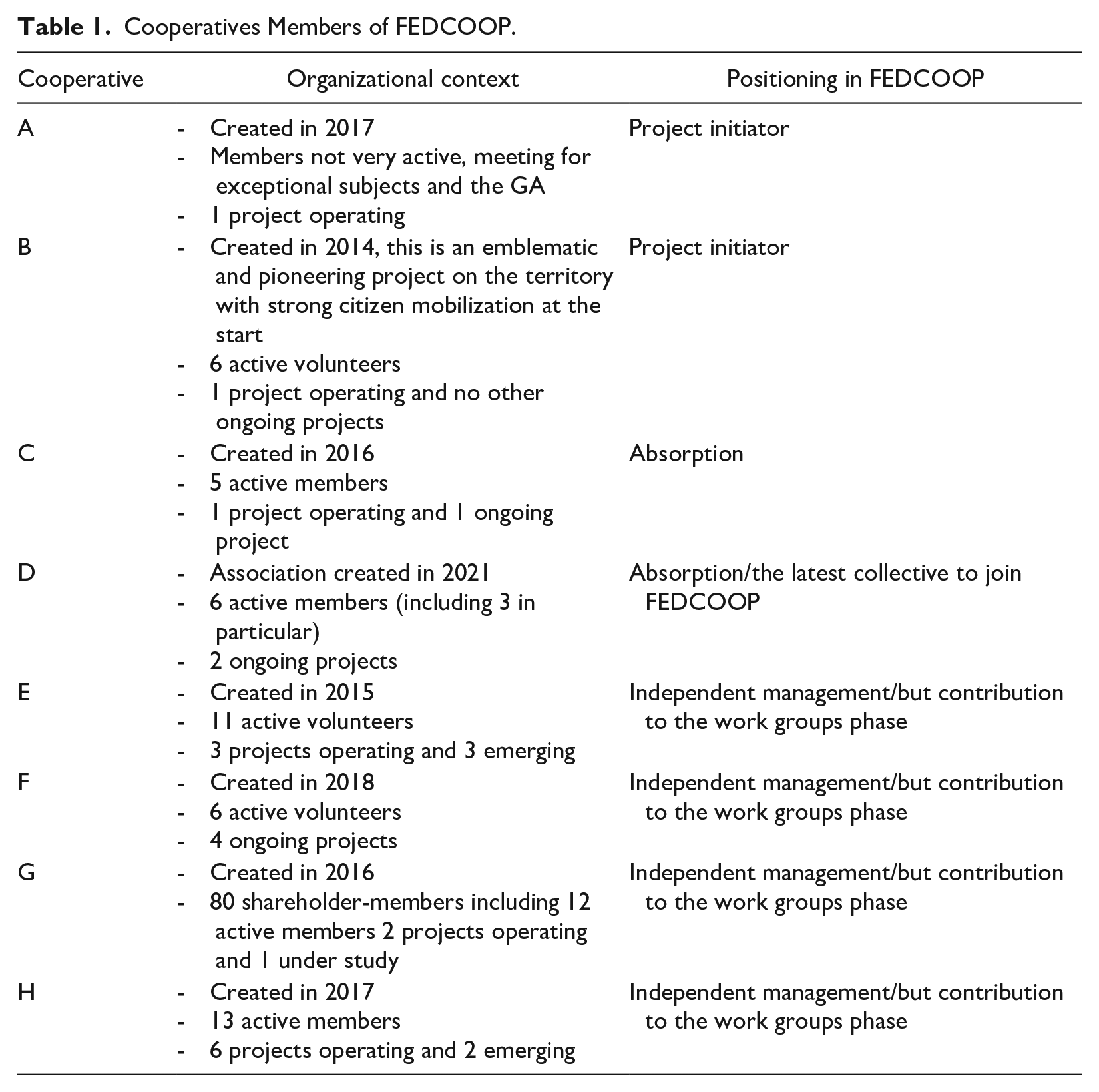
This case was particularly suited to investigating the scaling up of grassroots RE cooperatives from an inter-organizational coordination perspective. Indeed, although they benefited from some institutional financial support in building the project, these local cooperatives themselves took the initiative to group together on a larger scale: both organizationally as a federation or meta-organization, and geographically as an opportunity to pool collective resources. This case was also remarkably well-suited to exploring the potential tensions of scaling up in relation to the local embeddedness of the grassroots groups, given that such groups were deeply rooted in a region, the Gard, characterized by a long-standing engagement of citizens and militants who were particularly active against shale gas extraction in the 2010s.
Selecting this case was thus relevant to understanding the various tensions faced by the federation’s different actors, tensions between scaling up and local embeddedness which were to be manifested and observed through the process of realization of the project, and in its associated individual and collective effects.
Data Collection
Access to the field was the result of a long-standing collaboration between the researchers involved in the project and a regional cooperative, Districoop, which is part of a broader national network involved in distributing RE to consumers in France. Districoop was one of the actors behind the call for projects to support the creation of a federation of RE cooperatives in the Gard region, since it had an interest in securing its own energy supply (through volume enhancement) locally. The lead author was able to integrate the FEDCOOP team by providing voluntary work for the project, based on her previous experience in the RE sector. To increase construct validity and reliability (Yin, 2009), three data collection methods were used: participant observation and action, semistructured interviews (see Supplemental Appendix 1), and documentary analysis (see Table 2).
Data Collection—Sources and Methods.
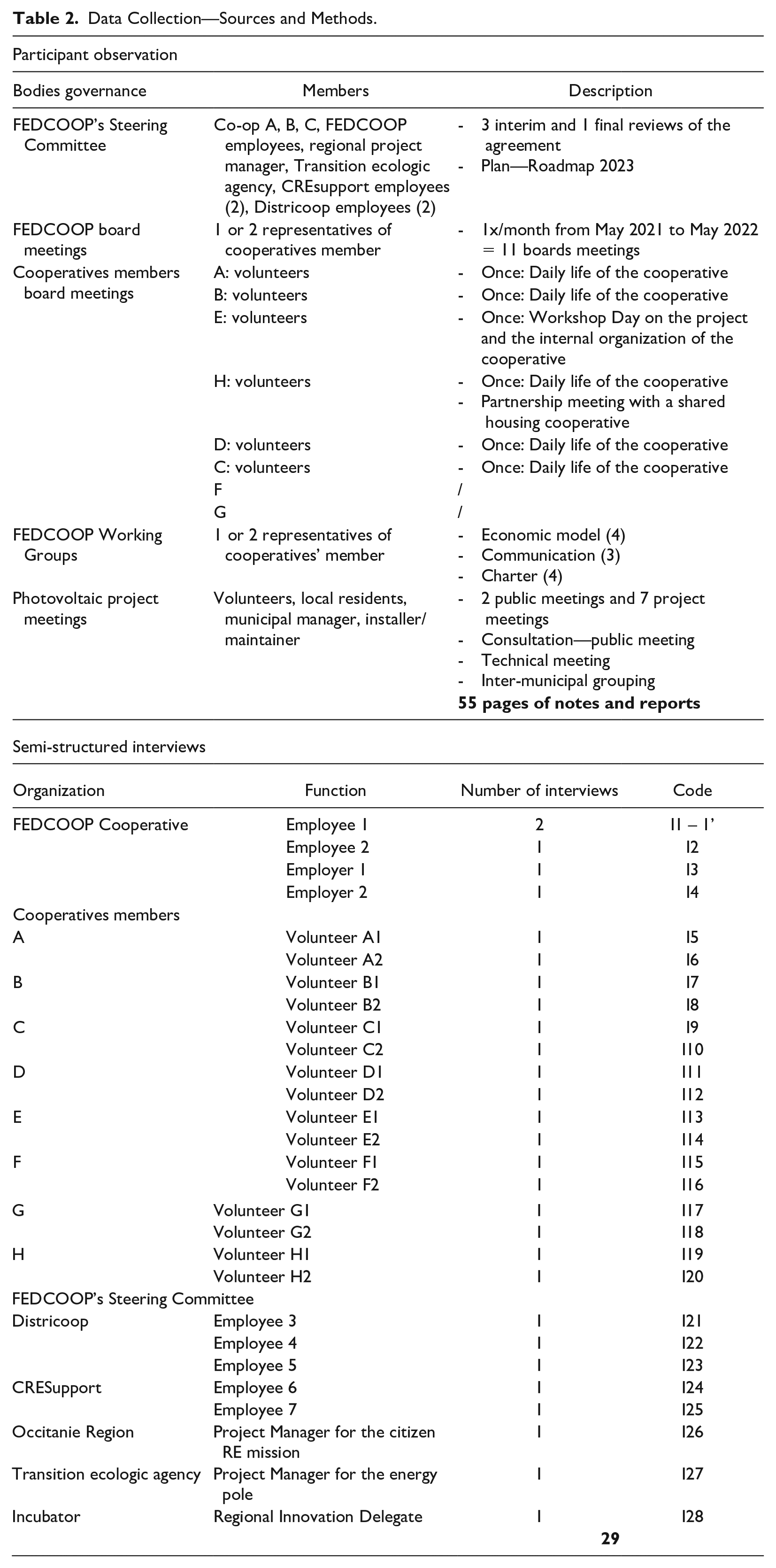
Participant observation lasted 1 year (May 2021 to May 2022) during the phases of organization and implementation of FEDCOOP. This observation covered meetings of several kinds: 11 administration boards, the annual general assembly, 12 working groups, 4 steering committees (interim and final reviews of the agreement), public meetings, and RE project meetings. We also participated in the board meetings of six of the founding cooperatives. Participant observation offers the opportunity to gain insight into social phenomena. It involves “social interaction in the field with subjects, direct observation of relevant events, formal and informal interviewing, some counting, collection of documents and flexibility in the direction [a] study takes” (Gephart, 2004, p. 458). To gather the visions of the various stakeholder groups, we also conducted semistructured interviews (29 interviews in total), with volunteers from the eight cooperatives (18), employees (3), and strategic partners and founders (8). Our interviewees were selected to ensure representation of all FEDCOOP stakeholders, including member cooperatives and regional players involved in the organizational configuration of citizen energy, such as public actors, support networks, Districoop, and incubator. This focus on a form of exhaustive comprehension of the process of building FEDCOOP is to be understood in relation to our primary goal, which was to capture the possible tensions involved in scaling up as they would appear in the construction of FEDCOOP. Rather than fixing the features of the local embeddedness of the RE cooperatives, we observed them in action as they engaged in the FEDCOOP project. To this end, we interviewed the local volunteers who were most involved in FEDCOOP from each of the member cooperatives. Given that each cooperative comprised approximately ten active volunteers, interviewing at least two of their most involved members also gave us a good view of each of the local groups. We further attended these local cooperatives’ board meetings and major gatherings during our year of field immersion, which allowed us to exchange views with the local volunteers and share some of their local activities. Participant observation represents 55 pages of information documented in a notebook, while the semistructured interviews total 62 hr of recording.
Secondary data were also useful in studying the contextual and historical dynamic of the project and its different communication initiatives and supports. Documentary evidence including internal reports, procedural documents, operational guidelines, and managerial memos were used extensively while conducting the study to substantiate the findings from the interviews and observations. These documents were valuable sources of information and stimulated new paths of inquiry for both the interviews and observations (Merriam, 2009). We had access, for instance, to documents such as the FEDCOOP statutes, related calls for projects, communication media, etc., and to various email exchanges thanks to the involvement of one of the researchers within the field. Key elements of the profile of the eight cooperatives involved are presented in Table 2.
Data Analysis
We conducted a longitudinal analysis of the construction of FEDCOOP and analyzed the data following four steps. The data analysis was based on an inductive process that favors the emergence and development of concepts grounded in data rather than based on pre-established categories (Gioia et al., 2013). As a first step, all interviews were recorded and transcribed to allow for an initial coding that emerged out of the data and from a first understanding of the transcripts. To improve consistency in data processing, the complete coding of all interviews was conducted by the principal researcher, who initially focused on the determinants of involvement of the local grassroot initiatives, the link between scalability and the federation, the FEDCOOP governance model, and the role of the broader regional citizen energy actors (see Supplemental Appendix 1, interview guide).
This helped us, in a second step, to trace the formation of the collective project over time by defining three different phases: (1) “Creating,” (2) “Organizing,” and (3) “Operationalizing,” to characterize FEDCOOP’s organizational trajectory. The temporal phases were determined based on the identification of critical incidents or significant changes in the unfolding of the project (Langley, 1999; Langley et al., 2013) out of which the three core cultural, ecological, and political tensions were identified among the members of the project, with a broader, more floating notion of time also emerging as relevant to understand these tensions.
In a third “analytical move” of theory-building (Pratt et al., 2022), our conceptual grasp was enlarged, and we were able to integrate these scaling-up tensions with the concept of local embeddedness, which appeared to offer a relevant prism through which to deepen our understanding of the stakes involved in scaling up, a move which was facilitated by the involvement of a second researcher-encoder. During the intense ensuing phase of data analysis, we iterated between the interview transcripts, the collected secondary data such as FEDCOOP reports, and insider knowledge. We considered the emergence of tensions when contradictions appeared in discussions between the FEDCOOP actors, especially between RE cooperatives, during the process of federation-building. Correlations between opposing theses came to light through modelers (terms that clarify the extent to which the speaker adheres to the statement): “ok,” “agree,” “indeed,” “against,” “but,” etc., and those referring to the semantic field of tensions: “complex,” “complicated,” “resistance,” “argument,” “disagreements,” “no consensus,” “difficulties,” “sticking point,” “fears,” “no unanimity,” “crystallization point,” “it’s a tense topic,” “contradiction,” “sensitive subjects,” “subject to debate,” and “polemical” (words used by volunteers).
Once established in our analytical direction, and in a fourth stage, we were able to use the data collected from the field in a more systematic categorization process, around the formation of eight conceptual categories that are aggregated into two main theoretical dimensions, local embeddedness and scaling up (see Figure 1). The tensions around local embeddedness were mainly manifested during phase 2 of the project: “Organizing” the federation. However, references to the difficulties involved in scaling up were present throughout all three phases of the period analyzed (see Figure 2).
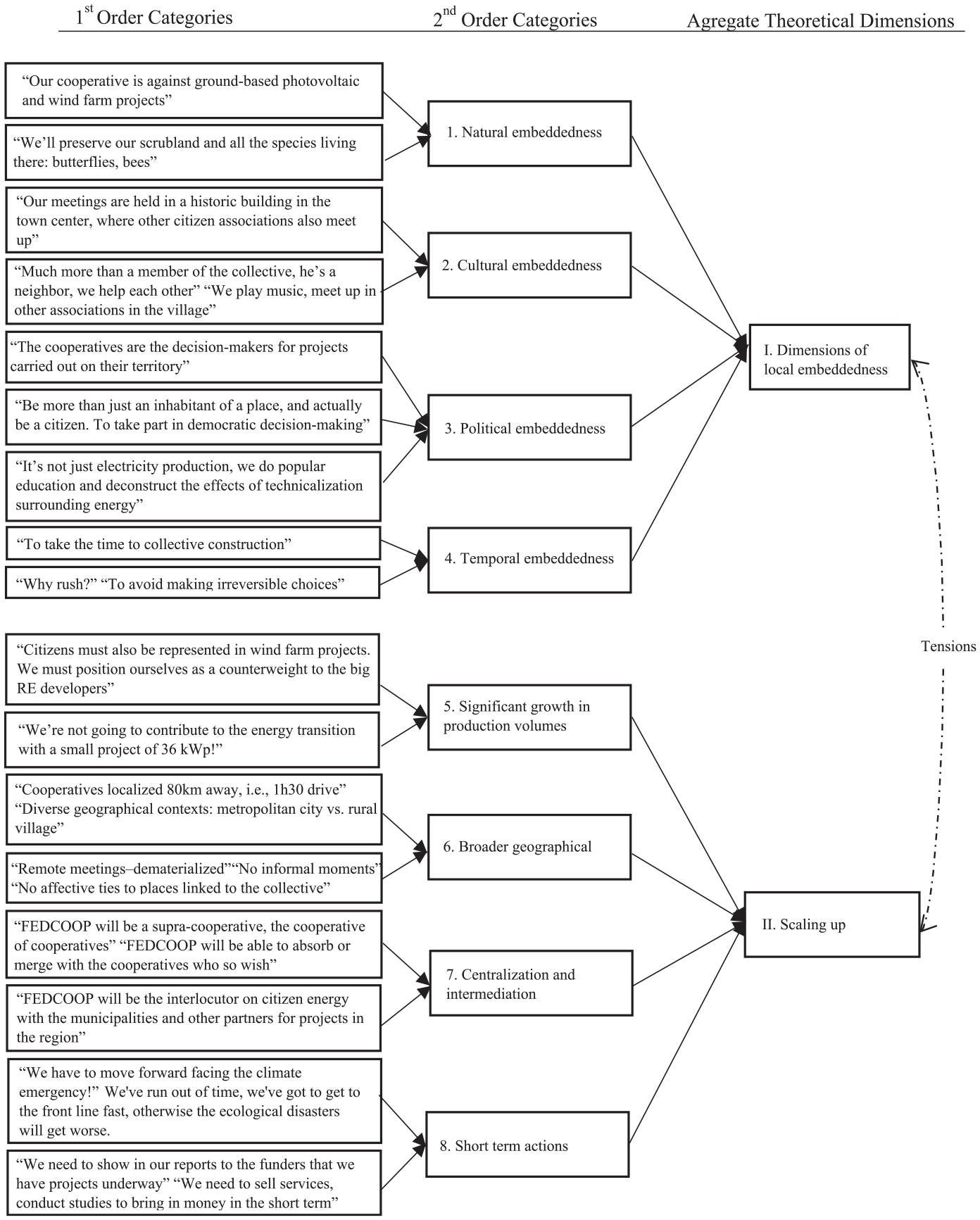
Data Structure.
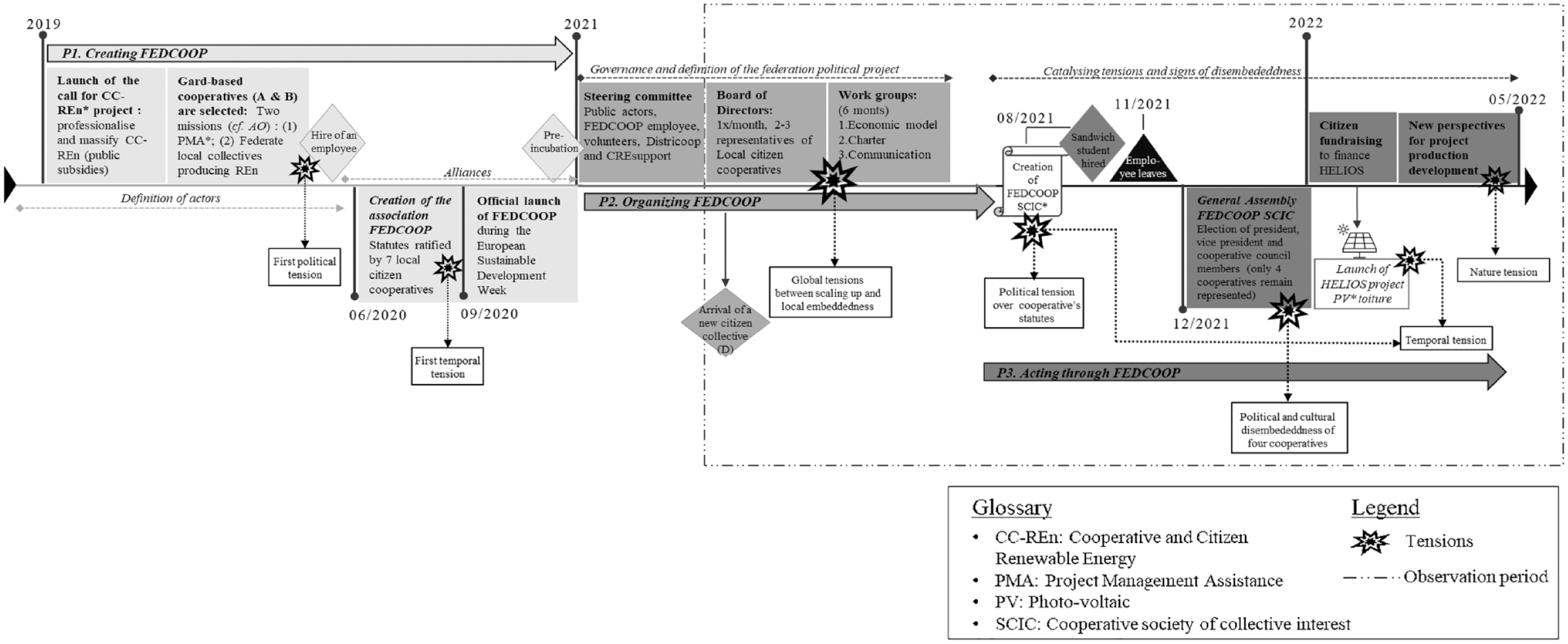
Structural Evolution of FEDCOOP.
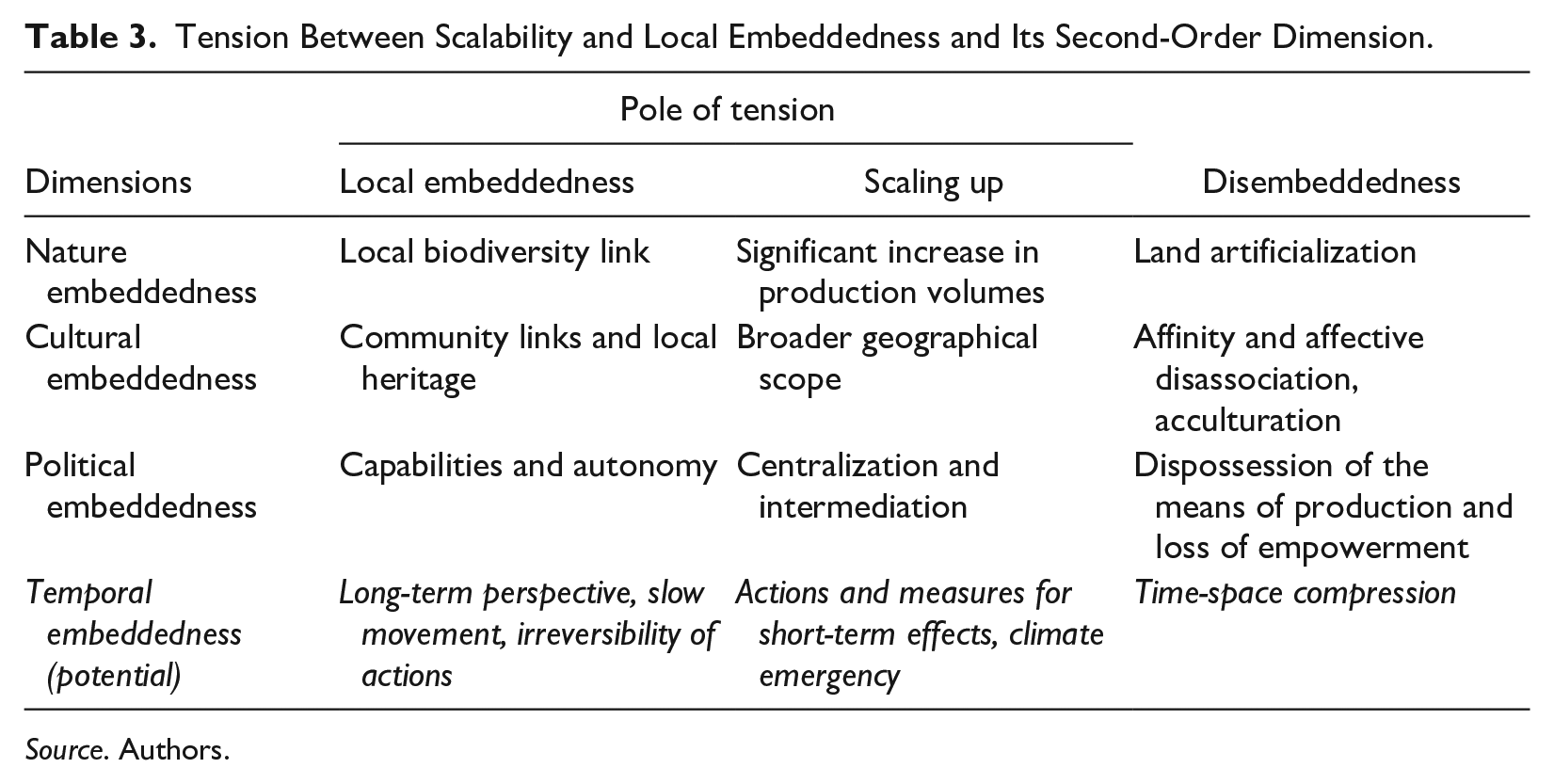
At the end, we re-organized key analytical elements in Table 3, so as to situate the main dimensions of local embeddedness being affected by scaling up and the resulting “disembeddedness” tensions (see Table 3). We then produced a narrative around the three temporal phases of the federation’s development, which could convey the ways in which the core tensions manifested and unfolded through the period of observation of the project.
Tension Between Scalability and Local Embeddedness and Its Second-Order Dimension.
Source. Authors.
Findings
Three phases shaped the trajectory of FEDCOOP’s initial development, which we have framed as (1) “Creating,” (2) “Organizing,” and (3) “Operationalizing.” The first phase corresponds to the creation of the federation and to the definition of its political project. We show how local cooperatives are rallied around the objective of scaling up during this first phase, while also defending the characteristics of their local embeddedness. We underline the first tensions that appear during this phase. Our second phase pertains to the structuring and organizing of FEDCOOP. It reveals the strengthening of an already existing tension around the political embeddedness of the cooperatives, as well as the emergence of new tensions around cultural embeddedness. The final phase involves a manifestation of all core tensions around nature, culture, and politicality—as well as potentially, time—that are now all manifested and are being triggered by two critical incidents, the launch of a RE production project, entailing a focus on volume, and the change of legal status of FEDCOOP, involving a shift toward corporatization of the project, that both accelerate and concretize the disembeddedness involved by scaling up. Half of FEDCOOP’s members withdrew from the collective during phase 3, opting to get back to the local scale close to their cultural, ecological, and political foundations.
Phase 1. Creating FEDCOOP: The Early Manifestation of Disembedding Tensions
The RE coops involved in FEDCOOP were born in a rich land of cultural, ecological, and political embeddedness. Indeed, the Gard region played a leading role in organizing the emblematic protests against shale gas exploration in France in the early 2010s, 2 and it is this strong movement that subsequently fostered the search for more sustainable sources of energy among the militants involved: “we fought against shale gas operations, then we wanted to mobilize and imagine what we could do in our region in terms of energy” (I7; I12). The protest movement around energy had allowed for close ties to develop among the local people involved. These ties offered a fertile ground for grassroots initiatives to mobilize both volunteers and local public actors who had initially campaigned together. Producing electricity from renewable sources thus marked a transition from the so-called antifracking movement toward the formation of local initiatives promoting RE as a “collective energy” (I8). A first, emblematic citizen RE coop was initially created in the aftermath of the protest movement, in the village of Aubais. 3
Nearly 10 years later, eight local initiatives were established in the Gard region, often inspired and supported by the pioneering cooperative: “we relied a lot on what the citizens of Aubais had already done” (I11). As a result, the shared, locally rooted, history was at the origin of these eight cooperatives, and it had already woven some cultural and political ties among them. All of them also had a robust link with nature and the determination to promote more environment-friendly sources of energy. Preserving biodiversity while criticizing the artificialization of the soil was a fundamental element of their commitment to developing news sources of RE. During conversations observed at the RE coops’ gatherings, some major industrial players were denounced for distending the relationship with nature when they construct large-scale power plants and the resulting impact on the landscape and biodiversity. “In our opinion, isn’t the right direction to develop renewable means of production by having large expanses of renewable installations between vineyards where the producer of electricity is unknown” (I15).
Rather than size and volume, a major rationale for joining FEDCOOP, among the member cooperatives, was that the federation would allow them to collectively recruit employees, hence ensuring the sustainable viability of the local cooperatives’ where volunteers were showing signs of exhaustion: “The issue is that these projects tend to attract a large number of people initially, but it becomes increasingly difficult to sustain their involvement over time. As a result, it can be challenging to re-energize the group for subsequent projects” (I6); “This realization led me to understand that we would face significant challenges if we tried to proceed on our own. (. . .) We started with fifteen members, and now there are only three or four at most” (I11). In addition, the local cooperatives wished to extend their societal impact in the energy sector by coordinating on the broader territorial scale of the Gard, where they had already built ties through the protest movement and the early dissemination of the RE coop model. The local triggers to join and form FEDCOOP were thus part of the RE coops’ e search to secure the local citizen energy production while reaching a spatial scale that would allow the local coops to pool resources, obtain financing, counter the slowdown in volunteering engagement and thereby concretize an alternative to the dominant national energy producers in France: “grouping together means having more weight with respect to the large energy structures, which focus mainly on their economic interests. Showing that an alternative movement is getting organized!” (I10).
With this perspective, two pioneering cooperatives A and B, joined together to respond to a call for projects geared to the “professionalization and massification of citizen energy in the Region” (I26, I27) that would not necessarily reflect the early preliminary preferences of all the local cooperatives. The call was launched by two public institutions: the broader Occitanie Region, which had set for itself the goal to“ triple renewable energy production and halve per capita energy consumption by 2050” (I26) and ADEME, a national state agency that works to promote RE in France: “we had often worked together on other things and when we saw the increased potential for citizen energy in the region, we wanted to quickly jump on the opportunity offered by the call for projects” (I3). These two cooperatives prepared the application dossier to obtain the funding, outlining in broad and varied terms what FEDCOOP’s orientations and political missions would be. Both of them also began to recruit a future employee who would support the development of the collective initiative.
It is only after winning the call for projects, that the cooperatives A and B approached the six other cooperatives established in the Gard territory to mobilize them on the creation of a federation. In fact, the success of the project hung on its ability to attract all the local cooperatives that were producing energy in the Gard region. The local contexts of the cooperatives could be quite varied in their own localities, in terms of the numbers of shareholder-members, ongoing projects, internal functioning and dynamics, etc. However, as we have seen, they all had similar needs that prompted them to join the project: “to counter the dwindling momentum of volunteering, share and pool resources (technical, legal, etc. skills), encourage citizen mobilization” (I12, I17, I14, I19, I25). As a result, FEDCOOP’s statutes were ratified by all eight cooperatives in June 2020, under the legal form of an association. The federation’s constitutive objective was established as follows: “FEDCOOP will test the coverage of a larger territory by a citizen regional RE operator by proposing practices and tools pooled with other similar structures existing or emerging on the territory” (statutes of the association). To achieve such objective, the cooperatives agreed to: “take action in all domains related to controlling energy consumption, promoting, and developing renewable energies, diagnostics, advice, feasibility studies, assistance for project sponsors and animation for local authorities, companies and individuals in the Gard region and adjacent regions” (statutes of the association).
However, the fact that the cooperatives had joined the federation project at different times already created a dissymmetry among them, and sowed the seeds of political disembeddedness by depriving the late comers of a feeling of having a true capacity to engage in shaping the project, so that tensions ensued: “The cards were already played, we arrived midway when a part of the trajectory was already traced out” (I19). Although the eight cooperatives all shared the same needs of becoming sustainable over time, of developing collective action, and thus, potentially, of scaling up under such terms, the organizational goal of FEDCOOP de facto fostered a heterogenous imaginary among the members, ranging from “countering the slowing mobilization of volunteers, while increasing their numbers and creating a regional solidarity network” (I13; I20) to “increasing the visibility of the citizen energy movement in the region” and even, for some, in the enthusiasm of pulling of forces, FEDCOOP could aim to “significantly increasing the volumes of electricity produced and becoming the link for a multinational of local cooperatives” (I5; I9). Such differences among the goals framed by the local coops would cause ripples throughout the next phase of structuring the federation, since the choice of one direction rather than another was to lead to a specific form of organizational coordination, more or less horizontal, or centralized, or intermediated, which in turn could lead to the cooperatives’ local specificities being disregarded.
The local political and cultural anchorage of the cooperatives is involved in these initial divergences. For example, cooperative E is located in a particularly remote area only connected to the nearest towns by an irregular bus service. Its members thus raised the issue of linking up—connecting with others—as a stake for their own initiative to join the federation project, since isolation was weighing on the dynamic of their own local RE collective: “the volunteers here are often involved in several of the town’s citizen projects. We aren’t able to dedicate ourselves as much as we’d like to energy. The federation could support us by helping us to become less isolated” (I14). For cooperative F, by contrast, being located in the region’s largest town and close to all the institutional decision centers, the issue was more about increasing the importance of citizen energy in the region (I16).
These local differences resulted in the formulation of a “catch-all” political project for FEDCOOP that aimed to encompass all the stakes of the local cooperatives without any real questioning of their potential contradictions. As a result, the federation’s scope of activities was very broad: ranging from the internal management of the cooperatives’ functioning to the development of RE production and awareness-raising services, such as training on reducing energy consumption, as well as advisory services for local authorities and companies.
Yet, the choice of name (which was to include the word “accelerator”
4
) proposed by four of the cooperatives shortly before the launch of FEDCOOP, also symbolized some confusion about the relationship to the timelines chosen and advocated among members. Whereas some were in favor of a slow movement: “it’s important to take time, to listen carefully to what is around us to avoid making possibly irreversible choices” (I18), others foregrounded the ecological emergency and the need to act swiftly: “We’ve run out of time, we move up to the front fast, otherwise ecological disasters will get worse! This is evident in the droughts that affect our town and dry up the springs that supply the village with water. We face increasing restrictions on our water consumption” (I8).
Such disagreement could not equate with a disembedding tension but contributed to the disparity of views in the project.
Phase 2. Organizing FEDCOOP: Sparking off the Disembedding Tensions
The waymarks during this 8-month phase (January 2022 to August 2022) include the start-up of the incubator program, the setting-up of the systematized governance bodies, such as monthly board meetings between the representatives of the member cooperatives, and quarterly steering committee meetings with the funders. Three internal working groups were also set up. Run by FEDCOOP’s employees, these groups covered three themes: the economic model, the ethics charter, and communication. The active volunteers of these working groups convened once a month during this period. It was during these discussion times that tensions around disembeddedness appeared clearly in the collective dynamics. Cultural disembededdness tensions appeared, while latent political disembeddedness tensions were also reinforced.
The main tensions around disembeddedness first appeared at the cultural level during phase 2. The FEDCOOP’s organization process brought to light significant disparities between the ways in which the member cooperatives embedded their respective activities in their locality’s history and culture, on the one hand, and the extent to which this could be incorporated in how FEDCOOP was starting to work. Some cooperatives manifested particularly strongly their attachment to locality through various cultural anchors (rites, symbols, and attachment). For instance, cooperatives such as E, F, and G were used for in-person meetings in highly symbolic places where their cultural embeddedness was manifested. For example, cooperative E ran seminars and organized encounters in local natural settings to raise awareness of the relationship between humans and nature in the Cévennes valleys. Such meetings featured an attachment to the village and its natural surroundings with a shared open-air meal. Similarly, the board meetings of cooperative H were held in an old bastide in the town center, a bastion of local resistance. This old town is recognized as a heritage site due to its historic castle and ramparts dating back to the 11th century, and the bastide was also used for organizing collective resistance actions against shale gas: The president of the cooperative asked me to follow her, and we both went down a narrow staircase into a dark room in the basement. On the way down she explained to me that several militant associations held meetings in this place. Some volunteers who already sat around a big table welcomed me. During the discussions on the agenda items, one volunteer tapped my arm and whispered “That’s activism! [vindicative and assertive tone]” (notes: board meeting, cooperative H, 18.11.2021).
By contrast, most of the federation’s meetings were held remotely. During the COVID-19 period, this was systematically the case, while some volunteers in the member collectives would continue to meet up in person in their village. Remote meetings persisted post-COVID on the grounds of geographical distance and the gain of time: “It takes me one hour twenty minutes to come from my bit of countryside! [laughter] It suits me not to have to make the journey” (I14). Furthermore, the FEDCOOP’s in-person meetings, as approved by other members of the cooperatives, were held in a room in the industrial premises of a partner wine-making cooperative: “a modern, innovative, high-tech and huge cellar that enables 120,000 hectoliters of wine to be made in a stainless steel vat” (internet site, wine-making cooperative), 5 surrounded by vines and facing a departmental road with heavy traffic. The locality was poorly served by public transport and meetings were rarely held (three times over the study’s observation period) in what seemed like a space of transit rather than one of embeddedness.
The spatial dispersion of the member cooperatives also made it difficult for volunteers to forge a cultural bond as they spent no informal time together, enabling them to create community markers. By contrast, volunteers from cooperative C met at each other’s homes, shared meals, and sometimes played music together. They were often active in the same associative network of their town or village. “He’s much more than just another cooperative member, he’s a neighbor. We help each other out. But we also think together about other projects for the municipality such as waste management” (I8). Furthermore, a volunteer from cooperative B pointed out how much the times of struggle against fracking marked a shared history in the social relations between the volunteers in his cooperative: “What made our collective strong is the fact that we militated together for nearly five years against shale gas. In the end, what tied us together, beyond our ecological convictions, was our attachment to a space that was going to be destroyed, ruined. And the times when you protest, prepare your banners, the songs you’re going to play during the march, your slogans, inevitably draw you closer” (I7).
Finally, it was during this sequence of organizing that divisions emerged around the question of the federation’s political governance. For some, due to its centralizing mission, FEDCOOP was positioned above the member cooperatives and seen as a meta-organization: “FEDCOOP is the region’s supra-cooperative” (I9). Others, however, demanded that they keep their autonomy when it came to decisions related to their territory, supporting a more horizontal scheme: “the local cooperatives must absolutely keep their autonomy in the territory because they are the ones who know the people, the projects”; “The local cooperatives must continue to be the decision-makers” (I20). The term “interference” (I17, I15, I18) is mentioned several times by some volunteers. The determination to introduce safeguards to preserve the cooperatives’ sovereignty is also expressed: “FEDCOOP must encourage autonomy. For sure, FEDCOOP will go where local collectives are unable to act, but at the same time, it will support the autonomy of local collectives so that they can assert their local presence even more” (I19). Being free to leave the network is also a condition for becoming a member: “you have to respect the dynamics of the different cooperatives, some function very well with a pseudo-autonomy when they have active volunteers. Each one can decide at any moment to join or leave the supra-structure depending on their situation” (I8). The federation’s board members thus managed to create a decision tree which, at each stage of developing the electricity production project, integrated whether or not the local cooperatives wished FEDCOOP to intervene. This established a compromise on the level of autonomy that the local cooperatives could retain as decision-makers for matters involving their territory and signaled the significance of the political disembedding tension that had to be handled in the organizing phase of FEDCOOP.
Phase 3. Operationalizing FEDCOOP: Cumulative Forms of Disembedding Tensions
Our characterization of this third phase is one where, in the third quarter of 2021, FEDCOOP becomes focused on action, and disembedding tensions culminate in the defection of some of the member cooperatives. This was manifested by two critical incidents: the development of a photovoltaic project, revealing critical ecological tensions in the collective discussions, and the conversion of the legal status of FEDCOOP from an association into a cooperative society, which was done both in haste and in view of prioritizing volume increase over the collective drafting of a broader transformative project.
During phase 3, preparing for the end of the grant funding and securing the position of the paid worker became a pressing concern, particularly for the employee himself (who in fact was working in a situation where he was responsible for finding revenue to finance his own job). In this context, a roof-based photovoltaic project called HELIOS provided FEDCOOP with an opportunity to develop its first revenue-generating project. HELIOS was medium-scale: “355kWp, 2,000m2 of roof, an investment of around €400,000” (notes from FEDCOOP’s board meeting, June 18, 2021) but involved complex technical aspects (oval-shaped roof, a building complying with ICPE 6 standards). The project was often discussed in FEDCOOP’s governance bodies, but in September 2021, it occupied a large place on the federation’s agenda, to the detriment of its functional organization. The time pressure—already present in phase 1—grew worse at this point.
The longer timeframe needed for organizing a collective transformative action was to conflict with the rationales in favor of efficiency supported by some volunteers, the employees, and FEDCOOP’s technical partners/funders. Some of the enrolled cooperatives favored “taking the time for collective construction” (I20), “Why rush ahead?” (I17), whereas the early leaders l replied “We can’t just keep discussing. I love debating, I love philosophizing, but that in itself has no real impact [. . .] But at some point, we have to act. The photovoltaic project is a way of acting” (I9). As will be discussed below, this would contribute to hamper the political embeddedness of the collective project.
On the ecological embeddedness, disagreement appeared on the levels of ecological radicalism to be adopted in the scaling-up project. One trigger for this tension pertained to the choice of materials in the HELIOS project. All parties agreed that solar panels with the lowest carbon footprint should be preferred, preferably panels made in France rather than imported from the leading Chinese manufacturers. However, price differences for materials such as panels and converters, depending on whether they are produced and assembled in France, in Europe, or abroad, were also a source of disagreement. Some volunteers supported European sourcing, while others preferred the domestic market regardless of the financial cost. “The financial gap is too wide to favor a French assembler. The European scale is already sending a strong signal of rejection towards internationalized industrial models” (I13).
The ecological tension was not restricted to HELIOS. In parallel, FEDCOOP gradually participated in other photovoltaic projects, one of which raised the issue of clearing part of a forest. This project involved integrating new categories of stakeholders such as DISTRICOOP, the ONF (Office National des Forêts—National Forests Office), SDIS (the regional fire service), and the DDTM (Regional management of land-use and sea) and also opened debates on the cooperatives’ positioning on their anchoring in nature. The debates were polarized between: (i) the cooperatives totally against land artificialization, and thus opposed to wind farms and ground-based photovoltaic installations: “We consider that our role is to fit as many rooves as possible and not to degrade our garrigues to produce electricity. That would just be reproducing the industrial practices that we denounce” (I20) and (ii) the cooperatives prioritizing engagement in this type of project, who cited models of citizen participation in wind farms as a counterweight to the fully private wind farms that were developing in FEDCOOP’s region: Wind is going to develop in any case, you can see this with the offshore wind farms. If we don’t act as a counterweight, the large industrialists will be the only ones to move ahead, with very few criteria concerning local economic benefits and no place for citizens in their governance. This would be burying our heads in the sand and giving them all the space! (I5).
Furthermore, and coming back to the political embeddedness tension, engaging with the HELIOS project meant that the legal status of an association would no longer be adapted for FEDCOOP, since the collective would need to be able to sell on the electricity produced. This thus required creating a cooperative society. The federation’s employee gathered and synthesized several model statutes taken from other cooperative societies (located within and outside the region) and combined these with the information from the working group studying the economic model. He then proposed a version of the statutes, which he submitted to the members for their rereading. Some remarked that the work done by the Charter working group should have been a prefiguration of the statutes. “I thought the charter was to serve as a basis for the statutes. But you, you want to rush ahead, get the statutes out quickly. Are we drafting our own statutes with our own specificities, or are we using someone else’s statutes?” (Volunteer H2, Board meeting notes, 27/09/2021). As a result, the political embeddedness tension also came to a head: “We aren’t even totally clear about FEDCOOP’s mission, there are still several points we disagree on and you’re asking us to read through the statutes that are circulating in emails” (Volunteer H1, Board meeting notes, September 27, 2021); “We committed to a timeline for HELIOS, if we don’t keep to it we’re going to lose all credibility” (Employee 1, Board meeting notes, September 27, 2021). As a result, the transition of the FEDCOOP association into a cooperative society undermined the political embeddedness of the project whereby the drafting of the statutes should have been a collective deliberative process—rather than a technicized, centralized benchmark exercise placing the member cooperatives in a position to consensually approve ex-post the statutes content proposal.
From December 2021, the cooperatives E, F, G, and H gradually withdrew from the only tenuous links between the members, which were the remote monthly board meetings. Their representatives were less committed and expressed themselves less often, contrary to the situation in phase 2. They no longer took part in organizing the collective or only in a very distant manner. In December 2021, the FEDCOOP cooperative held its constituent general meeting, where these local cooperatives did not participate. Only the four other cooperatives (A, B, C, and D) stood as candidates for the board of the FEDCOOP coop and acquired shares on behalf of their local cooperative’s legal entity. This officially marked the disengagement of the most locally embedded cooperatives, which no longer had representatives on the governance bodies.
Moreover, in the previous month, the FEDCOOP employee had announced his departure. Several reasons for this were mentioned, mainly related to his working conditions: “the differences in times when volunteers and the employee were available, the difficulties in organizing the link between the cooperatives, the pressing need to find funding and launch an income-generating activity, the isolation” (I1; notes from FEDCOOP’s board meeting, September 27, 2021).
The description of key events in this third developmental phase of FEDCOOP shows that the actions taken catalyzed the tensions expressed around (dis)embeddedness during the previous phases. Concretely establishing the cooperative left no room for a phase of accommodating the already existing tensions and forging a possible alternative consensual vision. The cumulated disembedding tensions around nature, culture, and politicality were further enhanced by the time pressure to which the federation’s growth was submitted and which was induced by its move to action. The adoption of a cooperative status failed to integrate the elements of political embeddedness that had emerged from the reflection on the federation’s charter. The charter had set out milestones for a collective project and all the member cooperatives had participated in this working group, which showed the group’s deep concern to draft a reference document that enshrined common values and shared identity markers.
For the cooperatives E, F, G, and H, what seemed to make sense again was to plow their efforts back onto a local level (town/village): “Today, I prefer to give my time to initiatives in my village. In fact, we’re exploring other sectors of action aside from energy: food, mobility, etc. We’ve become aware that our strength lies in our local anchoring. FEDCOOP is acting on another level” (Volunteer H2, informal discussion, General Assembly, 11/12/2021).
Discussion
What do we learn from this close observation of the processes of developing FEDCOOP to scale up grassroots initiatives in the RE transition? How does it inform the nature of the tensions involved between scaling up and the local embeddedness of these understudied actors of the energy transition (Chowdhury et al., 2021)?
We provide a more effective characterization of how local embeddedness is put in tension by scaling up, around three key main dimensions: politicality, culture, and nature. Although these features have been pointed out as salient to research on the embeddedness of initiatives for social solidarity and ecological preservation (Bowen, 2011), as discussed in our theoretical section, they had not been identified as part of a same process of resistance to scaling up. This suggests that all three dimensions should be included in a comprehensive view of what grassroots initiatives may lose when they engage in a scaling up project, or what a scaling up project should be careful to preserve in order for grassroots RE initiatives to successfully reach out to broader scales (Schiller-Merkens, 2020).
While previous characterizations of the scaling up limitations faced by local projects have acknowledged the role of reciprocal social relations tied to places (Bauwens et al., 2020; Bauwens & Devine-Wright, 2018; Smith & Stevens, 2010), this research shows that local embeddedness is not just built on a shared culture of reciprocity. It is also to be understood as a form of local political emancipation and in relation to local nature. This enlarges our understanding of what local embeddedness may mean when the stakes are to pull up various grassroots initiatives so as to build outreach and strengthen a project of social change. The observation and characterization of scaling up tensions show, in our case, that the local embeddedness features to be scaled up, that is, to be maintained alive in a broader federation, are grounded in closely interlinked cultural, political, and ecological dimensions. The political dimension involves a full direct engagement of citizens in the ecological transition.
The stakes of scaling up the locally embedded projects can be heightened by a temporal dimension which appears of particular importance when dealing with sustainability and with collective project building (Sharma & Jaiswal, 2018). Our research indicates that this often implies a long-term view that conflicts with the urgency of action, especially when this action is driven by efforts to industrialize projects and obtain financing (Slawinski & Bansal, 2015). In our paper, the time pressure on the federation (collective time) seems difficult to reconcile with the time of the local collectives and with the caution needed to build solutions that respect the nature boundaries (Tsing, 2012, 2013)
As an opening for future research, we suggest that these three core dimensions of local embeddedness might complement and reinforce each other in carefully drafted collective projects for scaling up sustainable, locally rooted initiatives. What we grasped here in terms of tension, can also be understood as a legitimate expression of core dimensions of local embeddedness to be embarked in such collective project. Indeed, the relations of reciprocity that people sustain locally, based on shared values and a common attachment to their place and its cultural heritage, also involve a shared attachment to the unique local features of biodiversity—that is, the garrigue and its endemic species (Gieryn, 2000). To protect and develop such spaces of social and ecological solidarity, the local actors who resist scaling up further aim to preserve their political embeddedness, or the capacity to act locally (Bowen, 2011). Finally, fostering cultural, ecological, and political embeddedness is attached to a form of temporality that could also be further explored in future research on scaling up grassroots initiatives, to allow for greater inclusivity in the local political action, in line with the longer horizon of biophysical cycles (Bansal & Knox-Hayes, 2013). Hence, in the multiple features of local embeddedness tensions that we highlight, local political capacity and a long-term horizon would appear prerequisite to promoting reciprocity in social relations and in relations with nature at a broader scale.
The unequal local embeddedness of grassroots projects can be further subsumed, based on our empirical observation. Indeed, the different grassroots initiatives experiment with various tensions on their local embeddedness when they engage in a collective process of scaling up. An emerging line of division could be traced between rural and urban initiatives, in terms of varying intensity of local embeddedness to be embarked in scaling up projects. More generally, and although community energy initiatives have received limited attention in the sustainability literature (Bauwens et al., 2022), they can play pivotal roles in sustainability transitions. A framework was thus needed to theorize the tensions that grassroots initiatives face as they collectively scale up and which our research has helped to characterize in three dimensions. This question is especially important given that the sustainability transition involves complex processes and their outcomes are crucially dependent on place-based, context-specific biophysical, institutional, and social conditions (Vermunt et al., 2020).
Our political and cultural tensions reveal the importance of the embeddedness of grassroots initiatives within local communities from a contextualist perspective (Hancock, 2003). We confirm results that show that embeddedness in local communities represents a key stake for fairer processes and outcomes. This requires the ongoing involvement of communities in decision-making processes, a condition that cannot be fulfilled when scaling up implies a significant time compression and a focus on an economic rather than democratic rationale (Bomberg & McEwen, 2012). With respect to time tensions, we thus show that collective action—involving multiple stakeholders and multiple positionings—can trigger tensions on local embeddedness when the action requires a short-term focus on economic concerns that weakens the collective processes at work (Bauwens & Devine-Wright, 2018). Here, and for our specific case, the structural constraints related to a path dependency in the founding conditions of the federation, do not allow the objective of scaling up and that of local embeddedness to be combined at a collective level. An ambivalent relationship to growth (DeSantola & Gulati, 2017; Vickers & Lyon, 2014) was also observed. Some actors defended scaling up and associated it with a large increase in volumes through massification—public actors who supported the federation and some cooperatives. Others, however, adopted an alternative approach to growth by giving greater consideration to the collectively built ethical project on which scaling up should be built. In our case, growth mostly viewed in terms of massification put in tension the ecological embeddedness of grassroots initiatives and created a disconnection from their bio-physical and material local anchoring (Bansal & Knox-Hayes, 2013).
Conclusion
Although the project is still ongoing and our conclusions should not be considered definitive, this scaling-up experience is rich in lessons about the capacity of overarching initiatives to integrate and build on local embeddedness (Georgallis & Lee, 2020). The broad picture seems to support Tsing’s argument on the no scalability of the embedded, reciprocal relations through which the “living world” is unfolding over time, at least not in conditions where the scaling-up project is endowed with short-term resources and faces tight production imperatives.
Such considerations reinforce the claims of Bauwens et al. (2020) and the earlier assumptions made by Smith and Stevens (2010) that the initial scale ambition of a project strongly shapes its subsequent growth pattern. Being established from the start at a larger scale than the local cooperatives, where economic pressures were prominent, the scaling-up initiative was deemed to follow a less embedded trajectory than its smaller-scale constituents. Yet, this conclusion would not do full justice to the case studied. Our research contributes to identifying some critical conditions under which various scaling-up trajectories might emerge and be supported over time. First, Hamilton et al. (2014) have alerted us to the timeframe needed to fund the scaling up of grassroots initiatives and to the need for governments to adopt a long-term view. In the absence of such long-term funding, the industrial project gained traction in the FEDCOOP collective as a practical short-term possibility of obtaining financial resources that could sustain the federation and the salaried job it had managed to create. Second, the case brings to our attention the ways in which locally embedded initiatives might interact with actors established at broader scales. If support from broader scales remains sporadic and/or focused on economic rationalities, meaning that key political, natural, and cultural issues of embeddedness are relegated to grassroots groups to handle on their own, then the chances of successfully combining scaling up and local embeddedness might be reduced. If scaling-up initiatives are approached more as long-term projects to be funded, possibly at a loss, to support the emergence of alternative economies, then a more engaged and open-ended form of commitment is needed from both public policy actors and from economic approaches established at broader scales.
Supplemental Material
sj-docx-1-oae-10.1177_10860266241238730 – Supplemental material for Tensions Between Local Embeddedness and Scaling up: Insights from Grassroots Sustainability Initiatives in the Renewable Energy Transition
Supplemental material, sj-docx-1-oae-10.1177_10860266241238730 for Tensions Between Local Embeddedness and Scaling up: Insights from Grassroots Sustainability Initiatives in the Renewable Energy Transition by Lea Baileche, Magalie Marais and Florence Palpacuer in Organization & Environment
Footnotes
Declaration of Conflicting Interests
The author(s) declared no potential conflicts of interest with respect to the research, authorship, and/or publication of this article.
Funding
The author(s) received no financial support for the research, authorship, and/or publication of this article.

Supplemental Material
Supplemental material for this article is available online.
Notes
Author Biographies
References
Supplementary Material
Please find the following supplemental material available below.
For Open Access articles published under a Creative Commons License, all supplemental material carries the same license as the article it is associated with.
For non-Open Access articles published, all supplemental material carries a non-exclusive license, and permission requests for re-use of supplemental material or any part of supplemental material shall be sent directly to the copyright owner as specified in the copyright notice associated with the article.
