



Abstract
Recognizing that management scholarship does not adequately address the preservation of natural resources, an ecological resource orchestration model is introduced in this article. To this end, we build on the case of Poiscaille, a French online platform that offers a distribution model for ultra-fresh fish and seafood with the goal of preserving the ocean for future generations. Using the extended case method, this study advances the resource orchestration model through an empirical case. The Poiscaille case provides rich insights into the resource orchestration model by showing how it fosters the sustainable management of natural resources. Thus, this article contributes to natural resource management research and the resource-based view literature.
Keywords
Introduction
Scientists have regularly cautioned that the increased use of both nonrenewable (or finite) natural resources and renewable natural resources, such as water, land, crops, timber, or fish stocks, can lead to their depletion. 1 For example, a report published by the Intergovernmental Science-Policy Platform on Biodiversity and Ecosystem Services warned that in 2015, 7% of fish stocks were harvested at unsustainable levels with minimal time afforded for reproduction (United Nations, 2019). This can lead to their decline. However, although natural resources play a key role in all organizations and industries (Figge & Hahn, 2020; George et al., 2015; Tashman, 2020), “management scholars have paid only scant attention to physical and natural resources and their idiosyncratic characteristics” (George et al., 2015, p. 1598).
Thus far, as acknowledged by George et al. (2015), “the management field has mainly used a singular frame to address [natural resource] scarcity—the resource-based view [RBV]” (p. 1600). As the resource orchestration model, which is defined as “the comprehensive process of structuring the firm’s resource portfolio, bundling the resources to build capabilities, and leveraging those capabilities with the purpose of creating and maintaining value for customers and owners” (Sirmon et al., 2007, p. 273), is anchored in the RBV paradigm, it offers an interesting model of the organizational management of natural resources in a manner that mitigates their depletion (Andersén, 2023; Karadag & Poppo, 2021). However, as with many other influential strategy theories (see Ghoshal, 2005; Nyberg & Wright, 2022), the RBV has been criticized for perpetuating “business-as-usual” thinking and causing harm to the natural environment through its inability to offer a sustainable resource management model (Bastian et al., 2018; Figge & Hahn, 2020; Tashman, 2020). Such an observation motivates our search for a resource management model that is consistent with natural resource sustainability. Thus, our research question is as follows:
In exploring this question, we first call the capacity of the resource orchestration model to conceptualize sustainable natural resource management into question. To this end, we assess the limits of the model from a strong perspective on sustainable development that considers biophysical limitations (Castro, 2004). A strong perspective on sustainable development assumes the finitude of natural resources by suggesting a limited substitution capacity between natural and human-made capital for preserving specific physical reserves of critical natural capital, such as biodiversity, ecosystems, or the ozone layer, whose losses are irreversible (Landrum, 2018; Neumayer, 2003).
Given the inability of the resource orchestration model to manage natural resources in a sustainable way, we follow Danneels’s (2007) use of the extended case method (Burawoy, 1991, 1998) to reconceptualize and extend the model by confronting it with the empirical context provided by Poiscaille, 2 a French online platform that distributes ultra-fresh fish and seafood through a subscription model and aims to preserve the ocean for future generations. Poiscaille is a salient example of an organization that manages natural resources in a sustainable way. By encouraging the catch of “forgotten” fish, such as labrus or tacaud, which are perceived as less tasty or more delicate than “normal” fish (e.g., salmon), and by relying on small-scale fishers who use traditional fishing techniques that do not harm the oceans and who the company pays at a fixed price, the company aims to combat overfishing. We examine how Poiscaille manages natural resources to show how the resource orchestration model can be extended by first relating it to concepts that call some assumptions of the RBV—for example, the possession of resources by firms (e.g., Alexy et al., 2018) and their value creation mechanism (e.g., Priem, 2007)—into question, and then moving to the strong perspective on sustainable development (Neumayer, 2003).
The extension of the resource orchestration model to the sustainable management of natural resources constitutes an ecological resource orchestration model. Our conceptualization adds to the current research on natural resource management by complementing the explanations of natural resource depletion, offering a prescriptive model for natural resource preservation, and shifting this literature from constructing a business case for sustainability to an “ecological case for business.” It also contributes to the RBV literature by proposing an alternative to the theory that extends prior research anchored in Ricardian economics, complements the triple-bottom-line approaches, and extends research on the resource orchestration model.
This article is organized as follows. The first section describes the resource orchestration model and discusses its limitations in considering natural resources from a strong sustainability perspective. The second section details the extended case method procedure that we applied to the case of Poiscaille. Building on this case, an ecological resource orchestration model is built in the third section. The final section discusses this extension to the resource orchestration model in dialog with the natural resource management and RBV literature.
The Resource Orchestration Model and Its Limits for a Sustainable Natural Resource Management
A Resource Management Model Grounded in the Resource-Based View to Understand Value Creation
While the RBV comprehensively defines the nature of resources and capabilities as sources of competitive advantage, it has proven unable to explain how managers and firms actually transform these resources to create value. The resource orchestration model originates from this inability (Priem & Butler, 2001). It explicates the process-oriented managerial actions that link the management of resources and the creation of value to show how resources are managed to create value for customers and a competitive advantage for the firm (Sirmon et al., 2007, 2011). It shows that a firm orchestrates its resources first by structuring its resource portfolio, defined as the sum of all the resources that a firm controls. This process involves resource acquisition, accumulation, and divestment, which the firm will later use for bundling and leveraging purposes. Then, bundling resources requires the transformation of the resources in the firm’s portfolio (Sirmon et al., 2007). The prevailing assumption of the underlying stabilizing, enriching, and pioneering processes is that resources are improved (by making minor incremental changes, by extending current capabilities, or by creating new capabilities, respectively) within a profit-generation model. Finally, leveraging is the set of processes used to exploit capabilities for taking advantage of specific market opportunities (Sirmon et al., 2007). It encompasses the mobilization of resources to exploit market opportunities, their coordination once integrated, and their deployment to support the firm’s strategy. Since its publication in 2007, the model has been subject to empirical tests that are encouraging regarding the importance of resource management for the constitution of a firm’s competitive advantage (see Sirmon et al., 2011).
While the main strand of research on the resource orchestration model has focused on the implications and impacts of the model on corporate strategies, business strategies, and competitive dynamics in industries (see Sirmon et al., 2011), a stream of related research has considered environmental and economic performance—what Andersén (2023) recently called green resource orchestration—which he defined as “a firm’s capability to coordinate and manage the structuring, bundling, and leveraging of resources to create economic value for the company while simultaneously creating environmental benefits” (p. 3). Research focusing on the capabilities, resources, and synchronization of several processes that simultaneously create economic value and environmental benefits is needed. Focusing on natural resources, Karadag and Poppo (2021) specifically showed that synchronizing the orchestration of natural resources with their temporal decay can improve their long-term preservation. However, despite this interest in natural resource preservation, we argue in the next section that the anchoring of the resource orchestration model in the RBV paradigm does not allow natural resource conservation.
Limitations of the RBV Paradigm for Managing Natural Resources in a Sustainable Way
The attributes of a firm’s sustainable competitive advantage, which are at the core of the RBV paradigm—value, rarity, imperfect inimitability, and exploitation of firm resources by the firm’s organizational process (VRIO; Barney, 1995; Barney & Clark, 2007)—do not lead to sustainability. To make such an argument, we show the inconsistency between the RBV and the strong sustainability paradigm according to which the capital that provides basic life-support functions and natural resources whose destruction is irreversible cannot be substituted for the provision of manufactured capital (Ekins et al., 2003; Neumayer, 2003). Such an assumption is particularly relevant in the natural resource management context, given the assumed limited substitution of natural resources, such as biodiversity, ecosystems, or the ozone layer, that must be preserved, with human-made capital (Neumayer, 2003). The inconsistencies between the RBV and the strong sustainability paradigm are discussed below and summarized in Table 1.
Limitations of the RBV Paradigm in Considering Natural Resources From a Strong Sustainability Paradigm.
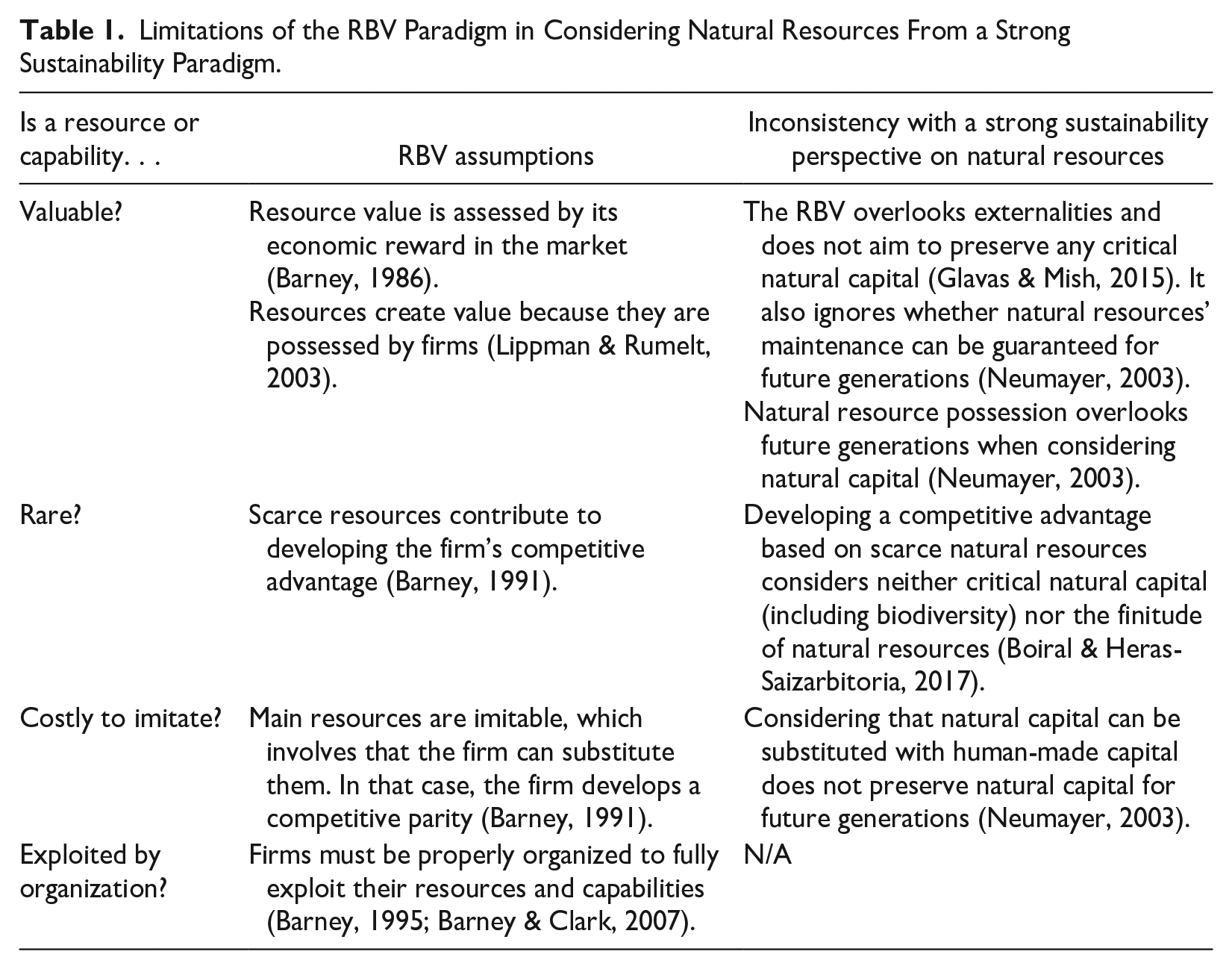
According to the RBV, a resource is valuable when it enables a firm to conceive or implement strategies that improve firm efficiency and effectiveness (Barney, 1991). A resource’s value is thus assessed by its economic reward in the market (Barney, 1986). However, such a conception is orthogonal to a strong perspective on sustainability. As the RBV assesses a resource’s value solely from the products or services it produces, any relevant externalities, such as environmental pollution or natural resource depletion, are overlooked (Glavas & Mish, 2015). In other words, the market is prioritized over the environment in the allocation of resources (Castro, 2004, p. 220). Thus, the issue of whether natural resource maintenance can be guaranteed for future generations is ignored (Neumayer, 2003).
From an RBV perspective, resources are also seen as being “tied semipermanently” to the firm (Wernerfelt, 1984, p. 172). As Lippman and Rumelt (2003) further argued, “the only source of wealth in the economy is the ownership of valuable factors” (p. 922). Thus, to create value, the RBV assumes that a firm must possess its resources. However, this assumption is called into question from the strong sustainability perspective. Conflicts that have been developed over natural resource possession (Downey et al., 2010), and the accumulation of domestic and industry laws and regulations to mitigate natural resource possession (Casarin et al., 2019) illustrate the potential dangers of overlooking the access to natural capital, including both renewable and nonrenewable natural resources, of future generations (Neumayer, 2003).
As resources are subject to imperfect competition due to their unequal distribution across firms, the RBV posits that firms develop a competitive advantage based on their initial allocation of resources. The scarcer a resource is, the greater its contribution to a firm’s competitive advantage (Barney, 1991). Indeed, the Ricardian grounding of the RBV assumes that the rarity of factors reflects the potential to generate rents for the owner (Barney & Arikan, 2001; Peteraf, 1993). However, such grounding does not consider the principles of a strong sustainability paradigm, as it overlooks any consideration of critical natural capital and the finitude of natural resources. Indeed, even when renewable natural resources are subject to depletion, they are bounded by their natural cycle of replenishment. Thus, building a competitive advantage based on the rarity of natural resources (both renewable and nonrenewable) increases the risk of depletion and even more widespread compromises of ecosystems and biodiversity seen as critical natural capital from a strong sustainability perspective (Boiral & Heras-Saizarbitoria, 2017).
Another RBV assumption is that inimitable resources contribute to the development of sustainable competitive advantages (Barney, 1991). The sources of inimitability include unique historical conditions, causal ambiguity, and social complexity (Barney & Clark, 2007). They can also be found in nonsubstitutability, that is, the impossibility of the firm using equivalent resources to develop the same competitive advantage (Barney, 1991). As only a few resources are inimitable, most resources, including natural capital, are seen from an RBV perspective as imitable through substitution. However, following the strong sustainability perspective, critical natural capital is deemed nonsubstitutable (Ekins et al., 2003), as it cannot be substituted with human-made capital, and each type of capital must be maintained for future generations (Neumayer, 2003). Hence, this third RBV assumption does not consider the principles of a strong sustainability perspective.
Given the inconsistencies between the RBV and the strong sustainability perspective, the resource orchestration model does not offer a sustainable natural resource management model. Building on the case of a company that has successfully developed a competitive advantage and preserved natural resources over the long run, we thus extend the resource orchestration model by relying on concepts anchored in both the RBV and the strong sustainability perspective, as explained in the next section.
Method
Building on Danneels’s (2007) use of the extended case method (Burawoy, 1991, 1998), we extend the resource orchestration model to the study of natural resources (see also Danneels, 2002, 2003, 2011). The extended case method relies on “[i]n-depth, holistic study of single or multiple cases in context to extend or elaborate existing theory” (Lê & Schmid, 2019, p. 124) and guides “the researcher [to] examine the literature relevant to his or her problem area, and employ the empirical data to fill in its gaps, reveal its flaws, elaborate its meaning, and extend its coverage” (Danneels, 2007, p. 514). The extended case method leads to generalization through the reconstruction of theories (Burawoy, 1991, p. 274). While Danneels mobilizes the method in the context of multiple cases (see Danneels, 2002, 2003, 2007, 2011), the extended case method can also be applied to single cases (e.g., Zander & Zander, 2005). This approach is particularly relevant in the context of resource-based studies (e.g., Bruni & Verona, 2009). To extend the resource orchestration model, we followed Wadham and Warren (2014) and proceeded in three stages, namely, detailing how we identified a theory and a case, describing how we collected data and identified anomalies, and finally explaining how we rebuilt the theory to accommodate anomalies.
Research Context
The extended case method is derived from empirical curiosity and the use of anomalies to extend a theory due to its failure to explain these anomalies (Ridder, 2017). In our research, curiosity came from the case of Poiscaille, a French online platform that orchestrates the provision of ultra-fresh fish and seafood “from objectively sustainable fisheries” (Poiscaille website, January 2023). Indeed, as Poiscaille communicates, “The company’s mission is to combat overfishing by guaranteeing better pay for fishers. To do this, it relies on 100% of French products fished using “soft” techniques, following a short circuit to ensure freshness while paying its fishermen fairly” (Pitch to investors, 2023). This empirical curiosity, which seems to go beyond the limits of the resource orchestration model, was the starting point that led to the collection of additional data on the case of Poiscaille to further identify the anomalies in the resource orchestration model, as explained below.
Data Collection
By drawing on multiple sources of data, we aim to understand how Poiscaille manages its natural resources to identify potential anomalies between the resource orchestration model and what actually happens on the ground that contributes to reconstructing the model (Wadham & Warren, 2014). In line with the extended case method, we collected data throughout many cycles of confrontation between data and theory (Danneels, 2007). To first gain a general overview of the resource management model of Poiscaille, we systematically collected press articles. This led to the construction of a 10-page written document that provides a comprehensive overview of the company’s resource management model that we validated with the founder of the company and that was updated throughout the data collection and analysis procedures. Then, we investigated scientific reports and academic articles to better understand the industry’s sustainability issues. This approach helps us to understand how Poiscaille’s natural resource management model positions itself within the industry regarding these sustainability issues. To improve our understanding of this matter, we also attended two tradeshows, as they offer spaces where companies are embedded in their environment (Lampel & Meyer, 2008). For example, we could compare the discourse of Poiscaille with the discourse of other actors in the market.
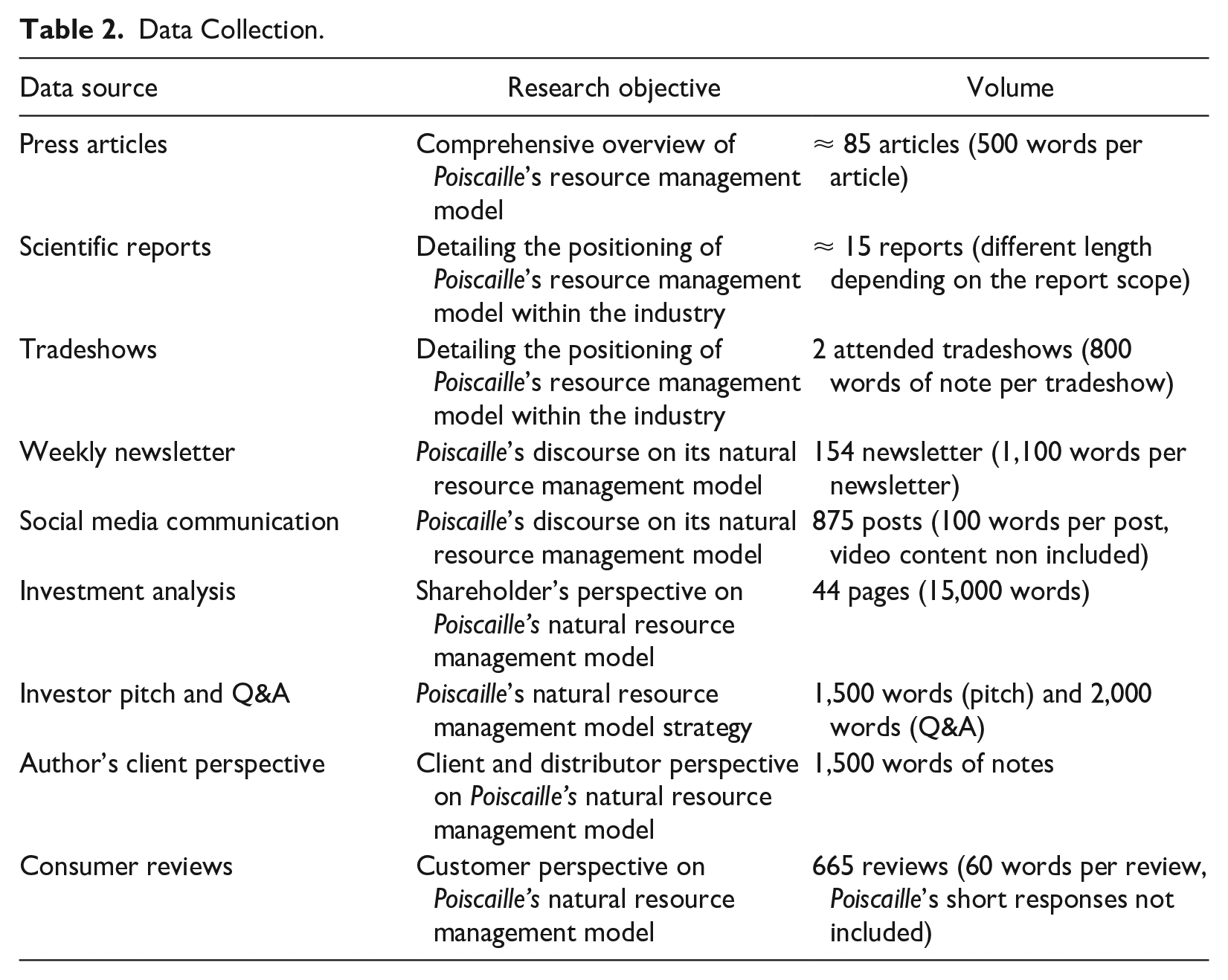
Then, gaining a better understanding of the anomalies of Poiscaille’s resource management model vis-à-vis the resource orchestration model involved obtaining firsthand data. To gain the company’s perspective, we relied on a weekly newsletter called Radio Ponton (literally, “radio pier”) that Poiscaille launched in January 2019; we systematically collected data between its start and April 2022 (154 collected newsletters). While it provides information related to the news of the week (weather forecasts, fisher involvement, etc.), more importantly, it constitutes the company’s discourse on how it manages its natural resources, both from an operational (presence to tradeshows, experiments, and the evolution of the operations) and a strategic perspective (announcement of new investors, evolution of the strategy, etc.). We complemented these data with information about the company’s social media platform (i.e., 875 collected posts duplicated both on Instagram and on Facebook), which offers similar types of content. To additionally gain a shareholder perspective, we relied on an investment analysis conducted by a crowdfunding company in 2023 that details the company’s strategy for the benefit of potential investors, including elements related to its resource management model. The analysis is complemented with Poiscaille’s written investor pitch and a Q&A between potential investors and Poiscaille’s top management team. Finally, we gained a customer perspective on the service, as one of the authors has been a client of the company and could experience the service over time and apprehend its evolution. Collecting fish and seafood from different shops in different areas of the country over the course of several years allowed the collection of further data from other clients and the distributors’ perspective. These were supplemented by the systematic collection of 665 consumer reviews from Google. The complementarities between the top executives, shareholders, and customer perspectives on Poiscaille’s resource management model specify the anomalies to the resource orchestration model that we mobilize in the next subsection to rebuild the model. Table 2 summarizes the data that we have collected to reach our research objective.
Data Collection.
Data Analysis
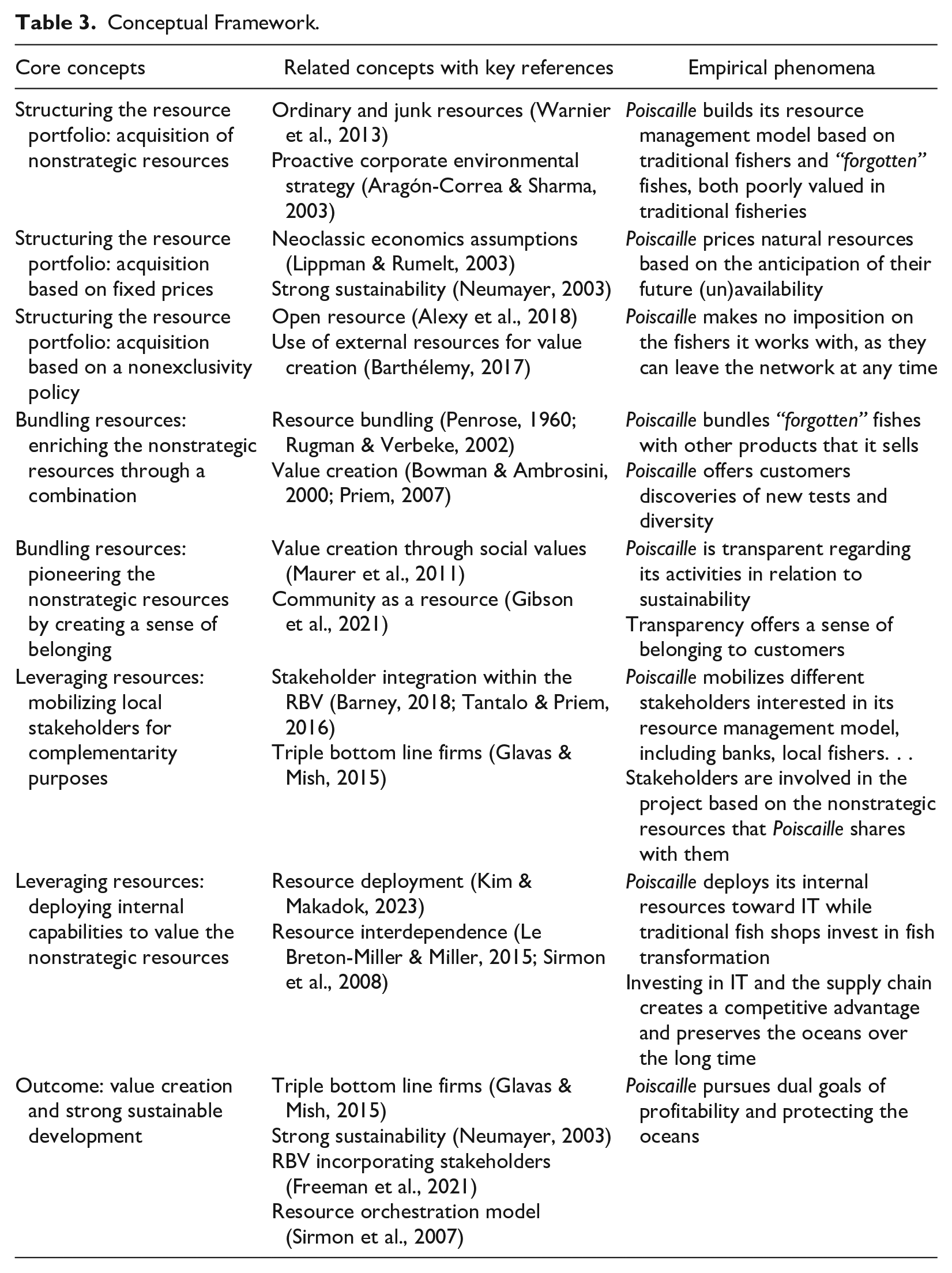
Akin to the extended case method (Danneels, 2007), we extended the resource orchestration model using an abductive approach (Sætre & Van de Ven, 2021) that iterates through two “running exchanges” (Burawoy, 1991, pp. 10–11), namely, that between the literature review and data analysis and that between data analysis and data collection. This study began with the resource orchestration model (and more broadly, the RBV), which, when applied to the Poiscaille case, led to anomalies regarding the outcome of Poiscaille’s natural resource management model in ways that are not solely aimed at developing a sustainable competitive advantage. Further literature that calls the RBV paradigm into question (e.g., Aragón-Correa & Sharma, 2003; Barney, 2018) is needed to bridge this anomaly. Given Poiscaille’s positioning regarding sustainable development, we also relied on the literature on the strong sustainability paradigm (see Neumayer, 2003). The second iteration calls for continuous back-and-forth movement between data collection and data analysis, as each analysis calls for additional information to subsequently be collected (Danneels, 2007). A better understanding of how Poiscaille structures, bundles, and leverages resources led us to focus our data collection and analysis on the specific actions that Poiscaille implements for engaging in these three processes. These two iterations informed the reconstruction of the resource orchestration model by offering an ecological resource orchestration model that can accommodate the anomalies found in the Poiscaille case. Following the extended case method (Danneels, 2007; Wadham & Warren, 2014), we conducted repeated interviews with the founder of Poiscaille to verify these emerging insights throughout the research process. Table 3 presents an overview of the core concepts, their related concepts, and the related literature and describes how they were empirically manifested in the case.
Conceptual Framework.
Findings
Acquisition of Nonstrategic Resources
All fishes are not equivalent. The fish industry distinguishes between noble fish, ugly fish, “well worked” fish, industrial fish, etc. In summary, some fish, such as tuna, trout, turbot, sole, or sea bass, are perceived as more desirable to consumers (Clouette, 2022). They are strategic for organizations because of their freshness and taste. The less desirable fishes have been “forgotten” by the fish industry as they are perceived as nonstrategic.
Rather than pursuing the acquisition of the most strategic resources, Poiscaille developed its resource management model based on the acquisition of these “forgotten” fish. This approach encourages fishers to catch all types of fish and seafood, as described in the following newspaper article:
With its delivery of product within 48 hours of the catch, Poiscaille offers “forgotten” fish. For example, the site sells mullet and pout, fish that are rarely found on fishmongers’ shelves, even though they are abundant along the French coast. “These fish are often neglected because they are little known and poorly paid. They are fragile, and trawlers and their large nets cut them open, making them unmarketable. Moreover, their flesh spoils quickly, and must be eaten quickly. In the traditional circuit, when the boats are at sea for several days, this is not possible,” says [the founder of Poiscaille]. (Le Figaro newspaper, February 20th, 2017)
The different drawbacks enumerated by the founder of Poiscaille are compensated by benefits for the conservation of the oceans: The diversification of its target species allows the company to reduce the pressure on fish stocks.
Poiscaille also relies on fishers who use small boats and “soft” fishing techniques. In fact, the company works with a network of 250 small-scale fishers who, due to the small size of their boats, are considered less efficient than large vessels because of their lower capacity to accumulate fish (Poiscaille’s website). In doing so, Poiscaille reduces the bargaining power of the largest fishing companies, which are considered responsible for the low level of fish stocks. In addition, by using a “soft” technique, the company avoids damaging the ocean. However, their location across France helps Poiscaille to overcome changing weather conditions and seasonality. When weather conditions are too risky for fish, Poiscaille can also acquire seafood from ponds along the coast. These different elements aim to guarantee profitability to the company’s resource management system.
In this way, Poiscaille relies on the acquisition of two resources—fish and fishers—that, within the RBV framework, would be assimilated into ordinary or junk resources; i.e., these resources would be perceived as neutral or negative in terms of performance (Warnier et al., 2013), and that firms anchored in an RBV paradigm would have divested due to their low value and poor contribution to the firm’s competitive advantage (Sirmon et al., 2007). However, Poiscaille acquires these resources because they ensure the conservation of specific physical stocks of critical natural capital (Neumayer, 2003). Small-scale fishers prevent the substitution of natural and human capital by avoiding the monopoly power of large vessels, and “forgotten” fish enable the substitution of critical natural capital with natural resources that are not subject to depletion. In this way, Poiscaille remains proactive in its consideration of the natural environment (Aragón-Correa & Sharma, 2003).
Acquisition Based on Fixed Prices
The founder of Poiscaille had previous experience in the fishing industry and the French Ministry of Ecology regarding related issues prior to founding the company (interview with the founder, October 2020). When he created the company in 2014, he already had a good understanding of the auction markets through which fish are mainly sold in France. The company’s description of this is presented below:
In France, most fish are sold by auction. This sales system is particularly volatile, with prices varying from 1 to 10 within a few days. Coupled with the vagaries of the weather and the movement of fish, fishing is an extremely unpredictable business. To compensate for these many parameters, the historical solution has been to fish large quantities to guarantee a minimum income even in times of poor sales. This strategy leads to the depletion of marine resources and fishers. Currently, there is no label similar to the organic label that guarantees fishermen a better income for virtuous practices. (Pitch, August 2023)
When the price of a resource is based on its expected value creation, as is the case in these markets, it increases the pressure on the most demanded species and endangers their sustainability. Thus, auction sales contribute to reproducing a “business-as-usual” perspective on sustainability through the assumption that natural resources are abundant and can be traded on a market without any consideration of their potential depletion (Neumayer, 2003).
Given such an understanding of the current system, the founder of Poiscaille developed a resource management system that relies on a fixed price for each species throughout the year, as explained below:
Poiscaille offers a very attractive model for fishers. They are guaranteed to sell their fish/harvest at a stable price throughout the year and are paid an average of 20% above market prices. This helps to enhance the value of small-scale fishing (small boats, “soft” techniques) and contributes to its development. (Investment analysis, August 2023)
Such a pricing strategy differs from the one advocated in the RBV paradigm, as the resource orchestration model assumes that resource acquisition involves the purchase of a resource at a price that reflects the expected contribution of the competitive advantage (Sirmon et al., 2007, 2011). The resource orchestration model echoes the strategy followed by fish auction houses, which set prices based on the level of demand, with the result that fishers are encouraged to focus on quantity and on the most in-demand species for gain maximization.
By offering a flat price throughout the year, Poiscaille decouples the price from the expected value added, avoiding perverse effects such as overfishing some species due to their high price. In particular, Poiscaille offers higher prices for “forgotten” species than does the auction house, which encourages fishermen to focus on catching these species instead of more in-demand species, thus reducing pressure on fish stocks, as detailed below in response to a question asked during the crowdfunding campaign:
Hello, could you please explain how the purchase price of fish from fishers is determined in relation to the auction price [. . .]. Why is it +85% for some species (sea bream), while it is +234% for others (mackerel)? Thank you.
Hello Séverine, we established price grids by zone for each species and for each fishing technique (a line fish is paid more than a net fish). For the most expensive products, between €15 and €25 per kilo, we are often slightly above the average price for the year. It is on the less expensive species that we make the biggest difference, as we never go below €3 per kilo, while some species have an average price of less than €1. We are also very interested in small calibers, which often cost much less than larger pieces. (Q&A to the investment campaign, August 2023)
By paying fishers an average of 20% more than the auction house (Poiscaille website), Poiscaille makes fishers less dependent on the auction market. By increasing their bargaining power, the founder of Poiscaille also explained to us that it improves their living conditions and prevents them from taking risks by going out to sea during stormy weather to earn extra money; fishing belongs to the most dangerous professions. Overall, Poiscaille does not price its resources according to their potential contribution to the firm’s competitive advantage (Sirmon et al., 2007, 2011) but rather according to their contribution to natural resource preservation.
Similarly, unlike firms that divest a resource when its potential value is uncertain (Sirmon et al., 2007, 2011), Poiscaille anticipates a future availability problem with respect to the species in the most demand and thus pursues a pricing strategy that aims to alleviate the pressure on certain physical stocks of critical natural capital by highly valuing the less threatened resources (Neumayer, 2003). This echoes previous research that questions the standard neoclassical microeconomic anchoring of the RBV according to which market prices help managers create, combine, manage, and exchange resources. However, this is not the case: As markets are incomplete (contrary to what neoclassical economics assumes), it is impossible to estimate the best use of a resource based on its price (Lippman & Rumelt, 2003). Poiscaille makes this estimate based on a strong sustainable rationale and thus offers a higher price to the least endangered natural resources to anticipate a future availability problem. This acquisition pricing strategy acts as an incentive for fishers to ensure the long-term conservation of natural resources.
Acquisition Based on a Nonexclusivity Policy
Although Poiscaille does not impose anything on the fishers it works with, as they can leave the network at any time, the appeal for fishers to join the network goes beyond valorization through pricing. In fact, while they are considered nonstrategic resources for the traditional fishing industry because of their lack of efficiency, Poiscaille values them, as is the case for Délia, one of the 250 fishers who belongs to the network:
Délia’s goal is to fish in a sustainable and responsible way. She harvests the resource in moderation and must increase its value to ensure her financial equilibrium. In this way, Délia emphasizes direct sales: she sells directly and promotes the products of her fishery on her Facebook page. A true spokesperson for Poiscaille, you have no doubt already seen Délia on one of the many news shows where she has been interviewed to explain and promote small-scale fishing. She also participates in several markets around Arcachon. (Poiscaille website)
According to this excerpt, this fisher has used Poiscaille to expand her distribution channel while respecting her own values. This is a good example of how fishers feel included in a network, as well as feeling free to leave it at any time. Through this method, Poiscaille aims to develop a competitive advantage based on resources that it has access to but neither owns nor controls, as they are accessible to everyone. This type of resource is referred to as open resources (Alexy et al., 2018). While they are assimilated as ordinary or junk resources under an RBV perspective (Warnier et al., 2013), by taking the example of technical consultants operating in the wine industry, Barthélemy (2017) demonstrated that resources not possessed by the firm can contribute to the firm’s competitive advantage. Going one step further, the claim can be made that surrendering control over resources also contributes to the development of a competitive advantage (Alexy et al., 2018).
Enriching Nonstrategic Resources Through Combination
Poiscaille faces obstacles in the valuation of its small-scale fishers as well as the valuation of the fish and seafood it sells, particularly in regard to “forgotten” fish that appear less valuable than “normal” fish due to their tastelessness and fragility. Thus, Poiscaille’s bundling is first based on the enrichment of its nonstrategic resources, that is, the extension of its capabilities for creating new value (Sirmon et al., 2007), by linking the different natural resources it has acquired. To this end, the company builds on the idea that, in some contexts, customers can value “forgotten” fish. Since Poiscaille sells fish and seafood in combination (1 kg of fish, 500 g of fish and 1 kg of seafood, or 2 kg of seafood), “forgotten fish” are sold in combination with resources perceived as more strategic, such as sea bass or trout. Since the daily catch of Poiscaille also varies within its network of fishers, it offers diversity to its customers who can discover new species and tastes over time and choose seafood from different geographical areas, as one customer explained:
I have been able to feast on many species I did not know about, horse mackerel, old fish, periwinkles… There’s always something extra in the basket, and you’re sure to find something to your taste. Oysters and scallops are sure bets and are almost always present. However, fishing also has its ups and downs, and the baskets can be less exciting at times, but you soon find consolation when you find a lobster, a sole or even a St. Pierre. (Google Review, February 2022)
Following the resource orchestration model, Poiscaille enriches the value of “forgotten” fish by combining them into a bundle of resources (Sirmon et al., 2007), as this Google review illustrates. The review also emphasized that each species alone may not trigger sufficient value and that a “basket,” or a combination, alone can appear disappointing from the customer's perspective. In the long run, however, the subscription model leads to customers finding the overall value of the service satisfactory. As Penrose (1960) noted, resources appear to be efficient or valuable in some uses when they are bundled with other resources (see also Rugman & Verbeke, 2002). Following the case of Poiscaille, enriching natural resources by bundling them with other resources to reach customer satisfaction means considering not only the exchange value of natural resources, i.e., their value at the point of sale, but also their use value, i.e., how they are perceived by customers (Bowman & Ambrosini, 2000). In other words, creating value involves focusing on one of the three aspects that meet customers’ needs: have customers choose to receive a previously available benefit at a lower unit cost, which often results in a greater volume purchased, make them willing to pay for a novel benefit, or make them willing to pay more for something perceived as better (Priem, 2007). Poiscaille focuses on this last aspect of value creation: creating better perceived value for customers by offering something different: Poiscaille does not offer more sophisticated value (e.g., high-quality salmon) but rather original value in comparison to the incumbent actors of the industry (e.g., new species sold in combination).
Pioneering Nonstrategic Resources by Creating a Sense of Belonging
Resource bundling also occurs through pioneering, i.e., the integration of new resources into existing resources through the association of existing resources in a new way (Sirmon et al., 2007). The case of Poiscaille shows that this can be accomplished by associating nonstrategic natural resources and immaterial resources to provide a totally new source of value: providing customers with a sense of belonging. Poiscaille bundles previously nonrelated resources together (Sirmon et al., 2007) by revealing to customers aspects that are usually considered nonvaluable for consumers. Through tradeshows’ attendance, its website, and weekly newsletters (i.e., Radio Ponton), Poiscaille communicates its reliance on nonstrategic resources: Its network of small-size fishers for which it values their traditional fishing techniques, the fixed-price acquisition strategy it has set, the benefits of “forgotten fish” by sharing culinary preparations or conservation tips to help customers consume them, etc. The aim is to share with customers—and more broadly its stakeholders—the company’s social values. Poiscaille also regularly shares its points of view on fishing practices and on the organization’s strategy. For example, it sometimes shares petitions or expresses the difficulties it faces in using sustainable practices, such as finding packaging that would be durable enough to avoid being damaged by shells and sustainable enough to preserve the planet:
Investigating our supplier: This week, Caroline, our production manager, investigated our supplier’s concerns about the “triple PE” plastic we were using. Caroline was not on board when we ordered the new packaging. In addition, she got the bad news: the three layers of plastic that make up our packaging are different in nature. A composition that disqualifies it from recycling. Although not perfect, C02 was better. Digging deeper, however, revealed that the removal of aluminum was good because its production generates far more C02 than plastic. One small positive in this discovery. So where do we go from here? First, we apologize for the misinformation. We feel stupid about showing so much enthusiasm on the wrong basis. In the short term, we’re going to look into going back to using clear wineskins for those cases that do not contain sharp shells. These single-material wineskins are recyclable. In addition, in the medium term, we’re working with our supplier to find packaging that is both strong, waterproof and recyclable. We’re on the right track, and we’re not giving up. (Radio Ponton #141, January 9th, 2022)
The consequence of such transparency, as exemplified with Poiscaille’s packaging, leads to a sense of community belonging, as illustrated in several Google reviews: Our kids discover some truly beautiful seafood that has a story behind it, and I show them the fisher’s description each time. (Google Review, 2021)
Poiscaille is not just a fish; it is also a very active community of fishers that we support in their defense of sustainable fishing. Poiscaille shares their joys and difficulties with us in a weekly newsletter to help us understand their constraints! For me, it gives me a little hope that we can still change our production systems by changing the way we consume. (Google Review, 2023)
These reviews show that being transparent about Poiscaille functioning creates a sense of belonging to customers. This approach improves their value perception of the offered service. Previous research anchored in the RBV has shown that building on social value (Maurer et al., 2011) and community (Gibson et al., 2021) both contribute to developing a firm’s competitive advantage. On the one hand, given the dynamic between the firm’s internal resources and the firm’s external institutional context, Maurer et al. (2011) suggested that firms can manage some of the cultural elements in their contexts by bridging their social value with the social value systems in which they are embedded. On their side, Gibson et al. (2021) argued that the features of the RBV are applicable to the community as strategic resources, meaning that building on a community, although external to the firm, can contribute to the firm’s competitive advantage.
Mobilizing Local Stakeholders for Complementary Purposes
To leverage its nonstrategic resources, Poiscaille relies on local stakeholders. For example, humor is used in explaining that Poiscaille wants to create the “the first fishing marriage agency” (Radio Ponton #120, August 15th, 2020). To this end, it organizes frequent meetings with the fishers of its network to share information that it has access to thanks to its national coverage. Similarly, during two months in 2021, Poiscaille organized the “Tour de France” network to better understand the fishers who comprise it (Radio Ponton #130, October 24th, 2021). In addition to fishers, Poiscaille mobilizes other locally anchored stakeholders. For example, at the end of 2022, the company raised eight million euros from banks and investors. In a newspaper article, the founder explains the stakeholders’ perspective on the investment as follows: The funds were raised from a pool of investors “in line with our desire to combat overfishing,” [the founder] points out. “Arkea Capital in Brest, for example, sees this as a way of ensuring the financing of new boats, since Poiscaille fishers will benefit from a guaranteed price. Like us, Crédit Agricole, through the IDIA Capital Investissement, wants to work toward better remuneration for the profession, while Quadia invests in food to restore its value.” (Maddyness Newspaper, October 13th, 2022)
As the extract points out, Poiscaille has attracted investors, such as the Arkea Capital Bank, who are locally anchored in a fishing area. In Poiscaille, they see the possibility of insured financing for fishers’ boats thanks to the fixed price at which Poiscaille buys their fish and seafood. The same is true for the two other investors mentioned in the newspaper article.
The examples of the mobilization of fishers and investors show the ability of Poiscaille to create a virtuous circle of value creation among its stakeholders. The greater the value created among them (through sharing information and ensuring stable revenue), the more value that is created for itself (through the creation of value for customers) and for society (by alleviating fish stock reduction). By relying on open resources, firms develop synergies among different types of resources that benefit both the firm and the stakeholders (Tantalo & Priem, 2016). Thus, all stakeholders appropriate part of the profit that the resources deliver (Barney, 2018). In doing so, the company incorporates the consideration of stakeholders in its resource management model (Freeman et al., 2021; Starik, 1995). This finding echoes previous RBV research on firms that collaborate with other organizations throughout the value chain to create a competitive advantage not only for the firm itself but also for these other organizations (Glavas & Mish, 2015).
Deploying Internal Capabilities for Value Purposes
We observe that to leverage its nonstrategic resources, Poiscaille deploys internal capabilities in a way that differs from traditional fish shops because of its portfolio of resources, which is composed of nonstrategic resources. While fish shops traditionally deploy capabilities related to fish transformation, to develop a strategy anchored in RBV thinking (a resource advantage strategy, market opportunity strategy, or entrepreneurial strategy) (Sirmon et al., 2007), fish transformation is only minimally performed within Poiscaille’s resource management system. The data show that Poiscaille focused only on the preparation and shipping of fish and seafood. All the elements related to transformation, such as fish gutting, which is performed by fishers, are outsourced.
Indeed, Poiscaille has deployed internal capabilities to make its supply chain more efficient. The aim is to deliver ultra-fresh fish and seafood within 48 to 78 hr, depending on where the clients are located, compared with conventional fish shops, whose supply chain may take a week for delivery. “Forgotten fish” then creates value, as these delicate fish do not spoil and remain tasty for customers. Regarding the deployment of IT capabilities,
[f]rom the outset, Poiscaille made the strategic decision to bring digital technology in-house, given the high logistical stakes of the business and the need to customize the information system.
The technical team consists of Yves (CTO and partner), a designer and three developers. A product manager has just joined the team. With the main tools already in place, no significant hiring is planned as part of the fundraising. This strategy is more of a continuous improvement approach.
The technical environment consists mainly of the following components:
A website with an e-shop and an editorial section.
A small application for fishers.
A global back office (“Kraken”).
An API that allows everything to communicate.
Certain tools are also used, such as Stripe for invoicing. (Investment analysis, August 2023)
As there were no standard IT solutions available on the market to handle the distribution of products according to Poiscaille’s online platform model, the company had to deploy capabilities to do so. Owing to its IT platform, Poiscaille can offer a mix of ultra-fresh fish and seafood, which are perceived as valuable by customers.
This finding echoes that of Kim and Makadok (2023) who emphasized the importance of capabilities’ organizational deployment to fit organizational workflows. Observed resource deployment is pursued by developing interdependence between resources and their internal and external contexts (Le Breton-Miller & Miller, 2015; Sirmon et al., 2008). Such interdependence (or combination and integration for Branzei & Thornhill, 2006) generates specialized and rare capabilities. Specifically, the deployment of internal capabilities for creating value based on nonstrategic resources is enabled by the superior information that the firm has accumulated on these resources (Alexy et al., 2018; see also Lavie, 2006). By leveraging nonstrategic natural resources with internally deployed capabilities, the organization values nonstrategic resources for consumers. In the end, their consumption diverts consumers from endangered resources, which leads to strong sustainable development (Neumayer, 2003).
Pursuing Value Creation and Sustainable Development
Through its acquisition of nonstrategic resources based on fixed prices and on a nonexclusivity policy, bundling through enrichment by pursuing combination and pioneering, and leveraging through the mobilization of local stakeholders for complementary purposes and the deployment of internal capabilities, we argue that Poiscaille pursues a dual objective that includes both value creation and sustainable development.
First, we used the description of the components of Poiscaille’s resource management model to find that the company’s goal is sustainable development. This is confirmed in the pitch of its crowdfunding campaign, which follows: Poiscaille’s mission is threefold:
Regeneration of fish populations: by maintaining sustainable levels of fishing, fish populations have the opportunity to recover and reach higher levels in the long term;
Conservation of marine ecosystems and increased ecosystem resilience to climate change and other environmental pressures;
Economic stability for coastal communities, as sustainable fishing practices enable coastal communities to secure their livelihoods over the long term. (Pitch, August 2023)
The strategy followed by Poiscaille is a triple-bottom-line strategy, which can be used by firms that aim to become more ecologically and socially responsive while also prospering economically (Glavas & Mish, 2015). To this end, a resource management model was first developed that incorporates stakeholders (Freeman et al., 2021) and assumes limited substitution between natural and human-made capital to preserve specific physical reserves whose losses are irreversible (Landrum, 2018; Neumayer, 2003).
In addition, Poiscaille aims to become profitable. The investment analysis written for its crowdfunding campaign states that “[t]he aim of this fundraising is to support the company’s cash requirements over the next 18-30 months, in order to achieve operating profitability by 2025” (Investment analysis, August 2023). Poiscaille is not an NGO but rather a startup. Thus, the goal of the resource management model that is described in this article is to develop a competitive advantage for profit generation, as is the case for the resource orchestration model anchored in the RBV (Sirmon et al., 2007).
We refer to the resource management model described throughout this section as the ecological resource orchestration model. Figure 1 shows the results, which are discussed in the next section, where we offer implications for natural resource management research and the resource-based view literature.
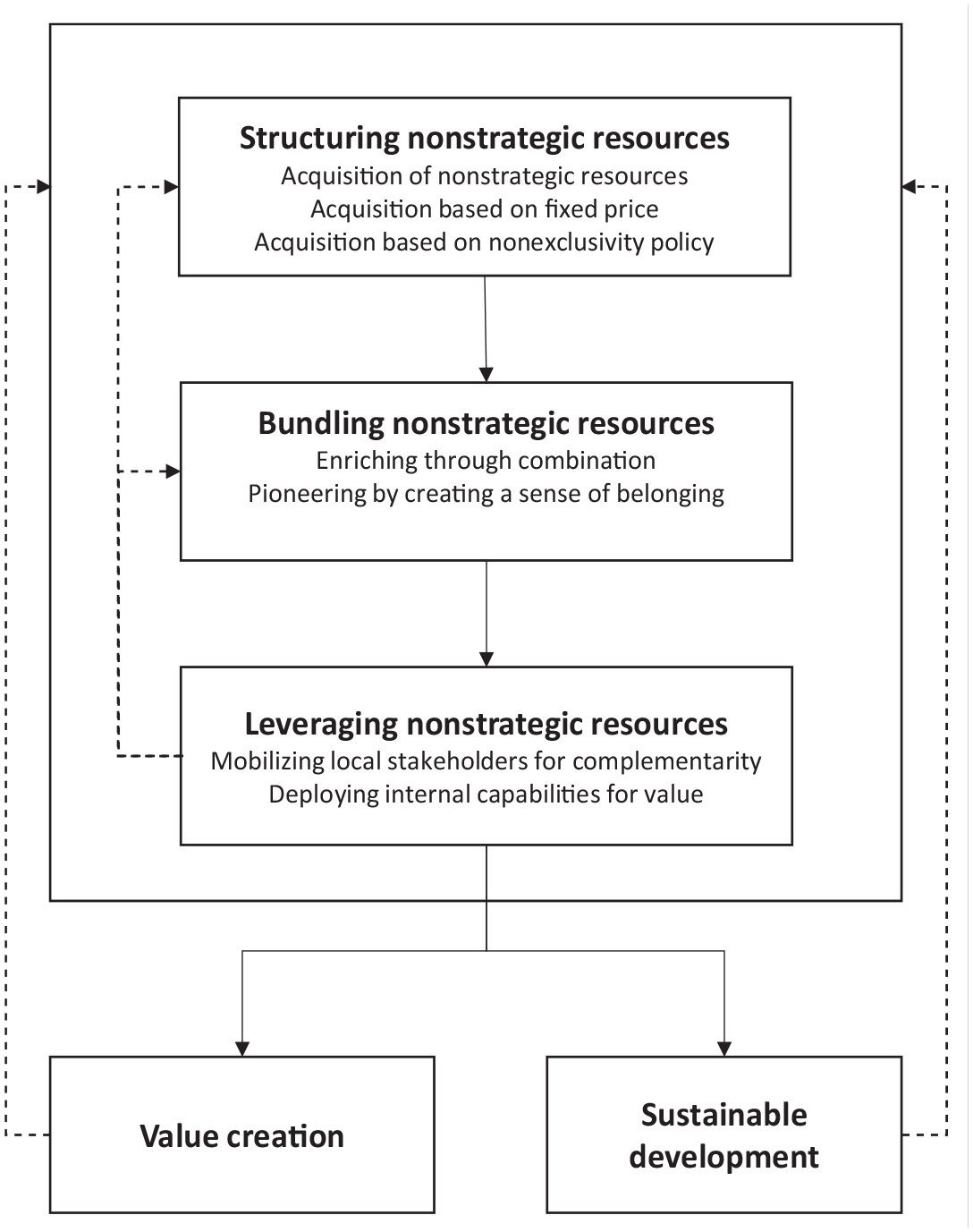
The Ecological Resource Orchestration Model.
Discussion
Implications for Natural Resource Management Research
Following previous attempts to respond to George et al.’s (2015) call for studying natural resources from a management standpoint (e.g., Figge & Hahn, 2020; Tashman, 2020), we argue that our research contributes to this bourgeoning literature by complementing the explanations for natural resource depletion, offering a prescriptive model for natural resource preservation, and shifting this literature from focusing on the construction of a business case for sustainability to that of an “ecological case for business.”
First, previous research has shown that natural resource depletion is caused by organizations’ dependence on natural resources that arises from the uncertainty of the natural environment (Figge & Hahn, 2020; Tashman, 2020). When organizations can control local ecosystems, they manage uncertainty privately through the use of an economizing logic that views natural resources and ecosystems as private goods that should be used to improve organizational efficiency (Tashman, 2020). Conflicts over natural resources epitomize this situation (Downey et al., 2010). Our research contributes to these explanations of natural resource depletion. Given the inconsistency between the RBV paradigm and the strong sustainability perspective on natural resources, we show that the depletion of critical natural capital (e.g., nonrenewable natural resources, biodiversity, and ecosystems) results from organizations’ search for more sources of competitive advantage. Thus, importantly, the way in which firms conceptualize competitive advantage encourages the depletion of natural resources. The inability to devise a sustainable natural resource management system is in line with prior research that criticizes management theories and models for their inability to meet the sustainable development requirements of corporations (Ghoshal, 2005; Nyberg & Wright, 2020) and to ensure the wise management of natural resources.
Furthermore, in contrast to prior natural resource management research, which has adopted a normative perspective by demonstrating the existence of different configurations to enhance the return on natural resources and to manage natural resource scarcity (Figge & Hahn, 2020; Tashman, 2020), we offer a prescriptive model of natural resource management by adopting a new paradigm for natural resource management. Consistent with Tashman (2020), who proposed solutions to natural resource depletion that transcend ecologizing—that is, natural resources must be used sustainably for social welfare—and the aforementioned economizing logics, in this article, we propose the use of nonstrategic renewable natural resources for critical natural capital preservation that, when bundled with internal resources, create value for customers, allowing them to achieve the concomitant pursuit of a competitive natural capital advantage and natural resource preservation. In doing so, we provide a prescriptive model to respond to the grand challenge of the scarcity and sustainability of Earth’s natural resources by finding a way to engage business, as exhorted by George et al. (2015), and move beyond “business-as-usual” thinking (Nyberg & Wright, 2022).
Finally, while prior research on natural resource management has focused on the business case for sustainability (e.g., Figge & Hahn, 2020; Tashman, 2020), we reverse the argument to make an “ecological case for business” (Ergene et al., 2021). We have facilitated this transition by adopting a strong sustainability perspective on natural resource management that has led to the development of an ecological resource orchestration model. Rather than pushing for incremental sustainable change for business purposes, our model encourages reliance on nonstrategic resources. It is thus necessary to find ways to establish an ecological case for businesses. It involves various mechanisms that we document with the case of Poiscaille and that are extended by relating to different concepts, such as creating a sense of belonging, bundling resources, deploying internal capabilities to value nonstrategic resources, and mobilizing local stakeholders (see Table 3 for details). Constructing an ecological resource orchestration model thus contributes to reversing the business case for sustainability and “business-as-usual” thinking, which has been criticized as ineffective in creating sustainable change (Kaplan, 2020; Nyberg & Wright, 2020, 2022).
Implications for the RBV Literature
Our ecological resource orchestration model provides an alternative to the resource-based view literature, echoing research that has similarly aimed to uncover ways of preserving natural capital and extending the ongoing discussions regarding the resource orchestration model.
First, by grounding our work in a strong sustainability approach, our main contribution to the RBV is to provide an alternative framing to RBV thinking (Newbert, 2007). Landrum (2018) delineated a spectrum of sustainable development between weak and strong perspectives, which she summarizes well with the phrases “doing less bad” and “repairing damage to systems,” respectively. The difference between the two perspectives on sustainability reflects the difference between current RBV thinking research and the anchoring of the extension to the resource orchestration model that we developed in this article. In the middle of the spectrum are various approaches that have challenged the RBV with the goal of “doing more good” (Landrum, 2018), such as the natural resource-based view and the contingent resource-based view, both of which are inscribed in a Ricardian foundation and involve the goal of developing a competitive advantage while still accounting for the natural environment (Aragón-Correa & Sharma, 2003; Hart, 1995). Our strong sustainability approach to natural resource orchestration extends this previous work by going one step further in finding consistency across the RBV and the strong sustainability paradigms. While it similarly develops a competitive advantage for the firm, it shifts from accounting for the natural environment to preserving natural capital.
Our model aims not only to limit environmental damage but also to regenerate the environment and generate social benefits (Upward & Jones, 2016). To this end, it echoes other RBV research that similarly aims to “repair damage to systems,” such as triple-bottom-line approaches to the RBV (e.g., Glavas & Mish, 2015; Tate & Bals, 2018). More precisely, while research such as Glavas and Mish (2015) challenges the RBV’s inimitability assumption by encouraging firms to imitate their resources and capabilities, thereby creating a collaborative advantage with the organization’s stakeholders, the ecological resource orchestration model that is developed in this article challenges other RBV assumptions, particularly the assumptions of value and rarity, by rethinking the nature of resources and relying on nonstrategic resources for the development of a competitive advantage and the conservation of critical natural capital (Fréry et al., 2015; Warnier et al., 2013). In doing so, we complement Glavas and Mish (2015) by rethinking what matters in regard to a competitive advantage under a strong sustainability paradigm. We also extend their work on stakeholder engagement by emphasizing stakeholder engagement through the orchestration of natural resources (e.g., creating a sense of community belonging with customers and mobilizing local stakeholders). Thus, we pursue Barney’s (2018) agenda of creating a dialog between stakeholder theory and the RBV, using the case of natural resources.
Finally, our work extends prior work on the resource orchestration model. On the one hand, our work responds to Andersén (2023), who called for the study of processes that simultaneously create economic value and environmental benefits. On the contrary, it explains how firms or managers can synchronize the orchestration of natural resources with their temporal decay for long-term preservation (Karadag & Poppo, 2021). These findings show that such processes rely on structuring a portfolio of resources based on the acquisition of nonstrategic resources, bundling resources with other resources to create value, and pursuing a leveraging strategy by mobilizing local stakeholders and deploying internal capabilities for long-term capital preservation.
Limitations and Future Research
This study is not without limitations. First, as we applied a unique case to show how the resource orchestration model can be extended through its relation to different concepts, our theorizing applies to empirical cases that are comparable to the studied case and located in natural resource-based industries. This can be seen in the prior research on the cut-flower or hemp industries (see Carton & Parigot, 2022, 2024), in which the application of our findings would have the most impact. However, additional research should be conducted to generalize this ecological orchestration model to the management of finite resources or to cases where it is difficult to find a nonstrategic resource equivalent to an endangered resource, as would be the case for water or the atmosphere. Second, our model barely accounts for environmental uncertainty (except for the pricing strategy used to anticipate a future availability problem), despite its importance in natural environments and natural resource contexts (Aragón-Correa & Sharma, 2003; Figge & Hahn, 2020; Sirmon et al., 2008; Tashman, 2020). This calls for further extensions of our model to better account for law and regulation, the natural environment, competition, and so on. Finally, unlike other natural resource management models that were developed for normative purposes (e.g., Figge & Hahn, 2020; Tashman, 2020), the ecological resource orchestration model that we developed is prescriptive. While this approach hinders the general understanding of how to manage natural resources in a sustainable manner, it also offers solutions to natural resource depletion that can be mobilized by practitioners, as detailed at the end of this article.
Conclusion
We began this article by asking why the resource orchestration model is conducive to critical natural capital depletion and found that this is due to its anchoring in the RBV, which is inconsistent with a strong sustainability paradigm. Building on the case of a Poiscaille that has successfully developed a competitive advantage and preserved natural resources over the long run, we extend the resource orchestration model by relying on concepts anchored in both the RBV and the strong sustainability perspective. This leads to an ecological resource orchestration model, according to which firms structure their resource portfolio based on the acquisition of nonstrategic resources acquired at a fixed price and not owned by the firm to ensure their preservation in the long run; bundle them with other resources through their enrichment by combining them with other resources to create value for customers and their pioneering by creating a sense of belonging among customers; and develop a leveraging strategy that achieves both a sustainable competitive advantage and the preservation of natural capital by mobilizing local stakeholders who find complementarity with the natural resource management model and deploying internal capabilities that are different from those typically deployed in the industry to value nonstrategic resources.
Our model led us to discuss the current research on natural resource management models by complementing the explanations of natural resource depletion, offering a prescriptive model for natural resource conservation, and shifting this literature from constructing a business case for sustainability to an “ecological case for business.” It also led us to discuss the RBV literature by proposing an alternative to the theory that both extends prior research anchored in a weak sustainability paradigm, complements triple-bottom line approaches with their challenges of the RBV, and extends current research on the resource orchestration model.
This work has several entrepreneurial, political, and pedagogical implications. First, given the prescriptive nature of our model, entrepreneurs can mobilize it to develop their own businesses to both develop a competitive advantage and preserve natural capital. As the model shows, this approach involves the reliance on nonstrategic resources, which are acquired at a fixed price and are not exclusive to the firm; their combination with other resources; the creation of a sense of belonging among customers to create value for customers; the mobilization of local stakeholders who find complementarity with the natural resource management model; and the deployment of internal capabilities that are different from those typically deployed in the industry to value nonstrategic resources. This resource management model not only impacts organizations at their inception but also during their growth, which should involve not only scaling up but also duplicating the model at a local scale to ensure its sustainable development (Bauwens et al., 2019). This is due to the embeddedness of the ecological orchestration model in its local context, in which a resource can be nonstrategic in one area and strategic in another area, and local stakeholders can vary from one area to the other.
Second, this work has policy implications for decisions to trade natural resources to compensate for waste and pollution, as illustrated by carbon compensation policies. The strong sustainability perspective that is at the core of our model suggests that the substitution of natural resources for human capital by allowing the degradation of critical natural capital by allowing air pollution or ozone layer degradation is not possible (Verret-Hamelin, 2019). As summarized by Neumayer (2013), the application of strong sustainable policies toward natural resources involves thinking not in terms of value but in terms of the physical stocks of critical natural capital. Thus, apprehending natural resources from a strong sustainability perspective involves being cautious about the establishment of compensation policies, as they contribute to critical natural capital destruction. In contrast, we suggest public policies that promote resource management models, such as the one developed in this article, that facilitate nonexclusive resource sharing, incentivize ventures aimed at adopting such a model in natural resource-based industries that are subject to depletion, and prevent monopolies in these industries as they distort market prices and render the execution of the model more difficult.
Finally, we believe that this study, based on RBV thinking, offers an example of how to challenge the main theories that were developed in the discipline of management. Performing research and teaching based on organizational cases that rethink concepts such as global value chains, governance systems, or international strategies, among other examples, can be a source of learning for future generations to show how it is possible to develop a competitive advantage while preserving natural capital.
Footnotes
Acknowledgements
The authors thank Marcus Wagner for his editorial guidance and the two anonymous reviewers for their thoughtful comments. They have also benefited from the feedback of Aurélien Acquier, Jean-Pascal Gond, Marie Joachim, Louise Lecomte, Thomas Roulet, Bertrand Valiorgue, and more generally all the colleagues who participated in our sessions at AIMS 2020 and 2021, AOM 2022 and attended the IFGE workshop at emlyon business school in 2023.
Declaration of Conflicting Interests
The author(s) declared no potential conflicts of interest with respect to the research, authorship, and/or publication of this article.
Funding
The author(s) received no financial support for the research, authorship, and/or publication of this article.
