




Abstract
Although environmental interventions require technical and social approaches, organizations often privilege the former. This pattern’s persistence remains underinvestigated. This study analyzes several years of ethnographic fieldwork in a peacebuilding- and sustainability-focused organization through the four dimensions of Connell’s gender regime framework to demonstrate how professional logics in fields with asymmetric gender institutionalization produce divergent organizational gender regimes that prefer particular forms of knowledge, work, and authority. The peacebuilding domain, which has institutionalized gender frameworks, considers multiple knowledge forms authoritative and relational processes productive; the environmental domain, which lacks comparable institutionalization, privileges technical expertise over social and community-based knowledge. Consequently, organizational actors attempting to translate gender-inclusive practices across domains face epistemic and structural barriers. This study contributes to institutional logics by demonstrating how professional logics shape gender regimes through epistemic mechanisms and extends Connell’s gender regime theory by linking organizational patterns to field-level institutional dynamics, with insights for environmental management.
Keywords
Introduction
While scholars have recognized the way that environmental challenges require both technical and social solutions, environmental management often privileges technical approaches that sideline alternative forms of knowledge and expertise (Hoffman, 2003; Hoffman & Jennings, 2015, 2021; Klassen & McLaughlin, 1996). In this context, technical approaches refer to expert-driven interventions with an emphasis on scientific or engineering solutions, quantifiable metrics, and efficiency, while social approaches focus on community engagement, local knowledge, and participatory processes. Environmental interventions disproportionately preferencing technical approaches can reproduce gender disparities (MacGregor, 2017, 2019), which may constrain the interventions’ effectiveness (Starik & Rands, 1995). Despite the recognition of these patterns, the environmental management literature has a limited understanding of why the privileging of technical approaches over social ones persists or how to address this imbalance. This study responds to this gap by examining how field-level gender institutionalization (or the lack thereof) shapes environmental management practices through epistemic mechanisms that shape what is considered legitimate professional work. Organizations that operate across multiple fields provide a unique window into how institutional pressures constrain or enable varying approaches to environmental management (Hoffman, 2001).
These patterns are particularly visible in environmental peacebuilding, an interdisciplinary field linking natural resource management to efforts around conflict mitigation, management, resolution, and recovery, and in which organizations work at the intersection of sustainability themes and peace work (Dresse et al., 2019; Ide et al., 2021). The peacebuilding field has increasingly institutionalized gender-inclusive approaches through frameworks like the Women, Peace and Security (WPS) agenda, seeking women’s participation and roles as agents of change throughout the peace and conflict cycle. The WPS agenda has been implemented through numerous efforts, including institutionalizing professional standards, evaluation systems, and donor requirements recognizing gender perspectives and strategies as integral parts of peace work (Cohn, 2008; Tryggestad, 2009). In contrast, the environmental sustainability field acknowledges the relevance of gender perspectives without comparable institutionalization (Arora-Jonsson, 2014; MacGregor, 2010). This creates conditions where organizations engaged in environmental peacebuilding navigate competing institutional pressures: peace-related work operates within field-level frameworks requiring gender integration, while environmental work lacks comparable structures. Understanding how these competing dynamics manifest within organizations reveals important insights about what constrains holistic environmental management practice and what may enable more integrated approaches to sustainability challenges.
The Center for Transboundary Environmental Cooperation (C-TEC) (pseudonym) exemplifies these dynamics. Founded during the Oslo Peace Process and operating in Israel and Palestine, C-TEC brings together Palestinians and Israelis—scientists, engineers, and civil society members—in collaborative environmental initiatives. The organization operates across two primary domains: peacebuilding programs focused on environmental education and dialogue, and environmental management initiatives focused on research, technology implementation, and cross-border environmental cooperation. This dual structure makes C-TEC representative of organizations navigating the institutional complexity created by operating across fields with different levels of gender institutionalization. Like other environmental peacebuilding organizations, C-TEC demonstrates marked differences in how gender considerations are integrated across its work, with systematic attention to gender in peace-related programs contrasting with largely peripheral treatment in environmental initiatives.
These organizational patterns became starkly apparent during a sustainable infrastructure tour in the fall of 2021 across Palestine and Israel. I joined a group of Gazan engineers and community development professionals, equally composed of men and women. From the outset, the tour faced gendered challenges. Gazan security was initially reluctant to allow the women to participate. The men in the group were engineers in respected institutions, while the women were mostly members of their local environmental or community development clubs. The officials saw the value of participation for the men but not the women. However, C-TEC’s Palestinian and Israeli partners insisted the women attend by firmly stating that the entire trip would be canceled if the women were excluded, proudly noting their commitment to gender inclusion and equality. In the end, the tour successfully commenced with both women and men.
Despite the partners’ initial stance on gender inclusivity, the tour exposed persistent patterns regarding the knowledge and approaches perceived as legitimate environmental work. The infrastructure tour schedule included visits to sites featuring a range of projects from cutting-edge, high-tech solutions to low-tech, community-centric environmental interventions. Visits to the sites of high-tech interventions carried out through technical skills and knowledge, projects more aligned with the men’s interests and expertise, received ample time. In contrast, the low-tech projects, more aligned with the women’s interests and expertise, were consistently rushed or removed from the schedule, despite the women’s requests to stay or visit these sites. This discrepancy points to a deeper issue, namely that, while women’s participation was considered critical to the tour’s continuation, their preferences and expertise were rendered unintelligible as legitimate environmental work within prevailing professional logics, demonstrating how technical approaches can be prioritized at the expense of recognizing diverse forms of environmental knowledge and practice.
While research has explored how fields shape gender regimes (Connell, 2005) and how organizations respond to pressures for gender inclusion (Benschop & van den Brink, 2013; Zanoni et al., 2010), we have insufficient knowledge of how organizations navigate fields with contrasting levels of gender institutionalization. This is significant for understanding how organizations might develop more effective or equitable approaches to sustainability challenges, which is particularly relevant as organizations increasingly operate across field boundaries (Furnari, 2016) and may face competing institutional pressures around gender inclusion. Therefore, this study seeks to address the question: How do field-specific gender regimes manifest in organizational practice when organizations operate at the intersection of fields with contrasting approaches to gender institutionalization? And, secondarily, what are the implications for environmental management?
This research makes a few key contributions. First, to environmental management scholarship, it shows how field-level gender dynamics can create intelligibility barriers, namely, the inability to recognize certain forms of work, knowledge, or outcomes as legitimate professional practice that constrain organizations’ integration of technical and social approaches to sustainability challenges (Hoffman & Jennings, 2015; Starik & Rands, 1995). Second, to scholarship on gender and sustainability (Alston, 2014; MacGregor, 2010), it demonstrates the structural constraints resulting from the lack of field-level gender institutionalization in environmental work that limit well-intentioned organizational efforts at inclusion, revealing an important ‘road not taken’ in sustainability practice. Third, to the literature on gender regimes in fields and organizations (Connell, 2005; Mackay et al., 2010), it demonstrates how multiple gender regimes operate within a single organization, showing how field-level dynamics shape organizational possibilities. While this study focuses on a nonprofit organization, its findings have implications for organizations across sectors that navigate multiple fields with different gender regimes. Ultimately, this research broadens our understanding of how environmental management practices are constrained by organizational choices, as well as field-level gender dynamics that shape which approaches are considered legitimate, valuable, and possible, and offers insights for accelerating sustainability mainstreaming through more integrated approaches.
Theoretical Background
To understand how field-level gender institutionalization shapes organizational gender regimes, with clear implications for environmental management practices, this study unpacks the mechanisms linking field-level dynamics to organizational-level patterns, which are particularly visible when organizations navigate multiple fields with contrasting levels of gender institutionalization.
Gender Regimes Across Fields and Organizations
Organizational fields, namely, “those organizations that, in the aggregate, constitute an area of institutional life” (DiMaggio & Powell, 1983, p. 148), play an important role in shaping how organizations approach gender. Fields are relational spaces in which diverse actors engage in practices and develop shared understandings around issues of common concern (Wooten & Hoffman, 2017; Zietsma et al., 2017). Importantly, fields are embedded in and shaped by broader political, social, and cultural contexts, which means that relations within them are not neutral but influenced by these wider structures (DiMaggio & Powell, 1983; Scott, 2013). Fields influence organizational practice through institutional logics, namely, the “socially constructed patterns of symbols and material practices, assumptions, values, beliefs, and rules” (Thornton et al., 2015, p. 2) that comprise meaning systems that help determine what issues are considered important, what solutions are appropriate, and what is considered competent professional practice (Thornton & Ocasio, 1999). These logics operate epistemically, where they can constrain behavior but, more importantly for the sake of this paper, determine what is seen, known, and valued. Fields develop distinct professional logics, influencing what is legitimate expertise and valued work, and organizations operating across multiple fields can face institutional complexity when these logics conflict (Greenwood et al., 2011).
At the same time, institutional logics scholarship in organizational and management studies has been largely inattentive to gender (Ejaz et al., 2023), failing to sufficiently examine how logics produce gendered organizational patterns. This oversight is consequential because professional logics often, intentionally or unintentionally, privilege certain knowledge and work forms in ways that may be gendered. When professions develop these logics in particular contexts, what becomes coded as “professional” or “objective” can reflect who had the power to define these standards (Acker, 1990). Understanding how field-level dynamics shape organizational gender patterns necessitates integrating institutional logics with a gender analysis.
Feminist institutionalism expands on this concept by exploring how gender is embedded in institutional fields (Mackay et al., 2010). It critiques mainstream institutional theory for its gender blindness and seeks to incorporate feminist perspectives into institutional analysis (Mackay et al., 2009). In this context, gender regimes, defined by Connell (2005) as the patterning of gender relations in institutions, become crucial for understanding how gender norms, practices, and power relations become institutionalized within organizational fields. Connell identifies four key dimensions through which gender regimes can manifest: division of labor (how work is distributed and subsequently valued; see also Acker, 1990), power relations (with attention to how authority is allocated and what knowledge is legitimated; see also Kanter, 1977), symbolism (with an emphasis on the beliefs or language that make gender in/visible, also embracing characteristics more culturally associated with masculinity, while marginalizing feminine-coded approaches; see also Ely & Meyerson, 2000), and emotional and human relations (emphasizing what relational processes are valued; see also Hochschild, 1983 and Fletcher, 2001).
Within organizations, gender regimes manifest through organizational processes—interconnected practices, activities, and logics that construct and maintain gender relations (Acker, 1990, 2006). These regimes often reflect broader societal gender orders (Acker, 2006; Cohen et al., 2023), yet they can also reflect the agency of individuals or groups seeking to disrupt or transform existing structures (Battilana et al., 2009; Heucher et al., 2024; Leca et al., 2008).
Research points to the ways organizations respond to institutional complexity, navigating competing or contradictory institutional logics (Greenwood et al., 2011). However, we know little about how organizations navigate multiple gender regimes, how these regimes manifest in organizations operating across fields with different levels of gender institutionalization, and the impacts of this variation on organizational practice.
Field -Level Variation in Gender Institutionalization
Fields have a level of variability with regard to how they have institutionalized gender in their professional standards, evaluation systems, and organizational practices. Some fields have developed more comprehensive institutional frameworks that systematically integrate gender considerations, employing the help of external consulting and professional evaluation programs like the International Labour Organization, or bringing in internal organizational members to address these issues. Other fields acknowledge gender’s relevance without translating this into institutional structures and practices. This variation reflects different levels of field-level institutionalization, particularly regarding the extent to which gender is embedded in policies, funding requirements, professional competencies, and evaluation criteria that can shape organizational practice across a field. Examining this variation provides insights into field-level dynamics that can influence organizational patterns.
The peacebuilding field illustrates how gender can become institutionalized at the field level through comprehensive frameworks. Historically dominated by masculine logics prioritizing militarized security and formal political processes (Cohn, 2008), the peacebuilding field has increasingly institutionalized gender-inclusive approaches. In 2000, the United Nations Security Council passed resolution 1325, calling for women’s integration in all aspects of peace and security. This resolution and subsequent frameworks led to the Women, Peace and Security (WPS) agenda, which introduced new gender logics and practices regarding women’s participation in peacebuilding efforts, shaping policies and procedures influencing international organizations, national governments, donors, and NGOs (Cohn, 2008; Tryggestad, 2009). These frameworks operate through multiple mechanisms: donor requirements increasingly mandate gender strategies and quotas; evaluation and reporting frameworks measure gender-related outcomes; and professional standards in the field have evolved to incorporate gender analysis as an important dimension of peacebuilding practice (Davies & True, 2019; True & Mintrom, 2001). These mechanisms embed gender considerations into organizational routines across the field, despite ongoing implementation challenges (Ben-Shmuel & Faraj, 2021; Lion, 2024, 2025; Paffenholz et al., 2015). Research documents the effects of this institutionalization, as women’s inclusion in peace processes is associated with greater opportunities for problem-solving, more effective policy-making, and more sustainable peace agreements (Adjei, 2019; Nilsson, 2012; O’Reilly et al., 2015); and women employ gender-specific conflict management strategies to prevent and de-escalate conflict (Rigual et al., 2022), mobilize for collective action (Goss & Heaney, 2010), shape government preferences for negotiations (Nagel, 2021), and form the backbone of peace organizations and peace education efforts (Ben-Shmuel & Faraj, 2021; Brock-Utne, 2009). The peacebuilding field demonstrates how field-level institutionalization can create systematic expectations and criteria that shape organizational practice.
In contrast, the environmental sustainability field presents a different pattern, recognition of gender’s relevance without comprehensive field-level institutionalization (Arora-Jonsson, 2013, 2014). The field acknowledges gender dynamics and their importance to environmental efforts, supported by evidence that women’s inclusion and leadership in sustainability result in effective outcomes (Resurrección et al., 2019). International initiatives have emerged, such as the 2019 United Nations Environment Assembly (UNEA) resolution on gender equality in environmental governance (Denton, 2002), indicating field-level awareness. However, these policies have not resulted in comprehensive institutional frameworks comparable to those in peacebuilding (Dankelman, 2010).
The field lacks systematic financial requirements regarding gender strategies, more comprehensive evaluation criteria for measuring gender integration, and broader professional standards treating gender analysis as part of core environmental competence. In this area, women have often been seen as victims rather than leaders (Arora-Jonsson, 2011; Denton, 2002) and are excluded from leadership roles despite their capacity to organize and implement coordinated action (Dankelman, 2010). Resource allocation and project prioritization tend toward technological and scientific interventions—often suggested and implemented by men, which can marginalize gender-inclusive processes and community-based approaches (Ben-Shmuel & Halle, 2023; Doneys et al., 2022), thereby limiting adaptation options (Alston, 2014; Buckingham & Le Masson, 2017; Lane & McNaught, 2009; MacGregor, 2017). Technical approaches continue to dominate environmental management practice (Hoffman, 2003; Hoffman & Jennings, 2015), despite growing evidence that more integrated approaches incorporating social dimensions improve outcomes.
This variation across fields raises questions that remain empirically unaddressed. While we can observe that fields differ in their levels of gender institutionalization, we have only a limited understanding of whether and how this field-level variation shapes organizational practice, and how these dynamics manifest across dimensions of organizational life, particularly in divisions of labor, power structures, symbolic discourse, and relational processes. This is particularly critical for organizations operating across fields and in contexts of institutional complexity, raising the question: what happens when the same organization spans domains with different levels of gender institutionalization? Integrating field-level institutional dynamics with an emphasis on organizational gender patterns can better shed light on this question.
Research Context and Methods
C-TEC is located in Israel amid an asymmetric intractable ethnonational conflict (Bar-Tal, 2000) between Jewish-Israelis and Palestinians. Founded by local parties during the Oslo Peace Process, the organization includes Jewish-Israelis alongside Palestinian staff members represented across the organizational hierarchy, including in the most senior positions. C-TEC operates across two primary organizational domains: peacebuilding programs (focused on environmental education and dialogue bringing Jewish-Israelis and Palestinians across geographies—citizens of Israel, residents of East Jerusalem, and residents of Gaza or the West Bank—together) and environmental management initiatives (focused on ecological, agricultural, and engineering research, technology implementation, and environmental diplomacy). While all of C-TEC’s work involves aspects of cross-border and cross-communal cooperation and addresses environmental issues, organizational insiders often distinguish between work they consider more “peace-related” (with a greater emphasis on relationship building) and more “environmental” (research and technology-focused).
This case provides a number of advantages for examining the research question. First, a single organization operating across two domains that share overarching goals, leadership, and resources allows for a clearer observation of field-level impacts. Second, the organization’s explicit engagement with both environmental and peacebuilding work—fields that have been documented to have different levels of gender institutionalization—creates conditions for observing how these field-level differences manifest.
Data Collection
Data were collected through ethnographic fieldwork (Van Maanen, 2011) conducted from 2020–2025 at various intervals of intensity. The primary data collection occurred from early 2020 through mid-2022, with intensive weekly presence in organizational activities, including attending meetings, conducting interviews, participating in organizational events, and collecting documents. During this period, I conducted over 170 observations and 80 interviews. All names of individuals and organizations are pseudonyms to protect their anonymity.
Participant observations included field notes written during observations and extensive unstructured conversations, with additional notes documented afterwards to capture contemporaneous details, impressions, and emerging patterns. Observations included organizational meetings, visits to project sites, conferences, training sessions, and informal interactions, allowing for a comprehensive examination of organizational practice.
Interviews were semi-structured, with 40 men and 40 women across organizational levels (senior leadership, mid-level management, project staff) and domains (environmental programs, peacebuilding programs, administrative functions). I conducted interviews primarily in English, the shared organizational language; interviews typically lasted 60–90 min. Most interviews were audio-recorded with permission and transcribed; when participants declined recording, detailed notes were taken (see Appendix 1 for more on interviews). I also collected organizational documents, including grant applications, donor reports, project evaluations, strategic plans, internal communications, and public-facing materials, all of which provided additional data on discourse and practices.
Fieldwork continued through October 2025 but became more sporadic following the war that began in October 2023. During this time, I conducted intermittent follow-up interviews with key informants, maintained connections with organizational members, and observed how organizational practice adapted to crisis conditions. This follow-up period allowed me to see whether the earlier patterns observed persisted and note how the organization navigated its work amid the difficult political conditions. C-TEC remains one of the only Israeli organizations to continue its partnership with Palestinian organizations during the war, implementing projects in Gaza, and adapting its programming to focus on humanitarian cooperation alongside its environmental and peacebuilding mandates. The impact of war on C-TEC’s work, and how members navigated it, is the subject of another forthcoming study.
Data Analysis
The data analysis followed a flexible and abductive approach (Deterding & Waters, 2018; Timmermans & Tavory, 2012), iteratively moving between empirical data and theory to develop analytical insights. I used Connell’s (2005) four dimensions of gender regimes as an analytical lens throughout data collection and analysis. By examining organizational practice across all four dimensions, I identified whether patterns were coherent across dimensions (suggesting field-level influences) or varied inconsistently (suggesting organizational or individual-level factors). Importantly, I examined not just whether relational work occurred but whether it was recognizable and articulable as producing domain-specific outcomes, where staff could name, explain, and evaluate relational processes as part of their professional practice (see Appendix 2).
The coding process moved through three levels of abstraction. First-order codes remained close to empirical observations, focusing on specific examples, quotes, behaviors, and practices in the data. Second-order codes grouped related first-order codes into interpretive themes, moving from description toward analysis. Third-order codes represented the highest level of theoretical abstraction, capturing the main findings that emerged across multiple second-order codes and connected to theoretical frameworks. Appendix 3 (see Online Supplemental Material) presents the coding structure. 1
To ensure trustworthiness in data collection and analysis, I often reflected on how my own positioning might be shaping my interpretation. I engaged in peer debriefing with Palestinian and Israeli informants and organizational members to test ideas and ensure research credibility (Lincoln & Guba, 1985; Morse et al., 2002), including sharing emerging interpretations, checking if my understanding resonated with their experiences, at times challenging my assumptions, rethinking an analysis, or reinforcing my interpretations. For example, some C-TEC members disagreed about the importance of a gender lens in the environmental domain, dismissing its impacts despite my analysis, while others pressed me to further clarify how or why this operated, or to better contextualize the complexities of their work.
Positionality
This study acknowledges my positionality as an organizational outsider to C-TEC, studying Palestinian-Israeli cooperation during a particularly devastating period. My mixed national, ethnic, and religious background, as well as my upbringing across multiple cultural and linguistic contexts, facilitated access and trust-building across different demographic groups within and around the organization. My long-term engagement in environmental and peacebuilding work, predating this research, provided familiarity with organizational dynamics and field-level norms that aided in understanding observed patterns.
My positionality certainly shaped what I could see and what I may have overlooked. As a woman and someone with a level of insider familiarity but also an outsider status, who did not fully belong to any of the demographic communities at the center of the study, I likely noticed patterns that some men in the organization or complete insiders would take for granted. However, this positioning might have made me less attuned to other dynamics. I sought to account for these limitations by seeking out interviewees coming from different domains of C-TEC’s work, with relatively equal representation across genders and ethnonational backgrounds.
Findings
The findings examine how field-level gender institutionalization in the peace domain creates coherent epistemic recognition across organizational dimensions, how the lack of institutionalization in the environmental domain enables epistemic restriction through seemingly gender-neutral professional norms, and finally, translation attempts by organizational actors seeking to bridge these domains and the intelligibility barriers they encounter.
Creating Epistemic Coherence: How Field-Level Gender Institutionalization Shapes Recognition Across Organizational Dimensions
In C-TEC’s peace-oriented domain, which primarily focuses on educational programming, field-level gender institutionalization through frameworks like the Women, Peace and Security (WPS) agenda has shaped organizational practices in ways that markedly differ from the environmental domain. Examining Connell’s (2005) four dimensions of gender regimes (i.e., division of labor, power relations, symbolism, and emotional and human relations) demonstrates a pattern in which multiple approaches to peacebuilding work are recognized as legitimate. This includes both technical aspects of programming and relational dimensions of cultivating an inclusive community, facilitating dialogue, and developing competencies for shared leadership across differences. The coherence of this pattern across Connell’s dimensions demonstrates how field-level gender institutionalization operates epistemically, shaping integrated meaning systems that determine what can be seen, known, and valued as professional practice. In this domain, staff engage in relational work and recognize, articulate, and measure it as part of producing peace outcomes.
While the WPS agenda is not explicitly referenced in C-TEC’s operations, comparable to dynamics in other peace organizations (Ben-Shmuel & Faraj, 2021), its impacts are clearly visible in institutional donor requirements that shape the organization’s approach to gender in peacebuilding work. “[Donor] organizations ask you to pay attention to the gender element, to say how women play an important role in projects. . . to increase our impact,” acknowledged Raed, a senior Palestinian staff member. Mid-level managers and resource development professionals often mentioned these external influences. Dan, a Jewish-Israeli grant writer, noted that “A gender perspective is compulsory for big donors, and it forces us, sometimes, to rethink our project around gender.. . . For these donors, gender is always a consideration. . . from gender quotas to a gender strategy.” These external requirements created institutional backing that established gender considerations as professional competence, providing a foundation that organizational actors could build upon through their daily practices.
Division of Labor: Multiple Work Forms Recognized as Organizationally Legitimate
How work is allocated and valued in C-TEC’s peace domain reflects systematic recognition of multiple work forms, with technical aspects of educational delivery and relational dimensions of community-building receiving organizational resources, staff attention, and evaluation. Program budgets were allocated to dialogue facilitation, leadership development, and community-building alongside academic coursework, treating these different work forms as necessary to achieve program goals. Part of program successes included evaluation frameworks where relational outcomes (e.g., participant connection despite difference, increase in trust, and development of culturally-competent leadership capacities) were measured and treated as legitimate program results. Organizational recognition of these activities allowed time to be allocated to relationship cultivation, valuing this labor as productive and beneficial alongside technical metrics (e.g., number of students enrolled or environmental classes taken).
Raed’s observation that “As a team . . . the gender ratio is very important for us,” reflects the view of achieving a demographic balance as a worthy use of organizational labor and effort, without assuming it would happen naturally. Staff members put extra effort into recruiting and supporting Palestinian women in their programs, incorporating an understanding of the cultural or religious pressures that often kept women closer to home to ease the concerns of participants and their families. Leah, a junior Israeli staff member, explained how the organization tried to make participants in general, and Palestinian women in particular, feel welcome: “We always try to have at least one woman and one man [working with them], as well as one who is a native Arabic speaker and one a native Hebrew speaker.” This work of creating inclusive conditions by understanding barriers and ensuring gender, cultural, and linguistic representation constituted recognized organizational labor with dedicated resources. The intentionality around gender inclusion was also reflected in organizational documents, which framed projects as “explicitly s[eeking] to encourage the involvement of women at all levels of implementation. . . and continu[ing] to develop strategies and processes to enhance [women’s] levels of engagement and involvement.” These examples demonstrate that resources were allocated not only to lecturers and educational content delivery but also to processes that enable inclusive participation.
Power Relations: Multiple Knowledge Forms Ground Organizational Authority
The forms of knowledge that grant authority to make organizational decisions reflect the various types of expertise that are considered legitimate for shaping programs, allocating resources, and determining organizational direction. Staff with backgrounds in dialogue facilitation, community organizing, feminist pedagogy, or conflict analysis could exercise authority over program decisions. Dan’s aforementioned observation that “gender is compulsory for big donors” reflects how institutional donor requirements established gender analysis as required professional competence in the peacebuilding field, and organizations must demonstrate this competence to secure funding, creating material incentives that cause staff possessing this knowledge to hold valuable organizational capacity. This institutional backing reinforced organizational recognition that a gender or feminist analysis constituted legitimate professional insight that colleagues should actively seek.
Staff members, particularly women who identified as feminists, exercised authority to shape programs according to their analytical perspectives, with one explaining that she had “substantial room to make decisions about incorporating approaches” she “found helpful for addressing gender or cultural dynamics.” The organization sought out gender perspectives as valuable knowledge, bringing in external speakers to discuss the gender dimensions of environmental and peace work and offering gender-focused sessions for program participants, demonstrating that this knowledge was valued. All of these additional forms of knowledge were seen as authoritative, meaning that multiple ways of knowing could ground organizational decisions about program content and direction.
Symbolism: Explicit Gender Vocabularies Carry Substantive Organizational Meaning
The language circulating in peace work and the symbols representing organizational success indicate that gender discourse carries substantive meaning. Staff used terms such as “gender strategy,” “gender element,” and “gender perspective” in meetings and documents, reflecting discourse where gender was recognized as an integral professional dimension. Organizational documents framed gender inclusion as “demonstrating the importance and necessity of an equitable approach that involves all demographics within society,” symbolically linking gender inclusion to effectiveness, justice, and the organization’s core peacebuilding mission (and not simply as a compliance requirement or performative gesture toward women).
The integration of gender into organizational discourse provided conceptual tools that staff could use, giving them language to discuss gender dynamics and vocabulary to articulate why inclusion matters in ways colleagues would recognize as legitimate concerns. This shared linguistic understanding meant gender considerations could enter conversations about resource allocation and program direction without requiring lengthy explanations, with the vocabulary itself signaling shared commitment. Organizational success narratives emphasized inclusive participation in ways that made relational achievements visible.
Emotional and Human Relations: Relational Processes Recognizable as Producing Peace Outcomes
The peacebuilding field’s professional discourse makes the connection between relational processes and peace outcomes intelligible in ways that do not require elaborate justification, for example, when staff members can articulate that “trust-building is peacebuilding” as a straightforward professional claim. Trust-building received organizational resources (e.g., dedicated program time, staff expertise, funding, and evaluation attention), demonstrating that it was viewed as a valued outcome. Staff members could say what a program accomplished by pointing to relationships formed and trust built as a legitimate demonstration of program success.
During a peace program conference, I observed a small subgroup discussing environmental action. They opened by first reflecting on their composition, noting, “There aren’t any Palestinians who chose to join this subgroup. It’s important we ask ourselves why and try to incorporate environmental action important to them in future meetings.” This moment captures how noticing absence, asking why, and planning to adjust constituted core professional practice within peace work, even when the topic under discussion was environmental. Staff could explain how this work produced peace outcomes (e.g., building trust creates conditions for cooperation, dialogue develops mutual understanding, inclusive participation ensures diverse needs get addressed), making relational processes recognizable as producing domain-specific results that organizational actors could name, measure, and justify as legitimate professional accomplishments.
Coherent Epistemic Recognition System Across Dimensions
The systematic pattern across all four dimensions demonstrates how field-level gender institutionalization shapes organizational practice by creating coherent epistemic recognition systems. Multiple work forms receive organizational resources, multiple knowledge forms ground professional authority, explicit vocabularies circulate with substantive meaning, and relational processes are recognizable as producing peace outcomes, forming a coherent system in which legitimacy determinations align (Connell, 2005). This alignment suggests that institutionalized frameworks have shaped what professional logics in the peacebuilding field recognize as legitimate practice (Tryggestad, 2009).
This coherence also results from field-level frameworks that create conditions that organizational and individual actors genuinely enact. The WPS agenda and donor requirements establish gender considerations as professional competence, providing institutional backing that legitimizes diverse approaches. Organizational processes operationalize this legitimacy by allocating resources to multiple work forms and creating evaluation systems measuring relational outcomes (Acker, 1990, 2006). Individual actors exercise agency within this enabling environment, leveraging institutional legitimacy and organizational support to shape programs according to feminist analysis and adjust practices based on awareness of who participates (Benschop & van den Brink, 2013). This multilevel dynamic demonstrates that field-level institutionalization operates epistemically to shape what counts as legitimate professional practice (Thornton et al., 2015), with the gender regime emphasizing ongoing relational processes alongside measurable outcomes, allowing the organization to address a broader range of needs (Connell, 2005; Nilsson, 2012; O’Reilly et al., 2015). This raises the question: what happens when field-level institutionalization is absent?
Epistemic Restriction Through “Gender-Neutral” Norms: How Absent Institutionalization Narrows Recognition While Obscuring Gender
In contrast to the epistemic recognition system observed in C-TEC’s peace-oriented work, the environmental domain shows a different pattern. The absence of field-level gender institutionalization in environmental management results in narrow recognition systems where technical-scientific approaches are privileged across all organizational dimensions, while relational and community-oriented work remains largely invisible as legitimate environmental practice. Dan, describing the difference between environmental and peace funding, noted that environmental grants “usually don’t have a strong gender focus” and that “sometimes they [donors] might ask about gender in the [environmental] project, but they’re also happy to overlook it.” This permissive institutional environment, where gender considerations can be ignored, creates conditions where narrow recognition systems can operate unmarked. The narrowing manifests through what organizational members describe as “gender-neutral” professional discourse, treating technical expertise as transcending social categories. However, this seeming neutrality obscures how what is recognized as legitimate environmental work reflects historically masculine-coded approaches prioritizing efficiency, replicability, and material interventions.
Division of Labor: Technical Work Granted Greater Legitimacy in Resource Allocation
In contrast to the peacebuilding field, C-TEC’s environmental domain prioritized providing organizational resources only to certain types of projects. As one key figure explained, “it’s always easier to fundraise for water and energy projects” because donors and senior figures know that they “funded a machine, a system, technology, and it is going to meet the needs of a certain number of people. It’s clear. You don’t need to interpret what this means for them.” The technical solutions’ clarity and immediacy made them organizationally attractive in ways that generate funding and senior leadership support. The infrastructure tour organized for Gazan participants illustrated this pattern starkly: the men in the group, primarily engineers, received introductions to multiple water systems and machinery projects, while the women in the group received no comparable project opportunities despite their participation and expressed interests in community development and environmental initiatives. In addition, across the environmental domain, women were concentrated in administrative roles and mid-level management positions, impacting what priorities received organizational attention and resources.
A few community-oriented programs were introduced into the environmental domain but received markedly less investment. For example, during the infrastructure tour, the female participants proposed an alfalfa cultivation project. Mai, the project manager, explained: “The women came up with an idea to grow alfalfa for animals. It took a lot of time to figure out that was the best thing . . . . The things the women want to do are more time-intensive.” This time intensity rendered the project less organizationally attractive than ready-made technical solutions that could be implemented quickly. This project remained unimplemented years after its conception. The pattern suggests that the issue extends beyond women’s presence or qualifications and instead systematically privileges approaches reflecting historical field development patterns where technical-scientific expertise became established as the primary legitimate basis for environmental work.
Power Relations: Technical-Scientific Knowledge Privileged as Primary Authority Basis
In the environmental domain, some forms of knowledge legitimate organizational authority and decision-making, while other forms fail to gain recognition as valid bases for professional judgment. When asked about gender in environmental work, Shmuel, a Jewish-Israeli scientist working on environmental projects, said: “Everything I do is technical . . . I’m a scientist . . . All the cultural issues around me, they’re just background noise.” This statement exemplifies the pervasive idea that technical expertise transcended social considerations and that environmental initiatives were unaffected by cultural or social dynamics. In doing so, he indicated that environmental solutions serve universal needs independent of how gender or power shape access to resources.
Senior members characterized the environmental domain of their work as “a do tank, not a talk shop,” a framing that delegitimized dialogue-based knowledge while positioning certain activities as legitimate environmental work, and sought “scalable,” “replicable,” and “tangible” “proofs of concept,” language that granted authority to particular approaches while implicitly questioning the legitimacy of alternatives. This framing meant that even work requiring substantial diplomatic skill, cultural understanding, and relationship maintenance was rendered legitimate primarily through its connection to technical environmental outcomes.
Gal, a Jewish-Israeli mid-level manager who possessed both engineering credentials and a strong interest in gender dimensions of environmental work, found that her technical background granted her some organizational credibility, but her gender lens did not. She made efforts to write gender commitments into grant applications, with the hope that formal commitments would compel the organization to “take it seriously” and “incorporate gender in a meaningful way.” However, her attempts were partially but largely unrealized, with senior environmental leaders dismissing the gender commitments as “superficial” box-checking exercises, and her emphasis on gender was relegated to “personal interest rather than professional expertise.” When Gal eventually left the organization at the end of her contract, new staff members found it difficult to push gender initiatives, often lacking Gal’s technical credibility and persistent advocacy. These dynamics demonstrated that Gal’s limited success depended on individual credentials, not institutionalized recognition of gender as legitimate environmental expertise.
Symbolism: Material Interventions Define Recognizable Success
The language present in C-TEC’s environmental work reflects the aforementioned “gender-neutral” discourse, which can obscure what is recognized as legitimate practice. Staff in environmental programs routinely dismissed gender as an irrelevant consideration, using phrases like “gender is not relevant,” they “don’t see gender,” and “what do women have to do with it?” to position their work as operating beyond social categorizations. One senior member, responding to a question about gender dynamics in his work, said “water is for everyone.” This gender-neutral framing allows patterns privileging certain approaches to operate unmarked, appearing as objective professional practice.
When senior environmental leaders described achievements, they pointed to material interventions and technological installations as demonstrations of impact, with multiple leaders identifying “getting a [water-generating] machine into Gaza” as the exemplar accomplishment of organizational effectiveness. Success narratives emphasized technical specifications, infrastructure deployments, and tangible deliverables. The maintenance of Palestinian-Israeli collaboration during the ongoing conflict, while evident in how work was described, served as an enabling context for technical achievements, with much less emphasis on the relational accomplishment.
Gender language that did appear in C-TEC’s environmental domain circulated without producing corresponding organizational action or recognition, demonstrating a more performative than substantive function. Liat, a Jewish-Israeli mid-level manager, noted that senior figures organizing conferences would rely on the “same old group. . . of male speakers” until someone noted “it looks bad” and only then would ask her to “find more women.” Similarly, an international partner working on local Palestinian and Israeli environmental projects uncomfortably acknowledged, “We are aware that funders are cognizant of diversity . . . and it would be great [if we had women leaders],” revealing how awareness of broader gender norms manifested as acknowledgement without integration. These moments demonstrate how some level of gender vocabulary or awareness could circulate in environmental work even though the field lacked the organizational understanding necessary to make gender vocabulary consequential for how work is structured, who participates, or what counts as an environmental achievement.
Emotional and Human Relations: Relational Work Occurs but Remains Invisible as Environmental Practice
Staff members in the environmental programs struggled to recognize and articulate the relational work occurring. When I asked both a West Bank Palestinian and a Jewish-Israeli engineer working together on cross-border environmental projects to describe how they do their work, their response overwhelmingly focused on technical dimensions: water system design, solar panel installation, and resource management methodologies. Only when specifically asked about their partnership did they share about their children, coffee conversations, and the personal connection they had developed, acknowledging that this relationship mattered and describing how they supported each other and maintained a connection despite political tensions. However, when asked how they would train someone new in this work, they defaulted to technical knowledge, with the Israeli partner noting that he had a (technical) class on the topic. The relational work they clearly engaged in and valued personally was not articulated in their professional environmental practice, played no apparent role in how their expertise would be transmitted, and went unrecognized as an integral step in environmental collaboration.
A joint committee that met regularly to coordinate cross-border environmental initiatives between East Jerusalemite, West Bank, and Gazan Palestinian and Jewish-Israeli partners engaged in substantial relational work. However, organizational discussions framed the committee’s work in technical language about the water systems and infrastructure, not the relational and political work members performed to maintain cross-border cooperation. Staff almost seemed to overlook this relational work as an outcome, while implicitly acknowledging its necessity for all of their environmental cooperation. When discussing new projects, they focused on whether the initiatives produced “clear outputs” in terms of material environmental interventions. Staff struggled to articulate mechanisms by which dialogue or relationship building might produce environmental outcomes, reflecting that this knowledge lacked the institutional and organizational backing that would establish this work as professional competence comparable to other technical or scientific credentials.
Epistemic Restriction Creates “Gender-Blind” Hierarchy
The pattern across all four dimensions demonstrates how the absence of field-level gender institutionalization results in narrow epistemic recognition systems that privilege technical-scientific approaches while marginalizing alternatives (Connell, 2005). Professional logics in environmental management, lacking institutionalized gender frameworks, have developed recognition systems privileging approaches established during field formation in engineering and natural science contexts (Hoffman, 2003).
The operation through “gender-neutral” discourse is particularly significant, obscuring how what is privileged reflects masculine-coded approaches (Acker, 1990, 2006) while presenting narrow systems as objective practice. This obscuring makes the system difficult to challenge, as attention to gender appears to introduce bias, rather than making visible existing patterns (Alston, 2014). The marginalization of women operates primarily through these epistemic dynamics rather than through explicit exclusion (Benschop & van den Brink, 2013), with women concentrated in positions of limited authority, and their community-oriented proposals languish while technical projects advance. This raises the question: when individual actors attempt to translate gender-inclusive practices from domains with institutional backing to domains without such frameworks, what barriers do these translation efforts encounter?
Encountering Intelligibility Barriers: Translation Attempts Without Field-Level Support
Mid-level managers, along with other staff members who had worked across both peace and environmental domains, attempted to translate gender-inclusive practices from the peace domain, where such approaches were institutionally backed, into environmental work where they lacked field-level frameworks. These organizational-institutional entrepreneurs drew on their cross-domain experience to introduce strategies that had succeeded in peacebuilding contexts, leveraging institutional legitimacy from one domain to shape practices in another. Despite being in positions with resources, possessing both technical credentials and gender expertise, and recruiting colleagues who shared their commitments, these translation efforts encountered barriers that rendered their initiatives unintelligible as legitimate environmental work within prevailing field logics.
Creating Hybrid Organizational Initiatives
One translation strategy involved creating organizational initiatives designed to integrate relational and community-oriented approaches into environmental work. The Environmental Professionals Network (EPN), operating between 2019 and 2021, brought together Palestinian, Israeli, Jordanian, Egyptian, and Turkish environmental professionals in what became the most demographically diverse initiative C-TEC’s environmental work had produced, with gender-balanced and multi-national membership structured through non-hierarchical leadership. The network generated projects, including an environmental consultancy organization serving civil society and private-sector efforts throughout the MENA region, an environmental entrepreneurship training program, and an advocacy initiative addressing international bodies on regional environmental cooperation.
Gal intentionally recruited women leaders from C-TEC’s peace programs, explaining how she “wanted to bring the strength of age and gender and national diversity” into projects, believing this would yield innovative and relevant work. 2 Shadia, a West Bank Palestinian female scientist recruited by Gal for a scientific diplomacy project in the environmental department, brought together groups of scientists from across the region to work on environmental issues. She attempted to integrate gender considerations into this technical work, trying to recruit women as leaders and beneficiaries, and introducing dialogue and social components to make the scientific collaboration more accessible and interesting to participants, particularly the women.
These initiatives encountered systematic barriers. Senior environmental leaders characterized the EPN as a “talk shop” lacking “deliverables” and described it as insufficiently “concrete” and not “replicable” in ways that would satisfy program standards. The EPN’s hybrid work forms faced intelligibility challenges within existing field logics. The network was shut down in 2021 despite its demonstrated outcomes.
Shadia similarly found it “harder to justify” the dialogue and social components she introduced into her regional-scientific networks, with the gender integration aspects of her work requiring additional explanation that technical dimensions did not, even as she worked to maintain the credibility of her scientific collaboration. The pattern across these initiatives demonstrates that organizational actors could create work forms blending technical and social approaches, recruit colleagues to these efforts, and even produce tangible outcomes, yet these hybrid forms consistently struggled to gain recognition as valid environmental practice, with the relational and community-oriented dimensions requiring ongoing justification that technical components did not.
Establishing Formal Commitments
Mid-level managers attempted to establish formal mechanisms compelling attention to gender by writing commitments into grant applications, anticipating that documented obligations would create organizational accountability (a strategy mentioned in Finding 2). Gal reflected on her strategic approach: Gender is so important here [in environmental work]. And in the Alpha and Beta [peace] projects, they have a much stronger understanding of gender. I wanted to try and make this happen in my department, so in our recent grant application, I made sure it was there, that we made gender commitments, so we’d be forced to address it in our work. Now I hope they [more senior staff] will take it seriously.
Gal encouraged senior members to hire an external gender evaluator to support their environmental projects’ gender mainstreaming goals. As Gal was preparing to leave toward the end of her contract, she discovered that C-TEC did not intend to implement the gender components she had written into the grant and that the donors were willing to overlook this. This contrasted with the peacebuilding domain, where donor evaluation frameworks actively measured gender outcomes, and organizations risked their funding if they failed to demonstrate compliance with gender metrics. This reflected that attempts to create formal mechanisms, absent field-level frameworks requiring implementation and measurement, could not overcome the disconnect between symbolic commitments and substantive organizational change.
Translation Efforts Encounter Systemic Epistemic Barriers
The pattern across translation strategies illustrates the constraints facing what I term organizational-institutional entrepreneurs, these organizational actors attempting to transform practices by leveraging institutional frameworks from domains where such practices are legitimized. Building on research examining institutional entrepreneurs as change agents (Battilana et al., 2009; Heucher et al., 2024), this concept extends the focus to actors who strategically translate institutionalized practices across field boundaries, working at the organizational level while drawing on field-level institutional backing from other domains. These entrepreneurs, despite occupying positions with resources, cross-domain experience, and strategic vision, faced systematic constraints when the receiving domain lacked field-level institutionalization, rendering their initiatives unintelligible as legitimate work. Translation efforts took multiple forms—creating hybrid organizational initiatives blending technical and relational work, establishing formal accountability mechanisms through grant commitments and evaluation proposals—yet all encountered barriers operating across multiple dimensions of organizational practice (Connell, 2005). In the division of labor, hybrid work forms received fewer resources than technical solutions; in power relations, gender expertise could not ground organizational authority even when combined with scientific credentials; in symbolism, formal commitments functioned as welcome additions without corresponding implementation; in emotional and human relations, relational work remained invisible as professional practice. The systematic pattern across these dimensions reflects field-level epistemic dynamics, suggesting that professional logics in environmental management, lacking institutionalized gender frameworks, constrain what organizational actors can make recognizable as legitimate environmental work.
These findings demonstrate the necessity of alignment between field-level institutionalization, organizational processes, and individual agency for effective organizational change (Mackay et al., 2010). Unlike the peace domain, where institutional backing, organizational support, and individual entrepreneurship work together to produce substantive gender integration, the environmental domain’s absence of field-level frameworks meant that persistent, strategic, and well-resourced individual efforts could not overcome epistemic barriers determining what counts as legitimate professional practice (Thornton et al., 2015). When Gal left the organization, 3 initiatives she had championed largely collapsed, with new staff unable to sustain efforts despite sharing her commitments. This collapse reflects structural conditions where Gal’s work produced outcomes without achieving institutionalization and was legible as her initiative, not a practice others could carry forward. These dynamics show that bottom-up organizational action, absent field-level structures that provide frameworks for recognition and accountability, faces intelligibility constraints that individual agency alone cannot overcome, with ordinary workforce mobility potentially resetting whatever translation gains individuals had made.
Discussion
This study examines the practices of organizations operating at the intersection of fields with contrasting approaches to gender institutionalization. The analysis presented draws on ethnographic fieldwork in an organization bridging peacebuilding and environmental management to illustrate how field-specific gender regimes privilege particular forms of knowledge, work, and authority. This helps explain why the environmental management field continues to prioritize technical solutions and how this pattern impedes efforts to mainstream sustainability. The findings show that the peace domain, where the WPS agenda has institutionalized gender-inclusive frameworks, enables organizational practices recognizing multiple forms of work, knowledge, and relational processes as legitimate professional practice. In contrast, the environmental domain, lacking comparable field-level gender institutionalization, privileges technical-scientific approaches while rendering alternative forms of knowledge and practice unintelligible as legitimate environmental work. Even when actors attempt to translate gender-inclusive practices across domains, these efforts encounter epistemic barriers, particularly when senior organizational support is absent.
Informed by Connell’s (2005) gender regimes framework, Table 1 maps areas of field-level institutionalization operating through epistemic mechanisms: the systems shaping what knowledge, problems, and professional practice are intelligible and legitimate.
How Field-Level Institutionalization Shapes Organizational Gender Regimes Through Epistemic Mechanisms.
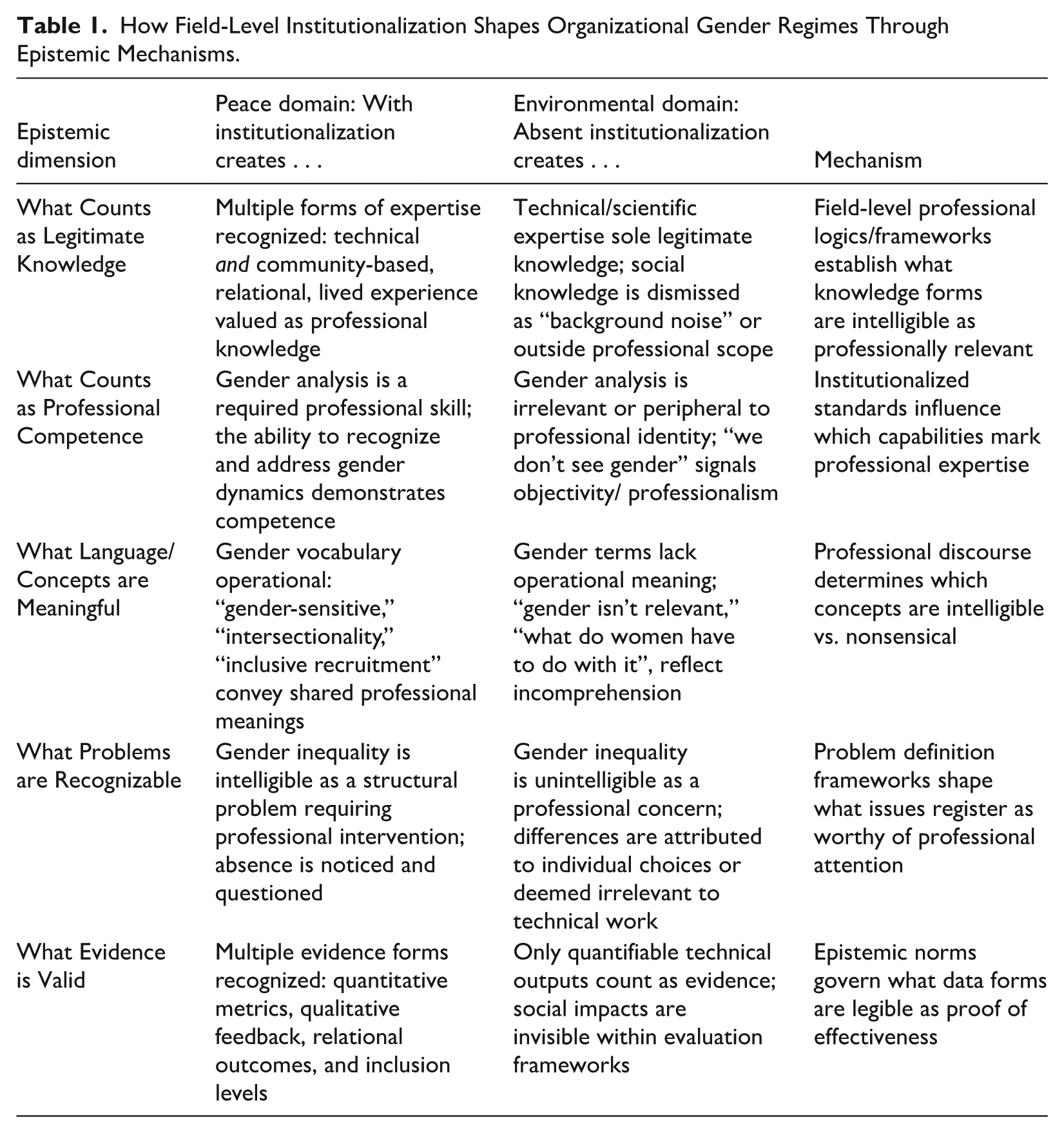
Field-level institutionalization establishes whether organizations work with or against prevailing currents. WPS institutionalization creates conditions where gender-inclusive peacebuilding flows downstream. In environmental management, absent institutionalization, gender-inclusive approaches require swimming upstream against field logics privileging technical expertise. While some organizations may develop such practices through exceptional effort, these practices work against institutional momentum. This explains why even well-resourced actors at C-TEC could not sustain initiatives without field-level frameworks that provide epistemic legibility (i.e., what counts as legitimate knowledge, professional competence, acceptable language, recognizable problems, or valid evidence) and organizational legitimacy.
This study contributes to environmental management and sustainability scholarship by showing how field-level gender dynamics create intelligibility barriers that constrain organizations’ integration of technical and social approaches to environmental challenges. While scholarship in environmental management has long recognized the need for multidimensional approaches combining technical expertise with social and community-based knowledge (Hoffman, 2003; Starik & Rands, 1995), and sustainability research increasingly acknowledges the importance of gender considerations for effective environmental interventions (Ferraro et al., 2015; Kassinis et al., 2016), neither stream has sufficiently addressed why technical approaches persist despite their limitations or why efforts to integrate gender dimensions fall short. The findings demonstrate that this persistence stems from these barriers, namely, the inability to recognize certain forms of work, knowledge, or outcomes as legitimate professional practice within prevailing field logics, which helps explain why organizations struggle to mainstream sustainability despite widespread recognition of its importance (George et al., 2016).
To scholarship on gender and sustainability, the analysis shows that masculine-coded approaches reflect field-level epistemic dynamics shaping what counts as legitimate environmental practice (Benschop, 2021; Buckingham & Le Masson, 2017; MacGregor, 2017). While this literature has long recognized the lack of neutrality in proposed gender-neutral discourse, this study advances our understanding of how fields, organizations, and individual agents interact, with bottom-up approaches facing limited success in the absence of field-level support. This study provides a feminist institutionalist organizational analysis that sharpens our understanding of these dynamics, suggesting that achieving meaningful integration of gender and social considerations into environmental management requires field-level transformation comparable to what has been achieved in peacebuilding through the Women, Peace and Security agenda, establishing gender work as both professionally intelligible and organizationally necessary.
To the literature on gender regimes in fields and organizations, this study contributes insight into how multiple gender regimes operate within a single organization spanning fields with contrasting levels of gender institutionalization. While considerable research has documented how organizations are not gender neutral (Acker, 1990, 2006; Connell, 2005; Corredor, 2023; Mackay et al., 2010), this study demonstrates what happens when different field-level gender regimes meet within organizational practice, showing how field-level dynamics influence who participates in work and what types of knowledge and approaches are valued (Dankelman, 2010; MacGregor, 2010). The analysis indicates that the effectiveness of gender mainstreaming can vary dramatically within a single organization depending on field-level institutional backing, with the same organization successfully securing gender inclusion in one domain through institutional requirements and organizational processes while achieving only superficial acknowledgement in another. This demonstrates that field-level institutional frameworks, when adapted and adopted within organizations, shape the possibilities for gender inclusion and, by extension, the possibilities for more broadly and effectively doing their work. The findings challenge assumptions that organizational change depends primarily on leadership commitment or individual agency, pointing to how field-level institutionalization creates or constrains the conditions enabling substantive transformation.
Implications and Future Directions
These findings have implications for organizations across sectors that are seeking to mainstream sustainability. Whether in nonprofit, governmental, or private sector contexts, organizations attempting to integrate social dimensions into technically-oriented work face intelligibility barriers when field-level frameworks fail to recognize these approaches as legitimate professional practice. Corporate sustainability efforts often privilege quantifiable technical metrics over social and community-based dimensions, reflecting similar field-level dynamics. The contrast offered in this study, in one domain where stakeholders actively measure, implement, and enforce gender commitments, and the other where gender components are often an afterthought, shows how accountability mechanisms shape organizational practice. In addition, the institutional precarity of translation work means that progress remains vulnerable to ordinary workforce dynamics. When individual entrepreneurs depart, their efforts can collapse as their work did not achieve recognition as a legitimate practice that others could sustain. Creating conditions for integration can benefit from field-level actors, funders, professional associations, and standard-setting bodies who can establish frameworks that make diverse approaches to sustainability work intelligible and necessary. Without these conditions, however, environmental work may perpetuate inequality and face more limited effectiveness in sustainability interventions.
This study examines a single organization in a specific conflict context, which enables deep understanding while also raising questions about patterns in other settings. Future research could explore whether similar dynamics operate in other environmental organizations, different geographic contexts, or organizations bridging environmental work with domains beyond peacebuilding. In addition, while this study focuses on gender regimes shaped by field-level dynamics, future scholarship might examine how gender intersects with other dimensions of power and marginalization, including race, class, and colonial legacies, or take up the call to link the WPS framework with environmental justice themes in environmental peacebuilding (Ben-Shmuel et al., 2026; Ben-Shmuel & Halle, 2023; Yoshida, 2019; Yoshida & Céspedes-Báez, 2021). The frameworks developed here, particularly the intelligibility barriers and the necessity of field-level institutionalization for organizational change, may offer insights into dynamics in other contexts where organizations attempt to integrate social considerations into technically-oriented fields.
Closing Reflection
As this manuscript undergoes revision in October 2025, a ceasefire is in effect following two years of devastating violence that have wrought generational, material, psychological, and environmental impacts. Although this period occurred after the primary data collection phase, the patterns documented have salience for understanding how crisis contexts intersect with organizational practice. The findings and follow-up observations suggest that, absent field-level frameworks that make a gender lens necessary, crisis conditions provide justification for further deprioritization, with gender considerations repeatedly relegated as inferior to more pressing concerns. As communities in Gaza, Israel, and throughout the region begin confronting the gaping wound of these past years, the patterns documented in this study take on immediate practical significance. Reconstruction efforts will require rebuilding physical systems, with attention to addressing significant environmental destruction, while also restoring the social fabric, community structures, and knowledge systems that sustain collective life. The findings suggest that approaches privileging rapid technical interventions over community engagement, or treating gender considerations as optional rather than essential, will reproduce the very limitations this research illuminates. The road ahead requires existing knowledge and new frameworks, material interventions and relational engagement—and the epistemic shifts that render such integrated approaches recognizable as essential, not optional, environmental work.
Supplemental Material
sj-docx-1-oae-10.1177_10860266261433103 – Supplemental material for What Counts as Environmental Work? How Gender Regimes Shape Organizational Practice
Supplemental material, sj-docx-1-oae-10.1177_10860266261433103 for What Counts as Environmental Work? How Gender Regimes Shape Organizational Practice by Ambreen Tour Ben-Shmuel in Organization & Environment
Supplemental Material
sj-docx-2-oae-10.1177_10860266261433103 – Supplemental material for What Counts as Environmental Work? How Gender Regimes Shape Organizational Practice
Supplemental material, sj-docx-2-oae-10.1177_10860266261433103 for What Counts as Environmental Work? How Gender Regimes Shape Organizational Practice by Ambreen Tour Ben-Shmuel in Organization & Environment
Supplemental Material
sj-docx-3-oae-10.1177_10860266261433103 – Supplemental material for What Counts as Environmental Work? How Gender Regimes Shape Organizational Practice
Supplemental material, sj-docx-3-oae-10.1177_10860266261433103 for What Counts as Environmental Work? How Gender Regimes Shape Organizational Practice by Ambreen Tour Ben-Shmuel in Organization & Environment
Footnotes
Acknowledgements
I thank the Deputy Editor, Carolyn Egri, and the two anonymous reviewers for their constructive engagement throughout the review process. Earlier versions benefited from feedback at the Academy of Management ONE PhD Consortium and the Ivey Sustainability Academy. I am grateful to the many institutions, departments, and forums that supported and encouraged this research: the Department of Sociology and Anthropology at the Hebrew University of Jerusalem, the Erb Institute for Global Sustainable Enterprise at the University of Michigan, the Truman Institute for the Advancement of Peace, the Azrieli Foundation, the Sophie Davis Forum, and the Lafer Center for Women’s and Gender Studies. Finally, I am grateful to the members of C-TEC who shared their time and insights for this research.

Ethical Considerations
This study was approved by the Ethics Review Committee at the Hebrew University of Jerusalem (approval number 202011261) on November 26, 2020. Respondents provided verbal and/or written consent before starting interviews.
Funding
The author received no financial support for the research, authorship, and/or publication of this article.
Declaration of Conflicting Interests
The author declared no potential conflicts of interest with respect to the research, authorship, and/or publication of this article.
Data Availability Statement
Not applicable.
Supplemental Material
Supplemental material for this article is available online.
Notes
Author Biography
References
Supplementary Material
Please find the following supplemental material available below.
For Open Access articles published under a Creative Commons License, all supplemental material carries the same license as the article it is associated with.
For non-Open Access articles published, all supplemental material carries a non-exclusive license, and permission requests for re-use of supplemental material or any part of supplemental material shall be sent directly to the copyright owner as specified in the copyright notice associated with the article.
