



Abstract
Blending narrative portraiture and feminist methods, this study explored the lives of two rural women who are creative writers. The study asked (1) What are their critical purposes? and (2) How did gender and place intersect in their writing lives? The findings were that the women used creative writing to engage in praxis by creating and disseminating knowledge. Their writing critically interrogated and redefined conceptions of womanhood. Additional critical purposes were unique to women's intersectional identities and lived experiences. They ranged from interrogating societal perspectives of gender, sexuality, and race to interrogating rurality and sexual violence. The aesthetic texts they created articulated and advocated for intersubjective truths. Shifting the focus of critical literacy from pedagogy and reading to writing beyond educational spaces, the women drew upon critical literacy not as a means of being taught how to understand the power of texts, but to wield the power of texts themselves.
In the United States, women face oppression across political and economic systems. The recent reversal of Roe v. Wade illustrates the weakened power that women have over their health, their bodies, and their life choices. Economically, women continue to earn less money than men (American Civil Liberties Union, 2023). The fragile state of women's political and economic power highlights the need for women to use literacy as a tool to resist oppression. A primary goal of this study is to understand how women approach writing as an aesthetic act and the possibility for these aesthetic acts to have critical purposes that interrogate oppression. Part of this work necessitated examining how women take on the role of artists and engage in praxis by shaping emotional and intellectual experiences for readers via aesthetic texts.
An additional goal of this paper was to analyze the relationship between place and gender for rural women who take up critical purposes in their creative writing. Findings from extant literature documented the use of creative writing by women as a tool for engaging in critical literacy. Women have used creative writing as an agentive tool for the purposes of resisting oppression based on gender (Clark-Parsons, 2017; Vieira, 2019) as well as gender and race (Kelly, 2020; McArthur & Muhammad, 2022; Muhammad, 2012; Winn, 2010; Wissman, 2007, 2011). In addition, women's creative writing has interrogated oppression based on gender, race, and sexuality (Blackburn, 2002; G uzzetti, 2022b). Women's creative writing has also resisted oppression regarding gender and ethnicity (Abril-Gonzalez, 2020; Cisneros, 2021; Guzzetti, 2022a). However, these studies have mainly examined the critical purposes of women in urban contexts. Therefore, this study seeks to contribute to the literature by examining how rurality, creative writing as an aesthetic act, and critical purposes intertwine in the lives of women writers.
To analyze these complexities, I employed a narrative portraiture design (Lawrence-Lightfoot & Davis, 1997) in order to illuminate the individual writing lives of two women, Tilly and Summer, in a mid-Atlantic rural region. In conjunction with portraiture, I used feminist methodologies to surface the voices of rural women writers who have been omitted from research (LaFrance et al., 2021; Oakley, 1981; Sprague, 2016). The research questions for this study were the following: What are the critical purposes of rural women who engage in creative writing? and How do gender and place intersect in the writing lives of women?
Blending Theories: Critical Literacy, Intersectionality, and Creativity
Critical Literacy and Intersectionality
Critical literacy is an important lens by which to examine rural women's engagement with creative writing. Freire's (1983) description of literacy detailed engaging with the world as a process of reading the world. Reading the world and reading words then are acts of writing and rewriting our perceptions as well as activating our consciousness. Freirean concepts are the foundation of critical literacy theory, situating literacy as a tool that develops critical consciousness and praxis. Critical consciousness entails the use of literacy to create awareness of political, economic, and social systematic inequity. This critical consciousness leads to praxis—subsequent reflection and transformative acts of resistance (Luke, 2019).
Intersectional theory offers important considerations for how oppression manifests; as such it adds nuance to Freirean conceptions of critical literacy. As a legal scholar and critical theorist, Crenshaw (1991) argued for the necessity of examining the complexity and magnitude of sociopolitical systematic oppression that is unique to the combination of race, class, and gender. Mayo and Blackburn's (2020) work blending queer, trans, and intersectional theories, highlighted the need to resist normative binaries regarding sexuality and gender. This resistance included dismantling male and female binaries in addition to interrogating the privileging of heteronormativity. Brooks (2019) applied these concepts of intersectionality to critical literacy in her delineation of categories of differences, saying that “Categories of difference are situated in a conception of power that allows for the interface between context, structures, and individual agency” (p. 422). In this conception of intersectional identity, all categories of difference (e.g., race, gender, sexuality, class) work in tandem. Literacy practices need to be situated within categories of difference.
Place
Exploring the lives of rural women as writers necessitated a conceptualization of place as socially constructed. Rural places are plural, material, relation, and imaginary—not monolithic (Corbett, 2013; Corbett & Donehower, 2017; Villalobos, 2023). These ideological, sociocultural places shape and are shaped by the literacy and interactions of people (Mills & Comber, 2013). In addition, place is an intersectional dimension of identity. Villalobos (2023) highlighted the erasure of rurality from extant intersectional scholarship. This erasure omitted the complex ways in which place, power structures, identity, lived experiences, and culture intertwine. Villalobos also highlighted the need to reject the imposition of numerous physical as well as imaginary borders—and the power discourses interwoven into these borders—that define place. As such, in addition to conceptualizing rurality as socially constructed, the place is an intersectional dimension of identity that is fluid, plural, and nuanced.
Critical Literacy and Creativity
In her conceptualization of marginalization, critical theorist hooks (1990) described the capacity of language to transform into aesthetic oppositional acts. hooks defined the margin as a place of intense oppression outside of the hegemonic or dominate systems of society. Yet the margin is also a place of radical creativity in which women articulate other realities and intersubjective truth. hooks (1990) positioned creative resistance as a crucial choice we must all make in order to dismantle the epistemology, language, and structures of colonization. In her view, this choice “shapes and determines our response to existing cultural practice and our capacity to envision new, alternative, oppositional aesthetic acts. It informs the way we speak about these issues, and the language we choose. Language is also a place of struggle” (hooks, p. 145). Thus, creativity—and for the purposes of this study creative writing—holds enormous potential and possibility for rural women engaging in counter-hegemonic work.
Misson and Morgan (2006) detailed this transformative potential and power when describing the relationship between critical literacy and aesthetic texts. As opposed to the focus of analytic, argumentative writing on comprehension, the aesthetic experience is both emotional and intellectual with a focus on the apprehending and interpretation of the reader. The aesthetic is a complex interplay between the artist's creation of the text, the created text, and the reader's experience of the text. Misson and Morgan (2006) positioned the writer as an artist, using textual structure and craft techniques to shape the reader's experience. Misson and Morgan (2006) highlight that the power of aesthetic texts to take up critical purposes is twofold. First, the shaping of the text is an exploration and discovery of intersubjective truths. Second, the aesthetic text then becomes an act of resistance to systems of oppression. Critical literacy goes beyond reading texts and understanding the oppressive ideologies inscribed in texts. It also includes shaping language into aesthetic oppositional acts that amplify intersubjective truths, knowledge, and experiences from the margins of society (hooks, 1990).
Blending these complex theories offered a framework for considering how rural women as creative writers shape emotional and intellectual experiences for readers via aesthetic texts. These texts articulated alternative versions of reality, representations, lived experiences, and intersubjective truths. This consideration emphasized the act of creating aesthetic writing as an act of critical literacy—going beyond the relationship between reading and developing awareness of inscribed ideologies. The act of shaping aesthetic texts became an act of praxis (Luke, 2019) as the author envisioned texts that create change in the reader. Texts thus offered an opportunity to consider intersectional lived experiences as relates to gender, race, and sexuality—but also how rurality might affect this work.
What do We Know About Women as Creative Writers?
Critical Purposes
Much of what we know about the critical purposes for women's creative writing has come from research examining creative writing as a tool to resist oppression based on gender in conjunction with other intersectional aspects of identity (Crenshaw, 1991). This examination has included African-American women's poetry (Blackburn, 2002; Kelly, 2020; Muhammad, 2012; Wissman, 2007, 2011) and plays (Winn, 2010); Indigenous women's narratives (Cisneros, 2021) and zines (Guzzetti, 2022a); Latina women's poetry (Abril-Gonzalez, 2020) and zines/do-it-yourself-magazines (Guzzetti, 2022a); as well as white women's poetry (Vieira, 2019). Notably, while these studies are mainly situated in urban contexts, findings did not indicate that women drew upon place—as an intersectional aspect of identity—to inform their critical purpose.
The writing of women countered misrepresentation, stereotypes, and labels imposed by dominant discourse in media and society ( Abril-Gonzalez, 2020; Cox, 2015; McArthur & Muhammad, 2022; Muhammad, 2012; Vieira, 2019; Winn, 2010; Wissman, 2007, 2011). For example, Muhammad's (2012) examination of a young woman, Iris, documented how Iris's poetry countered monolithic conceptions of identity; the relationship between skin color and beauty; and deficit framings of the bodies as well as culture of African-American women. In addition, studies highlighted the power of creative writing as a tool for legitimizing lived experiences and marginalized knowledges (Cisneros, 2021; Muhammad, 2012; Wissman, 2007). For instance, young Indigenous women used their narratives to articulate the impacts of colonization on Indigenous women in education spaces in which women are invisible, misrepresented, threatened, or silenced (Cisneros, 2021). Across studies, creative writing was used as a tool for developing critical consciousness in response to self-definition as well as the articulation of lived experiences and marginalized knowledges.
Guzzetti (2022a) and Clark-Parsons (2017) documented a different kind of critical purpose: Women sought to control, shape, and disseminate knowledge in the creation of zines, which were widely disseminated out into the world (Guzzetti, 2022a; Clark-Parsons, 2017). Guzzetti (2022a) documented a Navajo woman, Tatum, who wrote zines in response to colonization and the erosion of her language. Tatum incorporated Navajo language and cultural values into her zines. Tatum then disseminated these zines to a wide audience as a means of cultural and linguistic preservation. Clark-Parsons (2017) found that women's critical purposes focused on dismantling dominant media practices, consumption, and knowledge. Women created zines as a way of articulating and circulating knowledge that explicitly rejects mainstream media and created an alternative political discourse. In these studies, women went beyond writing and developed critical consciousness for themselves. Instead, their critical purposes took on dimensions of praxis as their creative writing controlled and disseminated knowledge (Luke, 2019).
Gender and Place
A small group of studies documented women in rural Nebraska and Appalachia engaging in writing narratives (Donehower, 2020; Hogg, 2006; Greer, 2012). For instance, Hogg (2006) documented older, Midwestern women writing histories, memoirs, and autobiographies. These narratives were rich in detail and intimate, yet also used silence to control the boundaries between public and private. These narratives controlled the representation of their lives as rural women and their family histories. In doing so, their writing operated in complex ways regarding gender and place by navigating the gender expectations of their communities while also subverting them as they claimed control over knowledge production in prominent community spaces. Similarly, Greer's (2012) analysis of a rural woman's autobiography pointed to the same use of creative writing to create a rich narrative of the woman's lived experiences—and thus control representation. Donehower (2020) also documented one woman, Ida, who used her books about local history to control depictions of her own social status. In contrast to women writing about complex intersectional oppression in urban contexts (e.g., Muhammad, 2012), these studies documented white, rural women using their written narratives to control representation and historical knowledge. Their purposes were not explicitly critical: they did not write as a means of resistance to oppressive structures. However, it is notable that these women were using their narratives to control knowledge and history in their communities.
Taken together, studies of women’s writing have detailed urban and rural contexts, but also have highlighted the need to consider place as a dimension of intersectionality (Villalobos, 2023). In addition, a small number of studies have illustrated the potential for women to engage in praxis in the creation and dissemination of texts (Luke, 2019). The analytic emphasis of these studies is focused on creative writing as a literacy practice, not on the aesthetic dimensions of creative writing and how those dimensions are used for the authors’ critical purposes.
Methods: Illuminating Women and Surfacing Their Praxis
The study took place in a mid-Atlantic coastal region. The region faces the growing threat of climate change to its waterways and agricultural practices. Historically, the region has a history of colonizing indigenous tribes, slavery, lynching, as well as the presence of the Ku Klux Klan, and racial inequality. Its history also includes the underground-railroad and historically free Black communities. The peninsula has small towns mixed amid farmlands, forests, marshes, and the ocean and bays. Surrounded by rural legacy lands, a small regional city adds urban elements. While the arts have a strong economic and cultural presence in the region, creative writing is mainly found in universities, community colleges, and a few community organizations.
In the winter of 2022, following institutional review board approval, I started recruitment for this study. I reached out to community organizations, coffee shops, bookstores, county libraries, and creative writing departments at community colleges, colleges, and universities. Because rurality (Corbett, 2013; Corbett & Donehower, 2017) and gender (Mayo & Blackburn, 2020) are not monolithic constructs, I cast a wide net for recruitment in order to understand the diverse lived experiences of women living in different rural communities in the region. My emails, flyers, and phone calls detailed the criteria for the study's purposeful sampling (Patton, 1990). I was focused on understanding the creative writing and writing lives of women, between the ages of 18–35, living in a rural mid-Atlantic region.
Two study participants, Tilly and Summer, highlighted the different intersectional experiences of rural women as writers. The richness of their writing lives, their commitment to their writing lives, and the power of their critical purposes needed illumination (Lawrence-Lightfoot & Davis, 1997). Tilly identified as a 26-year-old, Afro-Latina lesbian. She was born in a large city, but her family moved to a small town in the rural region when she was six. She briefly attended community college but then began a business in which she produced her own screenplays. She also wrote science fiction, political speeches, and podcast content. Living fifty miles east from Tilly, Summer identified as a 21-year-old, white woman. She was in her final year at a university-based creative writing program, which supported her in the creation and publication of dozens of poems while she worked in a coffee shop to support herself. She grew up outside of the small city.
Over the course of 3 months, Tilly and Summer invited me into their virtual writing spaces for interviews and observations. Using a screen-sharing platform, I watched recordings of their screens as they drafted and revised, listened to music, pulled up notes, or browsed for information. Cats walked across keyboards. Art hung on the walls behind them. In these same virtual spaces, I used semi-structured interviews to ask questions about their writing, their purposes, and their writing lives. Sometimes, we watched recording snippets of their texts expanding and contracting over 40 minutes of observation—something that fascinated them as much as it did me. Other interviews moved beyond virtual spaces and into participant-chosen rural places. These places were chosen because of their history as well as the inspiration they offered. Tilly chose a community park. Summer chose a nature trail at a rural museum. To capture these places, I took photos and wrote field notes. They brought artifacts—objects that held meaning for them as writers—to these interviews. They sent me poems, short stories, artist statements, and screenplays. For each woman, I was able to look across a data corpus that included five interview transcripts, two recorded observations of writing, a diverse range of creative writing, photographs, field notes, and my researcher's journal. These data helped me document the critical purpose as well as the craft techniques each woman used to build aesthetic texts (Misson & Morgan, 2006). Data also spoke to how each women approached the pluralities of rurality across the material and the imaginary (Corbett, 2013, Villalobos, 2023), thereby illuminating how rurality, creative writing, and critical purposes intertwined in their writing lives.
Portraiture and Feminist Methods
Narrative portraiture is an aesthetic process. I acted as the portraitist, searching for the story—along with metaphor and refrains—and then structured and organized the portrait. But portraiture is also a rigorous empirical process in that it systematically collects, analyzes, and critically interrogates data (Lawrence-Lightfoot & Davis, 1997). A strength of this research design is the transformative element of using portraiture to create social change—through transforming participant or societal perceptions of literacy lives (Henderson, 2021). In creating portraits, I searched for strengths and assets: goodness as opposed to deficit thinking or a diseased mindset (Lawrence-Lightfoot & Davis, 1997).
In line with the socially just potentiality of narrative inquiry (Montero & Washington, 2021), recent scholarship has taken up portraiture as an inquiry method that can blend with feminist or decolonizing methods to align with the goals of socially just research (S. Brooks, 2017; Player, 2021). As such, I blended narrative portraiture design (Lawrence-Lightfoot & Davis, 1997) with feminist methods. The blending of feminist methods for data collection interrogated the traditional role of the portraitist as the sole interpretive authority (Sprague, 2016). Feminist methods also provided critical strategies by which the illumination of goodness was firmly grounded in giving Tilly and Summer power over their stories, their representation, and their role as collaborators in the research study (LaFrance et al., 2021; Sprague, 2016; Thwaites, 2017). Specifically, Tilly and Summer acted to co-construct knowledge and shape data collection by guiding data collection: They chose the artifacts, the writing used during observations, the research settings, and the writing samples for the data corpus. This co-construction of knowledge decreased the researcher-participant power imbalance (LaFrance et al., 2021; Oakley, 1981; Sprague, 2016). Similarly to Player (2021), as insights emerged across data collection, I shared emerging insights with Tilly and Summer and asked for feedback. Tilly and Summer's power over their own representation did not occur just once at the end of the study but also happened through informal discussion. These opportunities spoke to Sprague's (2016) focus on power, knowledge, and collaboration in feminist methodologies.
Blending portraiture with feminist methods enabled me to work against employing deficit framing or savior narratives in the investigation of Tilly and Summer's lived experiences, to explicitly work against characterizing the margin as a place of pain or “a sign of deprivation, a wound, an unfulfilled longing” (hooks, 1990, p.152). Instead, this blend supported an illumination of the margin as a place that fosters creativity and the generation of intersubjective knowledge (hooks, 1990).
Data Analysis: A Generative Tension
First, I used a constant comparative method of transcription, coding, and writing analytic memos throughout data collection to be responsive to the rich experiences of the participants. For instance, the initial data analysis, from coding the first interview and writing observation, informed interview questions for the second semistructured interview. This process of using initial analysis to drive subsequent data collection created opportunities for design refinement in response to researcher reflexivity and the participants’ emerging insights as well as choices (LaFrance et al., 2021; Sprague, 2016). It also gave time for rapport to evolve (Thwaites, 2017) before we entered rural places of importance together.
Organizing and categorizing data while also creating an aesthetic whole that depicts complex human experiences creates a generative tension for portraiture researchers (Lawrence-Lightfoot & Davis, 1997). In this first phase of data analysis, drawing upon this tension, I used initial coding (Saldaña, 2016) to organize and categorize. These codes were draft-like and served to form a deeper understanding of the data. Codes were drawn from theory, but they were also inductive, reflecting patterns as well as dissonance. For example, drawing upon theories of critical literacy (hooks, 1990; Misson & Morgan, 2006), I coded the data corpus for how Tilly and Summer used their creative writing for critical purposes. A code that described Tilly's critical purpose was “interrogating gender, sexuality, and race.” I applied this code to data in which Tilly articulated her desire to platform queer, Black women as heroines. When examining data from interviews and observations with Summer, I used the code “gender” to categorize data in which she interrogated conceptions of womanhood or “rural” when she described the importance of rurality in her writing. Initial codes also traced craft the techniques of Tilly (characterization, plot, and setting) and Summer (imagery, sound, and metaphor).
I then clustered these initial codes into more meaningful units that reflected repetitive refrains in the data. For example, looking across the initial codes and data corpus, I found that “critical purpose” was too general to describe the work that Tilly and Summer were doing. A refrain became “Shaping textual worlds as critical purpose.” I applied this refrain code to data in which participants used craft techniques to build worlds or vignettes that reflected social, political, or economic issues. These refrains, and my memo writing about them, then informed the themes which helped to structure the writing of portraits in the second phase of analysis.
In the second phase of data analysis, I stepped away from coding and categorizing to immerse myself in a more holistic approach. Similar to Player (2021), I used the writing of initial portraits to “break from coding” to look at the aesthetic whole. Lawrence-Lightfoot and Davis (1997) compared the construction of the aesthetic whole to weaving, in which the portrait intertwines story, structure, and unity. I began this work by using themes to structure the portrait (Lawrence-Lightfoot & Davis, 1997). Themes were drawn from the repetitive refrains analyzed during phase one of data analysis. Examples of themes included “aesthetic texts as spaces for intersubjective truth”; “intersectionality and critical purpose in aesthetic texts”; and “the use of the aesthetic text as a form of praxis.”
Next, across data sources, I looked for a resonant metaphor that would serve to draw together critical purposes, each woman's story, and create cohesion. For Summer, the manipulation of form continually arose: buried deer skulls, tree branches framing the sky, a woman's body as a broken temple, her experimentation with poetic form, and the use of poems as forms for readers to enter. “Transformation” came to represent Summer's critical purpose as a poet. For Tilly, “self-taught” acted as a metaphor that synthesized Tilly's identification as self-taught, her writing beyond institutions, her online work, and her story about the lack of representation in the library. Finally, I used the field notes, recordings, transcripts, and artifacts from our interview in each woman's place of importance to shape the story, give it unity, and imbue the portrait with the voice, memories, and materiality of each woman in these places that held their history. In doing so, I grounded this act of interpretation in each woman's choice of rural place to further balance researcher and participant power in the act of representation (LaFrance et al., 2021; Sprague, 2016). This grounding helped bring their bodies, histories, voices, and purpose into the portrait.
My Positionality
As a cis-gender White woman, I come from a socioeconomic background that has vacillated between socioeconomic struggle and socioeconomic privilege. I brought my own history as a creative writer of both poetry and prose. I have made a number of choices in my life that balanced socioeconomic stability with the need to write. For me, writing is a political and aesthetic act. The importance of creative writing in my own life has driven my need to illuminate and explore women's experiences of creativity. I also brought my generational history as the daughter and granddaughter of women artists, who experienced oppression as well as trauma because of their gender.
My childhood was infused with rural landscapes and coastal waters. As a literacy educator, my career began in a rural Appalachian district, which included parts Qualla Boundary for the Eastern Band of Cherokee Indians and National Forest land. These places taught me about the fierce ideological independence and rich local knowledge of rural pluralities. I also realized my own need for connection to what Corbett (2013) framed as the wild and the isolated. Even after moving to international capitals in the Dominican Republic and Jordan, I carried my rural imaginings with me. I felt their imaginative resonance in international rural places like Wadi Rum, the hills outside of Amman, and Jarabacoa.
Portraits
Drawing upon Player (2021)—I grounded these portraits in the research context, which were infused with the participants’ histories and lived experiences as artists. They served to illuminate the materiality of the participants’ voices and bodies in rural spaces.
Self-Taught
On a rainy afternoon in April, I drove the highway that bisects the peninsula to meet Tilly at a park in a small town. Between our towns lay miles of marsh, coastlines, and fields. While driving, I thought back over our virtual interviews. Tilly described herself as a “self-taught” writer—bringing to my mind the self-taught artist movement. I could see why she used the term self-taught. During high school and her early 20s, she did not discuss her writing life with people in her hometown, yet she published and received recognition for the quality of her stories on platforms like Wattpad and Ink It. She turned to these platforms because they were the only places she could find stories about queer women. After leaving community college, she started screenwriting. Post-COVID, she used grassroots community connections for crowdsourcing, networking, and business sponsorships to film, produce, edit, and disseminate her screenplays.
When I arrived, Tilly was waiting under a large pavilion. Her confidence and honest, conversational manner moved from our interviews via screens to a picnic table at the park. She was warm, quick to laugh, poised to start telling a story. We braved the misty drizzle and started a slow winding walk around the park. With each stop, a part of Tilly's life as a writer emerged. First, we traced the small paths around the garden where Tilly wooed her wife. In front of an arbor and bench, she told me about one of her first stories with a queer female lead, “Runaway Queen.” Tilly's critical purpose evolved during high school from writing about queer white women to writing about queer women of color. This evolution was sparked by the limits of her local library. Less than a mile away, in a small brick building she frequented with her mother from a young age, she could not find literature that had queer women of color as lead characters. She could only find this in virtual spaces like Wattpad or Ink It, remarking, And it kind of upset me that in order for me to find stories of women loving women or men loving men, I had to go online and I had to read someone else who was my age or a little bit older writing it on Fiction Press, Wattpad, or Ink It … There weren't enough published books in like, libraries, that I was finding about stories that were similar to my own life. So I decided that I was going to change that. So when I first started writing … all of my leads were queer. But then … I realized there was another humongous element that I was missing … And that was race. Like I didn't want to just write stories about queer white women loving queer white women. I … wanna also include the factor of I am also a black queer woman and I wanna write stories about black queer women … from that point forward, all of my stories have black queer people in in some form, shape, or way.
Here, Tilly spoke to her need to use her fiction and screenplays to interrogate race and heteronormativity (Mayo & Blackburn, 2020). This use of characterization—creating main characters who are queer black women—worked to destabilize heteronormativity.
Tilly's main characters also challenged normative conceptions of gender by embodying a spectrum of characteristics in their identity as women: I pull a lot from myself for most of my characters … that started around like junior year of high school … where I told myself I was going to start writing characters that were more like me. That were more masculine presenting. That were also queer lady loving characters.
Tilly drew on her own experience as a woman who is masculine presenting—based on clothes, mannerisms, and gestures—to build these characters. In doing so, she used the aesthetic for critical purposes in presenting gender as nonbinary (Mayo & Blackburn, 2020).
We continued our walk to the far corner of the park where basketball courts spread out. Tilly painted the picture of hanging out at the courts with her friends. But then her tone shifted as she recalled interactions with the police after dark, how surveilled she and her friends felt. Her tone echoed the tensions she explored in her fiction and her need to foreground issues of equity. When I first started writing … I didn't include anything that was real in my work. It was all fantasy. It was all my imagination, but also I was young so I didn't know anything else. I was like 16-years-old … I didn't know what equity was.
The oppression that Tilly has faced informed her writing about equity, yet this oppression was also nuanced. Tilly acknowledged her own power and privilege as the child of a town councilman, a child who grew up in the upper-middle class, and a member of a countywide political group. This gave her a different status in her community.
Sometimes … assumptions … were put on other Black children who were in classes with me and even sometimes … myself until people found out like who my father was and then … a flip was switched for them, they were like … she's not like the other Black children in this class …
This power and privilege also presented significant issues. Tilly was deeply aware of the public consequences of her own actions and what they meant, not just for her and her family, but for the Black community. She recounted her mother's words to her as a teenager about her background: “It will reflect on your father, and it will reflect on you, and it will reflect on other Black people around you and it might not give another Black person a chance to become a council member again.”
This interrogation of race and the meaning of equity played out in her screenplays that she read excerpts from during interviews. In the following scene, a sister and brother questioned their father's motives and power when helping the son secure an interview at a competitive company. Sister: He wants you to get the job. Brother: No, yeah he wants me to get the job, so I'll be one step closer to moving out of his house. The only reason I had this interview is because he pulled some strings with the owner of the company. He doesn't think I know, but I know there's not a lot of Black people at this company and I'm not trying to be one of their diversity hires. Sister: Really, that's what you think this is? Brother: … that's what it is. I'm thankful for the opportunity, but I wish I could have got it myself without feeling like dad gave me a leg up. It's like they don't want me. They want to do him a favor … there's hardly any Black folks in there, and I think that's for a reason. I don't know if it's sitting right with me.
Scenes like these used dialogue and characterization to interrogate conceptions of how equity can be achieved. They mirrored the complexity of Tilly's own experiences with racism, power, and equity.
We continued to walk, turning back toward the pavilion. Tilly pointed out the parking space where she always parked under a large tree in her high school years, so she could work on her stories between school and work. On warm days, she would sit at a picnic table to people watch, hatch plots, pull in details from the day or the world onto her pages. Currently, most of her writing happens in front of a computer. During interviews and observations, shared Zoom screens revealed how Tilly's love of story manifested in her science fiction, which brought together the wide range of her critical purposes—gender, sexuality, and race. During observations, I noticed that while Tilly wrote new material, she frequently referenced a larger document. The larger document spanned over a hundred pages and helped her keep track of the sociopolitical worlds she built, the characters, and the plot. (See Figure 1 for an excerpt of her notes, which illustrates Tilly's work as she created an aesthetic space for her audience to experience dystopian worlds with hierarches based on race and resources.)

Tilly's drafting notes for her science fiction short story.
Tilly placed Gwinn in the role of hero and savior, which spoke to her commitment to foregrounding queer women as lead characters. As such, the story is an act of resistance (hooks, 1990; Misson & Morgan, 2006). Often, Tilly brought up another dystopian story about sociopolitical violence between the U.S. regions of the East and West versus the North and South. Across multiple interviews, she talked about her deep immersion in writing the story, the intricate world-building of the sociopolitical structure, characters, and the mapping of the regions. She sketched out a complex ranking system based on wealth, academics, and achievement that created an elaborate socioeconomic system of power in a so-called utopia.
In this utopia, racism was removed from one region but remained ingrained in another region. In the following excerpt from the opening chapter, the main character, a queer young woman of color, obsessed with her ranking as number one, listened to another student discuss the southern region: The South is dominated by savages hell-bent on eliminating our way of life. They don’t agree with how we chose to incorporate technology and advances in modern medicine to benefit each human's ability and capacity to achieve perfection. They would rather enjoy their huts in the sand dunes where the heat roasts them. We tried to integrate them in our society, but they denied us; and now, they are envious of us. They are not to be trusted and have harmed our people throughout history by kidnapping, torturing, and even killing our ancestors …
Like Guzzetti (2022a) and Clark-Parsons (2017), Tilly used her fiction and screenplays to go beyond the use of creative writing as a means to develop critical consciousness. Her writing took on dimensions of praxis (Luke, 2019) in offering her audience alternative, marginalized visions of reality and truth (hooks, 1990). In doing so, her aesthetic texts became vehicles of resistance (Misson & Morgan, 2006). When coupled with the large-scale dissemination of her writing—via online platforms and local venues for showcasing her screenplays—her navigation of herself as a writer, her text, and her audience took on powerful dimensions of praxis (Luke, 2019). This redistribution of alternative knowledge work to not only destabilize notions of sexuality and gender (Mayo & Blackburn, 2020) but also race and equity.
Our final stop on our walk was a large sprawling play structure. Tilly detailed how the entire community came out to build this playground for kids—including her wife. Tilly's nieces and nephews now come to play in the park. Her stories about this park illustrated the conceptions of the rural as plural and relational (Corbett, 2013; Villalobos, 2023). The park was a writing haven, yet also etched in racial tension, memories of love, and community work. When considering how rurality informed Tilly's work as a writer, the words generational and community reverberated—calling to mind Corbett's (2013) depiction of rurality as communities, cultures, imaginings, and materiality. For Tilly, as evidenced by the park where we slowly walked in winding circles, a fundamental aspect of rurality is community: I guess, community, like a lot of the kids that I went to elementary school with, I graduated high school with. The teachers that were at the school also taught their parents. Some of the family names are street names around here … Some of their families have lived on farms and worked on farms for one hundred years … I would definitely say those ingrained roots.
Transformation
Summer and I met on a cold but sunny day at a nature museum. The museum was a modern concrete and glass building with a pond and sculptures of birds surrounding the outside. We sat on a dock off a trail with a thin screen of woods and birds swooping before us. Part of Summer's love for this place was the similarity to her childhood home—with trails, a little lake, a dock, and lots of mud—where she spent her childhood building forts with her brother and her neighbor, making swimming pools of muddy water, and getting lost: I grew up in that house in the woods. Everything so much of my upbringing was that like rurality, like get dirty, all that kind of stuff … it feels like that perfect little combination of it where I can just sneak away.
I began to trace this metaphor of transformation when transcribing one of our earliest interviews. Summer talked about her manipulation of poetic forms—making pastorals into anti-pastorals in order to speak back to the pastoral cliches of rurality. Later, watching a Zoom recording of her screen, I observed the expansion and contraction of a poem's first draft. Summer-shaped lines recreate a digital universe of flower and bird and sky, emphasizing the synthetic sheen of the technological world as it mimicked the natural world. The sky was made up of coded pixels, programed clouds, silicon branches and “plastic leaves swallowing up the wind.” The dissonance between artificiality and nature created a space in which she wanted her readers, to feel … that discomfort of the artificial beauty that often is indistinguishable from the real beauty … I think the more that I'm able to put a reader into a space where they have to actively … evaluate the contrasting sides … regardless of what they leave with, they had to do some thinking and some interaction with it.
During interviews, Summer talked about her purpose as wanting to record the dissonance in the human relationship with nature, the feeling of driving down a backroad with beautiful vistas but trash in the ditches; the need to respect rural land; and the fact that nature has its own life apart from us. She noted that “A good portion of my work is simply … the process of illumination and being able to … show certain things and put it down and know that … is … documenting it, memorializing it, even if it's … something that might be mundane.” She used her poems—a blend of sound and image and reverie—to provoke readers. In creating aesthetic texts, Summer carefully shaped the relationship between herself as author, the text, and the audience (Misson & Morgan, 2006). In doing so, her antipastoral poem interrogated notions of the pastoral or idyllic in rural landscapes, speaking to Corbett's (2013) discussion of the romanticization of rural spaces. In line with Corbett, Summer's purpose focused on illustrating the importance of the stewardship of rural spaces.
As I sat beside Summer during the interview, as she folded and unfolded herself, the connection between her body, her history, and the landscape was amplified. Her writing took on the purpose of resistance. I heard echoes of this idea in a later interview when she equated the packaging, selling, and use of both rural spaces and women's bodies as commodification
“There's a lot of overlap in the commodification of women, bodies and the environment … [I] make those connections from growing up and all the things that moved me so much with how people treat the environment and everything.” Here, Summer spoke to the intersection between gender and rurality. Her work explored the intertwined commodification of women's bodies and the rural spaces they inhabit. I asked her what that looked like in her writing. In a soft voice, she read an excerpt from a poem focused on both womanhood and rurality: “I am taught to stitch a woman's spine into satin,” to look at lines “as if bones were woven lace.” In the next line, Summer carried this same theme of manipulation and containment into the natural world: “I'm taught composition/and framing as if the trees/are ours to shape as if we can own/what rests beneath/our skin—deer skulls sleeping/in ridges of sleeping snow, our dead/on display.” Summer directed her reader to the idea of learning to manipulate bodies or landscapes into the form of a dress or the framing of a photo, yet her “as if” questioned the control that the dress places on the body, the frame places on the trees, and the conception of ownership places on the process of life and death. Using metaphors of shifting forms—skulls, tree branches, dresses, and spines—Summer blended the aesthetic with critical purpose (Misson & Morgan, 2006). In contrast to rural women using their written narratives to control representation and historical, community knowledge (Donehower, 2020; Hogg, 2006; Greer, 2012), her poems used metaphor and imagery to highlight parallels between the attempt to control women's bodies and the attempt to control rural places. Drawing from her own intersectional experiences with gender and place (Villalobos, 2023), she amplified those in her poems.
It was also on this dock that Summer talked about her experience with sexual violence. As a woman who has experienced sexual violence, her poems acted as transformations that took on the critical act of speaking back to the event and processing or documenting, the disconnection between identity and womanhood. In one poem, Summer compared her body to forgotten, moldy blackberries. The blackberries were “pulled open,” “artificially sweetened,” and “industrially cooled” (cite). She described her body as “perishable” and “molding.” In another poem (see Figure 2), Summer used metaphor to compare the body to a “ruined temple.”
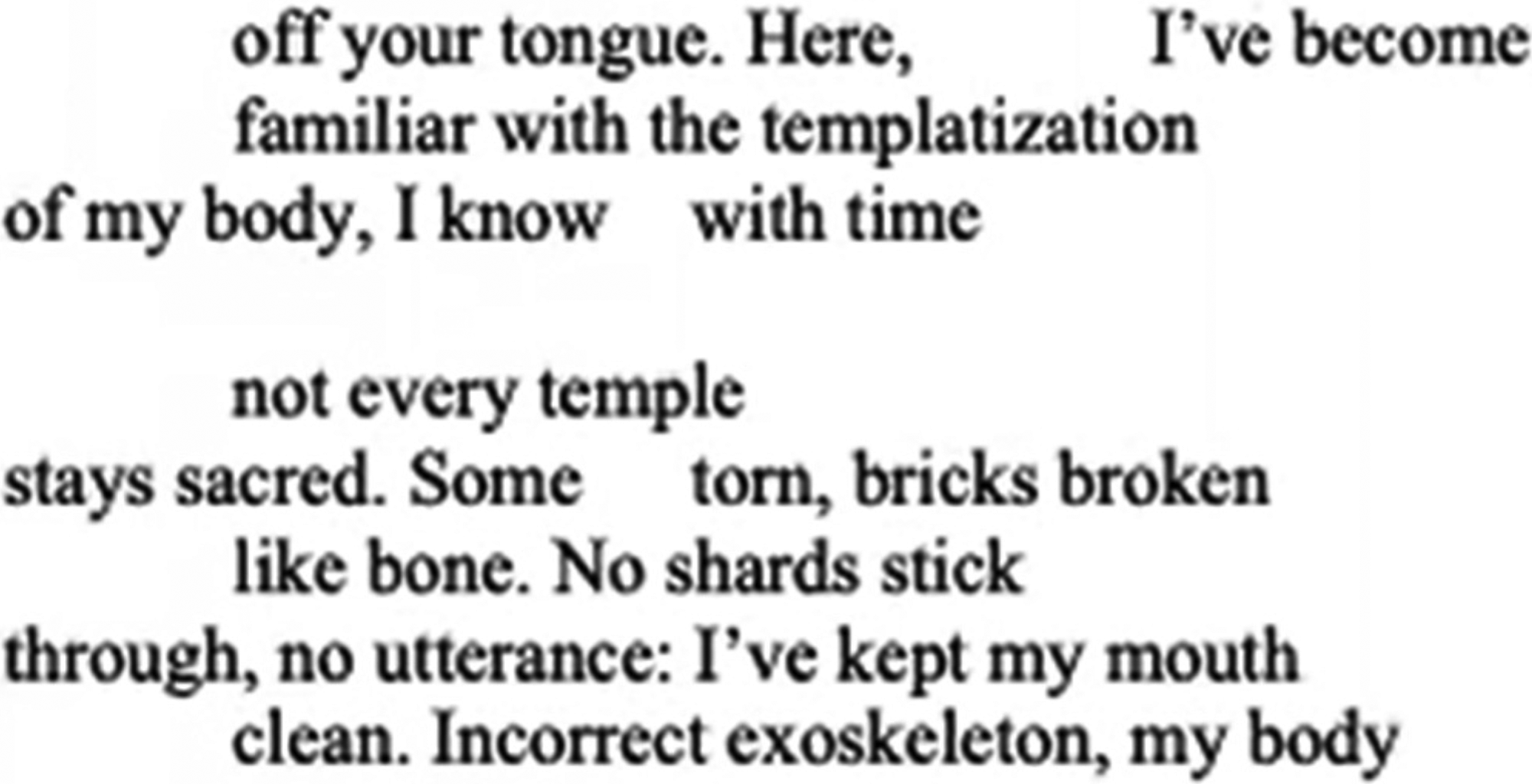
Summer's poem.
Summer's use of multiple poems to document gendered oppression took up hooks’ (1990) conception of the aesthetic as a space in which alternative, marginalized visions of reality and truth can be experienced.
Summer transformed the spaces within her poems to speak to truths about physical and psychological trauma based on gender. From oppression came a resistance by retelling and recreating the event, by parsing the oppression into writing: There's a lot of value in being able to … [make trauma] into a piece of art … . Something that stands on its own, that you can look at and be like, aside from this being terrible and this happening, I can also look at this beautiful thing that came out of it, that even though it's connected, it's not related because I chose to do this beautiful thing with it.
I think in that experience, like for a lot of people … you're not the only one going through this…some kind of…companionship through the darker, harder moments … sometimes seeing somebody else work through those things or experience them on the page can be a way for you to think about and feel some things that … maybe they were hard for you to come across in the first place.
Being immersed in this rural space with Summer—full of the interplay between forms glass, steel edges, slatted branches, wire sculpture, but also the softness of water, wing, and the hush of cars—framed this same interplay within her poems of women's bodies, memory, and landscapes. She used poetic techniques and structure to shape her intersubjective truths and the reader's experience regarding gender and rurality. Poems transformed trauma into beauty and resistance (hooks, 1990; Misson & Morgan, 2006). Writing poems was not for the purpose of developing critical consciousness. Instead, her critical purposes focused on the reader's experiences within these alternative visions of truth and reality. As a poet, she published on a prolific scale both locally and nationally. Thus, her writing was an act of praxis (Luke, 2019), moving into the world to create change in her readers.
Looking Across Portraits
hooks (1990) positioned language as an essential tool by which we can dismantle the epistemology, language, and structures of power. Tilly and Summer used their writing as an aesthetic space in which they created fictional worlds, poetic vignettes, and scenes from their own lives. In these aesthetic spaces, they articulated their intersubjective truths as well as redefined normalized conceptions of womanhood. In doing so they resisted oppression for a range of critical purposes. While both women critically took up conceptions of womanhood, their additional purposes were unique to their intersectional identities and experiences (Brooks, 2019; Crenshaw, 1991).
While attending to a diverse range of critical purposes, both participants created writing across multiple genres. Their work moved into the world in different ways: The prolific publication of poetry on a national scale, films shown on national channels as well as at community screenings, and stories on virtual platforms. These aesthetic texts produced knowledge that was disseminated to the larger world. As such, their writing became an act of praxis—an action that changes inequity (Luke, 2019).
The plurality of Summer and Tilly's experiences highlighted the complex ways in which place, power, identity, lived experiences, and culture intertwine (Villalobos, 2023). Both women drew upon rurality in nuanced, fluid ways. While both women live on the same peninsula—within the same physically bounded region—these rural places shifted in each woman's imagining, and were filled with their particular histories, and cultural and lived experiences (Villalobos, 2023).
Implications: Looking Forward
When thinking about how the portraits of these two women writers can benefit researchers and practitioners in the field of literacy, I have continually returned to my current understandings of critical literacy. Historically, literacy has been used as a tool to challenge oppression (Luke, 2019). The predominant focus of that challenge has been a pedagogical emphasis on reading and understanding the oppressive ideologies inscribed in texts (Misson & Morgan, 2006). Tilly and Summer contributed much to our understanding of how literacy acts as a tool beyond formal educational spaces, shifting the focus of critical literacy from pedagogy and reading to the creation and dissemination of texts. Beyond educational spaces, women draw upon critical literacy—not as a means of being taught how to understand the power of texts—but to wield the power of texts themselves.
This engagement in praxis offers additional points for consideration. Tilly and Summer showed engagement in praxis to articulate and advocate for intersubjective truths that are drawn from lived experiences and that highlight the complex intersectional experiences of rural women. Tilly meticulously crafted worlds—across hundreds of pages of notes and stories—to decenter heteronormativity and white normativity. Summer laced transformation throughout her poetry to help women facing trauma. This connection helps us, as literacy researchers, to deepen our understanding of the relationship between literacy, praxis, and intersectionality. This connection also works against the erasure of the complex ways in which place, power structures, identity, lived experiences, and culture intertwine (Villalobos, 2023).
An additional consideration is the scope and scale of this praxis. Tilly and Summer's creative writing and their embedded purposes reach national audiences. Their writing has done more than shape of knowledge: they have re-envisioned possible worlds and new knowledge from the margins of a hegemonic society (hooks, 1990). Yet for all the power of their work, the field of literacy knows little about the process of praxis. While, theoretically, we understand the process of praxis to include critical awareness, reflection, and action (Luke, 2019), we need a more substantive empirical understanding of how women use literacy for engaging in praxis. Given the oppressive sociopolitical reality that women face (American Civil Liberties Union, 2023), documenting the relationship between women, praxis, and literacy is a crucial area for investigation.
Also, creative writing surfaces across these portraits as a unique literacy tool with particular affordances. Tilly choreographed a scene in which a brother and sister dissect the tensions and ramifications surrounding equity hires. Summer painted images of stitching women's spines. As women weave their own critical purposes into texts, creative writing offers the ability to shape an aesthetic experience that is both emotional and intellectual (Misson & Morgan, 2006). These affordances underscore the importance of creating aesthetic texts that can be instrumental to the lives of women, making me wonder how creative writing can be incorporated into community and educational literacy programs, so more women have access to this powerful tool.
A strength of portraiture is the illumination of goodness for the purpose of transforming societal perceptions of literacy lives (Henderson, 2021). Possible transformed perceptions from this study centered on understanding the power women find in wielding their writing against the darkness and weight of oppression. To harness this power, they drew upon the plurality and richness of their lived experiences as well as their intersectional identities. They also drew upon their writing craft. The portraits illustrate the possible and as-yet-unexplored nuances between women, creative writing, and praxis. They illuminate the need for continued literacy scholarship that platforms the work of women as they continue to navigate, resist, and interrupt oppression with their writing.
Supplemental Material
sj-docx-1-jlr-10.1177_1086296X231215759 - Supplemental material for Rural Women, Creative Writing, and Resistance
Supplemental material, sj-docx-1-jlr-10.1177_1086296X231215759 for Rural Women, Creative Writing, and Resistance by Honor B. McElroy in Journal of Literacy Research
Supplemental Material
sj-docx-2-jlr-10.1177_1086296X231215759 - Supplemental material for Rural Women, Creative Writing, and Resistance
Supplemental material, sj-docx-2-jlr-10.1177_1086296X231215759 for Rural Women, Creative Writing, and Resistance by Honor B. McElroy in Journal of Literacy Research
Supplemental Material
sj-docx-3-jlr-10.1177_1086296X231215759 - Supplemental material for Rural Women, Creative Writing, and Resistance
Supplemental material, sj-docx-3-jlr-10.1177_1086296X231215759 for Rural Women, Creative Writing, and Resistance by Honor B. McElroy in Journal of Literacy Research
Supplemental Material
sj-docx-4-jlr-10.1177_1086296X231215759 - Supplemental material for Rural Women, Creative Writing, and Resistance
Supplemental material, sj-docx-4-jlr-10.1177_1086296X231215759 for Rural Women, Creative Writing, and Resistance by Honor B. McElroy in Journal of Literacy Research
Supplemental Material
sj-docx-5-jlr-10.1177_1086296X231215759 - Supplemental material for Rural Women, Creative Writing, and Resistance
Supplemental material, sj-docx-5-jlr-10.1177_1086296X231215759 for Rural Women, Creative Writing, and Resistance by Honor B. McElroy in Journal of Literacy Research
Footnotes
Declaration of Conflicting Interests
The author declared no potential conflicts of interest with respect to the research, authorship, and/or publication of this article.
Funding
The author received no financial support for the research, authorship, and/or publication of this article.

References
Supplementary Material
Please find the following supplemental material available below.
For Open Access articles published under a Creative Commons License, all supplemental material carries the same license as the article it is associated with.
For non-Open Access articles published, all supplemental material carries a non-exclusive license, and permission requests for re-use of supplemental material or any part of supplemental material shall be sent directly to the copyright owner as specified in the copyright notice associated with the article.
