




Abstract
This study examines differences in teachers’ uptake of critical language pedagogy during a 16-week graduate course. Drawing on narrative constructs of personal, professional, and linguistic identity, the study shows that the more tightly teachers integrate hegemonic language ideologies into their various identities, the more hesitant they are to take up critical approaches to language teaching. We use illustrative cases to describe a typology of engaged adopters, hesitant converts, and resistant skeptics. Based on our findings we recommend introducing critical language teaching early in educator preparation programs and during K-12 schooling so that teachers’ early identity formation includes critical approaches to language teaching. For teacher educators and professional developers working with veteran teachers, we recommend thinking beyond conveying linguistic information and attending to the identity work required of teachers making significant shifts to their personal, professional, and linguistic identities.
A robust body of research speaks to the importance of attending to the relationship between student language, student identity, and students’ sense of engagement in literacy classrooms (García & Wei, 2013; Kinloch, 2011; Smitherman, 2017; Valdés, 2023). Pedagogical approaches that uplift students’ linguistic genius continue to gain support in the research literature (e.g., Devereaux & Palmer, 2019; García et al., 2016). However, despite the growing focus on the role of language, language ideologies, and language/identity interactions in research on English language arts teaching, there is scant evidence of uptake of critical approaches to teaching about language in schools (Wolfram, 2018).
Although literacy researchers provide rich examples of how to integrate critical language teaching in teacher preparation and teacher professional development (Athanases et al., 2018; Mosley Wetzel & Rogers, 2015; Seltzer, 2022), we still know little about which teachers take up these approaches and why or why not. To encourage the adoption of critical, linguistically informed approaches to teaching about language use, teacher educators need additional information on how to support teachers’ uptake of critical language teaching. This study seeks to help teacher educators understand how teachers take up critical language teaching, what the sources of resistance might be, and how to support teachers’ growth in enacting critical language pedagogies.
To nuance our understanding of how teachers take up critical language teaching, we explore the learning trajectories of a group of 19 teachers during a 16-week graduate course on teaching English language in secondary schools. Specifically, we asked: What patterns exist in how teachers change their beliefs about language use and their approaches to teaching about language use? By examining patterns of uptake in relation to teachers’ linguistic beliefs, we identified relationships between teachers’ linguistic identity and their personal and professional identities. The resulting findings highlight the identity work that influences how teachers take up critical language teaching.
Theoretical Framing
This study builds on previous studies that examine how teachers from different backgrounds and in different contexts respond to and take up the ideas of critical language teaching (Mosley Wetzel & Rogers, 2015; Seltzer & de los Ríos, 2018; Taylor et al., 2019; Woodard & Rao, 2020). The analysis puts language ideologies alongside concepts of personal, professional, and linguistic identity.
Critical Language Teaching
Critical language teaching is a general term that encompasses varied linguistically informed approaches to teaching about language in schools. These approaches fit broadly under the umbrella of critical language awareness (CLA) and promote an understanding of the social, cultural, and power dynamics inherent in language use. Grounded in sociolinguistics and critical pedagogy, CLA encourages teachers and students to question assumed norms related to language, unveiling hidden biases and power structures associated with linguistic practices (Alim, 2010; Fairclough, 1992; Metz, 2023). Critical language teaching, as used here, encompasses a variety of approaches that lead to CLA, including translanguaging (García & Wei, 2013), critical language pedagogy (Godley & Minnici, 2008; Godley & Reaser, 2018), and anti-racist Black language pedagogy (Baker-Bell, 2020).
In the context of English language arts classrooms, critical language teaching goes beyond traditional grammar instruction and language proficiency, focusing on developing an awareness of the power dynamics embedded in language use (Alim, 2010; Metz, 2023). A growing number of scholars have put forward approaches for integrating these critical, linguistically informed pedagogies into everyday teaching (Devereaux & Palmer, 2019; Mallinson & Charity Hudley, 2013; Razfar & Rumenapp, 2013; Shapiro, 2022). These approaches emphasize the importance of recognizing and challenging linguistic prejudices and stereotypes that may be perpetuated in educational settings.
English Teachers’ Language Ideologies
The uptake of critical language teaching requires the adoption of a critical language ideology. Language ideologies are constellations of beliefs about how language works in society (Gal & Irvine, 2019). Martínez (2013) provided a useful heuristic by bundling sets of language ideologies into categories of hegemonic/dominant and counter-hegemonic/critical (see also Metz, 2018). In the U.S. context, hegemonic, or dominant, ideologies include a standard language ideology (Milroy, 2001), centering, for example, English based on standardized conventions, and the associated belief in the superiority of standardized English. These hegemonic ideologies also include assimilationist ideologies that suggest all students, regardless of their linguistic background, should adopt standardized English to be successful in American society. In contrast, critical, or counter-hegemonic, language ideologies recognize the systematic and rule-governed nature of all English varieties, emphasizing their inherent value, and embrace linguistic diversity as a strength of U.S. society.
The literature on teachers’ language ideologies reveals the prevalence of hegemonic language ideologies and the associated linguistic hierarchy that devalues language varieties other than standardized English (Anderson et al., 2024; Metz, 2019). Because hegemonic language ideologies, including the standard language ideology and assimilationist language ideologies, are viewed as common sense or “just the way it is,” they often operate on an unconscious level. Existing research shows that explicit interrogation of language ideologies can lead to a shift toward more critical language ideologies (Kroskrity, 2016; Metz & Knight, 2021). Research in teacher education thus explores ways to surface teachers’ implicit language ideologies as a step toward developing a linguistic critical consciousness (Athanases et al., 2018; Banes et al., 2016).
A number of studies examine how teacher education courses integrate sociolinguistics into teacher preparation as a way to help foster critical language teaching (Cruz & Anderson, 2024; Godley & Reaser, 2018; Wong et al., 2020; Woodard & Rao, 2020). On the whole, this body of research shows that teachers begin to adopt more critical language ideologies as they learn sociolinguistic facts. At the same time, related research demonstrates resistance to adopting critical approaches to teaching (Anderson et al., 2021; Banes et al., 2016; Orzulak, 2015), often focused on how teachers enact critical language ideologies. Hence, how teachers apply sociolinguistic knowledge and integrate it into their teaching is an ongoing area of research (Devereaux & Palmer, 2019; McMurtry, 2023). As a field, we know less about the variability in how teachers take up critical language teaching, which limits teacher educators’ ability to design experiences that differentiate learning based on teachers’ needs.
Teachers’ Personal, Professional, and Linguistic Identities
We offer the relationship between personal, professional, and linguistic identity as a mechanism to explain the differential uptake of critical language pedagogies. To explore the relationship between this differential uptake and teacher identities, we utilize a narrative conception of identity—the understanding that people make sense of their lives through stories they tell about themselves (Crowley, 2003). Scholars in psychology hold the view that people create enduring narratives of who they are (McAdams & McLean, 2013). Challenges to people's narrative identities may lead to discomfort, defensiveness, and emotional distress. In this study, we explore how developing CLA may challenge narrative identities on the personal, professional, and linguistic levels, leading to discomfort and fostering resistance to the uptake of critical language teaching.
Personal Identity
The most enduring level of identity in our study is personal identity. Personal identity manifests through the details people foreground and background as they interpret their lifetime of experiences and shape them into a coherent self-narrative (Crowley, 2003). The analysis of life stories has become a staple in qualitative research methods (Ochs & Capps, 2001) and in educational research more broadly (Connelly & Clandinin, 1990). Korthagen and others have described personal identity in terms of a “core” identity (e.g., Korthagen & Vasalos, 2005). This personal identity provides a throughline to inform other subidentities. From a narrative perspective, this personal identity is analogous to a character backstory used to explain and motivate the actions of an individual's context-dependent subidentities, such as their teacher identity.
Professional Identity
Professional identity constitutes a slightly more malleable identity, shaped by stories of self. Contemporary views of teacher identity build on dialogic and narrative constructions of identity (Akkerman & Meijer, 2011). These views emphasize that teacher identity is not an accumulation of knowledge and skills, nor is it a linear progression, but rather it is a constant negotiation and reanswering of the question “Who am I as a teacher?”.
Teacher professional identity is often defined by a teacher's view of good teaching and what a good teacher does (Chen et al., 2018). Teachers model themselves after, and compare themselves to, this vision of good teaching. The view of good teaching includes a vision of expertise in subject matter knowledge and pedagogical knowledge (Beijaard et al., 2000), as well as a relationship with students, parents, colleagues, and administration (Chen et al., 2018).
Teachers express their professional identity through the stories they tell about themselves and the narratives they use to make sense of their own experiences of teaching (Alsup, 2018; Beauchamp & Thomas, 2009; Connelly & Clandinin, 1995). Researchers use teachers’ stories to understand how teachers view themselves professionally (Curwood, 2014; Lojdová et al., 2021). New and novice teachers are in the process of forming professional identities, while more veteran teachers possess more firmly established teacher identities that may be tightly tied to their personal identities.
Linguistic Identity
Linguistic identity comprises the role of language use in how people understand themselves. People express who they are through how they use language (Bucholtz & Hall, 2004; Coupland, 2007). Aspects of linguistic identity may include whether someone takes great pride in their use of standardized English, makes use of their regional accent to mark their place of origin, or feels shame in the use of dialect features common to their community. Linguistic identity can be a central or peripheral aspect of the narrative people construct to make sense of their lives.
For English teachers, life experiences shape language ideologies with implications for how teachers approach teaching about language (Bukor, 2015; Metz, 2022; Metz & Knight, 2021; Seltzer & de los Ríos, 2018). The way teachers develop and change their beliefs and practices regarding language teaching is thus connected to narratives of their personal, professional, and linguistic identities (Ayiewbey & Sarkhosh, 2023).
This study examines the role these three aspects of identity play in the uptake of, or resistance to, critical language teaching. We argue that the integration, or coupling, of linguistic, personal, and professional identities contributes to how readily teachers take up new ideas of language use. The more strongly hegemonic language ideologies are centered in teachers’ personal and professional identities, the more difficult it becomes to rewrite those identities to account for counter-hegemonic language ideologies they learn about in coursework or professional development.
Researcher Positionality
As the first author, I describe my relationship to the study and the participants in the study from the perspective that relationality is more valuable than a checklist of demographic attributes (de los Ríos & Patel, 2023). I undertake this study with a vested interest in figuring out how to help teachers adopt critical language teaching. I grew up in urban public schools. My earliest memories include conversations with my mother—an educational sociologist studying school desegregation—about the racial dynamics of my friendships as a white boy in predominantly African American schools. Throughout my schooling, and later as a teacher in similar urban public schools, I witnessed the ways race, class, language, and identity intertwined to position some students as successful and others as failures in an inequitable school system.
After 15 years of classroom teaching, I became an educational researcher to address the experiences I lived through as a student and teacher. My graduate studies led me to adopt critical language teaching as a tool to disrupt race and class discrimination in schooling. For the past decade, I have worked with preservice and practicing teachers to research and develop teaching practices that promote critical language ideologies. This study seeks to explain the differential outcomes I have encountered, as well as those described in the literature.
The second and third authors, white female undergraduate students in teacher education, were new to learning about language ideologies. They supported my work on this project as part of a course in the honors college. They brought authentic questions, fresh ideas, and an outsider's perspective to the data processing and analysis.
Methods
Participants
The 19 students in the class came from varied contexts across the United States, including rural Montana, urban Miami, a suburb of Portland, Oregon, and an Indigenous-focused charter school in Hawaii. The teaching experience varied from one to more than 25 years. Teachers’ backgrounds varied as well, with some teachers having lived in multiple countries and contexts and others having never left the small town where they grew up. Eighteen of the teachers identify as white and one as Latina. Fifteen identify as female and four as male. The predominantly white female demographic of the course reflects the largely white female population of teachers, which was 80% white and 75% female at the time of the study (Taie & Lewis, 2022). Given the predominantly white makeup of the course, the variety of teachers’ lived experience and teaching experience was an asset to the course and provided rich data for the study. The data in this study come from the third time I taught the course. I requested students’ permission to use the course data after the class was over and grades had already been assigned.
Data
The data for the study consisted of the teachers’ written work. Written work included assignments for the course as well as weekly discussion board posts. The four key assignments included (a) a linguistic autobiography, (b) a research project on an English variety connected to their teaching context, (c) an exploration of language ideologies in grammar teaching resources, and (d) a unit plan or yearlong scope and sequence integrating key ideas from the course into their classroom curriculum. Weekly discussion posts required students to engage with ideas from readings, consider the implications of those ideas for their own classroom or context, and reply to at least three classmates’ posted responses. Because the majority of teachers were teaching full-time while taking the course, the course culture developed so that the discussion boards grew into authentic conversations about the ideas, sharing of related classroom activities, and personal successes and challenges of trying to implement the ideas in their classrooms.
Data Analysis
The analysis process consisted of two phases. First, the research team traced each teacher's writing across all 16 weeks of the course. From this longitudinal record we created biographical sketches that mapped the trajectory of each teacher's thinking. In the second phase, we analyzed across and within the biographical sketches to identify patterns in teachers’ uptake of critical language teaching, and then looked at underlying factors that helped explain those patterns.
The biographical sketches provided the teacher's linguistic history and teaching context as they presented it, as well as concerns, epiphanies, and applications of the course concepts. To write the biographical sketches, we began by analyzing the linguistic autobiographies teachers wrote in the first week of the course. In the linguistic autobiographies, teachers worked through a series of prompting questions (see Mallinson & Charity Hudley, 2013, p. 6 for examples) to reflect on language use in their life histories. These autobiographical accounts provided a solid starting point for each biographical sketch, allowing us to document each teacher's understanding of their own linguistic history.
To complete the biographical sketches, the research team collaborated in coding the writing for evidence of teachers’ language ideologies, noting evidence of hegemonic and critical language ideologies. We mapped how teachers responded to the ideas of the course week after week, paying special attention to evidence of change in thinking. Change in thinking was marked both by explicit discussion of change and by implicit change. Explicit change was evident in key quotes that were included in the biographical sketches. Implicit change was more subtle, identified when the codes for teachers’ language ideologies shifted from hegemonic to critical.
To understand differences in uptake within the groups of teachers, we identified passages in teachers’ writing that revealed a larger orientating narrative about their personal, professional, and linguistic identity. We employed the concepts of small stories and narrative orientation (Bamberg & Georgakopoulou, 2008; Razfar, 2012; Taylor et al., 2018) to uncover how teachers positioned themselves in relation to the ideas of the course.
For example, in her discussion posts, Kris provided anecdotes about her colleagues’ approach to language teaching, sharing that one colleague kicked students out of class for using the word “like” when speaking in presentations. We examined the function of these small stories over several instances combined with allusions to future stories, such as Kris explicitly asking, “If I move away from standardized English, how will my colleagues feel about it?” In the biosketches, we note how these pieces of stories and allusions to stories do the interactional work of foregrounding Kris's concern about her teaching identity.
The biosketches included sample stories and juxtaposed this evidence of narrative identities with the language ideologies the teachers espoused. In the case of Kris, placing her stated language ideologies alongside stories demonstrating concern for her teacher identity highlighted a moment of epiphany where she found her evolving language ideology “liberating.” On average, the biographical sketches reduced 150 pages of writing per teacher to four-page documents that focused on teachers’ narrated identities and condensed the development of teachers’ language ideologies.
The resulting biographical sketches became secondary data used for Phase 2 of the analysis. In Phase 2, we looked for patterns across the biographical sketches, grouping teachers according to how they responded to and took up the ideas of CLA and critical language teaching. The analysis allowed us to group teachers based on their initial language ideologies and stances and then on patterns of whether, and when, they came to take up and apply the ideas of the course. We identified five general groups, shown in the findings below. From these groups, we looked more closely at the three groups of teachers who demonstrated change in their thinking, attempting to add nuance to the variation we saw in these groups. We share the patterns of uptake in the findings below, with further discussion of the relationship between these patterns and aspects of identity in the Discussion section.
Findings
As we explored teachers’ responses to learning about CLA, we found five general patterns repeated across teachers. Some teachers were engrossed advocates (n = 3). They began the course familiar, to varying degrees, with the ideas of CLA, and spent the 16 weeks adding nuance and practical applications to their understandings. Other teachers were disengaged completers (n = 3). They went through the motions of the course, completing the basic requirements of assignments, but never delved deeply into the ideas. These teachers didn’t express resistance—many seemed to support the ideas—but they didn’t provide evidence of deep engagement that suggested development of new ways of thinking.
The remaining teachers showed significant change in their thinking about language teaching. Their engagement followed three general groupings we describe here and then expand on below: engaged adopters (n = 6), hesitant converts (n = 3), and resistant skeptics (n = 4). We provide a summary of all five groups in Table 1. We do not claim these are universal categories, but offer them as a tool to think through how teachers respond to learning about critical language teaching.
Patterns in Uptake of Critical Language Teaching and Associated Identity Work.
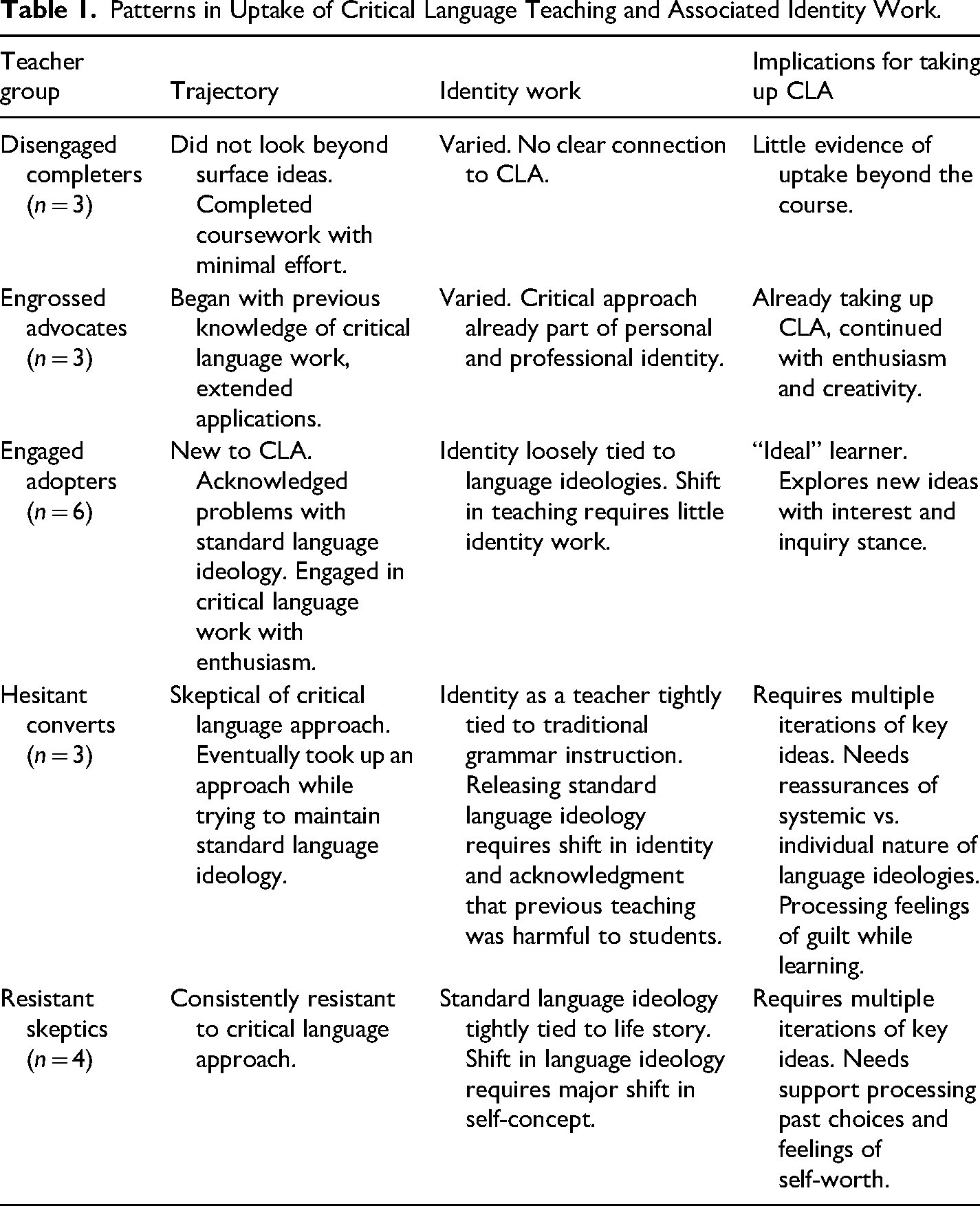
For the remainder of the findings, we explore illustrative cases (Erickson, 2006) of the three groups of teachers who demonstrated a change in their thinking and examine the causes and implications of those changes. These cases were selected as illustrative because they provided the most transparent and accessible examples of the characteristics at the core of each group we identified.
Engaged adopters demonstrated change in their language ideologies and language teaching early in the course. These tended to be younger teachers who didn’t have strong beliefs about grammar and language previously. They took up the ideas of CLA, explored them, and looked for ways to actively employ CLA in their curriculum and teaching.
Hesitant converts also changed their language ideologies, but required more evidence and examples than engaged adopters. They sought resolution of pedagogical and ideological tensions they perceived. These tended to be veteran teachers with experience teaching grammar and language over many years. The approaches to language teaching in the course contrasted with their teaching experience and called into question assumptions they held about how and why students should learn standardized forms of English. Because their identity as teachers was tied to their teaching of grammar, these teachers asked perceptive questions about approaches they were learning and raised legitimate tensions and concerns. Even so, each had a moment where they expressed acceptance of the validity of the critical language approach and became convinced of the veracity of the pedagogy.
Resistant skeptics shared many qualities with hesitant converts, but their resistance ran deeper. We found that these teachers’ concept of self was tied to their beliefs about language. Most came from stigmatized language backgrounds (primarily Southern or self-identified “hick” language) and pointed to their command of standardized English as the key to their own social, economic, and professional success. Most had endured personal persecution related to their adoption of standardized English, including teasing and even ostracization from their families, and thus were personally invested in the privileged position of standardized English in schools and professional contexts. The acceptance of a critical language approach required a complete revision of these teachers’ sense of self. The participants in this category in our study came around to a critical language pedagogy, but we have experienced similar teachers in other contexts who were not able to make this shift.
Overall, these findings show that the willingness with which teachers take up critical language approaches depends greatly on the teachers’ own identity positions in relation to language use. Our findings suggest teachers who have little professional or personal investment in standardized English adopt critical language teaching eagerly; teachers whose professional identity is tied to traditional grammar require more support to shift to a critical approach; and finally, teachers whose sense of self is intricately tied to standardized English require the most support and convincing that traditional grammar instruction does not serve students well.
Below we provide cases to illustrate each of these groupings. All names are pseudonyms.
Engaged Adopter—Rachel
Although engaged adopters showed little previous attention to language ideologies or knowledge of language variation, once exposed to the concepts they took them up readily. Rachel exemplified this category of learners in our study, quickly acknowledging the limitations of her traditional approach to teaching about grammar and language use and eagerly searching for applications of her new understandings.
A white female in her mid-20s, at the time she took the course Rachel had been teaching ninth-grade English in a public school in a small town in Montana for six years. She acknowledged a lack of attention to language variation before the course but started identifying examples in her life once she learned about it.
After introductory lessons on language variation and language ideologies, Rachel expressed a strong desire to incorporate language variation in her curriculum. In the second week of the course, she described her own position in relation to standardized English, writing in the discussion board, “Within my own classroom and within my own mind, I have utilized the argument of preparing students for the real-world by enforcing SAE [Standard American English], and I know this is something that has been instilled throughout my entire life—through my family, education, experiences, societal expectations.” This narrative orientation, describing her teaching approach in relation to her life story, provides context to understand how Rachel thinks about her own beliefs. She noted the influence of the standard language ideology across multiple facets of her life, “family, education, experiences, societal expectations,” but did not name it as central to any aspect of her own identity.
Having identified her position in relation to standardized language, she went on to describe the shift in her thinking: “The reading made me realize how important it is to emphasize [language variation] to students. Understanding different forms of language could be a tremendous way to have students open up their minds to diversity.” At the beginning of Week 2, Rachel bought into teaching her students CLA. Over the remaining 14 weeks, she demonstrated continuous growth in teaching about English variation and critical language ideologies. In Week 4, Rachel wrote, I truly do not feel prepared to address language ideologies.… All of it is a completely new concept to me, and I feel like I’ve just hit the tip of the iceberg when it comes to understanding language differences. On top of that, it is a total upheaval of my own constructions of language ideas—although we can start by introducing those topics in the classroom, I think there needs to be training and conversations for teachers within their education as well.
While these critical ideas of language were new to Rachel, she took them up thoughtfully in an open and engaged fashion. She carefully considered how to incorporate them into her own teaching and wondered how to spread the ideas to other teachers and to the wider society.
Rachel's uptake of critical language pedagogy was not impulsive but measured. She continued to ask hard questions throughout the course and expressed a holistic view of language, saying she “can’t shake the feeling that there is some merit” in Standard American English. She struggled with the traditional approach of her school and her colleagues, but she increasingly interrogated her preconceived notions as the course progressed. In Week 11, she wrote, “I have only just recently started changing my viewpoints on grammar and ‘correcting’ grammar in student writing, and I’ll tell you what—it has been liberating (for myself AND for my students, haha).” Toward the end of the course, Rachel examined her curriculum, writing, Upon reading further, I started to realize that there are quite a few language varieties throughout our 9th grade curriculum, but as I have reflected on in previous posts, I have not done the best job of addressing them in the past.
Rachel acknowledged the weakness in her previous teaching, but she did not describe any emotional resistance to changing her approach. Her story of herself as a teacher, her professional identity, is not bound up in her teaching about language.
Once Rachel learned about CLA, she was open and engaged in learning more. For her first class project, she did a deep dive into Native American Englishes and Navajo English because they were common and stigmatized in her context. She frequently traded lesson ideas with peers in the discussion board. For a final project, she revised her English 9 curriculum to include a critical language component with each core text in the ninth-grade units of study. This final project explicitly addressed the weakness she identified in her curriculum.
Although Rachel had taught a traditional approach to grammar for her previous six years in the classroom, her professional and personal identity were not tied to that approach. Once she learned about an alternative approach, she eagerly took it up and incorporated it into her teaching. In many ways, Rachel serves as an “ideal” case of a teacher learning about CLA. For other teachers, their investment in traditional grammar instruction and a standard language ideology made the change to a critical approach more challenging.
Hesitant Convert—Kris
Kris is a white female in her late 20s. She had been teaching ninth- and 10th-grade English in a small town in Missouri for seven years at the time of the study. Kris's linguistic autobiography set up a narrative about her teacher identity that stemmed back to her experiences of being praised for her own language use as a child and student. She described being given special individualized spelling lists in third grade because she was ahead of the class. She also explained, “My high school English teachers frequently asked me to help edit my peers’ papers. I really enjoyed helping with that.” She shared that these experiences set her on the path to becoming an English teacher. Kris expressed pride in her grammar teaching as well as in her own grammar knowledge.
As she learned about critical approaches to language teaching, she demonstrated openness, but resistance. She acknowledged the problem that language is used as a basis to judge people on other unrelated characteristics, but she held on to the value of traditional grammar teaching. In Week 2, Kris began to question her standard language ideology and her own beliefs about language. Returning to her life narrative, she again described her feeling of superiority because of her language use while she was growing up and realized she brought that feeling into her classroom as a teacher.
Where did this come from? My parents certainly wouldn’t have put this notion in my head. So where did I get this from? I am curious as to why I took so much pride in remembering the “rules.” I don’t think I am a snotty person, so I am just wondering where that superiority came from. It really bothers me.
It wasn’t until Week 4 that Kris experienced a breakthrough moment. She continued to reference three narrative aspects of her identity; she talked about her own linguistic beliefs and her pride in her language knowledge; she talked about her teacher identity and her desire to help all her students; and she described her personal identity as someone who seeks to promote justice and decency. She put these three aspects together as she described her epiphany. In the discussion board for Week 4, she wrote, This week, the readings really punched me in the soul. As someone who has always sought to advocate for minorities or even just human decency, I feel as if my past approach to grammar has been shameful.
As she read, she realized her previous approach to teaching grammar reinforced the language hierarchy she had internalized. She understood that her focus on grammar caused her students to feel bad about their language use. Kris communicated the visceral feeling of her realization in her post. This isn’t an intellectual exercise or a subtle tweak to Kris's teaching, but a “soul punching,” shame-inducing revelation. She continued, writing, “I am completely ashamed of myself.”
Kris offered additional insight into the source of her shame, explaining that her concept of herself as a teacher was connected to her approach to teaching. In responding to the reading from Lippi-Green's English With an Accent (
2012
), Kris oriented to her teacher identity narrative once again as she wrote, I completely get what it was saying about how easy it is for English teachers to just repeat the approach to language that they were taught by their English teachers. After all, my 10th grade English teacher is the person who made me finalize my decision to pursue this career. I adored her and wanted to be just like her. I don’t remember her ever shaming us for our grammar mistakes or speech patterns, but I desperately wanted her to think I was “smart” because I could write papers well and never used the word “ain’t.”
Kris's vision of good teaching involved an emphasis on proper grammar and promoting a standard language ideology. Changing her approach to grammar teaching required changing her view of good teaching and shifting her view of herself as a teacher.
In Week 6, Kris continued to process the implications of a critical language approach for herself and her students. She showed that she was in the process of revising her teacher identity narrative. She wrote in the discussion post, I don’t want to erase my students’ identities or make them feel bad about themselves. Teenagers have enough self-esteem issues without me doing that. I want my classroom to be a safe learning environment where they can trust me. I don’t want to damage that because they are afraid I will correct them when they talk.
As she became more aware of the implications of language teaching on her students, Kris redefined how that aspect of her pedagogy fit with her vision of herself as a teacher. She understood that her intentions hadn’t changed; rather, her pedagogy didn’t have the impact she intended. She expanded on her intentions as she communicated her vision of herself as a teacher: My heart was in a good place. I have corrected students like that because I want them to be prepared for interviews and collegiate life or any job that requires the use of SAE. I know now that I can teach language varieties differently and help celebrate how rich English truly is. Realizing the power structures and discrimination behind language use has made me passionately turn away from my old approach. I am looking forward to shifting my approach in the classroom.
The identity work Kris engaged in didn’t require a change in her goals for teaching, but rather a shift in how to reach those goals. She needed to acknowledge that her past approach was counterproductive, an acknowledgment that required a good deal of humility and forced her to contend with feelings of shame. Despite her initial resistance, Kris came out of the course with a revised teacher identity narrative that solidified her vision of herself as a caring teacher and added an ability to incorporate critical language teaching into her pedagogy.
Resistant Skeptic—Jamie
Jamie is a white female English teacher in her mid-40s with 16 years of teaching experience at the time of the study. She grew up in several rural towns across the Midwest and at the time of the study lived and taught outside Columbus, Ohio. In addition to teaching, Jamie had spent several years as an editor for a large educational publishing company. During her teaching career, she had taught in both inner-city Columbus and in rural districts in Ohio and Illinois.
In her linguistic autobiography from Week 1, Jamie expressed her belief that mastering standardized English was the key for improving one's life chances. In her narrative, she explained that mastering standardized English helped her get out of her rural hometown and opened up a world of possibilities for her. Jamie expressed that standardized English and a belief in the correctness of that standardized form were central to her own life story and sense of self.
In Week 4, as other students were describing their shift to a view of critical language teaching, Jamie pushed back. In response to another student's post about linguistic equity, she wrote, I think you and I come at the issue of SAE from opposite sides, but with equal intent. I definitely see your point about Native students who are not going to leave their communities when they finish high school. As someone who struggled to leave my community and succeed, though, I also see the flip side of that. What if they stay because they are not prepared to leave?.
Jamie oriented to the narrative of her life history to argue that students need to learn standardized English as a tool to get out of their home communities, if they want. She explained further, I think students need to have a guarantee, a protection of sorts, that local schools will not screw up their potential to escape their surroundings. (Can you tell from that statement anything about my own schooling? Yes, it was that bad.) Schools need to be held to some minimum literacy education that is equal in effectiveness throughout the nation. I don’t know how to make that square with Lippi-Green.
1
And no, I don’t think we are doing a good job of this in the current system. I just don’t know what Lippi-Green or linguistic equality does to make it better.
Jamie engaged deeply with the ideas of the readings and thoughtfully applied the ideas to her students’ and her own experiences. This is not an out-of-hand dismissal of the ideas, but a reasoned critique and resistance. Jamie invoked the narrative of her personal identity, highlighting the value of standardized English to her own life and the lives of her past students in both rural and urban schools. In her narrative, standardized English is a tool that enables students to leave their communities. Decentering standardized English shifts that narrative of schooling.
In Week 5, Jamie revealed more of her resistance, as well as metacognitively reflecting on the reasons for her resistance. She posted, So far at least, I can agree with the idea of these [prescriptive grammar rules] as myths and beliefs as long as we continue to focus on spoken English. I am not yet prepared to step into the morass of written standard English being a belief. Who knows where the semester will lead me, though. Perhaps I am deliberately taking baby steps in order to avoid being made to feel like everything I have done in my professional life is for naught.
Jamie continued to be thoughtful and accepting of some of the concepts; she agreed that many prescriptive rules of spoken language are arbitrary. She also was open to the possibility that her own thinking might change. Most importantly, she named a cause of her resistance. She suggested that she is slow to take up the ideas because that would means acknowledging her 16 years of teaching were flawed. It would mean rewriting the narrative of her identity as a teacher. In the face of this painful realization, Jamie admitted her approach was wrong, but she needed time to process that.
A week later, Jamie was still working through the slow shift in her understanding and her view of her own teaching. She wrote, Based on Weeks 1–5, I was expecting to feel defensive and guilty when I approached this week's reading. I have been feeling that everything I did in my 16 years of teaching was wrong and that I sucked as a teacher, tone deaf to my students’ needs and language. Instead, I found solace and confidence in the Schuster reading
2
in particular.
Jamie continued to process this revision of her teacher identity, and persevered despite the discomfort. She found useful pedagogies in the readings and slowly revised the narrative of her approach to teaching. Toward the end of the course, Jamie's resistance began to dissolve. In Week 11 she posted, This week's reading initially angered me very much. I actually had to take a couple of breaks from reading before I could complete it. But as Dr. Metz had challenged us to do, I pushed through and tried to focus on what was upsetting me and what that might mean. Why then, am I not still angry with Elbow
3
about his claims? Because I think he is correct. I do think most people think grammar is that black and white. Most teachers—at least from my era—taught that way and graded that way. And most non-grammarians think there is only one right way to write. Once I stopped being defensive and opened my mind to what he was saying, I agreed very much.
Jamie oriented to the dominant teacher narrative of the time as part of her own narrative teacher identity. She finally released her resistance and allowed herself to consider a new narrative identity.
From the first weeks, Jamie engaged with the ideas of the course despite the way they challenged her view of her teaching and herself. Nearly three months later, in Week 11, she began to let go of being defensive as she read. She described having to take breaks from the reading because of the emotions they evoked in her. Jamie came around to the ideas of critical language teaching, but the change was a slow, emotional process that involved dismantling her previous view of herself as a teacher and her view of herself as a person. Because Jamie's language ideologies were deeply intertwined with her life story—one of escape from her circumstances—changing those language ideologies involved changing her perception of herself.
Discussion
While the patterns in teachers’ uptake coalesced around five groups, we only examine three of the groups in this article. Neither the disengaged completers nor the engrossed advocates showed significant change in their ideologies or identity. While engaging both these groups of teachers is important work, we don’t take it up here.
The remaining three groups—engaged adopters, hesitant converts, and resistant skeptics—all showed change in their beliefs about language teaching that coincided with patterns in their conceptions of their linguistic, personal, and professional identities. We noted that when these three identities (personal identity, professional identity, linguistic identity) cohere around hegemonic language ideologies, the language ideologies are more resistant to change. When a language ideology shapes aspects of one's identity, shifting that language ideology necessitates rewriting the personal and professional narratives that govern identity.
Loosely Coupled Language Ideology and Identity
The analysis showed that teachers’ uptake of CLA varied by how tightly a standard language ideology was integrated into their various identities. Our engaged adopters showed little connection between a standard language ideology and their linguistic, personal, or professional identity.
When the engaged adopters were introduced to ideas that decentered standardized English and validated other varieties of language, they expressed feelings of destabilization, but not dismay. The ideas were new to these teachers and carried significant repercussions for their teaching, but the teachers didn’t express resistance. Rachel described a “total upheaval of my own constructions of language ideas” but framed that as a reason she and other teachers should be exposed to these ideas even earlier in their schooling.
The engaged adopters talked about changing their beliefs and their practices, but they didn’t talk about changing their identities. What showed up differently in their reflections was a willingness to move forward with critical language concepts decoupled from discussions of their identity as teachers or people. When Rachel talked about changing her approach to teaching grammar and writing, she framed the new approach as liberating. These engaged adopters talked about their previous approach to teaching as something they did, not who they were. I suggest that this loose coupling of language ideology and identity facilitated their shift from hegemonic to critical language teaching.
The findings suggest that teachers who don’t couple standardized language use, or hegemonic language ideologies, with their personal and professional identity will be more inclined to take up critical language pedagogies. We saw this with less experienced teachers who had not yet developed a strong teacher identity. We also saw it with teachers whose personal identity was more tightly connected to a historically marginalized language variety (i.e., Southern English), although some of these teachers’ professional identities can be even more tightly coupled to a standard language ideology (Metz, 2021).
Tightly Coupled Linguistic and Professional Identity
We noted that our resistant converts tied their professional identity as English teachers to their knowledge of, and beliefs about, standardized English. Many of these teachers talked about being praised for their own language use and knowledge of grammar in their own schooling. They emulated the teachers they had growing up and modeled their teacher identity on the kind of prescriptive grammarians that helped them be successful. Like Kris, these teachers often got into teaching because mastery of prescriptive grammar and language use helped them achieve their goals.
For the resistant converts, adopting a critical language pedagogy required reevaluating their past teaching and figuring out how to reconcile that with their own view of themselves as teachers. Kris made this process transparent through her discussion posts. First, she described the realization of her own attitudes about language: “I am just wondering where that superiority came from. It really bothers me.” Two weeks later, she had the revelation that her teaching practices perpetuated language discrimination, saying, “This week, the readings really punched me in the soul.” She then began the process of reconciling that realization with her story of herself as a teacher, first examining the origins of her vision of good teaching and then rewriting her teacher narrative. It took over a month for Kris to develop a new narrative of her teaching. She finally resigned herself to a new view of her past self when she said, “My heart was in a good place.” She was then able to look to the future to imagine the kind of grammar teacher she wanted to become.
This process of rewriting a narrative of professional identity is time-consuming, emotional work. It cannot be accomplished in an afternoon of professional development, and for many veteran teachers it may not be accomplished at all. We saw Jamie's lament of “feeling that everything I did in my 16 years of teaching was wrong and that I sucked as a teacher, tone deaf to my students’ needs and language.” That is a hard feeling to overcome. For many teachers, it may be easier, and certainly more comfortable, to continue teaching as they always have. Even so, rewriting one's professional identity is potentially easier than rewriting one's personal identity.
Tightly Coupled Linguistic and Personal Identity
Our resistant skeptics showed the most reluctance to embrace the ideas and practices associated with critical language teaching. They provided defenses of the standard language ideology and of assimilation ideologies. The teachers in this category all expressed support for implementing critical language pedagogy by the end of the course, although they remained skeptical of how it would be received in their contexts. We noted that these teachers described their hegemonic language ideologies as being part of their personal identities in addition to their teacher identities.
The resistant skeptics, like Jamie, told stories that showed how their linguistic identities, based in hegemonic language ideologies, were tied to their personal identities. Jamie came from a small rural town and described her language knowledge and language use as the key to “escaping.” In addition to her professional identity as a strict teacher of writing and an editor for a major publisher, she also held up her hegemonic language ideologies as a key to her whole life story.
For Jamie, as with many people from historically stigmatized linguistic communities, there was a social and familial cost to setting aside the language of home and adopting standardized language practices. Whether it is adopting an “academic” register, a “neutral” accent, or a specialized vocabulary, the move toward hegemonic language norms can be framed as “selling out,” “crossing over,” or being a traitor to one's own race (Alim, 2023; Kinloch, 2010). Being ostracized from one's family or community because of language use is an expensive sacrifice. To learn that this cost, this sacrifice, could have been avoided with a deeper understanding of language ideologies and language use initiates grieving. In these cases, the revision to one's life story changes cores aspects of identity. The sense of moral superiority, the view of one's own family or community as ignorant, the belief that one overcame challenges and bettered oneself risk becoming sources of shame instead of points of pride.
Jamie described feelings of guilt, shame, and anger as she learned about critical language teaching. These feelings took her four months of the class to process, and at the end of the semester she was still working through them.
The Identity Cost of Critical Language Teaching
In summary, we found that teachers with a greater identity investment in hegemonic language ideologies take longer to come around to critical language teaching. For new teachers, or teachers who have never devoted energy to the teaching of grammar and language, letting go of hegemonic language ideologies changes little about their professional identity. It requires little emotional investment to take up CLA and make it part of their evolving teacher identity.
For teachers who have built a professional identity around their knowledge of standardized English grammar and their ability to police, or “fix,” students’ language, adopting a critical language approach exacts a greater cost. To adopt a critical language approach, these teachers need to rewrite the narrative of who they are as teachers. They need to wrestle with how their previous teaching may have perpetuated inequities rather than empowering their students. These significant revisions to a professional identity require time, support, and patience.
Teachers, like Jamie, whose life story centers around their adoption of standardized English require even more time and support to renarrate their identities. When a person's core identity is tied to adoption of prescriptive language norms, the dismantling of those language norms threatens the story of self. Teacher educators teaching classes or professional development on CLA should be aware that the linguistic facts they convey touch on deeper identity narratives with potential impact for teachers’ sense of self.
Because there was only one teacher of color in this study, I resist extending the findings to teachers of color. Even so, my past work with teachers of color and other language-minoritized teachers who have been immersed in assimilationist and code-switching pedagogies suggests potential parallels worthy of further investigation. Gramsci's cultural hegemony (a key aspect of hegemonic language ideologies) suggests that oppressed groups become complicit in their own oppression through the maintenance of cultural (and linguistic) norms that benefit those in power (Gramsci, 1971; Ives, 2009). To the extent that teachers from language-minoritized backgrounds craft teacher identities that call for the adoption of standardized English, their introduction to critical language teaching may require a rewriting of their teacher identity from an assimilationist to an abolitionist framing (Alim, 2023). Future work on teachers’ uptake of critical language pedagogies would do well to examine the nuance in how teachers of color take up CLA (see Wong et al., 2020).
Implications
Our findings make visible one mechanism to explain why we see such differential uptake of CLA and critical language pedagogies despite the solid linguistic evidence undergirding these approaches. The connection between professional identity and language ideologies helps explain findings in previous studies that show more veteran teachers hold onto hegemonic language ideologies (Anderson et al., 2021; Metz et al., 2024; Metz & Knight, 2021).
The findings emphasize the urgency to bring critical language teaching to K-12 schools. The earlier students are exposed to critical language ideologies, the more easily they can incorporate them into their own identity narratives. This is true for students in communities that speak standardized English as well as communities that speak historically stigmatized varieties of English. The longer K-12 students (future teachers) remain immersed in hegemonic language contexts, the more energy, effort, and emotion will be required to rewrite the narratives they create around those language ideologies in their later lives.
A second implication is the need for sensitivity and patience as we work with teachers to take up critical language teaching. For most teachers, aside from simply acquiring new knowledge, the shift from a hegemonic language ideology to a critical language ideology necessitates a revision of life stories. This is not easy or fast work. The more tightly coupled language ideologies are to personal or professional identities, the more support is required to decouple and shift those ideologies. To help teachers successfully take up critical language pedagogies, teacher educators would do well to provide space for teachers to process the revisions to life stories and the associated adjustments to personal and professional identities. While existing research suggests the kinds of support preservice and novice teachers require when confronting language ideologies (Mosley Wetzel & Rogers, 2015; Seltzer, 2022; Woodard & Rao, 2020), additional supports are necessary when working with veteran teachers whose personal, professional, and linguistic identities are more deeply entrenched.
While this study highlights three white female teachers, teachers across racial, ethnic, and linguistic backgrounds experience a similar range of linguistic, personal, and professional identities loosely or tightly coupled to hegemonic language ideologies. The range of uptake shown in this predominantly white and female sample suggests that teacher educators need to look beyond easy categories of race, class, and gender to uncover the role language ideologies play in teachers’ linguistic, personal, and professional identities. By attending to the nuance of teachers’ identity narratives, teacher educators can support teachers in the identity work needed to take up critical language teaching.
Supplemental Material
sj-docx-1-jlr-10.1177_1086296X251352302 - Supplemental material for Nuancing Teachers’ Uptake of Critical Language Pedagogies
Supplemental material, sj-docx-1-jlr-10.1177_1086296X251352302 for Nuancing Teachers’ Uptake of Critical Language Pedagogies by Mike Metz, Grace Chicoine, and Lauren Bayne in Journal of Literacy Research
Supplemental Material
sj-docx-2-jlr-10.1177_1086296X251352302 - Supplemental material for Nuancing Teachers’ Uptake of Critical Language Pedagogies
Supplemental material, sj-docx-2-jlr-10.1177_1086296X251352302 for Nuancing Teachers’ Uptake of Critical Language Pedagogies by Mike Metz, Grace Chicoine, and Lauren Bayne in Journal of Literacy Research
Supplemental Material
sj-docx-3-jlr-10.1177_1086296X251352302 - Supplemental material for Nuancing Teachers’ Uptake of Critical Language Pedagogies
Supplemental material, sj-docx-3-jlr-10.1177_1086296X251352302 for Nuancing Teachers’ Uptake of Critical Language Pedagogies by Mike Metz, Grace Chicoine, and Lauren Bayne in Journal of Literacy Research
Supplemental Material
sj-docx-4-jlr-10.1177_1086296X251352302 - Supplemental material for Nuancing Teachers’ Uptake of Critical Language Pedagogies
Supplemental material, sj-docx-4-jlr-10.1177_1086296X251352302 for Nuancing Teachers’ Uptake of Critical Language Pedagogies by Mike Metz, Grace Chicoine, and Lauren Bayne in Journal of Literacy Research
Supplemental Material
sj-docx-5-jlr-10.1177_1086296X251352302 - Supplemental material for Nuancing Teachers’ Uptake of Critical Language Pedagogies
Supplemental material, sj-docx-5-jlr-10.1177_1086296X251352302 for Nuancing Teachers’ Uptake of Critical Language Pedagogies by Mike Metz, Grace Chicoine, and Lauren Bayne in Journal of Literacy Research
Footnotes

Funding
The authors received no financial support for the research, authorship, and/or publication of this article.
Declaration of Conflicting Interests
The authors declared no potential conflicts of interest with respect to the research, authorship, and/or publication of this article.
Notes
References
Supplementary Material
Please find the following supplemental material available below.
For Open Access articles published under a Creative Commons License, all supplemental material carries the same license as the article it is associated with.
For non-Open Access articles published, all supplemental material carries a non-exclusive license, and permission requests for re-use of supplemental material or any part of supplemental material shall be sent directly to the copyright owner as specified in the copyright notice associated with the article.
