



Abstract

With unprecedented temperature fluctuations, flooding, and fires, the signs of climate crises surround us. These issues have caught the attention of those perhaps most imperiled: Generation Z. Generation Z, today's generation of traditional high school and college students, is becoming recognized for their activism for the causes they care about (Seemiller & Grace, 2016). Students like Xiye Bastida and Greta Thunberg are international icons of this generation, bravely speaking out on the drastic policy, economic, and lifestyle changes. As Generation Z students arrive on college campuses, they expect to find cultures of sustainability and climate awareness in place; further, they are ready to advance their own learning accordingly, transforming ideals into reality (UNESCO, 2018). However, is the Higher Education and Student Affairs (HESA) field prepared to meet the learning and developmental needs of these students? With unprecedented temperature fluctuations, flooding, and fires, the signs of climate crises surround us. These issues have caught the attention of those perhaps most imperiled: Generation Z.
Many initiatives (e.g., American College & University Presidents’ Climate Commitment, 2009) have helped move sustainability to the forefront of campus facilities and academic initiatives. Resulting, sustainability has become prominent in disciplines such as business (Cullen, 2017), engineering (Thürer, Tomašević, Stevenson, Qu, & Huisingh, 2018), and teacher education (Stevenson, Lasen, Ferreira, & Davis, 2017). HESA programs have yet to cohesively incorporate sustainability into their curricula, though. To date, there is a lack of a systematic review of the presence of sustainability in HESA curricula, supporting anecdotal evidence that this topic is largely missing.
Issues of sustainability, plus how to both prepare students and lead organizations in working for sustainability, often remain a curricular afterthought for higher education administration. The time is ripe for a focus on sustainability in the preparation of higher education professionals. In her presidential 2019 address at the Association for the Study of Higher Education, Dr. Kris Renn reminded postsecondary educators and administrators that our legacy reaches not only Generation Z but into the next century. Indeed, what we do now will impact educators far into the future (Renn, 2019), necessitating a focus on sustainability, climate crisis mitigation, and positive human–environment relationships. Only this will ensure that administrators remain relevant and ethically minded as they contemplate how their current students will steward issues such as climate change and environmental injustice in postsecondary education. Issues of sustainability, plus how to both prepare students and lead organizations in working for sustainability, often remain a curricular afterthought for higher education administration. The time is ripe for a focus on sustainability in the preparation of higher education professionals.
Conversely, while recent research on sustainability education has advocated for embedding sustainability in all coursework across curricula (Michel, 2020; Sterling, 2010), HESA as a field of study is largely not engaging in this practice. As such, in this article, we provide five curricular examples of infusing sustainability into already existing graduate-level HESA curricula.
Defining Sustainability
The Brundtland Commission's (1987) report is often recognized for contributing the most widely accepted definition of sustainability in the field of higher education (Buckley & Michel, 2020; Merkel & Litten, 2007), characterizing it as “meeting the needs of the present without compromising the ability of future generations to meet their own needs” (p. 1). As well, the report illuminates the notion that although sustainability is rooted in the natural environment, it is very much a social issue. In the time since the Brundtland Commission, scholars and leaders have sought to better delineate sustainability as the intersection wherein three factors thrive: the environment, social equity, and economic vitality (ACPA, 2008). In our own work, we have found that this triple bottom line is not always cohesively well-implemented in education, as learning outcomes tend to be focused on environmental concerns (Buckley & Michel, 2020). Therefore, while we remain attentive to the common definitions and important conceptual development of the term sustainability, we also broadly consider sustainability as attention to thriving human–environment relationships.
Contextualizing HESA Programs
There are approximately 200 HESA graduate-level programs offered throughout the United States (Freeman, Hagedorn, Goodchild, & Wright, 2013). Beginning in the late 1800s, these programs have evolved into a professional field of study aiming to train professionals (Goodchild, 1991) for “so many different subjects—governance, teaching, financing, personnel work, counseling, testing, and the like” (Dressel & Mayhew, 1974, p. 112). Most programs emphasize administration, while more recent foci are on social science research, public policy, and teaching and learning. The 2019 Council for the Advancement of Standards in Higher Education outlines suggest curricular components specifically for student affairs programs that include foundational studies (e.g., “historical, philosophical, … and research foundations of higher education”), professional studies (e.g., student development, administration, and assessment), and supervised practice (p. 345). While most institutions offer these programs in a traditional face-to-face format, others do so either fully or partially online (Freeman, Hagedorn, Goodchild, & Wright, 2013). Indeed, what we do now will impact educators far into the future, necessitating a focus on sustainability, climate crisis mitigation, and positive human-environment relationships.
Infusing Sustainability into HESA Coursework
Considering the ways in which HESA programs are intentionally positioned to prepare higher education leadership, we share examples from five HESA programs on how to weave sustainability into traditional coursework. While an entire course on sustainability in higher education might be created, in this article, we provide examples of contextualizing or synthesizing courses (Buckley, 2014, 2019) where sustainability is a component of the class (through a lesson, case study, or skill practice) rather than its main focus (Michel, 2020). Given the adaptability with which these lessons might be incorporated into already existing HESA courses, we purposely showcase brief, rather than intensive, ways to infuse sustainability into the already existing courses. While recent research on sustainability education has advocated for embedding sustainability in all coursework across curricula, higher education and student affairs as a field of study is largely not engaging in this practice.
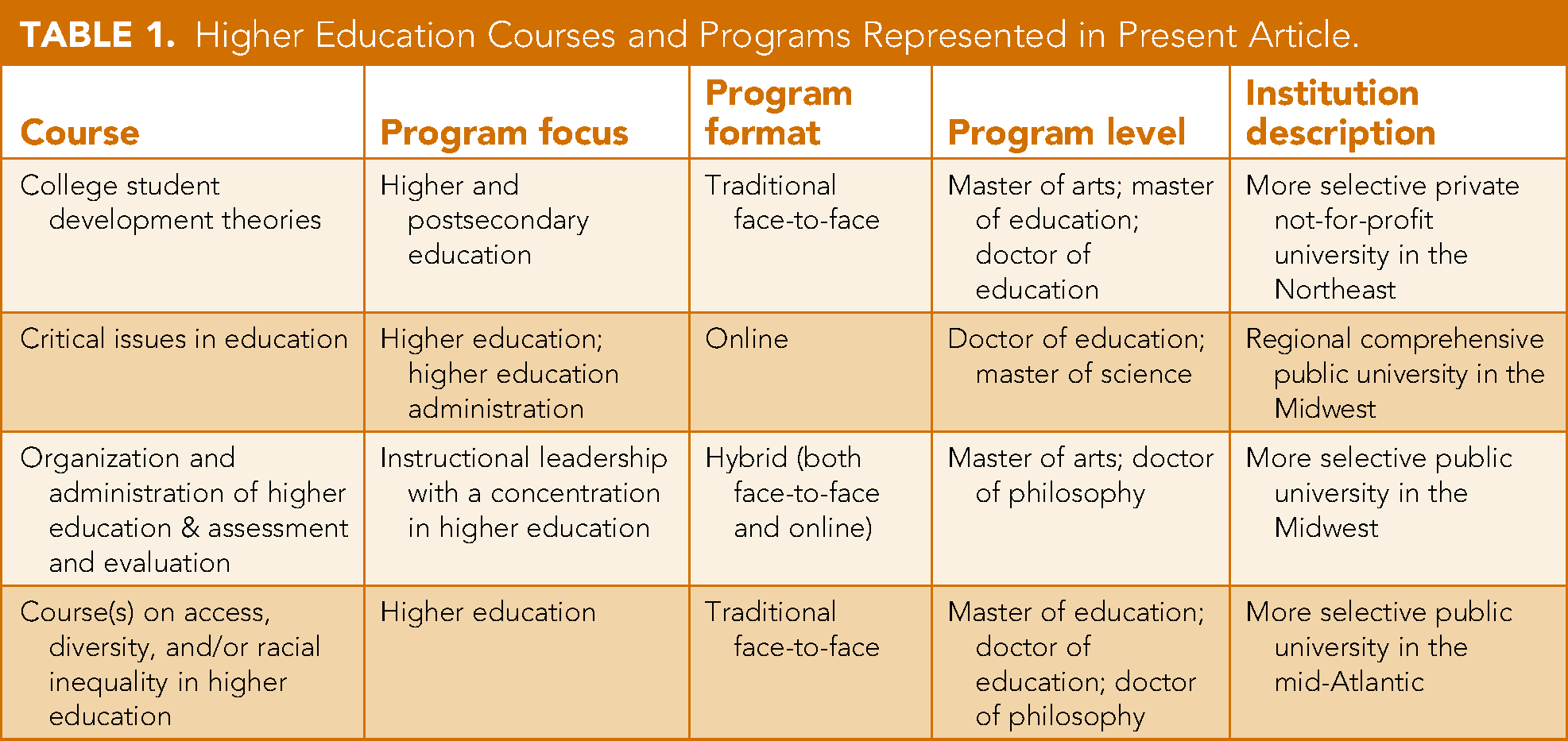
The authors of this paper are HESA faculty. We report on our activities and conceptualizations of our own teaching. More specifically, the first two cases report activities incorporated in our recent classes, while the other three cases suggest ways to infuse sustainability in common HESA coursework. Table 1 lists the courses portrayed in this paper along with information on each respective HESA program.
Higher Education Courses and Programs Represented in Present Article.
College Student Development Theories
One session of a College Student Development Theories course often focuses on epistemological theories, such as King and Kitchener's Reflective Judgment Model (1999), which grapples with the nature of knowledge around large, uncertain issues and can be utilized to understand how students’ perceptions of such issues guide their thinking and behavior. One way to connect this theory to sustainability is to incorporate a discussion on climate change—a large and uncertain issue—and the ways in which people in each of the three stages of the model (prereflective thinking, quasi-reflective thinking, reflective thinking) might react to climate change. In this particular example, students placed statements such as, “climate change doesn't exist,” within the three stages of the theory. As a result of these small group conversations, one student shared that her mother, having seen it on Facebook, recently asked her what exactly climate change was. The student had to then translate “climate change” into her mother's native language to help her conceptualize its meaning. She shared this as an example of someone in prereflective thinking, since her mother had not yet been exposed to the concept of climate change. Other students discussed their personal experiences of adapting their behaviors, or on the other hand, observing friends and family who had demonstrated resistance to change (like still using plastic straws), despite awareness of more sustainable options. They also talked about how, based on their knowledge of how plastic straws harm wildlife, they might start a campaign to get their office to provide an alternative. Here, the example of personal experiences with climate change provided students with a tangible application of a core student development theory and specific examples of each stage of thinking (CAS, 2019). In course feedback, students noted that it was helpful to practice real-world application of theory within the classroom context. Such opportunities not only enriched their learning, but helped to connect theory to their lives beyond the classroom. While an entire course on sustainability in higher education might be created, in this article, we provide examples of contextualizing or synthesizing courses where sustainability is a component of the class (through a lesson, case study, or skill practice) rather than its main focus.
Critical Issues in Education
The course Critical Issues in Education focuses on issues of equity and social justice, emphasizing both theories, such as neoliberalism and intersectionality, and the application of theory and research to practice for master's level students. For example, in one recent iteration of the course, the instructor chose to highlight racism, intersectionality, neoliberalism, and decolonization, before closing the semester with a week of discussing sustainability. During the final week, students were asked to draw connections between the previous weeks’ readings as they pondered the course's conclusion with a week on sustainability, and to then reflect on actions they could take in their assistantships or professional roles to create a more sustainable institution. Students drew various strong connections between sustainability and other equity issues in higher education. Several students focused on the importance of stewardship of land and resources as outlined in both their sustainability and decolonization readings, while others embedded sustainability in a broader ethos of collectivism in which the link between sustainability and decolonization was perceived. Other students took a different approach and used sustainability to extend critiques of neoliberalism. Still, other students connected sustainability to broader systems of injustice and inequity, noting that just as climate change overwhelmingly impacts communities that are poor, of color, and/or located in the Global South, so it also affects those communities’ access to local higher education and institutions. While students made broad connections to the social justice movements that they had been reflecting on throughout the class, they had a more difficult time theorizing practical steps to take, beyond the typical desires to conserve resources, such as energy, and to reduce environmental impact. Multiple students, never having considered sustainability as a part of higher education coursework, shared their newfound excitement at seeing sustainability addressed on the syllabus, and that they felt a new calling to think about sustainability in their practice. In one recent iteration of the course, the instructor chose to highlight racism, intersectionality, neoliberalism, and decolonization, before closing the semester with a week discussing sustainability. Multiple students, never having considered sustainability as a part of higher education coursework, shared their newfound excitement at seeing sustainability addressed on the syllabus, and that they felt a new calling to think about sustainability in their practice.
Organization and Administration of Higher Education
In courses on the organization and administration of higher education, students learn about the national structure of higher education in the United States, the organization and governance of institutions of higher education, and key administrative tasks of these institutions (e.g., finance, enrollment, and policy issues). One lesson might incorporate the role of academic curricula and how it exists within a broad academic plan for an institution, especially highlighting Lattuca and Stark's (2009) model of showcasing curricula within specific sociocultural contexts. To develop students’ understanding of the model alongside knowledge of sustainability, faculty could examine sustainability as a content area within a campus academic curricular plan. Course readings might include sections from Lattuca and Stark's (2009) Shaping the college curriculum: Academic plans in context, history sections of websites focused on the movement for sustainability in higher education curricula since the 1990s (such as the Association for the Advancement of Sustainability in Higher Education; AASHE, 2018a), and highlights from texts featuring the importance of disciplinary organization for higher education (e.g., Klein, 1990). As an out-of-class assignment, students could interview an instructor, student, staff member, or alumnus connected to an academic program (e.g., a major or minor) in sustainability, asking about the formation and placement of the program within their institution's disciplinary structure. The class could then consider the ways in which campus curricula have shifted over the last few decades to create whole academic programs related to a “new” discipline of sustainability (a concept and word whose current connotations date back to its 1987 usage) in light of changing scientific and sociological understandings of sustainability. In-class discussions could have students draw, again within Lattuca and Stark's model, each of its components that might have influenced the creation of sustainability programs. As an out-of-class assignment, students could interview an instructor, student, staff member, or alumnus connected to an academic program (e.g., a major or minor) in sustainability, asking about the formation and placement of the program within their institution’s disciplinary structure. Out-of-class projects could include students downloading publicly available data, the creation of an assessment or research question, and rudimentary data analysis with STARS data to practice assessment skills.
Assessment and Evaluation
Courses on assessment and evaluation in higher education often feature ways that administrators assess specific programs. One module within such a class can review national assessments along with various methods of benchmarking, a particular tool being AASHE's Sustainability Tracking and Rating System (STARS; AASHE, 2018b). Readings to accompany a traditional text for this module would be a review of the STARS website, including its history and the data required for submissions. Since an important feature of the tool is that it requires holistic data from across divisions on campus, divisions not necessarily associated with one another, it provides an opportunity for rich discussion on who is responsible for assessment, why a campus might be motivated to report, and how an institution might organize a collection of data on such a large, cross-campus scale. In class, students could address questions such as why campuses need or want benchmarking tools, what indicators STARS uses to measure sustainability, as well as the strengths and weaknesses of those measures. Also included would be ways that campuses use tools like STARS either to improve (or to gather) holistic data from across the institution. Out-of-class projects could include students downloading publicly available data, creation of an assessment or research question, and rudimentary data analysis with STARS data to practice assessment skills.
Access, Diversity, and Racial Inequality in Higher Education
The environmental justice (EJ) movement emerged in the early 1980s as a grassroots social movement by people of color in the United States and has shed light on and challenged the disproportionate burden communities of color and indeed all low-income communities face with respect to pollution and other environmental health hazards (Bullard, 2000). Although largely excluded from higher education access discourse and scholarship, EJ issues connect to the work of student affairs (Wells, Buckley, & Kimmel, 2016) and broadly to education as pollution directly affects humans physiologically, emotionally, and cognitively (Lu, 2020) and indirectly affects humans by driving down home values (Currie, Davis, Greenstone, & Walker, 2013). Thus, a course on higher education access might assign readings on the connection between EJ, school appropriations, and K-12 educational outcomes to show the limitations of widely used higher education access theories. Course discussions might examine federal and state policies and laws related to environmental (in)justice, showing how they create and perpetuate educational inequities for students of color. Additionally, courses on diversity could address this underrepresentation and the resultant inequitable experiences of students of color in higher education. Students of color remain severely underrepresented in environmental disciplines (NSF/NCfES, 2011), and many environmental fields are actually among the most racially homogenous, predominantly white fields (Carnevale, Strohl, & Melton, 2011). Students in HESA courses might examine how these inequities are the result of the climate for racial/ethnic diversity (Garibay & Vincent, 2018) as communities of color have experienced a historical legacy of exclusion within the mainstream environmental movement (Bullard, 2000), and EJ concerns are not yet fully valued and incorporated into postsecondary environmental and sustainability curricula in the United States (Garibay, Ong, & Vincent, 2016; Garibay, Vincent, & Ong, 2020). Higher Education and Student Affairs programs are fundamentally designed to prepare professionals who can educate and develop ethically responsive citizens, as well as facilitate postsecondary institutional environments under the same auspices.
Conclusion
Higher Education and Student Affairs programs are fundamentally designed to prepare professionals who can educate and develop ethically responsive citizens, as well as facilitate postsecondary institutional environments under the same auspices. Therefore, even the minor inclusion of sustainability, as specifically based on HESA's fundamental goal, must share center stage. Given that HESA stewards the Generation Z student body (though not only Generation Z), and that they will soon (if not already) be joining the ranks of HESA practitioners, we can best support their efforts with the infusion of sustainability into our curricula. By embedding sustainability into already existing curricula, connecting already existing cases with sustainability-related cases, inviting guest speakers (higher education scholars who focus on this topic) into class, developing projects that examine sustainability initiatives at the institution, and using sustainability as an exemplar of higher education's responsibility to society, we can position the future of the field to be better prepared for the challenges that lie ahead. Ultimately, only by making sustainability the exemplar of higher educations' responsibility to society can the field best meet the challenges confronting students here, now, and into the future. By embedding sustainability into already existing curricula, connecting already existing cases with sustainability-related cases, inviting guest speakers (higher education scholars who focus on this topic) into class, developing projects that examine sustainability initiatives at the institution, and using sustainability as exemplar of higher education’s responsibility to society, we can position the future of the field to be better prepared for the challenges that lie ahead.
Footnotes

We love feedback. Send letters to executive editor Frank Shushok Jr. (aboutcampus@ vt.edu), and please copy him on notes to authors.