



Abstract

The previous decade was the hottest ever recorded on Earth, and this trend continues apace. Amidst urgent sustainability challenges, scholars have argued that higher education has a central role to play in combating climate change, economic inequity, and social injustice. Consequently, there are now more than 2,500 sustainability-related degree programs across 900 higher education institutions (HEIs) throughout the United States (Vincent et al., 2017). Many HEIs are even making courses on sustainability a core graduation requirement for students of all majors (Michel, 2020). While the trend toward more higher education for sustainability is promising, to date the contributions of higher education toward fundamentally shifting future generations to become more sustainable remain inadequate (Michel, 2020; Rowe, 2007).
A body of empirical research on sustainability in higher education burgeoned in the early 2000s (Kates et al., 2001). However, the readership of peer-reviewed scholarship is largely insular, composed primarily of researchers in related fields of study. Academic literature on sustainability education rarely reaches policymakers, administrators, and other key leaders (hereafter referred to as leaders) who shape curricula and policy. These leaders typically consume articles from mainstream news sources that are written for nonspecialized audiences to support their decision-making (Biswas & Kirchherr, 2015; Shanley & López, 2009). For instance, the National Academies of Sciences, Engineering, and Medicine's (NASEM; 2020) report on Strengthening Sustainability Programs and Curricula at the Undergraduate and Graduate Levels has been distributed to faculty, but it has little reach to higher education leaders. How often is sustainability education being discussed compared with other disciplines? And, what is being reported about sustainability education?
Although an expanding body of scholarship is exploring higher education sustainability curricula (e.g., Michel, 2020), little is known about the reach of sustainability topics beyond the research community. To shed light on the prevalence of higher education for sustainability in the media, and thus what leaders are consuming, we analyzed trends in United States media reports from the last decade. To do so, we explored the following questions: How often is sustainability education being discussed compared with other disciplines? And, what is being reported about sustainability education?
Methods
Data Collection
We analyzed media outlets consumed by leaders who are key in shaping curricula. We included both higher education media (The Chronicle of Higher Education, Inside Higher Ed, and Times Higher Education) and mainstream media (The New York Times, The Wall Street Journal, and The Washington Post). To measure how often sustainability education is being reported on and what is being reported about it, we compared its coverage to three other disciplines. 1
We searched the ProQuest database for articles written from 2010 to 2019. Due to its absence in large databases, we searched for Inside Higher Ed articles using its own database and query functions. For higher education outlets, we searched for articles that included the discipline name and “curriculum” or “pedagogy.” Because mainstream media is less likely to focus on specific aspects of education, we searched for mainstream articles which also included the terms “higher education” or “postsecondary” and “teaching” or “learning.” A single author read all articles returned by the query and retained articles that included aspects of higher education and the discipline of focus. The other two authors each read a random 10% sample of the returned articles to verify that the primary reader's selections accurately captured target articles. From the reduced pool of articles, we further selected those with more than half of the content focused on teaching and learning in the discipline of focus. To maintain consistent integrity across article forms, we did not include blog items.
Data Analysis
Articles were coded to identify prevalent themes within the educational scope (i.e., teaching, learning, and curriculum) of the four disciplines. The first round of coding included preliminary assignments of codes to all higher education themes. Next, to guide initial codes while also allowing for other themes to emerge, we used concepts of higher education for sustainability common in the academic literature (e.g., competencies [Brundiers et al., 2021] and pedagogy [Michel, 2020]). A single author coded all articles, while the other two authors coded a random 10% sample to ensure consistency. Coding discrepancies were then discussed until an agreement was reached. In preparation for analysis, codes were binned into nine themes.
Prevalence of Sustainability Education in Mainstream Media
In higher education media from 2010 to 2019, articles focusing on education most commonly reported on business (n = 67), then engineering (n = 26), then medicine (n = 22), and then sustainability (n = 9; Figure 1). Sustainability was reported on approximately six and a half times less often than business, two times less than engineering, and one and a half times less than medicine.
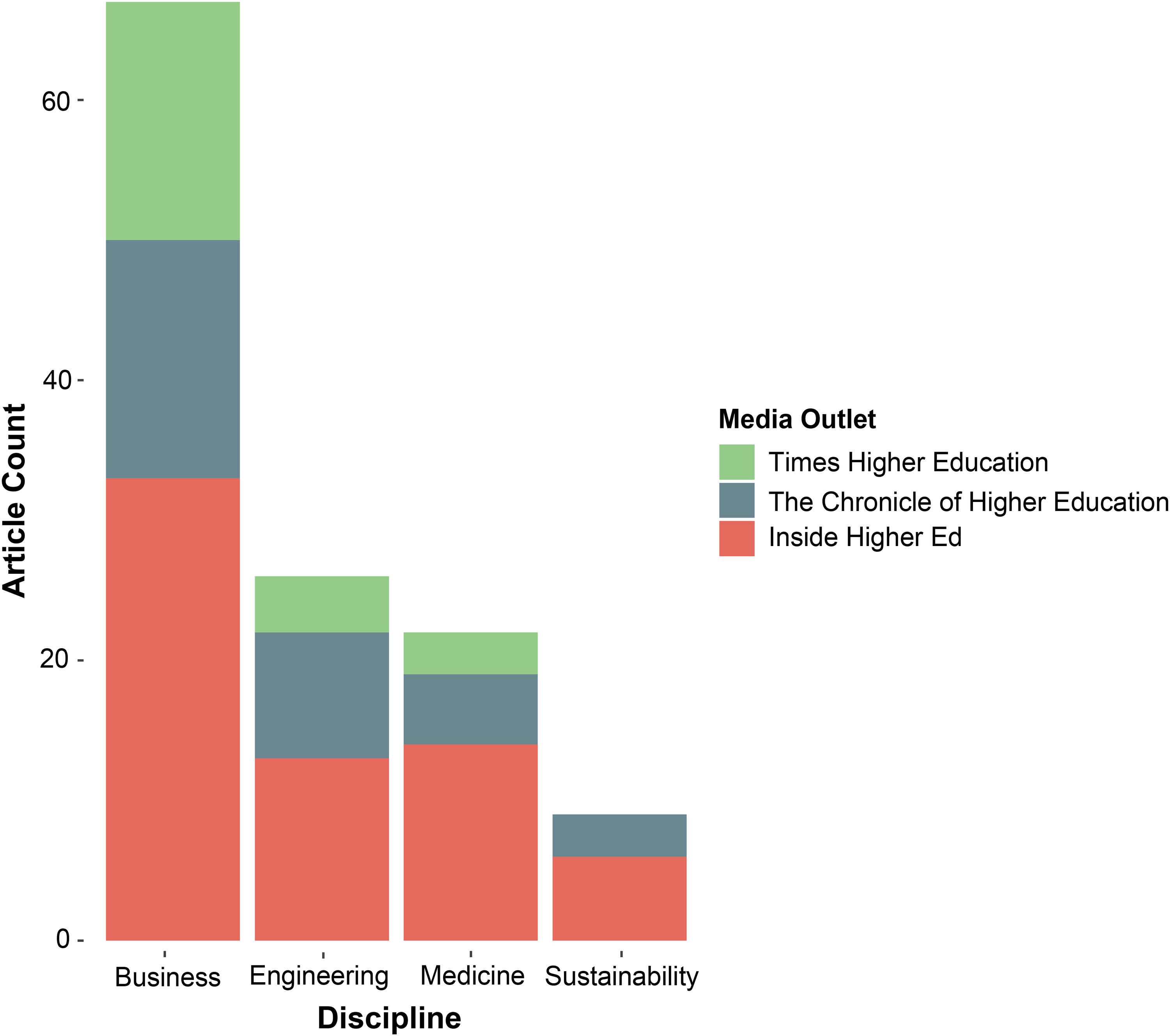
Number of articles in higher education media outlets reporting on education themes across four common disciplines during 2010–2019.
In mainstream media from 2010 to 2019, 18,677 articles mentioned higher education across the four disciplines (business: n = 11,842; engineering: n = 3,266; medicine: n = 3,244; sustainability: n = 325). 2 The percentage of sustainability articles focusing on higher education in the mainstream media (2%) resembled the proportion in higher education media (1%; Figure 1). In the mainstream media, sustainability was mentioned within our search criteria 35 times less often than business, and nine times less than both engineering and medicine.
The prevalence of articles focusing on sustainability education ranked significantly lower than those in the other disciplines across both media types. This lack of reporting on sustainability may account for its limited presence in higher education curricula. To make a transformative change to further create learning opportunities for all students, there must be a commitment from leaders to revise HEI structures, reward systems, and behavioral norms (Borg et al., 2012; Rowe, 2007). As such, we highlight the critical need for greater salience (in the aforementioned reputable news sources) of improving and growing opportunities in postsecondary sustainability education.
The prevalence of articles focusing on sustainability education ranked significantly lower than those in the other disciplines across both media types.
Sustainability Education Content in Higher Education Media
Nine themes emerged in the higher education media across the four disciplines (Figure 2): discipline (area of study), competency (knowledge, skills, and values students learn in a discipline), degree (requirements for an academic credential), pedagogy (teaching practices), remote learning (virtual education), collaboration (team teaching or interinstitutional collaborations), diversity (inclusive classroom practices), assessment (evaluation of student learning), and faculty development (training to improve teaching).

Percent of themes in articles published by higher education media outlets across four disciplines during 2010–2019.
Although prevalence differed, the themes of competency, discipline, and pedagogy were most common across all four disciplines. In sustainability, competency was the most common (35% of articles), followed by pedagogy (26%), discipline (23%), remote learning (11%), and collaboration (5%). The themes of faculty development, assessment, degree, and diversity were absent in sustainability articles, but present in the other disciplines (Figure 2).
Within sustainability, the themes of competency, discipline, and pedagogy (the most prevalent in the higher education media) are aligned with the “across the curriculum” movement. This movement stems from the Presidents’ Climate Leadership Commitment (PCCL; 2009), an HEI commitment to “accelerate research and educational efforts of higher education to equip society to re-stabilize the earth's climate.” Resulting is the pledge to make “sustainability a part of the educational experience for all students” of all fields of study, not just those majoring in sustainability fields (Rowe, 2007). In this vein, competencies (the sustainability-related knowledge, skills, and values students learn) and discipline (where sustainability is incorporated into majors, minors, or general education courses) are integral to the curriculum discourse. Additionally, a more recent growing body of literature explores promising pedagogies for teaching about sustainability for all students (Michel, 2020). Despite a call for infusing sustainability across higher education curricula (e.g., PCCL), the policy push has largely stopped short of implementation, and faculty struggle with incorporating it into their courses (Borg et al., 2012; Rowe, 2007). Given the absence of pedagogy in policy, practice, and until recently, research, its prevalence in the media discourse is surprising.
On the other hand, the prevalence of competencies in the sustainability education discourse was expected.
On the other hand, the prevalence of competencies in the sustainability education discourse was expected. Recent reports published by UNESCO and NASEM have all endorsed sustainability competencies and demarcated them as an emerging trend within sustainability education (Brundiers et al., 2021; NASEM, 2020). These reports are largely written by leaders for a wider audience than peer-reviewed journals, leading to a greater reach of this theme.
Remote learning was rarely mentioned in the media. However, given the transformation in the educational landscape due to COVID-19, we anticipate that we would now see a spike in reporting on virtual educational experiences. Collaboration was the least present theme in the sustainability articles, reflective of the rarity of the practice in sustainability education, which is problematic as interdisciplinary and transdisciplinary knowledge is vital for effective sustainability science.
Sustainability Education Topics Missing From Higher Education Media
Amid the limited reporting on higher education for sustainability, several critical topics have been overlooked: assessment, degree, faculty development, and diversity. One of the main goals of competencies is implementing a mechanism for assessing students’ learning. Increasingly, United States higher education accreditation efforts are requiring programs to provide evidence of students’ learning outcomes as an accountability measure. Given the prominence of competencies in the sustainability articles, it is surprising that assessment was not reported on. Also absent from the sustainability education discourse were degree requirements for an academic credential or alternative pathways to becoming credentialed in a sustainability-related field. This was a curious omission, as there is a desire for accrediting sustainability programs to professionalize the field and demonstrate graduates’ competence in sustainability-related work to employers (Brundiers et al., 2021). Faculty development has been neglected in the media, reminiscent of the near-absence opportunities for instructors to learn the pedagogical tools needed to teach sustainability-related subject matter (Borg et al., 2012). Increasingly, United States higher education accreditation efforts are requiring programs to provide evidence of students’ learning outcomes as an accountability measure.
Finally, diversity was absent in the media on sustainability education. Black, indigenous, and people of color occupy the frontlines of the climate crisis and other sustainability crises with closely interlinked environmental and justice dimensions. Paradoxically, although African Americans comprised 13% of the United States population in 2016, they received <3% of the environmental science degrees, making sustainability-related fields among the least diverse fields of scientific study (“Environmental Science,” n.d.). An absence of media discourse on how to apply pedagogical tools to reduce this disparity leaves little room for ideas to be shared around improving minority representation in sustainability programs.
Implications
Higher education institutions claim to be preparing future generations to confront sustainability challenges, yet they are largely neglecting to fulfill this charge. Within the United States, students’ exposure to sustainability is limited, due in part to a lack of strategic leadership at the HEI level, and due in part to the lack of a national response to (inter)national policy initiatives. However, in the wake of the 2020 Presidential election, the We Are Still In Movement, and the Education for Sustainable Development (ESD) for 2030 roadmap (UNESCO, 2020), we may be at the precipice of fundamentally altering the higher educational structure by which we educate students about sustainability. Whether we seize this moment is contingent on support from HEI leaders.
During the United States’ four-year withdrawal from the Paris Climate Agreement, over 400 HEIs pledged to remain committed to its goals (We Are Still In, n.d.). However, leaders were (and are) primarily focusing their efforts on reducing climate impacts rather than educating students about sustainability. These priorities overlook the foundational role that HEIs—the incubators for future generations of sustainability leaders—will have in long-term solutions to climate change. Although the full benefits of higher education for sustainability take years to materialize, educating all students about sustainability is critical for our future, and therefore, an increased presence of sustainability in the curriculum is indispensable in preparing the next generation to tackle global change. One way to contribute toward increasing opportunities for students’ sustainability learning is by intentionally aligning higher education curricula with the ESD for 2030 roadmap, which centers sustainable development goal (SDG) 4 on quality and inclusive education (in particular target 4.7) as well as other SDGs (UNESCO, 2020).
To increase students’ learning about sustainability, and to scale this learning to manifest global change for a more sustainable future, we are in desperate need of robust leadership both at the HEI and (inter)national levels. To date, though, there is gross underreporting of higher education for sustainability in the media consumed by leaders. Given the urgency of sustainability-related problems in our world today, we call for greater salience of sustainability in higher education and mainstream media reporting, which may facilitate idea flow between HEIs and catalyze leaders to add sustainability-specific priorities to their agendas. Bringing sustainability education to the forefront of both mainstream and academic audiences is a critical first step to building long-term capacity to solve global sustainability challenges. To date, though, there is gross underreporting of higher education for sustainability in the media consumed by leaders.
Footnotes

Notes
We love feedback. Send letters to executive editor Z Nicolazzo (