



Abstract
ADHD is one of the most common childhood psychiatric disorders (Goldman, Genel, Bezman, & Slanetz, 1998; Polanczyk, de Lima, Horta, Biederman, & Rohde, 2007) that might be characterized by symptoms of inattention, hyperactivity, and impulsiveness (American Psychiatric Association [APA], 2000). Inattention is the most commonly studied symptom of ADHD, and, although the diagnosis of ADHD involves attentional deficits according to the diagnostic criteria of the Diagnostic and Statistical Manual of Mental Disorders (4th ed.; DSM-IV; APA, 1994), attention is not formally defined in cognitive terms. Despite several studies having assessed experimentally different components of attention (alertness, selective attention, divided attention, spatial attention, visual search, executive attentional control) in children with ADHD, the actual mechanisms underlying attention deficits in ADHD remain poorly understood (for reviews, see Huang-Pollock & Nigg, 2003; Lansberger, Kenemans, & Van Engeland, 2007; Luman, Oosterlaan, & Sergeant, 2005; Mullane & Klein, 2008). Thus, further research that investigates the specific attentional abilities that are affected in ADHD is still necessary.
Important issues in the field of visual attention are concerned with whether processing occurs automatically or it requires top-down attentional control and whether certain pathological states affect, differentially, these ways of processing. Regarding ADHD, some studies have assessed whether children diagnosed with ADHD show any deficit when attention is devoted to searching for a target stimulus presented among distracter stimuli. A bulk of evidence comes from visual search tasks that take the feature-integration theory of attention by Treisman and Gelade (1980) as the theoretical framework. In a typical visual search task, participants are required to keep in memory a template of what (the target) they are told to search for, scan the scene, and detect the target stimulus among distracter items when it is presented. When the target differs from the distracters on the basis of one simple dimension (e.g., shape), the “single-feature search” is relatively easy, automatic, and not affected by the number of distracters in the display (set size). It is as if the target pops out from the visual display. When target and distracters share some perceptive features (e.g., shape and color), the “conjunction search” is harder, carried out in a serial and intentional way, and it is usually affected by the set size. By allowing ADHD participants to perform these kinds of visual search tasks, researchers might be able to assess how automatic and controlled processes operate in these children.
By reviewing the results of seven studies that used standard visual search tasks in a combined sample of 180 children with ADHD and 193 typically developing children, Mullane and Klein (2008) concluded that automatic search is rather preserved in ADHD participants, but serial search produced inconsistent results. Concerning the single-feature search tasks, children with ADHD showed significantly longer reaction times (RTs) than did typically developing children, but group and display size factors did not interact ever. In the conjunction search tasks, all examined studies reported longer RTs as the set size increased, and that pattern of results was observed in both ADHD and typically developing children. Six out of seven studies showed longer RTs in children with ADHD than in typically developing children, and only three studies found a significant group by display size interaction. Mullane and Klein suggested that these inconsistent results could be partially due to low statistical power (sample sizes ranged from 12 to 22 per group) and methodological differences among the studies.
However, we would like to suggest that a potential factor that might have contributed to the aforementioned inconsistent results with the serial visual search tasks is demotivation. Standard visual search tasks, as they are usually used in experimentally based settings might be declared as both boring and unappealing, about all by children with ADHD whose main attention impairment seems to be concerned with alertness (Bellgrove, Hawi, Kirley, Gill, & Robertson, 2005; Johnson et al., 2007). ADHD children’s abilities to keep a sustained state of alertness are also usually assessed through tedious and monotonous tasks (Casagrande, Violani, Curcio, & Bertini, 1997; for a review, see Parasuraman, 1998). Thus, the attentional deficits frequently reported associated with ADHD might be confounded by low motivation or disinterest to perform the tasks.
In line with the above contention, when visual search is assessed with more engaging videogame tasks, the differences between ADHD and typically developing children in both RTs and accuracy measures, as well as any interaction involving the groups, disappear (Mason, Humphreys, & Kent, 2004). Thus, using extremely boring and demotivating tasks, such as the standard visual search tasks, or extremely motivating and arousing ones, such as video games, might obscure potential deficits associated with intentional controlled processing or focused attention in ADHD. In other words, the former tasks might spuriously maximize the differences between children diagnosed with ADHD and typically developing children, and the latter tasks might spuriously minimize potential group differences.
The current study was aimed to assess performance of children diagnosed with ADHD on a specific type of visual search task, the flicker task (Rensink, 2000; Rensink, O’Regan, & Clark, 1997, 2000). This task is supposed to tap focused attention abilities, and to our knowledge it has never been used with children diagnosed with ADHD (with the exception of a study reported in the unpublished Cohen’s dissertation). An advantage of the flicker task to assess potential attention deficits in ADHD is that it seems to be more motivating than the standard visual search tasks, but less intriguing than video games.
In the flicker task, pictures of daily life scenes are used to assess visual search efficiency (Rensink, 2000). Two versions of a picture are presented. The pictures are identical except in a specific detail. The pictures alternate repeatedly and are separated by a brief gray screen. The observers have to search the scene for what has changed between the two pictures until they detect it. As the task uses pictures of natural scenes, participants tend to give priority to some areas of the scene than to others. Consequently, they detect changes in objects of central interest (CI) faster than changes in marginal-interest (MI) objects (Rensink et al., 1997). Both perceptual and semantic characteristics of the visual scene might be taken to create a sort of priority list that determines which items are going to be attended first. Changes in objects of CI pop out from the pictures, and they are usually efficiently detected. Changes in objects of MI are more difficult to detect and require serial visual search, and therefore performance is less efficient.
As change detection usually occurs under focused attention conditions (Rensink, 2002; Rensink et al., 1997, 2000), attention abilities can be evaluated in children diagnosed with ADHD by means of more ecologic stimuli within a rather enjoyable context. According to previous findings (e.g., Mullane & Klein, 2008), we expect ADHD and typically developing children to differ in detecting changes in objects of MI, but not in detecting objects of CI.
Method
Participants
A total of 36 children participated in the study: 18 were diagnosed with ADHD (mean age: 10.7 ± 1.5 years; 17 males/1 female) and 18 were typically developing children (mean age: 10.6 ± 1.5 years; 17 males/1 female). The ADHD group included 10 children who met the criteria for the ADHD/C subtype (exhibit both inattentiveness and hyperactivity/impulsiveness symptoms) and 8 who met the criteria for ADHD/I (show prevalently inattentive symptoms; Diagnostic and Statistical Manual of Mental Disorders [4th ed., text rev.; DSM-IV-TR; APA, 2000]). All children with ADHD were drug-naïve patients first admitted to the Day Hospital of the Child Psychiatry Unit of the University of Rome “Tor Vergata.” Children included in this study did not have a prior history of stimulant treatment. A psychopathological evaluation was performed by a team of child psychiatrists by means of the Kiddie Schedule of Affective Disorders (K-SADS; Kaufman, Birmaher, Brent, Rao, & Ryan, 1996), the Conners’ Parent Rating Scale (CPRS), the Conners’ Teacher Rating Scale (CTRS; Conners, 1989), the Children Depression Inventory (Kovacs, 1985), and the Multidimensional Anxiety Scale for Children (March, 1997). The inclusion criteria to participate in the study were the diagnosis of ADHD (based on the DSM-IV criteria and confirmed by K-SADS), no history of mental retardation, brain trauma, neurological diseases or physical impairment, a lack of comorbid mental disorders with the exception of oppositional defiant disorder (ODD), and learning disabilities.
The participants for the control group were matched in gender and age with the ADHD group and were selected from a wider group of 86 children recruited from two public schools in Rome. The control group participants had no history of cerebral injury or other neurological or psychiatric disorders.
All children aged 11 years and older had a full-scale IQ that fell above the 75th percentile on the Progressive Colored Matrices (PCM; Raven, Court, & Raven, 1990; Raven, Raven, & Court, 1993), and all children aged 10.5 years or younger had an IQ greater than 80 on the Progressive Standard Matrices (PSM; Raven, et al., 1990; 1993). The presence of ADHD in children from the control group was assessed via an independent evaluation carried out by the teacher and by one parent who completed a DSM-IV-TR report card (APA, 2000). Any child with a possible indication of ADHD was not considered. The mean age and IQ scores of children from the two groups did not differ significantly. Demographic data are reported in Table 1. The Child Psychiatry and Neurology Institute Ethical Committee approved the study. All parents or legal guardians of children gave written informed consent before testing.
Participant Demographic and Descriptive Characteristics.
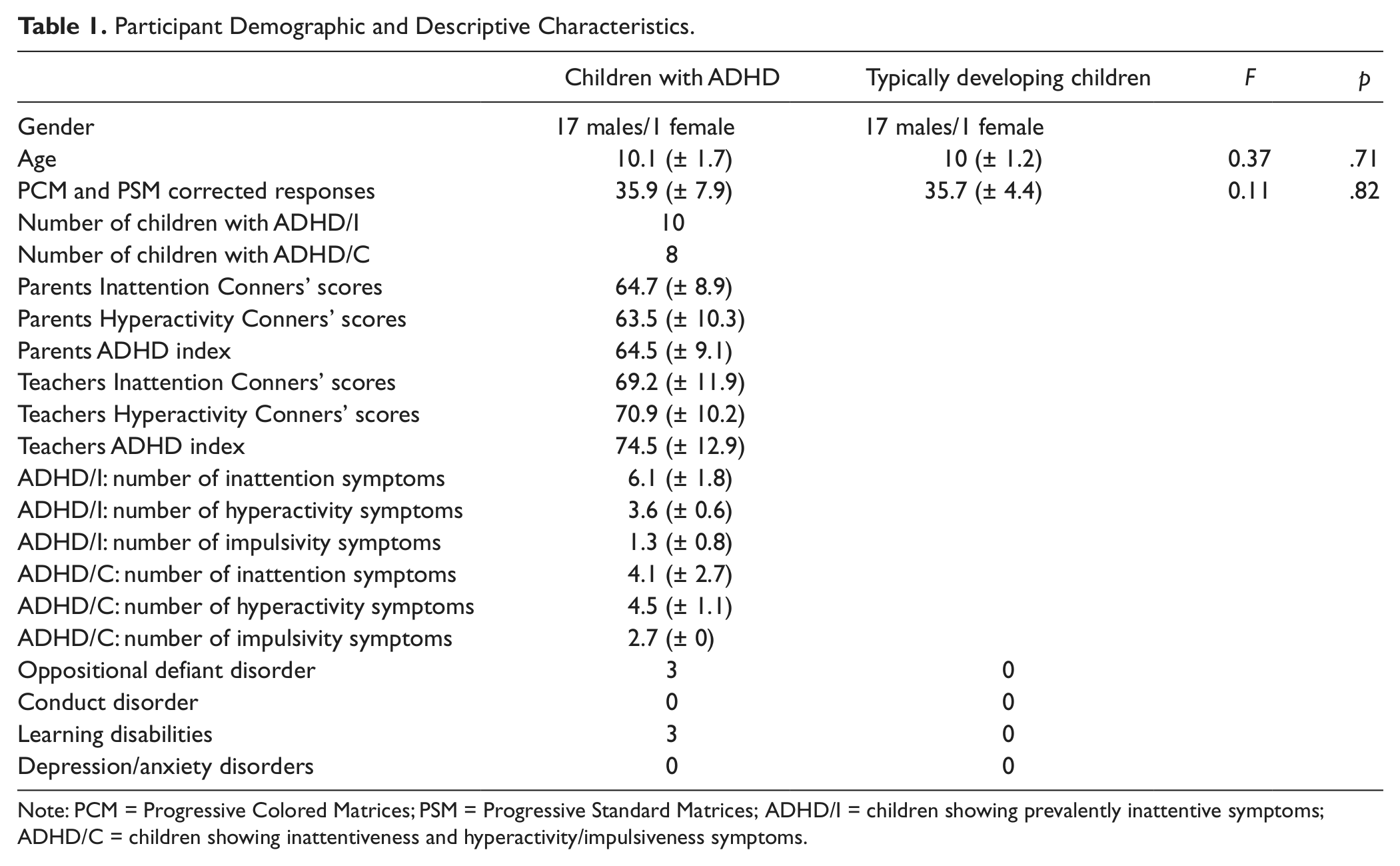
Note: PCM = Progressive Colored Matrices; PSM = Progressive Standard Matrices; ADHD/I = children showing prevalently inattentive symptoms; ADHD/C = children showing inattentiveness and hyperactivity/impulsiveness symptoms.
Apparatus
The stimuli were presented using E-Prime software on a Pentium 4 PC and were displayed on a 21-inch color VGA monitor from a viewing distance of approximately 56 cm (with a headrest).Responses were collected via the computer keyboard.
Stimuli
Three judges jointly selected 16 pictures from a larger sample identified through Google Images (see Figure 1 for some examples). The pictures depicted familiar scenes for children such as a group of children playing. Each picture measured 640 × 480 pixels. By removing a single object using Photoshop we created an alternate version of each picture. To make CI and MI changes, we followed the method indicated by Rensink et al. (1997).

Examples of the stimuli.
A group of 31 children (mean age 10.2 ± 1.6), who were not participants in this experiment, viewed each picture for 3 s and generated a written list of scene elements of highest interest. Items chosen by no more than 2 children were defined as MI objects and those chosen by all children were defined as CI objects.
Half of the changes referred to MI objects and the other half referred to CI objects. Changes consisted in removing one object from the scene, and the size of the changes averaged 49 × 49 pixels, approximately.
Procedure
Children were tested individually in a silent and dimly illuminated room. On each trial, an original and modified version of a picture alternated repeatedly (240-ms display time), separated by a gray screen (80 ms), until the participants pressed the space bar to indicate they had detected the change (see Figure 2). Children were instructed to press the space bar as soon as they detected that one object appeared and disappeared, and then they were told to verbally describe the change. An experimenter noted whether they accurately named the changing object.
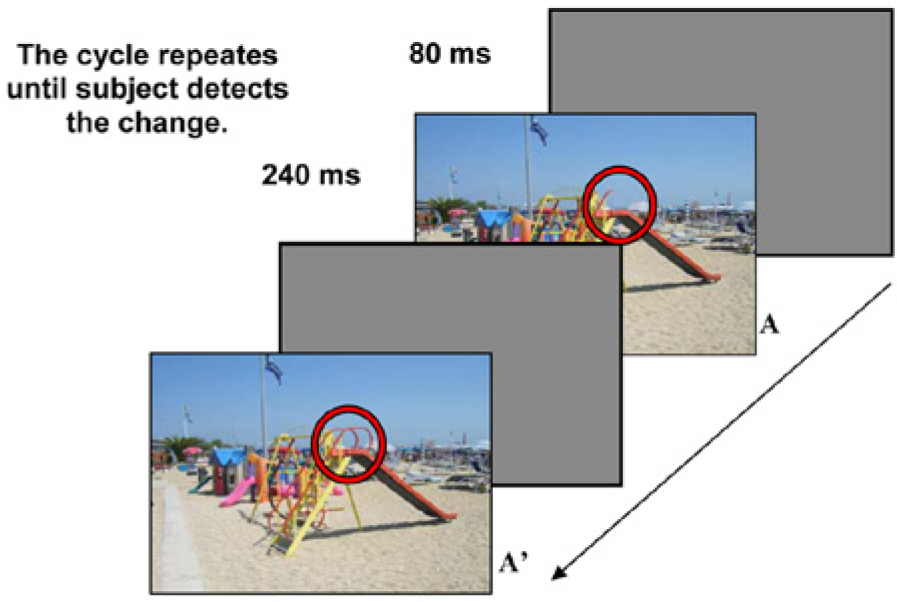
General design of the flicker paradigm.
Two pictures were used for practice. One depicted the Italian actor Roberto Benigni jumping on his chair during the Oscar Award ceremony, and the other depicted three race car drivers holding a trophy. After practice, children completed 16 experimental trials randomly presented for each participant. ADHD children performed the task in the Sant’Alessandro Clinic in Rome, and children from the control group performed the task at school.
Data Analysis
A Group (ADHD, Control) × Change Type (CI, MI) mixed ANOVA was carried out on both change detection RTs and errors. RTs in trials in which participants did not detect the change were replaced by the mean RTs + 2 SD for that condition. Post hoc comparisons were conducted using the Duncan test. A α value of .05 was used to establish statistical significance for all analyses.
Results
Mean RTs (±SD) and mean errors (±SD) are reported in Table 2.
Mean RTs, Standard Deviations, and Mean Number of Errors, as a Function of CI and MI Changes in Children With ADHD and TDC.
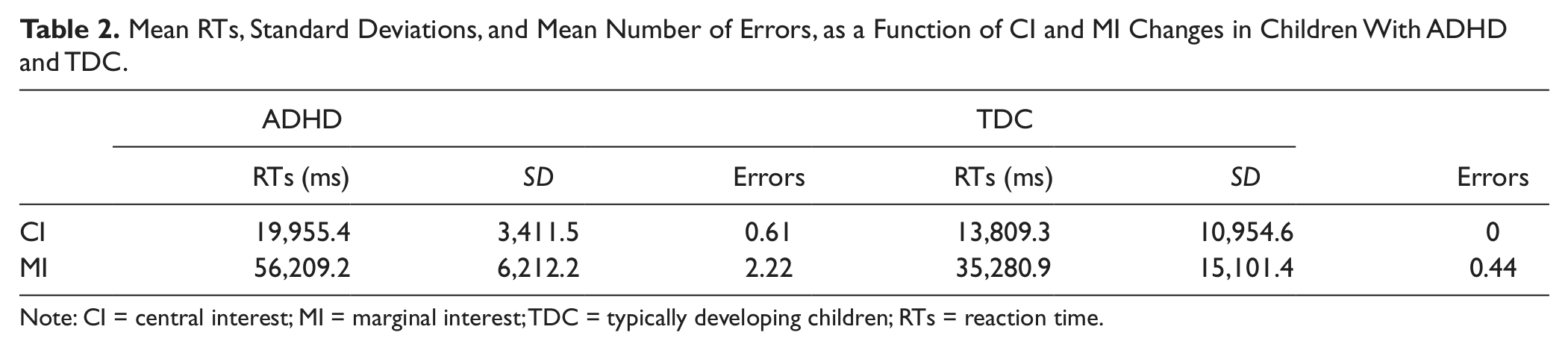
Note: CI = central interest; MI = marginal interest; TDC = typically developing children; RTs = reaction time.
RTs Analysis
Children with ADHD took longer to detect the changes than did their typically developing peers (38,082.29 ms vs. 24,545.13 ms), F(1, 34) = 7.77; p < .01; partial η2 = .19. All participants detected CI changes faster than MI changes (16,882.23 ms vs. 45,745.09 ms), F(1, 34) = 74.37; p < .0000001; partial η2 = .69. The Group × Change Type interaction was also significant, F(1, 34) = 4.88; p = .03; partial η2 = .13. The Duncan test revealed that children with ADHD showed significant slower RTs compared with typically developing children, but only when changes were of MI (p < .001; see Figure 3).
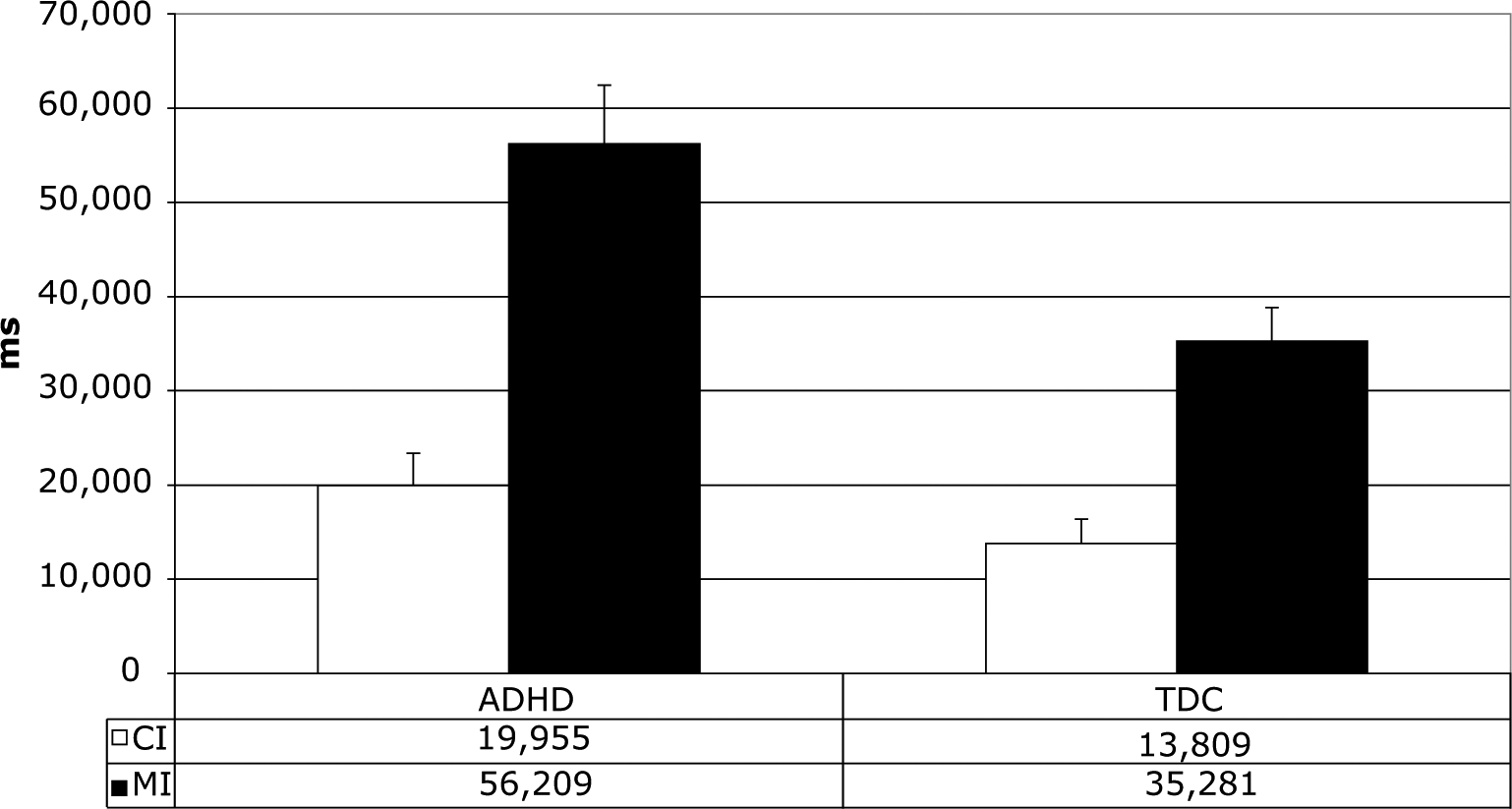
Response times (in ms) for detecting the CI (white column) and the MI (black column) in children with ADHD and TDC.
Group differences in MI changes detection were further examined with proportional change scores to reduce the effects of ADHD-related generalized slowing. For each participant, MI/CI proportion scores were calculated by dividing mean RTs for MI changes by mean RTs for CI changes. Differences between the two groups were not significant (t = 0.46; p = .65).
Accuracy Analysis
Children with ADHD made more errors than their typically developing peers (1.41 vs. 0.22), F(1, 34) = 16.03; p < .0001; partial η2 = .32. All participants were more accurate when detecting CI changes than MI changes (0.31 vs. 1.33), F(1, 34) = 19.01; p < .0001; partial η2 = .38. The Group × Change Type interaction was also significant, F(1, 34) = 6.64; p < .01; partial η2 = .16. Children with ADHD made significantly more errors than did typically developing peers only when they detected marginal changes.
Discussion
To our knowledge, this is the first time the flicker task has been used to assess attention deficits in children diagnosed with ADHD. The only exception is the unpublished dissertation by Cohen (2009). In Cohen’s study, children with ADHD were faster than were children from the control group in detecting marginal changes. This inconsistency with our results could be due to differences in the way error trials were treated in both studies. In the current study, RTs in error trials were replaced by the mean RTs + 2 SD of the specific experimental condition. In the aforementioned Cohen’s experiment, only RTs from correct trials entered into the analyses. This way of dealing with error trials might have favored rejection of slow RTs data from difficult trials, that is, when participants have to detect marginal changes. This data rejection procedure might have affected more dramatically ADHD children who might have found marginal trials difficult to detect.
The present study confirms that ADHD children are slower and perform poorer than typically developing children in a task that is thought to tap focused attention abilities. These results agree with previous findings that associate ADHD with important attentional deficits (Andreou et al., 2007; Johnson et al., 2007). However, the present findings do not replicate those observed by Cohen and Shapiro (2007) who concluded that the flicker task was not sensitive to uncouple people with and without ADHD. Some methodological differences between the two studies might be the cause of such inconsistent results. Our ADHD participants were drug-naïve children, whereas Cohen and Shapiro’s study examined ADHD adults under current and/or previous pharmacological treatment. The flicker task might have been more sensitive to capture group differences under nontreatment conditions.
Results of the present study replicate the findings consistently observed with the flicker task (Fletcher-Watson, Collis, Findlay, & Leekam, 2009), demonstrating the robust nature of change blindness. All the children showed a strong change blindness effect and a clear difference between CI and MI trials. Detection of CI changes required less than half the time needed to detect MI changes. Faster CI changes detection agrees with the assumption that these changes pop out from the picture, inducing an automatic capture of attention. However, the greater amount of time needed to detect MI changes confirms the use of serial top-down visual search strategies in these trials (Rensink, 2000). In the absence of a CI change that rapidly attracts the observers’ attention, observers must implement a serial top-down strategy to detect a MI change. Through a serial search strategy, the observers actively explore new locations of the picture until a change is detected (Caplovitz, Fendrich, & Hughes, 2008). This strategy is implemented in a top-down manner for at least two reasons: (a) It is goal directed; that is, it is aimed to search for changes outside the CI elements of the scene; and (b) it is driven by implicit information about the portion of the scene previously explored (Wolfe, Butcher, Lee, & Hyle, 2003). Once the general scene-schema has been extracted, knowledge-based information can be used to help guide attention (Henderson, 2003).
Importantly, the flicker task has proved to be useful to dissociate attentional performance in children with ADHD from performance of typically developing children. Whereas children from the two groups did not differ in their efficiency to detect CI changes, both RTs (only raw scores) and error data showed that ADHD children were impaired in detecting MI changes.
The results with error data are of special clinical and neuropsychological relevance. According to the attentional resources hypothesis (e.g., Helton & Warm, 2008; Kahneman, 1973), as task demands increase, so will errors. The poor accuracy of children with ADHD on the highest demanding condition (e.g., detection of MI changes) is consistent with a deficit in attentional resources, or with a specific impairment in using serial top-down strategies due to their limited attentional resources.
It is important to remark that only a small number of studies (three out of seven) found serial search deficits in ADHD compared with control participants by using standard visual search tasks (Mullane & Klein, 2008). The more appealing nature of the current flicker task did not preclude any attentional impairment in children with ADHD to be uncovered, despite the fact that it might have raised their motivational levels (see Mason et al., 2004). The task uses attractive ecological stimuli that children are familiar with, and it allows the possibility of further exploring the effect of semantic context on attention. Thus, the present flicker task seems to be a useful tool for assessing focused attention abilities in clinical and nonclinical populations.
Conclusion
For the first time, the flicker task has been used to assess focused attention, serial visual search strategies, and change blindness in children with ADHD. Of particular relevance is the fact that our patients were drug-naïve children, in whereas most of the previous studies have ADHD participants were medication free either on the day of testing or just 24 to 72 hr prior to testing. It allowed us to determine the effects of the ADHD disease on focused attention without the influence of medication. In other words, our results reflect the actual framework of attention in ADHD. However, the strict criteria followed for selecting our participants are also the source of a primary weakness of the present study, the small number of participants. Future studies should address that limitation by both increasing the sample of participants and evaluating attentional performance in the ADHD subtypes.
Finally, some characteristics of the current flicker task deserve further comments. First, regarding motivation, our task falls in between extremely boring tasks, such as the standard visual serial tasks, and extremely arousing ones, such as those that use video games. Second, from our point of view, the present task might be better situated to overcome the current gap between the clinical definition and the cognitive performance characterizing attentional disorder in ADHD.
In summary, the results of the present study allow us to conclude that children diagnosed with ADHD show a specific impairment in developing serial top-down strategies that have been proved to be useful to solve a rather difficult task, what might be attributed to their limited attentional resources.
Footnotes
Acknowledgements
We would like to thank all the children, parents, teachers, and primary schools who participated in the study: Istituto Comprensivo “Corradini,” Istituto “Ponte Linari” in Rome, and Istituto Comprensivo “Leonardo Da Vinci” in Pistoia. We would also like to thank all the children with ADHD and their parents.
Declaration of Conflicting Interests
The author(s) declared no potential conflicts of interest with respect to the research, authorship, and/or publication of this article.
Funding
The author(s) disclosed receipt of the following financial support for the research, authorship, and/or publication of this article: This research was partially supported by grants CSD2008-00048, PSI2010-09551-E, and PSI2011-23340, from the Spanish Ministry of Science and Innovation.