



Abstract
This study focuses on whether risk avoidance in decision making depends on negative affect or it is specific to anxious individuals. The Balloon Analogue Risk Task was used to obtain an objective measure in a risk situation with anxious, depressive, and control individuals. The role of attentional networks was also studied using the Attentional Network Test–Interaction (ANT-I) task with neutral stimuli. A significant difference was observed between anxious and depressive individuals in assumed risk in decision making. We found no differences between anxious and normal individuals in the alert, orientation, and congruency effects obtained in the ANT-I task. The results showed that there was no significant relationship between the risk avoidance and the indexes of alertness, orienting, and control. Future research shall determine whether emotionally relevant stimulation leads to attentional control deficit or whether differences between anxious and no anxious individuals are due to the type of strategy followed in choice tasks.
Introduction
Decision making in risk situations is defined as an option of choice, which entails either positive or negative consequences. Research suggests that the tendency to seek or avoid this kind of decision is influenced by personal or dispositional differences (Levin & Hart, 2003) and is modulated by emotional experiences and affective processing (Loewenstein, Weber, Hsee, & Welch, 2001). Indeed, emotions have a strong impact on the cognitive processes associated with decision making, as they promote cognitive responses that facilitate risk avoidance as well as reward winning (Maner et al., 2005). Thus, emotions, such as anger or rage, lead to increased risk tolerance, whereas other emotions, such as disgust, promote risk avoidance (Fessler, Pillsworth, & Flamson, 2004).
The foregoing arguments postulate the existence of a close relationship between the different emotional states involved in anxiety and risk avoidance in decision making. In this sense, the capacity of anxiety to show the presence of a potential threat produces psychological responses that help to reduce vulnerability to this threat (Barlow, 1988). Moreover, anxiety leads to pessimistic evaluation of future events and to focusing on the anticipated negative emotions resulting from these evaluations, leading to choices being considered as potential causes of negative emotions (Mellers, Schwartz, Ho, & Ritov, 1997). On the other hand, threat avoidance is considered a component of risk avoidance. Therefore, highly anxious individuals are likely to try to avoid risk (Maner et al., 2007). In this sense, several studies describe risk avoidance patterns in anxiety (Mitte, 2007; Miu, Heilman, & Houser, 2008). However, there is no conclusive evidence on whether this connection between anxiety and risk avoidance is specific to anxiety or whether, on the contrary, it is linked to the presence of negative affect. Thus, for instance, risk avoidance also was observed in depression in some studies (e.g., Allen & Badcock, 2003). Note that depression involves positive affect loss and shares a negative affective component with anxiety.
In view of this situation, this study aims to determine whether risk avoidance in decision making is specific to anxiety or whether, on the contrary, it depends on negative affect (if so, risk avoidance also should be found in depressive individuals). Most of studies of risk in decision making have based their conclusions on participant’s self-report. However, to achieve our research goal, we believe it is crucial to use a more objective measure based on behavior rather than measures so indirect as self-report (Maner & Schmidt, 2006). This work also aims to identify which features of attentional functionality can modulate the risk decisions made by anxious individuals. Numerous studies (e.g., Mogg & Bradley, 2006) show that anxious individuals selectively orientate attention to negative aspects of information, whereas other studies maintain that these individuals show greater difficulty than normal ones in disengaging their attention from threatening information; for a review, see Fox, Russo, and Georgiou (2005). More recently, several studies highlight the role of cognitive control attentional functions in anxiety. Specifically, biases toward the potentially threatening stimuli that characterize anxiety may be due to alterations in the individuals’ cognitive control (Eysenck, Derakshan, Santos, & Calvo, 2007). The advantage involved in detecting dangers and providing an effective response efficiently and without too much effort can be upsetting for anxious individuals, as they activate their detection and response mechanisms when negative information appears that would be irrelevant for most people. This strategy decreases the efficiency of attentional control, having a negative impact on performance. Thus, for instance, highly anxious individuals seem particularly sensitive to distractions from threatening information (Eysenck et al., 2007).
To evaluate attentional alterations in anxious individuals, the attentional network task Attentional Network Test–Interaction (ANT-I), developed by Callejas, Lupiáñez, and Tudela (2004), is used for simultaneous study of the operation of the alerting, orienting, and attention controlling networks proposed by Posner and Dehaene (1994). Thus, although highly anxious individuals seem to orientate their attention preferably to threatening or negative information, decision making in risk conditions would be mainly influenced by their lower cognitive-control capacity. In fact, several studies show that decision making requires the use of the executive functions, these being responsible for initiating, supervising, controlling, and evaluating behavior (Salvador et al., 2010).
According to the results of recent studies (Pacheco-Unguetti, Acosta, Callejas, & Lupiáñez, 2010; Pacheco-Unguetti, Lupiáñez, & Acosta, 2009), highly anxious individuals present a lower cognitive control even to nonthreatening stimuli. These studies also suggest that state and trait anxiety have different impacts on attention. Specifically, state anxiety mainly affects alerting and orienting attentional networks. This would suggest that these networks are more sensitive to the influence of external stimulation than to internal control, whereas trait anxiety seems to have no impact on these networks but on the control network.
This study aims to evaluate whether reduced cognitive control is observed in anxious individuals with neutral stimuli so as to enable future research to determine whether there is a relation between lack of control and risk avoidance in decision making in anxious individuals.
Method
Participants
A total of 90 psychology students (aged 18-25 years; 60 females and 30 males) were selected to participate in the study for course credits. Participants’ consent was obtained according to the Declaration of Helsinki (World Medical Association, 2004).
Materials
The following instruments were used to obtain measures of the participants:
The Spanish adaptation of the Positive and Negative Affect Schedule (PANAS) by Sandín et al. (1999) was used to evaluate the participants’ affective state. Cronbach’s alpha in the Spanish version is .88 and .87 for the positive and negative affects, respectively.
The Beck Depression Inventory (BDI) by Beck, Rush, Shaw, and Emery (1979): The average internal consistency of this questionnaire is .86 for psychiatric patients and .81 for nonpsychiatric ones, whereas its test–retest reliability ranges from .65 to .72.
The State–Trait Anxiety Inventory (STAI). The internal consistency of the Spanish version of this questionnaire, developed by Bermúdez (1978), ranges between .90 and .93 for state anxiety and between .84 and .87 for trait anxiety, whereas its reliability is .94 and .86 for the former and the latter, respectively.
The Social Desirability Scale (SDS), adapted into Spanish by Ferrando and Chico (2000): Its internal consistency is .75 and .85, and its estimated time stability is .89 after 1 month.
Moreover two experimental tasks were presented by means of Pentium-4 computers with 17″ screens and resolution set at 1,024 × 768 pixels. One of these computerized tasks of risk evaluation in decision making is known as the “Balloon Analogue Risk Task” (BART), developed by Lejuez et al. (2002), which allows to determine the behavioral index of assumed risk in decision making, avoiding the drawbacks related to self-report. The other task was the version of the ANT developed by Callejas et al. (2004), which was used to evaluate functionality in the three attentional networks and their interactions (ANT-I).
Design and Procedure
For sample selection purposes, BDI, SDS, and STAI were administered in the first-year students of psychology, teacher training, and English studies degrees at the University of Jaén. The selected participants were assigned to one of the following three groups according to their scores in trait anxiety and depression: control (scores below 12 in STAI and 9 in BDI), depressive (below 12 in STAI–Revised [STAI-R] and above 14 in BDI), and anxious (above 28 in STAI-R and below 9 in BDI). Participants with more than 13 scores in SDS were excluded from this study. Thus, the sample finally comprised 39 participants in the control group and 24 and 28 in the depressive and anxious groups, respectively. PANAS was used to evaluate the participants’ affective state in the three groups. Finally, all participants completed the BART and ANT-I tasks individually in the psychology lab. The administration order of both tasks was counterbalanced.
In each trial of the BART, participants were shown on the screen a balloon that could be inflated by pressing a button. Each pump involved a simulated gain of 25 cents. Participants could stop inflating the balloon at their discretion and save the amount obtained so far with this balloon. The task included 30 balloons with a different probability of exploding. If the balloon exploded, the gains were lost. Therefore, participants were asked to decide how far they could take inflation in each balloon: 25-cent potential gains versus the risk of losing everything achieved so far with that balloon. Group was used as an independent variable in the BART, being divided into three levels: control, depressive, and anxious. The average number of inflation beats (excluding exploded ones) was used as the dependent measure.
In the ANT-I task, every trial began with a fixation point followed by an alerting sound signal (a 2,000-Hz tone) in half of the trials. For two thirds of the trials, a spatial signal (an asterisk) was presented. The spatial signal was shown in the same spatial position as the subsequent target stimulus in one third of the trials (cued trials), whereas in the other third, it was shown in the opposite position (uncued trials). No spatial signal was shown in the remaining trials (no-cue trials). Next, the target stimulus (a row of five arrow-shaped stimuli) was shown above or below the point of fixation. Participants were asked to indicate as quickly and accurately as possible the direction (right or left) of the central arrow by pressing the letters M and V on a computer keyboard with their right or left hand, respectively. In congruent condition, flanker arrows point in the same direction as the central one, whereas the opposite occurred in incongruent condition. In neutral trials, the central arrow was flanked by two horizontal lines. In this task, the Group variable (control, depressive, and anxious) was manipulated between participants, whereas Alert (two levels: tone vs. no tone), Congruency (three levels: neutral, congruent, and incongruent trials), and Orientation (three levels: no-cue, cued, and uncued trials) variables were manipulated within participants. Reaction time (RT) and error rate were considered as the dependent variables. Participants were thanked for their participation in the study after completing both tasks.
Results
All analyses were carried out using the SPSS statistical software package (Version 19), and statistical decisions were taken at a level of significance of .05 or lower.
Self-Report Measures
PANAS scores were submitted to a univariate ANOVA. Regarding the positive affect, results showed a significant difference between groups, F(2, 109) = 4.40, mean squared error [MSE] = 41.49,
BART
The ANOVA of the data obtained in the BART showed a significant difference between groups, F(2, 87) = 4.05, MSE = 642.60,
The possibility exists that these differences were due to the fact that people suffering trait anxiety show a greater negative affect. Thus, an ANCOVA was performed using as covariant the scores obtained by the participants in the negative PANAS. The results of this analysis showed that the same differences were maintained as in the previous analysis, F(2, 78) = 4.31, MSE = 733.15,
ANT-I Task
A mixed factorial ANOVA 3 (Group) × 2 (Alert) × 3 (Congruence) × 3 (Orientation) was carried out with registered RT (shorter than 200 ms or longer than 1,200 ms were excluded from the analysis). The ANOVA showed that the main effects of the three within participant variables were significant: Alert, F(1, 87) = 125.515, MSE = 56766,
Mean Reaction Times in Alert, Congruence, and Orientation in Normal, Anxious, and Depressive Participant.
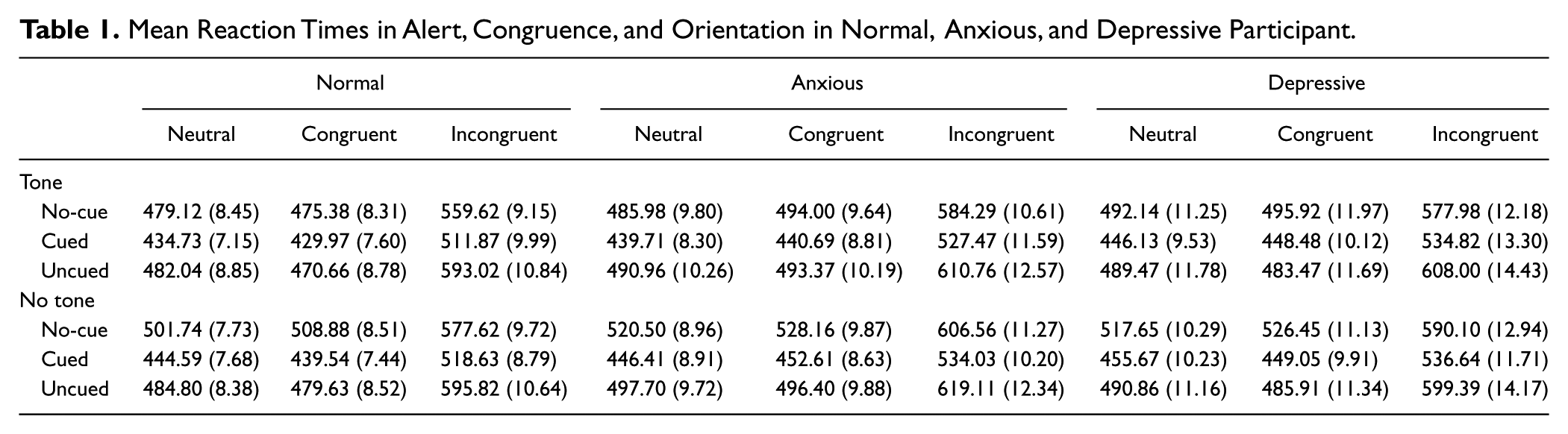
Regarding the interaction between Alert and Congruence, although the effect of the alert is significant in all cases, it is reduced in incongruent trials (M = 567.53, SD = 6.35) compared with neutral (M = 471.14, SD = 5.19) and congruent (M = 469.77, SD = 5.32).
Analysis of the Alert × Orientation interaction showed a similar pattern of results as previously. There is a significant difference between the presence or absence of tone in the three types of trials of variable orientation, although this is lower in the uncued trials (M = 524.63, SD = 6.11) than in the cued (M = 467.76, SD = 5.32) and no-cue (M = 516.04, SD = 5.51) trials.
Finally, analysis of the Congruence × Orientation interaction showed a greater effect of Congruence in uncued trials (M = 604.34, SD = 7.08) than in cued (M = 527.24, SD = 6.23) and no-cue (M = 582.71, SD = 6.18) trials.
In a similar way, and using error rate as the dependent variable, mixed factorial ANOVA 3 (Group) × 2 (Alert) × 3 (Congruency) × 3 (Orientation) was carried out with scores in anxiety and depression as choice variables and the remaining intraparticipant as manipulated variables. The main significant effects were those of the variables Congruence, F(2, 174) = 68.21, MSE = 10283.43,
Mean Error Rates and Standard Deviations in Alert, Congruence and Orientation in Normal, Anxious and Depressive Participant.
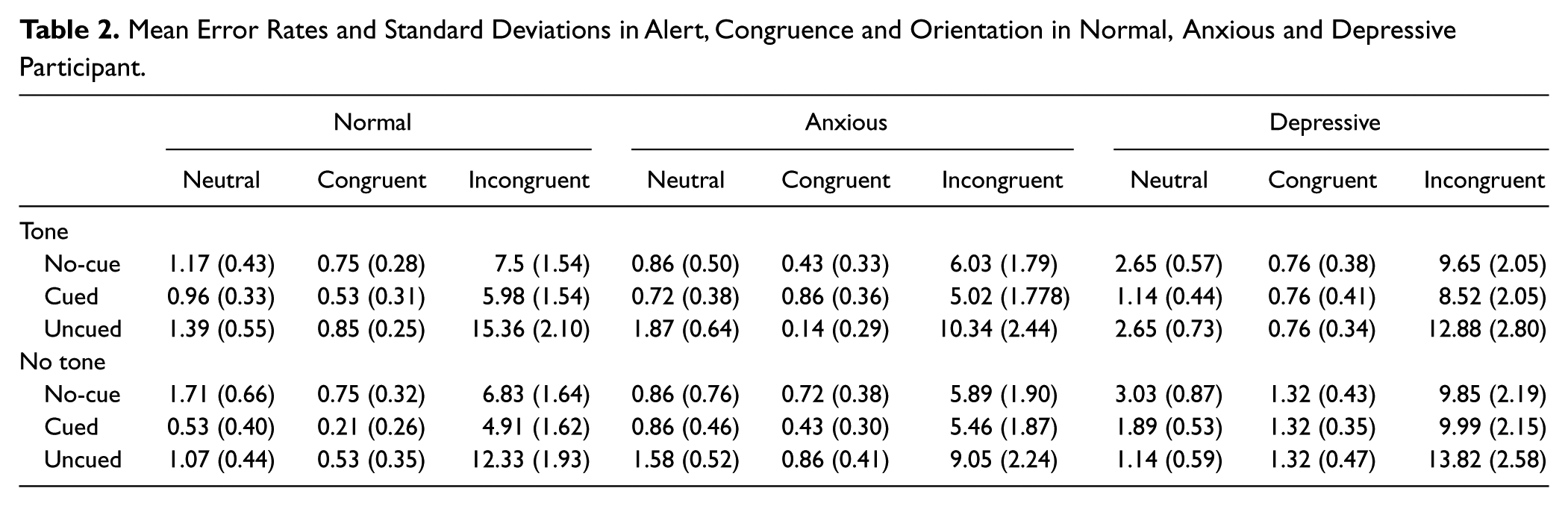
The analysis of this interaction showed that there is less effect of congruence on cued trials (M = 6.64, SD = 1.01) than on no-cue (M = 7.56, SD = 0.99) or uncued trials (M = 12.29, SD = 1.27).
Finally, to analyze the relationship between risk avoidance and performance on attentional networks correlations were performed between the number of beats and the indexes of alertness, orienting, and control. The results showed that there was no significant relationship.
Discussion
According to our hypotheses, the results obtained in our study show a clear difference between anxious and depressive individuals regarding assumed risk in decision making. Thus, anxious individuals present a significantly lower average number of pumps for balloon inflation in the BART than depressive and control ones, whereas no differences were observed between the latter two. The use of such an objective behavioral measure clearly indicates risk avoidance in the anxious group but not in the depressive group. These results agree with those of Maner et al. (2007), Mitte (2007), and Miu et al. (2008).
The scarce research in this area does not prove risk avoidance to be specific to anxiety or to negative affect. The comparison made in this study between anxious and depressive individuals that share negative affect allows us to conclude that affect is not responsible for risk avoidance. This statement is also grounded on three important aspects derived from the results observed in PANAS: (a) Scores in positive affect in the depressive group were significantly lower than those in the control and anxious groups, whereas no differences were observed between the latter groups, thus proving that depressive individuals undergo important positive affect loss; (b) although there are differences among the three groups in negative affect, the highest scores are observed in the depressive group; and (c) the ANCOVA that we performed showed that differences between groups in regard to the avoidance of risk is maintained when negative affect is entered as covariate. This pattern of results allows us to conclude that risk avoidance is related to anxiety and not to negative affect. Indeed, if it were related to the latter, avoidance also would have appeared in the depressive group. Therefore, these results demand further research specifically aimed at determining which components of anxiety are responsible for risk avoidance.
Regarding the impact of anxiety in the different attentional networks, our results partially agree with those obtained in other previous studies that have used neutral stimuli (Pacheco-Unguetti et al., 2010). Thus, responses were faster and more accurate when an alerting stimulus is presented, when trials are congruent, and when the target stimulus is preceded by a spatial sign (i.e., cued trials). Similarly, the significant interactions found between networks replicate the results of these studies. However, unlike these authors, we found no differences in the attentional-control network between control, anxious, or depressive individuals.
Attentional biases in anxiety have traditionally been considered to be related mainly to attentional orientation and to appear with threatening information. More recent studies suggest that anxiety is characterized by altered attentional control that may appear even with stimuli without emotional load. Thus, anxiety would then lead to a general worsening of attentional function, interfering with executive control processes (Eysenck et al., 2007). Our results indicate that these processes are not affected in anxious individuals when neutral stimuli are presented. Therefore, whether control-level deficits in anxious individuals are due to emotionally negative stimulation, as traditionally stated, remains to be analyzed (e.g., Mogg & Bradley, 2006). The greater attention captured by negative or threatening stimuli is shared by both low and highly anxious individuals. However, lack of control in the former results in difficulties to “disengaging” their attention from threatening information, despite its irrelevance. According to Eysenck et al. (2007), this difficulty would be explained by a generally lowered cognitive-control capacity. Our study does not support the hypothesis that anxious individuals find greater difficulty in controlling distracting information, regardless of whether the information is emotional because low and highly anxious individuals show a similar behavior in both speed and precision of performance. In this same way, Finucane, Whiteman, and Power (2010) found that lab-induced happiness and sadness do not differentially influence the efficiency of the alerting, orienting, or executive attention networks in the context of neutral stimuli.
Nevertheless, future research will determine whether there are differences in attentional control between low and highly anxious individuals in the presence of threatening information. More specifically, it is important to determine the role played by state- and trait anxiety in the control of attentional network with emotionally negative information because available data with neutral information suggest that anxiety may activate bottom-up processes, which mainly affect alerting and orientation networks, whereas trait anxiety seems to influence top-down processes, so it would be possible to modulate the operation of the control network (Pacheco-Unguetti et al., 2010).
Moreover, the results of our study show no association between risk avoidance and performance in the three attentional networks. This may be due to the fact that there is no direct relationship between the two but rather that other processes may be mediating that have not been measured with the tasks used, given that a properly functioning executive requires not only that the attentional system be effective but, among other factors, also the working memory, motivation, and adequate emotional processing that guide decision making (Muñoz & Tirapu, 2004).
Similarly, it also would be interesting to study the impact of both state- and trait anxiety on decision making in risk situations. Future research also should extend to the analysis of differences between anxious and depressive individuals using tasks for decision making in risk situations. These tasks will allow to determine whether the differences between both types of individuals are due to strategies used in information search or in the processes directly involved in decision making, as both types of strategies seem to be modulated by attentional control (Matthews, Panganiban, & Hudlicka, 2011).
Conclusion
This study shows a clear difference between anxious and depressive individuals regarding assumed risk in decision making. The use of an objective behavioral measure clearly indicates risk avoidance in the anxious group but not in the depressive group. Both share negative affect, which allows us to conclude that affect is not responsible for risk avoidance.
Regarding the impact of anxiety on the different attentional networks, our results show responses are faster and more accurate when an alerting stimulus is presented, when trials are congruent, and when target stimulus is preceded by spatial sign. However, we found no differences in the attentional-control network between control, anxious, or depressive individuals when neutral stimuli were used. Therefore, whether control-level deficits in anxious individuals are due to emotionally negative stimulation, as traditionally stated, remains to be analyzed.
Footnotes
Acknowledgements
The authors want to thank Dr. Lejuez for his permission to use the Balloon Analogue Risk Task.
Declaration of Conflicting Interests
The author(s) declared no potential conflicts of interest with respect to the research, authorship, and/or publication of this article.
Funding
The author(s) received no financial support for the research, authorship, and/or publication of this article.