



Abstract
Keywords
ADHD is highly heritable and persistent across the life span (Bidwell et al., 2011) and is associated with impairments in numerous domains of life functioning (Barkley & Murphy, 2011), including interpersonal relations (Overbey, Snell, & Callis, 2011). Although previous studies have reported lower marital satisfaction among adults with ADHD symptoms (Eakin et al., 2004), the mechanisms that might underlie this marital dissatisfaction, such as relationship attributions, have not been examined. Similarly, although a recent review (Johnston, Mash, Miller, & Ninowski, 2012) highlighted links between adult ADHD symptoms and parenting difficulties, most previous research has focused on parenting at the individual level. Less is known about how ADHD symptoms in adults may be related to mothers’ and fathers’ abilities to cooperate as a couple. In this study, we examine ADHD symptoms in mothers and fathers in relation to the couples’ marital satisfaction, attributions for each other’s behavior, and their reports of coparenting. We also examine these relations within the context of child ADHD symptoms and both parent and child comorbidities.
ADHD symptoms have been associated with difficulties in interpersonal relationships in adults (Babinski et al., 2011; Das, Cherbuin, Butterworth, Anstey, & Easteal, 2012; Overbey et al., 2011). Regarding marital relationships, studies have reported that adults with ADHD symptoms experience less marital satisfaction and elevated rates of marital dissolution (Barkley, Murphy, & Fischer, 2008; Eakin et al., 2004; Minde et al., 2003). In some reports, the association between adult ADHD symptoms and marital dissatisfaction appears to be independent of comorbidities (Eakin et al., 2004); however, these are not always controlled.
In addition to the possible contributions of comorbidities to the association between adult ADHD and marital functioning, the influence of child ADHD also sometimes remains uncontrolled. This omission raises concerns because we know that ADHD often affects both parents and children within a family (Biederman, Faraone, Mick, & Spencer, 1995), and child ADHD behavior is a risk factor for marital dissolution (Wymbs et al., 2008). In addition, there is considerable evidence supporting the transactional nature of the relationship between marital functioning and child problems including both ADHD and oppositional behavior (Jenkins, Simpson, Dunn, Rasbash, & O’Connor, 2005; Wymbs & Pelham, 2010). Thus, it is important to assess the extent to which adult ADHD symptoms are related to marital satisfaction independent of the impact of child ADHD symptoms. Similarly, it is important to control for child oppositional behavior, given its relations to both marital satisfaction and child ADHD. Finally, given the contextual nature of each partner’s experience of marital functioning, we argue it is also important to account for the partner’s level of ADHD symptoms when examining correlations between adult ADHD symptoms and measures of marital functioning.
Most existing studies of adult ADHD symptoms and marital distress have focused on adults with extreme or diagnostic levels of ADHD symptoms (e.g., Eakin et al., 2004). However, given the recognized limitations to the diagnostic criteria for adult ADHD (Barkley et al., 2008; Kessler et al., 2010), it is possible that impairments in social functioning may also appear at subdiagnostic levels of symptoms. We examine marital satisfaction as it relates to a dimensional measure of ADHD symptoms reported by mothers and fathers of children with varying levels of ADHD symptoms and oppositional behavior. We predicted that higher levels of ADHD symptoms in either parent would be related to less marital satisfaction as reported by both parents, even accounting for child ADHD. We also predicted that this relationship would survive control for child oppositional behavior.
Moving beyond marital satisfaction, we know less about the aspects of marital functioning that are linked to ADHD symptoms. Studies of marital functioning consistently demonstrate that attributions of blame or intent for negative spouse behavior predict lower and less stable levels of satisfaction in the marriage (Bradbury, Fincham, & Beach, 2000). Although various types of psychopathology within each spouse are associated with both attributions and marital satisfaction (Fincham & Bradbury, 2004), possible relations between ADHD symptoms and marital satisfaction and attributions have not been examined. ADHD symptoms can be hypothesized to influence marital attributions in at least two ways. First, ADHD symptoms may lead partners to give less attention to situational influences on behavior, to expend less effort when considering alternate causes of negative events, and/or to have more impulsive reactions to the partner’s negative behavior (Knouse et al., 2008), such that there is a positive relationship between the perceiver’s ADHD symptoms and negative attributions for the spouse. Alternately, it is also possible that ADHD symptoms in a spouse result in more negative attributions for his or her behavior by the partner (Canu, Newman, Morrow, & Pope, 2008). For example, partners with ADHD symptoms may act in ways that have negative consequences for their spouse, and such behaviors may be interpreted as intentional. Thus, we predicted that ADHD symptoms in mothers and fathers would be related to more negative attributions, both for their partners and as made by their partners about them.
As noted above, marital functioning and attributions are related to child ADHD and oppositional behavior, and to other adult psychopathologies. In addition, adults with high levels of ADHD symptoms have higher rates of comorbid internalizing (e.g., anxiety, depression) and externalizing (e.g., substance use, antisocial behavior) problems (Miller, Nigg, & Faraone, 2007). Therefore, we tested whether the associations between parents’ ADHD symptoms and marital functioning and marital attributions were specific to ADHD symptoms or might be better accounted for by comorbid symptoms of depression or hostility.
In families, couples function not only as marital partners but also as parents of offspring and must coordinate their parenting efforts. This ability to coparent is related to marital functioning and child behavior problems (Teubert & Pinquart, 2010). Parenting alliance, one aspect of coparenting, reflects each parent’s views of the cooperation and feelings of mutual respect in the parenting team (Konold & Abidin, 2001). To extend our understanding of how adult ADHD symptoms may be related to functioning within couples, we included assessment of the coparenting alliance. Although couples’ childrearing disagreements have been linked to child problems in families of children with ADHD (Johnston & Behrenz, 1993), the relation of coparenting to adult ADHD, to our knowledge, has not been examined. Given that adult ADHD is associated with reduced marital satisfaction and interpersonal communication deficits (Barkley, Fischer, Smallish, & Fletcher, 2006), we expected that adult ADHD symptoms would be negatively associated with coparenting alliance. As with the marital measures, we hypothesized that parenting alliance would be related to both self and partner ADHD symptoms, and that these relations would survive control for comorbid conditions.
In summary, we examined marital satisfaction, marital attributions, and parenting alliance as reported by both mothers and fathers of children with and without ADHD, and predicted associations between these variables and the level of ADHD symptoms in each parent and their partner. We also examined whether these associations were unique to ADHD symptoms or were accounted for by comorbid family problems.
Method
Participants
Mothers and fathers of 64 boys aged 8 to 12 years with (41%) and without (59%) ADHD participated in this study. Participants were recruited from both community and clinical sources. All mothers, and 81% of fathers, were the biological parents of their child. Demographic information can be found in Table 1. Child ADHD symptoms were assessed with mother and other informant reports on the ADHD Rating Scale–IV (ADHD-IV; DuPaul, Power, Anastopoulos, & Reid, 1998). Other informants were the children’s teachers (78%), coaches, day care workers, or relatives. The ADHD-IV is an 18-item scale that reflects Diagnostic and Statistical Manual of Mental Disorders (4th ed.; DSM-IV; American Psychiatric Association, 1994) criteria for inattentive and hyperactive-impulsive symptoms on a 4-point rating scale from 0 (never or rarely) to 3 (very often). The ADHD-IV has demonstrated good psychometric properties including a replicable factor structure, interrater reliability, and convergent validity (DuPaul et al., 1998). In this study, the internal consistency on the Inattention and Hyperactive-Impulsive subscales were, respectively, .80 and .87 for mothers, and .91 and .91 for other informants.
Family, Child, and Parent Characteristics.

Note. SES = socioeconomic status; ODD = oppositional defiant disorder.
Brief Symptom Inventory: High scores indicate greater symptom endorsement.
Children were considered to have ADHD if they had been diagnosed by a health professional, symptoms were present prior to age 7, and either the mother or the informant rated the child as 2 or 3 for at least six inattentive or hyperactive/impulsive symptoms. In addition, either the mother or teacher must have rated the child as impaired by his symptoms. Of the 26 boys with ADHD, 16 (62%) were taking medication at the time of the study. Parents were asked to complete all measures of child behavior, thinking of the child as off medication.
The Total Problems Score of the Strengths and Difficulties Questionnaire (SDQ; Goodman, 2001) was used to ensure that the control children did not have high levels of behavior problems. The SDQ has good psychometric properties (Goodman, 2001), and in this study, α = .89 for mothers and α = .85 for fathers. All children in the control group scored below the 90th percentile on the Total Problems Score (youthinmind, 2004). Children with pervasive developmental disorders were excluded from both groups.
Parent Measures
Parent ADHD symptoms
Mothers and fathers each completed the Current Symptoms Scale (CSS; Barkley & Murphy, 2006), an 18-item measure assessing adult ADHD symptoms on a scale ranging from 0 (never or rarely) to 3 (very often). The CSS has shown good reliability (Gomez, 2011; Ladner, Schulenberg, Smith, & Dunaway, 2011), construct validity (Gomez, 2011; Murphy & Barkley, 1996), and convergent validity (Ladner et al., 2011). Parent ADHD symptoms were calculated as the average level of endorsement across all items. Internal consistencies were .93 and .89 for mothers and fathers, respectively.
Relationship quality
The short form of the Dyadic Adjustment Scale (DAS-7; Hunsley, Best, Lefebvre, & Vito, 2001; Spanier, 1976) was administered to each parent to measure marital satisfaction. The DAS-7 has seven items, and the total score averaged across items rated from 0 to 5 or 6 was used. The DAS-7 total score has shown good criterion validity, convergent validity, and consistently high internal consistency (Hunsley et al., 2001). In this study, mothers’ ratings of marital adjustment were internally consistent, α = .83, as were fathers’ α = .81.
Spousal attributions
The Relationship Attribution Measure (RAM; Fincham & Bradbury, 1992) was administered to mothers and fathers to assess attributions spouses make for their partner’s behavior. The RAM has six scenarios, four of which are negative and two of which are positive. For each scenario, participants use a 6-point scale (1 = strongly agree to 6 = strongly disagree) to rate the cause of the behavior on six items that correspond to the attributional dimensions of locus, stability, globality, intentionality, selfish motivation, and whether the behavior is blameworthy. Only the four negative questions are utilized in scoring. The RAM has shown adequate test–retest reliability, as well as good internal consistency (Tonizzo, Howells, Day, Reidpath, & Froyland, 2000) and convergent and criterion validity (Fincham & Bradbury, 1992). In this study, RAM scores were averaged within and across scenarios. Internal consistency was α = .94 for mothers and α = .91 for fathers. Although higher ratings indicate less negative attributions, for ease of interpretation, inversed scores were used such that higher RAM scores indicate more negative attributions.
Parenting alliance
Each parent completed the Parenting Alliance Measure (PAM; Abidin & Konold, 1999) reporting their cohesiveness as a parenting team. The PAM has 20-items rated on a 5-point scale from strongly agree to strongly disagree. The PAM has high internal consistency, test–retest reliability, concurrent validity, criterion validity (Abidin & Konold, 1999), and construct validity (Abidin & Konold, 1999; Hughes, Gordon, & Gaertner, 2004). In addition, the factor structure of the PAM indicates that it is a valid measure for use with both mothers and fathers (Konold & Abidin, 2001). In this study, the internal consistency was α = .95 for maternal and α = .94 for paternal parenting alliance. PAM scores were calculated by averaging across the items on the scale, and higher scores indicate greater alliance.
Parental comorbidity
Both parents completed the Hostility and Depression subscales of the Brief Symptom Inventory (BSI; Derogatis, 1993). The BSI is a self-report measure of psychological symptoms rated on a 5-point scale (0 = not at all to 4 = extremely). The Depression subscale consists of six items, and the Hostility subscale has five items. The BSI has demonstrated good psychometric properties (Boulet & Boss, 1991; Derogatis & Melisaratos, 1983), including validity when used in families of children with ADHD (Seipp & Johnston, 2005). Scores were calculated by averaging items on each subscale. Internal consistencies for mothers’ ratings were α = .71 for hostility and α = .87 for depression. For fathers, α = .76 for hostility and α = .87 for depression.
Child comorbidity
Child oppositional behavior was assessed on the Oppositional Defiant Disorder Rating Scale (ODDRS; Hommersen, Murray, Ohan, & Johnston, 2006). The ODDRS is an eight-item scale keyed to DSM-IV criteria with items ranged from 0 (not at all) to 3 (very much). The ODDRS has demonstrated high internal consistency and interrater reliability as well as good test–retest reliability and convergent validity (Hommersen et al., 2006). The internal consistencies for mother and father ratings on the scale were both .91. Scores for each child were calculated as averages across items, and across mother and father ratings.
Procedure
This study was conducted in a research lab at the University of British Columbia and was approved by our university’s ethics board. After families indicated interest in participating, the study was described and informed consents were obtained. Mothers and fathers completed questionnaires separately, with mothers completing the measures during a lab visit with their son, and fathers completing the measures at home and returning them by mail. 1 Parents received an honorarium, and each child received a t-shirt.
Results
A total of 65 two-parent families completed all questionnaires required to be included for analysis. During preliminary data analysis, an outlier was discovered. This mother responded inconsistently across and within questionnaires. In addition, she rated herself very low on acculturation to Canadian culture. This family’s data were omitted from analysis, resulting in 64 families. As a subset of participants had missing data on one or more variables, we used multiple imputation in all analyses. A total of 20 imputations were conducted for each analysis, and each data set was analyzed separately; the results were then combined using the procedures outlined in Barnard and Rubin (1999). This procedure allows the full use of all available data without limiting inferences to those participants with complete data. In addition, due to several assumption violations, all reported statistics were bootstrapped, and bias-corrected and accelerated (BCa) bootstrapped confidence intervals were calculated via resampling.
Correlations Among Variables
Bivariate correlations among variables can be found in Table 2. As expected, DAS and PAM scores correlated positively with each other, and RAM scores generally correlated negatively with DAS and PAM scores. In addition, the comorbidities correlated with DAS, PAM, and RAM scores in the expected directions. Looking specifically at parental ADHD symptoms, for mothers, there was one marginal association of ADHD symptoms with lower PAM scores. For fathers, their ADHD symptoms were associated with less marital satisfaction (a marginal association with mother reports and a significant association with father reports), and with lower PAM and higher RAM scores.
Correlations Between Predictor and Criterion and Between Covariate and Criterion Variables.
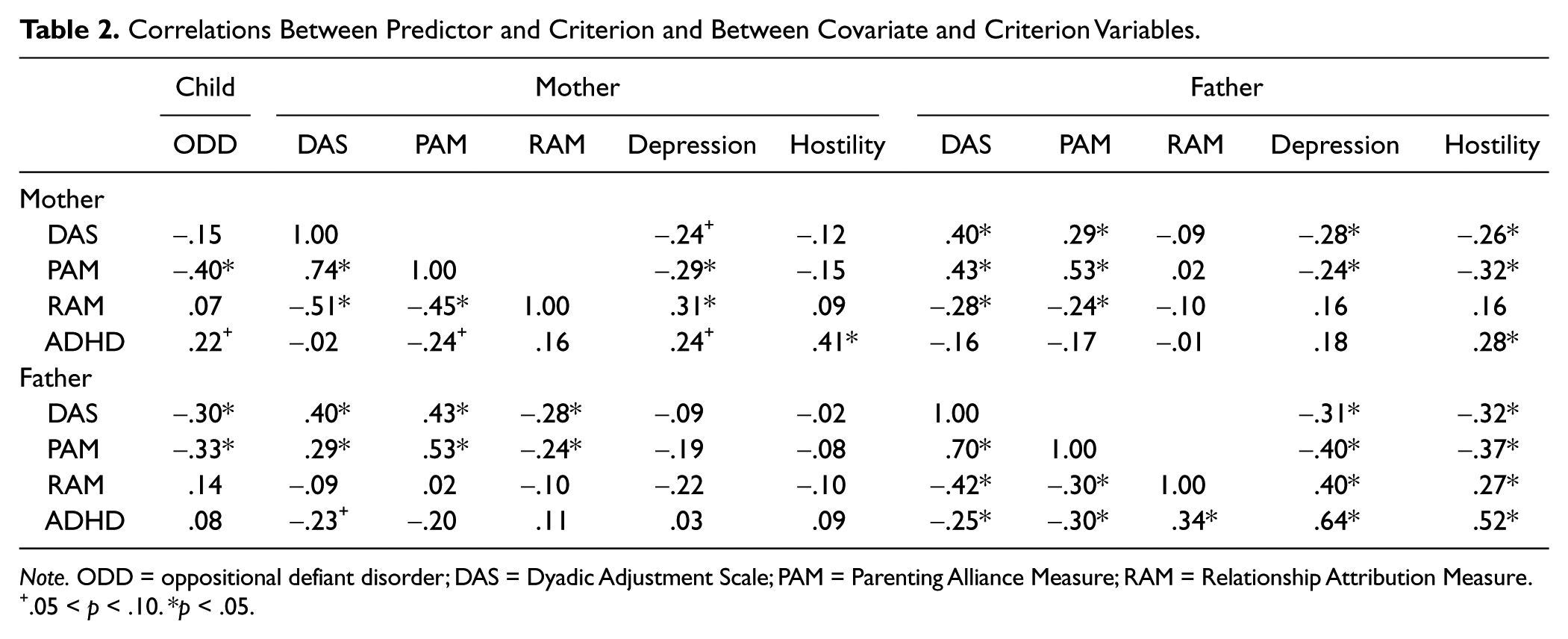
Note. ODD = oppositional defiant disorder; DAS = Dyadic Adjustment Scale; PAM = Parenting Alliance Measure; RAM = Relationship Attribution Measure.
.05 < p < .10. *p < .05.
Families of Children With and Without ADHD
Comparing families of children with and without ADHD on demographic variables and child comorbidities, only child oppositional symptoms differed significantly, with parents of children with ADHD rating their children higher, t(62) = 5.58, p < .001, 95% confidence interval = [.44, .93], d = 1.38 (see Table 1).Within-between ANOVA compared parental depressive and hostility symptoms across families of children with and without ADHD and across mothers and fathers within families. Hostility symptoms were significantly higher in parents of boys with ADHD, F(1, 62) = 12.81, p < .001, η2 = .09 (see Table 1), and this effect remained significant even when child ODD symptoms were covaried (p = .011). No other effects were significant.
To test whether parent and child ADHD symptoms were associated, an ANOVA was conducted comparing parental ADHD symptoms across families of children with and without ADHD and within mothers and fathers (see Table 3). Consistent with our hypotheses, parents of sons with ADHD were significantly more likely to report ADHD symptoms of their own. This main effect was qualified by a significant interaction between child ADHD status and parent sex, F(1, 62) = 11.55, p = .001, η2 = .07. Post hoc analyses indicated that mothers of children with ADHD self-reported significantly more ADHD symptoms than mothers of children without ADHD. Fathers of children with ADHD did not differ significantly from fathers of children without ADHD in their reports of ADHD symptoms. In addition, among parents of children with ADHD, mothers self-reported significantly more ADHD symptoms than fathers. However, among parents of children without ADHD, mothers and fathers did not significantly differ in their self-reports of ADHD symptoms (see Table 3). The interaction between child ADHD status and parent sex remained significant even when child ODD symptoms, parental depression, and parental hostility were covaried (p < .001).
Parental ADHD Symptoms and Relationship Variables as a Function of Child ADHD.
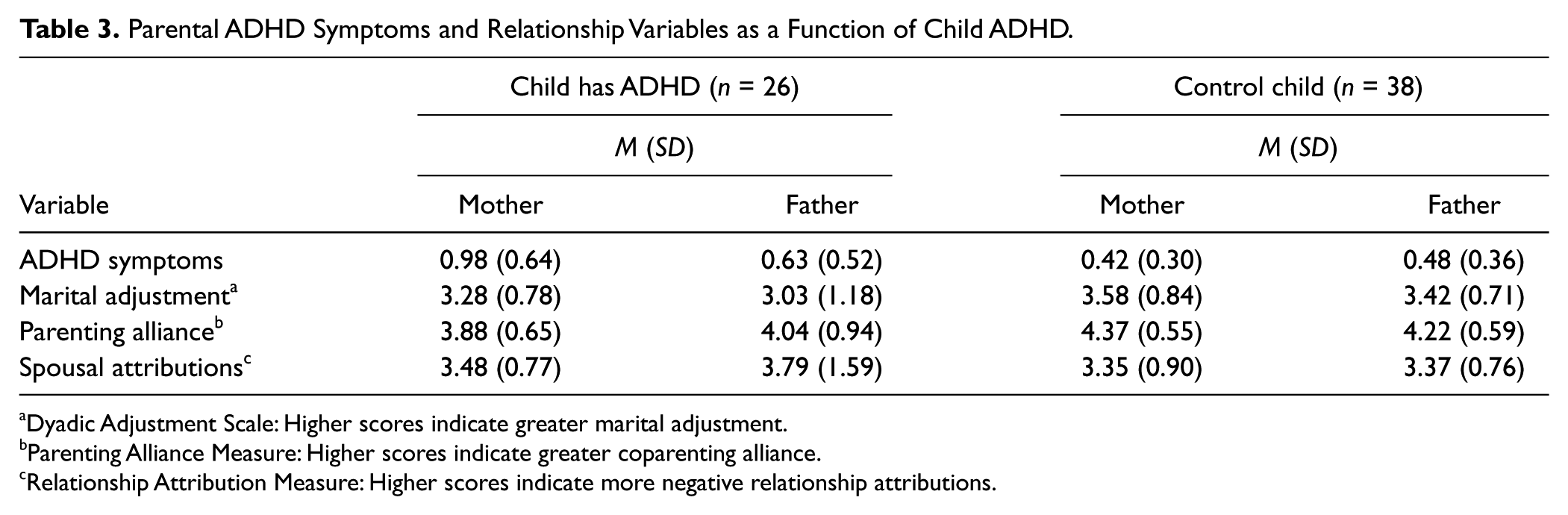
Dyadic Adjustment Scale: Higher scores indicate greater marital adjustment.
Parenting Alliance Measure: Higher scores indicate greater coparenting alliance.
Relationship Attribution Measure: Higher scores indicate more negative relationship attributions.
Finally, ANOVAs were conducted comparing the relationship variables across families of children with and without ADHD and within mothers and fathers (see Table 3). Although we expected parents of children with ADHD to differ on all of these measures, the only significant difference was on the PAM; parents of sons with ADHD reported lower parenting alliance than parents of control children, F(1, 62) = 9.71, p = .003, η2 = .10. When child ODD was covaried, this difference was no longer significant (p = .102).
Parent and Child ADHD Symptoms as Predictors of Marital Adjustment, Relationship Attributions, and Coparenting
Regressions were conducted to assess the relationships between parent ADHD symptoms and measures of marital functioning and coparenting. Analyses were conducted separately for mothers’ and fathers’ DAS, RAM, and PAM scores as dependent variables. At Step 1, mother and father ADHD symptoms and child ADHD status were entered, and at Step 2, an interaction term between mother and father ADHD symptoms was added. This interaction term was not significant in any model and is not discussed further. Models that significantly predicted marital and coparenting variables were reanalyzed: covarying child ODD symptoms, parental depression, and parental hostility. For marital adjustment, contrary to our expectations of a negative relationship between dyadic adjustment and parent ADHD symptoms, the overall models were not significant for mothers, R2adj = .04, F(3, 61) = 1.95, p = .132, or fathers, R2adj = .03, F(3, 61) = 1.72, p = .173.
For the RAM, parent and child ADHD symptoms did not significantly predict maternal negative relationship attributions either individually or together, despite our expectation of positive associations, R2adj = −.02, F(3, 61) = .65, p = .585 (see Table 4). However, as expected, paternal negative relationship attributions were significantly predicted by the full model, R2adj = .10, F(3, 61) = 3.21, p = .029, as well as by paternal ADHD symptoms in particular (see Table 4). When other parent and child psychological symptoms were included in the regression, the overall model remained significant, R2adj = .17, F(8, 55) = 2.57, p = .019, but now both maternal and paternal depression significantly predicted paternal relationship attributions, and paternal ADHD symptoms were no longer significant. This suggests that depressive symptoms account for much of the relationship between paternal ADHD symptoms and negative relationship attributions (see Table 5).
ADHD Symptoms Predicting Marital and Coparenting Variables in Mothers and Fathers.

Note. RAM = Relationship Attribution Measure; PAM = Parenting Alliance Measure; CI = confidence interval.
Child ADHD: 0 = control child, 1 = child with ADHD.
Psychopathology Predicting Negative Relationship Attributions and Parenting Alliance in Mothers and Fathers.

Note. RAM = Relationship Attribution Measure; PAM = Parenting Alliance Measure; CI = confidence interval; ODD = oppositional defiant disorder.
Similar regressions were calculated with family ADHD symptoms predicting parenting alliance. The model was significant for maternal reports of parenting alliance, R2adj = .13, F(3, 61) = 4.09, p = .010, with child ADHD status as the only significant predictor (see Table 4). This model remained significant when other parent and child psychological symptoms were included, R2adj = .21, F(8, 55) = 3.14, p = .005. However, child ADHD status was no longer a significant predictor, and child ODD symptoms became marginally significant (see Table 5), suggesting that ODD symptoms are largely responsible for the relationship between child ADHD and parenting alliance. Contrary to predictions, parents’ own ADHD symptoms did not significantly predict mothers’ reports of parenting alliance in the regression analysis. However, consistent with our prediction, the results for fathers’ reports of parenting alliance were significant, R2adj = .10, F(3, 61) = 3.36, p = .024, and father ADHD symptoms were marginally predictive of paternal parenting alliance (see Table 4). When other family psychological symptoms were included into the equation, the overall model remained significant, R2adj = .21, F(8, 55) = 3.16, p = .005. But again, paternal ADHD symptoms were no longer a predictor, and paternal depressive symptoms instead became marginally significant (see Table 5), suggesting that parental psychological symptoms, and paternal depression in particular, are largely driving the relationship between paternal ADHD and paternal parenting alliance.
Discussion
Contrary to expectations, our results indicated that adult ADHD symptoms were rarely related to measures of family functioning. For the relations that did exist, including ADHD or comorbid psychological symptoms of child or parents, reduced the associations between parental ADHD and family functioning. The reasons why our primary hypotheses were not fully supported are difficult to determine. Perhaps the parents with high levels of ADHD symptoms in our sample had developed compensatory strategies that reduced the impact of their symptoms, or had strategically selected partners who were tolerant of ADHD symptoms, or the influence of child ADHD symptoms in other family members affected the impact of each parent’s symptoms. Although our results regarding adult ADHD symptoms and family functioning are unexpected and null when examined in the context of family members’ psychological symptoms, the intercorrelations among measures of family functioning and the bivariate associations between parent ADHD symptoms and functioning were often consistent with our expectations. In particular, intercorrelations between mother and father reports of marital adjustment, relationship attributions, and parenting alliance were generally significant in the expected directions.
With regard to the links between adult ADHD symptoms and family functioning, previous research has found that spousal and self-reports of dyadic adjustment are lower in adults with ADHD compared with control adults (Eakin et al., 2004), even with child ADHD status controlled (Minde et al., 2003). In contrast to these results, we found that maternal ADHD symptoms were not related to self- or partner reports of dyadic adjustment. There were small correlations of father ADHD symptoms with both father and mother DAS reports, but these relations were reduced when placed in the context of mother and child ADHD symptoms, suggesting that the relationship between a father’s ADHD symptoms and marital satisfaction may be explained by ADHD symptoms in other members of the family. The differences between our results and previous findings may be due to our control of other family ADHD symptoms, as well as due to our focus on mothers and fathers separately. Consistent with the results for marital satisfaction, mother ADHD symptoms did not significantly predict mother-reported relationship attributions, nor the attributions her partner made for her. Father ADHD symptoms did predict his own negative relationship attributions about his wife, and this effect survived the inclusion of other family members’ ADHD symptoms but not other comorbidities. For the coparenting relationship, both mother and father ADHD symptoms related to their own reports of difficulties in this alliance, but these relationships disappeared in the context of other family members’ ADHD symptoms, particularly child ADHD status. These results are consistent with previous findings that child ADHD symptoms contribute to interparental conflict (Wymbs & Pelham, 2010).
Consistent with previous research, ADHD symptoms were associated with both depression and hostility for mothers and fathers, and child ADHD was significantly associated with ODD symptoms (Johnston et al., 2012; Maughan, Rowe, Messer, Goodman, & Meltzer, 2004). These comorbid conditions in both parents and children were correlated with family functioning in the directions that would be expected, and when entered into the regression equations, it was often these comorbid conditions that accounted for the relationships that had previously been attributed to ADHD symptoms. For example, the effect of child ADHD status on maternal parenting alliance became nonsignificant when child ODD symptoms were included and depressive symptoms seemed to be driving the relationships between parent ADHD symptoms and negative marital attributions. Together, these results suggest that ADHD-specific behaviors may not be the most strongly predictive of impairments in marital and parental functioning, but, instead, that comorbid parental and child psychopathologies are most important.
Several important sex differences were observed in our study. Among parents of children with ADHD, mothers reported, on average, higher levels of ADHD symptoms than fathers, although there were more significant correlations between father ADHD symptoms and measures of family functioning. Using norms for adult ADHD symptoms provided by Barkley (2011), no more than 16% of parents in control families and fathers in ADHD families scored above the 90th percentile. However, 38% of mothers in the ADHD group reported symptoms above the 90th percentile. In short, although mothers reported more ADHD symptoms than fathers, fathers appeared to be more affected by their ADHD symptoms. Eakin and colleagues (2004) speculated that husbands may be more upset by their wives’ ADHD symptoms than the reverse; however, this is contrary to our findings, which generally do not support links between adult ADHD symptoms and spousal reports of family functioning. However, looking at other psychological symptoms, we did find some cross-partner effects. For example, although mothers’ depression was related to their own but not their husbands’, perceptions of family functioning, fathers’ depression, and hostility were related to their own and their wives’ reports. These relations are generally consistent with previous results showing that depression and anxiety are associated with both self- and spousal reports of marital adjustment (Whisman, Uebelacker, & Weinstock, 2004). Sex differences were also found in the relations within measures of family functioning. Wives’ negative attributions about husbands were related to the husbands’ reports of dyadic adjustment and parenting alliance, but husbands’ attributions about their wives were not related to any of the wives’ reports of family functioning. This is consistent with previous research finding that wives’ attributions are more related to marital satisfaction than husbands’ attributions (Bradbury, Beach, Fincham, & Nelson, 1996; Sanford, 2005). Our results suggest that, compared with men, women’s experiences of their families are more strongly related to their partner’s views and to psychological symptoms.
In interpreting our findings, it is important to consider the nature of the sample. Although not referred for clinical services, the families in our study are representative of families who seek treatment. All children in the ADHD group had been diagnosed by a mental health professional, and most had sought clinical services. For example, 63% of children with ADHD were taking medication, and more than half of their parents reported using specialized parenting techniques such as reward system charts. However, the sample is restricted to two-parent families where both parents were willing and able to participate in research. Such families may be better functioning than many families with a child with ADHD, including single-parent families. Furthermore, it is possible that families’ treatment experience may have limited our ability to find significant effects between groups. This concern was alleviated somewhat by the fact that rerunning the analyses controlling for child medication status and use of behavior therapy did not alter our pattern of results. However, further research would be necessary to examine the possible influence of parental treatments. Our instruction to parents to imagine their child off of medication when completing questionnaires also introduces the possibility of recall bias. However, more than 80% of our families with children with ADHD consistently interacted with their child when he or she was not medicated. Neither excluding families whose children were never off of medication nor controlling for the presence of these long-acting medications altered our pattern of results, suggesting that the influence of recall bias is minimal.
Although we do not have measures of current or past treatment for marital difficulties, scores for the families in our sample were often below clinical cutoffs on measures of family functioning. For example, the DAS scores were consistent with those from previous studies of adults with ADHD (Eakin et al., 2004), but predictably higher than what has been found in samples of adults with more severe psychological difficulties (Hunsley et al., 2001). Scores on the RAM in our sample were similar to scores from typical couples in previous studies (e.g., McNulty, O’Hara, & Karney, 2008). Similarly, 20% of mothers and 44% of fathers of children with ADHD scored below the 20th percentile on the measure of parenting alliance in comparison with 5% of mothers and 18% of fathers of control children (Abidin & Konold, 1999). Overall, although the families in our sample likely overestimate the level of functioning in many families of children with ADHD, perhaps due to current and past treatment, they were still significantly more impaired than controls in parenting alliance, and although not significantly different, mean levels on the DAS and RAM also suggested greater difficulty in families with ADHD compared with controls.
Limitations
Our study is limited by several factors. First, the relatively small sample size limits our power to detect relationships among the variables. This is evidenced by a number of bivariate correlations and betas that are in the expected direction, but they fail to reach traditional levels of significance. Our study was powered to determine medium to large effects, and although it is true that smaller effects may be obscured by our sample size, effects of such a size are unlikely to be clinically significant. Nevertheless, our conclusions are tentative and require replication and elaboration. In addition, although one outlier was removed as there was an identifiable reason for the abnormal responses, two other outliers were maintained in the analysis as there were no apparent reasons for their extreme responses. However, we note that our use of bootstrapping and multiple imputation would minimize the effect of these outliers and that results remained the same even under the constraints of robust regression. Nevertheless, a larger data set would reduce the impact of such outliers and add confidence to the obtained results.
Our study is also limited by the uncertainty associated with the measurement of ADHD symptoms in adults. DSM-IV criteria were written for children, and it is currently unknown the extent to which these criteria are applicable to adults (Barkley et al., 2008). In this study, we relied on a dimensional approach to measuring adult ADHD; however, it is possible that different results might be obtained with a diagnostic approach. Similarly, it is possible that ADHD symptoms as currently written function differently in adult men compared with adult women. Finally, in this sample, parents’ scores on the Inattention and Hyperactivity/Impulsivity subscales of the CSS were highly correlated, r(62) = .74 and r(62) = .60 for mothers and fathers, respectively, and so were collapsed into a total score in our analyses to avoid difficulties in interpretation of highly colinear predictors and to minimize the number of variables considered in the regressions. It will be important for future research to consider the role that the two symptom dimensions may play in family functioning. Among the children with ADHD, 77% were rated highly on both inattentive and hyperactive symptoms by either their mother or another informant; the remaining children were split equally between predominantly inattentive and predominantly hyperactive/impulsive symptom endorsement. Although this distribution of child ADHD suggests that the effect of child subtype would be minor, future studies are needed to more fully examine this question.
It is likely that genetic effects are contributing to our results. In particular, our finding that parents of children with ADHD are more likely to have ADHD symptoms is likely reflective of a genetic relationship. Specifically, our results suggest that mothers’ ADHD symptoms might have a stronger relationship to their child’s ADHD than fathers’ ADHD symptoms, although the presence of more nonbiological fathers than mothers in this sample limits the strength of this interpretation. In addition, the specificity of any genetic effects is difficult to determine due to the significant relations among comorbid conditions and family functioning. Future research using genetically informed designs would be useful in sorting out how genetic and environmental factors work together within families with members with ADHD.
Clinical Implications
It is important to consider both parent and child ADHD symptoms in the context of other psychological difficulties. We found that when ADHD symptoms appear to be related to important domains of family functioning, other psychological difficulties often contribute to or were wholly responsible for the relation with ADHD. Furthermore, any one family member’s ADHD symptoms need to be understood in the context of other family members’ ADHD and comorbid psychological symptoms. Parents’ perceptions of family functioning are often meaningfully affected by the symptoms of other family members, and what appears to be the effect of one person’s ADHD may actually reflect a combination of their own and other family members’ ADHD and comorbid symptoms. As a result, in a clinical setting, it is important to not assume that the presence of ADHD symptoms in a parent necessarily implies difficulties in marital or family relationships, and if such difficulties are present, the clinician should consider treating comorbid psychological symptoms instead of or in addition to the ADHD symptoms. Our results suggest that comorbid depressive and hostility symptoms are related to coparenting, marital attributions, and marital satisfaction, and it would be beneficial for future research to explore how other kinds of psychopathology (e.g., parental anxiety) may be related to measures of family functioning.
Conclusion
This is the first study to investigate marital attributions and coparenting as they relate to ADHD symptoms in adults in a larger context that included child ADHD and family comorbidities. Results highlighted the importance of considering ADHD symptoms in the broader family milieu, as well as the value of including both mothers and fathers when investigating how ADHD is related to family members’ perceptions of one another.
Footnotes
Acknowledgements
We thank the families who generously gave their time and our lab colleagues who offered comments.
Declaration of Conflicting Interests
The author(s) declared no potential conflicts of interest with respect to the research, authorship, and/or publication of this article.
Funding
The author(s) disclosed receipt of the following financial support for the research, authorship, and/or publication of this article: This research was supported by a grant from the Social Sciences and Humanities Research Council of Canada to the second author.