



Abstract
Learning to read is a cognitively demanding task that requires sustained attention and on-task behavior on numerous occasions over extended periods of time. The available evidence suggests that attention problems have an early and lasting influence on reading during the first 2 to 3 years of school (Dally, 2006; Merrell & Tymms, 2005; Rabiner, Coie, & The Conduct Problems Prevention Group, 2000; Sanson, Prior, & Smart, 1996), suggesting that inattention may compromise a child’s capacity to benefit from formal reading instruction. In a rigorously controlled meta-analysis of six large-scale longitudinal data sets from the United States, Great Britain, and Canada, G. J. Duncan et al. (2007) found that inattention at school entry was the only nonachievement or learning-related predictor of later reading achievement (β = −.08). In a smaller longitudinal study, Rabiner et al. (2000) found that, after controlling for IQ and earlier levels of reading, teacher ratings of inattention during kindergarten and first grade were concurrently associated with word reading (β = −.29 at both time points), and had indirect effects on reading comprehension in fifth grade through an association with prior reading. Inattention in second grade directly predicted reading comprehension in fifth grade (β = −.10). Moreover, children identified as highly inattentive in first grade showed significant decline in their reading performance from kindergarten to first grade and remained an average of half a standard deviation below the group of typically developing children at fifth grade.
Prevailing models of reading development propose that the ability to process phonological information within language is central to the acquisition of word-reading ability (Bowey, 2005; Wagner & Torgesen, 1987). Phonological processing ability is conceptualized as comprising three separate but overlapping abilities: phonological awareness, which is the ability to detect, discriminate, and manipulate units of sound within language (Stanovich, 1992); phonological memory, which pertains to the storage of phonological information in short-term memory (Gathercole & Baddeley, 1993); and phonological recoding in lexical access (often referred to as rapid automatized naming or RAN), which reflects an individual’s ability to quickly and efficiently retrieve the phonological code associated with a visual or written symbol (Wagner & Torgesen, 1987). Recent meta-analytic data based on more than 300 longitudinal studies demonstrated that progress in learning to read words is reliably predicted by phonological awareness, phonological memory, and RAN, even after controlling for potential moderating variables, such as IQ and socioeconomic status (Shanahan & Lonigan, 2010).
Despite the central role of phonological processing in reading development and the deleterious impact of inattention on early reading development, few studies have examined the influence of inattention on phonological processing, and with somewhat inconsistent findings. Lonigan et al. (1999) found that teacher-rated inattention was concurrently associated with rapid naming (r = −.39) and phonological memory (r = −.32) independent of nonverbal IQ in a middle-income sample of 4-year-old children, and was independently correlated with phonological awareness (r = −.37) in a low-income sample. Moreover, in two longitudinal studies, teacher-rated inattention in preschool (Walcott, Scheemaker, & Bielski, 2010) and kindergarten (Dally, 2006) predicted a small proportion of variance in phonological awareness (R2 ranged from 4%-14%) 1 to 2 years later independent of prior levels of phonological awareness, verbal ability, and letter knowledge. In these studies, inattention was not similarly predictive of RAN performance (Dally, 2006; Walcott et al., 2010) or phonological memory (Dally, 2006), although in a recent longitudinal study, preschool inattention predicted kindergarten RAN (β = .08; Arnett et al., 2012). In contrast, in a study by Velting and Whitehurst (1997), teacher ratings of inattention-hyperactivity in preschool and kindergarten were not associated with a composite measure of early literacy skills, which included measures of phonological awareness. However, since a number of studies suggest that inattention is more reliably related to reading than hyperactivity (Ebejer et al., 2010; McGee, Prior, Williams, Smart, & Sanson, 2002), the use of a rating scale that included items assessing both inattention and hyperactivity is likely to explain this finding of no relationship. Overall, these findings provide some support for the suggestion that early inattentive behavior influences children’s phonological processing, which provides an additional explanation for the predictive relationship between inattention and reading.
The present study aimed to extend these findings by examining the longitudinal associations between inattention, phonological processing, and word-reading development among a sample of children who just begun formal reading instruction. In particular, we were interested in examining two separate but not mutually exclusive explanations for the predictive association between inattention and word-reading development. First, we aimed to evaluate whether inattention interferes with the process of learning to read during the first 2 years of formal schooling, even after controlling for those constructs considered to be central to word-reading acquisition, namely, phonological processing (Wagner & Torgesen, 1987) and prior levels of reading ability (G. J. Duncan et al., 2007). Second, we aimed to provide a reexamination of the longitudinal relationships between inattention and phonological processing to determine whether inattention also affects reading development by interfering with the development of phonological processing abilities across the first 2 years of reading instruction. Although most past research supports a developmental progression from attention problems to reading difficulties (e.g., McGee et al., 2002), children were initially assessed during the first few weeks of formal reading instruction to minimize any potential effects of prior reading on inattention. In addition, emergent reading skills, including letter name and sound knowledge, and beginning word recognition, were assessed at school entry to control for the autoregressive effects of prior reading (Bowey, 2005; Wagner, Torgesen, & Rashotte, 1994). Along with phonological processing, letter name and sound knowledge are the most robust predictors of word-reading acquisition (Shanahan & Lonigan, 2010). Thus, including these constructs in the model provided a stringent test of the independent effects of inattention on early word reading.
Method
Participants
Participants were 136 children (69 girls and 67 boys) attending a government elementary school in a middle-income suburb of the Gold Coast, which is a coastal city in the eastern state of Queensland, Australia. Information and consent forms were distributed to all parents of children from two consecutive first-grade intakes in the same school, with participants being those for whom parental consent was obtained. Children ranged in age from 62 months to 80 months (M = 67.77 months, SD = 3.81 months) at the first assessment, and English was the primary language spoken at home for all children. Children were tested at the very start of first grade (Time 1), at the end of first grade (Time 2), and again toward the end of second grade (Time 3). Of the 136 children who enrolled in the study, 116 children (58 boys and 58 girls) completed all time points, representing a retention rate of 85%.
At the time of testing, first grade in Queensland was directly preceded by a part-time and government-funded preschool year in which children were not exposed to any formal or explicit literacy instruction. Literacy instruction began during the first few weeks of first grade and, throughout first and second grade, involved explicit teaching of decoding and comprehension strategies, teacher-modeled reading aloud, guided practice and shared reading, talking about, questioning and analyzing text, and independent exploration or practice of what was being taught. Children were taught to decode words using phonic, contextual, grammatical, and semantic cues alongside being taught high-frequency sight words both in and out of context. Literacy activities occurred at the whole of classroom level, in small groups, and one-on-one with a teacher or other adult. Adjunctive literacy activities included home reading tasks, weekly school library visits, and independent silent reading time during class.
Measures
Inattentive Behavior
Because the focus of the present study was on the impact of classroom inattentiveness, and parents do not generally observe their children at school, and because past similar studies indicated that parent ratings of inattentiveness were not associated with reading outcomes (e.g., Dally, 2006), only teacher ratings of inattention were obtained. Attention problems were assessed at each time point using an inattention subscale developed by Purpura and Lonigan (2009) that was derived from the Conners’ Teacher Rating Scale–Revised: short form (CTRS; Conners, 1997). Purpura and Lonigan’s adapted version of the CTRS provides a five-item inattention subscale for use with young children that is not confounded by the items assessing learning behavior and academic achievement that are in the original CTRS cognitive problems/inattention scale (e.g., “poor in number concepts and arithmetic,” “not reading up to par,” “lacks interest in schoolwork”). Using a subscale to assess inattention containing these items would have artificially inflated any associations between inattention and the reading outcomes measured in the present study.
Teachers were asked to rate each item on the inattention subscale according to how much of a problem that behavior had been in the last month on a 4-point Likert-type scale (0 = not true at all and 3 = very much true), and total scores were derived by summing teachers’ response to each individual item on the subscale. Support for the construct validity of the inattention subscale was provided by significant correlations with ratings of Diagnostic and Statistical Manual of Mental Disorders (4th ed.; DSM-IV; American Psychiatric Association, 1994) symptom criteria for ADHD (Purpura & Lonigan, 2009). Internal consistency of the inattention subscale in the current study was α = .91 at Time 1, α = .90 at Time 2, and α = .91 at Time 3.
Phonological Processing Skills
Phonological awareness
Two tasks were used to assess phonological awareness at Time 1; final phoneme identity (Bowey, 1994) and sound blending (Majsterek & Ellenwood, 1995). These tasks were used to measure phonological awareness at Time 1 because they had been successfully used with prereading children in previous research, and their use of pictures and explicit task instructions made them suitable for this sample of children who at Time 1 were novice readers. In the phoneme identity task, children were presented with three pictures in a triangular format and were given information about the final sound in the top picture. Children were asked to identify which of the two bottom words also ended in that sound. For instance, children were told that mouse ends with ssss, and were asked to say whether purse or gate also ends with ssss. The task comprised 4 practice items and 24 test items. Children were given feedback for the practice items only. Scores were obtained by adding the number of words correctly identified. This task had adequate internal consistency, α = .71.
For the first eight items on the sound-blending task (one practice item and seven test items), children were presented with cards showing six color pictures. After ensuring the children could identify each picture, they were told the experimenter was going to say a word broken down into parts and that they needed to point to the picture of that word. Each word was presented to the child broken down into onset and rime for the first five items (e.g., d-og; m-an), and then individual phonemes for the final two items (e.g., c-u-p; sh-i-p). In the second part of the task (17 test trials), the child was told that, instead of pointing to a picture, they needed to say the word with all the parts pushed together. Initially, the child was asked to blend two- and three-phoneme words (e.g., ea-t; c-ow) with the test progressing to five- and seven-phoneme words (e.g., b-a-b-ie-s). The task was discontinued after three consecutive incorrect responses. The total score comprised the number of pictures correctly identified in Part 1 of the task and the number of correct words in Part 2. Internal consistency was α = .85 in this sample.
At Times 2 and 3, phonological awareness was measured using the Auditory Analysis Test (Rosner & Simon, 1971). Children were verbally presented with a word (e.g., cowboy), asked to repeat it, and then asked to repeat it again without a specified sound or sound sequence (e.g., “Now say cowboy again, but without boy”). The 40 items on this test progressed in difficulty from items requiring phonological analysis skills to remove the initial or final syllable from two-syllable words or the initial or final phoneme from one-syllable words (e.g., “Say gate without g”), to items requiring both phonological blending and analysis skills to delete initial phonemes from consonant blends or to delete medial syllables and consonant sounds (e.g., “Say reproduce without pro”). Testing was discontinued after six consecutive errors, and a total score was derived by summing the number of words correctly produced. Internal consistency was α = .93.
Phonological memory
The nonword-repetition task (Gathercole, Willis, Baddeley, & Emslie, 1994) was administered at all time points. Children were asked to repeat a series of progressively more difficult nonsense words presented by the experimenter (e.g., plexi, bant, zug). The procedure used in the present study was based on Bowey (1996), in which children were told that the nonsense words were the names of the space aliens shown in the accompanying pictures. Children were given 4 practice trials and 40 test trials. The test trials were organized into sets of 10 items that progressed in difficulty from two-syllable nonwords to five-syllable nonwords. The task was discontinued after four consecutive incorrect pronunciations, and children’s responses were tape-recorded so that accuracy of scoring could be checked. A total score was derived for this task by adding together the number of nonwords correctly reproduced. This test was reported to have a test–retest reliability of α = .77 among 5-year-old children and α = .80 among 7-year-olds (Gathercole et al., 1994).
RAN
The same two RAN tasks were used at all time points and were based on Wagner et al. (1987). The first task required children to quickly and accurately name five colors (red, blue, green, yellow, and black) presented serially on an A4-sized card in 10 rows in a randomized order, while the second required children to quickly and accurately name black and white line drawings of five objects (hand, ball, chair, dog, and star). The total time taken to name each set of 50 items was recorded. Each RAN score was transformed into a speed score, to give a measure of the number of items named correctly per second. This meant that higher RAN scores reflected better performance on the RAN tasks.
Letter Knowledge
Letter name and sound knowledge was assessed at Time 1. To assess letter name knowledge, children were asked to name all of the uppercase and lowercase letters of the alphabet. All letters were printed in Queensland Beginning Readers font, which is the style of handwriting used in Queensland elementary schools. Because the lowercase letters “a” and “g” look different when written in standard word-processed text than when handwritten, these letters were presented in both Queensland Beginners’ font and Times New Roman font, giving a maximum possible score of 54. The final score was based on the total number of letter names correctly identified. The internal consistency of this test was α = .98.
Letter sound knowledge was assessed by asking children to give the sound of 12 uppercase letters printed in Queensland Beginning Readers font (T, S, E, M, O, D, I, F, B, P, U, L), printed six-to-a-page. Children were presented with 3 practice items, R, A, and H, and were given feedback about the correctness of their responses. Children were then presented with the 12 test items. No feedback was given on these test items. Vowels needed to be pronounced using the appropriate short vowel sound to be scored as correct. Scores were obtained by adding the number of letter sounds correctly identified. The alpha reliability of this task was α = .83.
Word-Reading Ability
Novice word reading
Novice word reading was measured at Time 1 using the Clay Ready to Read test (S. Duncan & McNaughton, 2001), which comprises a list of 48 high-frequency words. Because it samples a greater number of words at the first-grade level then standardized tests of word reading designed for a broader age range (e.g., Mum, no, me, and), it is a more sensitive test of reading ability at the very earliest stages of learning to read. Thus, the Ready to Read test was administered at Time 1 to provide better control for the autoregressive effects of later word reading. The items I and a were not included because of the ambiguity of scoring them since they are both words and letters. The remaining 46 words were presented to children four-to-a-page, with feedback given only for the first word, the. Scores were obtained by adding the number of words correctly identified. Test–retest reliability of the Ready to Read test in 6-year-old children was reported as .97, with an internal consistency of α = .95.
Word-reading skills
Two tests were used to assess word recognition and two tests were used to assess word-reading efficiency. At Times 2 and 3, children completed the Word Identification and Word Attack subtests of the Woodcock Reading Mastery Test (Form H; Woodcock, 1998). At Time 3, children were also assessed using an adapted version of the Test of Word Reading Efficiency (TOWRE; Torgesen, Wagner, & Rashotte, 1999). Word Identification is a standardized test of word reading comprising a list of 106 words. The Word Attack test measures the ability to apply grapheme–phoneme correspondence rules to the pronunciation of nonsense words. The test consisted of 2 sample items and 45 test items. Both tests were administered according to standardized instructions. W scores were used as the index for these two tests, which use an interval scale that takes into account item difficulty.
The TOWRE test comprises two subtests; one to assess the ability to accurately and efficiently recognize familiar words as whole units or sight words (Sight Word Efficiency) and one that assesses the ability to phonologically recode nonwords quickly and accurately (Phonological Decoding Efficiency). These subtests were designed to assess the speed of printed word and nonword identification across all grades of primary and high school, and therefore included items that were too difficult for children in the beginning stages of learning to read (e.g., strange, justice, dangerous, and necessary). Thus, a new set of items was constructed so that the test would be sensitive to word and nonword-reading efficiency in second grade.
The 100 items for the word-reading efficiency test were developed by identifying one- and two-syllable nouns, verbs, and adjectives from a list of the 300 most frequent words in beginning reading materials (Elley, Croft, & Cowie, 1977). Example items were bed, pig, and run. The nonword list comprised 60 nonsense words created by swapping the initial consonants or consonant clusters among the real words in the first list (e.g., ped, kig, lun). The nonwords were constructed so that the standard pronunciation of the nonword did not resemble a real word, and so that, as much as possible, there was only one acceptable pronunciation for each nonword. Children were presented with the word efficiency test first and then the nonword-efficiency test. For both tasks, children were given 45 s to name as many words or nonwords as they could. Scores on each task were the number of items named correctly within the time limit.
Verbal ability
The Peabody Picture Vocabulary Test–Third Edition (PPVT-III; Dunn & Dunn, 1997), a measure of receptive vocabulary, was used to estimate children’s verbal ability at Time 1. This task was chosen over a measure of expressive vocabulary because its large colorful illustrations and engaging nature made it a less confronting and less burdensome measure for the sample of children who at this time point were new to formal schooling and testing situations. The task is also reported to be highly correlated with a measure of expressive vocabulary (median correlation = .76; Dunn & Dunn, 1997). The PPVT-III was administered according to standardized instructions, and children’s standard scores were used in all analyses.
Procedure
Ethical clearance for the study was obtained from the author’s departmental institutional review board, and permission to contact schools to partake in the research was obtained from Education Queensland. Time 1 testing began in the 2nd week of first grade. Time 2 testing occurred 8 months later during the children’s final term in first grade, and Time 3 testing took place around 9 months later when children were in their third term of second grade. To ensure optimal performance on all tasks, test administration was spread over three 20- to 25-min sessions across a 3- to 4-week period and occurred in a quiet room at the children’s school. The Ready to Read and letter knowledge tests were administered in the first session at Time 1 so that exposure to formal reading instruction was as limited as possible. The phonological processing tasks were administered in Session 2 and the PPVT-III was given in Session 3. At Times 2 and 3, the sessions were administered in the reverse order to ensure that the reading measures were given after the children had received a maximum amount of formal schooling for that assessment point. Teachers completed the CTRS toward the end of the month of testing at each assessment phase. Children were given stickers at the end of each session, and teachers were given movie tickets as a token of appreciation for their time.
Results
Preliminary Analyses and Descriptive Statistics
Independent group t tests indicated that the 15% of children who dropped out over the course of the study did not differ significantly on Time 1 levels of letter knowledge, novice reading skills, phonological processing, verbal ability, or inattention. Inspection of the distributional properties of each variable revealed only mild departures from normality in the inattention subscale at Times 2 and 3, and in nonword-reading efficiency scores at Time 3. The Ready to Read scores were kurtotic and positively skewed, suggestive of floor effects on this task, which was expected since these children had only just begun formal schooling. Approximately, a sixth of the children could not read any word, and a third identified one or two words. One child was a notable univariate outlier on this test, scoring at ceiling, which was 2.5 standard deviations greater than the next highest score. This child also scored at ceiling on the letter knowledge tests. Her teacher reported that she was already a fluent reader who could read books well beyond the level of her peers and her grade. At the end of first grade, this child obtained a word-reading age of 12 years, and a nonword-reading age of 18 years on the Word Identification and Word Attack subtests, respectively. Thus, she was clearly a member of the population of precocious readers, and not a member of the target population of beginning readers (Bowey & Francis, 1991), and so her data were excluded from all analyses. Removing this outlier substantially reduced the level of skewness and kurtosis, although the distribution of scores on this task remained positively skewed. Descriptive statistics for each variable for the final sample of 115 children are displayed in Table 1.
Descriptive Statistics for All Measures.
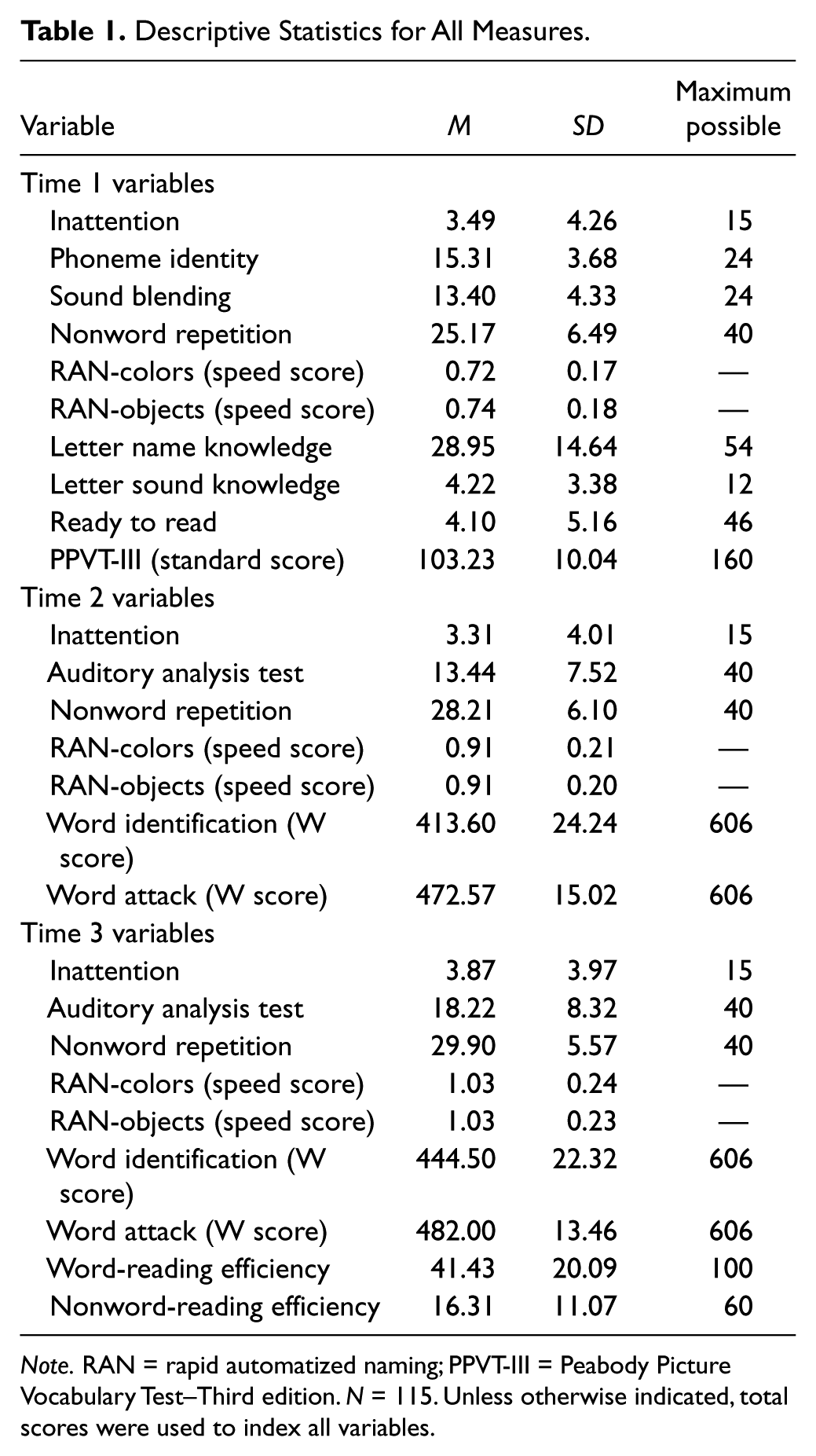
Note. RAN = rapid automatized naming; PPVT-III = Peabody Picture Vocabulary Test–Third edition. N = 115. Unless otherwise indicated, total scores were used to index all variables.
A series of composite variables were created to prevent problems with multicollinearity of predictor variables and to reduce the number of criterion variables for the regression analyses. Decisions regarding which variables to combine were made by examining the correlations among tasks assessing conceptually similar constructs, with particular attention to variables correlated at approximately r = .70 or above (Tabachnick & Fidell, 2001). Since the RAN-color and RAN-picture tasks were highly correlated at each time point (r = .67, p < .001, at Time 1; r = .74, p < .001, at Time 2; r = .70, p < .001, at Time 3), a composite RAN variable was created by averaging the speed scores for these tasks. Similarly, a composite letter knowledge variable was created by averaging the standardized scores for the letter name and letter sound tasks at Time 1 (r = .66, p < .001), and the same process was used to create a word-reading variable from the Word Identification and Word Attack tasks at Times 2 and 3 (r = .84, p < .001, at time 2; r = .63, p < .001, at time 3), and a word-reading efficiency variable from the two reading efficiency tasks at Time 3 (r = .86, p < .001). A composite phonological awareness variable was not constructed from Time 1 phoneme identity and sound blending since these tasks were only moderately correlated (r = .45, p < .001)
Bivariate Correlations Among Measures
The phonological processing, letter knowledge, and reading measures correlated both within and across time points in expected ways (see Table 2). The exception to this was the correlations involving the phoneme identity task and the other phonological processing tasks at Time 1. Although phoneme identity was moderately correlated with sound blending, it was not correlated with either nonword repetition or RAN. Inattention showed strong stability across all three assessments. Time 1 inattention was negatively correlated with the concurrent measures of phonological processing, letter knowledge, and novice word reading, and was negatively correlated with the phonological awareness measure at Times 2 and 3, and phonological memory at Time 3. Inattention was also negatively correlated with all reading and reading efficiency measures at Times 2 and 3. Time 2 inattention was negatively associated with concurrent measures of phonological awareness, RAN, and word reading, but not nonword repetition, and was negatively correlated with Time 3 phonological processing, reading, and reading efficiency.
Bivariate Correlations Among All Measures Across All Assessment Points.

Note. RAN = rapid automatized naming; PPVT-III = Peabody Picture Vocabulary Test–Third edition. N = 115.
Composite variable comprising RAN-colors and RAN-objects.
Composite variable comprising letter names and letter sounds.
Composite variable comprising Word Identification and Word Attack.
Composite variable comprising word and nonword-reading efficiency tasks.
p < .05. **p < .01. ***p < .001.
Hierarchical Regression Analyses
A series of hierarchical regression analyses were conducted to evaluate the independent effects of inattentive behavior measured at the very start of first grade (Time 1) on word-reading and phonological processing outcomes at the end of first grade (Time 2), and the effects of inattention at the end of first grade on second-grade reading and phonological processing outcomes (Time 3). Conservative regression models were constructed to ensure the autoregressive effects of prior levels of the criterion variable were controlled, as were the effects of verbal ability. In all models, Time 1 PPVT-III scores were entered at Step 1, followed by prior levels of the criterion variable (measured at the immediately previous assessment point) at Step 2. Other relevant causal variables were entered at Step 3, and inattention was entered at Step 4.
Influence of Inattention on Subsequent Word Reading
Table 3 displays the results of regression analyses on Time 2 word reading and Time 3 word reading and word-reading efficiency. School entry inattentiveness accounted for 6.3% of independent variance, even after controlling for school entry levels of verbal ability, the strong effects of novice reading and letter knowledge, and phonological processing. In the full model with all variables considered simultaneously, inattention, alongside letter knowledge, sound blending, and RAN, were the only unique predictors of Time 2 word reading. Furthermore, inattention measured at the end of first grade explained a small but significant proportion of additional variance in word reading (1.7%) and word-reading efficiency (1.6%) measured toward the end of second grade even despite the very strong contribution of prior reading (56.8% for Time 3 word reading and 55.3% for Time 3 word-reading efficiency). End-of-first-grade inattention was also a unique predictor of second-grade word reading and word-reading efficiency in the full model. Time 3 word reading was also predicted by prior reading and phonological awareness, while Time 3 word-reading efficiency was predicted by RAN performance.
Results of Regression Analyses Predicting Reading Outcomes at the End of First and Second Grades.
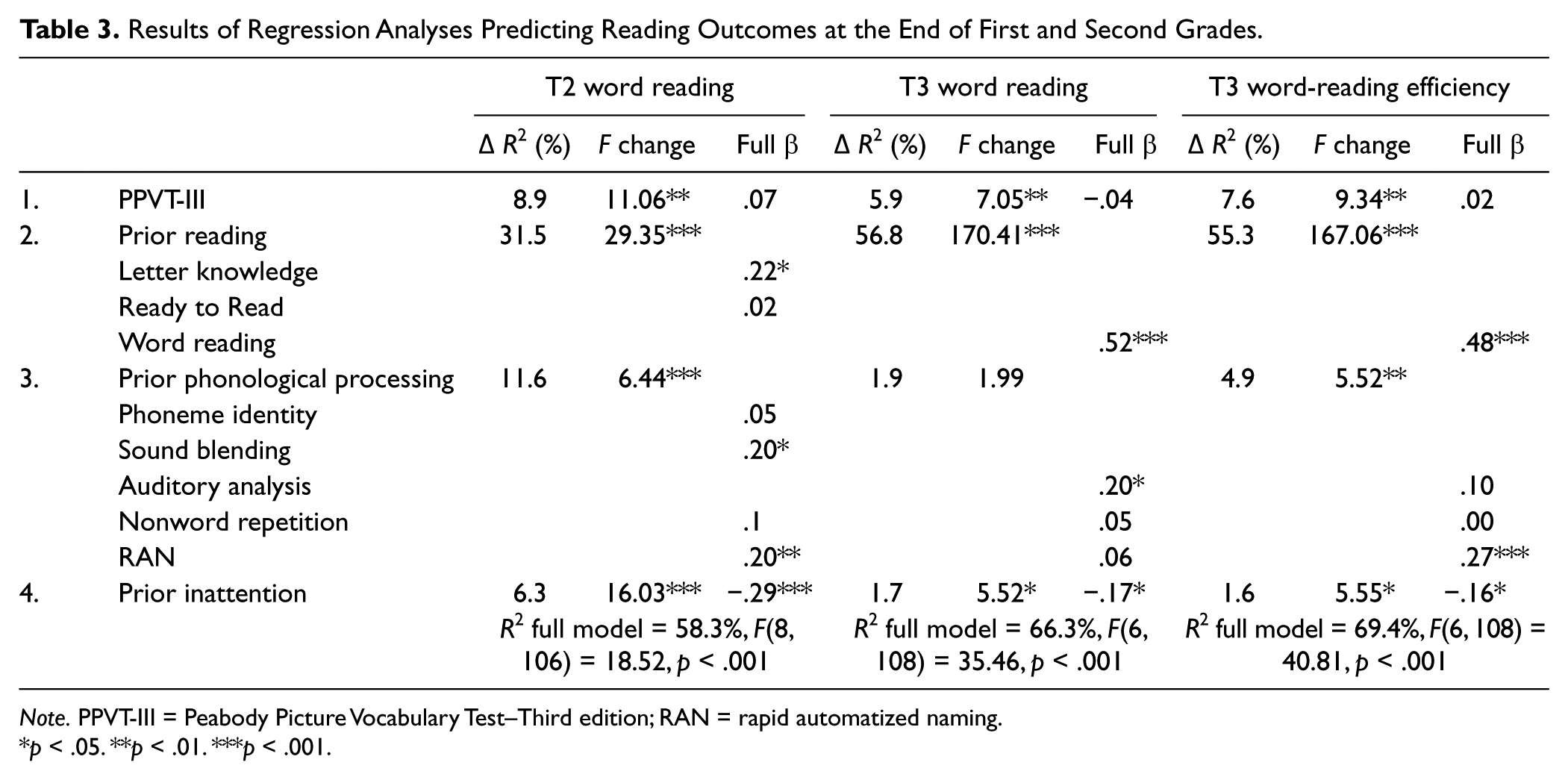
Note. PPVT-III = Peabody Picture Vocabulary Test–Third edition; RAN = rapid automatized naming.
p < .05. **p < .01. ***p < .001.
Influence of Inattention on Subsequent Phonological Processing Abilities
The results of regression analyses on each of the phonological processing abilities at Times 2 and 3 are displayed in Table 4. School entry inattention did not explain unique variance in RAN at the end of first grade after controlling for verbal ability, prior levels of the criterion variable, novice reading, and letter knowledge. Inattention did, however, account for 2.9% of variance in phonological memory, and was a unique predictor in the full regression model for that variable. Time 1 inattention explained 1.7% of variance in Time 2 phonological awareness, an effect that was marginally significant (p = .076). Time 2 inattention did not explain additional variance in phonological awareness, phonological memory, or RAN measured at the end of second grade.
Results of Regression Analyses Predicting Phonological Processing at the End of First and Second Grades.
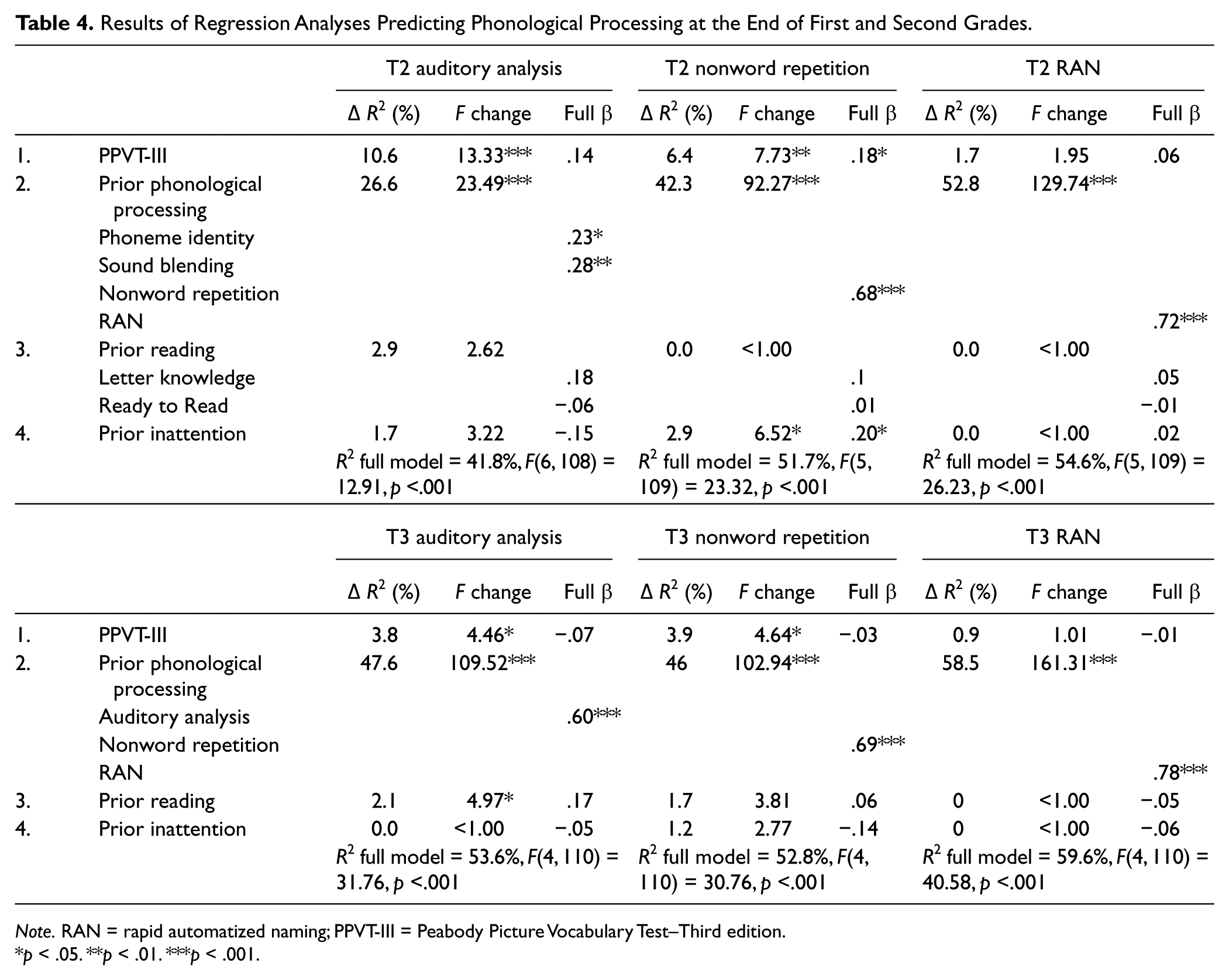
Note. RAN = rapid automatized naming; PPVT-III = Peabody Picture Vocabulary Test–Third edition.
p < .05. **p < .01. ***p < .001.
Reciprocal Influence of Word Reading on Inattention
Parallel hierarchical regression analyses were conducted to examine the possibility of a bidirectional link between these constructs. In the prediction of Time 2 inattentiveness, novice reading and alphabet knowledge (entered as a block) did not explain independent variance (R2 change = 1.1%, F change = 1.70, p = .187) after the effects of verbal ability and school entry inattention were removed from the analysis. Furthermore, neither novice word reading (β = .03, t = 0.38, p = .702) or letter knowledge (β = −.13, t = −1.69, p = .096) were unique predictors in the final model containing all variables. Similarly, Time 2 word reading did not account for independent variance in Time 3 inattention (R2 change = 1.2%, F change = 2.76, p = .100) and was not a unique predictor in the full regression model, β = −.14, t = −1.66, p = .100. Thus, reading did not significantly predict subsequent inattention.
Discussion
The present study used a sample of school entrants to examine the longitudinal relationships between inattention, phonological processing, and word reading across the first 2 years of formal reading instruction. Consistent with previous longitudinal research with children in the early stages of reading instruction (e.g., G. J. Duncan et al., 2007; Rabiner et al., 2000; Sanson et al., 1996), school entry levels of inattentive behavior predicted 6.3% of variance in word reading at the end of first grade, while inattentiveness at the end of first grade predicted a small but significant proportion of variance in word reading (1.7%) and word-reading efficiency (1.6%) near the end of second grade. Furthermore, in line with research with older children (e.g., McGee et al., 2002), support was not found for a bidirectional effect of reading on inattention.
When considered from the perspective of practical rather than statistical significance, the effects of inattention on subsequent word reading in the present study were relatively small, especially from Times 2 to 3. However, they should not necessarily be ignored given that the influence of children’s inattentive behavior on word reading during first grade was independent of and comparable with the effects of key determinants of success in learning to read (i.e., alphabet knowledge and phonological processing abilities; Bowey, 2005; Wagner & Torgesen, 1987), and that the effect of inattention on word reading from first to second grade was independent of the strong stability in word-reading skills across these two time points (explaining between 55% and 57% of variance). Thus, these findings are consistent with the suggestion that adequate levels of attentiveness in combination with other key early literacy skills may be required from the very beginning of reading instruction for word-reading acquisition to occur at an expected rate and for children to take full advantage of formal reading instruction.
The second aim of this study was to reexamine the link between inattention and phonological processing abilities. School entry inattention predicted phonological memory at the end of first grade, and there was a trend toward inattention being a unique predictor of phonological awareness at the same time point. However, inattention did not predict phonological awareness or phonological memory from first to second grade, nor was it predictive of RAN at either assessment point. Past research has found evidence for a relationship between inattention and phonological processing, but the findings have not been reliable. For instance, two previous longitudinal studies on the associations between inattention and phonological processing found that inattention explained unique variance in subsequent phonological awareness as measured by analysis tasks similar to the phoneme identity task used in the present study (Dally, 2006; Walcott et al., 2010) but not in a blending task (Dally, 2006), in measures of phonological memory (Dally, 2006), or in RAN (Dally, 2006; Walcott et al., 2011). A third longitudinal study with a much larger sample of young children, however, found that preschool inattention had a small but significant predictive association with RAN in kindergarten (Arnett et al., 2012). Taken together, this evidence suggests that any effect of inattention on phonological processing is small and probably time limited. In the present study, inattention explained small amounts of variance in phonological memory (2.9%) and phonological awareness (1.7%) during first grade, but not from the end of first grade to second grade. Similarly, in the study by Arnett et al. (2012), inattention did not continue to predict RAN performance in subsequent years of the study. It is likely that, as these abilities stabilize as children progress through formal schooling (Wagner et al., 1997), there is limited individual difference variability that can be accounted for by influences other than prior levels of phonological processing.
Overall, when considered alongside the findings of past research on the relationship between inattention and reading (e.g., G. J. Duncan et al., 2007; Rabiner et al., 2000), the results of the present study suggest that classroom inattention has an early influence on word-reading acquisition during the first years of formal schooling. The capacity to read words is an important ingredient for a wide range of academic skills, including reading comprehension, written expression, and mathematics problem-solving. Thus, if children’s early word-reading development is indeed slowed because of attention problems, then this will have carryover effects on other areas of academic achievement, as children’s ability to engage in new learning will be restricted directly because of current difficulties with paying attention, and indirectly because past learning (e.g., of words) was degraded by previous attention problems. Further longitudinal research is therefore needed that examines the pervasiveness of the influence of inattention on other academic skills and takes into account the early relationship between inattention and word-reading development.
The findings of the present study should be interpreted in light of several limitations. First, the study used a small sample of children confined to one elementary school, with most coming from a middle-class and Australian European background. Replication is therefore needed in larger and more diverse samples of children. The correlational nature of the study also needs to be acknowledged, and even though the study was longitudinal and controls were put in place for likely third variables, experimental or training research is needed to better identify the consequences of inattentive classroom behavior for reading achievement. Furthermore, a stronger test of the notion that inattentive behavior leads to difficulties acquiring phonological processing abilities would have been provided by following children from the preschool years into the first few years of elementary school. There is evidence that phonological awareness is less stable and more variable from year to year before children start school (Lonigan, Burgess, Anthony, & Barker, 1998), meaning that such research would help to determine whether there is an impact of inattentiveness on phonological processing abilities during the preschool period, which is considered a critical time for the development of emergent literacy skills. Finally, the present study provided a surface, macro-level description of the relationship. This study is not alone in this focus, and such research was necessary to establish the reliability of this association across different samples and different age groups of children. However, future research that aims to provide an account of the specific behaviors (e.g., heightened distractibility, poor sustained attention, low task persistence especially for tasks with little immediate reward; Barkley, 1997) or underlying processes (e.g., general processing speed; McGrath et al., 2011) that cause inattentive children to have difficulty with reading is critical to understand the practical significance of correlational relationships between inattention and reading, and to develop comprehensive etiological models of this relationship.
In summary, the present findings suggest that the association between inattention and word reading is in place during the 1st year of formal schooling, and this association is independent of other important predictors and precursors of reading development. The very early appearance of this relationship and the long-term impact of reading delay on other areas of academic functioning indicate that attention problems in the early elementary school years should be acknowledged as a risk factor for later academic difficulties. This means that teachers should be alerted to the potential effects of recurrent inattentive behavior, educated on how to recognize behavior indicative of problems with attention, and provided with strategies that minimize their impact. One implication of this recommendation is the need for research into the development of effective and classroom-friendly screening, and early intervention procedures for young children with attention deficits. However, a more promising avenue, particularly within the context of busy public school classrooms with limited capacity to provide targeted support, may be to investigate whole-of-classroom-level strategies for increasing the on-task behavior and engagement of all children, regardless of their attentional capabilities. Recent controlled trials with typically developing children (Deault, Savage, & Abrami, 2009) and children at risk of ADHD (Rabiner, Murray, Skinner, & Malone, 2010) indicated that computer- or web-assisted approaches have the potential to reduce the impact of attention problems on learning outcomes in first-grade classrooms. Additional causally interpretable and educationally meaningful research is needed to identify the instructional methods and classroom environments that are most effective in optimizing the learning of children with varying attention skills (Lonigan, Farver, Phillips, & Clancy-Menchetti, 2011).
Footnotes
Acknowledgements
The author wishes to thank Associate Professor Judith A. Bowey for her thoughtful comments and guidance on the work reported within this article.
Declaration of Conflicting Interests
The author(s) declared no potential conflicts of interest with respect to the research, authorship, and/or publication of this article.
Funding
The author(s) received no financial support for the research, authorship, and/or publication of this article.