




Abstract
Introduction
ADHD is one of the major neurobiological disorders worldwide. The main symptoms include inattention and hyperactivity/impulsivity (American Psychiatric Association, 2000). ADHD develops around early childhood; approximately 3% to 7% of children are diagnosed with ADHD. More recent studies suggested that 50% to 70% of children diagnosed with ADHD will continue their symptoms into adulthood (Barkley, 1998; Faraone et al., 2006). Individuals with ADHD tend to have higher rates of coexisting conditions, such as emotional and behavioral disorders (Barkley, 2002). People are often reported to have depressive mood and anxiety as well as externalized problems, such as antisocial behaviors and substance abuse (Biederman et al., 1993; Faraone et al., 2007). The debilitating nature of ADHD conditions can have a tremendous impact on one’s life in a negative way, leading to academic failure at school, poor performance in the workplace, and interpersonal conflicts by failing to understand the social cues and being unable to control one’s impulsive acts (Antshel & Barkley, 2009; Barkley, Murphy, & Fischer, 2008). Above all, people with ADHD conditions have very poor self-esteem.
The primary cause of ADHD problems is found to be associated with executive dysfunction (Barkley, 1997; Nigg et al., 2005; Ramsay & Rostain, 2011). Executive function (EF) has been known to be in charge of one’s planning, attention, organizing, verbal reasoning, prioritizing, working memory, and the abilities to generate and perform a sequence of responses (Barkley, 1997). Working memory plays a very important part in the writing process because this ability helps individuals perform multiple cognitive tasks simultaneously (Altemeier, Abbott, & Berninger, 2008). The writing process was found to involve a combined EF of the working memory; hence, a person with executive functioning problem in the processes of attention, planning, and high-order cognition would have difficulty with writing projects (Semrud-Clikeman & Harder, 2011; Wilson & Proctor, 2002). Gregg, Coleman, Stennett, and Davis (2002) reported that the functional use of linguistic features seemed to be similar between college students with and without ADHD; however, the writing quality scores of students with ADHD are significantly lower than those of their counterparts without ADHD. Quality writing was not judged by spelling mistakes, punctuations, grammar errors, and quality of the handwriting, but was based on examining the relationship of lexical and syntactical features within the writing context. In contrast, Semrud-Clikeman and Harder (2011) reported that there were no differences between college-aged students with and without ADHD on measures of EFs and written expressions. With the mixed findings, we further investigate the differences in linguistic features between college students with and without ADHD symptoms in terms of four basic dimensions. To the authors’ knowledge, no research studies have yet been conducted to investigate the linguistic styles in terms of the psychological variable between college students with and without ADHD symptoms.
As an objective method to assess words in language, the Linguistic Inquiry and Word Count (LIWC) has been widely used to measure the main psychological variables in social, clinical, personality, and cognitive psychology (for a review, see Pennebaker, Mehl, & Niederhoffer, 2003). This program calculates the number of words according to various word types for a written text and also provides 72 variables, which are categorized into four basic dimensions: Linguistic (e.g., clause per sentence, morpheme per sentence, first, second, and third person pronouns), Relativity (e.g., space), Personal Concerns (e.g., money, home, religion, or job-related words), and Psychological State (e.g., cognitive, social, words depicting positive or negative emotions). Due to its success, the LIWC has been translated to several languages, such as Korean and Spanish.
In this study, we used the KLIWC (Korean Linguistic Inquiry and Word Count), which is the translated version of the English language analysis program (Lee, Shim, & Yoon, 2005). The purpose of this study was to explore the language styles that individuals with and without ADHD symptoms use in their daily life. This study looks into the language style between college students with and without ADHD symptoms in the KLIWC dimensional aspect. We obtained both the language samples of college students and their ADHD test scores to test whether there are any differences in their linguistic styles and content variables that represent the psychological state between college students with and without ADHD conditions. It was hypothesized that college students with ADHD symptoms were different from those without ADHD conditions in their linguistic and psychological aspects.
Method
Participants
One hundred thirty-seven students (54.4% female, ages 19-27, M = 21.8, SD = 1.59) participated in this research. They were all freshman or sophomore college students enrolled in a general psychology course at Ajou University in Korea. The students participated in this study in exchange for an extra course credit for the introductory psychology class. The university database indicates that there were four students from a low-income family who were attending the university with a scholarship and one student with a physical disability in the participant group. No participant had any official record of diagnosed mental disorder, learning disorder, or intellectual disability. No participant failed to pass the university grade point average (GPA) guideline in the past semester. All participants completed and returned a consent form that provided information about the purpose of the study and the option to withdraw from the study at any time if they decided not to participate.
Measurements
Two ADHD questionnaires
ADHD symptoms were assessed using two types of ADHD self-report questionnaires for the study. One is the Korean–Adult ADHD Scale (K-AADHDS; E. Kim, 2003), which is based on 18 items developed by Murphy and Barkley (1995). This self-report checklist is designed to measure the current ADHD symptoms in adults for the two key subfactors as well as to measure the Inattention and Hyperactivity/Impulsivity levels. Cronbach’s alpha for this data is .87.
The other is the Korean–Conners’ Adult ADHD Rating Scale (CAARS-K; H. Kim, Lee, Cho, Lee, & Kim, 2005), which is a Korean version of the Conners’ Adult ADHD Rating Scale (CAARS; Conners, Erhardt, & Sparrow, 1999). The CAARS-K consists of 26 items on a 4-point scale, designed to measure four key-dimensions of problem behaviors in ADHD: Inattention/Memory Problems, Hyperactivity/Restlessness, Impulsivity/Emotional Lability, and Problems With Self-Concept. Internal consistency of the total questionnaires for CAARS-K was reported to be .91 (H. Kim et al., 2005). Cronbach’s alpha for this data is .85.
The KLIWC
This program is the translated Korean version (Lee et al., 2005) of the LIWC, a computerized text analysis program that categorizes and quantifies language use, originally developed by Pennebaker, Francis, and Booth (2001). The program is designed to count words on a specific category, such as standard language categories, psychological processes, words denoting relativity, and specific content areas, including school, workplace, and home.
Consciousness writing sample
Participants were instructed to describe their thoughts and emotions surrounding any topic and event that they could recall on the spot (Pennebaker & King, 1999). Using the above KLIWC program, the consciousness writing sample was analyzed to understand one’s language style.
Procedure
Participants visited the psychology laboratory with three to four students per group. The consciousness writing and ADHD questionnaires were conducted individually in a laboratory room. After understanding the instructions about the writing procedures, participants started to describe their thoughts and emotions surrounding any topic and event that they could recall on the spot (Pennebaker & King, 1999). The participants were given 20 min to write in an A4-size paper. Each writing sample was collected and analyzed by the KLIWC program. To compare the differences in the language style of college students with and without ADHD conditions, we classified participants into two groups: the non-ADHD group and the ADHD-traits group with a total score 15% lower and upper of ADHD symptoms.
Results
As an initial screening procedure, multiple t tests were conducted to investigate the relationship between 84 KLIWC variables and 137 college students’ writing samples. The 11 language variables that showed less than 0.9% usage in the writing sample were judged to be meaningless for obtaining the correlations with the test scores and thus were excluded from the analysis. Among the remaining 73 language variables, 22 variables showed statistically significant correlations with two ADHD testing scales, K-AADHDS and CAARS-K. In the following section, we present the results of the correlation among variables along with the independent samples t test for a group comparison between students with and without ADHD symptoms.
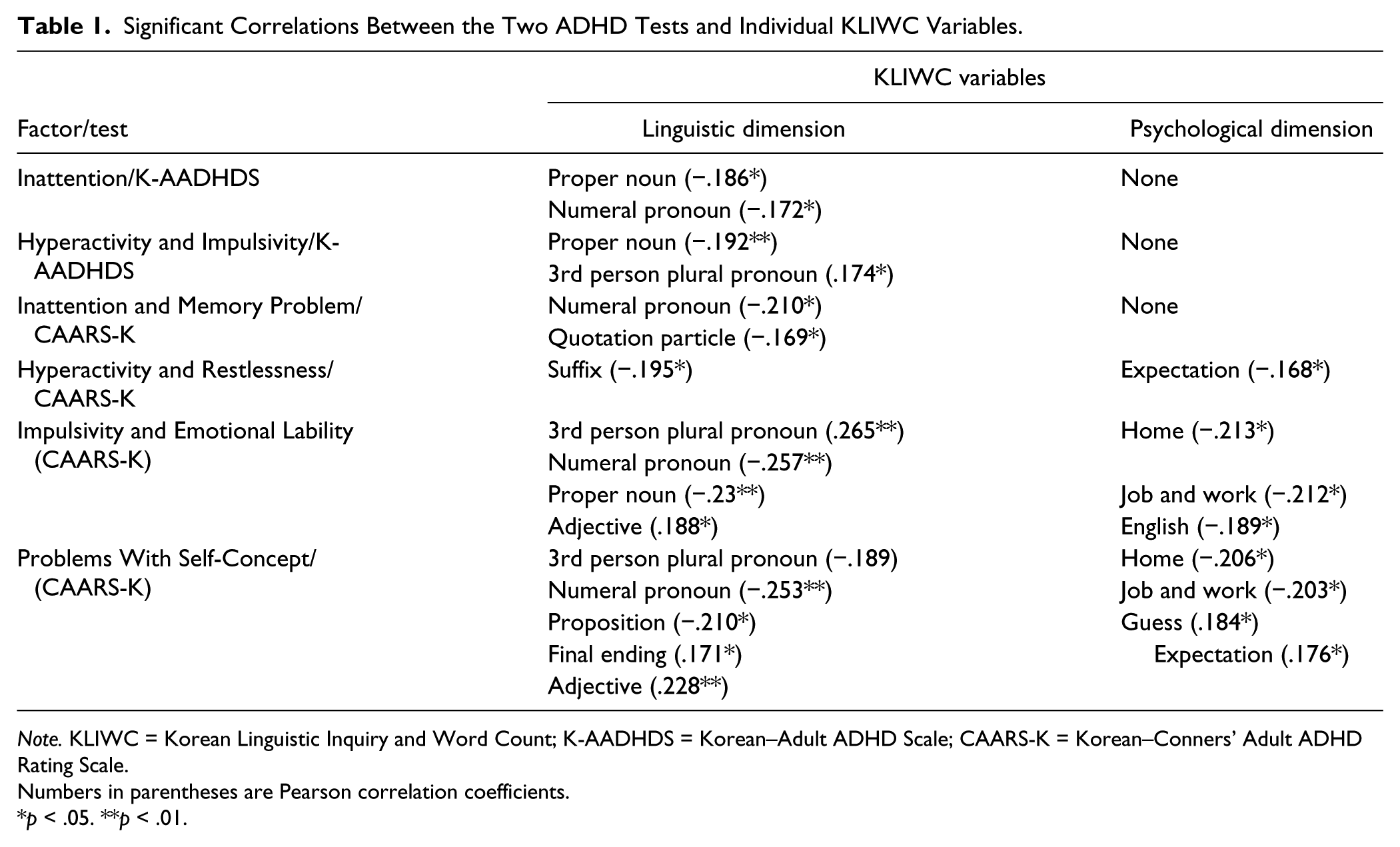
First, as presented in Table 1, higher levels of Inattention scores showed a significantly inverse correlation to proper noun (r = −.19, p < .01) and numeral pronoun (r = −.17, p < .05), whereas higher levels of Hyperactivity/Impulsivity scores showed a significantly negative correlation to proper noun (r = −.19, p < .01; see Table 1). Next, higher levels of Inattention and Memory Problem scores showed a significantly inverse correlation to numeral pronoun (r = −.21, p < .05) and quotation particle (r = −.17, p < .05), whereas higher levels of Impulsivity/Emotional Lability scores showed a significantly positive correlation to adjective (r = .19, p < .05), but showed an inverse correlation to proper noun (r = −.23, p < .01) and numeral pronoun (r = −.26, p < .01). With respect to the psychological dimension, higher levels of Impulsivity/Emotional Lability scores showed a significantly inverse correlation to home (r = −.21, p < .05), job/work (r = −.21, p < .05), and English (r = −.19, p < .05).
Significant Correlations Between the Two ADHD Tests and Individual KLIWC Variables.
Note. KLIWC = Korean Linguistic Inquiry and Word Count; K-AADHDS = Korean–Adult ADHD Scale; CAARS-K = Korean–Conners’ Adult ADHD Rating Scale.
Numbers in parentheses are Pearson correlation coefficients.
p < .05. **p < .01.
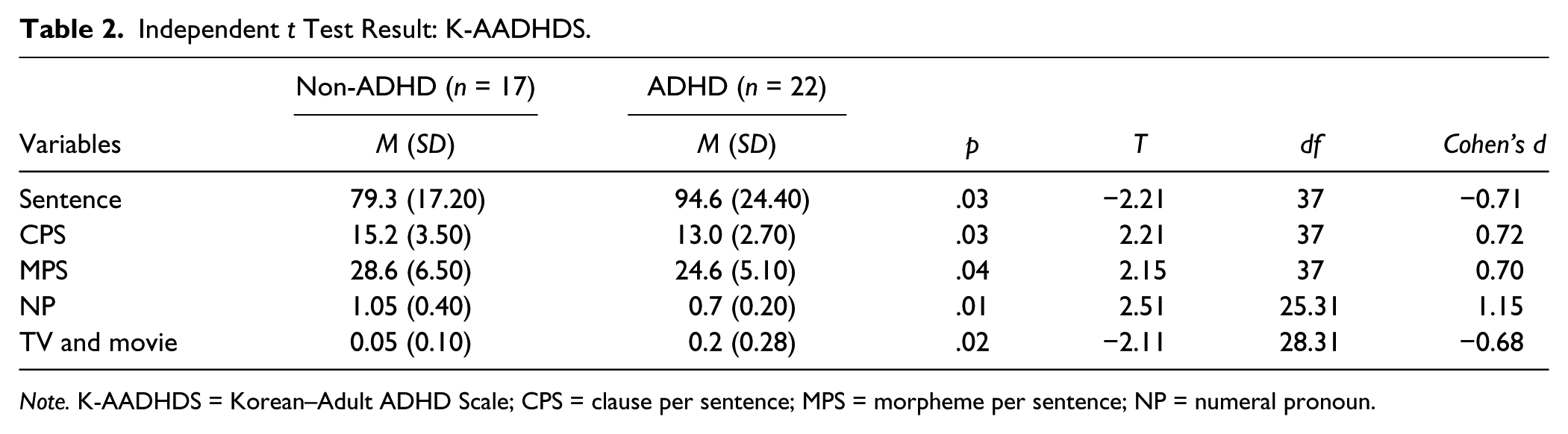
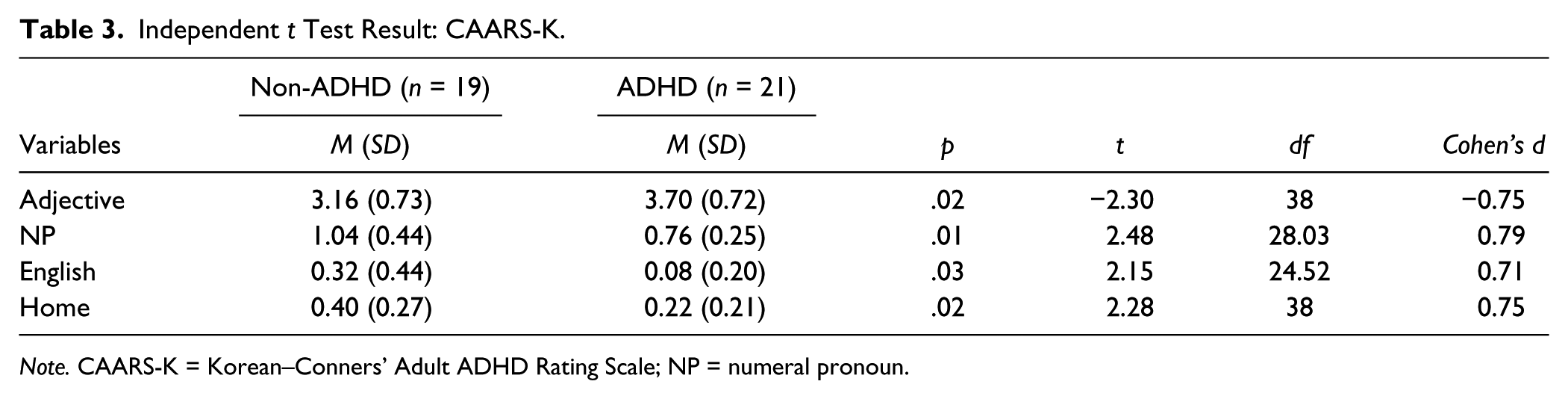
As shown in Tables 2 and 3, two independent samples t tests were conducted to compare the language styles and college students with and without ADHD symptoms. The results conveyed that college students with ADHD traits showed a significantly less number of usage of clause per sentence, t(37) = 2.21, p = .03; morpheme per sentence, t(37) = 2.15, p = .04; numeral pronoun, t(25) = 2.51, p = .03; English, t(24) = 2.15, p = .04; and home, t(38) = 2.28, p = .02, whereas they showed a significantly higher number of sentences, t(37) = −2.21, p = .03; TV and movie, t(28) = −2.11, p = .02; and adjectives, t(38) = −2.30, p = .02. These findings indicate that college students with ADHD traits show a significantly different style of language use from their non-ADHD cohorts.
Independent t Test Result: K-AADHDS.
Note. K-AADHDS = Korean–Adult ADHD Scale; CPS = clause per sentence; MPS = morpheme per sentence; NP = numeral pronoun.
Independent t Test Result: CAARS-K.
Note. CAARS-K = Korean–Conners’ Adult ADHD Rating Scale; NP = numeral pronoun.
From this correlations study, we can discover that college students with higher levels of inattention and hyperactivity/impulsivity issues are less likely to use a proper noun and a numeral pronoun. Both proper noun and numeral pronoun 1 are words that are reflective of pointing to a specific object or number, in which the words are positively correlated to one’s subjective well-being (Campbell, 1976). Without knowing its reason, college students who have a lower tendency of speaking these words are more likely to have poor subjective well-being (K. Kim, Bae, Kim, & Kim, 2011). Moreover, college students with higher levels of ADHD symptoms are less likely to use words, such as home and job/work, indicating their difficulty at home and work. Typically, individuals with ADHD tend to have frequent conflicts with family members and have difficulty getting things completed and getting along with their coworkers (Barkley et al., 2008). This tendency might induce the ADHD symptom group to use less number of words related with home and job/work. In this context, higher usage of words related to TV and movies by the ADHD group may indicate that the ADHD might distract their attention to media contents, thereby causing them to withdraw from ordinary life.
With regard to the comparison of language styles between college students with and without ADHD symptoms, college students with ADHD traits showed distinctively different language style from their counterparts. Students with ADHD traits conveyed significantly less clauses per sentence, morphemes per sentence, numeral pronoun, and home, whereas they used significantly more sentences and adjectives compared with students with non-ADHD symptoms. Linguistic complexity, which is indicated by the clauses per sentence and morphemes per sentence ratio (Just, Carpenter, & Keller, 1996), has often been observed to positively correlate with an increase in elaboration and age (i.e., time of development; Pennebaker et al., 2003).
Clauses per sentence and morphemes per sentence ratios are a typical index of linguistic complexity (Just et al., 1996). Linguistic complexity has often been observed to positively correlate with an increase in elaboration and age (i.e., time of development; Pennebaker et al., 2003). Furthermore, this index can be interpreted as a measure of a person’s tendency to simultaneously consider individual or even conflicting results or thoughts, that is, span, which has often been observed in experts. The frequency of use of these markers (i.e., clauses per sentence, morphemes per sentence) was observed to be notably higher in experts than in novices (K. Kim, Bae, Nho, & Lee, 2011). Furthermore, using significantly higher number of sentences and adjectives indicates that college students with ADHD traits show their difficulty by describing their thoughts and emotions in a more integrative and complex manner.
Discussion
The purpose of this study was to explore the difference in the language styles between college students with and without ADHD symptoms in their writing sample. Our findings indicate that college students with higher levels of ADHD scores tend to show less frequency of using proper nouns, numeral numbers, home, job and work, and English in their consciousness writing, whereas students with higher scores of ADHD are more likely to use adjectives in their writing. Furthermore, in a comparison between college students with and without ADHD symptoms, we found that there was a significant difference in their language style. Specifically with respect to the linguistic dimension, college students with ADHD traits showed distinctively less frequency of using complex sentences, clause per sentence, morpheme per sentence, and numeral pronouns, whereas they showed a higher frequency of using sentences and adjectives in their writing. As for the psychological dimension, ADHD college students showed distinctively less frequency of using English and home, whereas they showed a higher frequency of using TV and movie in their writing. This finding implies that college students with ADHD symptoms have a distinctive style of language use in both linguistic and psychological features. Furthermore studies need to be conducted to investigate their unique language style.
However, this study has some limitations and strengths. First of all, a confounding variable, which is not psychological, might elicit language differences between the ADHD and the normal group. For example, this study did not manipulate the socioeconomic status between the two groups. Thus, the ADHD group might have a lower socioeconomic status than the normal group, eliciting lower usage of words related with home and job while using more words related with TV. This socioeconomic status can also influence the complexity of language usage, such as clause per sentence and morphemes per sentence. Possibly, the higher socioeconomic group may use a relatively complicated language structure. Specifically, Lee, Park, and Park (2010) reported that the older generation with a higher socioeconomic status usually uses more number of words per sentence.
Second, with the cross-sectional design, our findings do not show any causal relationship but provides a valuable preliminary finding for further inferential research study to investigate the causal relationship between language style and ADHD conditions. Pennebaker and his colleagues (2001, 2003) demonstrated that the individual’s language styles change as the corresponding psychological variable changes (Lee, Kim, Seo, & Chung, 2007; Pennebaker & King, 1999). ADHD is a neurobiological disorder with high rates of comorbidity of psychological conditions, such as depressed mood and anxiety along with chronic anger issues.
An important issue is the possibility that the observed differences in the use of the KLIWC markers between students with and without ADHD in the current study simply reflect the differences in intelligence-related factors between the two groups. For example, as working memory, including EFs, has proven to be significantly correlated with fluid IQ and crystallized IQ, it could be a matter of course that the IQ and language are operated by common mechanisms to a certain degree. In the data of the current study, it is not possible to remove the variance attributable to IQ. However, it would be meaningful to identify which KLIWC markers are sensitive to IQ and other intelligence factors. For this, we collected written evaluations of a topic from another population. To be specific, we asked 50 undergraduate students at Ajou University to write an evaluation of a film of an artistic performance, which ran for about 15 to 20 min. Then, we collected additional variables, such as IQs and GPAs. The results indicated that there was no KLIWC marker sensitive to the IQ. However, there were a few markers that were observed to be significantly correlated with the students’ GPAs. For example, in the psychological dimension, expectation (r = .31, p < .05) and guess/inference (r = .28, p < .05) were positively correlated with the writers’ GPAs. In addition, negative correlations with GPA were observed for monetary and financial issues (r = −.39, p < .01). Also, this pattern is highly similar to that of a previous study that observed the sensitivities of KLIWC markers to IQ and other academic indexes, such as GPA (K. Kim, Bae, Nho, et al., 2011).
Of course, we are not claiming that the numerous aspects of language have no relationship with IQ or other intelligence factors. Rather, we believe that the values of markers calculated by the KLIWC program are not sensitive to IQ. Also, to our knowledge, few studies in the paradigm of LIWC and KLIWC have reported a relationship between individual markers and intelligence. This may be because the development of LIWC and KLIWC has been focused on a person’s psychological and cognitive characteristics rather than on his or her relevant abilities. Indeed, these programs do not include many indexes that are related with the cognitive ability, such as memory capacity (with the possible exception of the words per sentence ratio). Nonetheless, as the analysis of the relationship between language use and GPA suggests, a few language markers should be considered in a more careful way when future research explores the difference in language use between populations with and without ADHD.
As a future study related with the clinical issue, we ponder whether improving the writing skills of individuals with ADHD can lead to a reduction in their ADHD symptoms and positive emotional change. Seih, Chung, and Pennebaker (2011) reported that the intentional use of the first person pronoun was more beneficial in reducing both the distress and the usage of more cognitive words than was the use of the third person pronoun (see Seih, Lin, Huang, Peng, & Huang, 2008, for a similar result). Thus, an intentional training of using a specific pronoun or perspective switching could be beneficial in reducing the clinical symptoms. Future research should focus on the relationship between elaborations of writing and reducing ADHD symptoms.
Footnotes
Declaration of Conflicting Interests
The author(s) declared no potential conflicts of interest with respect to the research, authorship, and/or publication of this article.
Funding
The author(s) disclosed receipt of the following financial support for the research, authorship, and/or publication of this article: This work was supported by Ajou University Research Grant (S-2010-G0001-00081) to the first author, and by the Sogang University Research Grant awarded to the third author (201210070).