




Abstract
Keywords
Background
As children reach preschool age, problems with attention-driven behavior may emerge and interfere with the child’s ability to function. This initial preschool presentation of pathological attention-driven behavior impairments often presages other behavior problems such as oppositional behavior and aggression (Caspi, Henry, McGee, Moffitt, & Silva, 1995; Duchesne, Larose, Vitaro, & Tremblay, 2010; Farmer & Bierman, 2002; Wahlstedt, Thorell, & Bohlin, 2008), and mood and anxiety disturbance (Duchesne et al., 2010; Wahlstedt et al., 2008). While preschool years are often the youngest age at which attention-driven behavioral deficits can be clinically identified, it is unknown when the brain dysfunction associated with these behavioral deficits develops, whether concurrently or earlier. The phenotypic emergence of many neuropsychiatric impairments may be not due solely to concurrent brain changes. Instead, this phenotypic emergence may represent the uncovering of an alteration in brain maturation that occurred years earlier, prior to the age when symptoms can be identified (Censits, Ragland, Gur, & Gur, 1997; Galera et al., 2011; Murray & Lewis, 1987; Poelmans, Pauls, Buitelaar, & Franke, 2011; Rapoport, Addington, Frangou, & Psych, 2005; Ross, Kisley, & Tregellas, 2005). Thus, it is possible that preschool emergence of pathological attention-driven behavioral deficits may be related to aberrant brain development at a younger age. This report explores this issue by utilizing a physiological marker of infant brain development, P50 sensory gating, to assess whether preschool attention-driven behavioral impairments are predicted by an infant’s ability or inability to filter out extraneous auditory stimuli.
P50 sensory gating utilizes an auditory evoked potential paradigm to measure inhibitory processes in the brain. In the P50 sensory gating paradigm, auditory evoked potentials to two successive auditory stimuli, in this case 2 “clicks” are compared. Most healthy adults show an attenuated response to the second stimulus reflecting the robust ability of the brain to decrease response to irrelevant repetitive stimuli (Adler, Pachtman, Franks, & Freedman, 1982; Siegel, Waldo, Milner, Adler, & Freedman, 1984; Suzuki & Azuma, 1977). Sensory gating is often considered an automatic and involuntary first step in the attentional process (Boutros, Belger, Campbell, D’Souza, & Krystal, 1999; Braff & Light, 2004; Jerger, Biggins, & Fein, 1992; Lijffijt et al., 2009; Potter, Summerfelt, Gold, & Buchanan, 2006), and, in adults, diminished sensory gating ability is associated with neurocognitive and behavioral problems in attention (Adler et al., 1982; Chen & Faraone, 2000; Freedman et al., 1987; Paus, 1989; Potter et al., 2006; Wan, Friedman, Boutros, & Crawford, 2008). Further emphasizing the association between P50 sensory gating deficits and attentional dysfunction, P50 sensory gating is impaired in a number of psychiatric disorders characterized by attentional dysfunction, including schizophrenia (Adler et al., 1982), bipolar disorder (Martin et al., 2007), ADHD (Olincy, Ross, Harris, & Freedman, 1999), lower IQ autism (Orekhova et al., 2008), posttraumatic stress disorder (Ghisolfi et al., 2004; Neylan et al., 1999; Stewart & White, 2008), panic disorder (Ghisolfi et al., 2006), and Parkinson’s disease (Abel, Friedman, Jesberger, Malki, & Meltzer, 1991).
Recently, P50 sensory gating has been described in early infancy (Kisley, Polk, Ross, Levisohn, & Freedman, 2003; Suzuki & Azuma, 1977) with stable performance from infancy to 4 years of age (Gillow, Hunter, & Ross, 2010). Both presumed genetic risk factors—such as having a parent with a psychotic illness—and environmental risk factors—such as prenatal exposure to maternal anxiety, maternal nicotine use, or maternal illicit substance use—are well-established larger effect size risk factors of later attention-drive behavioral impairment. Each of these risk factors is associated with impaired infant P50 sensory gating, with effects identifiable in even relatively small samples (Hunter et al., 2012; Hunter, Kisley, McCarthy, Freedman, & Ross, 2011).
Thus, at least some of the same prenatal factors are associated with both impaired infant P50 sensory gating and later attentional dysfunction. This relationship may suggest that the phenotypic emergence of attention-driven behavioral deficits at preschool age represents, at least in part, an uncovering of earlier aberrant brain processes where the behaviors were not yet observable. This article reports on an attempt to bridge the gap, addressing whether impaired infant P50 sensory gating predicts later behavioral symptoms.
Method
Participants
Infants and their families were initially recruited from the Denver metropolitan area through a state birth registry as part of a study focusing on the impact of maternal factors on infant psychophysiology (Hunter et al., 2011). Exclusionary criteria included known birth defect, chromosomal abnormality, infant major neurological disorder, infant visual or auditory sensory disorder, or maternal non-nicotine substance use disorder active during pregnancy. Ninety-three infants, born between January 2007 and February 2009, completed an auditory evoked potential recording with an age adjusted for gestational age at birth of 70.6 days (SD = 30.9 days). Fifty infants (54%) had a parent complete the Child Behavior Checklist (CBCL; M ± SD child age at time of CBCL report: 40.9 ± 0.7 months). The infants who later had parental report of behavior at 40 months did not differ from those lacking later parental report on gender, gestational age at birth, mother’s age at birth, mothers years of education, race/ethnicity, maternal education level, or frequency at living with both biological parents (all p values >.11).
Demographic information for the 50 infants is summarized in Table 1. Infants with robust sensory gating were more likely than infants with diminished sensory gating to be female (65% vs. 33%), χ2 = 5.13 (df = 1), p = .024, but did not differ in gestational age at birth, age at P50 recording, race and ethnicity, or whether they lived with both biological parents. Gender was included in all subsequent group comparisons.
Demographic Information for Infants With Robust and Diminished Sensory Gating.
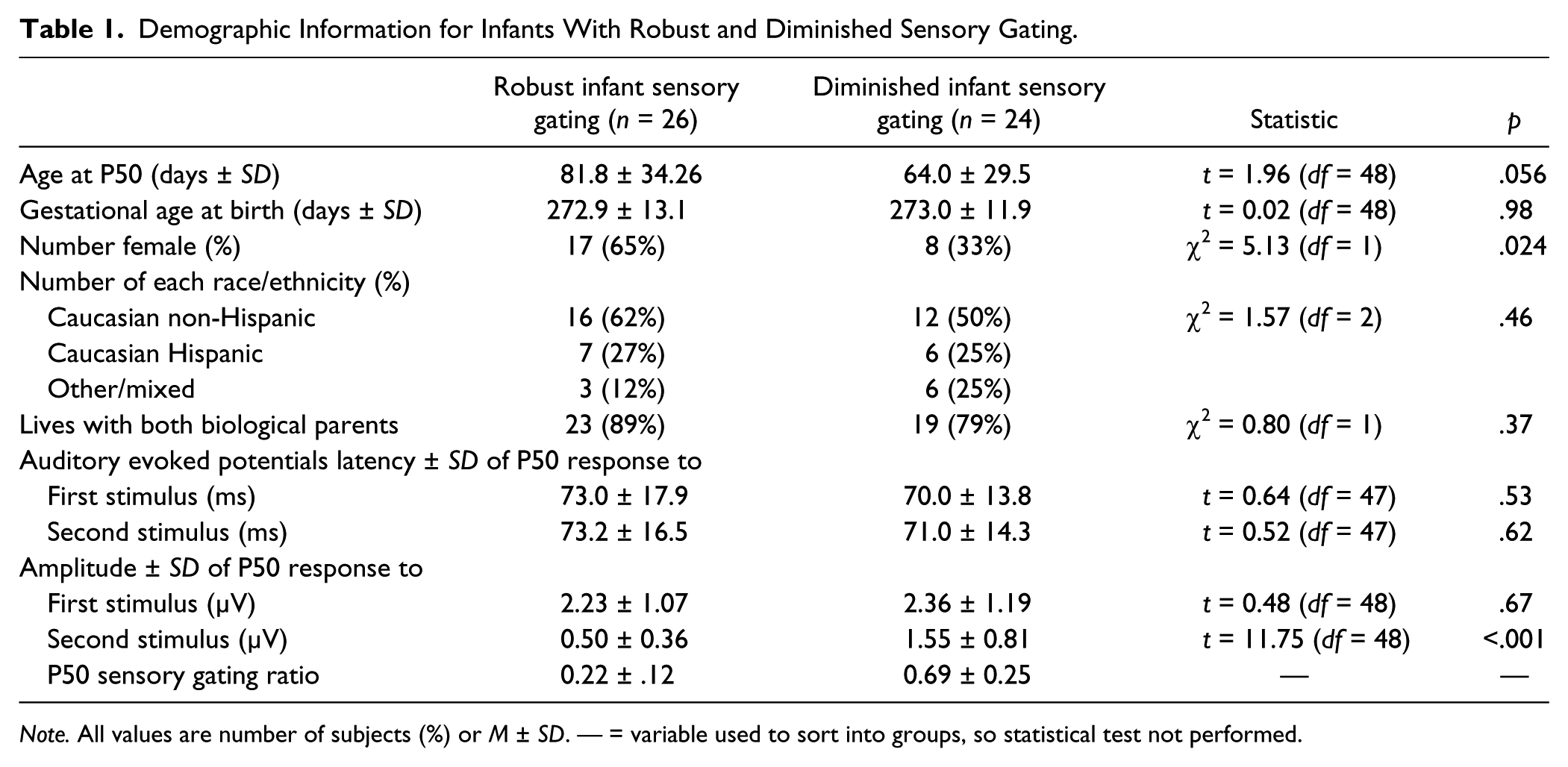
Note. All values are number of subjects (%) or M ± SD. — = variable used to sort into groups, so statistical test not performed.
Procedures
Informed parental consent was obtained and monitored by a local institutional review board.
P50 Sensory Gating
The methods used for the infant P50 sensory gating have been previously described (Suzuki & Azuma, 1977). Briefly, 50-ms auditory stimuli (clicks) were presented in pairs with an interstimulus interval of 500 ms and an interpair interval of 10 s. This interstimulus interval has been established among other intervals to be the amount of time in which sensory gating is the most active (Dolu, Süer, & Çigdem, 2001; Nagamoto, Adler, Waldo, Griffith, & Freedman, 1991). Auditory evoked potentials from the vertex were recorded during active sleep, which is the infant equivalent of rapid eye movement (REM) sleep. Active sleep was identified by combined electroencephalogram, electrooculography, submental electromyography, behavioral criteria (e.g., eyes closed), and respiratory pattern (Anders, Emde, & Parmelee, 1971). From the identified active sleep periods, the first 15-min period (approximately 85 stimulus pairs) was retained and used for further analyses. Single-trial-evoked potentials were extracted from 100 ms before each click to 200 ms following each click. Trials, in which the signal on the recording of any of these identified periods exceeded 75 mV, were excluded from further analysis. The average waveforms computed from these single trials were bandpass filtered between 10 and 50 Hz to accentuate middle latency components.
For each participant, the amplitude and latency of the largest positive peak between 50 and 150 ms after a click, preceded by a negative trough, was determined (Figure 1). The auditory evoked response in infants occurs about 70 ms after the stimulus rather than the 50 ms after the stimulus generally seen in adult populations. However, to keep terminology consistent with adult literature, the wave is termed P50 even in the infant subject. P50 sensory gating was measured by dividing the average amplitude of P50 evoked by the second click by the average amplitude evoked by the first click. A P50 ratio closer to 0 is indicative of robust suppression (gating), whereas a ratio closer to 1 is indicative of diminished sensory gating.

Representative individual examples of P50 sensory gating responses during active sleep.
P50 Data Analysis
Ratios have more variance than the underlying amplitude measurements. Dichotomization of P50 values into robust and diminished sensory gating decreases this variance and has been used to detect genetic and treatment effects. Children were split into two groups: P50 sensory gating ratios ≤0.4 considered robust sensory gating and scores >0.4 indicating diminished sensory gating. This division into robust and diminished P50 sensory gating is similar to values often used in adults, where a sensory gating ratios of <0.4 is considered normal (Siegel et al., 1984).
Parent Report of Child Behavior
The CBCL 1.5-5 is one broadly validated parental report tool to help parse out problematic behaviors (Achenbach & Rescorla, 2000). The CBCL consists of 99 items for the parent to report on child behavior. Each question is scored on a scale from 0 to 2 with scores summed across items. The CBCL produces seven subscales, two domain scores—externalizing behavior which is the sum of two subscales and internalizing behavior consisting of the sum of four subscales—and an overall Total Problems score. These classical subscales are based on factor analysis and have internal reliability ranging from acceptable to excellent (Cronbach’s αs of .66-.95), although somatic complaints may be less reliable in some populations (Tan, Dedrick, & Marfo, 2007). In addition, items can be regrouped into Diagnostic and Statistical Manual of Mental Disorders (4th ed.; DSM-IV; American Psychiatric Association [APA], 1994) oriented scales, including affective problems, anxiety problems, pervasive developmental problems, attention deficit-hyperactivity problems, and oppositional defiant problems. For 49 of the 50 children (98%), the CBCL was completed by the mother.
CBCL Data Analysis
Due to the nonnormal distribution of CBCL scores, a nonparametric (distribution-free) analysis of covariance was applied to the 40-month-old behavior scores after a rank transformation (Conover & Iman, 1982) to estimate the association with infant P50 sensory gating after adjusting for gender (Table 2). It has been shown that such a parametric analysis of covariance of the ranks is extremely well approximated by normal theory software after transforming the dependent variable to ranks (Zeng, Pan, MaWhinney, Barron, & Zerbe, 2011).
Measures of Child Behavior From Parent Report Utilizing the Child Behavior Checklist and the Impact of Gender and Infant Sensory Gating Ability.
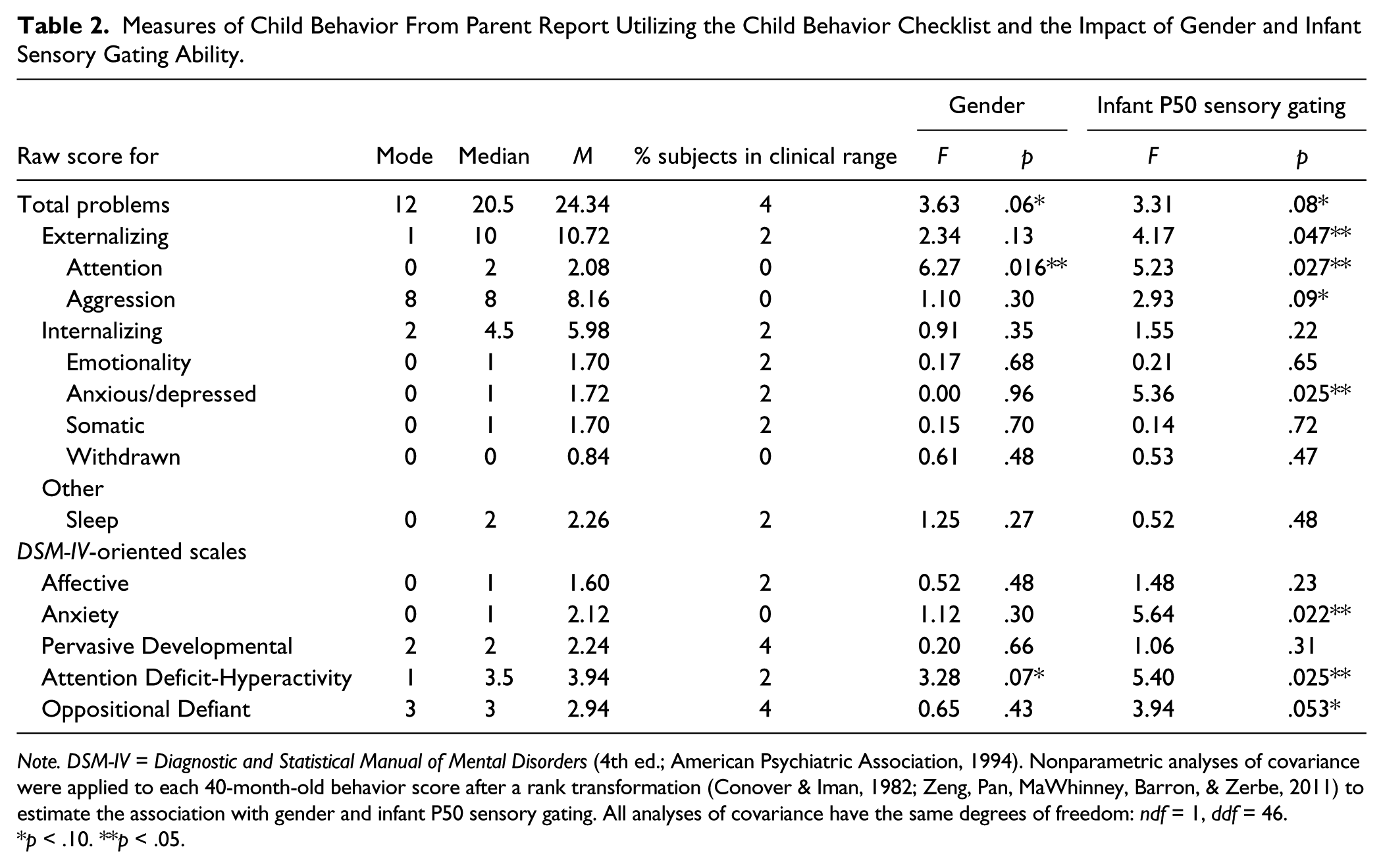
Note. DSM-IV = Diagnostic and Statistical Manual of Mental Disorders (4th ed.; American Psychiatric Association, 1994). Nonparametric analyses of covariance were applied to each 40-month-old behavior score after a rank transformation (Conover & Iman, 1982; Zeng, Pan, MaWhinney, Barron, & Zerbe, 2011) to estimate the association with gender and infant P50 sensory gating. All analyses of covariance have the same degrees of freedom: ndf = 1, ddf = 46.
p < .10. **p < .05.
Results
Infant P50 Sensory Gating
For the group as a whole, mean P50 amplitude in response to the second stimulus (1.00 ± 0.80 µV) was significantly lower (paired t = 9.88, df = 49, p < .001) than response to the first stimulus (2.29 ± 1.12 µV), demonstrating the presence of sensory gating. Mean ± standard deviation for P50 sensory gating ratios was 0.44 ± 0.31, consistent with reported infant values (Hunter et al., 2011; Hunter et al., 2012). Those infants with robust sensory gating were older than infants with diminished sensory gating although the difference did not reach significance and no relationship between age and P50 sensory gating values has previously been identified (Suzuki & Azuma, 1977). Those infants with robust sensory gating did not significantly differ from those with diminished sensory gating in latency of responses to the first or second sound or in the amplitude of response to the first sound (Table 1). The difference in ratios was due to infants with robust sensory gating having lower amplitude of P50 response to the second sound relative to infants with diminished sensory gating (Student’s t = 11.75, df = 48, p < .001).
40-Month-Old Child Behavior
Results from the CBCL are summarized in Table 2; the correlation between CBCL subscales is shown in Table S1 in supplemental data. As expected from a normally developing population, the modal score for the majority of subscales was the lowest possible score “0,” reflecting a strong floor effect with the instrument. For each scale, 0% to 4% of children had scores in the clinically affected range, consistent with what has been found with other populations recruited from nonclinical sources (Tan et al., 2007).
Relationship Between Infant P50 Sensory Gating and 40-Month-Old Behavior Scores With Gender Effect
Using the nonparametric (distribution-free) analysis of covariance, male children had higher ranking on attentional symptoms, with a trend toward an increased ranking on total problems. No effects of gender were identified on any other scale (all p values >.13). The impact of sensory gating was more widespread. Infants with diminished sensory gating were, 3 years later, ranked significantly higher (Figure 2) on attention (F = 5.23, ndf = 1, ddf = 46, p = .027), anxious/depressed (F = 5.36, ndf = 1, ddf = 46, p = .025), and externalizing symptoms (F = 4.17, ndf = 1, ddf = 46, p = .047), and ranked significantly higher on the DSM-IV-oriented scales of anxiety disorders (F = 5.64, ndf = 1, ddf = 46, p = .022) and ADHDs (F = 5.40, ndf = 1, ddf = 46, p = .025), with a strong trend toward higher ranking on oppositional defiant disorders (F = 3.94, ndf = 1, ddf = 46, p = .053). There was also a nonsignificant trend for infants with diminished sensory gating to be later ranked higher on aggression symptoms (F = 2.93, ndf = 1, ddf = 46, p = .09) and total problems (F = 3.31, ndf = 1, ddf = 46, p = .08).
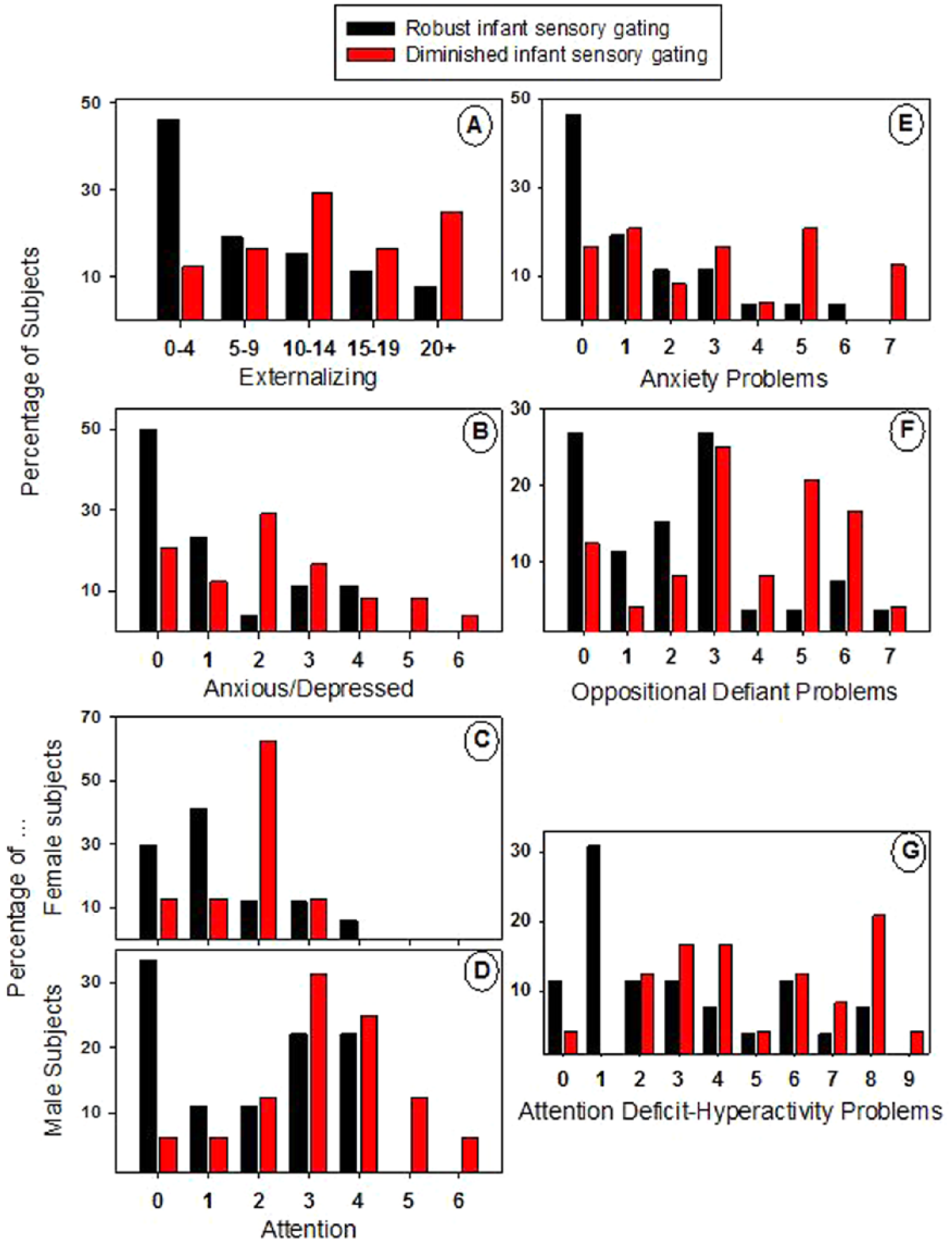
Distribution of parent-report symptoms for 40-month-old preschoolers who had robust and diminished P50 sensory gating based on assessment in infancy.
Discussion
Infants with diminished sensory gating deficit ranked higher, at 40 months of age, on parent-reported problems in attention and anxiety/depression, in the overall externalizing symptoms domain, and in DSM-IV (APA, 1994)-oriented scales of anxiety disorders and ADHDs. Infants with diminished sensory gating were later higher rated for oppositional defiant symptoms, although the difference did not reach statistical significance. Externalizing problems in early childhood have been linked to continuing problems with attention and behavior as children develop (Bellanti & Bierman, 2000; Campbell, Pierce, March, Ewing, & Szumowski, 1994; Fischer, Rolf, Hasazi, & Cummings, 1984; Hill, Degnan, Calkins, & Keane, 2006; Lavigne et al., 1998; Mesman & Koot, 2001; Olson, Schilling, & Bates, 1999), including higher risk for oppositional defiant disorder, conduct disorder, and ADHD (Swaab-Barneveld et al., 2000). Preschool externalizing symptoms also predict later internalizing symptoms, perhaps because children with early externalizing symptoms may have a hard time forming relationships with peers, and this rejection may later lead to internalizing symptoms like anxiety and depression (Mesman, Bongers, & Koot, 2001). Internalizing and externalizing symptoms detected in early preschool account for most of the variance in predicting preadolescent psychopathology with the only other main contributor being physical health problems (Mesman & Koot, 2001). Similarly, adolescents and adults with major psychiatric diagnoses often report that they exhibited symptoms like problems with attention or aggression when young (Banaschewski et al., 2005; Biederman et al., 1995; Busch et al., 2002; Doerfler, Connor, & Toscano, 2011; Harty, Miller, Newcorn, & Halperin, 2009; Hollis, 1995). Thus, diminished infant sensory gating may not only suggest increased behavior problems in preschool years but may also be predictive of increased risk for later childhood, adolescent, and even adult psychopathology.
P50 sensory gating is reflective of the ability to subconsciously filter out irrelevant auditory information and is fully developed by early infancy (Kisley et al., 2003), stable over time (Gillow et al., 2010; Hunter, Corral, Ponicsan, & Ross, 2008), and, in adults, correlated with attentional function (Cullum et al., 1993; Kisley, Noecker, & Guinther, 2004). The finding reported here that diminished infant P50 sensory gating is associated, 3 years later, with an elevation of attention-driven dysfunctional behavior supports the hypothesis that symptoms of inattention, are, at least in part, due to abnormalities in brain development detectable in infancy.
P50 sensory gating is a psychophysiological measure of primarily inhibition involving the hippocampus and cortex (Freedman et al., 1994). However, this inhibitory process is also part of the physiology of other cortical brain regions and is critical for multiple cognitive processes including working memory (prefrontal cortex), somatosensory specificity (somatosensory cortex), associative fear learning (auditory cortex), and recognition memory (hippocampus; Letzkus et al., 2011; Lewis, Melchitzky, & Burgos, 2002; Pouille, Marin-Burgin, Adesnik, Atallah, & Scanziani, 2009; Staiger, Zuschratter, Luhmann, & Schubert, 2009; Wiebe & Stäubli, 2001). Factors that disturb normal development of cerebral inhibition in the hippocampus are likely to also increase risk for less-than-optimal development of cerebral inhibition, and related cognitive processes, in other brain regions. This “comorbidity” of abnormal brain development may contribute to the relationship found in this study between infant P50 sensory gating and anxiety at 40 months of age.
This study is limited by a lack of data related to environmental factors between infancy and 40 months of age. It is possible that there may be some maternal factor that effects both infant early sensory gating performance and later behavior without there being a direct relationship between the two. In addition, the relatively small sample size limits power to include maternal variables, such as education level or socioeconomic status, in the analysis. However, the attrition from infant P50 measurement to CBCL at age 40 months showed no difference in demographic factors between those who remained in the study compared with those who did not. The limited number of 40-month-old children with clinically important symptoms also raises questions about generalizability of results into clinical populations. Future work with larger sample sizes and which includes postinfant maternal assessments may help clarify these issues.
Conclusion
In summary, impaired sensory gating is predictive of parent-reported problems with attention, anxiety, and externalizing problems at preschool age. The identification of infant brain changes associated with later onset of symptoms suggests that attentional dysfunction may, at least in part, be due to alterations in brain development that occur years prior to clinical presentation. Identification of early brain changes may be useful in identifying infants who would benefit from primary prevention interventions.
Footnotes
Acknowledgements
A special thanks to all the families who participated in this project.
Declaration of Conflicting Interests
The author(s) declared the following potential conflicts of interest with respect to the research, authorship, and/or publication of this article: Dr. Zerbe has equity interest in Abbott Laboratories, Johnson and Johnson Pharmaceuticals, Merck Pharmaceuticals, and Pfizer. Dr. Zerbe also has a contract with Merck Pharmaceuticals as a statistician in a study of potential benefits of a booster dose of vaccine for varicella zoster. Drs. Hunter, Wagner, Zerbe, and Ross receive salary support from National Institutes of Health (NIH)-funded grants. All other authors have no conflicts to disclose.
Funding
The author(s) disclosed receipt of the following financial support for the research, authorship, and/or publication of this article: This work was supported in part by grants from the National Institutes of Health (MH56539, MH068582, and MH086383), by an American Academy of Child and Adolescent Psychiatry Elaine Schlosser Lewis Award (AH), and by the Institute for Children’s Mental Disorders.