



Abstract
Problems with attention to classroom instruction and schoolwork are common in children (DuPaul, Stoner, & O’Reilly, 2002; Wolraich, Hannah, Baumgaertel, & Feurer, 1998) and predict academic difficulties independently of other behavioral/emotional problems (Barriga et al., 2002). For example, Merrell and Tymms (2001) found that after controlling for children’s reading and math skills at school entry, teacher-rated inattentive behavior predicted lower academic achievement over a 2-year period. Similarly, Rabiner, Murray, Schmid, and Malone (2004) reported that after controlling for internalizing and externalizing problems, first graders with elevated teacher ratings of Diagnostic and Statistical Manual of Mental Disorders (4th ed.; DSM-IV; American Psychiatric Association [APA], 1994) inattentive symptoms (APA, 1994) were 4 to 7 times more likely than peers to be rated as below grade level in reading, math, and written language. And Massetti et al. (2008) reported that 4- to 6-year-old children who met modified criteria for the inattentive subtype of ADHD showed significant deficits in academic achievement in reading, math, and spelling over an 8-year period.
Two recent studies provide especially compelling evidence of the predictive association between early attention difficulties and later academic struggles. J. Breslau et al. (2009) reported that increases in attention difficulties between ages 6 and 11 predicted subsequent declines in reading and math achievement between ages 11 and 17 in a community-based cohort of nearly 600 youth. Duncan et al. (2007) examined the relation between early attention difficulties and academic achievement in six large longitudinal data sets—two of which were nationally representative of U.S. children. They reported that attention skills at school entry, but not socioemotional skills, predicted subsequent reading and math achievement in all six samples. The authors suggested that “ . . . one explanation for this predictive power is that attention skills increase the time children are engaged and participating in academic endeavors and learning activities” (p. 1443). This interpretation is consistent with the hypothesis provided by Rabiner, Coie, and Conduct Problems Prevention Research Group (CPPRG; 2000) who suggested that attention difficulties interfere with the acquisition of critical reading skills during first grade and that it is difficult to “catch up” once this problem occurs. A similar hypothesis was suggested by N. Breslau et al. (2010).
What is perplexing about the negative relation between early attention difficulties and subsequent achievement is that children’s attention problems are often unstable. Rabiner, Murray, Rosen, et al. (2010) examined cross-grade stability in clinically elevated teacher ratings of attention difficulties, that is, ratings that fell 1.5 standard deviations about the normative mean, in three samples of elementary school-aged children. In each sample, including one where children met full diagnostic criteria for ADHD (MTA Cooperative Group, 1999) fewer than 50% of participants received clinically elevated ratings of attention problems from their teachers from 1 year to the next (range of 33% to 46%). The authors suggested that inattentive behavior may often be linked to features of a particular classroom and thus diminish when children enter a new classroom environment.
If attention difficulties show cross-grade stability less than half the time, why do they reliably predict children’s academic achievement? One possibility is that attention problems in Grade 1 interfere with the acquisition of foundational academic skills (e.g., phonetic decoding) and thus adversely affects long-term achievement even if the attention problems subsequently diminish. Alternatively, early attention problems may impair long-term achievement only when they persist across early grades. If this were the case, then the link between inattention and poor achievement may be largely driven by the subgroup of inattentive children whose problems show cross-grade stability. These alternatives have not been considered in prior research except for a study by Rabiner, Murray, Skinner, and Malone (2010), who found that children with teacher-rated attention problems in first and second grade had lower reading achievement scores in second grade than peers with attention problems in first grade only. However, this study included a relatively small sample that combined treated and control participants from an attention training intervention. Moreover, children were not followed beyond midsecond grade. The conclusions that can be drawn from it are thus limited.
To better understand the impact of persistent versus transient attention problems on children’s academic achievement during elementary school, we identified first graders with high rates of attention problems, grouped them based on whether these problems persisted into second grade, and examined the change in their reading and math achievement over the course of elementary school. Based on prior results from Rabiner, Murray, Skinner, et al. (2010), we predicted that children with persistent attention problems would show poorer achievement over time—particularly in reading—than those with “transient” problems. This finding would highlight the importance of targeting intervention efforts for students whose attention problems show cross-grade stability. If attention problems restricted to a single year do not predict diminished academic achievement, it would also suggest that requiring cross-grade stability of inattentive symptoms may be a useful addition to the diagnostic criteria for ADHD. We also planned to examine whether attention problems that emerge after first grade show a similar negative association with academic achievement, as the impact on achievement of earlier- versus later-emerging attention difficulties on academic achievement has not been previously examined. If attention difficulties that emerge in first grade have more problematic implications for children’s achievement, it would highlight the importance of early identification and intervention for such problems.
Method
Participants
Participants were 386 children from the Fast Track Project, a longitudinal multisite investigation of the development and prevention of conduct problems. The details of this investigation have been described elsewhere (CPPRG, 1992; Lochman & CPPRG, 1995). Sites included Durham, North Carolina; Nashville, Tennessee; Seattle, Washington; and rural central Pennsylvania. At each site, schools with known high rates of children at risk of the development of conduct problems were identified and randomly assigned to intervention or control groups. During the spring of kindergarten, teachers provided behavior ratings for all children enrolled in these schools so that “high risk” students could be identified to serve as intervention and control participants for the prevention trial. In addition, a “normative” sample of 100 children per site was obtained at the control schools by randomly selecting 10 children from each decile of the teacher rating score distributions (Teacher Screen Problem Behavior; Lochman & CPPRG, 1995). This selection respected the race and sex group composition obtained within each Teacher Screen decile, and was thus representative of the population in the high-risk schools targeted in the larger investigation. One site provided only 87 children because one of its schools dropped from the study during the first year.
Fifty-one percent of the children were boys, and 49% of the sample had a minority ethnic background (43% African American and 6% Other). Children’s mean age across sites at entrance into first grade was 6.52 years (SD = 0.44); the sample was 51.2% male, with 48.8% of the sample coming from a minority ethnic background, including 42.5% of whom were African American; 40.3% of the children came from single-parent families. Because the . . . Fast Track study drew its sample from schools that served high-risk and economically-disadvantaged neighborhoods, the sample included a greater representation of students with problem behaviors and families burdened with multiple stressors than typically found in community studies using a broader sampling frame. (Kam et al., 2011)
Measures
Reading achievement
Children’s reading achievement was measured during the summer before and after first grade using the Letter-Word Identification subtest from the Woodcock–Johnson Psychoeducational Battery–Revised (Woodcock & Johnson, 1989), a subtest that assesses children’s ability to sound out individual letters and read single words. During the assessment conducted in the summer following fifth grade, the Passage Comprehension subtest was also administered so that a Broad Reading score could be computed for each child. Scores on the Letter-Word subtest and Broad Reading scale have a mean of 100 and a standard deviation of 15. The Woodcock−Johnson tests of reading achievement correlate highly with other standardized reading measures, discriminate between gifted, normal, and learning disabled students, and are stable over time (Woodcock & Johnson, 1989). Within our sample, the test−retest correlation of Letter-Word Identification scores obtained before and after first grade was .64; the correlation between these scores and children’s Broad Reading score obtained after fifth grade was .56 and .79, respectively.
Math achievement
Children’s achievement level in math was assessed during the summer before and after first-grade year, and again after fifth grade using the Calculation subtest from the Woodcock−Johnson Psychoeducational Battery–Revised (Woodcock & Johnson, 1989). This test requires children to solve basic arithmetic problems. It correlates highly with other standardized measures of math achievement and discriminates between gifted, normal, and learning disabled students (Woodcock & Johnson, 1989). Scores have a mean of 100 and a standard deviation of 15. The test−retest correlation of Calculation obtained before and after first grade was .31; the correlation between these scores and the score obtained after fifth grade was .37 and .45, respectively.
School grades
Children’s year-end grades in math, language arts, science, and social studies during fifth grade provided an additional measure of academic achievement that may better reflect students’ performance in the classroom than achievement test results. Because grading systems varied across sites, FAST TRACK guidelines recommended categorizing grades in each subject area as “low,” “medium,” or “high” (Rains & Heinrichs, 2003). These categories were assigned numeric values of 1, 2, and 3 and averaged across academic subjects to create a composite of children’s grades for their fifth-grade year. The coefficient alpha across the four subject areas was .87. To create a metric consistent with the achievement test results, the composite grade score was standardized to a mean of 100 and a standard deviation of 15.
Attention
Children’s inattentive behavior in the classroom was assessed by teacher report in first and second grade using the ADHD Rating Scale (DuPaul, 1991). Six items corresponding to the inattentive symptoms of ADHD were averaged to create an inattentive score for each child. Coefficient alphas for this scale were .94 and .96 at Grades 1 and 2, respectively; the test−retest correlation over this time period was .51, which is impressively high given that children were in different classrooms with ratings provided by different teachers. This version of the ADHD Rating Scale is based on diagnostic criteria from the Diagnostic and Statistical Manual of Mental Disorders (3rd ed., rev.; DSM-III-R; APA, 1987), rather than on Diagnostic and Statistical Manual of Mental Disorders (4th ed., text rev.; DSM-IV-TR; APA, 2000) or Diagnostic and Statistical Manual of Mental Disorders (5th ed.; DSM-V; APA, 2013). However, the six items that assess inattentive behavior correspond closely to six of the current inattentive symptoms. And, although not all nine current inattentive symptoms are represented on this measure, it was used only to identify children with high levels of classroom inattentive behavior relative to their peers, and not to establish a diagnosis. Because appropriate normative data for the derived scales were not available, 1 and to be consistent with prior work on attention problems using Fast Track participants (Rabner, Coie & CPPRG, 2000; Rabiner, Malone & CPPRG, 2004), scores were standardized by grade within the sample.
Intelligence
IQ following kindergarten was estimated by summing children’s scaled scores on the Vocabulary and Block Design subtests from the Wechsler Intelligence Scale for Children - Revised (WISC-R). These subtests were selected because they show the highest correlations with the Verbal and Performance IQ scales, respectively (Wechsler, 1974), and time constraints did not allow the full test to be administered.
Procedure
Data collection for this study occurred between 1991 and 1996. Children’s attention problems were measured by teacher report in the spring of first and second grade and reflected teachers’ perceptions of students’ inattentive behavior over the course of the year; ratings were thus provided by different teachers each year. During the summer before and after first grade, and during the summer following fifth grade, trained members of the research staff individually administered subtests from the Woodcock–Johnson Psychoeducational Battery–Revised as part of a larger battery of measures. The Woodcock–Johnson was administered during the summer so that achievement results for all children were obtained at a comparable point in their educational careers, for example, after completing first grade, rather than at different points during the academic year. These staff had no knowledge of children’s attention problem ratings. Students’ grades after fifth grade were obtained using a modified version of the School Archival Records Search (SARS; Walker, Block-Pedego, Todis & Severson, 1991).
Classifying participants
Children were classified into one of four mutually exclusive groups according to whether they showed elevated teacher-rated attention problems, defined as at least 1.0 SD above the sample mean, in first and/or second grade. This cutoff has been used to identify highly inattentive students in earlier work with this sample (Rabiner et al., 2000) and is consistent with prior research using behavior rating scales to identify children with clinically elevated ADHD symptoms (Biederman et al., 1993; Edelbrock & Costello, 1988).
Group YN (n = 26) included children who were classified as inattentive in first grade but not second grade. Group YY (n = 22) included children who were inattentive in first and second grade. Group NY included children who were inattentive in second grade but not in first grade (n = 33). Finally, Group NN (n = 199) contained children with no evidence of attention problems in either first or second grade; these children served as an important reference for the three groups of children with differing patterns of attention difficulties. The remaining children could not be classified because they were missing attention problem ratings in Grades 1 and/or 2; these children were excluded from the analyses reported below. The reading and math achievement scores for excluded versus included children did not differ in any year.
This method of classifying participants into mutually exclusive groups based on their pattern of teacher-rated attention difficulties in first and second grade is consistent with our interest in examining the impact of persistent versus transient early attention problems. Although using any cut-score method to identify groups of participants is somewhat arbitrary, this question could not be addressed if teacher ratings were treated as continuous scores.
Table 1 presents descriptive statistics for demographic variables, IQ score, and attention problems score in first and second grade for children in each attention problem group. Males were overrepresented in the attention problem groups, especially in the persistently inattentive group. Caucasian students comprised 51% of the sample overall but were underrepresented in all three attention problem groups. The mean IQ score was in the low average range for all attention problem groups, that is, Group YY = 87.9; Group YN = 85.5; Group NY = 85.3, and significantly lower than for Group NN; gender, race, and IQ were used as covariates in our models to (statistically) equate groups on this dimension.
Sample Characteristics at Each Time Point.
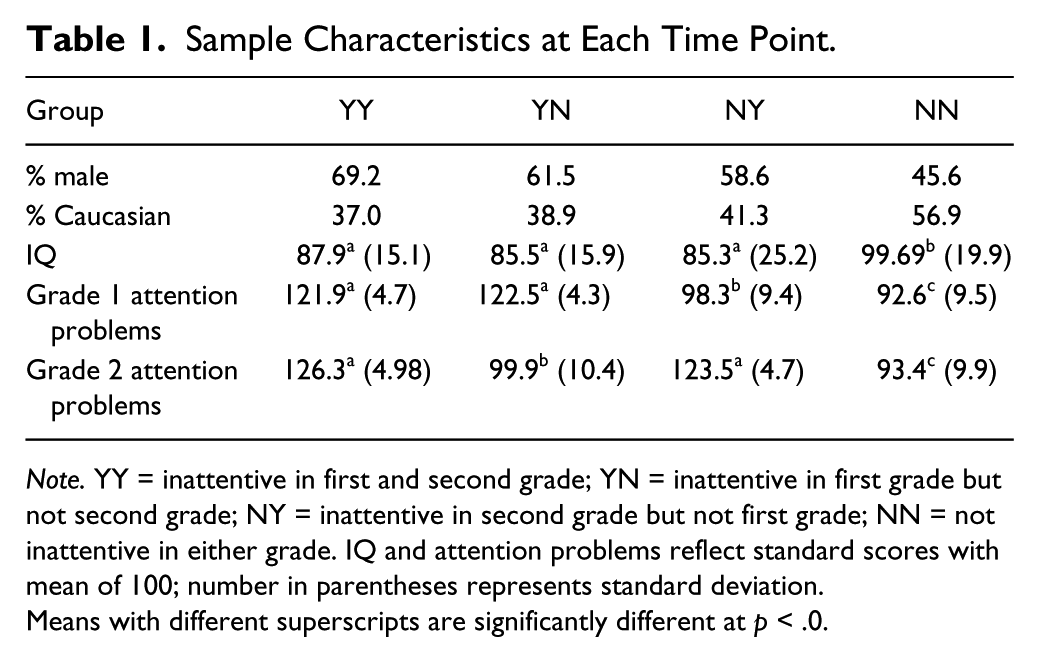
Note. YY = inattentive in first and second grade; YN = inattentive in first grade but not second grade; NY = inattentive in second grade but not first grade; NN = not inattentive in either grade. IQ and attention problems reflect standard scores with mean of 100; number in parentheses represents standard deviation.
Means with different superscripts are significantly different at p < .0.
Because children were grouped based on their attention problem scores in first and second grade, the observed group differences in mean attention problems scores are to be expected. 2 It is noteworthy, however, that mean scores for groups YY and YN were virtually identical during first grade but differed dramatically in second grade. And, the increase in attention problem scores between first and second grade for group NY was also striking. Thus, despite the somewhat arbitrary cutoff used to identify our different attention problem groups, these groups differed in their pattern of teacher-rated attention problems during first and second grade in meaningful ways.
Data-Analytic Plan
The analysis of data resulting from longitudinal designs involves a choice between coding time as a continuous predictor of growth across the developmental period of interest (as in growth curve modeling) or using time as a categorical predictor of change (a repeated-measures ANOVA approach). Because our measured outcomes were grades and achievement scores that were standardized within age, and as such would not be expected to “grow” across the study window, our approach used time as a categorical predictor. Study hypotheses were therefore tested using repeated-measures ANCOVA models that incorporated child IQ, gender, and race as time-invariant covariates. Because our focus was to examine academic outcomes in children with persistent versus transient early attention difficulties, and not to compare different childhood behavior problems as predictors of academic outcomes, we did not include externalizing behavior ratings as predictors as has been the case in our prior work (Rabiner, Coie, & CPPRG, 2000; Rabiner, Malone & CPPRG, 2004). 3
We used a mixed model approach to the analysis of repeated-measures data. The mixed model approach provides multiple advantages over more conventional analysis of variance-based approaches to within-subject designs, including the ability to evaluate the fit of a variety of covariance structures to the repeated-measures data, allowing for the computation of efficient estimates of fixed effects and valid standard errors of the resulting estimates (Littell, Henry, & Ammerman, 1998), and the straightforward accommodation of incomplete/missing data at the repeated-measures level of the design. The SAS procedure MIXED (SAS/STAT software version 9.2; SAS Institute, 2002-2005) and the restricted maximum likelihood method were used to estimate all models. The continuous covariate IQ was grand mean centered prior to model estimation.
We first modeled the covariance structure. Our data reflected a fully nested, hierarchical design, and so initial models specified the structure of variation between participants by including random intercepts for the site, school (nested within site), and teacher (nested within school and site) factors. To ensure the appropriate modeling of within-participant covariation, a series of three models was tested for each outcome, each of which imposed a different candidate covariance structure on the repeated-measures data. The structures tested included compound symmetry (CS), spatial power law (SP-POW), and fully unstructured, all of which are appropriate for unequally spaced repeated measures (Littell, Milliken, Stroup, Wolfinger, & Schabenberger, 2006). The Akaike information criterion (AIC; Akaike, 1974), finite-population corrected AIC (AICC; Burnham & Anderson, 1998), and Bayesian information criterion (BIC; Schwarz, 1978) were used to determine which covariance structure represented the optimal fit to the observed data; for such information criteria, the model that minimizes the relevant statistic is preferred. After we were satisfied that the covariance structure had been appropriately modeled, fixed effect parameters were estimated and interpreted for the final models.
Our primary interest was in comparing patterns of attained achievement across the groups previously defined using group-wise comparisons that addressed our main research questions. The comparison of Groups YN and YY allowed us to evaluate whether the relationship between first-grade attention problems and academic achievement depends on whether those problems persist into second grade. Comparing these groups with Group NN enabled us to test differences between children who experienced attention difficulties in first—and perhaps also second—grade and children who did not experience such difficulties. To examine whether attention problems that emerge in second grade show similar associations with academic achievement as problems that emerge earlier, we compared Group NY with the mean of Groups YY and YN, referred to below as Group YY/YN. We also compared Group NY with Group NN to test whether children with later emerging attention difficulties had poorer achievement than peers without evidence of early attention difficulties.
Results
For both academic achievement outcomes, the models that imposed no structure on within-participant covariation provided a better fit to the data than the models that imposed a CS or SP-POW structure, as indicated by consistently smaller values for all three information criteria (e.g., for the math achievement model with no random effects, the AIC for the unstructured model was 6,611.6 vs. 6,667.8 and 6,667.7 for the CS and SP-POW structures, respectively; for the reading achievement outcome model with no random effects, the AIC for the unstructured model was 6,811.2 vs. 6,840.6 and 6,840.3 for the CS and SP-POW structures, respectively). For the unstructured model, estimation of random intercepts for the site, school (nested within site), and/or teacher (nested within school and site) factors resulted in estimated G matrices that were not positive definite for both academic achievement outcomes, most likely due to the very small magnitude of the estimated variance components in question (e.g., for the math achievement model that included all random intercepts, variance components of .13 [z = .10, p = .46], 1.39 [z = .77, p = .22], and .00 [z undefined] were estimated for the site, school, and teacher effects, respectively); accordingly, following Searle, Casella, and McCulloch (1992), we removed these random effects from each model in favor of the more parsimonious fixed effects-only model. Our final ANCOVA model for each achievement outcome, therefore, imposed no structure on within-participant covariation and included no random effects.
Reading Achievement
Persistent versus transient attention problems
Table 2 shows results for the reading achievement outcome. Although the effect of the IQ covariate was statistically significant, all else held constant, neither study site, participant gender, nor race significantly predicted reading achievement. However, as expected, significant main effects for the time and attention difficulties group variable were qualified by a significant Time × Attention Group interaction, indicating that patterns of change in reading achievement across the K-5 interval differed significantly across attention difficulty groups. This interaction is depicted in Figure 1, which shows the mean reading achievement score of each attention difficulty group at the end of Grades K, 1, and 5. The group means shown in the figure and discussed throughout this section reflect model-adjusted means.
Type III Estimates of Fixed Effects (Top) and Variance–Covariance Estimates (Bottom) for the Prediction of Reading Achievement.

Note. Denominator df for tests of fixed effects are 301. Standard errors are in parentheses.
p < .0001.

Reading achievement by attention difficulty group.
Planned contrasts were used to test between-group differences at the beginning of the study window and to examine the patterns of between-group differences that comprised the predicted Time × Attention Group interaction. Results indicated that all else held constant, differences between Group YN and Group YY were not significant at the end of kindergarten, 82.8 versus 88.4, t(301) = −1.54, p = .13. Group NN’s mean reading achievement score was significantly higher than that of Group YN, 90.9 versus 82.8, t(301) = 3.23, p < .001, but did not differ from that of Group YY, 90.9 versus 88.4, t(301) = .82, p = .41.
Consistent with the observed Time × Attention Group interaction, Figure 1 provides the impression that change in reading achievement scores between the end of kindergarten and the end of fifth grade differed between groups. Planned contrasts confirm this impression. The difference in model-adjusted change in reading achievement between Groups YN and YY during the K-5 interval was 10.31 standard score points, t(301) = 2.39, p = .02, with Group YN increasing and Group YY declining in mean achievement over the K-5 interval. However, because Group YN had a lower score at baseline, these groups did not significantly differ at the end of Grade 5,
Figure 1 also suggests that it is attention problems during first grade that are especially detrimental for children’s reading achievement. Although children in Groups YY and NN did not differ in their reading achievement scores after kindergarten, by the end of Grade 1 their scores had diverged substantially,
First- versus second-grade attention problems
To test how attention problems that become evident in second grade are related to children’s achievement, mean achievement results for children in Group NY were compared with those for children in Group YY/YN as well as to the mean achievement results for Group NN. At the end of kindergarten, differences in reading achievement between Group NY and Groups YY/YN, and differences between NY and NN, did not approach significance. Moreover, change in reading achievement from kindergarten through the end of fifth grade did not differ between Group NY and Group YY/YN,
Math Achievement
Persistent versus transient attention problems
Table 3 displays results obtained for the math achievement outcome; these findings are also depicted in Figure 2. The effect of the IQ covariate was statistically significant but, all else held constant, neither study site, participant gender, nor race significantly predicted achievement. Contrary to expectation (and in contrast to results observed for the reading achievement outcome), although statistically significant main effects were observed for the time and attention group factors, the Time × Attention Group interaction was not significant (p = .36).
Type III Estimates of Fixed Effects (Top) and Variance–Covariance Estimates (Bottom) for the Prediction of Math Achievement.

Note. Denominator df for tests of fixed effects are 301. Standard errors are in parentheses.
p < .01. **p < .001. ***p < .0001.
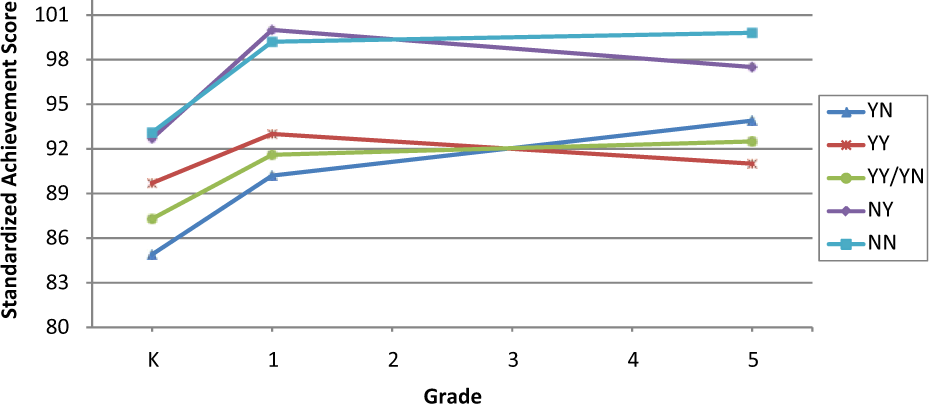
Math achievement by attention difficulty group.
Follow-up tests were conducted to explain the observed main effects for the attention group and time factors. Estimated contrasts comparing math achievement (averaged across levels of time) across attention difficulty groups revealed the observed difference between Groups YN and YY was not statistically significant, t(301) = −0.74, p = .46. However, math achievement was higher for Group NN compared with Group YN, 97.4 versus 89.7, t(301) = 5.29, p < .001, and Group YY, 97.4 versus 91.2, t(301) = 3.48, p < .001. Averaged across all groups, math achievement was significantly higher at the end of Grade 1 than at the end of kindergarten,
Although the overall Time × Attention Group interaction for math achievement was not significant, a marginally significant simple Time × Group interaction was found for the comparison of Groups YN and YY,
First- versus second-grade attention problems
Estimated contrasts comparing math achievement (averaged across levels of time) across groups revealed significantly higher mean achievement levels for children whose problems emerged in second grade compared with children whose problems emerged in first grade, 96.8 versus 90.5, t(301) = 3.38, p < .001. The observed difference between Groups NN and NY was not significant, 97.4 versus 96.8, t(301) = .35, p = .73. When examining the fifth-grade results only, results for Group NY did not differ from those observed for Group NN, 97.5 versus 100.1, t(301) = 1.00, p = .38, but were higher than those observed for Groups YY/YN, 97.5 versus 92.5, t(301) = 1.98, p = .049.
Grades
Differences between the attention problem groups in the composite school grades outcome was tested using the SAS procedure GLM (SAS/STAT software version 9.2; SAS Institute, 2002-2005). Covariates included IQ, gender, site, race, and children’s fifth-grade achievement scores in reading and math; achievement results were included as covariates to learn whether early attention difficulties predicted grades above and beyond their association with children’s academic achievement. The average standardized composite grade score for Groups YY, YN, NY, and NN was 93.1, 96.6, 97.6, and 100.1, respectively. Grades did not significantly differ between Group YY and YN, F(1, 268) = 1.14, p = .28, or between Group YY/YN and group NY, F (1, 268) = .81, p = .37. However, grades for Group YY/YN were lower than for Group NN, F(1, 268) = 6.77, p < .01 while differences between Group NY and Group NN were not significant, F(1, 268) = .77, p = .38.
Discussion
This study was intended to enhance our understanding of the link between early attention problems and academic achievement during elementary school by addressing two primary questions. First, does this link depend on whether attention problems persist across early grades or do attention difficulties during Grade 1 adversely affect long-term achievement regardless of whether they persist? And, do attention problems adversely affect achievement when they emerge later versus earlier in a child’s educational career?
Although academic achievement over time differed for children with persistent versus transient attention difficulties in first grade, both groups of inattentive first graders showed negative achievement outcomes relative to comparison children. In reading, inattentive first graders had significantly lower reading achievement scores after fifth grade than children without early attention problems, regardless of whether their attention problems had persisted into second grade. This appeared to reflect the adverse effect of attention problems on the development of children’s reading during first grade, as reading achievement declined during first grade for students with attention difficulties and increased for students without them. Beyond first grade, no additional separation between the different attention problem groups was evident. For math, first-grade attention problems were also associated with lower achievement in that inattentive first graders also had significantly lower achievement scores than their peers when scores were averaged across the three-grade window.
Although first-grade attention problems were linked with lower academic achievement in persistent and transient groups, these groups showed different patterns of achievement over time. For reading, achievement in children with persistent attention problems declined by more than two thirds of a standard deviation during elementary school relative to those whose problems dissipated after first grade. And, for math, children with persistent difficulties also tended to make smaller achievement gains during the K-5 interval than children with transient attention problems. Thus, the overall pattern of findings suggests that first-grade attention problems adversely impact achievement regardless of whether they persist and that persistent attention difficulties are especially concerning.
In contrast to the clear link between first-grade attention difficulties and children’s academic achievement, we found no evidence for this link when attention difficulties emerged during second grade. For these children, there were no significant declines in reading or math achievement during the K-5 interval relative to peers without early attention difficulties—and their achievement scores after fifth grade did not significantly differ from the comparison group. Moreover, they were performing significantly better in reading and math than children whose attention problems were evident in Grade 1 by about two thirds of a standard deviation. To our knowledge, this is the first examination of whether the link between attention problems and academic achievement depends on how early those problems emerge in a child’s school career—and obtained results indicate that this is clearly the case.
When children’s composite grades during fifth grade were used as the outcome, it was again the case that children with attention problems during first grade performed significantly below comparison children. This was true even after controlling children’s reading and math achievement results in fifth grade. Thus, relative to children without early attention difficulties, those who had been inattentive during first grade performed even less well in fifth grade than would be expected given their achievement results. For children whose attention difficulties became prominent in second grade, in contrast, the grades they obtained did not significantly differ from those obtained by comparison children. As with the achievement results, therefore, we found no evidence that attention problems emerging after first grade were linked to adverse academic outcomes during elementary school.
What might explain the pattern of results obtained? Consistent with a prior report from Rabiner, Murray, Roosen, et al. (2010), fewer than 50% of children identified as highly inattentive in first grade obtained similarly elevated ratings the following year. The fact that their attention difficulties persisted from one classroom environment to the next suggests that such problems are not context specific or resulting from a transient stressor in the child’s life. Instead, they are more likely to reflect a relatively stable attribute of the child and/or persistent environmental factors, for example, chronic stress, that undermines the child’s ability to attend. Because of these persistent difficulties attending in the classroom, it is not surprising that their academic outcomes are compromised. For children whose attention difficulties dissipated after first grade, or did not emerge until second grade, the likelihood that such difficulties reflect a stable child attribute or chronic environmental stressor is hypothesized to be lower. Instead, their difficulty attending in may be more related to contextual factors of that particular classroom (Evans, Allen, Moore, & Strauss, 2005). When these difficulties are pronounced during first grade there are adverse consequence for children’s academic achievement and performance during elementary school, perhaps because first grade is such a critical year for the acquisition of fundamental academic skills. When children’s attention problems emerge later, however, the acquisition of important academic skills in Grade 1 remains intact and there is no evidence that academic outcomes through elementary school are compromised. In our sample, this was reflected in the fact that children whose attention difficulties became prominent in second grade showed nearly identical patterns of achievement gains during first grade as comparison children.
One unexpected finding was that significant increases were found in children’s standardized achievement scores between kindergarten and fifth grade. In reading, this reflected the gains during first grade for children without attention problems; in math, gains were evident in all groups. Because achievement scores are based on age norms, they are expected to remain relatively stable from year to year. The increase we found indicates that participants’ achievement scores improved over time relative to those of the Woodcock–Johnson normative sample. It is unclear why this should be the case. The relevance to our study is that the Time × Attention Group interaction found for reading achievement is explained not only by declines over time among persistently inattentive children, but also by increases over time in children without first-grade attention difficulties. The latter increases may have occurred because our sample was relatively economically disadvantaged and their achievement scores at baseline may have been suppressed due to deprived backgrounds. This would be an interesting issue to investigate in future research. At the same time, we note that this pattern argues against our findings being explained by a regression to the mean phenomenon, because reading achievement results actually diverged over time between the attention problem groups.
Our study has several limitations. First, because the majority of participants were economically disadvantaged, the extent to which our findings can be generalized to more representative samples is unclear. Second, the criteria used to identify children with attention problems were sample specific and not based on national norms, which also limits the generalizability of our findings. These limitations highlight the importance of replicating these results in a more representative sample. Examining achievement outcomes in children whose attention difficulties persisted across more than two grades and that emerged later than second grade would also have strengthened our study. And, having data on participants’ attention difficulties during later grades would provide greater confidence that students classified as having transient attention problems were accurately classified. Finally, similar to other recent reports examining the predictive linkages between early attention difficulties and academic achievement (N. Breslau et al., 2010; J. Breslau et al., 2009; Duncan et al., 2007), data for this study were collected a number of years ago, between 1991 and 1996. Although the association between attention problems and academic achievement is robust, and there is no reason to suspect that this association has changed over time, it would be valuable to replicate these findings in a more recent cohort of students.
We would also note our study is a longitudinal descriptive study and does not address the mechanism(s) by which early attention difficulties undermine students’ academic achievement. Although it has been suggested that poor attention skills may compromise academic achievement because inattentive children are consistently less engaged in academic endeavors and learning activities than their peers (Duncan et al., 2007), the observational data required to test this hypothesis were not collected. We would also note that working memory deficits also compromise children’s academic achievement (Swanson & Alloway, 2012) and are more common in children with significant attention difficulties (Lui & Tannock, 2007). However, no direct assessments of working memory were obtained in this study, and the relative impact of attention difficulties and working memory deficits on children’s achievement over time would be an interesting issue to examine in subsequent research. Future work should also examine whether the links between academic achievement and the different patterns of early attention difficulties considered here extend beyond elementary school.
In summary, findings from this study enhance our understanding of the predictive association between early attention difficulties and academic achievement in several ways. First, they expand on earlier work by indicating that attention problems are especially likely to impair academic achievement when they persist across early grades. This suggests there would be value in exploring whether current diagnostic criteria for ADHD would benefit by modifying the 6-month symptom duration requirement—which can occur within a single school year—to requiring that inattentive symptoms be observed across grades. Our findings also provide initial evidence that, although attention problems which emerge by first grade predict reduced academic achievement and school performance (perhaps because they interfere with the acquisition of foundational academic skills), later emerging attention difficulties may not significantly compromise children’s academic functioning during elementary school. Although this strikes us as an especially important finding, results from a single study are not sufficient to conclude that later emerging attention problems do not undermine children’s academic outcomes. It will thus be important to examine this issue in several independent samples.
While recognizing the necessity of this additional descriptive work, results from the current study argue strongly for the importance of identifying children who struggle with attention problems during first grade and intervening to prevent this from adversely affecting their long-term academic performance. Prior research suggests that this will prove challenging, however, as an intensive tutoring program for first graders with early reading difficulties was not helpful to students who were also inattentive, even though it was highly effective for children with reading difficulties alone (Rabiner, Malone, & CPPRG, 2004). Developing interventions to enhance academic achievement in students with attention difficulties—something that has so far proven elusive—should thus be an important research priority.
Footnotes
Declaration of Conflicting Interests
The author(s) declared the following potential conflicts of interest with respect to the research, authorship, and/or publication of this article: David Rabiner has consulted for companies involved in developing attention training and working memory training software for children. These companies have also sponsored an online newsletter he writes on ADHD. The current work has nothing to do with attention training, but could be construed as related to this involvement because it highlights the adverse impact of attention problems on children’s academic development.
Funding
The author(s) declared receipt of the following financial support for the research, authorship, and/or publication of this article: This work was supported by National Institute of Mental Health (NIMH) Grants R18 MH48043, R18 MH50951, R18 MH50952, R18 MH50953, K05MH00797, and K05MH01027; National Institute on Drug Abuse Grants DA016903, K05DA15226, and P30DA023026; and Department of Education Grant S184U30002. The Center for Substance Abuse Prevention also provided support through a memorandum of agreement with NIMH. The authors would also like to acknowlege the contribution of Jose Sandoval and Pamela Ahrens to this work.