




Abstract
Introduction
Both human and animal choice behavior is characterized by the tendency to prefer immediate over delayed rewards—all else being equal. Under certain circumstances, this impulsive pattern of choice can lead to suboptimal decision making, where more valuable rewards available only in the future are sacrificed for less valuable rewards that can be gained without waiting. Such intertemporal decision making is underpinned by the complex interaction between cognitive and motivational processes (Sonuga-Barke, Cortese, Fairchild, & Stringaris, 2016). That this tendency seems especially marked in individuals with ADHD is supported by data from two different experimental paradigms that appear to tap different aspects of intertemporal decision processes (Scheres, Sumiya, & Thoeny, 2010). In one (simple choice paradigm, SCP) individuals are presented with repeated trials incorporating the same basic choice between two options differing in reward size and delay to delivery. In these tasks, delays are typically in the seconds-range and the actual delay is experienced by the participants. Two specific variants have been employed most often in ADHD studies. In the choice delay task (CDT; Sonuga-Barke, Taylor, Sembi, & Smith, 1992), the options are nearly always one unit of reward after 2 s and two units after 30 s. Here, the decision point comes at the beginning of the trial and once the choice is made the participant is committed to the chosen outcome. In the Maudsley Index of Delay Aversion (MIDA; Kuntsi, Oosterlaan, & Stevenson, 2001; Marco et al., 2009), the reward and delay parameters are usually the same as in the CDT, but the choice is presented in a computer game–based format. Participants operate a space battleship, which moves across the screen during each trial at a fixed rate and have to choose between either destroying one enemy spaceship after a short delay (2 s) or two spaceships after a longer delay (30 s). This means that the key choice point comes during the trial when the first enemy spaceship appears and the participant decides whether to shoot it or not. Both paradigms were originally designed to test the specific predictions of the delay aversion hypothesis—that choice of small immediate rewards is motivated by the desire to reduce delay. Thus, they originally compared the choice between the rewards in two settings. In both settings there were usually a fixed number of trials, so that choosing the large reward maximized rewards over time. In one, however, there was no postreward delay after the small reward and choosing that reward reduced the overall delay on the task. In the other, a postreward delay equalized the length of the trials, and choosing the small reward did not reduce delay. However, most studies have only included the no postreward delay condition of either task.
The second most common approach is called the temporal discounting paradigm (TDP). Here participants are presented with multiple trials offering different combinations of delay and reward. For instance, a small reward of €0, €5, €10, €20, or €30 delivered immediately might be contrasted with a large constant reward (e.g., €30) delivered after a variable delay (e.g., now, tomorrow, 1 week, 1 month). In this kind of task, delay length and reward size are varied systematically across trials to establish the function according to which they are traded off against each other. In these paradigms, choice options are often hypothetical—with the participants not actually experiencing delay or receiving the chosen rewards—and delays of the large reward are typically in the range of days and weeks. A more detailed description of delay discounting paradigms is provided by da Matta, Gonçalves, and Bizarro (2012).
Recently, two meta-analyses have addressed the issue of impulsive choice in ADHD, analyzing data from simple choice delay and TD paradigms (Patros et al., 2016; Pauli-Pott & Becker, 2015). However, these studies suffer from several methodological shortcomings, as they (i) include studies that duplicate data from overlapping data sets in different papers, (ii) omit key papers during the study period, and (iii) fail to take account of (a) different study designs (i.e., repeated measures designs) and significant variations in task designs and (b) whether just a subset of trials were included in the analysis. The latter limitations are problematic as they affect estimates of performance variance, which themselves affect experimental effect calculations (Borenstein, Hedges, Higgins, & Rothstein, 2009; Dunlap, Cortina, Vaslow, & Burke, 1996). For instance, in repeated measures designs, even if the task order is randomized or counterbalanced to minimize carryover effects (Park, Bose, Notz, & Dean, 2011), the total time on task is increased when compared with nonrepeated measures designs. This might have different implications for task performance in the involved experimental groups. In this sense, boredom and fatigue might increase much more in participants with ADHD than in controls with increasing experimental duration, differentially affecting performance quality in both groups. As a result, the mean group effect averaged across different task conditions might overestimate the true population effect when compared with nonrepeated measures designs.
We performed an up-to-date meta-analysis to address these methodological considerations incorporating data from both the SCP and TDP paradigms. Our prediction was that effects would be larger in SCPs than TDPs. First, the repetitive character of choice presentation in the SCP may exacerbate delay intolerance compared with the larger variation of task parameters across trials in the TDP. Second, trial density, that is, the number of choices during the complete experiment, is typically greater in the TDP than in the SCP. This may mean that the negative power of overall experienced delay might be larger in the SCP. Third, whereas participants actually experience delays in the SCP, they are mostly hypothetical in the TDP. Thus, SCP will elicit more delay aversion than TDP exacerbating the tendency to choose the immediate over the delayed reward.
Furthermore, we addressed the impact of variation in specific task characteristics to further our understanding of the mechanisms underlying ADHD-related delay intolerance and impulsive choice in ADHD, as well as methodological differences between studies in terms of study design. First, we examined the effect of session length differences as characterized by the number of choice trials in the SCP studies and the number of choices given with a specific combination of delay and reward in the TDP studies. We hypothesized that preference for the small immediate reward would be the greater the longer the sessions/the greater the number of trials on the basis that the negative affective power of delay would increase the more time that delay was experienced. Second, we examined the effects of reward type. We hypothesized that the preference for the immediate small option would be greater when choice outcomes were of low incentive value (i.e., points, compared to real rewards such as money or sweets) on the grounds that the lack of willingness of ADHD individuals to wait for delayed outcomes may be a task-specific expression of a deficit in intrinsic motivation seen in other contexts. For the TDP, we also expected larger group differences to emerge in low incentive conditions (discounting of hypothetical rewards) when compared with high incentive conditions (discounting of real rewards). Third, we examined the effect of compensation for task completion in general as a motivational factor, as adding incentives has been shown to improve performance on a whole host of settings (Konrad, Gauggel, Manz, & Scholl, 2000; Marx, Höpcke, Berger, Wandschneider, & Herpertz, 2013; McInerney & Kerns, 2003; Scheres, Oosterlaan, & Sergeant, 2001 see Luman, Oosterlaan, & Sergeant, 2005, for a review). Fourth, we analyzed the impact of study design (single measures vs. repeated measures) on group differences for the abovementioned reasons.
Method
Literature Search
Studies were identified by searching the following electronic databases: Pubmed (Medline), OVID databases (PsychInfo, EMBASE, EMBASE classic, and OVID Medline), WEB OF KNOWLEDGE (Web of Science, Biological abstracts, Biosis, and food science and technology abstracts) from inception to September 16, 2016. The following ADHD-related key words were employed: ADHD, ADD, attention deficit disorder with hyperactivity, syndrome hyperkinetic, hyperkinetic syndrome, hyperactivity disorder, hyperactive child syndrome, childhood hyperkinetic syndrome, attention deficit hyperactivity disorder, attention deficit disorder hyperactivity, attention deficit disorders hyperactivity, child attention deficit disorder, hyperkinetic syndromes, syndromes hyperkinetic, hyperkinetic syndrome childhood. These were combined with the following impulsive choice-related terms: delay, delay aversion, delay of gratification, delay intolerance, choice delay, impulsive choice, Choice Delay Task, CDT, Maudsley Index of Delay Aversion, MIDA, reward, waiting, delay discounting, temporal discounting, single-choice task. Search terms and syntax were adapted for each database.
Eligibility Criteria
Articles that met the following criteria were included: (a) were peer reviewed and included original data; (b) examined human participants; (c) employed SCPs (CDT, MIDA, or close variants) or TDPs; (d) incorporated a control group; (e) diagnosis of ADHD was validated using standard research diagnostic instruments (i.e., structured or semistructured interviews) in case of clinical trials, or validated diagnostic screening instruments (i.e., ADHD-specific questionnaires) in population-based trials. Moreover, the article clearly describes the diagnostic procedure and the sources of cases and controls; (vi) tasks only included certain rewards—not variable or uncertain delays or outcomes. If more than one article was published based on the same data set, we selected the study with the larger sample size or, in case of equal sample sizes, the study published earlier. Two reviewers (I.M. and X.Y.) independently assessed the eligibility of all studies.
Data Extraction
On the SCP the main outcome variable was the choices for the large delayed reward. As some studies reported absolute numbers, whereas others reported the percentage of choices, percentages were transformed into absolute numbers. For the TDP, the main outcome variables were k (the individuals’ discounting rate) and the area under the curve (AUC) of the discounting function. In the TDP, larger k values and smaller AUC values indicate steeper devaluation of the delayed reward (Peters & Büchel, 2011). Furthermore, the following variables were extracted as factors of interest for the meta-regression analyses: the number of trials scheduled in the SCPs and the number of choices given with a particular set of parameters in TDPs as indicators of session length; reward type (real vs. hypothetical); general compensation for task completion (yes, no). The authors of selected articles were contacted via email, and information on the variables of interest was gathered if not contained in the article, including the question whether the data stem from the same data pool used in other published studies.
Meta-Analytic Approach
The principal meta-analyses were performed using effect size estimates derived from random effects models. Independent meta-analyses were conducted for both paradigms (SCP; TDP) to conform to the assumption of independent effect sizes that underline meta-analytic procedures (Borenstein et al., 2009). Moreover, for studies reporting several relevant dependent outcome variables (i.e., repeated measures designs), the condition presented first was chosen if the conditions were presented consecutively. In the case of counterbalanced designs, an aggregate statistic was computed using Borenstein’s method (Borenstein et al., 2009). This method was chosen as it was found to be the least biased and most precise (Hoyt & Del Re, 2015). The default correlation between outcome measures was set at .50 (Wampold et al., 1997). Studies with sufficiently long “wash-out periods” (Hedayat & Stufken, 2003), that is, studies with a period of several days between the measurements, were treated like nonrepeated measures designs. Odds ratios (ORs; Cornfield, 1951) and standardized mean differences (Hedges & Olkin, 1985) were computed for the SCP and the TDP, respectively. We computed ORs based on the total event rate per study, that is, total number of choices per cohort. ORs were transformed to standardized mean differences for comparability using the following formula:

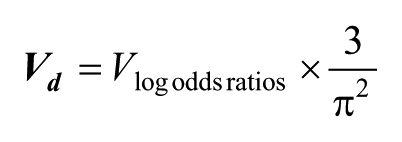
This method was originally proposed by Hasselblad and Hedges (1995). Standardized mean differences were assessed as low (d = .2), moderate (d = .5), and high (d = .8), according to the Cohen (1992) convention. All meta-analytic procedures were conducted using the R-software package “metafor” (Viechtbauer, 2010). Restricted maximum-likelihood estimation (REML) was used to estimate τ2, which are approximately unbiased (Viechtbauer, 2005). To assess between-trial heterogeneity, we computed Q and I2 statistics. When interpreting I2 values, we followed general conventions of .25, .50, and .75 corresponding to low, moderate, and high between-trial heterogeneity, respectively. Funnel plots, fail-safe N (Rosenthal, 1979), and rank tests for funnel plots (Begg & Mazumdar, 1994) were used to assess publication bias. In addition, we conducted meta-regression analyses to explore moderating effects of task parameters (session length, reward type, general compensation for task completion) and study design (single measures vs. repeated measures) using mixed effect regression models (Viechtbauer, 2010). It is noteworthy that the dummy coded age variable was created to enable pragmatic comparisons (i.e., children vs. adolescents and adults in the SCPs and adults vs. children and adolescents in the TDPs). Finally, sensitivity analyses were conducted for several methodological reasons.
Results
Study Inclusion
The flow diagram describing study selection is depicted in Figure 1. Discrepancies between raters’ judgment of whether an article met inclusion criteria occurred in 39 cases, and the respective articles were sent to S. C. for moderation. The studies were then discussed between all three raters until a consensus was reached. Of the remaining 64 studies included in qualitative synthesis, 32 used the SCP and 31 used TDP. One study incorporated both paradigms.

Flow chart of study selection procedure.
Five SCP studies were excluded for the use of duplicate data (studies presented in italics met inclusion criteria): Banaschewski et al. (2012), Bitsakou, Psychogiou, Thompson, and Sonuga-Barke (2009), Marco et al. (2009), and Wood et al. (2011) overlap with Kuntsi et al. (2010) ; the data stem from the International Multi-Center ADHD genetics (IMAGE) project (Kuntsi, Neale, Chen, Faraone, & Asherson, 2006), and Sjöwall and Thorell (2014) overlaps with Sjöwall, Roth, Lindqvist, and Thorell (2013) . Five SCP studies were excluded because of variations in task design (no trials constraint condition was implemented: Patros, Alderson, Lea, & Tarle, 2017; a prereward delay was imposed before response selection and variable delays were used: Gawrilow, Gollwitzer, & Oettingen, 2011; variable long delays were used, and no control group design was implemented: Potter & Newhouse, 2008; Potter, Ryan, & Newhouse, 2009 no condition without postreward delay was implemented: Schweitzer & Sulzer-Azaroff, 1995). Finally, one study was excluded due to methodological considerations (no independent control group was implemented, and data stem from the IMAGE project: Sonuga-Barke et al., 2011). Three of the remaining studies reported ADHD subtype data but provided combined data for the whole clinical sample upon request (Lambek et al., 2010; Solanto et al., 2007; Wahlstedt, Thorell, & Bohlin, 2009) and one study reported data for a subset of trials but sent the complete data upon request (Sjöwall et al., 2013). That way, we were able to include these studies in our meta-analysis. Wilhelm et al. (2011) incorporated two versions of the SCP (“sweets” and “money” condition) within one study, but the (“sweets”) condition was always presented first. Likewise, Solanto et al. (2001) presented two blocks of 20 trials each and rewards were delivered after each block. As the conditions in both studies were not randomized or balanced but were presented consecutively, we decided to use only the first condition from each study to avoid the inclusion of potential carryover effects. Altogether, we were able to include 22 SCP studies in our meta-analysis (see Table 1).
Study Characteristics SCP.
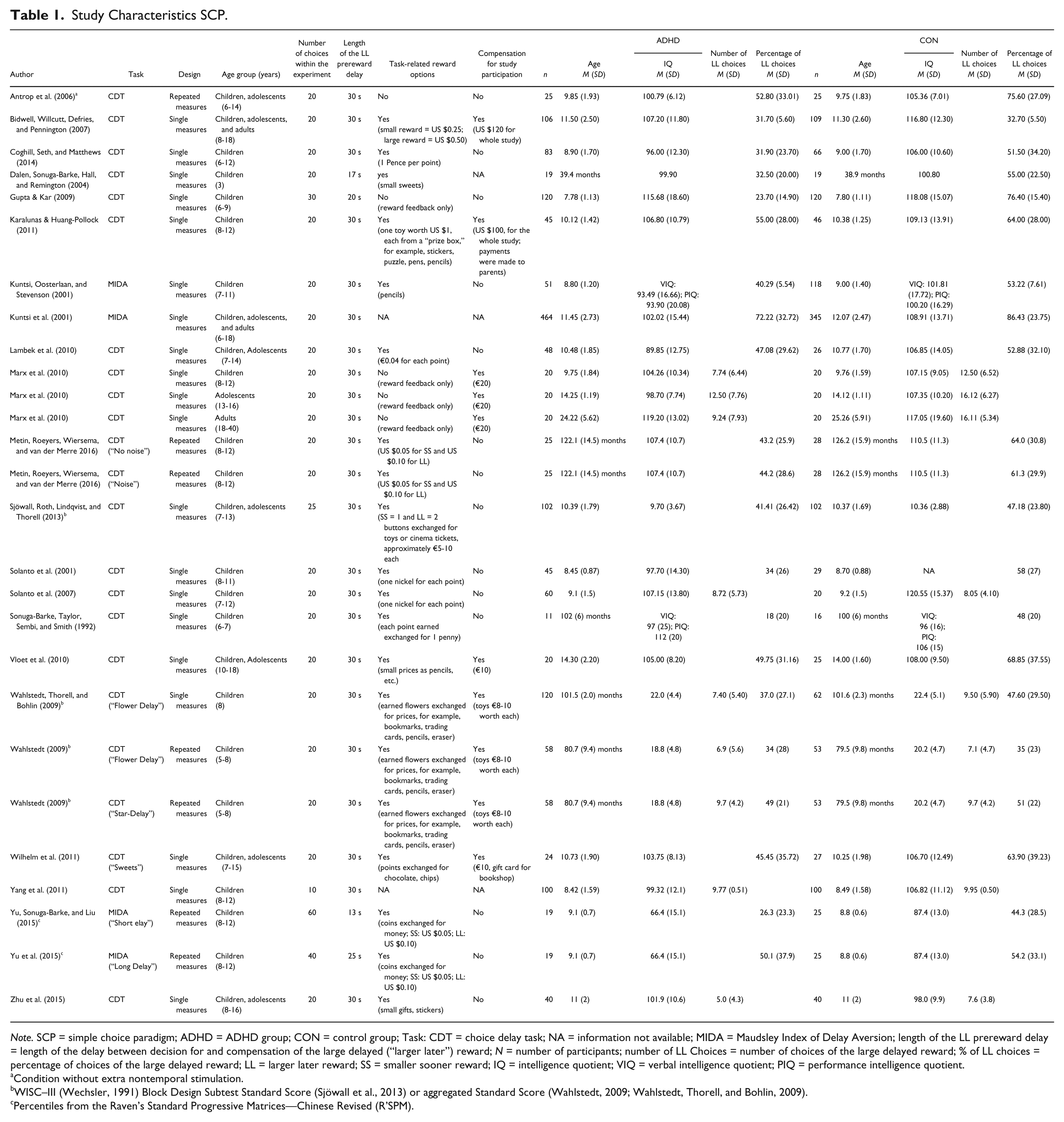
Note. SCP = simple choice paradigm; ADHD = ADHD group; CON = control group; Task: CDT = choice delay task; NA = information not available; MIDA = Maudsley Index of Delay Aversion; length of the LL prereward delay = length of the delay between decision for and compensation of the large delayed (“larger later”) reward; N = number of participants; number of LL Choices = number of choices of the large delayed reward; % of LL choices = percentage of choices of the large delayed reward; LL = larger later reward; SS = smaller sooner reward; IQ = intelligence quotient; VIQ = verbal intelligence quotient; PIQ = performance intelligence quotient.
Condition without extra nontemporal stimulation.
WISC–III (Wechsler, 1991) Block Design Subtest Standard Score (Sjöwall et al., 2013) or aggregated Standard Score (Wahlstedt, 2009; Wahlstedt, Thorell, and Bohlin, 2009).
Percentiles from the Raven’s Standard Progressive Matrices—Chinese Revised (R’SPM).
Of the TDP studies, nine studies were excluded for the use of duplicate data (Costa Dias et al., 2013; Dias et al., 2015) and Wilson, Mitchell, Musser, Schmitt, and Nigg (2011) overlap with Mitchell, Wilson, and Karalunas (2015) ; Demurie, Roeyers, Baeyens, and Sonuga-Barke (2013) overlap with Demurie, Roeyers, Baeyens, and Sonuga-Barke (2012) and Demurie, Roeyers, Wiersema, and Sonuga-Barke (2016) ; Hoogman et al. (2011), Mostert et al. (2018), and Onnink et al. (2015) overlap with Mostert et al. (2015) , which are all based on the IMpACT study (Franke et al., 2010); Scheres, Tontsch, and Thoeny (2013) overlaps with Scheres, Tontsch, et al. (2010) ; Wilbertz et al. (2013) overlap with Wilbertz et al. (2012) . One study displayed significant variations in task design and was therefore excluded (implemented postreward delays: Rosch & Mostofsky, 2016). Finally, seven studies were excluded due to methodological considerations (the diagnostic procedure was not explained: Fassbender et al., 2014; authors failed to respond to our request for missing relevant information: Barkley, Edwards, Laneri, Fletcher, & Metevia, 2001; Dai, Harrow, Song, Rucklidge, & Grace, 2016; Li et al., 2008; Plichta et al., 2009; Scheres et al., 2006; Scheres, Tontsch, et al., 2010). In three studies, the DDT was performed in the fMRI scanner (Carlisi et al., 2016; Chantiluke et al., 2014; Ortiz et al., 2015). However, as stress induction was not found to affect TDP task performance in ADHD participants in a recently conducted study (Krause-Utz et al., 2016), we decided to include these studies in our meta-analysis. Finally, we were able to include 15 TDP studies in our meta-analysis (see Table 2).
Study Characteristics TDP.
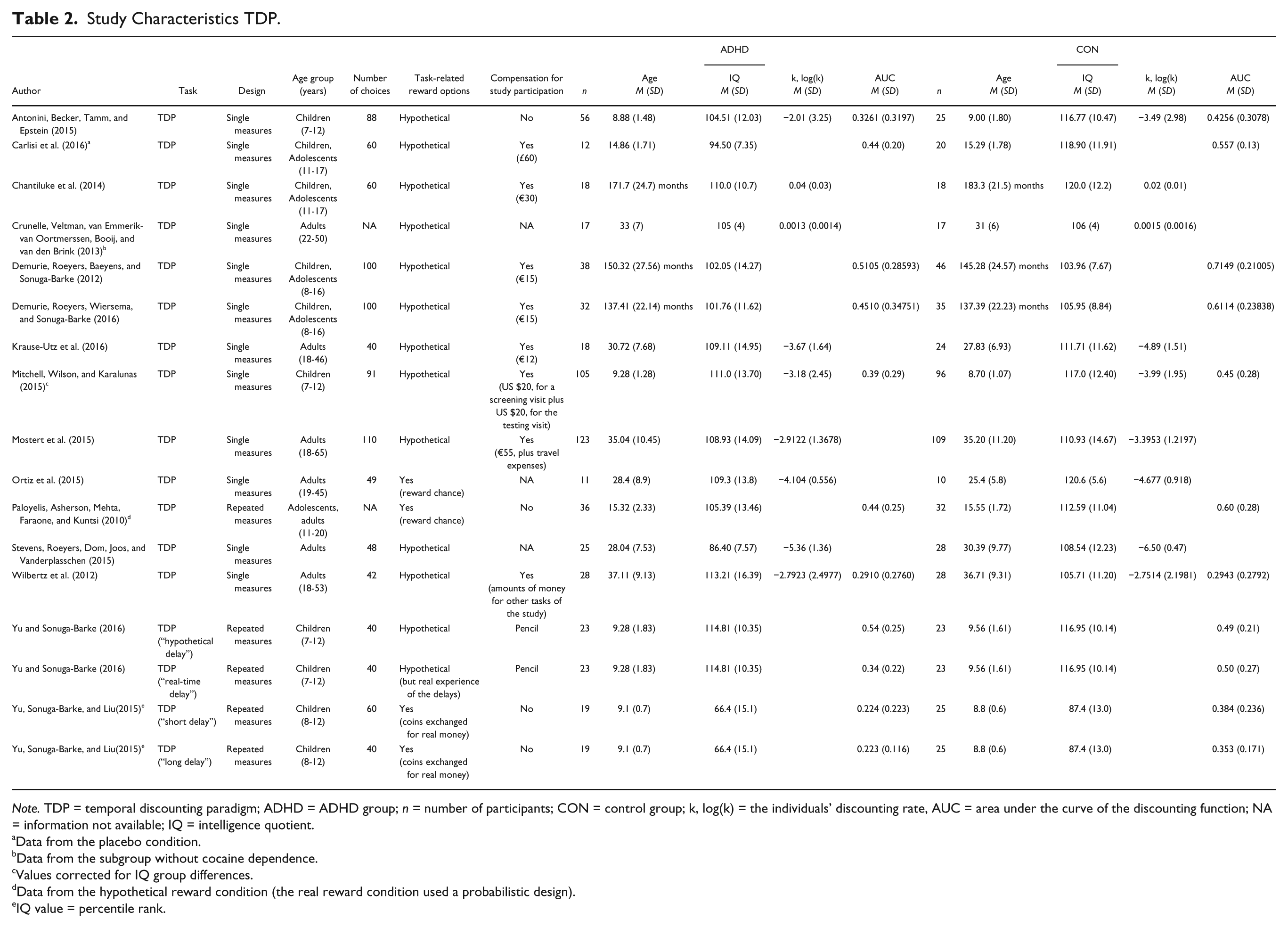
Note. TDP = temporal discounting paradigm; ADHD = ADHD group; n = number of participants; CON = control group; k, log(k) = the individuals’ discounting rate, AUC = area under the curve of the discounting function; NA = information not available; IQ = intelligence quotient.
Data from the placebo condition.
Data from the subgroup without cocaine dependence.
Values corrected for IQ group differences.
Data from the hypothetical reward condition (the real reward condition used a probabilistic design).
IQ value = percentile rank.
Overall Effect Sizes
Single choice paradigm
Based on the initial funnel plot, two extreme outliers were identified. Whereas Gupta & Kar (2009) reported an effect size outside the bounds of the confidence interval (CI), Yang et al. (2011) reported a standard error approximately 3 times the size of other studies (figure available upon request from the authors). These studies were excluded from all further calculations. Thus, the final sample included 22 independent trials from 20 studies, including four trials from within-study designs (Antrop et al., 2006; Metin et al., 2016; Wahlstedt, 2009; Yu, Sonuga-Barke, & Liu, 2018). The total participant sample in this quantitative review was n = 2.666 (1.425 of which with a diagnosis of ADHD). The sample size per trial varied between n = 27 (Sonuga-Barke et al., 1992) and n = 809 (Kuntsi et al., 2010). The estimated log OR for the SCP was 0.65 (95% CI = [.47, .83], p
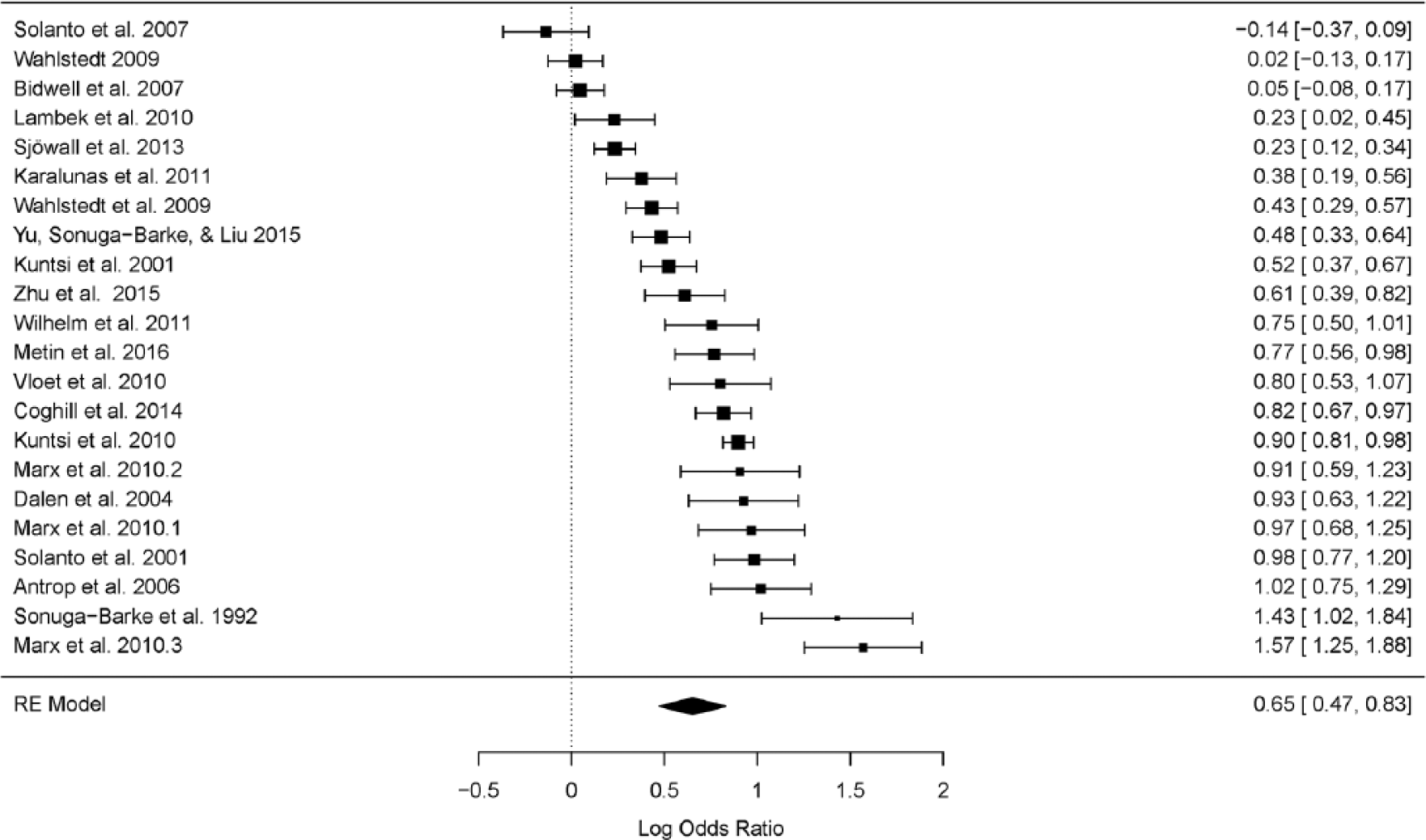
Forest plot of the effect sizes (log odds ratios) and 95% confidence intervals for comparisons of participants with ADHD versus controls (SCP).

Funnel plot visualizing the relationship between effect sizes (Log Odds Ratios) and heterogeneity adjusted standard errors (SCP).
Temporal discounting paradigm
The total participant sample in this quantitative review was n = 1.097 (561 of which with a diagnosis of ADHD). The sample size per trial varied between n = 21 (Ortiz et al., 2015) and n = 232 (Mostert et al., 2015). The final sample included k = 15 independent trials from 15 studies, including three trials from within-study designs (Paloyelis, Asherson, Mehta, Faraone, & Kuntsi, 2010; Yu & Sonuga-Barke, 2020; Yu et al., 2018). The estimated standardized mean difference for the TDP was 0.43 (95% CI = [.29, .57], p
Given that age was confounded with the dependent measure used (eight out of nine studies that were conducted with children or adolescents reported AUC; five out of six studies that were conducted in adults reported k), we repeated the meta-analysis for k and AUC estimators separately. For the k trials, the estimated standardized mean difference was 0.45 (95% CI = [.22, .67], p = .0001). In turn, the estimated standardized mean difference for the AUC trials was .43 (95% CI = [.24, .62], p
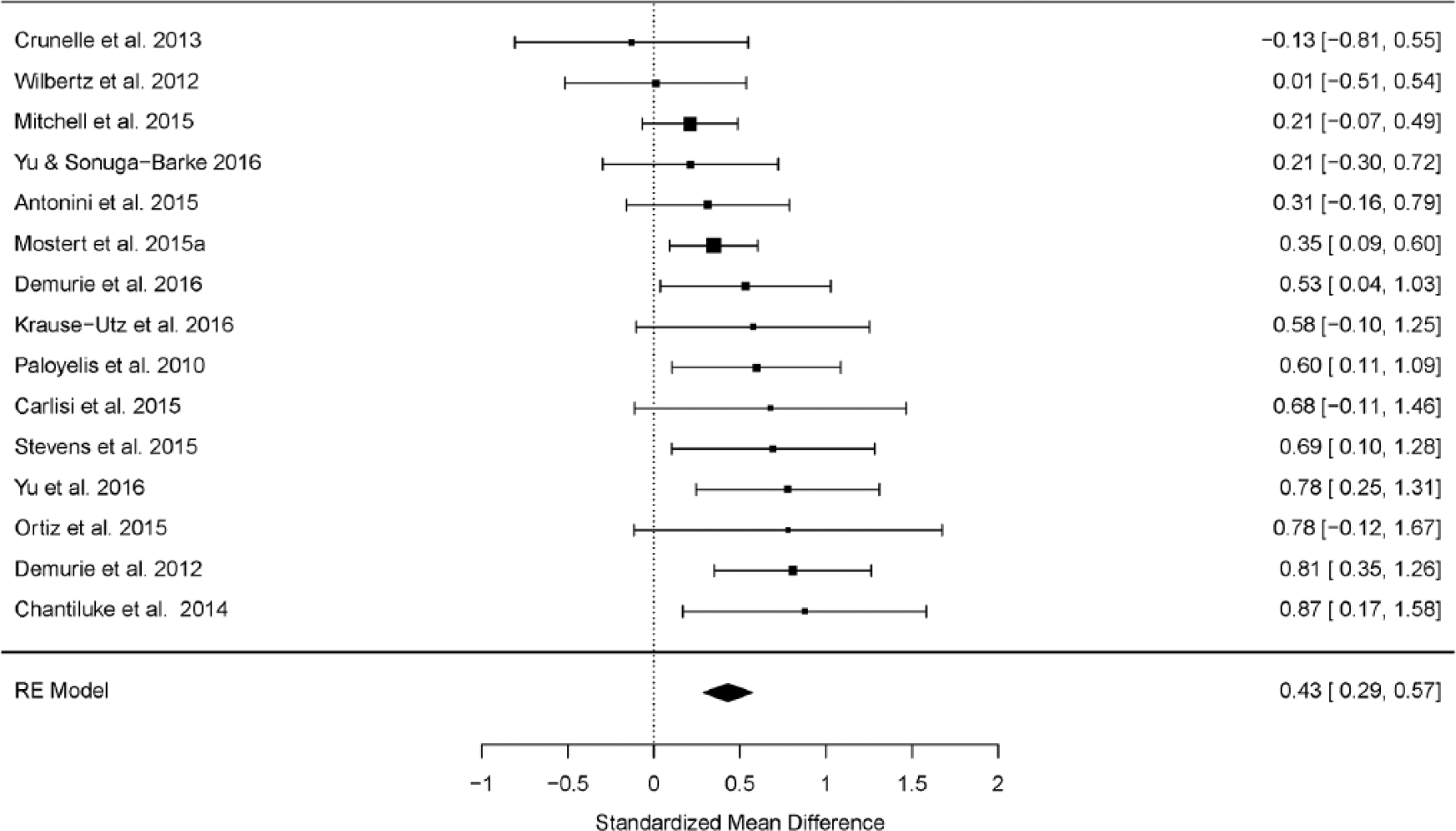
Forest plot of the effect sizes (standardized mean differences, d) and 95% confidence intervals for comparisons of participants with ADHD versus controls (TDP).

Funnel plot visualizing the relationship between effect sizes (d) and heterogeneity adjusted standard errors (TDP).
Moderation Analyses
Single choice paradigm
Fitting a mixed effects model including the number of choices, reward type (hypothetical vs. real), and general compensation for task completion (yes, no) as moderators revealed a significant result, Q(3) = 8.12, p = .04. Further analysis revealed reward as a significant moderator Q(1) = 7.52, p = .01. Offering a reward significantly decreased the log OR from 1.11 to 0.53 for participants with ADHD compared with controls, meaning that anticipation of real rewards nearly halved choice impulsivity in participants with ADHD. Reward accounted for 27.60% of the between-study variance, but residual interstudy heterogeneity was still significant, Q(19) = 226.92, p
Temporal discounting paradigm
The same analysis as above revealed nonsignificant results, Q(3) = 1.67, p = .64. A mixed effects model including study design as a dummy coded factor revealed a statistically nonsignificant result, Q(1) = .07; p = .79. An additional analysis including only age group (adults vs. rest) as a moderator revealed a nonsignificant result, Q(1) = .96, p = .33.
Sensitivity analyses
A sensitivity analysis revealed that for the SCP trials, excluding the Sonuga-Barke et al. (1992) study (which reported data from a subset of trials only) marginally reduced the estimated log OR from .65 to .62 (95% CI = [.45, .79], p
Discussion
In this meta-analysis, we aimed to compare the SCP and TDP in their ability to differentiate ADHD participants from controls with respect to their tendency to prefer immediate over delayed rewards, that is, impulsive choice. We predicted that effects would be larger in the SCP than in the TDP due to an expected greater salience of the negative power of experienced delay as generated by the repetitive character of choice presentation, lower trial density, and the experience of real (vs. hypothetical) delays. We further predicted that session length (i.e., the number of trials), incentive value (i.e., hypothetical vs. real rewards), and general compensation for task completion may moderate the magnitude of experimental group differences in both paradigms. Our meta-analyses on 22 SCP trials and 15 TDP trials revealed that both paradigms showed small to medium effect sizes (SCP: d = 0.36; TDP: d = 0.43), confirming that participants with ADHD are apt to choose small immediate over large delayed rewards more frequently when compared with controls. In the TDP, only marginal effect size differences emerged when analyzing the two available dependent measures (k, AUC) separately. These effect sizes are slightly smaller than those ones identified in previous meta-analyses, a result that might be attributed to our stricter methodological approach. Contrary to our expectations, we did not find larger effect sizes in the SCP. One explanation might be that the SCPs mostly uses real rewards (which seem to reduce the effect sizes) whereas the TDPs mostly use hypothetical rewards. Thus, the lack of differences may primarily be due to methodological confounds. Alternatively, both tasks might test different aspects of the underlying choice decision processes. In this sense, the integrated neuroeconomic model of decision making (Sonuga-Barke et al., 2016) specifies a three-stage decision-making process, comprising reward evaluation (assessment of the utility of potential choice outcomes based on parameters such as valence, magnitude, timing, and probability), decision and management (comparison of the subjective value of choice alternatives, choice of the most preferred option, choice implementation), and appraisal and accommodation (comparison of the expected and derived choice utility, generation of a prediction error; update of the initial utility evaluation; reinforcement learning). This decision-making process is informed and guided by three distributed and interacting brain systems, that is, self-referential processes, executive control, and reinforcement learning and emotion processing. Thus, the SCP might predominantly address emotion processing (negative feelings due to low-frequent trial succession and the experience of real, immediate delays), whereas the TDP, especially when using long temporal delays, might put more emphasis on executive aspects (e.g., decisions must be made for longer periods of time; future consequences must be weighed against each other). As it is impossible to disentangle these explanatory approaches at the moment, we put them up as possible hypotheses to be tested in future head-to-head studies.
In line with our hypotheses, we were able to show that offering a reward almost doubled the OR for participants with ADHD compared with controls in the SCP, suggesting that those with ADHD were much more likely to choose the large delayed reward in relation to controls when both anticipated real rewards. Delay in and of itself (separated from rewards) seemed to exacerbate impulsive choice—a finding consistent with the delay aversion model. However, as 18 studies with reward were contrasted against only four nonrewarded studies, this finding should be interpreted with caution. In contrast, we were not able to detect an effect of reward on the TDP effect sizes. Again, the analysis was not balanced in this paradigm, only three out of all included studies used a condition with reward in terms of chance payoff (Ortiz et al., 2015; Paloyelis et al., 2010) or real money (Yu et al., 2018), whereas all other studies used hypothetical rewards. In addition, a lower motivational power of chance payoff compared with certain rewards might have additionally contributed to these zero findings. In line with this assumption, no differences are commonly observed in the discounting functions for hypothetical rewards versus chance payoff in healthy participants (Johnson & Bickel, 2002; Lawyer, Schoepflin, Green, & Jenks, 2011; Madden, Begotka, Raiff, & Kastern, 2003; Madden et al., 2004), questioning the motivational power of this reward condition. Another factor that complicates a direct comparison of the reward effect in both experimental designs is an imbalance of the nature of the delays, that is, delays are always experienced in the SCP whereas they are almost exclusively hypothetical in the TDP. As a result, delay type and compensation strategy are confounded, that is, SCPs typically implemented real delays and rewards whereas TDPs typically implemented hypothetical delays and rewards.
Taken together, an imbalance between compensation strategies (real vs. hypothetical), a somewhat weaker motivational power of rewards (chance payoff vs. certain rewards) and a confounding between compensation strategies and the nature of delays (real vs. hypothetical) in published studies that have been conducted so far necessitate further systematic research to determine how both factors—delay and reward valence—independent from each other contribute to impulsive choice in ADHD. On one hand, our findings argue for a motivational value of real rewards or, the other way around, for a demotivating effect of hypothetical rewards in the context of delay, manifesting itself in more pronounced impulsive choice. On the other hand, recent neuroimaging findings argue for the negative emotional power of experienced delays in terms of aymygdala–striatal hyperactivation to trigger impulsive choice, irrespective of the nature of the rewards (chance payoff: Plichta et al., 2009; hypothetical rewards: Lemiere et al., 2012; Wilbertz et al., 2013), although no study using certain rewards instead of chance payoff has been conducted so far. A previously conducted study directly comparing temporal discounting in anticipation of real vs. hypothetical rewards in adults with ADHD does not resolve these uncertainties (Paloyelis et al., 2010). Although participants with ADHD showed steeper discounting when compared with controls in anticipation of hypothetical delays and rewards but equal performance in anticipation of real delays and rewards (Paloyelis et al., 2010), it remains unclear from this study if the real experience of the delays or the prospect of real rewards or both factors may explain these findings.
Contrary to our expectations, we were not able to identify a moderation effect of general compensation for task completion on the effect sizes, which might have several reasons: (a) compensation might not have influenced the behavior of the participants during the experiment as it was not contingent on task performance; (b) the participants, at least the children, might not have been aware of the compensation in advance; (c) at least the children might not have been compensated directly, but the compensation might have been given to their parents. Likewise, session length did not turn out to be a significant moderator variable. This was probably due to restricted variance in the SCP and to limited practical relevance in the TDP. More precisely, almost all SCP studies incorporated 20 trials, whereas one study that used 30 trials (Gupta & Kar, 2009) reported a very large effect size outside the bounds of the CI of all other studies and another study that used only 10 trials (Yang et al., 2011) reported a standard error approximately 3 times the size of other studies, such that both studies were excluded as outliers. These studies provide valuable information in that impulsive choice might increase with overall experimental session length (Gupta & Kar, 2009) according to the delay aversion hypothesis (Sonuga-Barke et al., 1992) and in that substantial interindividual heterogeneity exists, with some of the participants with ADHD being impaired already at very early stages of their performance whereas others still behave in a functional manner (Yang et al., 2011). With regard to the TDP, even though the number of experimental trials is more heterogeneous between studies, no real delays are imposed after the decisions so that the pure number of trials had only little impact on overall experimental length when compared with the SCP. To sum up, more studies are needed to examine how session length affects impulsive choice in participants with ADHD.
Across both paradigms, Pauli-Pott and Becker (2015) found in their meta-analysis an age-dependent decrease of impulsive choice in the sense that children with ADHD (
Finally, some statistical considerations should be discussed. The SCP displays larger between-study heterogeneity when compared with the TDP which might be due to several factors. First, the variance criterion is sensitive to the number of studies, and the SCP sample contains a larger number of studies when compared with the TDP. Second, SCP analyses are based on the number of choices in the sample instead of aggregated data and therefore show larger reliability, that is, smaller CIs. Third, the SCP might be more sensitive to contextual variables such as experimental length and the provision of real versus hypothetical rewards.
Conclusions
The strengths of our study lie (a) in the rigor of study selection according to methodological aspects, especially the exclusion of overlapping data sets and the systematic assessment of further factors that might inflate the effect sizes, (b) the larger content validity due to exclusion of studies with significant variations in task design (e.g., choice impulsivity did not reduce overall delay length; delay was not a consequence of choice but preceded choice), and (c) the separate estimation of effect sizes and moderation effects for both paradigms to avoid biased results due to confounding delay × reward effects. However, methodological difficulties that have emerged from the published literature, such as an imbalance of compensation strategies in both paradigms (real vs. hypothetical), a confounding between compensation strategies and the nature of delays (predominantly real delays and rewards in the SCP; predominantly hypothetical delays and rewards in the TDP), restricted variability in the number of trials in the SCP, and weak motivational power of rewards in the TDP (e.g., chance payoff vs. certain rewards), make it difficult to describe—at the moment—the interplay between the determinants of impulsive choice. However, it seems reasonable to believe that a stronger than normal aversion toward delay (Sonuga-Barke et al., 1992) interacts with a demotivating effect of hypothetical instead of real rewards, both factors promoting impulsive choice in participants with ADHD. This view is well supported by recent research demonstrating that the prospect of significant reward, along with valid trial-to-trial feedback, largely normalized the formerly altered brain activity patterns and associated task performance deficits in children with ADHD (Hammer, Cooke, Stein, & Booth, 2015; Hammer, Tennekoon, et al., 2015), putting up to discussion reward feedback immediacy as a further potential moderator of ADHD-related delay intolerance and impulsive choice in ADHD.
Our finding that both the SCP and the TDP obtain comparable effect sizes raises the question whether or not researchers should implement both paradigms in studies on impulsive choice in ADHD. Due to its larger ecological validity (delays are really experienced), its larger contextual sensitivity (sensitive to real vs. hypothetical rewards) and as it is the more precise performance estimator (in terms of reliability), we would suggest the SCP as the paradigm of choice, merely limited by the need for identification of further moderators of task performance due to the large residual heterogeneity and the still pending investigation whether or not both paradigms tap the same or different aspects of impulsive choice.
Footnotes
Acknowledgements
We would like to thank all authors and their study groups for their willingness and their friendly support in providing relevant information for the present study.
Declaration of Conflicting Interests
The author(s) declared no potential conflicts of interest with respect to the research, authorship, and/or publication of this article.
Funding
The author(s) received no financial support for the research, authorship, and/or publication of this article.