



Abstract
Keywords
Introduction
ADHD is a neurobiological, prevalent and highly morbid disorder estimated to afflict at least 5% of adults in the United States (Kessler et al., 2006). Although the validity of the diagnosis of adult ADHD has been recognized, questions remain as to whether adults with ADHD are good informants of their own symptoms.
This issue becomes increasingly relevant as medicine transitions to a population health management model in which in-person contact with patients will likely decrease. This creates the need for alternative means for clinicians to help monitor the well-being of their patients remotely in which patients’ self-reports becomes an issue of high importance. Yet limited information is available on the informativeness of self-reports of adults treated for ADHD during ongoing treatment.
Adler et al. (2006) examined the correspondence between Adult ADHD Self-Report Scale (ASRS) versus standard clinician ratings using the ADHD Rating Scale (ADHD-RS) in a sample of 60 newly referred subjects. They reported high internal consistency for both the patient- and rater-administered scales (Cronbach’s α = 0.88 and 0.89, respectively) with a high intraclass correlation coefficient (ICC) between scales for total scores (0.84). Kooij et al. (2008) examined the correlation between self-reported and clinician-assessed symptoms of ADHD in a Dutch sample of newly referred adults with ADHD, finding moderate correspondence between self- and clinician-assessed symptoms (Kooij et al., 2008). However, because these studies focused on new patients, the informativeness of self-reports during ongoing clinical care remains uncertain.
To our knowledge, only one study addressed the informativeness of patient’s self-report in response to treatment. Adler et al. (2008) analyzed data from two double-blind, randomized clinical trial patients, reporting good agreement between investigator ratings and self-ratings of baseline, end point, and change scores of ADHD symptoms. However, because clinical trials have inclusion and exclusion criteria, the generalizability of these findings to clinical practice is unclear.
Whether self-reports of ADHD symptoms are informative is an area of high clinical significance. This knowledge allows the treating clinician to remain confident that the patient-reported data on their symptomatic picture are accurate. Such information is needed to help clinicians monitor the clinical course of ADHD patients undergoing pharmacological treatment for ADHD over the long term and assure that patient’s clinical course remains stable.
The main aim of this study was to investigate the informativeness of self-reports of ADHD symptoms in adults with ADHD in the clinical setting. To this end, we examined the association between clinician-assessed symptoms of ADHD and patient self-reports in a sample of clinically referred adult subjects with ADHD-receiving pharmacological treatments for ADHD. Based on the available literature, we hypothesized a good correspondence between self-report and clinician-assessed symptoms of ADHD in a clinical sample.
Method
Subjects
Subjects were adults of both sexes, aged 19 years to 67 years, who had been referred to the Adult ADHD Program at the Massachusetts General Hospital for clinical care or participation in a clinical trial of a pharmacological treatment for ADHD. All subjects were on stable doses of long-acting stimulant medication for ADHD and were considered responders to treatment. Subjects receiving stimulants received only one type of stimulant (methylphenidate or amphetamine, never both). Subjects followed in the clinic had been on stimulants for at least a year. There were four such subjects who were also taking selective serotonin reuptake inhibitors (SSRIs) in addition to their stimulant treatment. Subjects participating in a clinical trial derived from a randomized double-blind study of methyl-folate added to open label treatment of a long acting formulation of methylphenidate (MPH). This study was approved by the institutional review board (IRB), and all subjects provided written informed consent.
Assessments
All subjects met Diagnostic and Statistical Manual of Mental Disorders (4th ed.; DSM-IV; American Psychiatric Association, 1994) diagnostic criteria for ADHD with childhood onset and persistent symptoms based on clinical assessment by an expert clinician. All subjects were treated with long-acting stimulant medication. ADHD symptoms were assessed by a psychiatrist using the ADHD Investigator Symptom Rating Scale (AISRS; Spencer et al., 2010) and by the patient using the ASRS v1.1 symptom checklist (Adler et al., 2006; Kessler et al., 2005) using a secured Internet-based data capture system. The psychiatrists making the AISRS ratings were blinded to the ASRS scores. The AISRS is a clinician-rated measure of ADHD symptoms on a 4-point scale from 0 (none) to 3 (severe). The ASRS is a self-reported measure of ADHD symptoms on a 5-point scale from 0 (never) to 4 (very often). Socioeconomic status was established using categories delineated by Hollingshead (1975) based on occupation and education. The Clinical Global Impression-Improvement (CGI-I) Scale, for ADHD, completed by the treating psychiatrist, was used to determine if subjects were responders to their stimulant medications. The CGI-I is a clinician-rated measure of global illness improvement on a scale of 1 (very much improved) to 7 (among the most extremely ill patients; Guy, 1976). Subjects were included in this study if they were considered responders to their stimulant treatment as defined by a CGI-I score of ≤2.
Statistical Analysis
Given that the data being analyzed are count data, which do not meet the assumptions of the Pearson correlations, we performed Spearman’s rank correlations to examine the association between the AISRS and the ASRS. All analyses were two tailed and performed at the 0.05 alpha level using Stata® (version 14).
Results
The sample consisted of 54 subjects. The average age of participants was 40.8 ± 12.2 years. 44% of subjects were male and 85% were Caucasian. The average socioeconomic status was 1.5 ± 0.7 on the Hollingshead Scale (Table 1). Subjects derived from the randomized clinical trial were on the study medications for 12 weeks, with the exception of one subject who only completed 6 weeks of the trial. Subjects seen in clinical care have been receiving stimulants for at least 1 year.
Sociodemographic Characteristics.

Note. SES = socioeconomic status. N = 52.
aSES missing for two subjects.
Using Spearman’s rank correlation, we found evidence of a strong, positive association between total scores on the clinician-rated AISRS and the patient-rated ASRS (rs = .65, df = 52, p < .001; Figure 1a). We found similar results when we examined this association in males (rs = .68, df = 22, p < .001), females (rs = .69, df = 28, p < .001), younger subjects (≤40 years of age as determined by the median split; rs = .64, df = 26, p < .001), and older subjects (>40 years of age rs = 0.70, df = 24, p < .001; Figure 1b-1e).
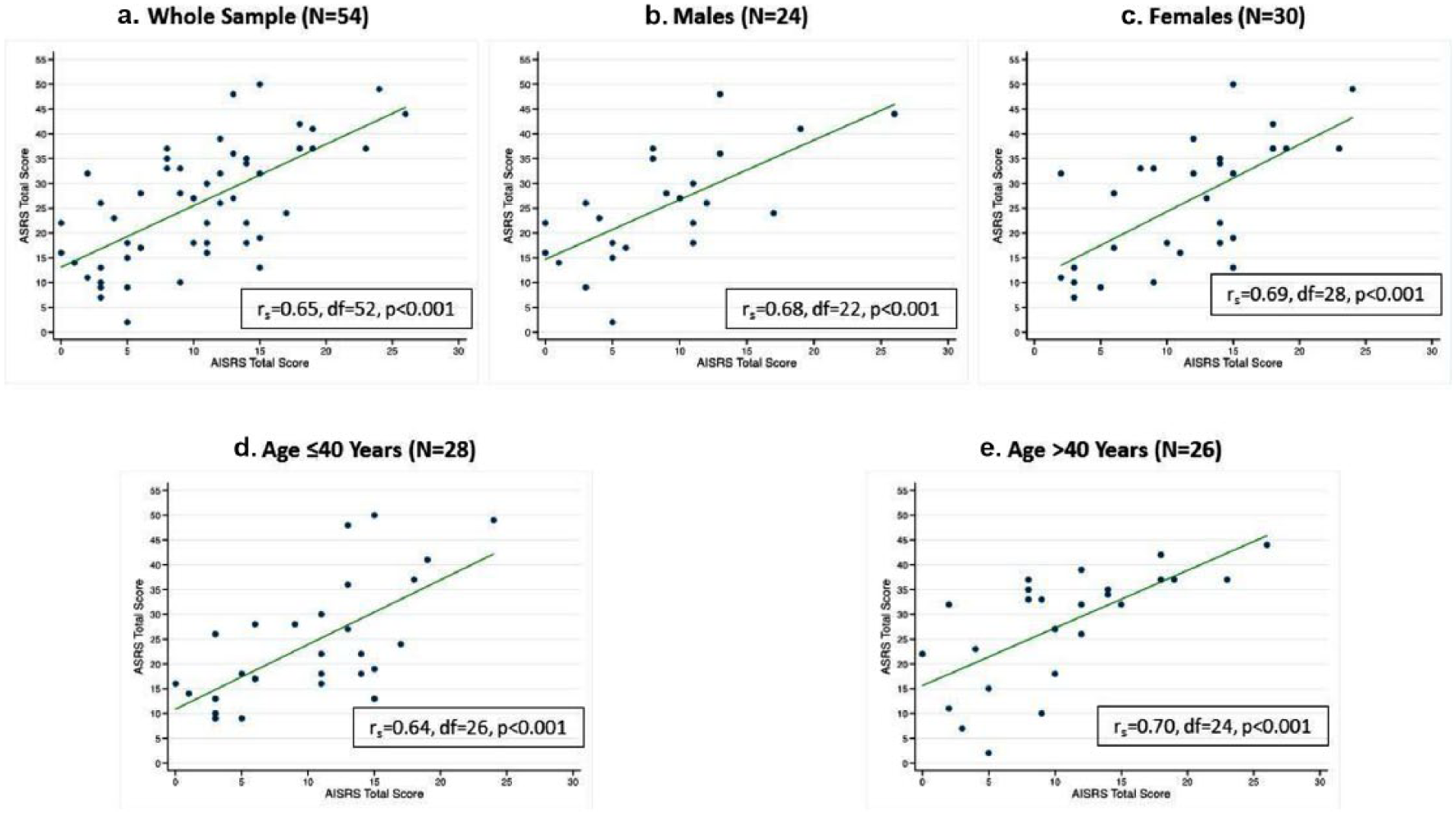
We used Spearman’s rank correlation to examine the association between the AISRS and ASRS among the following groups: (a) the whole sample, (b) male subjects, (c) female subjects, (d) subjects 40 years of age and younger, and (e) subjects older than 40 years of age.
Discussion
This study investigated the informativeness of self-reports of ADHD symptoms in monitoring response to stimulant treatment in a sample of clinically referred adults with ADHD-receiving pharmacological treatment for ADHD. Findings revealed very robust correlations between clinician-assessed symptoms of ADHD and patient self-reports of the same symptoms. These results extend to the clinical setting previous results documenting good correspondence between clinician-assessed ADHD symptoms and patient self-reports in the context of evaluative efforts and clinical trial results. Furthermore, our results are particularly robust considering that agreement was equally strong in males and females and younger and older subjects. Taken together, these findings support the informativeness of ADHD subjects’ self-report of their symptoms within and without the clinical setting.
Although findings by Adler et al. (2006) and Kooij et al. (2008) documented good correspondence between self-reports of ADHD symptoms and clinician-assessed symptoms in the initial evaluation of ADHD patients, their informativeness during ongoing treatment has not been assessed. This information is particularly important during the process of long-term monitoring of patients stabilized on a medication regimen. This knowledge allows the treating clinician to remain confident that the patient-reported data on their symptomatic picture are accurate.
Our results on the informativeness of self-reported symptoms of ADHD in patients receiving pharmacological treatment for ADHD in the clinical setting are consistent with those of Adler et al. (2006) who reported similar results in the context of clinical trials. However, as our results also include findings from an unselected clinical sample, they generalize to the clinical setting.
Our results on the informativeness of self-reported symptoms of ADHD are also consistent with those of Kessler et al. (2007) who examined the validity of a six-question Adult ASRS screener in a sample of subscribers to a large health plan in the United States. Results showed that the ASRS screener had strong concordance with clinician diagnoses, with an area under the receiver operating characteristic curve (ROC) of 0.90. Similar results were reported by Adler et al. (2011) who examined the correspondence between the self-reported Time-Sensitive ADHD Symptom Scale (TASS) with clinician-administered ADHD-RS in a sample of 80 adults with ADHD. The Pearson correlation coefficient between the self-reported TASS and the clinician-administered ADHD-RS was highly significant (r = .70, p = .0001). These findings are particularly noteworthy because the two scales were not identical.
The findings that self-reports of ADHD symptoms are informative has important implications. This knowledge will allow clinicians to remain confident that the patient-reported data on their symptomatic picture are accurate. Such information will help clinician monitor the clinical course of ADHD patients undergoing pharmacological treatment for ADHD over the long term and assure that patient’s clinical course remains stable. Considering that self-report information can be captured remotely with data capture technology, this approach to patient monitoring based on patients’ self-report is poised to minimize patient and clinician burden, improve adherence, and minimize cost.
The findings of this report need to be viewed considering its methodological limitations. Although the clinical sample was small, the results were very robust. We used Spearman correlations to analyze our data because we considered it to be the most appropriate test statistic for these types of data. Thus, we do not know if the results would have been similar if other statistical approaches would have been used. Although most of our subjects were receiving stimulant monotherapy, approximately two thirds of the sample derived from a randomized clinical trial of methyl folate added to open label treatment with MPH that showed almost identical results in those taking MPH with and without methyl folate. Nevertheless, more work is needed to further investigate whether our results will generalize to ADHD patients receiving other medical or psychiatric medicines. Because the diagnosis of ADHD did not include consideration to subtypes, we do not know whether the reported results would vary by subtypes. Also, because most cases were noncomorbid, we do not know if these results would generalize to more comorbid ADHD cases. Because the sample was largely Caucasian and referred, our results may not generalize to other ethnic groups or community samples. Despite these considerations, our work adds to the available literature supporting the informativeness of self-reported assessments of ADHD symptoms in the clinical setting in general and in the monitoring of ongoing treatment with stimulants.
Footnotes
Declaration of Conflicting Interests
The author(s) declared the following potential conflicts of interest with respect to the research, authorship, and/or publication of this article: Dr. Joseph Biederman is currently receiving research support from the following sources: AACAP, Feinstein Institute for Medical Research, Food & Drug Administration, Headspace Inc., Lundbeck AS, Neurocentria Inc., NIDA, Pfizer Pharmaceuticals, Roche TCRC Inc., Shire Pharmaceuticals Inc., Sunovion Pharmaceuticals Inc., and NIH. He is on the scientific advisory board for Akili and Shire. Dr. Biederman has a financial interest in Avekshan LLC, a company that develops treatments for attention deficit hyperactivity disorder (ADHD); his interests were reviewed and are managed by Massachusetts General Hospital and Partners HealthCare in accordance with their conflict of interest policies. Over the last 3 years, Dr. Biederman received research support from the Department of Defense, Ironshore, Magceutics Inc., Merck, PamLab, SPRITES and Vaya Pharma/Enzymotec. He received honoraria from Alcobra and APSARD. He was a consultant for Aevi Genomics, Akili, Guidepoint, Ironshore, Medgenics, and Piper Jaffray. He was on the scientific advisory board for Alcobra, Arbor Pharmaceuticals, and Shire. He received honoraria from the MGH Psychiatry Academy for tuition-funded CME courses. Dr. Biederman’s program has received departmental royalties from a copyrighted rating scale used for ADHD diagnoses, paid by Ingenix, Prophase, Shire, Bracket Global, Sunovion, and Theravance; these royalties were paid to the Department of Psychiatry at MGH.
Dr. Thomas Spencer received research support or was a consultant from the following sources: Alcobra, Avekshan, Ironshore, Lundbeck, Shire Laboratories Inc, Sunovion, the FDA and the Department of Defense. Consultant fees are paid to the MGH Clinical Trials Network and not directly to Dr. Spencer. Dr. Thomas Spencer has been on an advisory board for the companies such as Alcobra. Dr. Spencer received research support from Royalties and Licensing fees on copyrighted ADHD scales through MGH Corporate Sponsored Research and Licensing. Through MGH corporate licensing, Biederman and Dr. Spencer have a U.S. Patent (#14/027,676) for a nonstimulant treatment for ADHD and a patent pending (#61/233,686) for a method to prevent stimulant abuse. Dr. Lenard A. Adler; Grant/Research: Sunovion Pharmaceuticals, Purdue Pharmaceuticals, Enzymotec, Shire Pharmaceuticals, Lundbeck. Consultant: Sunovion Pharmaceuticals, Enzymotec, Alcobra Pharmaceuticals, National Football League, Major League Baseball, Clintara, Bracket, Rhodes Pharmaceuticals. Speakers’ Bureau: None. Stock Holder: None. Other Financial or Material Support: Royalty payments (as inventor) from NYU for license of adult ADHD scales and training materials since 2004 Dr. Stephen V. Faraone received income, potential income, travel expenses continuing education support and/or research support from Lundbeck, Rhodes, Arbor, KenPharm, Ironshore, Shire, Akili Interactive Labs, CogCubed, Alcobra, VAYA, Sunovion, Genomind and Neurolifesciences. With his institution, he has U.S. patent US20130217707 A1 for the use of sodium–hydrogen exchange inhibitors in the treatment of ADHD. In previous years, he received support from Shire, Neurovance, Alcobra, Otsuka, McNeil, Janssen, Novartis, Pfizer and Eli Lilly. Dr. Faraone receives royalties from books published by Guilford Press: Straight Talk about Your Child’s Mental Health, Oxford University Press: Schizophrenia: The Facts, and Elsevier: ADHD: Non-Pharmacologic Interventions. He is principal investigator of  . Dr. Faraone is supported by the K.G. Jebsen Centre for Research on Neuropsychiatric Disorders, University of Bergen, Bergen, Norway, the European Union’s Seventh Framework Programme for research, technological development and demonstration under grant agreement no 602805, the European Union’s Horizon 2020 research and innovation programme under grant agreement No 667302 and NIMH grants 5R01MH101519 and U01 MH109536-01. Ms. Maura Fitzgerald, Ms. Jessica Abrams, and Mr. Itai Biederman have no relevant disclosures or declarations of interest.
Funding
The author(s) disclosed receipt of the following financial support for the research, authorship, and/or publication of this article: This research was indirectly supported by the Pediatric Psychopharmacology Council Fund.