



Abstract
Introduction
Executive function is an umbrella term that encompasses a set of higher order mental processes, including planning, mental flexibility, response inhibition, information processing, self-regulation, persistence, and working memory (Anderson, 2002; Barkley, 1997; Diamond, 2013; Weyandt & Willis, 1994). Some research suggests that development of executive function is dependent upon the maturation of the prefrontal cortex (e.g., Diamond & Taylor, 1996). It is important to note that positive parenting styles enhance child executive function development, with the opposite being true for negative parenting styles (Alaniz, 2015; Kok et al., 2014; Roskam, Stievenart, Meunier, & Noël, 2014). Based on their review, Belsky and de Haan (2011) concluded that neglect or harsh discipline adversely affects brain development. Other social environmental factors (e.g., school, friend, work, and neighborhood) might have an impact on the development of child’s executive function. Specifically, it could be argued that parenting behaviors, including parental monitoring, have a significant impact on higher levels of executive functioning (Patock-Peckham, King, Morgan-Lopez, Ulloa, & Filson Moses, 2011). This study investigates the role of parental monitoring in moderating the effects of executive functions on hyperactive behavior.
Parental monitoring includes parental supervision, knowledge of where and with whom children are spending time, and in what activities they are engaged (Shelton, Frick, & Wootton, 1996; Small & Kerns, 1993). Children’s cognitive development can be improved by increased monitoring and supportive parenting, which may include elaborating and explaining the rules children need to follow when performing a specific task (Roskam et al., 2014). Empirical research has also suggested that parental monitoring has a crucial influence on child executive function development. For instance, Patock-Peckham et al. (2011) found that parental monitoring is a significant factor in an individual’s level of impulsiveness (general behavioral control). In addition, based on data collected from 421 families, Roskam et al. (2014) examined the impact of parenting on the development of children’s inhibition. The investigators found that parenting behaviors, including greater monitoring, were significantly correlated with the development of inhibition abilities in children. Similarly, Crossley and Buckner (2012) demonstrated that maternal monitoring was a significant predictor of children’s self-regulation.
Associations between executive functioning and ADHD have also been widely reported (e.g., Barkley, 1997; Booth, Carlson, & Tucker, 2007; Foley, McClowry, & Castellanos, 2008; Hoza, Waschbusch, Owens, Pelham, & Kipp, 2001; Willcutt, Doyle, Nigg, Faraone, & Pennington, 2005). ADHD is a neurodevelopmental disorder that can be defined by “impaired levels of attention, disorganization, and/or hyperactivity-impulsivity . . . . Hyperactivity-impulsivity entails over-activity, fidgeting, inability to stay seated, intruding into other people’s activities, and inability to wait—symptoms that are excessive for age or developmental level” (American Psychiatric Association [APA], 2013, p. 32). Bohlin, Eninger, Brocki, and Thorell (2012) found that poor inhibition significantly predicted externalizing problem behaviors and ADHD symptoms. Hughes, Graham, and Grayson (2004) also claim that impairments in executive functions may lead to behavioral problems.
There is much theoretical discussion regarding the association between executive function and hyperactivity. For instance, Barkley’s model (1997) emphasizes that children characterized by ADHD have impairments in response inhibition, which in turn causes secondary impairments in four executive functions namely working memory, self-regulation, internalizing of speech, and reconstitution (behavioral analysis and synthesis). Theoretical formulation of Barkley’s model leads to two hypotheses:
Empirical research provided evidence that hyperactive children tend to encounter more commission errors and display more frequent and longer delays in inhibition responses (Adams & Snowling, 2001; Albrecht, Banaschewski, Brandeis, Heinrich, & Rothenberger, 2005; Mitchell, Chavez, Baker, Guzman, & Azen, 1990). Further evidence suggests that hyperactivity is associated with a lack of task persistence. For example, Hoza et al. (2001) analyzed the executive functioning, including academic task persistence, of 83 boys meeting diagnostic criteria for ADHD and 66 same-aged male controls. The findings showed that boys with ADHD were off-task more often and solved fewer puzzle tests as compared with their non-ADHD counterparts.
Based on the results of the existing literature, we hypothesize that children who have experienced poor parental monitoring might be at risk for the development of difficulties in executive function. In addition, we hypothesize that children with hyperactivity tend to have deficits in executive functions. It is important to note, however, that despite the link between executive functions and hyperactivity, there is no research exploring whether parental monitoring acts as a moderator in this relationship, hence, further research needs to examine this conjecture. Previous research (e.g., O’Hara & Holmbeck, 2013) has demonstrated the moderating role of parenting behaviors (i.e., maternal and paternal behavioral control and paternal psychological control) in the relationship between executive functions and youth children adherence health care behavior. Hence, we hypothesize that parental monitoring will act as a significant moderator in the relationship between executive functions and hyperactivity.
Rationale for the Selection of the Specific Variables Examined in This Study
The current study was conducted based on findings of our first study (Sangawi, Adams, & Reissland, 2016). The results of that study showed that teachers reported hyperactivity to be more prevalent than other behavioral problems (e.g., emotional, conduct, and peer problems) among Kurdish school children. Poor parental monitoring was also found to be a strong predictor of academic self-concept and behavioral problems and was highly predictive of hyperactivity problems. As each of poor parental monitoring and negative behavior such as hyperactivity expressed by children has previously been found to be linked to poor cognitive abilities in schools, further research needs to examine this conjecture, particularly, in Iraqi Kurdistan, as these factors have long-term costs for society. Furthermore, Vernez, Culbertson, and Constant (2014) showed that a sizable group of students in Kurdistan perform poorly and have low academic achievement. We argue that one possible reason for this might be related to the impairments in the executive functioning of children in Kurdistan. It is important to further investigate the cognitive capacity of children in this region because it has been found to be an important prerequisite for academic achievement (Best, Miller, & Naglieri, 2011; Engel de Abreu et al., 2014). Furthermore, most of research on the relationship between parenting style and executive functioning has been conducted in North America and Europe. Very little research has been conducted to address role of parental monitoring on executive functions in Eastern societies. According to Lewis et al. (2009), the child’s cultural milieu plays a role in the development of executive function. Hence, conducting such research to investigate the role of parenting styles on children’s outcomes among non-Western societies is essential to obtain information about “the full cultural range of socialization experiences”(Stewart et al., 2000, p. 336).
Method
Participants
Participants were recruited from five primary schools in Sulaymaniyah city in the Kurdistan region of Iraq. The eligibility criteria for participants were as follows. First, they had to be Iraqi Kurdish, not other Kurdish refugees (e.g., Syrian) who were resident in Sulaymaniyah city. Second, they had to live with at least one parent, rather than other caregivers. Third, children had to attend Year 6 and be no older than 13 years. Finally, they had to be clinically well. Based on the method shown below in the “Procedure,” from an initial sample of 357 potential participants (see Flowchart 1), 112 children were selected to participate in the study. The mean age of the children was 11 years 5 months and ranged from 11.2 to 12.7 years, with 34 girls (30%) and 78 boys (70%). There were no missing data from parents and teachers reports (Strengths and Difficulties Questionnaire [SDQ]) and children’s reports (Parental Monitoring Assessment [PMA] questionnaire).
Procedures
A consent letter to approach schools was obtained from the director of the Sulaymaniyah Governor of Education. Five primary schools were chosen in different neighborhoods in the Sulaymaniyah city for the sampling procedure. The schools selected in the academic year 2014-2015 were Zargata, Kamiaran Shin, Makwan, Peshkawtn, and Kamiaran Swr primary schools. The head teacher and children received a leaflet with brief information about the purpose of the study. Every child took home a copy of the parental consent form along with the SDQ, which had to be completed by their parents. Children were assured of the confidentiality of their data and that any responses would only be seen by the research team. Children participated individually in a quiet room. Each child was given the three tasks (STOP-IT, Same-Opposite World, and persistence). Before starting the experiments, children were told that they were free to withdraw from the study at any time. After completing the tasks, children received small educational gifts (stationery) for their participation.
An initial sample of 357 Year-6 children completed the research questionnaires. PMA was completed by the children. In addition, teachers of the children also completed six items of the Hyperactivity subscale of SDQ, the same subscale which parents were asked to complete. After receiving all questionnaires, 35 SDQ were removed because of highly inconsistent scores between parents’ and teachers’ reports. The data of a child had to be excluded from the sampling process when there was a big difference (e.g., a parent’s report was 2, but the teacher’s report was 7 and vice versa) between teacher and parent ratings of the hyperactivity for this child. As shown in the Figure 1, 56 children reported poor parental monitoring based on their low cut-off of PMA. Among these children, 22 showed high levels and 34 showed low levels of hyperactivity. The group of children with good parental monitoring (N = 56) were matched to children with poor parental monitoring based on their hyperactivity levels.

Flowchart of the sampling procedure.
After classifying the children independent sample, t tests compared the participants’ responses. Means and standard deviation scores for PMA of the 56 children classified as receiving poor parental monitoring were M = 16.30/SD = 2.1, whereas for 56 matched children in the good parental monitoring group, M = 31.3/SD = 3.8, t(110) = 25.4, p< .001. In addition, for teachers’ reporting SDQ, t(110) = 18.5, p< .001 between the total of 44 children placed in high level of hyperactivity group (M = 6.9/SD = 1.04) and 68 children placed in low hyperactivity group (M = 2.2/SD = 1.4). For parents’ reporting SDQ, t(110) = 17.7, p< .001 between high level of hyperactivity (M = 6.05/SD = 1.01) compared with the low level of hyperactivity group (M = 1.9/SD = 1.3). These results indicate that the sampling procedure placed participants correctly into groups. In addition, a Pearson correlation between parents and teachers reports of SDQ (r = .86, p< .001) suggests very good consistency between parents and teachers reports of SDQ for the current sample (N = 112 children). Hence, due to the high correlation between their responses, the parents’ and teachers’ reports of hyperactivity were combined.
Measures
The PMA (Small & Kerns, 1993) and Hyperactivity subscale measured by SDQ (Goodman, 1997) were used. Before using among children, PMA was back-translated into Kurdish by three professionals including two bilingual and one native speaker. The SDQ was already back-translated into Kurdish in our previous study (Sangawi et al.,2016). It should also be mentioned that these questionnaires are considered to be relatively culture bias–free and have already been adapted and widely been utilized in several Eastern and Muslim countries (Farid, Rus, Dahlui, Al-Sadat, & Aziz, 2014; Krauss et al., 2014). It is worthwhile to note that the SDQ has been translated to 85 different languages, and the Kurdish version of SDQ has been reviewed and accepted by the publisher and is available from their website http://www.sdqinfo.com/py/sdqinfo/b0.py.
PMA
This measure was used to assess parents’ knowledge and awareness of the whereabouts of their children. The PMA was originally an eight-item scale developed by Small and Kerns (1993) from interview research by Patterson and Stouthamer-Loeber (1984). Children were asked to assess to what extent their parents knew where and with whom they were. Examples of items are, “My parents know where I am after school,” “When I go out, my parent(s) ask me where I am going,” and “My parents know who my friends are.” Each item has a 5-point Likert-type scale of possible responses, ranging from 1= never, 2 = rarely, 3 = sometimes, 4 = most of the time, and 5 = always. To obtain the level of parental monitoring, all items of the scale were summed and divided by the number of items. A higher score indicates higher parental knowledge of the whereabouts of their children. In terms of reliability, .84 and .93 were obtained from the study of Farid et al. (2014) and Patock-Peckham et al. (2011), respectively. The alpha reliability of the scale in the current study was .81.
SDQ
Children’s hyperactivity was assessed by a subscale of the SDQ (Goodman, 1997). The answers for the items of Hyperactivity subscale range from 0 = not true to 2 = certainly true. A higher score reflects higher level of hyperactivity. In the current study, both parents and teachers were asked to fill out the questionnaire because it is argued that using more than one source of information and multiple informant assessment of children would be more accurate (Kagan, Snidman, McManis, Woodward, & Hardway, 2002). Moreover, it has been argued that negative behavior should be detected in more than one setting, such as the home and school (APA, 2013). The alpha reliability in the study of Mieloo et al. (2012), using teacher reports high Cronbach alpha .85 was reported to hyperactivity. In our previous study (Sangawi et al., 2016), an alpha (.70) of the Hyperactivity subscale was obtained among Kurdish children.
Tests and Materials of Executive Function
STOP-IT task
This task is a computerized measure used to assess nonverbal response inhibition (Verbruggen, Logan, & Stevens, 2008). In this task, participants are required to respond as quickly as possible to a stimulus unless a stop signal is presented. For example, participants are asked to press the (Z) button on the keyboard when they see a square stimulus and the slash (/) button when they see circle stimulus. The task is comprised of two phases. Before starting the general experiment, a practice of 32 trials was shown to the participant, followed by an experimental phase of three blocks of 64 trials each (192 trials). Those trials (75%), which were not followed by an auditory signal, are counted as no-signal trials (the “GO” signal). However, 25% of the trials were followed by an auditory stop signal. Participants were asked not to press anything and to try to withhold their responses when they heard the signal (square or circle stimuli with an auditory “STOP” signal).
In this study, a number of dependent measures were adopted to reflect overall performance. To assess nonverbal response inhibition, the number of errors was recorded when participants incorrectly responded during the 48 signal trials. Success was judged by the ability to suppress participants’ response to press the key button when having a STOP signal. Higher commission error (responding to the signal trials) was calculated as fail in response inhibition. The mean reaction time on nonsignal-respond trials was also assessed. The mean reaction time of correct responses was calculated only because it is argued that the reaction times from error trials are unreliable and all trials without an error as the original reaction time (Wall, 2012). In addition, to assess accuracy in response, the mean percentage of correct responses on no-signal trials was also calculated. The collected data were analyzed by an additional analyzing program called Analyze-it created by Verbruggen et al. (2008) to provide descriptive statistics for the dependent variables.
Modified “Opposite Worlds” (MOW)
This task was used to assess the inhibition in the verbal response among children. This task was modified by Adams and Snowling (2001) from a subtest of the “Tests of Everyday Attention for Children” (TEACh) battery (Manly et al., 2001). In the task, a path of 50 randomly sequenced Digits 1 and 2 was shown to the children. In the normal condition (same worlds), children were required to say “1” or “2” as quickly and accurately as possible when they landed on it. The purpose of this condition was to see any unexpected difficulties a child might experience with the task and also to reinforce the “prepotent” response of naming the numbers in the usual manner. For the reversal trials (opposite worlds), they were asked to say the opposite of what was printed, that is, when landing on 1, the correct answer was “two” and when landing on 2, the correct answer was “one,” inhibiting the prepotent verbal response. If a child made a mistake during the test, he or she was encouraged to go back and correct his or her response and continue with the task. The accuracy (number of errors made) was recorded for each child. Higher commission error rates indicate poor inhibitory control. The time to complete each path (speed) was also recorded using a stopwatch.
Task Persistence
To assess a child’s ability to persist in a task, a challenging task was given to the children. The task consisted of nine pieces of a star puzzle, and the children were asked to solve it in two phases. During the first phase (the first 5 min), the child was required to work on the task. If the child finished (assembled the star’s pieces), the task in the first phase but the solution was not correct, he or she was told that it was not correct and was asked whether he or she wanted to go on with the second phase. The child was allowed to continue for the second phase (an additional 5 min) when he or she asked to have more time. The task was challenging for most of the children, and 82% gave up in both phases. The data of those (i.e., 18%) who could solve the task quickly were excluded from the analysis. This is because some children could quickly solve the puzzle; hence, we were not able to measure any persistence (i.e., whether they quickly give up or not). The length of time spent working at the task was recorded using a stopwatch.
Data Analysis
The Statistical Package of Social Sciences (SPSS 21) was used to perform all data analyses. Descriptive statistics (means, standard deviations) were also used. Research questions were tested by one-way ANCOVA and independent-sample t tests to find group differences. The PROCESS analysis by Hayes (2013) was also used to create the moderation models. Effect size was estimated by partial eta-square (
Normality of the Used Variables in the Study.
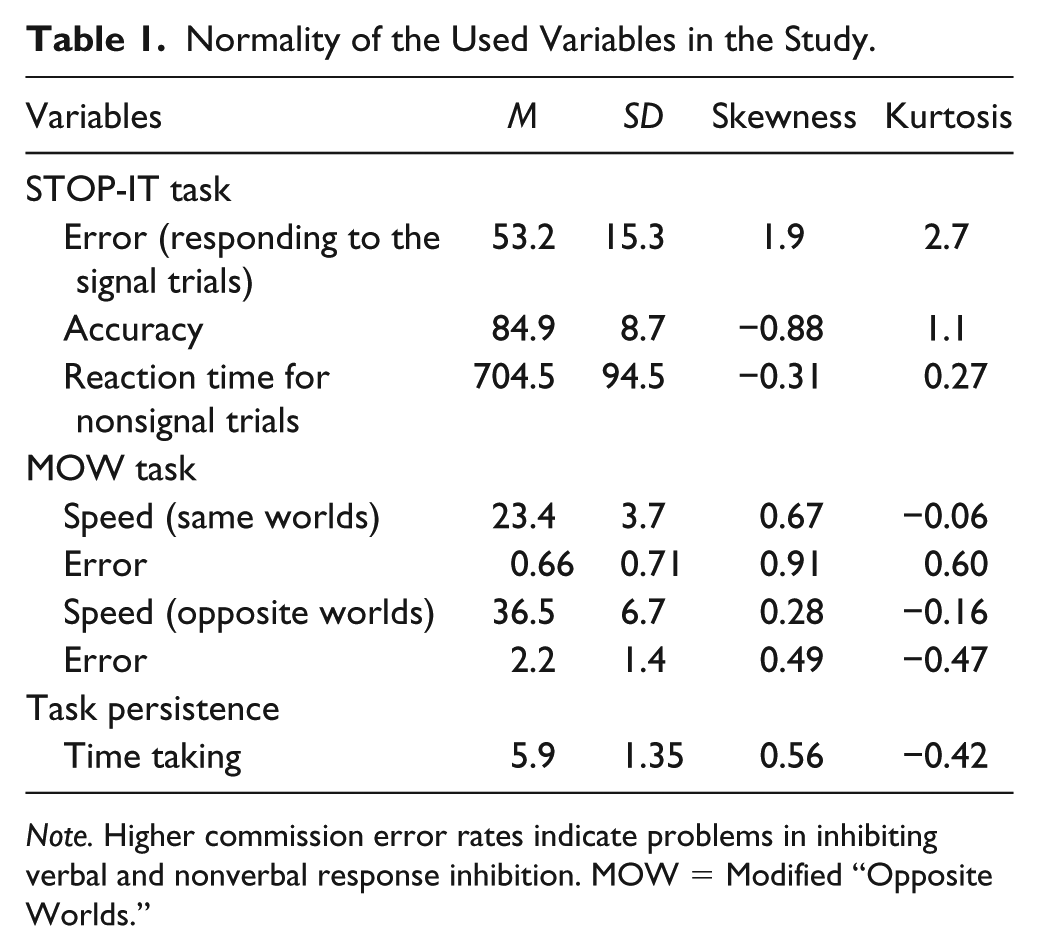
Note. Higher commission error rates indicate problems in inhibiting verbal and nonverbal response inhibition. MOW = Modified “Opposite Worlds.”
Results
Are Children With Poor Parental Monitoring at Risk for the Development of Difficulties in Executive Function?
STOP-IT task
Based on the existing literature, we hypothesized that children experiencing poor parental monitoring might are at risk for the development of difficulties in executive function. Independent-sample t tests were performed to investigate this hypothesis. Preliminary assumption checking was carried out to test normality, and the data were sufficiently normal for the purpose of performing a t test. Furthermore, the assumption of homogeneity of variance was also checked via Levene’s F test (p> .05) as satisfied for most of the variables. Welch’s t test (equal variance not assumed between groups) was used when any variable violating the assumption of homogeneity of variance. Following this process, three dependent variables of executive function measured by STOP-IT task were tested: nonverbal response inhibition, reaction time for nonsignal trials (on correct responses), and accuracy. As shown in Table 2, a statistically significant difference (medium effect size) between children with poor and good parental monitoring was found for a fail response in nonverbal response inhibition, t(110) = 2.61, p< .05, d = .50, and accuracy, t(110) = −3.81, p< .01, d = −.72. However, no statistically significant in reaction time was found between children with poor and good parental monitoring,t(110) = 1.1, n.s.
Mean Differences in Variables Assessed by STOP-IT Task Between Children With Poor and Good Parental Monitoring.
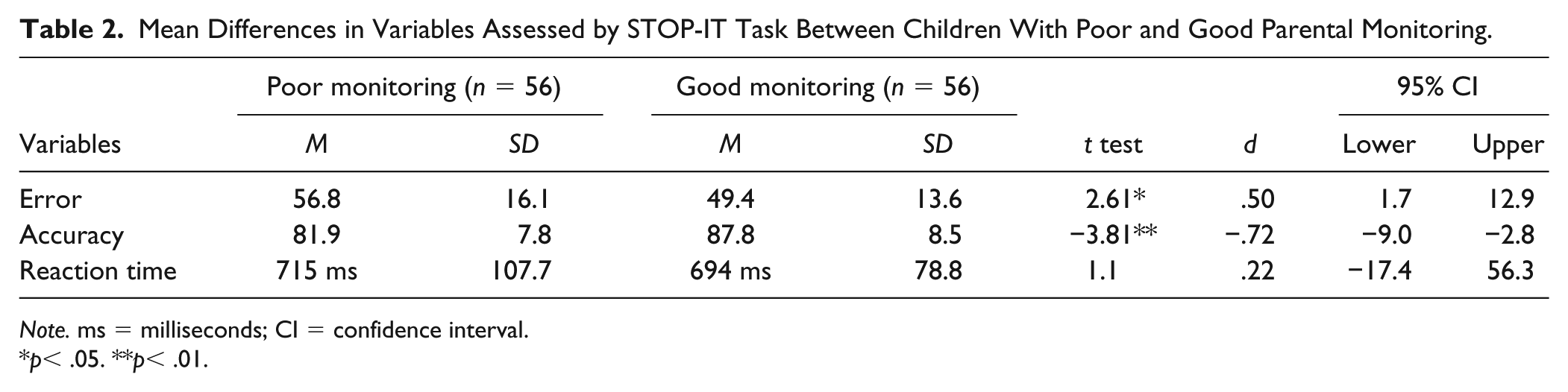
Note. ms = milliseconds; CI = confidence interval.
p< .05. **p< .01.
Furthermore, we examined group differences to test the hypothesis that children with hyperactivity have deficits in executive functions. The analysis revealed significant differences between children with low and high level of hyperactivity in response inhibition, t(110) = 2.82, p< .05, d = .53, and accuracy, t(110) = −3.41, p< .01, d = −.67. Surprisingly, in spite of having slower reaction times on the trials among hyperactive children, no significant differences were found t(110) = .98, n.s. compared with the control group (see Table 3).
Mean Differences in Variables Assessed by STOP-IT Task Between Children With Hyperactivity and Control Group.

Note. In this analysis, hyperactivity has been used as a categorical independent variable giving (1 = low level, 2 = high level of hyperactivity). ms = milliseconds; CI = confidence interval.
p< .05. **p< .01.
MOW task
To examine the group differences in the speed and accuracy (number of error) in the opposite conditions assessed by (MOW), one-way ANCOVA was performed using speed and accuracy in the normal conditions as covariates. Prior to conducting the analysis, the data were checked to make sure that they met the assumptions concerning homogeneity of regression slopes (p> .05 and homogeneity of variances (Levene’s F test, p> .05). There were no outliers as assessed by standardized residuals with no cases greater than ±3.29 standard deviations.
The results of one-way ANCOVA showed a statistically significant group differences on each of speed, F(1, 109) = 7.6, p< .01,
Similarly, based on their hyperactivity level, significant group differences were also found in speed, F(1, 109) = 7.2, p< .01,
Task persistence
For task persistence, the data of 82% (n = 92) children were analyzed for this task. As mentioned, this is because 18% (n = 20 children) could solve the puzzle quickly; therefore, we were not able to measure any persistence. Consequently, the mean scores for children with poor parental monitoring (n = 50) and good parental monitoring (n = 42) on task persistence were analyzed to find the group difference on task persistence. After meeting the assumptions, the result of independent-sample t test showed no significant difference between children with poor parental monitoring (M = 5.7/SD = 1.2) and good parental monitoring (M = 6.18/SD = 1.4) on task persistence t(90) = −1.72, n.s. However, the finding revealed a significant group difference on task persistence based on those children’s hyperactivity levels, t(90) = −2.61, p< .05, d = −.64. The mean scores for children with high level of hyperactivity (n = 39) was (M = 5.50/SD = 1.1), whereas for children with low level of hyperactivity, n = 53 was M = 6.3/SD = 1.4, suggesting that hyperactive children took shorter times (gave up sooner) in the task than the control group.
Does parental monitoring moderate the relationship between executive function and hyperactivity?
To test the hypothesis that parental monitoring acts as a significant moderator in the relationship between executive functions and hyperactivity problem, the PROCESS analysis by Hayes (2013) was used. Parental monitoring was treated as a categorical moderator variable. It should be mentioned, however, that at this analysis the data which has already been collected for hyperactivity was used as a continuous DV variable. Consequently, for STOP-IT task variables as shown in Figure 2a and b, the moderation analysis found no significant role of the parental monitoring in the relationship between nonverbal response inhibition and hyperactivity, B = .034, t = 1.11, interaction p value = .27, confidence interval (CI) = [–.026, .094]. Similarly, the results found that the relationship between reaction time and hyperactivity was not moderated by parental monitoring, B = .01, t = 1.2, interaction p value = .23, CI = [–.004, .016]. However, as shown in the Figure 2c, moderating role of parental monitoring was found between accuracy and hyperactivity, B = −.12, t = −2.20, interaction p value = .032, CI = [–.22, –.010], suggesting that the relationship between accuracy and hyperactivity differs across the two groups (i.e., children with poor parental monitoring vs. children with good parental monitoring).
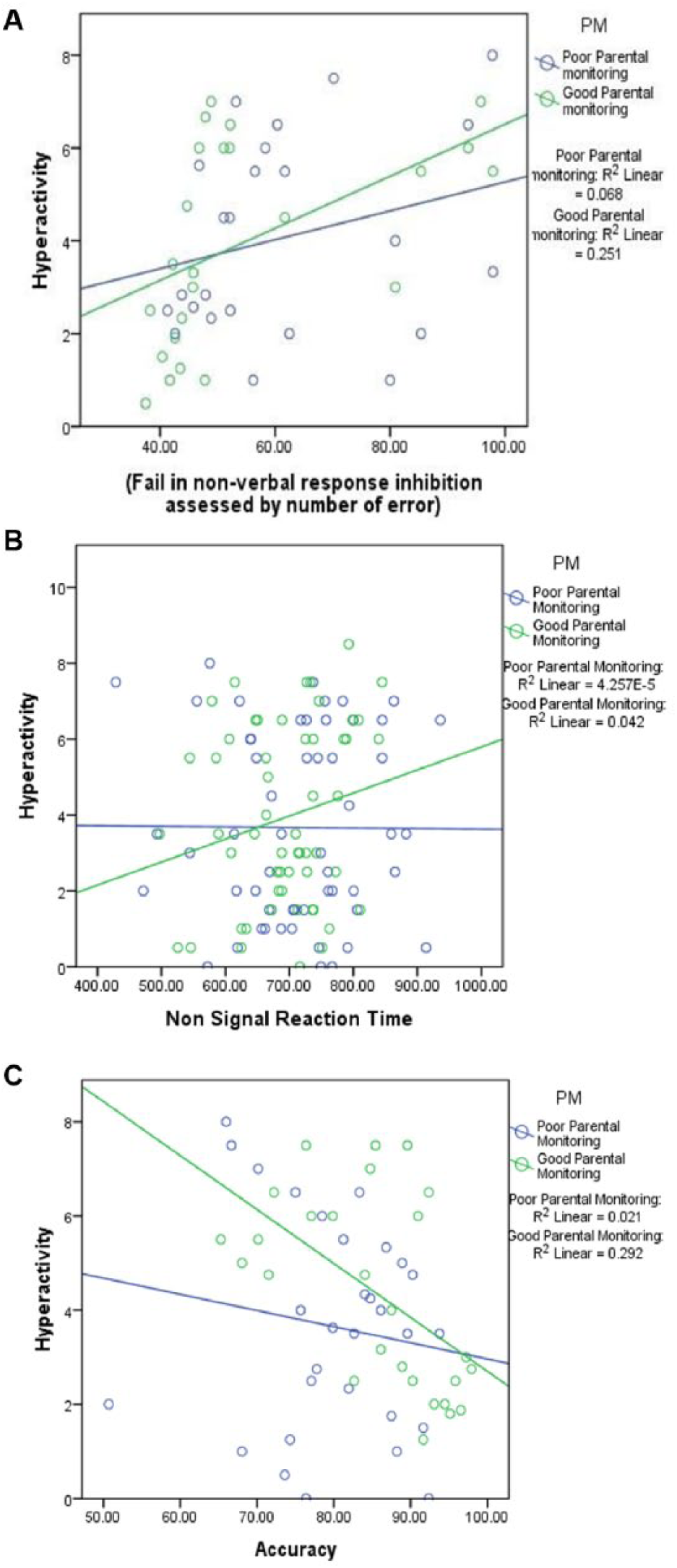
Moderating analysis of parental monitoring on the association between response inhibition, reaction time, and accuracy (assessed by STOP-IT task) and hyperactivity.
With respect to the MOW task, no significant interaction between parental monitoring and processing speed was found, B = −.06, t = −.84, interaction p value = .40, CI = [–.20, .080], thus confirming no moderating effect of parental monitoring in the relationship between processing speed and hyperactivity (see Figure 3a). However, as shown in the Figure 3b, the analysis revealed that parental monitoring acts as a moderator on the relationship between verbal response inhibition and hyperactivity, B = .72, t = 2.17, interaction p value = .03, CI = [.063, 1.37].
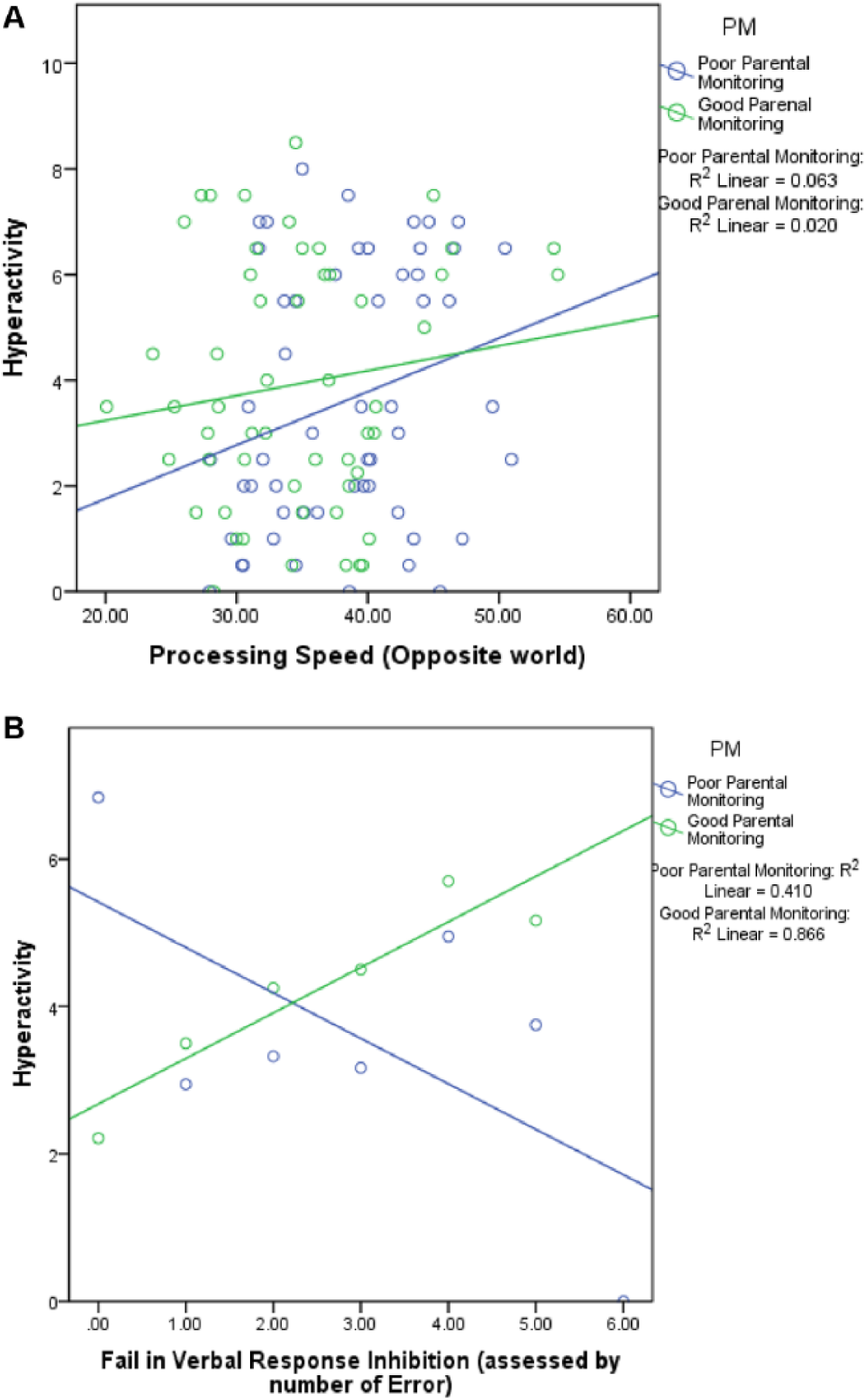
Moderating analysis of parental monitoring on the association between response processing speed and verbal inhibition (assessed by MOW task) and hyperactivity.
Furthermore, for task persistence, the moderation analysis confirmed that parental monitoring would emerge as a moderator in the relationship between task persistence and hyperactivity, B = −.91, t = −.2.4, interaction p value = .016, CI = [–1.64, –.17], suggesting that the relationship between task persistence and hyperactivity depend on the levels of parental monitoring (see Figure 4).

Moderating effect of parental monitoring on the association between task persistence and hyperactivity.
Discussion
This study was designed to test group differences (i.e., high vs. low hyperactivity) on components of executive function, namely verbal and nonverbal response inhibition, reaction time, processing speed, accuracy and task persistence, in Kurdish primary school children. Second, this study explored the possible moderating role of parental monitoring in the relationship between executive function and hyperactivity among these children.
The findings showed significant group differences in verbal and nonverbal response inhibition, processing speed, accuracy, and task persistence. More specifically, children with a history of poor parental monitoring exhibited poor inhibitory control, had significantly slower processing speeds, and made significantly more errors than controls. Consistent with previous studies (e.g., Hughes, Roman, & Ensor, 2014; Roskam et al., 2014), the current results suggest that parental monitoring plays a vital role in children’s executive function abilities. This could be because children of neglectful parents are less supported, subsequently becoming less responsive and having less expectations being placed upon them, thus resulting in cognitive difficulties and trouble achieving academically (Baumrind, 1991; Spratt et al., 2012). Thus, children’s cognitive development can be improved by supportive parenting, including elaborating and explaining rules children need to follow when performing a specific task. The current findings support the claim that the development of children’s executive functions is likely to be affected in the absence of parental support and monitoring (Brody & Flor, 1998; Hughes et al., 2014; Roskam et al., 2014). Nonetheless, the analysis did not show a significant difference in reaction time between poor and good parental monitoring groups. A possible reason for this result might be that children in both groups were asked to respond to 192 trials, and this might have resulted in fatigue effects. Overall, the results confirm previous conclusions (e.g., Crossley & Buckner, 2012; Patock-Peckham et al., 2011; Roskam et al., 2014) that environmental factors such as parental monitoring are an important influence on children’s executive function.
Consistent with previous studies (Adams & Snowling, 2001; Codding, Lewandowski, & Gordon, 2001; Foley et al., 2008; Hoza et al., 2001; Rubia et al., 2001; Schroeder & Kelley, 2009; Willcutt et al., 2005), children who scored high on hyperactivity exhibited difficulties in executive functions. These children had higher commission errors, indicating fails in verbal and nonverbal response inhibition; they also performed more poorly in terms of accuracy, processing speed, and task persistence compared with the control group. Although children with high level of hyperactivity had slower reaction times on the STOP-IT task, no significant differences were found when compared with the “low” group. This finding is consistent with that of Karayanidis et al. (2000), who found no group difference in the reaction times of children with ADHD versus healthy controls. Nevertheless, Bolfer et al. (2010) and Booth et al. (2007) reported significantly slower reaction times among children diagnosed with ADHD. These inconsistencies in results reported might be a function of the clinical populations recruited for these studies and the type or nature of the tasks used to assess these variables. Another possible reason could also be that, given that hyperactive children are considered to be impulsive they might have randomly pressed the button which resulted in their reaction time to be fast and similar to the control group. This interpretation is supported by the “hyperactive” group committing significantly more errors in the accuracy variable compared with the control group. As such, the findings of the present study lend further support to the mounting evidence that children with hyperactivity and issues pertaining to parental monitoring also exhibit impaired executive functions. We found that children with poor parental monitoring and high levels of hyperactivity had more difficulty with inhibition as compared with controls, which in turn, might have led to issues pertaining to other functions. This is consistent with Barkley’s theory (1997) that inhibition is a controlling function in relation to other executive functions and that difficulties in inhibition control might adversely influence other executive functions.
Regarding the moderation model, the findings support previous research (e.g., O’Hara & Holmbeck, 2013) who found the moderating role of parenting behaviors. Our moderation model indicated that the relationships between each of verbal inhibition (assessed by the number of error in the MOW task), accuracy (assessed by the STOP-IT task), and task persistence with hyperactivity were moderated by parental monitoring. More specifically, there was a positive relationship between verbal inhibition difficulties and hyperactivity only for those children who were characterized by good parental monitoring. This finding suggests that the easier the verbal inhibition task is for children with good parental monitoring, the less hyperactive they are. In addition, the model showed that the relationships between task persistence and accuracy with hyperactivity were significantly negative for children with good parental monitoring, whereas, it was not the case for children with poor parental monitoring. These findings also suggest that the more persistence and the more accurate children with good parental monitoring are, the lower their tendency to be hyperactive. However, the moderation model did not confirm that parental monitoring significantly moderates the association between nonverbal inhibition, reaction time, and processing speed with hyperactivity, suggesting that the direction of the relationships were similar in both groups of children (i.e., with poor and good parental monitoring). One possible reason for nonsignificant moderation effect for these executive variables might be related to the nature of the tasks being used to measure them. For instance, we found a moderating role of parental monitoring in the relationship between verbal inhibition using MOW and hyperactivity; however, this was not the case for nonverbal inhibition using STOP-IT task. Furthermore, a possible reason for reaction time might be that this variable is a “low” attentional function compared with other executive functions; therefore, it may be less affected by parental style. Taken together, current study reveals a correlation between certain executive functions and hyperactivity in children with good parenting. In contrast, in cases of poor parental monitoring, no correlation was found, suggesting that a decrease in parental monitoring reduces the impact of executive functions on hyperactivity. This shows that, when good parental monitoring is absent, executive functions might not attenuate hyperactivity in children or might exert less of an influence.
Previous studies indicate that executive deficits affect behavioral problems in children, including hyperactivity (Hughes et al., 2004; Willcutt et al., 2005). Conversely, improvements in executive function are associated with fewer externalizing problem behaviors and ADHD symptoms (Bohlin et al., 2012). Based on these studies, executive function significantly influences hyperactivity. Our study suggests a further possibility apart from conceptualizing executive function as the contributors to behavioral problem, namely that the impact of executive functions on hyperactivity might depend on the quality of parental monitoring. A possible explanation could be that children with good parental monitoring might have the opportunity to shape and develop their executive skills better, due to the fact that their parents explain and elaborate on the rules they must follow when performing a specific task (Crossley & Buckner, 2012; Roskam et al., 2014). Subsequently, these children are likely able to regulate their hyperactive or impulsive behavior when performing a particular executive task. However, a child with poor parental monitoring may not have a supportive environment and might therefore have less chance to develop their inhibitory/self-regulatory abilities which are developmentally crucial to regulate hyperactivity.
In conclusion, the current study suggests that, similar to hyperactivity, children with poor parental monitoring appear to have symptoms that are associated with control processes. Furthermore, our study highlights the significance of considering parental monitoring when seeking to understand the relationship between executive functions and hyperactivity. One of the main strengths of the current study is that the sample was tested in a developing country. In addition, it is the first study examining the moderating effect of an environmental factor such as parenting styles on executive function and hyperactivity in an Eastern society. Notwithstanding, the current study has a number of limitations. First, the current study relied on a sample of Kurdish children living in the Middle East; therefore, the findings of this study might not be generalizable to children of other ethnic groups. Second, a longitudinal study of children’s executive functions would allow for stronger conclusions. Third, children in this study were not clinically diagnosed as having ADHD. Their hyperactivity levels were rated by their parents and teachers. It is reasonable, therefore, to assume that their attentional problems were not as significant as one might expect of a clinical population, although keeping in mind the fact that there are very few clinical psychologists, the rate of ADHD might be underreported. In addition, it remains unclear whether the same results would be found with different ages (i.e., young and adolescents), something which future research might help to elucidate.
Implications for Practice
This study provides support for the argument that children with poor parental monitoring and high level of hyperactivity have impairments in executive functioning. We can anticipate that some of the children in this study will likely experience social, emotional, and intellectual impairment unless some action is taken to ameliorate their familial situations. Moreover, children who tend to have poor parental monitoring and hyperactivity also seem find it hard to pay attention in the classroom and therefore are at risk of being neglected in the educational setting, thus giving rise to further deteriorations in their executive functioning. Consequently, as children exposed to poor parental monitoring and hyperactivity respond similarly in assessments of executive functioning, we anticipate that interventions shown to improve the executive functioning of children with hyperactivity (Diamond & Lee, 2011) might be beneficial for children with poor parental monitoring. Children with difficulties in executive functions might also have problems with self-esteem. Therefore, these children should be encouraged to engage in activities designed to improve their cognitive abilities, including computerized training, noncomputerized games, aerobics, martial arts, yoga, mindfulness, and participation in the school curricula (Diamond & Lee, 2011).
Our results suggest that parental monitoring has an impact on executive functioning, which ultimately has long-term implications for children’s psychological and behavioral well-being. Moreover, the results of this study suggest that parents are instrumental in enhancing their children’s executive function skills and can be important allies in the treatment process. Therefore, the findings of the study indicate that primary care professionals, psychologists, and social workers need to play an important role in supporting parents by enacting strategies to reduce the negative effects of poor parental monitoring on the executive functions of children (Sangawi, Adams, & Reissland, 2018).
Footnotes
Declaration of Conflicting Interests
The author(s) declared no potential conflicts of interest with respect to the research, authorship, and/or publication of this article.
Funding
The author(s) received no financial support for the research, authorship, and/or publication of this article.