



Abstract
Objective:
Interference control is used to overcome conflict among competing memory representations and may contribute to memory difficulties in ADHD. This meta-analytic review examined memory interference to evaluate susceptibility to proactive, retroactive, and memory control interference among those with ADHD.
Method:
Twenty studies (1987–2019) examining verbal memory interference in ADHD met inclusion criteria (age: 8–36 years). Proactive and retroactive interference indices were extracted from list-learning tasks, and memory control indices were extracted from experimental paradigms (e.g., directed-forgetting).
Results:
Children with ADHD were less affected by proactive interference (g=−0.53, 95% CI [−0.75, −0.31]), whereas no significant differences were found in adults (g=0.13, 95% CI [−0.02, 0.28]). Adults and children with ADHD exhibited more retroactive interference (g=0.17, 95% CI [0.05, 0.29]) and performed worse on memory control tasks (g=0.35, 95% CI [0.08, 0.62]) relative to controls.
Conclusion:
Differences in verbal memory interference control in ADHD were observed but effects were different depending upon interference type and participant age.
ADHD is a neurodevelopmental disorder characterized by clinically impairing symptoms of inattention, hyperactivity, and impulsivity (American Psychiatric Association, 2013). A diagnosis of ADHD is often associated with deleterious outcomes such as social difficulties, occupational challenges, and academic problems (Arnold et al., 2020; Erskine et al., 2016). Academic difficulties are of particular concern, as individuals with ADHD consistently demonstrate lower report card grades and grade point averages relative to their peers (Jangmo et al., 2019; Loe & Feldman, 2007). Individuals with ADHD also have higher rates of grade retention, special education placement, learning disabilities, and high school/college (Biederman et al., 1996; DuPaul et al., 2018; Loe & Feldman, 2007). These educational difficulties may, in part, be due to learning-related challenges associated with verbal memory and potentially explain the adverse academic and occupational outcomes common among those diagnosed with ADHD.
Memory difficulties in ADHD populations have been documented consistently. Experimental studies and meta-analytic reviews find that children and adults with ADHD demonstrate weaknesses in both verbal and visual short- (Dovis et al., 2013; Rapport et al., 2008) and long- (Schoechlin & Engel, 2005) term memory. Meta-analytic reviews document greater impairments in verbal long-term memory relative to visual long-term memory in adults with ADHD (Schoechlin & Engel, 2005). Additionally, extant research of verbal long-term memory difficulties indicates significant weaknesses in initial learning of information among children and adults diagnosed with ADHD, while retrieval processes that access long-term memories appear to be intact (Egeland et al., 2010; Skodzik et al., 2017). For example, children with ADHD recall fewer words at immediate recall, indicating poor initial learning of information. However, the mechanisms responsible for recall difficulties are understudied in ADHD populations and warrant investigation given (a) the large-magnitude deficits observed within this population and (b) strong relations between verbal memory and important, ecologically valid outcomes such as academic achievement (Schneider & Niklas, 2017).
One potential mechanism to explain the poor immediate memory recall observed among those with ADHD is inadequate interference control. Interference control is a type of executive control process that is used to distinguish between competing memory representations (Jonides & Nee, 2006; Nelson et al., 2003; Unsworth, 2010; see Festini & Katz, 2021) or stop irrelevant memory traces from accessing the focus of attention (Friedman & Miyake, 2004). Successful interference control often requires the removal or inhibition of non-relevant items from memory (Ecker et al., 2014; Fawcett & Taylor, 2008; Oberauer & Lewandowsky, 2016), and inhibition difficulties are hypothesized as an underlying deficit in etiological theories of ADHD (Barkley, 1997). Poor interference control may affect learning and recall in several ways. For example, interference due to distraction or inattention at encoding can prevent relevant information from initially accessing memory systems (Clapp et al., 2010). Interference at retrieval, when memory traces are re-activated, may increase competition between similar memory representations wherein irrelevant traces vie for activation and retrieval (Anderson & Neely, 1996; Bjork, 1989). Because interference control involves executive functions shown to be impaired among children with ADHD (Barkley, 1997; Willcutt et al., 2005) and is a requisite and critically important process for successful memory recall, it stands to reason that deficiencies in interference control may contribute to the memory deficits observed in ADHD.
To date, several studies have examined memory interference among those with ADHD; however, the findings are equivocal. For example, one study found that children with ADHD evince less susceptibility to memory interference relative to a control group (Egeland et al., 2010), whereas no differences in memory interference have been observed in adult samples with ADHD compared to control groups (Vakil et al., 2012; Weyandt et al., 2013; see Holdnack et al., 1995 for an exception). In contrast, other studies have indicated that children with ADHD demonstrate more susceptibility to interference (Egeland et al., 2010). Additionally, adults with ADHD are less able to selectively forget information (White & Marks, 2004) and demonstrate worse ability to control certain aspects of their memory (e.g., retrieval induced forgetting; Storm & White, 2010) relative to neurotypical peers. These inconsistencies likely reflect varied methodological approaches employed in the respective studies. Critically, memory interference has been measured using different experimental paradigms (e.g., list-learning, directed forgetting tasks, retrieval-induced forgetting tasks) and assesses varied aspects of interference control (e.g., proactive interference, retroactive interference). In the present study, our team attempts to provide clarity to the discrepant literature by critically reviewing and meta-analyzing studies that examine interference control among patients with ADHD.
Constructs of Memory Interference
Proactive interference (PI) occurs when prior learning interferes with information learned more recently. PI is evident, for example, when individuals experience difficulty remembering a new telephone number because a previously-learned telephone number hinders learning the new number. List-learning tasks (e.g., California Verbal Learning Test [CVLT]) with a secondary learning trial are often used to measure PI. 1 PI can be calculated by subtracting the number of words recalled from the first presentation of a list from the number of words recalled from the first presentation of a second list (Donders, 2006). The evidence for differences in PI among those with ADHD compared to controls is equivocal, as some studies document that children and adults with ADHD appear to be less susceptible to PI (Egeland et al., 2010; Holdnack et al., 1995) while other studies report no differences in PI among children and adults with ADHD relative to typically developing peers (Cutting et al., 2003; Vakil et al., 2012; Weyandt et al., 2013).
Retroactive interference (RI) occurs when prior learning is impacted by new information. For example, RI is evident when individuals experience difficulty recalling previous addresses after learning a new one. RI is reflected in list-learning tasks when participants recall fewer words from an original list after learning a second list 2 (Donders, 2006). To date, only four published studies have examined RI among individuals with ADHD. These studies are similarly mixed with some indicating that children with ADHD are more susceptible to RI (Egeland et al., 2010), while others indicate no differential patterns of RI effects among children and adults with ADHD and neurotypical controls (Cutting et al., 2003; Holdnack et al., 1995; Vakil et al., 2012).
Directed forgetting tasks require participants to exert memory control by instructing participants to forget a subset of previously learned information (see MacLeod, 1998 for review). Directed forgetting requires interference control, as participants must control their memory contents to disregard to-be-forgotten information in favor of the more relevant to-be-remembered memoranda (e.g., Festini & Reuter-Lorenz, 2017; Oberauer, 2001). Directed forgetting effects have frequently been documented, such that participants are capable of following the forget instructions and demonstrating superior memory for to-be-remembered memoranda relative to to-be-forgotten memoranda, termed the Directed Forgetting Effect (Remember minus Forget; e.g., Bjork et al., 1998; Festini & Reuter-Lorenz, 2017; MacLeod, 1998). Two published studies have investigated directed forgetting in ADHD samples. One study found that compared to controls, adults with ADHD were less able to selectively forget information when instructed to (White & Marks, 2004); whereas, a second study reported no difference between children with ADHD and neurotypical children on tasks of directed forgetting (Gaultney et al., 1999).
Memory control has also been investigated with n-back, retrieval-induced forgetting, and value-directed memory tasks. The n-back task is a working memory task where a stream of memoranda are presented one-at-a-time, and the participant must decide if the current stimulus matches the one that was presented n-trials previously (Gray et al., 2003; Jonides & Nee, 2006). The number of trials (n) can be adjusted to affect task difficulty. Moreover, “lure” trials can be presented in which the current trial does not match the proper n-back trial, but it does match a trial that was in close temporal proximity to the correct trial, such as trial n+1 or trial n−1. Participants are more likely to erroneously respond on lure trials due to memory interference (Gray et al., 2003). Retrieval-induced forgetting is another task paradigm assessing the oft-reported phenomenon that it is more difficult for a person to remember non-retrieved information from a category than if they have previously recalled an item from that same category (Anderson et al., 1994). That is, the act of retrieving related memoranda interferes with the ability to later recall the non-retrieved memoranda. Value-directed memory is an additional memory control task in which individuals are told to remember a list of memoranda and pay particular attention to high-value items (e.g., each item is paired with a high- or low-value). For example, the words “table,” “donkey,” and “apple” are paired with 8-, 10-, and 12-point values, respectively. If participants remember all three words, they earn 30 points. Participants are incentivized to earn more points in exchange for better prizes after completing the task (e.g., see Castel et al., 2011). Participants typically remember more memoranda that were paired with high, rather than low, values (e.g., Castel et al., 2011). Although these tasks have been implemented less often in ADHD samples, they also reflect the ability to implement executive control over the contents of their memory to manage memory interference. We nonetheless included these tasks within the present review to fully assess memory interference among those with ADHD.
Collectively, it remains unclear whether those with ADHD demonstrate increased susceptibility to verbal memory interference, as studies document that individuals with ADHD are less, more, or equally susceptible to memory interference relative to peers. These differences may be explained by methodological differences, how memory interference was measured, task-specific characteristics (e.g., task difficulty level), and/or study characteristics (e.g., diagnostic rigor). One particularly critical moderating factor that could explain the observed between-study heterogeneity is the age of participants within studies. Children with ADHD evince significantly underdeveloped and underactive cortical and subcortical neural structures that support memory encoding, recall, and retrieval relative to peers (Al-Amin et al., 2018; Shaw et al., 2007). By adulthood, many of the identified structural and functional deficits are no longer evident (Hoogman et al., 2019). This appears consistent with the pattern of findings among studies examining ADHD-related proactive interference. For example, one study found that children with ADHD show less susceptibility to proactive interference compared to peers (Egeland et al., 2010), whereas no differences in proactive interference have been observed in adult samples (Vakil et al., 2012; Weyandt et al., 2013; see Holdnack et al., 1995 for an exception). However, meta-regression techniques would be necessary to confirm this hypothesis and is a goal of the present meta-analysis.
The purpose of the current meta-analysis is to identify and quantify the magnitude of differences in verbal memory interference in ADHD populations relative to typically developing controls as well as to identify patterns and moderators that may provide clarity to the equivocal literature on ADHD-related memory interference deficits. More specifically, the current study examines PI, RI, and other types of memory control (e.g., directed forgetting, retrieval-induced forgetting) in participants with ADHD relative to neurotypical participants. Based on the prior literature (Egeland et al., 2010; Holdnack et al., 1995; Vakil et al., 2012; Weyandt et al., 2013), we hypothesize that individuals with ADHD will be less impacted by PI compared their peers. We also hypothesize that individuals with ADHD will be more impacted by RI during list-learning tasks compared to non-ADHD control groups, consistent with findings from studies examining RI directly (Egeland et al., 2010). Because other investigations examining measures of memory interference control (e.g., directed forgetting, value-directed memory, retrieval-induced forgetting) have reported performance decrements in ADHD groups (Castel et al., 2011; Storm & White, 2010; White & Marks, 2004) we similarly hypothesize that individuals with ADHD will perform worse on these memory control tasks relative to their non-ADHD peers.
Method
Literature Searches
We conducted a three-tier literature search using PsycINFO, PsycArticles, PsycBooks, Proquest Dissertation and Theses, Medline, PubMed, and Social Science Citation Index (for tier-III searches). Tier-I search involved using search terms to locate studies relevant to memory interference in individuals with ADHD using the search engines described above. Search terms included permutations of attention dysfunction or the diagnostic label of ADHD (i.e., ADHD, ADD, attention deficit hyperactivity disorder, attention deficit disorder, attention problems, attention deficits) coupled with additional search terms to identify studies of memory interference (i.e., memory interference, interference in memory, interference control, cognitive control, memory control, proactive interference, retroactive interference, directed forgetting, inhibition of return, value-directed remembering, retrieval-induced forgetting, misinformation effect) and/or studies that included potential memory interference tasks (e.g., California Verbal Learning Test, CVLT, Rey Auditory Verbal Learning Test, RAVLT, Children’s Auditory Verbal Learning Test, n-back, updating working memory, Brown Peterson, AB-AC-AD). No search delimiters were indicated, and studies from all publication years, publication types, and geographical locations were eligible for inclusion. Independent searches were conducted by three of the authors (SAO, SBF, EKY) until no new studies were found. A Tier II backward search and a Tier III forward search (using Web of Science: Social Science Citation Index) was conducted to find additional studies that were cited by the identified study or which cited the originally identified articles, respectively. Search procedures were completed in August 2020 and yielded 1,395 peer-reviewed journal articles, 60 books/book chapters, 100 dissertations, 2 theses, 6 abstracts, 7 corrigendums, and 1 unpublished manuscript (See Prisma Chart, Figure 1).

PISMA chart.
Inclusion and Exclusion Criteria
Studies were included in the meta-analysis if they met the participant, memory interference task, and methodological criteria described below, and were published or available in English. Titles and abstracts of each study in the three-tier literature search was initially screened by two of the authors based upon the inclusion/exclusion criteria. Full text reviews of studies meeting initial inclusion criteria were conducted by three author (SAO, SBF, EKY). Studies were included in the meta-analysis based on authors agreement across three of the study’s authors. Title, abstracts, and full texts were considered sequentially when determining eligibility. Classification of the moderator variables described below were independently coded and then reviewed by two of additional authors. The first author (SAO) was involved with all coding decisions. All disagreements were resolved by consensus among three authors (SAO, SBF, EKY).
Inclusion criteria for the meta-analysis required the presence of ADHD or attention dysfunction in study participants who were compared to a typically developing control group. All age groups, including children and adults, were included. Studies were included in the meta-analysis if they examined assessments of verbal immediate memory recall of items from an initial list and an interference list or an interference component (e.g., a word list or a letter) where the primary objective was to recall information different than the interference component. Memory interference tasks in the current study included list-learning tasks with an interference trial (e.g., CVLT, CVLT-C, RAVLT), directed forgetting tasks, a retrieval-induced forgetting task, a value-directed remembering task, and an n-back with lures. 3 Studies were excluded if they reflected (non-memory) inhibitory control tasks such as the Stroop, Flanker, Go/No-Go, Continuous Performance Tests (CPT) and Stop-Signal, as they reflect measures of prepotent-distractor inhibition rather than memory interference (Friedman & Miyake, 2004), or if the cognitive task did not include a measure of memory interference. In addition, studies that did not involve verbal recall of items from memory (e.g., semantic inhibition of return) 4 were also excluded. Studies examining visual immediate recall with an interference list were also excluded, as the present review exclusively examines verbal memory due to the robust differences observed in verbal versus visuospatial memory among those with ADHD (Kasper et al., 2012; Schoechlin & Engel, 2005).
Studies were required to provide sufficient data to calculate a memory interference score and/or interference effect size. For example, to calculate a proactive or retroactive interference score for the CVLT or RAVLT, arithmetic means and standard deviations were required for List A Trial 1 and List B (to calculate proactive interference) and List A Trial 5 and the Short Delay Free Recall (SDFR) trial (to calculate retroactive interference). Emails were sent to the first authors for four studies that contained partial data to calculate effect sizes, and two authors responded to our data request. Studies in which the authors did not respond to email requests (two studies) or did not provide sufficient data to calculate an effect size (two studies) were excluded from the meta-analysis. Non-empirical/review articles, meta-analyses, comments on articles/books, case study/single-subject designs, abstracts, corrigendums, non-English articles, and repeat data were also excluded. In addition, the full text of one study labeled as an unpublished manuscript found during the tier II backward search could not be located.
Included studies
Twenty studies published between 1987 and 2019 met criteria and were included in the review (see Table 1). These studies consisted of 14 empirical journal articles and 6 dissertations, and yielded 32 effect sizes. These studies assessed memory interference among list learning (k=13), directed forgetting (k=4), retrieval-induced forgetting (=1), value-directed memory (k=1), and lure n-back (k=1) tasks. Individual study characteristics are provided in Supplemental Appendix A.
Effects Size Table.
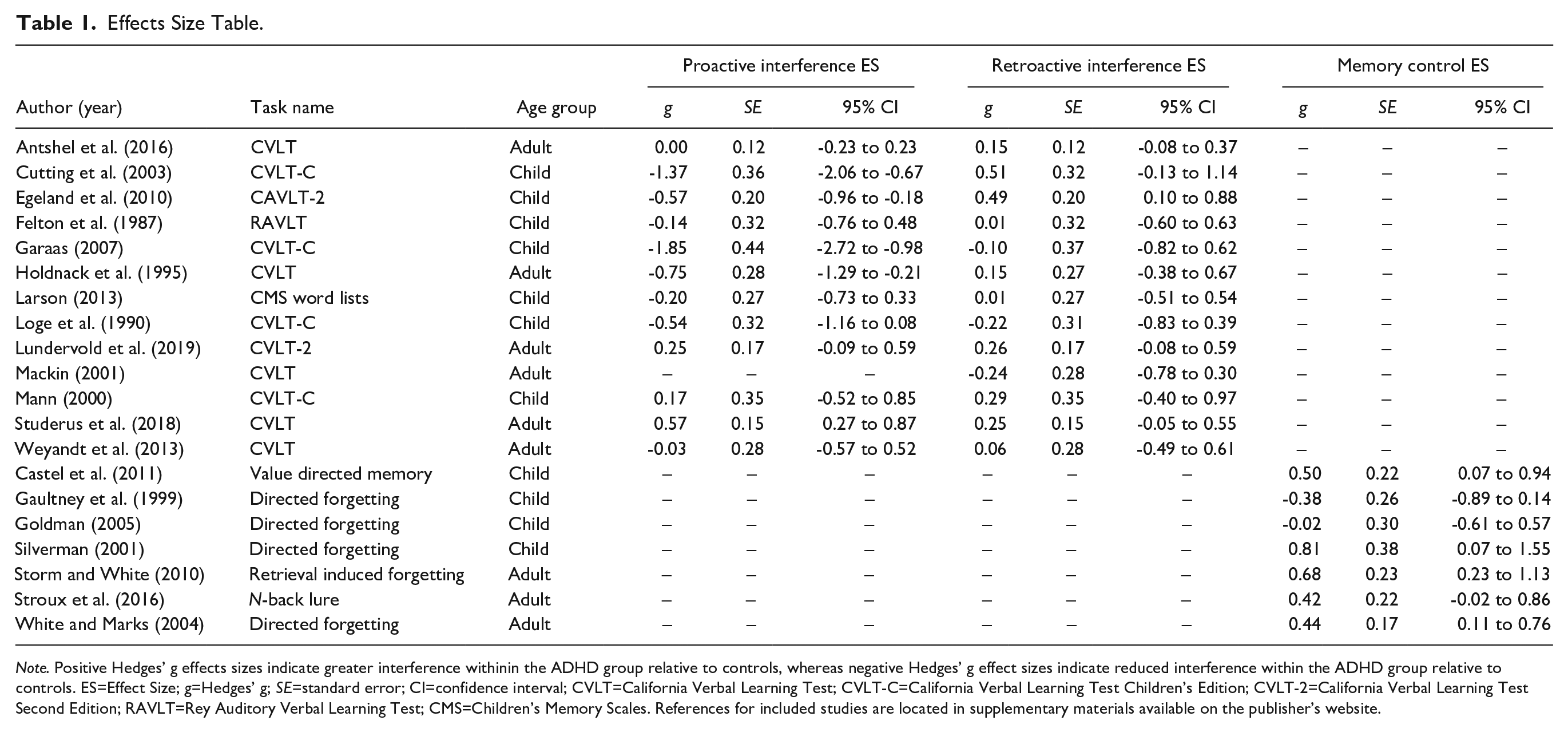
Note. Positive Hedges’ g effects sizes indicate greater interference withinin the ADHD group relative to controls, whereas negative Hedges’ g effect sizes indicate reduced interference within the ADHD group relative to controls. ES=Effect Size; g=Hedges’ g; SE=standard error; CI=confidence interval; CVLT=California Verbal Learning Test; CVLT-C=California Verbal Learning Test Children’s Edition; CVLT-2=California Verbal Learning Test Second Edition; RAVLT=Rey Auditory Verbal Learning Test; CMS=Children’s Memory Scales. References for included studies are located insupplementary materials available on the publisher’s website.
Study Level Variables
Variables coded as continuous moderators
Participant characteristics
Mean age in years of the entire sample was coded for the age moderator. A weighted mean age was calculated when age was reported by group. Percent female of the total sample was also coded as a continuous variable.
Task Difficulty
Number of words per learning list was coded as measure of task difficulty for each list learning, directed forgetting, retrieval-induced forgetting, and value-directed remembering task.
Variables coded as categorical moderators
ADHD participants
Studies were coded based on psychiatric medication use among ADHD participants and ADHD sample type. Psychiatric medication use was coded as an ordered categorical variable based on the medication status of the studies’ ADHD participants: 0=all unmedicated (k=7); 1=all unmedicated, as feasible (k=5); 2=majority unmedicated (i.e., <50%; k=2); 3=majority medicated (i.e., >50%; k=1). Five studies did not specify medication status. Sample type was coded as a categorical variable based upon the recruitment setting. A clinical setting was defined as a location where patients received psychiatric or behavioral treatment, such as an outpatient clinic. A community setting was defined as a referral source or setting that did not explicitly provide psychiatric services, such as a school, college, or general health provider. Categorical codings were as follows: 0=community (k=6); 1=mixed (k=6); 2=clinical (k=7). One study did not specify the referral source.
Control participants
An ordered categorical variable was coded based on the number of demographic characteristics (e.g., age, gender) which each study matched their ADHD and comparison groups. Ordered categorical variables of matched characteristics were as follows: 0=no matching (k=13); 1=matched on 1 to 2 characteristics (k=5); 2=matched on 3 to 4 characteristics (k=2).
Diagnostic rigor
An ordered categorical variable was coded based on the ADHD diagnostic method reported by each study, with higher scores representing greater rigor: 0=previously reported diagnosis or referral (k=1);1=single informant questionnaire or interview (k=10); 2=multiple informant questionnaires or interview (k=3); 3=multiple informant report based on normed questionnaires and gold standard clinical interviews (k=5). One study did not specify their ADHD diagnostic process.
Planned Analyses
Three separate analyses were conducted to examine the effects of proactive interference, retroactive interference, and memory interference control. If significant heterogeneity was evident among one or more of the three analyses, moderator analyses were conducted using a tiered approach. Due to the limited number of studies in each analysis, we chose to limit the moderators that were examined. We examine age and task difficulty as continuous moderators first, as these two variables were noted in previous studies to explain inconsistencies in between group differences in memory interference (Egeland et al., 2010; White & Marks, 2004). Additional categorical variables (i.e., psychiatric medication use, sample type, matched group sample, and diagnostic rigor) were planned following the continuous moderator analysis using mixed effects maximum likelihood analog to ANOVA if significant between-study heterogeneity remained at the overall study level after accounting for the continuous variables. Four tests of publication bias were used for each analysis: Fail-safe N, Begg and Mazumdar’s rank correlation test, Egger’s test of the intercept, Duval and Tweedie’s trim-and-fill procedure, consistent with best-practice recommendations (Borenstein et al., 2009).
Calculation of memory interference
For the first and second analyses examining proactive and retroactive interference, effect sizes were calculated one of two ways. First, means and standard deviations of the proactive and retroactive interference scores reported by individual studies were entered into Comprehensive Meta-Analysis (CMA Version 3.3, 2014) allowing for a between-group comparison. If studies did not report a proactive or retroactive interference score, difference scores were calculated using CMA by conducting a pre-post within-study comparison. For proactive interference, means and standard deviations for List B were entered as the post-score and means and standard deviations for List A Trial 1 were entered as the pre-score. For retroactive interference, means and standard deviations for Short Delay Free Recall were entered as the post-score and means and standard deviations for List A Trial 5 were entered as the pre-score. A pre-post correlation of .50 was assumed when these data were not reported. 5
For the third analysis examining memory control among other memory interference tasks (i.e., directed forgetting, value-directed memory, retrieval-induced forgetting, n-back with lure), interference scores were calculated based on the original study’s recommendations. For studies examining directed forgetting effects, effect sizes were calculated using CMA by conducting a pre-post within-study comparison for remember versus forget items. More specifically, the means and standard deviations for the items the participants were told to remember was entered as a post-score and the means and standard deviations for the items the participants were told to forget was entered as the pre-score. For value-directed memory, means and standard deviations for the selectivity scores (i.e., a participant’s tendency to recall high-value words more often than low-value words) were entered for effect size calculation. For retrieval-induced forgetting, difference scores were calculated for the category-plus-stem-cued recall portion of the task, based on the study’s recommendations (Storm & White, 2010). More specifically, the means and standard deviations for the words the participants did not receive retrieval practice were entered as the post-score, and words of categories that were not practiced and presented in the first half of the block were entered as the pre-score. Similar to the directed forgetting effect size calculation, effect sizes were calculated for retrieval-induced forgetting by utilizing a pre-post within-study comparison in CMA. For the n-back task with lures, means and standard deviations for the sensitivity index, which reflects the ability to accurately discriminate between targets and lures, were entered as the interference score. More specifically, the equation for the sensitivity index is as follows: ln{[H(1−FA)/(1−H)FA]} where ln=natural log, H=proportion of hits, FA=proportion of false alarms (Stroux et al., 2016). High values of the sensitivity index indicate an accurate discrimination between targets and simple targets as well as between targets and lures.
Computation of effect sizes
Means and standard deviations of interference scores as well as sample sizes were used to calculate Hedges’ g effect sizes and 95% confidence interval using CMA. Hedges’ g effect sizes are corrected for study sample size due to the upward bias in effect size magnitude for small-N studies (Lipsey & Wilson, 2001). Hedges’ g effect sizes are in standard deviation units, such that an effect size of 1.0 indicates that two groups differ by one standard deviation. An effect size of 0.2 is considered small, 0.5 is medium, and 0.8 is large (Cohen, 1988). Positive effects sizes reflect that the ADHD group had experienced more interference than the control group, whereas negative effects sizes reflect that the ADHD group had experienced less interference than the control group. Overall effect sizes were computed using a random effects model in which each study is weighted by its inverse variance weight (1/SE2) as recommended by Hunter and Schmidt (2004). Meta-analysis macros for SPSS (Lipsey & Wilson, 2001) using random/mixed effects were used for all moderator analyses, and random effects models with inverse variance weighting were used for effect size calculation and all moderator analyses to correct for study-level sampling error.
Multiple effect sizes
Several studies reported data to calculate multiple effect sizes for memory interference. This was due to studies examining different groups of participants within the same study (e.g., ADHD combined and inattentive groups, ADHD groups with different forms of a gene, comparing performance on neuropsychological tasks in the morning vs. evening) or two measures of memory control in the same study. To meet the independence assumption, only one effect size was used for each study in any given analysis (Lipsey & Wilson, 2001). Therefore, we selected the ADHD group that was most relevant to studying memory interference in the current study. For example, we chose to include ADHD combined presentation participants over inattentive presentation participants due to the well-documented difficulties with inhibitory control among those with the combined relative to inattentive presentations (Nigg, 2001). We also chose to include the ADHD sample positive for the 7-repeat allele of the D4 receptor gene in the Mann (2000) dissertation and the ADHD sample tested in the evening in the Garaas (2007) dissertation. Finally, we chose to include the directed forgetting measure in the Silverman (2001) dissertation. 6
Results
Proactive Interference: List Learning
A total of 12 studies reporting data on 641 individuals with ADHD and 577 typically developing individuals without psychological disorders were included in analyses examining proactive interference during list-learning tasks (see Table 1 for Hedges’ g effect sizes; see Figure 2 for Forest Plots). Across all studies, individuals with ADHD and typically developing individuals did not have significantly different levels of proactive interference (PI; g=−0.31, 95% CI [−0.63, 0.02]). However, the overall test of homogeneity was significant, suggesting that there was more variance among effect sizes than would be expected based on study-level error alone and supports the analysis of potential moderators (Q=66.02, df=11, p<.001).

Forest Plots for proactive interference, retroactive interference, and memory control analyses.
Continuous Moderators of Proactive Interference
A mixed effects weighted regression was conducted with SPSS to examine the influence of multiple moderators in a single regression model. The regression model examined mean age and task difficulty as potential moderators of PI. Measures of overall fit (QR) and an error/residual term (QE) are calculated in the weighted regression model. A significant QR indicates that the model accounts for significant variability among effect sizes. A significant QE indicates that the residual variance is greater than what is expected from random study-level sampling error (Lipsey & Wilson, 2001). Both statistics are represented as chi-square. The mixed effects weighted regression analysis indicated that the model explained a significant degree of between-study variance (R2=0.35, QR=9.21, df=2, p=.018). Only age (B=0.04, p=.011) was a significant predictor (task difficulty p=.580). No residual between-study variance remained after accounting for the model (QE=14.85, df=9, p=.095); therefore, these findings indicate that this regression model was sufficient to account for between-study heterogeneity in effect size magnitude, and that additional moderator analyses are not warranted. 7
An exploratory analysis was conducted to examine the magnitude of effect size difference in PI between child and adult studies. A medium effect size difference in PI scores for child-only studies (i.e., samples <18 years of age) was evident (g=−0.53, 95% CI [−0.75, −0.31],and k=7), indicating less PI in children with ADHD compared to children without ADHD; in contrast, the effect size was not significant (g=0.13, 95% CI [−0.02, 0.28], k=5) for adult-only studies (i.e., samples >18 years of age), indicating no difference in PI for adults with and without ADHD. However, given the limited number of studies in each age group, these results should be interpreted with caution.
Retroactive Interference: List Learning
A total of 13 studies reporting data on 701 individuals with ADHD and 601 typically developing individuals without psychological disorders were included in analyses examining retroactive interference (RI) during list-learning tasks (Table 1; Figure 2). Relative to the PI results discussed above, the results for RI showed a different pattern. Namely, individuals with ADHD across studies were significantly more affected by RI compared to individuals without ADHD (g=0.17, 95% CI [0.05, 0.29]). The overall test of homogeneity was not significant, suggesting that there was no additional variance among effect sizes beyond error variance (Q=9.39, df=12, p=.670). Therefore, moderators were not explored for RI.
Memory Control Interference
A total of seven studies reporting data on 271 individuals with ADHD and 278 typically developing individuals without psychological disorders were included in analyses examining memory control interference (Table 1; Figure 2). Across all studies examining constructs of memory control, individuals with ADHD demonstrated worse control over memory relative to typically developing individuals (g=0.35, 95% CI [0.08, 0.62]). The overall test of homogeneity was significant (Q=13.56, df=6, p=.035); however, moderators were not explored for tasks assessing for memory control due to the limited number of studies in this analysis as recommended (Borenstein et al., 2009; Higgins et al., 2019).
Publication Bias
Four tests of publication bias were used for each analysis (i.e., Fail-safe N, Begg and Mazumdar’s rank correlation test, Egger’s test of the intercept, and Duval and Tweedie’s trim-and-fill procedure; Lipsey & Wilson, 2001). These analyses are provided in Supplemental Appendix B. Overall, the analyses indicate that the publication bias was minimal and consistent across all three meta-analyses, and that publication bias correction procedures are not warranted; however, given the limited number of studies in each analysis, publication bias results should be interpreted with caution (Borenstein et al., 2009).
Discussion
The purpose of the current meta-analytic review was to examine whether individuals with ADHD show increased susceptibility to verbal memory interference relative to typically developing peers. The meta-analyses revealed significant differences in interference control over memory, with varying patterns of impairments depending upon the type of memory interference assessed. The present study is the first to examine meta-analytic evidence for the differential susceptibility to retroactive, proactive, and other forms of memory interference among those with ADHD.
Consistent with our hypotheses, individuals with ADHD exhibited more retroactive interference relative to peers without ADHD, although the effect size was small (g=0.17). In other words, learning novel information interfered with the ability to recall previously learned information. While examining the mechanisms underlying retroactive memory interference were beyond the scope of the present review, consideration of the neurocognitive deficits associated with an ADHD diagnosis may provide insight into our findings. Most contemporary models of ADHD implicate deficient executive functions, such as behavioral inhibition (Barkley, 1997) and/or working memory (Rapport et al., 2008; Willcutt et al., 2005) as core, potentially causal deficits associated with ADHD. Behavioral inhibition (BI) reflects the cognitive ability to suppress irrelevant information from interfering with a primary task or goal (Friedman & Miyake, 2004; Nigg, 2001), and is often impaired in ADHD populations (Alderson et al., 2007). Working memory (WM) reflects the ability to temporarily hold a limited amount of information (i.e., the storage component of working memory; Baddeley, 2007) while concurrently updating, monitoring, and focusing attention on relevant information held within working memory (i.e., the central executive component of working memory; Baddeley, 2007). Individuals with ADHD demonstrate weaknesses in both storage and central executive components of working memory relative to their peers (Kasper et al., 2012; Rapport et al., 2008). Interference control is an executive control process involved in both BI and WM that assists in overcoming conflict from competing information (e.g., Friedman & Miyake, 2004), including memory representations (see Festini & Katz, 2021; Irlbacher et al., 2014). ADHD-related weaknesses in executive functioning may impact the initial encoding, processing, and/or retrieval of information from memory due to the inability to reduce interference among different memoranda. That is, poor inhibitory control and difficulty focusing attention within working memory likely (a) potentiate the recall of prepotent, newly learned information while (b) simultaneously preventing the activation of prior memory traces, respectively. Moreover, neuroimaging findings indicate that the prefrontal cortex, which supports executive functioning, is both underdeveloped (Shaw et al., 2007) and underactive (Dickstein et al., 2006) in childhood ADHD and provides corroborating evidence for executive function-based etiological theories of the disorder. It is therefore likely that underlying executive processing deficiencies contribute to the increased susceptibility to retroactive interference observed within the present meta-analysis.
Also consistent with study hypotheses, individuals with ADHD experienced difficulty relative to peers on non-list learning measures of memory interference control, with a small effect size difference observed (g=0.35). The meta-analytic findings reflect data from diverse experimental paradigms including directed forgetting tasks, retrieval-induced forgetting tasks, value-directed remembering tasks, and n-back tasks that contain lures. As described previously, directed forgetting tasks require memory interference control because participants are asked to forget a subset of previously learned information and then, later, to recall the to-be-forgotten information. In non-clinical, healthy populations, individuals recall more words from the Remember relative to the Forget list, termed the Directed Forgetting Effect (e.g., Bjork et al., 1998). Deficient interference control of memory is evident when participants recall an equal number or more words from the Forget list relative to the Remember list, indicating that they did not successfully control their memory and forget the information that was cued as irrelevant. Two of the four studies included in the current meta-analysis found no difference in directed forgetting between children with and without ADHD (i.e., Gaultney et al., 1999; Goldman, 2005), whereas a study with adults (White & Marks, 2004) found a moderate effect size difference (g=0.44) and a study with children (Silverman, 2001) found a large effect size difference (g=0.81). The authors of the one published study with significant findings (White & Marks, 2004) noted that the discrepancy in findings may be due to the relative difficulty of the directed forgetting tasks and suggested that the directed forgetting task implemented in their study was likely more sensitive to the particular cognitive difficulties (e.g., working memory, task switching) experienced by individuals with ADHD. Given the small number of studies using this paradigm, we were not able to evaluate this notion. Future studies examining these various memory control paradigms in ADHD populations are needed to determine if these effects are stable or vary across paradigms.
Poor interference control abilities and/or low effort encoding strategies have also been implicated in ADHD-related differences in memory control. For example, a study examining value-directed memory (i.e., selective memory of high value words; Castel et al., 2011) found that while children with ADHD and typically developing children recalled a similar total number of words, children with ADHD recalled fewer high value words relative to the control group (g=0.50). The authors suggested that children with ADHD had difficulty strategically controlling their memory to preferentially encode high-value words and did not successfully discriminate between high- and low-value words. Another study (Storm & White, 2010) examining retrieval-induced forgetting in adults reported that individuals with ADHD did not demonstrate the typical retrieval-induced forgetting effect. Retrieval-induced forgetting occurs when retrieving related memoranda interferes with a person’s ability to later recall the non-retrieved memoranda. The ADHD group remembered both retrieved and non-retrieved words, compared to healthy controls who primarily recalled words that were retrieved during practice (effect size difference: g=0.68). Finally, a study examining interference control using an n-back task with lure trials in adults found a small-to-medium effect size difference between groups (g=0.42), indicating that adults with ADHD were more likely to erroneously respond on lure trials due to memory interference (Stroux et al., 2016). Collectively, the results of these different types of memory control studies indicate that individuals with ADHD demonstrate a weaker ability to control their memory, likely due to poor interference control and/or less efficient encoding strategies during learning.
Conversely, children with ADHD were less affected by proactive interference (PI) on list-learning tasks relative to their peers, whereas a non-significant effect size difference in PI was found for adults with and without ADHD. We suspect that children with ADHD experience reduced PI as a result of forgetting items from the first list or encoding information more poorly. For example, among the studies in the current meta-analytic review reporting data for List A Trial 1 on the CVLT, the effect size difference between ADHD and controls was large (g=1.03, 95% CI [0.57, 1.54], k=9), indicating that individuals with ADHD recall fewer words from the first list relative to their typically developing peers. This initial learning decrement in ADHD is also consistent with a recent meta-analysis examining verbal long term memory in adults with ADHD (Skodzik et al., 2017). Executive functioning deficits may result in weaker goal representations (i.e., committing the first list to memory in the CVLT) or the use of low effort encoding strategies (e.g., encoding information phonologically rather than semantically; Egeland et al., 2010) during certain learning tasks. Therefore, it may be easier for children with ADHD to maintain a new goal representation (i.e., recalling a new list) in the face of competing information (Egeland et al., 2010), but at the cost of forgetting prior information learned. The lower susceptibility to PI observed in children may be linked to the incomplete development of executive functions and the maturity of the prefrontal cortex among children, as extant literature documents a 3-year delay in cortical maturation relative to typically developing peers (Shaw et al., 2007). Therefore, encoding difficulties in children with ADHD may be secondary to underdeveloped cortical structures and result in less susceptibility to PI because the memory representations from the first list are not as strong and are more likely to be forgotten. Differences in cortical maturation are no longer evident in adults with ADHD (Hoogman et al., 2019) and may account for nonsignificant findings in adults.
Due to the limited number studies investigating memory interference in ADHD, several planned moderators could not be investigated. We chose to limit our moderator analysis to variables often discussed as contributing to differences among findings—namely age (Egeland et al., 2010) and task difficulty (White & Marks, 2004). Therefore, the results of the moderator analysis should be interpreted as exploratory rather than conclusive. In addition, while the proactive and retroactive interference analyses included very similar list-learning measures, the memory control analysis included qualitatively different types of tasks and may reflect task-specific effects. It may be more helpful to consider the individual contributions of these types of studies until more studies are available to examine via meta-analysis. Given the well documented weaknesses in visuospatial memory in ADHD populations (Rapport et al., 2008), future systematic reviews and meta-analyses are needed to assess visuospatial memory interference in children and adults with ADHD. Lastly, although the publication bias analysis indicated minimal bias, these analyses are less reliable when a limited number of studies are included (Borenstein et al., 2009), as is the case with the present meta-analytic review. Therefore, we cannot conclusively rule out publication bias effects, although this likelihood is small given robust outcomes on all indices assessed.
Identifying interference control weaknesses has important treatment implications for individuals with ADHD. While we were unable to directly test whether executive dysfunction contributes to memory interference with ADHD, our results and the broader ADHD literature are consistent with this interpretation. Interventions aimed at improving or compensating for executive weaknesses may similarly improve memory and learning by reducing interference effects and promoting appropriate encoding. Within the last decade, several computerized cognitive training programs have been developed that aim to improve executive dysfunction among those with ADHD (e.g., Cogmed; Klingberg et al., 2002). These programs are based on the concept of neuroplasticity and posit that repeated practice will lead to the modification of neural regions (e.g., prefrontal cortex) implicated in executive dysfunction. However, the treatment efficacy of cognitive training programs is limited in ADHD populations (see Rapport et al., 2013 for a review), as few treatments use training tasks that activate deficient prefrontal regions. Therefore, while theoretical rationale suggests that improving executive functioning through cognitive training may hold promise for remediating ADHD-related memory interference effects, extant cognitive training programs are likely ill-suited for achieving this goal. Conversely, behavioral compensatory programs involve restructuring the home and/or school environments to compensate for executive weaknesses. For example, rather than providing oral instructions, teachers could supplement verbal directions with written or other visual reminders and provide individualized learning opportunities for repetition and feedback. Improving encoding processes may also reduce interference effects. For example, direct reading or phonics interventions may improve memory retention by helping individuals with ADHD learn to combine verbal information into meaningful units that may be encoded more readily. However, future research is needed to confirm whether such interventions will have a meaningful impact on the poor encoding, increased susceptibility to retroactive inference, and deficient memory control observed within the present meta-analytic investigation.
Supplemental Material
sj-docx-1-jad-10.1177_10870547221085515 – Supplemental material for Verbal Memory Interference in Attention-Deficit Hyperactivity Disorder: A Meta-Analytic Review
Supplemental material, sj-docx-1-jad-10.1177_10870547221085515 for Verbal Memory Interference in Attention-Deficit Hyperactivity Disorder: A Meta-Analytic Review by Sarah A. Orban, Sara B. Festini, Erica K. Yuen and Lauren M. Friedman in Journal of Attention Disorders
Supplemental Material
sj-docx-2-jad-10.1177_10870547221085515 – Supplemental material for Verbal Memory Interference in Attention-Deficit Hyperactivity Disorder: A Meta-Analytic Review
Supplemental material, sj-docx-2-jad-10.1177_10870547221085515 for Verbal Memory Interference in Attention-Deficit Hyperactivity Disorder: A Meta-Analytic Review by Sarah A. Orban, Sara B. Festini, Erica K. Yuen and Lauren M. Friedman in Journal of Attention Disorders
Footnotes
Declaration of Conflicting Interests
The author(s) declared no potential conflicts of interest with respect to the research, authorship, and/or publication of this article.
Funding
The author(s) received no financial support for the research, authorship, and/or publication of this article.

Supplemental Material
Supplemental material for this article is available online.
Notes
Author Biographies
References
Supplementary Material
Please find the following supplemental material available below.
For Open Access articles published under a Creative Commons License, all supplemental material carries the same license as the article it is associated with.
For non-Open Access articles published, all supplemental material carries a non-exclusive license, and permission requests for re-use of supplemental material or any part of supplemental material shall be sent directly to the copyright owner as specified in the copyright notice associated with the article.
