



Abstract
Objective:
This study aims that oxidative stress and inflammation status in children and adolescents with attention deficit hyperactivity disorder (ADHD) compared to their healthy peers.
Method:
Thirty ADHD and healthy controls were included in this study. ADHD diagnosis according to the DSM-V and Conners’ teacher and parent rating scale by a structured psychiatric interview. Total oxidant status (TOS), total antioxidant status (TAS), and total and native thiol levels were determined using photometric methods. Presepsin, Interleukin (IL) 1-ß, IL-6, and Tumor Necrosis Factor-alpha (TNF-α) levels were measured with commercial ELISA kits.
Results:
We showed that TOS and oxidative stress index were significantly higher in the ADHD group, and TAS was lower than in the control group (p<.001). Similarly, IL1-ß, IL-6, and TNF-α levels were statistically higher in the ADHD group. Backward LR regression analysis reveals that TOS and IL-6 predicted ADHD.
Conclusion:
TOS and IL-6 levels may play a role in the pathogenesis of ADHD.
Introduction
ADHD is one of the most common neurodevelopmental disorders in childhood. According to the latest literature, it affects approximately 8% to 12% of children worldwide (Luo et al., 2019). It is a syndrome characterized by inattention, inability to focus, restless overactivity, impulsivity, and deficits in executive functions (Martin et al., 2018). Although abnormalities in the brain and catecholamine pathway are known in the pathogenesis of ADHD, its pathophysiology has not yet been fully elucidated. Studies also show that it is associated with oxidative stress and inflammation (Corona, 2020).
Oxidative stress is a condition that occurs with the deterioration of the oxidant and antioxidant balance because of the formation of excessive reactive oxygen species (ROS). ROS damage nucleic acids, proteins, and lipids. Radical damage to unsaturated fatty acids in the cell membrane and plasma lipoproteins leads to the formation of lipid peroxides (Rodwell et al., 2019). The brain has a high concentration of polyunsaturated fatty acids, and the brain is severely affected in the case of oxidative stress. ROS formed in the brain can cause cell death and bioenergetic disorders associated with various disorders, including psychiatric diseases (Moniczewski et al., 2015).
Oxidative stress triggers the inflammatory response. Alteration of the inflammatory response is observed when there is a redox imbalance (Solleiro-Villavicencio & Rivas-Arancibia, 2018). High ROS levels activate the secretion of proinflammatory chemokines and cytokines (de Araújo Boleti et al., 2020). Therefore, oxidative stress and inflammation are interrelated mechanisms. According to the literature, antioxidant enzyme levels are low (Nasim et al., 2019), oxidative stress (Sezen et al., 2016), and lipid peroxidation (Bulut et al., 2007; Ceylan et al., 2010) are elevated in ADHD patients. There are also studies evaluating the inflammation status along with oxidative stress. It has also been suggested that releasing inflammatory cytokines caused by stress may alter the maturation of the prefrontal cortex and neurotransmitters involved in ADHD (Corona, 2020).
The pathophysiology of ADHD is associated with oxidative stress and neuroinflammation due to an imbalance between oxidants and antioxidants, catecholaminergic dysregulation, drugs used for treatment, genetic, and environmental factors (Corona, 2020). This study aims to evaluate the oxidative stress and inflammation status of children with ADHD compared to the healthy control group.
Methods
Study Population
This study was performed in line with the principles of the Declaration of Helsinki. Approval was granted by the the University of Health Sciences Hamidiye Scientific Research Ethics Committee (registration number: 22/243). According to the power analysis, when α (error level)=0.05 power (1−β)=0.80 effect level=0.81 in the 95% confidence interval, the sample size for the independent t-test analysis to be made is at least 30 participants per group was calculated as 60. The age range of the participants is between 6 and 17 (15 boys; 15 girls). The study was conducted in the Bezmialem Vakif University Child and Adolescent Psychiatry Clinic. ADHD diagnosis and subtype were determined according to the Diagnostic and Statistical Manual of Mental Disorders-V (DSM-V) and Conners’ teacher and parent rating scale with a structured psychiatric interview by a child and adolescent psychiatrist. The inclusion criteria were as follows: (1) normal intelligence, (2) evaluation by a child and adolescent psychiatrist for behavioral/learning problems, (3) absence of inflammatory and/or chronic disease. The exclusion criteria are as follows: (1) Mentally retarded (2) Having inflammatory and/or chronic disease (3) Using drugs for chronic/ inflammatory disease. The healthy control group was selected from healthy individuals with the same demographic characteristics as the patient group without any psychiatric, inflammatory, or chronic diseases. Written consent was obtained from participants.
Measurement
Biochemical Analyses
Approximately 3 mL of blood was taken into BD Vacutainer® blood collection tubes in the study. After the routinely requested blood was studied, the remaining inert blood was studied. The blood samples were centrifuged at 3000×g for 10 minutes. Samples were stored in a refrigerator at −80°C until analysis.
Oxidative Stress Analyses
Total Antioxidant Level (TAS)
The total antioxidant levels of the samples were studied colorimetrically with the method developed by Erel (2004). Ascorbic acid (Sigma-Aldrich, Germany) was used as a standard. The concentrations of the samples were calculated as mmol Ascorbic acid Eq/L.
Total Oxidant Level (TOS)
The total oxidant levels of the samples were studied colorimetrically with the method developed by Erel (2005). H2O2 (Sigma-Aldrich, Germany) was used as a standard. The concentrations of the samples were calculated as µmol H2O2 Eq/L.
Oxidative stress index (OSI): Calculated as TOS/TAS.
Thiol Disulfide Homeostasis
Erel and Neselioglu (2014), “Modified Ellman Method” was applied for total and free thiol measurement. The molar extinction coefficient of 5-thio-2-nitrobenzoic acid (TNB) of 14.100 mol/L−1 cm−1 was used to calculate total and free thiol levels. The disulfide level was calculated as µmol/L using the formula (total disulfide-free disulfide)/2.
Inflammation Biomarkers
Presepsin, IL1-ß, IL-6, and TNFα cytokines, which are inflammation biomarkers, were investigated in serum samples. Cytokine levels were measured spectrophotometrically with commercial ELISA kits (Bioassay technology laboratory (BT-Lab), UK) in a multi-plate reader (Synergy-HTX, Biotech, USA). The lot numbers are IL-1β: E0143Hu, IL-6: E0090Hu, TNF-α: E0082Hu and Presepsin: E3754Hu.
Statistical Analysis
Variables were analyzed using the SPSS 25 program. Descriptive statistics were reported as mean±SD and median [min–max] for quantitative variables, and frequency (%) for qualitative variables. The distribution of the sample size was calculated with the Shapiro-Wilk test. A comparison of two groups with normal distribution was analyzed by the Independent Samples t-test. Two groups that did not show normal distribution were analyzed with the Mann-Whitney U test. The independent variables explaining the two-category independent variables were modeled using Binary Logistic Regression analysis. The inclusion of variables within the model was accomplished utilizing the Backward LR method. The confidence level was taken as 95% in the tests.
Results
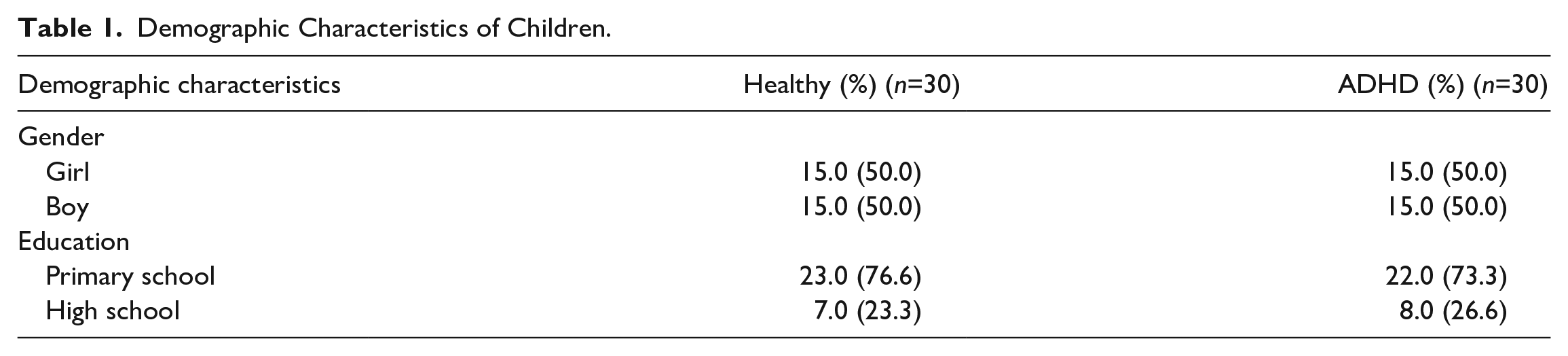
The average age of the participants was 11.06 in both groups. Table 1 shows the demographic data of the participants.
Demographic Characteristics of Children.
In Table 2, the difference in biochemical parameters between ADHD and control was evaluated. Among the oxidative stress parameters, TOS and OSI values were statistically significantly higher in the ADHD group compared to the control group, while the TAS value was lower (p<.001). Similarly, IL-6, TNF-α, and IL1-β levels of inflammation parameters were statistically higher in the ADHD group (p<.01). The findings of the study indicate that children diagnosed with ADHD exhibit elevated levels of oxidative stress and inflammation compared to their healthy peers.
Oxidative Stress and Inflammatory Markers Between ADHD and Control.
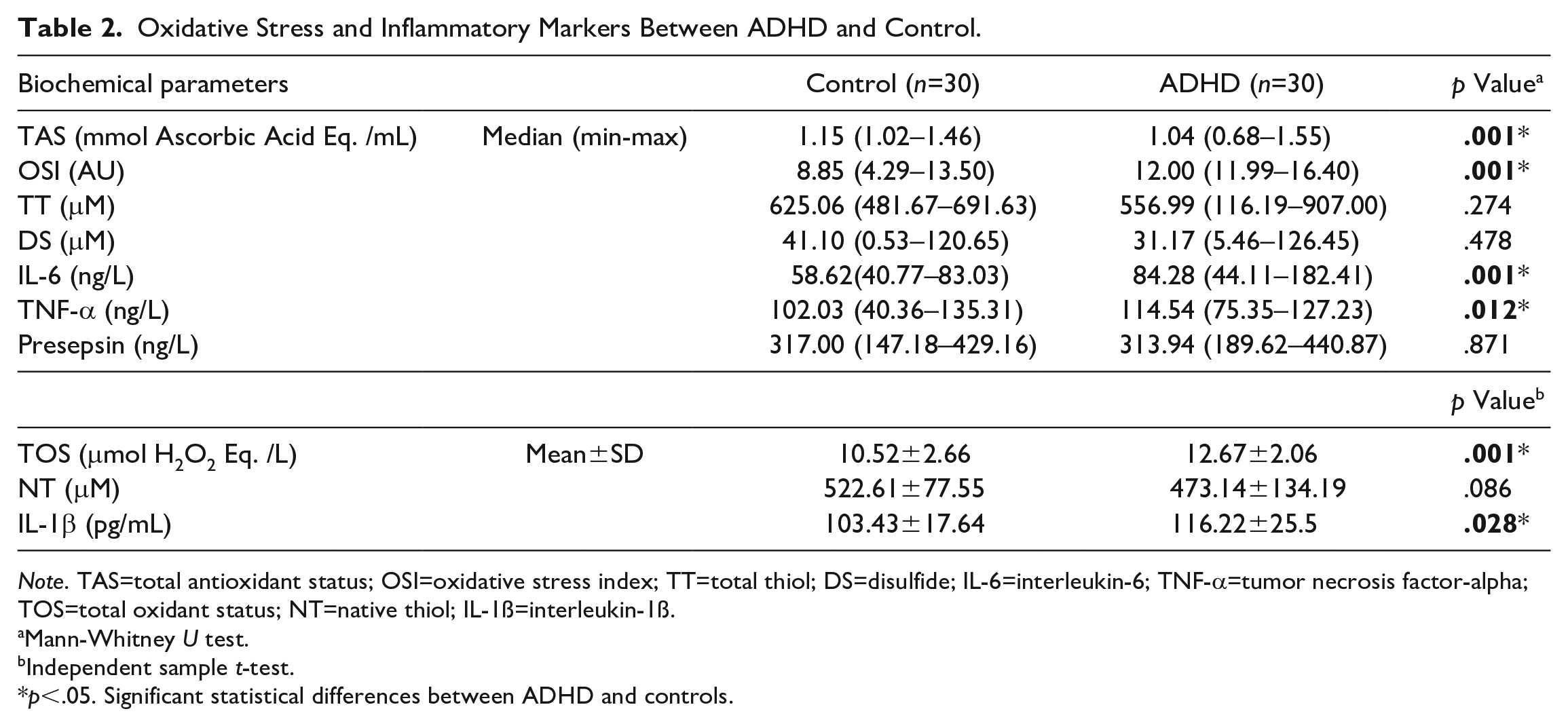
Note. TAS=total antioxidant status; OSI=oxidative stress index; TT=total thiol; DS=disulfide; IL-6=interleukin-6; TNF-α=tumor necrosis factor-alpha; TOS=total oxidant status; NT=native thiol; IL-1ß=interleukin-1ß.
Mann-Whitney U test.
Independent sample t-test.
p<.05. Significant statistical differences between ADHD and controls.
In the regression model (Table 3) created by the Backward LR method, TOS, TAS, and IL-6 variables were found to be significant (p<.05). The variables of TOS and IL-6 were identified as potential risk factors for the development of ADHD. The results of the study demonstrated a 2.9-fold increase in TOS levels and a 1.03-fold increase in IL-6 levels in children diagnosed with ADHD.
Logistic Regression Analyses for the Factors Associated With Children With ADHD.
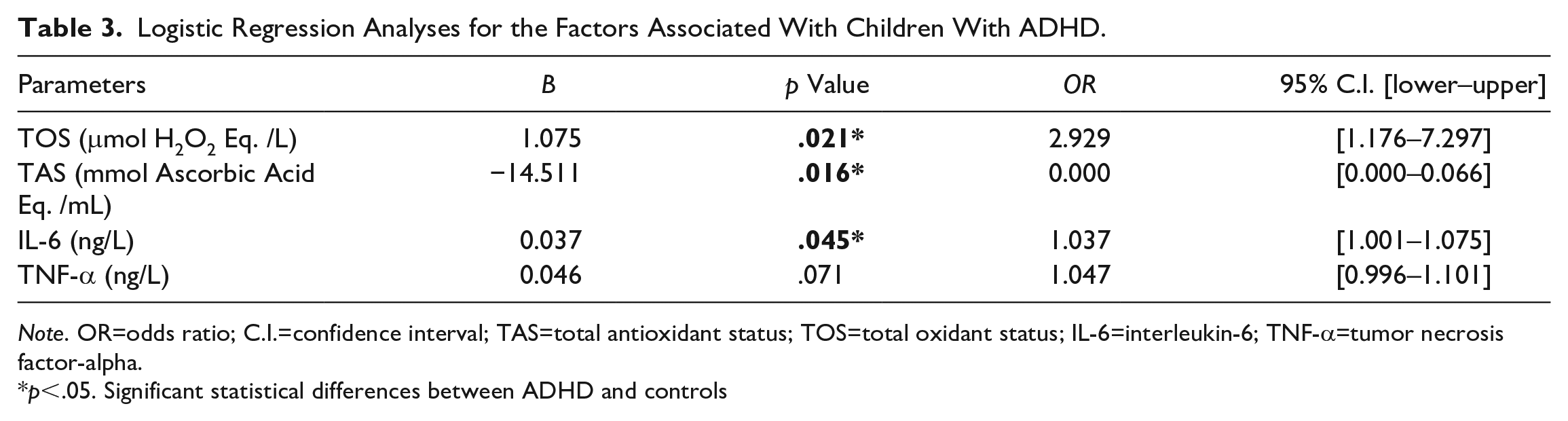
Note. OR=odds ratio; C.I.=confidence interval; TAS=total antioxidant status; TOS=total oxidant status; IL-6=interleukin-6; TNF-α=tumor necrosis factor-alpha.
p<.05. Significant statistical differences between ADHD and controls
Discussion
ADHD is the most common childhood neurodevelopmental disorder worldwide. Although brain region abnormalities and catecholaminergic disorders are involved in the pathogenesis of ADHD, its pathophysiology is still an area of research. There is evidence that oxidative stress and neuroinflammation may be involved in the pathogenesis of ADHD (Corona, 2020). In our study, oxidative stress and inflammation parameters of children and adolescents with ADHD were compared with their healthy peers. To the best of our knowledge, our study is the first to examine presepsin, one of the parameters of inflammation in ADHD. According to the results of our study, TOS, OSI, IL-6, TNF-α, and IL-1β levels were statistically significantly higher and TAS levels lower in children with ADHD compared to the control group. In addition, according to the regression model, it was found that TOS had a 2.9-fold and IL-6 had a 1.03-fold effect on the diagnosis of ADHD. According to our results, oxidative stress and inflammation may be involved in the pathogenesis of ADHD.
In our study, TOS and OSI values, which are oxidative stress markers, were high in children with ADHD, and TT, NT, DS, and TAS values were high in the control group. Although the parameters related to thiol were higher in the control group, no statistical relationship was found. There are studies on the relationship between oxidative stress and ADHD in the literature, but the results are inconsistent and contradictory. Similar to the findings in our study, it has been shown in case-control studies that TOS and OSI values are high, and TAS is low in children with ADHD (Kul et al., 2015; Sezen et al., 2016). In a study conducted on adults with ADHD, TOS and OSI values were higher than controls (Selek et al., 2012). Guney et al. (2015) evaluated oxidative stress parameters between ADHD patients and a healthy control group in the pre-treatment period. They found that TOS and OSI values were high and plasma thiol values were low in ADHD. Ogutlu et al. (2020) In their study, children with ADHD had higher TT, NT, and DS levels compared to the control. Similarly, Kurhan and Alp (2021) examined thiol-disulfide hemostasis in adult ADHD and found higher TT, NT, and DS levels in the control group compared to ADHD. Despite these studies, Karababa et al. (2017) found no difference between TOS, TAS, and OSI in 32 ADHD and 32 control studies. Apart from the OS markers examined in our study, other OS-related markers are also associated with ADHD in the literature. High malondialdehyde (MDA) levels in adult ADHD have been observed and associated with hyperactivity/impulsivity scores (Bulut et al., 2007). Ceylan et al. (2010) showed that oxidant enzyme levels are high and antioxidants are low in children and adolescents with ADHD. Our findings are consistent with many studies in the literature and show a relationship between ADHD and the oxidant system. In addition to the literature, we have shown that TOS levels increase the status of ADHD by 2.9 times with the Backward LR regression model we made in our study.
There are studies on possible mechanisms of how OS is related to ADHD. In rodent studies, it has been reported that maternal OS may lead to findings related to ADHD in the offspring. In these studies, hippocampal learning disorders occurred in the offspring due to maternal obesity. Also, learning disabilities develop together with hippocampal lipid peroxidation (Edlow, 2017). The brain is sensitive to OS due to its high lipid content. In addition, the energy requirement of neurons and synapses is relatively high, which leads to oxidative stress (Joseph et al., 2015). ADHD is a disorder characterized by dopamine deficiency (Martin et al., 2018). It is reported that H2O2, an important oxidant, suppresses striatal dopamine release (Avshalumov & Rice, 2003; Joseph et al., 2015). Accordingly, increased oxidative stress may lead to dopamine deficiency and may be involved in the pathogenesis of ADHD.
Studies in the literature show the relationship between inflammatory cytokines and ADHD. In our study, the levels of inflammation markers IL-6, TNF-α, and IL-1β were found to be statistically higher in the ADHD group than in the control group. Similar to our findings Darwish et al. (2019), Chang et al. (2020), and Donfrancesco et al. (2020, 2021) showed that serum IL-6 levels were higher in the ADHD group in their studies. In our study, in addition to similar findings in the literature, we showed that IL-6 increased ADHD by 1.03 times. Oades, Myint, et al. (2010) in their case-control study showed that IL-16 and IL-13 levels were correlated with total symptom scores, and IL16 was also associated with hyperactivity and IL-13 levels with inattention scores. Omega-3 fatty acids act as antioxidants in the body. In a study conducted in Iran, a significant decrease was observed in CRP and IL-6 values compared to baseline in children with ADHD who were given omega-3,ments. It was also found that this decrease was correlated with progression in symptom scores (Hariri et al., 2012). Cortese et al., in their study of obese children with ADHD, found that IL-6 and TNF-α values were correlated with hyperactivity/impulsivity symptoms. This relationship continued after body mass index data were controlled (Cortese et al., 2016).
Contrary to our findings, studies showed that TNF-α and IL1ß levels were similar to the control group (Donfrancesco et al., 2020; Oades, Dauvermann, et al., 2010; Oades, Myint, et al., 2010). Presepsin is a soluble N-terminal fragment of CD14, a member of the toll-like receptor family that initiates the innate immune response (Velissaris et al., 2021). It is an inflammatory marker that has been demonstrated to be helpful in predicting sickness severity. In our study, although the presepsin values were higher in the ADHD group, it was not statistically significant.
It has been suggested that neuroinflammation may be a risk factor for ADHD (Dunn et al., 2019). Cytokines have been shown to influence brain development, notably in the prefrontal cortex and anterior cingulate cortex (Wang et al., 2022). Studies in rodents have reported that cytokines may lead to changes in the pathology of ADHD by increasing norepinephrine levels and decreasing dopamine levels (Anand et al., 2017). TNF-α has been shown to influence synaptic formation in the hippocampus, while IL-1 and IL-6 have been shown to affect memory function (Yirmiya & Goshen, 2011). The cytokine status in ADHD is related to changes in the perineum and pregnancy. Infection by the mother during pregnancy, tobacco and alcohol use, and obesity can trigger inflammatory processes in the mother. Thus, neuroinflammation occurring during neural development may play a role in the pathophysiology of ADHD (Dunn et al., 2019). In rodent studies, it has been observed that learning disabilities due to obesity are associated with increased proinflammatory cytokine release in the hippocampus (Edlow, 2017). In another study, increased IFN-γ levels were associated with low birth weight and shorter pregnancy duration. Moreover, it was shown that increased IL-6 was associated with paternal smoking (Oades, 2011).
Limitations of the Study
Since the study was in a cross-sectional design, it is impossible to say that OS and inflammation cause or the result of ADHD. Longitudinal studies are needed for this. Our study cannot say the real relationship with this aspect, but it offers a statistical interpretation. In addition, we were unable to exclude factors that may affect oxidative stress levels, such as the participant's family medical history, diet, sleep patterns, and exercise status. For this reason, there is a need for studies that will consider the limitations we have presented. Thus, the relationship between OS and inflammation and ADHD will be supported by stronger results.
In conclusion, we have shown in our study that oxidative stress and inflammation are involved in ADHD. We found that TOS and IL-6 were strongly associated with ADHD.
Footnotes
Author Contributions
All authors contributed to the study conception and design. Material preparation, data collection and analysis were performed by [Sümeyye KOÇ], [Eray Metin Güler], [Songül Derin], [Fatih GÜLTEKİN], and [Selman AKTAŞ]. The first draft of the manuscript was written by [Sümeyye KOÇ] and all authors commented on previous versions of the manuscript. All authors read and approved the final manuscript.
Declaration of Conflicting Interests
The author(s) declared the following potential conflicts of interest with respect to the research, authorship, and/or publication of this article: This study was performed in line with the principles of the Declaration of Helsinki. Approval was granted by the Ethics Committee of University of Health Sciences Turkey (Date 2022/No 12/15).
Funding
The author(s) received no financial support for the research, authorship, and/or publication of this article.
