



Abstract
The Minnesota Department of Transportation (MnDOT) has introduced several innovations to managed lanes on the Interstate 35W (I-35W) corridor including: freeway shoulder operations; active traffic management featuring intelligent lane control signals; in-pavement lighting; and, variable advisory speed limits. I-35W is a unique test bed for deployment of features that expand the concept of managed lanes across all freeway lanes and shoulders and builds upon experience from I-394 MnPASS, as well as learning from other domestic and international projects. Strategies being implemented seek to reduce congestion, preserve and enhance transit and high occupancy vehicle (HOV) capacity, and employ variable priced optional tolling with state-of-the art technology. In the long run, a key outcome anticipated in the I-35W managed lanes projects will be the ability to demonstrate how MnDOT and other transportation authorities can safely add more capacity and enhance performance within the existing highway footprint. Through the U.S. DOT’s Urban Partnership Program, Minnesota has been given a unique opportunity to innovate, test and evaluate creative traffic management ideas with significant potential to set the stage for future implementations and to pass along this important learning to other parts of the country.
Keywords
Introduction
Encouraged by the 2007 U.S. Department of Transportation Urban Partnership Agreement (UPA) goal to substantially reduce congestion in the nation’s largest urban areas, the Minnesota Department of Transportation (MnDOT) has introduced several innovations to managed lanes. These techniques had not been previously used or tested, as an integrated approach, on urban interstate highways in the United States. The section of Interstate 35W (I-35W) adapted for managed lane operations is a 16-mile-long north–south radial providing direct access into and out of downtown Minneapolis (Figure 1). Historically, I-35W has been one of the most congested freeway facilities in the Minneapolis–St. Paul metropolitan area. At the busiest location, more than 204,000 vehicles per day use this route, and prior to managed lane development, portions of the corridor could remain congested for more than 6 hours during the day.

I-35W Corridor, Minneapolis–St. Paul Metropolitan Area
The I-35W managed lanes plan consists of an integrated set of strategies that feature proven techniques such as transit service and station enhancements and high occupancy vehicle (HOV) lane conversions to high occupancy toll (HOT) lanes. In addition, MnDOT is introducing several operational and technical advancements featuring,
Freeway shoulder operations
Active traffic management (ATM) with intelligent lane control signals
In-pavement lighting
Variable advisory speed limits
This article examines these features which are for the first time being integrated on a major arterial, in this case, an interstate highway. These strategies build upon learning from operational experience on Minnesota’s other HOT lane project, I-394 MnPASS, as well as learning from other domestic and international projects. MnPASS is Minnesota’s name for optional toll lanes built on the state’s roadway system. A summary of the managed lane measures being deployed on the I-35W corridor is described in Table 1.
I-35W UPA Managed Lane/Corridor Features
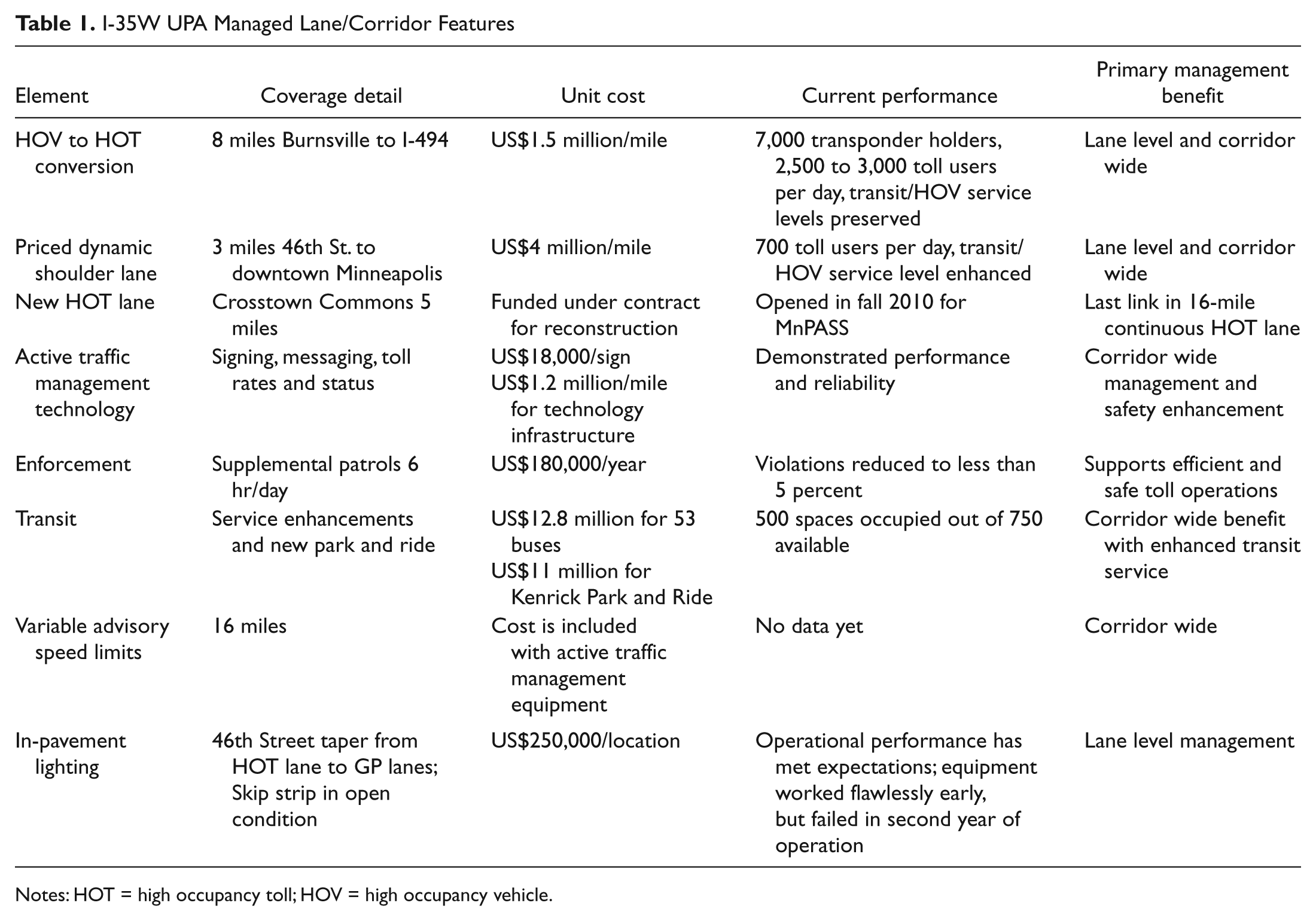
Notes: HOT = high occupancy toll; HOV = high occupancy vehicle.
Literature Review
Managed lanes comprise a wide array of techniques that help to maximize existing capacity, manage demand, offer choices, improve safety, and in some cases, generate revenue. Although there is no standard definition of managed lanes they are becoming increasingly more prevalent. The United States has had over 30 years of experience with managed lanes and more than 25 American cities have one or more form of managed lanes (Ungemah, Burris, Goodin, & Toycen, 2007).
Not surprisingly, research shows that travelers use managed lanes on days when travel time is more important. Value of time for toll paying users on managed lanes may be exceptionally high. Stated preference surveys to determine traveler’s value of travel time savings on managed lanes concluded that their value may be significantly under-estimated, especially for urgent trips (Burris & Patil, 2009).
Fuhs and Kassoff (2008) considered how to build flexibility into the next generation of managed lanes by evaluating best practices after 30 years of experience. They suggest that too often one or several user groups are targeted under managed lane operations without considering how populations and commuting patterns may change over time. According to Fuhs and Kassoff, planners need to understand these best practices as they relate to managed lanes and design them to serve the changing needs of travelers over time.
DeCorla Souza (2009) explores the notion of managed lane networks that could be created from the flexible use of shoulder capacity, a concept that is similar to the priced dynamic shoulder lanes (PDSLs) introduced on I-35W. ATM and restriping could be used to accommodate a new lane during peak periods within the existing highway footprint. This concept, termed flexible efficient express (FEE) lanes, denotes the flexible enhancement of capacity during rush hours. This approach avoids the need to take away an existing lane to create new priced lane capacity.
Ungemah et al. (2007) suggests that managed lane project objectives are reflecting not only mobility concerns but the need to generate revenue as well, which necessitates carefully examining the exemption and discount policy provided to certain user groups. Increasing traffic combined with the lack of financial resources is pushing many state DOTs to examine alternative financing and congestion mitigation techniques. It is widely recognized that managed lanes offer considerable advantages over traditional toll roads in that in many cases it is politically impossible to institute tolling on existing toll-free highways (Burris et al., 2007). This work, which surveyed 4,600 travelers, revealed strong interest in the managed lane concepts and indicated that travel time savings and reliability were the strongest reasons to support such policies.
Managed Lanes Evolve to Managed Corridors
The I-35W managed lanes strategy deployed by MnDOT seeks to reduce congestion, preserve and enhance transit and HOV capacity, implement variable priced optional tolling and state-of-the art technology without adding significant capacity in the form of general purpose lanes. I-35W is a unique test bed for deployment of a combination of features that expand the concept of managed lanes across all freeways lanes and shoulders. Regional traffic management center operators now have the ability to manage all lanes in the corridor via dynamic message signing that convey a wide variety of messages including HOT lane pricing, warnings, lane operational status, and variable speed limit advisories. This broad application of managed lane strategies thus expands the concept of lane management to the entire corridor.
As managed lane strategies become more sophisticated and more inclusive of all lanes, and even shoulders on a freeway corridor, a number of significant advantages and opportunities over general purpose lane operations become apparent. These include,
improving utilization of existing capacity across all lanes by managing demand, offering choices and enhancing safety;
preserving transit and HOV advantages;
applying operational strategies capable of responding to changing traffic and roadway conditions in real time;
managing traffic through access control, vehicle eligibility, driver advisories, speed limit advisories, and through pricing strategies; and
generating revenue through HOT lanes to offset the cost of operations and enforcement.
Under the I-35W managed lanes operation vehicular demand and roadway capacity can be balanced by taking appropriate actions before congestion forms. For example, with overhead changeable message signs over each lane at one-half mile spacing drivers can receive sufficient warning of a hazard, such as a stalled vehicle in a specific lane, and take appropriate action. This capability now gives traffic operations managers a powerful tool to help avoid secondary crashes and subsequent delays and may help accelerate emergency response. A reduced speed advisory posted over lanes in advance of an incident reduces queue formation and duration of congestion.
Typical Cross Section
The typical freeway cross section on I-35W includes three or four general purpose lanes in each direction, with one left-side HOT lane in each direction as well. In the section from 42nd Street north to downtown MnDOT has introduced the shoulder lane concept, described later as PDSLs, to provide lane continuity from the approaching section. In this section emergency pullouts are also provided for added safety in urgent situations (Figure 2).
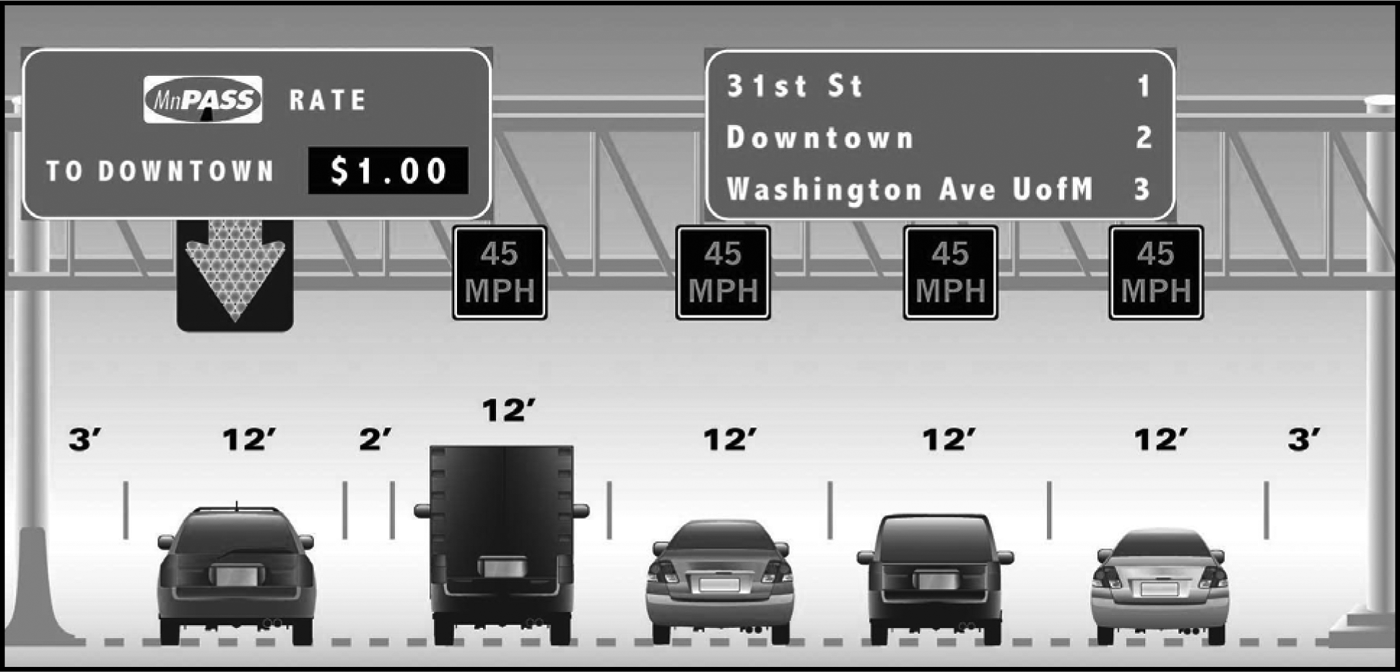
Typical cross section with priced dynamic shoulder lane
Managed Lanes Experience
MnDOT has already employed a number of variations on managed lanes including HOV lanes, bus only shoulders (BOS), and HOT lanes, known as MnPASS Express Lanes. HOV facilities have been in operation on I-394 and I-35W since the 1990s with mixed success. Although transit service and HOV usage in both corridors showed adequate performance, both corridors were perceived as being underutilized and each had relatively high violation rates. MnPASS Express Lanes are an evolution of the HOV system and, allows single occupant vehicles the opportunity to pay a toll to use the HOT lane. The Minneapolis–St. Paul metropolitan area now has a 300-mile system of BOS which were developed in response to growing congestion, a lack of transit advantages and the recognition that unused shoulder capacity could be employed to safely offer transit service in otherwise congested corridors. The BOS system in Minnesota is the largest in the nation.
MnPASS Express Lanes
MnPASS Express Lanes, also called HOT lanes, were first opened on the 11-mile I-394 corridor in 2005. MnPASS introduced completely dynamic pricing to HOT lane operations and now, after more than 5 years of HOT lanes operational experience, MnPASS has achieved a very high degree of customer satisfaction due to the benefits of improved time savings, travel time reliability and safety (MnDOT, 2009). The pricing strategy and hours of operation on I-35W MnPASS match those on the I-394 corridor. The minimum price per segment is US$0.25 and the maximum price for use of the entire corridor is US$8.00. A driver pays only the price displayed on the MnPASS pricing sign at the entry point even if the price should change during the trip. Tolls are deducted electronically from a user’s prepaid account via a windshield-mounted transponder.
With the September 2009 opening of the MnPASS lanes on I-35W from Burnsville Parkway to I-494, and the PDSL opening from 38th Street to downtown Minneapolis there are now two full years of operational experience. An important link in the middle of the corridor called the I-35W and Crosstown Commons section was not opened until November 2010. Figure 3 shows that in the 7-8 a.m. peak hour nearly 200 more users are now on the HOT lane equivalent to a 9% increase. This traffic is composed of toll paying MnPASS customers, transit and HOVs, as well as violators (although violators have now been reduced to less than 5%). Because of the new hours of operation, use of the lane declines below the prior performance under the HOV condition after 8:45 a.m. peak. Traffic on the lane does not rebound until after 10 a.m. when the lane is again open free to all users. Under the HOV policy previously used the lane was open to all traffic after 9:00 a.m. The data also indicate that performance has been enhanced during the 2-hr period (6:45-8:45 a.m.). The HOT lane is not yet achieving superior performance over the prior HOV and general purpose operations condition in the shoulders or off-peak periods. However, this evaluation must be considered in the context of a depressed economy, fewer violators in the lane, and post peak-hour demand.
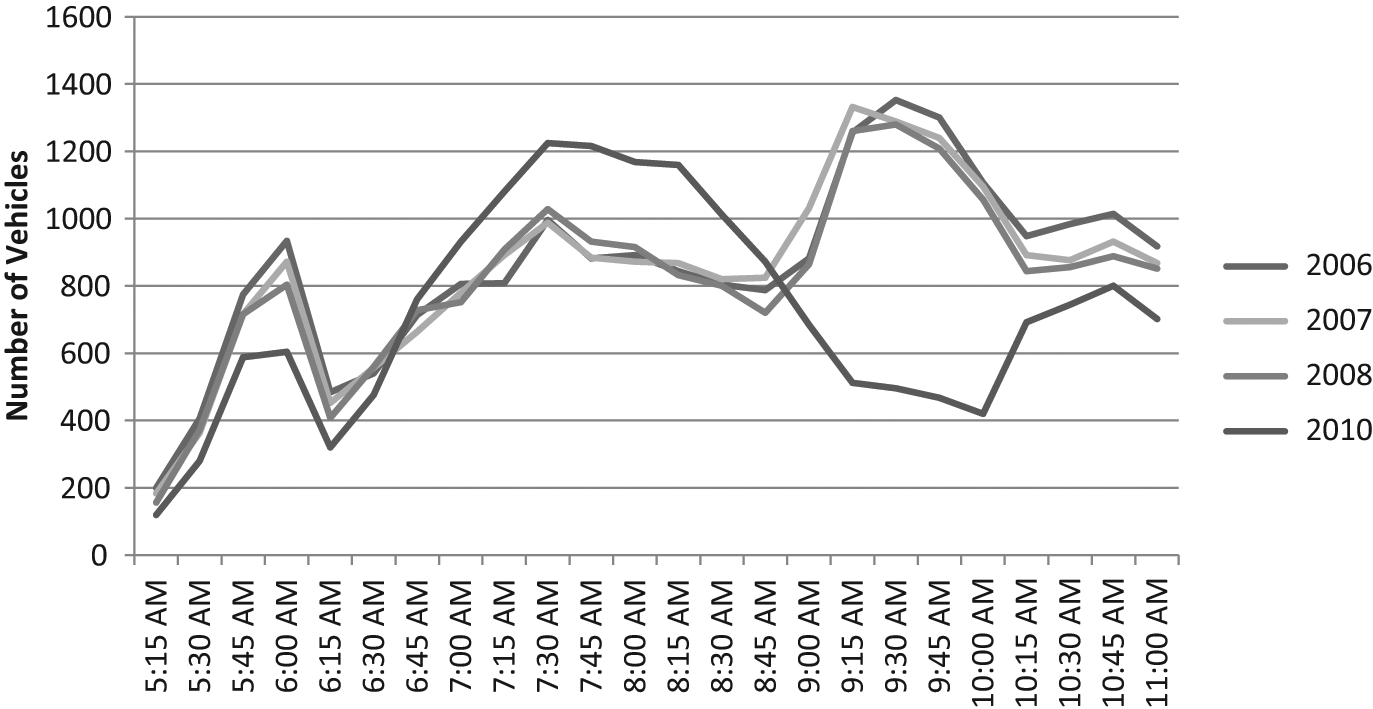
I-35W MnPASS Northbound Lane Performance 2006-2010
Generally, MnPASS lanes are priced in the peak periods only (6-10 a.m., 2-7 p.m.), and off-peak travel is free to all vehicles. When priced, travel on the lanes remains free for HOV 2+ occupancy vehicles, as is travel for motorcycles and buses. The operational goal for MnPASS is to ensure free-flow conditions for all users maintaining at least 50-55 mph performance. Performance evaluations confirm that this goal is being achieved at least 98% of the time. Innovations introduced as part of I-394 MnPASS are also integral components being deployed on I-35W MnPASS. These innovations include,
double white-stripe buffer separation of toll lanes from general purpose lanes,
dynamic pricing on multiple consecutive segments, and
advanced transponder enforcement technology.
Double white-strip buffer
The double white-stripe buffer separation allows the concurrent use of toll lanes parallel with general purpose lanes and avoids the capital expense and operational costs associated with barrier separation of HOT lane facilities. It is always illegal for drivers to cross the buffer. The buffer, a two-foot-wide double white stripe was introduced on the I-394 MnPASS Express Lanes project in 2005 and is in place on about 75% of the distance. Due to public concerns about the restricted access points, MnDOT has responded by substantially reducing the length of the buffer on I-35W to about 25% of the distance. This greatly increases the ability of users to access the facility without violation.
Dynamic pricing
Dynamic pricing is the tool that ensures MnPASS Express lanes meet performance goals. Under dynamic pricing, the price is adjusted every 3 min based on real time traffic conditions. A driver’s price threshold, or willingness to pay, may be met or exceeded by the toll causing the driver to choose either the toll lane or the general purpose lane for a given trip. By varying the price based on the density and speed of vehicles in the lane operators are able to maintain free flow conditions. Because these innovations have proven to be operationally successful, other parts of the country are now adapting portions of these concepts for new HOT lane projects.
Transponder enforcement technology
Safe, efficient and effective enforcement is essential to manage traffic in the toll lanes using dynamic pricing. Although visual enforcement is the still the primary tool, the Minnesota State Patrol also uses mobile transponder enforcement readers in patrol vehicles which can read the transponder in passing vehicles to determine if they are activated and valid. With this technology enforcement officials can verify that a transponder is working correctly and that it was correctly engaged (turned-on) in its windshield mounted bracket at the last tolling point. Violators may be given a ticket that could cost as much as US$142. Non-transponder equipped single occupant vehicles drivers caught in the MnPASS lanes during peak periods are given a similar fine.
I-35W MnPASS HOT lanes and the PDSLs present special challenges to the Minnesota State Patrol, the primary enforcer. Both the HOT lane and the PDSL facilities have relatively narrow shoulders which can make pullovers a safety hazard as well as a significant disruption to traffic. The Minnesota State Patrol, upon detecting a potential violator, will signal the vehicle to pull over to the right shoulder where possible. In the newly constructed Crosstown Commons section, a full 10-feet left shoulder is available for enforcement.
Managed Lane Innovations
Implementation of I-35W managed lanes involves the application of operational strategies that are capable of responding to changing traffic and roadway conditions in real time. Traffic management may be accomplished through a combination of access control, vehicle eligibility, driver advisories, and through pricing strategies. Under optimal performance conditions, vehicular demand and roadway capacity are kept in balance by system managers taking appropriate actions before congestion forms. This section describes the four innovative managed lane features that are being implemented on the I-35W corridor under the UPA initiative.
Freeway Shoulder Operations
Among the more ground-breaking managed lane components developed under Minnesota’s UPA project is the adaptation of freeway shoulders to HOT lane operations during peak periods. This innovation is referred to as PDSLs. The I-35W PDSL is a 3-mile extension of the existing HOT lanes that provides the last link to complete the ultimate 16-mile continuous MnPASS HOT lane from the southern metro area into downtown Minneapolis (Figure 1). Although an 8-mile portion of the HOT lanes and the 3 mile PDSL were opened in September of 2009, the full benefits of these managed lanes were not realized until the I-35W and Highway 62 (Crosstown Commons) project was completed in November of 2010.
Like traditional HOT lanes, transit and HOVs are free and toll paying customers must have a MnPASS transponder. The PDSL is currently available only in the northbound direction, and is open from 6 a.m. to 10 a.m. in the morning peak period and from 2 p.m. to 7 p.m. in the afternoon peak period. Traffic operations managers indicate no significant operational problems or enforcement issues and report that drivers generally understand that the PDSL is a shoulder in off-peak periods and comply with those restrictions.
ATM (With Intelligent Lane Control Signals)
Transportation agencies have used a variety of lane management strategies on freeways such as reversible flow lanes, express lanes, HOV lanes, truck lanes and toll facilities—in a manner that typically has not involved active management or variation in how traffic is controlled in response to changing conditions. ATM has recently added a new real-time dimension.
ATM is a holistic approach to managed lane strategies on congested freeway corridors. It encompasses the ability to dynamically manage recurrent and nonrecurrent congestion based on prevailing traffic conditions. Focusing on trip reliability, it maximizes the effectiveness and efficiency of the facility. It increases throughput and safety through the use of integrated systems with new technology. This congestion management approach consists of a combination of operational strategies that, when implemented in concert, fully optimize the existing infrastructure and provide measurable benefits to the transportation network and the motoring public (U.S. Department of Transportation, Federal Highway Administration, n.d.).
With the introduction of ATM on I-35W MnPASS, managed lanes have moved beyond the more traditional HOT lane development and operations with which the nation is becoming familiar. The I-35W managed lanes project is employing several new designs, technologies and operations strategies that have evolved the managed lanes concept into a managed corridor strategy. The measures employed on I-35W have grown from earlier learning in Minnesota as from national and international experience. Among the more significant are an array of symbols and graphics being used on the changeable message signs (mounted over each lane) developed with guidance from the Manual on Uniform Traffic Control Devices (MUTCD) and tested through a MnDOT market research effort (Figure 4). For example, under a caution condition yellow arrows may be used over lanes to indicate such a warning; a green arrow will indicate that a lane is open and a red X will indicate a lane is closed (Figure 4). The chevron and yellow arrow symbols are used to guide motorist out of a lane during an incident condition. Operations managers continue to learn which signs are most effective and under what conditions they should be deployed.

Managed lane sign options
Costs for ATM technology, which has been retrofitted in the I-35W corridor are around US$1.2 million per mile installed and include overhead signing, gantries, fiber optics, and MnPASS tolling technology. A key outcome anticipated with deployment of ATM is the ability to safely add more capacity in the same highway footprint with technology and operational enhancements and through narrowing of lanes and shoulders.
A significant challenge in designing and developing ATM on I-35W was providing the hardware for clear communication on overhead signing. In addition, effective and safe operation of the PDSL requires an ability to guide drivers out of the HOT lane as they approach the PDSL when it is closed. Through careful evaluation of a variety of technologies, solutions were designed that provided both overhead signing through the intelligent lane control signals (ILCS) and in-pavement lighting that conveys the operating status of the lane.
Intelligent lane control signals
The ILCS system, which is relatively new to the United States, consists of 4 × 5 feet full color signs over each lane that have the capacity for multiple communications and messaging options (Figure 4). ILCS enables operators at the Twin Cities Regional Traffic Management Center to manage a variety of conditions including,
operating lanes on freeway shoulders—the PDSL—to provide MnPASS HOT Lane continuity,
opening and closing individual lanes over the entire freeway to manage incidents,
providing travel alerts and queue warnings to drivers on downstream conditions,
posting speed advisories over each lane in advance of congested locations and to help reduce incident clearing time, and
enhancing highway performance with variable advisory speed limits to delay the onset of congestion after an incident or slowdown.
These signs are spaced every one-half mile in the I-35W corridor and are placed over each lane. Now fully deployed, 174 ILCS signs are displayed in the corridor. Each sign, which costs about US$18,000 per unit, has the capacity to display lane closures, red, yellow, or green arrows, chevrons and speed advisories, in addition to multiple messaging options.
Specially designed gantries, some as long as 170 feet, span both the north and southbound directions of I-35W to support the signs. Gantries have been engineered to enable sign maintenance to occur without the need for lane closures. Catwalks allow tethered maintenance workers to reach the signs and perform necessary repairs at any time without disrupting traffic below. The signs are mounted on hinges which allow for easy access to front facing panels without danger to workers or the driving public.
In-Pavement Lighting
A significant challenge was presented to the project team to design a dynamic, safe, and effective lane striping method that ensures appropriate use of the PDSL in the open and closed condition at the entry point. The solution used is an in-pavement lighting system. In-pavement lighting, which has been used in select applications in the United States, had not been previously tested on a freeway application in a harsh northern climate like Minnesota. The in-pavement lighting provides white skip-stripe lane continuity in the open condition, and provides a yellow taper directing traffic out of the lane in the closed condition. Individual lights, or “pucks,” are flush mounted and hardwired with redundancy. Multiple in-line lighting pucks compose the stripe that drivers observe when using the facility.
Variable Advisory Speed Limits
Variable advisory speed limits are a strategy to actively manage the corridor and to delay the onset of congestion under normal operating conditions. This strategy attempts to mitigate shock waves caused by fixed or moving bottlenecks under the current operational and enforcement environment.
The ILCS signing is the critical element to convey recommended travel speeds. ILCS signs display the same recommended speeds over each lane. However, northbound at 36th Street as the drivers approach the split between downtown and I-35W, different speeds may be posted for the two outside lanes to match conditions further downstream. A major benefit of the variable advisory speed limits is to slow traffic in advance of a congested location. More uniform speeds have the benefit of reducing headways and increasing travel time reliability and ultimately throughput. In addition, variable advisory speed limits should reduce primary and secondary accidents as well as reduce accident severity.
The implementation strategy that is being deployed under the I-35W UPA is to provide speed advisories to drivers—displayed as yellow digits and letters—and not as regulatory signing. A major trade-off considered in this decision was that speed advisories do not create additional conditions that require enforcement. MnDOT operations managers anticipated that more uniform speeds will delay the onset of freeway breakdowns and will also reduce emissions, noise and fuel consumption.
Although evaluation is currently underway, the variable advisory speed limit system is designed to prevent the rapid propagation of the shock waves caused by fixed or moving bottlenecks. This is accomplished by gradually reducing the speed levels of the incoming traffic flows. Variable advisory speed limits are determined every 30 seconds in real time given the location of the bottlenecks, the length of the speed control zone for each bottleneck, and speed deceleration pattern of the traffic flows in a given corridor. Values are calculated to minimize the effects on travel times.
Outcomes
Performance Indicators
Under the UPA initiative, MnDOT is committed to achieving the goal of reducing congestion in the I-35W corridor by at least 20% over previous conditions. Establishing a representative base condition and measuring the performance improvement is in itself a challenge given the significant events that happened before the project began. The most significant intervening events were the I-35W-Highway 62 Crosstown Commons reconstruction which began in 2006, and the collapse of the I-35W bridge over the Mississippi River in 2007. In addition to the already completed I-35W Mississippi River bridge, reconstruction of the Crosstown Commons Interchange in itself has removed a major urban bottleneck.
Freeway Shoulder Operations
The I-35W PDSL from 38th Street into downtown Minneapolis are now supporting about 750 MnPASS toll customers per day plus HOV and transit users. Because this section currently adds significant capacity northbound out of the Crosstown Commons reconstruction, the relatively small number of users is within expectations. Backups still occur however, at the I-35W and I-94 commons section and for that reason, increased use of the PDSL is expected as drivers seek to avoid spillover congestion in the adjacent non-tolled lanes. Traffic management center operators indicate no significant operational issues with the PDSL. The Minnesota State Patrol, the state’s primary enforcement agency for the corridor, also reports no significant enforcement issues. However, an ongoing concern with enforcement activity is that potential violators sometimes attempt to exit the lane inappropriately to get to the outside shoulder or to avoid a potential pullover altogether. Although this was anticipated, it is nevertheless an operational issue to be monitored.
ATM
The ATM system on I-35W was made operational in September of 2009. Prior to turning on the ILCS, MnDOT conducted surveys through an online community to solicit feedback on the new signage (MnDOT, 2010a). Respondents in the survey were asked what each sign was communicating. Three quarters of respondents understood the green arrow and 90% understood the yellow arrow warning to proceed with caution. Nearly all understood the red X to mean a lane closure ahead. There was greater uncertainty about the meaning of the yellow chevrons with the merge message. The greatest confusion existed when the white diamond was displayed on the ILCS. However, that confusion was easily clarified when “bus only” was displayed with the diamond.
After 2 years of operation, traffic management center operators have indicated mixed driver conformity with the messages and symbols posted on the ILCS. It is reported that some drivers ignore the red X until they are very close to the condition causing the lane closure. Yellow chevrons, contrary to the market research finding, seem to be effective in conveying desired driver response. This is a condition that will require continued monitoring and testing and perhaps development of new techniques to communicate the intended messages and corresponding actions.
In-Pavement Lighting
Minnesota’s introduction of in-pavement lighting presented significant challenges from both a public education standpoint as well as for technical operations. Prior to opening the PDSL, MnDOT posted a simulation on the web to give potential users an idea of what the system would look like as they approach from the south and head into the lane. Although it is challenging to measure effectiveness, traffic management center operators indicate little confusion among drivers and relatively few violations have been reported. The lights are highly visible when lit, even in full daylight and under adverse weather conditions. After one winter season in operation, it was reported that only one unit failed out of 54 white and 60 yellow lights. However, more lights failed in the second year of operations and they have been shut off indefinitely due to the relatively high replacement costs. A determination is being made as to the need and cost-effectiveness of a complete in road lighting system replacement. In the meantime, temporary striping is in place until a determination on replacement is made.
Variable Advisory Speed Limits
Because variable advisory speed limits are still new to the traveling public, the on-line community survey was also used to provide MnDOT with information on how drivers perceive a posted speed advisory. Almost all respondents correctly interpreted a sample speed displayed on the ILCS as a cautionary speed limit. Some respondents indicated uncertainty about when the advisory speed limit was to be used and how much in advance of a speed reduction zone the signs should be posted. Some erroneously believed initially, that it was a measure of the speed that they were traveling.
Variable advisory speed limits were made operational on I-35W in July of 2010. Although clear communication and driver interpretation is imperative to achieving the benefits of speed advisories, the real test of effectiveness will be in overall corridor performance and reduction in crashes and delays. Preliminary evaluation results with microscopic simulation indicate that the variable advisory speed limits could significantly reduce the sudden deceleration rates of the traffic flows reacting to fixed or moving bottlenecks, while the increases in travel times can be kept relatively small. Currently the field data is being collected from the I-35W corridor for a detailed analysis on the impact of speed advisories on delays and queuing. Once again a significant challenge to this evaluation is to develop a clear understanding of the baseline condition and all of the intervening factors that could affect system performance in the before and after condition.
Winning and Maintaining Support
Although gaining public and political acceptance for toll lanes was initially a significant challenge, a broad base of support has emerged for MnPASS lanes based on customer surveys and stakeholder discussions. The survey of MnPASS customers showed an exceptionally high degree of satisfaction in almost all phases of operations. Because the MnPASS lanes developed so far have not converted any general purpose lanes to toll lanes during peak periods, they are not a take-away for drivers in the general purpose lanes. Fundamentally, MnPASS lanes have overcome early perceived equity issues with corridor users and have won broad support because they have delivered on their promise of improved facility performance. MnPASS toll paying customers receive value for the tolls paid, and lane performance for transit and HOVs has not been diminished. Users of the general purpose lanes are better off because a portion the traffic stream has been removed (MnDOT, 2009).
Although the experience time frame has been relatively short, support and understanding of project objectives for the recently implemented managed lanes strategies such the PDSL, ATM, speed advisories and in-pavement lighting is emerging based on customer feedback through MnDOT’s Online Community customer feedback (MnDOT, 2010a). Additional experience and monitoring, as well as continued marketing, is imperative to the long-term success of these strategies.
Toll Revenue
Toll revenue collections on MnPASS HOT lanes are relatively modest by toll road standards. However, HOT lane project managers around the country have soon come to realize that generation of toll revenue is not the most compelling reason to support HOT lanes. Rather, from an operator perspective, the most compelling reason for HOT lanes is the improved highway performance which can be achieved. For MnPASS customers the added congestion free option, travel-time reliability and added safety are the most attractive features of HOT lanes. Transit providers in the Minneapolis and St. Paul metro area have also become strong supporters of MnPASS because they have preserved the transit advantage on the system.
MnDOT contracts with Wilbur Smith Associates, along with Raytheon and Cofiroute as key subcontractors, under a professional and technical services agreement to operate the state’s toll facilities and customer service center. Although Cofiroute, as the customer service center operator, does the customer billing for MnPASS, toll receipts get deposited directly into a State of Minnesota toll account and never get handled by the contractor.
I-35W MnPASS lanes have been implemented in two phases starting in September 2009. This 16-mile HOT lane corridor became fully operational in November 2010. Although growth of the customer base has been slower on the I-35W MnPASS project than on the I-394 MnPASS project, growth has nevertheless been steady and there are now about 7,000 registered MnPASS customers. By comparison, I-394 MnPASS project which has been fully operational for 6 years has about 12,000 registered customer accounts. Projections for the coming years indicate that combined, the I-35W and I-394 MnPASS lanes will generate enough revenue to cover their operations and enforcement costs, in the range of US$2.5 to US$3.2 million annually. Although it is too early to fully understand the revenue potential for the I-35W MnPASS corridor without the benefit of more operational experience, early indications suggest that revenue potential for the I-35W corridor may equal or exceed that of I-394.
The Future
MnDOT recognizes that the Minneapolis–St. Paul metro region can afford few new highway expansions to resolve congestion given the forecast for transportation revenue in coming years. Yet it is imperative that the agency continue to strive for improved highway system performance by adding choices to avoid congestion and reduce delays to enhance the region’s future competitiveness.
As such, MnDOT continues to test cost-effective techniques, projects and policies to optimize the performance of the highway system for users and modes. With both of the region’s HOV lanes now converted to HOT under MnPASS, MnDOT is now considering new designs, technologies and operational plans that might be an affordable means to expand the MnPASS system and its benefits. This plan, called the MnPASS System Study 2, has recommend expanded managed lane strategies such as use of shoulders as travel lanes during peak periods, restriping of highways to provide more lanes within the existing right-of-way, deployment of more ATM currently in use on I-35W MnPASS and consideration of adjustments to the vehicle occupancy requirements (MnDOT, 2010b). The MnPASS System Study 2 has been adopted by the Twin Cities Metropolitan Council as the region’s long-term strategy for highway system management. DeCorla Souza’s FEE Lane concept (2009) is a model that deserves careful consideration and evaluation for future application. The FEE Lane concept suggests that optional toll lane adaptations may be possible using dynamic shoulder lanes during peak periods. This could result in significant added corridor capacity without compromising currently available general purpose lanes. Some transportation experts have suggested converting general purpose lanes to toll lanes, although that strategy has not yet been successful anywhere. The soon to be tolled SR 520 floating bridge in Seattle is a possible exception.
Conclusions
Transportation agencies across the nation are increasingly pressed to deliver more highway capacity with funding streams that have remained stagnant or are diminishing in the face of rising construction costs. The challenge facing transportation planners and engineers is how to more efficiently and effectively use the existing infrastructure and enhance corridor performance without compromising safety. A key outcome in the I-35W managed lanes projects, through the deployment of the PDSL, ATM, variable advisory speed limits, and in-pavement lighting, will be the ability to demonstrate how a transportation authority like MnDOT can safely add more capacity, and reduce congestion and crashes within the existing highway footprint. Through the U.S. DOT’s Urban Partnership Program Minnesota has been given an unprecedented opportunity to innovate, test and evaluate these creative managed lanes and traffic management ideas with significant potential to set the stage for future implementations and to pass along this important learning to other parts of the country.
Footnotes
The author(s) declared no potential conflicts of interest with respect to the research, authorship, and/or publication of this article.
The author(s) received no financial support for the research, authorship, and/or publication of this article.