



Abstract
This article documents Congressional transportation earmarking practice in the late 20th and early 21st centuries, analyzing how Congress earmarks funds for projects and how earmark features determine beneficiaries. First, it illuminates the Congressional process for earmarking in a bill: Committees solicit requests, leadership structures the terms for earmarking, and members identify final priorities. Second, it distinguishes between authorization and appropriation earmarks, and among demonstration, discretionary, and stand-alone earmarks. Finally, it shows how statutory, nonstatutory, and hybrid earmarks vary in legal significance, with implications for federal, state, and other agencies’ ability to change or challenge a congressionally directed project. Major themes emerge. Increases in earmarking, technological advances, and earmarking reforms have made some stages of the process more formal and visible, although key stages remain opaque. In addition, Congressional earmarking is dynamic, evolving in response to situational opportunities and challenges. Concluding observations discuss how future earmarking could be made more transparent and effective.
Keywords
Introduction
In the late 20th and early 21st centuries, Congressional earmarking played a larger role in federal transportation funding bills than ever before. Congress uses earmarks to direct federal dollars to specific transportation projects, transferring discretion over federal funds from local, metropolitan, state, and federal officials to members of Congress. Members may handpick a project for funding, whether or not it delivers value for federal policy goals or for transportation systems in metropolitan areas and states, as articulated in their long range plans (LRPs) or near-term capital programs, known as transportation improvement programs (TIPs).
Although earmarking is nothing new, the scale and scope of this practice expanded sharply from the early 1990s to the mid-2000s. Earmarks in authorization bills grew from 10 in 1982 to more than 500 in 1991 to more than 6,000 in the 2005 authorization, Safe, Accountable, Flexible, Efficient Transportation Equity Act: A Legacy for Users (SAFETEA-LU). Expressed in constant 2010 U.S. dollars, the value of highway earmarks in the authorization bill swelled from less than a US$1 billion in 1982 to more than US$9 billion in 1991 and roughly US$24 billion in 2005. 1 Appropriation earmarks have grown as well, though tapering somewhat since the mid-2000s (see Table 1). Furthermore, the number of federal funding programs into which Congress has inserted earmarks has grown over time.
Congressional Earmarks in Transportation Appropriation Bills

Note: Table reflects earmarks only for the Department of Transportation, as included in larger annual appropriations for transportation, housing and urban development, and related agencies.
All values in 2010 constant U.S. dollars, based on the Gross Domestic Product (Chained) Price Index used by the U.S. Office of Management and Budget to express budget figures over extended periods.
All numbers and values for FY1994-FY2005 drawn from Congressional Research Service (2006a).
In FY2003, the Coast Guard and Transportation Security Administration were transferred from the Department of Transportation to the newly created Department of Homeland Security. Thus, FY2004 and later figures may not be directly comparable to those of previous years.
All numbers and values for FY2006 drawn from Congressional Research Service (2006b).
Numbers and values of earmarks for FY2008 and FY2010 are based on the author’s analysis of the Taxpayers for Common Sense (2008, 2010) Earmark Database, applying earmark definitional protocols of the Congressional Research Service.
Total appropriation values for FY2008 and FY2010 drawn from Congressional Research Service (2011).
Transportation planners and officials cannot afford to disregard these trends. A careful understanding of the political processes affecting earmarked funds is essential for those who would seek, administer, or use any federal transportation funds. To this end, this work provides a guide to the Congressional pork barrel during a period when earmarking of federal transportation funds reached unprecedented levels. It shows how specific features of Congressional earmarking practice shape whether and how underlying projects are realized, and affect the agencies implementing and administering those earmarked projects and funds. Most important, it suggests the potential for transportation agencies and local government officials, Congressional committees and staff, and Congress members themselves to make future earmarking more transparent and effective and to harmonize the impulse for earmarking with the impetus for regional and state transport planning.
Members of Congress earmark transportation projects for various reasons. Federal infrastructure investments typically deliver particularized governmental benefits to specific individuals, groups, or geographic constituencies and, members hope, electoral benefits to themselves.
Congressmen consider . . . [such projects] . . . as sweet plums to be plucked. Federal projects are highly visible and their economic impact is easily detected by constituents . . . The average constituent may have some trouble translating his congressman’s vote on some civil rights issue into a change in his personal welfare. But the workers hired and supplies purchased in connection with a big federal project provide benefits that are widely appreciated. (Fiorina, 1989, p. 40)
Such characteristics make earmarks especially good for credit claiming, whereby members of Congress seek to “generate a belief . . . that [he or she] is personally responsible for causing the government . . . to do something . . . desirable.” Congressional theorist Davis Mayhew (1974) suggests this activity is so important “that much of congressional life is a relentless search for opportunities to engage in it.” Furthermore, because transportation improvements are often viewed as noncontroversial and nonpartisan, Congressional sponsors use earmarks to safely build name recognition among constituents. “There’s no such thing as a Republican or Democratic pothole,” said one transportation expert interviewed for this study. “Everybody’s got needs for infrastructure improvements.” Finally, members may earmark projects deliberately to steer funds to a project or place that they or their constituents feel the planning process neglects. Said one interview respondent, [A] lot of local governments go after earmarks . . . I feel that occurs because . . . the states simply don’t share federal aid highway funds adequately with local governments, so local governments are forced to go to the earmarking process to get additional federal aid funds. That’s pretty simple, but that is what happens . . . [Also, there] is the question of whether local government officials are consulted in the planning process, to what degree are they consulted . . . [I]f they feel they are not being listened to, this is an end around option to them. The planning process is not rational, not working, if certain people are excluded from the process.
For actors involved in securing, administering, or spending federal funds, the stakes in earmarking are high, but the practice and its nuances are not well understood. Popular media typically discuss earmarks as though all deliver a coveted windfall to a designated project or beneficiary. In reality, Congressional earmarks can create significant unforeseen challenges and costs for organizations that ultimately implement them (Savage, 2009; Sciara, in press-a). Furthermore, earmarks can recast the distribution of federal transportation dollars, delivering added funds to some while subtracting funds from others (Sciara, in press-b).
This article peers directly inside the Congressional pork barrel to describe the process by which the U.S. Congress establishes earmarks for transportation projects. It shows how specific earmark features determine whether and to whom earmarked funds are a boon or bane, expanding or shrinking the discretion of transportation agencies, regional planning bodies, local governments, or other projects sponsors to use federal dollars and develop transportation projects. En route, it illuminates not only the evolving nature of Congressional earmarking practice and its growing formalization and transparency, but also its continued opacity in key areas.
In the first section, I break down the Congressional earmarking process into three phases: Members submit project requests for a bill, leadership defines the terms for earmarking the bill, and members identify their final earmark priorities. The next section distinguishes two main legislative vehicles that carry earmarks, authorization, and appropriation bills. Third, I describe three varieties of earmarks: in demonstration or discretionary programs, or stand-alone earmarks. Each relates differently to the federal program structure, making winners and losers of executive agencies, state transportation departments, and federal funding applicants. Finally, I take up earmarks’ legal status and challenges thereto, analyzing how the phrasing and position of earmarking language in a bill affects flexibility to develop or block the project. The concluding discussion reflects on themes evident in these practices and their implications, and offers recommendations for making transportation earmarking more effective in the future.
This work analyzes federal transportation funding bills as primary sources, secondary archival materials, and original interview data. For Federal authorization laws in 1987, 1991, 1998, and 2005, and for appropriation bills in evenly numbered fiscal years from 1998 through 2008, I studied how Congress designated earmarks in these acts and their legislative histories (the House, Senate, or conference reports accompanying the legislation). This article is also informed by legislative, academic, and government reports on earmarking, and other secondary sources that discuss Congressional earmarking in transportation. Furthermore, it draws on 55 semistructured interviews conducted within a larger study of Congressional earmarking and transportation planning. Respondents included officials of metropolitan, state, and federal transportation organizations; representatives of national interest groups and transportation policy organizations; Congressional committee staff; and other transportation experts. Participants reported their observations about and experiences with federal earmarks over the course of their careers and within their current organizations, collectively providing a comprehensive picture of the complex and evolving process that yields earmarks.
The Congressional Process Yielding Earmarks
An earmark that appears in a transportation spending bill represents the end of a process that generally parallels the bill’s path through Congress to become a law (see Figure 1). Congress creates earmarks in a complex series of events best summarized in three major phases. First, individual members of Congress identify projects for which they would seek earmarked funds. Second, the Congressional committee of jurisdiction managing a specific piece of legislation defines the global terms for earmarking in that bill, and committee leaders sketch the budget available to individual members for earmarking. Third, once informed of their available earmarking budget, individual Congress members identify their priorities for projects that would receive earmarks. 2
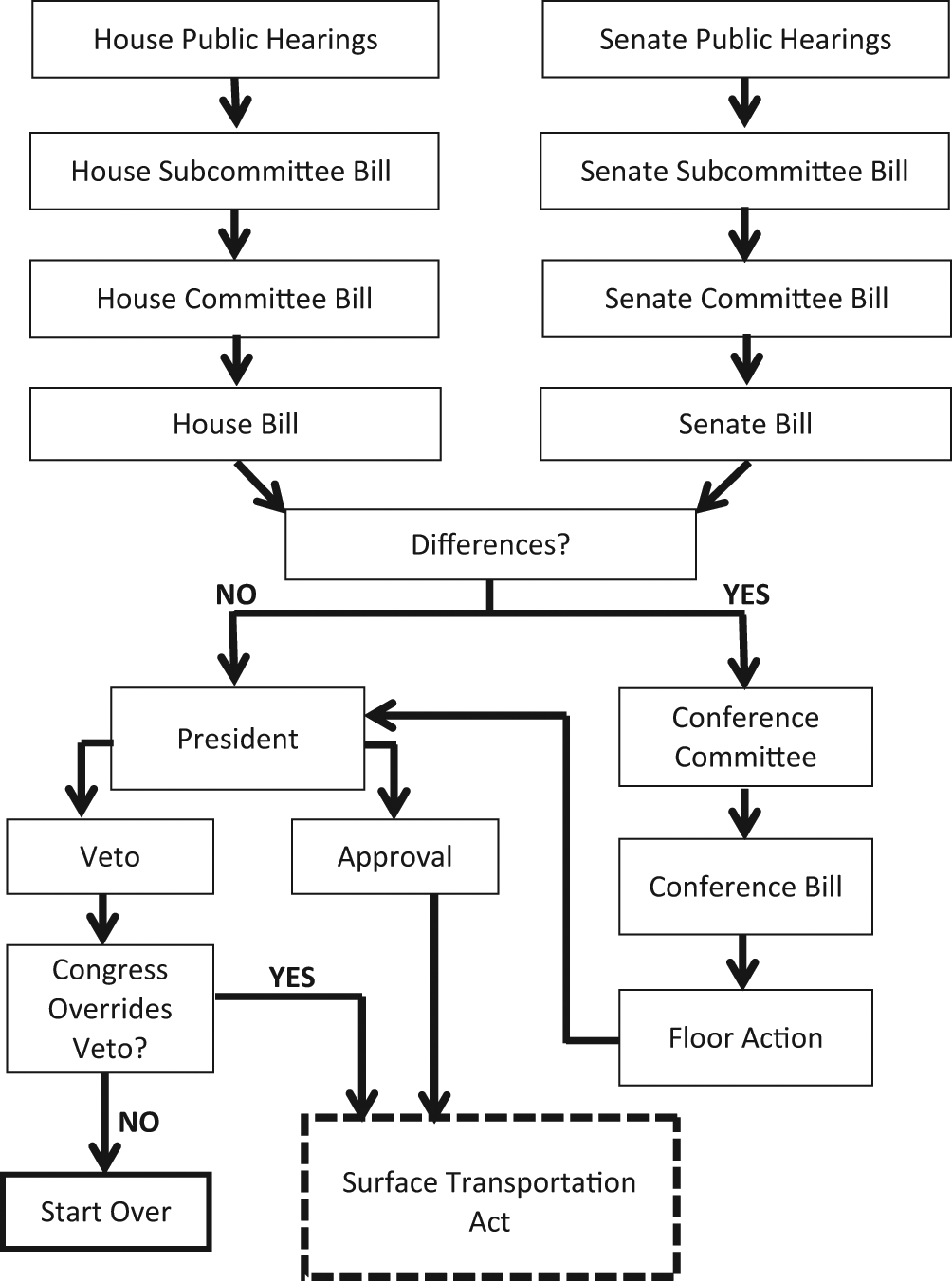
Legislative process for developing transportation authorization acts
This three-stage representation warrants some caveats. To begin with, bills do not progress through Congress uniformly and so the path for creating earmarks in a specific bill can be unique. For a particular bill, steps may be shuffled around, repeated, skipped, or involve substeps. For example, as members assemble their project lists, constituent groups may proactively request certain projects or members may solicit candidate projects from constituents. Also, Congress has sometimes added earmarks to bills in the very final moments of the legislative process, skipping earlier phases of this conceptual model, though Congressional reforms have limited such practices since the late 2000s. In addition, this model suggests members of Congress as the sole protagonists. However, state and local elected officials, transportation agencies, business owners, private interests, civic groups, lobbyists, and government affairs officers and consultants all monitor the legislative process and may work within it to provide information about or influence specific earmarked projects. Finally, Congressional earmarking behavior is dynamic and evolving; the trajectory of a transportation earmark presented reflects the process as it existed in the 1990s and early 21st century.
As transportation earmarks proliferated during this period, the process by which an interested party could secure one grew more formal and more visible. This evolution has been driven by technological advances and Congressional steps to reform earmarking and ostensibly increase transparency. House and Senate chambers and individual Congressional committees have defined procedural and informational requirements for submitting and publicizing earmark requests, identifying members who sponsor suggested earmarks, and highlighting earmarks contained in any measure under consideration. Although these requirements have made the earmarking process far more visible than it once was and increased opportunities for stakeholders to observe and participate in it, decisive phases of the process have remained obscured from view.
Committees Solicit Member Requests
In order for an earmark to be considered for inclusion in a spending bill, a member of Congress must communicate support for the earmark to the Congressional committee of jurisdiction for that bill. This is true whether the party ultimately seeking the earmark is really a transportation agency, community group, town mayor, governor, private organization, nonprofit group, or other entity.
Through the 1990s and early 21st century, the Congressional committees handling transportation spending bills steadily formalized procedures for receiving earmark requests from Congress members. Increasing requests, advances in computer and Internet technology, and House and Senate earmarking reforms have all contributed to this formalization.
Whereas members of Congress once requested earmarks of committee leaders and staff informally, some committees began in the 1990s to ask that members request earmarks on paper, computer disk, and, later, through Congressional intranet sites. Newspaper accounts first reference a 14-point project questionnaire or request form introduced in the late 1990s, around the time of Transportation Equity Act for the 21st Century (TEA-21), by Bud Shuster, then Chair of the House authorizing committee (Niedowski, 1997). Interviews with Congressional and federal agency staff suggest the same. The “Dear Colleague” letter circulated by the committee or subcommittee of jurisdiction began palpably to herald earmarking’s first phase. It announced the coming appropriation or authorization, solicited desired projects from House or Senate members, and included a form or a website link for submitting requests.
Interview data collected for this study indicate that some committees launched web-based request systems in the early 2000s. Online request sites store members’ submissions in two databases, managed separately by Democrats and Republicans. Only the committee chair may view all project requests. No member can view another’s requests, not even those of a colleague serving the same region; this suggests Congress members compete for rather than coordinate earmarks.
Computer technology has both fed and been necessitated by earmarking’s dramatic increase. Technological advances have allowed Congressional committee staff to manage greater volumes of project requests and text when drafting bills. One interviewee recalled that staff had formerly maintained requests on index cards alphabetized by member name, a system clearly inadequate for SAFTEA-LU’s 6,000-plus earmarks. Some individual Congress members later launched their own online request sites for constituent projects (Pear, 2008). Compiling requests online may enable members more easily to accept many requests, appear to treat constituent requests equitably, and fulfill earmark disclosure requirements.
On one hand, paper and electronic earmark request practices appear to have brought technical and planning considerations into the earmarking process. Request procedures vary by Chamber and committee, but more formalized processes generally have allowed committees to handle more requests and collect more information about suggested projects. Bill drafting committees have asked for such data as a project’s status in the long-range plan (LRP) and capital program (TIP; see Table 2). Such practices may encourage sponsoring Congress members or their staffs to research projects more carefully before requesting earmarks, by consulting transportation agencies and local planners about project details and merit; however, they do not require it.
Planning and Project Information Collected in Earmark Request Forms

On the other hand, authorization and appropriation committees may barely use the information they collect to evaluate and select earmark requests. According to one respondent, the earmark request forms are of limited “rigor,” and member-supplied information may be inaccurate. Instead, Congressional committee staffs have typically asked members to rank their own earmark priorities and later matched those with available funds. Committee scrutiny has been largely focused on ensuring that projects that would appear in the final bill meet the committee’s policy requirements, such as requiring matching funds for a project, and “identify[ing] potential problems and prevent[ing] them from blowing up in the committee’s face” (Legislative Services Group, 2002).
On the whole, the use of specialized questionnaires and computer technology to process requests has formalized Congressional earmarking practice and created opportunities for greater communication and information exchange between transportation planning agencies and Congressional offices. Ideally, such opportunities increase the likelihood that earmark projects would reflect priorities in regional and state transportation plans, would be financially feasible and have cleared environmental reviews, and would possess public support. Yet evidence suggests these Congressional practices have not yielded serious consideration of such planning concerns in earmark selection.
Until the late 2000s, earmark requests submitted by a congressperson or senator to a committee were not public. Disclosure rules adopted in 2007 by the House (110th Congress) required its committees to document the intended recipient, purpose, and requesting member for any suggested earmark. Also, the committee must certify that the sponsoring congressperson has no financial interest in the project (Lynch, 2009; U.S. Congress, House, Constitution, 2007). Rules adopted in the Senate required senators seeking an earmark to provide similar information. Furthermore, at least 2 days before any vote on a measure or conference report, the Senate committee of jurisdiction must publish online a searchable list of all earmarks therein and the names of requesting senators (Lynch, 2008).
In spite of these changes, unsuccessful earmark requests have remained difficult to observe. Disclosure requirements apply to earmarks proposed in legislation, amendments, and accompanying reports under consideration or approved. Procedures for the disclosure of requests themselves, however, are vague. House rules require the relevant committee make “open to public inspection” written statements submitted by a member for certain approved earmarks, but it is unclear how this is accomplished (Streeter, 2008, p. 7). In 2009, House and Senate Appropriation Committees required their members, not all representatives and senators, to publish earmark requests on their websites (Inouye, 2009). Earmark reform proponents have argued that all requests should be public, but the Freedom of Information Act (FOIA) establishes no right of access to such Congressional records (U.S. Congress, House, Committee on Government Reform, 2005).
Consequently, the scale of attempted earmarks can be pieced together only from disparate sources. News accounts state that for FY2008, the House Appropriations Committee received from 30,000 to 36,000 total requests across all sectors (“Keep Earmarks,” 2007; “The Road to Somewhere,” 2007). For FY2007, requests to the House numbered more than 21,000 and for FY2006, more than 34,000, again across all sectors (Daniels, 2006). It is impossible to know how many of those represent transportation projects. For the TEA-21 authorization in 1998, members submitted between 1,300 and 1,500 project requests (Greene, 1997; Pershing, 2003). In the early stages of reauthorizing that bill, then House Transportation and Infrastructure Committee Chair Don Young reported that members had submitted more than 5,300 project requests worth more than US$500 billion for the bill (Young, 2003). Reauthorization debates lasted 2 more years, and more requests were surely submitted before SAFETEA-LU was passed in 2005. Without open access to searchable databases documenting earmark requests, it is impossible to know how many requests are made for a given bill, by whom, or for what, or to know the ratio of earmarks requested to those actually considered or ultimately approved.
Big Dogs and Cardinals Define the Terms
As individual members of Congress identify projects to request, Congressional leadership sets the scope, scale, and distributional framework under which earmarking may occur in a piece of legislation, ultimately determining the funds available for a single member’s earmarks. Transportation authorization and appropriation committee leaders shape how the federal transportation program operates, defining most broadly total funding, most narrowly the fate of specific projects, and intermediately the terms and funding levels of individual programs and agencies.
For the annual transportation appropriation, for example, the subcommittee chairman—called a cardinal—and ranking minority member lay the ground rules for earmarking in the bill. Similarly, in an authorization bill, leaders define how much money will be available for earmarks; what programs, or accounts, may be used; and the split of earmarked funds between the majority and minority political parties. The majority typically claims the greater share, but the split may vary from year to year and between House and Senate chambers (White, 2004).
Subsequent decisions may determine the share of earmarked funds reserved for those colleagues on the committee versus those not. Members of the transportation authorizing committees—Transportation and Infrastructure (House), Environment and Public Works (Senate), and Banking, Housing, and Urban Affairs (Senate)—and their subcommittees traditionally have greater access to authorization earmarks than other members. The same is true of access to appropriations earmarks for members of the House and Senate Appropriations Committees and their subcommittees’ members and chairs, as reflected in a headline about the FY2002 appropriation: “Big Dogs in Congress Get the Big Bucks for Transportation” (Diaz, 2001).
For other members, the committee typically weighs seniority, leadership positions on other committees, and vulnerability in an upcoming election to determine a member’s allotment (Mayhew, 1974; White, 2004). The allotment may also reflect partisan or personal issues such as “who’s been naughty or nice, who’s helped [the committee], and who’s pissed the chairman off,” explained one interviewee.
As House and Senate committees prepare to finalize the bill in conference, committee staff inform members of their earmark budgets. “The member may have requested 40 projects worth $100 million,” explained one Washington observer, “but the staff says, ‘We’ll give you $10 million. How do you want that allocation spent by individual earmarks?’” The member must then identify what projects to include in his or her allotment.
Although these decisions appear to follow a sequential logic, they are unlikely to unfold so neatly. Instead, the scale, scope, and distribution of earmarks are likely to be the subject of simultaneous, intense, and ongoing negotiation throughout the legislative process, and most members may learn of their earmark allotment only very late in the legislative process, long after they have submitted the original requests.
Members Rank Final Priorities
In the final stages of the legislative process, an individual member must indicate to the committee how to distribute his or her allotment among requested projects. This largely invisible but important step affects what projects appear in the final bill and accompanying reports. When members finally rank their candidate projects for the committee, they create winners and losers among their constituents. A member may keep silent about such politically sensitive decisions to avoid telling a constituent group that its desired project was not a priority when push came to shove.
While it is not possible to observe members making these final choices, they are likely to prioritize candidate projects following a diversity of values, tastes, and preferences (White, 2004). Interview data suggest one trend is for members to spread their earmark allotment among many projects rather than to concentrate funds on a few. Members thus maximize the number of earmarked projects but reduce the size of individual earmarks. In contrast, some House and Senate members have refused to choose among projects, insisting instead that local transportation stakeholders together prioritize a set of commonly desired projects. Still other members may be devoted to a specific project. And some claim not to pursue earmarks at all.
U.S. senators and representatives are likely to use different earmarking approaches. Congressional scholars in the rational-choice tradition suggest that members of Congress, driven primarily to win reelection, act in ways that explicitly benefit constituents (Mayhew, 1974). Thus, U.S. House members more than senators prefer earmarks for narrowly defined projects to match the physical space of their jurisdictions, whereas senators may focus on larger scaled projects distributing benefits more widely for the state. The High Priority Projects (HPP) program in the 2005 authorization displays this logic; under the statute, Senate-designated HPP earmarks could be used interchangeably for same-state projects, whereas House-designated earmarks had to be spent on the specified project (FHWA, 2006).
As coda to the earmarking process depicted above, urgency and drama may accompany the final Congressional conference. Several interviewees remarked that a bill’s final passage is a messy process in which committees make quick decisions, earmarks may be included at the last minute or air-dropped, and mistakes occur. Committee staff and members operate under great time pressure to finalize the bill language, accompanying reports, and project lists, and things can and do go awry. Earmarks may be misdirected and mishandled in the process, with some projects inadvertently left out of the bill or report. Others that should have been dropped are not. And some projects are earmarked incorrectly in one aspect or another. Such errors can be addressed administratively or in a technical corrections or other bill, whereby earmark sponsors add language to clarify mishandled projects.
In sum, parts of the earmark request process have become more formal via request forms, enabling technologies, and disclosure rules. This has made the process more visible and increased opportunities for interaction between Congressional offices and earmark seekers. However, key pieces of earmarking practice—including Congressional decisions over which accounts will be earmarked, members’ allotments, and the ultimate selection of projects for inclusion in a bill—have continued to operate outside public view.
Vehicles for Earmarks
While Congress may include them in other bills, such as supplemental spending or economic stimulus bills, authorization and appropriation bills have remained the main legislative vehicles for transportation earmarks. Authorization acts structure federal transportation spending over a multiyear period, typically 5 or 6 years. They authorize overall spending ceilings, articulate policies and program goals, create new programs, continue or modify existing ones, and specify whether individual programs will distribute funds by formulae (i.e., apportionment) or by administrative discretion (i.e., allocation). Each year, as the authorization period progresses, the appropriation bill specifies an obligation limit on funding and releases authorized funds accordingly. Distinctions between these bills and their timelines make authorization earmarks and appropriation earmarks good for different things, with different impacts on transportation outcomes.
Authorization bills are passed infrequently and authorize funds in yearly installments for multiple years. In addition, earmarked authorization funds are frequently made “available until expended,” even if the project lags indefinitely. Transportation agency representatives interviewed for this study observed that this gradual allocation schedule makes authorization earmark well suited for projects under development. A highway agency may let five or six annual installments of an earmark accrue while it completes plans and designs and advance the project once the earmark’s full value is available or “in the bank.”
In contrast, earmarked appropriation funds typically must be obligated, or spent, that fiscal year, making them more appropriate for well-developed construction-ready projects. An appropriation earmark allows recipients of federal highway funds, like state transportation departments and metropolitan planning organizations (MPOs), to take concrete steps to advance projects supported by those dollars. For instance, they may seek Federal Highway Administration (FHWA) approval for the project agreement, plan specifications, and cost estimates. Once FHWA signs off on these documents, the project sponsor may contract with other parties for the work. A state department of transportation (DOT), for example, might engage a civil engineering firm to design a planned road reconstruction, committing the DOT to spend the funds, or undertake the design itself.
Whether earmark seekers pursue an authorization or appropriation earmark may depend on these or other considerations, including the Congressional sponsor or any lobbyist enlisted in the effort. Earmark seekers may target the legislative process in which their Congressional representative or lobbyist has the most influence. A member’s chances for earmarking in either bill hinge partly on whether they sit on authorization or appropriation committees, seniority in Congress, and on other internal Congressional practices for distributing earmarks. Similarly, individual lobbyists and firms who work with public agencies, local governments, or private firms to secure earmarks often specialize in either authorization or appropriation matters, depending on where their relationships and expertise are better established. 3
Varieties of Earmarks
Congress uses three main approaches to direct funds in transportation spending bills, by creating new demonstration programs expressly for earmarking, earmarking existing programs, or inserting earmarks as stand-alone items in a bill. Each earmark type fits into the federal transportation program to create different winners and losers of executive agencies, state transportation departments, and federal funding applicants.
First, Congress may build a new program potentially intended just for earmarking. Often called demonstration or priority projects, such earmarks are typically said to demonstrate new transportation improvement technologies or strategies or to deliver significant investments for the national transportation system. The first earmarks in federal aid highway bills of the late 1960s and 1970s were of this type, addressing economic development, roadway safety, and railroad crossings (Congressional Budget Office, 1978). They were few in number early on but proliferated in the 1990s through mid-2000s. The 1998 TEA-21 authorization funded 1,850 congressionally directed HPP, and appropriators have earmarked “surface transportation projects” and “high priority projects” as well, with examples in the FY2004, FY2005, and FY2006 appropriations.
Demonstration projects may be a boon or bane to states, depending on whether they come at the expense of or in addition to anticipated funds (Legislative Services Group, 2006). Congress inserts authorization bill language to designate such earmarks as above or below the line, where the “line” refers to a state transportation department’s guaranteed share of federal transportation funds following formulae for state-to-state funding equity. Demonstration or HPP that fall below the line can shift anticipated federal dollars away from planned state and metropolitan priority investments and to congressionally selected projects.
Second, Congress may use established discretionary programs to support earmarks. Without earmarks, discretionary program funds are usually awarded by federal agencies via a merit-based or competitive process guided by programmatic objectives and selection criteria. Earmarks, however, distribute discretionary funds following Congressional instructions and “take away the executive branch’s ability to choose projects,” explained a former FHWA administrator. They may benefit those state and local agencies and governments well-positioned to receive earmarks vis-à-vis their Congressional delegation but disadvantage those that would apply for funding competitively.
Earmarking hobbled competitive project selection in the Job Access Reverse Commute (JARC) Program, for example (Blumenberg & Schweitzer, 2006, pp. 18-25; General Accountability Office [GAO], 2001). Created in 1998, this Federal Transit Administration (FTA) program allowed transit operators, planning organizations, and other grantees to compete for funds to support projects improving transport for low-income individuals to and from job sites and employment activities. Appropriators soon began to earmark JARC funds, however, and continued doing so for several years. In the 2005 authorization bill, Congress changed JARC to a formula-based or apportionment program, shielding it from appropriations earmarks. In the FHWA portfolio, discretionary programs including the Federal Lands Highways, Ferry Boats and Ferry Terminal Facilities, Interstate Maintenance, and Bridge programs have been earmarked as well.
Congress uses a third type of earmark to fund projects as stand-alone items in a bill. Such earmarks are difficult to spot in legislation and associated reports, as they may be sprinkled within hundreds of pages of densely worded text and can refer obtusely to passages in the U.S. Code in a way that only funding experts may comprehend. Such earmarks, like the West Virginia welcome center listed in a TEA-21 section (1212) titled “Miscellaneous,” are likely to have project-specific beneficiaries.
These earmark varieties create different political tensions. Within Congress, authorizers and appropriators create earmarks where they can, often with each protesting that the other has infringed on its own discretion. For example, when authorizers create discretionary programs like JARC in an authorization bill, they object when appropriators earmark those funds in a subsequent fiscal year. Conversely, appropriators guard their right to release federal funds for obligation and object when authorizers create demonstration earmarks that have contract authority and are not subject to the appropriations process. Congressional earmarks also generate tension between the legislative and executive branches. As the discussion of discretionary earmarks suggests, executive agencies view earmarks as “curtail[ing] the ability of the Administration to control critical aspects of the funds allocation process” (Portman, 2007).
Legal Significance of Earmarks
An earmark’s legal status bears directly on this struggle between Congress and federal agencies over funding discretion. Federal agencies must administer transportation funds, including earmarked funds, according to laws governing those funds, and they may challenge an earmark if the underlying project is ineligible for federal program that would fund it. The earmark’s legal status determines the degree to which the earmark is binding and whether federal, state, and other agencies may change or challenge a congressionally directed project. Legal significance is determined primarily by where in a bill or accompanying legislative history Congress inserts the earmarking language: directly in the statute, in accompanying nonstatutory statements, or in a combination of both, an approach called incorporation by reference.
Statutory earmarks appear directly in the law’s text or its accompanying conference report, which reflects the revised bill resulting from final House–Senate negotiations. Earmarking language in the statute or conference report is legally binding. Funds so designated must be spent as written, and any changes or adjustments may be accomplished only by legislative action. Although such earmarks are generally shielded from executive challenges, federal agencies may block expenditure of earmarked funds if a project significantly diverges from its statutory description, as when an earmarked project changes considerably in planning and design stages. When Congressional earmark language is very specific, the mature project may not align with its initial description, making it ineligible for the funds.
Nonstatutory earmarks appear in the “explanatory statement of managers” that accompanies a conference report to clarify Congress’ intent but that is technically not law. Thus, such earmarks may be amended without additional legislation, allowing more room for project modifications. However, a federal agency can block the earmark if the underlying project does not align with funding criteria. In practice, executive agencies may be reluctant to do so, given the potential for Congressional retaliation. Furthermore, the GAO has ruled that federal agencies have a “practical obligation” to abide by such earmarks, raising the bar somewhat for administrative challenges (GAO, 2008, p. 10).
A third way to include earmarks in legislation combines an abbreviated reference to the earmark in the statute or conference report itself, with project and funding details added to the managers’ statement. This “incorporation by reference” approach anchors earmarks in statute, making them legally binding, but describes them more fully in nonstatutory language, making projects more easily modified. Interviewees report that Congress adopted the hybrid earmark when FHWA became more stringent about earmark eligibility and modification.
Earmarks in the Discretionary Bridge Program provide an example. The program supports the replacement, rehabilitation, or seismic retrofit of high-cost highway bridges, and eligibility criteria specify that project cost must exceed US$10 million (FHWA, 2007). The FHWA could block a nonstatutory earmark for a project too small or unrelated to qualify. A hybrid earmark, however, “allows Congress to tell the administrative agencies what to change (with the earmark), rather than leaving the interpretation of whether the change is allowable up to (the federal agency),” explained a U.S. DOT official.
The committee report will say, for example, spend this money on the following ten bridges. FHWA would say, “One project doesn’t fit the program description.” But now, the agency cannot say that. The (earmarked) projects are identified in statute.
The hybrid approach buffers the earmark from administrative blockage, providing flexibility for project modifications instead.
Congress has also answered eligibility challenges by using the phrase “notwithstanding any provision of law” with discretionary earmarks. This ensures that earmarked projects will get the funds even if they would otherwise be ineligible for the program. One federal official described how Congress has used this approach to earmark FTA’s Bus Program intended to support bus purchases: Congress has changed their approach over the years . . . [O]riginally they had to earmark it for something that was eligible under our program. Now they no longer do that. They put in this statement “notwithstanding any other provision of law,” which allows them to fund [almost anything] . . . [O]ne project I’m looking at right now is for pedestrian and traffic street improvements around [a cultural] center, to be funded with FTA discretionary money. Where’s the transit link? It’s not even [connecting to any transit service.] It’s purely a pork barrel project . . . [T]hey found that transit, with its discretionary program, can be used for anything, whether it has a transit nexus or not.
The official explained that Congress employed this approach after FTA began to require that earmarked projects include legitimate transit elements.
Overall, this evolution of earmarking practice suggests that Congress has strategically used the phrasing and positioning of earmarking language in bills, conference reports, and managers’ statements to navigate executive challenges and defend its earmarking prerogative.
Concluding Observations: Transforming Practice
For all parties who seek, administer, or use federal transportation funds, careful understanding of the political processes affecting those funds is paramount. This work peers inside the Congressional pork barrel in the late 20th and early 21st centuries, a period when earmarking of federal transportation funds reached unprecedented levels and attracted growing public scrutiny. It provides a guide to Congressional earmarking practices and in doing so illuminates several major themes.
In sum, parts of the transportation earmarking process have grown more formal and visible than in the past, drawing momentum from earmarks’ rapid increase, technological advances, and congressional reform efforts. Still, key pieces of the process have remained beyond view, including decisions made by Congressional big dogs to structure earmarking in a bill and by individual members to rank final projects. Furthermore, this analysis underscores the changeability in Congressional earmarking practice. Earmark seekers and Congressional authorizers and appropriators adapt earmarking practices in response to situational opportunities and threats. Such adaptive behavior yields differences in the types of earmarks created, the legislative vehicles used for them, and their legal status, and each distinction holds specific consequences for whether and how underlying projects are realized and for the agencies implementing and administering those earmarked projects.
And more changes are afoot. After recapturing the House in 2010, Republicans adopted an earmark moratorium stating that “no Member shall request a congressional earmark, limited tax benefit, or limited tariff benefit, as such terms have been described in the Rules of the House” (House Republican Conference, 2011, emphasis added). The Senate Appropriations Committee reluctantly followed suit, announcing that for the FY2011 and FY2012 appropriations it would not accept requests for earmarks “as defined by that rule” (Senate Committee on Appropriations, Press Room, 2011, emphasis added). The language enacting both moratoria suggests that Congress could still direct federal funds to specific projects, provided such actions fall outside the technical definition of earmarks. So-called “soft” earmarks that are included in report language and identify specific projects but not specific dollar amounts may prevail (Kirk, Mallett, & Peterman, 2011). Members of Congress may also increase direct telephone and letter appeals to federal transportation agencies to funds desired projects, practices respectively termed phone-marking and letter-marking (Nixon, 2010).
In the near term, continuing economic stagnation, mounting fiscal pressure, and rising political winds favoring federal cuts may extend the U.S. Congress’ hesitation to earmark; however, over the long term congressional designations for special projects are likely to find favor again. It is even more certain that future earmarking practices will take new forms, bans and reforms notwithstanding. As one observer remarked, “When one door closes, there is always two or three more that they can go through,” . . . . [L]awmakers . . . [might] develop even less transparent ways to finance their special projects. (Nixon, 2010)
Stakeholders must remain attentive to Congressional practice, as members of Congress who would earmark are apt to evolve approaches to meet new challenges and opportunities.
If the Congressional impulse to earmark is unlikely ever to wane completely, the dynamic nature of this practice opens it to transformative action by transportation agencies and local government officials, Congressional committees and staff, and Congress members themselves. Their efforts could make future earmarking more transparent and more effective.
For one, the Congressional committees responsible for drafting appropriation and authorization bills could decline member requests for projects that have not come through established planning processes and do not appear in approved regional or state TIPs. The TIP, akin to a capital program, lists federally funded projects and programs that a metropolitan area or state is ready to implement in the near term. Using the committee request process to restrict earmark candidates to TIP projects would ensure that projects benefitting from earmarks had been vetted by constituents and local jurisdictions through public planning processes. This would also eliminate the planning, financial, and administrative complications that non-TIP earmarks can present (Sciara, in press-a) and could reduce the use of opaque textual manipulations in bills and accompanying reports to make earmarks less visible and more binding.
Absent committee discipline to institute such a request process, individual members of Congress could themselves insist that earmark candidates suggested by constituents and stakeholders must appear in the regional or state TIP. Last, regardless of what Congress does, transportation agencies and local governments can initiate and sustain efforts to educate Congressional delegations and their staffs about TIP programs and projects (Sciara, 2009a). Without violating ethical norms that discourage lobbying by public agencies, local government and agency officials could inform Congress members of transport projects identified as high priorities in regional and state plans. They could also describe how earmarks outside those priorities might affect regional and state transport systems and the investments planned to improve them.
These measures could make earmarking work more in concert with than against regional and state transport investment plans. Of course, earmarks have been used expressly by some stakeholders to circumvent regional and state planning processes they deem inadequate or unfair. From this perspective, some argue that earmarks democratize the distribution of federal transportation funds. However, where planning processes and bodies themselves need improvement, the ability to sidestep them with earmarks ultimately diminishes the urgency for reform. Finally, earmarks drawn from regional and state TIPs also stand to enhance the very opportunities for credit claiming and name branding that politicians typically hope earmarks will provide. Projects chosen from established plans and in coordination with agencies and local officials are more likely to be well developed and have planning and environmental reviews in place. In such cases, a well-considered earmark could speed project delivery, make the desired ribbon cutting a safer bet, and realize the project’s public benefits sooner.
Footnotes
Acknowledgements
Two anonymous reviewers and friends of the Transportation Research Board Taxation and Finance Committee provided helpful comments on earlier drafts of this paper. The author alone is responsible for any errors or omissions.
Declaration of Conflicting Interests
The author declared no potential conflicts of interest with respect to the research, authorship, and/or publication of this article.
Funding
The author disclosed receipt of the following financial support for the research, authorship, and/or publication of this article: Support for this research and writing came from the U.S. Department of Transportation; the University of California Transportation Center; the Graduate Division of the University of California, Berkeley; and the Sustainable Transportation Center at the University of California, Davis.