



Abstract
Expressing end-user needs and including them into the public sector building process is crucial to the public sector client when making an informed and legitimate decision and implementation of a construction project. The aim of this article is to analyze how end-user needs can be, and in a specific case are, articulated and taken up differently by stakeholders through the early phases of the public building process. A time-geographical approach allows for theoretical analysis of the early phases of the construction project over time. Hereby an analysis of end-user needs can be visualized and thereby show the complexity of how to manage end-user needs in public building processes. It is here illustrated by the realization of a public House of Culture in a Scandinavian city. The analysis shows how stakeholders networked until the construction project and procurement forms were settled with the contractors. The analysis shows the complex interplay of how stakeholders take on end-user needs by integrating them into the policy process and the briefing process, creating new functional and technical building solutions. The public sector client has to create openings for all types of stakeholders to contribute as early as possible to the public building process when including and representing end-user needs.
Introduction
The public sector client has in general difficulties to express end-user needs when making an informed and legitimate decision regarding a construction project (Blyth & Worthington, 2001; Ryd, 2004). It is a political process involving various stakeholders articulating different views on end-user needs. Public buildings, when ready, have several aims and they are built in general to meet the public’s or the end-users’ needs. The grounding of legitimacy for public buildings is that they are in the interest of the public (the citizens), but this is not always the case. There are competing interests in local communities and limited public resources. In this paper, we argue that the public sector client should make a decision based on different stakeholder arguments and include end-user needs with different stakeholder perspectives. The briefing process, which involves identifying client requirements and end-user needs regarding public buildings, is a specific process that combines the building process and the democratic public policy process. In democratic states, construction of a public building relies on political arguments, giving stakeholders more opportunities to participate in democratic policy making. The formulation of public sector clients’ requirements, based on end-user needs, is thus a cumbersome political process that needs to be included in planning and decision making in the early phases of a construction project. It is important for both the public sector client and construction professionals to understand and manage this phase of the public building process before making an investment decision.
Public buildings for art performances, sports events, and other cultural activities are often landmarks, icons, or monumental buildings with a special impact on their cities (Jencks, 2005). Such buildings signal innate qualities of cities, devised to attract temporary visitors or more permanent settling of firms and individuals (Bröchner, 2009). There is a growing interest in cities and regions to build these types of identity-forming buildings based on end-user needs. In the Nordic countries, Houses of Culture have been popular investment projects in small and mediums sized municipalities. In general these houses combine different cultural activities within one public building.
When constructing a public building, end-user needs are essential and have to be approached openly and broadly to make sure that they are met (Barrett & Stanley, 1999). The local government as the municipal authority acts as a public sector client in this case. This was especially articulated by one visitor to the studied House of Culture, who even asked:
How could the municipality understand that this House of Culture is what we needed and how good it is today? (End-user in focus group, 2009-03-31).
During briefing the clients’ requirements are identified, expressed and clarified. In this paper we define the briefing process as:
. . . a dialogue between the client and the construction professionals, normally carried out by the architect, where the client’s aspirations, desires and needs as well as end-user needs are captured and presented in a written form called the ‘brief’. . . (Boyd & Chinyio, 2006, p. 11)
When formulated as a written “brief,” it indeed becomes a political statement for the public buildings. It is the result of a policy processing of citizens’ different demands and needs as tax-payers, democratic participants, caretakers, and culture consumers, etc. The views of the elected politicians, when acting as public sector clients, cannot directly transform values of the citizens (see, e.g., Hajer & Wagener, 2003). This gives stakeholders an opportunity to participate in the briefing and early phases of the building process.
End-users’ needs are expressed through the policy-making process and realized through the briefing and early stage of the building process. This is the case especially in Scandinavia where public and democratic values are in focus. Buildings are located and policies are only legitimate in a specific territory at a specific time; thus these processes have a specific time-spatial setting. The focus of this article is to open up the time and space dimension of planning and policy making in the early phase of the building process using a time-geographical approach to show when and where end-user needs are integrated.
This article specifically analyses when, by whom, and how, end-user needs are expressed in the briefing process regarding a public House of Culture to show the potential of a time-geographical approach for mapping these processes. The time-geographical approach provides a framework that can analyze the entirety of different processes and coalesce activities and resources. We apply a combined theoretical and methodological inductive approach to an in-depth case study both to learn from this case study and to extend the general implications for end-user needs in public building processes.
The article proceeds as follows: first, our conceptual framework is outlined based on time-geography and stakeholder participation developed through the reflexive case analysis. Second, the methods and data of the case study are presented. Thereafter, the case study of different stakeholders’ articulations of end-user needs is analyzed in a time-geographical perspective. Finally, some case-specific conclusions are drawn and more general implications discussed.
Briefing in Public Building Processes With a Time-Geographical Perspective
This theoretical framework was developed in interplay with a case study of the public building process of a House of Culture, through an abductive approach (Alvesson & Skölberg, 2000). This theoretical combination can be seen as a contribution as such and it also grounds our methodological approach and case study. Democratic public sector clients have a vision to create a good life for citizens when investing in a public building.
The Briefing Stage of the Construction Process
Research on briefing seems to agree with two fundamental and sometimes contradictory issues. However, briefing seems to be developed irrespective of the design process (Bertelsen, Fuhr Petersen, & Davidsen, 2002). However, briefing is considered to be integrated with the design process (Barrett & Stanley, 1999). Briefing is thus seen as a process where data and issues regarding the values and requirements of clients and other the values of relevant stakeholders are captured, interpreted, confirmed and communicated between the client and the construction professionals during the different stages of building processes (Green & Simister, 1999). With this perspective, briefing should create balanced and on-going synergies between the construction sector’s production demands and the client’s and end-users’ demands (Spencer & Winch, 2002).
In public building processes, we argue that briefing is much more complex, because public values have to be translated and compromised through policy processes. This is especially the case in states with a broad deliberative and inclusion planning practice (Mannberg & Wihlborg, 2007). Thus, the ideas, planning and formal political decision-making are all parts of the strategic briefing process when the public sector client forms and expresses its values and goals (Lindahl & Ryd, 2007).
Research has often focused on how clients manage stakeholder values during design and construction (Spencer & Winch, 2002; Saxon, 2005; Macmillan, 2006). But there is a need for new valuation methods and articulations to make end-user needs visible in building processes. There are also demands for developing research on how buildings add value for clients through stakeholder management (Winch, 2006). We meet these demands here through a time-geographical approach and by including the policymaking into the building processes.
The Time-Geographical Process Perspective
Briefing and public building are processes and all processes take place somewhere and take time to fulfill. Time-geography builds on this holistic approach by analyzing how projects are fulfilled by the resources that the actors have access to and the constraints they experience (Hägerstrand, 1985; Thrift, 2005). Time-geography is a perspective grounded in a specific ontological mode, forming a clear methodological approach to mapping processes in a time-place dimension. Time and place are here considered inseparable components. The time-geographical view of the world combines the view of objectivity in natural science with the social science view of subjectivity (Hägerstrand, 1976). The approach has become a foundation of different forms of analysis such as innovation diffusion (Rogers, 1962/2003) as well as everyday life (Ellegård & Wihlborg, 2001).
The use of time and space is fundamental for all social and natural processes, but still not commonly integrated as an explicit precondition for scientific analysis. Hägerstrand’s ambition was to create a notation system for making processes (irrespective of whether they were human or nonhuman) visible in the time–place. His starting point as a geographer was the map as a horizontal illustration with time added as a dimension emerging vertically above the map, and he thereby developed the now classical illustration of time and place (Figure 1).
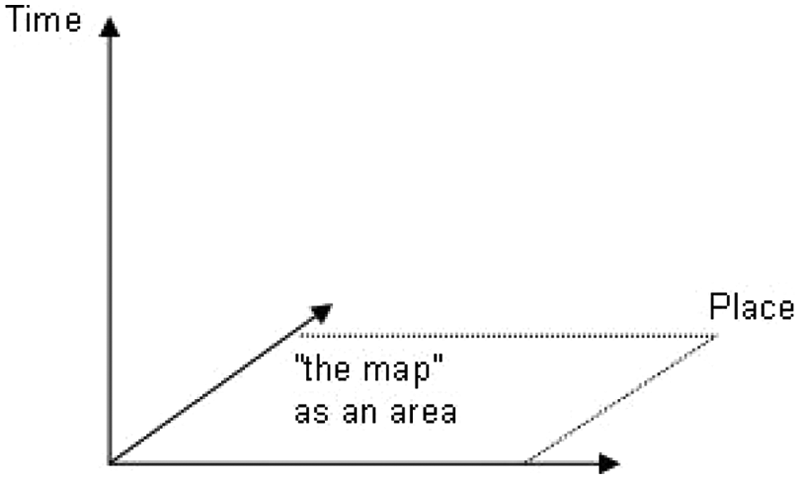
The traditional time-place illustration (Hägerstrand, 1953)
This notation system (Figure 1) can be used to visualize processes over time and their location and changes of places. In the time–place trajectories, different actors’ movements can be illustrated. By identifying stations in time–place, locations for specific activities and the relation between them can be illustrated. In Figure 2, there are two stations indicated by S, which may be for example a home and a House of Culture. The thick line f is a trajectory of an actor, leaving S1, visiting S2, and returning to S1.
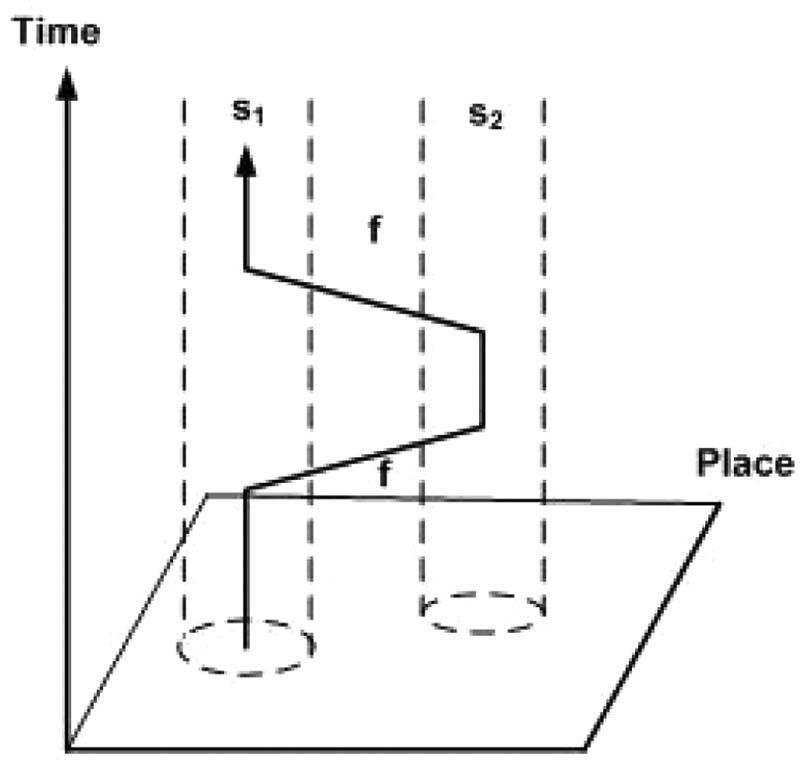
Stations in time-place (Hägerstrand, 1970)
The time-geographical notation system visualizes the use of time by “mapping” what has happened. There may be many reasons for the outcome in time–place, but they all fall back on the basic issue of who was actually in possession of the time–place when a specific process took place. The outcomes of processes are complex and can be seen from different perspectives. Hägerstrand’s approach to explain process development was to focus on the constraints hindering the actors, taking off from the actor’s perspective. This way he identified three types of constraints: capacity constraints (hinders within the actors own capability), coupling constraints (hinders to reach and connect to others and other objects), and finally authority constraints. All these are expressions of powers expressed in the process, meaning that something is hindering the actor from doing what s/he otherwise would have done, in line with Dahl’s classical definition of power (Wihlborg, 2011). The coupling constraint is about getting contacts and access to a process, which is essential for influencing a process. Authority constraints are both expressed through formal institutional arrangements and discursive powers like how and what to express. To relate to the briefing process, there are the formal arrangements of policy-making agendas and regulations regarding public buildings constraining the actors. There are also norms like ideas of the public and the value of culture forming and constraining how, when and by whom end-user needs are represented. Here, timing and placing of stakeholders are crucial for the activities and progress of the briefing process.
To Hold One’s “Stake”-Stakeholders in Public Briefing Processes
In the public briefing process, stakeholders articulate different values and influence the public decision-making process. Stakeholders are individuals or organizations that are actively involved in the construction project and their interests may be positively or negatively affected as a result of the project (Olander, 2007). Design and construction of art and culture buildings have been considered to be both very different from other building types and uniquely complex due to exacting technical demands and accommodation of various and sometimes conflicting needs of stakeholders (Short, Barrett, Dye, & Sutrisna, 2007). In other areas of urban policies, the interplay of stakeholders and elite actors play a crucial role. This is a core idea also in urban regime theory (Stoker & Mossberger, 1994), and this approach could probably be taken further into other policy areas.
Stakeholder theory has re-emerged in a more prominent role in the strategy and performance discussion even if it has a longer history (Harrison, Bosse, & Phillips, 2010). Stakeholder theory originally laid emphasis on effective management of a broad group of stakeholders affecting the firm (Freeman, 1984). Management studies demonstrated a positive relationship between integration of stakeholders and project performance. Stakeholders express power when formulating and arguing for their stake (Mitchell, Agle, & Wood, 1997). The balancing of different stakeholder values is central for the construction process (Barrett, 2007). Values are a power resource but have to be formulated in relation to values on the agenda and the specific issue. Stakeholders have to combine the problem they identify with political resources and policymaking to make a change of interpretation, argues Kingdon (2003). Regarding public buildings, as in this case, public and local core values are central for entering the agenda and have the power to make a change.
Stakeholders in the Public Building Process With a Time-Geographical Analytical Approach
Stakeholder theories in management perspectives point to the importance of legitimacy, power, and urgency to make an agent into a stakeholder (Mitchell et al., 1997). Legitimacy in public processes is gained through legal arrangements and territorially localized, discursive interpretations. Thus, stakeholders have to act legally, in the given territory and in accordance with the discourse then and there. Power is about the stakeholders’ capacity to make a difference. In the most classical and simple definition, power is to make someone do what s/he would not have done otherwise. Urgency is about the timing of the process so that the issue is on the agenda and the stakeholder is forced to act in the situation. These three components of stakeholder theory (Mitchell et al., 1997) can thereby be integrated into the time-geographical analysis. A legitimate stakeholder has power to make a difference when the timing is right and when it is urgent.
Briefing in a public building process can invite all stakeholders. Policymakers may follow the local opinion but they may also influence the scope and nature of the political activities (Kingdon, 2003); thus, they compromise the use of their resources, negotiate different demands and challenge values. When policymakers and professionals in the public administration act as public sector clients, they become central legitimate stakeholders with power resources, obliged to consider end-user needs to maintain democratic legitimacy and political power. However, stakeholders can take on different roles and interest throughout a process―over time. Thus, a time-geographical analysis can open up the many roles of stakeholders and how they shift in different phases of the process. Figure 3 presents a model for analyzing how stakeholders articulate end-user needs over time, with a time-geographical perspective, when performing different activities during the public building process. The public building process is analyzed in four different phases: the idea phase, the design phase, the construction phase, and the use phase. These phases are in general described as chronological phases in the building process, that is the idea phase is coming before the design phase. However, analyzing how stakeholders express end-user needs the public building process may involve another logical order. In the time-geographical illustration earlier, the phases in the building process should be seen as stations performed at a specific place over time. In our case study, the place is a city that changes over time because of ideas, design, construction, and use of a new public building. How stakeholders articulate end-user needs in the different building phases is analyzed by mapping different stakeholder trajectories in a time–place perspective. This analysis combines the political decision-making process with the briefing process. It develops new insights in the public building process by visualizing different stakeholder trajectories, expressing end-user needs with a time-geographical perspective.
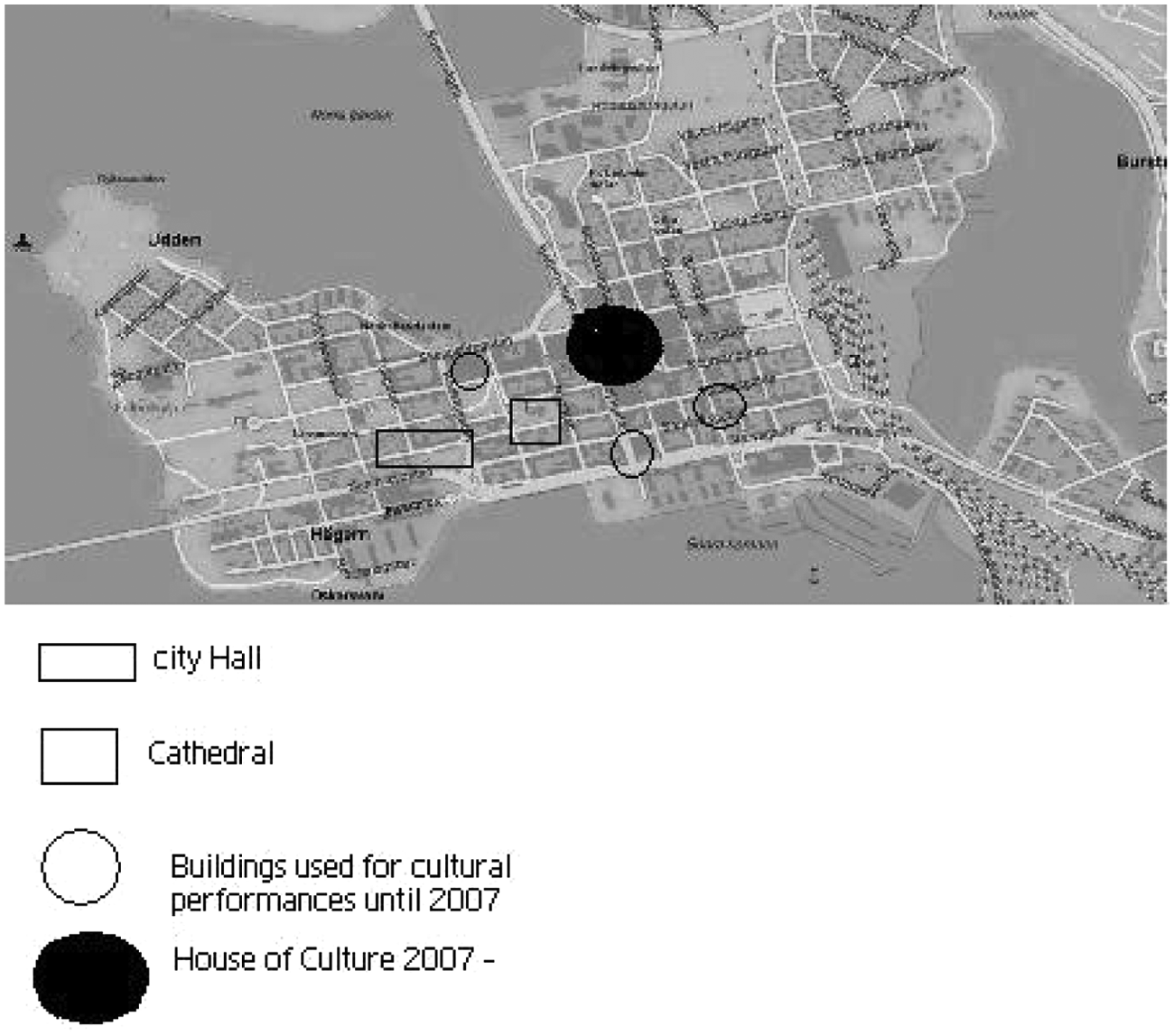
Changes of places for cultural activities in the city
An Inductive Case Study of Stakeholders-Methodology
The qualitative single case study underpinning this analysis is based on a complex methodology where different forms of data are collected and analyzed in several steps by process tracing (Eisenhardt, 1989; Miles & Huberman, 1994; George & Bennet, 2007; Tansey, 2007) where the time-geographical concepts de-constructs the traced process for analysis. By starting with the case, the interpretations are built through inductive processes in relation to the analyst’s theoretical pre-understanding as inspired by grounded theory (Geertz, 1993) and reflective abduction (Alvesson & Sköldberg, 2000). A single case study makes it possible to capture different angles and perspectives in depth and opens for analytical generalization by relating to theoretical perspectives (Eisenhardt, 1989; Yin, 1994).
The House of Culture in Luleå—Selection of the Case and Research Process
This case was chosen because it is both common for medium- to large-sized Scandinavian municipalities to build Houses of Culture or similar buildings (SKL, 2008), but it is still uncommon to make such large investments in public buildings with cultural content in peripheral areas such as northern Sweden. Our in-depth study of the early phases of the building process started with a prestudy in 2008 and has developed in close collaboration with actors in the region.
Houses of culture consist of varying venues combining different cultural activities, for example a concert hall with a library and an art gallery in the same building. Thus, there are different forms of end-user needs expressed through the briefing and policy process. The House of Culture in Luleå combines these cultural activities and covered a broad interplay of stakeholders in the briefing process. This case also includes special functional design, combining different cultural activities and involving art professionals with different goals. Thus, the arguments for the design and building had to be explicitly stated by the stakeholders and their representation of end-user needs, which is very complex in particular in design and construction of art and culture buildings as described by Short et al (2007). In addition, this process had a long history and the arguments had been expressed throughout it.
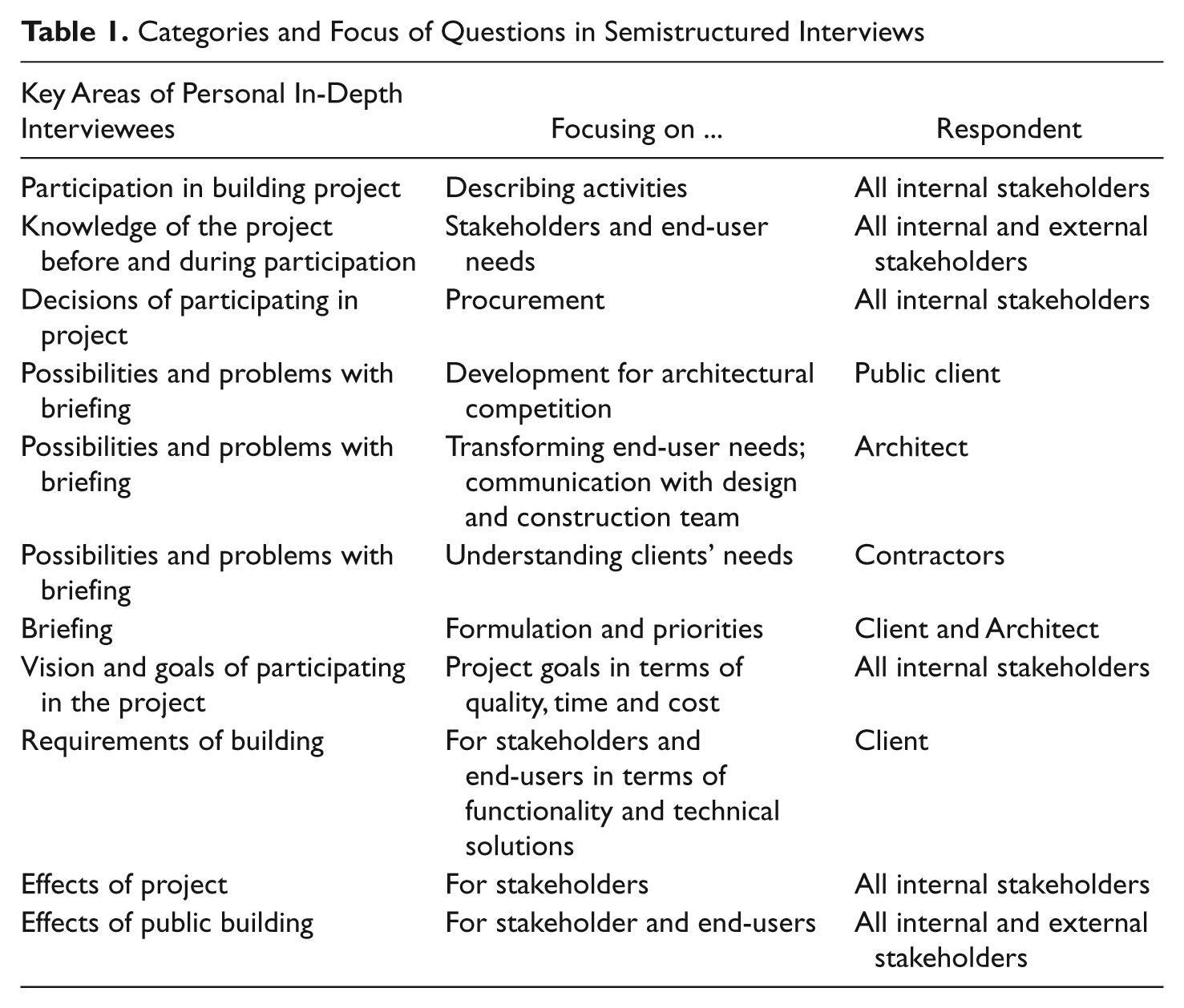
The main sources for process tracing were interviews, observations, and by analyzing archives such as feasibility studies, political decision documents, architecture programme, briefing documents, etc. According to the Swedish principle of free access to public records, all archive data from the construction project has been available and analyzed. Semistructured interviews with key stakeholders aimed to extend the picture of the process given by the archive records.
The semistructured interviews are the main source of the specific analysis presented here. The interviews focused on the actor’s role and activities in the process. Each interview lasted for at least 1 hr, several for 2 hr. All interviews were conducted during a time period of 2 years (second half of 2007 until first half of 2009). The first key interview was with the cultural manager (interviewed three times). He also opened up the network of relevant informants around the project. The interviews were recorded and transcribed.
Because the research process had several phases and the actors participated in one or more interviews, open interview guides were developed for the specific actor and interview occasion to follow up and strive for a closure of the traced process. A summary of the content of the semistructured interviews is presented in Table 1.
Categories and Focus of Questions in Semistructured Interviews
The Process of Analyzing
The tracing of the process was made when the building process had been performed and the building was in use. This might have influenced the validity of the study because the respondents told their stories based on their memories and the final results of the process. However, our broad material and solid description of it provide qualitative validity (Laurell Stenlund, 2010). The compilation was first sent back to the respondents for their confirmation and then also presented during workshops with actors from the construction project as well as internal and external stakeholders and end-users of the building. In total, six focus group interviews were arranged as reference group meetings as well as a final workshop concluding and confirming the description of the process.
Two main categories of stakeholders can be identified in construction projects: internal stakeholders, those actively involved in project executions; and external stakeholders, those affected by the construction project (Olander, 2007). Translated into the public briefing process, policy-making authorities and public administrations were coded as internal stakeholders. Other stakeholders, such as interest groups including trade and industries, using their democratic opportunity to articulate their needs, were coded as external stakeholders. The decision-making in public construction processes is based on a democratic rationality incorporating different rationalities, knowledge, and information (Cairns, 2008). The internal stakeholders are the ones having power in the process and form its development. They take up the values of the external stakeholders as expression of end-user needs. The external stakeholder could have power resources to be included in the processes and could thereby be seen as an internal stakeholder. Thus, the interpretation of internal or external stakeholders is a consequence of their power resources and use of them. Table 2 describes the interviewed persons by categorizing them into stakeholder type (Olander, 2007), role (Cairns, 2008), and phases identified during data analysis.
Interview Persons Categorized in Stakeholder Type, Role, and Phase

The traced process of articulating end-user needs has been illustrated through the trajectories of different stakeholders. Trajectories through a time–place dimension in a process is a basic time-geographical mapping that illustrates critical situations and opens for the analysis of constraints and resources in specific pockets of time–place; see data analysis presented in Figure 4. In the second step (“Different Stakeholders Articulating Different End-User Needs” section), we extend this analysis to focus on how end-user needs are expressed by different stakeholders through the process, but first some general information on the House of Culture in Luleå, Sweden.

Time-phase illustration of activities in early phases of the building process of a House of Culture
The House of Culture in Luleå
The case study describes a successful construction project with positive effects for the public sector client, construction professionals, and end-users. The client, the municipality, was the investor and developer of the project and is today also the owner and the facility manager of the building. The construction project was initiated by the client starting on September 29, 2003 and finished on January 12, 2007 when the building was opened to the public. The facts about the project are presented in Table 3.
Facts of Construction Project, House of Culture

The project was finished on time, according to the time schedule. The costs followed the budget and quality goals were achieved. Managers and staff working with concert arrangements in the library and in the art hall have expressed that the building is functional for the visitors and public activities. However, some working spaces for the employees could be improved. Trade and industry have described how the building has provided new job opportunities, developed organizational, and business activities as well as increased the amount of temporary conference visitors and tourists to the city (Laurell Stenlund, 2009, 2010).
The Geographical Location
The House of Culture studied here is located in a region traditionally dominated by heavy industry especially within steel and mining. The city of Luleå has approximately 74,000 inhabitants (2010) and the region, Northern Sweden, 250,000 people. Luleå is the main city in the region. During the last decades, the city profile of Luleå has changed from a dominance of heavy industry to more knowledge-based companies and Luleå University of Technology.
Figure 3 is a map of central Luleå, indicating the different locations of the buildings hosting the cultural activities before the House of Culture became available. The Cathedral and an old former church were used for concerts and other cultural arrangements. The City Hall was once suggested to include a concert hall, but this was rejected by the public opinion. The House of Culture is marked with a black thick circle situated close to the northern harbor. The previous building used for the city library is situated close to the northern harbor, and art exhibitions were held in rented space close to the southern harbor.
The public building process has thus changed the built environment. The city has a new building for cultural activities. The public sector client has described this change in terms of changed attitudes among the citizens toward culture, including art performances and library visits as well as to knowledge based industries (Laurell Stenlund, 2010).
By illustrating processes of change in a map, the timing is not made visible and it is not possible to see when different changes take place. A process description also misses the geographical localization of the process. However, time-geographical illustration makes this possible, as the analysis in “Analysis Through a Time-Geographical Lens” will show.
Analysis Through a Time-Geographical Lens
From the case analyses, three phases were identified where end-user needs were articulated: idea, planning, and design. These three phases may be compared with the chronological nature of the construction project: predesign, design, construction, and occupation (Barrett & Sutrisna, 2009). In Figure 4, we show how this developed over time and what activities took place in the different phases.
These phases are spread over the early phases of the building process including the first needs of a new building for music in the city in 1939. The public debate was on-going for 60 years in the city, in local press as well as in private and community circles. The planning phase became very intense during the decision making period from 2002 to 2003. The idea and planning phase resulted in the development of the client’s requirements in the written brief and in an architectural competition at the end of 2003. The design phase started after the winning solution was selected on March 29, 2004 and the construction phase started on April 5, 2005.
Stakeholder Trajectories
Four groups of stakeholders articulating end-user needs appeared through the analysis. These were interest groups, local policymakers, professionals in public administration, and construction professionals represented by the architect. The stakeholders are grouped together into one trajectory for each group in the time-geographical figure (Figure 5).
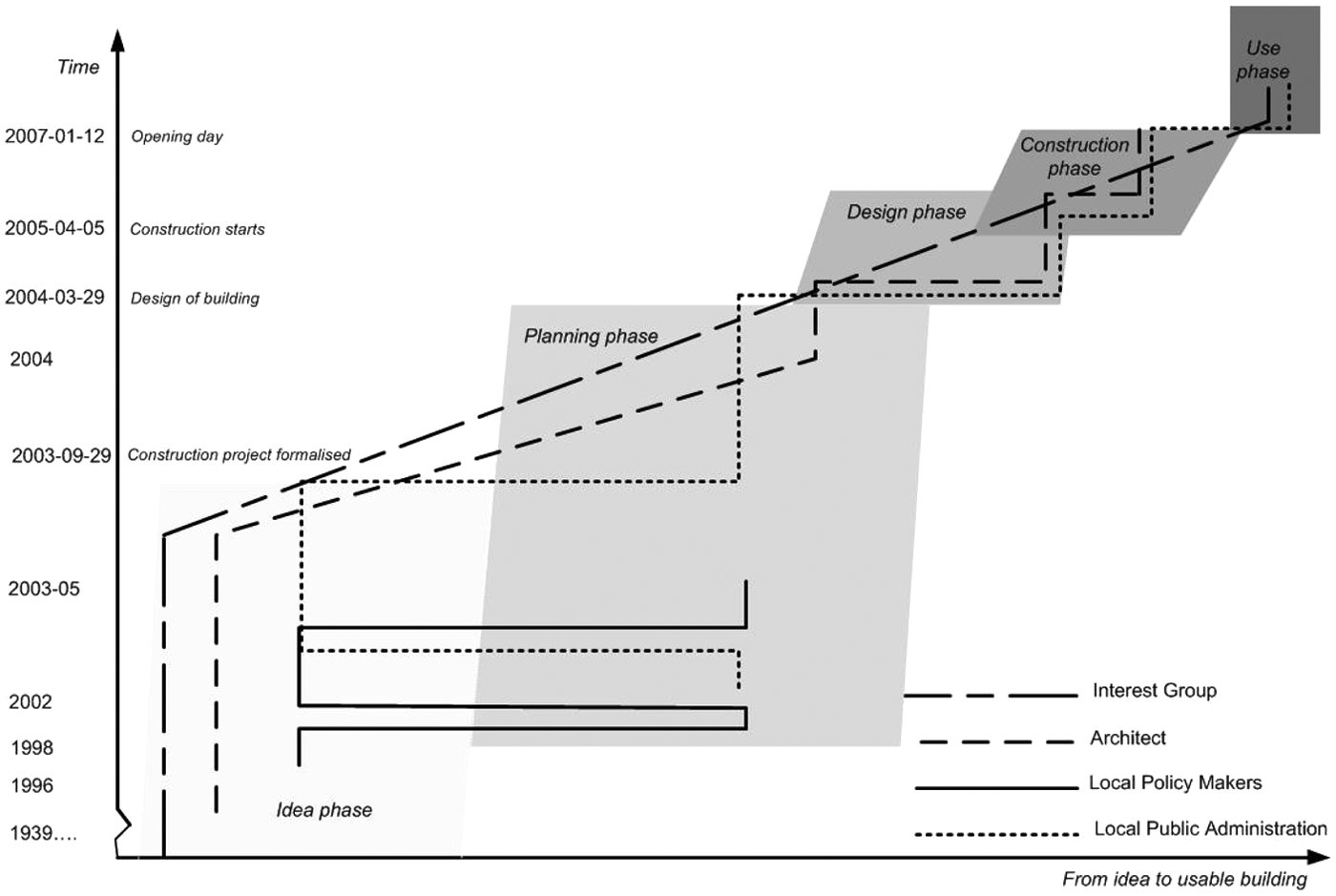
Stakeholder trajectories in a time-phase illustration of the building process of a House of Culture
Interest groups—A space for music and a place and benefits for local industry
The interest groups first articulated their need for a place for music performances. Later in the idea phase, they also expressed their interest in the other activities to be performed in the building.
The musicians as an interest group expressed their need for not just having a concert hall for performances but also for rehearsals as well as for visualizing the importance of art performances in the city. Already in 1939 the first announcement of a need for a better concert hall was expressed by the Orchestra Society. The Cathedral was not perfect for orchestra performances.
During the 1980s, a new, larger public and private opinion started. When the politicians finally responded to the orchestra’s demands in 1986, the former leader of the local orchestra expressed the question of a new building in the city.
Music is a must in the city, as a part of living in the city as well as a part of human life. (interview Orchestra member 2007-09-05)
After the decision to build a house of culture in 2003, the trade and industry—another interest group—discussed how the building could meet their needs. The representatives from local trade and industries and highlighted the use of the concert hall for commercial purposes and conferences (interview Representative for Trade & Industry, 2008-10-23). Their needs were mainly economic as benefits to local trade and industry, as expressed by the tourist manager:
Every visitor to the house of culture is important for the tourist sector and its development. (interview Tourist manager 2008-10-22)
The architect— understanding end-users’ tacit needs
The architect, who later won the architectural design contest in 2004, became engaged early in the public discussion of building a concert hall in the city during the 1980s. He became a “spider” in the network formulating and consolidating the ideas about the new House of Culture and he used his special competences to build and tighten up this network of interests and actors. The architect expressed the citizens’ needs with two perspectives, the first one regarding the location and the second regarding the cultural activities and its functionality. He recapitulated the story of the location by highlighting the strong local opinion among the citizens against the proposed location in 1996. He said:
This solution should be stopped. The concert hall should be somewhere else, preferably close to the northern harbour. More people attended than on May first [Labour Day]. (interview Architect 2008-10-02)
After the architect had read the written brief and as a participant in the architectural competition, he understood the end-user needs as follows:
One primary condition was the entrance and that the visitors should see the cultural content, with the library, art hall, café and concert halls directly when coming in. The house should invite its visitors and make it easy for them to find things (interview Architect 2008-10-02).
The architect’s translation of the public sector clients’ requirements into the winning proposal was based on his knowledge of the city and its inhabitants. After winning the architectural competition, during the design phase (2004–2005; also integrated during construction 2005–2007 but not included in this study) the architect together with the public sector client and contractors developed the written brief into building documents. The agenda for the continuation of the process was defined and other ideas were thereby excluded.
The analysis shows that the architect had the capacity to transform his role during the idea, planning, design, and construction process. As a stakeholder he used the time-geographical stations where expressions of end-users’ needs were briefed.
Local policymakers—Following the local opinion as well as forming it
Local policymakers are driven by democratic processes with an aim to fulfill citizens’ needs expressed in policies (basically to be re-elected). In Luleå, there had been long discussions of investments in a new concert hall (first in 1939), but the ideas had been steadily rejected by the political majority until 1996, when the municipality presented a possible solution that could meet the citizens’ desires by building a concert hall in the City Hall. However, this solution was not positively received by the orchestra society and their supporters. This response invited a reaction by the public demonstration in 1996.
The local political parties reacted differently in their manifestos for the upcoming municipal election in 1998, when the non-socialist minority put the need for a new concert hall on their political agenda. The Social Democratic Party had been in office in Luleå for a very long time, but at this time they had to form a majority together with the Left Party and the Green Party. The Social Democratic Chair of the Municipal Executive Committee related to these different opinions among the parties in office, highlighting that:
. . . the Left Party and the Green Party were not enthusiastic, but the Social Democrats had the question on their program, but they considered that education and elderly care should be given priority . . . (interview Chair of the Municipal Executive Committee 2008-04-01)
The Social Democrats did not give the question any priority in the election campaign of 1998 due to what they saw as lack of resources:
. . . based on financial reasons, we had to postpone the investment into the future. This decision was received with great disappointment among the supporters of the concert hall. (interview Chair of the Municipal Executive Committee 2008-04-01)
Hereby, the social democratic majority constrained the local political agenda at that time. The used the control over the municipal budget as a power resource to constrain the abilities for other actors to influence the issue and reach the formal decision-making agenda.
For nearly 60 years, this policymaker acted both as a stakeholder representing different cultural organizations’ interests and at the same time as a stakeholder responsible for the municipal organization and its budget. Four years later, before the municipal election in 2002, the social democratic policy-making stakeholder changed its focus by articulating the needs of the city, in contrast to before and to other stakeholders having a focus on specific end-user needs. Hereby, they used their power over the agenda again, but now to reframe the meaning of the building from a concert hall to a House of Culture and also by defining a new, larger, and more central place for the building. The issue was given a central political attention, avoiding the former political conflicts, as the cultural manager expressed as:
The Municipal Executive Committee considered that a House of Culture is a matter for the municipality and not only something for the cultural committee. (interview Cultural manager 2008-01-17)
From 2002 on, the idea of the building was not just a concert hall. The Chair of the Municipal Executive Committee raised the idea of combining different cultural activities in a house of culture. The building was thus no longer only a matter for the visitors and the cultural organizations, but also a matter for the city and region. The house of culture was to provide a centrally located arena for dialogue and positive experiences through a combination of different cultural activities such as concerts, library activities, and art exhibitions.
When the decision of building a house of culture was taken on September 29, 2003 by the Municipal Executive Committee, the construction project was initiated and a construction team was constituted by the client—the municipality. The construction professionals within the municipality, including the public administration, were responsible for the construction project. The construction professionals were supposed to represent the interest of the policymakers in the construction project. In Figure 5, this is illustrated by the trajectory for the policymaker merging with the trajectory for the public administration in 2003. At the same time a new map is developed with a new place for a new building in the city.
Public administration—As stakeholders rather than loyal servants
A parallel issue on the political agenda (2000–2002) was the expressed need for more space in the city library, and a decision to rebuild the library was made by the Municipal Executive Committee. The culture committee did not agree to the plan of rebuilding the old library. They argued instead for a new library. During this phase, employees working at the library also discussed the possibilities of combining the library and the concert hall in one building:
The natural way should be to have the library in a house of culture close to a concert hall. The library is open all days, everybody goes there and it is free for the citizens. (interview Library manager 2008-10-06)
The need for a new library was included into the policy process of the House of Culture in 2003, when the public administration found a new solution for the municipality to finance the construction project. During the idea phase, the public administration also integrated the general public and others to discuss the potential building and its activities.
The public administration should in theory act as loyal servants implementing what policymakers decide. But they also have to prepare decisions. First, the public administration conducted two feasibility studies, the second of which was accepted by the politicians. In these studies, end-user needs were transformed into useful concepts. The public administration team formulated and clarified several prerequisites that can be seen as an aggregation of end-user needs.
The public administration stakeholder group moved to the design phase when working as construction professionals, explaining and transforming the public sector client’s requirements into functional, and technical descriptions. Their main power resource was their knowledge about the administration and the daily business in the library and for the music and cultural arrangements.
Different Stakeholders Articulating Different End-User Needs
The above analysis shows how different stakeholders express different end-user needs. The interest groups represented by the orchestra society expressed the need for a concert hall. Trade and industries expressed a need for a conference center and cultural activities. The architect articulated end-user needs in terms of location, cultural activities, and functionality. The local policymakers first articulated end-user needs in relation to the need for different end-users, but then changed their focus by articulating the need for a building that would contribute to the development of the city as well as the region. They had the power to change the agenda and they did; thereby other actors and stakeholders just had to follow what was on the agenda. The House of Culture was intended to become a creative space for the public.
The public administration also articulated the specific needs in their cultural organizations such as more space in the public library. Professional managers in public administration appear to act as stakeholders rather than loyal servants, as Sehested (2009) concludes when pointing to the reflexive capacity among public administration managers with professional/technical competences. Hereby the public administration became an internal stakeholder by using their professional competence as a power resource when funding issues became urgent (Mitchell et al., 1997). They also used their knowledge of the end-user needs to enter the agenda and gain legitimacy as stakeholders rather than loyal servants.
The localization also became a power resource in this process. When reframing the end-user needs from a concert hall to a House of Culture, there was an extended need for space and the northern harbor became an alternative. The idea of a House of Culture was in line with the local reframing of the place of Luleå from a heavy industry region to an expansive knowledge region, where end-users had new needs and demands.
Concluding Remarks
The analysis shows the complex interplay of stakeholders taking on end-user needs and the importance of integrating the phases of the policy process and the briefing process. By focusing on the time–spatial interplay we have traced the process in both place and over time.
The case study shows that stakeholders articulated end-user needs differently and had various reasons for taking them on. The stakeholders obviously moved between phases of the building process, articulating end-user needs until the construction project and procurement forms were settled with the contractors. During this processes, they were able to express end-user needs in accordance to the aim of the phase of the process and the other actors active in that phase. This appeared through our analysis made with a time-geographical perspective. The different and changing roles can be visualized and integrated and thereby show the complexity of how end-user needs are articulated through public building processes.
During the idea phase, local policymakers first articulated end-user needs for two new buildings, one for concerts and one for the city library, not merging the two types of end-user needs. However, in the planning phase, the first feasibility studies were accomplished but later rejected and the idea phase was reopened. Then local policymakers found a consensus solution of “a cultural house with different cultural activities.” Here stakeholders that had represented different end-user needs found a common interest. This indeed indicates that the policymakers follow local opinion as well as shape it (Kingdon, 2003). By setting the agenda, they constrain the action spaces for other stakeholders. In relation to the end-user needs, it becomes obvious that the stakeholder groups have different capacities for, and interests in, expression these needs.
Legitimacy has to be, in this perspective, gained both from those whose interest they try to express and among other stakeholders as well as the structural setting of the building process. However, the stakeholders considered the issue of the House of Culture with varying levels of urgency during the stages of the process, and thus their participation in the process can be illustrated in a time–place illustration.
Public sector clients have a unique role compared to private sector clients when encouraging stakeholders to express needs not yet formulated, that is, to identify stakeholders who are not in the position of holding a stake and then promote their articulation of their needs and demands. They are supposed to speak for others, be altruistic and express not yet foreseen needs and interests.
By pointing out the political aspects of the briefing process and opening it through a time-geographical approach, a broader analytical framework has been formed. The briefing process in its early phases can be considered a policy-making process with potential to include deliberative methods for participants and stakeholders. Such an approach has both practical and analytical implications. It is also important to show that public building processes have to be legitimate and build on political values and norms in general. It is also important both for academics and management of construction work and public administration to promote common knowledge and perspectives to improve the trust in each other’s work.
Footnotes
Declaration of Conflicting Interests
The authors declared no potential conflicts of interest with respect to the research, authorship, and/or publication of this article.
Funding
The authors disclosed receipt of the following financial support for the research, authorship, and/or publication of this article: The authors gratefully acknowledge the financial support of SBUF (Development Fund of the Swedish Construction Industry) and Formas/BIC (The Swedish Research Council for Environment, Agricultural Sciences and Spatial Planning).