



Abstract
Population decline in once vibrant cities has introduced challenges to managing civil infrastructure. These challenges, such as fiscal constraints, reduced personnel, and increasing regulatory standards, are identified in this article in the context of water and wastewater infrastructures when cities do not follow a trajectory of growth. Following the discussion surrounding consequential issues arising from urban decline, retooling alternatives to mitigate challenges are explored. The study uses a mixed method approach, incorporating qualitative analyses of data collected from 4 U.S. shrinking cities, subject matter expert interviews, and statistical analyses of survey data from residents of 21 U.S. shrinking cities. Our analysis indicates that more than 70% of residents are willing to pay increased rates for improved services that may be accomplished through implementing retooling alternatives. Statistical modeling is used to identify the demographic variables that increase an individual’s propensity toward implementing five alternatives, revealing city-specify variations in support for different alternatives.
Introduction
The term “shrinking cities” is used to define substantial declines in urban populations (Bontje, 2004; Rybczynski & Linneman, 1999). Contrary to growth patterns typically assumed by engineers and planners, shrinking cities are plagued by increasing numbers of vacant properties (e.g., homes, businesses, brownfield sites) and decreasing demands for infrastructure services. During these economic contractions, the footprint of built infrastructure does not adjust, but rather remains stable, ultimately creating an excess of underfunded and underutilized infrastructure. The “shrinking cities” phenomenon has been well studied by social and political scientists (e.g., Armbost, D’Oca, & Theodore, 2008; Bontje, 2004; Martinez-Fernandez & Wu, 2009; Masi, 2008; Moraes, 2009; Pallagst, 2009; Wiechmann, 2009), yet the impacts on engineering and systems management are only beginning to be appreciated (e.g., McDougall, 2008; Schilling, 2009; Schlör, Hake, & Kuckshinrichs, 2009).
Traditionally, infrastructure design has been based on the assumption of growing or static populations without future design scenarios that allow for unexpected developments, agility, and flexibility, and thus, has been unable to effectively accommodate decreased demands (Hollander, Pallagst, Schwarz, & Popper, 2009; Kabisch, Haase, & Haase, 2006; Schilling & Logan, 2008; U.S. Environmental Protection Agency [EPA], 2014). Infrastructure life-cycle assessment is temporally static (Reap, Roman, Duncan, & Bras, 2008) and does not incorporate adaptable planning or recourse when the end of the useful life refers to the infrastructure being no longer needed to meet the population demands, as opposed to the infrastructure being degraded to the point that it can no longer provide service (Hollander et al., 2009). Due to inflexible infrastructure designs, shrinking cities face obstacles in controlling rising per capita costs for services while continuing to provide services to sparsely populated areas of the city. In one Michigan shrinking city, underutilized infrastructure and a high percentage of vacancies, reaching up to 72%, have required exploring opportunities to reconfigure infrastructure to continue to provide essential services, maintain quality of services, and save taxpayer money (U.S. EPA, 2014).
Water and wastewater infrastructure systems have unique characteristics that restrict their responses to the dynamics present in shrinking cities. First, because these systems are underground and unseen, they lack the same level of public awareness of operations and conditions as other infrastructure systems, such as roads and bridges. Second, these systems provide services that have major public health and environmental implications. Providing potable water to communities and conveying wastewater to treatment plants prevent the spread of disease while protecting the environment. In the context of shrinking cities, the water quality for local customers may worsen due to unseen, aging, and degrading pipelines, and increased water age or stagnant water may result from declining demands. This declining service quality, along with high service costs, may exacerbate deindustrialization, thereby continuing a cycle that may decrease the quality of the water and the efficiency of operations while increasing the per capita costs of the infrastructure system (Herz, 2006). However, shrinking cities have the potential to implement alternatives in operations and management, such as reductions in the physical footprint, which may stabilize or reduce costs while improving the water quality by decreasing stagnant water and the age of the water delivered through the system (Hoornbeek & Schwarz, 2009; Rybczynski & Linneman, 1999; U.S. EPA, 2014).
Each community must assess the viability of different infrastructure retooling alternatives in the context of both technical feasibility and community vision. The physical infrastructure and decline patterns throughout the city must be considered when examining options, such as physically resizing the system footprint, contracting excess capacity, or switching residents from the water infrastructure system to well connections. The decisions made about infrastructure below ground may have implications for the above ground life of the community, such as shifting land uses or consolidating neighborhoods to more populous areas, and thus, understanding the attitudes of the residents within the community is important for the successful implementation of infrastructure retooling alternatives. To best align with community vision and mitigate potential opposition or unsustainable solutions, the utility provider should incorporate participatory processes when implementing infrastructure retooling alternatives (Faust, Abraham, & DeLaurentis, 2013; Nancarrow, Porter, & Leviston, 2010; Agarwal et al., 2000; Susskind & Cruikshank, 1987).
By identifying the typical challenges associated with water and wastewater infrastructure in shrinking cities and providing insight into the public’s attitude toward these challenges and retooling alternatives, management strategies can be identified to facilitate the transition from shrinking to sustainable. In this article, we provide insight into these challenges by synthesizing the existing body of knowledge in the published literature, the results of interviews with subject matter experts (SMEs), and the data gathered via an online survey targeting the residents of shrinking cities. Based on this enhanced understanding, we then explore the appropriateness of current paradigms used to design and manage urban infrastructure. This article aims to (a) identify and discuss common challenges for water and wastewater infrastructure management spanning shrinking cities, (b) suggest possible water and wastewater infrastructure management alternatives that may mitigate these challenges, and (c) discuss the public’s attitudes with regard to the implementation of five water infrastructure management alternatives.
Water and Wastewater Challenges in Shrinking Cities
Although each shrinking city is unique, many challenges are common across this category of cities. Specifically, this article explores challenges in medium and large shrinking cities in the United States that at their peak population invested into an infrastructure footprint that is no longer needed at its current size to meet demand needs. To complement the literature regarding the issues plaguing shrinking cities, interviews with SMEs were conducted. Socioeconomic data (income, population, etc.) collected from the 2010 U.S. Census (U.S. Census Bureau, 2011) were used to identify shrinking cities in the Midwestern United States for interviews with SMEs to fill in knowledge gaps about current water infrastructure management. Personnel in Gary, Indiana; Akron, Ohio; Saginaw, Michigan; and Flint, Michigan were selected for additional interviews as these four cities use different, yet representative, water supply infrastructure management approaches typical to cities throughout the United States, and span multiple states restricting the reflecting of local policies. Water and wastewater infrastructure systems may be managed publically, privately, or via public–private partnership, at a local or regional level. For example, a private water supply company that uses a regional service approach manages Gary’s water system, whereas its wastewater system is municipal and managed within the boundaries of the city. On the other hand, Akron has municipal wastewater and water supply providers that manage both of their systems using a regional approach. Saginaw and Flint have individual municipal wastewater and water supply providers, with their systems contained within the urban boundaries of their respective cities. The contrasting classes of management approaches provide insight into issues that are unique to each management method, as well as issues that span the various structures of the systems (e.g., privately managed vs. publicly managed). Three to four phone interviews were conducted with city officials from these cities between August 2012 and September 2013. Between two and four face-to-face meetings that included more detailed questions and discussions were also conducted in three of the four cities between October 2012 and October 2014.
Financial Challenges
In shrinking cities, the cost of maintaining the aging infrastructure intended for use by larger populations remains constant or increases, whereas the tax base and number of customers decline (Beazley, Wilkowski, Eckert, & Wuest, 2011; Butts & Gasteyer, 2011; Rybczynski & Linneman, 1999). For instance, Detroit has an excess of aging water infrastructure, some of which is more than two centuries old and was originally intended to support more than twice the present population and a water-intensive manufacturing industry. However, since the 1950s, Detroit’s population and manufacturing industry have been shrinking, leaving the city with far fewer people who utilize the water infrastructure and fewer water-rate-payers. Yet, the entire infrastructure system must be maintained to provide services for the current population (Southeast Michigan Council of Governments, 2011).
The four cities investigated in this study (Akron, Ohio; Flint, Michigan; Gary, Indiana; and Saginaw, Michigan) indicated that water and wastewater systems need to be self-sustaining, and the current financial challenges were going to be met by decreasing their operation and maintenance costs or by increasing rates to consumers. Approximately 75% to 80% of the water-sector infrastructure costs are fixed (e.g., capital, operations; Herz, 2006; Hummel & Lux, 2007; Schlör et al., 2009), and the financial burden of capital replacements, in conjunction with the heightened costs of treatment and regulatory compliance, therefore falls on the residents of the community. The recovery of costs in the event of shrinking city populations (i.e., reduced number of customers) results in municipal services becoming more expensive per capita (Beazley et al., 2011; Butts & Gasteyer, 2011; Herz, 2006; Rybczynski & Linneman, 1999).
However, rate increases to meet financial challenges may not be uniform across all water users as different classes of consumers may be billed differently due to wholesale agreements between utilities and municipalities. For instance, in Akron, the water rates for suburban customers are higher than those for residents within the city boundaries. In Saginaw, the rates for both residential and wholesale customers are derived based on the distance required to transport the water. Gary’s regional rates are derived based on a “cost of service study,” to determine the appropriate billing for wholesale and residential customers. Previous studies (Butts & Gasteyer, 2011; Schlör et al., 2009) indicate these increased costs for both water and wastewater are not insignificant, affecting regions in Michigan and Germany, respectively, where population decline has been the highest and the incomes are the lowest, highlighting the social inequity occurring due to population decline patterns.
Income inequity in the shrinking cities that were selected for additional interviews is illustrated in Table 1. These cities are representative of classes of cities that use different water supply infrastructure management approaches typical to cities throughout the United States, and span multiple states, illustrating that the income inequity challenges are not isolated to select states or management approaches. The values in parentheses compare the income of a shrinking city with the income for a city in the same state with a typical growth pattern (identified in that table by italics), as well as the average income for the state where the shrinking city is located. These shrinking cities have a per capita annual income that is between $3,954 and $8,659 lower than the average for the associated state’s cities with a typical growth pattern, and between $5,954 and $11,325 less than the average per capita annual income for the state (U.S. Census Bureau, 2011). The median household income for each shrinking city was $4,269 to $19,634 lower than the average for a city with a typical growth pattern in the same state, and $13,712 to $21,618 less than the associated state average. Due to this income inequity, shrinking cities face not only a decline in customers but also the inability of the existing customers to afford drastically increasing rates, as the cost of services is a higher percentage of the residents’ average income. For other infrastructure services, which rely largely on tax bases, the lower average income results in a tax base that is decreasing not only due to urban decline but also due to lower incomes of the existing residents.
Average Incomes in Select Shrinking Cities, Cities With Typical Growth Patterns, and State Averages (Data Based on 2010 U.S. Census [U.S. Census Bureau, 2011]).
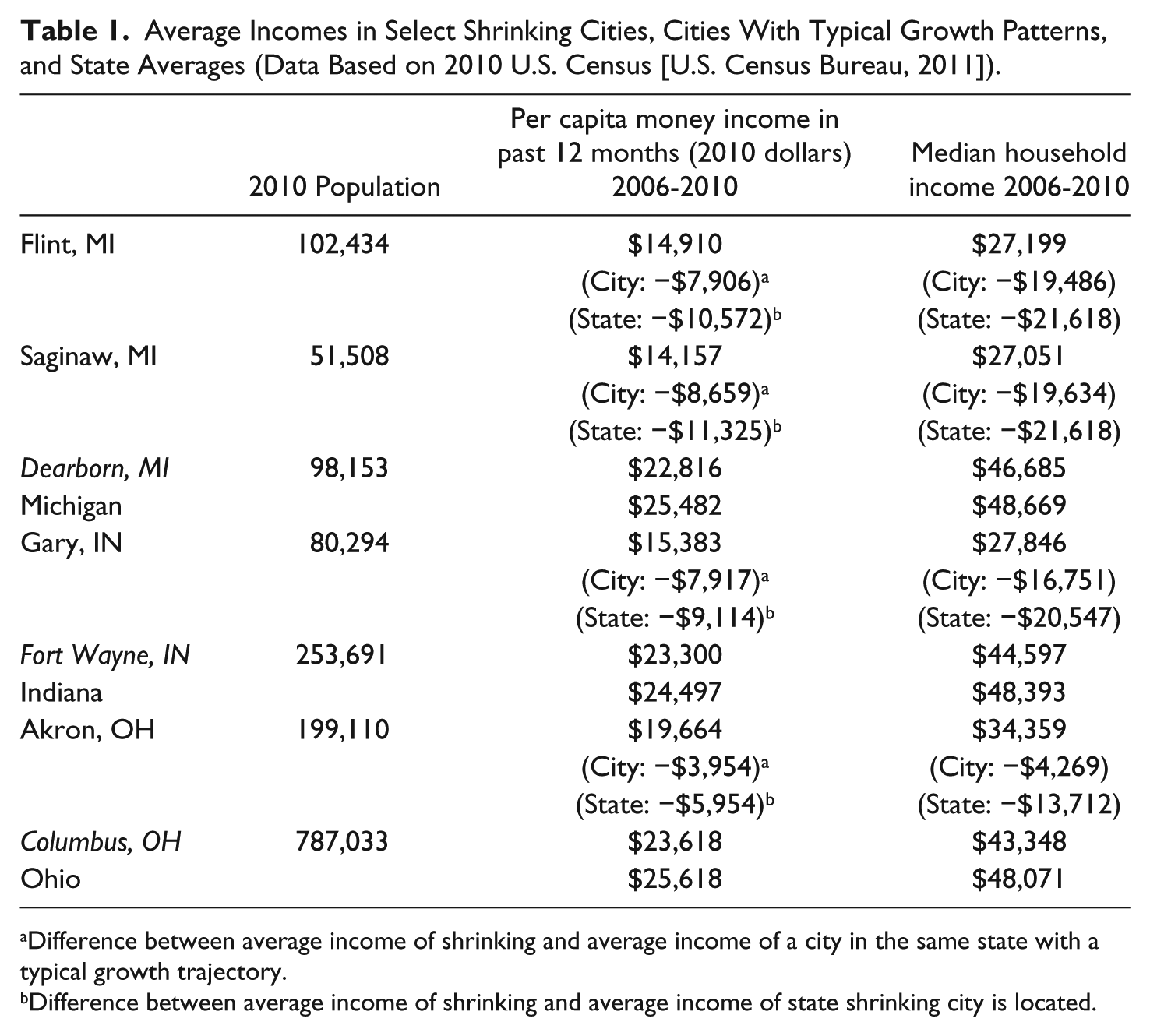
Difference between average income of shrinking and average income of a city in the same state with a typical growth trajectory.
Difference between average income of shrinking and average income of state shrinking city is located.
Personnel Challenges
Due to the dramatic decrease in available funds within shrinking cities, one of the common cost-saving strategies indicated by SMEs in Flint, Saginaw, and Akron was a reduction in personnel. However, completing non-urgent repairs, providing system upgrades, and pursuing long-term planning are difficult with a reduced level of staffing, so performing all the necessary maintenance then may not be feasible with the existing personnel resources. For instance, one city recruits the public to flush the neighborhood hydrants annually.
Further straining the fiscal operations of these systems is the retirement of personnel and the ensuing obligations to pay retirement benefits. For example, one city was paying retirement to approximately 4 times more people than were currently working. Detroit’s Chapter 9 bankruptcy filing in July, 2013, included the fiscal burdens associated with retired personnel across municipal departments (Helms & Guillen, 2013).
The private, regional water provider in Gary did not cite personnel reductions due to declining funds within shrinking cities as a major problem. Contrary to municipal systems, the private water supply provider reported a need to dedicate personnel resources to disconnecting and reconnecting services due to non-payment in the shrinking city more than in other cities within the region. This expense for the increased personnel is distributed throughout the region and drives up operation costs for the entire system.
Aging Infrastructure and Maintenance Challenges
Water and wastewater infrastructure systems have finite lives, with their condition deteriorating over time, that result in failures, decreased performance, or decreased service. Maintenance and reinvestment in infrastructure are necessary to extend their service lives (National Academy of Engineering [NAE], 2009). American Society of Civil Engineers (ASCE; 2013) predicts a nationwide funding gap of $84 billion by 2020 between investment needs and available funds, resulting in “ . . . higher costs to businesses and households as a consequence of less efficient and more costly infrastructure services.” Underinvesting in infrastructure is occurring nationwide (ASCE, 2013). Many cities, although currently maintaining water and wastewater infrastructure reactively, are attempting to transition to proactive approaches (e.g., Durrans, Graettinger, Tucker, & Supriyaslip, 2004; U.S. EPA, 2013), which is a difficult task to accomplish in fiscally strained, shrinking cities.
Interviews with personnel in shrinking cities indicated that due to fiscal constraints and reduced personnel, proactive maintenance is difficult and so maintenance largely occurs on an as-needed basis. Typically, in these cities, water mains receive attention when they fail and are only replaced when absolutely necessary due to the costs associated with replacing these major components. Based on both the published literature and our interviews, very few shrinking cities appear to have shifted to proactive attempts to identify solutions to manage and maintain excess infrastructure. The personnel interviewed from one shrinking city indicated that their municipal department has spent time and resources to explore addressing infrastructure issues through decommissioning and are actively looking for ways to resize their infrastructure for the current population. However, our interviews with SMEs indicate that this strategy appeared to be the exception rather than common practice.
Increasingly Stringent Regulatory Requirements
Water and wastewater providers must constantly meet increasing standards set by the state and federal government. These standards, put in place for consumer safety, have become increasingly stringent throughout the years (Roberson, 2011). To maintain the safety of the public and continue to meet the federal and state requirements, investments and regular maintenance that require financial capital are necessary. The cost of meeting more stringent regulations is increasingly difficult for water and wastewater systems within shrinking cities due to the declining tax base and other fiscal constraints. For instance, to obtain a National Pollutant Discharge Elimination System (NPDES) permit, the U.S. EPA (2013) requires any municipality with a population greater than 100,000 to have separate storm sewer systems. However, because many shrinking cities have combined sewer systems, creating a separate stormwater management program requires extensive financial resources, which is beyond the reach of most cities experiencing population decline.
Combined Sewer Systems
Further contributing to the problem of capacity within wastewater systems are the number of impervious surfaces in shrinking cities. Many vacant properties and brownfields leave behind concrete foundations, vast parking lots, and other surfaces that hinder the ability of water to enter the groundwater system during rainfall. These surfaces create runoff that enters the stormwater or combined sewer systems (CSS), which ultimately contributes to increasing the quantity and volume of discharges as the systems reach and exceed capacity.
CSS serve approximately 770 communities containing roughly 40 million people, largely concentrated in the Pacific Northwest, Northeast, and the Great Lakes Region (U.S. EPA, 2011). CSS are characteristic of older communities (U.S. EPA, 2011), including many shrinking cities in the Midwest. During wet weather, the systems may exceed their storage capacity or the capacity of the treatment plant, discharging untreated wastewater into surrounding streams, rivers, lakes, and oceans. Depending on the capacity of the CSS, precipitation as little as 0.1 inch may result in overflows (Lijklema & Tyson, 1993). This untreated wastewater degrades the quality of the water and can present a public health threat, environmental degradation, and reduction of aesthetics, as the overflows introduce a source of pathogens and pollutants into the receiving water. The National Combined Sewer Overflow (CSO) Control Policy (U.S. EPA, 1994, p.18689) states,
CSOs consist of mixtures of domestic sewage, industrial and commercial wastewater, and storm water runoff. CSOs often contain high levels of suspended solids, pathogenic microorganisms, toxic pollutants, floatables, nutrients, oxygen-demanding compounds, oil and grease, and other pollutants. CSOs can cause exceedances of water quality standards. Such exceedances may pose risk to human health, threaten aquatic life and its habitat, and impair the use and enjoyment of the Nation’s waterways.
Further exacerbating the issues posed by CSSs is that solids in the wastewater may settle within the system due to low flows, and subsequently discharge during wet weather events. During wet weather, generated runoff travels across the land, amassing non-point source pollutants and debris, contributing to the pollutant challenge present.
The Clean Water Act, a federal law, which established environmental programs such as the National Pollutant Discharge Elimination permit program, regulates pollutant discharges in waters, and has significantly improved water quality since the early 1970s (U.S. EPA, 2009). Suggested methods to mitigate overflows include increasing the capacity of the CSS and implementing stormwater management alternatives to reduce the regenerated runoff entering the CSS.
Philadelphia, Pennsylvania, has a CSS. The city is attempting to combat overflows by investing in management methods to treat stormwater onsite using green infrastructure, such as bioswales and rain gardens (Green City, Clean Waters plan; Baker, 2011; McRandle, 2012; Philadelphia Water Department [PWD], 2015). The PWD (2015) states that meeting wastewater and stormwater needs “ . . . requires either a significant new investment in ‘grey’ infrastructure (underground storage tanks and pipes) or a paradigm shift in our approach to urban water resources.” Prior to investing in such gray water infrastructure, Philadelphia is attempting to treat stormwater using green infrastructure (PWD, 2015). The Green City, Clean Waters effort not only avoids large rate increases, such as was seen when Portland, Oregon, invested in an overflow tunnel, but also creates jobs and improves aesthetics (Baker, 2011).
It should be noted that in the presence of extensive impervious surfaces, it is difficult to reduce stormwater runoff with solely green infrastructure (Baker, 2011). One SME interviewed identified similar concerns with regard to green infrastructure, stating that underutilized impervious surfaces create challenges in effectively reducing large quantities of runoff, and to reduce the area of these surfaces, the city must commit to rezoning or transitioning portions of the city’s land. A separate option may be to repave the underutilized area with porous pavement, an alternative that SMEs interviewed stated is often infeasible in sparsely populated areas within fiscally strained cities. Thus, a combination of strategies may be appropriate depending on the severity of the overflow problem in the city.
Method
In April 2012, U.S. EPA Region 5 hosted a workshop with SMEs spanning a variety of disciplines and professions to gain insight into potential methods for managing infrastructure in shrinking cities and developing tools to aid shrinking cities in reconfiguring infrastructure for the current populations. To complement the findings from this workshop and expand the possible retooling alternatives, infrastructure retooling alternatives were also assessed by the authors from literature and the previously discussed conference calls and meetings with SMEs. After the lists of technical and managerial retooling alternatives were compiled, five water infrastructure retooling alternatives were further evaluated to gauge the public’s attitudes toward implementation of the selected alternatives. Understanding and incorporating the public attitude are a step toward incorporating public stakeholder input early in the decision-making process.
To gain this insight into the public’s attitudes toward and knowledge of water and wastewater issues in shrinking cities and retooling alternatives, Qualtrics, a web-based survey software, was used to deploy a survey to residents of shrinking cities in November 2013. Responses were voluntary, and all respondents were above the age of 18. The survey’s validity was determined through content review by 11 SMEs with more than 10 years’ experience working on issues inherent to shrinking cities, water, and wastewater infrastructure management, or in the development and deployment of public perception surveys. Following content validation, the survey was pre-deployed to 25 people with limited knowledge of water-sector infrastructure issues to ensure that a population with limited knowledge could easily understand and respond to the survey (the responses from the pre-deployment were not included in the final sample pool). The feedback from the SMEs and pre-deployment was incorporated in the final survey instrument, to ensure that the survey gathered the desired data. Institutional review was completed prior to deployment of the survey.
Responses were sought from 21 medium or large shrinking cities in the United States that had peak populations of approximately 100,000, as of the 2010 Census, had lost at least 30% of their population based on data obtained from the U.S. Census Bureau (2011), and did not have a reported census period of growth since the peak population. Medium and large cities that had experienced substantial population decline were chosen due the large infrastructure footprint necessary to provide services at the peak population that has since declined considerably. Multiple cities were targeted to mitigate the reflection of location-specific policies and to allow for comparison of attitudes and knowledge among residents across different cities. The total residential population of the surveyed cities was 4.6 million as reported by the 2010 census (U.S. Census Bureau, 2011). Therefore, to achieve a 95% confidence level, with a 5% confidence interval, 450 complete responses were amassed.
The binary questions were statistically modeled using binary probit models. The binary probit models were estimated with the standard maximum likelihood method and assumed normally distributed error terms (ε) with a mean of zero. The binary probit model equation is as follows:

estimates the probability of outcome 1 for observation i. Phi (Φ) is the standardized cumulative normal distribution,
Descriptive Statistics of Significant Demographic Variables.
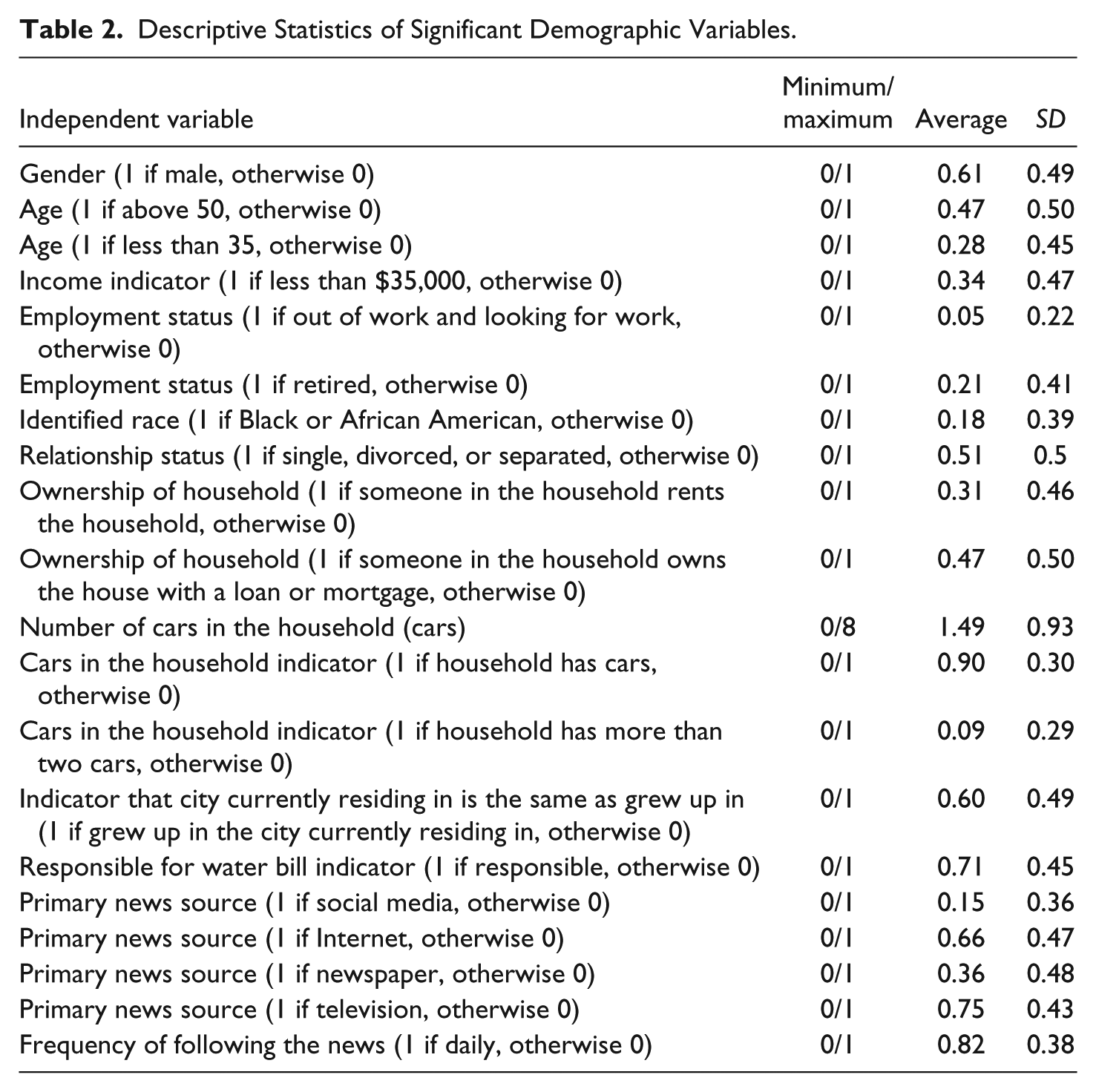
Marginal effects were used to interpret the results, with each variable’s marginal effect being the average of the individual marginal effects across the sample. A marginal effect is the average probability change from a one-unit change in the independent variable; and in the instance of indicator variables, it is the change when the variable changes from zero to one (Washington et al., 2011).
The Akaike information criterion (AIC) and the Bayesian information criterion (BIC) were used for model selection, where the smallest AIC and BIC denote the best models for the data. Although both terms are partially based on the log likelihood function, the BIC favors parsimonious models by penalizing overfitting to a greater degree in comparison with the AIC, which is asymptotically efficient, favoring models that minimize the mean square error (Cavanaugh, 2012).
Technical and Management Alternatives in Shrinking Cities
Engineers, researchers, planners, and decision makers are now beginning to emphasize stabilizing growth and resizing the city footprint to meet the need of the smaller population, thereby moving away from the attitude of awaiting population regrowth. Planning efforts in the literature (e.g., Armbost et al., 2008; Bontje, 2004; Cunningham-Sabot & Fol, 2009; Pallagst, 2009; Wiechmann, 2009) discuss how to transform the excess area to allow the city to reclaim and reinvent itself, which would be a shift from focusing on stabilizing current population.
As shrinking cities in the United States begin to explore the options of right sizing their infrastructure to meet the projected population needs, technical and management alternatives need to be explored. The feasibility of such alternatives to provide essential water and wastewater services to the community in a cost-effective manner should be considered. Changes to the systems, whether physical, operational, or managerial, may have the potential to reduce or stabilize the cost or increase the level of service of the systems. Various alternatives may be more viable in different locations due to factors such as population decline patterns, financial and personnel resources available, structure of the management of the infrastructure system (e.g., private vs. public, regional vs. city), and state and city laws, regulations, and ordinances.
Physically reducing the footprint of the aging infrastructure, either through the removal or abandonment of infrastructure, could be considered as an option. Other options proposed at the U.S. EPA workshop included alternatives that have the potential to generate revenues, such as contracting out the excess capacity of existing infrastructure systems. In addition to discussing alternatives, potential consequences and barriers to these alternatives were further developed by the U.S. EPA Region 5 post workshop. Tables 3 and 4 show potential water and wastewater infrastructure retooling alternatives, which were developed from our review of the published literature, interviews with city managers from five Midwestern shrinking cities, the U.S. EPA retooling workshop, and discussions with academics with expertise in infrastructure or issues related to shrinking cities.
Retooling Water Supply Infrastructure Alternatives.

Note. EPA = Environmental Protection Agency
Retooling Wastewater Infrastructure Alternatives.
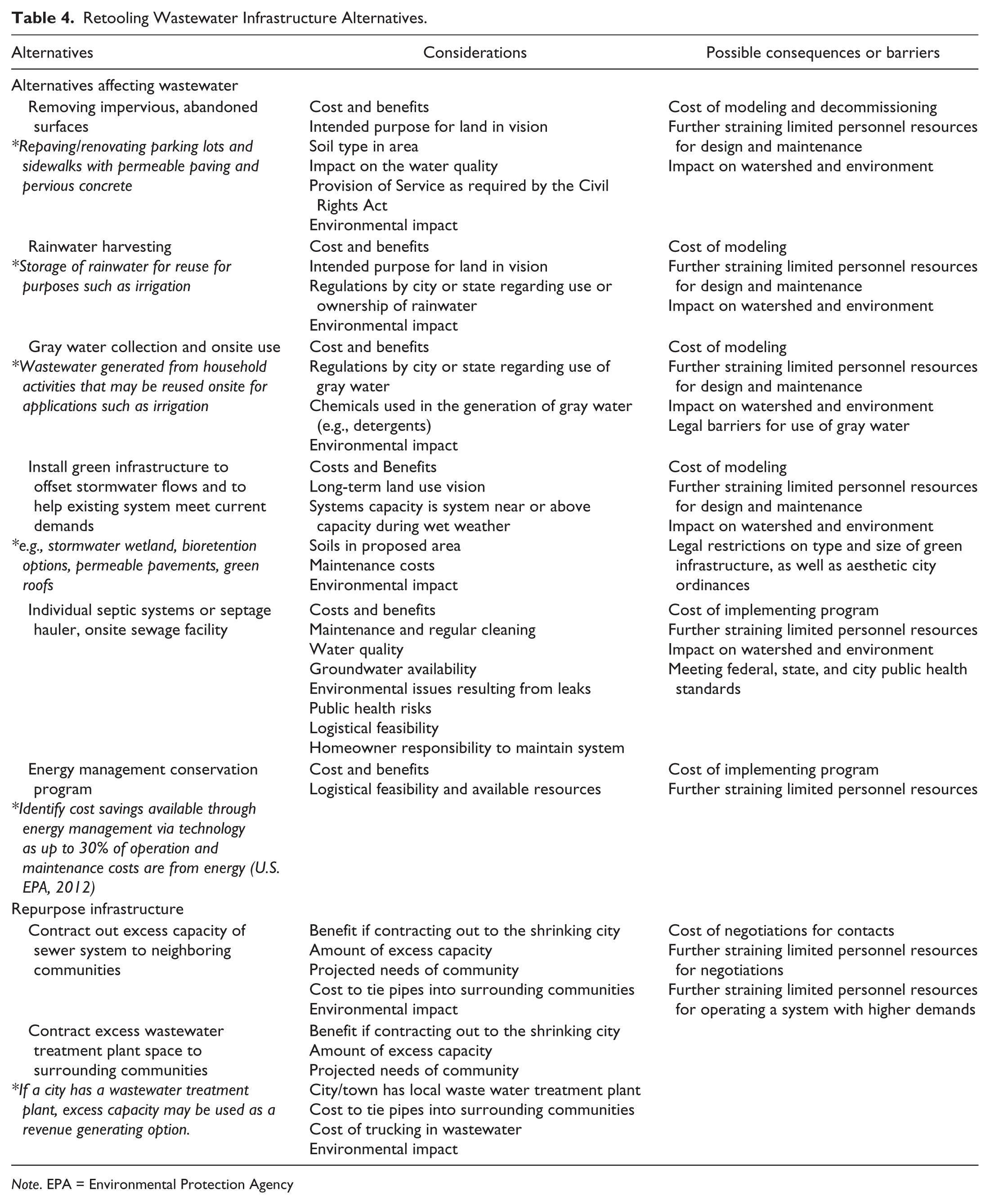
Note. EPA = Environmental Protection Agency
When considering the viability of different alternative, the location and the pattern of shrinkage must be considered. For instance, in the United States, the Rustbelt cities located primarily in Indiana, Michigan, Ohio, and Pennsylvania are the most affected by declining populations, are typically seeing a hollowing-out effect of the inner cities experiencing population loss, and are leaving the appearance called the “doughnut effect” (Pallagst, 2008). Thus, if exploring decommissioning water infrastructure, the connectivity of the network, as well as the criticality of the component for providing fire flow demands and adequate pressures, must be evaluated (Faust & Abraham, 2014). A city that is shrinking at the periphery may be able to decommission water infrastructure more easily than cities experiencing shrinkage in a “Swiss-cheese” pattern. Although an area within one of the cities was abandoned and no longer had residents, a pipeline had to be taken out of service and replaced with a larger pipeline for firefighting due to insufficient pressures in existing pipelines. Furthermore, the concentration of shrinkage and future land use of the area is important to consider. In Saginaw, a neighborhood termed the Green Zone has lost more than 70% of its population with little likelihood of the population returning (U.S. EPA, 2014). Thus, this area is discussing alternatives to potentially transition the land use away from residential toward green opportunity areas, reducing or eliminating the need for municipal services in the future.
SMEs in the selected shrinking cities indicated that they are or have considered contracting water services to surrounding communities. In these instances, the region is able to benefit from the reduced demands and excess capacity of the shrinking city, while providing a financial benefit to the shrinking city. However, in at least one instance, the negotiated price did not reflect the cost of service, and thus, the shrinking cities residents absorbed the costs until the next contract could be negotiated. Contrary to this example, however, another shrinking city was able to charge higher rates for contracted water services to the surrounding communities.
Despite the previously mentioned income inequity, a majority (70%-75%) of the survey respondents from shrinking cities indicated that they would be willing to pay for improved reliability of water and wastewater service, as shown in Figure 1. The willingness to pay for improved services demonstrates public support to shift toward management alternatives that would improve the efficiency and operations of the systems, which is a need readily identified by utility providers. Approximately 50% of all respondents stated that they would be willing to pay between 1% and 10% more for their service for these improvements (with 20%-25% willing to pay more than a 10% increase), which may come in the form of maintenance or reinvestment in the infrastructure system.
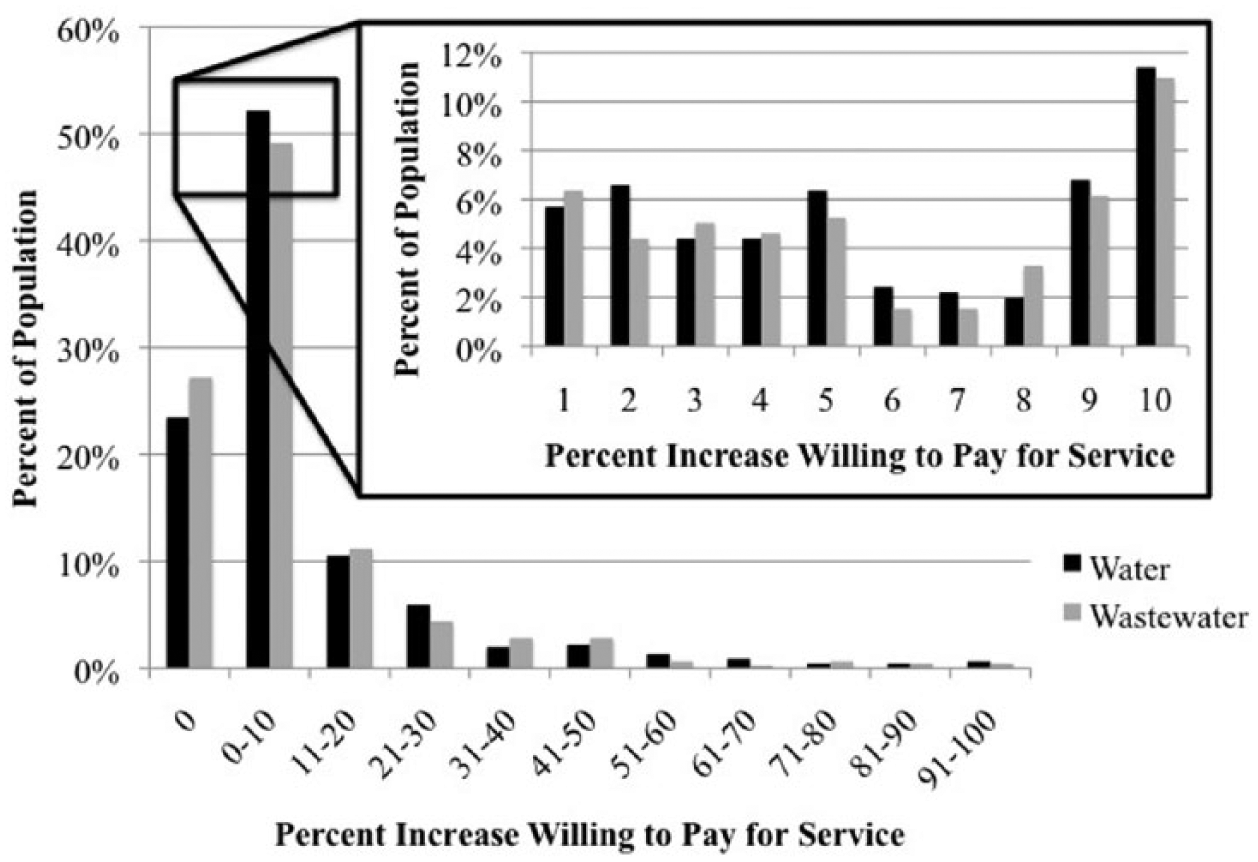
Survey respondents’ willingness-to-pay for improved services.
Five water infrastructure management retooling alternatives from Table 3 were further explored via the survey distributed to shrinking city residents for insight into which alternatives individuals thought should be implemented in their shrinking cities (Table 5). Understanding the attitudes of the public may aid in timely implementation within the community that transitions the city toward right sizing the infrastructure within the community’s vision. Specifically, the alternatives discussed in the survey included the following:
Invest in more infrastructure
Raze or decommission infrastructure
Repurpose infrastructure
Invest in maintenance of current infrastructure
Do nothing
Significant Parameters for Survey Responses to the Statement, “I Think My City Should . . . ” as Determined by the Binary Probit Models.

Note. AIC = Akaike information criterion; BIC = Bayesian information criterion.
Five binary probit models were used to quantify the significant variables that increase the tendency toward agreeing/disagreeing with the implementation of specific management. In Table 5, a positive/negative parameter indicates an increased likelihood of agreeing/disagreeing with the respective alternative. The marginal effects are shown in Table 6.
Marginal Effects for Survey Responses to the Statement, “I Think My City Should . . . ” as Determined by the Binary Probit Models.
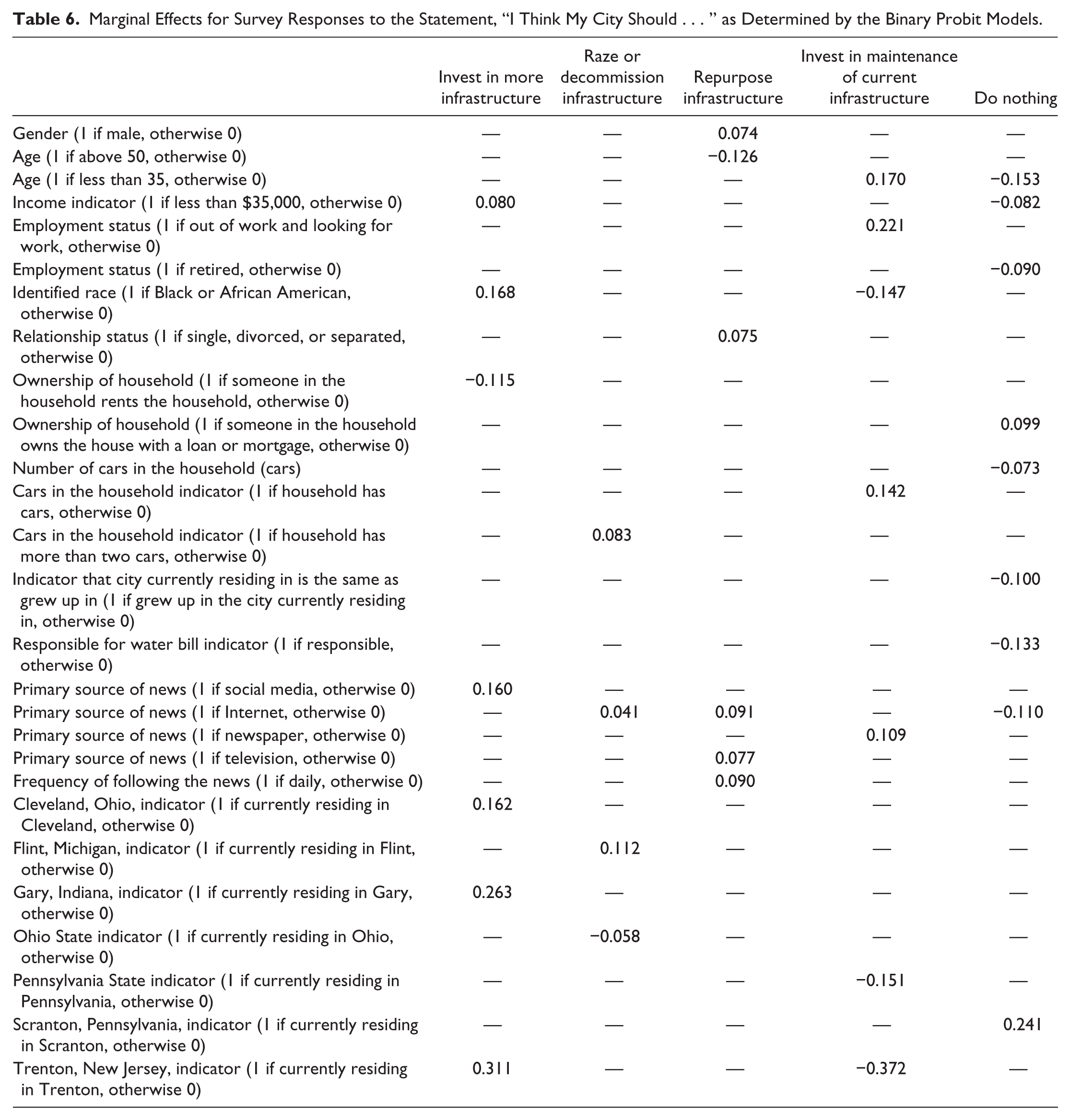
When exploring viable alternatives, utility providers or city managers could use the estimated models to identify which individuals may potentially cause opposition, allowing for proactive efforts to mitigate the resistance and increase awareness of the benefits of different alternatives. As shown in Table 5, many demographics, such as household ownership, age, and employment, were found to indicate an increased likelihood of supporting or opposing the implementation of different infrastructure management alternatives. Being a resident in certain cities was also found significant in providing support toward implementing select alternatives requiring financial investment, consistent with the previous finding about the willingness to pay increased rates for improved reliability of service. The cities in which residents indicated support of implementation of specific management alternatives included the following:
The cities in which residents opposed the selected alternatives were as follows:
As cities explore implementing various options for transitioning to more sustainable infrastructure management, understanding which alternatives the community may support allows for incorporating the community vision and public participation while mitigating potential opposition. Less than 20% of the survey respondents expressed no desire to participate in the decision making of the water or wastewater infrastructure management, indicating that communication avenues must be open between city managers and engineers who understand the societal needs and the community’s vision in developing alternatives and incorporating some level of participatory decision making for sustainable outcomes.
Conclusion
Shrinking cities face a multitude of infrastructure issues, exacerbated by challenging economic conditions. Although this article focuses on water and wastewater systems, similar issues also occur with other infrastructure services, such as transportation and power distribution networks. Faced with a declining tax base, further diminished by the income inequity occurring within the city, and reduced numbers of customers, utility providers are challenged with providing adequate service, while meeting increasingly stringent legal and environmental regulations. Retirements and staff reductions that result in the loss of institutional knowledge make it difficult for utilities to provide consistent and efficient service. Furthermore, underutilized infrastructure may result in reduced water quality and performance. Decreased demands can result in increased water age and stagnant water throughout the system. Unused impervious surfaces generate runoff, which enters the combined sewer systems present in many older communities, contributing to the volume and number of sewage overflows, worsening the surface water quality and further contributing to a deterioration of the urban environment.
The SMEs from the Midwestern shrinking cities interviewed in this study identified a need for enhanced understanding of technical and operational issues associated with infrastructure in shrinking cities. Previous work regarding infrastructure issues in shrinking cities has focused on the financial burden of increased per capita service costs (Butts & Gasteyer, 2011; Schlör et al., 2009) and water age (Barr, 2013). An analysis of the multiple problems facing the operation and management of water utilities due to urban decline is lacking. Interviews with SMEs also indicated that they were not aware of many alternatives that were being discussed or could be considered for the underutilization of infrastructure. Some of these alternatives include the qualitative discussion of incorporating green infrastructure or evaluating the ecological benefits of the vacant land (e.g., Burkholder, 2012; Hendrickson, 2009; Schilling, 2009) and incorporating green infrastructure (e.g., Baker, 2011). Another alternative explored includes decommissioning water distribution pipelines (Hoornbeek & Schwarz, 2009; U.S. EPA, 2014). Due to limited workforce, shrinking cities cannot typically afford the resources to fully evaluate and identify plausible management alternatives. By identifying challenges associated with the technical and operations aspects of water and wastewater infrastructure, retooling alternatives can be examined to facilitate the transition to sustainable services. Finding a viable alternative requires an understanding of the existing condition of the infrastructure, patterns of population decline, and future land use, as well as a rigorous assessment of the technical feasibility of different management alternatives.
Previous literature evaluating the public views in shrinking cities have focused on quality of life perceptions toward abandonment and vacancies (e.g., Bright, 2000; Greenberg & Schneider, 1996; Hollander, 2010, 2011) without evaluating the public views of infrastructure issues and management alternatives. As described by Herz (2006), decreasing infrastructure services and increasing per capita costs can perpetuate urban decline, highlighting the importance of understanding these attitudes to shift toward stabilizing the population. The results from the analysis presented may be used by decision makers in early planning/decision making regarding retooling alternatives to meet cities’ current infrastructure needs. Demographic and location factors influence the attitudes of residents toward these retooling alternatives. This information can be used to identify locations and individuals who have an increased initial support or opposition toward different retooling alternatives, narrowing the decision space for alternatives that may be more likely implemented without opposition.
The lack of published literature focused on underground infrastructure in shrinking cities and the underutilization of infrastructure in general make it difficult to synthesize information. This study illuminated the lack of information sharing between cities regarding the management of infrastructure in the context of urban decline. Typically, the end of life cycle for infrastructure refers to the end of the functional life, as opposed to the end of useful life in terms of necessity to meet population demands.
This study explores the issues in and attitudes of residents in medium or large shrinking cities in the United States. However, many small cities and towns throughout the United States are facing a multitude of issues related to urban decline that may be similar. Future research may include expanding the study to small cities and towns (with populations peaking less than approximately 100,000) experiencing urban decline. Another limitation of this study is that the public attitudes reflect a moment in time, when the survey was completed (2013). Attitudes are dynamic, evolving with outreach, information, and changing conditions. Conducting surveys to evaluate public views at a time period closer to the decisions regarding which alternatives to implement within a city will allow more accurate information of the current, local views.
In addition to considering growing or static populations, the possibility of population decline needs to be considered via infrastructure alternatives or additional financing structures to ensure long-term funding of infrastructure systems that are flexible in meeting the needs of the current population. Shifting the paradigm in infrastructure planning toward examining the life cycle of a city to incorporate possible options, such as decommissioning or razing infrastructure, may stabilize or reduce the costs of operating and maintaining water and wastewater infrastructure systems, improve the services provided, and potentially move water and wastewater infrastructure in shrinking cities from states of disrepair to sustainable levels of operation.
Footnotes
Authors’ Note
The contents of this article reflect the views of the authors, who are responsible for the facts and the accuracy of the data presented herein. The contents do not reflect the official views or policies of the National Science Foundation. Any opinions, findings, and conclusions or recommendations expressed in this article are those of the authors.
Declaration of Conflicting Interests
The author(s) declared no potential conflicts of interest with respect to the research, authorship, and/or publication of this article.
Funding
The author(s) disclosed receipt of the following financial support for the research, authorship, and/or publication of this article: This material is based on work supported by the National Science Foundation Graduate Research Fellowship Program under Grant No. DGE-1333468.