




Abstract
For decades, transportation scholars have argued for transit fares that vary by mode, distance, and/or time-of-day to reflect the marginal costs of providing transit service. This pricing strategy, they contend, would increase the efficiency and equity of transit service. Recent advances in smartcard fare collection technologies have reduced the operational obstacles to charging variable fares, yet relatively few transit agencies are doing so. Through interviews and a nationwide survey of transit professionals, this research examines why transit managers and their governing boards have been reluctant to adopt variable fare policies. We find that agencies and practitioners have little incentive to understand how the costs of transit service provision vary and that managers and policymakers tend to be loss averse—they worry more about the riders they might lose under variable pricing than those they might gain. Collectively, we find that transit agency objectives impede fare policy innovation.
Public transit systems differ from many other government enterprises in that they charge a fee, or fare, in much the same way that private businesses charge for their services. Transit fares are typically of two sorts: flat or variable. For decades, transportation scholars have argued in favor of flexible, differentiated transit fares, which vary by mode, distance, and/or time-of-day to reflect differences in the marginal costs of service provision (Cervero, 1981; Cervero & Wachs, 1982; Hodge, 1995). Such fare policies, researchers contend, could greatly increase the efficiency, efficacy, and even equity of transit service. Research on the costs of transit service provision suggests that short, off-peak trips tend to be relatively inexpensive to provide, while longer, peak-period trips are more expensive; and that capital-intensive services, such as subways, are more expensive than less capitalized modes, such as buses (Taylor, Garrett, & Iseki, 2000). Accordingly, varying fares to reflect these differences in costs would encourage passengers to consume more inexpensive-to-serve trips, and be more judicious in consuming more expensive-to-serve trips, thereby increasing the cost-effectiveness of transit service.
Despite an established body of research on the potential benefits of variable fares, relatively few transit agencies employ them, and over the past two decades, many have actually moved away from variable fare structures and toward simpler flat fares by dropping zone-based fares. 1 Recent technological advances, particularly “smartcards” (electronic cashless fare media) for fare collection, have greatly reduced the operational and administrative obstacles to charging differentiated time- or distance-based fares, yet very few transit agencies adopting smartcards have used them for fare differentiation.
Many observers have argued that, despite the opportunities for pricing innovations presented by smartcards, public agencies are risk-adverse, preferring status quo practices over policy changes (Fernandez & Rainey, 2006; Howitt & Wintrobe, 1995). Maintaining existing policies allows agencies to minimize mistakes and avoid public scrutiny (Grigg, 1988; Leaver, 2009). In addition, Bozeman and Kingsley (1998) argue that the amount of risk-taking by organizations is a function of the clarity of agency goals, and public sector goals are often too broad, too vague, or too controversial to evaluate for efficiency and effectiveness (Nutt, 2005). Specifically addressing transit pricing, Cervero (1990) finds that transit managers must satisfy multiple goals (e.g., capture the cost of service, maximize revenue, reflect the value of service to the user, promote equity, encourage transit use, and redress the under-pricing of automobile travel) that combine to make it hard for them to strategically price their services.
Nearly all of this research on transit managers’ resistance to differentiated fares was conducted prior to the emergence of smartcards, which now make implementing variable pricing far easier and more reliable for both transit systems and their riders than in years past. As smartcards become more common, will transit systems gradually reverse course and begin implementing variable fares? Will political and institutional resistance to variable pricing hold firm, suggesting that implementation was never the principal obstacle? Or have flat fares become so thoroughly inculcated in transit practice that most transit managers are unaware of the now decades-old research on the benefits of differentiated fares? In this article, we review literature on transit fares and pricing, report on findings from in-depth interviews we conducted with California transit officials, and discuss findings from a nationwide survey of transit agency governing board members, CEOs, and agency planners and analysts.
What Do We Know About Transit Fare Setting?
Standard micro-economic theory suggests that, when adequate capacity exists, the price charged for public transit should equal the short-run marginal cost that the last passenger imposes on the system (including other passengers). When supply is maximally utilized, the long-run marginal cost should be used to take into account the marginal capital costs needed to handle additional passenger loads (Pedersen, 2003). Marginal cost pricing of this type is a pre-condition of “anonymous equity,” an extension of the Pareto improvement as applied to the fair distribution of costs (Baumol & Fischer, 1986). Despite its theoretical advantages (which we do not discuss in detail here), marginal cost fare setting in even the most approximate sense is rare. Instead, low, uniform fares and free transfers are the norm. And, because the marginal cost of transit service tends to vary substantially by mode, time of day, distance, and travel direction (Taylor et al., 2000), flat fares create substantial cross-subsidies among riders.
How well do transit managers understand the marginal costs of their services, and the highly variable per-trip subsidies among riders? Funding for public transit comes from a wide variety of sources beyond fares and is usually earmarked as to its purpose. For example, federal funding for transit in metropolitan areas for the most part is exclusively confined to specific capital expenditures (vehicles, facilities, right-of-way, etc.), though over time, federal rules have expanded to allow some flexibility in the use of formula grant funds. Local voter approved taxes and bond issuances are almost always project-specific as well and are usually dedicated to new capital investments. Expenditures for operations are covered by a combination of passenger fares, charter and advertising income, and local, regional, and state subsidies. In 2012, one third (33.3%) of all transit operating costs nationwide were covered by fares, and two thirds by government subsidies; 100% of transit capital costs are covered by subsidies (American Public Transportation Association [APTA], 2013).
Because transit funding is so extensively earmarked for particular expenditures and not fungible, transit managers’ motivation to understand and analyze the intricacies of the variable costs of service provision is considerably diminished (Taylor et al., 2000). For example, if a careful analysis showed that rebuilding engines on older buses twice before retirement minimized long-run operating plus annualized capital costs, but federal subsidies earmarked for new vehicles could not be used to rebuild engines on older buses twice, transit managers would have less incentive to trade capital for operating costs, even if there is a strong economic argument for doing so. Such perverse incentives have resulted in what some analysts have described as “capital bias” in public transit finance (Obeng & Azam, 1995; Pickrell, 1986).
With diminished incentives to track and analyze the marginal costs of transit service provision, transit managers may be less aware of how dramatically their costs vary by time of day, direction of travel, mode, and so on. Absent such awareness, the motivation to pursue fare structures that reflect marginal costs is likely considerably dampened as well.
Regardless of the form it takes, the fare structure at a given transit agency should ideally reflect the array of goals and objectives transit officials and planners hope to achieve, within a politically constrained environment. A recurring theme in the literature on transit fares and goals, however, is that agencies’ defined goals are often problematic, being either too broad, too vague, too controversial, or simply absent, which makes it difficult for public officials to make consistent, strategic decisions (Taylor & Morris, 2015). The goals a transit manager has in setting fare policy can also conflict and overlap: capturing the cost of service, maximizing revenue, reflecting the value of service to the user, promoting equity objectives, encouraging modal shifts to transit, and providing a countervailing subsidy to transit users because of the under-pricing of driving (Cervero, 1990).
And in fact, transit agencies use a wide variety of fare discounts and programs to target the many and varied markets they serve. It is not uncommon to find discounts for disabled users, seniors and students, or for patrons of special events. Transfer pricing policies and multi-trip deep discounts (e.g., daily, weekly, or monthly unlimited use passes, etc.) further reflect the complexity of fare policy. With a few exceptions, such as higher fares for express services, most fare policies generally are unrelated to the marginal costs of service provision. For example, monthly unlimited ride passes can confer very deep discounts to riders who make heavy use of the transit system over a fixed time period, and reflect nothing of the cost of providing the service. Other authors comment that public managers lack the clear economic indicators of efficiency and effectiveness available to their counterparts in the private sector, partly as a function of public organizations’ role in addressing complex social functions. While evaluations of performance and innovation in private firms can be measured by levels of profit or satisfaction of stakeholder interests, the evaluation of public sector performance is much more difficult. Public agencies are expected to provide goods and services that cannot be easily packaged for exchange in economic markets and are often at odds with economic efficiency (Pandey & Wright, 2006).
Moreover, transit agencies are accountable to various stakeholders (elected officials, taxpayers, organized labor, commercial property interests, neighborhood associations, and riders) whose interests are not aligned. Transit agencies are often besieged by multiple, often conflicting service demands, with no overarching interest or objective toward which to steer (Fielding, 1992). The divergence of agency goals, combined with the challenge of measuring their achievement, make it nearly impossible for transit officials to develop fare structures and set fare levels in a consistent, principled fashion.
In addition to lack of goal clarity, a desire to avoid public scrutiny may also limit more widespread implementation of marginal cost pricing. A controversial decision that turns out poorly may have far-reaching consequences for a public agency. For example, Wilson (1989) argues that high-risk aversion is due to the sometimes staggering political costs paid by an agency when it fails or is perceived to fail at an activity. Moreover, because the public sector does not enjoy a private corporation’s clear division of ownership and control, “public scrutiny of actions by these organizations is immediate” (Grigg, 1988). Leaver (2009) explains in her “minimum squawk” theory that bureaucrats’ concern for their reputations will prompt them to make decisions that “keep interest groups quiet and mistakes out of the public eye” often at the cost of efficiency.
But transit managers regularly (albeit reluctantly) raise fares to cover rising costs, often in the face of considerable political outcry, and these fare increases are often viewed as unavoidable and publicly presented as such. Implementing differentiated fares entails similar political resistance as simple fare increases, but with far less certain benefits. Given both their substantial promise to increase operating efficiency and potential to threaten risk-averse decision makers, our research seeks to better understand the relationships between costs, fares, and risks in the fare policy decision calculus at U.S. transit systems.
Method
Given the enormous challenges that transit agency officials face in delivering efficient and effective transit service while balancing political risks and scrutiny, we aimed to explore through in-depth interviews and a nationwide survey the following issues:
the goals, objectives, principles, and practices that guide the structure and setting of fares at transit agencies, including the extent to which pricing reflects marginal costs;
the extent to which respondents see rationales for variable pricing;
the challenges to variable pricing perceived by respondents; and
utilization of new technologies and how these have or have not enabled fare policy reform.
To examine these issues, we conducted two phases of research. The first phase consisted of in-depth interviews with eight senior officials from four transit agencies (all in California) about their agencies’ marginal costs of providing services, the kinds of information practitioners deem relevant to making fare policy, their levels of risk tolerance, and their objectives in setting fares. These interviews allowed us to evaluate the unique context in which transit agencies operate, and the degree to which they are expected both to operate “like a business” and to simultaneously address a broad range of social goals. We interviewed officials who worked in finance and service planning units who could discuss with us the role that costs (marginal or otherwise) played in decisions about types and levels of service provided, the fares and prices charged, and the share of total (operating and capital) costs that fares should cover. We selected large agencies because they are more likely to be early adopters of smartcard technology (Yoh, 2008) and because a few large systems account for the bulk of all transit patronage nationally. We also selected agencies that had changed fares within the past 6 months to capture perspectives from those likely to be aware of (and able to accurately recall) the factors motivating changes in transit fare policies. The interviews averaged 1 hr in length (ranging from 30 min to 1 hr and 45 min). The questions were open-ended but structured, and included the following:
How do your costs vary by distance, time of day, and mode?
Given that capital costs are normally excluded from farebox ratio calculations, how much do you think including amortized capital costs in subsidy calculations would affect transit cost estimates?
Do you see logic in systematically relating fares to the costs of providing service? If so, why; if not, why not?
What are the primary objectives to satisfy when setting fares?
Are transit fares too high or too low?
If smartcards were used to vary the price of transit services by time of day, distance, or mode, what effect might this have on costs, ridership, labor, and voters?
Findings from our interviews informed the second phase of this research, a nationwide survey of transit operators. To test whether perspectives gleaned from our interviews are shared among decision makers and practitioners at transit agencies nationwide, we conducted a large scale survey to identify whether there were differences in views on transit costs and fare policies among (a) transit executives such as chief executive officers or general managers; (b) their immediate deputy executives in different functional units such as finance, service planning, operations, and so on; and (c) transit agency board members. We chose not to survey other stakeholders, such as passengers, drivers, or business interests, as their influence on fare setting is indirect and via the three surveyed groups.
We identified transit officials to survey through the National Transit Database (NTD) maintained by the U.S. Department of Transportation (2007). We selected those agencies that operated at least one fixed route and then identified the general manager, executive director, or chief executive officer associated with the agency. We supplemented these names by cross checking them against the APTA database of members. Through APTA, we also obtained contact information for staff who had attended a 2010 APTA fare collection workshop. We also identified board members through the APTA member database. The completed survey panel included 415 transit executives, 367 transit staff members, and 343 transit board members. All individuals were sent an invitation to an online survey; about one sixth (182 respondents, or 16%) provided complete responses that are included in our analysis. Of those who reported their titles, 36% were CEOs or executive directors, 56% were transit agency staff (including financial directors, analysts, and planners), and about 8% were board members. Figure 1 below shows the geographic distribution of our sample agencies compared with the agencies included in the NTD data.

Geographic distribution of sample.
Discussion of Findings
Clarity of Costs and Agency Goals
In general, most of our interviewees reported having little information or knowledge about the costs of service delivery at their agency. Most of those interviewed knew far less about the costs of service delivery than the revenues generated by various services, even among those working in finance departments. For example, one interviewee told us “You can’t just pump a train out and say, well, this train cost this much money . . . but we do know much more concretely . . . that the revenues [on express trains] are so much higher.” Similarly, when asked about how their costs vary, another interviewee reported that her staff was not able to isolate or attribute their costs, that any “rules of thumb were elusive,” and that they “have no good answer.” While this was the general sentiment expressed by most of our interviewees, some reported understanding the structure, level, and variance of service delivery costs. However, even when these were reasonably well understood, one interviewee reported, this information was not always shared or used within the organization. For example, staff in the finance department of that agency believed that the variance in the costs of operating each type of service offered were important to consider in service planning, but not in fare setting. Despite this belief, there was nonetheless, little coordination between the staff in the finance and service planning departments, so variable costs were not considered in most service planning decisions, either. One official in the service planning unit of a large transit agency put it bluntly: “We’ll never make a cost decision. Service is based on policy decisions, weighing the costs with the number of people served.” The independent roles and objectives of departments responsible for finance, fare policy, and service planning in transit agencies often have few incentives for collaboration, which inhibits the flow of information and intra-organizational decision making.
The relatively limited focus on costs in fare setting may be a function of agencies’ metrics for success and performance, which incorporate many factors extrinsic to the fundamentals of their operations. While interview data provide insight into the nuance and intensity of reported opinions and observations, survey data can show a broad cross-section of how agencies approach fare policies. Accordingly, in our survey, we asked respondents to identify their agency’s three most important goals (Table 1). The most commonly identified goals are (a) improving mobility and access for everyone, (b) providing cost-effective and efficient service, and (c) increasing overall ridership. In practice, these three goals often conflict with one another. For example, improving mobility and access for everyone may help increase ridership, but policies enacted to accomplish these goals—such as providing services to difficult and/or expensive-to-serve areas while charging low, flat fares—can compromise cost-effective and efficient service.
Which of These Goals Does Your Agency Pursue?

Note. We test whether the difference between groups is statistically significant. Reported differences between categories may not apear to sum correctly due to rounding.
Significant at the 90% level. **Significant at the 95% level . ***Significant at the 99% level. All significant differences appear in boldface.
Responses to this question about agency goals varied little among CEOs, transit agency staff, and board members, suggesting that those in the transit industry, regardless of role, tend to share a common perspective on goals, and that these goals tend to be widely diverse. However, there are a few exceptions to this generalization (Table 1). Agency staff members are more likely than CEOs to cite reducing traffic congestion and providing affordable travel alternatives as goals. Board members are more likely than CEOs to consider “providing multi-modal transportation options” an important goal, and they are less likely to identify increasing ridership as a goal. Board members are also less likely than agency staff to cite reducing traffic congestion and increasing ridership as the most important goals at their agency.
Setting Fare Policies: More Art Than Science
We also asked interviewees about the factors that they consider when setting fares. Our interviewees indicated that systematic evaluations of fare policies are subject to, and often displaced by, the immediate needs of an agency’s budget. One interviewee characterized the central question in any fare policy debate as “What fare do you need to make the budget work?” Another said his agency sought to minimize the percentage of costs borne by riders so as to encourage people to ride; they did so by indexing their fares on the consumer price index (CPI) while seeking to maintain existing levels of service. But, according to this manager, constant cost increases make this delicate equilibrium difficult and, ultimately, balancing the budget takes priority. In this case, the substantial recent increase in this agency’s fares was the result of budgetary crisis, which the interviewee asserted was a relatively more acceptable rationale to the public than any fare change for the sake of increasing economic efficiency.
Citing their “large and diverse” service area population, one manager discussed how so-called “price discrimination”—commonly used in private firms—would not pass political muster with a public transit agency. For example, higher fares for commuters on the agency’s express services would be opposed by the elected officials on the agency oversight board who have long insisted that fares be kept low. At another agency, an interviewee explained that they benchmarked their fares with peer agencies and attempted to take into account passenger demand elasticities but admitted that “there’s a lot of art; it’s not too much of a science.”
When asked about his agency’s measure of success in fare policy, one interviewee’s reply was quick: “staying out of the news,” a sentiment anticipated by the literature on public sector risk aversion (Grigg, 1988) and bureaucrats’ rational reluctance to draw attention that may expose mistakes (Leaver, 2009). We observed similar conservatism reported by interviewees’ reports on their agencies’ approach to revenue goals. One reported that her agency was focused on retaining revenue rather than on pursuing new revenue opportunities. She explained that, in the agency’s environment of uncertain and vacillating subsidy support, this focus on revenue retention was a necessity.
We found results consistent with interviews in our large scale survey. First, a vast majority (81%) of respondents report that they consider changes to fares only when forced to by budgetary exigency. About half (47%) report that public reactions to fare changes are one of the three most important factors they consider when changing fares. Nearly half (45%) report that farebox recovery ratio is one of the most important factors considered in changing fares; this could reflect a desire among respondents to link fares with costs, or it could simply be viewed by respondents as a proxy for budgetary pressures.
While some fare policies closely align with some identified goals, they tend to contradict other goals. For example, nearly as many respondents indicated that their agencies seek to set fares as low as possible (55%; see Table 3) as reported they aim to set fares to reflect the cost of service (51%; Table 3). While setting low fares may improve mobility and access for everyone, increase ridership, and provide affordable transportation alternatives, setting fares to reflect the cost of service helps to maximize cost-effectiveness, but not necessarily to provide affordable transportation alternatives. In other words, setting fares as low as possible and setting them to reflect costs are two very different things, highlighting the challenge of bringing fare policies in line with conflicting goals.
Loss Aversion
When asked to identify a hypothetical chain of consequences if their agencies were to implement variable fares that reflected costs, respondents tended to focus more on the riders they expected to lose, rather than those they might gain—a commonly reported phenomenon known as loss aversion (Kahneman, Knetsch, & Thaler, 1990). For example, most reported certainty that they would lose riders from higher-priced expensive to-serve trips, such as among peak-period riders traveling long distances, but were at the same time skeptical that inexpensive-to-serve short-distance or off-peak travelers might be attracted by new lower fares for those trips. The extent to which ridership would change depends on the urban context, economic conditions, traveler demographics, and so on; with information on these factors, the ridership effects of fare structure changes could be estimated, though few agencies have attempted such analyses. Absent such information, therefore, any move to distance- or time-based pricing is viewed as a decidedly risky policy pursuit, especially when travelers in outlying areas would be likely to pay longer distance fares, and these same outlying markets are perceived (rightly or wrongly) to already be paying disproportionate shares of local sales taxes that fund public transit services, including those into and out of urban core areas.
Transit officials also report that in a world where the cost of driving is artificially low and automobile use convenient, they have little choice but to maintain low fares to encourage mode shifts from private vehicles to transit. Given such concerns over an un-level playing field, aversion to pursuing some form of marginal cost fare pricing is perhaps understandable. But such concerns also suggest that transit officials should support pricing policies such as congestion tolling and parking pricing, which help to internalize the marginal social costs of driving. However, as Table 2 shows, transit officials tend to oppose, or are at best lukewarm toward, efforts to pricing the externalities of automobile travel. Just four in 10 respondents supported market-rate pricing of on-street parking, and just 27% supported high-occupancy/toll (HOT) lanes; this contrasts dramatically with the seven in 10 who supported increased carpooling.
Support for Other Transportation Programs and Policies.
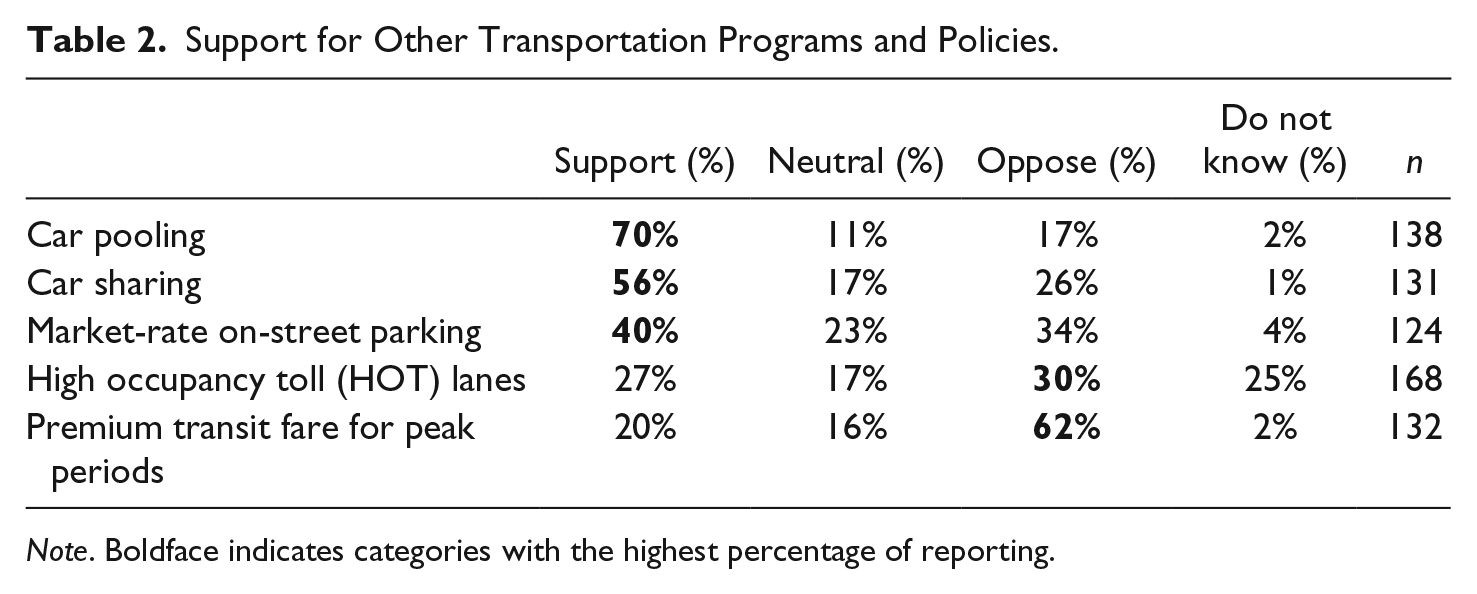
Note. Boldface indicates categories with the highest percentage of reporting.
Interest in Variable Pricing of Fares Is Mixed
Despite the reporting that (a) fares are usually adjusted only in reaction to fiscal crises, (b) fare structures are rarely adjusted to escape public scrutiny, and (c) fare levels are usually set in the absence of knowledge about the marginal costs of service provision, there is some—albeit minimal and mixed—interest in variable pricing strategies. Among those agencies whose respondents expect to adopt smartcard fare collection technologies in the near future, 55% report that they anticipate using the technology to introduce fares that differ by mode, 24% report interest in introducing zone- or distance-based fares, and 18% expect to increase the use of time-of-day fares. This level of interest may imply that some of the resistance to variable fares can be attributed to the obvious operational challenges to implementing variable fares in the absence of smartcard technologies; however, survey results among those who have already adopted smartcards suggest a different story: Only 18% have used smartcards to introduce differentiated fares by mode, 6% by zone or distance, and 6% by time of day. This may be explained by a possible spurious correlation (e.g., some intrinsic difference between late and early adopters explains why late adopters are more interested in variable pricing), or early adopters may still be in stages of implementing smartcards but will—in the near or distant future—use them for variable pricing.
Other evidence from our survey suggests some (albeit minimal) interest in variable fares. Table 3 summarizes differences between what respondents say their agencies currently do with respect to fare policies and their views on what they think their agency ought to do. While just 10% of respondents report that their agency varies fares by time of day, more than a third (35%) of all respondents think that time-of-day pricing is a good idea. This is a remarkable gap between beliefs and policy practice, which suggests that a substantial minority of transit managers, staff, and board members understand the nature of variable costs in public transit and the merits of time-of-day pricing to address them. Relatedly, while a third (33%) of respondents report that their agencies use some form of distance-based pricing, nearly half (46%) think that such policies are a good idea. These observed differences in both of these practices/beliefs gaps are statistically significant at the 0.01 level.
Does Your Agency Do This? Do You Think It Should?

Note. We use a t test to test whether the difference between “Does your agency do it?” and “Do you think it should?” is statistically significant. Reported differences between categories may not apear to sum correctly due to rounding.
Significant at the 90% level. **Significant at the 95% ***Significant at the 99% level. All significant differences appear in boldface.
Conclusion
While the demand for transit service is relatively price inelastic (Cervero, 1990; Litman, 2004), research has shown that, ceteris paribus, the difference between the highest and lowest average transit fares employed by transit operators in the United States is associated with halving or doubling ridership (Taylor, Miller, Iseki, & Fink, 2009). Thus, to the extent that high levels of transit use contribute to laudable public goals such as congestion mitigation and reduced emissions, transit fare structures and levels are very important. “Fair” fares are also critical in meeting transit’s more understated but nevertheless important role as a social service for their riders, often poor, with little or no private vehicle access (Cervero, 1981; Cervero & Wachs, 1982). Our interview and survey results collectively produce three principal findings with respect to transit fare setting.
Agency Officials Are Risk-Averse and Seek to Minimize Public Scrutiny of Any Fare Changes
The survey results emphasize that transit officials seek to ensure their actions avoid public scrutiny and negative publicity, which substantially inhibits implementing variable cost pricing for two reasons. First, implementing variable fare pricing in almost all cases would be a radical departure from the flat fare status quo, and would thus subject a transit agency to financial scrutiny, heightened media attention, and increased lawmaker inquiry—all of which transit officials report they actively seek to avoid. Second, managers’ concerns over the negative consequences of fare changes appear to be so embedded that they report focusing far more on the riders they might lose from any fare changes than the riders they might gain by implementing, for example, variable fares. They are, in other words, highly loss-averse. Compounding this is also a generally weak understanding of the likely ridership gains and losses that might accompany distance- or time-based pricing.
With Respect to Fare Policies, Transit Agencies Tend to be Reactive to Budgetary Pressures and Reluctant to Change Fare Structures When Changing Fare Levels
Rational (i.e., cost- or criteria-based) fare-setting policies are viewed as important (and a possible strategy for improving an agency’s long-term fiscal health), but in practice, transit fare setting appears to be almost exclusively budget-crisis-driven. Fare increases are much more often than not induced by fiscal crises, implying a focus on near-term responses to fiscal shortfalls rather than systematic evaluation of fare policies. Because transit systems depend so heavily on tax-based subsidies, their operating budgets often swing in tandem with tax revenues and are generally vulnerable to the vicissitudes of the economy. Analysts have long asserted that cost-based pricing, regularly adjusted to reflect changes in marginal costs, is superior to reactive, crisis-driven fare setting—even while acknowledging that fares often make up only a modest portion of total revenues. While fares should not be the only revenue source used to make up revenue shortages, fare revenues, which typically account for about one third of operating costs nationwide, are hardly trivial to support the provision of service. Such incremental cost-based price adjustments are common in the private sector, among airlines and shipping companies, and among public transit operators in Canada and Europe, but are largely unknown among U.S. transit systems.
Our findings also suggest that the crisis-induced fare-setting processes may not themselves be the problem, but rather reflect multiple and sometimes contradictory goals. While clearly defined and congruent agency goals and objectives allow staff to work unambiguously toward given objectives, public transit agencies often are burdened by a host of expectations that affect the quality of life for communities (e.g., reduce congestion and emissions, serve the needs of the poor and disabled, keep subsidies low, provide quality employment for workers, etc.).
There Is Some, Albeit Limited, Interest in Distance- and Time-Based Fares, Especially Among Agencies That Have or Soon Will Introduce Smartcards
While researchers have long argued for transit pricing based on principles of economic efficiency, in practice, most agencies pursue fare policies that appear to favor administrative efficiency (e.g., keeping fare collection simple) and effectiveness (e.g., simple and low transit fares and unlimited use passes that reward frequent riders). Our survey results underscore that even with an increasing technological ability to do so, a majority of transit agencies are unlikely to implement distance-based or time-of-day pricing anytime in the near future. Operational issues certainly present challenges. For example, distance-based pricing would require smartcard users to tap their cards upon ingress and again at egress, un-banked populations may face hurdles in obtaining cards, and user-side subsidies may complicate discussions about equity. Despite these real challenges to implementing variable pricing, many of these same issues exist with current pricing structures and fare collection media. For example, while tapping a smartcard both upon ingress and egress may increase dwell time, the time savings of smartcard collection technology have been shown to be superior to other forms of fare media (e.g., paper passes, tokens, and cash); incentivizing users and building habits to tap a smartcard upon exiting is not unlike transitioning to any other behavioral changes in adopting new technologies, and bus systems in Asia and Europe have been successful in implementing this new protocol. Finally, distance-based fares are far easier to implement on urban rail transit systems, but most of those systems do not have distance-based fares either, making it hard to conclude that reluctance to distance-based pricing is exclusively, or even largely, a function of inadequate technology.
While un-banked populations may face hurdles in accessing the new technology needed for variable pricing, obtaining smart media cards may be no different than access to paper media (e.g., passes, etc.) depending on customer service practices. More and more systems, Boston and Chicago among them, charge cash customers a premium for not purchasing and using stored-value cards, rationalizing that cash handling is costly. And finally, while user-side subsidies, such as university, school, or employer subsidized passes, may complicate discussions of equity in terms of ability to pay, these fare subsidies are very different from deep discount passes offered directly to users. By offering all students or employees rides, even those who rarely ride, the transit agency avoids the “adverse selection” problem in which only those who ride very frequently purchase them; the university or employer benefits by encouraging a mode shift by having substantially reduced barriers to transit use at low (or no) cost (Brown, Hess, & Shoup, 2001). Such passes are very different than deep discount frequent use passes and are consistent with economic efficiency and social equity principles inherent in marginal social cost transit pricing.
While resistance to variable pricing remains widespread, at least some of this resistance is due to the operational and practical challenges of implementing differentiated pricing in the absence of smartcards.
Finally, our survey revealed a significant gap between current practices (of charging flat, low fares) and beliefs among transit agency officials (that more flexible pricing should be implemented). Heard many times over in our interviews was the expressed aversion to losing any riders as a result of differentiated fares—despite possible gains in other riders or trips made on transit. This fear of losing riders to automobiles, coupled with officials’ reported interest in variable fares, suggests that transit agencies should support the adoption of congestion and parking pricing programs, which internalize the costs of driving. Doing so would remove a fundamental barrier to implementing more sustainable, equitable, and efficient transit fare policies; however, our survey results indicate that support for such auto pricing policies was weak among transit officials as well.
Government is not a private business, so it should surprise no one that pricing its (transit) services engenders such discomfort among transit managers and the public officials who oversee their work. But that discomfort, while understandable, comes at a price.
Footnotes
Acknowledgements
The authors are grateful for this support, and any errors or omissions are the responsibility of the authors and not the funding agency. Our heartfelt thanks go to the hundreds of transit professionals who took the time to be interviewed or completed our survey. Several research assistants helped with data cleaning and analysis, including Chie Akiba, Shira Bergstein, Stephen Sampson, and Tsai-Wei Wen. UCLA students and alumni also provided feedback during beta testing of our survey instrument. They are Alex Demisch, Rebecca Kalauskas, Eric Morris, Timothy Papandreou, Michael Smart, Sirinya Tritipeskul, Kansai Uchida, and Kimberly Yu. Finally, thanks to Joseph Issa for his work on copyediting and formatting this article.
Declaration of Conflicting Interests
The author(s) declared no potential conflicts of interest with respect to the research, authorship, and/or publication of this article.
Funding
The author(s) disclosed receipt of the following financial support for the research, authorship, and/or publication of this article: This research was funded by the University of California Transportation Center and the University of California Multi-Campus Research Program Initiative (MRPI) on Sustainable Transport.