



Abstract
One of the most heavily traveled freeways in the United States closed for construction over weekends in 2011 and 2012. Some public officials publicized the closures by appealing to civic pride whereas others threatened nightmarish delays they dubbed “Carmageddon.” In 2011, contrary to many media predictions, traffic flowed freely at volumes far below normal levels. Our analysis finds that travelers did not switch routes, modes, or trip timing, but instead forewent thousands of trips. Travel behavior changes were far more modest and mixed during the second closure in 2012. Although the lack of traffic problems surprised many public officials, we find traveler responses to both events congruent with past research. Traveler responses to the first event were more dramatic but short-lived, while more modest but durable responses to the second event suggest that travelers learned from, and were perhaps jaded by, the histrionics surrounding the first closure.
Introduction
One of the most heavily traveled stretches of freeway in the United States was closed twice between 2011 and 2012 to accommodate an overpass reconstruction. Interstate 405 (I-405) in Los Angeles first closed over a summer weekend in 2011 and again over an early fall weekend in 2012. Officials actively tried to influence travel behavior by publicizing the closure. Some of their messages appealed to civic pride and encouraged responsible voluntary cooperation. Other messages threatened nightmarish gridlock throughout the region; these histrionics led to the events being called “Carmageddon” and “Carmageddon II.” Intense media coverage of Carmageddon forecast a pending traffic disaster, while coverage of the second event was less extensive and dramatic.
To better understand how the public responded to the closures and to public officials’ messages, we collected motor vehicle and public transit travel data describing both events. We found, to the surprise of many, that the first closure resulted in reduced traffic; many people chose to cancel trips rather than to detour or reschedule them, but the dramatic travel reductions diminished over the course of the event as people learned that congestion levels were well below doomsday forecasts. In striking contrast, both the messaging and traveler responses to Carmageddon II were far milder. Taken together, the plans, public messaging, media coverage, and resulting travel responses to the two closures both provide a valuable natural experiment of the potential for short-term travel behavior responses to major planned traffic disrupting events and yield insights into how planners and local governments can prepare for exceptional events.
This article is comprised of six sections. After this introduction, we review existing research and frame the Carmageddon closures within the exceptional event literature. In our review, we include both supply and demand-side strategies adopted by governments and planners to prepare for exceptional events and the ways in which travelers respond. Second, we present the data and methods used in this study to evaluate traveler responses to Carmageddons I and II. Next, we report how travelers shifted in time, mode, and route during the two closures. Fourth, we discuss the limitations revealed by the twin closures for both demand and supply-side responses to exceptional events. Finally, we conclude with lessons of Carmageddon for exceptional event policy and planning.
Literature Review
Exceptional Events
The vast majority of research on travel behavior has focused on regular or routine travel; far less attention has been paid to exceptional events that trigger irregular travel that often “far exceed regular travel in volume and importance” (Wilmot & de Lapparent, 2009, p. 213). Giuliano and Golob (1998) added that travel behavior literature largely “deals with everyday conditions . . . and not with one-time extreme events” (p. 2). Exceptional events—when unexpected, inadequately planned for, or poorly responded to—can increase travel times significantly and without warning but the provision of information and advanced planning can mitigate these impacts (Downs, 2004; Taylor, 2002).
The Carmageddons, and events like them, contribute to the much smaller body of research on exceptional events, which Wilmot and de Lapparent (2009) defined as,
Exceptional events are all occurrences that generate irregular travel. The events may be good or bad, isolated or recurring, planned or unplanned. They generally generate traffic over relatively short periods of time and affect limited areas. Depending on the level of forewarning and the importance of the event, the traffic generated by an exceptional event could totally superimpose itself on regular traffic, or replace it. (p. 213)
Wilmot and de Lapparent (2009) provided a typology for characterizing exceptional events and help contextualize Carmageddon within the realm of exceptional events. The six typology features and their implications are summarized in Table 1. First is the nature of the exceptional event, which can range from desirable to undesirable (Wilmot & de Lapparent, 2009). Carmageddons I and II, although they imposed temporary costs on the city, were intended to yield net positive benefits through an added high-occupancy vehicle (HOV) lane and bridge reconstruction. Therefore, the city would be expected to—and did—mitigate temporary side effects through messaging and, in the case of Carmageddon I, increased transit service.
Exceptional Events Typology and Their Implications for Planning.
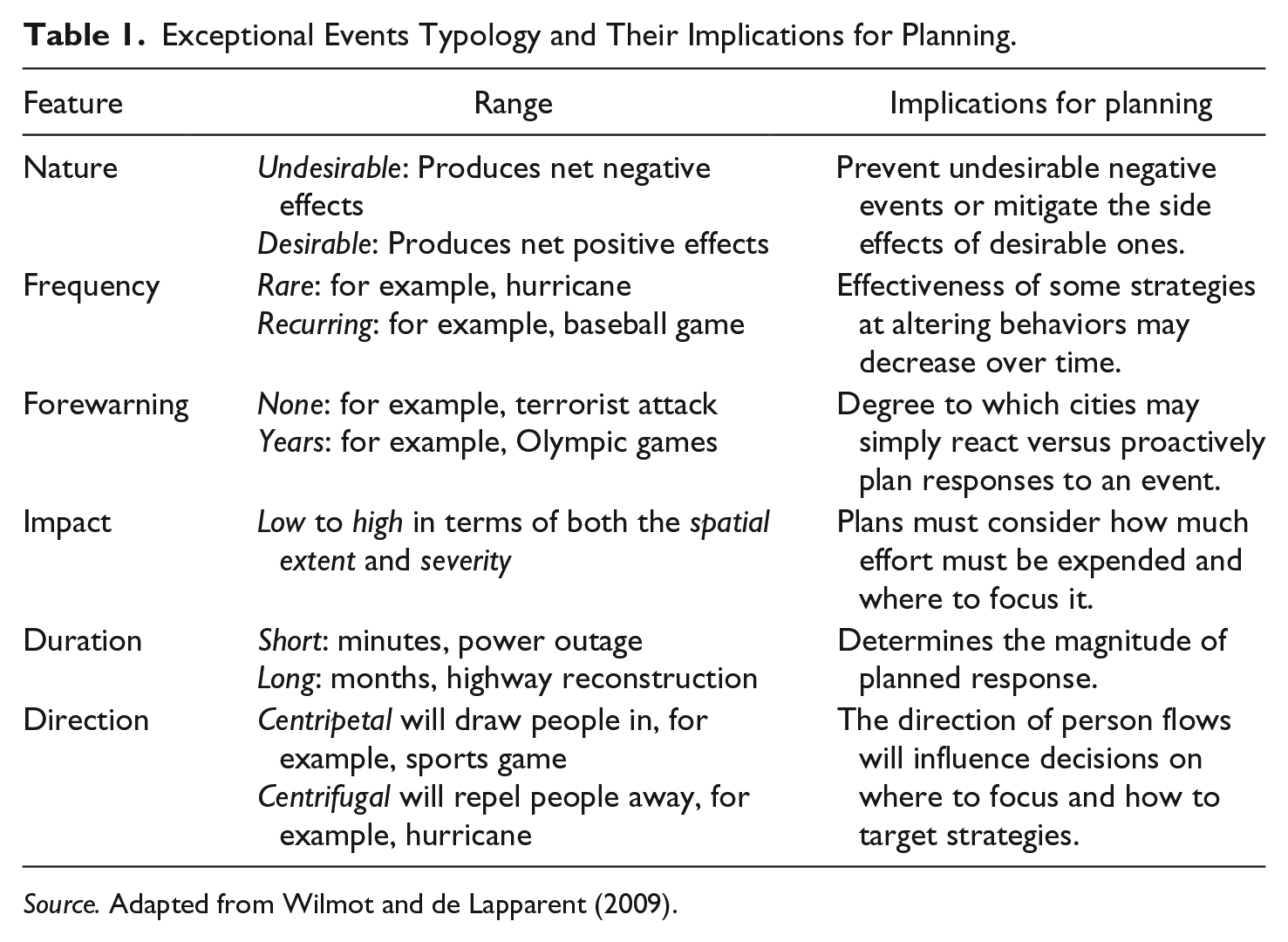
Source. Adapted from Wilmot and de Lapparent (2009).
Carmageddons I and II are events for which the forewarning—the degree of forecasting—was very high. Thus, planners and local officials were able to respond and plan a year in advance of the first event rather than reacting to an unanticipated event such as an earthquake. As a result of the forewarning, the duration of both events was also known: one weekend. A foreknown duration helped planners to devise strategies to mitigate event effects.
Although planners had ample forewarning and knew the duration of both Carmageddons I and II, the direction of their effects—that is, the way people would flow in response to the events—remained unknown. Exceptional events can draw travelers, repel them, or force them to follow detours (Giuliano & Golob, 1998). A major sporting event, for example, draws travelers from around the region toward a single venue. However, most travelers will flee from the path of an approaching fire. The closure of a major freeway interchange forces travelers to either find alternative routes or avoid the area altogether. The direction of travel helps planners focus on where and how to target their strategies. Do they, for example, use contra-flow lanes to increase directional capacity or work to squeeze additional capacity out of primary and secondary highway detours?
Similar to its unknown direction, city officials had difficultly predicting the impact—the severity and spatial extent—of the closures. The I-405 corridor is one of the most heavily traveled arteries in the world with roughly 375,000 vehicles passing through it on a typical summer weekend. Because of the steep mountainous terrain, there are few adjacent alternative routes. Traffic diverted from the closures was predicted to spill onto local streets, severely congesting a wide swath of Los Angeles. Because city officials neither knew the direction of the effects, its severity, or its spatial extent, many feared the worst, a sentiment that motivated city responses.
Unlike many exceptional events, which occur either very rarely (like a hurricane) or repeatedly (like a major sporting event), the two Carmageddon events presented a unique frequency—how rare or often an event occurs. The Carmageddon events were both not only rare (one per year) but also recurred 1 year apart. The unique combination of rare but recurring affected both the messaging strategies used during each event and travelers’ responses to them. The Carmageddon events represent a trend in highway construction and maintenance in which cities have increasingly opted for brief but total road closures over protracted partial closures to tackle reconstruction projects. Total closures can significantly shorten reconstruction time but depend on how motorists respond to them via detours or mode shifts. Although there is an emerging understanding of how motorists respond to exceptional events, how their responses evolve over time—during one or across multiple events—have received scant attention. If the frequency of large-scale closures continues to wax, the dynamics of warnings and traveler responses to them need to be understood much better. “Without data of behavior during exceptional events,” Wilmot and de Lapparent (2009) argued, “We will be unable to model and develop contingency plans to deal with them” (p. 213). Thus, the Carmageddon events yield an important learning opportunity for how local officials and planners prepare for repeated, infrequent, and increasingly common, exceptional events.
Strategies to Deal With Exceptional Events
Strategies for dealing with exceptional events are generally either focused on expanding available transportation capacity (supply-side) or tempering travel demand (demand-side).
Supply-side strategies
Supply-side strategies for exceptional events strategically expand adjacent and parallel capacity to encourage travelers to switch to alternative routes or modes (i.e., carrots) or to actively discourage travelers from driving alone (i.e., sticks). In the reconstruction of Parkway East (I-376) in Pittsburgh, for example, the Pennsylvania Department of Transportation expanded commuter train service, added new express bus service, and added HOV ramps. In addition, it expanded effective capacity through a package of operational improvements that included intersection improvements (paving, signaling, and re-timing), parking and turn restrictions, manual (i.e., human) traffic direction, and increased enforcement of traffic laws (Anderson & Hendrickson, 1983). Other reconstruction projects have relied on a similar portfolio of supply-side strategies, with some notable variations and additions. Contra-flow lanes were used in both Los Angeles’s I-710 Long Beach Freeway rehabilitation project (Monismith, Harvey, Tsai, Long, & Signore, 2009) and in the reconstruction of Boston’s Southeast Expressway to maintain peak flow capacity (Meyer, 1985).
In preparation for Carmageddon I, the Los Angeles County Metropolitan Transportation Authority (Metro), California Department of Transportation (Caltrans), and City of Los Angeles jointly developed aggressive plans to mitigate the effects of the closures, including temporarily adding street and transit capacity and widespread messaging to discourage travel through the affected corridor. Metro added transit service for the first closure, but not the second because it was deemed unnecessary. During the 2011 closure, Metrolink, the regional commuter rail authority, expanded commuter rail service and promoted a US$10 weekend pass that allowed unlimited rides and free transfers to any bus or rail service in the region. Metro also operated higher levels of service and offered free fares on its Red and Purple Line subways and Orange Line busway and increased service on select bus routes running near the first closure.
To expand street capacity, the Los Angeles Department of Transportation (LADOT) extended no-parking zones along major arterials adjacent to each closure. The California Highway Patrol deployed aircraft to monitor roadways for breakdowns and accidents so that crews could respond quickly. Caltrans established a state-of-the-art command center near downtown Los Angeles to monitor regional traffic conditions and direct traffic management teams toward hot spots where they could manually divert traffic as needed.
Demand-side strategies
By contrast to supply-side strategies, demand-side strategies attempt to reduce or modify demand for travel. Like supply-side strategies, demand-side strategies can be either carrots or sticks. Examples of “stick” strategies include market-based tactics like event-specific road or parking pricing or more drastic regulatory tactics like prohibiting odd-numbered license plates from driving on even numbered days of the week. These types of strategies have not found much use in planning for major short-term traffic disruptions in the United States.
The softer side focuses on marketing, promotion, and communications to encourage travelers to change their travel behavior. To convince travelers to switch modes, planners have implemented programs that help facilitate the organization of vanpool and carpool programs, constructed park-and-ride lots, and offered reduced or free event-related transit fares (Anderson & Hendrickson, 1983; Meyer, 1985). To ensure that travelers are fully aware of all the event and travel alternatives available to them and to discourage discretionary trips through the affected area, planners have relied on public information campaigns (Anderson & Hendrickson, 1983; Meyer, 1985; Wilson, 2011).
In an attempt to reduce travel during the Carmageddon I weekend, officials delivered print, radio, online ads, and email blasts to more than 6,000 organizations with messages alerting drivers to the impending closure for weeks in advance of the first event; these messages were broadcast as far north as the California–Oregon border (Frank, 2011). For both events, electronic roadway message boards alerted drivers of the impending closures weeks in advance of the event. Moreover, to get the word out prior to the first Carmageddon, Metro used traditional websites, created Facebook pages, broadcast messages on Twitter, and even leveraged Hollywood celebrity star power for the first event.
Public agency managers and elected officials sounded both optimistic and pessimistic messages before each event. Caltrans’s Los Angeles district director was upbeat when he advised, “You’re going to be surprised what you discover in your neighborhood if you take that opportunity.” Similarly, Metro’s executive director of highway programs offered, “It’s really going to take all of us Angelinos working together by staying home and shopping locally to keep our region moving.”
Concerned with the repercussions of public failure to heed upbeat calls for collective behavior change, several elected officials delivered decidedly more ominous messages, particularly prior to the first event. Los Angeles County Supervisor Zev Yaroslavsky coined the term “Carmageddon” to alert the public to the closure’s potential impact: “This doesn’t need to be a car-mageddon; the best alternative route is to totally avoid the 405 area, completely avoid it, don’t come anywhere near it, don’t even think about coming to it. Stay the heck out of here” (Bloomekatz, 2011). City Councilman Paul Koretz likewise chimed in that motorists should “avoid the area like the plague” (Stevens, 2012).
While two distinct messages—one of hope and one of fear—went out, the messages of fear captured the media’s imagination. The dominant image that emerged from the chorus of local and national news reports and the huge volume of blogs, tweets, and Facebook messages was not a promise of adventure and civic responsibility, but of doom. News headlines leading up to the event reported on how to “brace” for Carmageddon (Newman, 2011), how to “escape” from Carmageddon (Reicher, 2011), how to “avoid” Carmageddon, and how to “arm” Angelenos against Carmageddon (Sinsky, 2011). Saturation coverage ensured that news of Carmageddon and its potential effects had reached nearly every driving age adult in Southern California by the time of the first closure. Comedian Stephen Colbert even did a piece on The Colbert Report making fun of the over-the-top coverage, closing with a clip from an ostensibly serious news channel claiming that traffic backups might extend to the Mexican border nearly 250 km away (Colbert, 2011).
Behavioral Responses to Exceptional Events
Travelers’ experiment
The literature suggests that travelers respond to uncertainty by experimenting with a variety of travel options in the early stages of an exceptional event. In the reconstruction of Boston’s Southeast Expressway, for example, Meyer (1985) observed fluctuations in the number of vehicles using the Expressway, as travelers experimented with alternate routes and modes, with peak period volumes rising and falling over roughly 8 weeks before finally stabilizing. Although many indicated that they had tested out another highway or arterial route (51%), many also reported exploring other modes, including the subway (25%), commuter rail (9%), express bus (11%), and ferries (7%; Meyer, 1985).
Krammes (1990) generalized responses of travelers to five major highway reconstruction projects and concluded that motorists are likely to change their travel behavior only in response to significant capacity reductions. However, those behavior changes can be both substantial and highly varied; for example, travelers proved so flexible in responding to the 2007 collapse of the I-35W bridge in Minneapolis–Saint Paul, Minnesota, that traffic disruptions were modest despite the loss of a key link in the regional road network (Zhu, Levinson, Liu, & Harder, 2010). Pike and Mokhtarian (2012) examined the short- and long-term solo driving changes in response to a more modest construction-related freeway closure in downtown Sacramento. They found that most drivers (61%) did not shift mode or vehicle occupancy, while those who did were equally likely to increase (23%) as decrease (22%) driving alone in the near term. However, 83% of those who increased solo driving following the closure continued this over the longer term, while only 52% of those who decreased driving alone during the closure stuck with this change after the construction was completed.
The perceived “exceptionality” of an event can be powerfully shaped by the media. Several studies (Meyer, 1985; Valk & Schreffler, 2005; Wilson, 2011) have highlighted the critical role the media played in shaping behavioral outcomes and ensuring the success of a travel behavior modification effort as part of a major construction project. Meyer (1985) offered a most striking example from the reconstruction of Boston’s Southeast Expressway:
In the weeks leading up to the reconstruction, the local media . . . attention, in addition to numerous warnings from the [Department of Public Works’s] public information effort, resulted in there being 7000 fewer cars on the Expressway during the first week of reconstruction than there were in previous weeks. A major consequence of this decrease in traffic was a much improved traffic flow on the Expressway itself. By the third week of reconstruction, a vastly improved Expressway flow (and extensive media attention to this fact) began to attract large numbers of vehicles back to the Expressway. (p. 11)
Experimentation gives way to equilibrium
Behavioral responses to exceptional events are driven as much by perception as by reality. People respond to the uncertainty of an exceptional event in unpredictable ways, resulting in the unpredictable patterns of travel behavior observed during the early stages of an event. But with time, people learn and travel patterns settle into a more predictable equilibrium in which individual decisions are based on particular travel needs (Wesemann, Hamilton, & Tabaie, 1996). This explains why, once freeways damaged by the 1994 Northridge earthquake in Los Angeles were reconstructed and opened, travel patterns in all affected corridors more or less reverted quickly to their pre-quake levels (Wesemann et al., 1996). It also explains why remarkably free-flowing traffic conditions observed in the first few days of the 1984 Summer Olympics did not persist following the conclusion of the games (Giuliano & Prashker, 1986).
According to Yee, Leung, and Wesemann (1996), converging on a post-event equilibrium can take anywhere from several weeks to several months. Most likely changes observed will be those that can be achieved with the least amount of effort. In Meyer’s 1985 survey of affected users during the reconstruction of Boston’s Southeast Expressway, 65% reported no change in their travel behavior. In the reconstruction of North Freeway (I-45) in Houston, Texas, where capacity reductions were relatively minimal, 70% of travelers surveyed reported leaving home at the same time and 94% reported traveling the same distance to get to work or school (Meyer, 1985).
The cost of seeking out an alternative route or leaving earlier to avoid congested travel are often small in comparison with the real and perceived costs involved in learning how to navigate an unfamiliar transit system or in forming a carpool. In almost all observed cases, changes in route choice and departure times were the dominant responses (Anderson & Hendrickson, 1983; Krammes, 1990; Mokhtarian, Ye, & Yun, 2011; Valk & Schreffler, 2005; Yee et al., 1996; Zhu et al., 2010). Giuliano and Golob (1998) observed that motorists generally chose to remain in private vehicles to the greatest extent possible, opting to shift routes, travel schedules, and destinations rather than shift to public transit or ridesharing. Zhu et al. (2010) also found that travelers responding to the Minnesota bridge collapse chose to shift routes or departure times rather than mode.
Although modal shifts are rare, they do occur, and small shifts can be valuable from an operational perspective. During the 1984 Los Angeles Summer Olympics, for example, one major downtown firm’s concerted effort to organize worker carpools encouraged a substantial shift to ridesharing (Giuliano & Prashker, 1986). Modal shifts are especially pronounced when the disruption to established driving patterns is severe and viable alternatives exist. This was the case along the I-5/State Road (SR)-14 corridors damaged during the 1994 Northridge earthquake in Los Angeles, where the absence of highway detours and limited arterial capacity along the canyon route drove many travelers onto commuter rail (Yee et al., 1996).
In comparison with mode shifts, motorists are more likely to cancel or defer trips in response to short-term disruptions. Giuliano and Prashker (1986), who surveyed 2,000 downtown-area employees during the 1984 Summer Olympics, found an unusually large number of absences from downtown work sites as a result of vacations, modified work schedules, and temporary assignments to alternative work sites. They point to this as evidence that “faced with a short-term situation, many . . . choose simply to avoid the problem completely by taking vacation or other time off” (Giuliano & Prashker, 1986, p. 27).
Expectations Based on the Literature
Most of the research reviewed examines the effect of long-term, partial closures on workday travel; we focus instead on the effects of shorter term, complete closures on non-workday travel. We expected to find substantial changes in travel behavior because (a) more of the affected trips made during the weekend closure would be discretionary, (b) intense media messaging about the upcoming Carmageddon would motivate more cancelled trips than route detours, and (c) the short-term nature of the event would discourage mode shifts. We also anticipated that there would be substantial reductions in travel at the start of the closures and that travel patterns would gradually revert over time as people learned from increasingly available real-time information on closure-adjacent traffic conditions. If “hot spots” of congestion did occur, we expected that travelers would detour around them. And, if traffic proved light because of large numbers of foregone trips, we anticipated that trip making would increase over the course of the closures. We also anticipated that the second closure would result in smaller shifts in travel than the first, as travelers (and the media) learned from the earlier experience. As will be seen below, our hypotheses were largely, though not entirely, borne out.
Data Sources and Method for Comparison
Both closures began on Fridays at 7:00 p.m. Caltrans closed on-ramps, then connectors, and then shut down each lane in succession. By midnight, 10 miles of the I-405 in the north-bound direction from the I-10 to the US-101 and 4 miles in the south-bound direction from the US-101 to Getty Center Drive were closed to traffic. Our goal was to determine how the roughly 300,000 travelers who traverse the affected stretch of the San Diego Freeway per typical summer weekend day responded to the two closures. To do so, we compared traffic volume and transit ridership from each of the closure weekends with baseline control dates before and after each event. We ran t tests at a 95% confidence level to determine whether the changes observed between Carmageddon and baseline volumes were statistically significant. Figure 1 shows 14 freeway points and select Metro bus lines compared in our analysis.
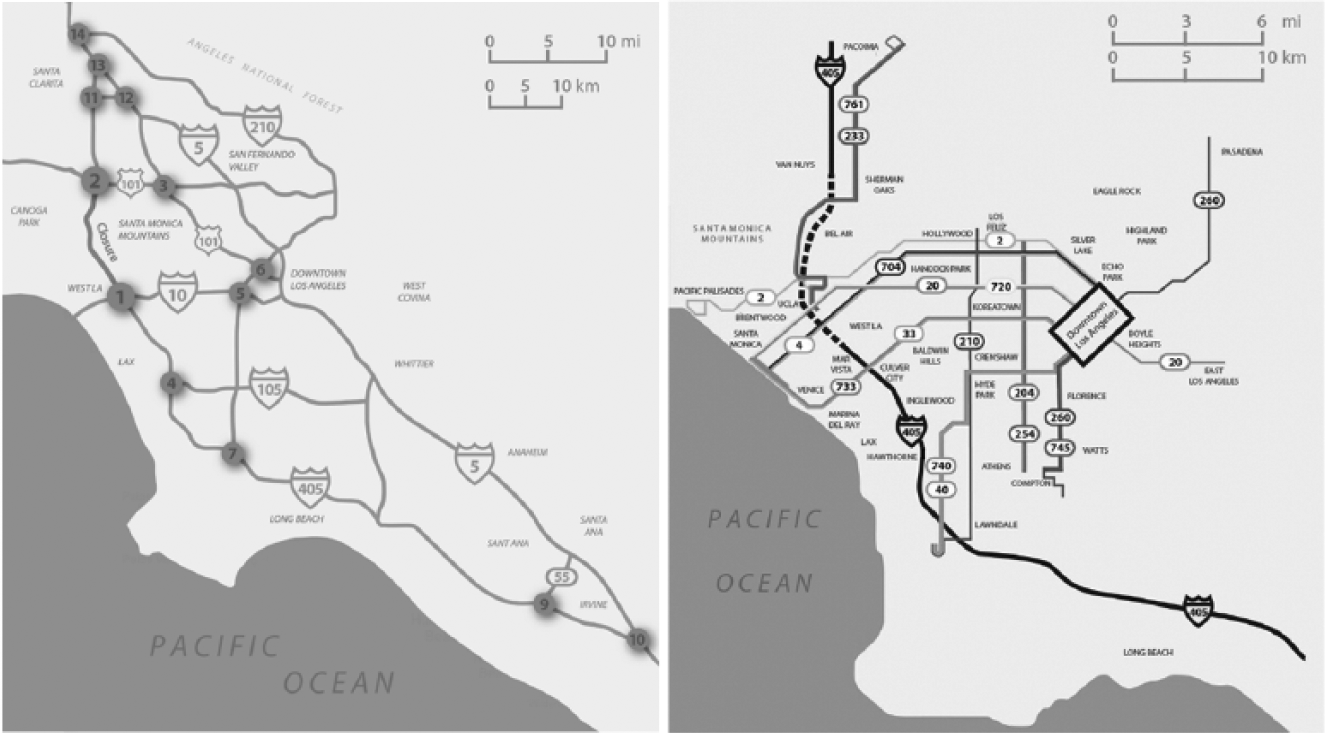
Points of comparison.
Freeway traffic volumes were obtained from Caltrans Performance Measurement System (PeMS) highway detectors. PeMS–LADOT, an intranet application managed by the LADOT, provided similar information for major arterial surface streets in Los Angeles. Metrolink and Metro provided transit ridership data for the study. We compared travel during the weekend closures against a baseline calculated as the average of four mid-summer, non-holiday weekend days in 2011, and four early fall, non-holiday weekend days in 2012. This allowed us to estimate what traffic volumes would likely have been had Carmageddon not occurred. In addition, because weather was constant over the time periods, we can attribute observed deviations from the travel baseline to the closures. Although the first closure was scheduled to run from Friday evening through early Monday morning, the work proceeded more quickly than expected, and the actual closure ended mid-day Sunday morning, about 15 hr early. The second closure ended an hour earlier than scheduled, early on Monday morning.
Travelers’ Responses to Closures
Despite widespread media reports of impending disaster, traffic during the first freeway closure fell far below expectations and even far below normal, on nearby freeways, adjacent surface streets, and even far-flung parts of the freeway network. Carmageddon II results were much more mixed; freeway volumes were mostly down near the closure, but the effects diminished with increasing distance from the closure. Adjacent surface street volumes relative to the baseline also rose significantly, unlike the first closure. So, what happened to all those trips?
No Evidence of Preemptive or Postponed Trips
We compared traffic volumes through the corridor the weekends before and after the closure and the days before and after the closure against the baselines to see if people preemptively took or postponed discretionary trips that would normally have been made on the Carmageddon weekends. However, we found no substantial shifts in trip making to weekends before or after the closures or to days before or after the closures. To the contrary, our findings suggest that as the two weekend closures progressed, area residents began to realize that the roads were substantially less congested than usual, particularly during the first closure, which led to gradual increases in trips and traffic over the course of each Carmageddon weekend. This is consistent with findings in the literature and suggests that the behavioral responses to the Carmageddons, although dramatic, especially for Carmageddon I, were short-lived as travelers responded to information before, during, and after the events and adjusted their behavior accordingly.
No Evidence of Mode Shifts
Travelers most emphatically did not shift to public transit during either closure. In fact, they shifted away from transit use during Carmageddon I, despite increased service. Drivers may have worried about navigating an unfamiliar transit system, while regular transit riders sought to avoid the predicted congestion just as drivers did. In addition, most of the affected freeway segments were not in high-use transit corridors to begin with. Figure 2 shows the changes in transit ridership across north- and south-bound Metro bus lines during Carmageddons I and II compared with the expected baseline. Metro Route 761 parallels the closed segment of the I-405 and when compared with the baseline ridership, fell by more than 20% during both Carmageddons, even though Metro substantially increased transit service during the first closure.
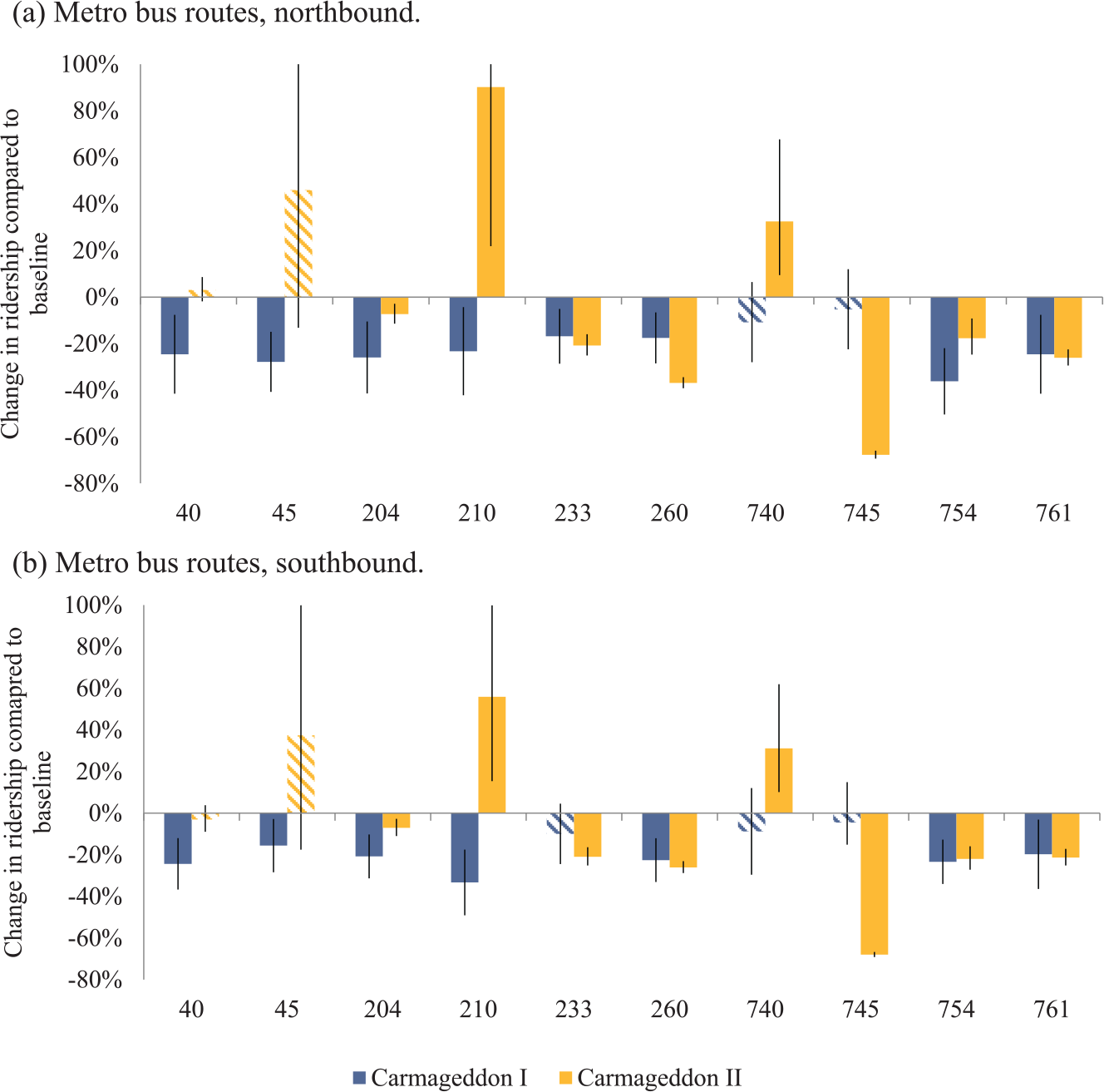
Ridership changes on closure-adjacent Metro bus routes during Carmageddons I and II.
Lower Freeway Traffic Volumes Near the Closures
Travelers heeded warnings and avoided driving near both closures. Traffic volumes on I-405 north and south of the closure were down by more than half during both Carmageddons I and II. On two intersecting freeways, north (US-101) and south (I-10) of the closures, traffic was also down substantially (see Figure 3).
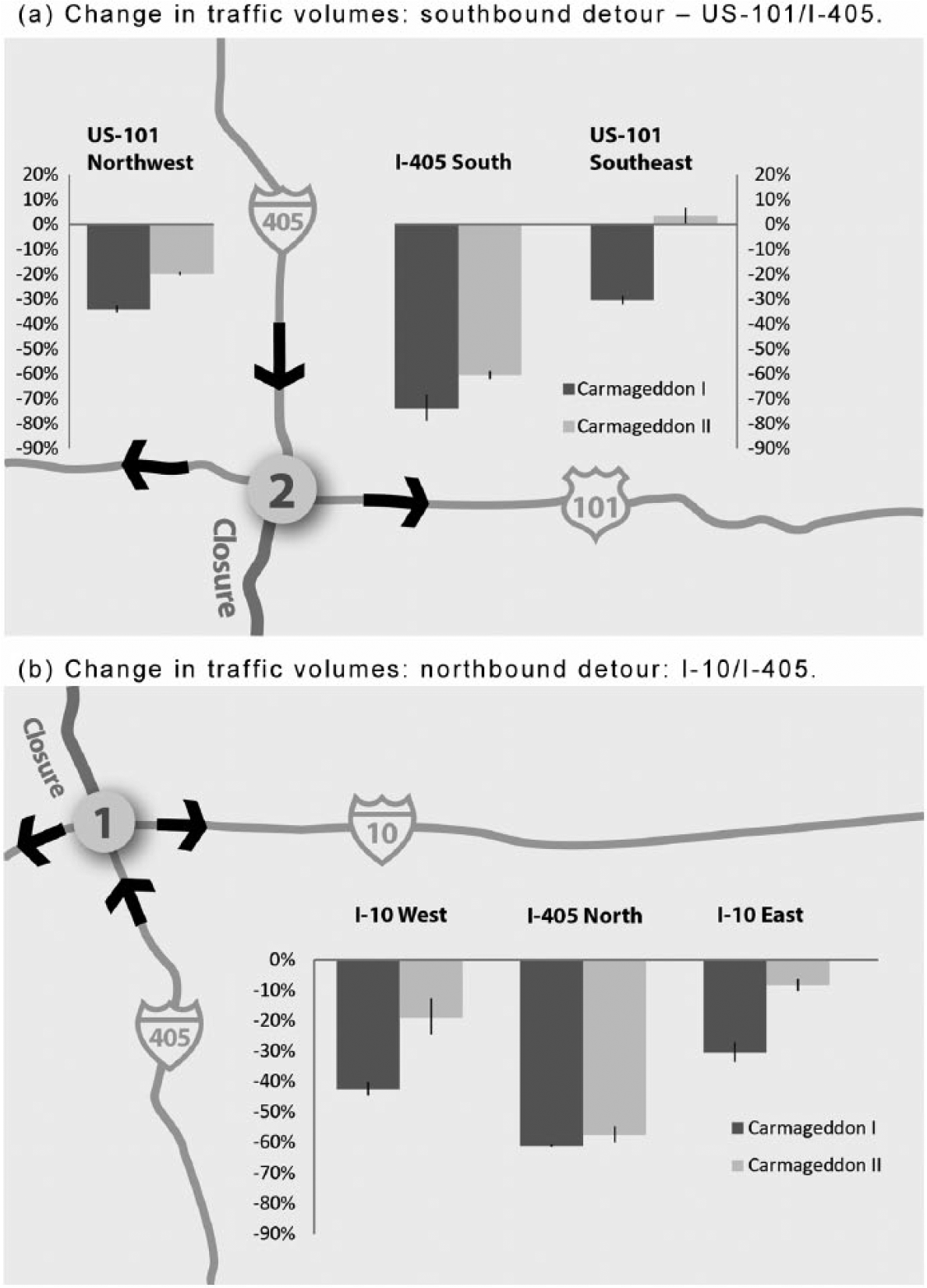
Percent changes in freeway traffic volumes compared with the baseline.
Lower Surface Street Traffic During First Closure but Higher During the Second
People stayed off closure-adjacent streets during the first event but shifted from freeways to nearby streets during the second. During Carmageddon I, nearby surface street volumes rose on a few arterials near the freeway closure interchanges, but fell on many more, suggesting that drivers did not shift in large numbers from freeways to surface streets. In contrast, during Carmageddon II, nearby surface street volumes rose substantially and consistently, suggesting that at least some of the observed drop in freeway traffic shifted onto arterial streets (see Figures 3 and 4).
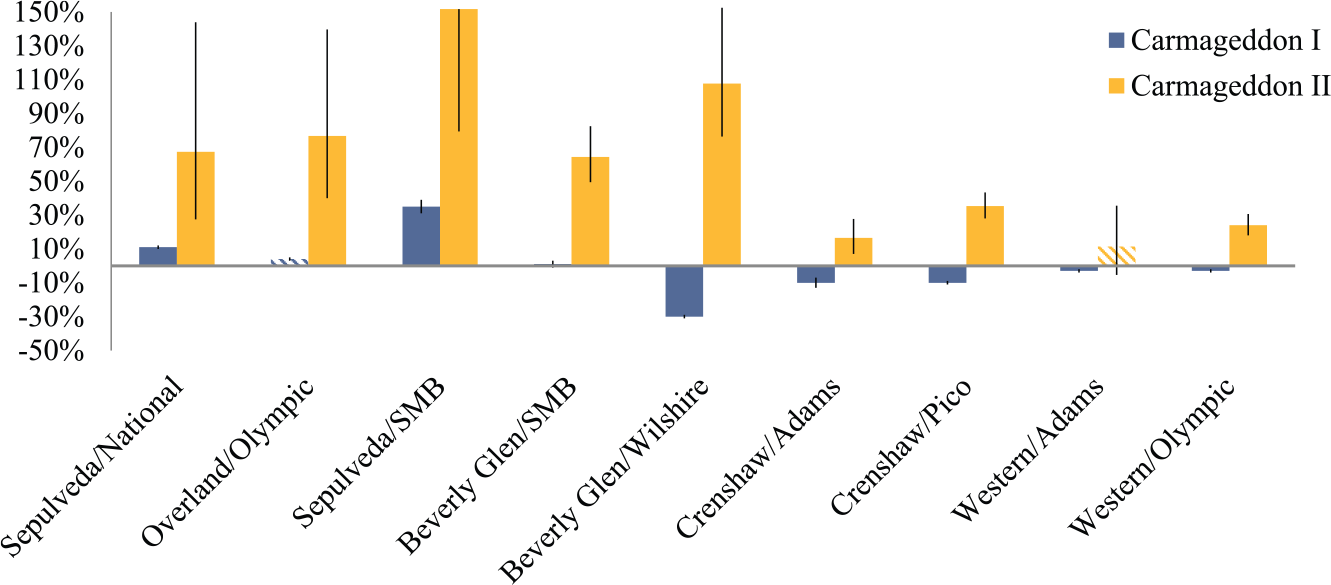
Percent changes in surface street traffic volumes on the Saturday of Carmageddons I and II compared with the baseline.
The Events Affected Traffic Levels Far From the Closure, Particularly During Carmageddon I
During the first Carmageddon, there were statistically significant declines in traffic volumes far and wide across the Southern California freeway network, suggesting not only that few drivers chose to detour around the closure, but also that those who did detour were substantially outnumbered by those who chose not to travel at all near and far from the closure. North- and south-bound freeway traffic volumes were down about 10% against the baselines in Irvine during Carmageddon I, 72 km from the closure. Traffic also fell during Carmageddon II, but the decreases were more muted and localized compared with Carmageddon I (see Figure 5).
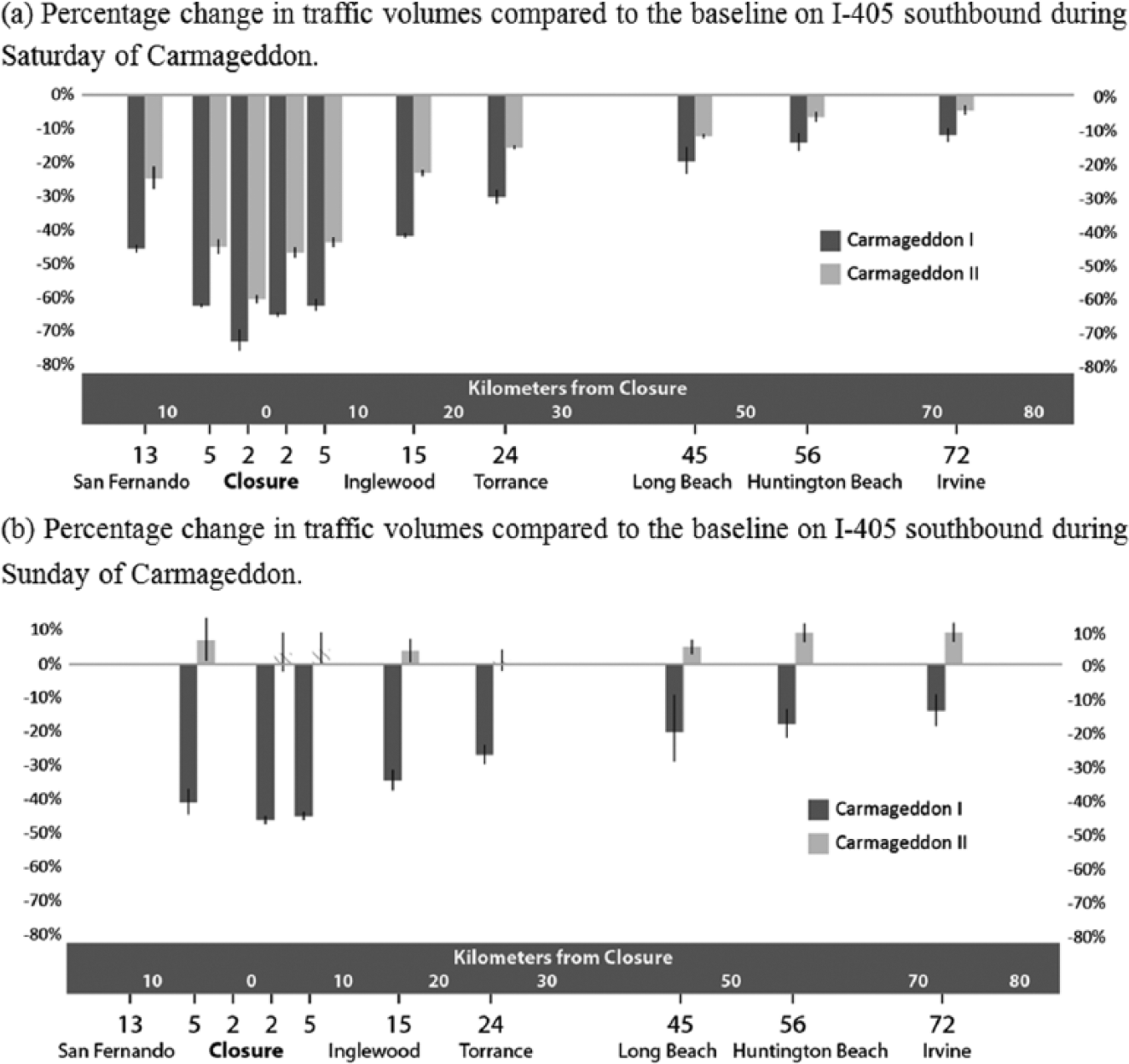
Freeway volumes relative to the baseline on Saturday and Sunday of Carmageddon I.
People Quickly Learned and Responded
Travelers responded to initially low levels of congestion by driving more as each closure progressed. North-bound traffic fell on routes leading to and away from the closure on the Saturdays of both Carmageddons I and II. The statistically significant reductions in traffic declined with distance, extending more than 80 km from the first closure. On Sunday of the second closure, traffic had returned almost completely to normal, baseline conditions, regardless of distance from the closure. This is remarkable because the Sepulveda Pass remained closed until early Monday morning. The large drops in traffic volumes observed on the Saturday of the first Carmageddon had eroded so much by the Sunday of Carmageddon II that traffic volumes had returned to normal on a freeway that was still partially closed.
Discussion of Findings
The Carmageddons were exceptional events that presented transportation officials with an exceptional problem: shutting down a vital, very heavily traveled urban freeway link without leaving the region crippled by congestion. Our analysis of traveler responses to the closures finds that these officials succeeded—far more than was necessary during the first closure. There was an initial period of experimentation during which a large majority of motorists, unsure about what to expect, heeded sometimes over-the-top warnings and stayed off the roads. Drawing on the literature and our data, we conclude that the three most important reasons why they stayed off the roads and did not travel by other means, on other routes, or at other times were because (a) the event took place during the weekend when a larger proportion of trips are discretionary than would have been the case on weekdays, (b) the disruption was relatively short-lived—less than a weekend as it turned out, and (c) the saturation media coverage warning of a likely “car-mageddon” reached and affected an unusually high proportion of Southern California drivers. These findings are consistent with Giuliano and Prashker’s (1986) argument that “faced with a short-term situation, many would choose simply to avoid the problem completely by taking vacation or other time off” (p. 27).
The first Carmageddon was perhaps a modern day version of “The Boy Who Cried Wolf.” Sincerely concerned public officials warned the public of likely traffic impacts during the weekend closure of one of the nation’s busiest freeways. The media showcased the more histrionic of these warnings with doomsday predictions of congestion stretching to the Mexican border and patients dying en route to hospitals. Such warnings engendered dramatic travel behavior changes that ensured that none of these dire predictions would come to pass.
These responses to the first event had important implications for Carmageddon II. Public officials were concerned that given the substantially lower than normal levels of traffic during the first closure, jaded motorists would ignore pleas to again adjust their behavior during the second closure, resulting in severe congestion. Therefore, although a few public officials again offered doomsday warnings, for the most part, public announcements stressed the success of the first closure, referred less to traffic nightmares, and appealed more to public cooperation and civic duty. Traffic volumes were higher the second time around in comparison with the empty freeways, streets, and transit vehicles that characterized the first closure, but the motoring public did adjust their behavior in a more measured response to more restrained media messaging.
Limitations of Supply-Side Measures
Many of the supply-side measures implemented to enhance transportation capacity during Carmageddon I had little effect because they were largely obviated by dramatic demand-side responses. That public transit use in the aggregate was down during Carmageddon I and largely unchanged during Carmageddon II suggests that few displaced motorists were well served by existing transit service, or if well served, they were likely unfamiliar with the transit system (because most residents do not ride transit regularly) and reluctant to experiment on such an unusual day.
Largely unsuccessful efforts to temporarily increase road and transit capacity in response to the Carmageddon closure point to two limitations of supply-side strategies. First, the additional capacity that can be squeezed out of the transportation system in congested, built-up areas through operational improvements has likely already been claimed, leaving little room to maneuver to accommodate exceptional events. Second, highway closures disproportionately affect motorists more than transit users; transit alternatives to such closures are often not well suited to compete with particular highway segments, and they involve a population of auto travelers who may not be familiar with transit travel generally.
Limitations of Demand-Side Measures
The demand-side strategies implemented in response to Carmageddon I were very, perhaps too, successful. Two messages went out to the public prior to the first event—a message of hope and a message of fear—and these two messages in concert elicited exceptional behavioral responses. People stayed local. They avoided travel that day, not just in the vicinity of the I-405, but throughout the entire region.
The ability to create such an overwhelming collective change in behavior is limited, if the evolution of behavioral responses observed between and during the course of the two events is any indication. The message of fear may have motivated a substantial initial response, but its effect decayed quickly over time as people heard news reports about the remarkably light traffic conditions across all Los Angeles that day. In all likelihood, the unrealized prediction of doom eroded the credibility of future messages of fear for the second closure.
Lessons From the Twin Closures
The preparations for and responses to two similar closures of a major transportation artery provide an opportunity to analyze both travel behavior and messaging strategies during exceptional events. Weekend travel is more discretionary than weekday travel, and residents of Los Angeles responded rationally to the flood of information before the first closure. Some people likely changed their travel plans to include different modes, routes, or times. However, many more either stayed at home or chose to visit destinations closer to home.
Comparing data from the two events provides evidence that travelers learn from information and experience. The dramatic traffic reductions associated with Carmageddon I were not repeated during Carmageddon II. The media messages crying wolf prior to the first closure were tempered in the second, and travelers appeared to learn from the first closure that despite some inconvenience, they could still drive to most destinations.
Travelers were not the only people who appeared to learn from Carmageddon I. Given how few travelers chose public transportation as an alternative to the closed freeway, officials did not waste money adding transit for the second event. Before the first closure, concerned officials informed the public of likely nightmarish traffic impacts. The media, without much in the way of supporting evidence, predicted severe and widespread regional gridlock. None of the dire predictions came to pass. In fact, the contrast between the perceived threat and reality was so stark that it left the media scratching their heads; one headline read, “True-Life ‘Disaster’ Doesn’t Live Up to Hype.”
Transportation planners and local officials can learn much from the two Carmageddons about planning for exceptional events—particularly infrequent, repeated, and amply forewarned events such as brief but total closures of major transportation infrastructure. For such events, it is helpful to schedule closures on days when peak volumes are lower and trips are more likely to be discretionary, allowing for substantial and diverse demand-side responses. Disseminating information can also be enormously effective—even more effective than providing added capacity or alternative travel modes. As real-time information becomes available to more travelers, that information can complement system capacity in real-time to reduce cost and delay. Finally, we conclude that crying wolf presents a dilemma, particularly as cities increasingly opt to completely, rather than partially, close transportation facilities for maintenance and reconstruction. Shifting from partial to complete closures, although greatly shortening construction times, also increases the frequency of exceptional events for which cities must plan, mitigate, and message. However, scaring people off of the roads ensures that the promised chaos will fail to materialize, but almost certainly encourages the traveling public to take future dire warnings with a grain of salt.
Footnotes
Acknowledgements
The authors thank Timothy Black, Earl Kaing, and Zodin Del Rosario, who participated in the data collection and analysis for this project.
Declaration of Conflicting Interests
The author(s) declared no potential conflicts of interest with respect to the research, authorship, and/or publication of this article.
Funding
The author(s) disclosed receipt of the following financial support for the research, authorship, and/or publication of this article: Student work on this research was funded by the Los Angeles County Metropolitan Transportation Authority. The authors are grateful for this support.