




Abstract
As the world is striving to improve water supply coverage, a significant number of rural communities are forced to turn back to unprotected sources due to service breakdowns of their water supply systems. Yet, these communities do not seem to receive the same attention as those building new systems. The purpose of this article is to reveal and diagnose the determinant factors of service failures and to propose mitigation measures to the rural water supply in Ethiopia. The study is conducted through a literature review and field discussions with experts (n = 48) and artisans (n = 35), who have been involved in the implementation, operation, and maintenance of the systems. Moreover, failed schemes (n = 20) were visited, and discussions were held with village elders of each water point. The findings indicate that lack of uniformity of implementation approaches, and institutional and organizational incapability of the local government aggravate the service failures. The further capacity building, institutionalization, and improving remuneration of employees are likely to reduce the problems substantially.
Introduction
Drinking water supply in the context of rural communities of developing countries is quite unsatisfactory. First, the need to develop water supply systems that serve all the citizens has not yet been addressed adequately. Second, built systems are not operating at full capacity (Carter, Tyrrel, & Howsam, 1999). To make matters worse, the annual financial capacities of the countries are below the level required to cover both the new development and operation of existing systems (Seppälä & Katko, 2003). These factors, together with extensive service failures, challenged the realization of the Millennium Development Goals (MDGs) and now the Sustainable Development Goals (SDGs), particularly in sub-Saharan Africa (SSA). The majority of the countries in the region were unable to achieve the targets by 2015 (United Nations [UN], 2014; WHO & The United Nations Children’s Emergency Fund [UNICEF], 2015). In particular, the situation is harsh in the rural setting of the region; eight out of 10 people are living without improved water services (WHO & UNICEF, 2015).
Dispersed rural settlements and the absence of infrastructure currently make it impossible to launch effective action to solve the water supply problems in rural Ethiopia. These areas still need multidimensional development to eradicate poverty and improve living standards. In addition to water supply, the rural communities need development in many other areas: farming technology, energy supply, housing quality, and access to basic services such as schools, markets, and health centers. The rural communities are suffering from various problems due to the absence of such infrastructure in their vicinity. These communities are busy all day long. Especially women are involved in laborious activities all year round. Yet, all these problems are interrelated. Thus, any plan to solve an individual problem in these communities is unlikely to succeed, because the problems are inseparable. Community management that has been promoted since the middle of the 1980s is meant to achieve sustainable solutions to water supply services, particularly during the post-construction period. Thus, to achieve sustainability objectives, external agents need to understand the situation in a community in advance of their intervention because experiences and expectations vary across communities.
In fact, sustainability has various definitions depending on the context it is used in. Brundtland’s (1987, p. 16) definition of sustainability as “development that meets the needs of the present without compromising the ability of future generations to meet their own needs” has a longer time frame than development projects normally have. However, in water supply and sanitation, it is limited to a fixed time frame due to the service lives of components and other external factors. Abrams, Palmer, and Hart (1998) defined sustainability of water services as “. . . water continues to be available for the period for which it was designed in the same quantity and of the same quality as was designed” (p. 4). This definition is close to the context of the term used in this article.
In general, the factors determining sustainability are social, economic, environmental, and technical by their nature. These factors have been defined by various scholars (Bendahmane, 1993; Carter et al., 1999; Eneas da Silva, Heikkila, de Souza Filho, & Costa da Silva, 2013; Giné & Pérez-Foguet, 2008; Katko, 1991; Montgomery, Bartram, & Elimelech, 2009; Spaling, Brouwer, & Njoka, 2014; UN, 2007). Although the above references from the last three decades spell out the requirements for sustainable water supply systems, the problem still persists, as manifested by the large proportion of non-functional systems. For example, 25% of the water supply systems in SSA countries fail before the second year after their inauguration (Taylor, 2009). According to Brikké and Bredero (2003), the corresponding non-functionality rate runs from 30% to 60%.
In Ethiopia, the non-functionality of water supply systems is also very serious (Chaka, Yirgu, Abebe, & Butterworth, 2011). It is very important for future development to determine the problems and the causes of service breakdowns of rural water supply. Therefore, this article aims at diagnosing the key reasons for service failures based on the literature review and a field study carried out by the first author in Ethiopia in 2012-2014 as an extension of a research, evolution of community managed water supply projects from 1994 to the 2010s in Ethiopia, done by Behailu, Suominen, & Katko (2015). The objective of the literature review is to map the changes that have occurred over the past decades in the thinking related to sustainability and to relate the contribution of the work to the concept of sustainable services.
In this article, improved water service refers to the definition given by the WHO and UNICEF (2010), which stated that “an improved drinking-water source is defined as one that, by nature of its construction or through active intervention, is protected from outside contamination, in particular from contamination with faecal matter.” Moreover, the functionality of water supply services implies the availability of water in the desired amount, quality, and price that is affordable to users and sufficient to cover operation and maintenance costs (including water fees, time, and energy; Sara & Katz, 2004; Sector Efficiency and Improvement Unit [SEIU], 2010).
Method
This study includes a literature review covering a variety of developing economies and a field survey on the rural water supply situation in Ethiopia. Articles published in scientific journals from the 1990s to 2014 were reviewed, especially as concerns factors related to sustainability of rural water supply. The fieldwork included interviews of 48 water office staff members from seven districts and 39 artisans involved in the construction and maintenance of the water supply schemes in two districts of Amhara region in Ethiopia: Fogera and Dega Damot.
Forty-eight water office experts were also asked to rank the causes of service breakdowns. The 35 artisans of Fogera district filled a questionnaire that contained different subjects related to the implementation of water supply schemes and their possible implications for the non-functional schemes. In addition, four artisans in the Dega Damot district were interviewed. Moreover, the first author attended an artisans’ evaluation meeting in Fogera district and visited 20 non-functional water schemes in November 2012, December 2013, and June 2014.
Results and Discussion
Literature Reviews and the Local Context
In administration, future research, and business strategies, the PESTEL (Political, Economic, Social, Technological, Environmental, and Legal aspects) framework is often used for analyzing the internal and external environment. The detail of this framework encompasses various elements: political, economic, social, technological, environmental, and legal aspects. The aim is to assess the feasibility of a certain activity within a wide framework, not just from technical and economic perspectives. Water as a public good requires continuity in supply and acceptability to consumers in quality and quantity. Therefore, the water supply service is unavoidably governed by these factors. Literature, which was reviewed from the 1990s to 2014, shows that the PESTEL framework has been used as a sustainability tool to keep services operational. Although these elements are explained in various forms in different studies, their focus is, however, ultimately on various governance factors. This study has presented some of the key sustainability elements that are commonly pronounced in the sector as shown in Table 1.
Sustainability Elements of Water Supply Systems.
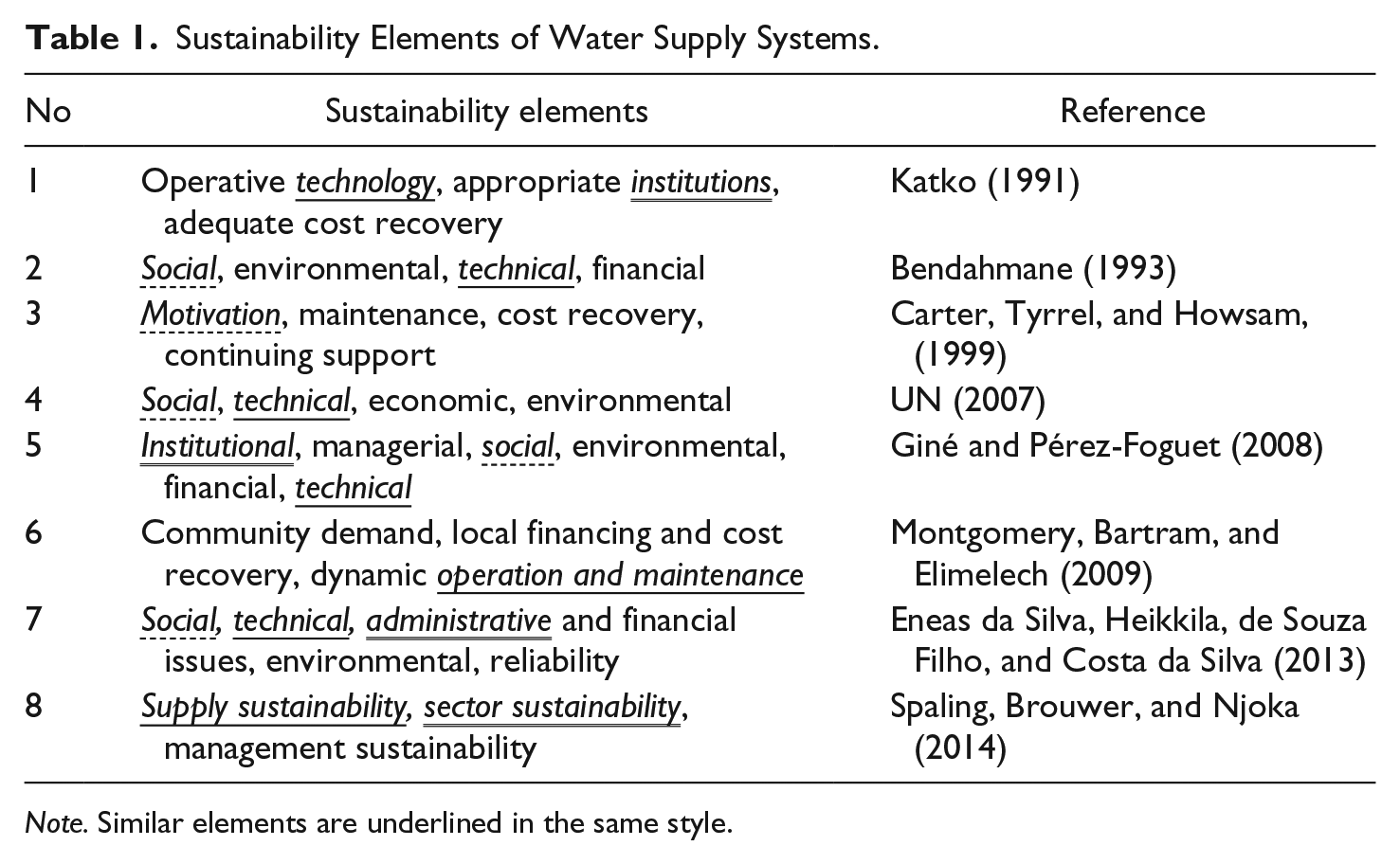
Note. Similar elements are underlined in the same style.
As elaborated in Table 1, the literature reviewed addresses many similar issues or wider themes. However, the sustainability of water supply and sanitation systems has not significantly improved. For example, the UN development agenda for the next 15 years remains focused on sustainability. This strongly suggests that past efforts in this regard were not as successful as expected. The following section summarizes how the literature describes the sustainability elements of water supply systems and the similarities that exist between them.
The factors of sustainability are interconnected, and no single element exists on its own. Thus, treating them separately is quite difficult. Yet, for the purpose of this article, the key sustainability elements are summarized under five major categories and are explained below (for clarification, the terms used by different studies are listed in the parenthesis). These elements are social aspects (motivation, community demand), economic aspects (cost recovery, financial, economy, adequate cost recovery), continuing support, environmental aspects (supply sustainability, reliability), and institutional aspects (support continuity, management sustainability, appropriate institutions, operation, and maintenance). These categories will be discussed below.
Social Aspects
Helping someone who understands a problem is much easier than helping those who have no idea of it. Similarly, it is worthwhile investing in communities that really understand the problems of unprotected water sources. In rural areas, many people think that water cannot cause any harm because they grew up seeing people drinking water from unprotected sources and the community has never linked water-related problems with the quality of the water used. Therefore, communities and citizens have to be taught to raise awareness and to create demand for improved services. A community and its members have to become motivated about water services (to be eager to receive them); otherwise, community participation and further management may not be as effective as it should be.
Table 1 presents the sustainability elements of different researchers in various ways. To a large extent, they are concerned about similar issues. For example, motivation (Carter et al., 1999), community demand (Montgomery et al., 2009), and social aspects (Eneas da Silva et al., 2013) approach the same subject but from different perspectives. Motivation, which is underlined by Carter, is assumed to boost the demand for water and improve the understanding of the need for improved water in the community. Therefore, the user community should be motivated and taught giving due attention to social bonds and norms (social capital) as explained by Eneas da Silva et al. (2013) and Pretty (2003). In general, communities should be motivated and supported by incentives through education (Carter et al., 1999) and provided with continuous training (Harvey & Reed, 2007). It is also very important to know about the available social capital in the target community (Eneas da Silva et al., 2013) to be able to create meaningful community participation through genuine demand (Montgomery et al., 2009).
The concern of community management, participation, involvement, and other related subjects in the water supply is to bring sustainable services. Social aspects are vital for creating solid community involvement, the sense of ownership, and committed management. The main question is how to assure long-term service delivery and how to keep rural communities served even beyond the economic life of the water supply systems. From the social point of view, the end user needs to be involved in the problem identification, planning, implementation, and management of their water supply systems, and the process should be designed to exploit the available social capital and give due respect to traditional institutions.
Economic Aspects
Economic aspects in this part refer to the ability of governments and communities to build capable water supply structures, and to support their operation and maintenance. However, the challenge in rural water supply is that people are often unable to cover the operation and maintenance costs. Hence, many projects and programs include cost recovery as a requirement of service sustainability. However, the definitions of full cost recovery in water supply and sanitation are very ambiguous. Some projects focus on the collection of money through tariffs for the operation and maintenance (O&M) of the systems but ignore the need to cover system replacement. Others deem it important that at least a part of the investment cost is recovered just to assure the renovation of old systems and their replacement when they have reached the end of their service life. However, in practice, communities in rural areas of developing economies often disregard this aspect because of lack of education, ability to pay, and appropriate institutions.
Most studies have considered cost recovery as one of the key sustainability elements. If communities are able to cover at least the O&M and system replacement costs, governments and NGOs that support water supply system development would be able to help those communities that are beyond the services. A very important question is to what extent a community can recover the costs of their system. A sustainable value of water supply systems includes operation and maintenance costs, capital costs, opportunity costs, economic, and even environmental externalities as indicated in Figure 1.
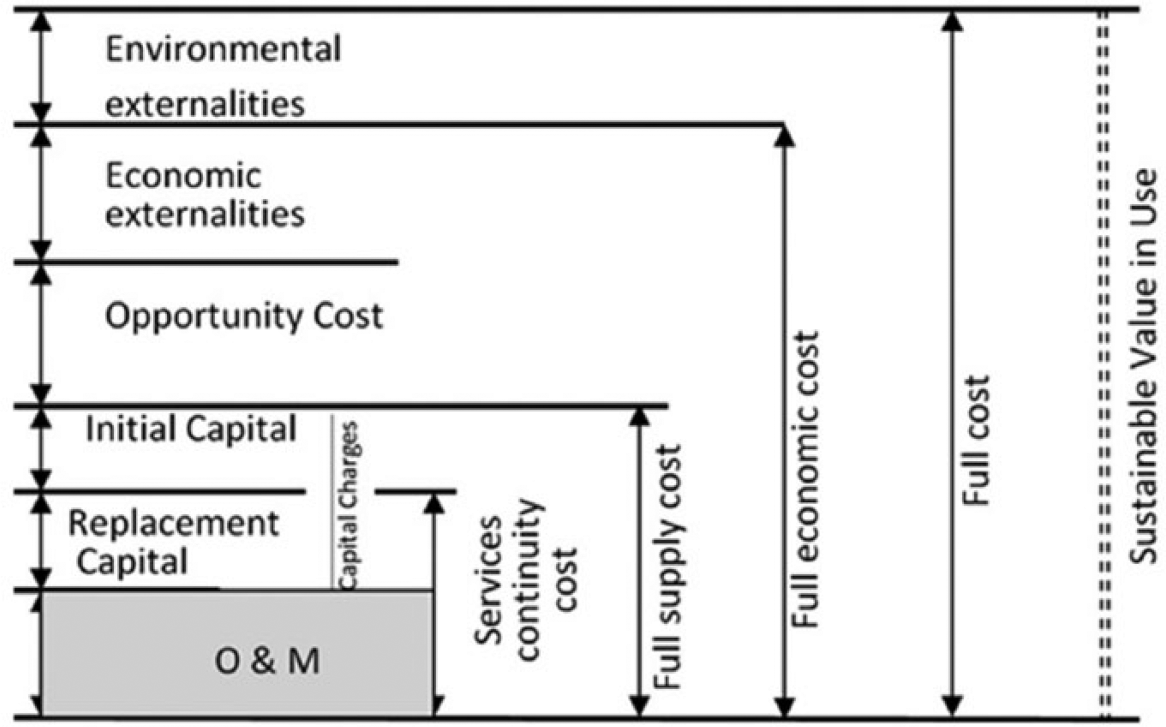
Water supply costs and shares that need to be recovered (modified from Seppälä and Katko, 2003; Rogers et al., 1998).
According to Seppälä and Katko (2003) and Rogers, Bhatia, and Huber (1998), the full costs of services are the aggregate of full supply costs (full financial costs), opportunity costs, and costs of social and environmental externalities. The last three components are often caused by environmental impacts and non-monetary costs. The problem is to know exactly the sorts of costs that can be recovered. Moreover, the possibility of recovering the full cost in the developing countries is unrealistic. In fact, ideally, it can be helpful if at least full financial costs are recovered, but the actual living conditions and level of understanding in the communities—including, for example, the need for cost recovery—make that largely impossible. Therefore, developing economies are far from equating environmental and economic externalities, and opportunity costs with actual costs.
Full cost recovery is a challenge, even to European Union (EU) member states (Hukka & Katko, 2015), let alone developing economies, because rural areas in the developing countries are very poor and their settlements are often too scattered to act jointly. In addition, based on earlier experiences, people tend to expect receiving water supply services (both new development and O&M) from the government or external supporters (Katko, 1990). Thus, recovering of costs, in practice, involves paying a tariff that often covers only the salaries of guards and replacement of simple spare parts. Deciding on the water charge is left to users who do not have the capacity to forecast future costs and know very little about cost recovery. As a result, they set a very low flat rate that is hardly ever collected regularly.
In Ethiopia, water charges are very rarely collected and are, on average, based on the findings of this study, on an average 3.2 ETB (Ethiopian Birr) (0.13 euro) per household per month (n = 179)—n is a number of water supply schemes. That is not enough to cover O&M costs, let alone full supply costs. However, as the spare part costs are increasing, the water fees collected from users are not rising correspondingly. That indicates that the rate of cost recovery in rural Ethiopia is far too low. The reason for such low rates is that tariffs are determined by the community without a full appreciation of the cost factors involved and a shortage of hard currency. Rural communities are challenged in setting adequate rates because the costs of spare parts are often unpredictable and paying of bills in cash every month is difficult for agricultural communities that are dependent on seasonal crop yields. Therefore, some improved rules and assistance are needed to provide services to the communities, and obviously, we have to start pursuing a policy that makes it possible to recover at least the service continuity costs.
Continuing Support
The third element, continuing support, refers to the support that needs to be extended beyond the project span to enable the users to manage their system properly. The ability to bring about substantial and sustainable change in a rural community is hampered by the project-based nature of improvements, which are often constrained by time and limited resources. For example, most donor- and NGO-based implementation of water supply and sanitation systems are restricted to a limited time where they are focused on construction, rather than sustainable operation of the systems. Once construction is complete, the external agents normally will hand over the system to the users and move on to the next project. However, the community who received the service is often ill-equipped to operate and manage it efficiently and needs ongoing support to ensure that their management and operational skills are adequate. This continuing support can be financial, technical, administrative, or whatever else is needed by the community. Not providing such support will be an impediment to successful and sustainable systems.
According to Carter et al. (1999) and Harvey and Reed (2007), this support refers to the role of back stoppers in the community during the post-construction phase. This concern is often given less weight in the realm of community management. The reason for the need of continuing support is the inability of rural communities to manage and operate water supply systems. First, they are not educated to operate such systems and, second, the heterogeneity of communities in religion, culture, and norms contributes significantly to lower coherence between community members in managing their common system. As Harvey and Reed (2007) remind, the effectiveness of ownership feeling in attaining sustainability is more challenged by individual behavior than the community.
Rural communities in developing economies need both technical and financial support, whereby donors and partner organizations have been lending a hand in many ways. However, as pointed out by Harvey and Reed (2007), external support should not undermine local efforts. In other words, external agents should not replace local actors but recognize their efforts and help to improve them. Therefore, support for the implementation of systems should be extended beyond the completion of a project so that it enables the users to handle their systems gradually. In this manner, the role of external supporters to create a capable local community will be realized (Harvey & Reed, 2007) as illustrated in Figure 2.
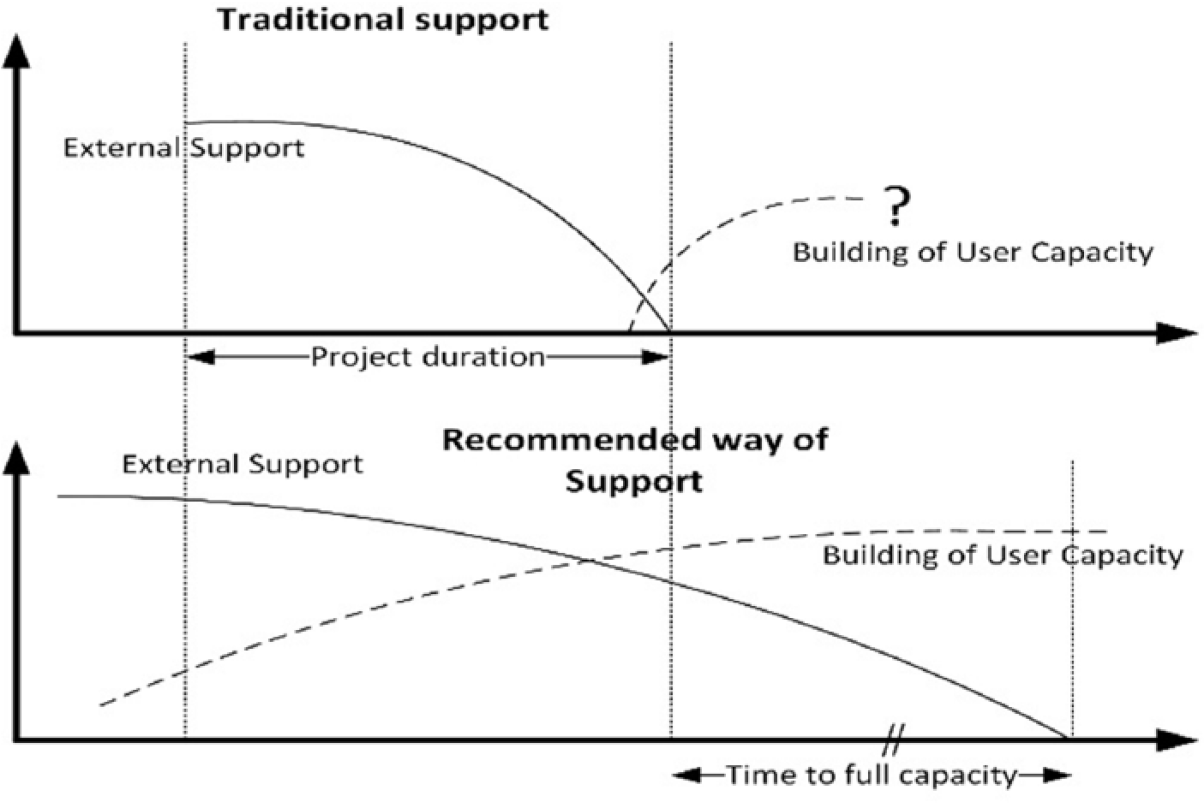
Traditional and recommended ways for external support in building community capacity.
Members of water user communities who are appointed to look after the water supply systems are known as caretakers. In Ethiopia, most implementers train water caretakers to repair and maintain the systems. However, the training methods do not include the full participation of trainee caretakers in practicing fitting and unfitting parts of systems. Thus, these caretakers in rural Ethiopia are not working as efficiently as they could. Besides, training is given in groups (caretakers from various water systems) for cost optimization reasons. Therefore, training demonstrates each component of the water supply systems to the trainees in groups and allows them to familiarize themselves with the components. Yet, the trainees do not get a chance to practice enough to master the job due to the high number of trainees. However, water supply schemes’ early stage failures are not common. Therefore, the caretakers do not get a chance to test their maintenance skills sufficiently. Consequently, when a system fails, they do not remember how to perform their tasks properly. Moreover, the performance of water supply, sanitation, and hygiene committee (WASHCO) and caretakers in water fee collection and utilization, and other management matters should be continuously supervised and strengthened until the intended result is achieved to comply with the view of Ayibotele (1988).
Environmental Aspects
As indicated in Table 1, supply sustainability (Spaling et al., 2014), environmental aspects mentioned by Eneas da Silva et al. (2013), and reliability (Masduqi, Endah, Soedjono, & Hadi, 2010) are referring to the same element, environmental sustainability in particular. According to Spaling et al. (2014), supply sustainability refers to the availability of water sources along with other supplies. The main concern in the rural water supply is the reliability of water sources, which can be expressed in terms of quantity, quality, and accessibility. Therefore, sources considered for water supply purposes should be protected from contamination and yield reduction. At the same time, improved water supply schemes should not have a negative impact on the environment (Eneas da Silva et al., 2013). In rural areas, the biggest concern is assuring the availability of water. Otherwise, the environmental impact of water supply schemes is minimal because of their size and less complex treatment technology.
Appropriate institutions (Katko, 1991), sector sustainability (Spaling et al., 2014), and the technical, administration, and financial capacity described by Eneas da Silva et al. (2013) are meant to create an enabling environment and sustainable services in rural water supply and sanitation (Lockwood, 2004). Thus, the planning of water supply schemes needs to be governed by rules that enable protecting the environment from harm and the resulting drying up of water sources. In this respect, the situation in Ethiopia is very promising if the efforts produce proper results. Watershed management has been practiced nationwide in the form of soil and water conservation works since 2010. That is good news for water supply as it replenishes groundwater and increases the yield of available surface water sources.
Appropriate Institutions
According to North (1990), institutions are the humanly devised constraints that structure political, economic, and social interaction. They consist of both informal constraints (sanctions, taboos, customs, traditions, and self-imposed codes of conduct) and formal rules (constitutions, laws, property rights). These national or local well-structured and appropriate institutions are vital for promoting sustainability. Such institutions should determine the ways in which communities are approached, issues discussed, the environment compromised, and technical matters managed. There should be a system of checks and balances vis-à-vis the activities and incentives for the stakeholders. In North’s (1990) sport team analogy, the institution is simply represented by the rules of the game whereas organizations are denoted by the players. Institutions are usually there to govern the way organizations act in a certain business. Moreover, organizations initiate institutional changes. Thus, both are important for development as one drives the other and keeps systems flexible with the dynamic world. That is the main reason to include institutions and organizations as the basis of governance along with policies (Kemerink, Mbuvi, & Schwartz, 2012).
Some examples, from Table 1, have described the importance of appropriate institutions to make rural water supply services sustainable. Quin, Balfors, and Kjellén (2011) argue that ‘Nobody is willing to walk and talk with the people . . .,’ although the organizational framework implies that actors undertake certain rules and responsibilities, they are not always undertaken properly. Thus, the above mentioned argument emphasized on the importance of enforcement of rules to push civil servants work with the people. This is directly related to the weakness of the institutions in Uganda to implement rules. The same is true in Ethiopia. Staff members of the district water office are responsible for the technical follow-up of the construction of rural water supply schemes, but they are not doing all they are supposed to do. The enforcement and the incentives to carry out these activities are non-existing. Apparently, the lack of adequate organizational and financial capacity of the districts has resulted in understaffed organizations and unsatisfactory implementation institutions. Therefore, strong institutions with appropriate enforcement and incentives should be placed at the district level to promote functional systems.
Chains of Causes and Effects on the Service Failures of Schemes in the Study Area
The Ethiopian government and partner organizations have been struggling to increase the coverage of rural water supply services with the aim to provide 15 liters per capita per day (lpcd) within 1.5 km. Therefore, these figures are simple indicators of evaluating the success of development in the sector although they alone do not constitute a sufficient base for such evaluation. This study shows that the travel distance is in the range of the national target in the surveyed households while water consumption level is much below the national standard (15 lpcd; Figure 3 reveals that more than three quarters of the population is fetching less than 15 liters of water per day. Moreover, approximately 50% of the studied water points [n = 25] fail at least twice a year, and 83% of 66 water schemes encountered water yield reduction for about 2 months in a year).

The level of per capita per day consumption.
As discussed earlier, rural water supply systems generally fail to serve or inadequately serve their communities due to social, economic, environmental, and technical factors. Based on the interviews, questionnaires, and field observations, the factors are greatly exacerbated by the lack of institutional capacity in Ethiopia. The institutional capacity in this article refers to a system that is established to facilitate development activities, follow-up and monitoring mechanisms, and the presence of controlling mechanism in the district water office. As shown in Figure 4, the lack of institutional capacity has a substantial influence on other factors. This figure is developed based on the interviews of 48 experts in the districts.
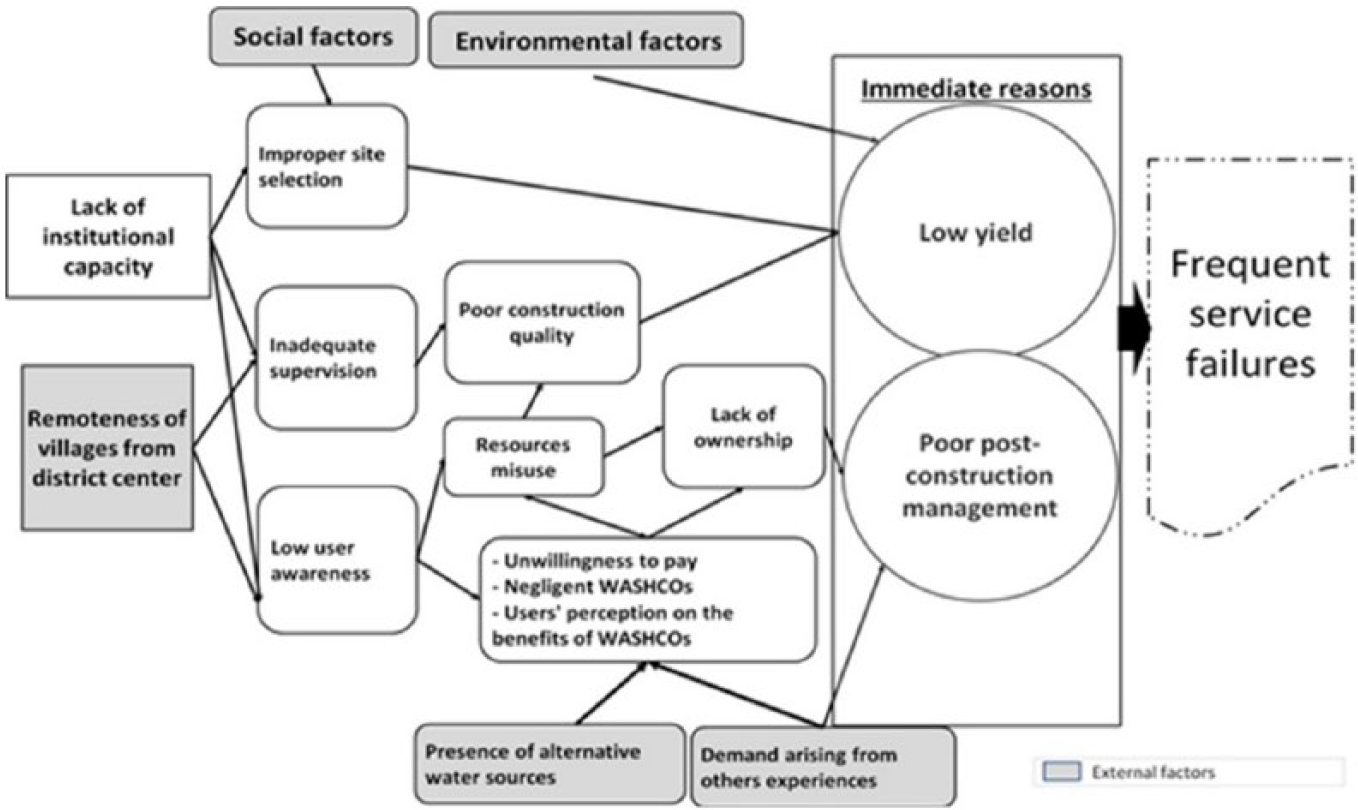
Factors contributing to service breakdowns in rural water supply in Ethiopia based on the findings from the field.
Service breakdowns are defined here as occurrences of service interruptions, failures to provide an adequate quantity of water, or abandoning the water system by the users. Based on interviews and questionnaires, frequent service breakdowns of rural water supply systems are due to low yields of water sources, poor post-construction management, water quality problems or a combination of these. Low yield implies that water sources dry up or built structures do not supply enough water for the design population. Moreover, poor post-construction management means that failed parts of a system are rarely replaced in time; people do not contribute to the maintenance and proper use by the community.
As Figure 4 shows, the low yield is the result of environmental factors or man-made causes. Most water supply schemes in rural areas under consideration are hand-dug wells for a group of households. Because these wells are shallow, groundwater level variation has a significant effect on the availability of water in them. The reliability of water supply also depends on the quality of construction and proper site selection.
In practice, quality construction means wells deep enough to allow extracting an adequate quantity of water in the driest season, leakage-free structures, durable components (that need nominal maintenance), and technology that can be operated by local knowledge. In the rural areas of Ethiopia, the most important construction quality factors are durability, site selection, and reaching the right depth where enough water can be found. Wrong timing of the construction of a hand-dug well, in particular, may lead to an erroneous estimate of the well’s yield. The construction has to take place during the dry season to ensure the availability of as much water as possible. However, in the study area, this issue was not found to be a major problem in projects that follow the Ethiopian financial year, which starts in July. The projects of implementers who follow a financial year starting in January usually overlap with the rainy season in June to September. Construction of wells during these months exaggerates the yields of the sources and eventually leads to a shortage of water in the dry season.
A very striking issue is material misuse and fraudulent reporting on the depth of wells. Although it is not a problem in all districts, the situation must be clarified to enable those concerned to take required action. Misuse of resources is covered up by the artisans and WASHCOs’ members (22 of 35 the artisans contacted agreed on the presence of resource misuse). As the committees are responsible for controlling the construction of the water supply schemes, it is easier for them to negotiate with the artisans. The artisans and WASHCOs sometimes report exaggerated well depths to the district water office to claim extra payments and construction materials. Based on the discussions, this problem is quite common in remote villages where supervision is weak. A couple of districts that faced this problem solved it by setting up a new control mechanism and intensifying supervision.
Inadequate supervision and improper site selection are the most important factors contributing to the yield reductions because they lead to lower construction quality. The problem is also aggravated by the lack of institutional capacity. Moreover, social behavior has influenced the site-selection process, because everyone wants to have a water point near one’s house. Therefore, the members need to have a debate on the site of water points and they generally agree to have them at a convenient distance for all users regardless of the hydro-geological conditions. This, in turn, is a problem with regard to the availability of water. In addition to the social factors, the institutional set-up and organizational competency have an impact on the quality of site selection. Most staff members have a low-level education, and their turnover rate is high. In most districts, skilled manpower with a bachelor’s degree will not work for more than a year because of higher salaries paid by other equivalent organizations or facilities in other districts. It is also difficult to make heads of district offices serve for a longer period. Based on the observations of the first author, four of the seven district heads were substituted within 18 months, and the new leaders did not have a background in any water-related field. The high staff turnover rate and the unstable situation of heads of water offices have serious effects on the progress of developments in the districts and, consequently, construction quality. The worst-affected villages are far from the administrative centers of the districts.
In Ethiopia, rural communities have less exposure to education, and only 49% of the total population is literate (The World Factbook, 2015), and thus, the rural communities have low levels of knowledge to interact with new systems management styles. Therefore, adequate training and awareness are very important for proper utilization and management of systems. The remoteness of the villages from the administrative center of their district also had an impact in addition to the lack of staff. The staff available in districts typically consists of seven to 21 people for a population range from about 33,000 to 225,000 as indicated in Table 2. They cannot address the demand effectively in their district. Moreover, technical staff members need to travel long distances to reach the rural communities and the remotest villages are often inaccessible by road. Hence, the personnel sent to educate a remote community and supervise construction may have to travel on foot, and the incentives offered are not very attractive either. Also, the incentives are not based on real efforts, and staff members usually hate to be assigned to remote villages because they would rather work nearby. Thus, supervision is very weak due to the workload and lack of incentives. Moreover, the artisans pointed out the absence of proper supervision (eight out of 35) as a second serious problem next to the lack of discussion (nine of 35) to resolve issues in the process of implementation.
District Populations (Rural) Based on the 2007 Census and Number of Water Office Staff.
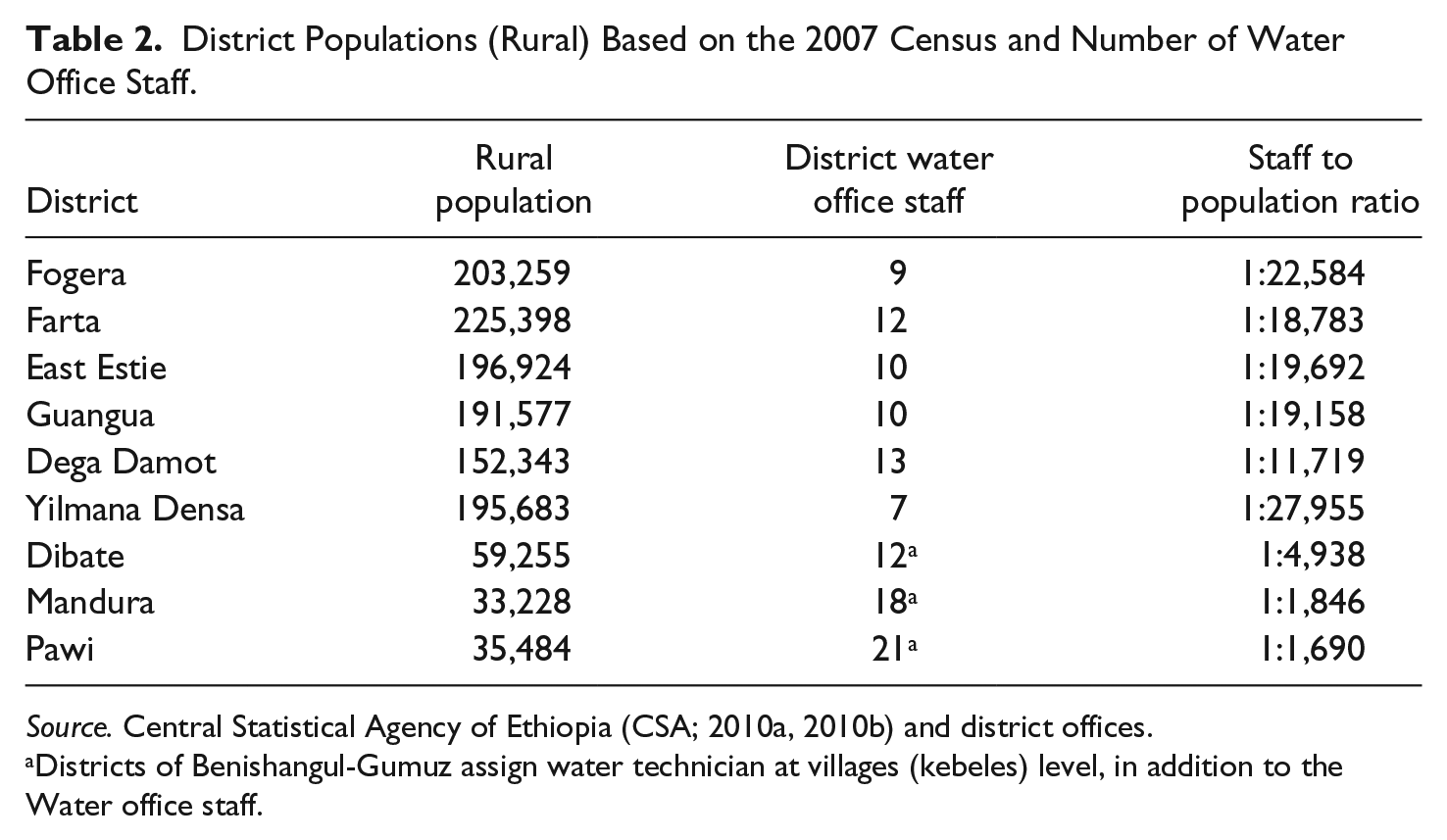
Source. Central Statistical Agency of Ethiopia (CSA; 2010a, 2010b) and district offices.
Districts of Benishangul-Gumuz assign water technician at villages (kebeles) level, in addition to the Water office staff.
In discussions, various factors were suggested, but it is difficult to identify a single reason being more responsible for the failures than others. For example, negligent committee members lose the interest of users (15 of 35 artisans who filled the questioner reflected that the committee members are negligent, and 17 of 35 feel the WASHCO members are self-benefit oriented). However, the negligence of WASHCOs is the result of the assumption of the community concerning benefits the WASHCOs members receive from the projects. That, again, raises suspicions about the committee being involved in the misuse of construction materials. All these causes and effects finally form a vicious circle. Generally, the reasons for a weak feeling of ownership include an unwillingness to pay, negligent WASHCOs, user perception of the benefits accruing to WASHCOs, and misuse of resources, in addition to the absence of well-established management systems. A well-established management system is characterized by a strong bond between the district water office and the user committee, where there is joint accountability for the management and implementation of proper tariff collection and the presence of a skilled workforce for operations and maintenance. Moreover, the committee should be legitimized by the local community and have procedures in place to replace a member when required. A secure supply of spare parts should also be available to the local community to reduce their dependence on the external government or NGOs.
The abovementioned factors are believed to emanate from low user awareness, the presence of alternative water sources, and demands triggered by competition with other communities. Hence, institutions established by districts can be blamed for not having appropriate community training, special remuneration systems, and control mechanisms in remote villages.
Conclusion and Recommendations
Conclusion
Based on the study, the following conclusions are made.
The concern of sustainability has not been changed in the last three decades. Various researchers have frequently pointed out the crucial components of sustainability, yet services failures have not substantially reduced in the past three decades despite an increased focus on community management.
The reasons for service breakdowns in rural water supply in Ethiopia include yield reduction or drying up of water sources, lack of timely maintenance, failure of rehabilitation, lack of spare part supplies, and lack of adequate cost recovery.
The absence of dynamic institutions that change with time and incorporate the social, environmental, and economic aspects of sector development has contributed for most factors of failures.
The existing policies are not supported by adequately trained human resources, adequate finance, and a proper institution at the district level. The district water offices’ human resource structure is not properly planned and organized. However, the human resource needs of districts have not ever been met, and what is even worse, the turnover rate of the existing staff is too high.
Perception of users on water services and water committee determines the overall water system management.
Recommendations
The following policy recommendations have been developed based on the rural Ethiopian situation, but many of the recommendations would also apply to other countries with similar characteristics.
The efforts of different sector agents should be harmonized and regulations made uniform. In this regard, the remuneration paid by all organizations working in the same country should be about the same to ensure expert services to all. Because most rural areas lack proper infrastructure, the staff and skilled labor who work in remote areas should receive special remuneration.
Both national governments and NGOs should focus on human resource development and find ways of maintaining the existing staff and reducing staff turnover in districts. That will promote the post-implementation support and create an enabling community.
District water offices should have a system of monitoring the level of education given to the rural community in terms of understanding their problem and management of their systems. The utmost effort should be exerted to train the community and create real demand for protected water schemes rather than competition among communities. That would make a substantial contribution toward reducing misunderstanding between users and WASHCOs and resources management.
The national or regional governments should help local governments and the community to understand the importance of cost recovery and market fluctuations in setting a water tariff that is sufficient to cover security and operations and maintenance costs.
Efforts to upscale the community through pre- and post-implementation should be supported to enable communities to manage themselves rather than expecting help from external agents when problems arise.
Material misuse during construction should be avoided by establishing strict supervision. Final checks should be made by the district technical staff to ensure the quality of construction and that the well is deep enough to provide the intended supply to beneficiaries.
Caretakers should be trained well during commissioning, and refresher training should be provided later for groups to accumulate sustainable and transferable knowledge in the community. Otherwise, the performance of operation and maintenance tasks will become impossible in the long run.
Water offices should supervise the performance of the water systems, WASHCOs, and their financial management because the users and their representatives often lose confidence.
Educating the community regarding the benefits and management of the service before implementing a project is vital for creating a sustainable system.
Footnotes
Acknowledgements
Scholarships from Maa-ja vesitekniikan tuki ry and Centre for International Mobility (CIMO) in Finland, logistical support from the Community-Led Accelerated WASH (COWASH) project in Ethiopia for fieldwork, and the support from the Academy of Finland (no. 288153) are gratefully acknowledged. Moreover, we acknowledge the three anonymous reviewers who were involved in the process, and the editor for their constructive comments.
Declaration of Conflicting Interests
The author(s) declared no potential conflicts of interest with respect to the research, authorship, and/or publication of this article.
Funding
The author(s) disclosed receipt of the following financial support for the research, authorship, and/or publication of this article: Scholarships for this study were received from Maa-ja vesitekniikan tuki ry, CIMO in Finland and the Academy of Finland (no. 288153).