




Abstract
No matter how widely they may be defined, new social infrastructure projects can learn much from previous public–private partnership (P3) policies as well as from current global experience. What can be learned, though, and how? This article adopts a theoretical policy learning perspective and investigates what public works researchers and policymakers might get out of focusing on policy learning in more detail. Three perspectives are presented as follows: the technical approach, the professional/coalitional approach, and the experimental approach. International case illustrations are presented to illustrate P3 policy learning over space and time.
Keywords
Introduction
We are presently seeing a renewed focus on the need for social infrastructure such as hospitals, housing, prisons, and university facilities. For more social infrastructure projects to be successful, however, lessons may have to be learned from previous social infrastructure projects as well as economic infrastructure projects such as in transport. There is little doubt that as infrastructure public–private partnership (P3) policy ideas have diffused around the world, there is plenty of room for lessons to be learned from countries with long experience. The challenge is to explore policy learning in P3s so that lessons relevant to tomorrow’s social infrastructure can be articulated and implemented. This challenge is not made any easier when some countries seem to be moving away from pure P3s to a more mixed model of infrastructure that relies as much on government and on public financing as it does on the market and on private financing.
This article, however, is not the original one we intended to write. 1 Our initial goal was to articulate what policy learning has occurred in social P3s and how these lessons might inform the future adoption of P3s in social infrastructure. This article is the one which needed to be written before we could answer these questions. In this article, we aim first to articulate both “social infrastructure” and “infrastructure policy” before we then explore the concept of policy learning more fully. In this article, we adopt a theoretical lens on policy diffusion to explore how policy makers, planners, P3 professionals, and P3 project managers learn when they seek policy lessons from previous P3 experiences and apply these to new social infrastructure projects. Policy learning can be understood as “the alteration or change in the thinking or beliefs of actors in the policy setting, based on experience, information or knowledge, and concerned with policy objectives” (Laatsit, 2019, p. 10; see also Dunlop et al., 2018; Dunlop & Radaelli, 2012). Much of the P3 literature has implicitly or explicitly considered lessons learned in some form or another (see, for example, Little, 2011; Martin et al., 2013; Siemiatycki, 2014; Van den Hurk, 2018), but a strong theoretical focus on policy learning has not been common. Indeed, while some of the P3 literature in the public works domain has considered the concept of policy diffusion (Verhoest et al., 2015), none of it to our knowledge has explicitly theorized and then built on the central matter of policy learning. We want to make up for that with this article. This theoretical perspective could allow us to understand how it is that some P3 ideas are being reconsidered while other policy ideas are launched (such as rediscovering the role of government in infrastructure governance). Policy learning ideas could also assist us to differentiate between the appearance of learning, such as “when policy makers adapt to the policy shifts of others,” compared with actual learning, which occurs “when their beliefs of [policy] cause and effect change” (Dobbin et al., 2007, p. 460).
The research questions in this article are therefore more modest than our initial ideas. We ask the following: How might we define both social infrastructure and infrastructure policy? In the context of global policy diffusion, how does policy learning occur for infrastructure P3s? And what, then, might the implications be for social infrastructure P3s?
The article is structured in the following way. The “Social Infrastructure and Infrastructure Policy” section focuses on defining both social P3s and infrastructure policy. Section three begins with the context of policy diffusion and looks in particular at the concept of policy learning to articulate some theoretical threads to assist our task. Section four then discusses a range of empirical examples of policy learning from the P3 experience and what this may imply for our state of the art as far as P3 policy learning goes. The “Conclusion” section provides final concluding remarks.
Social Infrastructure and Infrastructure Policy
Social Infrastructure
“Social infrastructure” is a common phrase in among both P3 academics and practitioners. So how “social infrastructure” might be defined? The concept of “social infrastructure” exists in counter distinction to the idea of “economic” infrastructure. But what is at its heart? To begin with, let us limit our considerations to physical infrastructure. A brief look at the literature quickly reveals that many authors use the phrase without attempting any definition. Others refer to various types of capital projects which make up the field of social infrastructure. Thus, Liu et al. (2017) state simply that “hospitals, schools, prisons, museums, public housing, and the like are considered to be social infrastructure; (Yong, 2010).” And Keating (2008) likewise discusses hospitals, schools, and fire stations in his investment commentary on social infrastructure P3s, although begrudging what he headlined as “social P3s” but with “anti-social [financial] margins.”
Several attempts at defining social infrastructure in the literature are presented in Table 1. This table is illustrative rather than comprehensive.
Definitions of Social Infrastructure.
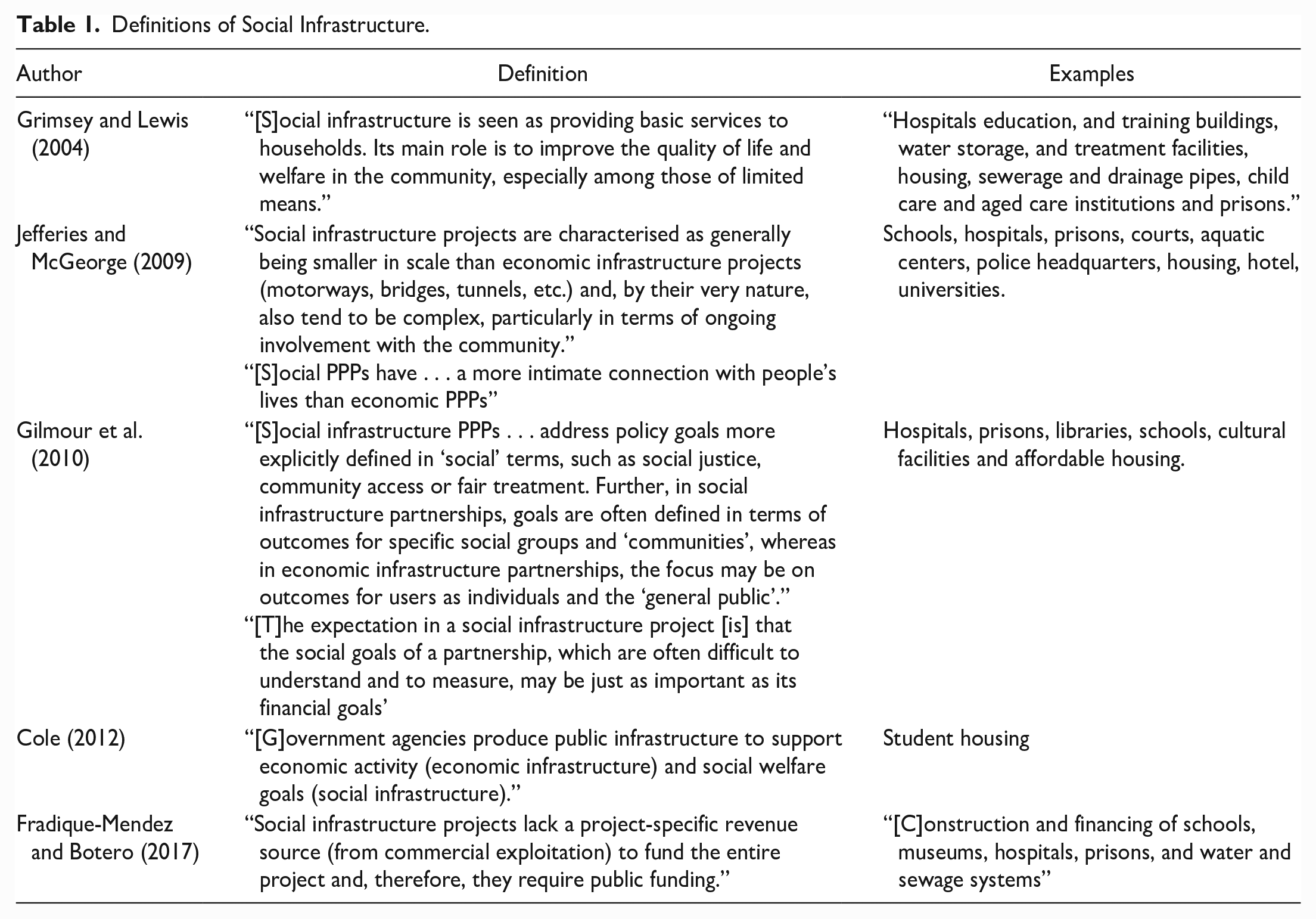
Grimsey and Lewis (2004) cite Argy et al. (1999) and extend the listing of project types to include water supply, drainage, and sewerage facilities as well as child care and aged care institutions. They comment that “social infrastructure is seen as providing basic services to households” and that its “main role is to improve the quality of life and welfare in the community, especially among those of limited means.” Jefferies and McGeorge (2009), also citing Argy et al. (1999), add more project types still into the growing list (including courts, aquatic centers, police headquarters, housing, hotel and universities.) They comment that social infrastructure projects are generally of a smaller scale than economic infrastructure projects such as motorways, bridges, or tunnels, and tend to be complex in terms of community involvement because they have a more intimate connection with people’s lives. To these pointers, Gilmour et al. (2010) argue more cogently that social infrastructure P3s “address policy goals more explicitly defined in ‘social’ terms” including questions of social justice, community access, or fair treatment. They then add confusingly, though, that “in social infrastructure partnerships, goals are often defined in terms of outcomes for specific social groups and ‘communities,” whereas in economic infrastructure partnerships, the focus may be on outcomes for users as individuals and the “general public.”
Cole (2012) in his study of student housing argues more clearly that government agencies produce public infrastructure to support either “economic activity (economic infrastructure)” or else to support “social welfare goals (social infrastructure).” Finally, and somewhat cutting across these previous definitions, Fradique-Mendez and Botero (2017) argue that “social infrastructure projects lack a project-specific revenue source (from commercial exploitation) to fund the entire project and, therefore, they require public funding.” What are we to make of these various definitions? Possible criteria on which to define what constitutes social infrastructure (as distinct from economic infrastructure) appear to include the following:
a) The basis of funding (i.e. whether a self-funding revenue source exists).
b) The type of project being delivered including its scale and complexity (as illustrated in Table 1).
c) The broader policy goal(s) being pursued by governments through such a project.
We adopt the third of these definitions in this article. This decision deserves some discussion. Arguments about what ought be deemed “social” as distinct from “economic” go back centuries, so there is much to be learned from other domains. Windholz and Hodge (2012), for instance, examine what constitutes social regulation and on what criteria ought we see it as different to economic regulation. They make several important points relevant to our task of defining social infrastructure. Applying their logic to the current task, we might first conclude that social infrastructure is that infrastructure which is delivered for the fundamental goal of social (rather than economic) policy. It is not the nature of the project nor the source of project revenue, which is crucial here, but the policy goal being pursued. If the infrastructure being delivered is fundamentally aimed at achieving socially desirable outcomes or meeting collective aspirations gained through the democratic mandate of an elected government, it is social infrastructure. Such socially desirable outcomes are often sought in preference to those produced by efficiently operating markets, and they “reflect broader societal values such as justice, equity and fairness, social cohesion or solidarity, and enhancing trust” (Windholz and Hodge, 2012, p. 223). On the other hand, the primary purpose of economic infrastructure is to develop markets and improve their economic efficiency. The central value reflected here is that of economic development and efficiency. The idea that social policy (and thus, a social infrastructure P3) primarily advances social values while economic P3s primarily advance economic values is at the heart of our definition. This is probably not new. Under this idea, public water supplies, court houses, and libraries clearly have (primary) social goals at their center and are social infrastructure. Public universities, public hospitals, and prisons, too, are social infrastructure as well.
But the reality is also that the distinction between what is “social” and what is “economic” in real policy decision-making on P3s is difficult to draw. The reason for this is because, as Windholz and Hodge (2012) point out in their analysis, the primary values dominating “social” policy importantly also have economic values acting as a set of secondary supports and constraints. Conversely, the primary values dominating “economic” policy also have social values acting as a set of secondary supports and constraints. Indeed, they argue that these secondary, or supporting, values play an important role in providing the foundations for the stability and legitimacy of government policy and decision-making.
Another way of putting this is that there is no such thing as a purely economic policy (or P3 infrastructure project) or a purely social policy (or project). Policies and projects all have a set of primary values which dominate as well as secondary values which support. Purely social infrastructure (or purely economic infrastructure) only exists in the simplified world of theory.
These insights on the distinction between social and economic infrastructure are analytically useful and instructive. It is not simply hard to point to a unique set of projects which are said to be purely economic P3s or purely social P3s. It is more likely to be impossible. Some people may view private universities, private prisons, or “private” hospitals as social infrastructure, others as economic infrastructure. And if roads paid for through our taxes are predominantly economic infrastructure, then why not water paid for through taxes as well as on a user pays basis? It is little wonder that the distinction between social and economic infrastructure P3s in practice “is ambiguous and difficult to establish empirically” as Gilmour et al. (2010) say. Of course, added to this is the reality that many government policies have not one but multiple policy goals, and such policies often exist in a delicate balance of competing values rather than in a neat hierarchy. In the end analysis, the question is one of discerning which values become primary and which values become secondary as a policy evolves. These insights provide a more informed conceptual and analytical framework for deeper discussions on social infrastructure.
Infrastructure Policy
Having limited ourselves to physical public infrastructure, what is then meant by “infrastructure policy”? This phrase is again certainly in commonly usage among all P3 observers, so articulating what meaning we ascribe to it provides a further important foundation to our task of investigating policy learning for social infrastructure. Being part of the public policy lexicon, though, “infrastructure policy” is likely to hold a multitude of meanings. We will dwell on these only sufficiently to gain an appreciation of the breadth of the policy notion.
A sensible direction to take in defining infrastructure policy would be to draw on the wide array of definitions posited for (public) “policy” over past decades and apply these to the context of infrastructure. Table 2 illustrates several such potential raw definitions from the policy literature.
Policy Definitions Which Could Apply to Infrastructure.
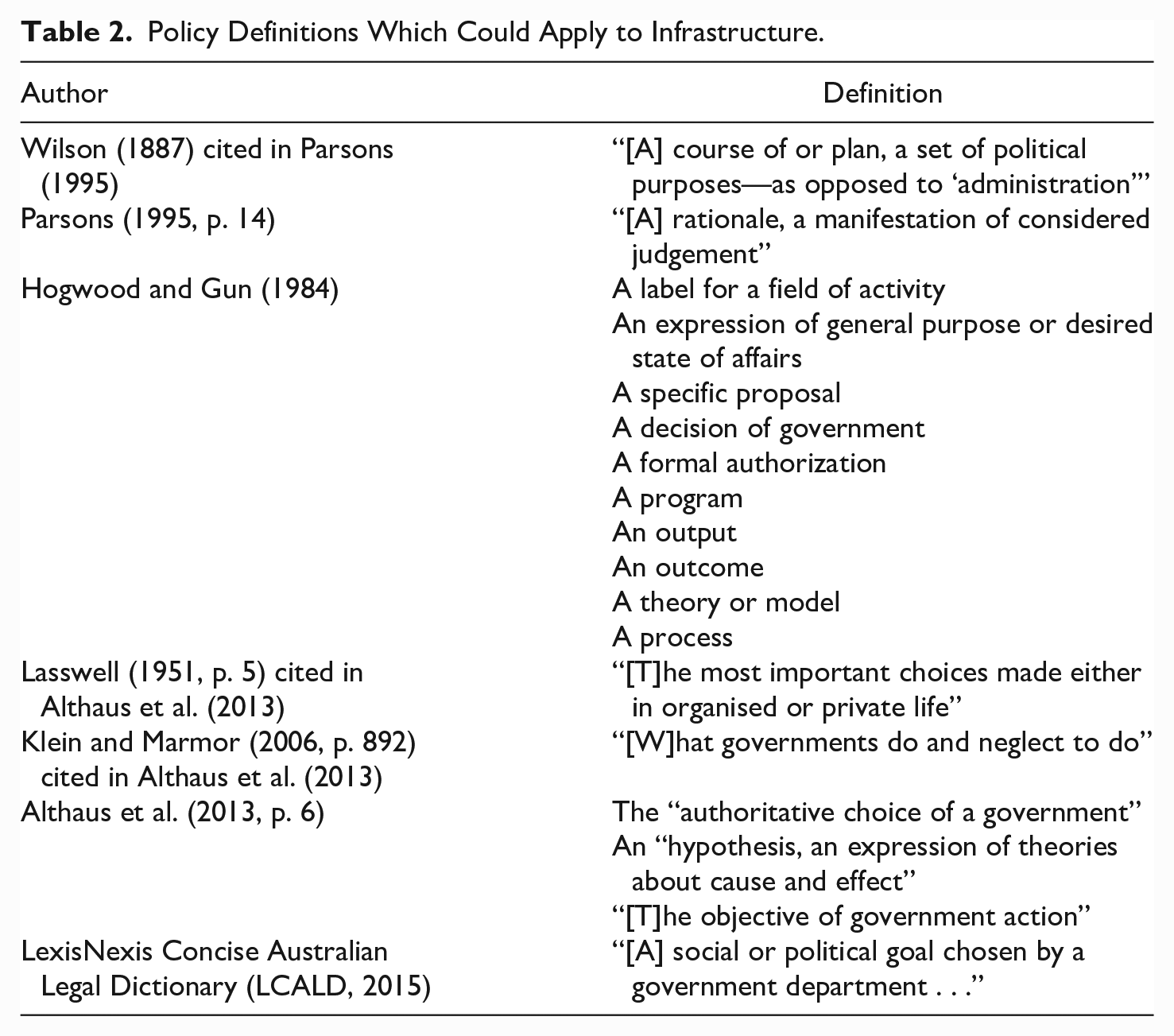
This brief table shows that infrastructure policy could potentially relate to a stunning range of possible government infrastructure activities, ideas, beliefs, purposes, decisions, plans, judgments, programs, and projects. It also illustrates the idea that policy may be as a result of either government overall, or else as a result of goals chosen by a government department.
Perhaps what we might conclude here, rather than fuel any further contestation, is simply that infrastructure policy relates to authoritative choices of government made in the context of their beliefs and their objectives (Althaus et al., 2013, p. 6). Having set the foundations, we can now proceed on our inquiry into P3 social infrastructure policy diffusion and learning. It is to this matter that we now turn.
Policy Diffusion and Theories of Policy Learning
How do organizations and policymakers learn from a previous policy and from policy implementation elsewhere? There is an extensive literature on policy diffusion, policy transfer, lesson drawing, and policy learning, as well as policy success and failure (Boven et al., 2001; Carroll & Common, 2013; Dobbin et al., 2007; Dolowitz & Marsh, 2000, 2012; Hogan & Howlett, 2015; Luetjens et al., 2019; Rose, 1993). In this section, we focus on the context of international policy diffusion and its relationship to policy learning. Through this, we aim to highlight a few useful theoretical themes to build an understanding of P3 infrastructure policy learning.
The inspiration for this article came from a paper by Dobbin et al. (2007), The Global Diffusion of Public Policies. Writing from the perspectives of sociology and international policy practice, they sought to understand the rapid and wide geographic spread of public policies across the globe. They reviewed contending theories of policy diffusion. Importantly, they differentiated between three ideas of how policies can be diffused across the world (social constructivism; coercion and competition), and the separate idea of diffusion through policy learning. They made several important observations relevant to our inquiry.
They first comment these four lenses on policy diffusion may each tell part of the diffusion story. They comment that sociologists have a tradition of viewing policy diffusion through the lens of social construction, saying that [T]he conventions of nation-states are socially generated, much like the conventions of families, social movements, or religions. Although policy makers see themselves as trying to divine best practices . . . they are seldom able to judge whether an innovation improves upon the status quo. Policy choices are based on fads, revered exemplars, or abstract theories, rather than solid evidence.
The perspective of social constructivism in Dobbin et al. (2007, p. 452) emphasized the important role of international agencies and the role of ideas in policy diffusion. They also attempted to discern how policies might become socially acceptable, and argued that countries mimic other countries who appear to be doing well (even copying them ritualistically “without fully understanding the roots of that success”). Unsurprisingly, too, they emphasized the crucial importance of global groups of professional experts as well as national expert groups in spreading policy ideas. Interestingly, however, their emphasis was on copying and mimicking here rather than necessarily having an evidence base. As Dobbin et al. (2007, p. 454) put it, the fundamental principle under the idea of social constructivism is that “[C]hanges in ideas drive policy diffusion.” . . . and that “policy makers copy the policies that they see experts promoting and leading countries embracing or policies that they see their peers embracing.”
Dobbin et al. (2007, p. 454) also pointed to the notions of both coercion and competition in driving policy diffusion. They saw prominent examples of policy coercion as including the “preferences of the U.S. government, the European Union (EU), the International Monetary Fund (IMF), and the World Bank [shaping] policy in countries reliant on [them] for trade, foreign direct investment, aid, grants, loans, or security.” Such coercion often involves a change in incentives to recipient nations. Whether coercion is achieved through aid or loan conditionality, by a powerful country influencing a weaker country through policy leadership, or through a dominant country pushing its own hegemonic ideas on others, it amounts to coercion. Theories based on economic competition, on the other hand, assume that “some policies diffuse when countries compete for capital and export markets” (Dobbin et al., 2007, p. 457).
The separate identification by Dobbin et al. (2007) of “policy learning” as a mode of policy diffusion was instructive. In their words, [L]earning occurs when new evidence changes our beliefs . . . Learning does not occur when policy makers simply adapt to the policy shifts of others, but only when their beliefs about cause and effect change. (Elkins & Simmons, 2005)
We may also learn at various levels ranging from simply how to better achieve particular goals through to which fundamental goals to pursue. Dobbin et al. sketched various approaches to policy learning. These covered the generation of societal knowledge, the process of cumulative additions to knowledge based on our experimentation (which they titled “Bayesian updating”), and how information having policy salience is then socially channeled through networks and institutions to become influential.
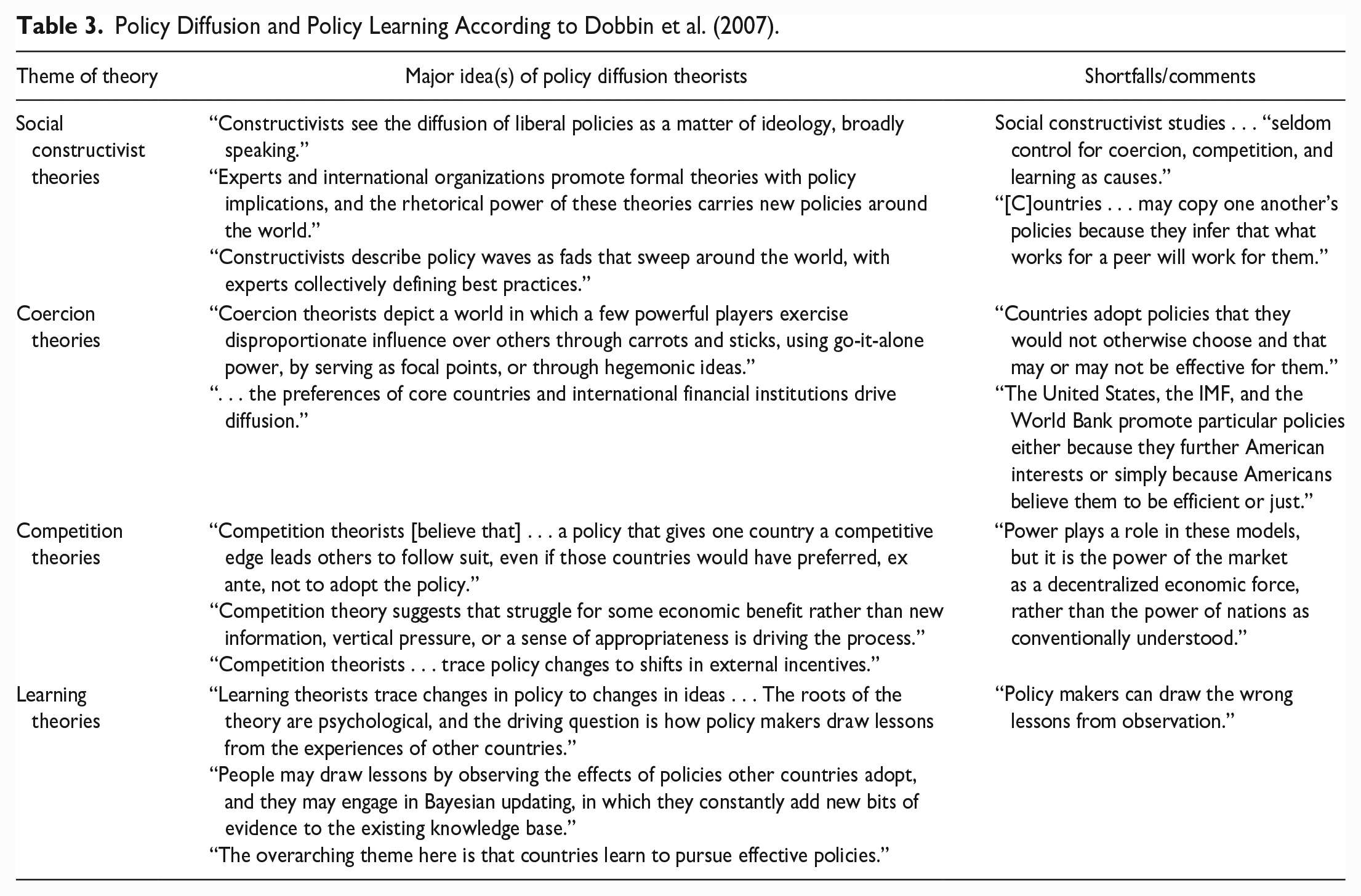
Overall, this seminal article by Dobbin et al. (2007), therefore, reminded us that sociologists, political scientists, and economists have all developed different explanations as to how policies might be diffused and how these activities could be related to policy learning. A summary of major themes they articulated from the literature is as shown in Table 3.
Policy Diffusion and Policy Learning According to Dobbin et al. (2007).
But so what? Where does all this leave us? How can these ideas be synthesized together to assist our task of investigating infrastructure policy learning for social P3s? There are clearly many aspects to how policies might be diffused across the world and policy learning is part of this terrain. Thus, as one anonymous referee reminded us, there needs to be an acknowledgment that there are multiple factors which can influence policy learning. 2 Synthesizing the policy learning domain and adding the context of social infrastructure P3s is an unenviable task.
Looking specifically at the P3 literature, there have been some contributions already made in terms of analyzing aspects of policy transfer for the case of P3s. Verhoest et al. (2015, p. 118), for example, analyze the diffusion of P3s for the case of European transport projects. They point out that “policies and institutions to promote the uptake of [P3s] have diffused across the world,” and that while the official rhetoric usually reflected internationally proclaimed doctrines, “national governments have responded very differently to the reform trend.”
On a far bigger geographic scale, Quiggin (2019, p. 845) analyzed the diffusion of neoliberal policies around the world and used P3s as his focal point for his analysis. He commented that P3s “have been a characteristic policy of neo-liberalism as implemented in the former British world system” and observed that “financial institutions and export agencies continue to promote the model to newly industrializing countries in the Asia Pacific region.” And on the scale of a single nation, Wibowo (2015) studied the diffusion of P3 ideas into Indonesia. He analyzed the influence of bodies such as the World Bank and international agencies as well as the channels through which P3 ideas were spread, the various motives for this policy transfer and the complexity of implementation issues.
If we focus now just on the theme of learning, we can view the process of learning as being part of the broader territory of policy diffusion (Dobbin et al., 2007). We also conceptualized the process of learning in terms of three approaches: 3 the technical approach, the coalitional approach, and the experimental approach. These are shown in Figure 1.
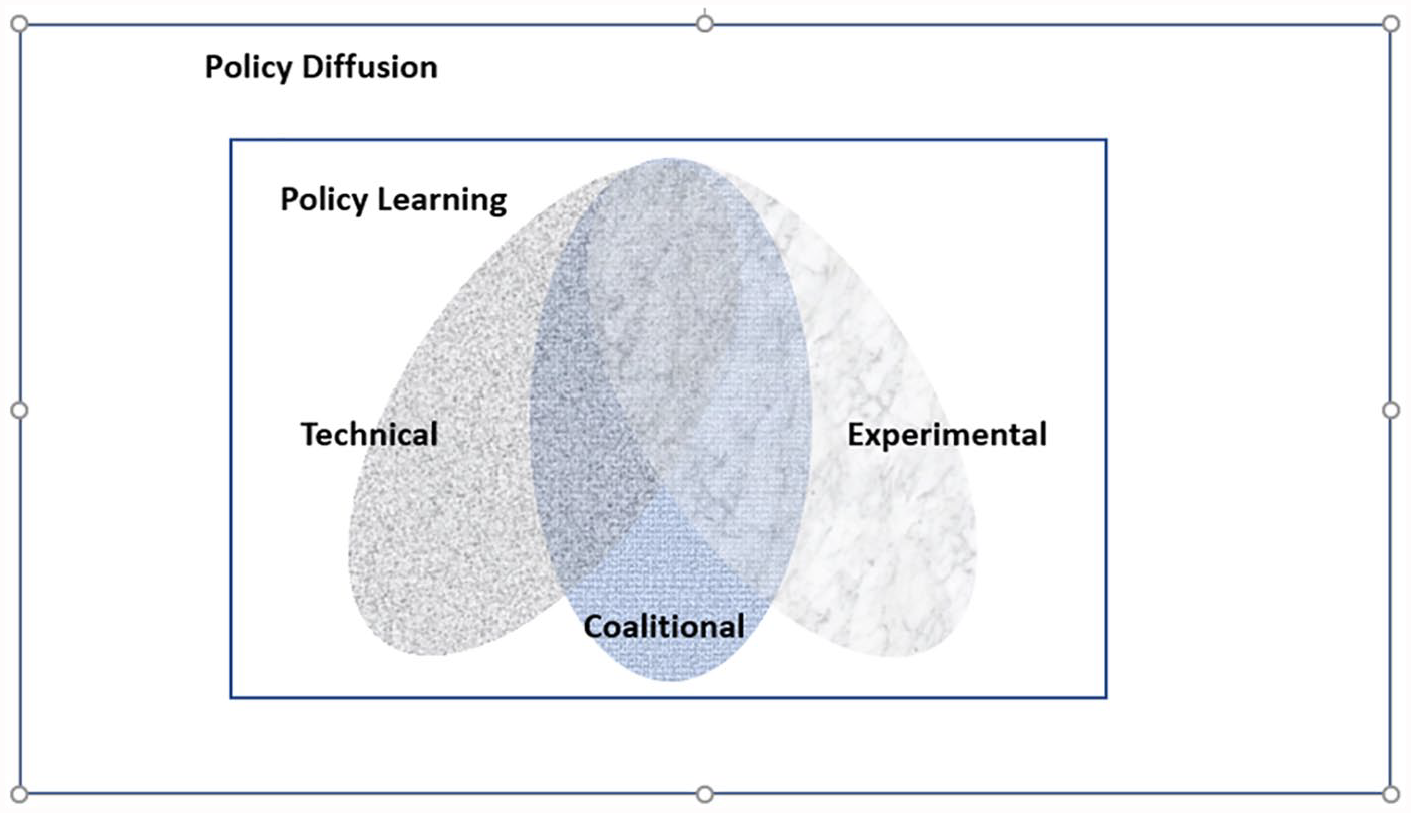
Policy learning themes.
This first perspective suggests that there is often focus on technical knowledge among elites “about what is effective” (Dobbin et al., 2007, p. 460). Social knowledge is generated, that is, “the sum of technical information and of theories about that information which commands sufficient consensus at a given time among interested actors to serve as a guide to public policy designed to achieve some social goal” (Haas, 1980; quoted in Dobbin et al., 2007, p. 460). Policy learning occurs within networks and international organizations (Dobbin et al., 2007; see also Sommerer & Tallberg, 2019). Rose (1993) adopted this technical knowledge perspective when he famously focused on “lesson drawing” across countries in public policy. He set out a whole approach to how governments could work systematically with drawing policy lessons from one setting to another.
A second perspective for understanding policy learning is the coalitional approach. An iconic representative of this approach has been the Advocacy Coalition Framework (ACF) in public policy studies. Indeed, the first book by the theory’s founders, Paul Sabatier and Hank Jenkins-Smith was titled “Policy Change and Learning: An Advocacy Coalition Framework” (Jenkins-Smith et al., 2014). Importantly, the ACF also recognized the primacy of technical information. Two hypotheses from the ACF stand out in the context of policy learning: One hypothesis focuses on prestigious learning forums where professionals from different coalitions participate, and which are dominated by professional norms. Another hypothesis explores the availability of quantitative data and explicit theories that might exist and suggests that these are conducive to policy learning (as opposed to more qualitative data). Like numerous theories of policy change, the ACF is founded on an understanding that policy reforms are inherently political (Radin, 2012).
A third way to look at policy learning is to acknowledge that policy learning is experimental. In this approach, “success stories” count as inspirations for others to learn from. Organizations learn from “failures” and make efforts to prevent future failures and turn attention toward a policy that might be less inclined to produce a failure. Therefore, for example, we might view policy learning where a P3 policy gets transferred from one context (e.g., in the United Kingdom or Australia) to other contexts (e.g., Canada and Europe, and later Asia). This approach focuses on a more scientific review of available hard evidence. An example of this approach is the review paper by Petersen (2019) in which he compared the cost, quality, and value for money for P3s.
These three tentative themes of policy learning emphasize different mechanisms. The technical approach emphasizes the views of elites and their knowledge and beliefs about what lessons can be learned from experience elsewhere, and from the theories and ideas with which they are familiar. The coalition approach emphasizes the power of the coalition including all parties inside as well as technical information and professional attitudes. The experimental approach emphasizes the hard evidence of success (or failure) above other attributes. Table 4 shows these three different learning approaches and indicates some of the major conceptual differences between each.
Characteristics of Three Learning Approaches.
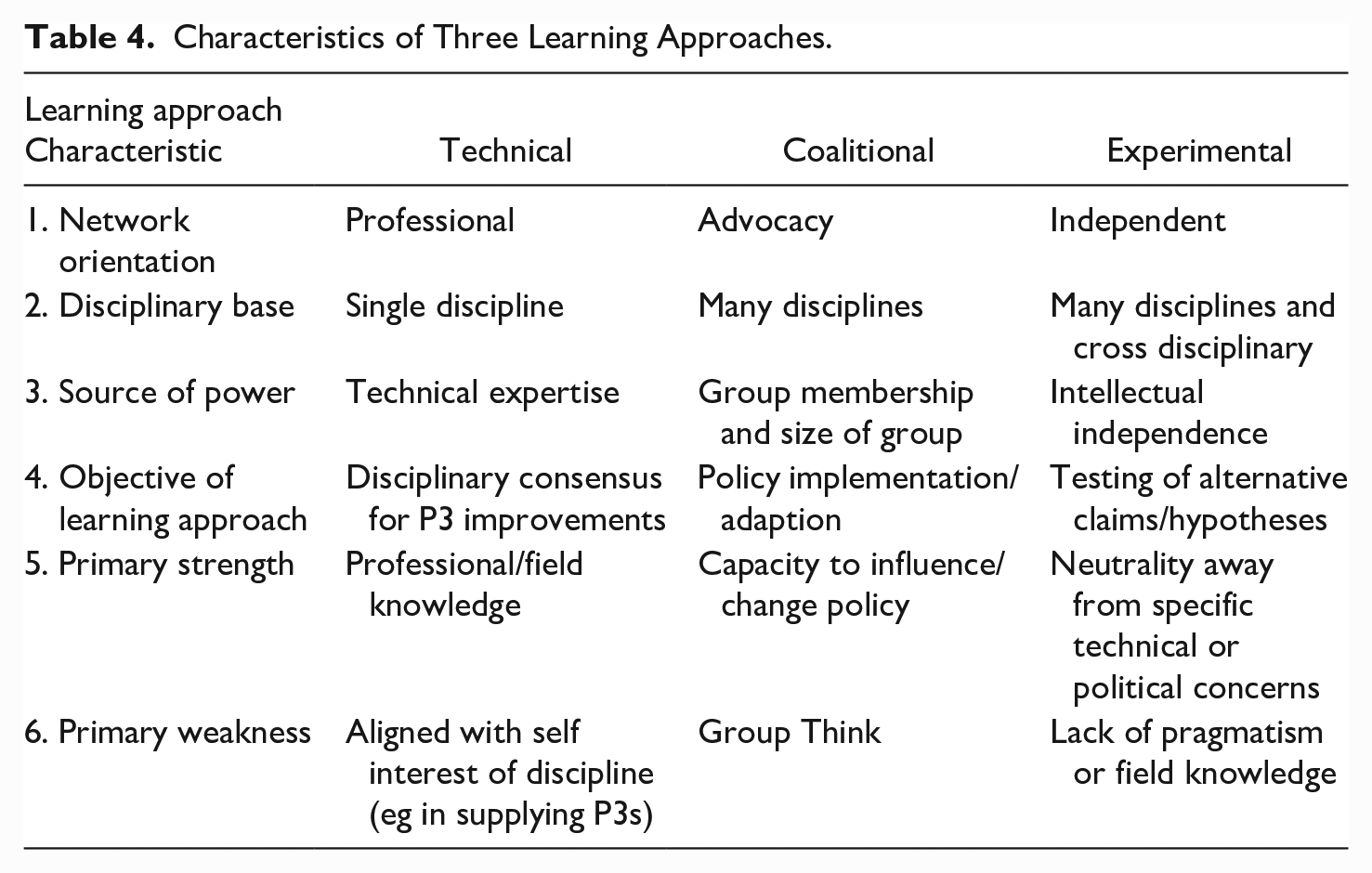
There is, however, a significant degree of overlap to these themes, and they are not mutually exclusive. The technical approach overlaps to some extent with the coalitional perspective, and the experimental approach is also dependent on the availability of technical information and on professional coalitions using that technical information to determine success or failure. There is also a clear and strong sociological undercurrent throughout as well, and all assume the existence of social networks. As Hall (1993, p. 280) stated, the underlying idea is that “[t]he process whereby one policy paradigm comes to replace another is likely to be more sociological than scientific” (cited in Dobbin et al., 2007, p. 461).
There is much that could be added to these policy learning perspectives. J. Campbell, personal communication (2019, 10 June) argues that the outcomes of learning are just as important as the process of learning, and may broadly include policy adoption, adaption, reversal, or denial. He reasons that the notion of learning might also be contrasted against the power struggles that occur between “various factions who like or don’t like what is being learned . . .,” the bureaucratic inertia which may lead to little policy change in reality, or the uncertainty that may occur because people “have insufficient information because the information they have is contradictory or inconclusive.”
What constitutes P3 infrastructure policy success is also relevant here. McConnell (2010) argues that understanding policy “success” requires us to acknowledge three different independent forms (or dimensions) of success: success through programs, through process, or through politics. There are ample possibilities to examine both success and failure of policies in general (Boven et al., 2001; Luetjens et al., 2019) as well as what constitutes success from the perspective of P3s (Hodge and Greve, 2016). The policy success review of Luetjens et al. (2019) added a fourth category to the three categories proposed by McConnell. The fourth category concerns temporal assessment and follows the earlier work of Pollitt (2008). The temporal assessment considers the policy’s performance over time and the legitimacy for the political system more broadly.
According to Laatsit (2019, p. 13), who reviewed the literature on policy learning for his study of European innovation policies, a distinction is often between the more formal forms of policy learning that takes place in officially mandated policy evaluations and reports, and the more informal and sometimes spontaneous policy learning that mainly takes place in social networks and policy networks. Although this distinction may be important, it is equally hard not to believe that some combination of formal and informal learning usually occurs in any situation (J. Campbell, personal communication, 2019).
There is clearly much to consider when contemplating policy learning. In the remainder of this article, we will adopt the diffusion ideas proposed by Dobbin et al. (2007) and discuss some examples using our three themes framework on policy learning. Our policy learning framework will, therefore, view policy learning for P3s as taking place:
Using technical information and quantitative data to build a consensus among interested elite actors to serve as a guide to public policy.
As a coalitional process where coalitions learn and build a case for their worldview.
As experimental where success and failures give guidance to the next steps.
Empirical Illustrations of Policy Learning for P3s
In theory, we ought to be able to analyze social infrastructure P3 policy through the eyes of the three policy elements defined by Althaus et al. (2013): authoritative choices of government, cause and effect hypotheses held, and government’s underlying objectives. For these policy alternatives, we could view policy learning in terms of the technical approach, the coalitional approach, and the experimental approach. Of course, this assumes a far wider literature on infrastructure diffusion and learning than currently exists, as well as a more detailed information base on this phenomenon. We will not attempt this task and will simply make some tentative observations using these concepts. To achieve this, we will now point to a few empirical illustrations in a number of experienced P3 countries and international organizations.
The United Kingdom seems to be going through a formal learning process using technical information. The United Kingdom was the pioneer of the P3 model with its PFI (Private Finance Initiative) version in the early 1990s. The United Kingdom learned continuously as the P3 policy developed in that country. There were several Treasury reports on P3 that updated the framework and worked recent experiences into the policy model. PF2 (Private Finance 2) in 2012 was presented as a more thorough revision of the model, but as later studies have shown, there was not much substantial difference between PFI and PF2 (National Audit Office [NAO], 2018). At the same time, the P3 model was followed closely by the NAO in numerous reports. The NAO was constantly auditing and questioning Her Majesty Treasury’s approach to P3 (NAO, 2018). There is an active academic research community that provided ongoing social science research on P3s. There was also an ongoing media interest in P3 to keep the public debate about P3 alive. In many ways, the United Kingdom was engaged in a decades-long learning process about how best to involve private finance (or not) in the provision of public infrastructure. The result of the learning process so far is itself also interesting. The United Kingdom ended up abandoning or disavowing its earlier policy when it gave up on the terms PFI and PF2 in 2018 (Department for Transport and Infrastructure and Projects Authority, 2018). Although it may be questionable if the practice of procuring infrastructure has changed much in reality, the vocabulary certainly has. The current terms used are “national infrastructure plan,” and the terminology of P3 itself has disappeared from the government’s policy. From a learning perspective, this could be a case of where the government and others involved in the P3 policy have all considered the technical (and political) information collected over the years, analyzed it, and reached the conclusion that the government’s policy on P3 has exhausted its usefulness. In April 2019, the Department for Transport and Infrastructure and Projects Authority (2019) in the United Kingdom issued a report with 24 lessons learned from major infrastructure projects. They were presented in the following categories: “accountability must be unambiguous, behavior matters more than process, control schedule and benefits as well as costs, deal with systems integration, and enter service cautiously.” Although done on the background of the megaproject Crossrail, the report nevertheless bears witness to a prioritization of policy learning and its adoption of markedly different language and conceptual frames stands in contrast to earlier times.
Canada, among the early adopters of the P3 model, is also an interesting case. Canada engaged in P3 policy from the early 2000s and quickly set out to produce technical information about P3 progress. There were provinces where the P3 model got a hold, including British Columbia, Ontario, and Quebec. Canada also had a national P3 unit until 2017 when the federal government in Canada decided to close it down. The work on infrastructure governance was continued in the Infrastructure Canada agency (Infrastructure Canada, 2017). Canada’s explicit rationale for this institutional change was that the mission of the federal P3 unit had been accomplished, but also recognizing the most of the P3 projects occur in the provinces.
P3 policy was initially introduced into Australia with the objective of reducing the frequency of legal disputes occurring with infrastructure delivery (Hodge & Duffield, 2010, p. 402). The Australian experience with P3s have long been prominent internationally and the policy guidance documentation developed in states such as Victoria, for example, has spread widely. The diversity of a federal system of governing has itself provided fertile ground for policy learning between states.
Attitudes to competition (compared with negotiation) and contract renegotiation (as compared with the sophisticated “perfect” contract) have also changed. Today, Australian states such as Victoria welcome unsolicited private bids which are negotiated as distinct from competitive auctions. A greater willingness to openly experiment with infrastructure provision arrangements has also been demonstrated in states such as New South Wales.
International organizations might regard their task as processing and disseminating lessons from earlier policy experiences (Dobbin et al., 2007). The European Court of Auditors (2018) has drawn some skeptical conclusions recently after examining the P3 model. The Organization for Economic Cooperation and Development (OECD) has gone through a kind of a learning process in its dealings with P3s.
But international organizations are also coalitional entities where struggles over policy occur. The OECD began its work on P3s with the establishment of the meetings of the Network for Senior Budget and P3 Officials. The network first produced a report on the standard issues of a P3. The first report was entitled “PPPs: In Search of Risk Sharing and Value for Money.” These were the two key items in the initial P3 debate. Risk sharing (or more accurately, explicit risk bearing) is of course a crucial part of the P3 debate. The Organization for Economic Co-operation and Development (OECD, 2010) examined the institutional framework and made a report on “Dedicated PPP Units.” One of the recommendations was that each country should have a P3 unit for P3s to get going. OECD (2012) came up with the Recommendations for Public Governance of P3s. In the mid-2010s OECD used their own framework to review the P3 policy of several nations, including the United Kingdom and Russia. These were thorough reviews that examined the P3 policy of those nations very carefully and made assessments of whether the P3 policy was sound. In the course of the late 2010s, OECD had gathered much information about P3s. There was a group within the International Transport Forum working on private finance and transport infrastructure, but with a wider brief than just looking at P3s. As a result, International Transport Forum (2018) compared the P3 model with the regulated asset-based model of providing public infrastructure.
The emerging availability and acknowledgment that P3s were not the only show in town anymore led the OECD to produce a new report in 2017, “The Governance of Infrastructure” (OECD, 2017b) as well as an accompanying policy recommendation paper entitled “Getting Infrastructure Right” (OECD, 2017a). In this report, the OECD focused on infrastructure governance as the main concept while the “delivery models” of P3, State Owned Enterprises, and Regulated Asset Base were listed on an equal basis. Indeed, in the final version of the report, the focus on the “delivery models” was placed in an appendix and did not even feature in the main parts of the report.
In 2014, the G20 Global Infrastructure Hub was established. The Global Infrastructure Hub provides a sort of clearing house for information on infrastructure governance, and this center could, therefore, be regarded as policy learning through the technical elite. But it is also a coalition of the G20 countries advocating their approach. The Global Infrastructure Hub employs a number of industry experts in their office in Sydney, Australia. In a parallel vein, the World Bank together with many other international organizations established the PPP Knowledge Lab in 2015. And like the Sydney Global Information Hub, this center, while focused on P3s, is also considering infrastructure projects more broadly.
Implications and Propositions
In this section, we posit some tentative propositions which might result from our analysis so far of social P3 infrastructure policy learning. They are by their nature exploratory rather than any sort of empirical proof as one might expect from comprehensive case studies. We have six propositions to put forward.
First, there has been some limited P3 infrastructure policy diffusion research to date, but far less P3 infrastructure policy learning research. Even less research has been undertaken on the specific matter of social P3 infrastructure policy learning. This implies, as our first proposition, that
Second, much of the broader P3 policy diffusion activity that has occurred to date has related to the language game of P3s rather than the matter of sophisticated infrastructure delivery techniques or reform. In other words, while there has been much diffusion of the partnership language, less diffusion has occurred pertaining to the underlying infrastructure delivery techniques, financial disciplines sought, and contractual rigors employed. The second proposition is therefore that
Third, much of the P3 policy diffusion to date has related to policy competition (e.g., for foreign direct investment) and policy coercion (from, for example, international actors) rather than genuine policy learning. The third proposition is therefore that
Fourth, the context in which P3 diffusion and learning has occurred has remained central. Stone (2004) has long argued that non-state actors (such as international consultants and bankers) can be as important as the state and other international actors when policies are transferred. Holden (2009) warned a decade ago the if the British P3 drive to export its PFI expertise in health infrastructure was successful, it would “become a mechanism for policy transfer, but one based primarily on what was good for British firms rather than what is good for the health of developing country citizens” (p. 329). His contrast with genuine policy learning was stark, when he warned that [T]here is therefore no attempt at “lesson-drawing,” just an attempt to “sell” the policy itself in order to literally sell specific services. This strategy is thus intentional and rational, but in the service of particular commercial interests rather than in the pursuit of better policy.
Our fourth proposition is therefore that
Fifth, policy learning will no doubt have occurred across the range of P3 goals. Given the dozens of explicit, implicit, technical, and political goals sought by governments pursuing P3s (Hodge & Greve, 2016), there is likely to be a wider range of both technical and political dimensions to this learning that is often acknowledged in the public works literature. Our fifth proposition is therefore that
Conclusion
What can a focus on social infrastructure learn from the existing approaches to infrastructure public–private partnerships? In this article, we first clarified what is meant by “social infrastructure” and “infrastructure policy.” We then focused on the distinctions between policy diffusion through social construction, through competition, through coercion, and through policy learning, using insights from an article by Dobbin et al. (2007). This enabled us to concentrate more fully on policy learning. We argued that there were three separate forms of policy learning: technical, coalitional, and experimental. We then briefly illustrated these forms of policy learning with examples from leading P3 countries and international organizations working with P3 policy. On this basis, we ended by suggesting five propositions on how to conduct research going forward on policy learning for social infrastructure.
Footnotes
Declaration of Conflicting Interests
The author(s) declared no potential conflicts of interest with respect to the research, authorship, and/or publication of this article.
Funding
The author(s) received no financial support for the research, authorship, and/or publication of this article.
