



Abstract
The US Department of Defense (DoD) makes extensive use of the US multimodal transportation network to move material for operational support, keep facilities supplied, and move personnel. Federal agencies, especially the US Department of Transportation, work closely with the DoD. States and localities also play a critical role in defense infrastructure. This research examines state freight and defense community plans to identify how the transportation needs of the DoD are being addressed in state planning. The findings are 72% of the 50 state freight plans mention defense transportation, while 34% considered defense transportation needs in-depth. About 6 of 19 identified state defense community plans mention transportation, but only 3 have specific defense transportation goals. Nationally, the DoD and federal agencies work closely together to maintain the nation’s defense transportation network, but at the local and state level closer cooperation on transportation issues should be developed. Military readiness remains high, but efficiencies in the system can be improved.
Introduction
The US Military is a major user of the US domestic transportation system. The US Interstate System is officially named the “National System of Interstate and Defense Highways.” Road, rail, air, water, and pipelines are all important for the movement of defense assets. The Department of Defense (DoD) manages over 27 million acres and 4,300 facilities in all 50 states and US territories which all need to move freight (Collins & Hampton, 2012). For example, an armored brigade deploying overseas from Fort Carson, Colorado used 823 railcars to move over 1,000 miles the unit’s 2,000 wheeled and tracked vehicles and 95 truckloads of equipment to the strategic port of Corpus Christi, Texas (Prater, 2019). The U.S. Transportation Command (USTRANSCOM), through the Defense Transportation System (DTS), spends over $5 billion annually moving units, people, equipment, and households for the DoD (Connor et al., 2019). The freight transportation network is crucial for national defense.
The DoD recognizes the importance of the transportation system. The 2018 National Defense Strategy (NDS) calls for “resilient and agile logistics . . . to ensure logistics sustainment while under persistent multi-domain attack” (United States Office of the Secretary of Defense, 2018, p.7). In order to do this, the US needs to win the “home game” by having military/government/industry partnerships and infrastructure which provides preparation areas and launching pads (Wissler, 2018). Prior National Security Strategies had already embedded a whole-of-government approach emphasizing interagency planning for national security and defense transportation. The military acknowledges that greater reliance on civilian transportation assets creates challenges and requires greater planning (Brown et al., 2000).
As such, DoD, through its various logistical groups, supports the movement of personnel and materials to and from domestic and overseas deployments, requiring managing transportation at a local, state, regional, national, and international level. This degree of coordination requires the DoD to work with many different agencies to ensure transportation satisfies these diverse operational goals. As such, military transportation requires a mix of long-term planning for roadways, shorter term planning to improve intersections, congestion etc., as well as operational needs to manage oversized/over dimensional loads, hazardous materials, and time sensitive deployments.
Partnerships for Defense Transportation
The successful military usage of the civilian transportation system depends on a rubric of public-public and public-private partnerships (P4). The P4 arrangements with the DoD, in various forms, is a means for communication, action, and cooperation (Meurer et al., 2016). The military needs to rely on the national, state, and local transportation agencies. It also needs to work with the private sector such as the railroads, airlines, and shipping lines. Functioning effectively in this P4 environment requires planning.
At the local level, the RAND Corporation, identified three areas of transportation public-public partnerships between installations and their host community (Lachman et al., 2016). These include transit, access roads, and airports/railroads. For passenger transit, bases often have arrangements for bus, vanpool, or commuter rail for personnel living off base. Regarding roads and traffic, state and localities jointly fund and maintain connector roads to the bases. Base airports and rail facilities sometimes have joint use agreements. There are diverse authorities and approaches used for these installation-community partnerships with a wide range of benefits.
How Engagement Occurs
Engagement with the military is a mix of many different actors, ranging from strategic commands at a theater level to local operations. In this mix, there are many levels of coordination, which range from the immediate operational focus on moving personnel and material today to the longer-term deployment/remobilization factors related to various missions, including for humanitarian needs. So, there exists a matrix of different needs, ranging from the immediate to the longer term strategic. As we examine military transportation needs from the strategic national to the local tactical system, the responsibilities of moving for military mobility becomes more fragmented.
Federal Coordination
At the federal level, the US Department of Transportation (DOT) and the DoD have extensive interagency relationships (Mars, 2015). The Maritime Security Program (MSP), the Civil Reserve Air Fleet (CRAF), the Strategic Rail Corridor Network (STRACNET), and the Strategic Highway Network (STRAHNET) are the four primary means enabling the DoD to have adequate sealift, airlift, and domestic land transit capacity. Further, the US DOT’s Maritime Administration (MARAD) has designated 23 “strategic ports” including 18 commercial ports for deploying military units. This defense/government relationship may appear to be not as formalized at the state and local transportation level so openness for joint planning becomes essential. Following are two examples of federal coordination of infrastructure which influences public and private sector infrastructure decisions.
STRACNET is a rail network consisting of over 36,000 miles of track serving over 120 defense installations whose mission requires rail service (Transportation Engineering Agency, 2019). The Military Surface Deployment and Distribution Command’s Transportation Engineering Agency (SDDCTEA) works with State DOTs, the Surface Transportation Board (STB), the US Federal Railroad Administration (FRA), the Association of American Railroads (AAR), the American Railway Engineering and Maintenance of Way Association (AREMA), and individual private railroad companies to maintain and protect the rail infrastructure. Alford and Ditmeyer (2007) report the DoD and DOT are working on developing a net-centric approach to STRACNET rail operations. A 2018 evaluation of the strategic rail network found the system met defense readiness requirements for maintenance condition, clearance, and gross weight capability (Military Surface Deployment and Distribution Command, 2018).
The highway equivalent of STRACNET is STRAHNET. It is a 62,000-mile system of roads designated as necessary for movement of heavy equipment, fuel, ammunition, parts, food, and other commodities to support U.S. military operations. It connects over 200 important military bases and strategic ports. About 75% of the system is interstate highways. The system is designated by the Federal Highway Administration (FHWA) in partnership with SDDCTEA. The designation of a connector route for a military base access/egress allows individual state DOTs to fund improvements and upgrades (Cowin & Briggs, 2013). When compared with the National Highway System, the overall STRAHNET system has maintained pavement and bridges at a higher level of ride acceptability (Federal Highway Administration, 2019).
State Level Coordination
There are some multi-state defense transportation planning efforts. The Interstate I-14 “Forts to Ports” connecting military bases and strategic ports in Texas, Louisiana, and Mississippi is an example. Whether regional defense transportation planning like this by Gulf Coast Strategic Highway Coalition will be a trend is uncertain.
States work with military bases and fund defense transportation infrastructure. Following the closing of numerous of bases in 2005, there has been an increase in state willingness to invest in off and on base infrastructure improvements. The bases can be their own National Guard facilities or federal bases. For example, Florida has the Defense Infrastructure Grant Program which funds local infrastructure projects that benefit both the community and military installation. In 2019, Clay County Development Authority received $367,000 from this fund to resurface roads around Camp Blanding. Colorado recently announced a new initiative to improve safe and efficient access along several key highways and roads that are vital to providing strategic connectivity for military bases. States DOTs do work with their military on many aspects of transportation.
Almost half the states (45%) have military affairs organizations (Association of Defense Communities, 2017). State military affairs organizations are generally part of state governments housed in the governor’s office, part of a state agency, or an independent office. They typically operate with one or two staff and an advisory board. The primary focus is supporting military families and veterans, encroachment, and joint-land use. The offices are concerned with community-military partnering, but not specifically transportation. They are the state organizations who typically utilize the state defense community plans reviewed in this study.
At the federal level, the military/government connections seem to be effective in governing the transportation networks, nonetheless the Government Accountability Office (GAO, 2011) has identified some areas for improvement. The connections are less clear at the state and local levels. According to a Transportation Research Board report, DoD policy is that state and localities are responsible for off base infrastructure, but prescribed planning process timelines are not adequate (Committee for a Study on Federal Funding of Transportation Improvements in Base Realignment and Closure Cases, 2011). The FHWA developed a guide to help state’s coordinate with military for deployments (Keever & Soutuyo, 2005). Belfield (2013) found there is often disconnect at the local (e.g., metropolitan) level. An exception being the Hampton Roads (Virginia) Transportation Planning Organization (HRTPO), which has long-standing relationship with the military community and integrated them into the transportation planning process (Belfield, 2018). Local traffic congestion and delays were the major transportation concerns of the military in Virginia. This research begins to explore the connection between military and state transportation planning which Belfield (2013) examined at the local level.
Scholarly Research on Domestic Government/Military Transportation Planning
Most of the research on joint military/government transportation planning efforts comes from technical reports and defense trade journals. There is a body of research on land use planning with the military cf. Clanahan (2021), but little peer-reviewed transportation specific research was found through web searches and the Transportation Research Board’s Transport Research International Documentation (TRID) database. This does not mean joint transportation planning is not happening but might not be publicly documented.
The uncovered scholarly research related to state DOTs and military planning mostly involves modeling approaches and data for modeling. McKinzie and Barnes (2004) conduct an overview of military mobility modeling. Craig and Walton (2002) develop a GIS model to identify strategic military freight corridors. Pandit et al. (2019) look at coupling data sets. Autonomous vehicles, cyber security, and physical security are heavily researched areas involving DOTs and the military but are not specific to the planning connection of the military and states.
Methodology
This research uses content analysis of state freight plans and state defense community plans to identify and compare how military transportation needs are incorporated into the plans. The plans were reviewed in detail and key word searches utilized by a research assistant with a sampling review by the authors. For the state freight plans a keyword search of the terms including military, veteran, and defense was utilized as well as the acronyms STRAHNET and STRACNET. To distinguish between in-depth discussions of the military and just “mentions,” if the discussion spanned more than one paragraph or section, or if there was a whole section dedicated to the military, the plan was coded as in-depth. Key themes were identified and summarized.
Every state has a freight movement plan (Kale, 2003). The Fixing America’s Surface Transportation (FAST) Act requires each State which receives funding under the National Highway Freight Program to develop a State Freight Plan to provide for immediate and long-range planning. Large transportation consulting firms often assist with the planning and some firms support freight plans in multiple states. The Moving Ahead for Progress in the 21st Century Act (MAP-21) enabled states to develop freight advisory committees (FAC) for the planning. The military can be part of the “freight community” which provides input to the planning process.
The freight plans were evaluated based on the published state freight plans listed on the FHWA website (Federal Highway Administration, 2018). This analysis does not consider, however, any supplemental reports published by various states DOTs not on the FHWA website. If a state mentioned military connectivity to state freight and highway systems in additional reports not published by their DOT on the FHWA website, they were not evaluated. Defining what to consider as the freight plan document for analysis was more challenging than expected.
Most states do planning for the military presence in the state. An Association of Defense Communities Annual Survey found 74% of the states have conducted strategic studies identifying the strengths, weaknesses, opportunities for growth and potential threats to military installations (Association of Defense Communities, 2017). Not all the strategic studies could be found so states not mentioned below were excluded from the analysis. Nineteen states were found to have developed comprehensive plans of how to connect with and support the missions of the military bases in their states. Most of the studies were driven by Base Realignment and Closure (BRAC) concerns. The plans for these states which includes Alabama, Alaska, Arizona, Arkansas, California, Colorado, Connecticut, Florida, Georgia, Idaho, Indiana, Kentucky, Mississippi, Pennsylvania, South Carolina, Texas, Virginia, Utah, and Washington were analyzed. These states represent roughly 60% of the military workforce (Governing, 2019).
Findings
State Freight Plans
About 36 out of 50 state freight plans listed on the FHWA website mention military or defense issues in their freight plans. Seventeen significantly highlight military importance or have a larger mention of the military in their freight plan. The significant consideration of the military is not associated with defense spending share of state GDP or defense personnel (Office of Economic Adjustment, 2019) or a specific consultant (see Table 1). From those plans with a larger military section, most highlight the defense/military installations, supply chain activity and/or the importance of them in their state’s freight activity. Many do this by having a military section and add facts about their military assets and the economic impact to the state. The military was occasionally listed as an important stakeholder in the planning process. Veteran employment opportunities in transportation were mentioned in a few plans. Sometimes the plans list the military installations and infrastructure under “Safety and Security” goals. The states which mention military in their freight plans account for 52% of domestic military jobs.
State Freight Plans with a Significant Consideration for Defense Transportation.
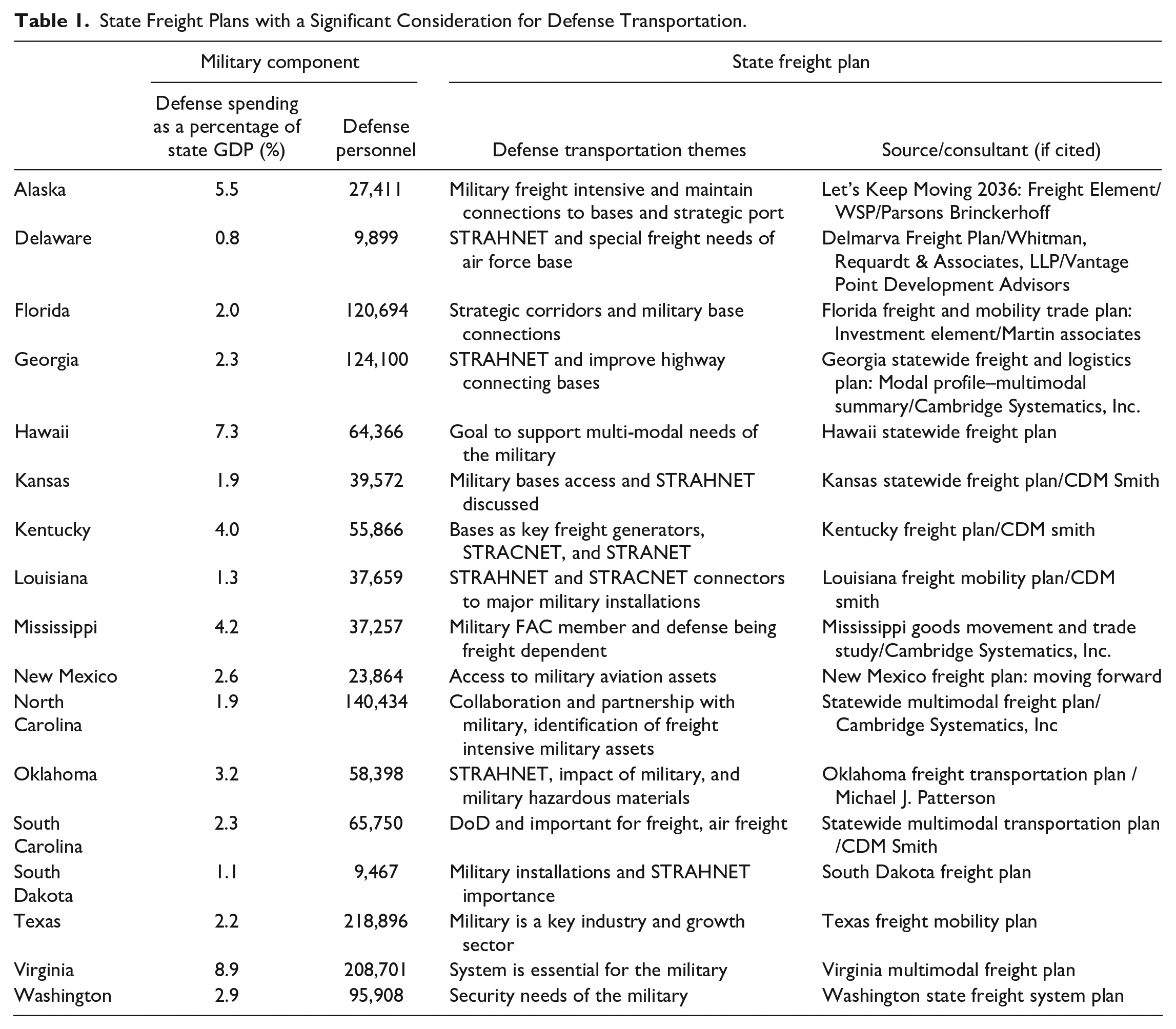
The STRAHNET and STRACNET were mentioned in 22% of the plans. Some listed this as a possible source of federal funding while others just defined it in their plan. A priority of military and defense related infrastructure was seen in evaluation scoring for the funding of future projects of some plans. Other themes that were seen in the plans related to the military include rural freight corridors, aerospace, and inter-agency coordination.
States do connect their military bases to the highway network and most fund military base related infrastructure such as access roads, but this was not always included in the freight plans. An example of a state plan which includes base access is Louisiana designating $30 m to reconstruct two lanes with full shoulders to a training area at Fort Polk. Some freight plans include military bases in maps of highway/rail systems and mention access. According to the Association of Defense Communities (2017), 52% of the states provide funding for on-base infrastructure and 61% fund off-base infrastructure. Programs such as the Defense Access Roads (DAR) program allow the DoD to provide some funding support to upgrade access roads and this is considered in some freight plan funding. The Kansas plan, as an example of how base access is presented, states “The U.S. military has a significant presence in Kansas. Military installations require efficient and reliable access to the freight transportation system for national defense purposes” in the Military Institutions section of the Condition and Performance of the State’s Freight System chapter (CDM Smith, 2017. p 34). The military was not listed on the Kansas freight advisory council.
North Carolina is an example of a state with a significant military presence which connected extensively with the military in its planning process. Defense was identified as a key freight intensive industry. The state conducted stakeholder interviews of military bases, utilized military shipment data, and had a section devoted to the military supply chain. The result was one of their key strategies, “Maintain safe, reliable connections to ports, rail terminals, air cargo facilities, military bases, and major logistics and manufacturing sites (Cambridge Systematics, 2017. p 88).
Washington is an example of a freight plan which emphasized the security needs of the military. The plan highlights a joint mobility exercise and border security. Coordination with the Washington Military Department is emphasized. The strategic objective is “The freight system must meet security and defense priorities” (Washington State Department of Transportation, 2017. p 72). The plan focused on both the military and defense contractor sectors as freight generators and important for the economy.
State Defense Community Plans
Many defense economy plans analyzed do not include transportation goals in their state military affairs initiatives. Most plans mentioned growing job opportunities for veterans and military families, which implies personal mobility, and not the movement of materials. Improving QOL for the military and their dependents is a universal theme. Of the 19 defense plans, 3 of them highlighted defense freight transport as a driver of job creation. Some plans mention base access roads, funding infrastructure sources, logistics, collaboration between agencies, and working with the DoD Office of Economic Adjustment (OEA), which helps fund some of the plans. The OEA mission is to adapt to DoD program changes, expansions and cutbacks, as well as incompatibilities between military operations and local development. OEA funded joint land and air use studies can have transportation implications.
The most extensive and recent examples of transportation, logistics, and infrastructure in a defense state plan can be seen in Growing the Military Mission in the Commonwealth of Virginia: 2019 Strategic Plan (Hopkins, 2019). In Pennsylvania’s strategic plan Appendix E—State Logistics Initiatives looks at South Carolina, Georgia, Virginia, New Jersey, Washington, and Mississippi state transportation initiatives (Deitrich et al., 2018). Other examples of state defense plans which mention transportation are Texas, South Carolina, and Washington. Most of the plans are seeking to avoid BRAC and attract more defense mission spending.
Virginia’s plan calls for a forward-leaning approach to continue to grow the military mission in Virginia. Identifying the emphasis on resilient and agile logistics in the NDS, the state proposes to enhance its defense transportation research and development as well as increase funding for defense access roads. The specific goal targets defense access roads funds with risk of storm damage.
Mississippi seeks to protect and grow the military presence but also emphasizes defense and national security assets as economic drivers for the state. Goal Four of the plan is to “leverage interconnected networks of physical infrastructure and defense assets to aid in lowering defense costs and enhancing the lethality of the warfighter” (Michel et al., 2019. p 11). Specific objectives include making greater use of the state’s new strategic port, promoting the state’s transportation advantages to the DoD, and incorporating defense needs more in the state’s modal freight plans. Like Virginia, the NDS call for resilient and agile logistics is a justification for transportation investment.
Discussion
Despite the importance of the military in states’ multi-modal network, defense transportation needs are not extensively included and addressed. Except in a few cases issues with equipment mobilization, demobilization, hazardous materials, etc. are not considered in the plans. Most state plans mention the military, but except in a few cases it is unclear how much the needs of the military as freight stakeholders are being considered. There could be several reasons the military freight transportation was not more prevalent in the state freight and community plans.
Many of the military base transportation planning issues are at the local level and deal with traffic rather than freight access. For example, Okaloosa County, the City of Crestview and the State of Florida developed a plan with Eglin Airforce Base and Hurlburt Field to address traffic congestions issues which were impacting military mission readiness. This joint planning was supported by the Tri-County Community Partnership Initiative which is a National Defense Authorization Act (NDAA) Section 331 Community Partnership Program. The NDAA provides a framework for military, civic, and business leaders to collaborate.
Certain consultants may have a greater military awareness. Cambridge Systemics and CDM Smith are listed on many of these projects. This is not to compare firms, but to illustrate how different states and firms may prioritize the freight needs in a different manner. This also reflects the guidance for state freight plans where military shipments are not included among the criteria, thus not penalizing any plan that excludes military shipments.
This analysis was based on secondary data. Perhaps the military was more involved with freight planning than was evident from the written plans. Also, state plans have multiple parts and pieces. Defense needs could have been considered in parts of the plans which were not uncovered through web searches. It could be the methodological approach does not capture the full military involvement.
Defense is a national issue which involves the whole US transportation system. The close connections at the federal level could make state involvement less important for defense freight issues as well as the different coordination efforts with various state and local agencies. Improving the freight network for everyone helps the military so defense needs are being meet by considering them as a general freight stakeholder.
Military bases can be challenging to work with on long range issues such as freight infrastructure. Base commanders need to focus on their immediate warfighter mission. They are only in command a few years and rarely are transportation experts. Long term institutional relationships needed for freight planning are not often in place or may be conceived as a private sector responsibility through various FAC or associational groups.
Military Disclosure and Transportation
In a civilian led system, military operations are accountable to public decision markers. As such, military disclosures concern operational and strategic goals can be expressed publicly, but there are limits as to how far that disclosure should be released by other agencies. In all cases, the military is not engaging in a dramatic rebuilding of military installations in the US, but mobility remains a critical question in the military’s ability to meet critical missions. Given concerns over security, there are limits as to what should be discussed and shared between various agencies themselves and shared by those same agencies to the general public.
Conclusions
Solving issues pertaining to defense transportation needs is critical to the military’s success so it is important they are integrated into the freight planning process. Belfield (2013) notes “a partnership between the military and transportation stakeholders takes time to develop and strengthen” (p. 144). Cloutier (2020) refers to these as “structured partnerships.” The challenge is to establish the long-term institutional connections.
Continual connections between the military and community take a P4 approach with some form of organizational structure. There needs to be institutions for collaborations which allow the military commanders to make the community aware of their transportation issues and jointly plan on how to alleviate transportation problems when they arise. Many defense communities already have collaborative organizations established which focus on joint space use, and military and dependent life issues. Their role can be expanded to consider military freight issues. The Association of Defense Communities promotes community-military partnerships and identifies best practices. The DoD has several programs and initiatives to support such efforts. There are resources and models to help defense communities establish partnerships for improved defense transportation.
At the state level, the state military affairs organizations could serve as the champion and institution for collaboration which brings together the DOTs and the military bases. They are generally engaged with the base commanders on QOL issues so freight needs would be a relatively easy extension. The new NDS makes clear resilient and agile logistics will be a factor with the next BRAC, so state military affairs organizations have a vested interest to ensure defense freight moves safely and efficiently.
As discussed, the fragmented policy is driven by local needs at one level pushed up the system, while being driven by national needs pushing down to ensure the system is effective. As such, there remains an institutional challenge concerning how to balance the needs to identify those systems where military cargos are dependent, but to do so in a manner that does not violate national security objectives.
Future Research
This is a preliminary exploratory study of joint military and state planning for transportation. It is based on secondary data. Future research should collect primary data from the state freight planners to get their perspective on how the military is and should be involved with state transportation planning. Best practices of state level joint transportation planning should be established and published. The Defense Infrastructure Program (DCIP) was launched in 2020 to address deficiencies in infrastructure (e.g., transportation) around military installation and case studies of the DCIP could provide useful insights on joint transportation planning.
Footnotes
Declaration of Conflicting Interests
The author declared no potential conflicts of interest with respect to the research, authorship, and/or publication of this article.
Funding
The author disclosed receipt of the following financial support for the research, authorship, and/or publication of this article: This research was prepared under contract with the National Security Technology Acceleration Support and Economic Diversification Efforts for the State of Mississippi with financial support from the Office of Economic Adjustment, Department of Defense. The content reflects the views of the authors and does not necessarily reflect the views of the Office of Economic Adjustment.
