




Abstract
Capital management capacity is an important precursor to government administration of public infrastructure. This research develops a framework to assess capital management capacity by extending an existing framework and demonstrating how the framework can be used in the U.S. to evaluate state and local governments’ capital management practices. The framework is evaluated using the State of Vermont Agency of Transportation and Palm Beach County Department of Engineering and Public Works.
Keywords
Introduction
Public infrastructure programs are capital intensive, involving expensive projects with long lives. Capital spending is a significant economic driver. Every 10% increase in state-level capital investment realizes a full point in state per capita growth (Srithongrung, 2008). Targeted investments in public infrastructure during the “Great Recession” provided return of as much as $2 for every $1 invested (Ermasova, 2013). Capital investments may also be a vital link to economic recovery from the COVID-19 crisis.
Governments must be careful in how they invest in public infrastructure. The ability of government to manage capital planning and budgeting is reflected in its capital management capacity; those with the most capacity may be best able to carry out capital projects (Hou, 2007). This study (1) develops a comprehensive framework for assessing capital management capacity that builds on and extends existing capital management models, and (2) demonstrates how our comprehensive framework can be used to assess capacity of U.S. subnational governments using two case studies of transportation infrastructure planning and implementation at the state and local levels. The contribution of this study is a capital management capacity framework, grounded in theory, that can be used by public organizations to benchmark themselves and understand their own capacity, and determine alignment between existing practices and normative recommendations to enhance their capacity. The capital management capacity framework also advances the state of knowledge and practice by offering a holistic approach for public infrastructure management that incorporates not only long-term capital planning, budgeting, centralized execution, and maintenance planning and funding, but also information technology and human resources management processes.
Literature Review
Management capacity is defined as “government’s intrinsic ability to marshal, develop, direct, and control its human, physical, and information capital to support the discharge of its policy directions” (Ingraham & Donahue, 2000, p. 294). It “rests on the quality of managers and systems: governments and agencies with strong managers and sound management systems can be described as having high capacity and are more likely to perform better,” suggesting that “‘management matters’ and ‘good management contributes to good performance’” (Ingraham, Joyce, & Donahue, 2003, p. 15). This connection is critical when it comes to capital projects as lack of capital management capacity can cause “economic disruptions, dislocations, and decline” (Jimenez & Pagano, 2012, p. 125).
Management capacity was at the heart of the Government Performance Project (GPP) focus on defining and measuring managerial efficacy for comparison across governments. Using survey data, follow-up interviews and document reviews, the GPP measured capacity for Financial Management, Human Resources Management, IT Management, Capital Management, and Managing for Results across the states, and selected cities and counties. The project was refined over subsequent years, culminating in the 2008 final round of state evaluation (Barrett & Greene, 2008; Posner, 2015).
Capital management capacity refers to a government’s ability to plan, allocate, finance, implement, and evaluate projects to accomplish missions and goals associated with providing effective and efficient infrastructure systems. The GPP assessment of capital management capacity looked at three areas: analysis of future needs through capital planning, effective project management, and appropriate maintenance of capital assets (Ebdon, 2003). The analysis found that governments had strong project management capabilities but were weaker in asset maintenance with few undertaking regular assessment of asset conditions and maintenance needs (Ebdon, 2007). It also highlighted the importance of IT systems in supporting capital management.
The capital budgeting literature recommends a systematic capital process that reflects management capacity (Ammar et al., 2001; Gatti, 2012; Mikesell, 1999; Srithongrung et al., 2019). In general, the process comprises four main components—long-term capital planning, capital budgeting, project management, and maintenance (Ammar et al., 2001; Srithongrung et al., 2019)—and two supplementary practices—intergovernmental and internal coordination (GPP, 2005). These are key for capital program performance and outcomes because they bring together the strength of structured decision making and detailed action plans for government to manage its infrastructure. These studies offer the foundation for developing our capital management capacity framework.
Capital Management Capacity Conceptual Framework
The systematic capital management model (Srithongrung, 2006; Srithongrung et al., 2019) is a building block for our capital management capacity conceptual framework. This model, as a starting point for our framework, encompasses the core focus of capital management from the GPP relevant to planning, organizing, directing, coordinating, reporting, budgeting, and financial planning, and includes other aspects of GPP such as managing for results. This systematic capital management model closely parallels the fundamental concepts of performance management (Kamensky, 1993) and results-oriented management (Kettl, 1997), by integrating managerial activities and directing them toward accomplishing an organization’s strategic goals or a community’s policy priorities (Srithongrung, 2006). By incorporating elements of performance management, the systematic capital management model focuses on policy goals rather than solely emphasizing bureaucratic processes, internal management, and control (Kettl, 1997). This supports allocation of capital resources that invests in public infrastructure efficiently and effectively.
Like the systematic capital management model, our capital management capacity framework includes four components within which performance management is woven throughout: (1) long-term capital and fiscal planning, (2) capital budgeting and financial management, (3) centralized execution and project management, and (4) infrastructure maintenance. The first component, long-term capital and fiscal planning, includes physical infrastructure planning and fiscal planning. This includes conducting comprehensive planning and needs assessment, and establishing a multi-year Capital Improvement Program (CIP). Capital budgeting and financial management involves developing an annual capital budget with systematic project prioritization, financing strategies and debt management, and projected lifecycle costs. Centralized execution and project management includes managing project acquisitions and contracts, and monitoring and reporting on project implementation. The maintenance component involves establishing repair and replacement lists, determining maintenance funding, and asset management.
To these four components we add two other GPP management functions (see Figure 1 for the framework). Human resources (HR) and information technology (IT) are incorporated into our capital management capacity framework as part of the management infrastructure that supports capital planning, capital budgeting and financial management, execution and project management, and maintenance.
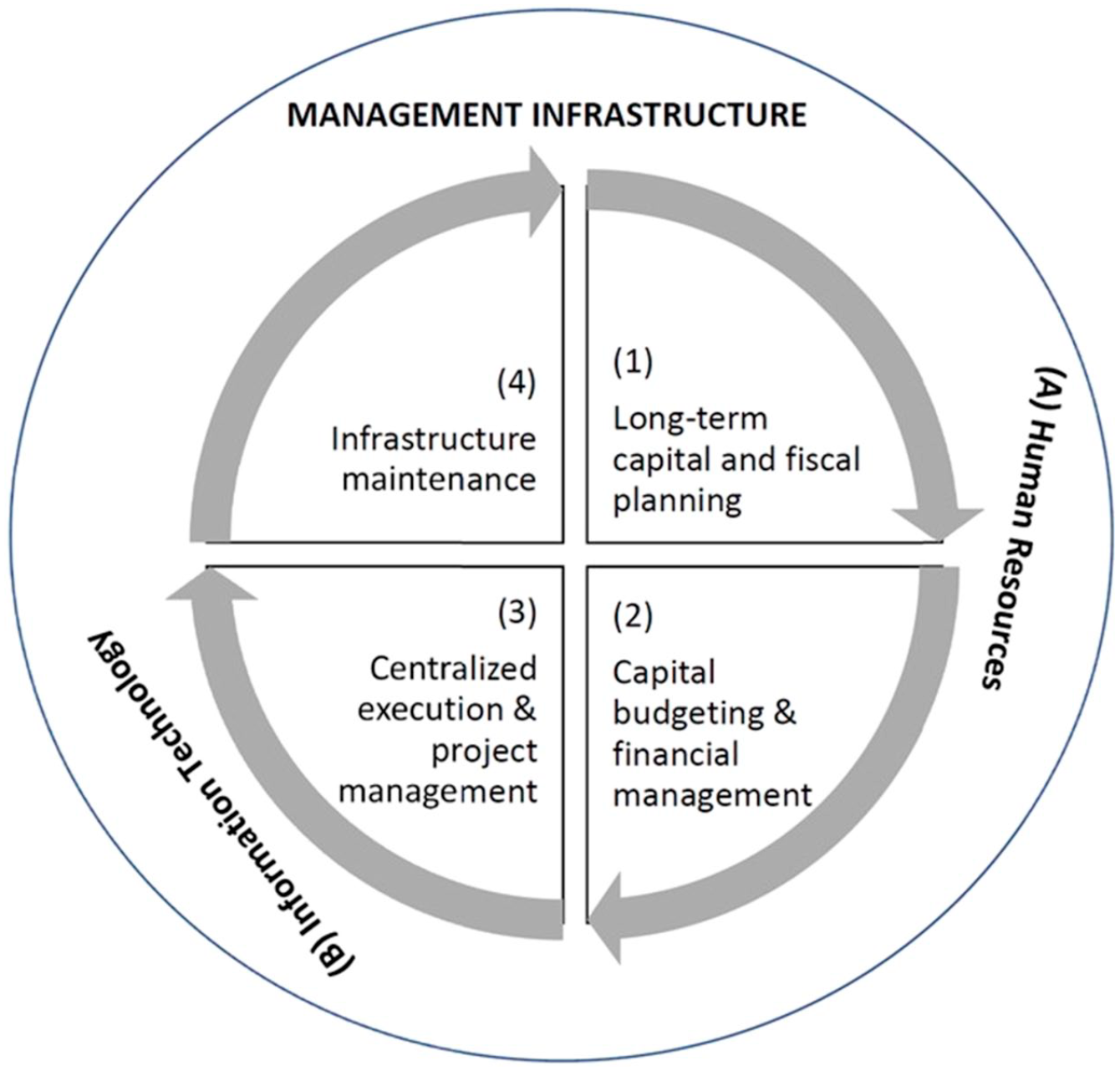
Capital management capacity conceptual framework.
In terms of HR, capital management capacity relies heavily on human factors; for example, skilled labor is needed for project management, contracting oversight, and cost estimating. The connection between human capital and organizational success is evident in the literature. Kroll and Moynihan (2015) found that personnel training and development is related to public organizational reform success. In the private sector, pay incentives for managers translate into more optimal capital projects. For example, performance-based pay mitigates managers’ incentives to overstate project needs, priorities, scopes, and timelines, and correlates with improved delivery time, cost, and quality (Bernardo et al., 2001).
IT, initially treated in the GPP as a separate management function, is integrated throughout capital management. Geographic Information Systems (GIS) are an example of how IT supports capital management. A Texas Department of Transportation district uses a GIS-based tool for integration and visualization of capital projects data to support analysis and planning (France-Mensah et al., 2017). Municipalities and utilities have used GIS to enhance capital planning and asset management (Baird, 2010). Thus, effective capital management should also consider the IT infrastructure that supports capital planning and implementation.
We operationalize the capital management capacity framework through questions shown in Figure 2. To pilot test the framework we focus on transportation which represents significant government infrastructure spending but is generally less political and largely a technical task of implementation and engineering. Low capital management capacity is felt directly in the transportation sector where poor roads and deficient bridges can affect the ability of businesses and consumers to conduct daily operations.
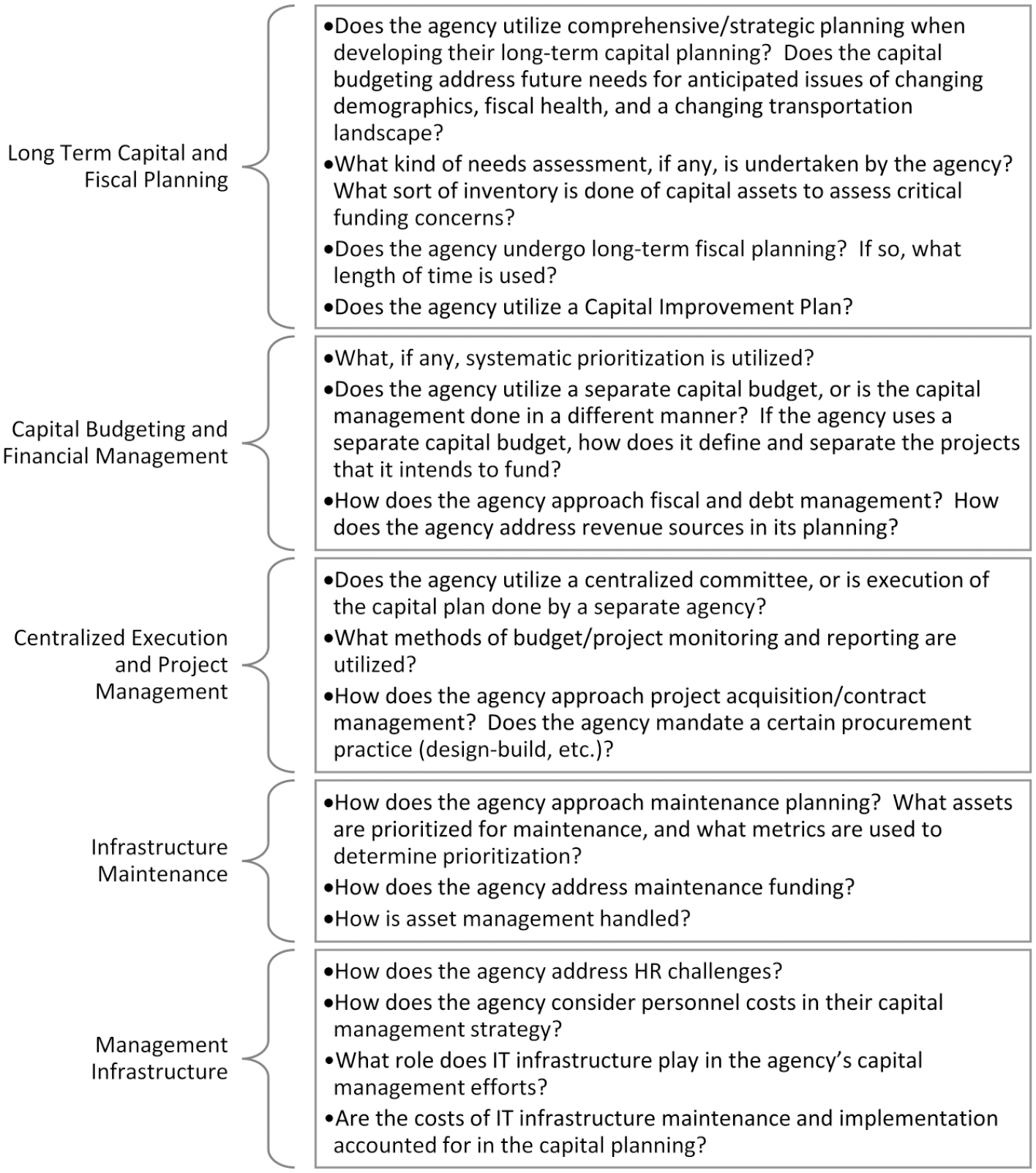
Operationalization of the capital management capacity framework.
Methods
We pilot test the capital management capacity framework using two transportation agencies: the State of Vermont Agency of Transportation (VTrans) and the Palm Beach County (Florida) Department of Engineering and Public Works (DEPW). VTrans is responsible for the construction and maintenance of Vermont’s transportation network. VTrans has one of the state’s largest workforces (over 1200) with a $615 million FY 2020 budget. Vermont has a small, aging population with a built-out infrastructure and the country’s smallest GDP. It received an infrastructure grade of B- in the 2005 GPP, which improved to B+ in the 2008 GPP, receiving high marks for maintenance and average scores for capital planning (Barrett & Greene, 2008).
The Palm Beach County DEPW is responsible for 3617 lane miles of roads, 314 bridges, and streetlights, paths, and sidewalks. In FY 2021, it has a $63 million operating budget, $118.5 million capital budget, and 469 employees. The county’s overall 2002 GPP grade was C+ (Barrett, Greene, & Mariani, 2002), scoring well in both capital management (B) and financial management (B), but less well in managing for results (B-), HR (C), and IT (C-). The county population increased by 13.4% between 2010 and 2019 (U.S. Census Bureau, n.d.), resulting in increased demands on roads. Unlike many other local governments, this county has various earmarked funding sources for roads, including gas tax, impact fees, and infrastructure tax.
We conducted content analysis of publicly available documents, including annual budgets and capital improvement plans, and other documents found through official websites. For VTrans, this included the Statewide Transportation Improvement Program (STIP) and the Transportation Asset Management Plan (TAMP). Documents reviewed for Palm Beach County included the 5-Year Road Program, DEPW strategic plan, the Annual Report on Thoroughfare Roads, the Comprehensive Plan, and the Capital Project and Reserve Status Report. The analysis was centered around the components of the capital management capacity framework shown in Figures 1 and 2.
Capital Management Capacity of VTrans
Long-Term Capital and Fiscal Planning
Comprehensive, strategic planning is used extensively by VTrans, as required by state law. Long-term capital planning takes the form of the STIP (VTrans, 2020) and the TAMP (Vermont Agency of Transportation, 2018b) which address the significant challenges inherent to the aging and shrinking population, built-out highway system, climate change, and funding model that relies on user fees and fuel taxes. For long-term planning VTrans uses a continual evaluation process to identify key needs tied to performance indicators such as the number of bridges needing repair and percent of surface pavement of acceptable quality. Needs assessments are influenced by citizen input using statewide surveys. VTrans also maintains a complete infrastructure condition inventory that identifies critical immediate and future needs.
Long-term fiscal planning is state- and federally mandated. The state requires capital planning be done at least every 10 years and 20 years for the TAMP and Long-range Transportation Plan (Vermont Agency of Transportation, 2018a, 2018b). VTrans maintains a 4-year financial plan that describes projects and projected spending, and a CIP that itemizes capital projects, outlines historical spending, and projects revenues and expenditures (State of Vermont Agency of Transportation, 2020).
Capital Budgeting and Financial Management
VTrans’ Project Selection and Prioritization Processes (VPSP2) was introduced in 2020 to replace an ineffective system with too many projects in a politically-driven process (VTrans, 2021). VPSP2 uses a performance-based, data driven process that prioritizes projects based on safety, mobility/connectivity, asset condition, resiliency, community, environment, economic access, and health access.
The VTrans capital budget is appropriated by program area (paving, aviation, etc.) in a Transportation Bill. Individual projects are identified within 10 program areas and broken down by fund types (State of Vermont Agency of Transportation, 2020). VTrans addresses its funding sources separately from those for other infrastructure. For the STIP and TAMP funding considerations include the availability of user fees and fuel taxes, use of Transportation Infrastructure Bonds, and relative instability of Federal Highway Trust Fund.
Centralized Execution and Project Management
Execution of the capital plan is achieved through various disseminated functions. The Highway Division oversees construction and maintenance operations for highway projects, the Division of Policy, Planning, and Intermodal Development oversees planning activities in conjunction with the Metropolitan Planning Organization (MPO) in Chittenden County, and the Division of Finance and Administration is responsible for budgeting, accounting, auditing, and IT.
Project monitoring follows Transportation Planning Initiative guidance that outlines reporting processes and expectations for project development and execution (Vermont Agency of Transportation, n.d.). The Division of Finance and Administration is responsible for acquisition and contract management. While no procurement practices are specifically emphasized (beyond a legal requirement for competitive bidding), four main modes of procurement are used: traditional bid contracts, design-build, job-order contracting, and public private partnerships (PPP).
Infrastructure Maintenance
Maintenance planning is a central part of VTrans’ capital management strategy. A complete condition assessment is conducted every two years (Federal Highway Administration (FHWA), 2017). VTrans identifies maintenance planning as one of its chief concerns and emphasizes the need to effectively manage existing assets (Vermont Agency of Transportation, 2018b). The agency has used an integrated strategy since 2014. Benchmarks found in federal legislation influence maintenance decisions across modalities.
Maintenance funding is a consistent challenge. Vermont only has funding for 67% of its projected transportation maintenance needs (Vermont Agency of Transportation, 2018b) and has struggled with funding consistency. The end of Recovery Act funding led to a precipitous drop in federal funding and existing fuel taxes and user fees are insufficient to make up the nearly $100 million difference (FHWA, 2017). At the direction of the legislature, VTrans analyzed alternative funding sources, such as vehicle mileage fees, to help close funding gaps.
VTrans employs a variety of asset management tools including off-the-shelf software and in-house databases (spreadsheets, GPS data). Recently, a contract was awarded for a more integrated approach via the Vermont Asset Management Information System (VAMIS) that combines 24 asset groups under one software solution.
Management Infrastructure
VTrans prioritizes human resources. The first of its strategic goals is to “promote organizational excellence by attracting, developing, and retaining a talented, diverse, and engaged workforce” (State of Vermont Agency of Transportation, 2019). The agency’s Strategic Plan further identifies four HR goals and objectives relating to employee development, employee retention and quality of life, inclusion and civility training, and onboarding for new employees.
Personnel costs are included in the agency’s budget, but no discussion was found regarding the impact of labor costs over time. Program level reports also exist on IT infrastructure costs, including for new equipment, ongoing maintenance, and implementation. Aside from the implementation of VAMIS, there is little mention of the role of IT infrastructure in VTrans documents.
Overall Assessment
As a whole, VTrans appears to do well in capital management capacity, consistent with the 2005 and 2008 GPP results. Efforts to plan for future challenges meet or exceed state and federal requirements. The TAMP drew praise in an FHWA review. Systematic project prioritization follows national guidelines, unlike the former politically driven process. VTrans has examined alternatives to unstable funding from fuel taxes. Asset management, a significant concern for a state with largely built-out infrastructure, is moving to an integrated, multi-agency platform.
VTrans may have room for improvement in developing its capital management capacity. While the agency addresses HR goals in areas like employee development, there is little indication of broader plans for recruitment and retention in skilled areas of high need. IT infrastructure is not clearly identified beyond the move to VAMIS, and, as indicated in the 2008 GPP, may be a continuing concern for the agency if it relies on aging IT infrastructure for asset maintenance.
Capital Management Capacity of the Palm Beach County DEPW
Long-Term Capital Planning
Capital planning in Palm Beach County is based on the regularly updated Comprehensive Plan, two elements of which relate to transportation. The Capital Improvement Element (Palm Beach County, 2020b) focuses on managing growth and economic development. The Transportation Element includes goals, objectives, and policies for system components. Specific goals are included for levels of service (e.g., peak volumes on different types of roads). Roadway planning is based on the county’s Thoroughfare Right-of-Way Identification Map, which is derived from the MPO’s 2035 Cost Feasible Plan-Highway Component map that provides a plan for services based on estimated needs and financial resources (Palm Beach County, 2019b).
The County adopts a 5-year CIP and 5-year Road Program. The CIP is compiled annually by the Office of Financial Management and Budget; the DEPW allocation is for bridges, drainage improvements, resurfacing, signals, street lighting, and striping. DEPW develops the road program for construction and expansion (Palm Beach County, 2019b). Data regarding the CIP and Road Program are in the Comprehensive Plan (Palm Beach County, 2020b).
The CIP and Road Program include revenue and expenditure projections, and effects on future operating budgets and debt. Fiscal policies, such as debt limitations, are also included in the Comprehensive Plan. Capital planning is clearly linked to comprehensive plans and external factors focused on future needs. However, information pertaining to needs assessment and inventories is not readily apparent. Processes and documents may exist, but they are not easily accessible to the public.
Capital Budgeting and Financial Management
CIP proposals are categorized as either essential (immediate health and safety hazard), necessary (maintaining service levels), or desirable (enhancing quality of life). Project prioritization in the Road Program is based on five criteria: volume-to-capacity ratio, involvement of a public hazard, whether it is a reliever for high-volume roads, system continuity, and feasibility of alternate transportation modes. Projects in the Urban Service Area have higher priority than others with similar volume-to-capacity ratios. The County also coordinates with the MPO and state transportation plans (Palm Beach County, 2019b).
Detailed CIP requests (including estimated operating budget impacts) are reviewed by the Office of Financial Management and Budget. General Capital Projects in the CIP include the non-Road Program allocation for DEPW, and are primarily funded by ad valorem taxes and a one-cent sales surtax approved by voters in 2016 (Palm Beach County, 2020d). Road Program revenues are primarily from gasoline taxes, impact fees, and interest earnings. A six-cent local option gasoline tax is dedicated evenly between road improvements and transit. Impact fees fund road construction and other projects in growth areas (e.g., libraries, parks, and public safety) and account for the majority of Road Program funding. The Road Program is combined with the CIP and submitted by the County Administrator to the County Commissioners. The first year is adopted as the Capital Budget.
Centralized Execution and Project Management
DEPW is primarily responsible for road-related transportation projects. The DEPW Construction Coordination Division, rather than the County Purchasing Department, is involved in bidding or contracts for construction, engineering, or architectural services. The Palm Beach County Code specifies the use of competitive solicitation, including design-build contracts.
The County Engineer submits an annual report to the Mayor and County Commissioners related to road construction projects. This report includes project status, projected completion dates, costs, awarded contracts, and bidding schedule (Palm Beach County, 2020a). The DEPW also reports on critical projects in the Road Program, including project status, funding timeframe, and bid/construction dates (Palm Beach County, 2021a). The Office of Financial Management and Budget compiles a countywide report that includes status of capital project funding sources and reserve funds (Palm Beach County, 2021b). Significant contract awards and final payments are also detailed, as well as budget summaries for each project and a list of inactive projects.
Infrastructure Maintenance
Most maintenance projects are included in the operating budget. However, spending that extends asset useful lives by more than a year, such as road resurfacing, are in the CIP. The Comprehensive Plan repeatedly references the importance of asset maintenance and replacement (Palm Beach County, 2020b). Ongoing operating and maintenance costs are included in capital project requests.
Infrastructure maintenance has been a significant issue for the County and is a strategic priority. Transportation and other assets are aging and insufficient. Delayed maintenance has led to a backlog of over $1 billion in needs (Palm Beach County, 2020e). Because of these needs voters approved a one-cent sales surtax in 2016 to catch up on deferred maintenance of roads and bridges, drainage, canals, parks, and government buildings. The results can already be seen in road maintenance: nine lane miles were resurfaced in 2011 compared to 202 lane miles in 2019 (Palm Beach County, 2020c).
While infrastructure maintenance is clearly a high priority, it is difficult to determine, from available documents, tools used for asset management. As the County has quantified its infrastructure needs, the DEPW likely has systems in place, but no firm conclusions can be drawn.
Management Infrastructure
DEPW staffing increased in recent years but hiring and retention are problematic. DEPW has difficulty competing with private sector salaries to fill professional and skilled trade positions (Palm Beach County, 2020e). The department’s workforce emphasis is demonstrated by its strategic plan: two of the five goals relate to HR with one focusing on a supportive environment and the other on teamwork. Various objectives and performance metrices were established to work towards these goals (Palm Beach County, 2019a). The DEPW annual budget includes details of personnel costs and the CIP estimates effects on the operating budget, including HR costs (Palm Beach County, 2020b).
Available information is insufficient to make judgments about the role of IT in capital planning. However, the FY 2021 DEPW budget notes that “The department continues to invest time and resources to focus on migrating paper records to electronic systems so that information is better recorded and shareable” (Palm Beach County, 2020e, p. 145). Specifics are not clear, but it appears that there are ongoing issues with technology.
Overall Assessment
The Palm Beach County DEPW appears to have fairly strong capital management capacity according to the framework. Long-term capital planning for transportation infrastructure is linked to the county’s Comprehensive Plan and to the MPO’s plans. Systematic project prioritization and long-range revenue forecasts are used. Project management requires significant reporting, which fosters accountability. The CIP includes estimates of personnel and other operating and maintenance costs for capital projects.
Infrastructure maintenance has received increased attention, aided by a new sales tax, but the large backlog of deferred maintenance will take time to work through. Management challenges exist related to workforce recruitment and retention. However, it is not possible to draw firm conclusions regarding IT management, although there are at least some processes that are still heavily paper-based and inefficient.
Conclusion
This study developed a capital management capacity framework based on existing literature and the GPP evaluation criteria. The framework includes four components and two supporting management infrastructure: long-term capital planning, capital budgeting and financial management, centralized execution and project management, infrastructure maintenance, and HR and IT management infrastructure. The framework was operationalized through a series of questions and applied to transportation agencies for the state of Vermont and Palm Beach County, Florida. Findings of the two pilot studies are provided in Table 1.
Capital Management Capacity Findings.
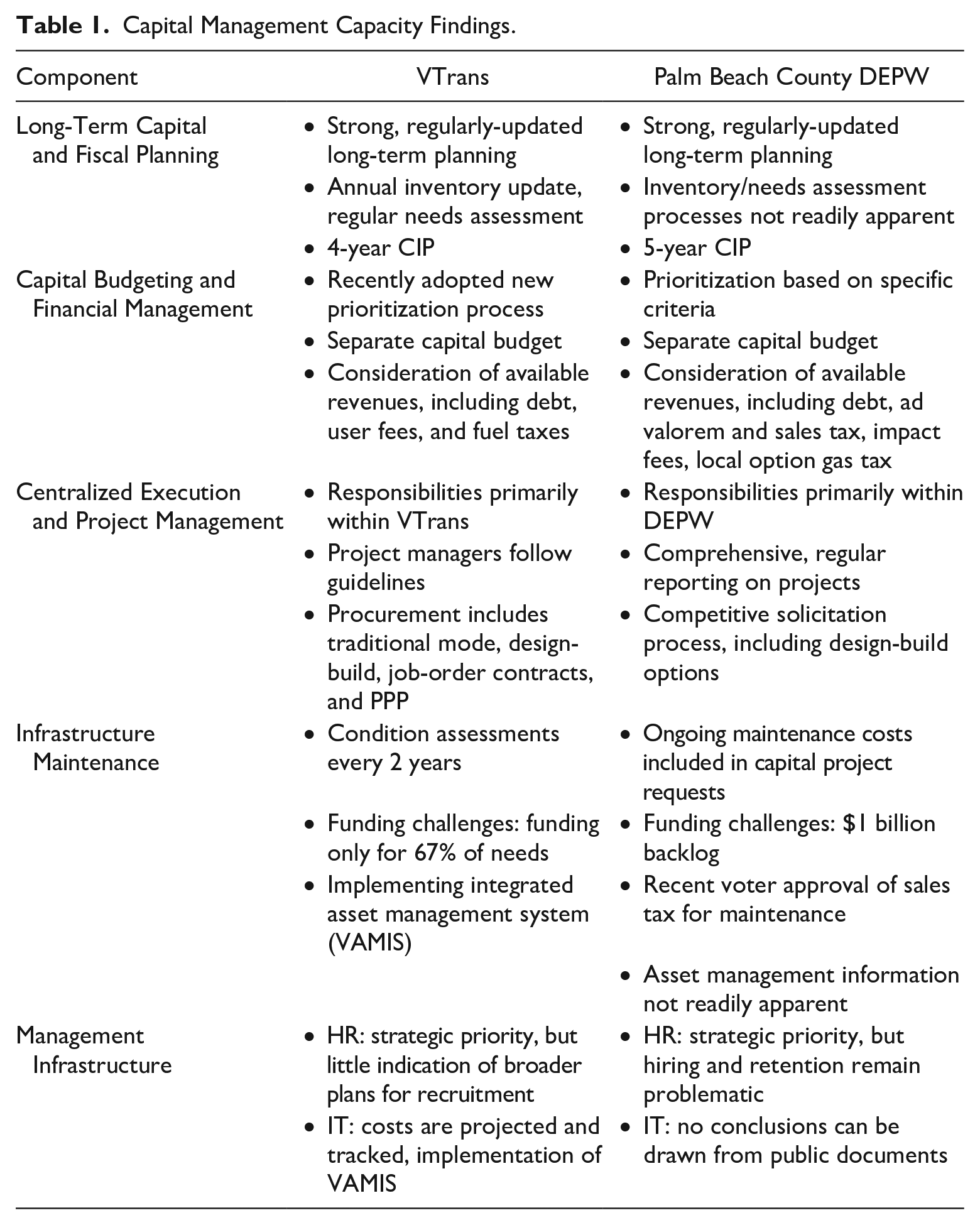
While these agencies represent two different levels of government, we found similarities in capital management capacity. Both are strong in long-term planning, budgeting, and project management, but have challenges in infrastructure maintenance due largely to deferred maintenance. While funding issues are being addressed in various ways, maintenance is an ongoing concern. Management infrastructure is more difficult to ascertain based solely on public documents. Both agencies have identified employee recruitment, retention, and development as strategic importance. Each noted implementation of new IT systems, but how these systems meet asset management needs is unclear.
The GPP was last conducted 13 years ago for states and 20 years ago for counties. While we cannot assign letter grades based on this initial exploratory approach, our findings are similar to earlier studies that identified asset maintenance and IT as weaknesses in capital management (Ebdon, 2007). This demonstrates the value of our framework, which can be used by organizations to understand their capacity and to benchmark themselves over time and against other similar governments. The consistency of issues since the GPP analysis points to continued need for maintenance funding and technology.
New management challenges have arisen since the GPP, yet a comprehensive effort of similar scale has not been undertaken (Posner, 2015). While our framework does not begin to approach the scale of the GPP, it provides a means to evaluate capital management capacity that is grounded in theory. By operationalizing the framework—developing usable questions that guide evaluation of capital management capacity—and applying it to two agencies, we have shown its usefulness in determining alignment of existing practices with normative recommendations. Our application of the capital management capacity framework using the two selected agencies provides a pilot test of the framework. We ensure content validity by first verifying the correspondence between the conceptual definition and the operationalization of the capital management capacity as used in the pilot testing. Our inductive case study approach systematically documented observations related to capital management practices consistent with our framework. Comparison of results across the two agencies and consistency of our results relative to the prior GPP analysis further suggests validity of the framework and promise for useful application. However, additional testing is necessary to determine the extent to which it is reliable and generalizable.
This study’s approach should be used for agencies in other infrastructure areas before formalized assessment (letter grading) can be assigned. Applications across states and local governments provide necessary context for informed assessment. Follow-up interviews can help fill in gaps that may be left by content analysis of published documents. Despite these limitations, our analysis illustrates the framework’s applicability, which can be used to assess and improve capital management capacity.
Footnotes
Declaration of Conflicting Interests
The author(s) declared no potential conflicts of interest with respect to the research, authorship, and/or publication of this article.
Funding
The author(s) received no financial support for the research, authorship, and/or publication of this article.
