




Abstract
A three-component intervention was implemented with 47 youth with autism spectrum disorders (ASD) as they transitioned from high school to adult life. The youth, ages 16 to 19 years, were randomly assigned to a Year 1 group or a Year 2 group. Participants in the Year 1 group received a transition planning intervention consisting of (a) group training sessions for families in the transition process, (b) person-centered planning meetings facilitated by project staff, and (c) follow-up assistance with career exploration and plan implementation. Data were collected pre- and post implementation to measure student and family expectations, self-determination, and career decision-making ability. The Year 2 group began receiving services following the second data collection point. Participants in the Year 1 group reported statistically significant increases in all four measured variables, whereas the Year 2 group showed no significant changes. Implications for redesigning transition services for this population are discussed.
Since the passage of the federal Individuals With Disabilities Education Act (IDEA) in 1990, transition planning has been a requirement for students with disabilities in the United States who are 16 years or older. Amended in 2004, IDEA defines transition planning as a
results-oriented process, that is focused on improving the academic and functional achievement of the child with a disability to facilitate the child’s movement from school to post-school activities, including postsecondary education, vocational education, integrated employment (including supported employment); continuing and adult education, adult services, independent living, or community participation. (Individuals With Disabilities Act, 2004)
Despite some improvement in the last two decades, educational, employment, and independent-living transition outcomes remain poorer for young adults with disabilities than for their nondisabled peers (Edwards, Patrick, & Topolski, 2003; Test et al., 2004; Wagner, Newman, Cameto, Levine, & Garza, 2006). Those diagnosed with autism spectrum disorders (ASD) tend to have even poorer outcomes than those with other disabilities (Howlin, 2000; Howlin, Goode, Hutton, & Rutter, 2004).
Researchers have consistently demonstrated that adult employment, independent living, and social outcomes for individuals with ASD are poor (Cederlund, Hagberg, Billstedt, Gillberg, & Gillberg, 2008; Hendricks & Wehman, 2009). Ballaban-Gil, Rapin, Tuchman, and Shinnar (1996) reported that 53% of adults with ASD were living in congregate residential placements and only 11% were employed. A small percentage of individuals with ASD may achieve near normal outcomes (Marriage, Wolverton, & Marriage, 2009), but, even among the subgroup considered “high functioning,” only 15% to 20% (Howlin, 2000) achieve good postsecondary education, employment, and independent-living outcomes (Cameto, Levine, & Wagner, 2004; Hurlbutt & Chalmers, 2004; Tsatsanis, Foley, & Donehower, 2004).
Few young adults with ASD transition from school into employment or higher education, and many attend sheltered workshops or day activity programs (Garcia-Villamisar, Wehman, & Navarro, 2002; Targett & Wehman, 2009). For those who do find work, employment is often below their level of skills and education (Hendricks, 2010; Muller, Schuler, Burton, & Yates, 2003). Workers with ASD also switch jobs frequently, are paid less than their coworkers, and tend to view their work experiences in negative terms (Muller et al., 2003). Somewhat surprisingly, Cimera and Cowan (2010) reported that adults with ASD who seek employment through the Vocational Rehabilitation system are employed at a higher rate than those in other disability categories. Unfortunately, persons with ASD tend to work fewer hours, are paid less, and are among the most costly individuals to support. Poor employment outcomes are especially troubling given the growing body of evidence indicating that persons across the autism spectrum can work when provided with appropriate supports (Hillier et al., 2007; Moore, 2006; Quirk, Zeph, & Uchida, 2007; Schaller & Yang, 2005; Wehman, Targett, & Young, 2007). This includes many individuals with significant social, cognitive, communication, and behavioral impairments (Hagner & Cooney, 2005; Henn & Henn, 2005).
Renty and Roeyers (2006) found that the availability of supportive social networks and effective professional supports were more strongly related to positive outcomes than individual characteristics. A number of external factors could conceivably moderate the effect of ASD-related impairment on outcomes, including educator and parent expectations; the quality of a student’s educational, community, and work experiences; the quality of a student’s transition plan; the size of a student’s social network; and the ability to access needed supports. There is evidence, for example, that many parents of youth with ASD have reduced expectations for their children and express doubts about the likelihood of their children achieving desired adult outcomes (Ivey, 2004). Family members and teachers also maintain low expectations for self-determined behavior (Carter, Trainor, Owens, Sweden, & Sun, 2010) for young adults with disabilities. Low expectations can lead parents and teachers to fail to teach students with ASD the skills they need for adult life (Grigal & Neubert, 2004; Kraemer & Blacher, 2001) and to offer fewer opportunities for youth with ASD to develop a sense of responsibility appropriate for adults or to engage in career decision making (Carter, Trainor, Cakiroglu, Swedeen, & Owens, 2009; Ivey, 2004; Ochs & Roessler, 2001). Conversely, a strong positive relationship has been found between a high level of expectation of employment on the part of families and teachers and later employment outcomes (Carter, Trainor, Ditchman, Swedeen, & Owens, 2010).
Family involvement in the transition process is associated with positive postschool outcomes for students with ASD (Held, Thoma, & Thomas, 2004; Kincaid, Chapman, Shannon, Schall, & Harrower, 2002; Smith, McDougall, & Edelen-Smith, 2006). The active participation of transitioning students in the planning process also is associated with positive postschool outcomes (DeFur, 2003). Poor adult outcomes and low expectations for persons with ASD are often the result of a planning process that is not person and family centered (DeFur, Todd-Allen, & Getzel, 2001; Grigal & Neubert, 2004; Schall, 2009). Professionally driven planning formats and processes distance students and families from active participation (Thoma, Rogan, & Baker, 2001). Furthermore, individuals with ASD and their family members may need training and preparation to actively participate in designing transition plans (Briel & Getzel, 2009).
There are several obstacles to individuals with ASD participating in transition planning. Active participation typically requires the ability to interact with others and the ability to communicate one’s preferences and desires. Individuals with ASD, by definition, struggle with social interaction and communication (American Psychiatric Association, 2000). However, communication difficulties by themselves do not preclude active participation in transition planning, and even individuals who have very limited communication have shown the ability to express important life preferences when provided with appropriate accommodations (Lattimore, Parsons, & Reid, 2002; Olney, 2001). Those with ASD also may experience high rates of anxiety, especially social anxiety (Bellini, 2006). This necessitates the consideration of careful preparation and accommodations in order for such individuals to participate meaningfully in planning.
Individuals with ASD and their families also need factual information about the complex systems of supports and funding streams that will help them design appropriate individualized supports (Autism Society of America, 2001; Thoma et al., 2001). No single point of entry to adult services exists as it does for school-age students with Individualized Education Plans (IEPs; Revell & Miller, 2009). Service systems often are overlapping, fragmented, and uncoordinated (Waisman Center, 2009; Wittenburg, Golden, & Fishman, 2002), and few families enter the transition process with an understanding of the complex state and federal programs that might be used in supporting the transition to adult life (Schall & Wehman, 2009).
The purpose of this study was to assess the effectiveness of a transition planning approach that empowers students with ASD and their families, educates them about the transition process, and helps them connect with community resources on the transition readiness of youth with ASD. Our research questions included the following:
Research Question 1: How does participation in a comprehensive family-centered intervention affect students with ASD and their families’ expectations for adult life?
Research Question 2: How does participation in a comprehensive family-centered intervention affect levels of self-determination among transition-aged students with ASD?
Research Question 3: How does participation in a comprehensive family-centered intervention affect career decision-making ability for transition-aged students with ASD?
Method
A randomized control trial design was used to answer the research questions. One group of students and families received the intervention in Year 1 and a delayed-exposure group received the intervention in Year 2. Data were collected prior to and following Year 1 implementation.
Participants
Public high schools in New Hampshire and Maine were contacted, informed of the project, and asked to collaborate. School awareness of and collaboration with the project was essential because the intervention was expected to result in plans that would become incorporated in students’ IEPs. Those indicating a willingness to collaborate identified a contact person, either the Director of Special Education or the Transition Coordinator, and that individual received and distributed project fact sheets to eligible students and their families. Project staff met with families and students expressing an interest, and informed consent and assent were obtained. Because the intervention and data collection involved parents as well as students, at least one parent, guardian, or parent surrogate enrolled in the project along with the student. Each family received a small stipend after completing the training sessions and after completing the final surveys. Through this process, 49 students and 49 parents were enrolled during a 2-month enrollment period. Two participants dropped out of the study, both for reasons unrelated to the study. One became distraught on the death of his brother and was unable to focus on project activities. The other participant moved out of state with his family. Demographic information is provided in Table 1.
Demographic Variables
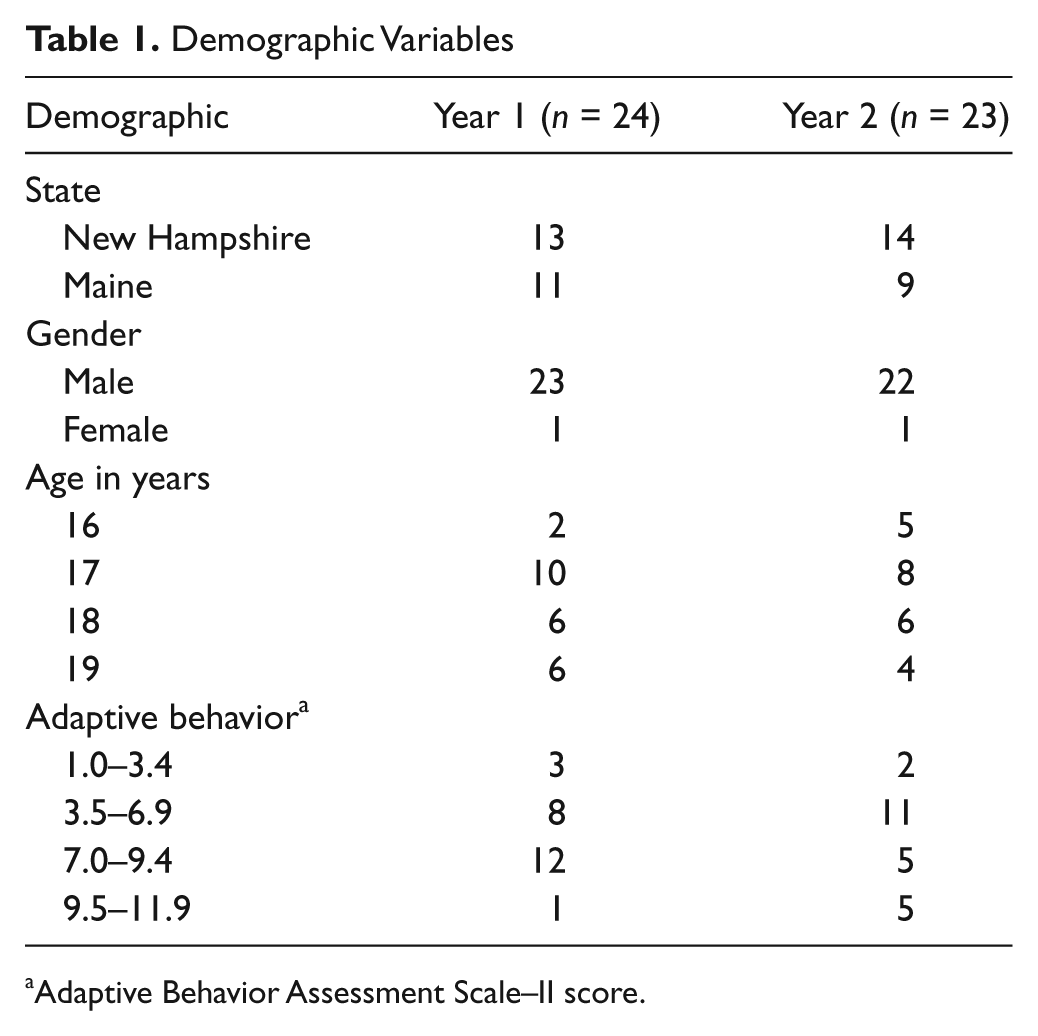
Adaptive Behavior Assessment Scale–II score.
Of the participants, 37 had been diagnosed previously as having autism, 8 with Asperger Disorder, and 2 with Pervasive Developmental Disorder–Not Otherwise Specified; hereafter all will be referred to as having ASD. Following enrollment, students were randomly assigned to participate in Year 1 (n = 24 families) or in Year 2 (n = 23 families). This delayed-exposure design allowed the Year 2 group to serve as a control group in Year 1, while assuring that all enrolled students and families received the full intervention.
Post hoc tests showed that students in the two groups were equivalent in age, M1 = 17.7 years, M2 = 17.4 years, t(47) = .939, p = .353; race (all White); and gender (1 female in each group, Mann–Whitney U p = .977). The Adaptive Behavior Assessment Scale–II (ABAS-II; Harrison & Oakland, 2008) was used to assess level of adaptive behavior across groups at enrollment. The ABAS provides a composite mean-scaled score based on an assessment of adaptive skill domains in relation to a standardized sample with a mean of 10 and a standard deviation of 3. Differences in ABAS-II scores across the two groups were not statistically significant, M1 = 6.42, M2 = 6.75, t(47) = .496, p = .63, indicating that both groups had similar levels of functional impairment at enrollment. The Autism Diagnostic Observation Schedule (ADOS; Lord, Rutter, DiLavore, & Risi, 1999), was administered by a trained assessor to confirm presence of ASD. In all, 27 of the participants met the cutoff for ASD, and 20 met the cutoff for autism.
Project Staff
The first and second authors served as codirectors of the transition program. Planning facilitators were four full-time staff (two from each state) who were master’s-level professionals. To become planning facilitators, they had to complete a three-credit graduate course in Person-Centered Planning and have experience with planning facilitation on previous projects.
Procedure
Project services consisted of a sequence of three components as follows:
Group training sessions for families
Parents participated in group training on strategies for person-centered planning, networking, and utilizing adult service options and resources to design and work toward a positive future beyond high school. Training sessions followed a curriculum called Specific Planning Encourages Creative Solutions (SPECS; Cotton & Boggis, 2007), consisting of six modules as follows: (a) orientation to planning, (b) tools for planning, (c) creative problem-solving, (d) quality services, (e) creative financing, and (f) getting to action. Two modules per day were scheduled on three Saturdays, 4 weeks apart, with lunch provided. The curriculum was customized to the funding and service systems specific to New Hampshire and Maine and provided separately to the parents in each state. At least one family member of each student had enrolled in the project and agreed to attend the six modules. In some cases, both parents attended. In three cases, illness or other difficulties caused a parent to miss 1 day (two modules) of the group training. In these cases, the information was presented individually to these families in-person in the family’s home by planning facilitators.
A 15-question quiz consisting of a mix of true–false and multiple-choice questions was developed to assess acquisition of knowledge about transition planning and options, based on the training curriculum, and given to families 1 week prior to the first SPECS session and 2 months following the final session. Quiz scores could range from 0 to 45. Paired-sample one-tailed t tests showed statistically significant increases in transition knowledge following training, pretest mean = 23.6, posttest mean = 33.5, t(35) = 2.76, p = .014.
Person-centered planning
Component 2 consisted of person-centered planning. The two planning facilitators in each state assisted each student and family through a structured planning process to develop a transition plan, in a ratio of one planning facilitator to about eight participants at any one time. The person-centered planning process used in this project has been utilized in previous research (Cloutier, Malloy, Hagner, & Cotton, 2006; Hagner, McGahie, & Cloutier, 2001) and is described in detail in Cotton (2003).
Fidelity of planning was assessed by means of observations at a sample of three planning meetings in Maine and three in New Hampshire conducted by the project codirectors, following an observational checklist called “How Person-Centered Was This Planning?” The checklist, developed based on a review of literature on the elements of person-centered planning, scores each of 12 elements of a planning process as 2 (fully present), 1 (partially or somewhat present), or 0 (not present), for a total score between 0 and 24. Interrater reliability of the checklist is .91 (Hagner & Cloutier, 2008). The instrument also shows good discriminant validity, with person-centered planning meetings scoring significantly higher than traditional agency-driven transition planning meetings, and a score of about 20 serving as a threshold to identify a substantially person-centered planning process (Hagner & Cloutier, 2008). All meeting sampled in this project exceeded this threshold, and the average score was 22.4.
Planning facilitators assisted the student and family to select and invite a planning group varying in size from 2 to 12 family members and/or community members, depending on the student’s wishes and network of contacts. The facilitators met with the student as needed to prepare for maximizing participation in the planning. Planning consisted of a series of three to five meetings, typically held in the evening at the family’s home. Once initial ideas had been formulated, school and adult service personnel were invited to the third or fourth meeting to provide input and buy-in for the final plan. The completed plan contained the following elements (Cotton, 2003):
History
Who You Are Today
Strengths and Accomplishments
Supportive People and Resources
What Works and What Doesn’t Work
Vision for the Future
Fears, Concerns, and Barriers
Goals
Next Steps and Follow-Up
Participant comments during meetings and the resulting plans were documented on flip-chart paper at each meeting, and the flip-chart documents were photographed and emailed to participants. Facilitators ensured that all participants are able to contribute to the plan, that the focal individual participated fully, the planning proceeded at the individual’s pace, and that established ground-rules (such as avoiding comments critical of another participant) and scheduled time limits were followed. The planning resulted in transition goals and an implementation plan customized to the individual with ASD.
Accommodations were provided as needed to ensure participation by students with ASD in the planning process. Individual accommodations included (a) informal meetings between the facilitator and student prior to the start of planning to develop rapport; (b) preparation meetings with the student prior to a group meeting to discuss the agenda and participation strategies; (c) provision for students to take breaks during meetings as needed or participate for designated parts of a meeting, with periodic summaries of discussions held during the student’s absence; (d) provision for students to participate by listening-in and interjecting from an adjacent room or the other end of the room; (e) allowing students to participate by writing notes to be read to the group or posted onto flip-chart paper, by using an assistive communication device or by using a “thumbs up/thumbs down” communication system for key ideas and conclusions; and (f) distant participation via “Skype” from the student’s bedroom or by preparing a PowerPoint presentation to be shown at the meeting.
Follow-up assistance
The third project component consisted of ongoing assistance from planning facilitators in implementing student plans for 4 to 6 months following development of an initial plan. Assistance included career exploration activities with students to investigate career options, including (a) informational interviews, (b) job shadowing experiences, (c) online or in-person investigation of postsecondary options, and (d) unpaid or paid work experiences, and participating at IEP or other meetings on request to assist students and families to present their plan ideas and ask for specific educational or other services.
Group 2 participants received a phone call from planning facilitators midway through Year 1 to remind participants about the project and verify contact information. These conversations also included participant updates about school progress and summer plans, to secure continued engagement with the project, and details about the planned start of Year 2.
Instruments and Data Collection
Survey data were collected at enrollment and 12 months later, prior to the initiation of services for the Year 2 group. Standardized surveys were used to measure the impact of the project on (a) student and parent expectations for the future, (b) self-determination, and (c) vocational decision-making ability.
Future expectations
The expectations section of the survey used for the National Longitudinal Transition Study–2 (Wagner, Newman, Cameto, Levine, & Marder, 2006) was used to measure student and parent expectations for educational attainment and future independence. The instrument rates five education milestones (graduate high school with a regular diploma, attend school after high school, complete a postsecondary vocational program, complete 2-year college, complete 4-year college) and four independence milestones (obtain a driver’s license, obtain paid employment, be financially self-sufficient, and live independently) on a 4-point scale from “definitely will” to “definitely won’t.” This instrument has been extensively field-tested and used with individuals with disabilities and their families, and results have been reported for a national sample of families of transitioning students with autism (Wagner et al., 2006). Expectation surveys were completed by students and parents separately.
Self-determination
Self-determination was measured using the Arc Self-Determination Scale (Adolescent Version), a student self-report measure designed for use by students with cognitive disabilities (Wehmeyer & Kelchner, 1995). The scale measures four domains of self-determination: autonomy, self-regulation, psychological empowerment, and self-realization. The scale was developed and normed on 500 adolescents with and without cognitive disabilities (Wehmeyer & Schwartz, 1998). The instrument has high internal consistency (Cronbach’s α = .90) and high concurrent validity with other conceptually related measures such as locus of control and self-efficacy (Wehmeyer & Schwartz, 1998).
Career decision-making ability
Career decision-making ability can be defined as the ability to view one’s skills and preferences in relation to the world of work, to engage in career exploration to gather information, and to make an informed decision (Amundsen, Borger, Iaguinto, Butterfield, & Koert, 2010; Ochs & Roessler, 2001). This variable was measured with the Vocational Decision-Making Interview–Revised (VDMI-R; Czerlinsky & Chandler, 1992). This instrument, designed for use with individuals with disabilities, consists of a structured interview with 54 questions at a fourth-grade reading level. The VDMI-R produces total score and subscores for vocational decision-making readiness, employment readiness, and self-appraisal. Reliability studies have reported internal consistency estimates of .62 to .84, and test–retest reliability coefficients of .62 to .80 (Tiffany, 2004).
All project surveys were administered in-person in family homes by the planning facilitators. Questions on the three student surveys were read to the students for clarity and comprehension as needed. Occasionally, unfamiliar terms were explained (e.g., “fringe benefits” on the VDMI-R) to assist the students in understanding a question. Parents were present for the survey administration and sometimes assisted in verifying that students understood a question before answering. Some students took short breaks during the administration of a survey, and some required 2 to 3 separate meetings to complete all 3 surveys. Across both groups, 4 participants were not able to complete the Student Expectations Questionnaire, 11 participants were unable to complete the Self-Determination Scale, and 6 participants were unable to complete the VDMI even with these accommodations.
Data Analysis
To measure changes between pre- and postsurvey measurements, paired t tests were run separately for Group 1 and Group 2. One-tailed repeated-measures tests with a significance level of .05 were used. Analyses were performed using SPSS Version 19.0.
Results
The Year 1 group reported significantly higher student expectations for the future, parent expectations for the future, self-determination, and vocational decision-making ability. None of these variables improved significantly for Year 2 group. Results of analyses for the four dependent variables are summarized in Table 2.
Mean Pre-and Postintervention Scores on Dependent Variables by Study Group
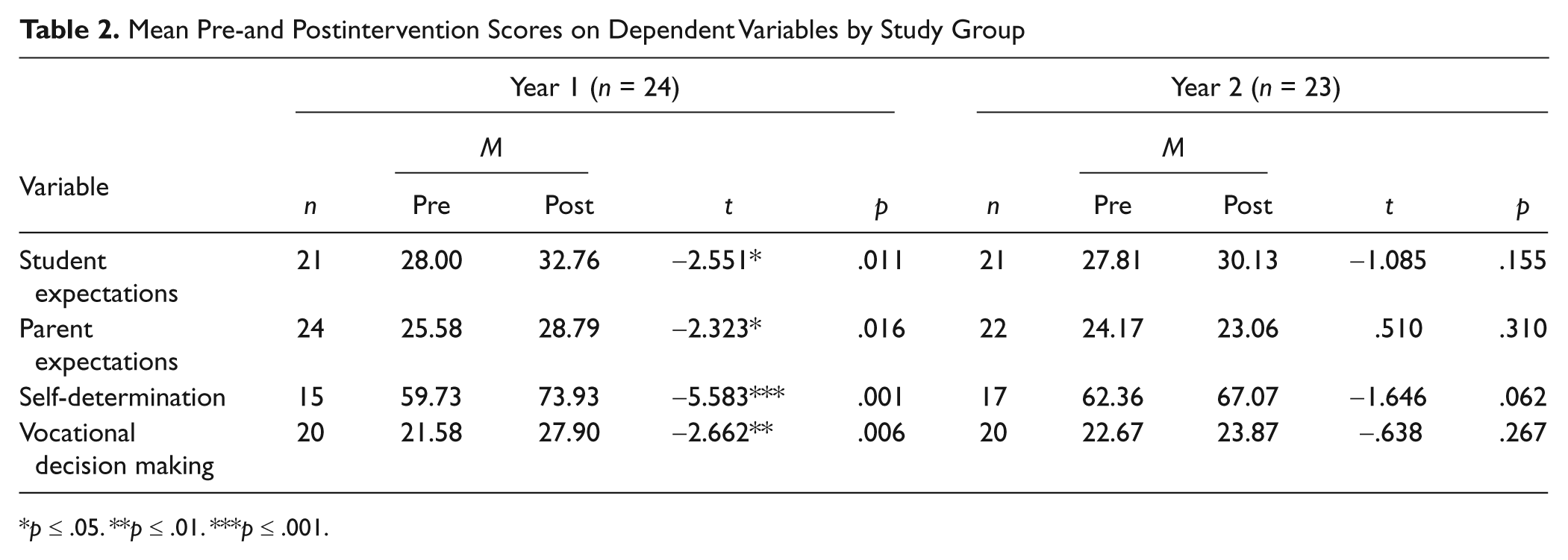
p ≤ .05. **p ≤ .01. ***p ≤ .001.
Discussion
A three-component intervention consisting of structured training, individualized planning sessions, and follow-up support for implementation and exploration resulted in significant increases in student and family expectations for the future and in highly significant increases in student self-determination and career decision-making ability. These results support the contention of researchers such as Ochs and Roessler (2001) that
Educators and rehabilitation counselors must intensify their career-related assessment and instructional efforts. These efforts include . . . increased school and community-based career education and work experience programs, awareness on the part of the professionals who work with youth with disabilities of the importance of positive expectations, and involvement of students in the development and direction of their own educational and rehabilitation plans. (p. 175)
The fact that increases in measured variables in the Year 2 group were not significant indicates that a combination of maturation over time and exposure to the models of transition assistance currently being provided to students with ASD is not sufficient to accomplish these goals.
Through the family-centered transition planning process, students and families were able to identify postschool goals and steps needed to achieve these goals. With assistance from a personally chosen planning team, students and families were also able to identify resources required to be successful and access those resources. A brief example will illustrate this process.
One student, Daniel, identified a goal of working in the film industry and attending college to study film or broadcasting. His planning team helped him research occupations and job requirements in the film industry, and people and organizations in his community where he could gain experience. Daniel’s planning facilitator developed an internship opportunity at the public access channel in his community. The student’s school provided an aide to support the internship, and Daniel was able to learn skills related to operating professional video cameras, lighting, and sound. In addition, Daniel was supported to write a movie review column for his school newspaper. Through these experiences, he became more aware of what he did and did not like, what supports he required to be successful, and how to communicate his needs to others. As Daniel’s mother noted, “He is able to dream, and explore opportunities, and nothing is going to hold him back.”
Several limitations should be noted in interpreting the findings from this study. First, the survey data were self-reports, and some participants received a level of assistance to complete the surveys (e.g., paraphrasing question items) that may have affected their answers. In addition, a few participants were unable to complete the surveys, and these were those students with the most significant language limitations, so this may limit the generalizability of findings to this group. Second, the study sample was relatively small and lacked diversity. While the findings suggest the efficacy of the approach, further study with a larger and more diverse population is needed. Future researchers also should follow transitioning students for a longer time period and obtain data on in vivo postschool outcomes such as employment and postsecondary education.
Family-centered transition planning is a straightforward, readily implementable intervention that has the potential to have a significant positive effect on the transition of students with ASD from high school to adult life. Providing this service does not necessarily involve additional costs over and above what school systems, developmental services, and the vocational rehabilitation system currently provide. Although the possibility of finding new dollars for service enhancements in the near future appears remote, each of these systems is already mandated and funded to provide transition planning, and to collaborate with one another (Certo et al., 2003). Lack of funding, or the need to overlay a new service on what already exists, should not be viewed as implementation barriers. Rather, implementation will involve redirecting existing funding away from planning models that have not worked, toward empirically based transition practices such as the one described here. For students with ASD, the family-centered transition planning model shows promise as an effective, evidence-based transition practice.
Footnotes
The author(s) declared no potential conflicts of interest with respect to the research, authorship, and/or publication of this article.
The author(s) disclosed receipt of the following financial support for the research, authorship, and/or publication of this article: This study was funded by Grant R40 MC 15597 through the U.S. Department of Health and Human Services, Health Resources and Services Administration, Maternal and Child Health Research Program.