



Abstract
The purpose of this study was to investigate the effects of a modified system of least intrusive prompts on text-dependent listening comprehension for four middle-school-aged students with intellectual disability and autism during read-alouds of adapted grade-level biographies. A system of least intrusive prompts was modified by inserting a rule for answering “Wh” questions and an opportunity to hear sections of the biography again. The procedure was evaluated via a multiple probe design across students. Outcomes indicate that all students improved listening comprehension after intervention and all students maintained high levels of correct responding 2 weeks after intervention. In addition, three students generalized skills to new biographies. The need for future research and implications for practice are discussed.
Keywords
Even though access to the general curriculum has been required for all students since the Individuals With Disabilities Education Act (IDEA) Amendments of 1997, there continue to be few studies in which researchers demonstrate how daily instruction can be linked to grade-level academic content standards for students with moderate and severe developmental disabilities (Browder, Spooner, Ahlgrim-Delzell, Harris, & Wakeman, 2008; Browder, Wakeman, Spooner, Ahlgrim-Delzell, & Algozzine, 2006). A lack of empirically supported models is especially critical given that alternate assessments based on alternate achievement standards (AA-AAS) are required to be aligned with grade-level standards (U.S. Department of Education, 2005). For students to “show what they know” on state assessments like the AA-AAS in academic content areas, models of effective teaching practices are needed.
Recently, researchers focusing on academic learning for students with moderate and severe developmental disabilities have provided teachers with examples of ways to promote learning in the areas of reading, math, and science for students by extending well-known procedures like time delay and task analysis to this new content. For example, Riesen, McDonnell, Johnson, Polychronis, and Jameson (2003) found two paraprofessionals’ use of constant time delay in science, German, and U.S. history classes promoted learning of instructional targets drawn from the general education curriculum (e.g., cooking symbols for bake, mix, stir; clothing necklines; definitions of terms from a science unit) for students with moderate intellectual disability. Similarly, Polychronis, McDonnell, Johnson, Riesen, and Jameson (2004) found middle school general education teachers were able to embed constant time-delay instruction with a focus not only on basic skills like telling time and naming classmates but also for some grade-appropriate geography content (i.e., naming the capital cities of 20 states) for four students with developmental disabilities. Jimenez, Browder, and Courtade (2008) taught high school students with moderate developmental disabilities to use a nine-step algebra task analysis to solve functional math problems, and Jimenez, Browder, and Courtade (2009) used multiple exemplar training, time delay, and a graphic organizer (i.e., Know, What, How, and Learn [KWHL] chart) to promote independent work during science inquiry lessons and generalization of learned skills to untrained materials for middle school students with moderate intellectual disability.
Providing instruction on grade-level content to students who are nonreaders is challenging. Nearly all academic learning (e.g., math, science, social studies, language arts) and many daily tasks (e.g., following a recipe to cook, using a grocery list to shop for food) require individuals to derive meaning from text. Browder et al. (2009) described a conceptual model for literacy in which students with moderate and severe developmental disabilities have opportunities to learn to read through intense, effective instruction as well as opportunities to gain meaning from text through listening comprehension. Many older students with severe developmental disabilities have not had reading instruction and need to access content other ways. Even if students are readers, some upper grade content may be beyond their reading level. One way to actively engage nonreaders and beginning readers with age-appropriate literature is through interactive read-alouds, which are also called shared story reading in the literature.
Shared story reading is a broad instructional approach used to promote young children’s emergent literacy (Justice & Lankford, 2002), vocabulary development (Blewitt, Rump, Shealy, & Cook, 2009), print awareness (Pullen & Justice, 2003), and receptive word learning (Justice, 2002). Shared story reading has been used to promote literacy for students with mild disabilities, including phonological awareness in young children with specific language impairments (Justice, Kaderavek, Bowles, & Grimm, 2005), emergent literacy skills in at-risk preschoolers (Justice & Kaderavek, 2002), young children with visual impairments (Erickson & Hatton, 2007), and students with mild disabilities (Katims, 1991).
Shared story reading has been adapted for use with students with moderate and severe disabilities to promote literacy. When shared story reading is used with these students, the practice typically involves a partner reading a story aloud while providing opportunities and support for listener participation as well as ways for the listener to demonstrate understanding of the text being read. Common features of shared story reading include the use of repeated story lines (e.g., main idea of a story or chapter), attention getters to engage the reader with the story’s context (e.g., apples for a story about an orchard), and repeated opportunities to hear the story read again (i.e., rereads). When shared story reading is used with older students, text is often summarized into shorter, more easily understood chapters, with and without picture support, and read aloud to the listener.
Shared story reading is an evidence-based practice for promoting literacy for students with extensive support needs (Hudson & Test, 2011) and researchers have evaluated the effects of shared story reading on literacy for students with severe disabilities. Koppenhaver, Erickson, and Skotko (2001) found girls with Rett syndrome made gains in early symbolic communication when they participated in shared story reading with their mothers. In addition, Browder, Mims, Spooner, Ahlgrim-Delzell, and Lee (2008) found shared story reading increased the independent responses of three students with profound disabilities who had previously been unresponsive during reading instruction. Mims, Browder, Baker, Lee, and Spooner (2009) found shared story reading promoted listening comprehension for two elementary students with significant intellectual disability and visual impairments. A limitation of these studies was the focus on foundational literacy skills (Browder, Mims et al., 2008; Koppenhaver et al., 2001) and comprehension at a literal recall level (Mims et al. 2009).
Mims, Browder, and Spooner (2010) extended the literature by investigating the effects of a modified system of least prompts on text-dependent listening comprehension beyond literal recall. In the study, four elementary students with moderate and multiple intellectual disability received intervention during shared story reading of an adapted children’s book. When a reread prompt of targeted information was inserted into the verbal and model prompts of the system of least prompts, students increased the number of text-dependent listening comprehension questions (e.g., sequencing, cause and effect) they answered. As in most prior studies on shared story reading, Mims et al. focused on elementary-aged students and used adapted picture books. In contrast, Browder, Trela, and Jimenez (2007) used adapted middle school novels in a read-aloud format. In this study, three middle school teachers learned to use a task analysis and systematic instruction to increase engagement during read-alouds of adapted novels for six middle school students with moderate and severe intellectual disability and autism. Following teacher training, students were able to identify vocabulary in text, read repeated story lines, participate in reading routines (e.g., turn the page), read new words, and answer questions by referencing text. To date, this has been the only study to extend interactive read-alouds to older students with moderate and severe developmental disabilities.
The need exists for more research to evaluate how read-alouds can promote comprehension of academic content for students with moderate and severe developmental disabilities and how learned skills might generalize to new content. Although previous researchers, such as Browder et al. (2007) and Mims et al. (2010), have demonstrated learning across stories, all stories were presented with systematic instruction and repeated readings. Through systematic prompting of comprehension strategies (e.g., having the reader focus on smaller chunks of text), it is plausible that the listener would be able to apply these skills to new text without repeated readings.
The purpose of this study was to evaluate the effects of a modified system of least intrusive prompts on text-dependent listening comprehension for middle school students with moderate and severe developmental disabilities during read-alouds of grade-level biographies. Specifically, we examined the following questions:
What was the effect of a modified system of least intrusive prompts on text-dependent listening comprehension during read-alouds of adapted grade-level biographies?
Did students generalize learned skills to new biographies?
Did the classroom teacher find the intervention beneficial for students with severe developmental disabilities?
Method
Participants
Participation criteria included (a) ability to use symbolic or abstract language (i.e., communicated through picture symbols or words), (b) met the federal definition for intellectual disability and autism, (c) ability to make selections receptively from an array (e.g., eye gaze, pointing, activating a switch), (d) available for the study 3 times a week, (e) regular school attendance (e.g., no more than five absences in previous 6 months), (f) signed informed parental consent, and (g) teacher recommendation. One girl and three boys, ages 12 to 14 years, met these criteria, and their demographic information is provided in Table 1.
Student Demographics
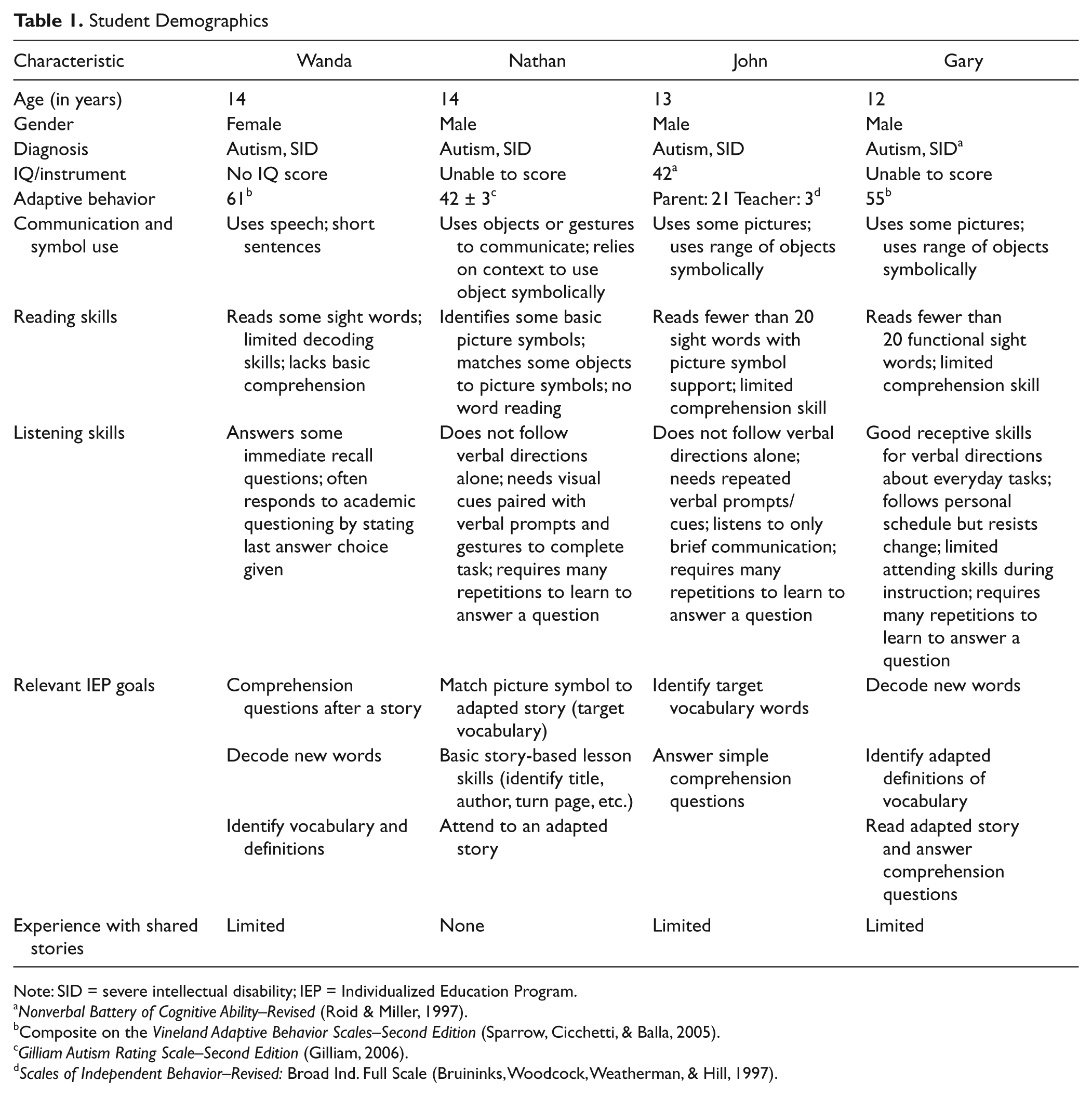
Note: SID = severe intellectual disability; IEP = Individualized Education Program.
Nonverbal Battery of Cognitive Ability–Revised (Roid & Miller, 1997).
Composite on the Vineland Adaptive Behavior Scales–Second Edition (Sparrow, Cicchetti, & Balla, 2005).
Gilliam Autism Rating Scale–Second Edition (Gilliam, 2006).
Scales of Independent Behavior–Revised: Broad Ind. Full Scale (Bruininks, Woodcock, Weatherman, & Hill, 1997).
All of the students were classified as having autism and intellectual disability. Wanda used spoken language to communicate, and the other three participants used pictures and objects. Three of four students read some sight words with limited comprehension but Nathan had no word recognition skills. All of the students had difficulty following verbal directions and answering questions. The interventionist who implemented the study and collected the data was a full-time special education doctoral student with 10 years experience in public schools teaching students with moderate and severe disabilities.
Setting
Students attended a self-contained class for students with autism in a middle school located in a large metropolitan school district in the southeast. Individual baseline, intervention, generalization, and maintenance sessions took place in a multipurpose room located across the students’ classroom. The room was shared by eighth-grade teachers and related service personnel for meetings, student counseling, and student make-up work (e.g., taking tests that had been missed). Each student received intervention individually 3 times a week for approximately 20 min a day between the hours of 9:00 a.m. and 10:30 a.m. In addition, the students continued to participate in three 45-min language arts lessons each week, which focused on sight words, decoding, and comprehension of passages read aloud from adapted novels (fiction). For these read-alouds, the teacher was following a task analysis similar to that used by Browder et al. (2007) that did not include the range of comprehension questions or least intrusive prompts introduced in the current study. Prior to the study, none of the students had been taught rules for answering “Wh” questions (i.e., who, what, why, when, and where) or the use of a graphic organizer in answering sequencing questions (i.e., What came first? Next? Last?).
Materials
Biographies
Biographies used for intervention were selected from two 6th-grade literature textbooks (Holt, Rinehart, & Winston, n.d.; Littell, 2002). Together the special education teacher, Grade 6 language arts teacher, and interventionist selected five biographies that peers without disabilities were likely to read or discuss during the school year, those of John Brown, Gary Paulsen, Harriet Tubman, Matthew Henson, and Amelia Earhart. The interventionist adapted the biographies for nonreaders by summarizing text using controlled vocabulary and pairing keywords with picture symbols using Writing With Symbols 2000 software, version 2.5 (2003). The adapted biographies were printed and organized in three-ring binders because, even though listening comprehension was the dependent variable measured in this study and students were not required to read independently, it was important for students to have a printed copy of each biography for the interventionist to refer to the text during read-alouds. Biography length was reduced so it could be read entirely each session.
Content validity
To ensure the adapted biographies retained high quality (i.e., content and performance centrality), an expert in middle school literacy and learning in the content areas compared the adapted biographies with the original biographies and responded to the following questions: Do the adapted biographies capture the main points of the original? Do the adapted biographies provide students with significant disabilities similar experiences with grade-level literature that peers without disabilities have with the original curriculum? The expert approved all the biography summaries with no recommended revisions.
Questions
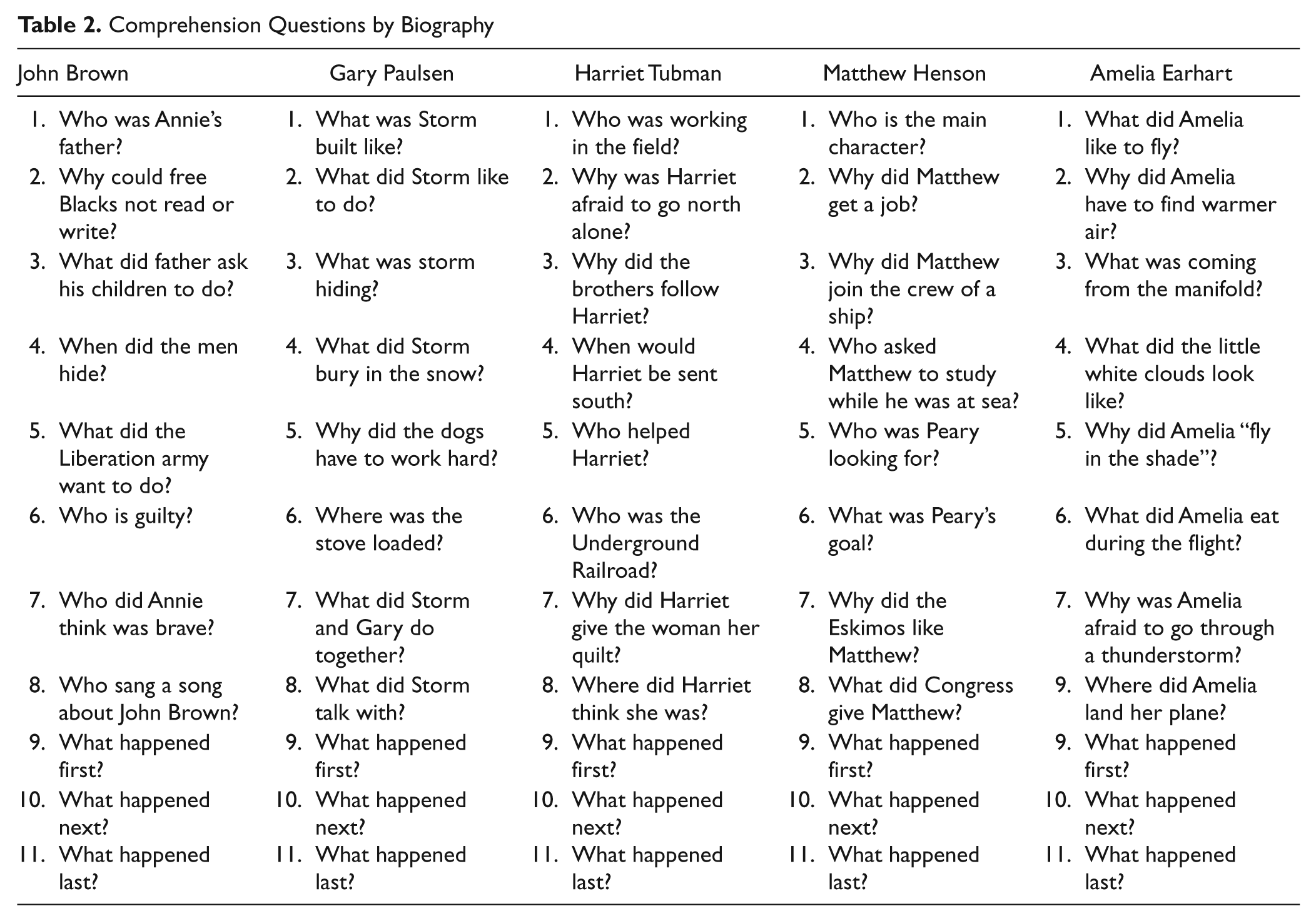
A total of 11 comprehension questions, including 8 “Wh” questions (i.e., who, what, where, when, why) and 3 sequence questions (i.e., What came first? Next? Last?), were written for each biography and placed in text so questions and answers fell on the same page. Comprehension questions from each biography are listed in Table 2.
Comprehension Questions by Biography
Students receptively responded to comprehension questions by selecting one of four response options. Response options included a combination of picture symbols and words printed on 2.5-in. × 1.5-in. index cards and laminated. Each comprehension question included a correct response and three plausible distracters (e.g., if the question asked about a person, all response options were people). The target and distracter options contained picture symbols from the page so students could not correctly answer the question by simply matching the picture symbol from the response card to one on the page. Response options were attached to a page protector via Velcro™ in a 2 × 2 format and organized sequentially by question. Placement of response options on page and order of presentation during intervention varied from session to session.
Graphic organizers
Two graphic organizers were created for use in the intervention. The first graphic organizer (see Figure 1) was similar to one used by peers to organize their responses to the sequence questions (i.e., What came first? Next? Last?) in the general education language arts class. The second was a T-chart graphic organizer with rules for answering “Wh” questions (see Figure 2). Intervention materials were adapted and constructed by the interventionist from supplies found at an office supply store for approximately US$150.00, a cost determined to be practical and cost-effective by the research team.
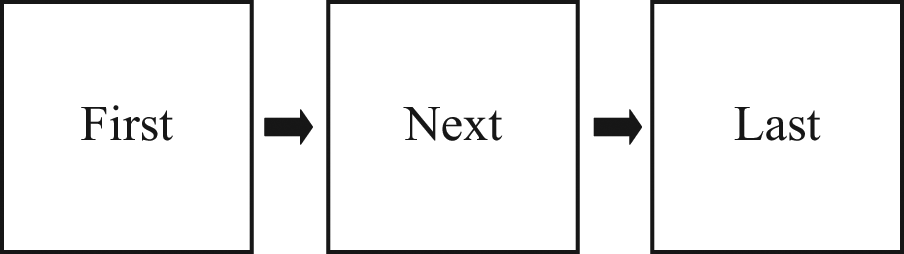
Graphic organizer for sequence questions
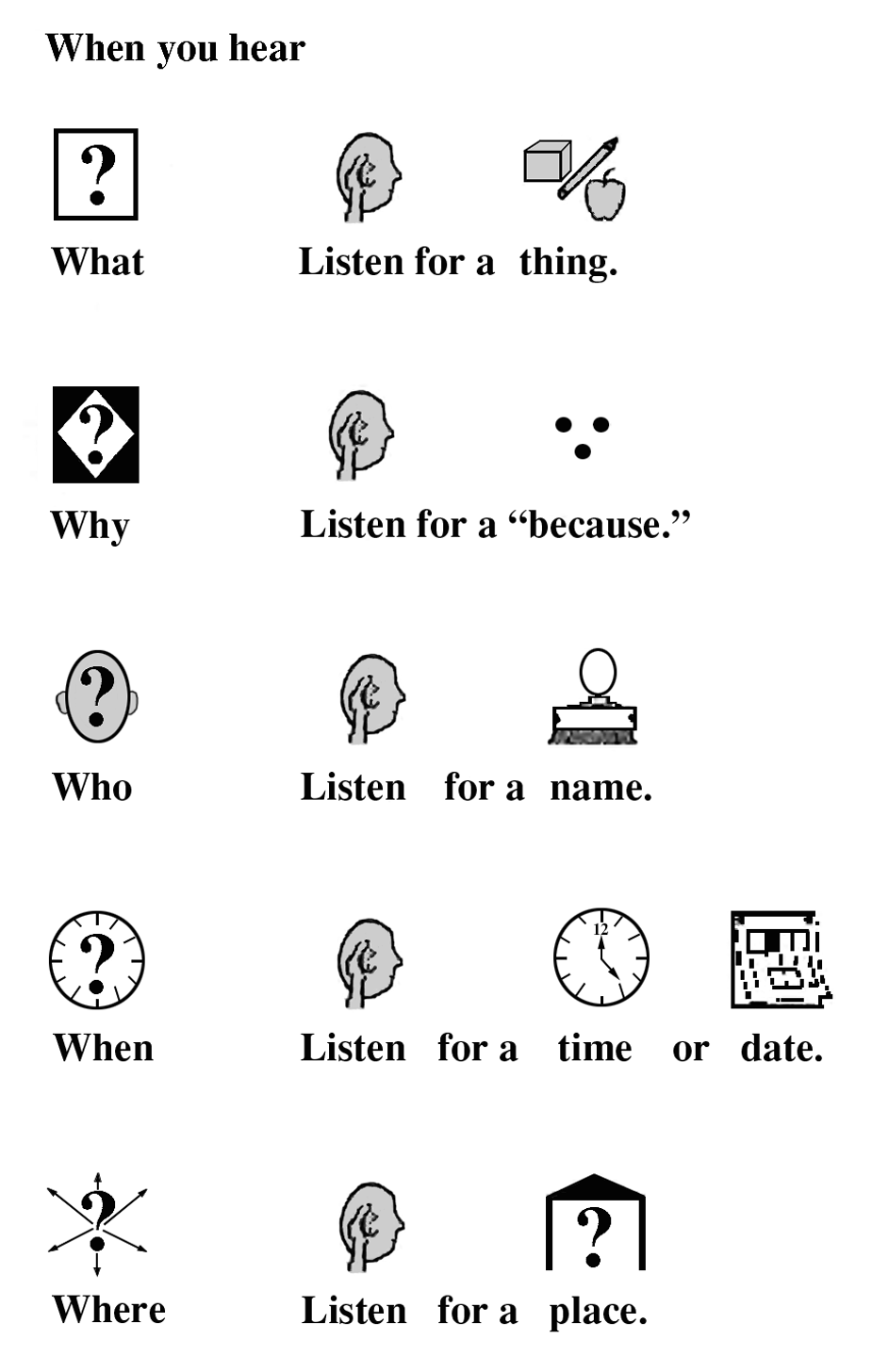
Rules for answering comprehension questions
Research Design
A multiple probe across students design (Gast, 2010) was used to establish experimental control and allowed for instruction to begin with one student while periodic baseline probe sessions were conducted with all other students. This decreased the threat of learning through prolonged testing and exposure to materials. Maintenance data were collected on students who had finished the study while other students continued intervention. Study phases included baseline, intervention, generalization, and maintenance. The interventionist conducted baseline sessions for five sessions prior to intervention and task performance data for each student was low and stable or descending. Students were introduced into intervention in a time-lagged manner until all students completed intervention. Experimental control was demonstrated by a consistent change in level of data from baseline condition to intervention condition across students for all biographies.
Baseline probes of biographies were conducted prior to and between intervention phases. These probes indicated the number of correct unprompted responses to comprehension questions. The order of biographies was varied across participants to control for sequence effect. With the exception of the last biography for John which was taught 4 times, students received instruction on each biography three sessions as additional readings may have resulted in memorization of the answers to the questions rather than listening to the text.
Dependent Variable and Data Collection Procedures
Dependent variable
The dependent variable was the number of correct unprompted responses to text-dependent listening comprehension questions (see Table 2). Each question was asked at a predetermined time during a read-aloud of adapted biographies, which occurred the same way each time the biography was read. Data summarized the number of correct unprompted responses to comprehension questions during the read-aloud.
Data collection
The interventionist delivered intervention to all students and immediately scored student responses on a data sheet as each comprehension question was asked. A second person from the research team observed 25% of baseline and intervention sessions and scored student responses to comprehension questions for purposes of computing interobserver agreement (IOA) reliability, and interventionist behaviors for purposes of computing procedural fidelity.
IOA and procedural fidelity
IOA reliability for student response data collection was taken on 27% of baseline sessions and 28% of intervention sessions. During baseline, the third author scored each question as correct (+) or incorrect (−). During intervention, each question was scored item by item and the prompt level required for the student to provide the correct response was recorded. IOA was calculated by taking number of agreements divided by the number of agreements plus disagreements and multiplying by 100%. IOA for baseline and intervention sessions was 100% for all students for all sessions.
Procedural fidelity was computed by having the third author score whether or not the interventionist presented each step of the intervention for each predetermined comprehension question across 27% of baseline sessions and 28% of intervention sessions. Procedural fidelity was calculated by dividing number of steps present by total number of steps planned and multiplying by 100% (Billingsley, White, & Munson, 1980). Procedural fidelity for baseline and intervention sessions was 99.8% (range = 98%–100%).
Procedures
Baseline
The interventionist and student sat side-by-side at a table for all sessions. Response options and graphic organizers (i.e., sequence graphic organizer and “Wh” question T-chart) were on the table in front of student. To begin, the interventionist showed the student the biography and said, “Today, we are going to read a biography about [person’s name]. A biography is a true story.” The interventionist held the adapted biography in front of the student so both could see the printed page and moved a finger under text while reading aloud. At predetermined points in the story, the interventionist stopped and asked 1 of 11 comprehension questions paired with the biography. After a question was asked, the interventionist pointed to and read aloud the response options, looked expectantly at student, and waited 4 s for a response. If a response was correct, the interventionist recorded “+” on the data sheet. If the student responded incorrectly or made no response within 4 s, the interventionist recorded “−” and continued reading. Each biography was read entirely and students were given an opportunity to answer all comprehension questions each session. The interventionist did not prompt or praise student responses or refer to the sequence graphic organizer or “Wh” question T-chart. General verbal praise was given for work behaviors and attending to task on a variable ratio schedule.
Intervention
Intervention included a modified system of least intrusive prompts delivered during a read-aloud of an adapted biography. The interventionist began each session as described in baseline procedures. At predetermined points during the read-aloud, the interventionist stopped and asked 1 of 11 comprehension questions and waited 4 s for a response. If the response was correct, the interventionist recorded the response as a correct unprompted response, delivered descriptive verbal praise, and continued reading the biography. If the response was incorrect or no response was given within 4 s, increasingly intrusive prompts were provided until the student gave the correct response. In this study, the system of least intrusive prompts was modified by inserting a rule for answering “Wh” questions and an opportunity to hear sections of the biography read again (i.e., rereads). The first prompt involved the interventionist stating the type of “Wh” question being asked and its rule while pointing to the “Wh” word and rule on the T-chart. For example, if the student failed to respond to the question, “Who was Annie’s father?” the interventionist said, “When you hear who, [pointed to ‘who’ on T-chart], listen for a person’s name” [pointed to rule on T-chart]. The interventionist then reread the paragraph containing the answer (i.e., general reread prompt), repeated the question and response options, and waited 4 s for a student response. The rules stated in the first level prompt for each question are shown in Figure 2.
If the student failed to respond or responded incorrectly, a second prompt was given. In the second prompt, the interventionist reread the sentence containing the answer (i.e., targeted reread prompt), modeled the correct response (e.g., pointed to response option for John Brown), reread the question and response options, and waited 4 s for a student response. If the student failed to demonstrate a correct response, the interventionist provided a third prompt. In the third prompt, the interventionist provided the controlling prompt by pointing to the correct response option and saying, “The answer is John Brown. Your turn. You point to John Brown.” Descriptive verbal praise was given for correct responses (e.g., “You’re right! John Brown was Annie’s father.”). Students were given preferred items following all sessions.
The sequence graphic organizer (see Figure 1) was used during intervention to help students organize their responses to three sequence questions following the prompting procedure previously described, but the number of response options the student had to select from was different for the second and third sequence questions. For the first question (i.e., What happened first?), students selected from one of four response options and placed their responses in the first box of the graphic organizer. This response was no longer available in the array of options. For the second question (i.e., What happened next?), students selected from one of three response options and placed it in the second box. For the third sequence question (i.e., What happened last?), students selected from the two remaining response options and placed it in the third box.
Massed-trial training
After the 1st week of intervention, the second participant, Nathan, failed to demonstrate a therapeutic change in level. Massed-trial training was implemented on how to answer a comprehension question before the next biography was introduced to increase his correct unprompted responses. Questions were taken from the biography used with Nathan during intervention the 1st week. For each trial, the interventionist ensured student attention (e.g., Ready?), asked a comprehension question, pointed to and read aloud the four response options, then immediately pointed to and said the correct response (e.g., “The answer is John Brown.”) and asked the student to do the same (e.g., “Now, you do it.”). After 10 question–answer trials at 0-s delay, another 10 question–answer trials were conducted in the same fashion, but a 4-s delay was inserted after presenting the response options, giving the student an opportunity to respond independently. Descriptive verbal praise was given after each correct response, and a student-selected reinforcer was given at the end of training. Errors were interrupted and the correct response modeled and the controlling prompts were given. After massed-trial training, intervention was delivered using the procedures described previously. Massed-trial training was given before the next six intervention sessions, then discontinued when Nathan’s data demonstrated a therapeutic change in level (i.e., increased number of correct unprompted responses).
Maintenance
Maintenance data were collected 2 weeks after intervention was completed. Maintenance conditions were the same as baseline conditions except biographies were randomly selected from biographies used during intervention.
Generalization
Generalization of learned skills was measured during the introduction of new biographies. Generalization was measured by comparing the mean number of correct unprompted responses to comprehension questions during baseline to the mean number of correct unprompted responses during baseline probes taken during intervention prior to instruction on new biographies. The mean number of correct unprompted responses during baseline probes after intervention was computed by adding the total number of correct unprompted responses for each baseline probe divided by the number of baseline probes (i.e., five).
Data Analysis
During baseline and intervention, the number of correct unprompted responses was graphed. Data were analyzed by visually inspecting graphed data to identify trend, level, and variability and to determine whether a functional relation existed between the independent and dependent variables. Prediction, verification of prediction, initial effect, and replication of effect were assessed for all students and biographies.
Results
Each student answered 165 “Wh” questions across five biographies during intervention. Wanda answered 106 questions correctly (i.e., 64%); Nathan, 77 (i.e., 47%); John, 92 (i.e., 56%); and Gary, 124 (i.e., 75%). Student performance data are displayed in Figure 3.
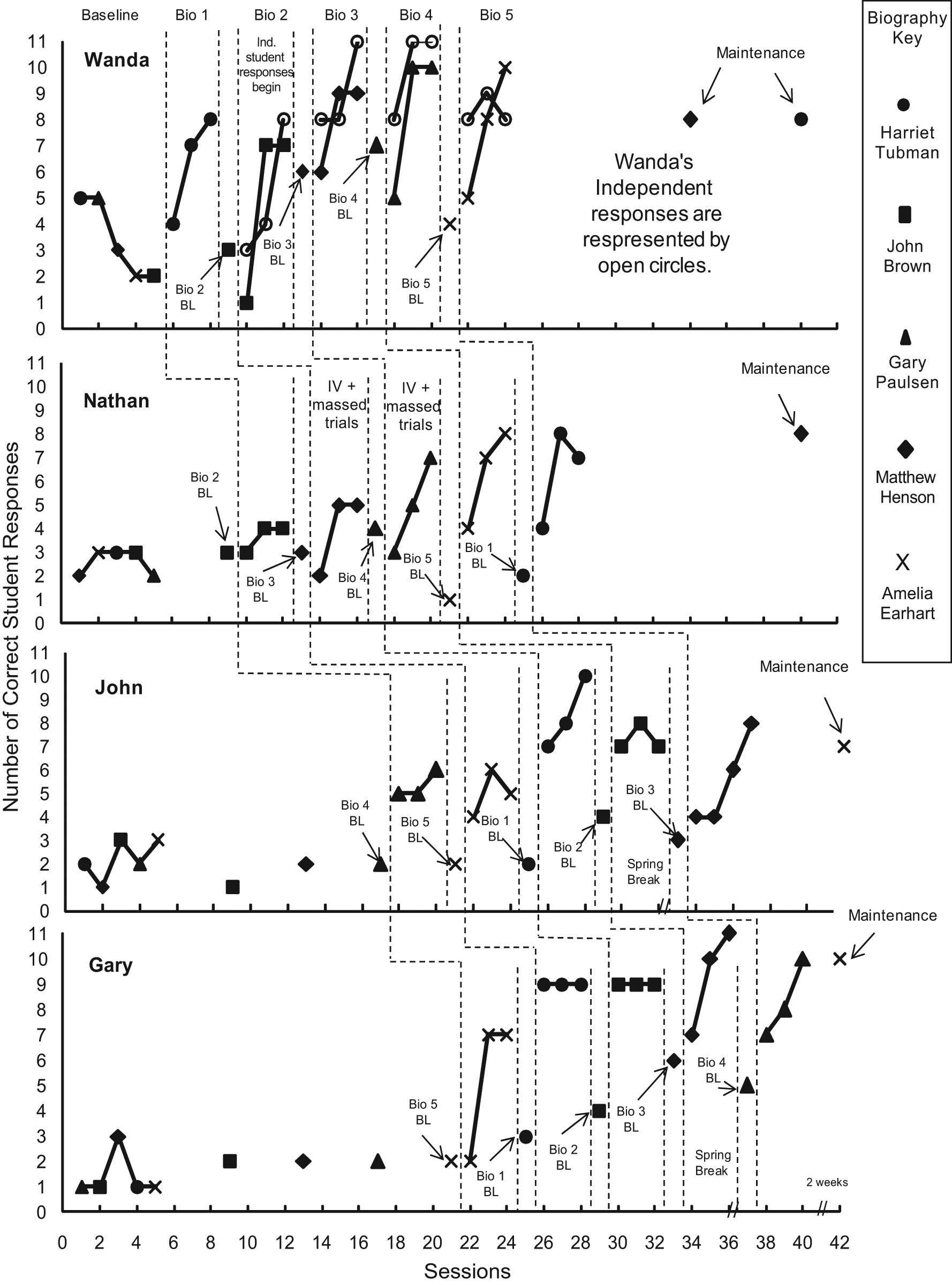
Number of unprompted correct student responses during shared story reading of a biography across all study phases
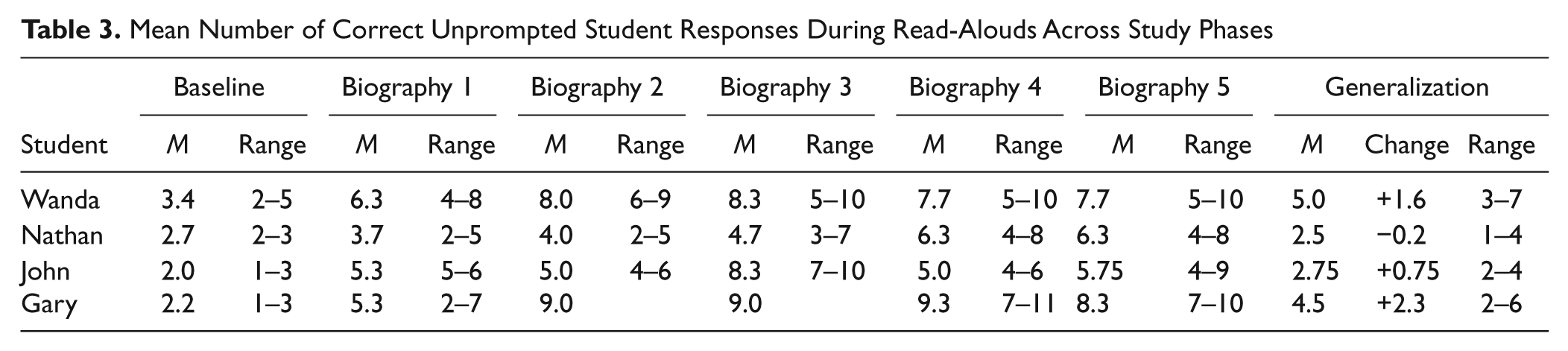
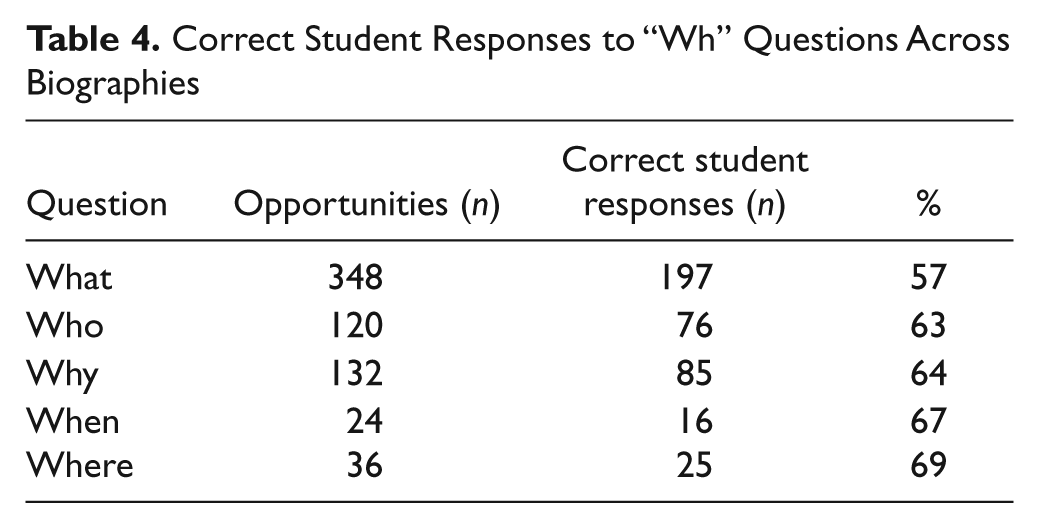
A comparison of the mean number of correct unprompted responses and ranges for baseline, intervention, and generalization for each student are provided in Table 3. Each biography was assessed at least once in baseline; baseline mean was computed by calculating the total number of correct unprompted responses divided by the number of baseline sessions. To compute the mean number of correct unprompted responses for each biography during intervention, the sum of correct unprompted responses was divided by the total number of sessions the biography was taught in intervention. Table 4 contains the frequency and percentage of correct student responses by “Wh” question.
Mean Number of Correct Unprompted Student Responses During Read-Alouds Across Study Phases
Correct Student Responses to “Wh” Questions Across Biographies
Wanda
Although Wanda’s educational records and her teacher indicated that she was a nonreader except for some sight words, beginning with Biography 2, Wanda began to read the biographies aloud and answer the comprehension questions without any help from the interventionist after intervention. Wanda’s performances during independent reading are displayed in Figure 3 as a second data series. Wanda’s mean number of correct unprompted responses during independent reading sessions increased considerably from baseline through the five biographies.
Nathan
Because Nathan’s response to the first biography was minimal, the research team provided massed-trial instruction (i.e., 10 question–answer trials at 0-s delay and 10 question–answer trials at 4-s delay) prior to intervention until he showed a therapeutic change in level. Massed-trial instruction occurred for six sessions (i.e., two biographies). Biography 2 showed an increase in correct unprompted responses as did Biography 3. For the remaining biographies, the massed-trial instruction was discontinued. Nathan showed an increase in correct unprompted responses for Biography 4, and maintained level of responding for Biography 5.
John
The number of correct unprompted responses for John increased from baseline, with a noticeable peak during Biography 3.
Gary
Gary’s correct unprompted responses increased steadily across the biographies.
Generalization
In Figure 1, the generalization data points are enclosed within phase lines (e.g., Bio 1 BL, Bio 2 BL). This data point indicates performance on the new (not yet trained) biography to be introduced in the next phase. As can be seen in Table 3, the mean number of correct unprompted responses for baseline probes after intervention was higher for three students but lower for Nathan.
Social Validity
The classroom teacher completed a social validity form for each student after the study ended. Using a 5-point Likert-type scale, the classroom teacher indicated her level of agreement or disagreement with 10 statements by circling one of five responses (5 = strongly agree, 4 = agree, 3 = neutral, 2 = disagree, and 1 = strongly disagree). Statements measured study procedures (e.g., the system of least prompts is appropriate for the student) and outcomes (e.g., the adapted biographies helped access the general curriculum for this student).
The teacher strongly agreed that the use of system of least intrusive prompts was appropriate for all students, the use of rules for answering “Wh” questions was appropriate for all students, and the adapted biographies helped all students access the general curriculum. In addition, the teacher strongly agreed to statements, “I am considering using the system of least intrusive prompts to help increase my other students’ comprehension skills” and “I am considering using rules for answering ‘Wh’ questions with the students in my classroom.” The teacher agreed comprehension questions from adapted biographies were important and adequate for most students and the ability to correctly answer text-dependent comprehension questions during a biography lesson was a valuable skill for all but one student. Anecdotally, the teacher shared that one student showed an increase in his ability to answer “Wh” questions during class and in his use of a personal schedule, whereas another student demonstrated increased participation in group reading lessons. All students demonstrated enjoyment in intervention procedures and were eager to work with the interventionist.
Discussion
Students demonstrated low and steady or descending levels of correct unprompted responding during baseline and all students’ correct unprompted responses increased after intervention; a functional relation between the intervention and number of correct unprompted responses to comprehension questions was demonstrated. The change in level after intervention was replicated across all students and biographies. These outcomes add to the literature that read-alouds are effective for promoting text meaning for students with moderate and severe developmental disabilities (Browder et al., 2007; Browder, Mims et al., 2008; Mims et al., 2009; Mims et al., 2010; Skotko, Koppenhaver, & Erickson, 2004). Previous researchers (Browder, Mims et al., 2008; Koppenhaver et al., 2001; Mims et al., 2009) demonstrated the use of fiction literature (e.g., Dirty Bertie, Call of the Wild) during shared story reading promoted literacy for students with developmental disabilities. We have extended this research by demonstrating nonfiction biographies also can be used to promote literacy during read-alouds and add to Browder et al.’s (2007) demonstration of how to use read-alouds with older students.
In this study, we have provided some unique insights for future use of read-alouds to promote text comprehension. First, we used the most extensive list of comprehension questions to date in the research on read-alouds for students with developmental disabilities and introduced a new first level prompt that may have helped students know how to find the answer to “Wh” questions that not only required immediate recall (e.g., “who”) but also some inference (e.g., “why”). This may have been due to using a first level prompt that gave the student a rule for finding the answer when the text was reread (e.g., “who—listen for a person’s name”). Results from previous researchers indicate that the use of rules can promote comprehension. For example, Gajria and Salvia (1992) found teaching five summarization rules (Brown & Day, 1983) improved comprehension of expository text for 15 students with learning disabilities in Grades 6 through 9. Jitendra, Cole, Hoppes, and Wilson (1998) found rules for summarizing the main idea and self-monitoring improved reading comprehension for three Grade 6 students with learning disabilities.
A second insight was that these rules may have helped students know how to find answers to comprehension questions when new biographies were introduced. One of the potential shortcomings of prior shared story research is that students may memorize the answers to the comprehension questions through repeated readings of the story. Repeated readings are an important part of interactive read-aloud instruction because it gives the student an opportunity to produce more independent correct answers across readings. In the current study, three of the students began to answer more comprehension questions without prompting on the first reading of a biography compared with baseline.
Secan, Egel, and Tilley (1989) also found that students with autism generalized skills in answering “Wh” questions (i.e., what, how, and why) to new questions (e.g., storybook questions) when a relevant cue was visible. In their study, Secan et al. divided “Wh” questions into subcomponents based on use (e.g., what was divided into use as an object or noun and use as “which”) and taught each subcomponent to criterion before moving to the next. Likewise, all subcomponents belonging to a specific question type were taught to criterion before moving to the next question type (e.g., all “what” questions were taught before “how” and “why” questions). Unlike the findings of Secan et al., however, we found that students improved correct responses on all types of “Wh” questions taught simultaneously (see Table 4) and student responses did not vary greatly across types of questions, even though rules for answering “Wh” questions were not taught in sequential order by subcomponents. Future research is needed to compare whether students learn “Wh” questions better when introduced concurrently or sequentially and the extent to which this learning is influenced by the use of a rule for answering questions.
Future investigations also should include a measure of generalization to determine which method gets students to the ultimate goal of being able to comprehend the content after one reading. Nathan’s lack of generalization, although disappointing, is also instructive. Nathan entered the study with the fewest communication skills. His initial response to the intervention was minimal, but improved with massed-trial instruction before intervention. With this strategy, Nathan showed higher responding to the subsequent biographies. In contrast, Nathan did not generalize his skills. What Nathan may have learned was how to memorize answers through the massed-trial instruction. Even though these massed trials were discontinued, they may have helped him learn how to memorize the answer by the third session with the biography rather than applying the rule to find the answer. Although generalization is the ultimate goal, memorization may be a starting point for some students because it provides a means to learn facts from text summaries (e.g., in this study, key points for each biography).
A student like Nathan also might improve generalization from modifications to the intervention such as teaching each type of comprehension question to mastery before introducing the next question or using a more salient prompting method (e.g., having him touch the answer in the text). More research is needed with students like Nathan who begin intervention with fewer listening and communication skills. Researchers might focus on how to make the text more salient to the student (e.g., revised wording, use of pictures, use of activities to build background knowledge). In the future, researchers also might evaluate methods to shape responding, for example, by teaching the student to answer a question after one sentence is read, then two sentences, and so on.
A third insight was that students might have reading skills beyond what they have demonstrated to date in school settings. Shortly after beginning the study, Wanda began asking to read the biography for herself. Prior to the study, it was not known that Wanda could read and comprehend the adapted material independently because similar material had not been available to her. Rather than discontinue the intervention when it became apparent that Wanda could read, the interventionist delivered the intervention as planned to improve Wanda’s comprehension, then gave her the opportunity to read the biography and answer questions without assistance from interventionist. As Wanda read the biography aloud and asked herself the questions, the interventionist recorded Wanda’s responses and graphed correct unprompted responses as a second data series in Figure 3. Wanda’s case illustrates that students’ ability to “show what they know” can be limited by the opportunities provided. For example, when given a list of sight words to read, Wanda could demonstrate only that ability. However, when given a text summary, she was eager to show she could read the paragraphs aloud. In contrast, Wanda’s oral reading skills were beyond her comprehension skills, a common discrepancy well documented in the literature (Flores & Ganz, 2007), and she improved her ability to answer comprehension questions through the combined reading/listening intervention.
Limitations and Suggestions for Future Research
There are several limitations to this study. First, the intervention was conducted by a member of the research team. Ultimately, interventions need to be implemented by classroom teachers, and it is important to develop interventions that are effective and easily implemented by educators to close the research-to-practice gap. Researchers have documented that special education teachers can effectively promote literacy for students with significant intellectual disability in the context of shared story reading. For example, Browder et al. (2007) found training effective for three middle school special education teachers to promote literacy for their students with moderate and severe disabilities during shared story reading and Mims et al. (2010) trained a teacher and two paraprofessionals to use least prompts to teach text-dependent listening comprehension during the reading of fictional shared stories. In the future, researchers should evaluate the effectiveness of teacher training on implementing read-alouds of adapted grade-level academic content within the context of shared story reading interventions to promote literacy with elementary and secondary students.
A second limitation of this research is the one-to-one instructional format in which the intervention was delivered. Although one-to-one instruction is common for many students with disabilities, teaching students in groups has advantages. In a review of small group instruction, Collins, Gast, Ault, and Wolery (1991) found group instruction (a) increases the number of students teachers can instruct at one time, (b) requires less classroom personnel and instructional time, (c) is often used in less restrictive environments, (d) provides opportunities for students to learn important social skills (e.g., how to interact appropriately with peers), and (e) provides opportunities for students to learn additional information by observing other members of the group. Generalization of findings to other students also is limited due to the small number of students involved (n = 4) in this study. Researchers should investigate ways to evaluate interventions using larger groups of students.
The use of a separate setting for intervention is a third limitation of this study. Although the majority of students with severe developmental disabilities receive instruction in self-contained classrooms, researchers have noted that embedded systematic instruction within ongoing classroom activities can promote acquisition of academic grade-level content (e.g., vocabulary sight words) for students with severe disabilities in inclusive settings (Johnson & McDonnell, 2004; Riesen et al., 2003; Wolery, Anthony, Snyder, Werts, & Katzenmeyer, 1997). Although the results of this research are promising, it remains an empirical question whether read-alouds can promote literacy in inclusive settings for students with moderate and severe developmental disabilities. Research is needed that investigates the efficacy of using read-alouds in the general education classroom and to develop effective instructional models that can be implemented by teachers, para-educators, and peers in the general education classroom. When making these applications, it would also be preferable to try the grade-level nonadapted text first. Some students may not need text to be summarized to demonstrate comprehension. In the case of the biographies adapted for this study, however, the length of the original biographies would have prevented them from being read aloud to the student in one sitting.
A fourth limitation in the study is that it cannot be conclusively determined each participant used the rules for answering “Wh” questions taught during the intervention to find or recall answers. For the intervention to be most useful, students would need to learn to use it without assistance. A future extension might be to take a student-directed learning approach (Agran, King-Sears, Wehmeyer, & Copeland, 2003). Students might be able to learn to use the strategy for self-instruction and record data for both their use of the strategy and their responses to comprehension questions (Gilberts, Agran, Hughes, & Wehmeyer, 2001).
Implications for Practice
Results from this study can be interpreted to conclude that students with moderate and severe developmental disabilities are able to acquire comprehension skills using systematic instruction and adapted grade-level biographies. The use of adapted grade-level biographies is congruent with recommendations by Browder, Spooner, Wakeman, Trela, and Baker (2006) for linking classroom instruction with academic content standards. The relatively fast pace with which biographies are introduced into intervention also emulates the faster instructional pace of the general education classroom. The implication for educators is to use a variety of grade-level adapted materials while targeting generalizable skills (e.g., same set of comprehension questions). A question for future research is whether or not students could demonstrate similar improvements in listening comprehension after listening to original text read-aloud instead of an adapted text. Adapting academic content is time-consuming for teachers and it remains an empirical question if similar results could be attained without such adaptations.
A system of least intrusive prompts was modified by inserting a rule for answering “Wh” questions along with a reread prompt. Previously, researchers found that teaching rules was effective for promoting reading comprehension for students with disabilities (Gajria & Salvia, 1992; Jitendra et al., 1998). In this study, one student began stating the “Wh” question rule when the interventionist began the first prompt, even though she was not required to do so in the intervention. A second implication for educators is that, for some students, learning can be more efficient by inserting information or decision-making strategies into the system of least prompts during instruction.
The prompts used in the intervention were introduced with the use of graphic organizers (visual referents). Graphic organizers are an effective instructional method for teaching reading comprehension (National Reading Panel, 2000) and used widely in the general education classroom. Examples of studies using graphic organizers to promote academic learning for students with more severe disabilities are beginning to appear in the literature. Jimenez, Browder, and Courtade (2009) taught three middle school students with moderate intellectual disability to self-regulate their learning during science class by embedding a strategy to complete a KWHL chart into the lesson. Students asked themselves questions (i.e., What do I know? [
A fourth implication for educators is that having multiple response options for students to select their answers is important for students with limited communication skills and practitioners need to give thought to how many options to provide, as well as what to use as distracters when a receptive format is used. Students have a 50% chance of getting the correct answer with two response options. In this study, students selected from four response options, reducing the chance for guessing to 25%. Although we included only plausible distracters (e.g., when asked a “who” question, all the response options were “people”), it may be beneficial to include implausible or nonsensical distracters to determine whether the student understands the question. For example, when asking a “who” question, some of the response options might be objects rather than people.
This study adds to research on using read-alouds to promote literacy skills for students with significant intellectual disability. Students with moderate and severe developmental disabilities are underrepresented in the research on literacy instruction, and this study was the first demonstration of the use of adapted grade-level biographies during read-alouds with this population. In addition, this study adds to the research on the use of systematic instruction and system of least prompts to promote listening comprehension for students with significant intellectual disability by inserting a rule for answering “Wh” questions and a reread prompt into the verbal prompt of the system of least prompts.
Footnotes
The author(s) declared no potential conflicts of interest with respect to the research, authorship, and/or publication of this article.
The author(s) received no financial support for the research, authorship, and/or publication of this article.