




Abstract
General education placement of students with autism spectrum disorders (ASD) has increased at a rate faster than all other disability categories combined. As more children are diagnosed with ASD and expected to meet the same academic standards as their neurotypical peers, there is a demand for effective educational strategies. Using a multiple-baseline across participants design, seven cognitive strategies and three meta-cognitive strategies from the Solve it! Problem Solving Routine were taught to three adolescents with ASD. Percent of correct responses on word problems improved immediately upon implementation of the intervention. A peer comparison validation strategy was used to compare participants’ accuracy with the class average. All three participants got more problems correct during intervention when compared with their peers; this effect persisted for two participants during maintenance. The impact of the characteristics of ASD on the use of each strategy implemented within the Solve It! Problem Solving Routine is discussed.
General education service placement of students with autism spectrum disorders (ASD) has increased at a faster rate than all other disability categories combined (Sansoti & Powell-Smith, 2008). In 1990–1991, only 4.8% of children with ASD spent 80% or more of the day in the general education setting, compared with 2003–2004 when 29.1% of children with ASD spent 80% or more of the day in the general education setting (U.S. Department of Education, 2004). As more children are diagnosed with an ASD, and expected to meet the same academic standards as their neurotypical peers, there is a demand for effective educational strategies. Unfortunately, the National Research Council (2001) and National Autism Center (2009) report there are no identified evidence-based academic interventions for students with ASD.
During middle schools years, students with ASD perform on average 5 years below their neurotypical peers in mathematics (Wagner et al., 2003). Twenty-three percent of students with ASD have a mathematics learning disability (Mayes & Calhoun, 2003a) compared with 5% to 8% of school-age children (Greary, 2004). In middle school, mathematics becomes more abstract and applied, emphasizing mathematical thinking, which includes higher level thinking, reasoning, and problem-solving skills relating to the real world (National Council of Teachers of Mathematics [NCTM], 2000). Higher level thinking, reasoning, and problem-solving skills can be weaknesses for children with ASD (Barnhill, Hagiwara, Myles, & Simpson, 2000; Griswold, Barnhill, Myles, Hagiwara, & Simpson, 2002; Mayes & Calhoun, 2003b). These specific cognitive skills are related to the executive functioning (EF) deficits associated with ASD.
EF deficits in individuals with ASD include poor organizational skills, attention difficulties, motivational issues, and work completion problems (Happe, Booth, Charlton, & Hughes, 2006). EF deficits include difficulties with (a) memory/planning, including cognitive processes such as organization, working memory, and interference control; (b) set shifting/mental flexibility, including cognitive processes such as perseveration, attention, and self-monitoring; and (c) inhibition/response control, including cognitive processes such as impulse control. Students with EF deficits are challenged by abstract concepts, inferences, and applied problems (Donnelly, 2005).
The complexity of material in mathematics can be problematic for children with ASD. As the number of steps required in solving word problems increases, problem solving requires working memory, organization, and mental flexibility for task completion. To become independent learners, students with ASD can develop cognitive and meta-cognitive skills in the form of learning strategies; however, the strategy may need to be adapted for language and attention difficulties (Bebko & Ricciuti, 2008). Fortunately, learning strategy instruction has been validated for children with learning disabilities (Schumaker, 2009) and may be appropriate for children with ASD.
Deshler and Schumaker (1986) defined learning strategies as a sequence of behavior consisting of physical actions and cognitive behaviors that learners use as they complete learning tasks. Effective learners use strategies to complete tasks; ineffective learners do not. Strategies can be learned and include cognition for learning purposes such as planning, memorization, or checking (Pressley, Forrest-Pressley, Elliott-Faust, & Miller, 1985). Generally, students increase their use of strategies as they proceed through middle school, high school, and college (Pressley & Hilden, 2006). Effective learners invent strategies based on the demand of new tasks and continually build upon their repertoire of strategies (Schumaker, 2009). However, some students do not discover or use the most potent strategies as they confront academic tasks, but these strategies can be taught, acquired, and generalized (Pressley & Hilden, 2006).
In the 1980s, Montague began a series of studies to develop strategy instruction for mathematical word problem solving (Montague, 1984, 1992; Montague, Applegate, & Marquard, 1993; Montague & Bos, 1986). What resulted was a combination of cognitive and meta-cognitive strategies that encompass the Solve It! Problem Solving Routine (Montague, 2003). Table 1 describes each step in the Solve It! Problem Solving Routine. Researchers found the use of the Solve It! Problem Solving Routine was an effective strategy to teach students with learning disabilities (Daniel, 2003), spina bifida (Coughlin & Montague, 2010), and intellectual disability (Chung & Tam, 2005) to solve mathematical word problems. Montague and Dietz (2009) suggested that more empirical studies need to be conducted on the Solve It! Problem Solving Routine across different settings and with various participants to establish the evidence base. To date, the Solve It! Problem Solving Routine has not been tested with students who have ASD, but may be effective because the routine capitalizes on their strengths as visual thinkers with strong rote memories, while also providing support for EF deficits in the areas of attention, memory, sequencing, and organization.
Solve It! Problem-Solving Routine Cognitive and Meta-Cognitive Processes.

Source. From Montague (2003). Used with permission from Exceptional Innovations, Inc. (2003).
The purpose of this study was to investigate the use of the Solve It! Problem Solving Routine for students with ASD and to answer the following research question:
Research Question 1: What is the effect of the Solve It! Problem Solving Routine on the percent correct of multiple-step word mathematical problems for students with ASD in middle school?
Method
Participants
Approval to conduct the research study was granted by Institutional Review Boards at the University of Central Florida and the participating school system. Three adolescents with an ASD were chosen for the study. Diagnosis of one of the ASD was obtained independently from a physician, licensed psychologist, or psychiatrist. The author confirmed the diagnoses by interviewing the participants’ parents using the Autism Diagnostic Interview–Revised (ADI-R; Rutter, LeCouteur, & Lord, 2003). Additional inclusion criteria were attendance at a public middle school, mathematics instruction delivered in a general education setting, teacher report of word problem difficulties, and a documented IQ of 80 or higher as an indicator of high-functioning autism (Bertrand, Mars, Boyle, & Bove, 2001). Twenty-fifth percentile ranking or higher in reading comprehension per the Woodcock–Johnson Tests of Achievement (Woodcock, McGrew, & Mather, 2001) was required, as the word problems were written at the third-grade level. Table 2 contains student demographic information.
Participant Characteristics.
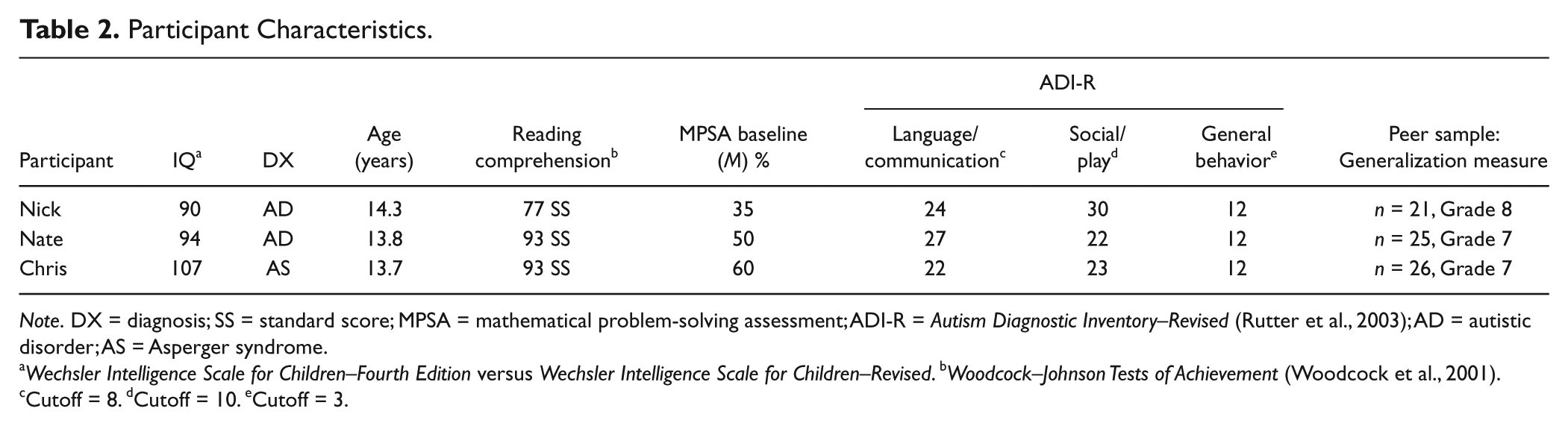
Note. DX = diagnosis; SS = standard score; MPSA = mathematical problem-solving assessment; ADI-R = Autism Diagnostic Inventory–Revised (Rutter et al., 2003); AD = autistic disorder; AS = Asperger syndrome.
Wechsler Intelligence Scale for Children–Fourth Edition versus Wechsler Intelligence Scale for Children–Revised. bWoodcock–Johnson Tests of Achievement (Woodcock et al., 2001). cCutoff = 8. dCutoff = 10. eCutoff = 3.
Nick
Nick was an eighth-grade student who was educated 100% of the day in the general education setting. He received an extra period of intensive mathematics due to low performance on statewide standardized assessments. Nick was diagnosed with autistic disorder at the age of 15 months. He received intensive early intervention services from the age of 2 years until school age. Upon entering school, he continued to receive intensive in-home therapies.
In academics, Nick was a “B” student and received accommodations in the general education setting. His accommodations were extra time, quiet setting for testing, and reduced number of problems; he could have mathematical problems read to him. Nick was aware of his accommodations but did not self-advocate for use of the accommodations. He performed poorly on word problems and had not passed the statewide grade-level assessment in math.
Nate
Nate was a seventh-grade student who was educated at least 80% of the day in the general education setting. He spent 1 hr a day in a resource class for students with ASD for academic assistance. Nate was diagnosed with autistic disorder at the age of 18 months. He received intensive early intervention services from the age of 18 months until school age. Upon entering school, he continued to receive intensive in-home therapies.
In academics, Nate was a “B” student and received accommodations in the general education setting. His accommodations were extra time and a quiet setting for testing. He was aware of his accommodations, but did not self-advocate for use of the accommodations. Nate’s performance on statewide tests and classroom assignments had decreased since he started middle school.
Chris
Chris was a seventh-grade student who was educated at least 80% of the day in the general education setting. He attended a social skills class in a resource room. He was diagnosed with Asperger’s syndrome at 10 years of age. Prior to the Asperger’s diagnosis, he was diagnosed with a behavior disorder and served in a classroom for children with severe behavior disorders. He received intensive speech-language services from the age of 2 years until school age. Chris had a severe regression in language and motor development around the age of 18 months.
In academics, Chris was an “A” student and received accommodations in the general education setting. His accommodations were extra time and a quiet setting for testing. He was aware of his accommodations, but did not self-advocate for use of the accommodations. He performed average on tests even though he had very high computational abilities.
Setting
The study took place in two public middle schools in a central Florida school district. Nick and Nate attended the same middle school, whereas Chris was the only participant at the other middle school. Schools had similar demographics. At each school a certified exceptional educator provided support services for students with ASD in general education settings. The participants were taught and practiced the Solve It! Problem Solving Routine individually in a separate classroom. Generalization data were collected in their general education mathematics classrooms.
Materials
During each phase, materials from the Solve It! Problem Solving Routine curriculum were used (Montague, 2003). These items included scripted lessons, pre-/post-assessments, strategy cue cards, and strategy posters. A rule was embedded into lessons that each step of the strategy had to be completed. Many students with ASD have strict adherence to rules and routines. The addition of the rule was an attempt to increase the likelihood that the students used each step of the routine. Curriculum-based measures of one-, two-, and three-step word problems developed by Montague (2003) specifically for middle school students were utilized to assess progress, along with released, sixth-grade Florida Comprehension Assessment Test (FCAT) exam questions. Each mathematics probe contained five word problems. Four word problems—1 one-step, 2 two-step, and 1 three-step—were taken directly from Montague’s curriculum-based assessment, and 1 sixth-grade FCAT word problem was chosen to facilitate generalization to the general education classroom. All generalization probes consisted of one medium-difficulty sixth-grade FCAT test item. A sixth-grade FCAT problem was chosen rather than grade-level problems to ensure that all participants had access to the mathematical content contained within the word problem.
Dependent Variable and Reliability
The dependent variable was percent correct on word problems (Montague’s curriculum-based measure [CBM] and FCAT word problems). Montague’s CBM of mathematical word problems was calibrated using Item Response Theory methods to achieve equivalence with respect to difficulty level across measures. The internal consistency of the measures ranged from .70 to .80. The FCAT is intended to measure student knowledge of the Florida Sunshine State Standards (Florida Department of Education, 2007). Questions were obtained from released FCAT tests available online. FCAT reliability indices at Grades 4, 5, 8, and 10 are above .90 (Florida Department of Education, 2007). Each question is rated for level of difficulty (easy, medium, difficult), and the answer is provided.
Interrater reliability was established by having a doctoral-level exceptional educator independently grade 33% of the work samples across all phases of the study. Results were compared with the participants’ teachers’ grading results. Interrater reliability was calculated by the formula: agreements / (agreements + disagreements) × 100%. Interrater reliability was 98% across all participants and all phases.
Independent Variable and Treatment Integrity
The independent variable was the Solve It! Problem Solving Routine curriculum (Montague, 2003). The curriculum consists of teaching students seven cognitive strategies and three meta-cognitive strategies. The seven cognitive strategies are: read, paraphrase, visualize, hypothesize, estimate, compute, and check. The three meta-cognitive strategies are self-management (say), self-questioning (ask), and self-evaluation (check). Table 1 provides an overview of the strategies. The strategies used are thought to facilitate linguistic and numerical information processing, visual representation in memory, comprehension of problem information, and planning for problem solution (Coughlin & Montague, 2010). The instructional model includes (a) assessment of performance and appropriate identification of students for the instruction, (b) explicit instruction in mathematical problem solving, (c) process modeling, and (d) evaluation of student outcomes with an emphasis on strategy maintenance and generalization (Montague, 2003). The curriculum consists of a pre-/posttest, five training lessons developed for students to learn the strategy, and acquisition lessons developed for students to reach mastery.
Treatment integrity was accomplished in several ways. First, scripted lessons from the Solve It! Problem Solving Routine were used to teach the intervention. Second, a treatment-integrity checklist was followed during all phases of the study while teaching the lessons. Last, a research assistant assessed treatment integrity while watching videos of 33% of the intervention sessions, and comparing instruction to the instructor’s treatment-integrity checklist. Treatment was carried out with 100% fidelity.
Design and Procedures
A multiple-baseline design across participants (Tawney & Gast, 1984) was utilized to evaluate the effectiveness of the Solve It! Problem Solving Routine on the percentage of mathematical word problems solved correctly. Participants completed five word problems each session. All sessions were videotaped. Upon completion of the session, a copy was made of the student’s graded worksheet. Data were graphed after each session.
Baseline phase
All participants were scheduled to enter baseline at the same time. However, Chris had a family emergency and was absent when baseline began. Baseline data were collected on all participants until one participant reached stability and entered the intervention phase. Stability was defined as less than 50% variability around the mean (Alberto & Troutman, 2006). The other two participants remained in baseline. Intervention began for Nate after Nick had three sessions in intervention. Intervention began for Chris after three sessions of intervention for Nate.
Intervention phase training condition
Training sessions followed scripted lessons from the Solve It! Problem Solving Routine. The author served as the instructor and started by guiding the student in a discussion about mathematical problem solving and why it is important to be a good problem solver. Next, the instructor presented the strategy to the student, described the cognitive processes, and modeled the meta-cognitive processes. During the first session, students were given a folder that contained a graph of their baseline data, and strategy cue cards. The embedded rule was posted on the folder (i.e., “Each step must be completed”). Each student reviewed baseline data with the instructor. The processes were presented on a wall chart. Students practiced verbalizing the processes and strategies by reading the wall chart. The students were introduced to the acronym “RPV-HECC” (read-paraphrase-visualize-hypothesize-estimate-compute-check) as a strategy to memorize each step. The students were required to memorize the strategy. The instructor demonstrated how to use the strategy to solve typical mathematical word problems. Then the student was asked to guide the instructor on each step. Together the instructor and the student solved three more mathematical word problems. After the first session, every subsequent training session ended with a mastery check of memorization of the strategy and a mathematical word problem probe consisting of five word problems. When 100% mastery of strategy memorization was achieved, and at least five training sessions were completed as outlined by the curriculum, the next phase began.
Intervention phase acquisition condition
During the acquisition condition, each session began with the participant completing five mathematical word problems. The student was given one verbal prompt to use the strategy, but not given access to the cue cards or the wall chart. After completion of the word problems, the instructor and the student corrected the student’s work using the wall chart and cue cards. For each problem, the instructor modeled the cognitive and meta-cognitive process. Students graphed their results after each session with the instructor.
Maintenance phase
Maintenance occurred 4.5 weeks after completion of the study. During maintenance, one probe was conducted daily for 3 days. During each probe, students were given the problems and one verbal prompt to complete the problems.
Generalization phase
One probe was conducted each week during all phases of the study. All students in the participant’s regular education classroom completed one FCAT word problem as part of the mathematics lesson. A mean percentage correct was calculated to obtain a class average to use as a peer comparison.
Results
To assess the effectiveness of the intervention on the dependent measure, visual analyses were conducted of changes from phase to phase and variability within phases. Results are presented in Table 3 and Figure 1.
Baseline, Intervention Phase, and Maintenance Results for Each Participant.


Results of Solve It! Problem-Solving Intervention.
Nick
During baseline, Nick’s data were stable with a slight acceleration trend. He met criteria to enter the intervention phase training condition after 4 days. During the intervention phase training condition, Nick immediately increased his percentage correct to 100%. He stabilized after 5 days in training although the data showed slight deceleration. During the intervention phase acquisition condition, he achieved a similar mean percentage correct with slight acceleration. He met criteria for completion of the intervention phase acquisition condition in the curriculum by completing the five acquisition sessions as required by the Solve It! Problem Solving Routine curriculum. During maintenance, the highest data point was consistent with the acquisition phase, whereas the lowest data point was similar to the baseline phase.
Nate
Nate stabilized in baseline after 6 days of data collection. On Day 3, he was absent. He entered into the intervention phase training condition on Day 7, and immediately increased his percentage correct to 80%. With stable data and 100% memorization of the Solve It! Problem Solving Routine steps, Nate entered intervention phase acquisition condition. Nate met criteria for completion of the intervention phase acquisition condition by completing the five acquisition sessions. During maintenance, Nate’s highest data point was consistent with the acquisition phase, whereas the lowest data point was similar to baseline phase.
Chris
Chris entered late into the baseline phase due to family circumstances. Data collection for the other two participants had begun and the study could not be delayed. Chris scored 60% correct during each baseline session. The data were stable with no trend. During the intervention phase training condition, Chris immediately increased his percentage correct to 80%. Chris met criteria for completion of the intervention phase acquisition condition of the curriculum by completing the five acquisition sessions as required by the Solve It! Problem Solving Routine. During maintenance, his highest data point was consistent with the acquisition phase, whereas the lowest data point was similar to baseline phase.
Overall, all participants increased their percentage correct in mathematical word problem solving. The immediacy of the effect for each participant indicates the strength of the intervention. Within-phase analysis indicates a high level of change with little variability. Results of the maintenance phase suggest that 4.5 weeks after the completion of the intervention phase, students with ASD did not maintain use of the strategy at the intervention level. Overall, maintenance levels were higher than baseline levels; however, there were overlapping data points between baseline and maintenance.
Validity
Content validity was established by using scripted lessons from the Solve It! A Practical Approach to Teaching Mathematical Problem Solving Skills (Montague, 2003) and mathematical word problems previously validated for internal consistency and reliability (M. Montague, Personal Communication, September 10, 2008).
Social validity was established by giving the Intervention Rating Profile-15 (IRP-15; Martens, Witt, Elliott, & Darveaux, 1985) to the exceptional educators involved in the study. The IRP-15 is a 15-item Likert-type scale that evaluates the acceptability of an intervention by teachers. Reliability of the instrument is .98 (Martens et al., 1985). The exceptional educators observed the intervention implementation, assisted with videotaping, and reviewed student data. Each exceptional educator was provided a copy of the Solve It! Problem Solving Routine curriculum. Both exceptional educators rated the intervention as effective. The first teacher scored 59 of 60 on the IRP-15. The second teacher scored 55 of 60. Both teachers scored lower on Question 10, which asks teachers whether they have used this type of intervention in the past.
The Mathematical Problem Solving Assessment–Short Form (MPSA-SF; Montague, 2003) was administered pre- and post-intervention to determine the social validity of the interventions from the student’s point of view. The MPSA-SF is a Likert-type informal diagnostic tool to identify strengths and weaknesses in mathematical problem solving. The MPSA-SF utilizes a student profile form to summarize and visually display the individual’s strengths and weaknesses. Results revealed that the participants had very little or no increase in self-perceptions or attitudes toward mathematical word problem solving or mathematics in general. This is inconsistent with prior research for children with learning disabilities (Daniel, 2003; Montague, 1992). This may have been due to a ceiling effect at the preintervention phase of the study. Often people with ASD lack self-awareness (Myles & Simpson, 2002), which may have accounted for high ratings at preintervention administration. However, all participants reported increasing their knowledge of strategies in mathematical word problem solving. Preintervention ratings ranged from 1 to 2, with a mean rating of 1.6. Postintervention ratings ranged from 3 to 5 with a mean rating of 4.3.
To further demonstrate the social validity of the intervention, a peer comparison validation strategy was used. Peers for social validity consisted of all students in each of the participant’s grade-level mathematics classes. Peer sample size for each participant varied given the class size. It was unknown whether other students with disabilities were served in the general education settings. During generalization probes throughout the study, peers from the general education mathematics classroom were asked to complete the same FCAT word problem the participants’ completed during the daily session. Visual analysis was conducted to determine whether the participants were performing at a similar achievement level as their peers. By the intervention phase acquisition condition, all three participants got a higher percentage correct than their peer average. Nick and Chris scored higher than their peer average during maintenance as well. Only Nate scored lower than his peer average in maintenance; as evidenced by the work sample, he did not use the Solve It! strategy at that time.
Discussion
Although all three participants improved their ability to solve word problems, perhaps the most interesting finding is the impact of the characteristics of ASD on the use of each strategy implemented within the Solve It! Problem Solving Routine. In the first step, the participants were taught to read the problem, ask themselves whether they understand the problem, and if not go back and reread until they understand the problem. Even though all three participants had reading comprehension skills above the readability level of the word problems, some language interference was evident. For example, at one point during baseline, Nick was completing a word problem that began with “Three boys went to the movies, they bought tickets.” While solving the problem he stated, “I do not know how many of the boys bought tickets.” This also was written on his paper as an explanation for not completing the problem. Another example of language interference was demonstrated when Nick stopped during a problem about purchasing supplies to build a pen for a dog and stated, “I know how to solve this problem but why would anyone pay $46.99 for a dog pen?” Nick thought the pen was a writing pen with a dog on it. He was unable to pick up the context clues to determine the appropriate meaning for the word. Nate did not know the meaning of a dog pen and asked the instructor what it meant.
The second step in the strategy was to paraphrase. The students were able to state that paraphrasing was putting the question into their own words or saying the important parts of the question. They were taught to underline the important parts of the question. All three participants consistently underlined the important parts of the question. However, the participants were not able to put the question into their own words. All three participants simply reread the underlined parts of the question. This is not surprising, given the mental inflexibility (Happe et al., 2006) and communication deficits (Farrugia & Hudson, 2006) reported for persons with ASD. Many times the high verbal ability of students with ASD gives the illusion that they are effective communicators when they are not (Farrugia & Hudson, 2006). The external support of underlining the important parts of the question appeared to provide enough support to solve the problem correctly.
The next step in the strategy involved creating a visualization of the problem to assist in problem solution development and problem solving. Initially, all three participants drew pictorial representations. After roughly 2 days of modeling the use of a schematic representation, the students started using tables, graphs, and visual organizers. Schematic representation leads to greater problem-solving ability and assists the student in moving to an abstract representational level (Jitendra, Griffin, Deatline-Buchman, & Sczesniak, 2007; Xin, 2008). Nick attempted to create a table or a visual organizer but was unable to make connections between the parts of the problem and a solution. This is consistent with prior research on cognition of children with ASD regarding difficulty with abstract concepts (Donnelly, 2005) and organization of information (Happe et al., 2006). This may be a component of poor visual working memory with students who have an ASD (Williams, Goldstein, & Minshew, 2006).
The next step was to hypothesize or develop a plan to solve the problems. Chris demonstrated no difficulty in this area. He quickly determined the number of steps and wrote the operations symbols on his paper to help organize his work. Once Nate was able to create a schematic representation of the problem, he quickly figured out the number of steps needed to solve the problem. Nate relied on keywords and many times keywords can be misleading in multiple-step higher level word problem solving (Xin, Jitendra, & Deatline-Buchman, 2005). Nate frequently wrote down the opposite operation (division instead of multiplication) and did not catch his mistake until he was estimating. Nick had difficulty planning the steps of the word problem. He verbalized and wrote on his paper, “Maybe I would . . . ” indicating that he was unsure of himself. Again, this is consistent with past research on cognition for children with ASD. Memory for low-level materials is intact while memory for complex levels of organization may be impaired (Fein et al., 1996) and planning and organizational abilities also may be impaired (Happe et al., 2006).
The next step was to estimate. Two of the participants quickly learned how to apply estimation. Nick, however, was unable to estimate even with multiple model prompts and direct instruction of the concept. He frequently stated that he did not understand why he needed to perform this step because he could simply solve the problem and get the correct answer. He did not understand how an estimate could help him whether it was not the exact answer. This finding is consistent with prior research indicating that children with ASD have difficulties with abstract concepts (Donnelly, 2005) and desire for exactness (Griswold et al., 2002). Coughlin and Montague (2010) removed the step of estimation when working with students who had spina bifida due to their difficulty with this step.
The next step in the strategy was to compute. When entering numbers in the calculator, all three participants were under the assumption that it did not matter what order they entered the numbers. All three were using a strategy that did not apply in all computations. Another example of a rule that does not apply to higher-order mathematics was apparent with Nick when he stated that the largest number always had to be the dividend and the smallest number had to be the divisor because you cannot divide a number by a larger number. Students with ASD demonstrate an adherence to a set of rules and may not change the rule to meet the demand of the new task (Barnhill, 2001).
The final step was to check. Two participants checked their answer with the estimate and made sure the numbers in the equations matched the word problem but rarely rechecked their computation. However, Nick would redo the entire problem and if he did not get the same answer, he would redo the problem again and again. Because of poor estimating skills and desire for exactness, it was hard for him to compare the estimation and his answer. As a result, at the end of the study, it still took Nick 45 min to solve five word problems compared with 20 min for the other two participants. The goal of Solve It! is for the students to complete 10 problems in 60 min (Montague, 2003).
Implications for Practitioners
The results of this study have implications for practitioners teaching students with ASD. Bebko and Ricciuti (2008) reported that students with ASD use strategies. In this study, all participants had knowledge of strategies for problem solving prior to the study but did not appear to use the strategies when solving mathematical word problems. On at least two occasions in baseline, participants used ineffective strategies unrelated to the Solve It! Problem Solving Routine. Mathematics teachers need to assess and determine what types of strategies children with ASD are using. If students are not using strategies or using ineffective strategies, they need to be taught effective strategies. Effective learners adapt strategies to meet the demands of the learning task. This may be difficult for students with ASD who often demonstrate strict adherence to routines and mental inflexibility.
Researchers have suggested that procedural facilitation strategies may be needed for some children with ASD instead of traditional strategy instruction, as they may need additional and longer support to implement the strategy effectively (O’Connor & Klein, 2004). If students do not maintain use of a strategy, teachers should provide support in the environment to facilitate and generalize its use. This could be accomplished by using Solve It! cue cards, referring to a poster on a wall, or reviewing the strategy prior to its application.
Limitations
There are several limitations to the study. Adhering to the constraints of the concurrent multiple-baseline design across participants can be problematic (Tawney & Gast, 1984). One participant entered the baseline phase late, compromising the ability to compare the intervention phase of the first participant with at least two baseline phases. Second, due to the small sample size in single-case research, generalization and external validity are limited (Tawney & Gast, 1984). This is a preliminary study and needs to be replicated. Third, the instruction was delivered one-on-one, and the researcher provided the instruction instead of the participants’ educators. Researcher bias could have been a factor. The study should be replicated using classroom educators as instructors.
Conclusion
All three participants with ASD in this study learned to use problem-solving skills to accurately complete mathematical word problems. Problem solving has become a skill that is infused in all areas of mathematics (NCTM, 2000). Yet researchers have suggested that middle school special educators spend only 1 hour per week on teaching problem solving (van Garderen, 2008). Using explicit instruction (Hudson, Miller, & Butler, 2006) to teach cognitive strategies may provide students with EF deficits the support needed to make the connections between procedural learning (processes) and declarative learning (rote factual knowledge), which may result in conceptual knowledge.
These preliminary results suggest that the Solve It! Problem Solving Routine may be an effective intervention for students with ASD. Consistent with the findings of previous researchers, students with ASD used strategies (Bebko & Ricciuti, 2008), and benefitted from strategy instruction (O’Connor & Klein, 2004; Songlee, Miller, Tincani, Sileo, & Perkins, 2008), but may need longer time learning the strategy through procedural facilitation (Bebko & Ricciuti, 2008).
Footnotes
Declaration of Conflicting Interests
The author(s) declared no potential conflicts of interest with respect to the research, authorship, and/or publication of this article.
Funding
The author(s) disclosed receipt of the following financial support for the research, authorship, and/or publication of this article: This research was funded in part by the Organization for Autism Research Dissertation Award.