



Abstract
This study explored the attitudes of parents and professionals who work with children with autism spectrum disorder (ASD) toward the utilization of iPads and use of iPad applications by children with ASD. A survey of parents (n = 90) and professionals (n = 31) assessed information and communication technology (ICT) anxiety and self-efficacy, attitude toward ICT and iPad applications, and iPad utilization. Both parents and professionals held positive attitudes toward ICT and iPad use for children with ASD. Parents reported high use of iPads by their children, and professionals reported some, albeit limited, utilization as part of their practice. These findings suggest that iPad applications are not being used by professionals to a degree that is consistent with their favorable attitudes toward them. iPad use has been enthusiastically adopted by many parents; however, there appears a need for training in their use and research to establish an evidence base.
Keywords
The use of information and communication technologies (ICTs), such as iPad (Apple Computer Inc., 2012) and tablet applications, as a platform to assist in the education and skill development of children with autism spectrum disorder (ASD) is a relatively new area of investigation. Nevertheless, anecdotal evidence supports the potential usefulness of such applications (Attwood, 2003; Jowett, Moore, & Anderson, 2012; Ploog, Scharf, Nelson, & Brooks, 2013). Furthermore, ICTs such as iPad applications are potentially a time- and cost-effective, innovative, and widely accessible form of intervention (Abdullah & Brereton, 2012; Strain, Schwartz, & Barton, 2011). To assess the potential impact that new generation devices such as iPads have for children with ASD, it is necessary to explore the attitudes and behaviors of their parents and the professionals who work with these children toward this modality. The attitudes of parents and professionals are likely to be related to the degree to which children with ASD are encouraged and supported to use such technology for the purposes of education, behavior change, and/or skills development.
As methods of diagnosis for ASD become increasingly refined, diagnosis can occur as early as 18 months of age. This has created additional demand for early intervention for children with ASD. Early intervention typically refers to a series of individualized programs designed to meet the developmental needs and goals of the specific child (Ben Itzchak & Zachor, 2011). Although early intervention has positive outcomes for children with ASD, the high cost associated with these therapies place financial pressure on the health care system and the families of children with ASD (Bailey, Hebbeler, Scarborough, Spiker, & Mallik, 2004).
A number of experimental studies have demonstrated that ICT-based programs are effective and engaging to children with ASD (Hutinger, 1996; Ploog et al., 2013; Rajendran & Mitchell, 2006; Silver & Oakes, 2001; Werry, Dautenhahn, & Harwin, 2001). A recent review of the literature concluded that there is accumulating evidence, albeit limited at this stage, that ICT-based programs can be used in the treatment and education of children with ASD to enhance social, communicative, and language development, and that such technologies are likely to play a central role in the treatment of children with ASD in coming years (Ploog et al., 2013). A number of factors have been postulated to explain the appeal of ICT for children with ASD: ICT is inherently less socially threatening than face-to-face interactions (Goodwin, 2008; Rajendran, Mitchell, & Rickards, 2005), the nature of communication is more consistent with the autistic style of learning and interaction (Rajendran & Mitchell, 2006), and children with ASD have a strong attraction to, and fascination for, systems of a mechanical nature, given their inherent structure and predictable nature.
Technological advances have led to a shift in the use from more traditional ICT resources such as the computer, to newer mobile devices such as iPads and tablet computers. Touch screen devices such as the iPad are becoming a popular choice for many children (both typically developing and with ASD) and offer many advantages over traditional devices; they are compact, portable, reinforcing (Murdock, Ganz, & Crittendon, 2013), and potentially cost-effective. Research into the effectiveness of iPad applications to deliver interventions for children with developmental disabilities is emerging. A recent systematic review evaluated the use of iPods, iPads, and related devices to deliver educational programs for people with developmental disabilities and found that outcomes were largely positive, suggesting that these devices are viable technological aids for individuals with developmental disabilities (Kagohara et al., 2013). For children with ASD, exploratory research has examined the effectiveness of the iPad as a communication device (Flores et al., 2012), in the delivery of video modeling treatment (Jowett et al., 2012), and a play story to increase dialogue (Murdock et al., 2013). Research to date on the effectiveness of these devices, however, is limited; thus, there should be some caution in their use (Maglione et al., 2012).
The cost-effectiveness of iPad applications contributes to their attractiveness as a mode of delivery for early interventions. Applications are low in cost in comparison with face-to-face educational and therapeutic interventions for ASD. For example, an in-home intensive Applied Behavioral Analysis therapy program can cost between AUS$30,000 and AUS$50,000 per child per annum (Sharpe & Baker, 2007), making this impractical for use in the public health care or educational systems and inaccessible to many families. More similar to an iPad is an electronic communication device such as the DynaVox Maestro. This is available for approximately AUS$12,000. In contrast, iPad’s retail for less than AUS$1000 and ASD-specific iPad applications can be purchased from between AUS$0.99 (e.g., “Autism Track”) and AUS$200.00 (e.g., “Proloquo2Go”), with several alternatives available at no cost (e.g., “ABA Flashcards”).
Given the potential of iPad applications to enhance and increase the delivery of educational and/or therapeutic interventions to children with ASD, it is time to examine factors that might influence the uptake of such interventions. Examination of parental and professional attitudes toward iPads for children with ASD is an important component of the uptake of this technology since attitudes are typically a strong predictor of subsequent behavior (Kadel, 2005; Wang, Ertmer, & Newby, 2004). To better understand attitudes toward ICT generally, two predictors can be examined: anxiety toward technology and self-efficacy. Early negative ICT experiences are detrimental to overall technology use, creating an exaggerated, negative set of responses and cognitions about one’s ability to use technology (Brown & Inouye, 1978; Cassidy & Eachus, 2002). Conversely, positive first experiences with ICTs facilitate the development of positive self-beliefs about capabilities, associated with an increase in positive attitudes toward technology. However, even if one encounters a negative first experience with technology, continual exposure and assistance can alleviate some of the anxiety and negative cognitions associated with that experience. An understanding of anxiety and self-efficacy will assist in the prediction of attitudes and thus behavior toward ICT.
Although there is minimal research on the attitudes of parents toward the use of iPad applications for their children’s development, informal commentaries from parents suggest that they are generally viewed positively. Parents express expectations that applications might effectively enhance their children’s growth, communication, cognition, fine and gross motor, and social interactive skills through accessible activities for education and treatment (DeCurtis & Ferrer, 2011).
Professionals who work with children with ASD recognize the role that technology may play assisting children to reach therapeutic goals (Attwood, 2003). Despite this, many professionals have expressed concerns regarding implementing iPad use into lesson plans and therapy sessions (Gasparini & Culen, 2012). Research in related areas suggests that this anxiety toward iPad use might be attributed to a lack of confidence in the selection and use of applications, fearing lack of technological experience and awareness may inhibit children from gaining the maximum benefit from this adaptive technology (Hennessy, Ruthven, & Brindley, 2005).
Educators, support staff, therapists, and parents profoundly influence the assimilation of new technologies into education and therapeutic intervention (Smith, Caputi, & Rawstorne, 2000). Therefore, it is important for research to explore the attitudes of those who work with children with ASD as well as the children’s parents. Attitudes will likely affect the extent to which iPad applications are integrated into therapeutic and educational programs delivered both by professionals and, in the home, by parents.
Research Aims
To date, there has been little research into the attitudes of parents and professionals toward the use of iPad applications by children with ASD. The aims of this exploratory study were to (a) examine the attitudes of parents and professionals (engaged in work with children with ASD) toward ICT generally and iPad application use specifically, (b) examine the extent to which children with ASD engage in iPad application use in the home and also the extent to which professionals utilize iPads in therapeutic settings, and (c) examine the extent to which education level, technology-related anxiety, and self-efficacy predict attitudes toward ICT generally and iPad application use specifically.
Method
Demographic Information
Parents (n = 90) were asked to provide information regarding their age, level of education completed, and their child’s age. Professionals (n = 31) were asked to provide information on their age and occupation.
The age of parents ranged from 22 to 63 years (Mage = 42 years, SD = 5.75). Most parents had an undergraduate (n = 33, 36.7%) or postgraduate degree (n = 27, 30.0%). The age of children with ASD ranged from 2 to 12 years (Mage = 7 years, SD = 2.84). See Table 1.
Parent and Child Demographic Characteristics.

Note. Total n = 90.
Professionals’ ages ranged from 25 to 65 years (Mage = 39 years, SD = 8.34). They came from a range of backgrounds with the most common being speech pathologists (n = 7, 22.6%). See Table 2.
Professional Age and Occupational Characteristics.
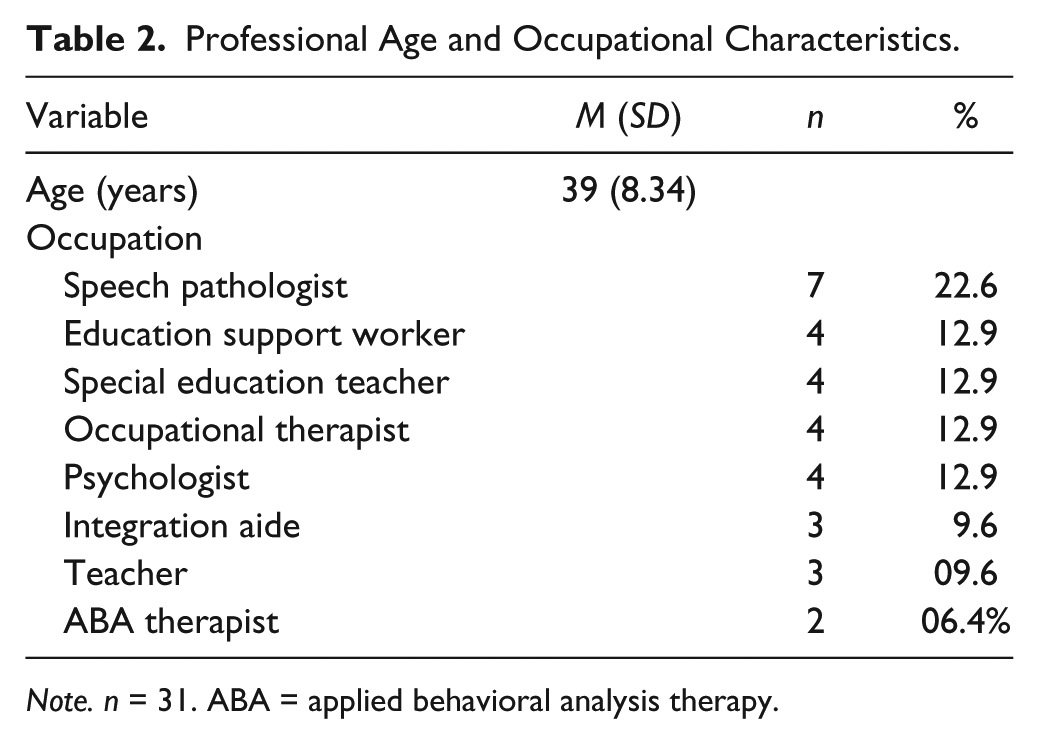
Note. n = 31. ABA = applied behavioral analysis therapy.
Measures
Technology-related self-efficacy, anxiety, and attitudes: Parent and professional questionnaires
The three domains of the 49-item Computer Technology Use Scale (CTUS; Conrad & Munro, 2008) were used to measure computer self-efficacy, technology-related anxiety, and attitudes to technology.
Computer self-efficacy
Items were derived from the four mediators of self-efficacy including persistence, goal setting, attribution, and coping strategies. Participants responded to 11 items indicating their perceived ability to effectively use different types of technology using a 7-point Likert-type scale (1 = strongly disagree, 7 = strongly agree). In separate samples, Conrad and Munro found the psychometric properties of the 11-item computer self-efficacy domain were satisfactory, ranging from .72 to .76 (Conrad & Munro, 2008).
Technology-related anxiety
This domain of the CTUS measured participant anxiety related to technology (Conrad & Munro, 2008). Based on the unique two-factor structure of this domain, all items loading onto factor 1 concern computer use, whereas factor 2 refers to the use of technology generally. Items were purposely intended to measure both unpleasant and positive emotional states. Participants respond to the 15 items on a 7-point Likert-type scale (1 = uncomfortable, 7 = comfortable). In separate samples, the internal consistency was satisfactory, with the overall alpha coefficients for the 15 items ranging between .76 and .87 (Conrad & Munro, 2008).
Attitudes toward technology
This domain was included to determine whether attitudes toward various types of technologies were positive (e.g., “I can do more things with technology”) or negative (e.g., “Technology complicates people’s lives”). Responses were rated using a 7-point Likert-type scale (1 = strongly disagree, 7 = strongly agree). The internal consistency of the 10-item attitudes to technology domain has been shown to be acceptable across the two samples, ranging between .70 and .74 (Conrad & Munro, 2008).
Attitude toward iPad applications: Parent and professional questionnaires
The “Attitudes Toward iPad Applications” subscale comprised the 10 items from the “Attitudes Toward Technology” subscale of the CTUS (Conrad & Munro, 2008). In this study, the items were contextualized to specifically measure attitudes toward iPad application use, rather than technology use in general. For example, Question 29 “iPad applications enrich people’s lives” was a modification of Item 19 from the original scale “Technology Enriches People’s Lives” (Conrad & Munro, 2008). Responses were rated on a 7-point Likert-type scale (1 = strongly disagree, 7 = strongly agree). This new scale showed good internal consistency with a Cronbach’s alpha coefficient of .83, comparing favorably with the original CTUS. This indicated that the modified scale did not suffer psychometrically; indeed, it showed higher internal consistency than the original.
Frequency and duration of iPad use: Parent questionnaire
This domain was developed for the current study and included items to measure frequency of the child’s iPad use (i.e., “percentage of time spent engaging with iPad apps in the past 5 days”) and duration of iPad use (i.e., “provide an estimation of the amount of time your child spent engaging with iPad apps in the last 5 days”). The parents were also asked to report on the amount of time (months/years) their child with ASD had been using an iPad.
Frequency and duration of iPad use: Professional questionnaire
Length of iPad use in months/years was estimated with the item “Provide an indication of how long you have been using an iPad as part of your occupation with children with an AD.” Professionals responded to the following item reporting an estimation of their total iPad use in the past working week: “provide an indication of how many days you have used an iPad as part of your occupation in the past 5 working days.” In an attempt to differentiate the use of iPad applications for therapy/education and or reinforcement/reward, the following items were included: “How often were iPad applications of a therapeutic and/or educational nature used by children with ASD as part of your occupation” and “How often were iPad applications used by children with AD as part of your occupation for purposes other than education/therapy (i.e., reinforcement, reward, or entertainment).”
Procedure
Parents of children with ASD and professionals working with children with ASD were recruited through advertisements placed in school or organizational newsletters or on school/organizational websites. Autism-specific organizations, early intervention centers, mainstream primary schools, parent support groups, and special education facilities Australia-wide were contacted during the recruitment process. All participants were asked to complete an online questionnaire that took approximately 20 min to complete.
Due to the online administration of the questionnaire, participants were not required to sign a consent form. However, all participants were asked to read a brief introduction to the study that included a statement explaining their consent would be implied through completion of the questionnaire. The project was approved by an accredited University Human Research Ethics Committee.
Data Analysis
Descriptive statistics (frequency percentage, M, SD) were used to analyze sample characteristics, computer self-efficacy, technology-related anxiety, attitude toward technology and iPad use, and iPad-related behavior for parents and professionals.
Two independent samples t-tests were conducted to compare general attitudes to technology, as well as attitudes specifically toward iPad applications, across parents and professionals. Correlation analyses were performed to investigate the relationship between attitudes and behaviors toward iPad applications for both professionals and parents. Four multiple linear regression analyses were conducted to explore the extent to which anxiety, self-efficacy, and level of education (for parents only) predicted Attitudes Toward Technology and iPad application use for parents and professionals. “Total attitude toward iPad apps” and “Total attitudes toward technology” were entered as the dependent variable while education level (for parents only), computer self-efficacy, and technology-related anxiety were entered as predictors.
Results
Anxiety, Self-Efficacy, Attitudes, and Behaviors: Technology and iPad Applications
The attitudes toward technology in general and iPad applications specifically were favorable among both parents and professionals. The results of t-tests revealed no significant difference in mean parent attitudes (M = 45.15, SD = 8.15) and professional attitudes (M = 46.14, SD = 6.65) toward general technology use, t(121) = −0.594, p = .55. Furthermore, there were no significant difference in parent attitudes (M = 51.73, SD = 9.26) and professional attitudes (M = 50.62, SD = 9.19) toward iPad application use, t(120) = 0.565, p = .57. No significant difference in mean technology-related anxiety was identified between professionals and parents, t(113) = −0.838, p = .40, although professionals did have a slightly higher (although non-significant) mean technology-related anxiety (M = 85.83, SD = 11.88) than parents (M = 83.51, SD = 14.97) Comparisons of mean computer self-efficacy for parents (M = 49.40, SD = 8.37) and health professionals (M = 47.54, SD = 8.10) revealed no significant difference between the groups, t(117) = 1.30, p = .19.
iPad Application Use
As professionals and parents were asked slightly different questions in the “Behavior Toward iPad Applications” subscale, the variable “total behavior toward iPad applications” was computed separately for both groups.
Parental reports of child iPad use
Parental reports of child iPad use showed that almost half of the children (46%) had begun using an iPad 12 to 18 months ago, while 30% had begun using an iPad in the past 6 months. Only a small percentage of children in the sample (3%) had never used an iPad. iPad use was high for children with ASD, with the mean frequency of use reported as a total of 4.6 days (SD = 1.74) out of the previous 5 days. Child iPad usage was further broken down into estimated time spent using the device across the 5-day period: 22% of parents reported a total of 5 to 6 hr use by their child across the 5-day period. Furthermore, 16% of parents stated their child’s iPad use exceeded 10 hr, with a mean of approximately 2 hr (SD = 2.03) of iPad use per day.
Professional iPad use
Based on self-report data, professionals’ iPad usage was quite irregular: 26% of professionals had been using an iPad in their work with ASD children for less than 6 months. Furthermore, 35% of professionals reported having never used an iPad as part of their occupation. Although approximately half of the sample reported limited to no use of iPads, the remaining half of the sample demonstrated some use of the iPad across three of the five previous working days, either for therapeutic intervention (16%) or purposes other than therapy, such as reward, reinforcement, and play (16%).
Relationship Between Attitudes and iPad Use
There was a moderate positive, but not significant, relationship between Attitudes Toward iPad Applications and use of iPad applications (frequency/duration) for professionals, r(28) = .40, p = .38. Furthermore, a strong positive relationship, r(88) = .57, p = <.001, between iPad application use and Attitudes Toward iPad Applications was found in the parent group. When investigating the association between Attitudes Toward Technology generally and iPad use, a strong positive relationship was identified among parents, r(86) = .52, p = .001. In contrast, a weak positive relationship between Attitudes Toward Technology generally and iPad use was found in the professional group, r(28) = .18, p = .348. This association was not significant.
Predictors of Parent and Professional Attitudes
Parental attitudes
Together, the factors “computer self-efficacy,” “technology-related anxiety,” and “highest level of education” accounted for 39% of the total variance in parental “Attitudes Toward Technology.” The standardized beta coefficients reveal technology-related anxiety was the strongest predictor of parental Attitudes Toward Technology and iPads (see Table 3).
Predictors of Parental Attitudes Toward Technology.
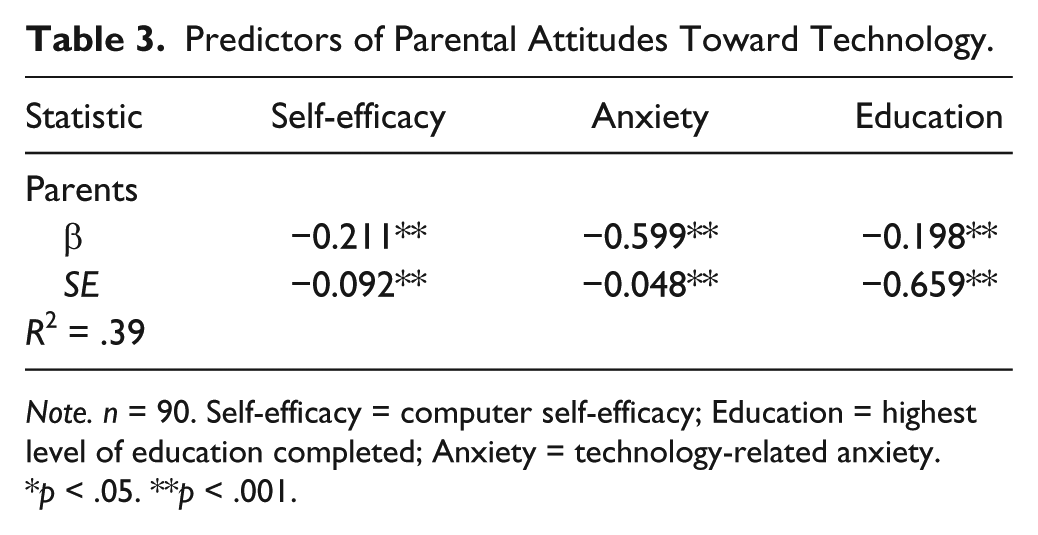
Note. n = 90. Self-efficacy = computer self-efficacy; Education = highest level of education completed; Anxiety = technology-related anxiety.
p < .05. **p < .001.
An R2 value of .23 indicated that 23% of the total variance in parents’ “Attitudes Toward iPad Applications” was explained by “computer self-efficacy,” “technology-related anxiety,” and “highest level of education” combined. Standardized beta coefficients indicate that “technology-related anxiety” was the most significant predictor of parental Attitudes Toward iPad Applications (see Table 4).
Predictors of Parental Attitudes Toward iPad Applications.
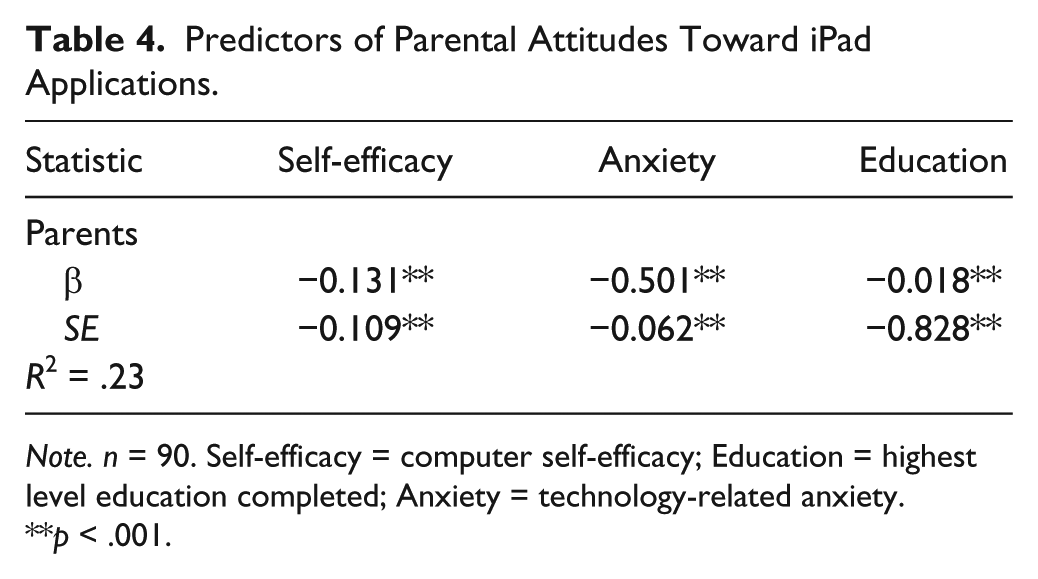
Note. n = 90. Self-efficacy = computer self-efficacy; Education = highest level education completed; Anxiety = technology-related anxiety.
p < .001.
Professional attitudes
Predictors of professionals’ “Attitudes Toward Technology” revealed that combined “computer self-efficacy” and “technology-related anxiety” explained 39% of their “Attitudes Toward Technology.” Consistent with parental attitudes, “technology-related anxiety” was the strongest predictor of professionals’ Attitudes Toward Technology.
An R2 value of .21 indicated that 21% of the total variance in professional “Attitudes Toward iPad Applications” was explained by “computer self-efficacy” and “technology-related anxiety,” combined. The standardized beta coefficients showed that “technology-related anxiety” was the strongest predictor of professionals’ attitudes toward “iPad applications” (see Tables 5 and 6).
Predictors of Professionals’ Attitudes Toward Technology.
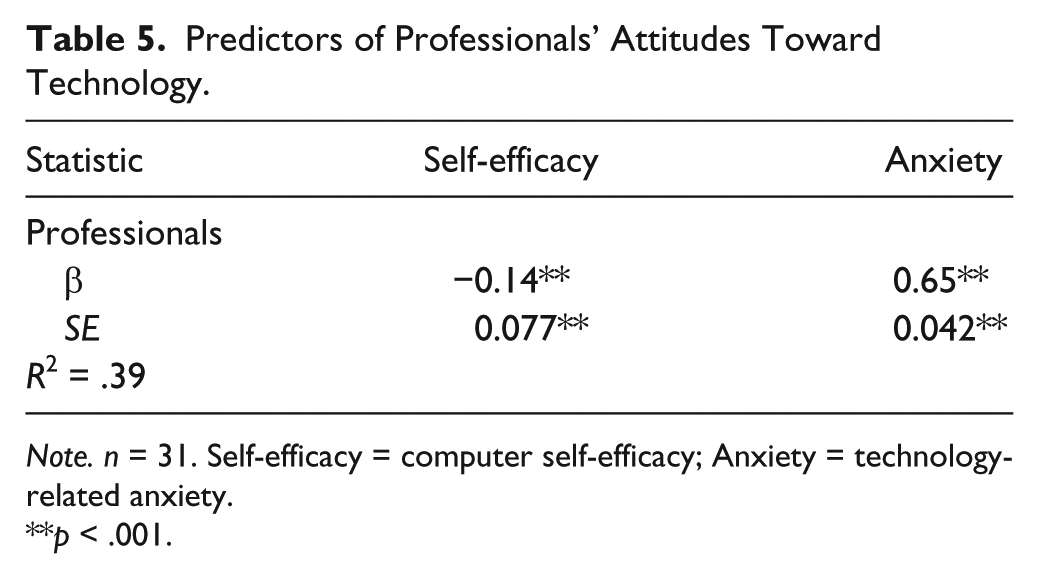
Note. n = 31. Self-efficacy = computer self-efficacy; Anxiety = technology-related anxiety.
p < .001.
Predictors of Professionals Attitudes Toward iPad Applications.
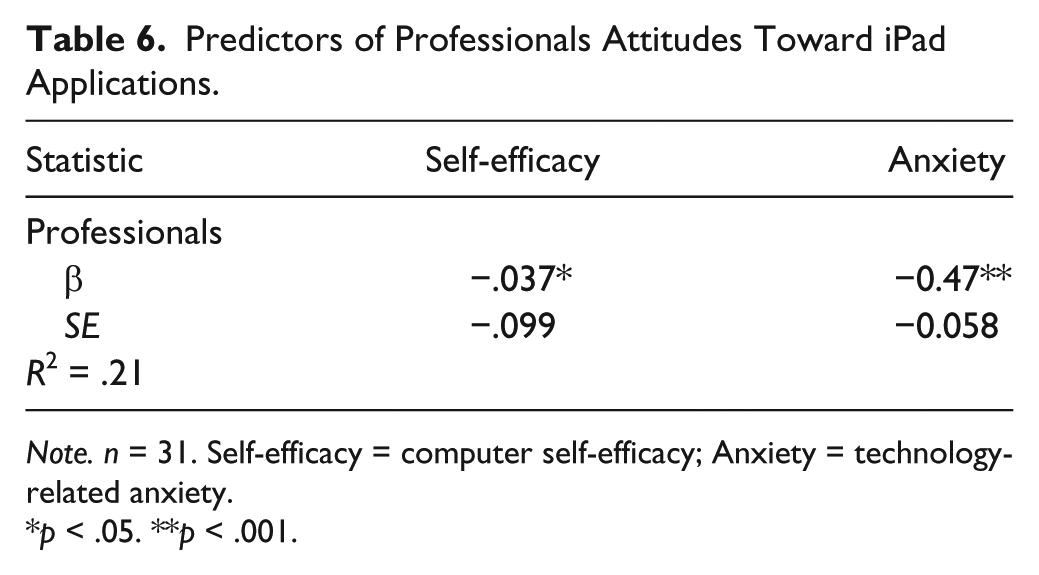
Note. n = 31. Self-efficacy = computer self-efficacy; Anxiety = technology-related anxiety.
p < .05. **p < .001.
Discussion
The present study was the first study, to the authors’ knowledge, to examine parental and professional attitudes and behaviors toward ICT-based support materials generally, and iPad application use specifically for use by children with ASD. Our findings indicated that both parents and professionals held positive attitudes toward ICT and iPad use and, for parents, positive attitudes were positively associated with extent of use of iPad applications by their children with ASD. Parents reported a high level of iPad application use by their children, and professionals incorporated some, albeit irregular, use of iPads into their work with children with ASD. Thus, for professionals, the lower reported iPad use did not appear to be the result of less favorable attitudes toward them (or to technology generally). Surprisingly, technology-related anxiety was the strongest predictor of positive Attitudes Toward Technology and iPads for both parents and professionals.
Parents reported a high level of iPad use by their children; 22% of parents reported that their child with ASD had used the iPad for approximately 5 to 6 hr in total across the past 5-day period. This is the first study to the author’s knowledge to assess the extent of iPad use by children with ASD. In the broader area of the use of touch screen devices for people with disabilities, it has been acknowledged that the use of portable touch devices is a rapidly growing area of research (Stephenson & Limbrick, 2013). Research on the extent and type of iPad use for typically developing children is scarce; however, a 2011 study conducted in the United States found that 52% of 0- to 8-year-olds had access to a new mobile device such as a smartphone, video iPod, or iPad/tablet. In a typical day, 11% of 0- to 8-year-olds used a smartphone, video iPod, iPad, or similar device to play games, watch videos, or use other applications, and these children spend an average of 43 min a day on such devices (Common Sense Media, 2011).
Our findings indicated that, despite the lack of strong evidence confirming the efficacy of iPad applications as an educational or therapeutic intervention for ASD (Maglione et al., 2012), parents reported a high uptake of this technology. Research investigating alternative treatment methods in ASD suggests that many parents do not wait for treatments to be empirically supported, with some parents using a trial and error system of intervention for their child (Christon, Mackintosh, & Myers, 2010). Parents appear to adopt a similar approach toward iPad application use for their children with ASD, with literature in health and disability reports suggesting that parents have emerged as the primary driving force behind iPad use in ASD (Australian Government, 2013). Given this high rate of uptake by parents, it is important to educate them on the appropriate use of iPad applications for their children with ASD and also to caution parents regarding the lack of scientific evidence for many of these applications.
There are several possible explanations for the limited uptake of iPads by professionals working with children with ASD. Professionals are trained to wait for evidence-based intervention to ensure best practice (Hennessy et al., 2005), and the lack of scientific validation of iPad applications may explain their limited use. A lack of confidence may also explain the limited use of these devices. In the formal education context, Price (2011) proposed that lack of training and unfamiliarity with ICT devices such as the iPad leaves educators and clinicians lacking confidence when attempting to integrate the use of applications into a lesson plan or “one-on-one” therapy session.
Training or professional development in the use of ICT devices for professionals working with children with ASD may increase their confidence in the utilization of iPad applications for the delivery of education and goal-based intervention in the future. As well as a dearth of available specialist training and evidence of the efficacy of iPad applications, other factors such as time pressures and an inflexibility of existing curricula/intervention models to incorporate the use of iPad applications are potential factors which could explain the limited iPad use reported by professionals. Nevertheless, further research is required to clearly identify the predictors of use of iPad applications by professional educators, therapists, and clinicians.
Education level, computer self-efficacy, and technology-related anxiety predicted positive Attitudes Toward Technology use in general by parents. These findings support the expectation that higher levels of education and higher computer self-efficacy would result in more positive attitudes toward general technology use (Conrad & Munro, 2008).
Technology-related anxiety was identified as the most significant predictor of both attitudes to technology generally, and iPad applications specifically for both parents and professionals. The direction of this relationship suggested that higher technology-related anxiety was associated with more positive attitudes toward both technology generally and iPad applications specifically. These results are inconsistent with previous research that has identified high technology-related anxiety as being associated with negative Attitudes Toward Technology (Cassidy & Eachus, 2002; Conrad & Munro, 2008; Smith et al., 2000). Despite the technology-related anxiety, the positive Attitudes Toward Technology may be attributed to parental first-hand experiences of the benefits of technology for children with ASD.
It is important to note that the scale used in this study to investigate technology-related anxiety was developed in 1990 and was therefore based on technological devices, including the videocassette recorder and microwave oven, considered modern in that period. Technology-related anxiety today may best be understood in the context of interactive devices such as the iPad and smart phones. These devices are exponentially more complicated and serve more purposes than technology from the 1990s, and so technology-related anxiety in 1990 was likely a somewhat different construct to technology-related anxiety today. As this is the first study to find a strong relationship between technology-related anxiety and positive Attitudes Toward Technology, it is important for future research to explore this further. Future research on the use of iPads would also benefit from the development of scales specifically focused on this modality, rather than the use and adaptation of scales based on ICT generally.
The strengths of this study are that it provides insights into the complex interactions between anxiety, self-efficacy, attitudes, and behavior toward the use of ICT-based resources in parents of children with ASD and professionals who work with these children. There are some limitations that need to be taken into account when interpreting the results of this study. This study attempted to gauge an aggregated use of the iPad by the child with ASD over a 5-day period, as reported by parents. However, it is evident that providing an accurate measure of time spent using the device is difficult. Data were not collected regarding the type of applications that were used by children at home or parental views on the purpose of the applications being used (i.e., were they seen as beneficial for educational or skill development or for other purposes such as entertainment). Furthermore, relying on self-report of behavior is problematic, as the information obtained is subjective and retrospective. Perhaps future research could attempt to develop an electronic mechanism, such as an iPad application, that accurately measures iPad use by children. Validated research in this area may help clarify current usage norms in this population.
Although this study provides insight into the attitudes of parents and professionals toward iPad application use in ASD, further research is required to provide scientific evidence for the effects of iPad use. It is important to acknowledge that there is likely to be differential efficacy across iPad applications depending on the applications themselves, user variables such as child’s skill level and severity of ASD. Thus, several factors should be considered when assessing the use of iPad applications for children with ASD. The rapidly increasing use of iPads among this population, and the potential they hold as a means for delivering time- and cost-effective, education and goal-based intervention to children with ASD, suggests that the research work should progress as a matter of some urgency.
Footnotes
Declaration of Conflicting Interests
The author(s) declared no potential conflicts of interest with respect to the research, authorship, and/or publication of this article.
Funding
The author(s) received no financial support for the research, authorship, and/or publication of this article.