




Abstract
Supported electronic text (eText), or text altered to provide support, may promote comprehension of science content for students with disabilities. According to the Center for Applied Special Technology, Book Builder™ uses supported eText to promote reading for meaning for all students. Students with autism spectrum disorder experience difficulty comprehending science content because of the extensive amount of background knowledge required in conjunction with difficulties understanding abstract and figurative language. Investigations on the most effective methods for reading comprehension and teaching science to this population are equally limited. In this pilot study, feasibility was supported in high levels of treatment fidelity and teacher- and student-reported satisfaction. A multiple probe across participants with an embedded ABCD design was used to evaluate various modifications of Book Builder™ on measures of vocabulary, literal comprehension, and application questions. Considerations for students with ASD, limitations, and recommendations for future research conclude the article.
Keywords
Comprehension in core content areas is a challenging skill for many students, and can be especially difficult for students with autism spectrum disorder (ASD, for example, Chiang & Lin, 2007; Knight & Sartini, in press; Whalon, Otaiba, & Delano, 2009). As students enter middle and high school, there is a shift from using primarily narrative text to using expository text, due to a greater emphasis placed on core content. Reading in content areas, which are often expository in nature, can often exacerbate the existing reading challenges some students face (Gajria, Jitendra, Sood, & Sacks, 2007). Extensive vocabulary and background knowledge required to adequately comprehend science can be problematic even for skilled readers. Given these factors, it might be expected that students with disabilities would receive lower grades and do not perform as well as their typically developing peers in science (Cawley, Kahn, & Tedesco, 1989).
Students with ASD may receive lower grades due to their reading comprehension scores, which are usually lower for students with ASD than matched controls (Frith & Snowling, 1983; O’Connor & Klein, 2004). For example, Nation, Clarke, Wright, and Williams (2006) assessed 41 students with ASD aged 6 to 15 on reading skills of word recognition, non-word decoding, text reading accuracy, and text comprehension, finding that students with ASD and low verbal ability demonstrated significantly poorer reading comprehension levels than matched controls.
Students with ASD may have difficulty comprehending science content due to the extensive amount of background knowledge required. Assessing reading comprehension of 12 individuals with high-functioning ASD (HF ASD) compared with 60 matched peers based on IQ, Wahlberg and Magliano (2004) found that students with HF ASD had deficits in applying background knowledge to understand text and in making global and abstract connections. O’Connor and Klein (2004) found that individuals with ASD experience other comprehension difficulties, including integrating information, understanding and resolving anaphoric reference, and monitoring comprehension. Many students with Asperger syndrome can comprehend factual information, but have challenges in making inferences from text (e.g., Griswold, Barnhill, Myles, Hagiwara, & Simpson, 2002). Individuals with ASD often have difficulty in comprehending abstract or figurative language (e.g., use of metaphor; American Psychiatric Association [APA], 2000). Applying background knowledge to abstract and global connections, making inferences, and understanding metaphors are not only requirements for reading comprehension, but also essential for understanding most science content.
Research on Reading for Students With ASD
Although students with ASD have variable challenges in reading and understanding text, little research has been conducted on effective reading and comprehension interventions. Chiang and Lin (2007) synthesized literature on reading comprehension instruction for students with ASD. Of 11 included studies, only 4 studies evaluated methods to enhance text comprehension; these included peer tutoring, cooperative learning groups, and procedural facilitation (e.g., graphic organizers). Although comprehension is a weakness for many students with ASD, studies reviewed demonstrate appropriate interventions can aide comprehension skills. The majority of students with ASD in the studies had below average IQs, and yet could still learn comprehension strategies, suggesting IQ should not preclude students from interacting with text. In a more general review of reading interventions, only 5 of 11 studies targeted vocabulary development and comprehension, including use of peer-delivered instruction (e.g., cooperative learning groups) and one-to-one instructional delivery (Whalon et al., 2009). Knight and Sartini (in press) found that students with ASD benefited most from response prompting strategies (including model-lead-test), and visual supports to support comprehension across content areas.
Research on Method for Teaching Science to Students With ASD
If research on reading for students with ASD is lacking, then research on effective methods for teaching science to them is equally limited. Spooner, Knight, Browder, Jimenez, and DiBiase (2011) reviewed 17 studies on teaching science to students with severe disabilities (including ASD) and found only 14 to be acceptable quality. Although limited, the review supports systematic instruction as an evidence-based practice to teach science (e.g., science terms, steps in an inquiry-based science lesson, standards-based academic science skills) to students with severe disabilities. From these studies, it is clear that students with ASD benefit from systematic and explicit instruction in content areas (Spooner, Knight, Browder, & Smith, 2012). Experts agree that peer tutoring, cooperative learning groups, and procedural facilitation can be used to increase comprehension for students with ASD, but studies on science comprehension were not found in literature reviews. Literature suggests that students with high incidence disabilities need different strategies for comprehending expository text than they do for understanding narrative text (Gajria et al., 2007); therefore, the same would likely be true for students with low incidence disabilities.
Supported Electronic Text (eText)
Computer-assisted instruction (CAI) can benefit students with ASD and intellectual disabilities (IDs; Knight, McKissick, & Saunders, 2013) in reading by (a) decoding and word identification (Coleman-Martin, Heller, Cihak, & Irvine, 2005); (b) sentence construction (Yamamoto & Miya, 1999); and (c) basic reading skills (Heimann, Nelson, Tjus, & Gillberg, 1995). Supported eText, a type of CAI, holds promise for promoting access to science for all students. Supported eText is text that has been changed to promote access to content areas by increasing font face, size, and contrast; reading text aloud via text to speech; clarifying concepts through hyperlinks to other digital pages; and providing graphics and vocabulary definitions (Anderson-Inman & Horney, 2007).
Preliminary evidence suggests supported eText can improve reading comprehension for students with learning disabilities (Anderson-Inman & Horney, 2007); however, few studies have examined effects of eText on comprehension by students with ASD. Williams, Wright, Callaghan, and Coughlan (2002) evaluated effects of traditional versus electronic books on independence, motivation, and in-context word recognition by students with ASD aged 3 to 5, and found that electronic books were more motivating and increased in-context word recognition; however, supported eText specifically was not addressed. Douglas, Ayres, Langone, Bell, and Meade (2009) evaluated supported eText for students with mild to moderate IDs in a series of six single-subject studies, and found visual supports and graphic organizers combined with explicit instruction most beneficial. Few studies have examined effects of eText on acquisition of core content information in science, and they did not include students with ASD or ID.
Supported eText would likely not be feasible for teachers to create on their own, but Book Builder™ (BB) is a free software offered by Center for Applied Special Technology (CAST, 2014) that gives users a template to create their own digitally authored books offering supports including text to speech, hyperlinks to an online glossary, and embedded coaches/avatars. As limited research has been conducted on supported eText for students with ASD, the primary purpose of this pilot study was to evaluate feasibility (fidelity, satisfaction) of BB in science for middle school students with ASD. In addition, researchers evaluated proof of concept by using differing versions of BB. This study represents the first of a series of studies exploring benefits of supported eText for students with ASD.
Method
Participants and Setting
Students
Four middle school students met inclusion criteria of (a) a diagnosis of autism consistent with Diagnostic and Statistical Manual of Mental Disorders (5th ed.; DSM-5; APA, 2013) criteria; (b) eligibility for Alternate Assessment based on Alternate Achievement Standards (AA-AAS); (c) adequate vision and hearing to use a computer; (d) basic computer skills (e.g., ability to manipulate the mouse); (e) a vocal verbal response; (f) low comprehension scores (e.g., low scores on a curriculum-based measure maze task; Fuchs & Fuchs, 1992); and (g) enrolled in Grades 6 to 8.
Antonio was an 11-year-old, African American, sixth-grade male diagnosed with ASD (Childhood Autism Rating Scale [CARS]; Schopler, Van Bourgondien, Wellman, & Love, 1980), in mild-moderate range and a moderate ID (IQ 55, Differential Ability Scale-School age). His individualized education program (IEP) team determined his eligibility for an AA-AAS based on global delays in reading, writing, and math. Based on the Woodcock Johnson, Antonio’s broad reading score was a 55 (very low range). Furthermore, his raw score on the Maze fluency measure (Fuchs & Fuchs, 1992) was a 3.00, and his corrected score was 43%. Antonio had a vocal verbal response, greeted peers and adults independently, and was usually willing to participate in science lessons. Antonio was proficient with a computer, including the ability to log into and out of a computer independently, manipulate a mouse, use basic word processing skills, and he also enjoyed computer games.
Rachel was an 11-year-old, African American, sixth-grade female diagnosed with ASD (CARS; Schopler et al., 1980), in mild-moderate range. Rachel also had a moderate ID (IQ 53, Stanford Binet V). In past years, she had been on Alternate Assessment–Modified Achievement Standard (AA-MAS), but had not been successfully passing, and it was anticipated that she would qualify for an AA-AAS during the course of the 2009–2010 school year. Based on the Woodcock Johnson, Rachel’s reading comprehension score was a 51 (very low range). Furthermore, her raw score on the Maze fluency measure (Fuchs & Fuchs, 1992) was a 2.00, and her corrected score was 25%. Rachel was very social, greeted peers and adults with prompting from a teacher, and had difficulty when her routine was disrupted. Rachel had adequate computer skills for the study including the ability to log into and out of a computer independently, manipulate a mouse, and basic word processing skills.
Ethan was a 12-year-old, African American, seventh-grade male diagnosed with ASD (CARS; Schopler et al., 1980), in the mild-moderate range, who also had a mild ID (IQ 63, Leiter R). He was eligible for an AA-AAS based on global delays, and had both broad reading and comprehension delays; Ethan’s broad reading score was a 72 (low range; Woodcock Johnson). Furthermore, his raw score on the Maze fluency measure (Fuchs & Fuchs, 1992) was a 4.00, and his corrected score was 31%. Ethan had a vocal verbal response, but verbalized very infrequently without prompting from an adult. Ethan could log into and out of a computer independently, manipulate a mouse, and use basic word processing skills. After the study’s completion, the teacher informed researchers that Ethan was also an English learner.
Dave was a 14-year-old, African American, eighth-grade male diagnosed with ASD (CARS; Schopler et al., 1980), in the mild range, and a mild ID (IQ 67, Leiter R). His IEP team determined his eligibility for an AA-AAS based on delays in reading, writing, and math. Dave’s broad reading score was a 68 (very low range; Woodcock Johnson). Dave had challenges in communication as evident by his raw score on the Maze fluency measure (Fuchs & Fuchs, 1992), which was a 3.00, with his corrected score being a 43%. Dave had a vocal verbal response and greeted others in response to their greetings. Dave could log into and out of a computer independently, manipulate a mouse, and use basic word processing skills. He also enjoyed searching the Internet for websites and playing games on the computer during his free time.
Special education teacher
The special education teacher was a 36-year-old female and had 10 years of teaching experience. In addition, she had a bachelor’s degree in special education, and was working on a master’s degree in special education at a local university.
Setting
The resource classroom was in a public school and was designed to meet needs of students with ASD. There were six students in the classroom, one classroom teacher, and one paraprofessional. Students spent all of their instructional day in a resource room, but rotated to other resource classes for core academics (i.e., mathematics, English Language Arts [ELA], science, social studies).
Interventionist and Second Observers
The interventionist was a graduate assistant (GA) for a federally funded project who had his master’s degree in counseling. The second and third observers who collected data on the independent and dependent variables were special education doctoral students who worked for the same project as the interventionist.
Materials
Expository texts using BB
Researchers used BB to present expository science text to students. BB is a free, online, authoring tool that allows users to create electronic books. Researchers developed all e-books based on middle school grade-level science lessons from Read to Achieve: Comprehending Content Area Text (Marchand-Martella & Martella, 2010). Researchers designed science e-books in intervention to include all of the recommended resources by BB’s website: (a) explanatory resources (e.g., hyperlinks to vocabulary definitions, embedded coaches); (b) illustrative resources (e.g., drawings, photos, sounds, and typical examples of a concept in text); (c) translational (e.g., hyperlinks to vocabulary definitions, text to speech, simplified text at a lower reading level [specifically a second-grade reading level; using a Lexile text measure]); (d) summarizing (e.g., concept map, list of key ideas); (e) enrichment (e.g., background information); and (f) instructional (e.g., embedded coaches). Throughout all conditions and phases, students listened to an audio recording of each e-book two times, and were then asked vocabulary and comprehension questions. Books changed in content every other day. As the content changed throughout the study, each data point in the graph in Figure 1 represents a different probe corresponding to a new e-book (e.g., first probe on Session 1 was on the lesson topic/book Skills Scientists Use; the next probe on Session 2 was on the topic/book Classification).
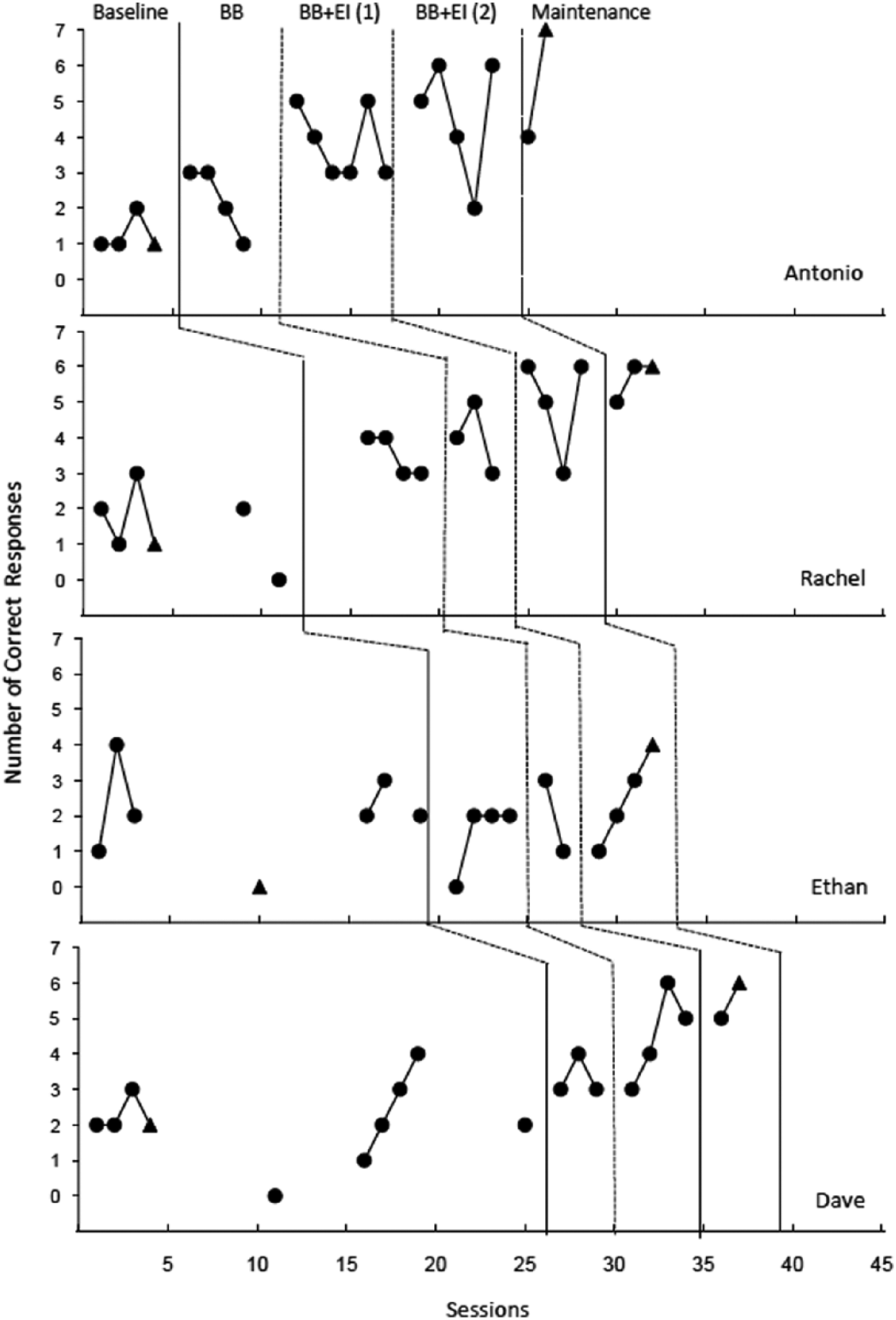
Number of correct responses for Antonio, Rachel, Ethan, and Dave.
Elements of instruction were decided using Higgins and Boone (1996) software design guidelines for creating individualized CAI for students with ASD, with the exception of (a) communication attempts (i.e., when the student responded incorrectly, software did not respond); (b) student choice of stimulus materials (i.e., all materials were the same); (c) vary reinforcers; and (d) prompts (i.e., software did not provide prompts when students did not respond within a set time period; however, interventionists did).
Feasibility Measures
Procedural fidelity (PF)
PF measured training of BB, accurate implementation of assessment probes, and accurate use of system of least prompts (SLP) from the instructor during lessons for 30% of the trainings/sessions. First, a second observer attended training sessions for BB and used a PF checklist to determine the presence or absence of each step included. A checklist was used to record whether or not the researcher showed the students how to use content enhancements, hyperlink to vocabulary definitions, turn the digital pages, and so on. Second, the second observer also measured PF during baseline and intervention probes using + for present and − for absent for each vocabulary and comprehension question. Finally, the second observer recorded whether or not the instructor accurately used the SLP prompting strategy for mechanical procedures during lessons. PF was calculated by dividing the number of steps the researcher performed by the total number of steps for BB training, probe data, and accurate use of SLP prompting system.
Satisfaction
In this investigation, a formal social validity data measure was used with teachers and students to determine satisfaction of supported eText for students with ASD (Kazdin, 1977). General and special education teachers were asked the following on a questionnaire: need for this type of science instructional methods in middle schools for all students and whether or not intervention was feasible, practical, and/or cost-effective. General education and special education teachers were also shown a demonstration of the program. Students with ASD were asked to rate the supported eText intervention.
Proof of Concept Measures
Dependent variable
The dependent variable was the number of correct responses on science probes. Questions changed for each data point; that is, each e-book had a corresponding probe that assessed three vocabulary, three literal comprehension, and one application question. Correct responses for vocabulary and literal comprehension questions were defined as the students clicking on the correct word out of an array of four when asked the question on a digital quiz. Using Wondershare QuizCreator software to use text to speech, it asked the students, “When water falls from the clouds to the ground, it is called what?” The response was correct if the student selected the word “precipitation” out of an array of four words. Correct responses for application questions were defined as students clicking on an untaught exemplar of the vocabulary word (e.g., “Which one is an example of ‘condensation’?”). Students were given a score of 0 for an incorrect response or no response, and a score of 1 for an independent, correct response at the request of the computer program. Response options were word only (i.e., no pictures) and were read aloud via text to speech.
Content and instructional validity
As text from science e-books was taken directly from the Read to Achieve: Comprehending Content Area Text (Marchand-Martella & Martella, 2010), the validity of the content as aligning with state/national science standards was implicit. E-books were evaluated by an expert on explicit instruction to ensure procedures used in the book were consistent with explicit instruction from direct instruction literature (e.g., use of modeling to teach examples and non-examples; referring to the definition). Content changed as students progressed through the intervention. Level of content complexity and amount of vocabulary per lesson was validated with a content expert. Baseline books and intervention books were considered to have comparable content (a full list of questions and answers can be made available by the author). For example, a topic in baseline was Classification (e.g., vocabulary words: eukarya, domains, and prokaryotic cells), whereas in intervention, a topic included Plant Transportation and Food Production (e.g., vocabulary words: xylem, phloem, and photosynthesis). Prior knowledge was addressed by (a) asking the classroom teacher if content had been taught after providing a list of topics and corresponding questions prior to the lessons, and (b) using one of the same lessons for baseline and intervention, with the only change being the supports offered in the book (see triangles in Figure 1).
Experimental Design
Effects of supported eText using BB on students’ science vocabulary and comprehension were assessed using a multiple probe across students with an embedded ABCD design (Gast, 2010). Visual analysis of graphed data was used to determine strength and rate of the changes in the dependent variable across all conditions and phases of the investigation. If students scored lower than five out of seven on the comprehension, vocabulary, and application probe for two consecutive sessions, then students moved to the next phase of intervention.
Procedures and Independent Variables
General procedures
During all conditions, students were provided with illustrative resources (e.g., drawings, photos, sounds, and typical examples of a concept in the text), and a translational resource (i.e., text to speech; Anderson-Inman & Horney, 2007). Throughout all conditions and phases, students listened to the audio recording of the e-book two times. Following the second listening of the e-book, students were assessed to determine number of correct responses to vocabulary and comprehension questions.
Pre-baseline training and baseline
Before students entered baseline, they were trained to use BB supports available during baseline (i.e., text-to-speech, illustrations, and basic operations of the program). When all students demonstrated proficiency (90%–100%) on training assessment given at the conclusion of training, the researcher began baseline. During baseline, only text to speech and illustrations were provided. Student performance on the number of correct responses on science vocabulary was recorded. Pre-baseline training sessions lasted less than 15 min, and baseline sessions lasted 10 min or less.
Pre-intervention training on BB
Students were instructed on how to use embedded coaches and hyperlinks to vocabulary definitions offered via BB individually before they started intervention. The researcher also demonstrated the program, provided assistance and clarification, and answered students’ questions. Following training, students were given an assessment on mechanics and resources of eText (e.g., click play button to access text to speech, and sequentially click on the embedded coaches at the bottom left corner of the page to access instructional supports). When all students demonstrated proficiency (90%–100%) on the training assessment, the researcher began intervention. During instruction, if students performed an incorrect operation or did not perform an operation within 10 s of the natural stimulus from program, the researcher prompted them using a SLP prompting system for the incorrect/no operation (i.e., indirect verbal, direct verbal, model). Additional supports (e.g., additional cues to text, answers to questions) were not offered under any condition. Throughout all conditions and phases, the BB program, error correction, or reinforcement for answering correctly in the lesson and in the assessment was not provided. Pre-intervention training sessions lasted less than 10 min.
Phase 1: BB
The first independent variable was the supported eText delivered to the student via the BB program. Students in intervention were provided with illustrative (pictures) and translation resources (text to speech). In addition, the researcher was specifically interested in the effect of the following on the dependent variable: (a) explanatory resources (i.e., hyperlinks to vocabulary definitions, embedded coaches); (b) translational resources (i.e., hyperlinks to vocabulary definitions, simplified text at a lower reading level [specifically a second-grade reading level]); and (c) instructional resources (e.g., embedded coaches; Anderson-Inman & Horney, 2007), so these resources were part of all instructional phases. In Phase 1, the embedded coaches (i.e., avatars that can be programmed to “say” whatever you type) were instructionally designed to deliver comprehension strategies as recommended by CAST (2009): (a) predicting, (b) questioning, and (c) summarizing (see CAST for a description; see Figure 2d for an example). The first coach, “Pedro,” was used for prompts, and asked questions such as, “Let’s make a prediction. What do you think this book will be about?” The second coach, “Hali,” gave students hints, such as, “Look at the picture and read the title. This will help you make a prediction.” The last coach, “Monty,” offered models of the comprehension strategy; for example, Monty might say, “I see that the title is Plants, and the picture shows a plant in the soil. I predict this story will be about plants.” Sessions for this phase lasted approximately 10 min.
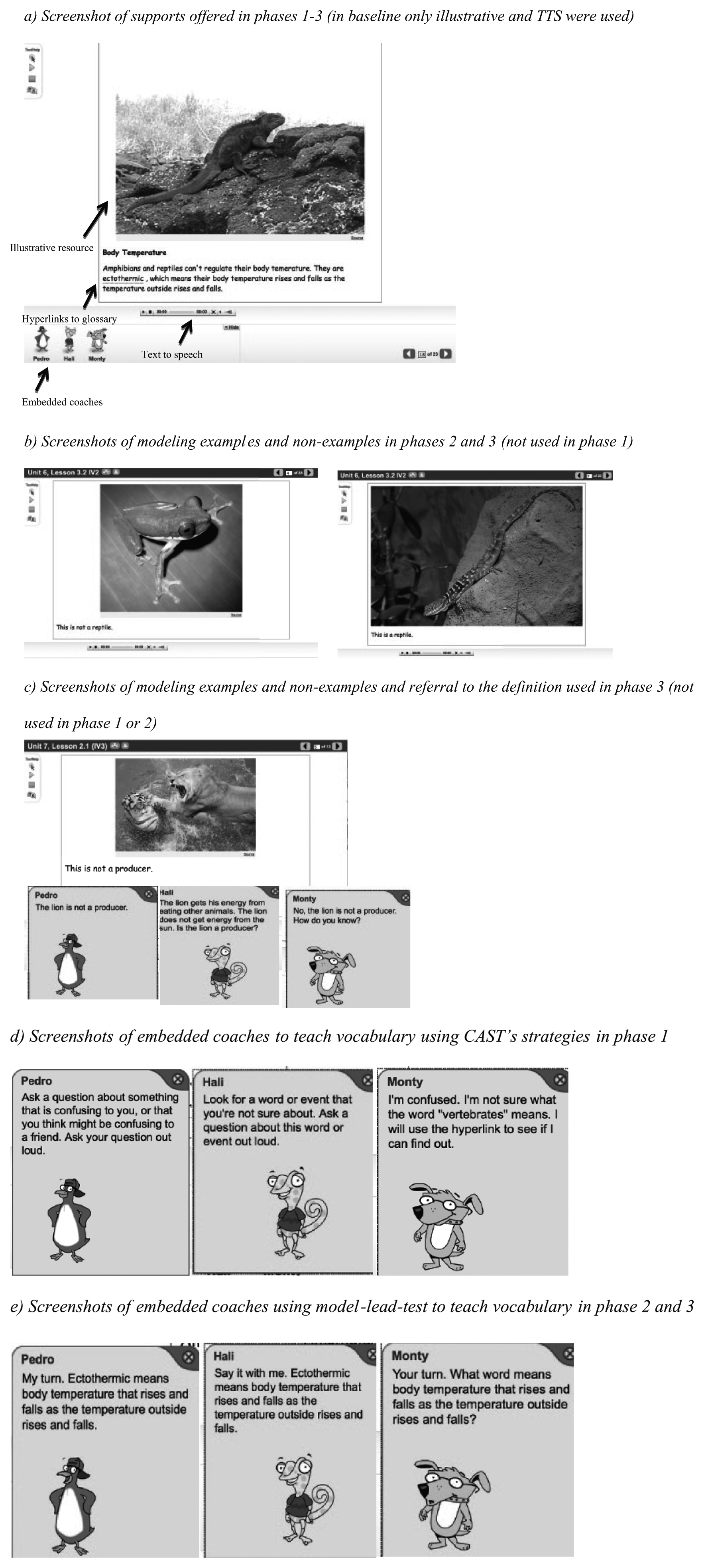
Screenshots of supports offered in various phases of intervention.
Phase 2: BB and explicit instruction (BB + EI 1)
The second independent variable was the supported eText delivered to the student via BB as described in the preceding section with two differences. First, coaches were modified to provide explicit prompting to students (i.e., model-lead-test). For example, Pedro “modeled” answers by saying something like, “To break down is to biodegrade.” Then, Hali led the students by saying, “Say it with me. To break down is to biodegrade.” Finally, Monty “tested” the student by asking a question such as, “To break down is to what?” (see Figure 2e). Students were told at the beginning of this phase that if they could not answer Monty, they should click on the second coach, Hali. Second, text and pictures were altered to provide students with examples (e.g., cat as an example of “mammal”) and non-examples (e.g., snake as a non-example of “mammal”) of vocabulary words and concepts (see Figure 2b). Sessions for this phase lasted from between 15 and 20 min per student.
Phase 3: BB with explicit instruction and referring to the definition (BB + EI 2)
The third independent variable was the supported eText including the use of explicit prompts delivered to the student via BB as described in the preceding section with one difference: The coaches explained the reason “why” one was an example and one was a non-example using a referral back to the definition. Text was altered to provide students with examples and non-examples of the vocabulary words and concepts. The differences between this phase and the previous were (a) that the last coach required the students to refer to the definition and provide a rationale, and (b) only one example and one non-example were shown for each vocabulary questions, as books were taking over 20 min for students to complete; sessions for this phase lasted from 20 to 30 min, depending on the student. See Figure 2 for screenshots of the supports used across phases. Maintenance procedures were identical to Phase 3 procedures, and conducted 1 and 2 weeks after Antonio met criterion, and 1, 2, and 3 weeks after Rachel met criterion; these data were not collected for Ethan or Dave.
Interobserver reliability
Interobserver agreement (IOA) was collected for all students and in all conditions (40.5% of baseline probes and 35.8% of instructional probes). Furthermore, a third rater collected IOA on PF of the instructor’s behavior for the pre-baseline trainings (66.7% of sessions) and for the pre-intervention trainings (45.8% of sessions). The second and third observers compared results using an item-by-item analysis. The reliability coefficient was calculated by dividing the number of agreements by the total number of agreements and disagreements.
Results
Descriptive data were examined to evaluate the feasibility (fidelity, satisfaction) of the BB program, and proof of concept analyzed using a multiple probe across participants with an embedded ABCD research design on student outcomes.
Fidelity
As a computer program delivered both the instruction and the probes, PF measured the training of BB during pre-baseline and pre-intervention by the interventionist, and prompting from instructors during lessons and probes. During pre-baseline and pre-intervention trainings, throughout lessons, and during probes, the interventionist used a checklist to monitor PF and second rater observed 56.1% of sessions to establish reliability. IOA on the PF for the pre-baseline trainings was collected on 66.7% of sessions, and reported with 100% agreement of steps completed. IOA on the PF for the pre-intervention trainings was collected on 45.8% and reported with 100% agreement of steps completed. Throughout the lessons, IOA on the dependent variable was collected on 45.2% of baseline lessons, 25% of Phase 1 lessons, 50% of Phase 2 lessons, 60% of Phase 3 lessons, and 100% of maintenance lessons. Throughout all phases, there was 100% agreement of steps completed. Although the IOA may seem high, the reason for the consistency was that the baseline probes, instructional probes, pre-baseline assessments, and pre-intervention assessments were delivered by the computer. The researcher monitoring probes and assessments only prompted students when necessary, and followed the SLP prompting system consistently.
Satisfaction
Satisfaction of BB was evaluated by asking a special education teacher, a general education teacher, and four students with ASD using a survey. Questionnaires for teachers consisted of 20 items; 14 of which were close-ended questions, and the remaining were open-ended. The special education teacher and general education teacher agreed (a) BB helped students increase science vocabulary and science comprehension, (b) the use of BB as designed (with supports recommended by CAST) was beneficial for students, and (c) they would use it as a supplementary aide to science instruction. In addition, they agreed that (a) BB was practical and easy to use; (b) they were more likely to use a free program, such as BB to create digital books rather than a program to purchase; and (c) BB would be beneficial for students in other content areas.
When asked open-ended questions, the special education teacher reported the most beneficial resources were coaches to provide model-lead-test. Limited amount of verbal language, repeated information, and “picture cues above the text” were stated as being “helpful if the program was used for students who are lower readers to increase understanding of science content.” She thought, “students with high functioning autism, cognitive disabilities, and students with learning disabilities” might benefit most from the program. She might use BB to create her own books because the process seemed time-consuming and she reported not being “great with technology and trying to record on MP3 and importing it is intimidating.” The special education teacher stated that another application to BB might be to teach definitions of vocabulary words. Finally, she suggested that BB would be beneficial if there was a way for BB to recognize/respond to student errors, as there was no way to guarantee they will follow coach’s directions.
The general education teacher stated the most helpful resources for her students would be summarizing resources, because “all children have difficulty summarizing what they read.” In response to the question, “Which type of student do you think would most benefit from using BB in science,” the general education teacher stated, “all students, as this could be a great way to differentiate instruction.” She also said she would use BB to create her own books, and “it would be a great assessment tool used after they read books created on BB, then they could preview and grade the quality of their classmates’ books.” Other useful applications she recommended would be “a tool to differentiate instruction.” She also stated “leveled coaches that model, have students imitate, and then allow students to answer is an excellent way to gain attention and content knowledge.” In response to, “Do you think that BB could promote inclusive practices? Why or why not?”, the general education teacher said,
I think BB™ is an excellent tool to be utilized during inclusion. As it is a wonderful way to differentiate instruction and modify not only the method of instruction, the Lexile level of the material but also the BB™ would allow for students of all levels to work together. For example, the higher level students can create books while lower level students can interact and read them. They can work in pairs and independently.”
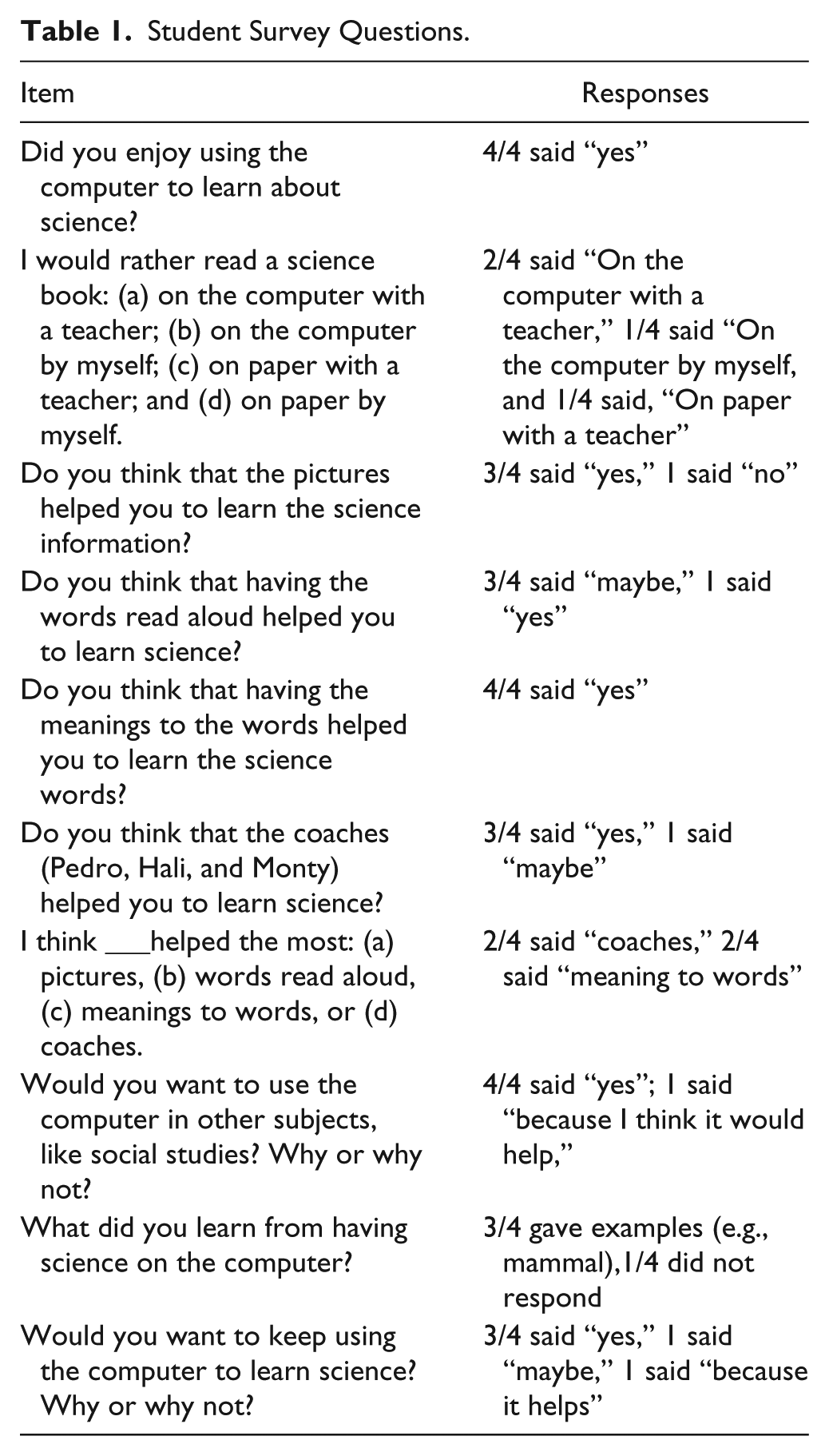
In addition to the special and general education teacher, students with ASD were asked questions about BB. Surveys were read aloud to students by the second observer, and contained both close-ended and open-ended questions (see Table 1). All students enjoyed using the computer to learn about science, thought that having meanings to the words helped them to learn science, and most students thought coaches helped them to learn science. In addition, all students thought that either meanings to the words (i.e., hyperlinks to vocabulary) or coaches were the most beneficial.
Student Survey Questions.
Treatment Outcomes
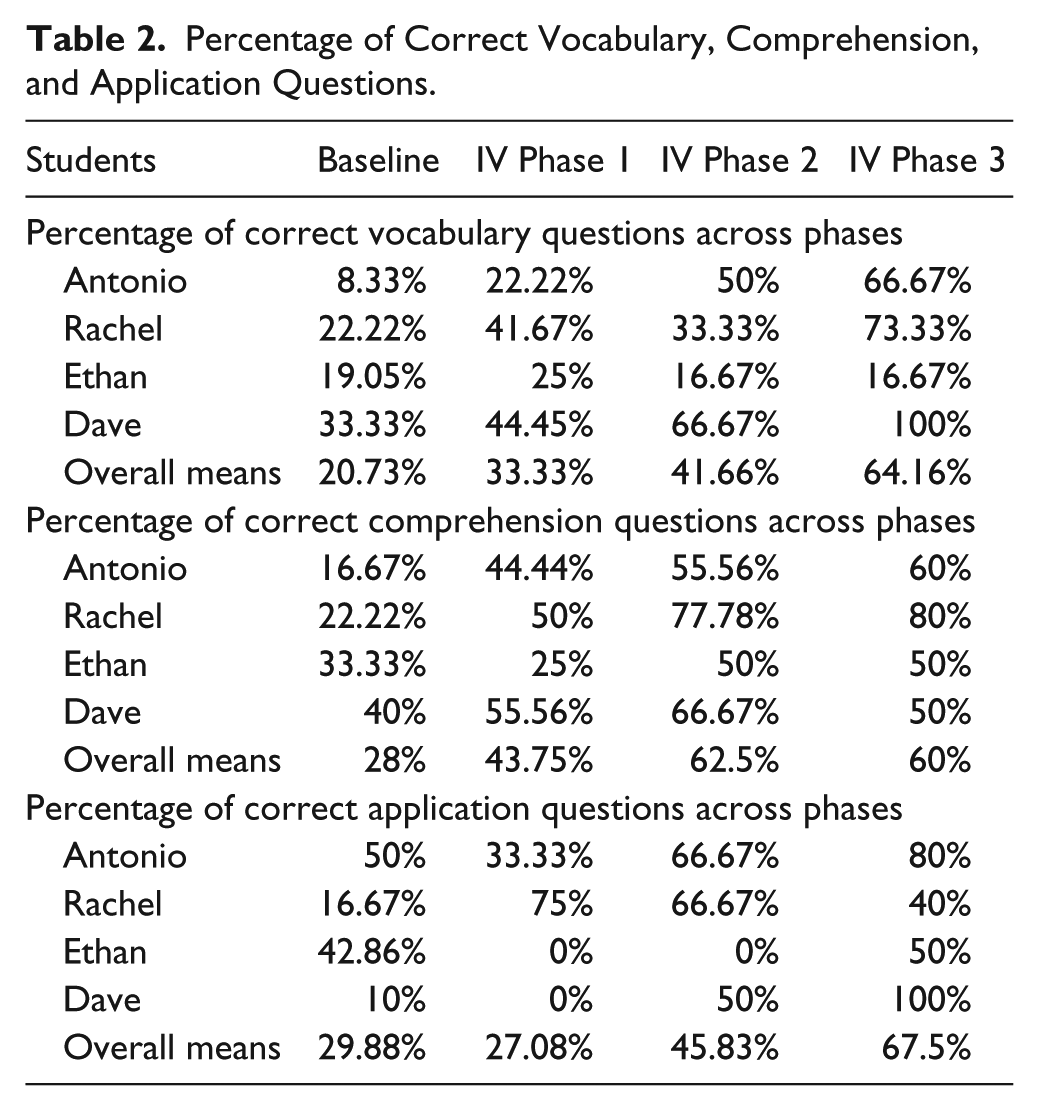
A second purpose of this study was to use an embedded ABCD design to test proof of concept by modifying the BB as a result of student progress. Three of four students increased mean number of correct responses from baseline to all intervention phases when explicit instruction was added to BB. Figure 1 shows each student’s number of correct responses on vocabulary and comprehension probes across all phases of the study. Table 2 shows students’ percent correct on vocabulary questions, comprehension questions, and application questions across phases. Based on the percentage correct in the tables, it appears as though all phases of using BB were improved from baseline for three out of four participants, and especially for the BB + EI 2 phase; however, data instability and threats to internal validity make results untenable. Antonio and Rachel began to respond in BB. Ethan did not seem to respond at all and Dave seemed to respond in BB EI 2. Longer phases would have helped clarify responsiveness, but the study was marginalized due to time constraints of the end of the school year (see Figure 1; Tables 2).
Percentage of Correct Vocabulary, Comprehension, and Application Questions.
Antonio’s scores on probes were low and stable during baseline (M = 1.25). During BB phase (M = 2), he showed an initial change in level with a contratherapeutic trend. There was a large degree of overlap between all phases and conditions. His performance showed an initial increase in level with a mean of 4 during the BB + EI 1 phase, but data were variable, ranging between 3 and 5. During the BB + EI 2 phase, data were variable with a range of 2 to 6 and a mean of 4.6. In the fourth probe in the BB + EI 2 phase, Antonio was in an alternate setting, which may have accounted for some of the variability. During the maintenance phase, Antonio’s scores showed an accelerating trend, and ranged from 4 to 7.
Rachel’s performance during baseline was low and variable, ranging from 0 to 3 (M = 1.5). When BB was introduced, scores initially changed in level, with a contratherapuedic trend (M = 4). During BB + EI 1, data were variable with a range of 3 to 5 (M = 4). In BB + EI 2, scores were variable, ranging from 3 to 6 (M = 5). During maintenance, Rachel’s scores accelerated and ranged from 5 to 6 (M = 5.6).
Ethan’s scores were variable during baseline (M = 2). During the BB (M = 1.5) condition, there was an initial abrupt change in a contratherapuedic direction. Data stabilized at 2, with a range of 0 to 2 (M = 1.5). In the BB + EI 1 phase, data showed a decelerating trend (M = 2). When BB + EI 2 was introduced, there was a change in trend, and his scores began to steadily increase, ranging from 1 to 4, (M = 2.5). Maintenance data for Ethan were not collected due to time constraints.
Dave’s performance during baseline was variable with an increasing trend and ranged from 0 to 4 correct responses. In the interest of time, intervention began before data were stable. There was a large degree of overlap in data between baseline and the BB condition (100%) and the data were variable. When BB + EI 1 was introduced, the trend in the data began to accelerate (M = 4.5). When the last data point in this phase decreased, the research team decided to begin BB + EI 2. Data in the BB + EI 2 phase were accelerating (M = 5.5), but limited due to the end of the school year, and maintenance data for Dave were not collected due to time constraints.
Discussion
The purpose of this pilot was twofold: to evaluate feasibility of BB, and to explore supported eText using modified and unmodified versions of BB for the purpose of pursuing additional research in this area. As this was the first phase of such research, the intent was to provide proof of concept by determining whether or not using BB was possible and could be beneficial for students with ASD in subsequent studies. Further studies will continue to refine the intervention and determine causal inferences.
In the current study, feasibility was measured through fidelity and stakeholder satisfaction. In all conditions and for all students, fidelity of implementation with trainings, program, and assessments was high. Overall, stakeholders were satisfied. The special education teacher found BB beneficial and believed it helped increase students’ science knowledge, whereas the general education teacher validated the strategy as being useful for all of the students in her classes, as a means to differentiate instruction, and useful for assessment. Students enjoyed supported eText, most indicated a preference for books in a supported electronic format over traditional print-based books, and all students felt that having the hyperlinks and coaches were the most beneficial resources. Treatment outcomes were less tenable due to time constraints and issues with internal validity.
Douglas et al. (2009) showed that supported eText could improve reading and listening comprehension of leisure and functional materials (e.g., reading recipes) for students with ID. In contrast to the Douglas et al. studies, when students in the current study used only text to speech and visual supports in the baseline condition, their progress was variable and overall means were low, suggesting that eText supports for students with ID may need to be differentiated from those for students with ASD. In two of the Douglas et al. studies, explicit instruction had a positive impact on their performance; similarly, in the current study, students’ means were higher when explicit instruction was used (e.g., modeled examples, referral to the definition).
Experts agree that the incorporation of research-based instructional design features is a key element for ensuring that technology-mediated instruction is effective (e.g., Boone & Higgins, 2005; Higgins & Boone, 1996), especially for the group of students for which “ . . . access to the medium of print does not necessarily translate access to comprehending print” (p. 42). Providing an alternative format does not address the concerns about textbooks raised by many (e.g., vocabulary, poor organization, and distracting information; Boone & Higgins, 2005). Access to information is not the same as access to learning (Rose, Hasselbring, Stahl, & Zabala, 2005). For example, during the baseline phase of the current study, it could be argued that students with ASD had equal access to information. That is to say, the text to speech equaled the playing field for the students who were not fluent readers just as the illustrations provided a reference for abstract or difficult concepts. These supports, while giving students access to the information, or access to the medium of print, did not by themselves provide access to learning. Even in the BB alone condition, when students were given access to embedded coaches (i.e., providing comprehension strategies recommended by CAST, 2014 as being research-based) as well as hyperlinks to definitions, only a few students showed minimal improvement. Access to learning may have occurred during Phase 2 and Phase 3 of the investigation, when students were provided with coaches who delivered explicit instruction. The combination of access to information (e.g., text to speech, illustrations, hyperlinks to vocabulary) and the consideration of research-based, instructional design strategies delivered via a universally designed program may provide access to learning for individuals with ASD.
Although additional research is needed on the particular CAI supports needed to benefit various populations of students, the extant CAI literature is replete with features associated with systematic and explicit instruction (e.g., Knight et al., 2013). The current study used systematic and explicit prompting strategies; however, in contrast to other CAI studies (e.g., Hetzroni & Shalem, 2005), the current study did not have a method to reinforce correct answers or to error correct, as these were not available as part of the BB program.
Challenges and Considerations
Creating and implementing supported eText using BB
Although BB is free and user-friendly, more than 20 books were created, with each book taking 1 to 2 hr to complete. Teachers may not have time to create digital books for every science lesson, so BB could be used for lessons that are especially challenging, to pre-teach the information, or to summarize the chapter. One benefit to BB is the virtual sharing of books; once books are created, they can be shared with others who have an account. Many books have already been created on the website, so teachers may be able to use a shared book if one already exists on the topic of interest.
Comfort and constraints of technology
In terms of creating e-books, teachers may need additional assistance to feel comfortable with the technology. The special education teacher in the current study was somewhat reluctant to use the audio import function offered by BB, which could be indicative of a more global challenge in providing personnel preparation on assistive and instructional technologies (Bausch & Hasselbring, 2004). Teachers are often constrained by the availability of resources from the software, and they adapt their instruction to fit the inflexible software they want to use (Boone & Higgins, 2005). Social validity from teachers seemed overwhelmingly positive, notwithstanding the fact that reinforcement and error correction (critical to success for students with severe disabilities), were not built into BB.
Prompting and the use of supports
Similar to the results of the Matthew (1997) study, students needed prompting to use the embedded supports, especially when students were required to verbally respond to the embedded supports (e.g., when the coaches asked the students a question and students were asked to respond verbally). In contrast to the findings of the Matthew study, instructor supports were not needed to minimize distractions from the program’s features (e.g., animation). In fact, most students seemed more engaged when coaches were animated (e.g., one student smiled when the coach, Monty asked him questions, but not at other times). Another difference between the two studies was that in the current investigation, most students were able to recall the definitions. This may have been because the definitions were not dictionary definitions, they were context-based, and/or because the students were taught using explicit instruction. As embedded supports and help features are a common feature of informational technologies, future studies should include measures of students’ use of supports and how this affects student learning in these environments (Proctor, Dalton, & Grisham, 2007).
Feasibility in teaching students to use the program
During both the pre-baseline and pre-intervention trainings, all students learned how to use the supports of BB with only one training session, indicating that it would be feasible for teachers to implement BB as a supplement to class instruction. Once students were in the intervention phase(s) and using BB with the embedded supports, they were allowed to receive prompts from the researcher for up to two times per book. Researchers planned to give a booster session if students required additional prompts; however, booster sessions were not needed, indicating students maintained the skills from the training sessions throughout the intervention with minimal prompting.
An area of concern with technology-based interventions for students with ASD is that the skills gained during the CAI can fail to generalize to novel environments (e.g., Stromer, Kimball, Kinney, & Taylor, 2006). Although generalization to other settings was not explicitly measured, one student scored much lower on the probe in an alternate setting than his previous scores for that phase. In most cases, when BB using explicit instruction was introduced, students were able to generalize the vocabulary concept to an untrained exemplar (see Table 2). This may have been because generalization tactics were used to highlight critical variables of the science concepts so that an irrelevant factor would not acquire stimulus control over the target behavior (e.g., Stokes & Baer, 1977).
Limitations
One of the contributions of the current study is that it evaluates a novel approach for enhancing access to science core content for students with ASD; however, limitations must be considered. Primarily, threats to internal validity compromising experimental control, and time constraints also compromised the study’s integrity (e.g., Dave had an increasing trend in baseline; Antonio and Rachel started to respond to BB in Phase 1); authors would have collected additional data given more time. BB did not offer students error correction or reinforcement as part of the software package. Error correction and reinforcement offered within the design of the software would have provided additional assistance for students in the acquisition of science content in the current study. If the software package provided these design elements, this could have affected student learning in a number of ways: (a) students may have received these consequences immediately following the behavior, leading to increased rates of student learning, (b) the software would likely have been more consistent and/or precise in delivering the consequence than a teacher, (c) it would be recyclable, in that the students could repeat the same question and answer as needed, and (d) students may decrease their dependency, as the teacher would not always have to be near the student in case they needed to be redirected. Finally, as the pilot study was conducted in a resource setting for students with ASD, additional research is needed in inclusive settings, with students with varying disabilities, and in various content areas.
Future Research
As this is the first of few studies in the area of supported eText for students with ASD, there are several avenues for future research. First, efficacy of BB and other supported eText formats using research designs permitting causal inference are needed. Instructional design components need to be carefully examined to determine the supports, features, and strategies that produce student outcomes. Second, similar to the work of Mechling, Gast, and Cronin (2006), who incorporated students’ “special interests” into CAI as a reinforcement for task completion, future research could examine using students’ special interest as part of BB. Third, there is a notable lack of research on how best to increase comprehension for students with ASD (e.g., Chiang & Lin, 2007; Knight & Sartini, in press), especially for informational text. Researchers have proposed that reading expository text may be more demanding for students than reading narrative text (Gersten, Fuchs, Williams, & Baker, 2001), and therefore, comprehension strategies that best “match” text format (and student) should be further evaluated. Finally, researchers should consider using more recent instructional design considerations recommended by Boone and Higgins (2007, 2012).
Footnotes
Acknowledgements
Authors would like to acknowledge Heather Schenning, Trey Willis, and Kevin Ayres for providing invaluable contributions to this study.
Authors’ Note
The opinions expressed do not necessarily reflect the position or policy of the Department of Special Education and Rehabilitation Counseling, and no official endorsement should be inferred.
Declaration of Conflicting Interests
The author(s) declared no potential conflicts of interest with respect to the research, authorship, and/or publication of this article.
Funding
The author(s) disclosed receipt of the following financial support for the research, authorship, and/or publication of this article: Support for this research was provided in part by Grant No. 554902 from the University of Oregon, National Center for Supported eText Dissertation Grants Program awarded to the University of North Carolina at Charlotte, and by Grant No. R324AQ080014 from the U.S. Department of Education, Institute of Education Sciences, awarded to the University of North Carolina at Charlotte.