




Abstract
Adults with autism spectrum disorder (ASD) and significant intellectual disability (ID) often have limited speech communication abilities. Abundant research supports use of augmentative and alternative communication (AAC) to enhance skills of children with ASD and ID, but less research has examined efficacy of AAC with non-speaking adults. In this study, three adults with ASD and significant ID were taught basic functional communication using the iPod Touch® with MyTalk Mobile® software within a single-case, multiple-probe across-subjects design. The iPod Touch® taught with most-to-least prompting increased participants’ independent manding, participants were able to discriminate between picture symbols, and participants’ manding generalized to a naturalistic setting with typically available preferred items. Implementation of AAC coincided with increases in speech for one participant. Results illustrate how an applied behavior analysis approach incorporating a speech generating device is effective in teaching communication to adults with ASD and significant ID.
Keywords
An increase in children identified with autism spectrum disorder (ASD; Centers for Disease Control and Prevention, 2014; U.S. Department of Education, 2011) and intellectual disability (ID; Boyle et al., 2011) highlights a critical need for evidence-based communication interventions. Failure to develop social-communicative skills in early childhood is a hallmark of ASD (American Psychiatric Association, 2013), and socio-communicative deficits often persist into adulthood, particularly for individuals with significant ID (Hewitt et al., 2012). The importance of interventions to promote socio-communicative skills among children with ASD is ubiquitously recognized (e.g., Duffy & Healy, 2011); however, substantially less attention has focused on addressing the communication needs of older individuals with ASD and ID (Lang et al., 2014). Teaching functional communication to adolescents and adults is critically important in promoting their active participation in home, workplace, and community environments (Hendricks & Wehman, 2009; Orsmond, Krauss, & Seltzer, 2004) and reducing their challenging behavior (Kurtz, Boelter, Jarmolowicz, Chin, & Hagopian, 2011).
A robust research literature has evolved to support use of augmentative and alternative communication (AAC) to enhance communication skills of children with ASD and ID (e.g., Bock, Stoner, Beck, Hanley, & Prochnow, 2005; Gosnell, Costello, & Shane, 2011; Hetzroni & Roth, 2003; Hill, 2010; Millar, Light, & Schlosser, 2006; Mirenda, 2001, 2003; Schepis, Reid, Behrmann, & Sutton, 1998). AAC is a general term for communication support encompassing low-tech and high-tech systems, including speech generating devices (SGDs). For example, the Picture Exchange Communication System (PECS; Frost & Bondy, 2002) is one low-tech system with substantial empirical support (Tincani & Devis, 2011). A variety of high-tech SGDs, also known as voice output communication aids (VOCAs), also show promise in improving functional communication and decreasing challenging behavior (Casey & Merical, 2006; Durand & Carr, 1991; Durand & Merges, 2001; Fisher et al., 1993; Schlosser, Belfiore, Nigam, Blischak, & Hetzroni, 1995).
Recent technological advancements have made high-tech AAC devices, including the iPod Touch® and iPad®, easier to implement due to increased accessibility, portability, and customizability of applications to meet diverse user needs (Hammond, Whatley, Ayres, & Gast, 2010; Laarhoven, Johnson, Laarhoven-Myers, Grider, & Grider, 2009; Lorah, Parnell, Whitby, & Hantula, 2014; Lorah et al., 2013; Olive et al., 2007; Sennott & Bowker, 2009). These commonly available devices are advantageous because they have not only AAC functions but also other functions that enhance quality of life, including music and games, as well as activity scheduling applications to promote independence in life skills. Devices such as the iPod Touch® and iPad® that are commonly used by people without disabilities can reduce stigma associated with more specialized AAC devices (Conley, 2012; Shinohara & Wobbrock, 2011; Van Laarhoven, Johnson, Van Laarhoven-Myers, Grider, & Grider, 2009). Furthermore, emerging research suggests that some users prefer high-tech AAC devices and systems in comparison with their low-tech counterparts (Lorah, Parnell, et al., 2014).
Recent studies have demonstrated effectiveness of high-tech, tablet-based AAC systems for individuals with ASD and ID with significant communication impairments (Gosnell et al., 2011; Hill, 2010; King et al., 2014; Laarhoven et al., 2009). However, participants in these studies were mainly school-aged or younger children; few studies have evaluated high-tech AAC for adults, making it difficult to generalize findings from the current literature to the adult population. In one promising recent study, Hong, Ganz, Gilliland, and Ninci (2014) taught caregivers of a 32-year-old man with ASD and severe ID to implement a high-tech AAC system, observing collateral, if minimal, increases in his independent use of the system. Given the prevalence of communication impairments among adults with ASD and significant ID, additional studies are needed to evaluate promising strategies for teaching AAC to this population.
Thus, the purpose of the study was to examine effects of teaching three adults with ASD and significant ID with most-to-least prompting to use an iPod Touch® as an AAC device on (a) independent mands for preferred items, (b) discrimination between picture symbols, (c) generalization to a novel, naturalistic setting with typically available preferred items, and (d) vocal speech.
Method
Participants
The three participants were recruited from a private agency providing vocational and residential support services to adults with disabilities in the mid-Atlantic region of the United States. Clinical support staff nominated clients for participation based on the following criteria. She or he must have had (a) a diagnosis of ASD and/or ID, (b) no functional speech communication abilities, and (c) she or he must not currently be using any AAC system. Informed consent to participate in the study was obtained from the participants’ parents or legal guardians per the university’s and agency’s Institutional Review Boards.
Mark
Mark was a 44-year-old Caucasian man and was diagnosed with autism, obsessive compulsive disorder (OCD), ID, and attention deficit hyperactivity disorder (ADHD). His most recent administration of the Vineland Adaptive Behavior Scales prior to his admission to the agency yielded a composite score of <20, with an age-equivalent score of 2 years 6 months. Prior to this study, his main mode of communication was gesturing, including pointing, nodding, and waving to get attention. He also used modified sign language to request permission to use the bathroom. Mark occasionally attempted to communicate vocally, but his speech was not functional due to low intelligibility. He had been previously screened for use of a VOCA, but he showed little interest in the device (i.e., he pushed it away), and thus, he never used it. He lived in a community home with staffing support and attended a center-based vocational program. At the time of study, the frequency of Mark’s undesirable behaviors was low and consisted of occasional physical aggression (i.e., grabbing, kicking, punching, biting, ripping clothing, pulling hair, or pulling others to the ground) and self-injurious behavior (i.e., hitting or scratching himself, and banging walls or tables with head). He worked on simple assembly jobs in the center-based vocational program, and he was soon to be assessed for community employment.
Farrah
Farrah was a 31-year-old African American woman who was diagnosed with autism, ADHD, OCD, and schizoaffective disorder. Her most recent administration of the Vineland Adaptive Behavior Scales prior to her admission to the agency yielded a composite score of <20, with an age-equivalent score of 1 year 10 months. On the Childhood Autism Rating Scale (CARS), she received a standard score of 41 in the severely autistic range. Her primary mode of communication consisted of modified signs to use the bathroom and gestures such as pointing or nodding. She lacked functional speech abilities. She lived in a community home with staffing support and attended a center-based vocational program where she worked on simple assembly tasks. She had no known history of using a VOCA or other AAC system. She had a history of exhibiting physical aggression (i.e., grabbing, pushing, or hitting others) and non-compliance (i.e., refusing to move by dropping on the ground). At the time of study, however, she had not exhibited the behaviors more than once per year in the past 2 years. Farrah was also recommended for a community employment assessment.
Deandre
Deandre was a 33-year-old African American man who was diagnosed with autism and ADHD. His most recent administration of the Vineland Adaptive Behavior Scales prior to his admission to the agency yielded a composite score of 22, with an age-equivalent score of 1 year 11 months. His primary mode of communication was a few spoken words and gestures, but he did not initiate social interactions or independently request his wants and needs. He often exhibited echolalic speech; thus, his communication was inconsistent and not functional. He had no known history of using a VOCA or other AAC system. He lived in a community home with a housemate and staffing support. He also did janitorial work in the community and attended a center-based vocational program. Deandre had a history of engaging in disruptive behaviors (i.e., cursing, yelling) and eloping, but he had not performed those behaviors for at least 2 years at the time of the study.
Setting
The study took place in a center-based vocational training program located in the Mid-Atlantic region of the United States. Preference assessment, baseline, and iPod Touch® training sessions were conducted in a section of a 3.5 m × 5.5 m office located in the center. Generalization sessions were conducted in the participants’ work area (2.5 m × 3.5 m to 3.5 m × 5.5 m) during their scheduled break time.
Materials
The iPod Touch® 16GB downloaded with an icon-based speech generating application, MyTalk Mobile®, was used as an AAC device. The iPod® Touch was chosen due to its small size, approximately 12 cm × 5 cm, and portability. MyTalk Mobile® was chosen due to its ease of use for the programmer and communicator, customizability, and relatively low cost. The pictures symbols used on the MyTalk Mobile® app. were a combination of pictures copied from Google Images™ and pictures of preferred items taken by the first author. A protective case, the Otter Box®, prevented damage to the devices. Between six and 10 picture symbols of preferred items were displayed on the touch screen within the MyTalk Mobile® app. A timer on a smartphone was used to track the duration of each session.
Experimental Design
A multiple-probe design across participants was used to examine the efficacy of iPod Touch® training on independent manding and speech of three adults with ASD and ID. Following a preference assessment, a baseline phase evaluated participants’ ability to mand for preferred items with the device. Next, in the intervention phase, participants were taught to mand with the iPod Touch® with most-to-least prompting. Finally, the generalization phase assessed participants’ ability to request preferred items in their typical workplace setting during scheduled breaks. Baseline, intervention, and generalization sessions occurred approximately 3 times per week over the duration of the study.
Dependent Measures
Data were collected on participants’ percentage of independent mands per opportunity and frequency of vocal responses (i.e., speech). Vocal responding was not explicitly taught with the intervention. However, as previous investigators have noted, increases in vocal responding coinciding with AAC (e.g., Ganz & Simpson, 2004) were sought to determine whether participants’ vocal responding would increase with intervention.
An independent mand was defined as the participant tapping a picture on the iPod Touch® to request an item, without prompting, with enough pressure to initiate the audio voice programmed in the MyTalk Mobile® software. If the participant tapped the picture of an item without sufficient force to evoke the audio voice, an independent mand was not recorded. If the participant tapped on the picture of an item as described, but reached for a different item, it was recorded as an incorrect response. A vocal response was defined as the participant clearly saying the name of the item being requested (e.g., “cookie”), either before or after pressing the corresponding symbol on the iPod Touch®. An independent vocal response was not recorded if the participant made a vocalization, but the vocalization was only an approximation of the item being requested (e.g., “cook”), was not intelligible, or was a different word.
Preference Assessment
Prior to the baseline phase, a preference assessment was conducted to determine the items to be programmed on the iPod Touch® for each participant. First, the first author interviewed the participants’ parents and staff members who were familiar with the participants. They answered questions on the Reinforcement Assessment for Individuals With Severe Disabilities (RAISD; Fisher, Piazza, Bowman, & Amari, 1996), listing items that the participants appeared to enjoy in order of preference. Seven items or activities identified in the RAISD were then evaluated in a multiple stimulus without replacement preference assessment (MSWO; DeLeon & Iwata, 1996). Six pictures of the items or activities from the MSWO preference assessment for each participant were programmed into the iPod Touch® for communication.
Interobserver Agreement
Interobserver agreement (IOA) data were collected on participants’ mands and vocalizations during 66.7% of all sessions, distributed across all phases of the study, based on availability of a secondary observer. The primary observer was the first author, a board certified behavior analyst and doctoral student in special education. The two secondary observers were a master’s student in social work and a master’s student in applied behavior analysis. Secondary observers were trained by reviewing the operational definitions of each target response and collecting in vivo practice recording sessions until at least 90% IOA was obtained. All data were collected with paper data sheets in the research setting as baseline, intervention, and generalization sessions took place. IOA was determined by point-by-point agreement ratio; for each requesting opportunity, both observers had to agree on occurrence or non-occurrence of both the mand and the vocalization. IOA was calculated by dividing the number of agreements by the total number (the number of agreements plus the number of disagreement) and multiplying by 100. The average IOA was 99.9% (range = 93.3%–100%).
Procedural Fidelity
A procedural fidelity checklist was used to assess the degree of implementation of the intervention during 65.5% of intervention and generalization sessions, completed simultaneously by primary and secondary observers. The intervention checklist was comprised of six steps necessary to implement each intervention session, whereas the generalization checklist was comprised of four steps necessary to implement each generalization session. The raters marked yes if the step on the checklist was accurately implemented, or marked no if it was not. The percentage of steps completed was calculated by dividing the number of steps marked yes by the total number of steps. The interventions were implemented with 100% accuracy. IOA was collected for 70% of sessions for which procedural fidelity data were collected, and was calculated by dividing the number of agreements by agreements plus disagreements and multiplying by 100. IOA for both fidelity checklists was 100%.
Baseline
During each baseline session, the participant was provided with an iPod Touch®, which was turned on with the communication app MyTalk Mobile® opened on the screen. The six preferred items identified with the MSWO preference assessment were placed in front of the participant on the table, but they were out of his or her reach. Pictures of all six items were displayed on the screen of the device. If the participant requested any of the six items independently by pressing a picture on the iPod Touch® for any item, or by clearly vocalizing the name of any item, she or he received access to the item with verbal praise. No prompts were provided. If the item was food, she or he was given a small piece, and if it was not food (e.g., puzzle), she or he was given access for up to 30 s. If the participant reached for any item, but did not request by pressing a button on the device or by vocalizing the name of the item, an independent response was not recorded and access to the item was not given. The session lasted until the participant made 15 requests or until 15 min elapsed, whichever came first. To minimize the frustration level of participants, Mark and Deandre had free access to all preferred items at the end of the each session. Farrah, who persistently reached for items during each session, had free access to all preferred items after every five to seven trials.
Intervention
Once stable baseline data were achieved, iPod Touch® training was conducted. Each participant was provided with an iPod Touch® with the MyTalk Mobile® app opened, as in baseline. Their six preferred items, as identified in the preference assessment, were placed in front of each participant, but out of his or her reach. The goal of the intervention was to teach each participant to discriminate between picture symbols by selecting the appropriate picture symbol among an array of six symbols presented simultaneously on the screen. Although the MyTalk Mobile® software had the ability to display between one and six picture symbols on the screen simultaneously, it would automatically vary the size of each picture symbol based on the number of picture symbols on the screen. Therefore, all six preferred item pictures were presented on the device; however, to maintain consistency in the size of each picture symbol and to eliminate the need for participants to conditionally discriminate between symbols at the onset of training, five of the six symbols were covered with construction paper and tape. If the participant pressed a picture for an item, or clearly vocalized the name of an item, she or he was given access to the item. If the participant reached for an item, but did not request the item by pressing the corresponding symbol on the device or by clearly vocalizing the name of the item within 5 s, the instructor used most-to-least prompts (i.e., hand over hand, partial physical, modeling, gestural, and verbal) to prompt the participant to request the item, and social praise was provided for the prompted response. On a very small number of trials, the participant did not reach for an item or attempt to press a symbol for an item. On these trials, after 5 to 10 s, the first author would entice the participant by saying the names of the six items (e.g., “I have . . . ”), or by asking the participant, “What do you want?” At the end of each trial, the experimenter randomly changed the picture symbol that was exposed to give the participant an opportunity to request a different item. As in baseline, the session lasted until the participant made 15 requests or until 15 min elapsed, whichever came first.
Once the participant independently requested items with only one picture exposed on the screen with at least 80% accuracy across two consecutive sessions, two picture symbols were exposed to teach the participant to discriminate between two symbols. Then, if the participant discriminated between two items with 80% accuracy for two consecutive sessions, another picture was exposed, and so on, until all six picture symbols were exposed. The same most-to-least prompting procedures were followed. An exception to this procedure occurred in Mark’s intervention. During Session 3, he removed the cover for the covered pictures on the iPod Touch® screen, exposing all six of the pictures on the screen. From then on, he was taught to request with all six pictures exposed.
If the participant reached for one item, but requested a different item with the device by tapping the picture of a different item, the response was scored as an error. In these instances, the instructor used hand-over-hand prompting to prompt the participant to tap the picture of the item, which the participant reached for and provided social praise and access to the item. If the participant pressed the picture for one item, but reached for a different item, the instructor blocked access to the requested item and prompted the participant to press the correct symbol with most-to-least prompting.
If the participant requested an item with the device, but did not accept the item she or he requested, the trial was marked as an error and then the next trial began. Each session lasted until the participant made 15 requests or until 15 min elapsed, whichever came first. The prompts were faded gradually as necessary with a most-to-least prompting procedure (i.e., hand over hand, partial physical, modeling, gestural, and verbal).
Correspondence checks
Correspondence checks (Frost & Bondy, 2002) were conducted for 30% of trials during intervention and for 50% of trials during generalization (below) for which participants had to discriminate between two or more picture symbols. Every intervention and generalization session included at least some portion of correspondence checks. Correspondence checks were conducted to ensure that each participant was conditionally discriminating between picture symbols on the device and not simply pressing symbols at random. During trials for which correspondence checks were conducted, following the participant making an independent request with the device, the instructor presented the participant with all six of the items with the instruction, “Take it.” If the participant reached for the item she or he requested, she or he was given immediate access to the item along with verbal praise. If she or he reached for a different item, she or he was prompted to press the correct button on the device with most-to-least prompting and was given access to the item with verbal praise. Prompted trials during correspondence checks were recorded as errors. Consequently, if the participant was not correctly discriminating between picture symbols during intervention and generalization, this would have resulted in lowered rates of independent responding as reflected by the data.
Generalization
Following successful acquisition of discriminated manding during training, generalization sessions were conducted in each participant’s vocational area of the center during his or her scheduled breaks during the workday. During these sessions, each participant was given the opportunity to request novel preferred items, which were snack and lunch food items that the participant typically brought to the workshop each day. Procedures during generalization were identical to intervention, except that each participant had the opportunity to request eight to 10 preferred items, rather than six items, during each trial. In some cases, this required the participant to scroll to a different page of the device to select the appropriate picture symbol. As in baseline and intervention, sessions lasted for 15 min or until the participants made 15 requests.
Results
Results for Mark, Farrah, and Deandre are displayed in Figure 1, which depicts their percentages of independent manding per opportunity (left y axis) and frequency of vocal responding (right y axis). During baseline, each participant displayed very low levels of independent manding with the iPod Touch® and almost no vocal responding. When training began, there was an immediate, large magnitude increase in all three participants’ levels of independent manding with the iPod Touch®. Each participant learned to discriminate between six picture symbols during training. High levels of independent manding continued during the generalization phase, in which participants requested eight to 10 different preferred items in their respective vocational areas. In contrast, the intervention did not produce measurable improvements in Mark’s or Farrah’s vocal responding. However, iPod Touch® training corresponded with substantial increases in Deandre’s vocalizations. Results for each participant are as follows.
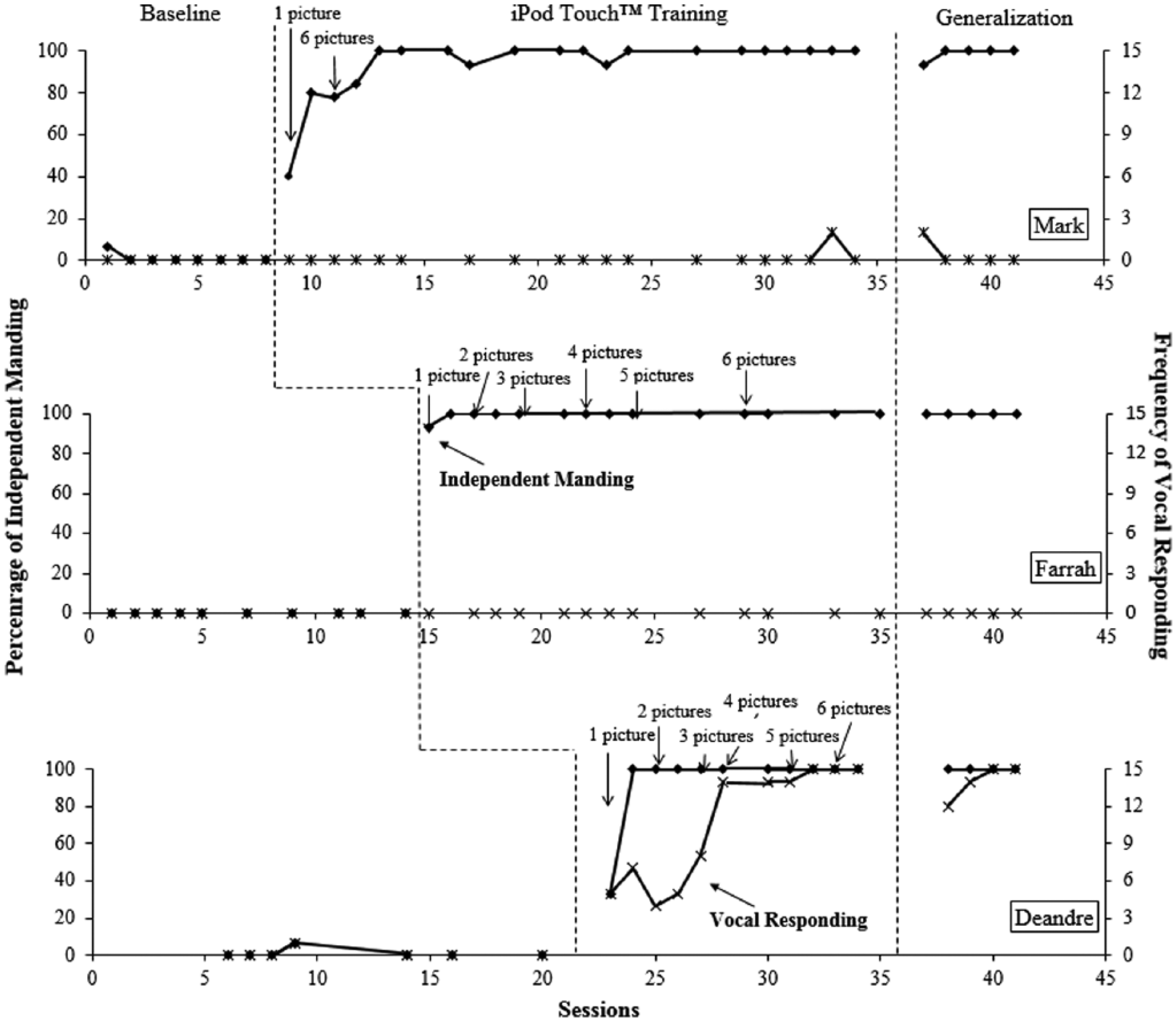
Percentage of independent manding and frequency of vocal responding during baseline, intervention, and generalization.
Mark
Results for Mark during baseline, iPod Touch® training, and generalization phases are displayed in the top panel of Figure 1. During baseline, he independently manded using the iPod Touch® during an average of just 0.83% (range = 0%–6.67%) of opportunities. After introduction of iPod Touch® training, his independent manding immediately increased to 40% during the first session. On average, he independently manded during 93.5% (range = 40%–100%) of opportunities during the iPod Touch® training condition. During Session 3, Mark removed the cover for the covered pictures on the iPod Touch® screen, exposing all six of the pictures on the screen. However, as shown in Figure 1, he was able to successfully discriminate between all six picture symbols, and thus, he continued to use all six symbols during the remainder of intervention. His percentage of his independent manding during the generalization phase was 98.7% (range = 93.3%–100%).
Mark did not exhibit any vocal mands during baseline, but he emitted two vocal mands during one intervention session, 33, and two vocal mands during one generalization session, 37.
Farrah
Results for Farrah during baseline, iPod Touch® training, and generalization phases are displayed in the middle panel of Figure 1. During baseline, Farrah did not independently request any items with the iPod Touch®. After introduction of training, Farrah’s independent manding immediately increased, and she learned to discriminate between all six picture symbols. Her percentage of independent manding during intervention was 96.7 (range = 93.3%–100%). Farrah independently requested with 100% independence during generalization. Farrah never emitted any vocalizations during baseline, intervention, or generalization.
Deandre
Finally, results for Deandre during baseline, iPod Touch® training, and generalization phases are displayed in the bottom panel of Figure 1. Baseline data collection for Deandre was delayed until Session 6 to minimize his potential reactivity to the materials and setting, specifically, his frustration at being presented with preferred items, but not having the skills necessary to request them. Deandre’s average percentage of independent manding during baseline was 0.95% (range = 0%–6.67%). His percentage of independent manding immediately increased during intervention, in which he averaged 95.6% (range = 33.3%–100%) independent manding. He continued to mand with 100% independence during generalization.
Deandre emitted one vocal mand during Session 9 of baseline; otherwise, he never vocalized during baseline. In contrast to Mark and Farrah, when training began, Deandre’s vocalizations increased to the point that he vocalized during most trials from Session 28 through the remainder of the study. During intervention, he averaged a frequency of 10.6 vocalizations per session (range = 5–15), and during generalization, he averaged 14 vocalizations per session (range = 12–15). Although he was vocalizing during most trials, he also continued to use the iPod Touch® to request during training and generalization.
Discussion
The purpose of the study was to examine effects of teaching three adults with ASD and significant ID with most-to-least prompting to use an iPod Touch® as an AAC device on (a) independent mands for preferred items, (b) discrimination between picture symbols, (c) generalization to a novel, naturalistic setting with typically available preferred items, and (d) vocal speech. Consistent with previous research supporting the efficacy of high-tech AAC with children and adolescents with ASD (Lorah, Parnell, et al., 2014; Still, Rehfeldt, Whelan, May, & Dymond, 2014), the current study found that each adult participant learned to independently mand with the iPod Touch® with MyTalk Mobile® software. As in previous work (e.g., Lorah, Crouser, Gilroy, Tincani, & Hantula, 2014), most-to-least prompting and stimulus control procedures, hallmarks of an applied behavior analysis approach, resulted in two of three participants acquiring the ability to conditionally discriminate between picture symbols. A third participant discriminated between six picture symbols without explicit training. Correspondence checks conducted during 30% of trials verified that participants successfully discriminated between picture symbols. Moreover, all three participants generalized their manding to novel, naturalistic preferred items in their typical vocational settings.
The intervention produced immediate and large magnitude increases in all three participants’ independent requesting, particularly Farrah’s. Baseline data strongly suggest that participants could not independently mand for preferred items with the device prior to intervention. Although speculative, as adults with lengthy learning histories, it is possible that prior exposure to pictures in an instructional context, through picture activity schedules, for example, facilitated their relatively quick acquisition of manding in the study. In practice, practitioners should consider participants’ prior histories of exposure to and success with picture-based instructional systems, and how this could facilitate (or hinder) their acquisition of communication with picture-based SGDs.
The frequency of vocalizations increased for only one participant, Deandre, following intervention. This finding is consistent with previous research showing variability in participants’ acquisition of speech with AAC and is likely a function of individual characteristics prior to training (Schlosser & Wendt, 2008). For example, participants who possess vocal imitative (i.e., echoic) abilities prior to intervention may be more likely to emit vocal responses as they request preferred items (e.g., Tincani, 2004). Because no formal pre-intervention measures of speech or vocal imitative ability were taken prior to baseline, it is impossible to determine the extent to which Deandre’s pre-existing speech abilities may have facilitated his vocalizations during intervention. Future research should examine the role of pre-intervention speech abilities in the acquisition of vocal behavior during training, procedures for promoting speech during training (cf. Tincani, Crozier, & Alazetta, 2006), and the extent to which SGD use could be faded for users who acquire vocal speech abilities.
In contrast to previous research on teaching high-tech AAC use to children with ASD, which shows variability in acquisition across users, all participants in the current study learned independent manding repertoires quickly. Mark achieved 100% independence in five sessions, whereas Farrah and Deandre achieved 100% independence in two sessions. Although baseline data indicated that Mark, Farrah, and Deandre lacked the ability to mand with the SGD prior to intervention, and had no known histories of using picture-based SGDs, given their respective ages of 44, 31, and 33 years and histories of educational and habilitative programming, it is possible that any prior exposure to picture-based instructional systems could have facilitated their acquisition of independent manding in the current study.
The study has three additional limitations that should be considered in interpreting the results. First, although each participant acquired use of the SGD to request preferred items and generalized manding to novel preferred items in a naturalistic setting, only one trainer, the first author, implemented the intervention, and thus, it is not known whether participants’ skills generalized across novel communicative partners, such as residential or vocational staff. In addition, the study did not assess the extent to which iPod® use generalized across different environments and situations in vocational and residential settings. As discussed, although vocalizations were measured in the study and increased for one participant, Deandre, no explicit teaching procedures for vocalizations were implemented in the study, and thus, the data do not permit an analysis of why this increase occurred.
Results suggest several additional areas for future research. First, as this is one of few studies to show that adults with ASD may learn to request with high-tech AAC devices, additional studies are warranted to replicate these findings and to investigate additional strategies and devices to promote basic functional communication. Future studies should include measures of picture discrimination, as in the current study, in addition to procedures that promote generalization to natural environments and novel communicative partners. Recent research suggests that pre-intervention assessment measures are useful in determining users’ preference for AAC systems, including preferences for high-tech versus low-tech systems (Lorah, Parnell, et al., 2014). Therefore, future studies could include pre-intervention measures of system preference and comparisons of acquisition between more preferred and less preferred systems. Future studies could also assess for user preferences regarding the type of AAC software and type of graphic display on the device (e.g., graphic symbols vs. pictures of items; Gevarter et al., 2014).
Conclusion
High-tech AAC clearly benefits individuals with ASD and significant ID, yet little research has investigated strategies for teaching high-tech AAC to adults. This study demonstrates that adults with ASD and significant ID can learn basic functional communication with the iPod Touch® using well-established teaching procedures from the science of applied behavior analysis. Results suggest that high-tech AAC may facilitate speech for some users; however, the conditions under which speech occurs and the extent to which speech may persist in the absence of the device are not yet understood. Additional research is needed to replicate findings of the current study and to discover additional strategies for teaching functional communication to adults with particular attention to user preferences, generalization to the natural environment, and speech.
Footnotes
Declaration of Conflicting Interests
The author(s) declared no potential conflicts of interest with respect to the research, authorship, and/or publication of this article.
Funding
The author(s) disclosed receipt of the following financial support for the research, authorship, and/or publication of this article: This research was supported by a grant from the Chimes Foundation.