




Abstract
Joint attention, or shared attention to an object or event, is a pivotal skill for the development of social interactions and social communication. Joint attention typically develops in natural contexts within the first year of life. Children with autism spectrum disorder (ASD) and related developmental disabilities often experience difficulty developing joint attention. Clinical interventions to increase joint attention exist. However, there are limited studies investigating methods to incorporate joint attention interventions in inclusive preschool classrooms with peers as social partners. For young children in preschool settings, peer-mediated social skills interventions reflect natural contingencies and may promote generalization. In this study, we employed a single-case multiple baseline across child–peer dyads design to evaluate the effects of a peer-mediated joint attention intervention for children with or at risk for ASD on response to joint attention (RJA) from peer bids and initiations of joint attention (IJA) from target children with ASD. The intervention included direct instruction with a social narrative to teach three peers to initiate bids for joint attention to measure target children’s responses. Target children later received the same direct instruction to increase IJA to same-age-peers. Results indicate increased target child RJA and IJA to peers. Limitations and implications for research and practice are discussed.
Joint attention is the shared focus between two individuals on an object or event (Dube et al., 2004). For example, a parent may point to a bird outside the window and say, “Look, there’s a bird.” Their child may follow the parent’s point of view, looking at the bird, and then back toward the parent. Typically, infants acquire joint attention within daily interactions with parents before their second birthday (Jones & Carr, 2004). Joint attention is a pivotal social skill that is necessary in order to fully benefit from social learning environments such as school. Joint attention has been found to be linked to expressive language and more advanced social skills, including social interactions and play, imitation, and perspective-taking (Jones et al., 2006; Kasari et al., 2008, 2012). Children who have not developed joint attention by preschool age are at greater risk for delays in future language and social development (Kaale et al., 2012).
The development of joint attention is critical to social success with peers (Sullivan et al., 2015). By the preschool years, children who are typically developing have already established early social skills, such as joint attention, and are beginning to develop more advanced social skills such as joke telling, conversing about abstract concepts, as well as cooperative play and imaginary play (Hansen et al., 2019). Children with autism spectrum disorders (ASDs) and related developmental disabilities often enter early learning environments with social skill deficits, such as a lack of joint attention (Krstovska-Guerrero et al., 2016). These social skills deficits make it more difficult for children to learn in less structured early childhood settings. Children with ASD and developmental disabilities may need early explicit instruction in joint attention and other pivotal social skills (Hansen et al., 2014). Fortunately, a growing body of research indicates the feasibility of teaching early social communication skills to young children with ASD, including in natural settings (Akamoglu & Meadan, 2018; Schreibman et al., 2015).
Interventions that are developmental and behavioral in nature have been found to increase the initiation of joint attention (IJA) and response to joint attention (RJA) and also show collateral effects on other preschool skills such as social interaction and play (Kasari et al., 2006, 2008). Additional research has shown both interventionist- and parent-mediated joint attention interventions to be effective, including in generalized settings (Hansen et al., 2018; Kaale et al., 2012). Few studies have examined joint attention interventions in preschool settings (e.g., Hansen et al., 2019; Kaale et al., 2012). Peers are well positioned to mediate social skills interventions in inclusive preschool settings as they are a child’s natural social partner, and can model age and socially appropriate skill (Watkins et al., 2015).
Despite legislative and social changes to promote the inclusion of young children with disabilities with their same-age peers, relatively little research has been conducted on interventions to promote the potentially positive effects of inclusive settings on social communication skills (Hansen et al., 2014). Opportunities to interact and observe prosocial modeling from same-age peers may certainly benefit young children with disabilities; however, children with deficits in joint attention may need explicit instruction to benefit from peer models. Early social communication skills, such as joint attention, are not usually included in the scope and sequence of early childhood curricula, where emphasis is placed on more age-appropriate skills like play, vocabulary, and early literacy skills (McLachlan et al., 2018). Peer-mediated interventions are relatively novel in inclusive preschool settings. In fact, in a review of peer-mediated interventions in inclusive settings, only three of 15 studies took place in preschool classrooms (i.e., Zagona & Mastergeorge, 2018).
Previous, infrequent peer-mediated interventions in the preschool context have targeted more advanced skills such as commenting (i.e., Goldstein et al., 1992), social interaction (Katz et al., 2013), and use of communication devices or systems (Thiemann-Bourque et al., 2016; Trembath et al., 2009). To our knowledge, only two studies, Kaale et al., 2012, and Hansen et al., 2018, have directly targeted joint attention in the context of an inclusive preschool classroom. This study intends to extend the body of literature on peer-mediated early social skill interaction by addressing the following research questions:
Method
Participants and Recruitment
Participants were all recruited from the same charter school in a suburb of a large city in the southeast United States. This school was selected due to the principal expressing an interest in social skills interventions at her school. The researchers received parent permission for all child participants, including peers, via a permission form sent home.
Participants were divided into dyads with one target child who had a developmental disability, and one peer participant who did not have a developmental disability. Target children were eligible if they: (a) were preschool age with a teacher-reported special education eligibility of ASD (b) spent the majority of their school day in an inclusion classroom with same-age nondisabled peers, and (c) demonstrated clinically significant low levels of RJA and IJA as assessed with the corresponding subscales of the Early Social Communication Scales (ESCS). Peers were eligible if they: (a) attended the same classroom as the target child, (b) were not at risk for ASD or a related developmental disability, (c) demonstrated age-typical rates of RJA and IJA as assessed with the corresponding subscales of the ESCS, and (d) engaged in zero to low rates of challenging behavior per teacher report. Six children age 4 years old were selected by their preschool teacher to form three dyads; a target child and a peer in each. Teachers sent home recruitment information and parent permission forms for the children they selected as being appropriate participants.
Prior to the collection of baseline data, children were screened by the first author using the Joint Attention subscale of the ESCS (Mundy et al., 2003). The ESCS is commonly used to identify the need for joint attention intervention in the literature (see Freeman, Gulsrud & Kasari; Krstovska-Guerrero & Jones, 2016 for examples). A score of .70 is the suggested cutoff score per the examiner’s manual for the ESCS (Mundy et al., 2003). All students identified by the classroom teachers were screened as appropriate for inclusion (i.e., all three target children showed RJA levels below .70, and all peer children showed RJA levels above .70).
Dyad 1 consisted of Zane and Wayne. Zane was the target child and received special education services under the ASD eligibility category. Zane scored in the mild-moderate range (32) on the Childhood Autism Rating Scale–2nd Edition (CARS-2; Schopler et al., 2010). Zane displayed limited vocal language that consisted mostly of echoic or scripted responses. He showed social interest in peers but had limited play skills and difficulty with transitions. Zane responded to 40% of bids during screening using the ESCS subscale. Wayne was the typically developed peer in Dyad 1. Per teacher report, Wayne had an age-typical language, intact social and play skills, and a social interest in Zane. Wayne’s ESCS subscale score from screening was 100%.
Dyad 2 consisted of Rocky and Linus. The target child, Rocky, had a special education eligibility of ASD per the teacher report. His CARS-2 score was in the moderate range on the CARS (35). Rocky had age-appropriate language skills but often used scripted phrases or repetitive topics or phrases, and struggled with pragmatic language. Rocky demonstrated limited social interest and played with his peers. Rocky scored 20% on the ESCS subscale. Linus was the peer for Dyad 2. Linus had a diagnosis of cerebral palsy but had age-typical social skills and language. Linus scored 100% on the ESCS.
Dyad 3 consisted of Robert and George. The third target child, Robert, had a special education eligibility of ASD. Robert spoke in one-word utterances with a limited vocabulary (e.g., “yes,” “no,” “ok”). Robert had difficulty with vocal imitation (i.e., limited echoic repertoire), as well as receptive communication (e.g., following one-step directions). He scored in the severe range on the CARS-2 (37). Robert scored 0% on the ESCS. George was the peer for Dyad 3. George had age-appropriate social skills and vocabulary, and he scored an 80% on the ESCS. Table 1 shows the dyads and their initial scores.
Participant Age, Peer Partner, and Score on Intake Assessments.
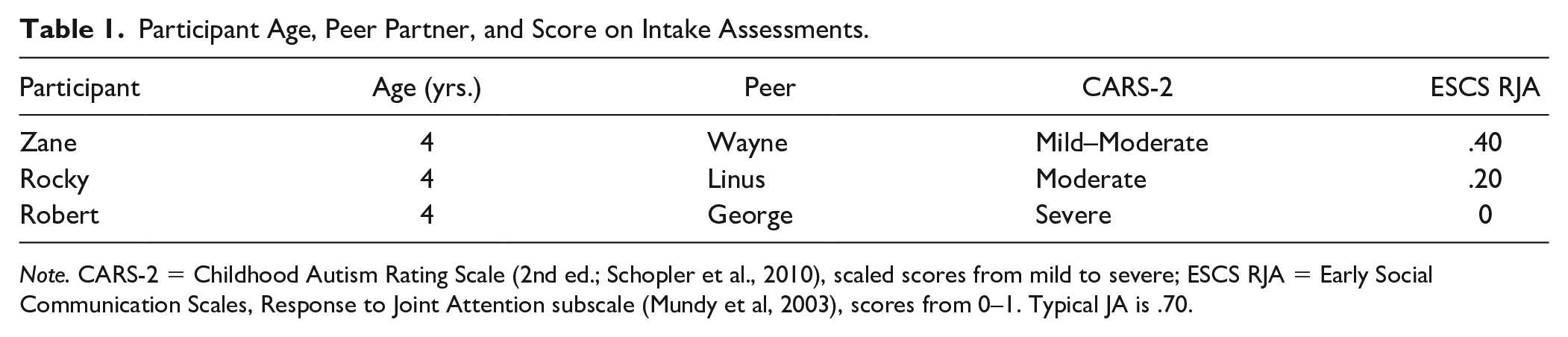
Note. CARS-2 = Childhood Autism Rating Scale (2nd ed.; Schopler et al., 2010), scaled scores from mild to severe; ESCS RJA = Early Social Communication Scales, Response to Joint Attention subscale (Mundy et al, 2003), scores from 0–1. Typical JA is .70.
Setting
All participants attended one of two inclusive classrooms in a public charter preschool in a large, Southeastern metropolitan area. Both classrooms had one head teacher, 2–3 teaching assistants, and between 8–10 additional students in the room during session. Each classroom had developmentally appropriate play areas, furniture, and materials. The school had approximately 30% of students with disabilities served in inclusion and self-contained classrooms.
Dyads 1, Zane and Wayne, and 3, Robert and George, attended classroom A. In Dyad 2, Rocky and Linus attended classroom B. Baseline and intervention sessions occurred in the morning. Training sessions for Dyads 1 and 3 occurred in the classroom during center time at a side table or learning station. Learning stations were identified as areas of the classroom dedicated to a skill or activity matched to the curriculum. For example, the table toy station had puzzles and matching games based on caterpillars and butterflies during the life cycle unit. Training sessions for Dyad 2 occurred in the classroom during snack or carpet time, at a small side table. Dyads 1 and 3 selected the location and activity for the session, but due to time constraints, Dyad 2 selected only the activity and always completed sessions at the same small table. For all dyads, the other students in the class were either engaged in free-play activities (Dyads 1 and 3) or snack time (Dyad 2). While the interventionist required the target child and peer to play together, other children were not kept from that area or blocked from use of the materials.
Design
The effects of the joint attention intervention were evaluated using a concurrent multiple-baseline across participant design (Ledford & Gast, 2018). Participants were entered into the intervention following a stable baseline with sufficient data to demonstrate a functional relationship, following best practice for multiple-baseline designs across participants.
Procedure
The first author, a female with a PhD in early childhood special education and 10 years of experience implementing interventions for children with ASD, was the lead adult interventionist. Additional data were collected by a graduate student in applied behavior analysis, who attended 90% of sessions. The participants had access to their normal classroom manipulatives such as puzzles, books, science center materials, and thematic kitchen toys. In addition, the first author provided the games “Don’t Break the Ice,” “Hungry Hippos,” and “Pop-up-Pirate,” as well as stimuli such as 3D cardboard stars, a plush toy, and various light-up items. The interventionist rotated the programmed stimuli to avoid satiation, and items were always placed a minimum of two feet away from the participants.
Baseline
During baseline, the interventionist sat with the dyad at a learning center or table for a 10-min free-play session. Prior to the session, the interventionist arranged three to four novel programmed stimuli in the selected play area or table. The participants were not given any instructions or prompts, and they chose a game to play or a stimulus to manipulate. The interventionist provided vocal prompts in order to ensure the participants remained together (e.g., “remember you’re playing with Linus right now”).
Peer training
Peer training took place in the classroom at a learning station or table away from other students in the classroom, immediately prior to the peer-mediated intervention session with the target child, with the target child present if they were interested. The same rotations of programmed stimuli from baseline were placed around the area prior to peer training and were available for practice. Prior to each session, the interventionist read a social narrative titled “Look at that!” about gaining the target child’s attention and pointing out objects in the classroom. The social narrative included line drawings and text outlining how to deliver an IJA to a peer (i.e., “When I see something new, I want my friend to see it too. To show my friend, I first say his name. Then I point and say ‘look’”); prompt a response (i.e., “Sometimes my friend won’t hear me and I can try again”); and to reinforce with social attention (“It’s fun to see new things together. When I show my friend new things, then we can play”). Following best practices for use of a social narrative, the interventionist asked comprehension questions and role-played with the peer after the presentation (e.g., “Show me how you would point something out to a friend,” “What if your friend doesn’t look?”; Milne et al., 2020). Social praise (e.g., “Nice job! That is how we show our friends new things”) was delivered per each correct response. Each training session lasted approximately 5–10 min. For more details on the peer training and the social narrative procedures, see those outlined in Hansen et al. (2018). The social narrative is available from the first author upon request.
Peer-mediated intervention
Peer-mediated intervention sessions occurred immediately after the interventionist peer sessions, in the same location in the classroom. As at baseline, the interventionist prompted participants to remain together. In addition, if the peer had not initiated joint attention within 3 min of the start of the session or previous trial, the interventionist used a least-to-most prompting hierarchy with a 3-s time delay to elicit a target minimum of five bids for joint attention from the peer per 10-min session. For example, if the peer did not engage in an IJA toward the target child after 3 min passed, the interventionist provided an indirect verbal prompt (e.g., “Remember we can show these fun things to Zane”). If the peer did not engage in an IJA toward the peer, the interventionist provided a direct verbal prompt (e.g., “Show Zane the funny zebra”). The final step in the prompting hierarchy was a model prompt, “Watch me! Zane, look at the zebra!.” The social narrative was read prior to the start of each session regardless of peer mastery.
Target child initiation
Following peer mastery of the IJA intervention (i.e., making unprompted IJA bids for three consecutive sessions) and target child response to peer bids at typical levels (i.e., 70% of peer bids with a response for three consecutive sessions), target children received instruction on the initiation of bids for joint attention. This instruction included (a) inclusion of the target child in the presession reading of the social narrative; (b) additional support for comprehension of the social narrative, including additional modeling and feedback; and (c) least to most prompting during the play session. Target child participants Zane and Rocky successfully continued on to IJA. Target child Robert did not receive intervention on IJA skill, however, the interventionist did prompt for initiations to peers and those prompted initiations were documented (see Table 2). Frequency of target child initiations of joint attention and the subsequent responses of their peers are displayed in Table 2.
Initiations and Responses From Peers and Target Children.
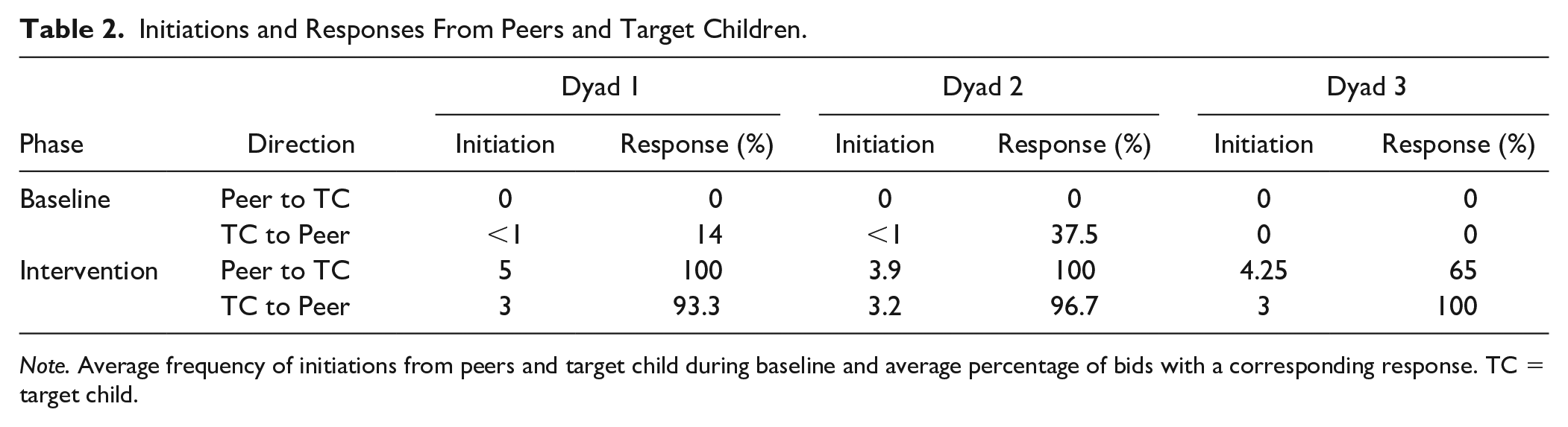
Note. Average frequency of initiations from peers and target child during baseline and average percentage of bids with a corresponding response. TC = target child.
Response measurement
Target child RJA data were collected as a percentage of appropriate responses to the peer’s prompted or spontaneous bids presented approximately once every 1–2 min, across 10-min sessions. Controlled presentation event recording was used. Specifically, the frequency of peer bids with a joint attention response was divided by the total peer bids and multiplied by 100 to calculate a percentage of bids with target child RJA. RJA from the target child was defined as a gaze shift to the object or event lasting at least 2 s, followed by a gaze shift toward the peer. Gaze shifting could be accompanied by changes in body direction or vocal utterances, but this was not required. Scanning the environment, turning their body without looking at the object, or making a vocal utterance without looking at the object were not counted.
Prompts for peer bids of joint attention include verbal reminders (e.g., “Show him that light”) and gestures (i.e., pointing) to stimuli. A bid for joint attention was successful when the peer said the target child’s name, directed the target child’s attention to an object, and the target child either shifted his gaze to the object, turned toward the object, and/or vocally responded about the object to his peer. The interventionist did not prompt the target child’s responses.
Target child IJA data were collected as frequency of appropriate bids to peer, either prompted or spontaneous, across 10-min sessions. Data were graphed on the count of target child bids, regardless of appropriate peer response. Bid topography included a verbal response (e.g., “Look at the ____,” or “Name, look!”) with a gesture (pointing or moving the stimulus toward the peer). Peer RJA responses were measured in the same fashion as target child RJA.
Data collection
Data were collected in vivo by the first and third authors with pen, paper data sheets, and a smartphone timer. Prior to participating in data collection, the third author, an advanced graduate student in applied behavior analysis, viewed an example video of similar training sessions from previous studies and coded instances of response to and IJA. This occurred until the second author demonstrated 100% agreement with the first author.
Interobserver agreement and procedural fidelity
Interobserver agreement (IOA) was calculated using a point-by-point method (i.e., each instance of JA recorded by the primary observer corresponded with those observed by the second observer). Because no video was allowed in the classrooms where this study took place, no time stamps were available, and IOA was calculated using the number of observed instances. Disagreements were subtracted from total observations, and the result was divided by 100 to obtain a percentage. IOA was collected for 46% of sessions for Dyad 1, 40% of sessions for Dyad 2, and 44% of sessions for Dyad 3. Mean IOA was 96% (range = 80%–100%).
Procedural fidelity data was collected for 80% of sessions. Errors in procedural fidelity were noted. Only one session had errors in procedural fidelity. The procedural fidelity checklist is available from the first author upon request.
Results
Results of the joint attention intervention are displayed in Figure 1. Target child RJA behavior is graphed in closed diamonds, and peer initiations of joint attention are graphed in open circles.
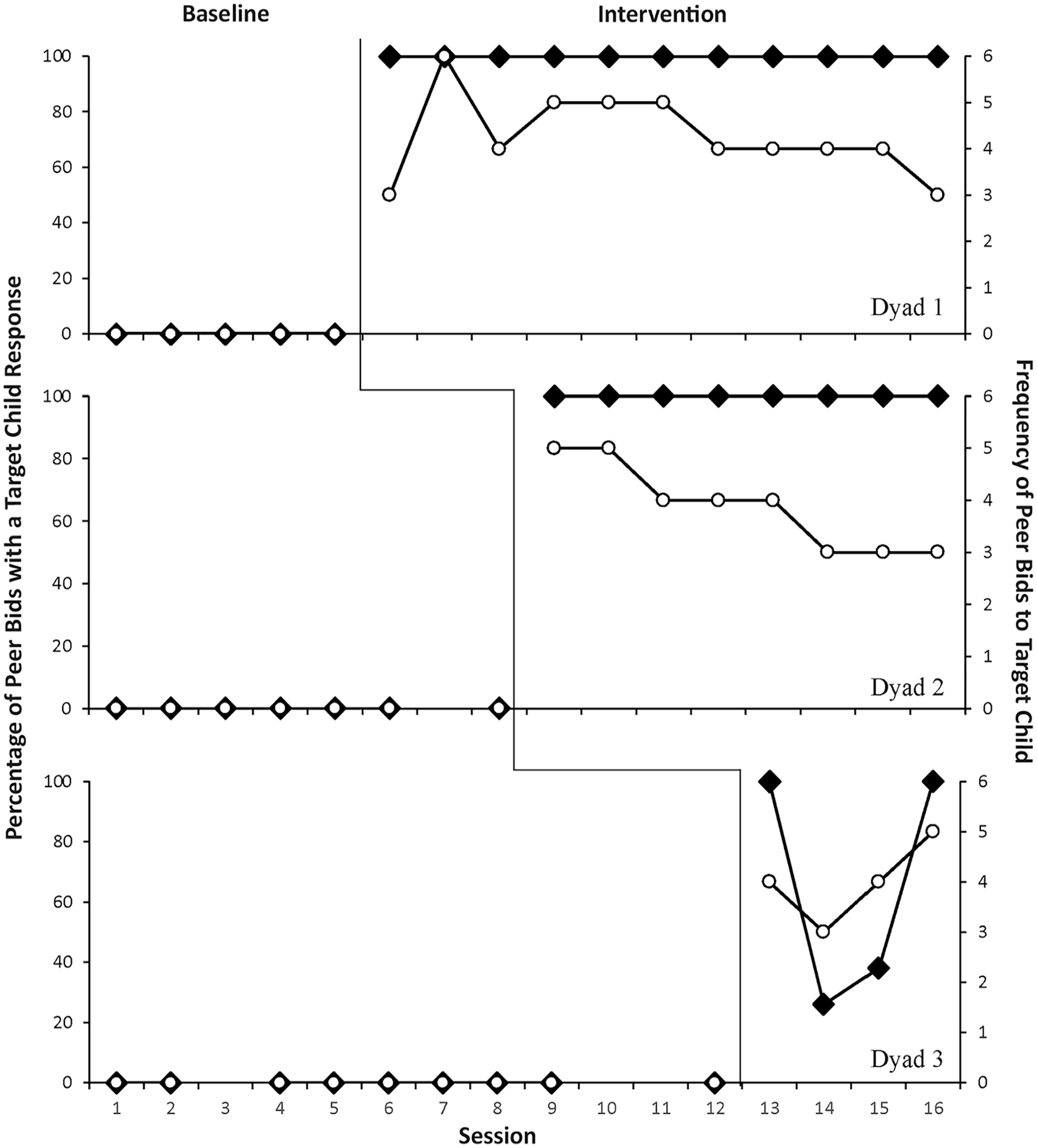
Effects of peer-mediated joint attention intervention.
Response to Joint Attention
A sufficient amount of data was collected to demonstrate a functional relation with limitations for target child RJA behavior. Data are shown in Figure 1. The data demonstrates three basic effects of the intervention. Wayne and Zane formed Dyad 1, and their RJA data is shown on the first tier of the graph. At baseline, Wayne initiated zero times across five sessions, and thus Zane responded zero times. Upon intervention, Wayne’s initiation data (gray bars) immediately increased in level, with a mean initiation of 4.2 initiations per 10-min session (range = 3–6). Zane’s rate of response (closed squares) immediately increased to 100% with no variability for all 11 sessions. Linus and Rocky made up Dyad 2, and their RJA results are shown in tier two. Linus delivered no initiations for joint attention across all seven sessions of baseline, and Rocky responded zero times. Following intervention, Linus’ initiations (gray bars) immediately increased in level, with a mean of 3.88 per 10-min session (range = 3–5). Rocky’s RJA (closed black squares) immediately increased to 100% with no variability for all eight sessions of intervention. George and Robert were in Dyad 3, and RJA results are shown in tier 3. George and Robert’s baseline data were at zero levels during baseline. After intervention, George’s IJA immediately increased in level, with a mean of 4.0 (range = 3–5). Robert’s RJA increased in level immediately, with some variability. Across the four intervention sessions, the mean of the responses was 70.75% (range = 33.3%–100%). A vertical analysis revealed no change in baseline data concurrent with intervention in other tiers, supporting experimental control.
Target Child Initiation of Joint Attention
Data for target child IJA is available in Table 2. Zane displayed zero IJA until intervention was introduced. Upon the addition of additional modeling and prompting of IJA behaviors for his peer, Zane spontaneously emitted one bid for joint attention, to which Wayne responded. Following initiation on Zane’s IJA, Zane made an average of 3 bids across 9 sessions (range = 2–5). Wayne’s RJA was 100% with the exception of 33.3% during session 11, with an average response rate of 92.55% (range = 33.3%–100%). Rocky intermittently made independent bids for JA before receiving intervention on IJA, which elicited some responses from Linus. Rocky’s average IJA prior to receiving any additional training was 0.4 per session across 10 sessions (range = 0–2). Upon increased access to intervention, Rocky’s IJA averaged 3.16 bids per session across 6 sessions (range = 2–4). Linus’s RJA was 100% except for session 13, which was 75%, for an average of 95.8% accurate response (range = 75%–100%).
Discussion
In this study, we examined the effect of peer training on peer-mediated RJA in inclusive preschool classrooms. Our data demonstrate a functional relation between the peer training and an increase in peer IJA and target child RJA. Further, a nonexperimental pilot of the inclusion of intervention on IJA for target children indicates some capacity for the development of RJA and IJA semiconcurrently.
These data are promising in that they indicate that, in a natural setting during typical preschool activities, it is possible to increase joint attention between children. Despite the inclusive preschool setting, baseline data indicated few bids from peers to target children despite consistent use of the same materials. Teachers reported very little interaction between target children and any peers during unstructured play prior to intervention as a part of their rationale for selecting these specific dyads. Although systematic data was not collected on target child engagement following intervention, anecdotal reports from classroom teachers indicated that target children sought out their peers during unstructured time and appeared more engaged during group activities. Involving peers in systematic instruction on early social communication skills may have collateral effects on social communication targets such as initiations to peers and play skills, as well as potential benefits in group instruction settings. Future research should directly measure these collateral benefits as well as investigate ways to explicitly program for the generalization of social communication skills.
Early social communication skills, such as joint attention, are behavioral cusps for later gains in communication and social skills (Hansen et al., 2018). There is a growing body of research to suggest evidence-based practices for instruction on early social communication skills, but a lack of research that directly intervenes on joint attention natural environments with natural social partners (Meindl & Cannella-Malone, 2011). Although children who are typically developing develop these skills in infancy, children with ASD may reach early childhood education environments without having developed these skills. Parents are logical intervention agents for children who would typically be spending the majority of their time in their parents’ care; however, it may also be beneficial for preschool children to develop early social skills appropriate to those being used by their peers. Peer-mediated intervention in preschool may provide critical models for socially valid social communication skills than adults (Collins et al., 2018). While the logic of increasing placement of children with ASD in inclusive settings is in part to improve opportunities for social communication models from typically developing peers, it may be necessary to explicitly program these opportunities, as in this study.
Implications, Limitations, and Future Directions
Despite the evident utility of utilizing peers to teach these skills, there may be some barriers to peer-mediated intervention. In particular, teaching social communication skills to young children with ASD may require explicit teaching to ensure social interaction becomes preferred and reinforcing (e.g., Jones et al., 2006; Taylor & Hoch, 2008). In this investigation, preference for social outcomes or any other environmental stimuli was not assessed, as this was not a typical practice used in the preschool classroom. Although the data demonstrated a functional relationship between this intervention and RJA and IJA, the absence of an objective measure of preference may be viewed as somewhat of a limitation. For example, Rocky made several spontaneous bids for joint attention (IJA) to his peer under baseline conditions when a novel volcano lava lamp was present. His teacher subsequently reported that items with an on-off switch were highly preferred and potentially a perseverative interest for Rocky. Future research may benefit from procedures to establish a) what joint attention stimuli may be highly preferred and thus increase interaction with the object and limit interaction with peers; and b) establish what reinforcing value social attention from peers has for the target child. If future investigations identify a lack of social outcomes functioning as reinforcers, teacher-mediated intervention may be a necessary first step to pair primary reinforcers with social interaction (e.g., Zrinzo & Greer, 2013). Inclusion of items assessed as mutually preferred between the target child and peer may also help increase the level of reinforcement available for each part of the dyad during intervention sessions.
Another barrier observed in a solely peer-mediated intervention was the inability of same-age peers to complete a precise prompting hierarchy. For most participants, this was not necessary, but Robert likely would have benefited from intensive intervention from an adult to increase his levels of RJA. It should be noted that the other two target children were less impacted by autism symptoms than Robert. Future research may consider baseline assessments of prerequisite skills (e.g., pointing) and presession training from the adult interventionist to limit the need for later adult intervention and increase the ability of the peer to improve socially valid skills.
This study had methodological limitations due to the applied setting and natural constraints on scheduling and child availability. For example, some limitations exist to the generality of these findings due to the high level of communication skills of two out of the three participants. ASD severity may be a moderating factor for the effectiveness of peer-mediated intervention as peers are less able to provide more intrusive prompts than a trained interventionist. While results of this study indicated more intensive presession training from an adult as in Hansen and colleagues (2018) was not necessary to increase RJA behavior, a different profile of learner may require additional procedural modification as seen in the last tier.
Future research should address barriers to the generalization of joint attention skills. Specifically, future research should evaluate the effectiveness of this intervention across peers to assess whether target children are able to spontaneously generalize RJA behaviors given a bid from a novel peer. In addition, a remaining barrier to the applicability of these results is the intervention agent. As the lead author is not a normal member of this classroom environment, it is possible that her presence served as a discriminative stimulus for joint attention behavior. Future research might consider a pyramidal model to train teachers to train peers, thus eliminating the need for an interventionist and potentially leading to greater maintenance of the effect of the intervention. We were also unable to collect social validity questionnaires from teachers due to the end of the school year. Teacher perceptions of the feasibility of these intervention procedures would inform future teacher training iterations.
Finally, little is known about the importance of the developmental sequence of these early skills. We chose to teach RJA and then IJA in order to imitate the developmental progression, but it is possible these skills could be taught in tandem. As evidenced by Robert’s slower response to intervention, children will need differentiated, individualized instruction. It is possible that Robert would have learned to respond given more explicit adult instruction, but it is also possible that Robert was missing prerequisite skills for joint attention. Future research should examine the effects of intervention on component skills of joint attention (e.g., imitation, social gaze) for nonresponders to intervention.
In summary, in this study, we extended the findings of Hansen et al. (2018) by removing adult-mediated priming sessions and adding intervention on target child IJA. Results indicated that for most participants, peer training was sufficient to increase RJA and IJA behavior in target children.
Footnotes
Declaration of Conflicting Interests
The author(s) declared no potential conflicts of interest with respect to the research, authorship, and/or publication of this article.
Funding
The author(s) received no financial support for the research, authorship, and/or publication of this article.