




Abstract
Students with autism spectrum disorder frequently face challenges when learning mathematical concepts. For example, they may have difficulties solving mathematical word problems, in particular Cartesian product problems. This research is a case study with a multiple probe design in which the participants were three Spanish students diagnosed with autism spectrum disorder. A conceptual model-based problem-solving approach adapted to the characteristics of the participants was used to teach them how to solve Cartesian product word problems introduced sequentially in the instruction (first multiplication, then division, and finally both operations). The results show a functional relationship between the intervention and the students’ performance. The three participants generalized their learning to two-operation Cartesian product problems (an addition and a multiplication). Moreover, two of them retained what they learned 6 weeks after completing the instruction. The implications for teaching this and other mathematical content to students with autism are discussed.
Keywords
Autism spectrum disorder (ASD) is a developmental neurobiological disorder that manifests itself during the first years of life and lasts for a lifetime. The fundamental characteristics of people with ASD are (a) persistent deficiencies in communication and social interactions, and (b) restrictive and repetitive patterns of behavior, interests or activities (American Psychiatric Association [APA], 2013). ASD features present heterogeneously and encompass a high degree of variability on social communication and repetitive behaviors (Georgiades et al., 2013), as well as in language skills (Kjelgaard & Tager-Flusberg, 2001). People with ASD may exhibit deficits in theory of mind (Frith, 1989; Ozonoff & Schetter, 2007) or in executive functions such as planning and attention (Ozonoff & Schetter, 2007), and may experience difficulties with abstract concepts lacking visual representation (Ozonoff & Schetter, 2007). Another characteristic of some individuals with ASD is a tendency to interpret language literally (APA, 2013; Happé, 1993).
Regarding academic achievement, a recent review by Keen et al. (2016) also points out to a large variability in academic performance of children with ASD, who may show strengths in some specific areas and weaknesses in others. Focusing on academic performance in mathematics and reading, Chen et al. (2019) examine the heterogeneity of academic performance profiles in children with ASD, finding a low-performing subgroup with poor mathematics skills and a high-performing subgroup that showed superior mathematical skills compared with reading. Other authors (Bullen et al., 2020) found that some students with ASD showed significantly lower performance on problem solving tasks than on computation tasks.
In the last years, several researchers have conducted interventions devoted to teaching mathematical skills to students with ASD. For example, the review by Barnett and Cleary (2015) selects 11 studies of evidence-based interventions that have mathematics as their primary target. The authors identify two types of interventions: those using visual representations and those using cognitive strategy instruction; and two types of targets: academic and functional skills (see Barnett & Cleary, 2015). The authors emphasize the need for more interventions targeting academic skills, particularly in problem solving, to minimize the challenges faced by some students with ASD (Barnett & Cleary, 2015). In another systematic review of mathematics interventions for students with ASD, Gevarter et al. (2016) include 22 studies and identify different mathematical intervention components (such as breaking down word problems, schema-based instruction and problem-solving cognitive strategies, among others) and behavioral-based intervention components (such us reinforcement, modeling, and prompting). King et al. (2016) select 14 studies of evidence-based interventions, describing participant characteristics, methodological features, interventions, target behaviors and related outcomes. Their findings are in line with previous results, stating the necessity of further high-quality research in this line.
Focusing on mathematics problem solving, the systematic review by Root et al. (2021) identifies six types of evidence-based practices for students with ASD: task analysis, system of least prompts, graphic organizers, explicit instruction, schema-based instruction, and technology assisted instruction. Their results align with those of previous works (Barnett & Cleary, 2015; King et al., 2016) and point to the effectiveness of some strategies originally aimed at students with learning disabilities. In particular, Schema-Based Instruction (SBI) (e.g., Rockwell et al., 2011) and Modified Schema-Based Instruction (MSBI) (Cox & Root, 2020, 2021; Polo-Blanco et al., in press) have been successfully implemented with students with ASD to improve verbal mathematics problem-solving skills.
Another evidence-based practice frequently used to teach mathematical problem solving to students with learning difficulties is Conceptual Model-Based Problem Solving (COMPS) developed by Xin and her collaborators (see for example Xin, 2012, 2019; Xin et al., 2008). The COMPS methodology follows a direct instruction process consisting of sessions with guided practice, independent practice, and continuous feedback (Engelmann, 1980) and contains two stages: story grammar and problems with unknowns (Xin, 2012). The COMPS methodology relies on the use of schematic diagrams that emphasize the algebraic representation of mathematical relations in equation models (e.g., “Part + Part = Whole” for additive word problems; “Unit Rate × Number of Units = Product” for equal group multiplicative word problems) (Xin, 2012). An important ingredient of this method is the use of a cognitive heuristic DOTS checklist (Detect the problem structure; Organize the information using diagrams; Transform the diagram into a math expression, and Solve the operation) developed to help students’ self-regulation in the problem-solving process (Xin, 2012).
The use of the COMPS program has proved beneficial for solving additive and multiplicative mathematics problems with students with learning difficulties (Xin et al., 2011, 2019). Some instructional aspects of COMPS have been shown to be effective with students with ASD, such as the use of visual aids (Wong et al., 2015), or the use of cognitive strategies such as heuristics (Whitby, 2013). This lead us to believe that a modified version of COMPS methodology, including adaptations specially oriented to students with ASD, may be effective to improve their problem-solving skills. This idea was explored in a previous work (Polo-Blanco et al., 2022) where modifications to the traditional COMPS approach were included to better adapt to the characteristics of people with ASD. For example, a checklist was provided depicting the four actions of the cognitive heuristic DOTS checklist, including pictograms for each of them. The results of this work showed a functional relationship between a modified COMPS intervention and the performance of a 14-year-old student with ASD in solving multiplicative structure problems. The participant improved his problem-solving skills, generalized them to problems with two operations (an addition and a multiplication), and transferred his knowledge to an everyday situation.
Because of the difficulties experienced by some students with ASD (Bullen et al., 2020; Chen et al., 2019), and the need for further research on teaching them mathematical skills and problem solving (Barnett & Cleary, 2015; King et al., 2016), it is pertinent to implement interventions that cover all aspects of the mathematics curriculum, to provide students with ASD who have difficulties with the best possible education.
One of the main contents of the mathematics curriculum is multiplicative word problems, in particular Cartesian product (CP) problems. CP problems involve finding all possible combinations of two different sets of items. For example, the problem “I have 5 shirts and 3 pants, in how many different ways can I dress?” is a CP multiplication problem. General problem solving is likewise reinforced by solving CP problems (Martino & Maher, 1999). Solving CP problems and other types of mathematical problems can be a challenge for many students because it requires different skills, such as reading comprehension, reflection, planning the steps to follow and the strategies to use, checking the result and communicating it to others (Daroczy et al., 2015).
Most of the aforementioned studies that deal with solving multiplication problems focus on two types of problems: equal group and multiplicative comparison (Cox & Root, 2021; Xin et al., 2008, 2011), with CP problems being less usual (Polo-Blanco et al., 2021). We found several studies on solving CP problems with typically developing students; the most relevant of them are summarized below. The research by English (1991, 1993) with students between 4 and 12 years of age showed that the participants developed effective strategies for solving CP problems presented in a familiar context. Elsewhere, the research carried out by Pinto et al. (2018) involved students between 8 and 10 years old who displayed various combinatorial and non-combinatorial strategies to obtain better performance in direct CP multiplicative problems. The research carried out by Tillema (2013, 2020) with students between the ages of 10 and 14 years shows that participants use various strategies when solving combinatorial tasks, including schematic tree diagrams and matrices, and that sometimes they do not follow consistent patterns when matching the elements to establish the corresponding combinations.
Due to the scarcity of research involving CP problems in the particular case of students with ASD, and the need for further research on mathematical problem solving with students with ASD as we discussed above (Barnett & Cleary, 2015; King et al., 2016; Root et al., 2021), in this article, we consider the following research questions:
Method
Participants and Setting
The participants were selected from a larger project related to mathematical learning and autism. In this project, participants had been recruited through different channels: associations of people with disabilities and/or autism, school guidance teams and hospital outpatient clinics. For the present study, individuals who met the following inclusion criteria were selected: (a) being diagnosed with ASD as per the Diagnostic and Statistical Manual of Mental Disorders (5th ed.; DSM-5; American Psychiatric Association, 2013), (b) having a mathematical age of at least 6 years in the Test of Early Mathematics Ability (TEMA-3; Ginsburg et al., 2007) to ensure the pre-requisite knowledge of numerical addition and subtraction facts, and (c) scoring no higher than 50% in a pretest of mathematical word problems requiring multiplication or division. Four students were selected for the study. They were enrolled in four different mainstreams schools in a province of northern Spain. One of the students was excluded after it was verified that he was able to solve CP problems with more than 80% success rate.
The three participants were Hispanic males diagnosed with ASD by a child psychiatrist from Social Security. They were in the moderate autism range, according to their scores on the Childhood Autism Rating Scale (Schopler et al., 1988).
Student A was 8 years 4 months old. He began to show signs of the disorder at 2 years of age. He had a co-morbid diagnosis of attention-deficit/hyperactivity disorder (ADHD) and ASD. His IQ was 75 and his Verbal Comprehension Index (VCI) was 95 according to Wechsler Intelligency Scale for children–5th edition (WISC-V; Wechsler, 2015). At the start of the study, he obtained a score of 63 (mathematical age 8 years 7 months) on the TEMA-3 mathematical proficiency test (Ginsburg et al., 2007). He was a third-grade elementary school student. Academically, according to his teachers, he was able to read with ease and perform relatively complex calculations, but he exhibited significant difficulties solving mathematical problems. He received 6 hr a week of special education services mainly aimed at working on aspects of language and mathematics.
Student B was 8 years 8 months old. He had a diagnosis of ASD with no comorbidities. He had an IQ of 77 and a VCI of 68 (WISC-V, Wechsler, 2015). At the start of the study, he obtained a score of 43 (mathematical age 6 years 7 months) on the TEMA-3 mathematical proficiency test (Ginsburg et al., 2007). He was a fourth-grade elementary school student. He could read, although he showed comprehension difficulties. At school, he received special education services 10 hr per week in different areas, including language and mathematics.
Student C was 8 years 7 months old, diagnosed with ASD with no comorbidities. He had an IQ of 95 and a VCI of 105 (WISC-V, Wechsler, 2015). At the start of the study, he scored 58 (mathematical age 7 years 9 months) on the TEMA-3 mathematical proficiency test (Ginsburg et al., 2007). He was a fourth-grade elementary school student. According to his teachers, the student followed a learning curriculum suited to his age, although he exhibited difficulties solving mathematical problems. At school, he received special education services 2 hours per week in the area of mathematics.
The study was conducted during the summer school holidays. It took place in a classroom prepared for this purpose in a public university in northern Spain. This classroom was adapted to be free from distractions to facilitate the students’ attention and concentration. Between two and four weekly sessions were held with each student, depending on the availability of the families. The first author of this work conducted all the training sessions. She was a PhD student with a degree in elementary education, specialized in special education, and a master’s degree in educational research and change. She had more than 4 years of experience teaching mathematics to students with ASD, with and without intellectual disabilities.
Dependent and Independent Variables
The dependent variable was the percentage of problems correctly solved in approximately 15 min during independent practice at the end of each instructional session. The independent variable was a problem-solving intervention based on a modified conceptual model–based problem solving (COMPS) approach (Polo-Blanco et al., 2022; Xin, 2012), which was detailed in the “Procedure” section.
Design and Data Collection
A single-case, multiple probe across students design (Horner & Baer, 1978) was followed to assess the effectiveness of a modified COMPS instruction on the performance of multiplication and division CP problems. The phases of the experiment were as follows: baseline, training on CP word problems (introduced sequentially: first multiplication, then division, and finally both operations), follow-up, generalization (to two-step problems), and maintenance (six weeks after training). To show dependency between instruction and student performance, the students were introduced to the intervention sequentially over time. Once a student reached a stable baseline (same score in at least three consecutive sessions), the training began. When the student showed mastery (at least 80% correct) in at least two consecutive sessions, the next student was introduced to training, provided his baseline was stable, and so on. In total, 27 sessions were held with Student A, 25 with Student B, and 23 with Student C.
In the baseline phase, the students’ performance solving single-operation CP problems was evaluated. Their ability to generalize to two-operations (two-step) CP problems was also assessed once. Once a stable baseline was observed for Student A (i.e., the same score in at least three consecutive sessions), that student was introduced to the training. Students B and C were introduced sequentially to the training after attaining a stable baseline, and once the previous student’s performance had improved at least two sessions in a row.
The training sessions consisted of CP problems with story scenarios without unknowns (e.g., “If I have 4 shirts and 3 pants, I can dress in 12 different ways”) and CP problems varying the unknown: first with the final quantity unknown, which leads to a multiplication operation (e.g., “If I have 4 shirts and 3 pants, in how many different ways can I can dress?”); second with one of the parts unknown, which leads to a division operation (e.g., “If I have 4 shirts and some pants, and I can dress in 12 different ways, how many pants do I have?”); and finally, mixed problems involving either multiplication or division. The criterion for transitioning from CP stories to CP problems with a final unknown was to achieve 100% in one session. The criterion for transitioning from CP with a final unknown to CP with an unknown in one of the parts was to achieve 100% in two consecutive sessions in this type of problem. The training phase ended when the student successfully solved problems with both operations in three consecutive sessions. The student then began the follow-up phase, which consisted of three sessions. In each session, the student solved a test similar to the one in the baseline phase with only the statements of the word problems, without the guidelines of the worksheet (see “Procedure” section) or support from the checklist. After completing the follow-up phase, the generalization to two-operation CP problems with a probe similar to the generalization in the baseline was evaluated three times. Finally, three probes were administered 6 weeks after finishing the instruction (maintenance) consisting of six one-operation CP problems, similar to those in the baseline phase.
Probes and Scoring
The evaluation during the baseline, follow-up, and maintenance phases consisted of probes that contained six single-operation CP problems, three multiplications and three divisions, presented to the student in randomized order. The problems were adapted from Mulligan and Mitchelmore (1997) and Tillema (2013), and involved amounts no greater than 30. In addition, each training session included a problem with a context not practiced with the students before with the unknown in a random position to see if they exhibited any difficulties when transferring the skills learned to unknown contexts (Polo-Blanco et al., 2021), and to try to prevent them from doing the operations mechanically. During the training phase, each session ended with a probe of five problems of the type presented in the session, which the student solved independently. The percentage of right answers was considered when grading the probes.
The generalization probes, both in the baseline phase and after completing the instruction, consisted of six two-step problems that required two operations, an addition and a multiplication, such as “There are 3 square watches and 2 round watches in the watch store. They also have 4 strap colors to choose from: black, blue, green and yellow. How many different watch and strap combinations are there?”
Procedure
Baseline
During baseline sessions, each student had to solve a six-problem probe as described above. Each student was given A4 sheets one by one, each one containing the statement for the problem to be solved. The instructor would begin by saying, “Now you are going to show me how you solve these problems.” If students asked for help, the problem was read again to them, and they were encouraged to continue. They were not given hints as to how they were solving the problems, nor were they corrected for errors. No time limit was set, and the sessions lasted approximately 15 min.
Training
All the training sessions were carried out by the first author individually with each student. A COMPS intervention was carried out with modifications for students with ASD. The modifications included (a) augmentative and alternative communication systems such as pictograms to facilitate the student’s understanding of the problems (García-Moya, 2018), (b) drawings illustrating the combinations in the problem posed, and (c) a visual checklist with brief verbal instructions adapted from DOTS (Detect, Organize, Transform, Solve) sequence, with pictograms accompanying each of the instructions (Polo-Blanco et al., 2022; Xin, 2012).
Each instructional session was planned to last a maximum of 45 min. At the beginning of each session, the instructor set the session time limit using a visual timer (Ozonoff & Schetter, 2007) so that the student could check the time left to finish. If a student became unmotivated or expressed that he did not want to continue, he was asked to write a list with the numbers of problems to be solved and to circle each one as he finished it.
The instruction was direct, with continuous teacher feedback and modeling, guided practice and independent practice (Xin, 2012). Specifically, the sessions began by guiding the student through three problems before having him solve five problems independently. During the independent practice, no feedback was given to the student as in the baseline phase.
In line with similar COMPS methodology studies (Polo-Blanco et al., 2022; Xin et al., 2008) the intervention was carried out in two phases: (a) word problem story scenarios without unknowns and (b) word problems with unknowns.
Word problem with story scenarios without unknowns
The first training session was devoted to stories without unknowns (e.g., “If I have 4 shirts and 3 pants, I can dress in 12 different ways”). In these sessions, as mentioned, the student became familiar with the material, in particular with the representation of the story through drawings, and its relation to the diagram and the operation. The steps of the worksheet and the checklist (see Figure 1) were adapted from the DOTS sequence as follows:
Steps 1 to 3. Story scenarios without unknowns, pictogram sentences, and drawings (“Detect”). The student read only the story and chose and pasted on the worksheet the pictogram sentence corresponding to the story statement. This use of augmentative language was intended to facilitate his understanding of the situation and the completion of the subsequent steps (García-Moya, 2018; Barnett & Cleary, 2015; Mirenda, 2003). Next, the student made a drawing showing the two factors (e.g., shirts and pants) and joined them using different colored arrows (see Figure 1) or chose a diagram already drawn.
Step 4. Schematic diagrams (“Organize”). Relying on the drawing from the previous step, the instructor guided the student to fill in the schematic diagram with the data from the story through the word problem grammar questions (Xin, 2012) as follows: “How many objects of the first type (i.e., shirts) are there? Write the number in the square,” “How many objects of the second type (i.e., pants) are there? Write the number in the circle,” and finally “How many combinations are there in total? Write the number in the cloud. Now we are going to count how many arrows you drew. Notice that it is the same number that you wrote in the cloud.” During guided practice, the instructor provided feedback whenever the student made a mistake.
Step 5. Operation (“Transform”). The student wrote the operation that related the three numbers provided in the problem story based on the information in the schematic diagram. During guided practice, the instructor helped the student to identify the operation from the diagram. For example, if they had difficulty identifying the division, the instructor showed them to cross out the circle on the diagram (see Figure 2).
Step 6. Solution (“Solve”). The student explicitly wrote the expression for the operation to be performed and solved it. During guided practice, the instructor insisted that the student use the drawing to check for himself the solution. To this end, the student was asked questions like “Did you check your answer? Does it make sense? Is it correct?”
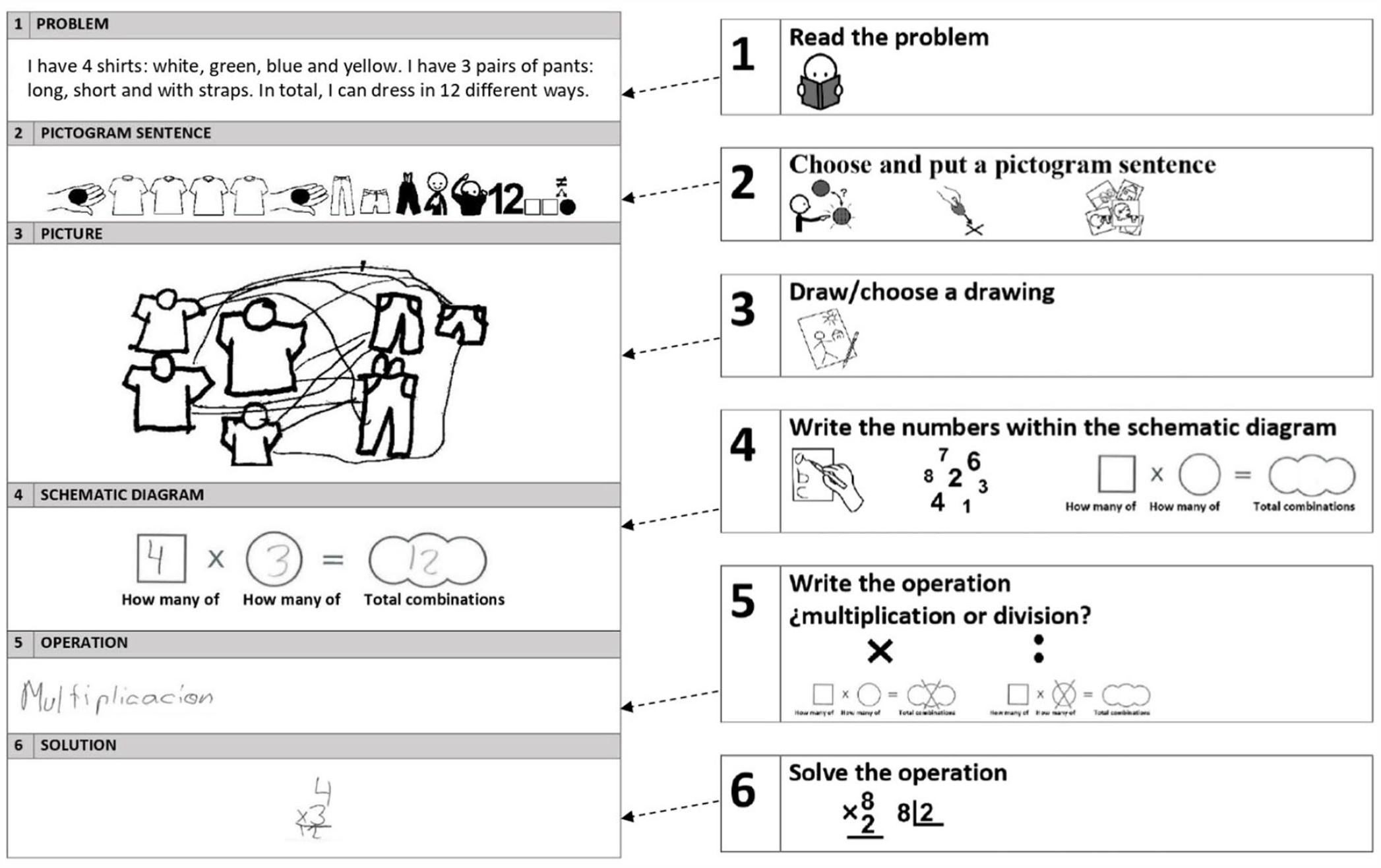
Materials for solving CP problems.
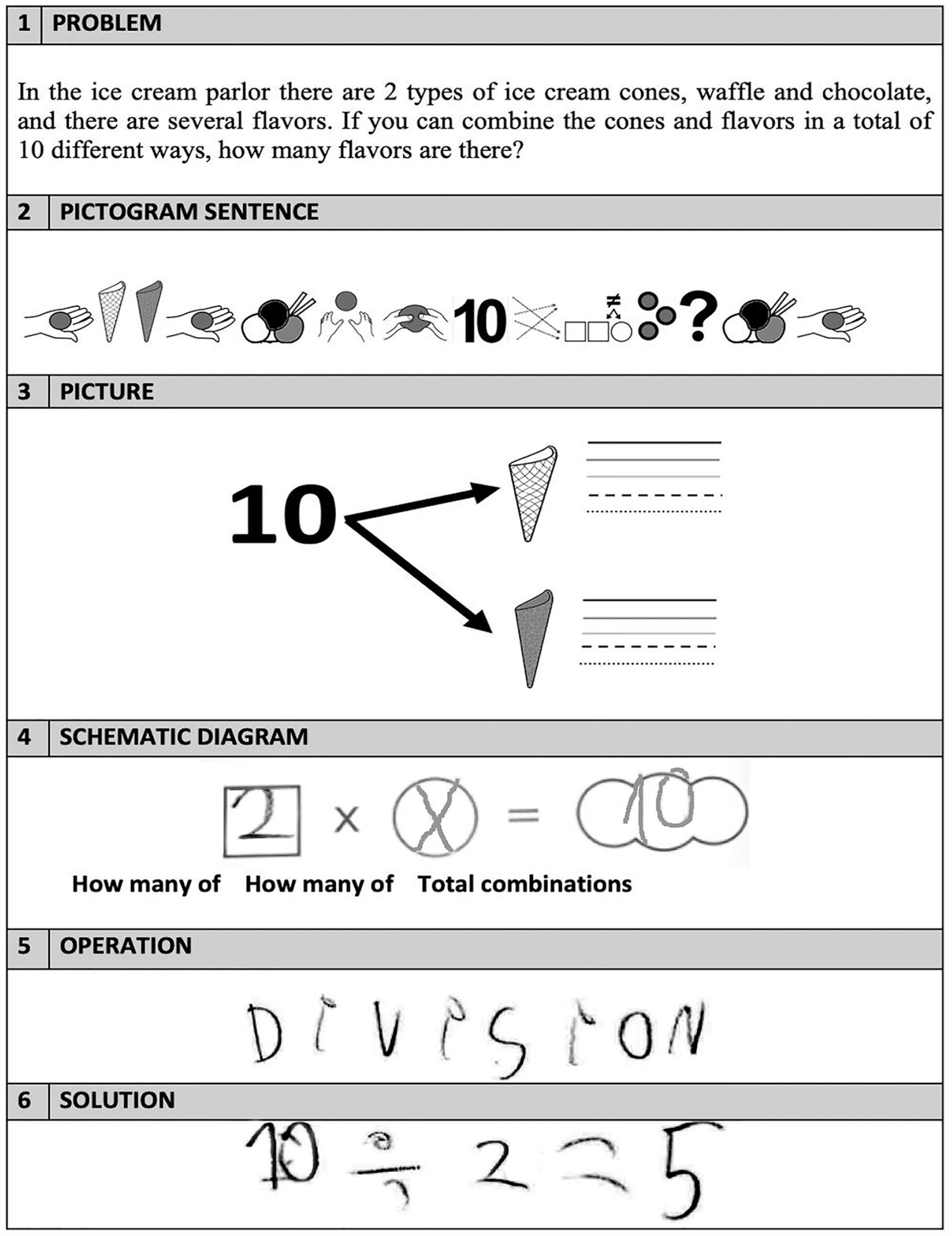
A solved CP problem.
The session ended when the student solved five stories independently. During the independent practice, no feedback was given to the student. If the student correctly filled in the worksheet for the five stories, the next session started with word problems with unknowns. If that was not the case, the next session was dedicated again to working on stories without unknowns until he correctly solved five stories independently.
Word problems with unknowns
The process for this phase was similar to that of the stories phase and included CP multiplication problems, then division and finally both operations. The multiplication problems were taught in a similar way as the word problem stories without unknowns, emphasizing that the result was the number of arrows drawn (see Figure 1). The division problems were taught with a drawing by dividing the total number of combinations (the largest number provided in the problem) by one of the factors (the smallest number in the problem) using different colors. Specifically, one color was chosen, and a line was drawn for each object in the factor (e.g., number of different ice cream cones; see Figure 2). Using a different color, the student drew another set of lines between each object of the factor, and so on until the number of lines drawn matched the total number of possible combinations (largest number in the problem). For these problems, the instructor emphasized that the result (such as the number of different flavors) was the number of different colors used in the drawing (see Figure 2). In addition, during training on problems involving both operations, crossing out the cloud in the diagram was associated with having to multiply and crossing out the circle with having to divide (see checklist in Figure 1).
Follow-up
In each follow-up session, the student completed a probe with six problems, three multiplications and three divisions, which were presented in randomized order. The probes were similar to those in the baseline phase and only contained the problem statements and did not include any support like the one provided in the worksheets or the checklist.
Generalization to two-step problems
During each of the three generalization sessions, the student solved six two-operation problems (one addition and one multiplication) independently and without any support. The same feedback was provided by the instructor as in the baseline sessions.
Maintenance
Three maintenance sessions were held with each student 6 weeks after completion of the instruction. In each session, the student solved a probe similar to that in the baseline and follow-up phases.
Internal Validity
All the sessions were videotaped, and inter-rater and procedural agreement data were randomly collected from all phases. Data for about 33% of the sessions (baseline, training, follow-up, generalization and maintenance) were collected for each of the students and was re-evaluated by a second observer, a university teacher specialized in special education, who was unaware of the study hypotheses. Inter-rater agreement was calculated for each phase in this way: number of agreements divided by total number of data and the result was multiplied by 100.
Inter-rater agreement was 100% during baseline, 96% during training, 100% during follow-up, 100% during generalization, and 100% during maintenance. The mean inter-rater agreement for each student across all phases was 96.55% for Student A, 100% for Student B, and 96.30% for Student C.
Procedural data were collected during 33% of the videotaped sessions. The same second observer rated the instructor’s performance on the planned behaviors (procedural agreement) which were the following: the instructor (a) provides the correct number of problems in each session, whose characteristics are the agreed ones; (b) provides the number of pictograph phrases and drawings agreed upon during the training sessions; (c) provides the checklist during the training sessions; (d) emphasizes the key aspects of each type of problem while solving guided practice problems; (e) allows students to solve problems autonomously during independent practice; and (f) congratulates students at the end of each session, verbally and visually (thumbs up) for the work they have done and gives them an award (a sticker, a tour of the building where the research is taking place, or playing with toys). Procedural agreement was calculated in this way: number of correctly implemented behaviors divided by total number of planned behaviors and the result was multiplied by 100. Procedural reliability was 100% for Student A, Student B, and Student C.
Social Validity
Social validity is an essential concept concerned with the social significance and appropriateness of the effects of interventions (Gresham, 1983). For this reason, examining social validity to meet the concerns of students, parents, and teachers is an important part of applied research. In this study, social validity interviews were conducted with participants and their family members. Specifically, both the participants and the families responded to two online opinion questionnaires: one before and one after the study. In the preliminary questionnaire, the participants answered questions related to their affinity for mathematics, problem solving, and materials or supports that facilitated problem solving. Similarly, the families answered questions related to the children’s affinity for mathematics and problem solving, and the main difficulties they observed in their children in this area. The subsequent questionnaires (both for the participants and the families) were similar to the preliminary ones, but included aspects involving the COMPS methodology, the children’s acceptance, and their motivation during the instructional experience.
Results
Figure 3 shows the percentage of right answers obtained by the students when solving the CP problems. As the graph shows, Student A’s progress throughout the study exhibits some fluctuations. Student A scored an average of 33.33% in the first baseline session, since he solved all the multiplication problems, except for one of them, where he used a subtraction. In the rest of the baseline sessions, he obtained a stable 50% score since he continued to solve all the problems with a multiplication, which evidenced his lack of understanding of the problems. In the baseline generalization session, he obtained 16.67%, solving one problem correctly, but then resorting to two multiplications in all the other ones. During the intervention, he made some mistakes solving some division problems. In these situations, he was strongly urged to cross out in the diagram the number that was not provided in the problem statement to correctly identify both the operation and the result. In the first generalization session, he scored 66.67%. All the mistakes were due to incorrectly writing the numbers given in the problem statement, although he always chose the right operations (addition and multiplication). During the maintenance phase, the student made the same mistakes than in some of the training sessions, resorting to multiplication in some of the problems requiring division.
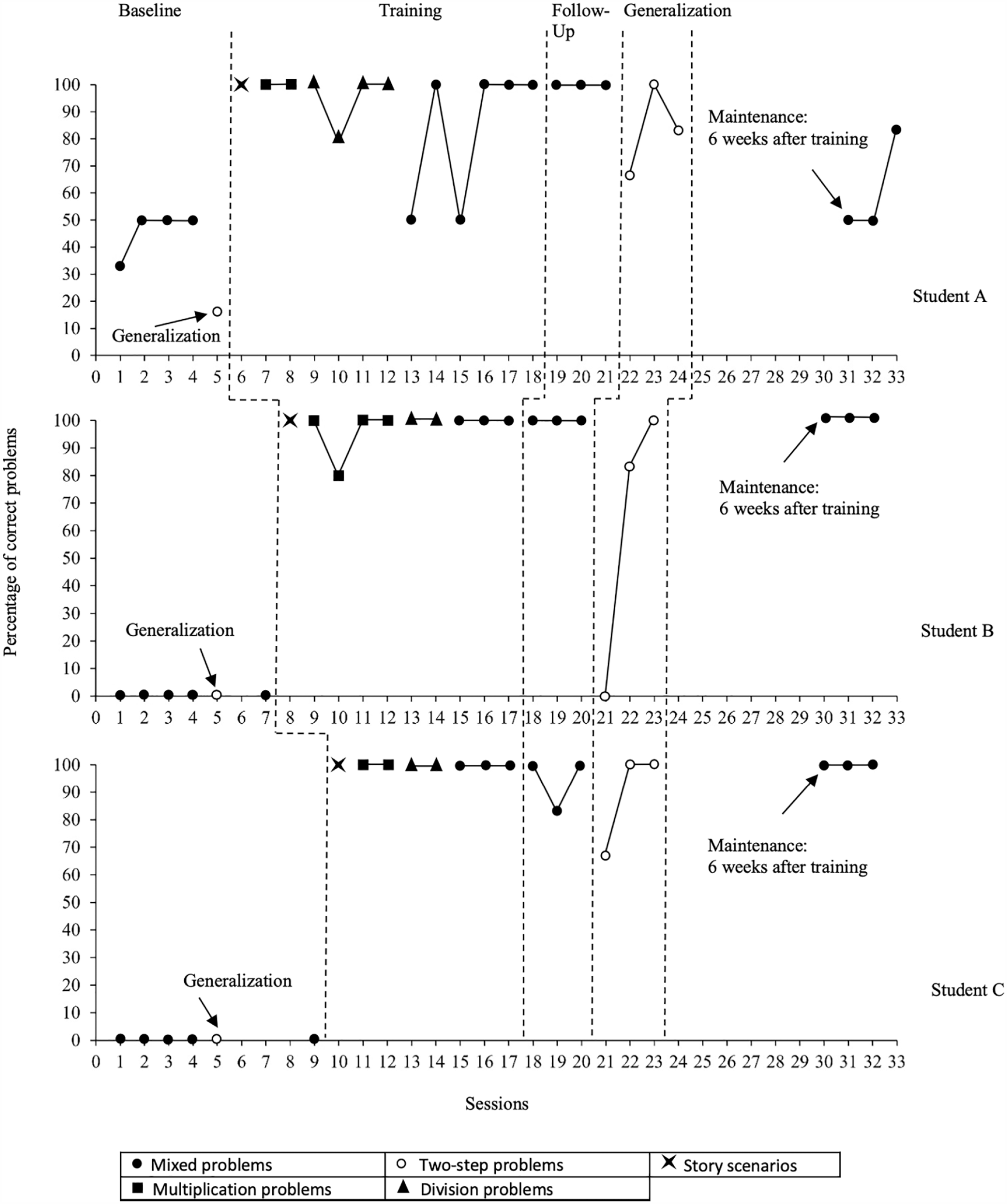
Percentage of correct problems during the baseline, training, follow-up, generalization, and maintenance sessions.
Student B scored 0% in the baseline because he solved all the problems by adding the two numbers provided in the problems. From the beginning of the training phase, he showed a significant improvement, correctly solving all the problems except in the second multiplication session (due to a calculation error). It should be noted that in the follow-up and maintenance sessions, it was the student himself who drew the diagram, imitating the one provided in the worksheets during the training phase. For example, for the division problems, he drew a diagram indicating: total combination ÷ How many of? = How many of? In the first generalization session, the student scored 0% since he ignored the addition operation and performed only the multiplication. Specifically, after finishing all the problems of the first generalization session, he expressed verbally that there were errors in the statements of the problems because there were three numbers instead of two. At the beginning of the second generalization session, he was reminded that there were no errors in the problems. During the second and third generalization sessions, he drew a diagram depicting: How many of? (result of summing the first numbers in the problem) × How many of? = Total combination. In the second generalization session, he scored 83.33% only making a calculation error in a multiplication.
Student C scored 0% in the baseline because he solved all the problems with additions, and in the generalization problems, he did not carry out any operations, instead answering with the last number that appeared in the statement. After the training began, he showed consistent performance, making a single mistake in a problem in the second follow-up session wrongly identifying the operation. It should be noted that in this phase, whenever he hesitated in choosing the right operation, the student drew a diagram imitating the one provided in the training phase worksheets. In the first generalization session, the student scored 66.67%. He was uncertain as to how to approach the first problem, which he solved with two multiplications (instead of an addition and a multiplication), and in the second problem, he swapped the numbers in the operations, although the choice of operations was correct. The student was urged to read the problem statements slowly to understand them.
To calculate the effect size, we used the percentage of non-overlapping data (PND) (Scrugs et al., 1987). The PND index is determined by dividing the number of data points in the intervention phase that exceeded the highest data point in the baseline phase by the total number of data points in the intervention phase and multiplying by 100. The PND indexes between the baseline and intervention phases were 84.62%, 100%, and 100% for Student A, B, and C, respectively, classifying the intervention as very effective for all of them.
Social Validity
As mentioned earlier, the participants answered questionnaires before the intervention and after the generalization phase. In the preliminary questionnaire, they answered questions about their opinion of mathematics and problem solving, as well as the aspects they found most challenging. The responses were varied, from clearly expressing a like for problem solving (A) to expressing a dislike (C). To the question “What is the hardest part of solving problems?,” two students (A and B) replied “understanding the story told by the problem,” and the third (C) said “answering the question that the problem asks.” In response to the question “What is the easiest part about solving the problem?” the three students said “performing the operation.”
After completing the generalization phase, the students took another survey that contained questions about aspects of the methodology (e.g., pictogram sentences, drawings, schematic diagram). Specifically, they were asked which aspects had helped them to understand and solve the problems. The three responded that it was easy for them to follow the steps of the worksheets and the checklist, that the pictogram sentence was very useful for understanding the problem statement and solving it, and that the drawing helped them verify that they had done the problem correctly. Only Student A responded that he had not liked having to draw the pictures, but he did like choosing them. The schematic diagram was of little use according to Student A, very useful for Student B, and quite useful for Student C. In general, the three participants expressed that they enjoyed the experience.
The families were also interviewed before and after the experience. In the preliminary questionnaire, they were asked about their children’s like of mathematics, and in particular of problem solving. They were also asked questions regarding those aspects they thought were most difficult for the children. All three reported that their children showed a like for mathematics, although two of them (B and C) stated that they found it quite difficult. The three families replied that the most difficult aspect of problem solving for their children was understanding the story, and the easiest was doing the operation (A and C) and identifying the numbers that appear in the problem (B). As for the aspects they thought helped them solve problems, they replied drawing pictures and using materials.
In the subsequent interview, when asked what their children had thought of the experience, the family of Student A said that their son had not specifically expressed what he liked the most, although he had stated that he was happy to go to the sessions with the instructor. The families of Students B and C expressed seeing an improvement in their sons’ mood after the experience, and they exhibited more confidence when solving problems because they now understood what they were doing. Both families reported that their children spoke to them at length about what they had done in the sessions, and when asked what aspects they liked most, one family said “Our son told us that there are pictograms, and when you cross out the cloud you have to multiply and when you cross out the circle you have to divide” (B) and another stated, “He told us about how he solves the problems, what he did in the session, how easy it is for him and the drawings he made” (C).
Discussion
The purpose of this study was to examine the effects of a modified COMPS intervention to teach students to solve mathematics CP word problems requiring multiplication and division. The results of the study show an immediate improvement for the three participants, reaching a mean accuracy of 95.48% during the intervention, 77.78% during the generalization, and 87.04% during the maintenance phase. A functional relationship was thus observed between COMPS instruction and the improvement of students with ASD solving multiplication and division CP problems.
The participants showed a very positive attitude to learning, and they were participative and cheerful from the beginning of the training phase. The use of the COMPS methodology (Xin, 2012), with the appropriate modifications to adapt it to the characteristics of the students with ASD, allowed these students to correctly solve CP requiring multiplication and division, to generalize the material learned and to retain it over time. Specifically, Students B and C, who had scored 0% in the baseline, improved their performance immediately after starting training, making hardly any mistakes when solving the problems in every phase of the study. It should be noted that Student B always drew his own diagram to solve the follow-up, generalization, and maintenance problems, while Student C drew his own diagrams only in those follow-up problems where he was not sure what operation to perform.
In the case of Student A, his performance was less stable. He exhibited difficulties when division problems were introduced, which he solved with multiplication in some of the sessions, and he was distracted quite often during the sessions, which affected his performance. This concentration difficulties, probably exacerbated by his comorbid diagnosis of ADHD with ASD, could have led him, at times, to misunderstand the problems. In those cases, the use of pictogram sentences proved to be very useful.
Finally, in each training session, there was one problem whose context had never been presented until that moment. The results show that no participant had problems transferring what they had learned to the new context. Moreover, as suggested by other authors (Polo-Blanco et al., 2021), students with ASD could benefit from contextualizing the problems in topics that interest them so as to aid their engagement with the problem. Our results in this regard are particularly promising, since they show that the students were able to transfer what they acquired to new contexts. Moreover, as in the study by Polo-Blanco et al. (in press), the three students generalized what they had learned to two-operation problems. In addition, two of them (B and C) retained what they had learned 6 weeks after the last training session.
Students A and C showed immediate good performance on the two-step problems which suggests generalization occurred. Student B was confused during the first generalization session by the presence of three numbers in the problems instead of two, so he approached them as if they required only one operation (multiplication). He seemed displeased by the change in the problems, verbally expressing that the instructor must have made a mistake when writing them. After clarifying that there were no errors, he solved the problems in the remaining two sessions with more than 80% success. However, during these generalization sessions, he seemed to be more restless. He also showed reading difficulties and needed to reread the statements of the problems several times.
Some aspects of the COMPS methodology have been shown to be particularly suited to the characteristics of students with ASD. For example, using the schematic diagram of COMPS facilitated students’ understanding of the problems, given the tendency of people with ASD to resort to visual processing. Moreover, the inclusion of a checklist with guidelines for solving problems supports deficits in executive functions, such as planning, which are characteristic of individuals with ASD. In addition, as in other works that adapt methodologies for students with ASD (Polo-Blanco & García-Moya, 2021; Polo-Blanco et al., 2022; Root & Browder, 2019), modifications to the COMPS methodology have also been incorporated in this study. These include the pictogram sentences to support their understanding of the situation presented in the problem (García-Moya, 2018), the diagrams depicting the problem situation, as well as pictograms accompanying the instructions in the checklist. These modifications take into account that the use of augmentative language benefits information processing in students with ASD (Barnett & Cleary, 2015; Mirenda, 2003).
From the point of view of the type of problems involved, the results show that the students improved their performance when solving CP problems, which contributes to the scarce literature on multiplicative problem solving in students with ASD (Cox & Root, 2021; Polo-Blanco et al., 2022). The results are also consistent with other works on solving CP problems with typically developing students (English, 1991, 1993) in the sense that the participants in our study also developed effective strategies to solve this type of problems.
In general, the results are consistent with studies on problem solving that evaluate the effectiveness of COMPS methodology with students with difficulties (Xin, 2012; Xin et al., 2011, 2020). Specifically, the methodology had been shown to be beneficial for working with additive word problems (Xin, 2019), multiplicative word problems (Xin et al., 2008) and, more generally, to prepare students to learn algebra (Xin et al., 2011). This work expands the contents that can be practiced using a COMPS approach, addressing the acquisition of CP problem-solving skills.
Focusing on students with ASD, the results are consistent with the work of Polo-Blanco et al. (2022), which evaluates the effectiveness of a modified COMPS approach to teach a student with ASD to solve multiplication and division problems. Moreover, the results build on the scarce research that addresses the effectiveness of other methodologies adapted to students with ASD for solving problems with a multiplicative structure, such as MSBI (Cox & Root, 2020, 2021). As SBI and MSBI are considered evidence-based practices for students with ASD (Gevarter et al., 2016; Root et al., 2021), the results of this study also show the effectiveness of the COMPS methodology adapted or modified for the mathematical learning of these students.
Limitations and Future Lines of Work
One limitation of this work is the sample size, which does not allow the results to be generalized to other subjects with ASD, although the study is deemed to be sufficiently rigorous (Ledford et al., 2018). Another limitation is that the study took place in a context that was unfamiliar to the students and during the summer vacation. This prevented us from assessing how the learning acquired during the study influenced their school learning; thus, the study could be replicated during the school year to determine if the results obtained are transferred to school settings (Davis et al., 2016).
However, some aspects of this study could pose challenges when implemented in school settings. One limitation when implementing this intervention in educational settings (mainstream or special) is that it would require the training of teachers in this instructional methodology. Moreover, in the context of our study individual instructional work was carried out with each student, so instructional sessions in school settings would require one teacher working one-on-one with the student. In the case of Spain, where this research took place, students with a similar profile to the participants are usually enrolled in mainstream schools and receive individualized support from specialists for a few hours per week. As a future line of research, it would be feasible to carry out interventions that require working individually with the student during those hours of specialist support. Future lines of work could also include to replicate this study with other type of problems, with emphasis on the early years of schooling.
Footnotes
Authors’ Note
The authors thank the participants and their families for their collaboration in this study.
Declaration of Conflicting Interests
The author(s) declared no potential conflicts of interest with respect to the research, authorship, and/or publication of this article.
Funding
The work has been carried out with the support of the project with reference PID2019-105677RB-I00 funded by MCIN/ AEI /10.13039/501100011033, PREJCCM2019/7 funded by Junta de Comunidades de Castilla-La Mancha and by the Ayudas Concepción Arenal of the Government of Cantabria.
