



Abstract
Individuals engage in purchasing skills on a daily basis. Regardless of the curricular focus of secondary students with intellectual and developmental disabilities (IDD; i.e., academic or functional), possession of life skills is important. In this single case design study, researchers examined the provision of online instruction to three U.S. high school students with IDD learning to solve making change with coins problems. Researchers provided students with an intervention package consisting of a virtual money manipulative, modeling, and the system of least prompts (SLP). A functional relation was suggested between the dependent variable of independent accuracy and the intervention package. Students also increased their percentage of task analysis steps completed independently following receipt of the intervention package. All three students maintained their percentage of task analysis steps completed independently and their independent accuracy was higher than baseline. However, generalization to real-life experiences was not examined.
Keywords
A shift has occurred over the last few decades in the mathematics education of students with intellectual and developmental disabilities (IDD), representing less attention to functional or life skills mathematics and more attention to academic mathematical content (Bowman et al., 2019; Hudson et al., 2018). Yet, mathematics education for students with disabilities in general, or IDD in particular, does not need to be dichotomized (Collins et al., 2011; Karl et al., 2013). Functional mathematics can still involve academic components and academic mathematics can still support life skills or applications (Bouck, 2012). Students with IDD should receive access to and instruction in academic mathematical content. However, that does not mean they do not still need to learn real-life applied mathematics, such as purchasing skills or financial literacy. The acquisition and maintenance of life skills improve students’ independence and functioning within a community, especially for students with IDD (Ayres et al., 2011).
Purchasing skills—skills related to financial transactions including, but not limited to, using money and comparing prices (Browder et al., 2011; Mechling & Gast, 2003)—are the elements that individuals consistently engage in daily life. On a regular basis, individuals must make changes, purchase items, compare prices, and determine tax or tip. The literature on purchasing skills for students with IDD is expansive, although, as noted, decreasing (Bowman et al., 2019; Hudson et al., 2018). In a recent review of mathematics interventions for secondary students with intellectual disability (ID), Goya et al. (2019) found that 11 of the 34 articles focused on functional skills, which they noted almost exclusively addressed purchasing (e.g., making change, price comparison, percent of change). Other studies focused on foundational mathematical skills and, to a much larger extent, interventions targeting grade-level mathematical standards.
Within the purchasing literature, limited attention exists to making change, although that does not suggest a lack of importance. Researchers have paid more attention to teaching the amount of money one needs to purchase items (e.g., Cihak & Grim, 2008) as well as more recently percent of change problems, such as tax, tip, or discounts (e.g., Root et al., 2018, 2020). Within the existing limited research on teaching students with IDD to make a change, Burton et al. (2013) explored the role of technology. Specifically, Burton et al. taught students with IDD to make changes via video modeling. The students in their single case design study successfully acquired and maintained the skills. More recently, Bouck et al. (2017) examined the concrete-representational-abstract (CRA) instructional sequence, taught via explicit instruction, to teach middle school students with IDD to calculate the change one would receive from word problems involving dollars and coins. The four students in the single case design study learned to accurately determine the change in coins from the problems in all phases—with concrete manipulatives (i.e., plastic money), representations (i.e., drawing pictures to represent coin values), and abstract numerical strategies (i.e., counting up).
Manipulatives
Attention to concrete manipulatives—either on their own or as part of an instructional sequence (e.g., CRA)—is a common mathematical practice in the education of students with and without disabilities (Carbonneau et al., 2013; Peltier et al., 2020). However, increasingly common is research exploring virtual manipulatives in lieu of concrete manipulatives. Virtual manipulatives are generally digital representations of concrete manipulatives that are accessible by mobile device apps or internet-based web apps (Bouck, Mathews, & Stenzel, 2020). For students with disabilities in general, researchers suggested virtual manipulatives were just as effective as concrete manipulatives (Peltier et al., 2020; Satsangi et al., 2016; Shurr et al., 2021). Researchers found a preference for virtual manipulatives among secondary students and also suggested some concrete manipulatives can be stigmatizing for secondary students given they are more commonly used with younger students (Satsangi et al., 2016; Satsangi & Miller, 2017).
The existing literature on virtual manipulatives as an intervention for students with IDD is almost exclusively focused on more academic skills, such as division and addition with positive and negative integers, as well as focused on middle school students (Bouck et al., 2021, Bouck & Park, 2020; Bouck, Park, et al., 2020; Bouck, Park, & Stenzel, 2020). Bouck, Park, Levy et al. (2020) explored students learning to solve division with remainder problems via virtual Cuisenaire® rods with explicit instruction. The students all acquired the skills, but results were inconsistent during maintenance, as well as when the virtual manipulative was not provided. In another single case study also involving virtual Cuisenaire® rods, Bouck, Park, and Stenzel (2020) found students acquired as well as maintained solving division with remainder problems when provided access to the virtual manipulative. Bouck & Park (2020) explored a two-color counter virtual manipulative, in conjunction with the system of least prompts (SLP) to teach students to solve addition of integers. The three students were all relatively independent; they also acquired the skill and two were able to maintain as well as generalize. Finally, Bouck et al. (2021) explored the use of a virtual number line with corrective feedback to teach four students to solve addition of integers problems. Students were more successful in solving with the virtual number line in conjunction with feedback. They also maintained high levels when the corrective feedback was withdrawn.
The existing literature on virtual manipulatives and students with IDD suggests virtual manipulatives—inclusive of both virtual manipulatives as a stand-alone intervention and as part of a manipulative-based instructional sequence—are an evidence-based practice for students with IDD, according to the quality indicators and standards from the Council for Exceptional Children (Cook et al., 2014; Long et al., 2023). Throughout the literature regarding virtual manipulatives and students with IDD, a consistent focus exists on the researcher as the interventionist, one-on-one and face-to-face intervention administration, and the use of explicit instruction to teach students how to use the virtual manipulative to support mathematical understanding and problem solving (e.g., Bouck et al., 2021; Bouck & Park, 2020; Bouck, Park, et al., 2020; Bouck, Park, & Stenzel, 2020).
Current Study
A strong literature base is emerging about the benefit of virtual manipulatives to support secondary students with IDD (Bouck et al., 2021; Bouck & Park, 2020; Bouck, Park, et al., 2020; Bouck, Park, & Stenzel, 2020). Yet, the literature is predominantly limited to middle school students with a focus on more academic mathematics, including foundational skills (e.g., subtraction with regrouping) and grade-level standards (e.g., addition of integers). Little research exists regarding high school students with IDD or more functional mathematics. And yet, teaching students with IDD functional skills—such as making change—can increase student outcomes in activities of daily living and can be connected to general education mathematics content (Ayres et al., 2011). This study explored the use of a virtual money manipulative to support high school students with IDD in solving problems involving making change with coins. In this study, the researchers sought to answer the following questions: (a) Are students able to increase the percentage of task analysis steps completed independently in solving making change problems with coins using an intervention package consisting of virtual money manipulatives, modeling, and the SLP? (b) Are students able to increase their accuracy in solving making change problems with coins using an intervention package consisting of virtual money manipulatives, modeling, and the SLP? (c) Do students maintain their independent accuracy and percentage of task analysis steps completed independently in making change with coins following intervention? and (d) What are student and teacher perceptions of virtual mathematics instruction and the use of the virtual money manipulative?
Method
Participants
The participating students were educated in the same rural high school self-contained special education classroom by the same special education teacher. All three students received their mathematics instruction only within a special education setting. The teacher had a Ph.D. in special education and 10 years of experience in teaching special education at the secondary level. Students were included in the study if they could use a computer to navigate Zoom and virtual manipulatives with limited support; were identified as having IDD; were nominated by their teacher to benefit from additional support in math with attention to life skills math; could identify and distinguish between pennies, dimes, nickels, and quarters; and returned parental consent and student assent form. All three students had prior instruction within the classroom related to money, often with simulated coins or real coins, with a focus on counting coins and showing a value amount. Students were to receive 40 minutes of money instruction two to three times per week but, according to the teacher, this did not consistently occur during the year of the study.
Randall
Randall was a 16-year-old, tenth-grade, White male student. Randall was identified with multiple disabilities including ID, autism, and other health impairments (i.e., attention deficit hyperactivity disorder). According to the school records, Randall’s IQ was 50. Randall had a math goal involving counting the value of money when provided with dollars and coins. His Individualized Education Program (IEP) indicated he could identify coins and count the dimes separately with 80% accuracy with verbal prompts. On the researcher-administered KeyMath-3 assessment (Connolly, 2007), Randall’s numeration score was 7, which was a K.8 grade equivalency. His mental computation score was 3 (K.5 grade equivalency), addition and subtraction 4 (1.9 grade equivalency), and multiplication and division 0 (1.8 grade equivalency). His overall total operations score was 7 (1.1 grade equivalency). His teacher reported that he struggled with money. Randall demonstrated relative independence in navigating Zoom as well as the web-based apps throughout the study.
Kate
Kate was also in the tenth grade and 16 years of age. She was a White female identified with an ID and the school reported her IQ as 42. One math goal on her IEP focused on counting mixed coins and bills with fluency. Her IEP indicated that she could identify coins but needed prompts to count like coins. On the researcher-administered KeyMath-3 assessment (Connolly, 2007), Kate’s numeration raw score was 1, which is a K.8 grade equivalency. Her total operations raw score was 5 (K.8 grade equivalency), which represented a raw score of 1 on mental computation and estimation (less than K.0 grade equivalency), 3 on addition and subtraction (K.8 grade equivalency), and 1 on multiplication and division (2.4 grade equivalency). Kate was relatively independent on Zoom and the web-based apps; she also helped other students who struggled with screen sharing on Zoom.
Kevin
Kevin was a ninth-grade, Asian, male student who was 16 years of age at the time of the study. Kevin’s IEP indicated he received services under the disability category of ID and his file indicated an IQ of 46. One of Kevin’s math IEP goals involved counting mixed coins up to $1.00 with 80% accuracy. His IEP indicated he could identify mixed coins with 80% accuracy. On the researcher-administered KeyMath-3 assessment (Connolly, 2007), Kevin’s raw numeration subscore was 8 (1.0 grade equivalency). His overall total operations raw subscore was 5 (K.8 grade equivalency), which reflected his raw score of 1 (<K.0 grade equivalency) on mental computation and estimation, 5 (1.4 grade equivalency) on addition and subtraction, and 0 (<K.0 grade equivalency) on multiplication and division subtests. Kevin struggled with Zoom relative to sharing his screen at the beginning (i.e., he repeatedly forgot how to share this screen and needed assistance) but otherwise, he was independent on Zoom and on the web-based apps.
Setting
All three participating students were educated in the same self-contained special education classroom located in a rural community in a mountain state in the western United States. All students participated in all sessions online via Zoom but were physically located in their special education classroom. Two researchers were present on the Zoom calls each logging in from their personal computers from home. The classroom teacher logged in using the same Zoom link on two classroom computers from different locations in their standard classroom. One student and one researcher were placed in a virtual Zoom breakout room (i.e., researchers worked one-on-one with students). The classroom teacher was not seated directly with the students but was within the physical classroom and available if needed for any technology-related issues (i.e., audio problems, screen sharing). All students participated in sessions one-on-one with the researchers unless a secondary data collector was present for inter-observer agreement (IOA). Each session lasted no more than a half-hour in length, although as students progressed throughout the study, the length of the sessions decreased. The study occurred two days a week during students’ mathematics period. When the three participating students were engaged with the study, other students worked in small groups or one-on-one with the teacher or paraprofessionals within the physical classroom.
Materials
A device with access to Zoom, probes, and a virtual money manipulative were used throughout the study. The students used classroom Chromebooks or computers to access Zoom during the study. Probes were used across all sessions and consisted of three-word problems involving making change with coins centering on purchasing items within a store. Word problems involved items costing less than $1 (e.g., “You went to a store and bought an item that cost $0.46. If you gave the cashier $1, how much change would you get back?” or “You went to a store and bought a pack of gum that cost $0.82. If you gave the cashier $1, how much change would you get back?”). Each probe involved one problem that researchers modeled and two problems that students worked to solve. To develop the probes, researchers generated unique problems, and then both randomly selected problems for each probe as well as assigned the probes to a session (i.e., baseline 3, intervention 1). Due to the nature of online instruction, probe sheets were not printed out but were orally presented to students. Throughout the study, the researchers read the problems to the students and repeated them as requested.
The Math Learning Center Money Pieces online app was used throughout the intervention sessions. The manipulative was formatted similarly to base 10 blocks (i.e., the dollar was 100 cubes, the dime was 10 cubes, and the penny was one cube), although the money value representations were included with the cubes (see Figure 1). Money pieces were located on the left side of the screen with other options and settings located at the bottom. The manipulative presented a blank white workspace and virtual markers to write the problem on the workspace. The researchers felt it was appropriate to examine this form of money manipulative given research suggesting the efficacy of bland (i.e., less realistic) manipulatives, such as base 10 blocks—as opposed to rich or realistic manipulatives such as real or closely simulated money (McNeil et al., 2009). Further, research exists connecting place value representations of money and more advanced math skills, such as understanding decimals (Rittle-Johnson & Koedinger, 2009). Given the students had historically and repeatedly been exposed to real and simulated money but still struggled, the researchers were interested in examining a blander place value interpretation of money to support understanding of making change.
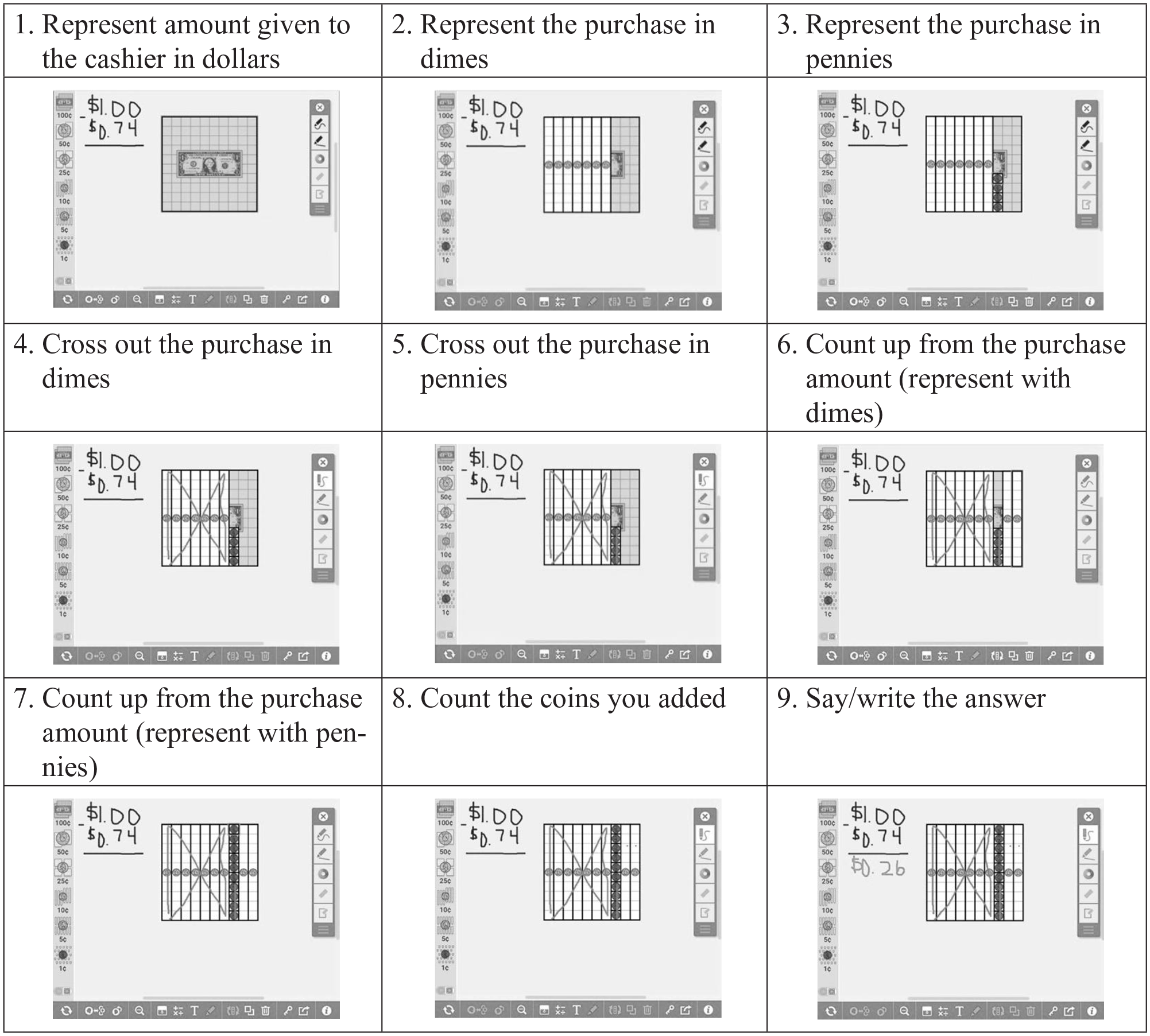
Task Analysis and Money Manipulative From Math Learning Center
Experimental Design
In this study, researchers used a concurrent multiple probe across participants design (Ledford & Gast, 2018). All three students began baseline simultaneously. The first student completed three baseline sessions and when their baseline accuracy data were stable with a decelerating or zero-celerating trend, they entered intervention. The second student continued in baseline until the first student (e.g., Randall) completed two sessions in which an increase in the percentage of task analysis steps completed independently occurred and the student answered at least one of the two problems correctly without prompting on the last two steps of the task analysis (50% independent accuracy). The third student entered intervention in the same manner. Hence, when Kate completed two sessions with an increase in the percentage of task analysis steps completed independently and at least 50% independent accuracy, Kevin began intervention, as long as his accuracy baseline was stable and decelerating or zero-celerating. When students met mastery criteria—three or fewer prompts across the two problems students solved and 100% independent accuracy on those two problems for three consecutive sessions—they entered maintenance.
Independent and Dependent Variables
The primary dependent variables during the intervention were independent accuracy and the percentage of task analysis steps out of nine completed independently in solving problems involving making change with coins under the context of shopping. During baseline, only accuracy (saying or writing the correct answer) was assessed, as researchers provided no prompting during baseline. Independent accuracy was determined if students correctly and independently provided the answer, with independently indicating that the last two steps of the task analysis (i.e., count up the coins added to represent the change and say or write the answer) were not prompted (see Figure 1). Independent accuracy was indicated as a percentage out of two problems (recorded as yes/no); students could be 0%, 50%, or 100% independently accurate during intervention and maintenance, and 0%, 50%, or 100% accurate during baseline. The percentage of task analysis steps completed independently was calculated by the percentage of steps of the task analysis students did not require prompting to complete out of the total of nine. A secondary dependent variable during intervention was the number of prompts students needed. The number of prompts represented the sum of all types of prompts given throughout the session.
The researchers focused on making change with coins, even though it could be considered a limited purchasing skill, as a pilot to examine teaching money skills online to students with IDD via virtual manipulatives. According to Bowman et al. (2019), making change with coins is a skill taught within the numbers and operations content standards of the National Council of Teachers of Mathematics. However, making change with coins, even the limited ones in which students in this study were restricted to use, is a skill students should know, given cash is still used in the purchasing of items (Bryant et al., 2021).
The independent variable was an intervention package consisting of a virtual money manipulative, modeling, and the SLP. The SLP included indirect verbal prompts, direct verbal prompts, and model prompts and was implemented when the student initiated an incorrect step, made a mistake, or did not initiate the next step within 10 seconds. An indirect verbal prompt was the researcher asking what they should do next, a direct verbal prompt involved the researcher telling the student something specific to the error (e.g., “you forgot to cross out the cost of the item”), and a model prompt was the researcher showing the student what to do by sharing the researcher’s screen. Prompting was initiated as needed for each step of the problem outlined in the task analysis (see Figure 1).
Procedures
Two researchers were present on each Zoom call throughout the study but worked one-on-one with students using the breakout rooms; students were in their classrooms and researchers were in their homes. The first researcher, a professor in special education at a large midwestern university whose research focuses on mathematics interventions for students with disabilities trained the second researcher, a second-year doctoral student in the special education department of the same university to implement all parts of the intervention. Beyond the researcher, serving as the interventionist, students received no assistance from other adults physically within the classroom. If students struggled with the technology (i.e., sharing the screen) and the researcher could not coach virtually, another student helped support the student with screen sharing.
Baseline
Prior to beginning intervention, each student completed at least three baseline sessions involving making change. During baseline, students completed one baseline probe consisting of two problems per session. Researchers read each of the two problems aloud twice; however, they repeated the problem as requested by students. Researchers instructed the students to solve the two problems the best they could and provided no training, instruction, prompting, or additional information. Students did not have access to the virtual money manipulatives or real money in baseline. They solved the two problems on the researcher-provided virtual whiteboard app or on scrap paper with a pencil and indicated the answer. Researchers only collected accuracy (i.e., yes/no correct for each problem for probe data of 0%, 50%, or 100% accuracy) during baseline and did not collect the percentage of task analysis steps completed independently or prompting data. Given the students did not use the virtual money manipulative during baseline and prompts were not provided, researchers did not collect any independent data in baseline.
Intervention
Students were taught to use the virtual money manipulative (Money Pieces from The Math Learning Center; see Figure 1) to solve problems involving making change. In each session, researchers first modeled how to solve one problem, then students solved two problems. While students solved two problems with the virtual money manipulative (i.e., completed the probe), researchers implemented the SLP if the student initiated a step incorrectly, forgot what to do next, or did not initiate the step within 10 seconds. Once students achieved the preset mastery criteria of needing three or fewer prompts across the two independent problems and 100% independent accuracy on those two problems for three consecutive sessions, intervention ended.
During the virtual instruction, students were taught to use the virtual money manipulative via modeling. During the modeled problem, the researcher demonstrated how to use the money manipulative paired with a verbal narration explaining their thinking. After stating the problem (e.g., “At the store, you bought a candy bar that cost $0.74. If you gave the cashier $1.00, how much change should you get back?”), the researcher stated the problem again, while this time simultaneously writing cost = $0.74 and gave = $1.00 on the whiteboard of the app with a virtual pen. Then, the researcher began to model how to solve first by using the pen tool to write the problem vertically ($1.00–$0.74). After writing the problem, the researcher represented the amount of money given to the cashier ($1.00) with a large square of $1, which represented 100 pennies or 100 cubes (see Figure 1). Next, the researcher explained the need to represent how much was spent on top of the dollar block and dragged dimes and pennies, separately (7 dimes, 4 pennies) on top of the dollar to represent the cost of the item. Researchers purposefully focused on representing the cost and change with just dimes and pennies because students were more easily able to count by ones and tens. Next, the researcher crossed out the cost of the item using the pen tool to represent that money was spent and one would not get that back in change. The researcher then modeled filling in the remaining squares of the $1 starting with dimes and then pennies to represent the change one would receive back from the cashier while counting aloud. Finally, researchers modeled counting the change to get the total amount back from the cashier ($0.26; see Figure 1).
After modeling one problem, the student then completed two problems using the virtual money manipulative. Students were not required to write the problem as part of the task analysis as the digital pen was cumbersome for the money app, as it involved students moving the cursor or trackpad with sufficient control to write, and the students found it frustrating prior to the start of the study. As such, while the researchers demonstrated writing the problem, the students were not required to although most often they attempted to write the two numbers on the whiteboard. While solving, if the students initiated a step incorrectly or did not initiate the next step within 10 seconds (i.e., 10-second time delay), the researcher implemented the SLP. Because of the nature of online instruction, the prompts included only indirect verbal, direct verbal, and model prompts. Using a task analytic data collection sheet, researchers noted if each step of the task analysis was completed independently or was prompted. If the step was prompted, the researcher noted the level of prompting required; if a student needed further prompting after the indirect verbal, researchers administered a direct verbal after another 10-second wait time, and then likewise a modeling prompt.
Maintenance
Starting one week after the intervention ended, students completed two maintenance sessions to measure the extent of their ability to maintain accuracy and the percentage of task analysis steps completed independently. Researchers read two problems from the probe to the students and they were asked to solve the problems the best they could. Students completed the problems using the virtual money manipulatives; researchers provided the SLP as needed. No instruction was provided prior to the completion of probes in each maintenance session.
Inter-Observer Agreement and Procedural Fidelity
To collect data on IOA, a secondary data collector was present for at least 25% of sessions in each phase for each student. The secondary data collector collected independent accuracy and the percentage of task analysis steps completed independently data in the same fashion as researchers and the data were compared to calculate IOA. Researchers divided agreements by agreements plus disagreements and multiplied by 100 to get the percentage of agreement between the independent data collectors. Inter-observer agreement for independent accuracy was 100% for all three students during baseline. It was also 100% for intervention for Randall and Kate and 90% for Kevin; researchers did not agree on one problem for independent accuracy. For the percentage of task analysis steps completed independently IOA, researchers were 100% for Randall, 98.6% for Kate, and 97.8% for Kevin.
To measure procedural fidelity, researchers used a checklist. During each session, the researcher delivering the session evaluated to make sure all procedures were being implemented with fidelity. Specifically, each researcher checked to ensure students had access to the appropriate material (e.g., virtual manipulative), researchers modeled one problem, students had access to screen sharing or another way to show researchers their work virtually, and the SLP was implemented following 10-second time delay or when the student initiated a step incorrectly. Researchers calculated procedural fidelity at 100% for each student. When IOA occurred for the independent accuracy and the percentage of task analysis steps completed independently for the 25% of sessions, the second observer also evaluated the checklist. The IOA between researchers for the procedural fidelity checklist was 100% for each student.
Social Validity
After the completion of the maintenance phase, researchers conducted social validity interviews with students and their teachers regarding the intervention and online instruction. Researchers asked students the following questions: (a) Did you like solving the problems with the virtual money manipulatives, why or why not?; (b) Did you like solving the problems using real money, why or why not?; (c) Do you think this is something that you would use outside of school?; (d) What did you think about learning online?; (e) Is there anything else you would like to tell us? Researchers asked the teacher questions regarding her opinion of the students demonstrated improvement in money skills throughout and following the intervention as well as her perceptions of students learning math online.
Data Analysis
Researchers employed visual analysis of graphed data in addition to calculations consistent with single case research design (Ledford & Gast, 2018). Researchers graphed data using Excel and analyzed it visually to determine the overlap of data between phases as well as the immediacy effect when entering intervention. Researchers used the split-middle technique to determine the trend for each phase across students. Researchers found the middle point for each phase followed by finding the point representing the mid-date and mid-rate. Researchers drew a line between the mid-rate and mid-date points to determine if the data were accelerating, decelerating, or zero-celerating (White & Haring, 1980). Next, researchers determined if the data were stable or variable by determining if 80% of the data within each phase fell within 25% of the median. If so, the data were considered stable, and if not, variable (Ledford & Gast, 2018). Last, researchers used an online Tau-U calculator to determine the effect between baseline and intervention (Vannest et al., 2016). Based on standard convention, effect sizes greater than 0.80 were considered very large, between 0.60 and 0.80 large, and between 0.20 and 0.60 moderate.
Results
Overall, a functional relation was suggested between the intervention package of a virtual money manipulative, modeling, and the SLP and the dependent variable of independent accuracy (see Figure 2). Throughout intervention, students decreased the number of prompts needed, increased the percentage of steps of the task analysis completed independently, and increased their independent accuracy. However, given independence data were not collected at baseline, researchers could not determine a functional relation between the dependent variable of independence and the intervention package. Students also maintained independent accuracy and the percentage of task analysis steps completed independently for two weeks following intervention.

Graphs of Student Independence and Independent Accuracy on Making Change
Randall
Randall answered zero questions correctly for each of his three baseline sessions (see Figure 2). When moving into intervention, Randall experienced an immediate effect; he was 100% independently accurate. Randall achieved the mastery criteria following 10 intervention sessions. He was 100% independently accurate for eight of those sessions; for two sessions he was 50% independently accurate. During maintenance, Randall was 100% independently accurate for both sessions. Note that Randall had additional time between his maintenance sessions due to his need to quarantine at home due to COVID-19. The Tau-U between baseline and intervention conditions for the independently accurate dependent variable was 1.0 for Randall.
Randall completed 61% of the task analysis steps independently across the two problems in the first intervention session. He needed nine prompts across the 18 steps. Randall’s percentage of task analysis steps completed independently increased and number of prompts decreased, except for the third session. When Randall needed prompting, they were indirect verbal or direct verbal and almost exclusively involving the steps for counting—most frequently for representing the cost of the item and with pennies as opposed to with dimes. For the last five sessions, Randall’s percentage of task analysis steps completed independently was 94.4%. He required only one prompt (indirect verbal) across the two problems. Randall’s task analysis steps needing prompting were not always consistent across intervention. However, the majority of his prompts occurred for representing the total of the purchase in dollars, the total of the purchase in dimes, and the total of the purchase in pennies. In this first session, he also needed prompting to say or write the answer. Randall was 100% in completing the task analysis steps independently for both maintenance sessions.
Kate
Kate answered zero questions correctly during all four baseline sessions (see Figure 2). Kate experienced an immediate effect moving into intervention and she independently completed the last two steps of the task analysis for a correct answer for both problems. Kate achieved the mastery criteria following 14 intervention sessions. She was 100% independently accurate for all but two of those sessions. During maintenance, Kate’s independent accuracy was 50% and then 100%, respectively. For Kate, the Tau-U between baseline and intervention was 1.0 for the independently accurate dependent variable.
Kate was 47.4% independent in terms of the task analysis steps across the two problems and needed 12 prompts across the 18 possible steps for the first intervention session. Kate’s progress with the percentage of task analysis steps completed independently was slow and variable. She increased the number of prompts needed for session 2 but significantly decreased in session 5. For the last five sessions, Kate’s percentage of task analysis steps completed independently ranged from 83.3% to 100%, requiring a range of 0 to 3 prompts. When Kate required prompting, they were almost always for counting, such as counting out the number of dimes or pennies to represent the cost of the item purchased or occasionally to count up the change to receive. Kate’s prompts were exclusively indirect verbal or direct verbal prompts. Kate’s most frequently prompted steps of the task analysis during intervention included representing the total of the purchase in dimes and the total of the purchase in pennies. Earlier on, she also needed prompting to cross out the pennies and she occasionally struggled with counting issues and needed a prompt. During maintenance, Kate was 88.9% and 83.3% in terms of task analysis steps completed independently, needing four and then five prompts, respectively. These prompts involved counting, such as when bringing out the dimes to represent the cost of an item she counted 10, 20, 30, 50.
Kevin
Kevin answered zero problems correctly on all of his baseline probes (see Figure 2). The effect of intervention was gradual for Kevin. In this first intervention session, he was still 0% independently accurate. Throughout the intervention, Kevin was 0% to 100% independently accurate, although he finished the last eight of his 20 intervention sessions being 100% independently accurate. To note, during one session—intervention session 12—Kevin experienced computer challenges and switched computers halfway through the session. He was 50% accurate and needed 12 prompts that session; for the session before he was 0% accurate and needed 10 prompts and for the session after he was 100% accurate and needed 10 prompts. The Tau-U between the Kevin’s independently accurate baseline and intervention data was 0.83. During maintenance, Kevin’s accuracy was 100% for both maintenance sessions.
In terms of the percentage of task analysis steps completed independently, Kevin needed a lot of prompting at the beginning of the intervention. He began at 20% independent and needed 27 prompts. Starting at session 4, he was always over 50% independent in completing all the task analysis steps. Starting at session 16, Kevin completed 83.3% of task analysis steps independently and, with session 17, he needed only three prompts (i.e., mastery criteria). When Kevin needed fewer prompts, they were often focused on counting and frequently indirect verbal prompts. He struggled with counting the dimes and would often bring out too many for both representing the cost as well as finding the change. He would at times count the dimes correctly but would continue counting by tens instead of ones when adding the pennies. Due to the approaching end of the school year, researchers stopped Kevin’s intervention phase when he was just shy of meeting the mastery criteria. Specifically, in his last six intervention sessions, he needed 4, 4, 3, 3, 4, and then 3 prompts and was 100% accurate. On his second-to-last intervention session, he needed four prompts; had he needed three or fewer, he would have met mastery and the intervention terminated.
Social Validity
Randall and Kate both indicated they liked working with the researchers as well as using the virtual money, although they both struggled to articulate what they liked about the manipulative. They also both agreed that they wished the researchers were in person with them as they preferred to learn math in person. Kate said she felt working with the researcher and the virtual money manipulatives taught her a method to learn (to make change). Randall said he felt it was hard to write on the virtual manipulative money app, which frustrated him. Kevin indicated he liked working with researchers and felt the lessons would be useful in a future job. He found virtual instruction different and hard to get used to but was glad he could work with researchers safely online. The teacher indicated she noticed positive changes in the students with regard to money in the classroom. However, she was most excited about what she perceived as her students’ independence and indirect skills of using the technology and navigating issues that arose. She felt engaging with the researchers online and learning how to use the technology and solve situations developed problem-solving skills in her students as well as increased their knowledge of using technology. She was very positive about her students learning math online and that they not only were able to learn math but also technology skills.
Discussion
Individuals engage in purchasing skills on a daily basis and, regardless of the curricular focus of secondary students with IDD (i.e., academic or functional), possession of daily living skills, such as making change, is important. This study examined online instruction for three high school students with IDD learning to solve making change with coins problems. Researchers provided students with an intervention package consisting of a virtual money manipulative, modeling, and the SLP. A functional relation was suggested between the dependent variable of student-independent accuracy and the intervention package. The students increased their percentage of task analysis steps students independently completed following receipt of the intervention package. All three students maintained their percentage of task analysis steps completed independently and accuracy was higher than baseline for all three.
As suggested by the results, the students acquired and maintained skills relative to making change with coins within a virtual learning environment. These results and this study add value for several reasons. One, while schools are increasingly returning to all in-person schooling, educators need to know effective interventions in the event of a need to return to online teaching and learning for students with IDD. Although virtual learning may not be ideal for students with IDD, especially as it relates to functional skills like purchasing, studies like this provide evidence for educators regarding interventions or intervention packages that can be used to teach concepts online. While using actual money in the classroom or community setting may be more appropriate and ideal (Barczak, 2019), it is not always possible. Teachers also need research-supported strategies to teach students with IDD in person as well as online. During the COVID-19 pandemic, all educators—particularly those of students with IDD—were ill-prepared to teach virtually (Trust & Whalen, 2020). Virtual manipulatives, in and of themselves or as part of an intervention package, offer an approach for continuing to educate and meet the educational and IEP needs of students with IDD within a virtual environment relative to multiple mathematical areas, including purchasing or money.
Despite contextual limitations, this study does add to the limited current literature examining life skills related to purchasing or money. A decline in life skills research exists but there is also a privileging and a neglect of what is examined within the overarching category of life skills, with more recent emphasis on hygiene and food preparation and less on money or purchasing. And yet, financial literacy skills benefit all students. In fact, 14 states require high school education related to personal finance for students (Scribner, 2022), and attention to financial literacy instruction in high school is said to be increasing since the pandemic (Povich, 2022). Students with IDD should be no exception to the increased attention to and access to financial literacy instruction. They should learn about the range of purchasing options and financial literacy, including debit and credit cards, paying by such means as Venmo or Apple Pay, budgeting, purchasing, and—as in this study—making change with cash. Despite attention to digital money options, cash still exists and all students, including students with IDD, should know how to make a change and determine they are receiving the correct change.
In addition to supporting the acquisition and maintenance of financial literacy skills—representing life skills and increasing part of the general education curriculum (Povich, 2022; Scribner, 2022)—this study also allowed students with IDD to independently engage with technology. Technology skills are increasingly fundamental for employment for all (Ruppar et al., 2023). As such, students with IDD also need access to and experience with technology and opportunities to independently navigate common technology in society, such as Zoom or more generic video conferencing. While not the focus of the study, the teacher remarked about her students’ gain in skills related to independently using technology (Zoom, Chromebooks, novel websites) as well as problem solving when the technology might not always work. The online nature of data collection integrated student use of twenty-first-century skills (accessing the Zoom link in email, video conferencing—including screen sharing and website navigation) into weekly instruction (Reed et al., 2022).
Implications for Practice
One implication for practice involves an effective intervention for teaching making change to secondary students with IDD. Despite the potential to engage in this skill frequently throughout life, limited research-based interventions exist for teachers to teach making change. Burton et al. (2013) found success with video modeling and Bouck et al. (2017) with the CRA with plastic money as the concrete manipulative. However, in this study, researchers demonstrated success with accuracy and independence via free virtual manipulatives. The intervention provided a cost-effective option for educators, as well as took advantage of twenty-first-century technology and technology skills. Researchers suggest virtual manipulatives are just as effective as concrete but less socially stigmatizing for secondary students (Peltier et al., 2020; Reed et al., 2022; Satsangi et al., 2016; Satsangi & Miller, 2017; Shurr et al., 2021).
Teachers interested in supporting secondary students with IDD learning to make change, who have access to a mobile device with an app or a computer with internet may consider the free money manipulative app as a means to support. This is particularly true for providing students a means to practice at home or in the event of the need to engage in online or remote education. In particular, the researchers felt the base 10 like aspects of the virtual money used in this study, which physically highlights dimes as $0.10 or 10 pennies, was beneficial to student understanding. The inclusion of physical scaffolds to support the understanding of the coins is lacking in concrete manipulatives, which may suggest an advantage to the virtual manipulatives. However, researchers should probe for generalization to actual money or in actual community-based settings when making a purchase (e.g., store).
Although not privileged within the study, making change for less than a dollar holds implications for general education curriculum access beyond financial literacy classes. Making change involving amounts less than one dollar is essentially adding and subtracting with decimals to the hundredths place. The actual virtual money manipulative used in the study aligns with a base 10 view, rather than the picture or symbolic coins, which supports the natural connection to decimals for students. Similarly, the concepts involved in the study could be established as algebraic equations—granting access to the general education curriculum in algebra for secondary students with IDD, but still connected to important life skills. The results of the study suggest implications for the positive connection between general education access (e.g., algebra) and life skills for secondary students with IDD.
Limitations and Future Directions
One limitation of the study involved that researchers worked one-on-one with students, which may not always be realistic in classroom situations. Further, the intervention was delivered by a researcher, rather than a teacher, which is inconsistent with typical classroom practices. In the future, researchers should consider a teacher or paraprofessional delivering the intervention as well as doing so in a small group setting. At times the events of the classroom appeared distracting to the participating students, as evidenced by them speaking to another student in the class or even apologizing and indicating they were paying attention to something else in the room. Consequently, some prompting may have been a result of the environment rather than students not knowing the next step.
The online nature of the study, while a necessity of the times, could itself be viewed as a limitation. Online delivery could be especially viewed as a problem due to the struggle that many students, especially students with IDD, face with online instruction. However, the authors assert part of the struggle with online instruction was the lack of resources and strategies for teaching students online, including students with IDD. In the event of another pandemic or shift to emergency remote instruction, the strategies found successful in this and other studies could support teachers and students. Another limitation involved unavoidable situations which were a result of the pandemic and the online nature of instruction. For example, Randall had an extra week between maintenance sessions as he was quarantined due to the pandemic. Additionally, there was one time in which Kevin had to change devices in the middle of the session due to computer issues. The teacher placed him on the computer that projected in front of the classroom, which appeared to be distracting for him. Researchers noted both of these within the graphs. Due to the end of the school year, Kevin’s intervention ended just shy of him meeting mastery criteria. However, his data suggested he maintained at the same rates as his last intervention. Further, he only needed one additional prompt beyond mastery in the session that resulted in mastery not being met before the intervention ended (e.g., session 19).
Researchers failed to capture data on generalization, either in natural (i.e., community) or simulated settings as well as generalization to real money. However, the teacher noted that students had limited access to the community during the year of the study due to COVID-19. In the future, researchers should seek to determine students’ ability to generalize from solving problems with virtual money manipulatives to actual money. This includes, ideally, the application of the skill in real-life settings, such as a store in which students paid for an item and needed to determine if a correct change was received. At a minimum, in future studies, researchers should gather generalization data within a simulated purchasing experience within the classroom. Researchers focused on problems involving making change with coins, with the intent to scaffold student learning by starting with coins. In real life, almost all items cost more than $1. In future studies, researchers should probe for generalization to determine change with bills or problems involving making change with bills and coins. Additionally, as a limitation, researchers did not gather independent data during baseline. As prompting was not provided in baseline and students were not given access to the virtual money manipulative, researchers did not gather data on the number of task analysis steps or the total number of prompts for students to answer the computational money problems in baseline. In the future, researchers should seek to make baseline conditions more similar to intervention but without the instruction, allowing for the comparison of independent data across conditions.
In future studies, researchers could also make the connection between the functional life skill of making change and academic mathematics (e.g., algebra) more explicit by setting up the making change problems in a linear algebra equation or in connecting the money to decimals (Rittle-Johnson & Koedinger, 2009; Rivera & Baker, 2013). Related, future researchers should also seek to compare student success with virtual and concrete money manipulatives as well as the blander base 10-based money manipulative used in this study to actual digital representations of coins (McNeil et al., 2009). Although previous researchers found secondary students with disabilities to be just as effective with virtual manipulatives as concrete manipulatives, the research is limited to academic mathematics (Peltier et al., 2020; Reed et al., 2022; Satsangi et al., 2016; Satsangi & Miller, 2017; Shurr et al., 2021). Finally, although researchers collected social validity data, teachers and students were not explicitly asked if they found the intervention meaningful.
Footnotes
Authors’ Note
Holly Long is now affiliated with Saginaw Valley State University, Saginaw, MI, USA; Carrielynn O’Reilly is now affiliated with Whitefish School District in Whitefish, MT, USA
Declaration of Conflicting Interests
The author(s) declared no potential conflicts of interest with respect to the research, authorship, and/or publication of this article.
Funding
The author(s) received no financial support for the research, authorship, and/or publication of this article.
