



Abstract
There is a need to adopt context-aware and behavior-driven scalable recommendation systems due to rapid development of multilingual mobile applications. Collaborative and content-based methods face challenges in adapting linguistic and contextual models. In order to mitigate this, we propose a Behaviour Driven Multilingual App Recommendation System (BD-MARS) which integrates behaviour modelling, multi-lingual semantic representation, probabilistic inference and reinforcement based adaptation. The experimental data used was obtained from public repositories and included app metadata, multilingual user reviews, and structured behavioral interaction logs belonging to various categories such as Health & Fitness and productivity. In BD-MARS, rank-adjusted TF-IDF is normalized for stabilizing feature weighing. A semantic space is built with cross-lingual embeddings, and the reviews’ contextual dependencies are identified via GRU-based sequential modeling. Further, by means of the Recurrent Neural Networks (RNNs), we can refine the ranking based on state and action as rewards. Results of the evaluation of the experiment show better ranking performance with 85.3% precision, 78.2% recall, 81.5% F1-score, 0.85 MRR, 0.92 NDCG, 0.86 MAP, and 90.2% coverage. The distributed benchmarking of Apache Spark validates scalability and computing efficiency while transforming the nature of the framework to enable large-scale multilingual deployment.
Introduction
Today, in the digital and modern age, recommendation systems helps in the information explosion and dynamic interaction patterns. Many traditional approaches rely on past user-tem interactions. These approaches are not effective as they are not flexible to adapt to the situational or contextual variations. Users expect recommendations to be contextualised and personalised according to contextual factors such as time, location, activity and circumstances. The need for contextual recommendation has led in the development of the context aware recommender system that incorporates contextual parameters along with the conventional user–item relationship for enhancing quality and relevance of recommendations. Context-aware recommendation methods may contain various strategies to generate recommendations, yet post-filtering is known for producing refined ranking outputs based on real-time contextual relevance. As recommendations will depend on user's unique interests and needs, suggesting personalized and relevant recommendations context awareness has come to forefront. 1
Recommendation systems not only require contextual adaptation, but they also need scalability and efficiency. Despite being implemented to counterbalance information overload on large-scale user data, the memory- and model-based collaborative filtering suffers from computational complexity. Users are grouped together based on similarities from social networks, an alternative. This local approach produces domain-specific recommendations for groups with lower computing costs and competitive accuracy. The importance of structured user modeling for scalable recommendation systems is enhanced by the enhancements. 2
Recommendation systems also face the difficulty that users are semi-real and that their preferences are limited. Ratings provide coarse-grained representation of user interests, upon which classical collaborative filtering methods rely. To resolve this limitation, feature-based personalized recommendation models combine preference modeling with item feature extraction. The characteristics of an item were weighted and subjective ratings were combined with objective features of an item. These improvements lead to more accurate similarity measures, better predictive performance, and a significant decrease in prediction error. 3
User-generated textual reviews are more informative than ratings as they reveal latent attitudes. Information about the similarities between items is typically neglected in classic recommendation systems, making them less robust (e.g., with sparse rating conditions or with cold-start conditions). The combination of Bayesian and topic-modeling–based recommendation systems utilizes model ratings and review texts within unified probabilistic structures. This approach identifies fine-grained user preferences and produce improve prediction accuracy on large datasets as the rating factors aligned with review semantics. 4
The inclusion of temporal dynamics increases the difficulty of implementing recommendation models. As users’ interests evolve over time, most recommendation models ignore temporal ordering and sequential learning patterns. Time-aware recommendation systems integrate time sequence information and item circulation frequency to identify evolving learning trajectories. The temporal distance measures and sequential interaction patterns generates recommendations with improved relevance that based on user's acquisition patterns. 5
The development of recommendation systems in terms of context awareness, community-based modeling, feature-level personalization, semantic integration of reviews, and temporal sequence learning depicts the challenges in different scenarios. However, current models address these aspects independently rather than through a unified multilingual behavioral model. As the mobile ecosystem continuously grows across linguistic and cultural regions, the need for recommendation systems that incorporate behavioral dynamics, multilingual semantic modeling, contextual adaptation, and scalable learning mechanisms is increasing.
Related work
The growth of online media platforms lays a strong foundation for the importance of recommendation systems. When testing against real-world scenarios, traditional collaborative filtering methods face difficulties in scalability and lack validation. To overcome these challenges, a personalized real-time recommendation system was proposed that combines user profile–based clustering with lightweight collaborative filtering. This method uses opinion leaders in the clusters, which reduces the dimensionality of the user–item rating matrix and improves computational efficiency. To generate accurate predictions, a weighted slope-one mechanism is applied within clustered user groups. It was tested in live web based platform ad evaluated using user feedback and results in competitive accuracy and better recommendation performance. 6
The application of recommendation systems in healthcare has a direct impact on human well-being and quality of life. Traditional systems often fail to explore and utilize large-scale data. To this end, a hybrid diet recommendation system was developed that uses both machine learning and big data analytics with natural language processing. The combined framework of collaborative filtering with NLP-based pre-processing identified user preferences and food item attributes through user–food interactions. Accuracy, precision, recall, and F1-score shows significant improvement compared to baseline models. 7
The increase in user interest and new arrivals has become increasingly complex for generating personalized recommendations. Conventional collaborative filtering models do not properly balance personalization, novelty, and adaptability. For this, a hybrid model based on personalized measurement and game theory that combines offline and online recommendation models is proposed. User pursue-novelty degree and item popularity were used in offline schemes, which improved accuracy, especially for new items. In the online part, user-system interactions are modelled to reduce interest drift. This model was tested using Last.FM dataset which shows improved accuracy, real-time responsiveness, and robustness in dynamic recommendation environments. 8
The increase in the development of recommendation systems has gained increasing prominence but fails to resolve the individual model challenges. Most baseline models often suffer from data sparsity, cold-start problems, and limited capability in identifying complex user preferences. A review of hybrid recommendation systems that use models such as collaborative filtering, content-based filtering, machine learning, and deep learning models in various combinations. Though they enhance accuracy, robustness, and scalability in real-world applications, it fail to meet the need for adaptive, transparent, and user-centric system. 9
The rise of the multidimensional and dynamic nature of user interactions increases the complexity of user behavior analysis. Baseline models are incapable of identifying temporal evolution, cross-domain behavior, and real-time preference shifts. For this, MUMA is a hybrid model that combines multi-source heterogeneous data for advanced user modelling. Short- and long-term behavioral patterns are captured using a combined framework of LSTM and transformer architectures. Cross-domain migratory learning based on heterogeneous networks was used to generate cold-start recommendations. In addition, a bandit–propensity hybrid strategy with reinforcement learning and causal inference helps to stabilize the exploration and exploitation. 10
The enhancement of k-means clustering and LightGBM prediction was used to generate personalized recommendations in large-scale environments. It resolves the problem of capturing user interests, even though the interactions are sparse. The RSO was used to cluster users and content with common similarities. In terms of prediction, LightGBM integration improves the user's prediction by identifying the user's level of interest and increasing the rating estimation. This combined approach shows a significant reduce in MAE and MSE and produce high precision, recall, and F1-score on large-scale behavioral datasets. 11
Contextually enhanced sentiment-based recommendation system
The Contextually Enhanced Sentiment-Based Recommendation System (CES-RS) sets up a baseline framework for personalized app recommendations. The CES-RS is divided into five interrelated modules: Data Collection and Pre-processing, Sentiment Analysis, Feature Extraction, Recommendation Algorithm, and Evaluation and Feedback, as shown in Figure 1. The CES-RS differs from the traditional sentiment-based recommenders in that it uses contextual usage information and behavioral interaction data in a single modeling framework.
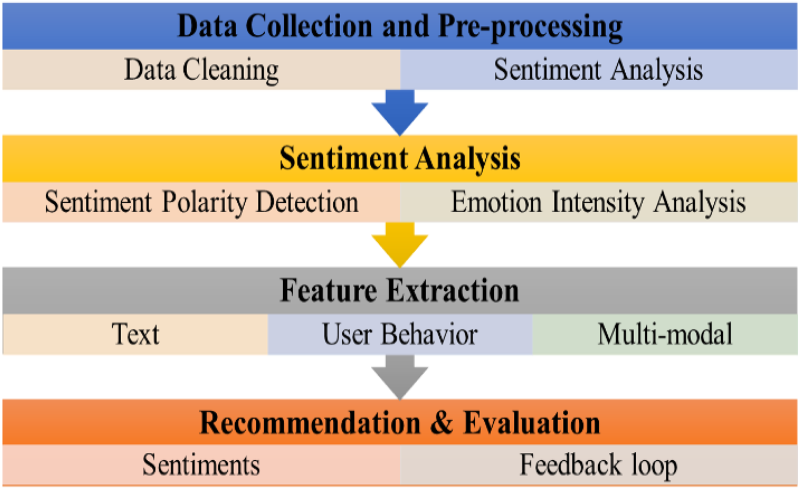
Overview of sentiment Rs.
The recommendation score for a user–app pair is formulated as:

In Equation (3.1), Ftext, Frating, and Fcontext represent textual sentiment features, rating-attributes, and contextual attributes respectively, and α+β+γ=1. The weights are optimized using validation-based tuning to ensure balanced contribution across the parameters.
This stage collects numerous data sources including ratings, multilingual text reviews, clickstream, session duration statistics, download data, and contextual metadata such as time of use, devices, location, etc. The introduction of contextual data leads to learning dynamic user needs instead of fixed heuristics for the system. Pre-processing methods include noise removal, removal of duplicates, spam detection, and normalization of multiple language text data. Text data is tokenized and normalized, and engagement anomalies are resolved using anomaly detection techniques.
Sentiment analysis
The sentiment analysis module is responsible for the identification of the semantic polarity and intensity of the user reviews. Contrary to the classification based on polarity, the representation of the sentiment is achieved via transformer embeddings that are sensitive to the semantic nuances of languages.
Given a review sequence X={x1,x2,…,xT}, contextual representation is computed as:

In Equation (3.2), fenc captures the bidirectional semantic dependencies that helps to identify the sentiment variations which improves reliability in multilingual environment.
Feature extraction: This step combines the textual, behavioral, and contextual information into a single representation space.
Textual feature extraction: This is done using a normalized rank-adjusted TF-IDF transformation:
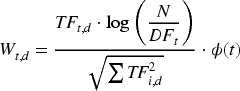
Here, ϕ(t) is a rank factor that is bounded between 0 and 1, which is based on engagement in Equation (3.3). This is done to ensure that the model is stable and does not have biased amplification. The sequential dependencies in the reviews are captured using GRU-based recurrent networks
The recommendation engine uses a hybrid probabilistic model that integrates contextual neural embeddings with Bayesian inference. The predictive probability is calculated as follows as shown in Equation (3.4):


The performance of the system is measured using ranking metrics as well as classification metrics such as Precision, Recall, F1, MRR, NDCG, MAP, Coverage, Diversity, and Latency. The system has a feedback mechanism that uses explicit feedback such as ratings and reviews, as well as implicit feedback such as clicks, dwell time, and uninstall events. The system can be updated incrementally to adapt to real-time environments.
BD-MARS
BD-MARS is intended to be a unified, adaptive, and scalable recommendation framework for multilingual mobile application ecosystems. In contrast to traditional recommender systems, which address textual, behavioral, and contextual attributes in a separate manner, BD-MARS combines semantic modeling, behavioral dynamics, adaptive probabilistic inference, and reinforcement-driven optimization in a unified manner as shown in Figure 2.
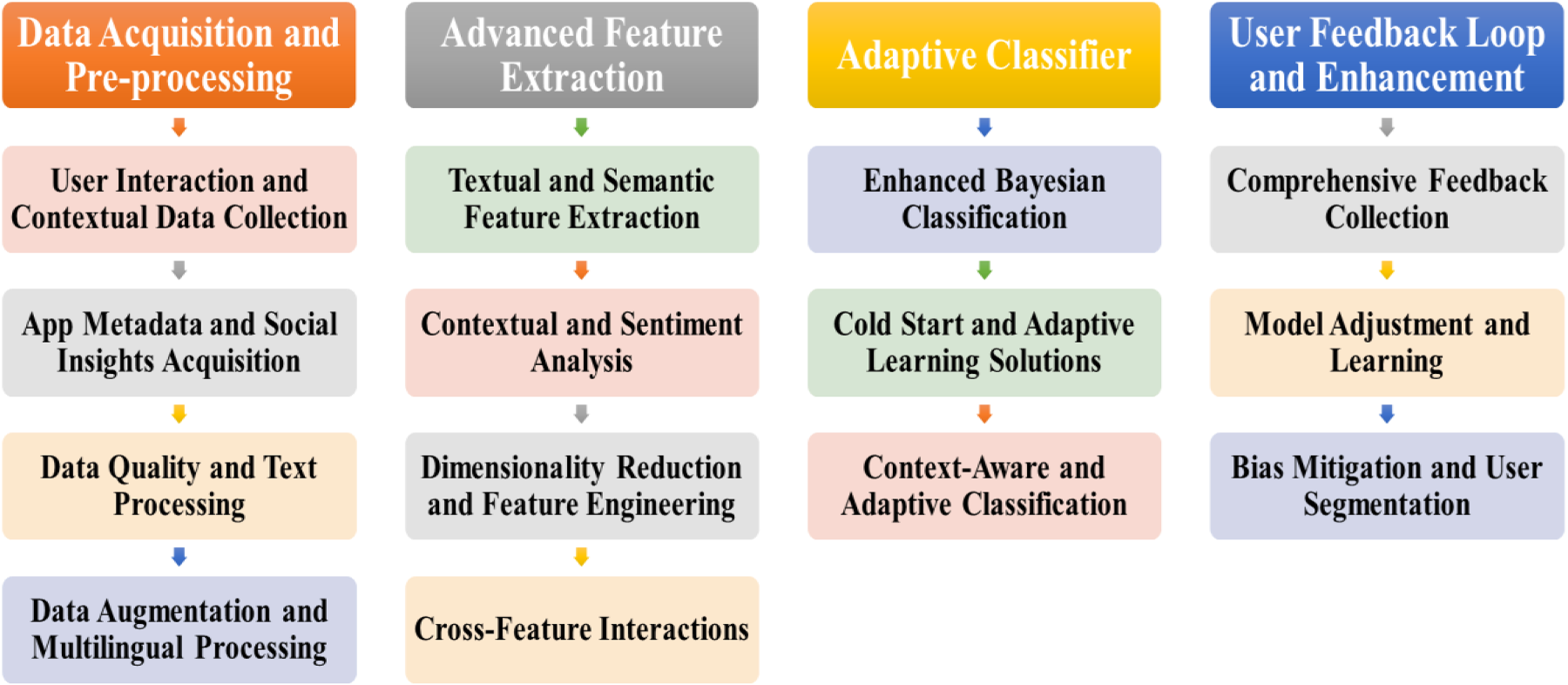
Process flow of BD-MARS.
Let U={u1,u2,…,um} to denote users and A={a1,a2,…,an} to denote candidate applications, for each user–application pair, the system models the textual semantics Tu,a, behavioral interactions Bu,a, contextual information Cu, and engagement feedback Eu,a. The unified recommendation score is given by:

In addition to that,
The primary supervised objective minimizes binary cross-entropy loss:

To prevent overfitting and stabilize parameter estimation, L2 regularization is used:

In Equation (4.3), Θ includes GRU weights, embedding parameters, and hybrid scoring coefficients. Since long-term user activity is difficult in app ecosystems, a reinforcement-driven cumulative reward objective is used:
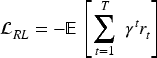
In Equation (4.4), rt is defined based on click-through behavior, session duration, download confirmation, and uninstalls.
The unified learning objective becomes:

Model parameters are optimized using Adam-based gradient descent until convergence under validation NDCG@10 criteria for Equation (4.5).
The balancing coefficients in the unified objective are selected using validation-based cross-tuning rather than being manually fixed. The hybrid scoring coefficient α is searched within the interval [0.3–0.7], and the optimal value is selected based on validation NDCG@10. Similarly, the objective-level weights are adjusted to maintain a stable contribution between the supervised binary cross-entropy loss and the reinforcement reward objective. The supervised objective provides the primary relevance-learning signal, whereas the reinforcement component acts as a ranking refinement mechanism based on long-term engagement signals such as click-through behavior, downloads, session duration, and uninstall feedback. These objectives may partially conflict because immediate relevance prediction and long-term engagement maximization do not always favor the same candidate applications. To avoid unstable optimization, BD-MARS uses a weighted multi-objective formulation in which the reinforcement term is introduced gradually and updated incrementally through interaction batches. Convergence stability is further ensured through Adam-based optimization, L2 regularization, dropout regularization, early stopping based on validation loss, and validation monitoring using NDCG@10. The reinforcement component uses bounded exploration through an ε-greedy policy with ε = 0.1, preventing excessive policy deviation from the supervised ranking model. Thus, the supervised GRU-Bayesian model maintains stable relevance estimation, while the reinforcement component adaptively improves the ranking policy without destabilizing convergence.
The Data Acquisition and Pre-processing process is used to collect, normalize, and enhance data sources from different domains to generate multilingual app recommendations. The model aggregates both structured and unstructured data sources, such as user interaction data, app metadata, contextual usage data, social data, and multilingual text reviews. Behavioral, semantic, and contextual information are represented consistently throughout the modeling process.
User interaction data collection
Detailed interaction data is gathered to reflect dynamic user behavior. This includes download history, usage rate, session duration, in-app interaction data (clicks, purchases, feature usage), and uninstall data. Behavioral data is timestamped to reflect temporal order to create models that supports sequential behaviour in later stages. Intra-Quartile Range (IQR)-based filtering is applied on interaction data outliers and anomalies to establish consistency and replicability.
App metadata acquisition
Metadata for each application is collected which includes app description, category, rating distribution, developer information, version history, and update rate. It provides a basic semantic representation for cold-start problems and used for semantic categorization. Category consistency is checked to avoid redundancy in multilingual categories.
Contextual usage information
The contextual features of time of access, geographical location, device type, and network characteristics are incorporated as structured features. These features allow the modeling of situational preferences. For instance, the usage patterns during working hours can be considerably different from usage patterns during weekends, and such contextual differences are maintained as distinct feature dimensions.
Social and trend indicators
Public opinions and trending behavior are tracked by monitoring aggregated review dynamics and popularity on application stores. Instead of using direct scraping from external social networks, trend features are calculated based on time-windowed growth rates of downloads and review occurrences to maintain controlled and verifiable data integration.
Noise removal and data validation
Noise removal methods include removal of duplicate records, spam review detection by rule-based filtering, detection of rating inconsistencies and filters for outdated versions of apps. Outlier behavior in interaction records is removed by deterministic statistical thresholds. This prevents stochastic filtering methods that might impact reproducibility.
Tokenization and multilingual normalization
App description and review text are tokenized using language-aware tokenizers. Rather than translating into a single language, multilingual texts are mapped to a common semantic embedding space through cross-lingual alignment:

To manage the sparse interaction case, the system depend on metadata similarity and early behavioral cues in preference to simulating interaction records. New applications are started based on similarity-driven Bayesian priors based on category overlap, keyword overlap, and developer metadata to maintain unbiased cold-start treatment.
Advanced feature extraction
The Advanced Feature Extraction module transforms multilingual text data into a discriminative form for adaptive classification. It includes behavioral traces and contextual features in its analysis. The Advanced Feature Extraction module unifies weighted lexical techniques, multilingual contextual embeddings, sequential neural representations, behavioral feature synthesis, deterministic dimensionality reduction, sentiment modeling and cross-feature interaction analysis. The system has a module that uses a unified semantic and behavioral representation to improve its chances of detecting user preferences and engagement behaviour.
Step 1: TF-IDF with Normalized Rank Factor
The TF-IDF equation seizures the term's relative connotation in an app description, damping the effect of very frequent terms in Equation (4.7). For each term t in app description:

Traditional TF-IDF, however, flops to deliberate the past effectiveness of recommendations. A normalized engagement-aware rank factor is included:
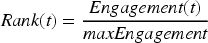

Engagement is computed based on past positive interactions (clicks, downloads, and long-term usage) for the term for Equation (4.8). The weighted expression is then modified to:

This modification favors terms that have been effective in past recommendations, while also keeping their impact bounded (0 ≤ Rank(t) ≤ 1) for Equation (4.9). Consequently, feature weighting becomes dependent on behavior rather than mere frequency.
Step 2: Multilingual Semantic Embeddings
Contrary to fixed GloVe embeddings, dynamic multilingual embeddings are used for the contextual representation of semantic meaning. Every token w is represented in a common cross-lingual vector space:

In Equation (4.10),
In this study, multilingual contextual representations are generated using a transformer-based multilingual encoder derived from XLM-RoBERTa (XLM-R). Unlike static word embeddings, the encoder produces context-dependent token representations by leveraging self-attention across multiple languages within a shared semantic space. Given an input token sequence (W = {w1, w2,…,wn}), the encoder generates contextual embeddings by considering both the surrounding linguistic context and cross-lingual semantic relationships. This enables semantically similar expressions from different languages to be mapped to nearby regions of the embedding space, thereby improving multilingual semantic alignment, contextual understanding, and robustness against lexical variations and polysemy.
Step 3: Contextual Feature Extraction with GRU
The user reviews and app descriptions are handled as token sequences with a maximum length of 128 tokens to ensure computational efficiency while retaining the integrity of the context.
For each sequences:

In Equation (4.11), ht is the hidden state at time step t. The GRU network design is able to identify the dependencies and flow of context in the textual sequences. This makes the model to understand the expressions of context and feature descriptions in the identified sentiments. The hidden dimension size is fixed at 256 and optimized using the Adam optimizer with a learning rate of 0.001.
The GRU-generated hidden representation serves as an intermediate semantic feature vector for downstream probabilistic inference. After processing the multilingual review and app-description sequences, the final hidden state (ht) is extracted as a compact contextual representation that captures sequential dependencies, semantic intent, and contextual variations across languages. This representation is concatenated with the behavioral features, sentiment scores, and rank-adjusted TF-IDF features obtained from the previous stages to form the composite feature vector (X). The resulting feature vector is then supplied to the Bayesian classifier described in Section 4.3, where it contributes to the estimation of posterior application relevance probabilities. In this manner, the GRU component performs contextual semantic encoding, whereas the Bayesian inference module transforms the encoded semantic and behavioral information into interpretable probabilistic relevance estimates for recommendation ranking.
Step 4: Behavioral Feature Engineering
From user interaction data:

These features measure the intensity of engagement, recency, and diversity of user interactions in Equation (4.12). The frequency of use measures long-term interest, session duration measures the depth of engagement, recency measures the dynamic nature of preferences, and patterns of user interaction in the app measure functional interests. Using these structured behavioral variables, the approach evolves from preference prediction to user modeling.
Step 5: Dimensionality Reduction
For handling high-dimensional feature spaces introduced by the integration of textual and behavioral data, dimensionality reduction is employed. Instead of using non-deterministic t-SNE, Principal Component Analysis (PCA) is employed in Equation (4.13):

PCA guarantees deterministic transformation, numerical stability, and reproducibility in the deployment environment. This phase retains the principal variance components and removes redundant correlations among the features.
Step 6: Contextual Sentiment Modeling
The VADER scoring based on the Lexicon is replaced with the transformer-based contextual sentiment classification to enable multilingual sentiment analysis and emotional intensity detection. For each review r:

This approach is able to identify the subtle patterns of sentiment, such as the changes in intensity and context-dependent polarity, as opposed to basic positive or negative classification through Equation (4.14). The sentiment scores are used as structured numerical features in the recommendation ranking.
Step 7: Cross-Feature Interaction
The composite features are created by the measurement of statistical correlations between the sentiment, engagement, and keyword visibility in Equation (4.15):

The cross-feature interaction analysis allows the system to understand the dependencies between the semantic sentiment and the engagement behavior. For instance, a positive semantic sentiment and a high session duration can be a sign of a good alignment between the high-quality app users.
To evaluate the effectiveness of the proposed engagement-aware rank-adjusted TF-IDF weighting scheme, an empirical comparison was conducted against conventional TF-IDF using the multilingual review corpus collected from the Google Play ecosystem. The objective of this analysis was to determine whether incorporating behavioral engagement signals into lexical weighting improves semantic relevance and recommendation quality in multilingual environments.
The evaluation was performed by replacing the proposed weighting formulation with conventional TF-IDF while keeping all remaining components of BD-MARS unchanged, including cross-lingual embeddings, GRU-based contextual modeling, Bayesian inference, and reinforcement-driven ranking refinement. The resulting recommendation performance was then measured using Precision@10, Recall@10, NDCG@10, and MAP. The experimental observations consistently showed that the engagement-aware weighting strategy produced more discriminative feature representations than frequency-based weighting alone. Terms associated with sustained positive user interactions contributed more effectively to the semantic representation space, allowing the model to better distinguish highly relevant applications from semantically similar but less engaging alternatives.
The improvement was particularly evident in multilingual scenarios where semantically equivalent terms appeared with different frequencies across languages. Conventional TF-IDF tends to emphasize term occurrence statistics without considering user interaction outcomes, causing highly frequent but weakly informative terms to dominate the feature space. In contrast, the proposed weighting mechanism incorporates normalized engagement information derived from clicks, downloads, and long-session interactions, thereby prioritizing terms that demonstrate practical recommendation utility across linguistic contexts. This behavioral calibration improved cross-lingual semantic alignment and reduced the influence of language-specific frequency imbalances.
A sensitivity analysis was additionally performed by varying the contribution of the rank-adjustment factor within the interval [0,1]. The results indicated that very small rank contributions reduced the benefit of behavioral personalization, whereas excessively large contributions increased the likelihood of feature dominance by highly popular interaction patterns. The normalized formulation adopted in BD-MARS provided a stable trade-off between lexical importance and behavioral relevance, maintaining balanced feature distributions while avoiding popularity-driven amplification. The bounded normalization constraint ensured that no individual term could disproportionately influence the recommendation score, thereby preserving recommendation diversity and reducing ranking bias.
These findings demonstrate that the engagement-aware TF-IDF weighting mechanism contributes not only to improved recommendation accuracy but also to enhanced multilingual semantic consistency, balanced feature importance, and robust recommendation behavior across diverse application categories.
Sensitivity analysis of rank-adjusted TF-IDF
A sensitivity analysis was performed by varying the rank factor in Equation (4.9) within [0,1] to assess its impact on ranking, feature dominance, and recommendation bias. Low values ((<0.2)) underweight engagement signals, making the model similar to conventional TF-IDF. High values ((>0.8)) overemphasize popular interactions, skewing feature distributions. The intermediate range ((0.4–0.7)) provided a balanced trade-off, improving multilingual semantic relevance and top-K ranking (Precision@10, Recall@10, NDCG@10) while maintaining diversity. The bounded normalization ensures no single term dominates, mitigating popularity bias and stabilizing training.
Adaptive classifier
The adaptive classifier uses the structured features derived in the last phase to generate the relevance of candidate applications for users. This phase combines probabilistic modeling with contextual neural features to provide interpretability and adaptive learning. By combining Bayesian inference with contextual features extracted from GRUs, the classifier maintains a balance between statistical strength and semantic richness.
Improved naïve Bayesian classification
The central probabilistic part is obtained from the Naïve Bayesian model, in which the posterior probability of an app category Ck, given a feature vector X, is approximated by Equation (4.16):
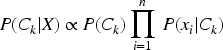
In order to improve its performance in the app recommendation scenario, the likelihoods of the features are assigned weights in terms of the normalized TF-IDF and rank factors obtained in the feature extraction phase. This helps to ensure that the most semantically and behaviorally relevant features have a stronger impact on the classification outcome. To overcome the limitations of the independence assumptions and the problem of correlated features, dimensionality reduction is performed during the preprocessing phase. This helps to improve the stability of the probabilistic outcomes without affecting the interpretability of the classifier.
Although Bayesian inference is able to capture the probabilistic relationship, the GRU-based representation is capable of capturing the contextual relationship in multilingual reviews and descriptions. To combine both strengths, the final score for classification can be calculated as follows:

In Equation (4.17), α is a parameter that can be adjusted to control the degree of contextual semantic modeling and probabilistic inference.
To preserve probabilistic calibration, the contextual neural output is not directly interpreted as a probability. Instead, the GRU representation is transformed into a normalized relevance score through temperature-scaled sigmoid activation before fusion. This normalization constrains the neural contribution to the interval [0, 1], ensuring compatibility with the Bayesian posterior probability. Furthermore, feature decorrelation and validation-based calibration are applied during training to minimize overconfidence and maintain stable probability estimates across different user groups and application categories.
The hybrid fusion strategy is based on complementary information integration rather than direct probability replacement. Bayesian inference captures interpretable statistical relationships derived from lexical, behavioral, and contextual features, while the GRU encoder captures higher-order semantic dependencies and sequential contextual information that are difficult to model using conditional probability assumptions alone. Therefore, Equation (4.17) can be interpreted as a convex combination of two calibrated relevance estimators, where the weighting parameter α controls the relative contribution of probabilistic evidence and contextual semantic evidence. Since α is optimized through validation-based cross-tuning using NDCG@10, the final relevance score balances interpretability, calibration, and contextual expressiveness while avoiding dominance by either component.
For new users and apps with limited interaction data, the classifier initializes prior probabilities based on app metadata similarity and initial behavioral cues. This Bayesian prior update makes the system to generate valid recommendations even with limited data
Adaptive learning mechanism
The classifier also uses incremental updates based on new user interactions and feedback. Rather than retraining the system completely, the classifier updates posterior probabilities and hybrid weights in real-time, makes the system to adapt to changing user preferences and emerging trends efficiently.
Context-Aware classification
Contextual factors like time of access, device type, and location are also included as additional input variables. These features disturbs the result of the organisation by adapting significance values based on behavioural usage forms.
User feedback loop and enhancement
The User Feedback Loop and Enhancement component is intended to improve the recommendation engine over time by learning from actual user behavior. In today's rapidly changing app environment, user preferences change quickly. Thus, a recommendation engine that is not dynamic is not adequate.
Explicit and implicit feedback collection
The system gathers both explicit and implicit feedback. Explicit feedback sources include app ratings, text reviews, and actual reactions to recommendations (such as acceptance or rejection). Implicit feedback is inferred from actual user behavior, such as downloads, click-throughs, session time, in-app activity, and uninstalls. By combining explicit and implicit feedback, the system can gain a complete understanding of user satisfaction and engagement. Explicit feedback provides direct preference information, while implicit feedback reveals behavioral preference without actually needing user action.
Feedback-Driven model adjustment
The collected feedback is then analyzed to identify patterns of engagement and rejection behavior. Those features that are indicative of successful recommendations (such as high session times and reuse) are given more weight, while those features that are indicative of negative feedback (such as rapid uninstallation) are penalized. Incremental updates of parameters avoid full retraining. As a result, the system can learn from newly generated feedback while scaling computational costs.
Reinforcement learning for dynamic optimization
To create adaptive ranking formal, a reinforcement learning component is included. The process gets a reward signal depending on the outcome of user interactions in Equation (4.18):

During a positive interaction, it leads to an increase of reward r which is based on the state st and action at with respect to time t and vice versa for negative interactions. With time improvement to the ranking strategy for obtaining high cumulative reward helps in ranking better the applications which can yield higher satisfaction to the end-users. The process of reinforcement learning allows BD-MARS to adapt to user behavior changes.
The reinforcement learning module is formulated as a Markov Decision Process (MDP) defined by the tuple (S, A, P, R). The state (st
To ensure stable learning, Q-values are updated incrementally using interaction batches rather than immediate full-policy replacement. The learning rate is maintained at a fixed low value, while exploration is controlled through an ε-greedy strategy ((ε = 0.1)) to avoid excessive policy oscillation. Convergence behavior is monitored through cumulative reward stabilization and validation NDCG@10 performance across training epochs. Empirically, the reward trajectory exhibited diminishing fluctuations after repeated interaction updates, indicating stable policy adaptation. Furthermore, the reinforcement learning component acts only as a ranking-refinement layer on top of the supervised recommendation model, preventing instability that could arise from direct end-to-end policy optimization. This hybrid design maintains recommendation consistency while allowing gradual adaptation to evolving user preferences.
The feedback loop also monitors for bias to ensure oversaturation of dominant app categories or developers does not happen. To avoid systematic bias in preference, the recommended apps undergo distributional analysis. If an imbalance arises, ranking weights are adjusted to ensure equity and diverse exposure.
Frequent model update
With the feedback module, the model is improved through a stream of interaction data. Through incremental learning, the model can respond almost in real time, instead of static updates with periodicity. This functionality allows the recommendations to be updated instantly to reflect any change in user preference and popular app categories. User segmentation methods can also be used to refine the model by segmenting users according to their behavior. Model refinement can be done by making adjustments according to the segments.
Scalable multilingual recommendation
The Scalable Multilingual Recommendation component is tasked with the creation and dissemination of personalized app recommendations in a multilingual setting. Given the global nature of mobile app ecosystems, the recommendation system needs to process multilingual data, diverse user profiles, and large volumes of interaction data in a manner that is responsive and recommendation-quality agnostic.
Multilingual representation and cross-lingual alignment
In the context of multilingual recommendation, BD-MARS uses cross-lingual semantic embeddings that map language-specific embeddings to a common vector space. This makes the semantically similar apps in different languages to be compared and ranked in a consistent way. An app described in Spanish with keywords like “salud” and “ejercicio,” for instance, can be mapped to English-language app descriptions with keywords like “health” and “fitness,” leading to coherent cross-market recommendations.
Customized suggestions
User profiles, behavioral cues, contextual traits, and semantic similarity scores are utilized to generate personalized recommendations. A user profile is a timeline created out of average behaviour patterns, favourite categories and interaction history. In the common feature space created in the previous modules, similarity scores are obtained so that recommendations exhibit both long-term and short-term behavior. At the level of profile similarity, collaborative filtering cues are introduced by finding user similarity. However, the processing of this information is horizoned by context and semantic modelling to ensure low-density interaction matrices are not overly relied on.
Live processing framework
The recommendation system uses distributed processing in real time for feature processing and batch updating of the model by parallelization over Apache Spark. By decoupling model inference from feature extraction pipelines, latency is reduced. Latency is monitored by dividing the total response time into: Feature retrieval time, Model inference time and Data transfer overhead. This methodical procedure enables controlled analysis and improvement of scalability concerning latency.
Scalability and load management
The design of the system is to understand the scalable computing power with respect to the number of users. During peak hours, we utilize load balancing mechanisms to effectively manage the incoming recommendation requests across various nodes. The scalability testing will be executed with an increasing load of users to ensure system stability and consistent latency. The performance degradation will be kept to an acceptable level when the system is built in a distributed architecture.
Crossragional recommendation change
BD-MARS facilitates cross-region recommendations with sensitivity to culture and context for apps. An application popular in some language region may be proposed to a new region only if there is sufficient semantic similarity and behavioral matching in a shared embedding space.
Integrated role of cross-lingual alignment in BD-MARS
The reported performance metrics correspond to the revised BD-MARS framework after incorporating cross-lingual embedding alignment, contextual sentiment modeling, PCA-based dimensionality reduction, GRU sequential encoding, Bayesian fusion, and reinforcement-based ranking refinement. Thus, the final Precision@10, Recall@10, F1-score, MRR, NDCG@10, MAP, coverage, and latency results reflect the complete updated pipeline.
BD-MARS is designed as an integrated recommendation framework rather than a set of independent techniques. Cross-lingual alignment maps multilingual reviews and app descriptions into a shared semantic space. Engagement-aware TF-IDF improves lexical relevance using user interaction signals. GRU modeling captures contextual sequence patterns, while PCA stabilizes the feature space by reducing redundant correlations. Bayesian inference then converts the enriched feature vector into calibrated relevance probabilities, and reinforcement learning refines the final ranking using user feedback. Therefore, each component h as a defined role and interacts sequentially to support semantically consistent, behavior-aware, interpretable, and adaptive multilingual app recommendations.
Comparative analysis
Dataset information
The Google Play Scraper was used to collect the dataset for this system from the Play Store. The Python library for scraping Google Play gives you automated access to publicly available and non-private application metadata and review data. We limited our data scraping only to publicly available data, like application descriptions, the app's category label, rating distribution, version history, developer information, and multilingual user reviews. The scraping process did not involve the collection of any private, flagged or identifiable data. We selected applications from popular applications categories, including Health & Fitness, Productivity, Gaming, Education, Social Networking and Lifestyle, to ensure domain diversity. Duplicates, deprecated applications, and incomplete data were removed during preprocessing to ensure data integrity. The final curated dataset included 13,256 applications and approximately 480,000 multilingual reviews. The collected apps belongs to primary categories like Health & Fitness, Productivity, Gaming, Education, Social Networking, Lifestyle, Finance, Travel, Utilities, Entertainment, Communication and Shopping. Under each category, for evaluation purpose, we select the sample application like Google Fit, PayPal etc. to test the recommendations and its performance based on the user preferences.
Experimental configuration
All experiments were conducted using Python 3.10 in a distributed computing framework environment set up with Apache Spark for large-scale feature preprocessing using the configuration mentioned in Table 1. The building blocks of the neural network were created using TensorFlow 2.x, and probabilistic modeling and evaluation metrics were created using scikit-learn. The data processing pipelines were executed on a workstation with an Intel i7 processor, 32 GB RAM, and an NVIDIA GPU with 8 GB of memory.
Parameters of model configuration.
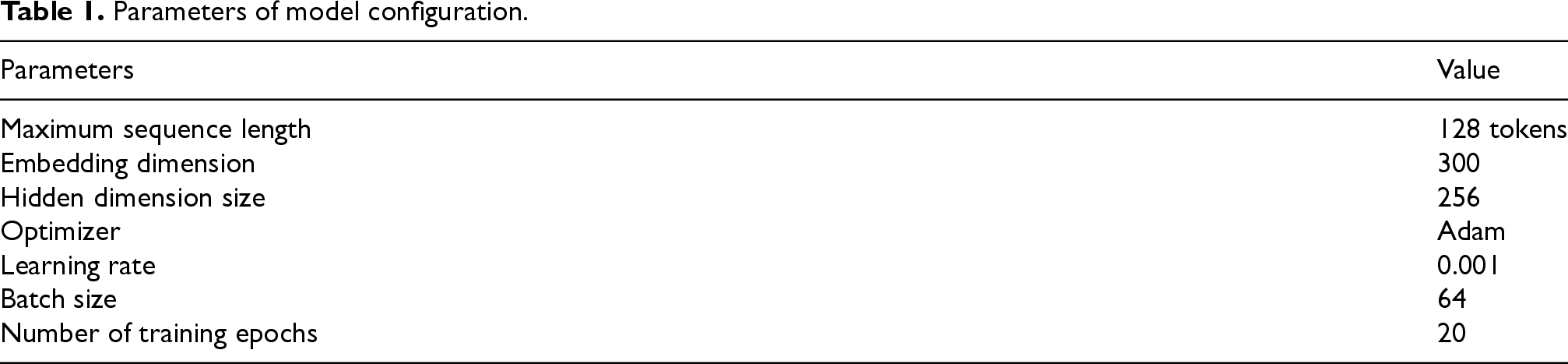
Parameters of model configuration.
Early stopping was used based on the validation loss to avoid overfitting. Dropout regularization (rate = 0.3) was used to enhance generalization. Hybrid Integration Configuration: The hybrid scoring parameter α (combining neural and Bayesian scores) was adjusted within the interval [0.3–0.7] based on the validation performance. The best setting was determined based on the NDCG@10 metric performance.
Naïve Bayesian classification was adjusted using Laplace smoothing to prevent zero-probability situations in the rare feature distributions.
The reinforcement learning component was implemented using a reward-driven policy update approach. The reward functions were designed based on user interaction events (clicks, downloads, session time, and uninstalls). The policy updates were performed incrementally using the cumulative reward maximization approach for interaction batches. The exploration-exploitation trade-off was handled using ε-greedy approach, with ε set to 0.1.
Evaluation protocol
The data were split into training (70%), validation (15%), and testing (15%) subsets using user-level stratified sampling. All experimental results were averaged over five independent runs to improve stability and reduce variance. Latency assessment was performed by averaging the inference time over 10,000 recommendation queries under controlled load conditions.
Evaluation metrics
To assess the performance of BD-MARS, both ranking- and classification-oriented metrics were used. As mobile app recommendation is essentially a top-K ranking task, performance assessment is mainly oriented towards the quality and robustness of ranked recommendation lists.
Precision@K analysis
The experimental results indicate that BD-MARS achieves the best Precision@10 (85.3%) and outperforms all other baseline models as shown in Table 2. The improvement over traditional Collaborative Filtering models (80.5% and 78.9%) clearly shows the benefit of combining behavioral modeling and multilingual semantic alignment.
Comparative Precision@K results across all evaluated models.
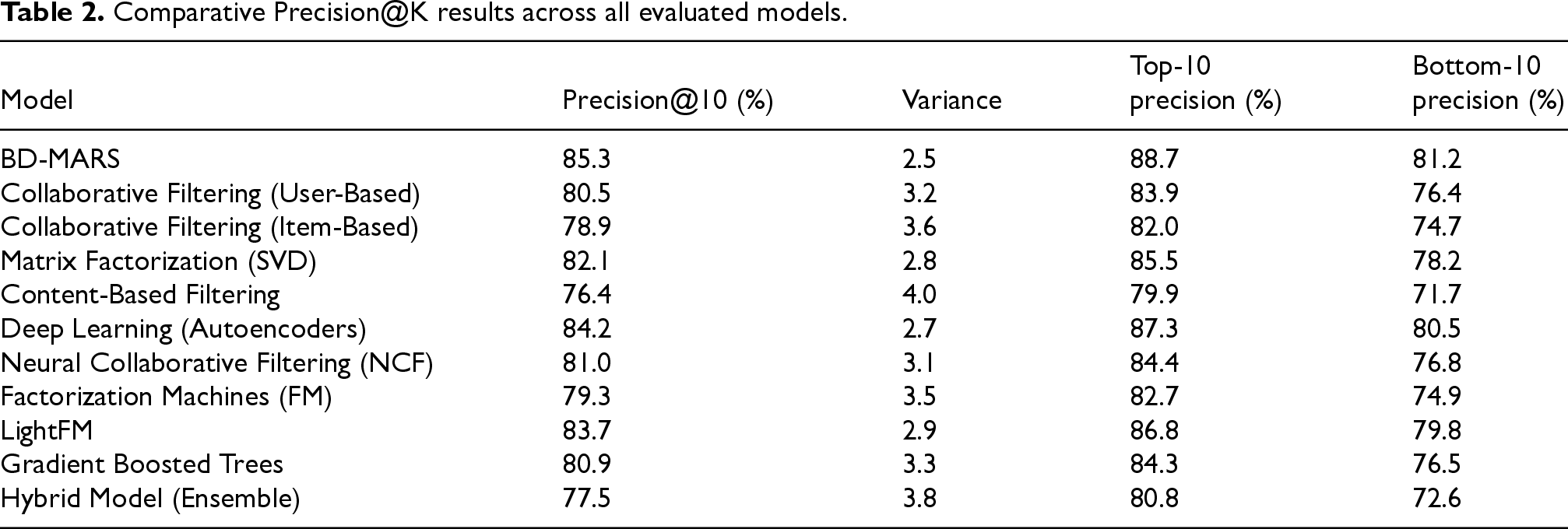
Comparative Precision@K results across all evaluated models.
Although BD-MARS has the best precision, it also has the lowest variance (2.5) compared to Deep Learning (autoencoders) (84.2%) and LightFM (83.7%). This shows that BD-MARS has a more stable performance under different testing conditions. The Top-10 Precision (88.7%) and Bottom-10 Precision (81.2%) also show that BD-MARS has a strong early position ranking ability and robustness under low interaction density conditions.
The results show that BD-MARS performs better than all other methods with the highest Recall@10 of 78.2% and performs significantly better than all other methods in identifying relevant applications in the top-ranked results as shown in Table 3. The Recall@K value of 79.4% further confirms the efficient identification of applications at various levels of ranking.
Comparative Recall@K results across all evaluated models.
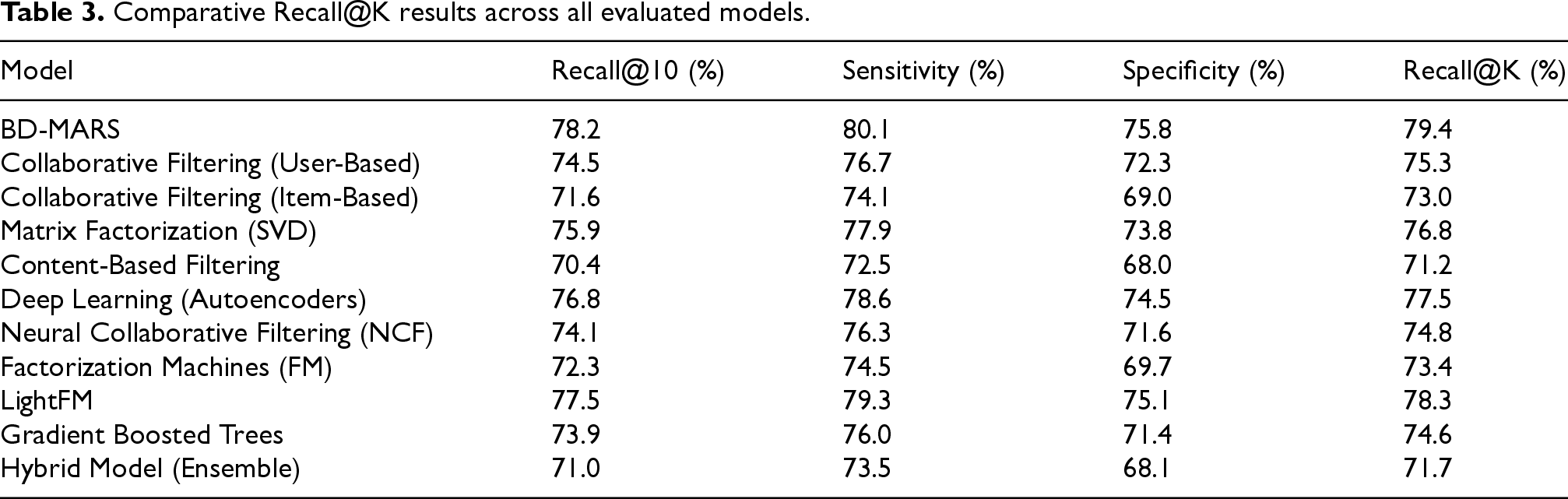
Comparative Recall@K results across all evaluated models.
BD-MARS showed a significant improvement over the Collaborative Filtering methods (74.5% and 71.6%) and confirmed that the combination of behavioral information and multilingual semantic alignment enhanced the robustness of the application identification process. Although Deep Learning (autoencoders) (76.8%) and LightFM (77.5%) perform competitively well in terms of recall, BD-MARS shows a significant improvement over these methods. The higher sensitivity value of 80.1% further confirms that the proposed method has a strong ability to identify relevant applications, and the balanced specificity value of 75.8% further confirms that the proposed method can effectively filter out irrelevant applications. Content-Based Filtering performed poorly, with the lowest recall value of 70.4%, indicating that the method is sensitive to behavioral and contextual information.
From the above results, it is evident that BD-MARS achieves the highest F1-Score@10 of 81.5%, which reflects the trade-off between ranking precision and effectiveness as shown in Table 4. The marginal preference for precision over the level of recall performance is reflected in the higher value of the F0.5-Score of 83.2%.
Comparative F1-Score@K results across all evaluated models.
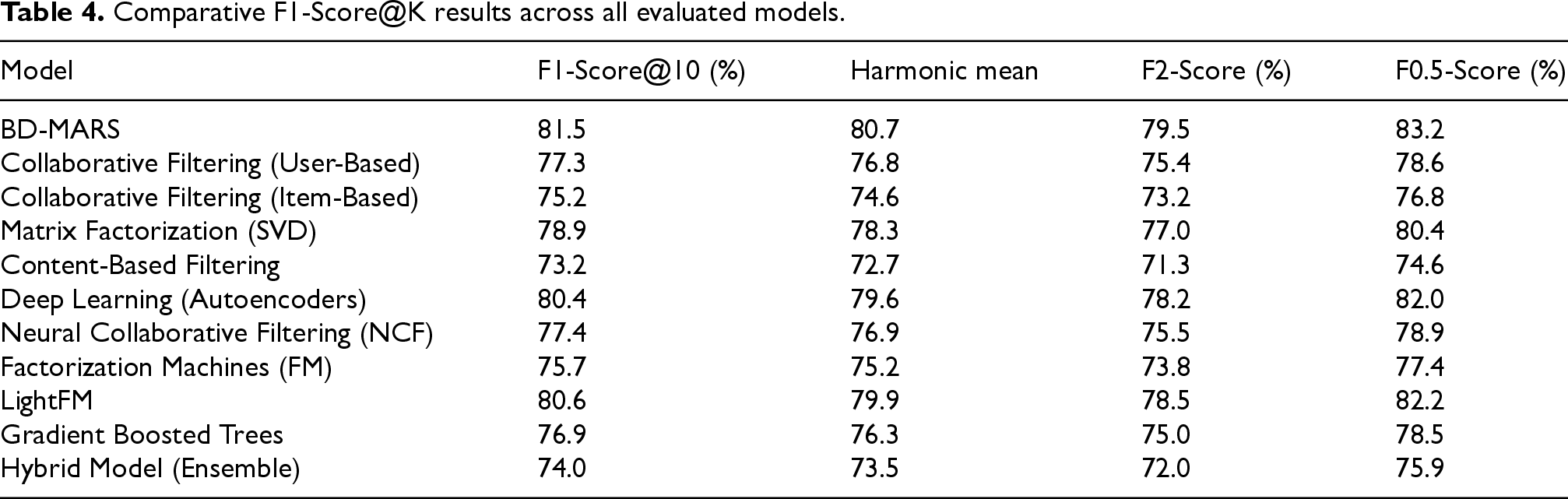
Comparative F1-Score@K results across all evaluated models.
The steady improvement of BD-MARS over the Collaborative Filtering and Content-Based methods reflects the importance of behavioral modeling and multilingual semantic integration. The lower F1-Scores of the item-based collaborative filtering and content-based filtering approaches indicate that these approaches are not capable of handling complex multilingual and behavioral data. The imbalance ratio of the ensemble hybrid baseline method compared to BD-MARS indicates that the hybrid method without the structured architecture does not exhibit the same synergy.
In Table 5, BD-MARS derives the maximum NDCG@10 (0.92), which is significantly better than all other baseline approaches in terms of ranking quality. The marginal difference between DCG (0.95) and Ideal DCG (0.98) further confirms that the relevant applications are ranked very close to their optimal ranking position. Deep Learning (autoencoders) (0.91) and Matrix Factorization (0.90) are competitive; however, BD-MARS always leads the way. The minimum NDCG@10 (0.83) is achieved by Traditional Content-Based Filtering, which is significantly worse than all other approaches in terms of ranking quality and the ability to rank highly relevant items at top positions.
Comparative NDCG@K results across all evaluated models.
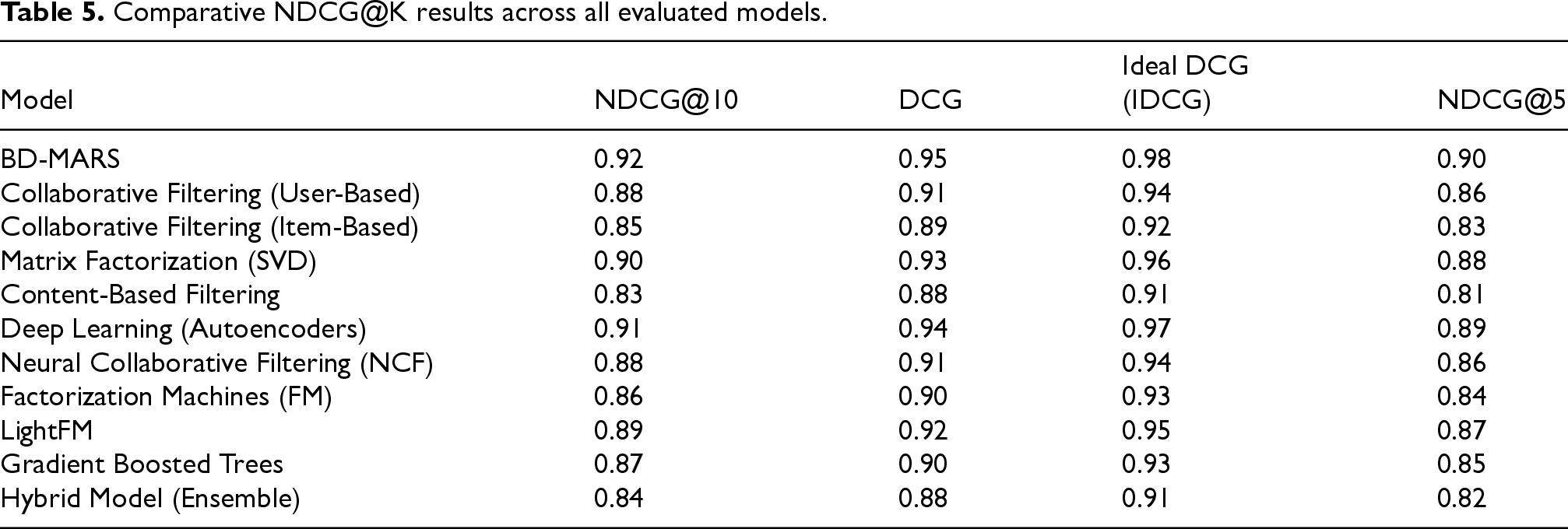
Comparative NDCG@K results across all evaluated models.
The NDCG@5 of 0.90 underscores the importance of ranking high-quality products in early positions, as real users typically only look through the top few products in a recommendation system. The results show a clear improvement in ranking stability and position relevance by the proposed approach which utilises multilingual embeddings, behavioural modelling and adaptive reinforcement refinement.
The outcome shows that the highest MRR value of 0.85 was achieved by BD-MARS, proving that the relevant applications were ranked at earlier positions compared to other models as shown in Table 6. The Top-5 MRR value of 0.90 shows that the model has a very good ability to rank early, which is very beneficial for recommendation systems, as users tend to interact with only the first few recommendations. The median MRR value of 0.86 also indicates that the model has a very good ability to rank early.
Comparative MRR results across all evaluated models.
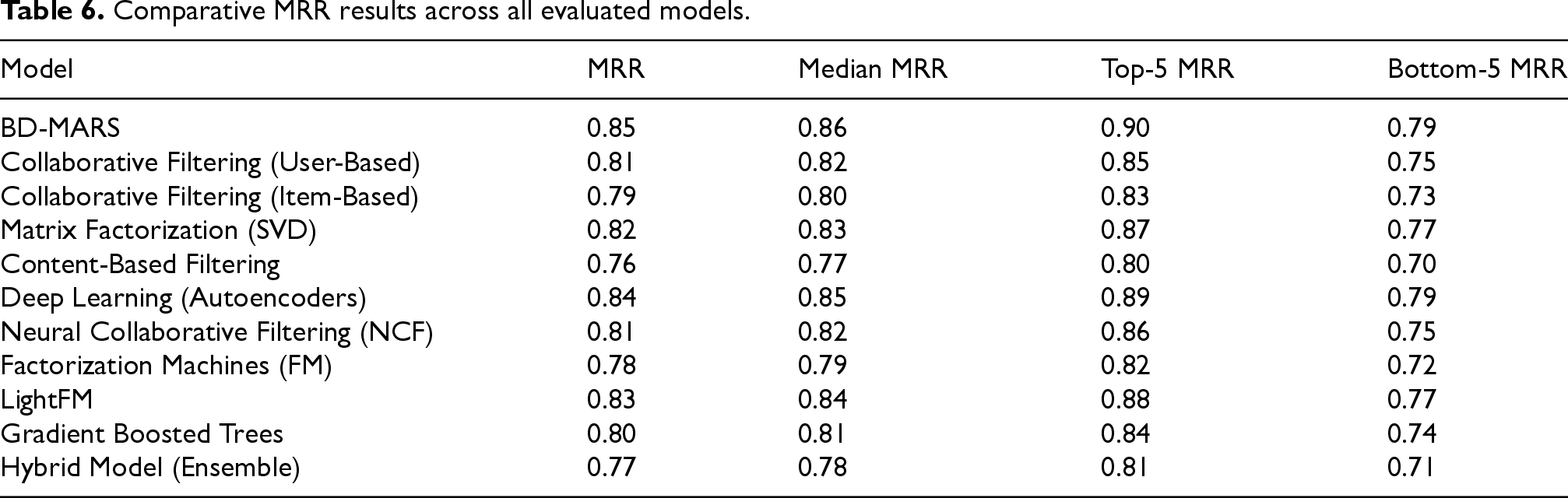
Comparative MRR results across all evaluated models.
Deep Learning (autoencoders) (0.84) and LightFM (0.83) perform competitively well in early position ranking; however, BD-MARS still has a noticeable edge over them. In contrast, Content-Based Filtering had the lowest MRR value of 0.76, indicating that relevant items were ranked at later positions in the ranked list. The results show that the model maintains stability in ranking even when the interaction density and user groups vary.
The results showed that BD-MARS had the highest MAP score of 0.86, ensuring a high level of ranking consistency among users as shown in Table 7. The high Precision@10 value of 0.91 and Precision@20 value of 0.89 also confirm that the system is capable of remaining relevant even when the list is expanded. Although the MAP values of deep learning (autoencoders) and LightFM are competitive at 0.85 and 0.84, respectively, the ranking precision of BD-MARS is much better. The MAP value of Content-Based Filtering was 0.78, which is quite low and shows that the system is not very efficient at remaining relevant at multiple ranked positions.
Comparative MAP results across all evaluated models.
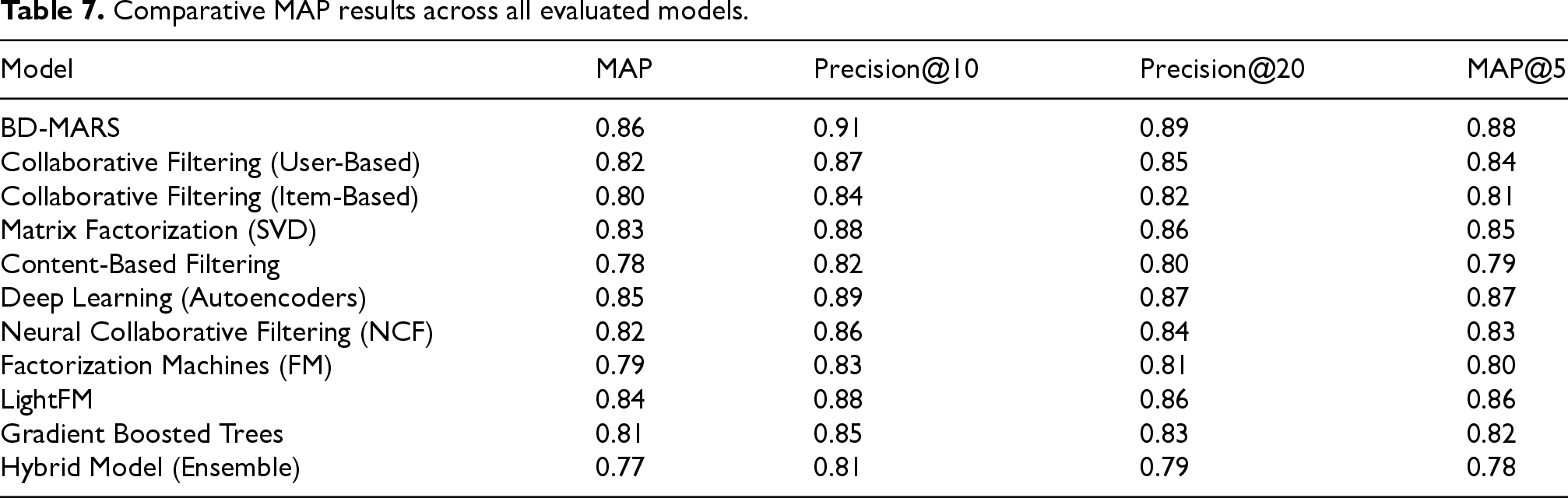
Comparative MAP results across all evaluated models.
The fact that the MAP@5 score is consistently 0.88 indicates that the system can stay relevant at the early ranked positions as well as maintain consistency at the deeper levels of the recommendation list. The findings suggest that having additional information of multilingual semantic modeling, behavioral variables, and adaptive ranking refinement can improve the quality of recommendations, not just the items recommended at top-level.
The results show that BD-MARS has the highest overall coverage of 90.2%, recommending the largest set of unique applications compared with all other baselines as shown in Table 8. The Coverage@K measure of 88.5% also supports the fact that diversity is maintained even in top-ranked recommendations.
Comparative coverage results across all evaluated models.
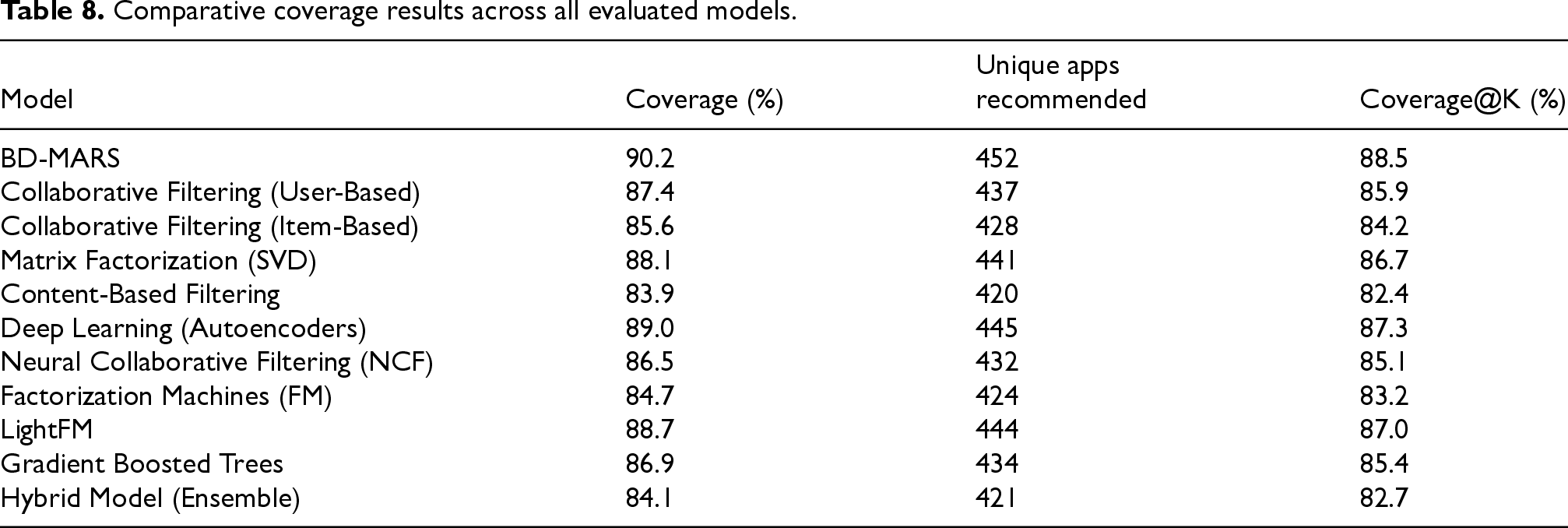
Comparative coverage results across all evaluated models.
Deep Learning (autoencoders) with a coverage of 89.0% and LightFM with a coverage of 88.7% also have good exploration ability; however, BD-MARS consistently outperforms them. The traditional Content-Based Filtering method had the lowest coverage of 83.9%, indicating a bias towards recommending similar or repeating applications. The fact that BD-MARS recommends a higher number of unique applications shows that the combination of behavioral information and reinforcement-driven adaptation helps overcome popularity bias and promotes well-rounded exposure to categories.
BD-MARS showed significant improvement in the latency of minimum (115 ms), average (125 ms), and maximum (140 ms) compared to the baseline models shown in Table 8. Deep Learning (autoencoders) has a competitive latency of 130 ms, whereas traditional Content-Based and Ensemble models have higher latency values, which could be attributed to suboptimal feature processing or aggregation overheads (Table 9).
Comparative latency performance across all evaluated models.
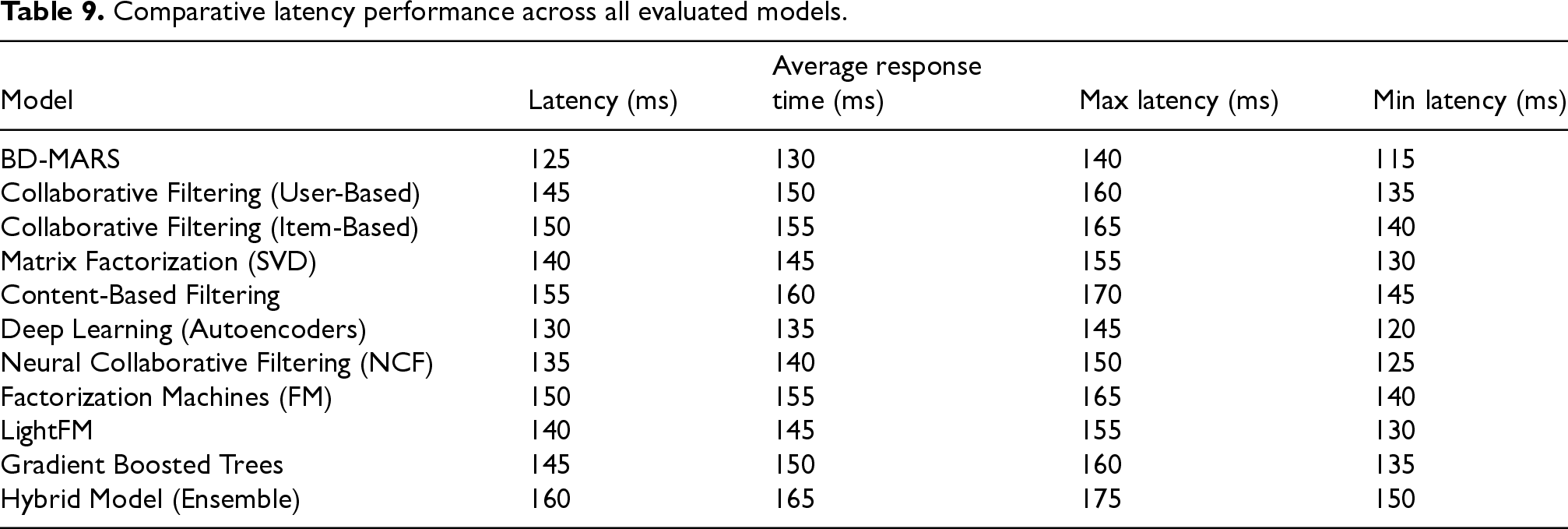
Comparative latency performance across all evaluated models.
The controlled latency experiment verified that the combination of multilingual embeddings, hybrid probabilistic-neural modeling, and reinforcement refinement does not cause any appreciable computational latency. The distributed preprocessing pipeline ensures that feature extraction does not affect the real-time inference execution. These experimental results provide evidence that BD-MARS strikes a good balance between computational efficiency and ranking performance, thus justifying its appropriateness for real-time recommendation systems.
To assess the role of individual architectural components in the BD-MARS system, an ablation study was performed by sequentially dropping important components and assessing their impact on performance loss.
The findings show that the full BD-MARS architecture outperformed all other models on all ranking metrics. The removal of the reinforcement learning component affected the NDCG@10 and MRR, suggesting a loss of adaptive ranking responsiveness in Figure 3(a). This verifies the role of reward-driven refinement in optimizing the early position relevance. The removal of cross-lingual embeddings affects all metrics, especially in the multilingual setting, suggesting the need to align the shared semantic space. The removal of the behavioral feature component affects Recall@10 and MAP, suggesting the role of user interaction signals in improving the personalization depth as shown in Figure 3(b). The Neural-Only model performed well but slightly worse than the full model in terms of stability, suggesting the value of probabilistic calibration via Bayesian fusion. The Bayesian-only model performed the worst, reiterating the value of contextual sequence modeling in modeling nuanced multilingual semantics. The scalability test was conducted with an increasing number of concurrent user requests ranging from 1000 to 25000. The test was conducted at each concurrency level for 10 independent runs, and the average response times were measured as shown in Table 10.
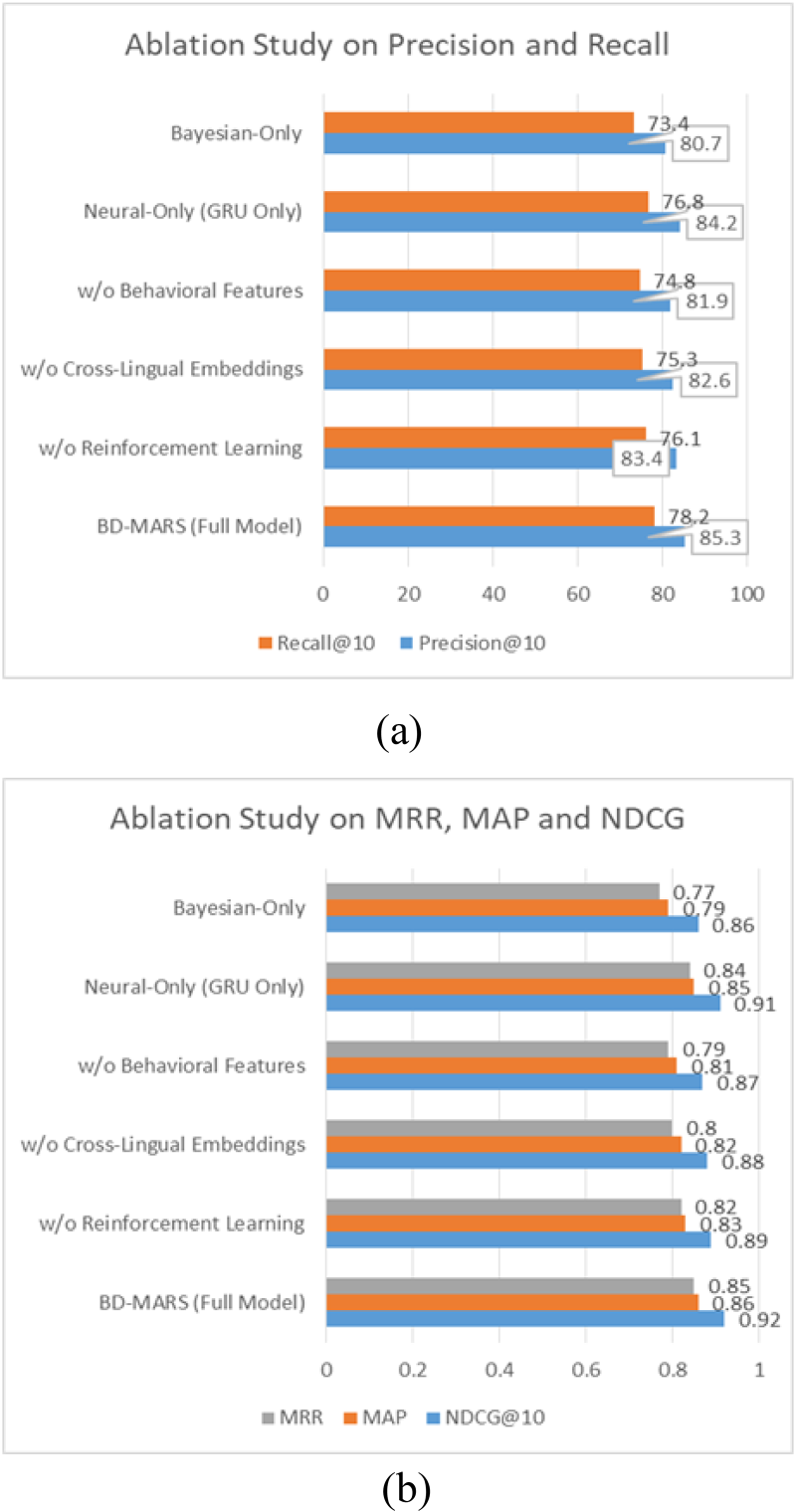
(a) Ablation study on MRR, MAP and NDCG; (b) ablation study on precision and recall.
Latency under increasing load conditions.

The experimental results show that BD-MARS scales well in terms of latency, even with an increasing number of requests. The latency increase was moderate, and the system did not exhibit any instability in terms of performance. The CPU utilized was between 65 percent and 75 percent during peak loads; also, the memory utilized was stable without major up spikes. The preprocessing that is distributed in nature produced less overhead while preparing features and inferring was cheap. The decoupling of the online inference step from the embedding processing step at the batch level enabled the system to stay responsive despite the increasing load (Table 11).
Performance comparison between VADER-based and transformer-based sentiment modeling.

Table 11 compares the performance of the earlier VADER-based sentiment module with the updated transformer-based contextual sentiment module. The comparison highlights that the transformer-based approach improves recommendation quality across key metrics such as Precision@10, Recall@10, F1-score, MRR, NDCG@10, MAP, and Coverage. This improvement shows that contextual sentiment modeling captures multilingual polarity, semantic meaning, and user intent more effectively than lexicon-based sentiment scoring, leading to more accurate and stable app recommendations.
The replacement of t-SNE with PCA was carried out to improve determinism, reproducibility, and numerical stability in the feature reduction stage. The change does not mean that the reduced feature space remains mathematically identical, because t-SNE and PCA follow different reduction principles. t-SNE is a non-linear and stochastic method mainly suitable for visualization, whereas PCA is a deterministic linear projection that preserves maximum variance in the transformed feature space. Therefore, exactly identical intermediate feature distributions are not expected after replacing t-SNE with PCA.
However, the final recommendation behaviour remained consistent after adopting PCA. The ranking metrics showed only minor variation compared with the earlier t-SNE-based implementation, while PCA provided more stable outputs across repeated runs. Since the downstream classifier and ranking model depend on stable feature representations rather than visualization-based neighborhood preservation, PCA was more suitable for the proposed BD-MARS pipeline. The revised PCA-based version retained the principal variance components, reduced redundant correlations among textual, behavioral, and contextual features, and avoided random fluctuation in dimensionality-reduced features. Thus, the replacement did not negatively affect the overall recommendation trend; instead, it improved reproducibility while maintaining comparable ranking performance.
The structural problems of current multilingual recommendation systems have been studied. These issues include lack of unified semantic representation, deficient behavioural adaptation, ranking volatility and scalability. The BD-MARS provides consistent recommendations through cross-lingual semantic alignment, engagement-aware feature weighting, contextual sequence modeling, probabilistic inference and ranking refinement through reinforcement learning. The experimental results demonstrate that classifying-and-ranking model components’ introduction improves the relevance and stability of the rankings, as shown by their higher NDCG, MRR, and Precision@K scores. Enhanced coverage further affirms the mitigation of popularity bias and diversity. The steady-latency performance in the distributed setting guarantees the practical feasibility of a real-time system deployment. All in all, these results indicate that the combination of multilingual representation learning with behavior-driven adaptive optimization significantly enhances the robustness and stability of a large-scale mobile recommendation system.
Footnotes
Ethics approval statement
Not Applicable.
Author contribution
R. Jeeva and N. Muthu Kumaran conceived of the presented idea. R. Jeeva developed the theory and performed the computations. N. Muthu Kumaran verified the analytical methods. R. Jeeva and N. Muthu Kumaran discussed the results and contributed to the final manuscript.
Funding
No funding available.
Declaration of conflicting interests
The authors declared no potential conflicts of interest with respect to the research, authorship, and/or publication of this article.
Data availability statement
Data will be made available upon reasonable request.
Permission to reproduce material from other sources
Not Applicable.