



Abstract
This article examined the extent that Nisbett and Cohen’s herding hypothesis can account for cross-national variation in homicide. Three research questions were addressed. First, to what extent does herding influence homicide cross-nationally? Second, do different types of herding influence homicide differently? Third, are the effects of herding on homicide more pronounced in weak nation states? Little support was found for the proposition that herding influences homicide. Additionally, no consistent support was provided for the notion that the effects of herding on homicide are more pronounced in weak states. These results lend no support to Nisbett and Cohen’s proposition that there is a worldwide link between herding and violence.
Introduction
Nisbett and Cohen’s (1996) provocative culture of honor thesis has reinvigorated the debate about the influence of culture on levels of violence. Building on previous research on the culture of violence in the South, the authors use a sophisticated mixed methods approach to provide compelling evidence for the link between culture of honor and contemporary levels of Southern violence. Nisbett and Cohen (1996) also provide a unique contribution to our understanding of the origins of the Southern culture of honor. They specifically link the herding background of Southern settlers with the emergence of the culture of honor, and the resulting violence, in the South.
Despite the unique connection that Nisbett and Cohen (1996) draw between herding and homicide, little research has directly examined this link. Most of the extant literature on the culture of honor theory has focused on the link between the culture of honor and violence. Existing research on the herding hypothesis has been mixed, but seems to find a least partial support for the notion that herding may be important for understanding contemporary variation in Southern violence (Baller, Zevenbergen, & Messner, 2009; Chu, Rivera, & Loftin, 2000). Evidence in support of the herding hypothesis has led to calls for more research on this topic. In response to this call, the current study seeks to examine three important aspects of the herding hypothesis that have yet to be addressed. First, this study examines the extent that the herding hypothesis is generalizable to settings outside of the Southern United States. Nisbett and Cohen (1996, p. 89) explicitly state that the processes that they outline should operate in all herding societies, thereby suggesting a link at the cross-national level. Yet, existing criminological research on this issue has been confined to examinations of violence in the South. Anthropological case studies have noted a link between herding and use and support of violence in some nations (Figueredo, Tal, McNeill, & Guillen, 2004; Moritz, 2008), but it is unclear if the findings from these studies can be generalized to other settings. Examining the herding hypothesis at the cross-national level will shed light on whether Nisbett and Cohen’s (1996) claims about the generalizability of the herding hypothesis hold true. In addition, testing the hypothesis in other settings allows for an examination of the contemporaneous effects of herding on homicide. Although Nisbett and Cohen (1996) contend that understanding the historical legacy of the herding economy is important for explaining contemporary Southern violence, they also acknowledge that the transition away from a herding economy, and the ability of the contemporary state to protect Southerners from the predation of others, has weakened the strength of the culture of honor overtime (p. 92). This makes it difficult to determine if a null relationship between historical herding levels and contemporary rates of violence is the result of the fact that herding does not influence violence, or a result of the fact that the effects of herding on violence have become substantially attenuated over time.
The second unaddressed aspect of the herding hypothesis concerns whether the effect of herding on homicide is contingent on the type of herding. Nisbett and Cohen (1996) do not address this issue, but Baller et al. (2009) cite compelling historical evidence that suggests that animal thieves in the Old South were more likely to attempt to steal cattle and pigs than goats and sheep because the former were more expensive and less noisy. If true, this would imply that the culture of honor was only likely to emerge in places where cattle and pig herding was prevalent. Based on this evidence, Baller et al. (2009) only assess the effect of cattle and pig herding on homicide. The significant interaction that they report between their measure of herding and the percentage of Scottish-Irish population lends credence to their assertion; but the finding also leads to questions about the effects of the types of herding not examined, and whether significant effects hold if cattle and pig herding are examined separately. Additionally, it is not clear that cattle and pig theft is universally viewed as superior to sheep and goat theft. A cross-national examination of the effects of different types of herding on homicide sheds light on the type(s) of herding that most likely lead to the emergence of the culture of honor, and whether these processes operate to influence violence outside of the Old South.
The third unaddressed issue concerns the circumstances under which the effects of herding on homicide are most pronounced. Nisbett and Cohen (1996) explicitly state that the economic precariousness faced by herdsman is more acute when the state is too weak to prevent or punish theft of property. As will be discussed below, it also seems plausible that the link between herding and homicide might be more pronounced in lesser developed nations. Yet no study to date has examined these claims. This is likely due to the fact that it is generally acknowledged that frontier areas were relatively weak and underdeveloped when herding was common in the Old South. Such an assumption cannot be made in a contemporary assessment of the relationship between herding and homicide at the cross-national level because many modern nation states are well equipped to prevent and punish theft of property. For example, in nation states such as Australia, which is characterized by both high levels of herding and a strong national government, it is likely that the state has taken steps to prevent or punish theft of cattle. And although this fact may not eliminate the economic precariousness faced by herdsmen, it likely reduces it and decreases the likelihood that herding should be associated with violence. As such, it is necessary to explicitly model the factors under which the effects of herding on homicide are most pronounced.
The objective of this study is to expand contemporary knowledge of the relationship between herding and violence. Toward that end, this study examines the extent that cattle herding, pig herding, sheep herding, and goat herding, respectively, influence homicide at the cross-national level, and whether these effects are more pronounced in weak states and lesser developed states. This analysis is performed using a sample of nations larger than most cross-national research, and with sufficient cultural variation to address the topic of interest.
Theoretical Framework
Nisbett and Cohen propose a culture of honor theory to explain White, southern male violence. According to Nisbett and Cohen (1996), higher levels of southern violence stem from the economic environment of the early settlers’ country of origin. Settlers of the northern United States consisted primarily of Dutch, Germans, Puritans, or Quakers. Importantly, these early northern settlers were from farming communities where cooperation with neighbors was emphasized and the need to have a reputation for strength was unimportant. Early southern settlers, on the other hand, were Scottish and Irish descendents of Celtic Herdsman. Nisbett and Cohen (1996) argue that this distinction is important because the precarious economic environment of herdsman require them to project a determined willingness to protect their honor and property at all costs. Under such circumstances, herdsmen adopt a stance of extreme vigilance whenever they face an affront that calls into question their ability to protect their honor and property. Nisbett and Cohen (1996) suggest that early Scotch-Irish settlers imported these characteristics to their new American homeland.
The geographic makeup of Appalachia, with its low population density, mountains, and wide-open spaces, likely reinforced the cultural tendencies of Scotch-Irish immigrants. Inefficient farming practices, and the impotent reach of American law enforcement in frontier areas, encouraged southern settlers to have a strong attachment to their land and to rely on self when protecting their investments. As a result, a retributive justice system emerged where lex talionis was the law of the land and every man was the sheriff of his property. According to Nisbett and Cohen (1996), herding remained the basis of the southern economy for many decades, and by the time subsequent changes in the economy began to influence southern culture the culture of honor was well established.
The defining element of the culture of honor is the willingness of individuals to use violence to protect their reputation of strength and honor. Cultures of honor are said to be most likely to emerge where the individual is at risk from his countrymen, and where the state is incapable of punishing theft of property. When such conditions prevail, individuals living in areas where the culture of honor dominates will be more likely to view the use of violence as a legitimate tool for the protection of self, family, and home as well as for the socialization of children. Additionally, adherents to the culture of honor are more likely to support owning a gun for protection and are more willing to use a gun in response to perceived aggression. Men in particular are influenced by these processes because issues of honor and strength are often explicitly linked to masculinity. Nisbett and Cohen (1996) suggest that these processes lead to violence in the following way:
In a culture where honor is so important, arguments lead to affronts that demand retribution. The availability of guns increases the chances that the retribution may be deadly. In addition, the knowledge that the other person may be armed and may begin acting violently may lead to preemptive first strikes. Once conflicts escalate, a man may be more apt to take a first strike as a matter of self-protection before he himself gets shot. At a cultural level, the occurrence of hundreds of these violent self-fulfilling prophecies creates a milieu where the threat of violence keeps individuals vigilant in their own defense. (p. 38)
Importantly, Nisbett and Cohen (1996) propose that the influence of the culture of honor extends well beyond regulating individual behavior. The values espoused by the culture of honor are said to operate at the collective level to influence rates of crime. More specifically, the culture of honor operates at the macro-level to influence crime by creating a social milieu that keeps individuals vigilant in their own defense.
Although Nisbett and Cohen (1996) devote a considerable amount of time to discussing the link between culture of honor and violence, they acknowledge that the weakest part of their theory concerns the link between herding and the emergence of the culture of honor (pp. 88-89). The validity of their claim hinges on the assumption that herdsman across the world face economic precariousness and likely operate in places where they cannot rely on the protection of the state. These arguments primarily have been drawn from case studies of the characteristics of particular herding economies, but processes occurring in one setting are not always generalizable to the next.
Research on the Culture of Honor Theory
Most of the research on Nisbett and Cohen’s (1996) propositions has focused on the link between the culture of honor and violence, rather than the herding hypothesis. Overall, the extant research has reported inconsistent results. Some of the strongest evidence was presented by Nisbett and associates (Cohen, 1996, 1998; Cohen, Bowdle, Nisbett, & Schwarz, 1996; Cohen & Nisbett, 1994; Cohen & Vandello, 1998; Nisbett & Cohen, 1996). For example, Nisbett and Cohen (1996) found that homicides involving threats to property or integrity were more common in the south; southerners are more approving than northerners of violence for protection of self, family, and possessions, in response to an insult, and for socializing children; southerners who are insulted respond with a range of physiological, cognitive, and behavioral reactions that are different from noninsulted southerners and all northerners; southerners are more likely to believe that the failure to respond to an insult will cause others to hold them in contempt; and southern laws, institutions, and social policies require many people to participate in a meaning system that is consistent with the culture of honor. (Cohen, 1998, pp. 83-84; see also Nisbett & Cohen, 1996).
What was most remarkable about Nisbett and Cohen’s (1996) research is that it used multiple methods and data sources to test and find support for the culture of honor theory. These findings led Nisbett and Cohen (1996) to conclude that southerners are more approving of violence when it is used for self-control or social control, and that various public representations—such as laws, institutions, and social policies—are expressive of values justifying violence under those circumstances where an individual’s honor is placed at risk as a result of a threat or affront to their person or property. A recent article by Altheimer (in press) also lends support to Nisbett and Cohen’s propositions. Using data from 51 nations, Altheimer (in press) found a proxy of culture of honor to exhibit greater effects on homicide than important structural controls such as economic inequality and the sex ratio.
Other research, however, has not been nearly as supportive. Some have argued that some of the research performed by Nisbett and associates was plagued with methodological problems, and when these problems are controlled for results emerge that are inconsistent with the core propositions of the theory (Chu et al., 2000; Felson & Pare, 2010; Loftin & Mcdowall, 2003; Rivera, Chu, & Loftin, 2002). For example, Loftin and McDowall (2003) find little support for Cohen’s (1998) claim that strong social organization increases the risk of honor-related homicide in the South. They attribute Cohen’s findings to errors in the measurement of homicide and the failure to account for the undue influence of a few notable outliers. Even research somewhat supportive of the culture of honor theory has reported inconsistent results and marginally significant findings. For instance, Hayes and Lee (2005) found that southern rural white males were only more approving of the use of violence than northerners in some situations related to defending honor, family, and property.
The extant literature on the herding hypothesis consists of only a few studies and has not yet established a definitive link. Anthropological case studies have noted support for the notion that members of herding societies are more apt to condone the use of violence under certain circumstances than membersof farming societies (Figueredo et al., 2004; Moritz, 2008). For example, Figuerodo et al. (2004) found that respondents from herding communities scored higher on the revenge scale than respondents from farming communities. Nisbett and Cohen (1996, pp. 18-19) note that Reaves (1993) found that homicide rates are higher in areas of the South that are more suitable for herding than agriculture. Chu et al. (2000), however, were unable to replicate the findings reported by Nisbett and Cohen (1996). They argue that previous results suggesting a relationship between White male homicide rates and environmental regions are artifacts of skewed distributions, unreliable estimates of homicide rates, and the failure to control for the distribution of White poverty levels. Baller et al. (2009), on the other hand, found support for the herding hypothesis. More specifically, they found that White male argument related homicide was significantly influenced by an interaction between a proxy of the presence of Scottish-Irish communities and the amount of herding activity. They interpret this interaction to suggest that herding in the South strengthened the code of honor among the Scottish-Irish. Baller et al. (2009) also found that argument-related homicide was lower in southern counties with high agricultural activity, thereby suggesting that the emergence of the culture of honor is inhibited in certain agricultural settings.
The Current Study
To date, the extant research has been unable to definitively establish a link between herding and violence. This fact alone suggests that further examination of this relationship is warranted. Besides the need for replication, there are important theoretical issues that have yet to be explored in previous research. First, there is a need to explore the extent that herding influences violence outside of the Old South. Explicit statements by Nisbett and Cohen that suggest a worldwide link between herding and homicide—when considered in light of the fact that previous anthropological case studies have also found a link between herding practices and violence—suggest that a cross-national test of the herding hypothesis is appropriate (Baller et al., 2009).
An additional theoretical issue that requires more attention concerns the types of herding most likely to lead to the formation of the culture of honor. Ballerssner (2009) argue that in the Old South cattle and pigs were more attractive to steal than goats and sheep because the former were more expensive, less noisy, and easier to drive at night. If certain types of herding are characterized by lower levels of risk, the culture of honor should not be as pronounced, or may not develop at all. Under such circumstances, all types herding would not be expected to increase rates of homicide. To examine these issues, this study examines the effects of cattle herding, pig herding, sheep herding, and goat herding, respectively, on homicide.
Although testing the relationship between herding and homicide across nations seems theoretically defensible, doing so also presents some unique challenges. Herding practices vary across space and time, and the experiences of herders worldwide likely vary across nations. The herding-related processes that Nisbett and Cohen claim influenced homicide in the Old South likely are much different from the herding related processes occurring in some modern developed nations but might more closely resemble the herding related processes in some less developed nations. A herder in contemporary Australia is likely to have a much different experience than a herder from rural Botswana. For the former, the strength and stability of the state may greatly reduce the risk posed to his herd, thereby eliminating the economic precariousness that Nisbett and Cohen claim is vital for understanding how herding leads to the emergence of the culture of honor and subsequent elevations in levels of violence. For the latter, on the other hand, the state is likely weak or nonexistent, and unable to provide protection against threats or affronts to his person or property. Under these circumstances it seems much more likely that the processes described by Nisbett and Cohen will emerge. Unfortunately, Nisbett and Cohen say little about how variation in herding-related processes across nations might influence the emergence of the culture of honor and none of the extant research provides guidance on this issue.
Due to the challenges raised above, some might argue that applying the herding hypothesis to the cross-national level in this manner is inappropriate because nation-level indicators may be too large and unable to control for variations in community type. This may further lead some to conclude that the most appropriate way to study this issue at the cross-national level is with country-specific case studies or through the use of choropleth maps that assess whether the regions around the world that have a higher presence of herding activity also have elevated levels of violence. These criticisms are important to consider, but it is also important to reemphasize that Nisbett and Cohen explicitly link herding and homicide at the societal level. Furthermore, there is no guarantee that similar issues would not be encountered if this study examined global regions rather than nation-states as the unit of analysis. There is no set rule on the most appropriate geographic unit to examine when studying cultural processes and violence. Some previous research has examined the link between cultural processes and violence in different regions of the United States (Northern, Southern, Western, etc.), even though these regions are larger than some nations.
Rather than rejecting the application of the herding hypothesis to the cross-national level, perhaps a more appropriate approach—and the one endorsed here—involves the use of multiplicative interaction terms to discern the conditions under which the effects of herding on homicide are most pronounced. The interaction terms examined here center around two issues. First, is the effect of herding on homicide more pronounced in weak nation states? Testing such an interaction is supported by the fact that Nisbett and Cohen (1996) explicitly suggest that the effect of herding on homicide is more pronounced in weak nation states. Second, is the effect of herding on homicide more pronounced in lesser developed nations? Although Nisbett and Cohen (1996) say little about the role that development plays in these processes, it seems plausible that the herding occurring in lesser developed nations more closely resembles the processes outlined by Nisbett and Cohen (1996) than the herding occurring in contemporary developed societies. Thus examination of an interaction between herding and development seems warranted.
Based on the discussion above, the following research questions are examined in this study:
Research Question 1: To what extent does herding operate to influence cross-national variation in homicide?
Research Question 2: What types of herding are most likely to influence rates of homicide?
Research Question 3: To what extent is the effect of herding on homicide conditioned by the strength of the state and national levels of development?
Method
The Sample
Nations were selected for analysis if data were available for the herding indicators and the homicide measure. 1 Sample selection for cross-national criminological research traditionally has been driven by data constraints; reliable measures of social and structural characteristics of nations have been limited to Western industrialized nations. 2 In recent years, however, data from a larger subset of nations have become available, thereby making it possible to examine the predictors of crime in many non-Western nations as well as in nations with emerging economies (Pridemore, 2002; Stamatel, 2009). The number of observations for the analyses performed in this study ranges from 163 to 184 nations. The variation in the number of observations is the direct result of the fact that the availability of the herding data varied by the type of animal. Data for 184 nations were available for cattle herding; data for 179 nations were available for goat herding; data for 171 nations were available for sheep herding; and data for 163 nations were available for pig herding. Relative to most cross-national research, the sample examined here is large. This provides the added benefit of being able to examine the core hypotheses in nations from virtually every continent. Thus, although the sample is not randomly drawn, it includes a diverse set of nations from different cultural settings, making it adequate for an initial examination of the relationship between the variables of interest.
Dependent variable
The dependent variable examined in this study is the international homicide index. This violence indicator was selected for three reasons. First, the theoretical perspective reviewed above explicitly links herding to homicide. Second, at the cross-national level, homicide data are more reliable than data for other offenses (Lafree, 1999; Neopolitan, 1997). Crime definitions are often inconsistent across nations and reporting practices vary by nation (Neopolitan, 1997). Both of these issues make comparability across nations difficult. It is generally agreed on, however, that homicide is the most similarly classified crime across nations (Neopolitan, 1997). Third, homicide data were available for a larger group of nations than other crime offenses. Alternative data sources such as the International Crime Victimization Survey (ICVS) were only available for a smaller subset of nations.
Currently, the United Nations provides homicide data from both public health agencies and national law enforcement agencies. The public health data come from the World Health Organization Cause of Death Estimates (WHO), Pan American Health Organization Regional Core Health Data Initiative (PAHO), and European Health for All Database (WHO-HFA). The law enforcement data come from the Statistical Office of the European Communities (Eurostat), the International Criminal Police Organization (Interpol), Observatorio Centroamericano sobre Violencia (OCAVI), UNICEF TransMONEE database (Transmonee), and the United Nations Survey of Crime Trends and Operations of Criminal Justice Systems (UN-CTS). There is no consensus on whether public health or law enforcement data provide the most accurate assessment of levels of homicide across nations. In attempt to draw on the strengths of both sources, the international homicide index was used as the dependent variable here.
The international homicide index (Marshall & Block, 2004) was created by ranking nations from lowest to highest based on the 2003 to 2008 average UN Public Heath homicide rate and the 2003 to 2008 average UN police homicide rate, creating a standardized ranking for both measures, and averaging the two standardized rankings. 3 The international homicide index ranges from 1 to 100, with high values indicating higher rates of homicide. Most cross-national criminological research uses either public health or law enforcement data, but use of the international homicide index has two primary advantages: improved reliability and fewer missing values (Marshall & Block, 2004). Appendix A lists the IHI values for the nations examined in this study. Because the international homicide index is relatively new, some readers may remain skeptical of any results presented using this index. To account for this concern, separate analyses were also performed examining homicide rates generated by public health data and law enforcement data, respectively. These results did not differ substantively with the results presented here. The few instances where the findings diverged are discussed below.
The homicide measure used here cannot be disaggregated by different types of homicide. This represents an important limitation, as the herding hypothesis focuses on expressive or argument-related homicide. Despite this fact, there is both theoretical and empirical justification to use the international homicide index as the dependent variable here. First, Lee (2011) provides a framework for understanding how the culture of honor can operate to influence predatory and instrumental violence. Lee argues that in settings characterized by isolation from the law, poverty, and the breakdown of mainstream institutions that socialize people to navigate the challenges that they might encounter; the strategies of action that are normally used to solve interpersonal disputes will be drawn on to navigate through other situations, thereby increasing levels of predatory violence. According to Lee (2011), this accounts for why predatory violence is also high in some places where the culture of honor is thought to operate and why the culture of honor likely influences instrumental and expressive rates of violence at the macro level. Assuming that Lee’s arguments are correct, it seems plausible that the impact of herding on the culture of honor should increase both expressive and instrumental rates of homicide across societies. Second, there is evidence that expressive homicides make up the majority of total homicides committed in the United States. In their analysis of Supplementary Homicide Reports (SHR) data, Miethe and Drass (1999) note that expressive homicides accounted for 79.4% of all homicides. More recent analysis of the SHR by Maume and Lee (2003) found that expressive homicides make up 62.4% of all homicides. Thus a substantial uptick in expressive homicides may increase total homicides rates. Most cross-national homicide data cannot be disaggregated, so the proportion of homicides committed cross-nationally that are expressive in nature is not known. Pridemore’s (2006) research on homicide characteristics in the Udmurt Republic of Russia found that 45% of all homicides were argument related; thereby lending support to the notion that expressive homicides make up a substantial proportion of homicides committed in other nations.
These two issues provide justification for using total homicide rates in a preliminary analysis such as this. Admittedly, some may view this data limitation as insurmountable, thereby rejecting the use of currently available cross-national data to assess hypotheses such as these. A more prudent approach advocated here is to utilize the available data, while acknowledging its limits, until more desirable data become available.
Independent Variables
Four herding indicators are utilized here: cattle per capita, pigs per capita, sheep per capita, and goats per capita. Data for these variables were taken from the web site of the Food and Agriculture Organization (FAO) of the United Nations (http://faostat.fao.org/). These variables were created by taking the number of heads for each respective animal and dividing that number by the population of each nation. This operationalization has been used in previous research that examined the relationship between herding and homicide. Baller et al. (2009) state that this measure is consistent with the imagery of herding societies because it gives higher values to units with more animals and fewer people. All four herding indicators exhibited skewed distributions. This skew was corrected by natural log transforming these indicators. Appendix B lists the herding/capita values for each nation.
Nisbett and Cohen (1996) also suggest that the herding will most likely lead to the emergence of the culture of honor in societies where the state is either unwilling or unable to provide protection from the predation of others. To tap into this phenomenon, a weak state indicator was created. This measure was created using two indicators from the World Bank’s Worldwide Governance Indicators data set (WGI). The WGI are based on subjective or perceptions-based data on governance reflecting the views of a diverse range of informed stakeholders, including tens of thousands of household and firm survey respondents as well as thousands of experts working for the private sector, NGOs, and public sector agencies. The indicators taken from the WGI are political stability and absence of violence, and rule of law. Political stability and absence of violence measures perceptions of the likelihood that the government will be destabilized or overthrown by unconstitutional or violent means, including politically motivated violence and terrorism. More specifically, this measure assesses the risk of a military coup, rebellion, civil war, political assassination, terrorism, urban riots, violent demonstrations and extremism. Rule of law measures perceptions of the extent to which agents have confidence in and abide by the rules of society, and in particular the quality of contract enforcement, property rights, the police, and the courts as well as the likelihood of crime and violence. These two indicators were standardized and combined into a scale with a Cronbach’s alpha of .92. This indicator was reverse coded so that nations with low levels of political stability and rule of law received higher values. All nations with a score below the mean of this index were considered weak and assigned a value of 1.
Although the weak state indicator seems to adequately account for the ability or willingness of a nation to protect citizens from the predation of others, the use of this indicator raises some important questions. First, because the weak state indicator includes measures of perceptions of violence the error term generated from this variable may be correlated with the error term of the dependent variable, violating an assumption of OLS regression. To check for this possibility the models were also examined using only the rule of law indicator. The results did not differ substantively from results reported below. 4 Second, the designation of weak states seems arbitrary; there is no theoretical justification for choosing the mean—as opposed to some other value—as the cutoff point. Three different operationalizations of weak state were considered here: a continuous weak state indicator, an indicator where nations were considered weak if they were 1 standard deviation below the average of this indicator, and an indicator where nations were considered weak if they were below mean levels of the continuous indicator. The mean cutoff point was reported here because the models that included the continuous indicator exhibited potentially problematic levels of multicollinearity 5 and the models that included the weak state indicator with the standard deviation as the cutoff point contained a small number a nations, which may have made the detection of an interaction difficult. Regardless of these concerns, the results did not change substantively when either weak state measure was used. Instances where the results diverged are discussed below.
Control Variables
The control variables included in the analyses performed in this study were selected in consideration of several factors. The first was to isolate the effects of herding on homicide. This includes controlling for those factors hypothesized to serve as a barrier to the spread of the culture of honor. The second was to ensure that these measures mirrored the control variables typically included in recent cross-national analyses of homicide. Additional factors included choosing control variables in consideration of limited availability of degrees of freedom and problems associated with multicollinearity that are common in cross-national criminological research. The following control variables were included in these analyses: permanent crops, crop index, economic inequality, GDP/capita, sex ratio, young population, and urbanization.
Nisbett and Cohen (1996) argue that agricultural production serves as a barrier to the emergence and spread of the culture and honor. Two indicators of agricultural production were used here. The first is permanent cropland. This variable measures the percentage of land in each nation cultivated with crops that occupy the land for long periods and need not be replanted after each harvest, such as cocoa, coffee, and rubber. This category includes land under flowering shrubs, fruit trees, nut trees, and vines, but excludes land under trees grown for wood or timber. The second is the crop production index (crop index). This measure is an index of the yearly production of all crops in the nation, with the exception of fodder crops. Both of these indicators were taken from the World Development Indicators web site (World Bank, 2011).
Data for economic inequality were taken from the Standardized World Income Inequality Database (Solt, 2009). Economic inequality was operationalized using the Gini index. Controlling for economic inequality is necessary because previous research has found economic inequality to be among the most consistent and powerful predictors of violence at the macro-level (Messner, Raffalovich, & Sutton, 2010; Pratt & Cullen, 2005). Importantly, no attempt was made to control for national levels of poverty in the analysis. This omission is important because recent research by Pridemore (2008) suggests that poverty is an important predictor of homicide. Considering that this debate is not yet settled (see Messner et al., 2010), and that there is no theoretical reason to expect poverty rates to influence the nature of the relationship between herding and homicide, economic inequality was used as the control for economic deprivation here. Data for the remaining control variables were taken from the UNData web site (United Nations, 2011). The indicator of development is the GDP per capita for the year 2002. Controlling for development is necessary to assess whether the theoretical propositions discussed above apply to both developed and nondeveloped nations (Pratt & Godsey, 2003; Savolainen, 2000). The urbanization measure represents the proportion of national residents who reside in urban areas. It has been proposed in previous research that nations with higher levels of urbanization will have higher rates of homicide (Fischer, 1975; Hoskin, 2001). The young population measure is operationalized as the proportion of the population between the ages of 15 and 24. Previous research has found that nations with a larger proportion of young people in the population have higher rates of homicide (Gartner & Parker, 1990). Sex ratio was operationalized as the ratio of men per 100 women in society. Sex ratio has been found to be an important predictor of violence within and between nations (Pratt & Cullen, 2005).
Results
Bivariate Correlations
Table 1 reports the bivariate correlations between the variables examined here. A close examination of these coefficients reveals some interesting relationships. First, homicide is significantly associated with three of the four herding indicators, but the relationships are relatively weak and inconsistent. Homicide is positively associated with cattle/capita and goats/capita, but negatively associated with sheep/capita. Pigs/capita has a small insignificant correlation with homicide. Homicide is not associated with any of the agriculture indicators examined here. This may leads to questions about Nisbett and Cohen’s (1996) assertion that agricultural societies are less violent than herding societies (see discussion below). As might be expected, homicide is also associated with several of the statistical controls. Economic inequality, young population, and weak state are positively associated with homicide. On the other hand, GDP/cap, sex ratio, and urbanization are negatively associated with homicide.
Correlations, Means, and Standard Deviations
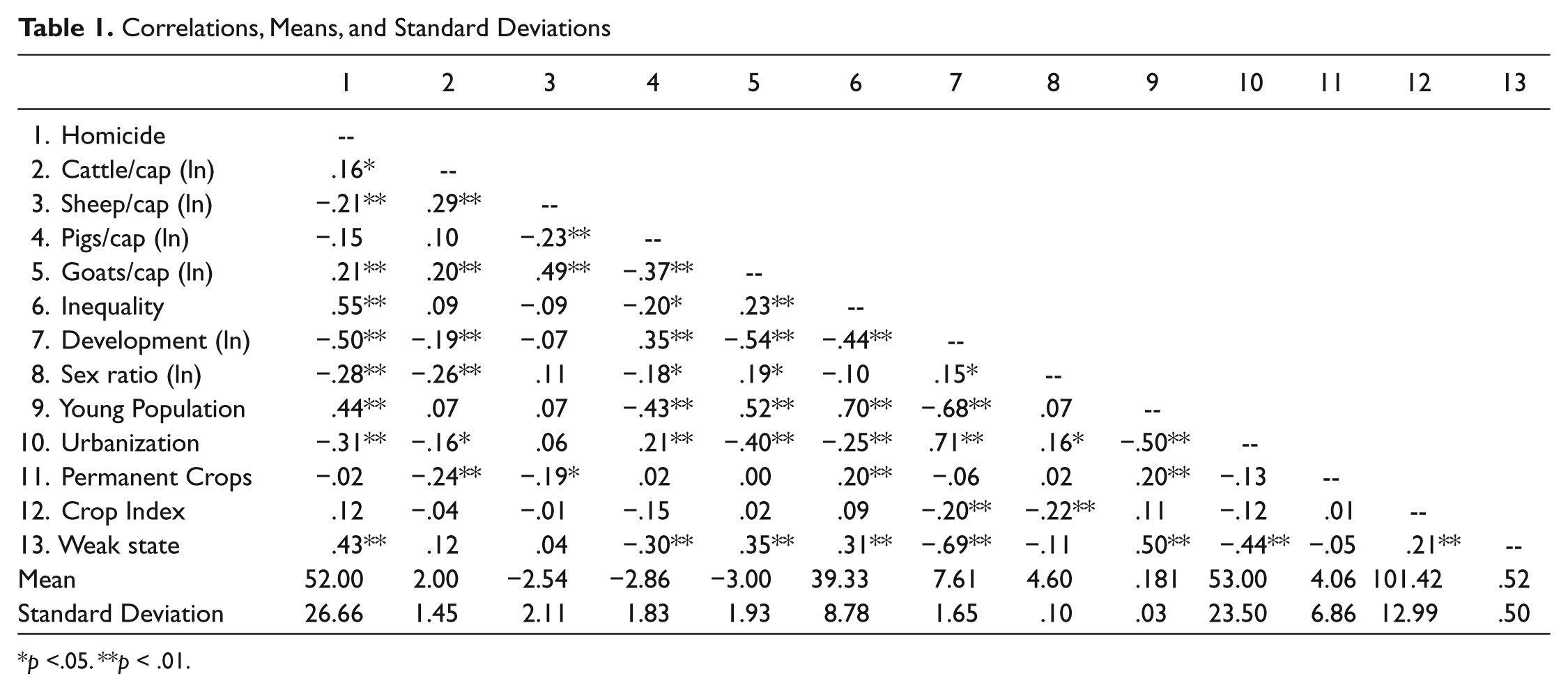
p <.05. **p < .01.
Second, the herding indicators are only moderately associated. Cattle/capita exhibits a significant positive association with goats/capita and sheep/capita. Pigs/capita is negatively associated with sheep/capita and goats/capita. Goats/capita is positively associated with cattle/capita and sheep/capita, and negatively associated with pigs/capita. An examination of the association between the herding indicators and the agriculture indicators also reveals some noteworthy findings. A close reading of Nisbett and Cohen (1996) would suggest that the herding indicators should be negatively associated with the agriculture indicators. This is only the case with one of the agriculture indicators examined here. Permanent crop land is negatively associated with cattle/capita and sheep/capita but has no association with goats/capita and sheep/capita. The crop index is not significantly associated with any of the herding indicators. Taken together, these findings suggest that different types of herding may reflect distinct social phenomena that likely do not have uniform effects on homicide. Furthermore, the fact that homicide is not positively associated with all four herding indicators suggests that only certain types of herding may lead to the development of the culture of honor.
Regression Diagnostics
OLS regression was used to examine the hypotheses proposed in this study. Extensive regression diagnostics were performed to ensure that the models did not violate the assumptions of OLS regression. Although violation of all regression assumptions was taken seriously, those violations that are particularly common in cross-national research warrant further discussion here. First, the distribution of the each variable was closely examined. As noted above, in situations where variables were found to be skewed, transformations were used to ensure that every variable closely approximated a normal distribution. Second, VIF’s and tolerance levels were examined to ensure that multicollinearity was not a problem in these models. This was particularly important when considering the high correlations between some of the independent variables. Multicollinearity was considered problematic when the VIF’s were more than 4 and/or tolerance levels were less than .2. Multicollinearity was not a problem in any of the models reported here. Third, it is possible that the large amount of population variation among the nations examined here would cause heteroskedasticity in the OLS models (see Pratt & Godsey, 2003). To assess this possibility, Bruesh-Pagan and Cook-Weisburg tests were performed using STATA. No heteorskedasticity was detected. Fourth, as with all data using relatively small samples, there is a possibility that certain outlier cases could exert undue influence. Leverage values, Cook’s D, DF fits, DF betas, and studentized residuals were all examined to assess the impact of outliers. Whenever the diagnostics suggested that a nation might have exhibited undue influence that nation was dropped and the analysis was rerun without the excluded case(s). Under no circumstance did the analyses performed on data that excluded certain cases differ substantively from the analyses performed on the complete sample.
Multivariate Analyses
Results of the regression analysis performed here are reported in Table 2. In Model 1 homicide is regressed on the structural controls, the agricultural variables, and the weak state variable. Economic Inequality (B = .46), GDP/cap (B = −.25), and sex ratio (B = −.18) significantly influence homicide. The significant relationship between economic inequality and homicide is consistent with previous cross-national research (Nivette, 2011). Additionally, the nonsignificant impact of population composition and urbanization confirms recent claims that static demographic and population predictors serve as weak predictors of homicide at the cross-national level (Nivette, 2011). It is difficult to compare the significant finding between sex ratio and homicide reported here with findings from previous research because sex ratio is one of most inconsistent and unstable predictors of cross-national variation in homicide (Nivette, 2011; Pratt & Cullen, 2005). The significant negative relationship between economic development and homicide is at odds with findings from Nivette’s (2011, p. 122) recent meta-analysis that suggests that economic development is “consistently immaterial to the explanation of homicide.” One possible explanation for this difference is that the current study consisted of a larger and more diverse number of nations than all the studies examined by Nivette (2011). The larger sample is partially due to the greater availability of data from lesser developed nations that previously have been excluded from cross-national criminological analysis. The inclusion of these nations likely increased variation in the measure of development, which might have increased the likelihood that a significant effect was detected. The findings from Model 1 also raise questions about Nisbett and Cohen’s (1996) claim that agricultural variables influence homicide rates. The permanent cropland indicator is negative but only has a p value of .07. Although previous cross-national research has used the p < .10 level to determine statistical significance, the sample size (184) precludes doing so here. Forty-three percent of the variation in homicide is explained by the variables included in the model.
Multivariate Regression of Homicide on Herding and Statistical Controls

Note: Standardized coefficients are placed in parentheses below the unstandardized coefficient.
p < .05. **p < .01.
Cattle/capita is introduced in Model 2. This model is virtually identical to Model 1. Cattle/capita does not influence homicide. In Model 3, the cattle per capita/weak state interaction term is found to significantly influence homicide. This interaction suggests that the effect of cattle/capita on homicide is amplified in weak states; but, as will be further discussed below, this finding is highly sensitive to the dependent variable used and the manner in which weak state is operationalized. As such, care must be taken not to overstate the implications of this finding. Overall, 43% of the variation in homicide is accounted for by the variables examined here.
Models 4 and 5 examine the effect of sheep herding on homicide. Similar to the previously reported models, economic inequality, GDP/capita, and sex ratio are found to influence homicide in Model 4. Furthermore, neither agriculture variable influences homicide. Surprisingly, sheep/capita negatively influences homicide. This suggests that homicide is less likely in nations with higher amounts of sheep herding activity. This is counter to what Nisbett and Cohen (1996) propose and seems to suggest that certain types of herding may provide the added societal benefit of lower rates of violence. The effects of the sheep per capita/weak state interaction on homicide are examined in Model 5. No support for the interaction is found. Both models report an adjusted R-squared of .51.
The effects of pig herding on homicide are reported in Models 6 and 7, respectively. Model 6 tests the direct effects of pig herding on homicide. In this model economic inequality and sex ratio are significant, but GDP/capita drops from statistical significance and the weak nation indicator becomes statistically significant. This is due to the changed composition of the sample, not from the inclusion of pigs per capita into the model. 6 No support was found for the proposition that pig herding influences rates of homicide. Additionally, as reported in Model 7, no support is found for the notion that pig herding is more likely to lead to homicide in weak states. Both models report an R-squared of .45.
The effects of goat herding on homicide are reported in Models 8 and 9. Model 8 tests for direct effects and finds no evidence that goat herding influences homicide. Like the previous models tested, only some of the important structural predictors were found to influence homicide. Additionally, no support was found for the proposition that the effects of goat herding on homicide were amplified in weak states.
Although not reported here, analyses were also performed that examined the possibility that herding interacted with levels of development to influence homicide rates. This analysis was necessary because it is plausible that herding influences rates of homicide, but only in lesser developed nations. The results of this analysis were similar to those reported above. There was no support found for an interaction between development and any of the herding indicators.
In addition to the results reported above, sensitivity tests were performed to ensure that the results were not being driven by the operationalization of certain variables. First, separate analyses were performed that considered the UN public health homicide rate (WHO, PAHO, and WHO-HFA vital statistic data) and the UN law enforcement homicide rate (Eurostat, Interpol, OCAVI, Transmonee, and UN-CTS police reports of homicide) as the dependent variable, respectively. In general, the results from this analysis led to the same conclusions as the findings reported above: there was no consistent support for the notion that herding influenced homicide in the manner proposed by Nisbett and Cohen, and no support for the notion that the effects of herding on homicide were moderated by the weak state indicator. Second, the international homicide index was collapsed into a binary variable where nations one standard deviation above mean levels of the IHI were given a value of 1 and all other nations were given a value of 0. The findings from the logistic regression on the binary IHI closely resembled those reported above. The third sensitivity check involved performing a logistic regression on a binary measure of the logged international homicide index—where nations one standard deviation above mean levels of the logged IHI were given a value of 1 and all other nations were given a value of 0. These results closely resembled those reported above. Fourth, an analysis was performed that examined an interaction between the herding indicators and a continuous weak state indicator (see note 5 concerning multicollinearity in these particular models). This analysis revealed some interesting findings. Cattle herding and goat herding did not interact with the continuous weak state indicator to influence any of the homicide indicators (IHI, public health, or law enforcement). Pig herding, on the other hand, was found to interact with the continuous state indicator in the expected manner: the effect of pig herding on homicide was exacerbated in weak states. Interestingly, lamb herding interacted with the continuous weak state indicator to negatively influence homicide. Thus, although the findings using the continuous weak state indicator were slightly different than the results reported above, the general conclusion drawn remains the same. Fifth, an analysis was performed with an alternative weak state indicator; nations were considered weak if they were one standard deviation above mean levels of the continuous weak state indicator. Using this indicator, cattle herding was found to interact with the weak state indicator in the expected direction, but sheep herding was found to interact with the weak state indicator in a manner opposite to what might be expected. Neither pig herding nor goat herding were found to interact with this weak state indicator to influence homicide. Last, the weak state indicator was substituted for a measure that combined the variables from the weak state indicator with gross domestic product. This measure was created by standardizing each indicator and summing them together. Utilizing such an indicator seemed justified on both empirical and theoretical grounds. Combining weak state and development eliminated the potential multicollinearity that emerged in the models that included the continuous weak state indicator. The alpha for this combined measure was .92. Additionally, it seems plausible that herding may be more likely to influence homicide in lesser developed nations that are absent of the rule of law. The findings mirror those reported above: support for Nisbett and Cohen’s assertions was inconsistent at best.
Discussion
This study examined the relationship between herding and homicide in a cross-national sample of nations. These findings provide little support for Nisbett and Cohen’s (1996) proposition that herding influences violence across space and time. Perhaps the most consistent direct effect was that sheep/capita decrease levels of homicide across all nations. This finding, of course, is opposite of what was expected. None of the other herding indicators were found to exhibit direct effects on homicide. Furthermore, virtually no support was found for the proposition that agriculture serves as a buffer to the formation of the culture of honor. Neither the crop index nor permanent cropland were found to reduce violence in the models examined. Additionally, there was little consistent support for the notion that any of the herding indicators interacted with the weak state indicator—regardless of how it was operationalized—to influence rates of homicide in the expected direction. Taken together, these findings raise some important questions that warrant further discussion.
The first question that emerges is how can we account for the fact that the different herding indicators were only weakly associated? The answer is not entirely clear, but the weak associations reveal that all forms of herding are not similar. As such, it is likely that any impact of herding on any sphere of society likely varies by the type of herding. The weak association between the different types of herding, when considered in light of the other findings reported in this study, suggest that the herding hypothesis is in need of refinement. More work needs to be done to understand the factors that lead to the emergence of herding societies, why certain types of animals are herded as opposed to others, and how different types of herding might influence society differently.
Another question that emerges concerns the negative association between sheep per capita and homicide. There is no theoretical basis to expect such a relationship. Additionally, a close look at the correlation coefficients does not provide any indication as to why such a relationship would emerge. Sheep herding is negatively associated with homicide and the amount of permanent cropland in the society, but not significantly associated with any of the structural controls. As such, the argument that sheep herding leads to lower levels of homicide because nations characterized by high levels of sheep herding are less developed or have higher rates of inequality would hold little weight. There may be, however, an explanation for this relationship. As noted above, Baller et al. (2009) note that sheep and goats were less attractive targets for potential thieves because they were more difficult to steal. As a result, they argue that the culture of honor was most likely to emerge where cattle and pig herding were most common. Based on this argument, perhaps sheep herding not only inhibits the development of the culture of honor but also increases trust and interdependency among sheep herders, thereby reducing rates of homicide. An alternative explanation is that sheep herding may serve as a proxy of levels of interdependence or some other societal indicator that is negatively associated with violence.
It is not exactly clear why the agricultural indicators were not significant. These findings are at variance with results from two previous studies that found agricultural indicators to reduce levels of violence (Baller et al., 2009; Messner, Baller, & Zevenbergen, 2005). Perhaps agriculture only serves to buttress the growth of the culture of honor in the Deep South. Alternatively, it may be that other factors not examined here mitigate the ability of the agricultural processes to reduce rates of homicide. A third possibility is that some of the nations examined here had high levels of both agricultural production and herding activity, thereby making it difficult to parcel out the effects of agriculture on homicide using regression analysis. Ad hoc analyses (not reported here) of a possible interaction between the agriculture indicators and the weak state indicator yielded insignificant results. Thus there is no support for the proposition that agricultural processes may only buffer the effects of culture of honor in weak states. Additionally, it does not seem likely that the null findings are the result of the operationalization of the agriculture measures. These measures tap into aspects of land use and involvement in agriculture, two important aspects highlighted by Nisbett and Cohen (1996).
The final and most important issue that must be addressed concerns the implications these findings have for the herding hypothesis in particular, and the culture of honor thesis in general. Taken together, these results did not support the argument that herding influences rates of homicide. More work is needed to expand our understanding of why this is so. One possible explanation is that herding does not influence the emergence of the culture of honor across nations. This study did not examine a direct link between herding and the emergence of the culture of honor, but the fact that previous research has not consistently linked herding with the culture of honor and/or violence make this argument plausible (Chu et al., 2000; Felson & Pare, 2010; Loftin & Mcdowall, 2003; Rivera et al., 2002). Additionally, anthropological research has found that support for violence is not uniform across herding societies (Moritz, 2008; Paine, 1994) and criminological research has documented the emergence of honor cultures in places where herding activity is not present (Anderson, 1999). It should be noted that the herding hypothesis is only one component of the culture of honor thesis, and Nisbett and Cohen (1996, p. 88) acknowledge that the herding hypothesis is the weakest part of their thesis. Thus, even if little support is found for the herding hypothesis, the core statements of the thesis may still be correct. Herding may not influence the emergence of the culture of honor, but the culture of honor may influence homicide if the two factors that Nisbett and Cohen say cause the culture of honor are present in a society: economic precariousness that causes one to project a determined vigilance to use violence in protection of his property, and the absence of a state that is willing or able to protect citizens from the predation of others. Interestingly, a recent article by Altheimer (in press) found that a proxy of culture of honor that accounted for economic precariousness and weak state protection significantly influenced homicide across a sample of 51 nations.
One limitation of this study—and most other cross-national research—is that it was not possible to disaggregate the homicide indicator. This is potentially problematic because Nisbett and Cohen (1996) specifically state that herding is most likely to affect rates of expressive homicide. Due to this limitation, it is important not to overstate the implications of the findings reported here. For instance, it is possible that some of the nonsignificant findings reported here would have been significant had rates of expressive homicide been included as the dependent variable. That is, the inclusion of nonexpressive homicides in the dependent variable may have biased the results toward insignificance. Despite this concern, and as noted above, there is reason to believe that use of the total homicide indicator was justified. An additional limitation concerns the use of the nation as the unit of analysis. It is possible that some of the nations examined in this study had both high levels of herding and agricultural production. In such nations, the effects of herding on homicide might have been offset by the effects of agricultural production.
In spite of the limitations noted above, this study expands our understanding of the herding hypothesis in important ways. First, it is the first to examine the relationship between herding and homicide among a cross-national sample of nations. This sample was larger than those used in most previous cross-national research and consisted of nations with substantial cultural variation. This represents the most extensive test of the generalizability of the herding hypothesis to date. Second, it is the only study to examine the effects of different types of herding separately. This provides an added layer of nuance to our understanding of Nisbett and Cohen’s (1996) provocative hypothesis.
This study has implications for future research. First, future research should examine the link between herding and the culture of honor. The findings reported here suggest that herding may not lead to the emergence of the culture of honor. No previous study has explicitly examined this relationship. Rather, a significant positive relationship between herding and homicide has been taken as an indication that Nisbett and Cohen’s (1996) propositions about the intervening mechanisms are correct. Importantly, any attempt to address this issue must consider if different types of herding influence the intervening mechanisms differently. Second, future research should look to examine the effects of herding on other types of violence. Nisbett and Cohen (1996) did not limit the scope of the culture of honor theory to homicide and examinations of the link between herding and other types of assaultive violence would greatly expand knowledge on this issue. Relatedly, future research that examines the herding hypothesis outside of the Old South should attempt to use disaggregated homicide data. By addressing these issues, future research will bring us one step closer to understanding the extent that this important cultural perspective accounts for macro-level variation in violence. Finally, cross-national research on this topic should attempt to develop more sophisticated measures of herding. One potential avenue would involve use of anthropological and historical data to develop more precise herding measures across nations.
Footnotes
Appendix
Western Developed Nations
| Nation | cattle/cap | goats/cap | pigs/cap | sheep/cap |
|---|---|---|---|---|
| Australia | 1.45 | 0.14 | 0.15 | 5.54 |
| Austria | 0.26 | 0.01 | 0.43 | 0.04 |
| Belgium | 0.28 | 0.00 | 0.66 | 0.01 |
| Canada | 0.45 | 0.00 | 0.47 | 0.03 |
| Cyprus | 0.07 | 0.54 | 0.57 | 0.38 |
| Denmark | 0.34 | --- | 2.39 | 0.02 |
| Finland | 0.20 | 0.00 | 0.25 | 0.02 |
| France | 0.34 | 0.02 | 0.26 | 0.16 |
| Germany | 0.17 | 0.00 | 0.32 | 0.03 |
| Greece | 0.05 | 0.47 | 0.09 | 0.83 |
| Hungary | 0.08 | 0.01 | 0.47 | 0.11 |
| Iceland | 0.24 | 0.00 | 0.13 | 1.67 |
| Ireland | 1.84 | 0.00 | 0.47 | 1.26 |
| Israel | 0.06 | 0.01 | 0.03 | 0.06 |
| Italy | 0.12 | 0.02 | 0.15 | 0.15 |
| Liechtenstein | 0.16 | 0.01 | 0.06 | 0.10 |
| Luxembourg | 0.45 | 0.00 | 0.18 | 0.02 |
| Netherlands | 0.24 | 0.01 | 0.73 | 0.07 |
| New Zealand | 2.49 | 0.04 | 0.09 | 10.23 |
| Norway | 0.21 | 0.02 | 0.17 | 0.55 |
| Poland | 0.14 | 0.00 | 0.49 | 0.01 |
| Portugal | 0.14 | 0.05 | 0.23 | 0.34 |
| Slovakia | 0.12 | 0.01 | 0.28 | 0.06 |
| Slovenia | 0.24 | 0.01 | 0.30 | 0.05 |
| Spain | 0.16 | 0.08 | 0.58 | 0.59 |
| Sweden | 0.18 | --- | 0.21 | 0.05 |
| Switzerland | 0.22 | 0.01 | 0.22 | 0.06 |
| United Kingdom | 0.18 | 0.00 | 0.09 | 0.61 |
| United States of America | 0.34 | 0.01 | 0.21 | 0.02 |

Declaration of Conflicting Interests
The author declared no potential conflicts of interest with respect to the research, authorship, and/or publication of this article.
Funding
The author received no financial support for the research, authorship, and/or publication of this article.