



Abstract
This study explores patterns among female family annihilators using a non-random sample (n = 7), where offenders killed four or more family members during a single homicidal event. Acts of maternal familicide are measured against the family annihilator profile. Overall, many variables remain consistent across gender, but there appear to be substantive differences in motivation, spousal murder attempt, and the role of alcohol. Findings suggest that research on the family annihilator needs to be more inclusive of women, including use of more gender-neutral language. Practical and theoretical implications are discussed, and a new definition of the family annihilator is offered.
Scholars (see, for example, Chesney-Lind, 2006; Naffine, 1987) have challenged the predominant masculine nature of theories of crime, deviance, and social control, arguing that female offender behavior is often not adequately explained by criminological theory, in that it was built largely on the criminality of adolescent and adult males. Women also commit fewer violent crimes than men and thus appear “out of place” in the criminal justice system (Gilbert, 2002; Wilczynski, 1991). Males have not traditionally been scrutinized as carefully for behaving in a violent manner; they were simply men, being manly, breaking the law along the way (Farrell, Keppel, & Titterington, 2011). This is not to suggest that society is more accepting of violent acts of males over violent female offending, but that male violent offending does not elicit the same “shock value” as when females carry out similar acts. Paradoxically, the idea that women are of less interest and unworthy of a researcher’s attention has been a long-time concern within the field of criminology (Chesney-Lind, 2006; Daly & Chesney-Lind, 1988; Flowers, 1987; Naffine, 1987). Traditional explanations for female criminal behavior have typically been adapted from research conducted with males (Laberge, 1991; Leonard, 1982; Naffine, 1987; Smart, 1979). Feminist researchers argue that this “add women and stir” practice is done without considering the possible theoretical implications (Naffine, 1987, 1996). Gender gaps in our understanding with respect to patterns of crime are particularly evident when examining the literature on violent offenses.
Cultural ideologies also influence the way the public view female offenders. Wilczynski (1997) has argued that women who deviate from ascribed gender expectations run the risk of being dichotomously labeled as either “bad” or “mad.” This is evidenced in much of the infanticide and filicide literature where women were identified as the principal offender. The very idea that a mother is capable of killing her child(ren) works against the emphasized feminine assumption that women are passive and nurturing (Jensen, 2001). When an illness-based explanation cannot be found to justify how a woman could defy her “nature” and kill her children, she is considered to be bad or evil (Wilczynski, 1991). This polarized view of women limits both roles and expectations of women ultimately limiting mobility within social, economic, political, and other spheres, reinforcing traditional patriarchal social structures.
Patterns of Gendered Offending
Overall, women disproportionately commit violent offenses in the context of domestic relationships (Jensen, 2001; Peterson, 1999; Silverman & Kennedy, 1988). It has been noted that women, when they do commit acts of homicide, are more likely to kill their family members (i.e., children and intimate partners) than strangers (Jensen, 2001; Scott, 2005, 2008). Looking more generally at gendered patterns of homicide, women kill most commonly in the domestic arena and intimate partners are killed more frequently than children by women (Cooper & Smith, 2011; Messing & Heeren, 2004). Multiple theories have addressed female perpetrated homicides in the domestic context, concluding that women often kill intimate partners as a result of abuse (e.g., Belknap, Larson, Abrams, Garcia, & Anderson-Block, 2012; Cooper & Smith, 2011; Peterson, 1999).
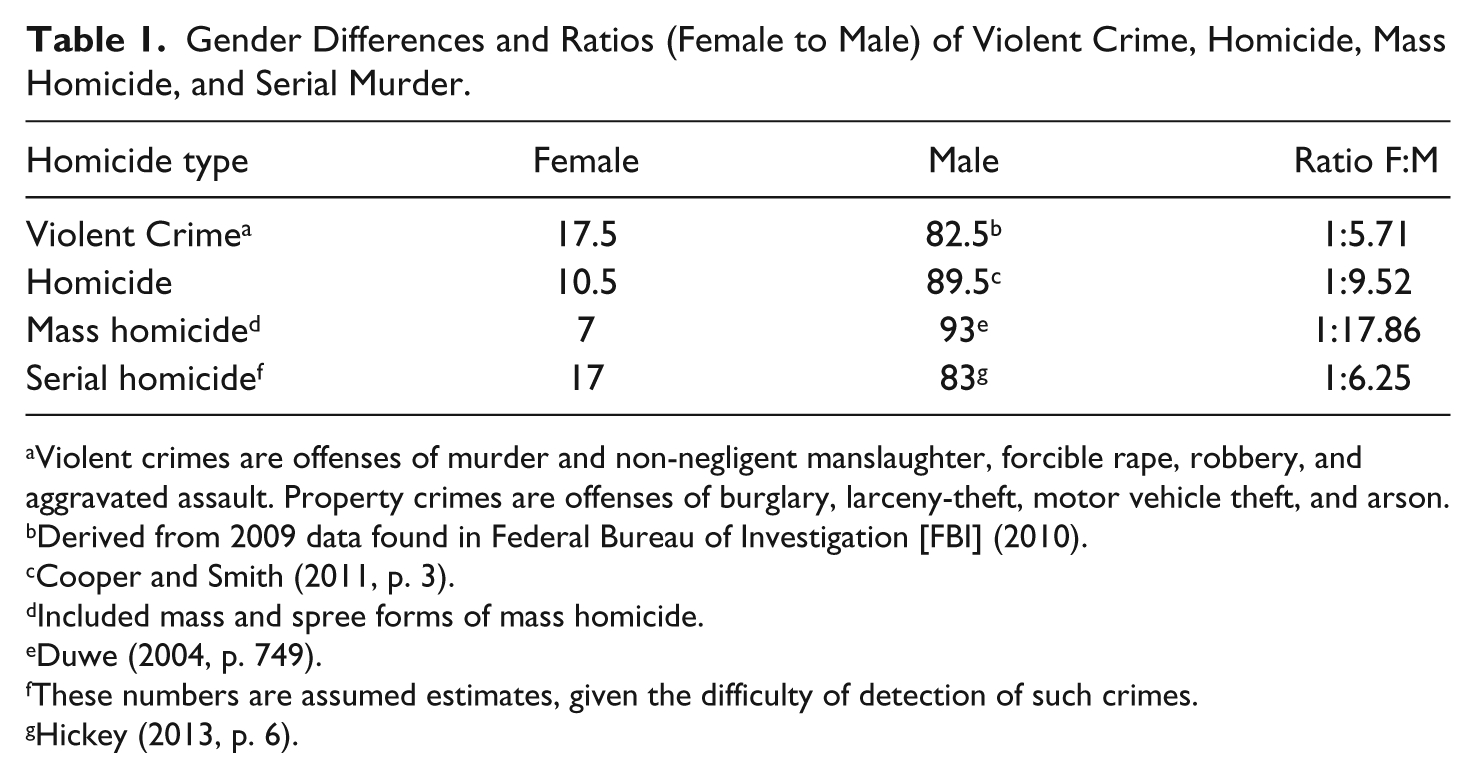
Table 1 demonstrates that males are often dominating actors in violent situations as offenders. Females continue to commit less violent crime than males accounting for just less than one in six reported violent offenses (17.5%, ratio 1:5.71; Federal Bureau of Investigation [FBI], 2010) and are approximately 1 in 10 homicide offenders (10.5%, ratio 1:9.52; Cooper & Smith, 2011). Duwe (2004) estimated that women accounted for about 7% of mass murderers (7%, ratio 1:17.86), far fewer than the proportion reported for serial homicide (17%, ratio 1:6.25; Hickey, 2013). Because of these low numbers, the occurrence of female mass murderers was overlooked in criminological research as possible perpetrators; their case studies rarely summarized in early major works of mass murder behavior (see P. E. Dietz, 1986; Fox & Levin, 2012; Levin & Fox, 1985).
Gender Differences and Ratios (Female to Male) of Violent Crime, Homicide, Mass Homicide, and Serial Murder.
Violent crimes are offenses of murder and non-negligent manslaughter, forcible rape, robbery, and aggravated assault. Property crimes are offenses of burglary, larceny-theft, motor vehicle theft, and arson.
Derived from 2009 data found in Federal Bureau of Investigation [FBI] (2010).
Cooper and Smith (2011, p. 3).
Included mass and spree forms of mass homicide.
Duwe (2004, p. 749).
These numbers are assumed estimates, given the difficulty of detection of such crimes.
Hickey (2013, p. 6).
Feminist criminologists argue that as women’s crimes only comprise a small portion of all offenses, they have not been given priority (Adelbery & Currie, 1987). Women prior to the 1990s who committed serial murder, were also not found in many books on the subject (Scott, 2005). Table 1 shows that they are now much more prevalent than first thought (Duwe, 2004). At issue was that our understanding of serial murder was predominantly male-defined, leaving the patterns of female serial homicide offenders in obscurity. As researchers started to gender test serial homicide patterns of women as offenders (see, for example, Keeney & Heide, 1994; Pearson, 1998; Scott, 2005) our understanding of the offense type was enhanced. The purpose of this study is to test the profile of the Family Annihilator, which was created by male criminologists based on the acts of men, by exploring whether women who commit familicide meet the standards set out by the family annihilator profile.
Maternal Child Homicide
Although there is limited theory and research addressing maternal familicide, there is considerable attention given to child homicide (e.g., McKee, 2006; Palermo, 2002; Resnick, 1969). Maternal homicide against biological children has been categorized into three groups: Neonaticide (the killing of a child within the first 24 hr of life), infanticide (the killing of a child within the first year of life), and filicide (the killing of a child between the ages 1 and 17). Friedman, Horwitz, and Resnick (2005) have noted the paucity of studies of maternal filicide carried out with samples from the general public. In a later study, Friedman and Resnick (2007) observed that studies of women who have killed their children have largely relied on institutionalized subjects; those who were currently serving prison sentences or who have been sentenced to a psychiatric facility. In other words, this is an under-researched area, and those studies we do have, although revealing, are derived from samples that may bias results.
According to Stanton and Simpson (2002), risk for homicide victimization of children decreases with age. Children are most at risk for homicide within the first 24 hr of life, but this risk steadily decreases over time. Children killed after the first year of life are slightly more likely to have been killed by a male perpetrator, while children younger than 1 year are more likely to be killed by a woman. Maternal neonaticidal offenses are most uniform in that women offenders were more likely to be young, uneducated, the homicide a result of a dissociative event so strong it resulted in the death of the baby. The authors assert that other patterns for homicides of children later in life are less clear. Two reviews of the maternal filicide literature note that there are strong associations between maternal filicide and certain stressors, such as marital violence (Friedman & Resnick 2007; Stanton & Simpson, 2002), unstable and/or violent upbringings of the offender and parental separation in childhood (Stanton & Simpson, 2002), financial and housing concerns (Friedman & Resnick, 2007; Stanton & Simpson, 2002), social isolation and primary responsibility for childcare (Friedman & Resnick, 2007).
Child homicide research provides gender-specific theories recognizing the motivational differences among sexes (e.g., Liem & Koenraadt, 2008; Stanton & Simpson, 2002). Early literature concerning child homicide has suggested that children are both sources of frustration and easy targets for the alleviation of frustration (e.g., Totman, 1978) and that their deaths are often the result of excessive physical punishment (Ward, Jackson, & Ward, 1969). Early research also suggested that women kill their young children because they were unplanned or burdensome (Resnick, 1969). A more recent study (Messing & Heeren, 2004) on female multiple murderers found conflicting evidence about women who kill their children. For instance, previous child homicide studies (Alder & Polk, 2001; Stanton & Simpson, 2002; Wilczynski, 1997) suggested child abuse to be a contributing factor to murder. However, Messing and Heeren (2004) did not find child abuse to be a precipitating event to the multiple homicides of children. The relationship between these variables appears to be complex and less clear. To illustrate, the most common form of homicide was the result of excessive battering (31.4%-40.4%), followed closely by homicide risk due to a mother who suffered from mental illness (27%-40%). Mentally ill mothers were more likely to be married and financially stable, but were more likely to attack older children (Stanton & Simpson, 2002). Friedman, Horwitz, et al. (2005) have also postulated that older children may be more at risk for purposeful homicide, while younger children may be more likely to die of fatal abuse
Theories explaining why women kill their children (Alder & Polk, 2001; Crimmins, Langley, Brownstein, & Spunt, 1997) suggest that social isolation (e.g., lack of social engagement) and limited resources (e.g., lack of social support) are contributing factors. Theories of child homicide victimization suggest that women who kill their children are often subject to environments in which they are under physical and psychological stress (Alder & Polk, 2001; Crimmins et al., 1997), are more likely to experience low self-esteem, and suffer the disadvantages of social inequality (e.g., Alder & Polk, 2001; Crimmins et al., 1997; Peterson, 1999). However, as Messing and Heeren (2004) pointed out, many women face the aforementioned barriers, but do not engage in a criminal activity, much less kill their family members.
Motivation of women who kill their children can also be intrinsic or intrapsychic. Stanton and Simpson (2002) in their review note that in “mentally abnormal filicide” (p. 10). In other words, children were killed as a rational extension of delusional ideation around being a good mother; killing their child(ren) out of a sense of altruism or greater good. These altruistic motives seem to be more prominent when parents commit filicide-suicide (Friedman, Hrouda, Holden, Noffsinger, & Resnick, 2005). This review does not comment on whether there were previous psychiatric histories of women who had committed these acts, leaving open the possibility that the act of killing ones children was taken as a symptom of delusion and/or psychosis rather than an act of a sane person. As noted by Pearson (1998) and Wilczynski (1991) the search for an illness-based explanation for women’s aggression is more common than for men.
Multiple Homicides
The term mass murder often has been used as a blanket term to describe all forms of multiple homicide situations. To avoid further confusion, this study will define mass murder as multiple homicides that occur in closer spatial (i.e., same location) and temporal proximity (Duwe, 2004, 2007). Although debated, homicides included in this category must happen within a 24-hr timeframe (Fox, Levin, & Quinet, 2008). Mass murderers most often act alone and kill their victims all at once (Hickey, 2013; Levin & Fox, 1996; Leyton, 1986, 2005) where the time between murders can last a few minutes or as long as several hours (Fox & Levin, 1998). Currently, there are debates surrounding the number of victims used to define mass murder (Fox & Levin, 2003; Holmes & Holmes, 2010; Lester, 1995). Some researchers use a victim count of two (e.g., Messing & Heeren, 2004) or three as the baseline (e.g., Hickey, 2013; Holmes & DeBurger, 1988; Holmes & Holmes, 1992), while others use four (e.g., Duwe, 2007; FBI, 2005, Fox & Levin, 1998). To ensure that our analysis is consistent with (arguably) the most widely accepted (among law enforcement) mass murder definition, this study will base its analysis on the most conservative requirement of four victim deaths (including the annihilator if applicable).
Like with other categorizations of extreme female killers (see Hickey, 2013, pp. 218-220, 309 for comparison), monikers for this killing class tend to be gendered. With respect to serial killers, women are labeled with names such as the “Beautiful Blonde Killer,” “Sister Amy,” and “Giggling Grandma.” We do not see names such as “Handsome Blonde Killer,” “Brother Andrew,” or “Giggling Grandpa,” assigned to men in this crime group. Monikers for male serial murderers reflect a much more serious and dangerous tone. In the case of familicide, men in patriarchal roles are labeled family annihilators, and sons who kill family members are titled “defiant.” Women, who kill their families and children, are given names suggesting that they are to be taken less seriously such as “Murdering Moms” (Fox & Levin, 2012, p. 164). There is no category for “Deadly Dads.” Males are depicted as making decisions (good or bad) in response to conditions around them (loss of employment, family status, social status, etc.), while the sparse literature on women who committed these crimes suggests that they were motivated by compassion or mental illness, reminiscent of the traditional bad/mad archetypes identified earlier by Wilczynski (1997).
Mass murderers are often identified as “loners” (Hempel, Meloy, & Richards, 1999), dealing with feelings of depression, anger, and frustration (Fox & Levin, 2012), whereas serial murderers are often characterized as killing for symbolic value based on ritualistic behavior (Hickey, 2013). Fox and Levin (2012) reported that many mass murders end with the murderers turning themselves in, being killed by police officials, or killing themselves. When compared with serial murderers, it was found that mass murderers often have no interest in staying alive or escaping the authorities. Furthermore, mass murderers will often seek out a victim pool that they feel are responsible for their frustrations. Both Fox and Levin (2012) and Hickey (2013) agreed that often these killings are well planned. Mass murderers can be further distinguished by age of the offender, motive, and weapon preference (Hempel et al., 1999). Generally speaking, mass murderers are slightly older than the average homicidal offender and more often motivated by some sort of revenge (Duwe, 2004). In addition, the majority of mass murderers have clear-cut motives; their victims are often specifically chosen because of who they are or what they represent, and are most often killed with a gun, or a knife, than any other weapon (Duwe, 2000; Fox & Levin, 1998, 2012; Levin & Fox, 1996).
Fox and Levin (2003) created an additional typology of multiple murderers solely based on motivation: power, revenge, loyalty, profit, and terror. The motive of power is seen in cases where the murderer wishes to gain control and dominance over their victims. According to Duwe (2004), revenge, where the killer is seeking retaliation for a perceived wrong, is the most common motive among mass murderers. The theme of loyalty is best described as an instrumental motive; the murderers are often inspired to kill by a warped sense of love and loyalty. This is commonly seen in cases where the murderer has a desire to save their loved ones from misery and hardship. Some multiple murderers kill to gain a profit, which could be to eliminate witnesses or victims to a crime. Multiple murderers who kill to “send a message” are often categorized as acts of terror (Fox & Levin, 2003).
The evidence regarding the role of alcohol and/or drug abuse by the offender is mixed. Goetting (1995), looking at homicides specifically in families, suggests that the role of alcohol is significant. In more definitive works on mass murder (Fox et al., 2008; Holmes & Holmes, 2000), the role of alcohol is not addressed. Hempel et al. (1999), in their study of 30 non-randomly chosen mass murder offenders, demonstrated that alcohol played a very minor role. P. E. Dietz (1986) suggested that intoxication is a characteristic of the family annihilator profile, but not addressed with respect to other mass killer types and not supported with other studies. Palermo (1997), in his typology of mass killers, lists that offenders may have a history of drug and/or alcohol abuse, but there is no evidence for this assertion provided.
The Family Annihilator: A Profile
According to P. E. Dietz (1986), the family annihilator is the most common type of mass killer and is
. . . usually the senior man of the house, who is depressed, paranoid, intoxicated or a combination of these. He kills each member of the family who is present, sometimes including pets. He may commit suicide after killing the others, or may force the police to kill him. (p. 482)
Holmes and Holmes (2000) described the family annihilator as operating based on intrinsic motivations (psychological, known only to the offender). When it comes to victim selection, all family annihilators have targeted a victim pool that reduces the need to travel to kill their victims as murders most often occur at or near the principal family residence. Fox et al. (2008) described the typical family annihilator as: “ . . . a head of the household who perceived that he has total say over his clan, in life and in death. He feels entitled by his position to determine his family’s destiny” (p. 76, italics added). They also assert that often the husband/father will kill his children in what is termed “murder by proxy,” linking the innocent victims (children) with the primary victim (mother/wife). Findings in previous studies that focused on the gender differences among multiple murderers (e.g., Farrell et al., 2011; Keeney & Heide, 1994; Messing & Heeren, 2004) suggest that the family annihilator profile, built solely on the patterns of male perpetrated cases, may not fit patterns of females who engage in this crime type.
Messing and Heeren (2004) found the majority of female multiple murderers were most likely to murder their biological children, often as a result of losing custody of them. Instead of creating new roles for themselves, women chose to escape their distress through violence against their children. Some researchers have suggested that some women may kill their families as a method of exercising what they perceive to be care and protection (Alder & Polk, 2001; Cleeton, 2001; Daly & Wilson, 1988; Messing & Heeren, 2004), while men who kill in the domestic context are often motivated by revenge and/or loyalty (Fox & Levin, 2003). Furthermore, it was found that these multiple child murders seemed to be carefully calculated and very rarely committed in the spur of the moment (Messing & Heeren, 2004). The same study found that female multiple murderers were highly efficient, calculated, and controlled killers, characteristics suggested by the lack of extensive physical injuries to their victims, alluding to evidence that there was no protracted physical battle before death.
Current Study
This study examines case studies of women who mass killed at least four of their immediate family members, fitting a minimum and conservative victim pool requirement set by Levin and Fox (1985) and the FBI (2005) for inclusion into the family annihilator classification. These case studies were then used to determine to what extent females fit the traditional mass murderer definition and profile of the family annihilator. Based on the literature (P. E. Dietz, 1986; Duwe, 2004, 2007; Fox & Levin, 1998, 2012; Holmes & Holmes, 1994, 2000), both specific and general findings related to behavior, background, and demographic characteristics of mass murderers were categorized looking at precipitating events, known facilitators, and predisposing factors.
Initial population searches for female family annihilators were conducted using homicide cases identified by Newton (1993) and Flowers and Flowers (2004) and followed up with online American newspaper databases, and available court documents, looking specifically at cases between 1970 and 2010. This timeline based on Duwe’s (2004) observance that mass murder appeared to accelerate circa 1970, or at least appeared to become the subject of interest in news media. All women on these lists, who had killed at least four members of their family, were included in this study (N = 7), representing a non-random sample. Infanticide and/or neonaticide were excluded due to the possibility that the killings were attributed to the effects of post-partum depression and/or psychosis, as cases with known biological factors could confound the results of this study. As with other studies (Duwe, 2004; Fox & Levin, 1998), also excluded from this sample are victims of highly organized and/or institutional killings and victims of political terrorism. A deductive content analysis was used for gathering data, which were then analyzed using a structured categorization matrix developed from previous theories and literature associated with the family annihilator (e.g., P. E. Dietz, 1986; Fox & Levin, 1998, 2005; Holmes & Holmes, 1994, 2000). Below, the crimes of Stella Delores Almarez, Patricia Bolin, Shirley Marie Curry, Rachel David, Susan Eubanks, Khoua Her, and Jeanne Anne Wright are discussed. Raw numbers rather than percentages are reported due to the small number of subjects. The offender and crime characteristics in these sample cases are then compared with the profile of the family annihilator.
Case Summaries
Stella Delores Almarez of Norfolk, Nebraska, was 29 years old and recently separated from her husband, Anthony Almarez. Stella was described by neighbors as “loving” and “awfully nice” (“Accuse Mother,” 1980) and “a beautiful woman” (“Mother Held,” 1980). On June 18, 1980, Stella used a .32 caliber revolver and knife to kill her four daughters: twins Stella Loraine (age 2) and Gloria (age 2), Odelia (age 10), and Antoinette (age 7). Odelia and Gloria died of gunshot wounds, while Stella Loraine and Antoinette died of knife wounds (“Accuse Mother,” 1980; Richards, 2000). She then shot herself in the head, but survived. Authorities found the children in the family home in their beds and in separate rooms (“4 Daughters,” 1989; “Accuse Mother,” 1980; “Woman Kills,” 1980). Mr. Almarez was not present during the murders. Richards (2000) reported that Stella and her husband were in the process of getting a divorce. In court, it was revealed that Mr. Almarez was seeing another woman (“Woman Accused,” 1980). She was concerned about raising her children alone. Stella was charged with four counts of murder and tried in November 1980. She was found not guilty by reason of insanity (“Woman Accused,” 1980) and was committed to the Lincoln Regional Center for treatment (“Woman Kills,” 1980). Psychiatrists at Lincoln Center released Stella in October 1985. Her exact diagnosis or current whereabouts has not been shared with the media (“Woman Kills,” 1980).
Patricia Bolin was married to Ronald Bolin, a successful businessman, who founded his own mechanical-design company. Friends of the family described Bolin’s life as “ideal” (“Ohio Mother,” 1976). On December 8, 1976, at age 40, Patricia shot and killed her husband (age 43), daughter Tamela (age 12), and son Todd (age 9). She attempted to kill her eldest daughter Alicia (age 15), but her gun misfired and Alicia ran to a neighbor’s house to call police (“Mom Kills,” 1976). Although the motive was unknown, Patricia had purchased the gun and ammunition 6 weeks before the event, suggesting that the murder was premeditated. According to Seagrave (1992), police reported that she had consumed two pints of vodka before the shootings. Police also reported that Ron was killed first as he was found inside the front door of his home, while his daughter Tamela and son Todd were found in the kitchen and family room (“Exec’s Wife,” 1976). Patricia fatally shot herself before the police could enter the home. Police were not able to establish a motive, and she was buried 3 days later beside her victims (“Triple Murder,” 1976). According to court documents (Curry v. State, 1981), Shirley Marie Curry lived in Lowell, Arkansas, after her divorce in 1967. Although she received custody of all three children, she agreed to a stipulation that at age 14, the children could choose which parent they wished to live with, as requested by her ex-husband, Jimmy Lee Curry. Shirley remained bitter about the divorce and was public about her hatred for her ex-husband. In 1971 at age 14 her eldest, Sabrina, left to live with her father. Shirley cut off all communication with her, along with her ex-husband, telling individuals she felt that they were working together to influence her other two boys to leave her. On June 19, 1974, the day began with a custody hearing, where Richard, age 14, had requested to live with his father. This application was granted, effective the next day. In court, Mrs. Curry admitted that she had threatened Jimmy Lee in the past, stating to Richard that should his father try to collect Richard’s belongings she would “ . . . blow his guts out” (p. 2).
That night, just before midnight, Shirley shot her sons Richard (age 14) and Jessie (age 11) in the family home and then drove her truck to Jimmy Lee’s house in Springdale. She shot her ex-husband (age 39) as he opened the door and then moved to the upstairs to Sabrina’s bedroom. She knocked on the door and when Sabrina (age 17) inquired as to whom it was she answered calmly “It’s your mother.” She then turned on the light and shot her. She then moved on to Jane Brophy’s (age 27) home, the half-sister of Jimmy Lee living in the same town, and killed her with the same gun. Her last stop was her sister’s ex-husband’s home, James Dodson (age 46), who lived west of Farmington. He was shot several times as she opened his door, but he survived the assault. Upon arrest, she asked “I missed the last one didn’t I?” (p. 3). She also stated to an officer that she could kill him (the officer) with two fingers and that she was not afraid of him. It is assumed that she was initially intending to kill herself, as a suicide note/last will was found at the scene leaving everything, including her debts, to her sister. She noted that her kids had testified that they were afraid of her and that people did not want to come near her (Curry v. State, 1981; “Mother Who,” 1974), and that shooting her children would solve “ . . . all the heartache and hurts” (“‘Kind’ Woman,” 1974). Four medical experts agreed that she had late-onset paranoia and/or schizophrenia starting about age 36. She was found mentally ill to the degree of legal irresponsibility and committed to 4 years at the State Hospital. In July 1978, she pleaded not guilty by reason of insanity, resulting in a hung jury on the charges of capital felony murder of her husband and eldest daughter. In a second trial, the jury found her guilty, with a sentence of life without parole. Although appealed in 1981, the decision was upheld (Curry v. State, 1981).
On August 3, 1978, Margrit Brigitta Ericson, who later changed her name to Rachel David, threw her youngest children Rebyca (age 5), David (age 6), Joseph (age 8), and Debbra, (age 9) off of the 11th floor balcony of the International Dunes Hotel in Salt Lake City, Utah (Croft, 1978). Three stacks of hotel chairs were also found on the balcony where her other children Joshaha (age 10), Elizabeth (age 13), and Rachel (age 14) were either pushed or convinced to jump of their own volition (Boardman, 1978). Not one of the children screamed when being thrown or when they jumped from the balcony (Hicks, 1978). Mrs. David (age 38) then jumped to her death. More than 50 onlookers, including police, pleaded with her to stop (Bernick, 1978). The investigation revealed that her husband, Immanuel David (age 39), a micro-cult leader of about 10 members, had killed 2 days earlier.
Unemployed, police wondered how the family could afford to live in hotels (Bauman, 1978), having paid almost $75,000 in 1 year for their previous hotel (Bauman, Boren, & Croft, 1978) and $30,000 for their three-room suite at the Dunes (“Mother, Six,” 1978; “Woman, 7,” 1978). Bauman (1978) reported that much of the family’s income came from donations made by Immanuel David’s followers. He had been known to police for years and was being investigated by the FBI for wire fraud (Bauman et al., 1978; “Mother and 6,” 1978). Upon being notified of her husband’s death, the hotel manager reported that Rachel David was concerned about the hotel bill and where she would live (Croft, 1978). She has also expressed concern to officers about not being able afford her husband’s burial (Boardman, 1978).
On October 26, 1997, Susan Dianne Eubanks, age 35 of San Marcos, California, shot and killed her four sons: Brandon (age 14), Austin (age 7), Brigham (age 6), and Matthew (age 4). Her nephew was at home during the killing and was found physically unharmed in bed, with blankets up to his chin (People v. Eubanks, 2011). Court records show (People v. Eubanks, 2011) that both Austin and Brigham had 0.02 micrograms of Xanex in their blood. Susan then shot herself in the stomach in an attempted suicide. Eubanks was unemployed, receiving workers’ compensation and Social Security benefits from a work-related injury. She had become addicted to prescription medication and was in financial trouble, owing $40,000 in credit card bills (People v. Eubanks, 2011, Perry, 1997a). It is known that Susan was a victim of domestic abuse at the hands of Eric Eubanks (Perry, 1999), her estranged husband. She had two restraining orders issued against him. In addition, he had been charged with misdemeanor battery (Perry, 1999). Police had also been called to the house for a domestic dispute involving Susan and her boyfriend, Rene Dodson, the day of the murders (People v. Eubanks, 2011, Perry, 1997b).
Court documents also show that calls were placed earlier that day by Brandon and by Susan to a family friend, Kathy Goobs, both pleading for her to pick up the kids. Kathy eventually agreed, but never came. Five prepared suicide notes suggest that Susan killed her children out of anger toward the children’s fathers for abandoning her (People v. Eubanks). Suicide notes to Eric and Rene stated that “I have lost everybody I have ever loved. Now it is time for you to do the same” (“Mother Kills,” 1999, p. 4). At trial in August, 1999, her lawyers claimed that she had spent the day drinking and using prescription drugs and, as a result, could not inform the intent to murder that is required for a capital murder finding (Perry, 1999). After 2 hr of deliberation, the jury found Susan guilty on all four counts of first-degree murder. She was sentenced to death in October 1999 (Perry, 1999).
Khoua Her was a 24-year-old Hmong refugee living in St. Paul, Minnesota, who killed all six of her young children: Kouaeai, (age 11), Samson (age 9), Nali (age 9), Tang Lung (age 7), Aee (age 6), and Tang Ke (age 5; Johnson, 1998). Little is known about this woman, despite the notoriety of the case, as most official documents related to her case were sealed (Egan, 1998). Recently separated from her husband, Tau Hang, and living in a housing project Khoua Her held various translator and production jobs and was reported to be in financial stress and living in poverty (Cleeton, 2001). Khoua had all six children by the time she was 20 and had little extended family she could turn to after her separation (Huckerby, 2003).
Her was living in a situation of escalating marital violence (Cleeton, 2001). Police had been called to the house at least 16 times in the 2 years prior to the murders (Volpp, 2003). On September 3, 1998, Khoua dialed 911 and reported that she had attempted suicide. Transcripts of the call revealed that she had also stated that “I don’t know why I killed my kids” (Egan, 1998, p. 7). When emergency officials responded to the call, they found Khoua lying semi-conscious with an extension cord around her neck (Cleeton, 2001; “Woman Pleads,” 1998). The children had been strangled to death using pieces of cloth (Cleeton, 2001; Huckerby, 2003; Johnson, 1998). Khoua claimed to have killed out of love. She had recently been considering suicide and was worried about the fate of her children: “If I died, then nobody would love my children” (“Women Pleads,” 1998, p. A26). She was arrested and charged with six counts of intentional homicide (Johnson, 1998; “6 Children,” 1998), pleaded guilty, and was sentenced to 50 years in prison (“Mother Gets 50,” 1999).
New Jersey native Jeanne Anne Wright was a 25-year-old, pregnant, single mother, with no fixed address, when she drowned her four children (Janah, age 7; Emilio, age 5; Jonathan, age 2; Juan, almost 1 year) in the Cooper River, on November 10, 1983. The children had two different fathers, whose identities were unknown. She was living between her parents’ and friends’ homes. Before the murders, she had told her mother that she was going to stay at a friend’s apartment with the children, so that they could help prepare for a birthday party (“Jersey Mother Held,” 1983; “Jersey Mother Indicted,” 1983). It was later mentioned in court that Jeanne was diagnosed and suffering from chronic depression, with a borderline personality disorder in addition to living as an epileptic, experiencing grand mal seizures. She also displayed “bursts of temper” (“Jersey Mother Indicted,” 1983; Norman, 1983) and at the time of the murders Jeanne believed that the father of the three oldest children planned to kidnap them (“Jersey Woman,” 1984; New Jersey v. Wright, 1984). She was also distraught over her inability to care for the children (“Jersey Woman,” 1984; Norman, 1983). She drowned her children by placing them in the river one at a time, stating that her children were asleep when she “did away with them” (“Jersey Woman,” 1984, p. B2). Court documents reveal that she admitted they were awake; only Juan pleaded for help (New Jersey v. Wright, 1984). Jeanne reported that the children missing on November 12, 1983 saying she believed that they had been kidnapped (“Jersey Mother Indicted,” 1983; New Jersey v. Wright, 1984, p. B2). Shortly thereafter, two of her children’s bodies were discovered, which led to her confession. During sentencing, Judge Rossetti said that Jeanne killed her children “because they were better off dead than with their father” (“Jersey Mother Given,” 1984). Jeanne was sentenced to four concurrent life terms on April 19, 1984 (“Jersey Woman,” 1984).
Results
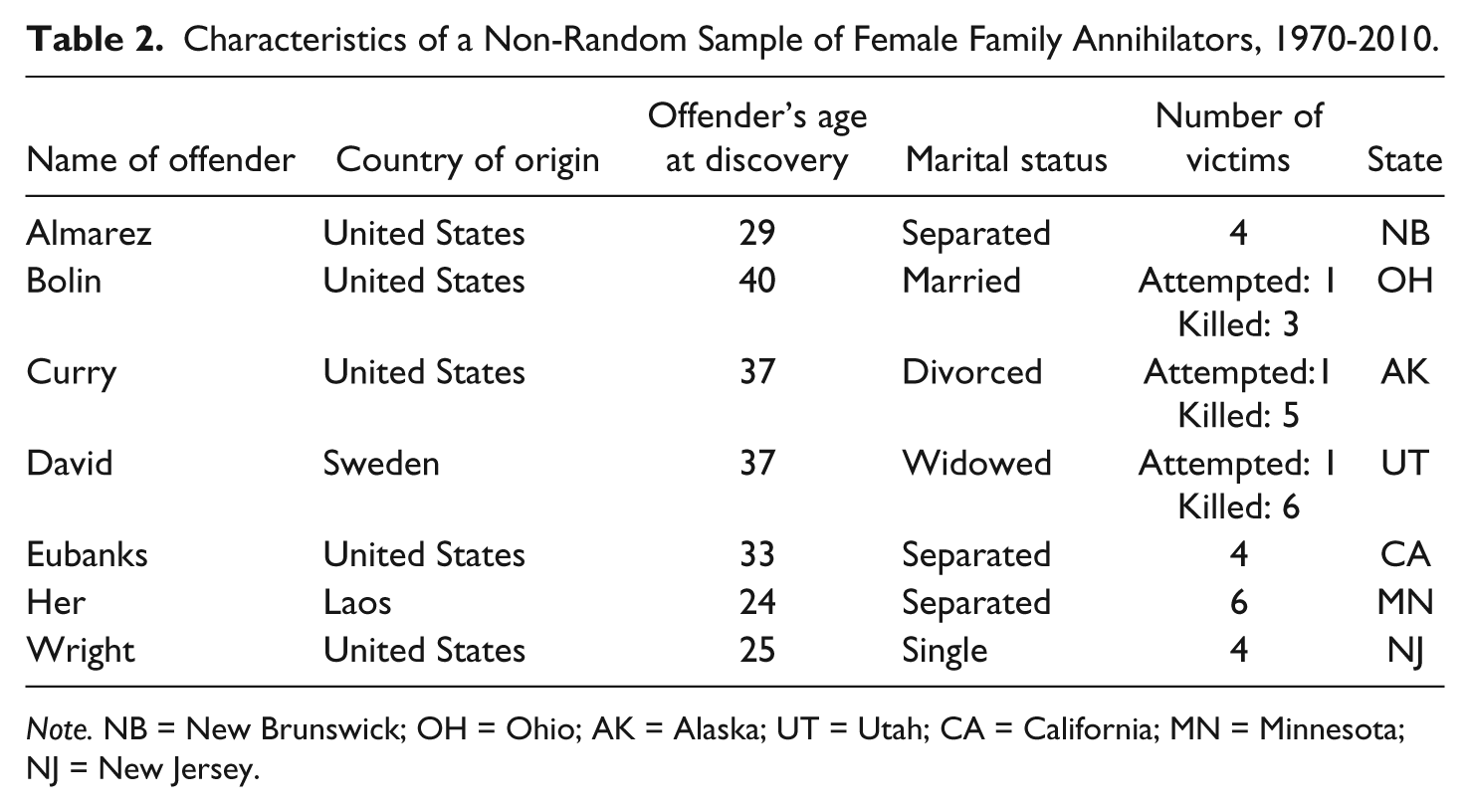
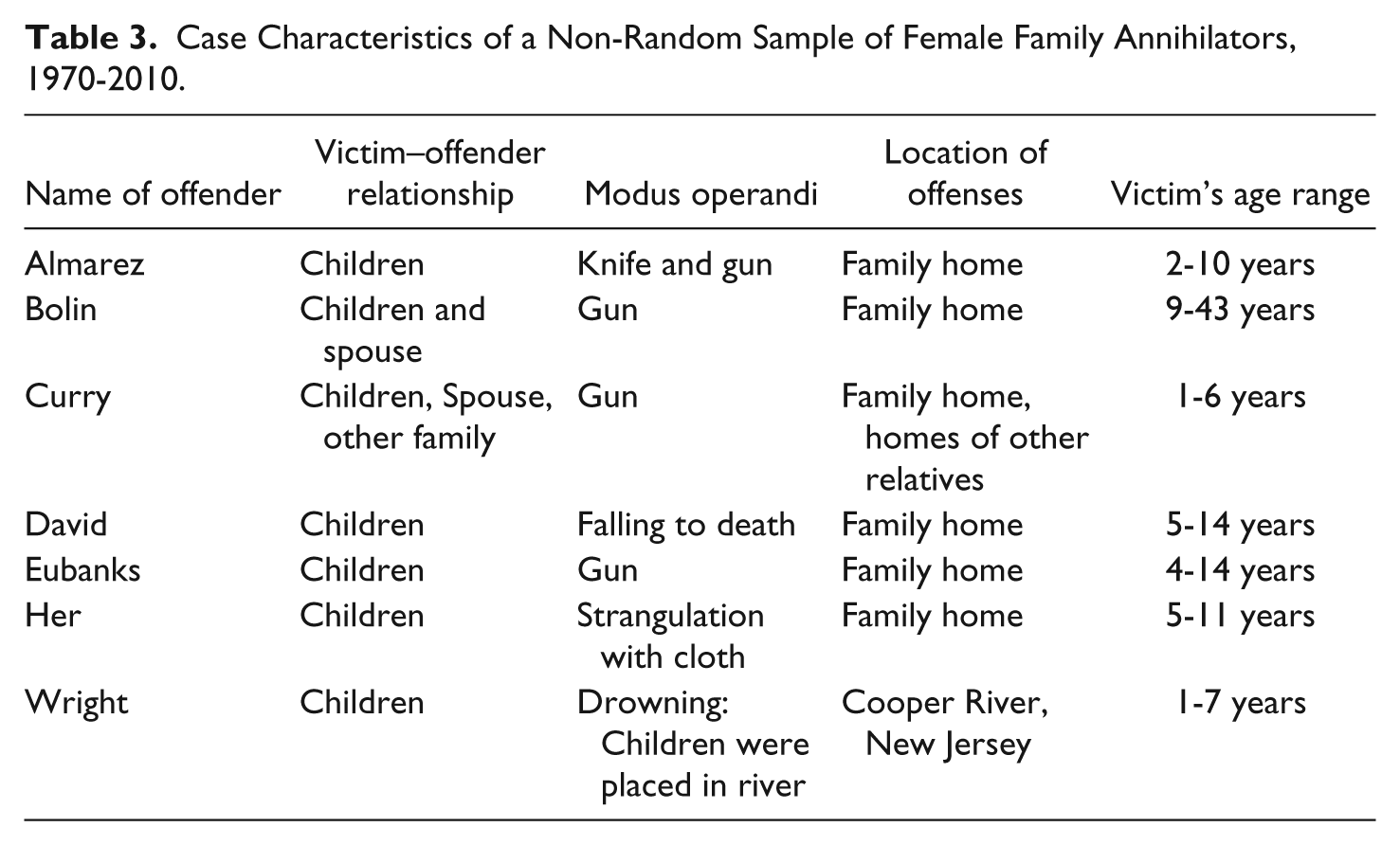
Table 2 illustrates that the crimes occurred in different states, and the mean offender age at the time of the offense was 32.14 years, with a range of 16 years (24-40). Of the seven women studied, two were immigrants. At the time of the killings, three were separated, one was newly widowed, one was married, one was divorced, and one was single. Seven women were collectively responsible for the murders of 32 victims: 29 were children, two were spouses, and one was an extended family member related to a spouse. The mean age of the 29 child victims was 11.38 years, with a range of 16 years (1-17). Three female family annihilators attempted to kill an additional victim, but did not succeed. Table 3 demonstrates that six carried out all or most of the mass killings in the family home. More than half (four) used a gun as their weapon of choice, one using a knife as well. In most cases, the female family annihilator did not kill her spouse along with her children (n = 5). Interestingly, only Bolin was living with her spouse at the time of the crimes.
Characteristics of a Non-Random Sample of Female Family Annihilators, 1970-2010.
Note. NB = New Brunswick; OH = Ohio; AK = Alaska; UT = Utah; CA = California; MN = Minnesota; NJ = New Jersey.
Case Characteristics of a Non-Random Sample of Female Family Annihilators, 1970-2010.
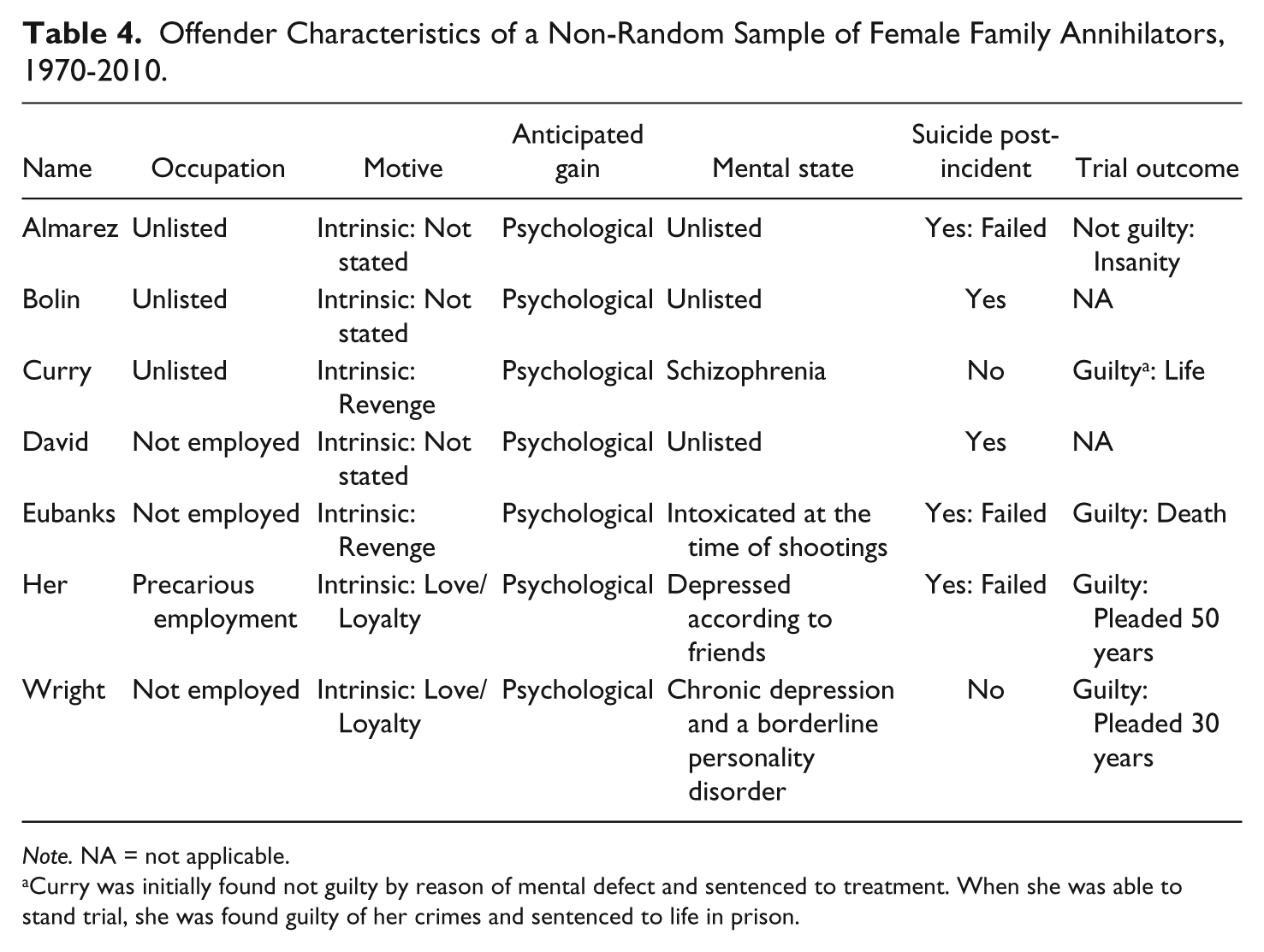
Most of the offenders were unemployed or underemployed at the time of their crimes. A trend of poor or unstable living conditions was observed among these women, who were often the primary provider and caregiver for their families. Only Bolin was not living in poverty. Table 4 shows that after killing their victims, five women attempted suicide—two were successful. Offender motives were difficult to establish in all seven cases. Two of the female family annihilators left evidence that they were motivated by revenge. Her and Wright said to others that they had killed their children out of love and/or concern for their victim’s well-being. David and Almarez appear to have killed their children out of loyalty or altruism, but the offender never confirmed this. In three cases, motive was not determined.
Offender Characteristics of a Non-Random Sample of Female Family Annihilators, 1970-2010.
Note. NA = not applicable.
Curry was initially found not guilty by reason of mental defect and sentenced to treatment. When she was able to stand trial, she was found guilty of her crimes and sentenced to life in prison.
There is evidence that both Her and Wright were suffering from depression immediately prior to the killings, but only Wright had a clinical diagnosis. At trial, three experts testified that Curry suffered from schizophrenia. Eubanks was intoxicated at the time of her offenses, while the mental states of Bolin, Almarez, and David were not reported, although David may have been depressed because of her husband’s recent suicide. Five women went to trial. Almarez was found not guilty by reason of insanity and sentenced to a treatment facility. Curry was initially found not guilty due to mental defect and sentenced to treatment and later found guilty and sentenced to life in prison. Only Eubanks was found guilty at trial and sentenced to death. Both Her and Wright pleaded guilty and received sentences of 30 and 50 years in prison, respectively.
Discussion and Conclusion
The central goal of this exploratory study was to test the traditional profile of the family annihilator with the intention of developing a more effective means of classifying females who mass murder many members of their family. This family annihilator profile assumes that offenders are older, heterosexual, married, more mature males, who are the sole or primary income earners for their households. The murderer suffers from mental illness, in that they are usually depressed and/or paranoid and also may be under the influence of either alcohol and/or drugs. He is often an authoritarian figure, often with a history controlling many aspects of family life before ending the lives of his immediate family. He kills all members of the family that are present including his spouse, often with a gun, and this may include a family pet. The killings are more often motivated by revenge against the spouse, and the children are killed as a proxy to that spouse-directed anger, usually in or near the family home. The family annihilation ends when the father either takes his own life or forces police to kill him. Implicit in the family annihilator profile is that the families are patriarchal in structure. Table 5 summarizes the characteristics that are present of the family annihilator profile in this group of seven female family annihilators, along with some characteristics that have been identified in mass murder and filicide research as significant. Although many of the characteristics of the family annihilator profile are present, the findings of the current study suggest new areas for exploration with regard to the established profile and its applicability to female family annihilators.
Summary of Key Findings Comparing Sample to the Family Annihilator Profile and Selected Characteristics of the Mass Murder and Maternal Filicide Profiles.
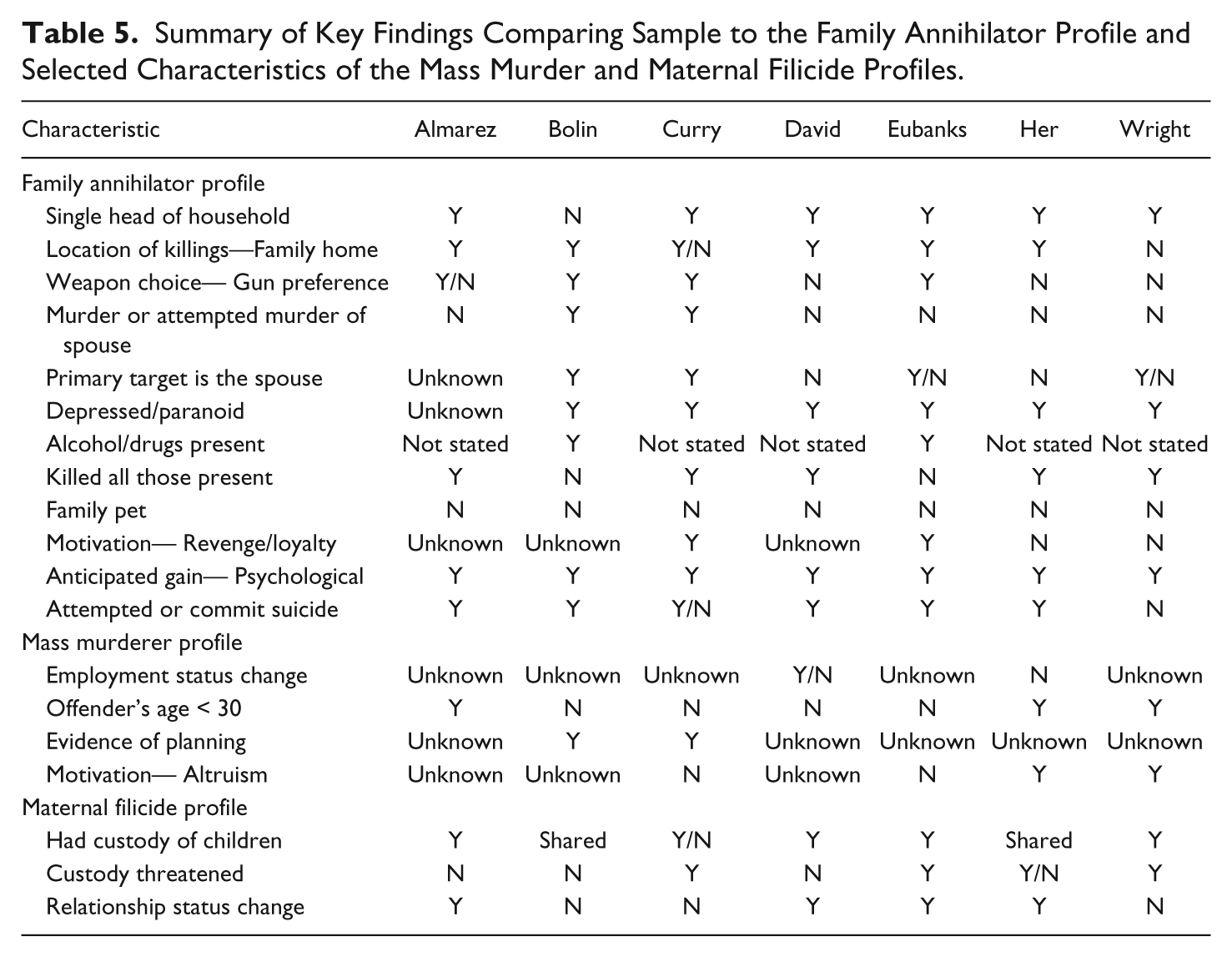
First, similar to the family annihilator profile, all but one of these women was head of the household. Most were separated, widowed, or divorced, and the male head of the household was often noticeably absent or uninvolved with the children in most of these cases. Although not middle-aged, women tended to be older, on an average, than mass murderers identified by Duwe (2004; mean offender age 1976-1999 = 29.12 years compared with 32.14 years for this sample). All but one mass killing occurred, at least in part, at the family home. Evidence examined in this study indicates that at least six of seven women were depressed at or before the killings, and that in most cases, all family members present were killed. The exceptions were where a gun did not fire allowing one victim to escape, two survived their injuries, and in one case a nephew was not targeted although present in the home when the killings were taking place. In all but one case, there was an attempt or a plan to commit suicide after the killings in which two were successful.
Overall, the findings of this study were generally consistent with previous research regarding family annihilators and anticipated gain (Holmes & Holmes, 2000). They suggest that all of the women killed for psychological gain, most often having intrinsic or unknown motivation for the killings. There were no cases found among the sample where the offender was assumed to have killed based on expressive gain as seen among other mass murderers (Holmes & Holmes, 2000). Contrary to the family annihilator profile, in only two cases was there evidence of revenge-motivated killings. Most of these women were described as doting mothers, suggesting a strong bond to their offspring. Two clearly expressed a motivation that suggests that they killed their children for altruistic reasons, wishing to stop pain and suffering. Although contrary to the family annihilator profile, this pattern of homicidal motivation has been identified in mass murder (Fox & Levin, 2012), maternal filicide (Resnick, 1969; Stanton & Simpson, 2002), and filicide-suicide research (Friedman, Horwitz, et al., 2005).
There does appear to be a slight weapon preference for guns by the offender, predicted by the family annihilator profile (Fox & Levin, 1998, 2012). This number is lower than for mass murders more generally (69%; Duwe, 2004). This discrepancy could be explained by studies looking at more common forms of filicide, where trends suggest that guns are not commonly used among women who kill their children (Messing & Heeren, 2004). In addition, some earlier research (Block & Christakos, 1995; Riedel & Best, 1998), which has focused on women’s methods of murder, found guns to be a less common choice among female murderers, especially in cases where children were the primary victims (Silverman & Kennedy, 1998).
P. E. Dietz (1986) and Fox and Levin (2012) have noted that the family annihilator will often kill their (female) ex-spouses even if not living with them at the time of the killings. Our findings do not confirm earlier studies. If the spouse was absent from the home, they usually did not seek them out. Earlier profiles (P. E. Dietz, 1986; Fox & Levin, 1998, 2012, Holmes & Holmes, 2000) assume a patriarchal family structure and therefore are limited with regard to what is considered family. These women, at the time of the homicides, were more likely to head non-patriarchal and non-nuclear families. Although the majority of families in the United States are in the two-parent, heterosexual form, just less than a third (29.5%) are single-parent households (U.S. Bureau of the Census [USBC], 2012a). Of these, approximately four of five of these single-parent households are headed by women (USBC, 2012b).
Analysis indicates that the mental state of the offenders and rates of intoxication only partially or do not conform to the family annihilator profile. In only two cases was there evidence of drug and/or alcohol intoxication. This finding does seem to be supported by the work of Hempel et al. (1999) looking at the characteristics of mass murderers that found that alcohol plays a very minor role in these offenses. In three cases (Almarez, Curry, and Wright) there was evidence of psychological disorder. In two of these cases, it factored into sentencing, and in the other, there was a clinical diagnosis before the murders had occurred. Newspaper accounts and court documents suggest that in six cases depression was mentioned by either the killer or someone else after the killings took place. This suggests that female family annihilators, not suffering from post-partum depression or psychosis, are more likely to be labeled as “mad” rather than “bad,” consistent with the previous literature on classifying female offending (Wilczynski, 1991, 1997). However, only one (Almarez) was sentenced to an institution in lieu of prison. One other (Curry) trial was deferred until the defendant could receive treatment and then given a life sentence. Curry, Eubanks, Her, and Wright all received significant sentences, including death, for their actions, suggesting that surviving offenders may be both “mad” and “bad,” which may be interesting to pursue in further studies.
Given most of these women were raising their children without their partners present at the time of the murders, some of these women could have been enduring stress related to motherhood, confirming findings by Messing and Heeren (2004). This is also supported by the maternal filicide literature (Alder & Polk, 2001; Crimmins et al., 1997; Peterson, 1999). P. E. Dietz (1986) did not take family size or gender-specific triggering events into account in the profile. For example, Her and David had both immigrated to North America at a young age, starting their families in a new, unfamiliar country. Offenders who immigrated to North America without their extended families may have had a difficult time raising their children. This suggests triggering events for female family annihilators that may include a lack of family support or separation from a spouse, in addition to larger family size. This finding also suggests that future research could find interest in examining immigrant and non-immigrant groups and this phenomenon. Her also had many children at a very young age. Overall, this suggests that the correlation between the age of the offender and the number of children should be examined in future research.
Poverty, debt, and unemployment did appear to play a significant role in the lives of these women. Fox and Levin (2012) suggested that loss of employment or a significant employment change can be a trigger for a mass murder event. Only one woman had sporadic employment, yet most of these women had sole custody of their children, and were the primary source of family income. Given that many of these women may not have been working because they were primary caregivers, loss of employment status does not appear to be a common trigger. Change in relationship status, however, may be an area for more exploration. Many of these women were either in the process of separation, and one was newly widowed. Even Eubanks, who was divorced at the time of the murders, had just broken up with her boyfriend (People v. Eubanks, 2011). Curry, Eubanks, and Her also had histories of domestic violence with the fathers of their children. Therefore, lack of financial support which was tied to a relationship change, coupled with primary responsibility for childcare, could be triggers for a female family annihilator.
Real or imagined concerns about losing custody of the children may also be a trigger for female family annihilators. Four of seven women in this study were feeling threatened by actual or potential loss of access to their children. Khoua Her had made arrangements for her husband to take three of the children, but when she came to court, he stated that he no longer wanted them (Egan, 1998). Curry was about to lose a second of three children to her hated ex-husband as he made a choice to leave at age 14. Eubanks had called Brandon’s father and asked him to tell Brandon to lie about the violence between her and her boyfriend, even if it meant lying to police, as she was concerned that the children would be taken (People v. Eubanks, 2011). Wright believed that the father of her three oldest children was going to kidnap them. This seems to be consistent with other findings on maternal filicide (Messing & Heeren, 2004).
Although research has indicated that male mass murderers outnumber female mass murderers, which may justify the focus on male perpetrators in the past (e.g., Messing & Heeren, 2004), this traditional family annihilator profile contains gender bias. Rather than using more gender-neutral language, the profile uses words such as “he” and “his” (e.g., P. E. Dietz, 1986, p. 482; Levin & Fox, 1985, pp. 47-48), asserting murder by proxy happens because they are her children (Fox et al., 2008 p. 75). Second, profiles should be cautioned about making assumptions such as patriarchal structures, ignoring other forms of family structure, such as female-headed households (whether alone or with a male partner), same sex couple formations, and extended family forms. Certain domestic mass murderers may not have been recognized as family annihilators because they did not meet specific standards outlined in the traditional profile, such as killing a spouse, because the spouse was absent and custody of the children belonged to the killer. In other words, if a woman who has six children and is raising them alone, kills herself and her children in or near the family home, is she excluded from the family annihilator category because she did not leave her home and track down and murder her spouse?
Similar to initial gender tests within the serial murder literature (Keeney & Heide, 1994; Scott, 2005), the definition of mass murder has become confused with the profiles that have been generated around the acts of male family annihilators. Remaining consistent with the FBI’s (2005) victim pool, time, and spatial constraints of mass murder homicide, a proposed definition of the family annihilator is offered here. It is intended to initiate future discussion and research, which may expand sample sizes, thus leading to a better understanding of the familicide phenomenon as a whole. We recommend a more gender-neutral definition as a starting point: An individual who kills at least four of their family members, in an attempt to kill all immediate family members, in a single location, usually within a 24-hour time frame. Triggers and patterns of this murderer class often vary by gender of offender.
Limitations of this study are numerous. It should be noted that these findings might be an artifact of the small sample, the sample frame, and the data sources utilized. The results are not generalizable to the larger potential population of female family annihilators. The use of Levin and Fox’s (1985) and the FBI’s (2005) definition of mass murder may have limited the sample size of the current study, when compared with other mass murder studies due to the requirement of four victims. For instance, in Messing and Heeren’s (2004) study, a two-victim count was used, which provided a 32-case sample from 1993 to 2001. Using a victim count of three decreased their sample to 16. To ensure that victim pool numbers would not be a basis for criticism, this study used the most conservative and least challenged victim counts. Finally, this study relied on publically available documents. At the time of this study, we did not have access to police reports, coroner reports, trial prosecutor interviews, or clinical records on these women, which contain privileged information. Although some court documents were available via academic search engines, one was sealed (Egan, 1998). Therefore, many of the findings here are a reflection of newspaper accounts, which have many issues especially when it comes to covering the crime of homicide (see Duwe, 2000, for discussion). Future studies on this subject should seek to overcome some of these difficulties to provide a more definitive picture of this subject matter.
Summary
It has been argued here that women have been overlooked in the study of mass murder, specifically when looking at the category of family annihilators. It appears that when women kill their families on a mass level, there is little academic explanation for their crimes. Seven cases of female familial mass murderers have been offered for examination. Their murderous acts are categorized as mass murders, but for some reason practitioners and academics are hesitant to give the label “family annihilator,” which is easily offered to men who commit similar acts. This study has challenged the traditional profile of the family annihilator as well as questioned how women who commit these crimes are viewed. Identifying the differences between male and female family annihilators can aid in the understanding of both types of offenders. In addition, studying this group of women further can add to the literature regarding why some women kill. Specifically, what may cause women to kill their children in multiple contexts? The examination of poor living conditions, relationship status, and custody threats of these women has turned up features that are different from those that have been found among male family annihilators. We have noted that the current definitions assume a patriarchal structure of family and male perpetrators. Furthermore, the terms that have been adopted, such as the “family annihilator” and the “defiant son” overshadow the more serious issue of accuracy, in that all of these predators have committed familicide. We suggest a reversion back to more accurate and less sensational terminology.
Footnotes
Declaration of Conflicting Interests
The author(s) declared no potential conflicts of interest with respect to the research, authorship, and/or publication of this article.
Funding
The author(s) received no financial support for the research, authorship, and/or publication of this article.