




Abstract
Utilizing data from multiple local newspapers, this study examines disparities in the presence/absence and amount of newspaper coverage given to homicide victims in Los Angeles County, California. Multilevel logistic and negative binomial regressions indicate that the level of economic disadvantage and percentage of minority residents in/around the crime scene neighborhood negatively affects the presence/absence and rate of newspaper coverage. These findings contribute to the literature by highlighting the role of neighborhoods in the production of newspaper stories. This study has implications for the social construction of and criminal justice response to crime.
Despite the overrepresentation of violent crime in the media, many homicide victims receive little or no coverage (Chermak, 1994, 1995; Chermak & Chapman, 2007). As decades of agenda-setting research demonstrates, the media shapes our social reality, telling readers what social issues to consider and how to think about them (Gamson, Croteau, Hoynes, & Sasson, 1992; McCombs & Shaw, 1972, 1993; Schildkraut & Muschert, 2014; Surette, 2007). Given that the media serve as most Americans’ primary source of information about crime-related issues (Beckett & Sasson, 2004; Chermak, 1994, 1995; Rome, 2004; Simmons, 2012), discrepancies between media depictions of homicide and actual victimization patterns can indirectly shape residents’ attitudes toward crime and crime control policies (Boulahanis & Heltsley, 2004; Heath, 1984; Liska & Baccaglini, 1990; Simmons, 2012; Williams & Dickinson, 1993). On a broader level, disparities in media coverage marginalize the lives of those killed in Black and Latino communities by reinforcing stereotypes about “worthy victims” (Rome, 2004; Sorenson, Manz, & Berk, 1998; Stabile, 2006). 1 Newspaper coverage can also shape criminal justice responses to homicides, placing detectives and prosecutors under increased public scrutiny (Lee, 2005; Phillips, Haas, & Coverdill, 2012; Pritchard, 1986; Weiss, Berk, Li, & Farrell-Ross, 1999).
The extant literature suggests that homicide media coverage is primarily driven by victim and offense characteristics. Drawing on the journalistic motto “if it bleeds, it leads,” the rarity theory posits that homicides involving “unusual” victims or circumstances (e.g., multiple victims, nonfirearm, children, elderly, women, etc.) garner greater media attention than those with “common” victims or circumstances due to their increased human interest appeal (Johnstone, Hawkins, & Michener, 1994; Lundman, 2003; Pritchard & Hughes, 1997). Media scholars have also underscored the influence of victim/offender race on media coverage patterns. According to the devaluation thesis, Black and Latino victims receive less media coverage than White victims because they do not conform to scripts about “ideal victims” (Gruenewald, Chermak, & Pizarro, 2011; Gruenewald, Pizarro, & Chermak, 2009). Relatedly, compared with other victim-by-offender racial configurations, homicides involving Black/Latino offenders and White victims garner heightened media attention by tapping into Whites’ fears of victimization at the hands of minorities (Gruenewald et al., 2011, Gruenewald et al., 2009); Lundman, 2003; Lundman, Douglass, & Hanson, 2004).
In this article, I argue that neighborhood context plays an important, yet largely overlooked, role in the production of homicide media coverage. 2 Through the process of ecological contamination (Werthman & Piliavin, 1967), stereotypes about the criminal character of Black/Latino communities are ascribed to victims killed in these areas (for a review, see Sampson, 2012). Faced with pressing publication deadlines and limited victim information, journalists rely on neighborhood stereotypes when making inferences about less readily observable indicators of newsworthiness—e.g., victims’ social status, innocence, dangerousness, etc. (Chermak, 1995; Gruenewald et al., 2011; Lundman, 2003; Pritchard & Hughes, 1997). As such, journalists’ perceptions of victims’ status and culpability are colored by racialized conceptions of urban spaces (Chermak, 1995; Lotz, 1991; Pritchard & Hughes, 1997).
To date, quantitative studies have largely ignored the effects of neighborhood characteristics on media coverage patterns, particularly as they affect Latinos. The dearth of research on Latino victims is particularly problematic given that they are the nation’s largest minority group and have increasingly been stereotyped as crime-prone recently (Chiricos & Eschholz, 2002; Stowell, Martinez, & Cancino, 2012; Wang, 2012). 3 The present study attempts to fill this gap in the literature by exploring neighborhood disparities in the coverage of homicides from Los Angeles (LA) County, California. Data collected from six local newspapers on a large sample of homicide victims were analyzed using hierarchical regression models to answer the question “What effect do neighborhood characteristics have on the newspaper coverage of homicides?” This question is important not only because geographic disparities in terms of homicide coverage devalue the lives of victims from minority communities but can also shape criminal justice policies and practices. Crime news influences prosecutorial and police decision making as well as community members’ fear of crime and support for punitive criminal justice policies (Boulahanis & Heltsley, 2004; Gruenewald et al., 2011; Phillips et al., 2012; Pritchard, 1986; Weiss et al., 1999; Welch, Payne, Chiricos, & Gertz, 2011). 4
Literature Review
Contending Theories of Newsworthiness
Journalists’ considerations of newsworthiness are central to the media selection process (Chermak, 1995). Newsworthiness is shaped by the organizational and situational context in which journalists operate, making it difficult to objectively define (Chermak, 1995; Lundman, 2003). As such, journalists (re)negotiate and (re)articulate the concept of newsworthiness on the ground through their implementation of editorial policies/practices, as well as through interactions with coworkers and the public (Beckett & Sasson, 2004; Campbell, 1995; Chermak, 1995; Lundman, 2003). Given the large number of homicides that occur each day in many major U.S. cities and the limited print-space available to cover such cases, journalists rely on conceptions of newsworthiness to help them make selection decisions (Johnstone et al., 1994). Moreover, because newspapers continually strive to increase their profit margins through the accumulation of a larger readership, selection decisions are driven by a combination of market forces and sociocultural dynamics (Beckett & Sasson, 2004; Chermak, 1995). Drawing from these and other insights, two theories of newsworthiness have frequently been invoked to explain disparities in media coverage: rarity and devaluation.
According to the rarity theory, events are more likely to get media coverage if they are considered “uncommon” or “unusual” (Gruenewald et al., 2009; Jerin & Fields, 1994; Johnstone et al., 1994; Lundman, 2003; Pritchard & Hughes, 1997). From this perspective, journalists do not consider “frequent” or “mundane” occurrences to be newsworthy because they fail to pique the readers’ attention. As such, homicides involving “atypical” victims or circumstances are thought to have a human interest appeal (Johnstone et al., 1994; Peelo, 2006). A number of factors contribute to the rarity, and in turn the human interest appeal, of a homicide, including prominence/notability of the victim, shocking/horrific nature of the offense, multiple victims, unusual killing method, or stereotypically “vulnerable victims” such as children, elderly, and women (Beckett & Sasson, 2004; Gekoski, Gray, & Adler, 2012; Johnstone et al., 1994; Pritchard & Hughes, 1997). At the community level, rarity is largely defined by neighborhood homicide rates. That is, victims killed in minority communities are seen as “common,” and thus less “deserving” of journalistic attention, because violence is perceived to be heavily concentrated in these areas (Chermak, 1995; Paulsen, 2002; Pritchard & Hughes, 1997). Taken together, the rarity theory predicts that the effects of neighborhood demographics should vanish once crime features, victim characteristics, and homicide rates are adjusted for in the model.
An alternative account is offered by the devaluation hypothesis. Within this paradigm, stereotypical portrayals of victims and offenders help readers make sense of stories by offering ready-made scripts that comport with their commonsense beliefs about crime and race (Gilliam & Iyengar, 2000; Gruenewald et al., 2009; Lundman, 2003; Lundman et al., 2004). As a result, homicides involving White victims are thought to be more newsworthy than homicides involving Black or Latino victims because they feed into Whites’ exaggerated fears of victimization (Boulahanis & Heltsley, 2004; Peelo, Francis, Soothill, Pearson, & Ackerley, 2004; Pritchard & Hughes, 1997; Stabile, 2006). Given stereotypes characterizing Whites as “archetypal victims,” Black and Latino victims are considered less newsworthy than White victims as they do not fit the image of an “ideal victim” (Eliason-Nannini & Sommerlad-Rogers, 2012; Garcia, 2012; Stabile, 2006). The fact that mainstream news organizations tend to market toward Whites further reinforces the use of racial stereotypes when selecting which homicides to cover (Dixon, 2008; Pritchard & Hughes, 1997).
Theoretical Orientation
Instead of exclusively focusing on victim characteristics, as much of the prior research has done, this study simultaneously looks at neighborhood and victim demographics. Although there has been relatively little theorizing about the effects of community context on media coverage outcomes, a neighborhood-level variant of the devaluation hypothesis helps to explain geographic disparities in newspaper reporting patterns. According to Werthman and Piliavin (1967), neighborhood stereotypes are attributed to individuals who reside in or frequent the area through a process of ecological contamination. The incorporation of neighborhood stereotypes into individuals’ cognitive maps helps them make sense of their spatial surroundings by determining which areas are dangerous and/or crime-prone (Lum, 2010; Matei, Ball-Rokeach, & Qiu, 2001; Rengert & Pelfrey, 1997). Yet, because dangerousness is difficult to directly observe, individuals often rely on more readily perceivable neighborhood characteristics such as racial and socioeconomic composition to make these assessments (Chiricos & Eschholz, 2002; Matei Ball-Rokeach, & Qiu,2001; Quillian & Pager, 2001; Rengert & Pelfrey, 1997; Sampson, 2009, 2012; Sampson & Raudenbush, 2004; Welch et al., 2011). These insights suggest that the stereotypes associated with Black/Latino and economically disadvantaged communities might lead newspaper reporters to perceive victims from these areas as less “vulnerable,” and thus unworthy of coverage (Chermak, 1995; Pritchard & Hughes, 1997). Moreover, when police investigations are ongoing, details about homicide victims slowly reach news agencies, leading journalists to rely on more readily available information such as crime scene location to meet publication deadlines (Chermak, 1995; Gruenewald et al., 2011; Lundman, 2003; Pritchard & Hughes, 1997). In the absence of detailed victim information, neighborhood racial composition and socioeconomic status can serve as proxies for less readily observable indicators of newsworthiness such as victims’ social status, innocence, and dangerousness (Pritchard & Hughes, 1997; Quillian & Pager, 2001).
The Effects of Race, Place, and Rarity on News Coverage
Findings regarding a number of nonracial victim characteristics provide support for the rarity hypothesis. Older and younger victims are more likely to receive coverage than young-adult victims (Boulahanis & Heltsley, 2004; Gruenewald et al., 2009; Johnstone et al., 1994; Paulsen, 2003; Pritchard & Hughes, 1997; Sorenson et al., 1998; Taylor & Sorenson, 2002). In general, female victims are considered more newsworthy than their male counterparts (Boulahanis & Heltsley, 2004; Buckler & Travis, 2005; Johnstone et al., 1994; Lin & Phillips, 2012; Paulsen, 2003; Pritchard & Hughes, 1997; Sorenson et al., 1998). Homicides involving multiple victims receive greater newspaper representation than single-victim cases (Buckler & Travis, 2005; Gruenewald et al., 2009; Johnstone et al., 1994; Lundman, 2003; Paulsen, 2003; Sorenson et al., 1998).
The victim devaluation hypothesis has also gained support in the literature. Homicides involving Black and Latino victims are less likely than White victims to receive media coverage across several dimensions, including (a) any coverage whatsoever, (b) multiple articles, (c) coverage in lengthy articles, or (d) front-page placement (Buckler & Travis, 2005; Lundman, 2003; Paulsen, 2003; Pritchard & Hughes, 1997; Sorenson et al., 1998; Weiss & Chermak, 1998; Wilbanks, 1984). Moreover, interviews with news staff underscore the influence of victim race on coverage patterns (Boulahanis & Heltsley, 2004; Lotz, 1991; Pritchard & Hughes, 1997). At one Boston newspaper, for example, journalists were asked the following question by their editor(s) about potential stories: “Is it dark out there?—meaning is the victim black? If the answer was yes, the reporter was told to forget about it” (Lukas, 1986, as cited in Lotz, 1991, p. 62). However, research examining victim race effects among racially homogeneous populations indicates that crime circumstances are more predictive of news coverage patterns than victim demographics, suggesting that the relationship between victim race and newsworthiness may be context dependent (Schildkraut & Donley, 2012).
Offender demographics can shape the media selection process as well. Homicides involving minority offenders are less likely to receive coverage than cases with White suspects (Boulahanis & Heltsley, 2004; Paulsen, 2003; but see Sorenson et al., 1998). In addition, victim-by-offender racial configurations can affect coverage patterns, with intraracial homicides receiving less media coverage than interracial ones (Gruenewald et al., 2011; Gruenewald et al., 2009; Lundman, 2003; Paulsen, 2003). It is argued that homicides with Black/Latino offenders and White victims garner greater media attention because they tap into Whites’ long-standing fears of victimization by minorities (Gruenewald et al., 2011, Gruenewald et al., 2009; Lundman, 2003; Lundman et al., 2004).
A small set of studies have examined the impact of community-level characteristics on media coverage patterns. At present, however, there is little consensus regarding the influence of neighborhood characteristics on media coverage patterns due to somewhat contradictory findings, and as such, further investigation is warranted. Several researchers find that homicides occurring in affluent communities receive greater media coverage than homicides from disadvantaged ones (Johnstone et al., 1994; Paulsen, 2003; Sorenson et al., 1998); yet others find no effect or mixed results (Lundman et al., 2004; Paulsen, 2002; Pritchard & Hughes, 1997). Some studies find that neighborhood racial composition has no effect on media coverage outcomes (Boulahanis & Heltsley, 2004; Johnstone et al., 1994; Paulsen, 2002), while others indicate that the percentage of Black residents in the crime scene community has a positive effect on front-page placement but no impact on the amount of coverage (Lundman, 2003; Lundman et al., 2004).
Qualitative findings shed light on the importance of community context, revealing a linkage between location, race, and socioeconomic status (Chermak, 1995; Lotz, 1991; Pritchard & Hughes, 1997). As a Milwaukee reporter noted, Location is a key factor. It’s sad. It’s something that bothers me . . . If it [a homicide] occurred in Shorewood or Brookfield (upscale, mostly White suburbs) it would be a huge story. A suburban-area crime will always get more [coverage] because of where it is (Pritchard & Hughes, 1997, p. 62).
When asked to discuss factors affecting coverage patterns, another Milwaukee reporter remarked, “I would say geographic location, economic level, and education of victims may have been factors . . .” (Pritchard & Hughes, 1997, p. 62). Likewise, a T.V. reporter indicated that We look for, if there was a shooting or murder, what kind of neighborhood did it happen in, and who did it happen to . . . we do mentally rate the quality of crimes that occur, based on who is involved, how innocent is the victim (Chermak, 1995, p. 63, emphasis added).
According to a Houston Chronicle journalist, victims are more likely to receive media coverage if they are killed in areas with a low homicide rate because such events are considered rare or unusual (Paulsen, 2002); however, Paulsen found no significant relationship between census tract homicide rates and media coverage in Houston.
Contributions of the Extant Research
This study makes several theoretical and methodological interventions. Foremost, it draws on criminological insights about the importance of neighborhoods to help explain geographical patterns in homicide media coverage. More than half a century ago, Shaw and McKay (1942) argued that neighborhood conditions shape crime rates, with disorganized areas experiencing higher levels of crime. Social disorganization theory is still a dominant perspective in criminology and a wealth of research from this tradition has shown that residential racial segregation and economic disadvantage influence homicide rates in various locales and time periods (Griffiths & Chavez, 2004; Krivo & Peterson, 1996; Kubrin & Herting, 2003; Sampson, 2012; Stults, 2010; Vélez, 2009). Moreover, residents’ perceptions of neighborhood crime and disorder rates are shaped by measures of racial and economic composition (Sampson, 2009, 2012). Despite the enduring significance of neighborhoods within the criminological literature, media studies rarely devote analytic attention to neighborhoods (for exceptions, see Boulahanis & Heltsley, 2004; Johnstone et al., 1994; Lundman, 2003; Lundman et al., 2004; Paulsen, 2002). Even when neighborhood factors are used to predict media coverage outcomes, researchers do not control for homicide rates (but see Paulsen, 2002), include spatially lagged predictors, or employ multilevel techniques to control for correlated observations.
Less is known about media representations of Latinos due to an overreliance on White–Black racial classification schemes or small Latino samples. To date, only a handful of studies have examined the media coverage of Latino victims/suspects, most of which included a small sample of Latinos (e.g., Buckler & Travis, 2005; Lin & Phillips, 2012; Paulsen, 2003; Phillips et al., 2012; Sorenson et al., 1998; Taylor & Sorenson, 2002). The paucity of research on Latinos is troubling given that they represent one of the fastest growing minority groups in the United States, have a high rate of homicide victimization, and have become increasingly stereotyped as crime-prone in recent years (Chiricos & Eschholz, 2002; Logan, Smith, & Stevens, 2011; Stowell et al., 2012; Wang, 2012). 5 Indeed, some studies suggest that Latinos are considered less newsworthy than Black and White victims (Gruenewald et al., 2009; Paulsen, 2003) and are viewed as more criminally inclined than Blacks in certain areas of the country (Chiricos & Eschholz, 2002), in part due to the perceived criminal threat of undocumented immigrants (Wang, 2012). Accordingly, a comprehensive assessment of media selection processes, particularly in areas with a large number of Latino victims such as LA County, requires investigation of the coverage that Latino victims receive (Riedel, 2003).
This study also expands the geographical scope of homicide media coverage analyses. Most researchers have examined newspaper patterns within a single city, whereas this study collected articles on homicides within LA County (for exceptions, see Phillips et al., 2012; Pritchard, 1985; Pritchard & Hughes, 1997; Sorenson et al., 1998; Taylor & Sorenson, 2002). Analyzing homicide data from an entire county not only stabilizes multilevel estimates by increasing the sample size but also generates insights about coverage patterns pertaining to a larger geographical area (Bickel, 2007; Rabe-Hesketh & Skrondal, 2008; Raudenbush & Bryk, 2002). Given LA County’s large news market (second only to New York city) and high homicide rate, its newspaper coverage patterns are of relevance to other large urban areas (Bureau of Justice Statistics, 2014; California Department of Justice, 2014; LA Almanac, 2014; LA Newspaper Group, 2014a; Scarborough Research, 2007).
Methodological Framework
The data set analyzed here contains information on willful homicides that occurred in LA County during 2007. Because there is no publicly available data set linking LA County homicide victims and offenders to the crime scene neighborhood, multiple sources were used to construct a comprehensive database containing such information (Riedel, 1999, 2003). Data were primarily drawn from the LA Times “Homicide Report” as it is one of the most comprehensive publicly available information sources for homicides in LA County. The “Homicide Report” was initiated on January 1, 2007, as a way to provide every victim with media attention, and since then it has collected information on homicide autopsies, arrests, and prosecutions (LA Times, 2014). As a supplement to the “Homicide Report,” a data set containing victim and offense characteristics for all 2007 LA County homicides was obtained from the California Department of Justice on special request. Additional offender/arrest information was gathered from the following sources using victim/offense information: (a) law enforcement and District Attorney press releases, (b) the LA Sheriff Department’s “The Inmate Information Center” database, (c) the LA County Superior Court’s “Index of Defendants in Criminal Cases,” and (d) appealed cases cataloged in LexisNexis’ “Federal & State Cases” search engine. The triangulation of multiple data sources helps to mitigate potential reporting issues associated with offense characteristics listed in any particular database (Frankfort-Nachmias & Nachmias, 2007).
Exhaustive newspaper searches were conducted in Newsbank’s “Greater Los Angeles” portal using victim, suspect, and offense information gleaned from the aforementioned sources (Gruenewald et al., 2011; Gruenewald et al., 2009, also used Newsbank’s services). 6 Newspaper coverage for each homicide was searched from the offense date until the last date of data collection on August 8, 2011. This analysis focuses on print articles to replicate prior research on homicide media coverage, and thus electronic articles were excluded from regression models. 7 Articles written in six local newspapers cataloged in Newsbank’s “Greater Los Angeles” portal were collected: (a) Daily Breeze, (b) Daily News of Los Angeles, (c) Long Beach Press-Telegram, (d) Pasadena Star-News, (e) San Gabriel Valley Tribune, and (f) Whittier Daily News. These newspapers were selected because they are among the most widely circulated local newspapers in LA County and have a diverse readership (LA Almanac, 2014; LA County Chief Executive Office, 2014a; LA Newspaper Group, 2014a; Scarborough Research, 2007). 8 In contrast to newspapers targeted toward a specific racial/ethnic group such as the LA Sentinel or La Opinion, these media outlets target a broader racial/ethnic demographic, thus facilitating the replication of prior research on mainstream media outlets. 9 Given this study’s focus on local newspaper coverage, the LA Times’ national scope precluded it from being included in the sample.
This study collected articles from six local newspapers located in LA County. Analyzing data from six newspapers increases the robustness and generalizability of the models presented here by estimating media effects across a wider range of social contexts. For example, one newspaper may cover a particular homicide because it does not have many other potential stories that day, whereas another newspaper may not cover the same homicide because the staff prioritized other stories that day. Thus, utilizing multiple newspapers provides a robust test of newsworthiness theories by adjusting for such daily fluctuations based on publication deadlines and the availability of other potential stories, providing a more general picture of media coverage patterns (Chermak, 1995; Gruenewald et al., 2011; Lundman, 2003; Pritchard & Hughes, 1997). Moreover, multiple newspapers increases the generalizability of estimates by demonstrating that the significance of neighborhood variables is not particular to a single newspaper, but rather part of a larger news market that devalues victims killed in minority and low-income neighborhoods.
This analysis, like several others, focuses on the news coverage given to homicides from a single year (e.g., Buckler & Travis, 2005; Johnstone et al., 1994; Pritchard, 1986; Pritchard & Hughes, 1997; Schildkraut & Donley, 2012; Weiss & Chermak, 1998; Wilbanks, 1984). The “Homicide Report” was developed in 2007 and data collection for this study ended mid-2011 (LA Times, 2014). Thus, focusing on 2007 afforded cases sufficient time to progress through the legal system by the time data collection ended (Buckler & Travis, 2005; Pritchard, 1985). Moreover, tracking each homicide for up to 4.5 years helped ensure that all published stories are included in the sample (Buckler & Travis, 2005; Lundman, 2003; Pritchard, 1985). Although this study focused on one county in a single year, several factors suggest that the results are generalizable to other periods and locales. First, the 2007 homicide rate is representative of recent trends in LA County: From 1999 to 2008, the average homicide rate for LA County was 9.92, compared with a homicide rate of 8.4 in 2007 (California Department of Justice, 2014). Second, LA County’s homicide rate and demographics are comparable with other large urban areas (Bureau of Justice Statistics, 2014; U.S. Census, 2014). Finally, in general, newspaper coverage patterns are fairly stable over time (Lundman, 2003; Paulsen, 2003) and the findings presented here are consistent with prior research on the region (Sorenson et al., 1998).
With a population of more than 9 million residents, LA County’s racial/ethnic and socioeconomic diversity makes it an ideal locale for studying neighborhood disparities in newspaper coverage (U.S. Census, 2014). Most LA County residents are racial/ethnic minorities, with Whites comprising 48.7% of the population (44.6% of residents are Latino, 11.9% of residents are Asian, and 9.8% of residents are Black; U.S. Census, 2014). LA County is socioeconomically diverse as well—economic measures have large standard deviations (see Table 1). Despite LA County’s demographic heterogeneity, it is racially and economically segregated like other urban areas (Charles, 2000; Massey & Denton, 1989). Blacks primarily inhabit areas in South LA County near the city center, Latinos mainly reside in East LA County, Asians live in San Gabriel Valley, and Whites occupy suburban areas in the West and Northeast (Hipp, Basolo, Boarnet, & Houston, 2012; Matei, Ball-Rokeach, Wilson et al., 2001). Unemployment is highly concentrated in a few Black and Latino neighborhoods in South Central and South East LA, the same areas with high levels of violent crime (Hipp et al., 2012). At the neighborhood level, the average 2007 homicide rate was 0.423 per 1,000 residents (see Table 1).
Summary Statistics by Newspaper Coverage Type (N = 837)
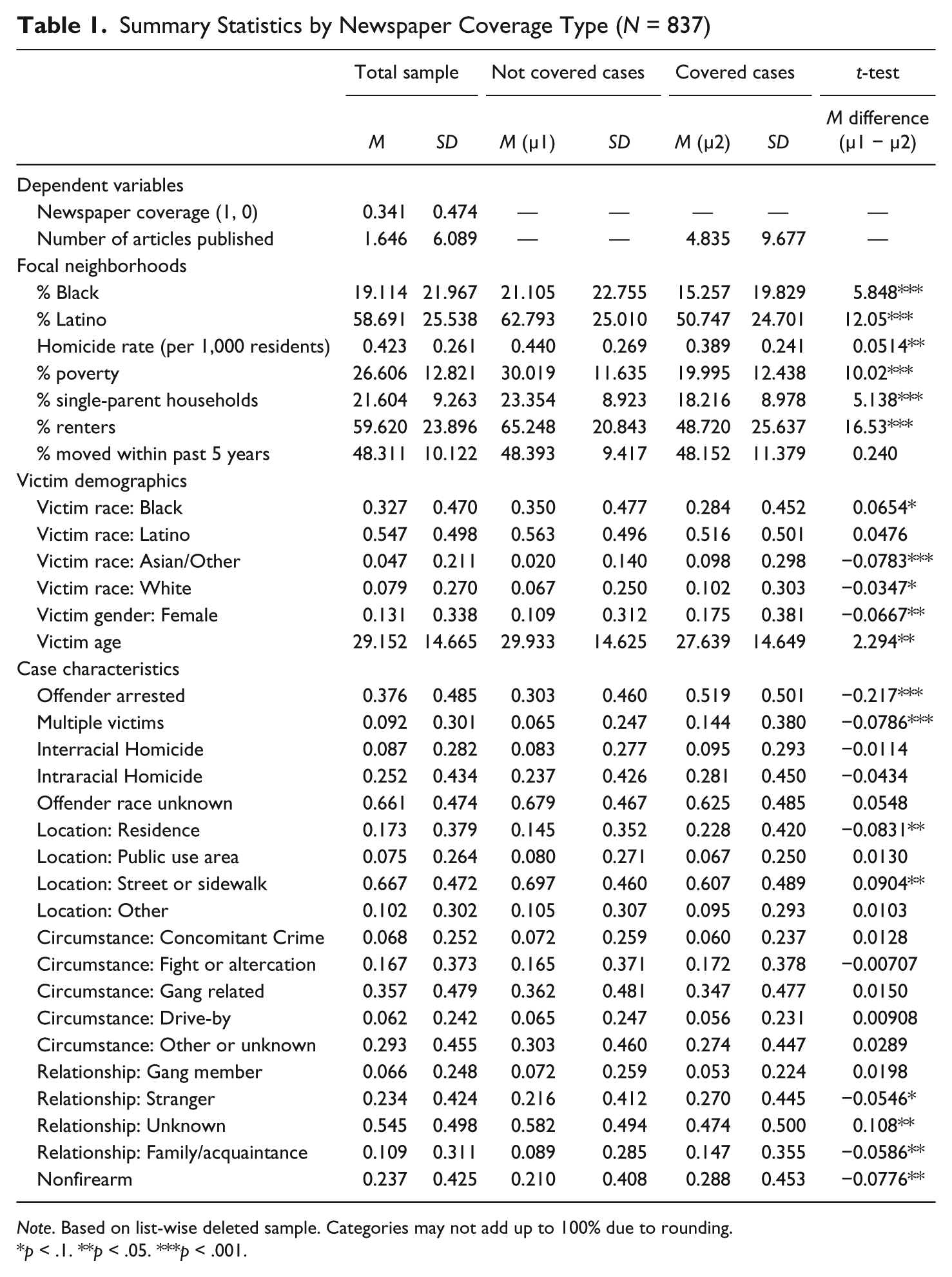
Note. Based on list-wise deleted sample. Categories may not add up to 100% due to rounding.
p < .1. **p < .05. ***p < .001.
Outcome Measures
Building on prior research on LA County homicide newspaper coverage, the dependent variable is measured dichotomously and as a count: (a) presence/absence of coverage for each victim (1 = at least one article published, 0 = no articles published) and (b) the number of articles published for each victim (Sorenson et al., 1998). These two outcome measures capture the overall prominence of coverage each homicide victim receives (Gruenewald et al., 2009; Lundman, 2003) and have been frequently analyzed in prior research (e.g., Buckler & Travis, 2005; Gruenewald et al., 2011; Gruenewald et al., 2009; Lin & Phillips, 2012; Lundman, 2003; Lundman et al., 2004; Schildkraut & Donley, 2012; Sorenson et al., 1998). As Lundman (2003) argued, whether or not a homicide is covered and the amount of coverage it receives are among the most important decisions in the news-making process, reflecting journalists and editors’ conceptions of newsworthiness. The decision to cover a homicide provides “an opportunity for readers to learn that a homicide has in fact taken place and to learn the characteristics of the people involved,” while “the decision to cover a homicide more than once provides multiple opportunities for readers to learn about a homicide” (Lundman, 2003, p. 366). Articles were collected for up to 4.5 years after the offense date, providing ample time for newspaper organizations to cover each homicide (Buckler & Travis, 2005; Lundman, 2003). 10 To control for differences in exposure time, an offset term (measured as the number of days from the offense date to the last day of data collection) was included in models predicting the number of articles published, transforming the count dependent variable into an incident rate ratio (IRR) of news coverage where λ = (number of articles) / (exposure time). These outcome measures do not include “Homicide Report” stories because this study attempts to replicate prior research on print media. Furthermore, the “Homicide Report” was largely created by the LA Times to remedy any disparities that might exist in its print coverage of homicides, making it unsuitable as an outcome measure—i.e., it would be a constant because all homicides are given a single website page (LA Times, 2014).
Victim-Level Covariates
Victims were divided into three racial categories: Black, Latino, and other racial groups (White, Asian, and “Other”). Due to the small number of non-Black or non-Latino victims, these racial groups were combined to help stabilize model estimates. Measures of victim-by-offender racial combinations were constructed based on the primary/first perpetrator’s race (interracial, intraracial, and unknown). Victim gender was dichotomously coded (female = 1, male = 0). Victim age was squared to capture its hypothesized u-shaped functional form (i.e., rarity theory predicts that childhood/elderly victims receive greater coverage than middle-aged ones).
Offense characteristics were also modeled. Categorical variables pertaining to features of the crime include (a) multiple victims (1 = yes, 0 = no), (b) victim–offender relationship (stranger, gang member, unknown relationship, and family member/acquaintance [referent]), (c) firearm usage (1 = yes, 0 = no), (d) offense circumstance (concomitant crime, fight/altercation, gang related, drive-by shooting, and circumstance unknown [referent]), and (e) incident location (residence, other public use area such as a park or school, and street/sidewalk [referent]). 11 In addition, the models control for whether or not an offender was arrested because prior research has linked media coverage and criminal justice outcomes (Phillips et al., 2012; Pritchard, 1986; Weiss et al., 1999).
Neighborhood-Level Covariates
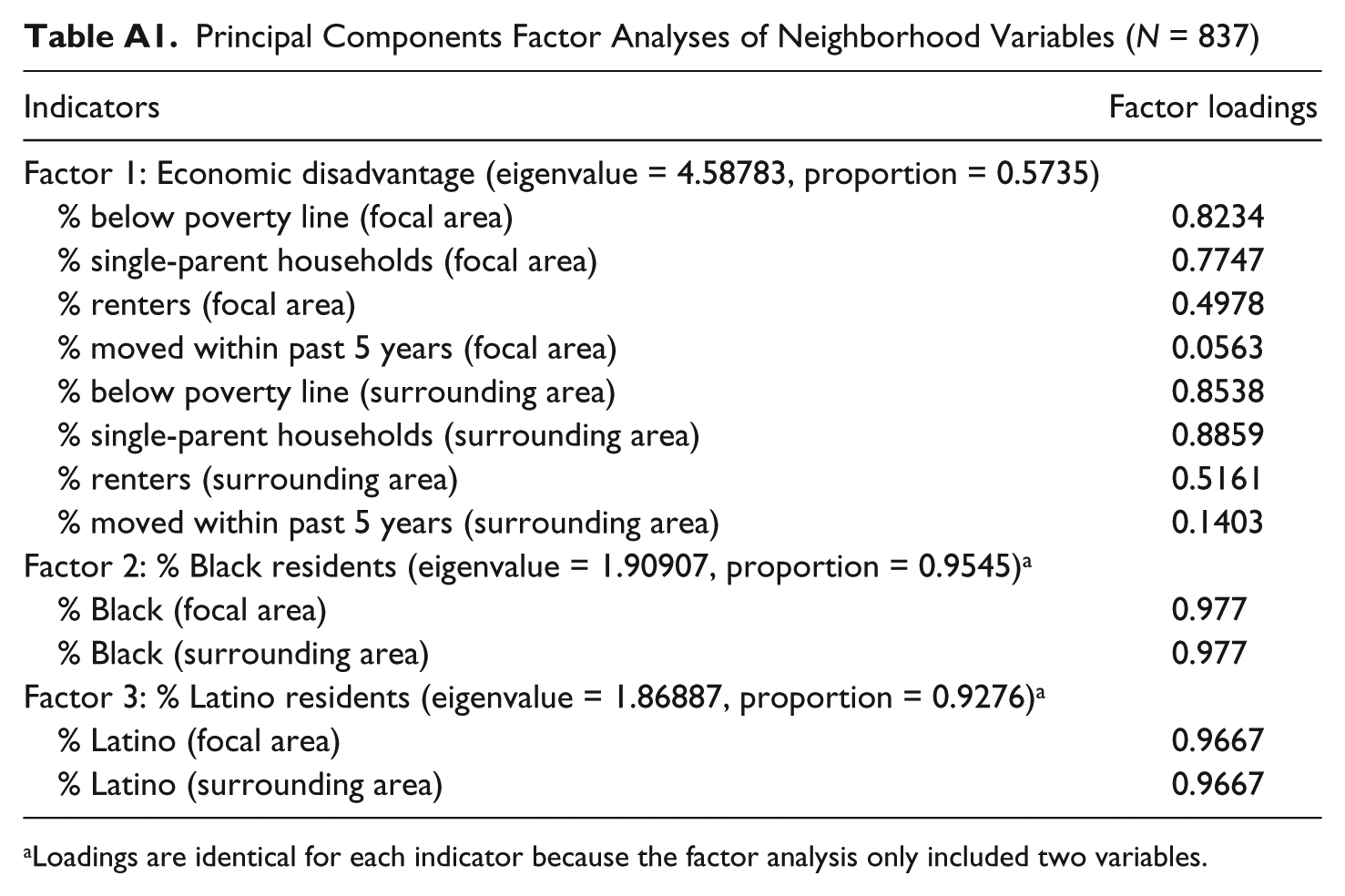
Neighborhood-level variables were derived from the 2000 Census. 12 For each homicide, address information pertaining to the crime scene location was obtained from the “Homicide Report” and geo-coded using ArcMap GIS. Forty-six homicide victims could not be geo-coded due to missing or incomplete address information (e.g., no address information listed on the “Homicide Report,” missing street number, incorrect address, etc.). Because these cases did not have a Level 2 identifier (i.e., census tract number), it was not possible to use multiple imputation to deal with missing neighborhood demographics (e.g., percentage of Black, percentage of Latino, etc.), and thus list-wise deletion was used instead. Given that these cases represent such a small portion of the sample (5.2%), excluding them from the analysis is unlikely to bias model estimates (see Allison, 2002). Racial composition of the crime scene community (i.e., “focal area”) was measured as the percentage of Black or Latino residents per census tract. Principal components factor analysis was used to construct a measure of economic disadvantage based on several indicators: percentage below the poverty line, percentage of single-parent households, percentage of renters, and percentage moved within past 5 years (see the appendix). As a measure of rarity at the community level, each census tract’s 2007 homicide rate was included (Paulsen, 2002); this variable controls for the fact that the majority of homicides occur in predominantly low-income and minority-dominated areas. Finally, a binary variable measuring whether the homicide occurred in the primary coverage/circulation area of the six newspapers sampled was included. This measure controls for the possibility that newspapers may be more likely to write articles on victims killed in the areas on which they typically focus. For example, while the Long Beach Press-Telegram covers events in various locales, it primarily focuses on events occurring in the following areas: Long Beach, Lakewood, Cerritos, Seal Beach, Signal Hill, and Downey (LA County Chief Executive Office, 2014b; LA Newspaper Group, 2014b). If the homicide occurred in an area covered by at least one of the six local newspapers included in the sample, it was coded as 1, otherwise, the variable was coded as 0.
Analytic Strategy
Consistent with prior research, the data are hierarchically organized with victims at Level 1 nested in census tracts at Level 2 (Boulahanis & Heltsley, 2004; Johnstone et al., 1994; Lundman, 2003; Lundman et al., 2004; Paulsen, 2002). Given this hierarchical data structure, two types of random intercept models were estimated in STATA 13: (a) logistic regression predicting the odds of coverage and (b) negative binomial regression predicting the number of articles published. Negative binomial regression, rather than Poisson regression, was used to address overdispersion stemming from the large number of homicides that received no coverage (Agresti, 2008; Cameron & Trivedi, 1998). 13 Community-level variables were grand mean centered to reduce multicollinearity, making them interpretable as deviations from the overall mean (Bickel, 2007; Rabe-Hesketh & Skrondal, 2008; Raudenbush & Bryk, 2002). Models were estimated with and without neighborhood racial composition to see if and how including or excluding these variables changed victim race effects. Moreover, in light of qualitative research linking race and socioeconomic status at the neighborhood level, interaction terms for racial composition and economic disadvantage were included (Chermak, 1995; Lotz, 1991; Pritchard & Hughes, 1997).
To account for potential spatial autocorrelation, spatially lagged predictors were controlled for (i.e., features of areas neighboring focal census tracts—“surrounding areas”). Theoretical and computational concerns warrant the use of spatially lagged predictors instead of alternative approaches (i.e., models with a spatial error component or spatially lagged outcome). Specifically, in addition to being incompatible with multilevel modeling, these alternative methods hinge on “contagion” or “unobservable similarity” assumptions that seem inappropriate in this context (Anselin, 2003; Elffers, 2003; Hipp, Tita, & Boggess, 2009; Morenoff, 2003). 14
The measurement of spatial lag variables is identical to those from focal neighborhoods (see the appendix). 15 Spatially lagged predictors were constructed by multiplying the demographic characteristics of surrounding census tract and a row-standardized spatially weighted matrix. A 2-mile cutoff was used to generate the spatial weight matrix because homicides usually occur within 2 to 3 miles of the victims’ home (Groff & McEwen, 2006). Due to patterns of residential racial and socioeconomic segregation, demographic characteristics of focal and surrounding census tracts are strongly correlated (Morenoff, 2003), and thus simultaneously estimating both types of measures could induce multicollinearity. Principal components factor analysis was used to address this issue by combining focal and surrounding census tract measures into a single factor score for economic disadvantage, percentage of Black residents, and percentage of Latino residents.
Results
Summary statistics and regression models reveal robust neighborhood effects. After controlling for a host of demographic characteristics and crime circumstances, victims killed in/around areas with large Black, Latino, and low-income populations receive less media attention. Furthermore, intraclass correlations reveal considerable variation in news coverage across neighborhoods. Taken together, these findings offer strong support for the devaluation thesis at the community level.
Descriptive Statistics
Table 1 displays summary statistics by coverage type as well as the corresponding t tests for these comparisons. Notable differences emerge between homicides that received media coverage and those that do not. Like prior research, a large proportion of victims (almost 66%) in this sample received no media coverage whatsoever. The average number of articles published per homicide was 1.64 for the entire sample, compared with 4.83 among cases that received at least one article. Blacks and Latinos comprise the vast majority of homicide victims in LA County. On average, homicides that did not receive media coverage occurred in areas with larger Black and Latino populations than homicides that received newspaper attention. Economic measures reveal similar patterns: percentage of poverty, percentage of single-parent houses, and percentage of renters are higher for homicides that were not covered. Several rarity measures are related to media coverage patterns: A larger percentage of covered cases than noncovered cases involve crime scene communities with lower homicides, multiple deaths, female victim(s), nonfirearm weapons, stranger victim–offender relationships, and residential or street crime scenes. According to Table 1, there is no statistically significant difference between covered and not covered in terms of victim-by-offender racial configurations and crime circumstances.
Model Estimates
Tables 2 and 3 display results from multilevel logistic and negative binomial models predicting the presence/absence and rate of newspaper coverage. Victim race does not significantly predict the odds of coverage (Model 3), but Latinos receive significantly less newspaper coverage (Model 6). These findings indicate that the nonsignificance of victim race, with the exception of Latinos in Model 6, does not depend on the inclusion of neighborhood variables. Consistent with the rarity thesis, cases involving multiple victims are more likely to receive any coverage whatsoever as well as coverage in multiple articles. For both dependent variables, solved homicides received greater media attention; the arrest of an offender most likely increases the amount of news coverage a victim receives because such cases have more details to report on (e.g., offender demographics, case developments, etc.). Female victims have a higher rate of coverage, but gender does not predict the odds of coverage. Age has a negative effect on the odds and rate of coverage, but age-squared is not significant, indicating that the relationship between age and newspaper coverage is linear rather than quadratic. While the aforementioned rarity measures are significant, several indicators of rarity are nonsignificant (e.g., neighborhood homicide rates, victim–offender relationship, victim–offender racial configuration, murder weapon, and most of the circumstance variables). Finally, homicides occurring in the primary coverage area of the six sample newspapers are significantly more likely to be covered (Model 3) and have a higher rate of coverage (Model 6) than those not in the primary coverage area.
Multilevel Logistic Regression Predicting the Odds of Coverage (N = 837)

Note. Exponentiated coefficients; robust standard errors in parentheses. Neighborhood-level covariates are grand mean centered. Referents are as follows: Victim-by-offender race = unknown offender race; location = street or sidewalk; circumstance = circumstance unknown; relationship = family member or acquaintance. Dummy variables include primary coverage area, offender arrested, multiple victims, and nonfirearm.
p < .1. **p < .05. ***p < .001.
Multilevel Negative Binomial Regression Predicting the Number of Articles (N = 837)
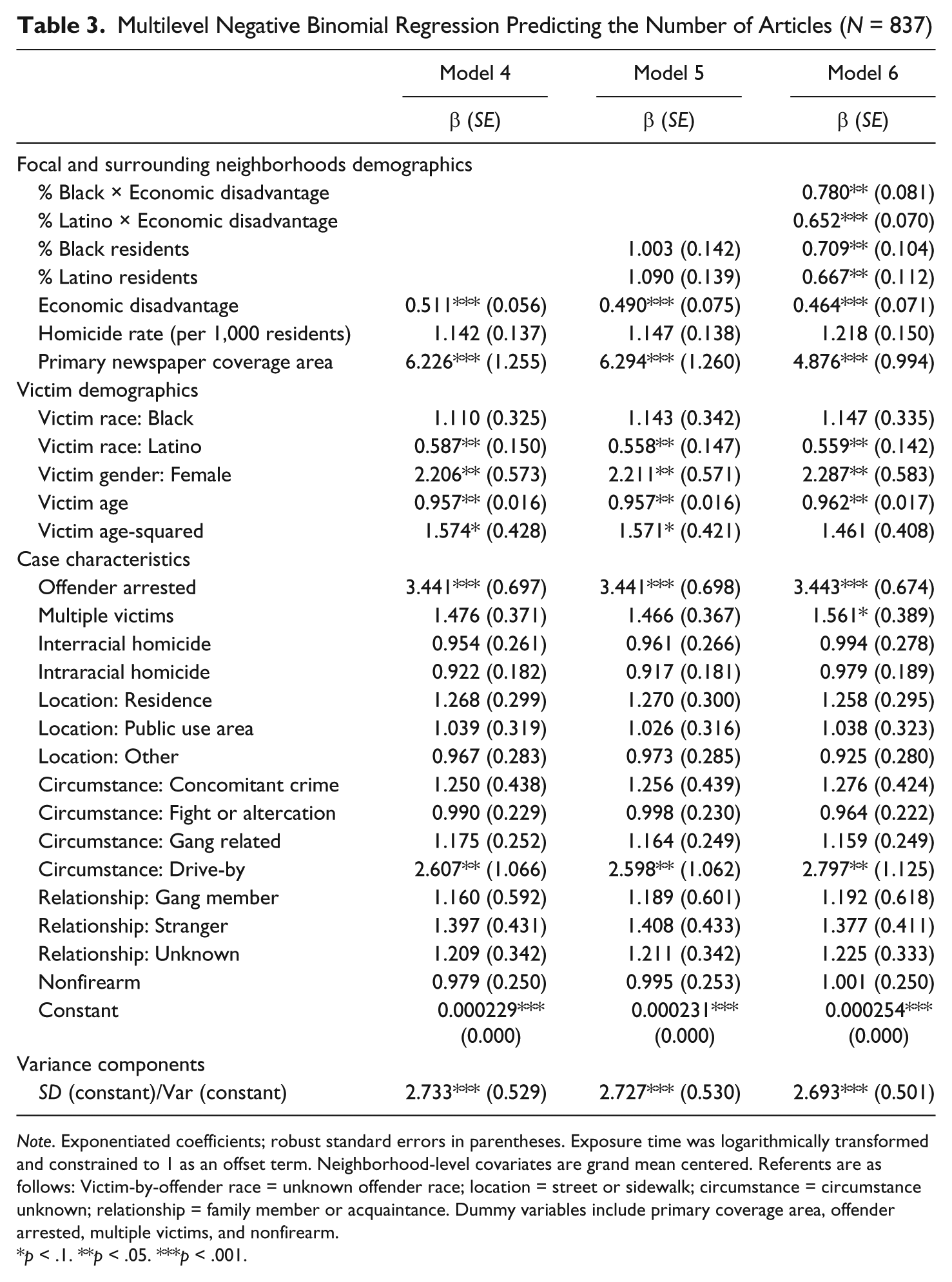
Note. Exponentiated coefficients; robust standard errors in parentheses. Exposure time was logarithmically transformed and constrained to 1 as an offset term. Neighborhood-level covariates are grand mean centered. Referents are as follows: Victim-by-offender race = unknown offender race; location = street or sidewalk; circumstance = circumstance unknown; relationship = family member or acquaintance. Dummy variables include primary coverage area, offender arrested, multiple victims, and nonfirearm.
p < .1. **p < .05. ***p < .001.
Neighborhood racial composition and socioeconomic status have a significant negative effect on coverage outcomes, underscoring the importance of neighborhoods. Given that neighborhood demographics for focal and surrounding areas were combined via factor analysis, coefficients represent a one standard deviation change (Hamilton, 2012). Thus, a one standard deviation increase in economic disadvantage corresponds to a 70% reduction in the odds of coverage (Model 2) and a 51% reduction in the rate of coverage (Model 5). Racial composition measures become significant when interacted with economic disadvantage in Models 3 and 6. As neighborhood variables were mean centered, the main effect of β1 in an interaction term β1 × β2 represents the effect of β1 when β2 is held at its mean. For instance, at the mean level of economic disadvantage, a one standard deviation increase in the percentage of Latino residents corresponds to a 43% reduction in the odds of coverage (Model 3) and a 33% reduction in the rate of coverage (Model 6). When economic disadvantage is held at the mean, a one standard deviation increase in the percentage of Black residents corresponds to a 29% reduction in the rate of coverage (Model 6) but does not have a significant effect on the odds of coverage. At mean levels of neighborhood racial composition, a one standard deviation increase in economic disadvantage correspondences to a 72% reduction in the odds of coverage (Model 3) and a 53% reduction in the rate of coverage (Model 6). In Models 3 and 6, neighborhood racial composition and socioeconomic status interactively shape reporting patterns. Therefore, in areas with high levels of economic disadvantage, an increase in the percentage of Black and Latino residents has a negative effect on the likelihood.
Unadjusted intraclass correlations from intercept-only models highlight the importance of neighborhoods in accounting for news coverage (Bickel, 2007; Goldstein, Browne, & Rasbash, 2002). According to intercept-only versions of the models in Tables 2 and 3, roughly 59% of the variance in the presence/absence of coverage and 57% of the variance in the amount of media coverage is at the neighborhood level. 16 Given that intraclass correlations of .3 or more are indicative of substantial clustering, these figures reveal that community context accounts for a large proportion of the variance in media coverage (Bickel, 2007; Raudenbush & Bryk, 2002).
Discussion
In the news-making process, neighborhoods matter. Drawing insights from the neighborhood stereotypes literature, I hypothesized that the criminalization of Black/Latino and economically disadvantaged communities would lead the media to marginalize victims killed in and around these areas. Predictions derived from this theoretical orientation were supported: neighborhood demographics are statistically significant, neighborhood racial composition and socioeconomic status interactively shape reporting patterns, and a large amount of the variance in media coverage is explained at the neighborhood level. Victims killed in/around economically disadvantaged Latino communities are less likely to receive any coverage whatsoever, even after controlling for victim-level covariates. Moreover, victims killed in/around economically disadvantaged Black and Latino neighborhoods have lower rates of newspaper coverage. These patterns support the devaluation thesis at the community level and mirror findings from the criminological and urban geography literatures implicating neighborhoods in the (re)production of various inequalities, especially lethal violence (Sampson, 2012).
Regression models challenge conventional individual-level conceptions of newsworthiness. If, as the rarity theory argues, newsworthiness is primarily based on the crime’s sensational nature, neighborhood effects should disappear after controlling for rarity measures, yet this was not the case. Although certain rarity factors were significant, they cannot fully explain media coverage patterns: adjusted estimates indicate that neighborhood characteristics shape the production of newspaper stories. Moreover, geographic disparities in media coverage call into question individualistic race-based explanations of victim devaluation by highlighting the importance of neighborhood racial composition. Neighborhood demographics were highly significant, while victim race and victim-by-offender racial combinations were not, with the exception of Latinos in Model 6.
This article extends the literature in several ways. Estimation of neighborhood effects expands the concept of newsworthiness beyond individual attributes, locating newspaper coverage within a larger socioecological context. In addition, the large number of Latinos included in the sample helps to shed light on the media attention given to this relatively understudied, yet increasingly victimized and stigmatized, group (Chiricos & Eschholz, 2002; Logan et al., 2011; Stowell et al., 2012; Wang, 2012). Last, in contrast to previous research focusing on a single news agency or city, articles pertaining to all homicides in LA County were collected from six different newspapers. Given this design feature, neighborhood effects were examined over a broad range of geographic locales and news markets.
Like any study, this project has limitations that should be considered when drawing inferences from the data. While regression models reveal neighborhood effects that are consistent with qualitative research highlighting the importance of location, they cannot directly show how community context matters (i.e., the institutional and cultural dynamics at work on the ground). Given this metacritique of quantitative methods (Abbott, 2004; Frankfort-Nachmias & Nachmias, 2007), additional qualitative research is needed on the topic (Lundman et al., 2004).
This study did not examine content-based media coverage inequalities. Even when minority victims receive coverage, it is less comprehensive or sympathetic than depictions of White victims, and therefore an examination of content-based neighborhood disparities in newspaper coverage would enhance our understanding of media processes (Dowler, 2004; Eliason-Nannini & Sommerlad-Rogers, 2012). While this study focused on the presence/absence of coverage and the number of articles published, it is important to recognize potential differences between the quantity and quality of newspaper coverage (e.g., Buckler & Travis, 2005; Gruenewald et al., 2011; Paulsen, 2003; Pritchard & Hughes, 1997; Schildkraut & Donley, 2012; Sorenson et al., 1998). For example, five short articles published by a particular newspaper may total the same length as one long article published by another newspaper, making them comparable in terms of the actual newspaper space devoted to a story. Similarly, a front-page story receives qualitatively more coverage than articles in other sections, given the increased prominence associated with front-page placement. In light of the distinction between the quantity and quality of media attention, the present study cannot speak to geographic biases in terms of the quality of coverage a victim receives. Although the absence of content-based coverage measures does not detract for this study’s focus on the presence/absence and amount of coverage, further research should employ additional measures of newsworthiness, including article length and page placement, to better elucidate content-based disparities at the neighborhood level.
Future research should also investigate neighborhood effects in racially/ethnically oriented and electronic newspapers. The present study did not look at coverage in racially/ethnically oriented newspapers to replicate prior research focusing on mainstream media outlets; the six newspapers sampled were selected because they are widely circulated and have a racially and ethnically diverse readership (LA Almanac, 2014; LA County Chief Executive Office, 2014a; Scarborough Research, 2007). Lundman et al. (2004) found that Black-oriented newspapers are more likely to cover crimes in Black communities, highlighting the need for additional research comparing the effects of neighborhood characteristics on crime coverage in racially/ethnically oriented newspapers versus those geared toward a largely White audience. Similarly, this study focused on print media to replicate prior research and extend the topic to the neighborhood level. It may be, however, that results differ when electronic media outlets are examined.
These findings have several social justice and policy implications. Media representations play a pivotal role in the social construction of homicide and administration of justice (Surette, 2007). The media has a hegemonic effect on individuals’ conceptions of the social world, unknowingly influencing how we think about social issues (Gamson et al., 1992; McCombs & Shaw, 1972, 1993; Schildkraut & Muschert, 2014; Surette, 2007). Thus, given that the public often views criminal justice responses to homicide as affirmations of the state’s valuation of victims (Zimring, 2003), the relative inattention to killings in and around economically disadvantaged minority neighborhoods perpetuates racialized notions about victimization, demarcating entire communities as “undeserving” of victimhood. In addition to reinforcing stereotypes about “worthy victims,” such coverage disparities deny the struggles of these communities, particularly those implicated in the production of homicide rates, including residential segregation and poverty (Beckett & Sasson, 2004; Campbell, 1995; Stabile, 2006). Consumption of crime news is also associated with residents’ heightened concerns about crime, which in turn increases their support for punitive criminal justice policies such as capital punishment, three strikes laws, and zero-tolerance policing (Boulahanis & Heltsley, 2004; Gruenewald et al., 2011; Mohan & Taylor., 2011; Perkins & Taylor, 2002; Welch et al., 2011). 17 On the ground, media attention influences police and prosecutorial decision making. Homicides that receive greater media attention are more likely to be solved (Lee, 2005), resolved through a plea agreement (Pritchard, 1986), and prosecuted capitally (Phillips et al., 2012; Weiss et al., 1999).
Given the space restrictions of newspapers, burgeoning digital media outlets offer new avenues for ameliorating disparities in homicide coverage (Gruenewald et al., 2011). Journalists in various locales, including LA County (i.e., “Homicide Report”), are currently using digital media outlets to cover a wider range of victims (Homicide Watch D.C., 2014; LA Times, 2014; Redeye Chicago, 2014). These online sources also focus on the structural and situational causes of crime, an approach shown to increase readers’ awareness of the social antecedents of crime and their support for preventive crime control policies (Coleman & Thorson, 2002). In this regard, digital media outlets can help to counteract the barrage of one-dimensional media accounts depicting Blacks and Latinos as criminally inclined by providing readers with a holistic picture of victims and their community (Kang, 2004).
Summary and Conclusion
In summary, this study uncovered neighborhood disparities in the amount of media coverage given to LA County homicide victims. The use of multilevel modeling, coupled with data from multiple newspapers, not only helped to elucidate reporting biases across a wide range of editorial and community contexts but also offered a new methodology for studying newsworthiness. The inclusion of neighborhood-level predictors moves beyond individualistic notions of newsworthiness, situating media coverage patterns within the social ecology of LA County. Regression models underscore the centrality of community context in the news-making process, revealing that homicides occurring in and around economically disadvantaged Black and Latino neighborhoods receive less media attention. As a whole, this study challenges the journalistic adage “if it bleeds it leads” by demonstrating that media coverage depends on “who is bleeding,” and more importantly, in what neighborhood (Dowler, 2004, p. 94). In this regard, the realtor’s adage “location, location, location!” more aptly describes the process by which LA County homicides are selected for newspaper coverage.
Footnotes
Appendix
Principal Components Factor Analyses of Neighborhood Variables (N = 837)
| Indicators | Factor loadings |
|---|---|
| Factor 1: Economic disadvantage (eigenvalue = 4.58783, proportion = 0.5735) | |
| % below poverty line (focal area) | 0.8234 |
| % single-parent households (focal area) | 0.7747 |
| % renters (focal area) | 0.4978 |
| % moved within past 5 years (focal area) | 0.0563 |
| % below poverty line (surrounding area) | 0.8538 |
| % single-parent households (surrounding area) | 0.8859 |
| % renters (surrounding area) | 0.5161 |
| % moved within past 5 years (surrounding area) | 0.1403 |
| Factor 2: % Black residents (eigenvalue = 1.90907, proportion = 0.9545) a | |
| % Black (focal area) | 0.977 |
| % Black (surrounding area) | 0.977 |
| Factor 3: % Latino residents (eigenvalue = 1.86887, proportion = 0.9276) a | |
| % Latino (focal area) | 0.9667 |
| % Latino (surrounding area) | 0.9667 |
Loadings are identical for each indicator because the factor analysis only included two variables.
Acknowledgements
The author thanks the anonymous reviewers for their constructive feedback and the Homicide Studies editor for her helpful comments. I would also wish to thank Mona Lynch, Geoff Ward, Ann Hironaka, and John Hipp and for their insightful comments on earlier drafts of this paper, and Tara Reed and Joseph-Martin Novelo for their help collecting the data analyzed in this study.
Declaration of Conflicting Interests
The author(s) declared no potential conflicts of interest with respect to the research, authorship, and/or publication of this article.
Funding
The author(s) disclosed receipt of the following financial support for the research, authorship, and/or publication of this article:
This project was partially funded by the Proteus Action League.