



Abstract
At present, the average homicide clearance rate in the United States is approximately 65%, down roughly 15% from the mid-1970s. This research seeks to inform how police can best improve homicide clearance rates by identifying best practices in homicide investigations. To accomplish this goal, as part of a federally funded project, seven geographically representative law enforcement agencies were identified that had at least 24 homicides in 2011 and had a clearance rate of 80% or higher from which effective investigative practices could be gleaned. Qualitative findings indicate that a strong community policing presence, collaboration with external agencies, and an innovative culture facilitate high rates of homicide clearance. Implications for policy and future research are discussed.
Introduction
The prevalence of homicide in American society continues to perplex citizens, legislators, policy makers, and police officials. Occasionally horrific events—such as Newtown, Connecticut, and Aurora, Colorado—place a national focus on homicide; in these cases it was mass homicides. Ironically, according to the Uniform Crime Report, the average number of homicides occurring on a daily basis (slightly more than 40 homicides per day in the United States in 2011) surpasses the deaths that occurred in these horrific mass incidents, yet many of these daily homicides receive relatively little attention beyond the local media market. The good news is that the numbers of homicides have continued to drop over the past several years, however, the numbers of victims still remains high; there were 16,799 homicides in the United States in 2011 (Cooper & Smith, 2011) at the time this research was conducted. While the frequency of homicide is dropping, with presumably lower caseloads for homicide investigators, clearance rates have also been on a steady decline since the 1960s with a current average clearance rate hovering around 61% (Roberts & Lyons, 2011); hence, fewer homicide offenders are being identified and arrested.
A litany of studies exists that examine the complex nature of homicide, its victims, and its offenders. Collectively these studies provide new insights to understand the problem. The challenge is to take this knowledge of homicide characteristics and trends and integrate it with new and emerging police strategies, practices, and technology. By transcending theory to policy, the obvious goal would be to clear more homicide cases. A hopeful artifact would be to prevent future homicides from occurring. The challenge is not simply to apply a new technology or implement a promising practice. Rather, the need is to re-examine the role of the homicide investigator and the methodology of homicide investigations. Many proven investigation techniques will still apply but through a different paradigm to make them more effective with new insight about the application of the technique. In addition, new techniques and a new organizational philosophy of homicide investigations may help increase the effectiveness of these inquiries—and thus is the focus of the present research.
Homicide clearances are categorized into one of three mutually exclusive categories. They are cleared by arrest, exceptional clearance, and un-cleared (Jarvis & Regoeczi, 2009). Scholars seeking to delineate differences within each of these categories have parsed them further into four operationalizations. A discussion of these operationalizations is not pertinent to the current study, and can be reviewed further in the work of Riedel (2008) as well as Lundman and Myers (2012). What is relevant to the current research is that the findings of the latter study indicate that there are no differences of clearance rates across these mutually exclusive categories and extralegal victim characteristics (i.e., victim race and incident location). As will be discussed in more detail, the literature lends support for the notion that police investigate homicides equitably. Despite this generally held belief, little scholarly attention has been paid to the actual work the police do to clear homicide cases (the most impressive study to date is Keel, Jarvis, & Muirhead, 2009). As Puckett and Lundman (2003) noted, Researchers need to gain access to police departments open to research and then use that access to explore the effects of the investigative actions of detectives on homicide clearances . . . the present research remain[s] largely silent on the effects of the investigative actions . . . Much therefore remains to be learned about what detectives do and how what they do affects clearances. (p. 188)
The present research seeks to fill this knowledge gap by utilizing observations from seven cities in the United States with high homicide clearance rates and effective homicide investigative practice to inform practitioners and guide future research in this area.
Homicide Clearance Rates
Factors that affect homicide clearance rates are perhaps the most underrepresented aspect of the homicide literature. To date, homicide clearance research has focused predominantly on two competing perspectives. Black’s (1976) theory of law contended that police exercise their discretion to clear incidents of homicide based on extralegal characteristics of victims and the areas in which the crime occurred. Conversely, other scholars argue that homicide is the most serious crime and all police work diligently to clear every case, regardless of victim characteristics or where the crime occurred (Gottfredson & Hindelang, 1979; Klinger, 1997). Although findings lack consensus, in aggregate the research has shown that extralegal characteristics of victims, as well as the location of their homicide, do not influence clearance rates (Addington, 2006; Litwin, 2004; Marché, 1994; Puckett & Lundman, 2003; Regoeczi, Kennedy, & Silverman, 2000; Riedel & Rinehart, 1996; Wellford & Cronin, 1999). This collective evidence lends support to the notion that police treat investigations of homicide equally—that is, overall police use comparable diligence in all homicide investigations. However, the equitable application of due diligence by police to solve homicides does not inform how police actually clear such incidents. A focus on the daily operational aspects of police homicide investigations should yield insightful information.
To this end, studies have examined the effects of detective experience and workload on homicide clearances, yielding mixed results. Homicide is the offense type most likely to be influenced by available resources to investigate (Greenwood, Chaiken, & Petersilia, 1977; Marché, 1994) although other findings have rebutted that such a relationship exists (Keel et al., 2009; Litwin & Xu, 2007). Using arguably the most robust sample of cases and specified modeling, Puckett and Lundman (2003) found no relationship between detective experience, as well as detective workload, and homicide clearance rates. Their results also indicated that new homicide detectives, who are assigned to work under the guidance of an experienced detective that have primary responsibility of the case, demonstrated no significant differences in clearance rates of homicide as compared with detectives with more experience in the homicide unit. Perhaps aiding in the explanation of these null findings is that homicide investigators in large cities are experienced police officers who progressed from patrolling the streets to less visible detective units prior to being assigned to the homicide unit (Rachlin, 1995). Interestingly, this line of research has eluded the notion that detective caseload could mask other organizational resource limitations—such as adequate staffing—that in turn result in decreased response time to homicide scenes and the number of available detectives to gather evidence and witness testimony (Keel et al., 2009; Litwin & Xu, 2007; Wellford & Cronin, 1999).
Extant research has identified two sets of factors that influence the effectiveness of police to clear homicides. The first set are physical attributes of the homicide incident, such as the availability of physical evidence resulting from the incident and the method (i.e., firearm or knife) of committing the homicide (Litwin, 2004; Litwin & Xu, 2007; Puckett & Lundman, 2003; Regoeczi et al., 2000; Riedel & Rinehart, 1996; Wellford & Cronin, 1999). More salient to the current study is the second set of factors that can be attributed to the community in which the homicide incident occurred. Research has demonstrated that successful homicide investigations rely on information from witnesses to the crime as well as information from other witnesses and citizens who reside in the crime area that can inform detectives about victims and potential violators (Greenwood et al., 1977; Litwin, 2004; Reiss, 1971; Riedel & Rinehart, 1996). However, witnesses may be less likely to cooperate with a police investigation for fear of retaliation (Riedel & Jarvis, 1999) or a lack of trust in the police (Kane, 2005; Puckett & Lundman, 2003; Regoeczi & Jarvis, 2013; Warner, 2007). Police can build trust with citizens, reinforce legitimacy, and reduce fear of crime generally, and retaliation specifically, through an effective community policing approach (Brookman & Innes, 2013). Evidence also suggests that community policing improves police investigations (Skogan et al., 1999) and can have a violence prevention affect (Kenney, White, & Ruffingengo, 2010; White, Fyfe, Campbell, & Goldkamp, 2003). Incorporating observations of community policing and police investigative processes is the next logical step in the explanation of homicide clearance rates, a step the present research provides.
Since the terrorists attacks of September 11, 2001, significant strides have been made with respect to law enforcement intelligence and the sharing of information across jurisdictions (Chermak, Carter, Carter, McGarrell, & Drew, 2013). Improved practices and standards for analyzing and sharing information have been articulated throughout multiple federal publications (D. L. Carter & Carter, 2009b) and the creation of fusion centers has enhanced law enforcement’s infrastructure to share analytic products (D. L. Carter & Carter, 2009a). This analytic capability, coupled with existing analytic methods commonly found within forensics (i.e., DNA testing and blood spatter patterns), has been found to improve homicide clearance rates (Keel et al., 2009; Roberts, 2007; Wellford & Cronin, 1999). Given the rather recent integration of intelligence-led policing (ILP) within agencies in the United States (J. G. Carter, Phillips, & Gayadeen, 2014), research has yet to explore the implications of this emerging philosophy for homicide investigations and clearance rates.
A review of the literature relevant to explaining homicide clearance rates has revealed that a gap exists with respect to what is known about how police investigative processes can influence rates of clearance. Building on the work of Keel and his colleagues (2009), the present research seeks to identify strategies and tactics of successful police homicide investigations. Jarvis and Regoeczi (2009) noted why such a focused examination is needed: [NIBRS] . . . data lack detailed information on some of the investigative and procedural aspects of homicide investigations (i.e., the availability of witnesses, police response times, number of detectives assigned to the case, and other details). Such data would improve efforts to understanding homicide solvability. (p. 185)
Method
This is qualitative research based on extensive interviewing of a wide variety of police personnel over a 4-year period who directly investigate homicides and those law enforcement personnel (sworn and non-sworn) who provide investigative support. This approach is consistent with Jack Greene’s (2014) solicitation to his peers for more qualitative and contextualized insights from complex police processes that cannot be fully captured through traditional quantitative modeling. The information was derived from four Bureau of Justice Assistance (BJA) projects where the first author was directly involved in the interviews. 1 The projects were not originally conceived by BJA as being an integrated series of violence control projects. Rather, they originally started with Project 1 as a Training and Technical Assistance (TTA) program for violence reduction. As a result of these findings, coupled with external initiatives of the Justice Department’s Civil Rights Division, Projects 2 and 3 were developed, in part to apply the lessons learned from Project 1. Based on additional lessons learned from Projects 2 and 3, Project 4 was developed.
Admittedly, an ideal research project would have been conceptualized differently. However, federal TTA projects rarely follow preferred research protocols. Moreover, this approach does not negate the fact that experimentation was performed in law enforcement agencies from which important new knowledge was learned. The qualitative methodology employed was derived from the quantitative findings of Keel and his colleagues (2009). Specifically, Keel was consulted on these projects to share his data for purposes of identifying factors most important to homicide investigations that should be examined through in-depth interviews to provide the much-needed context of how these practices work. Given the fidelity of how investigations are managed across agencies, such context allows for the identification of factors that facilitate and inhibit successful clearances. The authors have been able to control some variables and record the findings through in-depth interviews to provide contemporary policy insights for homicide investigation. Each project is described below from a methodological perspective.
Project 1
In 2007, the BJA created the Targeting Violent Crime Initiative (TVCI) wherein a competitive solicitation was released for police departments to develop a violence reduction program using ILP. There were 103 funding awards made—while all had to be some type of violence reduction program, some of the awards expressly focused on homicide reduction. All grantees were required to have a project team of managers, analysts, officers, and investigators to participate in a conference that provided training and held discussion sessions where grantees described their projects and solicited input on ways to refine their crime control initiatives.
The projects were closely monitored. After 18 months, not surprisingly, many of the projects had little or no success. However, 10 projects were identified that had significant successes in reducing violence (see Bureau of Justice Assistance, 2012). These agencies were selected by BJA for a detailed assessment to understand how the project worked, its key components, and results. A team then visited the agencies to learn in greater detail about the projects’ implementation and effects. This article reports the successful projects that addressed homicide from a perspective of new policy applications.
Projects 2 and 3
Under a BJA TTA program, these two major law enforcement agencies requested that BJA provide an assessment of their homicide investigations due to the agencies’ lack of success in effectively clearing homicide cases. The jurisdiction in Project 2 (with a population of approximately 344,000) had a homicide rate of 33.1 per 100,000 with a clearance rate of 35%. The agency in Project 3 (with an approximate population of 4,000,000 in the jurisdiction) had a homicide rate of 29.4 per 100,000 with a clearance rate of 22%. A team of five experienced homicide investigators, one forensics specialists, the BJA project monitor, a logistics officer, and the first author as team leader made four, 1-week site visits to each agency reviewing records, policies, operational procedures, and conducting extensive interviews with critical personnel (it is estimated there were about 445 hr of interviews with each agency.) Although there were some unique issues with each agency that contributed to their lack of success, each agency also had stark failures that were largely consistent between the agencies. These ranged from their philosophical approach of policing to the failure to effectively perform specific investigative techniques and strategies.
The problems and failures found in each agency were independently documented by the assessment team. Following each assessment visit, the team met to discuss findings, issues and next steps. Based on the collective discussions and conference calls, the findings and recommendations were drafted. The team met again to discuss each finding and recommendation similar to a Delphi panel. There was a clear consensus on the conclusions and recommendations—indeed, nearly all reported findings were unanimous by the team members.
Extensive recommendations were made to each agency on changes that could increase the efficacy of homicide investigations. BJA also provided a homicide investigation training program based on the needs defined in the recommendations.
Project 4
Based on the results of Projects 1, 2, and 3, preliminary findings suggested that clearance rates of homicides were significantly influenced by (a) actions taken in the first 48 to 72 hr following the report of the homicide 2 and (b) specific types of investigative activities that were used by the agencies. However, there were some findings for which the implications were not fully explained. For example, although most of the successful agencies tended to have some unique investigative approaches, they also used traditional approaches to investigations with greater success than the poorer performing agencies. Although suppositions could be made why this occurred, more information was clearly needed to understand the successes. To explain these actions better and to identify other successes in homicide investigations, BJA instituted the “Homicide Process Mapping Project.” Seven cities and counties were identified that had 25 or more homicides per year (most had far more) and a clearance rate of 80% or higher. 3
Team members who participated in Projects 2 and 3 performed site visits at each of the seven Project 4 cities. Standardized quality control questions were used in every interview by the interview team members. After the interviews were performed, team members met to discuss the findings and ensure consistent interpretations of findings. Standard qualitative methods were used essentially as a modified Delphi panel to ensure objectivity and reliability in the findings.
Detailed interviews were performed with homicide investigators, homicide supervisors, homicide commanders, and “other police personnel” to determine the tactics and strategies they performed that led to their clearance successes. “Other police personnel” varied between agencies and were identified based upon the unique programs or initiatives of each jurisdiction. For example, in jurisdictions where analysts were used extensively in homicide investigations, the analysts were interviewed. In jurisdictions that had a large number of gang homicides and gang investigators aided homicide investigations, the gang unit members were interviewed. Interviewing “other police personnel” who provided direct support of homicide investigations permitted a more granular understanding of the investigative successes. At the end of each site visit interview session, the supervisor and investigator were asked to “walk through” the first 48 hr of a homicide investigation and describe the specific tasks their unit performed, with an estimate of the time frame in which each task was performed. It is estimated that there were approximately 120 total interview hours in this project.
Notes on the Methodology
As noted previously, this is qualitative research that used document analysis and interviews in each of the four projects. The law enforcement agencies selected in the study were purposive because the goal was to assess what policies and practices worked and what did not to define successful policy and practice. The current study utilized semi-structured interviews with key investigative personnel to develop a process map of successful homicide investigation practices. Process mapping, as developed out of the scientific management school of thought (Taylor, 1911), allows for detail to be applied to the sequence and flow of complicated tasks that in sum are required to achieve desired ends. Such an approach is ideal for examining successful homicide investigation practices and has been employed by other scholars to quantify police investigations generally (Robinson & Tilley, 2009) and homicide investigation processes more specifically (Innes, 2002). A homicide investigation consists of a complex array of tasks that must be performed, initially, over a short period of time, often under significant stress. The tasks are further complicated because they must meet a range of legal standards, conform to scientific integrity for later forensic analysis, or require dealing with challenging human relationships. Other tasks are influenced by external pressures—such as the community or elected officials—to ensure that the tasks are performed quickly, accurately, and successfully.
In quantitative research, one typically seeks to define representative samples and perform inferential analysis to understand and interpret phenomena. This is not typically the case in qualitative research. Rather, qualitative inquiry seeks to understand the exceptions to the rule. Findings seek to understand “what can be” and “what is” rather than infer “what might be.” Generalizability of the findings is not a core goal of this type of research. Rather documentation of key variables and practices and their effects for replication by other agencies is the core component of the research. The policy findings from this research can lead to more successful homicide investigations, more successful prosecutions, and, in some cases, the prevention of homicide.
The contrasts among the projects were important. Projects 2 and 3 demonstrated clearly what did not work and provided important lessons for all agencies. Projects 1 and 4 identified successes in investigative strategies as well as organizational and management practices which, in some cases, support a re-engineered investigative function. These agencies accomplished functional results of increased clearance rates and in some cases prevention of future homicides.
Although the integration of four projects’ methods as the basis for research findings is admittedly not traditional, the findings would not have otherwise so clearly emerged to demonstrate successful practices.
As one simple example, in Projects 1 and 4, an important part of the investigative practices was to perform a comprehensive neighborhood canvass to seek information from citizens in some detail about the homicides. These were not simple “knock and talk” exercises but discussions with citizens that often included a community-based patrol officer who citizens knew and trusted. In virtually every case, the neighborhood canvass yielded some type of information—sometimes innocuous—that contributed to the successful investigation and case development. In Projects 2 and 3, neighborhood canvasses were rarely performed and when they were used the process was superficial. In both Projects 2 and 3, investigators made statements that the canvass was a “waste of time,” “nobody talks to the police,” and “the community does not trust us.” Not only does this reinforce the value of this methodology to add context to the findings, in this case for the neighborhood canvass, but also reinforces the importance for the police department to lay a solid community-based foundation for this practice to be successful.
Homicide Process Mapping—Cities of Study
The Project 1 jurisdictions were used largely as a benchmark and pointer for variables to be explored in future study. The project was intended for policy demonstration, not research. As such, it lacked detail in data collection; however, it produced descriptive reports on projects that stimulated further inquiry. In addition, it also served as a rudimentary comparative control resource for later projects. The key findings produced in this article were found in Project 4 where the methodology could be more controlled and greater focused information could be collected. Moreover, in Project 4 all jurisdictions visited could be identified.
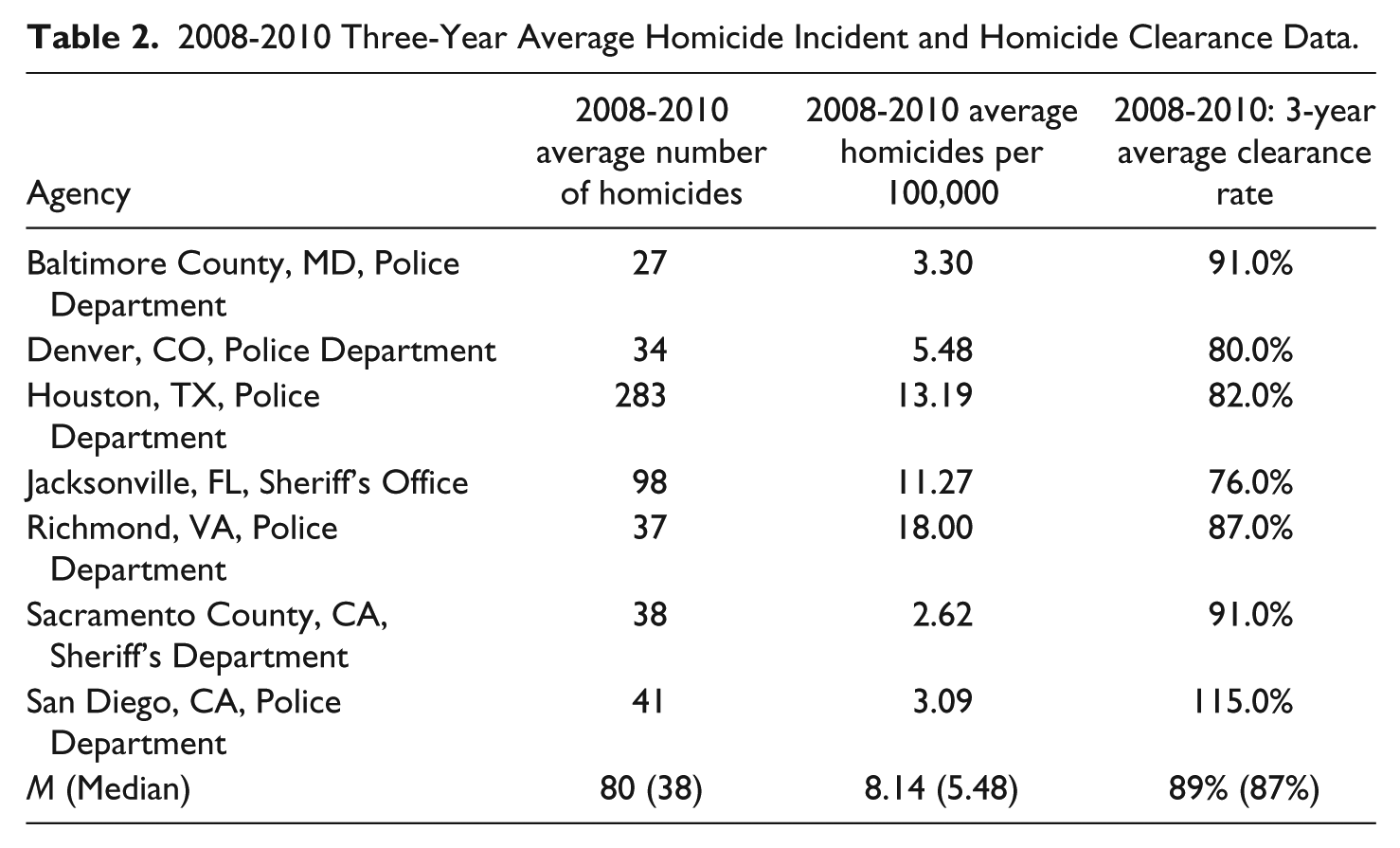
The baseline criterion for selecting jurisdictions in this project was that the jurisdiction had at least 24 homicides and a homicide clearance rate greater than 80% in 2011. To provide a snapshot of the agencies included in the current study, Tables 1, 2, and 3 depict city population and homicide metrics. Population data were collected from the U.S. Census Bureau, homicide data from the Federal Bureau of Investigation’s (FBI) Uniform Crime Reporting (UCR) data, and agency-specific homicide clearance data were provided by the FBI upon request. The number of homicide investigators represents sworn personnel assigned exclusively to homicide investigations and includes all ranks. This number does not include cold case squads because their investigative methodology is significantly different from active homicide investigations.
Population and Sworn Officer Data.

2008-2010 Three-Year Average Homicide Incident and Homicide Clearance Data.
2011 Homicide Incident and Homicide Clearance Data.

An oddity of homicide clearance rates is that the clearance rate can exceed 100% (such as the case with San Diego noted in Table 2) because of the UCR methodology. Homicides may be cleared that were committed in a previous year, hence increasing the clearance rate for the subsequent year. For example, a homicide committed on December 31, 2013, will count in the 2013 homicide crime rate. If the person who committed the homicide is arrested the next day—on January 1, 2014—the clearance by arrest will be counted in the 2014 homicide clearance data. Median statistics are presented because the Houston Police Department represents an outlier that positively skews the data. As shown in Table 1, agencies included in the study serve a median population of 869,602 and have a median sworn employment of 1,645 officers with a median of 21 homicide investigators. From 2008 to 2010, the median agency averaged 38 homicides, which equated to 5.48 homicides per 100,000 population, with an average clearance rate of 87% as shown in Table 2. Finally, because these seven agencies were selected based on 2011 homicide data, information for this specific year is provided in Table 3. In 2011, the median agency encountered 36 homicides, which equated to 5.48 homicides per 100,000 population, with an average clearance rate of 85.3%.
Discussion of Findings
Findings from the seven cities are organized and presented here within two organizational components: strategies and tactics. Specifically within policing, research has demonstrated that these two aspects of organizational practice should be the focus of applying evidence-based practices for achieving enhanced processes and outcomes (Lum, 2009). Strategies are related to the operational foundation of the agency. They are typically long-term applications of policing philosophy that can be generally applied to the entire organization or specifically applied to a particular function, such as homicide investigation. Strategies dictate the direction of all organizational initiatives; they represent the predicate for the way a task is approached and decisions are made. Tactics are task oriented. They prescribe what investigative activities will be performed and how they will be performed to accomplish an objective. Tactics are specifically defined activities needed to implement the strategy.
This project identifies both strategies and tactics that have been demonstrated in the site visit agencies to successfully increase homicide clearance rates. There were a number of factors that were consistently prominent in the successful law enforcement agencies. These factors were identified by the successful agencies as being critical to their success. By contrast, these same factors were non-existent, or minimally employed, in the unsuccessful agencies (i.e., Projects 2 and 3), supporting validation in the findings. The most critical findings—which represent a wide array of issues—are discussed below from their application of being strategic or tactical issues. Although there is always some overlap, the categorization is for the core application of the practice as it relates to homicide clearances.
Strategic Issues
Staffing
Adequate staffing requires a sufficient number of investigators to rapidly respond to immediate callouts when a homicide is discovered and to adequately conduct the crime scene and follow-up investigations. Although a range of different models exist, an optimum squad size is one supervisor and four investigators, with investigators rotating as the lead investigators. The number of squads is at an optimum when given the annual number of homicides in a jurisdiction, each investigator is the lead investigator for three homicides per year. 4 At first impression, this number may seem low; however, there are several factors that lead to this conclusion. The lead investigator typically has a number of responsibilities on a case that other investigators do not. These include managing the information flow and the case file, briefing supervisors and commanders on the status of cases, meetings with the District Attorney’s office on the investigation, meetings with the medical examiner, meetings with forensic analysts, as well as a wide array of other case management responsibilities. In addition, the lead investigator will be responding to homicide scenes and providing investigative support to other cases. Finally, in virtually all homicide units studied, investigators had other cases they would be assigned—such as officer-involved shootings, suicides, suspicious deaths, and/or kidnapping. These would be additional cases that typically were not as detailed and labor-intensive as homicide investigations. Hence, although the optimum number of cases for an investigator to serve as lead may by three cases a year, there are many other responsibilities in the investigator’s portfolio.
An alternate model, less frequently used but very effective, is the team approach. Under this model, there is no lead investigator in the traditional sense. Rather the different tasks required in the investigation are divided among the team members, usually based on expertise. Thus, in each homicide case, team members would perform fundamentally the same tasks. A Project 4 agency that uses this model found it very effective because it built on the strength of each investigator’s skills and consequently investigators worked more quickly and effectively. A critical issue, however, is selecting and assigning investigators with the skill sets needed for each team—a sometimes challenging requirement.
Staff scheduling
Scheduling of investigators should be based on crime analysis. Homicide investigators in Projects 2 and 3 were scheduled to work the day shift. In Project 3 there were one or two investigators assigned to work in the evenings (4:00 p.m. to midnight), but they largely responded to inquiries and handled some follow-up investigations. In both Projects 2 and 3, when a homicide was reported, the homicide squad that was to handle the next case would be called in from off-duty. In both cases, the investigators would have to go from home to police headquarters, meet their partners, gather their equipment, and pick up a police vehicle to respond to the scene. Consequently, a great deal of time was lost—and, perhaps evidence and witnesses were also lost—as a result of this staffing model. The agencies in Projects 1 and 4 all had full homicide investigation squads assigned both in the day and the evening. In some cases, a homicide investigation squad was also assigned to the midnight shift. The assignments of Project 1 and 4 agencies were made based on crime analysis to have investigators readily available at peak times for a faster start to the investigation. (It also cost less in overtime if a squad was already on-duty, rather than having to be called in.) Thus, analytic-based scheduling can make the investigation more robust—particularly in those critical initial hours of the response. It is also a more efficient method thereby saving money by reducing overtime.
Training and professional development
Optimum training and preparation for the position of homicide investigator is a minimum of 3 years as a patrol officer, followed by at least 2 years as a detective with general investigative experience. Upon selection as a homicide investigator the preferred process is to assign the new investigator to a seasoned detective for a field training process (or mentorship) of 3 months. In addition, minimal training for the new investigator on death investigation, homicide crime scene investigation, and interviewing and interrogation is recommended.
One Project 4 agency had a particularly successful professional development model for homicide investigators. Any officer who had an interest in eventually being selected to the homicide investigation unit had to first work as an aggravated assault investigator. The investigative process is very similar to a homicide investigation, so the investigator begins developing the skills needed for a homicide assignment. In addition, homicide investigators would mentor aggravated assault investigators to guide them professionally and to get to know them so the best prospects for a new homicide investigator would be known when a vacancy became available.
An effective foundation
It is generally recognized that the critical time interval for identifying suspects, witnesses, and evidence is the first 48 hr after a homicide is reported. A core question in Project 4 was, “What investigative techniques employed in the first 48 hr after a homicide has been reported is critical to a successful investigation?” As noted previously, the findings suggest that the key issue was not “what” tasks were performed, but “how effectively” they were performed. As consistently reported in Project 4 interviews, the key elements of importance for a homicide investigation during the first 48 hr rests on four points:
If the suspect has not been apprehended or killed at the scene, collect as much information as possible about the suspect’s identity and behavior because of the likelihood that the suspect is still in a reasonable proximity and is moving away from the scene rather than hiding.
Identify and take statements from witnesses before they leave the area and cannot be located, while memories are more accurate and before witnesses can begin comparing observations or stories.
Identify and collect critical evidence for later analysis before the evidence is contaminated or lost.
Understand the motive and manner of death to provide direction for the investigation and interviews of suspects and witnesses.
As intuitively logical as these four points appear, they consistently eluded practice in the Projects 2 and 3 agencies.
These factors rely on a community that trusts and supports the police and are therefore willing to talk with investigators and/or voluntarily provide information to the police. If there is a barrier of distrust that precludes widespread substantive information gathering, the investigation will be limited. This barrier even extends to anonymous tips. For example, all Project 4 agencies reported the value of Crime Stoppers programs and other anonymous tip methods, such as a dedicated phone line or an anonymous tip form on a website. The Projects 2 and 3 agencies stated that “Crime Stoppers and tip lines have little value.” These agencies simply lacked the community support because the foundation had not been laid. Importantly, this foundation is laid by the tone of the police administration and the commitment of officers department-wide over an extended period of time.
Crime and intelligence analysis
The evidence clearly shows the use of an analyst can significantly support a successful homicide investigation. The agency in Project 2, a major U.S. city, had two crime analysts for the department as a whole and no intelligence analysts. The Project 3 agency, with some 18,000 sworn officers, had three intelligence analysts to serve the entire agency and no crime analysts. Conversely, all of the homicide units in the Projects 1 and 4 agencies had access to both crime and intelligence analysts 5 with most of the agencies having an analyst assigned directly to the homicide unit. One homicide commander stated that the first person he calls when notified of a homicide is usually the analyst. In two other agencies, an intelligence analyst responds to homicide scenes. It was explained that the investigators were focused on detecting evidence to identify the perpetrator. However, the analyst tended to view the crime scene from a broader perspective, looking for causal elements—such as other offenders, known crime hot spot in the vicinity, environmental factors—that could provide more insight for both the investigator and for preventing future violence. For example, in Richmond, Virginia, because most of the homicides had a gang nexus, an important responsibility of the analyst was to do a threat assessment for a retaliation homicide by gang members. All of the agencies in Projects 1 and 4 used analysis for investigative support, ongoing threat definition, and/or pattern analysis of homicide trends.
Equipment and resources
Not surprisingly, successful investigations required the access to tools to facilitate the investigation. According to the interviews, basic tools and resources include a cell phone, camera, digital recorder, rubber gloves, departmental take-home car (at least on days when the investigator is on call), laptop computer, interview room with audio and video recording, and access to computerized information systems (both governmental and commercial) that can aid in tracking suspects and witnesses. All of the agencies in Projects 1 and 4 had this minimal equipment and typically much more. Investigators consistently reported the value of not only having these basic resources but also having them readily available. For example, if a homicide investigator was on call and did not have a take-home vehicle, the investigator would have to respond from home to the police station, pick up a car, and then respond to the scene. This was the case in the Project 3 agency, which in some cases due to the size of the jurisdiction took 2 to 3 hr for the investigator to arrive at the crime scene. As another example, when an investigator is in the field, it is much faster and more effective if the investigator can use a laptop computer to access critical information systems rather than return to the office. Although seemingly logical, the Projects 2 and 3 agencies did not have most of this basic equipment.
In Project 2, investigators had cars that could be taken home when on call, depending where the investigator lived. Investigators had digital recorders, but they were of different types—some personally purchased—many of which required different types of software to download. Investigators had no laptop computers and did not have access to any information systems other than the department’s propriety records management system and the National Crime Information Center (NCIC). Although there were two interview rooms in the homicide unit office area, the recording equipment was broken in both rooms.
In Project 3, despite this being a large major agency, investigators had no cell phones (most use their personal phone), no take-home cars, no cameras or recording equipment, no laptop computers and minimal computers in the homicide office, and limited interview rooms, none of which had recording equipment. A number of investigators reported they purchased their own materials to make a “crime scene response kit” for even the most basic items as rubber gloves and hand cleaner. The department had no computerized case management system—so all case files were paper—and investigators had no access to computerized information systems.
In Projects 2 and 3, the limited (or no) resources simply made the investigators’ work more difficult, more time-consuming, and less productive, particularly in those critical first hours after the response. Beyond the productivity issues, the lack of equipment and resources also reduced morale and, in the eyes of investigators, de-valued their work. As one Project 2 investigator stated, “Nobody cares what we do.” The failure to provide investigators the minimal equipment and resources jeopardizes public safety and deprives victims of justice. Beyond depriving investigators of the tools to perform their jobs effectively, this dysfunction sends a message, intended or not, to investigators from administrators that their work and responsibilities are not valued.
Tactical Issues
Understanding the character of homicides
An important analytic question is, “What is the nature of homicides in the jurisdiction?” The answer should indicate if there is a notable criminogenic trend of homicides within the community that is accounting for a disproportionate number of deaths. The most common examples are gang-related homicides and drug-related homicides. Understanding the unique characteristics of these homicide patterns can contribute to both an increase in homicide clearance rates and the prevention of future of homicides. Investigative resources from gang and drug enforcement units can provide invaluable insight for narrowing the focus of suspects as well as to gain additional information from their criminal informants. Working as a team expedites a successful investigation.
In all of the Projects 1 and 4 agencies, homicide investigators reported that they work regularly with specialized investigative units when there was an overlap with a homicide investigation. Two agencies reported that whenever there was a drug- or gang-related homicide, an investigator from the appropriate unit would be assigned to the homicide investigation team on the case for up to 72 hr, depending on the status of the case and the facts. Project 3 homicide investigators stated that sometimes they worked with investigators of other units, but the practice varied and was not institutionalized. Project 2 homicide investigators fundamentally dismissed the idea of working with specialized units. One homicide investigator from Project 2 stated, “Narcs just get in the way at a homicide investigation. People who think they would be useful just don’t understand what we do.”
Patrol and uniformed officers
In successful agencies, the first responding uniformed officers were trained to identify, detain, and conduct a preliminary interview of suspects and witnesses; they identified and protected forensic evidence and often performed a neighborhood canvass, often before the homicide investigators arrived. Consistently, agencies in Projects 1 and 4 stressed the importance of the first responders being proactive—their actions essentially created a platform of information from which the investigators launched their investigation. In Projects 2 and 3, the first responders were essentially, as characterized by one investigator, “place holders.” The inferred view was that uniformed officers did not have the skill and competence to perform the preliminary investigation tasks and their role was essentially to secure the scene and do little more.
As one example of an expanded role of first responding uniformed officers, a patrol sergeant in a Project 4 agency said “the crime scene is mine until the homicide investigators arrive.” Recognizing the importance of witnesses, this agency had patrol officers immediately interview witnesses on their patrol car video cameras to ensure more accurate statements and have a video record in case witnesses later changed their stories. In the same agency, homicide investigators had prepared a “homicide callout checklist,” which patrol officers used to guide their preliminary investigation and record all essential information. Each responding patrol officer completed the checklist and was debriefed by the Patrol Sergeant to clarify any issues. The patrol sergeant would then meet with the homicide team on their arrival to brief the investigators and give them the checklists. All agreed that this was an effective approach to enhance investigations. In another Project 4 agency, the initial responding patrol officer would be assigned to the homicide investigation team (in plain clothes) for the first 48 to 72 hr of the investigation. The rationale was that the patrol officer knew the people and geography of the area that would expedite the investigation. Beyond assisting the investigation, this was also seen as a professional development opportunity for patrol officers.
Crime scene investigators
The need for both an effective and responsive forensic evidence capability has shown to be critical for successful homicide investigations and prosecutions. The first portion of this capability is to have trained and equipped crime scene investigators 6 (CSIs) who can recognize and collect crime scene evidence. The most successful homicide investigations have CSI personnel who are staffed on peak call shifts and have homicide calls as their top response priority. Moreover, the relationship (and confidence in competence) between CSIs and homicide investigators are also important ingredients for success. Project 3 had minimal CSIs available to cover a high crime and large geographic area. Investigators sometimes waited as long as 3 hr for the CSIs to arrive. Moreover, evidence was often compromised or destroyed during the wait between dispatch and arrival of the CSI. Also in Project 3, homicide investigators had limited confidence in the competence of CSIs, hence the CSIs only collected evidence at the specific direction of the homicide investigators.
Conversely, Project 4 agencies staffed the CSIs during the day and evening shifts and had CSIs on call during off hours. More importantly, in all of the Project 4 agencies, homicide investigators reported a great deal of confidence in the competence of CSIs. As such, CSIs and homicide investigators communicated during the initial response and usually did a “walk through” of the crime scene looking for evidence. Following this, the CSIs tended to process the scene independently of homicide investigators. After the scene was processed, there was usually a conference between CSI and homicide investigators at the scene to describe what had been found and determine if further processing was needed and types of evidence to be sought. In one Project 4 agency, the same team of CSIs and homicide investigators was scheduled for the same days and shifts to ensure they worked together on every case. The investigators stated that this significantly enhanced coordination and efficiency of the investigations.
Forensics laboratory
The second element of successful forensic support for homicide investigations was to have an effective and responsive crime laboratory. All law enforcement agencies in all four projects had access to an accredited crime laboratory. 7 There was a mixture in the structure of the crime laboratories; some were part of the law enforcement agency whereas others were part of a different organizational entity. In all cases, homicide investigators also had access to a “back-up” laboratory, oftentimes a private laboratory, to be used only in “special circumstances.” Ironically, the crime laboratories in both Projects 2 and 3 were among the newest, had some of the best equipment, and were professionally staffed, although both appeared to be somewhat understaffed based on the caseload. Both of the Projects 2 and 3 crime laboratories were organizationally independent of the law enforcement agency and the police executive in the respective jurisdictions appeared to have no influence over the laboratories’ operations or priorities.
The Project 2 crime laboratory staff limitation was exclusively financial. Beyond staffing, the crime laboratory had a strict “first in, first out” policy for all evidence. Except in the rarest of cases, the forensic analysis of any case did not violate this policy. Homicide investigators argued that homicides should take priority in forensic analysis because of the seriousness and public threat of the crime. The crime laboratory responded that they were to serve the entire agency and “that every unit advocated their cases needed priority.”
The Project 3 crime lab was understaffed because the laboratory director candidly stated that he wanted stay within—or under—the fixed budget and would not ask for additional analyst positions because they wanted to demonstrate that the laboratory was fiscally austere. Moreover, the laboratory director appeared to be more responsive to the District Attorney’s Office than the police department. As a result, except in unusually high profile cases, the Project 3 crime laboratory would only do forensic analysis of evidence that was going to court, not on evidence to support an investigation. Thus, although Projects 2 and 3 had competent accredited crime laboratories, their support for homicide investigations was unexpectedly tepid.
Conversely, the agencies in Project 4 had crime labs that were responsive to homicide investigators. Several Project 4 agencies reported that in homicide cases, they regularly got preliminary DNA analysis returned within 48 hr because the laboratory knew the importance of the results to support the investigation. 8 The lesson learned is that a competent well-equipped and well-staffed crime laboratory that is not responsive to investigators will have a limiting effect on homicide clearances. Conversely, a crime laboratory that is “customer driven” and views itself as part of the investigation team—rather than an independent agency—can be an important factor for both the investigation and the trial.
Team approach
During the reform era of policing (Kelling & Moore, 1988), there was growing professionalism in all aspects of policing responsibilities and a growing emphasis on specialization. Homicide investigations were reflected in this trend in several ways, in particular through the growing vision that homicide investigators were the “first among equals” reflecting the best and brightest investigators. As such, homicide investigators tended to have a superior perspective of their role and viewed other police units simply as having a support role to aid homicide investigators in solving their crimes. Indeed, this was clearly the perspective of homicide investigators in the agency of Project 2. Given the nature of complex criminality and the vast expertise that has been developed by law enforcement personnel in all assignments, this “first among equals” perspective of homicide investigators is simply not pragmatic.
The agencies in Projects 1 and 4 tended to use an evidence-based approach to investigations requiring diverse sources of information and expertise. Investigators realized that homicides, which were linked to other types of criminal activity—most notably drug trafficking and gangs—could be more effectively investigated by using the knowledge and informants of other units. As such, these agencies tended to use a team approach to investigations. As an example, a homicide unit supervisor from a Project 4 agency stated that if they had a gang-related homicide, a gang unit investigator would be assigned to the homicide investigation team until the case was cleared or leads were exhausted. Not only does this approach provide ad hoc expertise to the investigation team, it was a more efficient use of human resources, particularly as agencies downsized during financial exigency. 9 The most successful homicide investigators realized the value provided in a team approach to investigations and practiced it regularly. Among Project 4 agencies, the most common units to work with homicide investigators were auto theft, drugs, gangs, vice, domestic violence, gun crime unit, and a fugitive or major crimes unit.
Working with external agencies
Much like the traditional reluctance to work with other units within the law enforcement agency, historically homicide investigators resisted working with outside agencies—the investigators seemed to view it as a matter of professional pride that they were able to solve the crimes. While there is a role for pride in one’s work, the greater good is served by utilizing all resources necessary to clear a homicide for both justice and public safety. All agencies in the study showed some evidence of working with outside agencies, however those in Projects 1 and 4 were most proactive and most effective. For example, homicide investigators in an agency in Projects 1 and 4 regularly included an agent from the Bureau of Alcohol, Tobacco, Firearms and Explosives (ATF) for investigations of gang homicides. All Project 4 agencies reported they regularly used a fusion center as a resource in investigations. 10 Agencies also reported working with neighboring law enforcement jurisdictions, probation and parole, the High Intensity Drug Trafficking Area (HIDTA) intelligence center, and various federal agencies. The critical factor learned was that when working with specialized law enforcement agencies, corrections organizations and contiguous law enforcement agencies, the probability of clearing a homicide notably increased.
The Projects 2 and 3 agencies stated they often contacted the ATF and Drug Enforcement Administration (DEA) for assistance in homicide investigations, however, they stated that they received limited information of value from these contacts. Follow-up with federal agencies in both jurisdictions acknowledged some information sharing. Furthermore, individual discussions with some federal agents acknowledged a “distrust” of the Projects 2 and 3 agencies. These findings are consistent with limited research to date examining local police and their cooperative relationships for sharing information (Carter, 2015) and engaging in research (Alpert, Rojek, & Hansen, 2009). Information sharing and assistance cannot be assumed, but must be earned through professional competence of the agency. 11
Fugitive squads
Three of the Project 4 agencies had a specialized unit that was designed to track and locate people. Using different names, these units conducted extensive surveillance, worked criminal informants, monitored social media, searched a wide array of commercial and law enforcement databases and networked with other agencies to locate people. These units, which would search for both suspects and reluctant witnesses, were surprisingly successful and were relied on heavily by homicide investigators. This left investigators more time for case development and case management.
District or prosecuting attorney
Although an arrest will clear the homicide for purposes of the Uniform Crime Report, the ultimate goal is to successfully prosecute a homicide suspect. Prosecuting attorneys view the investigation process somewhat differently than investigators. While investigators seek information to identify and apprehend the offender, prosecutors seek information that can identify, apprehend, and convict the offender. Given the requirements to meet their burden of proof in court, prosecutors seek a greater amount of evidence, which can also withstand constitutional scrutiny. These distinctions sometimes place homicide investigators and prosecutors in conflict. In both Projects 2 and 3, the conflict between the two was palpable. Having interviewed prosecutors as well as investigators, both consistently complained about the competence of the other. Conversely, the agencies in Projects 1 and 4 established a cooperative relationship with their District Attorneys’ offices. In some cases, prosecutors respond to homicide crime scenes; in other cases, a prosecutor is assigned to a police homicide unit; in another model, the District Attorney’s office has specifically designated homicide prosecutors. In each case, a model was developed that met the needs of the jurisdiction with the investigators and prosecutors having an open, functional relationship. The consequence is not only an increase in clearances but also increased successful prosecutions.
Medical examiner
Understanding the causes and circumstances of death is a key component in the investigation process. The greatest successes show that this is enhanced when there is close direct communications between homicide investigators and the medical examiner’s office. In Projects 1 and 4, the lead homicide investigator was always present during the victim’s autopsy and was able to not only discuss the autopsy results but ask specific questions during the autopsy that would help direct certain aspects of the examination. Investigators agreed that this was a critical component in the investigation. In Project 2, homicide investigators sporadically observed the autopsy and had a somewhat contentious relationship with the medical examiner. In Project 3, homicide investigators never attended an autopsy and rarely spoke to a medical examiner. Rather, they relied solely on the medical examiner’s report. Without a close and cooperative information sharing relationship with the medical examiner’s office, the investigators can miss important clues to direct the investigation.
Victim‒witness advocate
The use of victim‒witness advocates emerged on a large scale in the 1970s with responsibilities to protect rights of victims and witnesses of criminal acts. Historically, homicide investigators have had limited interaction with victim‒witness advocates, often limited to a referral. Oftentimes the victim‒witness advocate is located in the District Attorney’s office although some police departments also have an advocate. The use of victim and witness advocates in policing is reflective of the community policing movement wherein police agencies are open to avenues and partnerships beyond traditional law enforcement practices. In Richmond, for example, the homicide unit embraced the victim‒witness advocate as a resource to support the investigation. Investigators worked closely with members of the victim’s family to not only collect information for the investigation but to also help the family recover from the trauma of victimization. This increased the amount of information that was obtained from the family, often leading to faster arrest—families often had more information about offenders than they originally told police—many times not knowing the information would be of value to the investigation. An offshoot of this program was that there were fewer complaints from the victim’s family about investigative and prosecutorial actions. One of the challenges to overcome was the re-socializing of investigators to have a community orientation—this was a different role for investigators, which did not evolve easily.
In Denver, the victim‒witness advocate’s office had 38 staff members, funded by a fee assessment on every criminal conviction within the jurisdiction. Beyond being proactive in establishing relationships with victims’ families and witnesses, all of which increases the information flow to investigators, the office also provides witness relocation when necessary. The investigators have access to the protected witness, which further supports the investigation. While this is an atypical victim‒witness advocate office, it nonetheless illustrates the value of this function.
Crime Stoppers and citizen tips
All homicide investigators interviewed from all agencies agreed on the importance of tips from citizens to aid the investigation. The notable difference was that the Projects 2 and 3 agencies received relatively few tips whereas Project 1 and 4 agencies reported regularly receiving tips (many of which had limited value) from citizens after a homicide. The differences appear to be based in the community support for and trust in the law enforcement agency. Somewhat surprising to the researchers was the importance given to the Crime Stoppers program in the Projects 1 and 4 agencies. The Project 2 agency had Crime Stoppers, but reported that it had limited value. There was no Crime Stoppers program in the Project 3 agency, although it did have a “tip line.” Although the enthusiasm for Crime Stoppers varied among the agencies, all agreed that it was a positive resource for homicide investigations. Once again, these agencies also tended to have generally strong community support, which is an important factor in the value of Crime Stoppers.
Technology investigations and analysis
Technology is part of the daily life of most Americans. Cell phones, computer memory, email, use of social media, online shopping, and search engine queries are a few of the common elements of a person’s daily routine. Consequently they can provide valuable information in a homicide investigation about both the victim and suspect. For agencies in Projects and 1 and 4, forensic analysis of technologies was part of almost every homicide investigation. Several agencies reported that when a homicide was reported, lead investigators routinely requested “data dumps” from the cell phone towers that overlap the crime scene while responding to the scene. 12 Cell phones of victims and suspects were always analyzed and a forensic analysis of digital evidence was performed in virtually every investigation where a victim or suspect’s computer was found. Investigators interviewed from these agencies consistently pointed to the value of digital evidence—and, in particular, information in cell phone towers—as an important part of many investigations.
Investigators in both Projects 2 and 3 stated that they did not have regular access to any form of forensic digital analysis. Both stated in special cases that they could request a forensic analysis from an outside agency (which tended to be slow) or a commercial firm (which tended to be expensive). Several of the investigators in Project 3 did not know what types of data could be gained from cell towers or how to start the process with wireless carriers to get the information. Project 2 investigators said they would get the information from cell towers “if warranted by the known facts.” Investigators in both Projects 2 and 3 agencies recognized the value of digital evidence and admitted in many instances it might strengthen and/or speed up the investigation. However, they rarely sought it because requests were cumbersome and often denied.
Conclusion
The current research focuses on the capabilities of seven agencies with high homicide clearance rates to document their successful attributes. At the outset of this research, intuition would suggest that large agencies would have higher clearance rates because they have more resources and experience investigating homicides. Although resources and experience are part of the equation in explaining homicide clearance rates, their substantive role is limited. Why are some agencies more successful at clearing homicides than others? Based on the collective findings, the successful agencies had laid a solid foundation of community relationships and partnerships with other law enforcement agencies. Indeed, the importance of having solid community relationships, particularly through the use of community policing, to develop community-based trust during an investigation was repeatedly emphasized by homicide investigators. Similarly, they relied on contemporary developments in policing—such as the use of crime analysis and intelligence analysis—and developed an organizational ethos of working cooperatively.
Moreover, the successful agencies were more competent and had better capabilities. Competence includes staffing, training, and the development of contemporary expertise, such as collecting digital evidence. Similarly, the agencies provided investigators with the resources and equipment needed to perform successful investigations. One of the interesting facets of police culture found in the successful agencies was the reliance on patrol officers to perform a wide range of tasks associated with the investigation. Importantly, in these agencies, patrol officers were viewed as partners in the investigation. Can effective investigative practices prevent homicides? The evidence suggests “yes” in some cases. Effective investigations can eliminate repeat offenders and reduce the numbers of retaliation homicides. Although not the direct goal of homicide investigators, prevention can be an important artifact of a substantively strong investigation.
The factors discussed above show an interesting trend of contrasts between the agencies in Projects 1 and 4 that had homicide clearance rates of 80% and higher versus the agencies in Projects 2 and 3 that had clearance rates of 35% and 22%, respectively. In light of these factors, what are the implications for investigations to increase homicide clearances? Fundamentally, for the homicide clearance rate to increase, the homicide unit needs to be adequately staffed with competent, qualifications-based investigators who are equipped with the tools to conduct an effective investigation. Moreover, it is important to have strong support and an open relationship with the community, throughout the law enforcement agency, and with other law enforcement agencies in the region. Although these are easy principles to state, they are difficult to achieve because they require organizational and individual change for which there will always be some resistance to overcome. Depending on the priority given to homicide clearances in the agency as well as the fiscal condition of the department, some resource re-allocation may also be required—this is always a difficult process that creates new conflict if not handled adroitly.
Further findings indicated that the role of the homicide investigator has also changed. The investigator is no longer simply “digging for information,” as was largely the vision of investigations in the professional era of policing. Rather, the homicide investigator is increasingly becoming an information manager. In the successful Projects 1 and 4 agencies, the investigator was reaching out to a wide range of people in the department, in the community, and in the region as well as a wide range of databases to link them together to identify and apprehend the suspect. This requires a broader range of skills, which was evident in interviews at the successful agencies. This is in comparison with the Projects 2 and 3 agencies, which led one research team member, who was a former homicide unit commander, to observe that, “It’s like the homicide unit is stuck in a time warp trying to solve a homicide only by ‘beating the pavement’ rather than networking. It’s a different world.”
Although an examination of the impact of extralegal factors believed to be influential on homicide clearance rates—such as victim race and incident geography—are outside the reach of the current research, the findings lend insight to the theoretical discussion of the value of police in the homicide investigatory process. Keel et al. (2009) posited their interpretation of the police‒citizen interaction as one that puts the emphasis of perception on community members and not police. More specifically, how community members perceive the value of police in the homicide investigation process. Keel et al. concluded that community members perhaps devalue the role of police in homicide investigations as they are one of many actors (i.e., medical examiner and prosecutors) in the homicide clearance process. Keel and his colleagues further clarify this finding in the context of community mistrust in the police given the measurement of the variable in their study. Both interpretations of the findings are in contrast to those presented here as each of the departments examined for their high clearance rates demonstrated exceptional cooperation and collaboration with community members via the victim‒witness advocate and crime tips initiatives. This finding lends support for the notion that community members value the role of police in the homicide clearance process. This contrast in findings coupled with the measurement validity mentioned by Keel et al. (2009) perhaps signal an important focus of future inquiry in this area of the literature.
Through the process of identifying the practices of successful homicide investigations that can be implemented by practitioners tasked to clear these incidents, the present research has also provided scholars with concepts that would benefit from a quantitative evidence base. Future research should continue to quantifiably observe the effective investigative practices identified in this current research in an attempt to parse out sensitivities to variations in agency and community types. More specifically, research which empirically examines the presence or absence of these investigative practices across agencies with varying levels of homicide clearance rates is a much-needed contribution to the knowledge base. A quantitative study would also allow for the inclusion of factors likely to influence homicide clearance rates, such as police department resources, officer training, detective workload, presence of victim‒witness advocate, available evidence, information sharing with other agencies, strength of community policing, variation in demographic and income census tracts, homicide circumstances related to other criminal activity, and differences across clearances by arrest and exception to name a few.
In addition, scholars should seek to specifically understand how each unique agency operationalizes their clearance rate calculations. Some agencies in the present study would not clear additional homicides by a single offender as they believed it would be “double counting.” For example, if an offender committed separate homicides over a course of time and was eventually convicted of just one of the homicides, some police departments would only clear one of the offender’s homicides despite knowing the offender committed more than the homicide for which he or she was convicted. Although it is believed that this is the exception rather than the rule, and that multiple victims across different events are rare among homicide offenders, such erroneous clearance rate calculations could alter already sensitive inferential findings. Finally, scholars should examine the emerging multidisciplinary partnerships that are likely to facilitate practice and research of homicide clearance rates. Such partnerships include cooperation among law enforcement, public health, community, and correctional institutions as the contemporary movement of the prevention and response to violence is dispersed across these areas.
Footnotes
Declaration of Conflicting Interests
The author(s) declared no potential conflicts of interest with respect to the research, authorship, and/or publication of this article.
Funding
The author(s) disclosed receipt of the following financial support for the research, authorship, and/or publication of this article: This study was supported by Grant 2009-D2-BX-K001 awarded by the Bureau of Justice Assistance, U.S. Department of Justice.