



Abstract
Although the COVID-19 pandemic has brought much of U.S. society to a grinding halt, its impact on the occurrence of mass shootings is largely unknown. Using data from the Gun Violence Archive and an interrupted time-series design, we analyzed weekly counts of mass shootings in the U.S. from 2019 through 2021. Results show that total, private, and public mass shootings increased following the declaration of COVID-19 as a national emergency in March of 2020. We consider these findings in the context of their broader implications for prevention efforts as well as how they pave the way for future research.
Mass shootings have and continue to be a cause for concern among the U.S. population. Events like Columbine (1999), Pulse (2016), Las Vegas (2017), Parkland (2018), and El Paso (2019) have given way to perceptions that public locations including schools, workplaces, nightlife venues, and even Wal-Mart are not immune to acts of violence. This is due, in no small part, to the disproportional amount of news coverage that these highly lethal events generate (Fox et al., 2021; Schildkraut et al., 2018). The coverage of mass shootings also overshadows media attention given to less lethal incidents of gun violence and violent crime in general. Homicides broadly, while on the rise (see Howard, 2021), account for less than 1% all offenses known to law enforcement, and mass shootings represent less than 1% of homicides. 1 Although public mass shootings are those that typically garner the most attention, mass shootings do not only occur in such public spaces. Neighborhoods and even private residences have experienced such tragedies (Barton et al., 2020), yet these mass shootings rarely make national headlines.
The COVID-19 pandemic, which was declared a national emergency on March 13, 2020 (Proclamation No. 9994, 2020), brought much of U.S. society to a grinding halt. This shift appeared to include the occurrence of public mass shootings. In the month following the declaration, for example, news outlets reported that it was the first March in nearly two decades without a school shooting (e.g., Lewis, 2020), largely because schools were shut down and learning had transitioned to an online format. Similarly, the Associated Press reported that the number of public mass shootings for the year was the lowest it had been in more than a decade (Pane, 2020). Such findings are not entirely surprising, particularly when considered from a routine activity perspective (Felson & Eckert, 2019, Schildkraut et al., 2019, 2022; Stickle & Felson, 2020)—the pandemic effectively reduced the opportunity for motivated offenders (mass shooters) to converge with suitable targets (victims) in settings absent capable guardians (public spaces).
Notably, however, USA Today reported that mass shootings more broadly reached a record high that same year, increasing 20% over years prior (della Cava & Stucka, 2021), and other news outlets followed suit. Such claims were drawn from data from the Gun Violence Archive (GVA), which collects incidents where four or more people are shot, regardless of location or circumstance. Using these broad parameters, the GVA (n.d.c.) recorded an average of approximately 385 shootings per year between 2014 and 2020, despite that, using stricter definitions, other researchers (e.g., Fox & DeLateur, 2014; Schildkraut, 2021) have found that approximately 20 public mass shootings occur on average annually. This raises an important question as to what impact the pandemic has had on the occurrence of mass shootings. Put another way, did the occurrence of public mass shootings really dissipate or did these events simply relocate to more private spaces, particularly in light of reported increases in the number of events more broadly?
When considering the occurrence of mass murders more broadly, research has identified two distinct waves (Duwe, 2004). The first wave, occurring in the 1920s and 1930s, mainly included acts of familicide that were the result of an agricultural depression (leading farmers who could no longer provide for their families to kill them) and rising divorce rates. The second wave, conversely, is characterized by more public mass shootings and has occurred on a considerably larger scale than the first wave. This wave began in the 1960s with the tower shooting at the University of Texas (1966) and continues with similar acts through present day. Given the potential strains experienced by individuals and families because of the pandemic, including rising unemployment rates (Falk et al., 2021) and other increasing financial pressures (e.g., Farmer, 2020; Horowitz et al., 2021), it begs the question as to whether COVID is shifting the U.S. back toward the first wave of mass murder (characterized by rising rates of familicide) or if it even possibly is creating a third, new wave of these events.
Preliminary research (Peña & Jena, 2021) has found that the number of mass shootings increased in the post-pandemic period. Using GVA data, the authors plotted 28-day moving averages in the number of mass shootings each year between 2014 and 2021, before and after the onset of the pandemic, which they defined as beginning April 16, 2020 (Peña & Jena, 2021). In addition to finding increases in the number of events occurring in the post-pandemic period, with estimates suggesting an additional 343 shootings above expected counts during the 15 months analyzed, Peña and Jena (2021) also reported increases in the number of individuals killed and injured in these events. While this study provides important insight into how mass shootings may be impacted by the COVID-19 pandemic, how these changes are distributed in public and private spaces has yet to be assessed. Such information may be vital, as to prevent criminal activity—and mass shootings in particular—“we must know where and when crime occurs for more effective prevention” (Hewitt et al., 2022, p. 2; emphasis added).
Accordingly, the purpose of this study is to determine the impact of the coronavirus pandemic on the occurrence of mass shootings in the U.S. We specifically focus on the changes in prevalence of mass shootings that occur both in public locations (including, but not limited to, schools and workplaces) and private spaces (e.g., homes, apartments/complexes, and residential streets) prior to and after the public health emergency declaration—after which stay-at-home orders were initiated to keep people out of the public sphere (AJMC Staff, 2021). Based on previous research (e.g., Duwe, 2004), as well as initial news reports, we hypothesize (1) that incidents of public mass shootings would be lower following the declaration of the pandemic as a national emergency and (2) that incidents of private mass shootings would be higher after the declaration.
By examining how mass shootings increase or decrease alongside rapid social changes, this line of inquiry can help extend research on trends in mass shootings and their distribution in public and private spaces. It also can be used by policymakers tasked with identifying how best to prevent and respond to these events, as well as mitigate potential harms. No event in recent history has affected everyday routine activities as much as COVID-19 and the associated lockdown measures. To the extent that we find public mass shootings to decrease in public spaces and to increase in private residences, it would suggest that these events are heavily contingent on daily routine activities and opportunity structures for crime. But to the extent that we do not see such trends, it would suggest that mass shootings also may be influenced by other social problems that have been exacerbated by the pandemic—such as increased strains and stress—that facilitate anger and violence. Thus, though our main focus is on the impacts of COVID-19, more broadly, this research can help us to better understand the nature of mass violence in American society.
Methods
Methodological Considerations
It first bears noting that there is no one agreed-upon definition for “mass shooting” either within or beyond the scholarly community nor is there a universal database cataloging such events (Bjelopera et al., 2013; Freilich et al., 2020; Huff-Corzine & Corzine, 2020; Schildkraut & Elsass, 2016; Turanovic et al., 2022). Several available resources (e.g., Berkowitz & Alacantra, 2021; Duwe, 2020; Fox, 2021) rely on a four-fatality threshold established by the Congressional Research Service (Bjelopera et al., 2013). Consequently, these databases are skewed toward the most extreme events while simultaneously omitting a number of other high-casualty cases, such as the shootings at Thurston High School in Springfield, Oregon in 1998 (2 killed and 25 injured) or the STEM School in Highlands Ranch, Colorado in 2019 (1 killed and 8 injured). Other sources (Schildkraut & Elsass, 2016) utilize narrowing parameters (e.g., excluding shootings in which the offender targets specific victims like family or friends, those that occur during the commission of another crime, or those that are related to gangs or drugs) to highlight a specific subset of mass shootings (e.g., public). In both instances, these resources have a low base rate of events that makes them ill-suited for time series analysis. Moreover, these data sources often focus on events that occur in more public spaces and thereby fail to capture mass shootings in more private or residential locations.
An alternately available database that is regularly highlighted by researchers, the media, and policymakers is the GVA (n.d.a.), which defines a mass shooting as an incident where “FOUR or more shot and/or killed in a single event [incident], at the same general time and location, not including the shooter” (emphasis in original). The GVA specifically notes that they do not exclude cases based on any circumstances to identify or omit certain subcategories of events, instead focusing specifically on cases that meet a numerical threshold. Although the inclusion parameters for “mass shootings” are broader than these other databases that focus only on the public variety of such events, these data provide an important opportunity to consider the occurrence of any events in which four or more individuals are shot rather than those where the same number of individuals are killed. By including this larger census of events, we are able to compare those mass shootings that occur in public with those that occur in private locations, such as homes and apartment complexes.
Data and Measures
The GVA’s online archive of gun violence catalogs incidents collected from over 7,500 law enforcement, media, government, and commercial sources daily in an effort to provide near-real time data about the results of gun violence. For the current study, data from the GVA were downloaded from March 11, 2019 through March 14, 2021 from their mass shootings tracker established using the definition above. A total of 1,067 incidents were identified by the GVA (n.d.c.) during the study’s timeframe. Included within the downloaded data were the date of the shooting and location (address, city or county, and state) where it occurred. Each case then was coded discretely as occurring in private or in public based on the source(s) provided with each incident (i.e., news media reports). In instances where the information about location type was not readily available, satellite maps with street view of the incident’s provided address were used to determine the nature of the site and coded accordingly. Across all cases, there were no missing data.
Private shootings included any incidents that occurred at or in a place of residence, including houses, apartments (units or complexes), mobile home parks, or just outside of a home on a residential street. Public shootings encompassed a range of locations including, but not limited to, bars and nightclubs, places of worship, parks, convenience stores and gas stations, and streets or intersections. Notably, despite that previous research has found that the majority of public mass shootings 2 occur at workplaces and schools (Duwe, 2020; Schildkraut, 2021), the data collected from the GVA revealed just five and four cases occurred at each, respectively, over the two-year study period.
Of the total number of cases, 41.4% of shootings (n = 442) occurred in public spaces and 58.6% (n = 625) occurred at private locations. Once coded, each variable then was aggregated to create measures at weekly (N = 105; 52 pre-declaration and 53 post-declaration) intervals to assess changes in total mass shootings, as well as public and private mass shootings, from before to after the declaration of COVID-19 as a national emergency (March 13, 2020).
The week of national emergency declaration was chosen as the point of intervention/interruption for the analysis. All weeks that occurred before the order was implemented (March 11, 2019 through March 15, 2020) were dummy coded as 0, and all weeks after (March 16, 2020 to March 14, 2021) were dummy coded as 1. Due to the widespread variation in the timing of COVID-19 stay-at-home orders nationwide (Moreland et al., 2020), various sensitivity analyses also were conducted that selected different weeks to be the point of interruption (from March through April 2020), which are presented and described later.
Analytic Strategy
We conducted an interrupted time series analysis (ITSA) to determine whether the average weekly count of mass shootings significantly changed after the onset of the COVID-19 pandemic. ITSA is a strong quasi-experimental research design that is valuable for evaluating the impacts of an intervention, policy change, or major event. In ITSA, data are collected at multiple and equally spaced time points (e.g., weekly) before and after the onset of the event. The main objective of ITSA is to examine whether the data pattern observed post-intervention is different to that observed pre-intervention. With each segment of the time series, a level and trend occur. The level is the value at the beginning of the time interval, and the trend is the rate of change, which is the slope of the segment. The final model should account for the level and trend, and changes thereof, in the pre- and postintervention time frames (Bernal et al., 2017; Box-Steffensmeier et al., 2014).
Here, the ITSA estimates change in the level and slope of the mass shootings series with the onset of the pandemic, which is assumed to “interrupt” the time series (Box-Steffensmeier et al., 2014). Given the nature of the data, Poisson regression analyses were conducted. Models were specified for overall counts of mass shootings, and separately for mass shootings in public and private spaces.
Several methodological issues need to be addressed when conducting ITSA related to seasonality, nonstationarity, and autocorrelation (Jandoc et al., 2015). Accordingly, prior to specifying the final models, seasonality and systematic patterns in the residuals for each time series were considered (Bernal et al., 2018). We accounted for seasonality by incorporating a vector comprised of monthly dummy variables (11-fixed effects month indicators) in the regression equations to account for cyclical variations in mass shootings over the study period. 3 Indicators of seasonality were found to significantly improve model fit for each set of analyses. 4 We performed Portmanteau (Q) tests for white noise and examined correlograms to determine partial and autocorrelation in the time series. Results indicated that modest serial correlation was present in each mass shooting time series; thus, we employed Poisson autoregressive models to account for serial correlation while also adjusting for overdispersion (Carter & Turner, 2021; Schwartz et al., 1996). Based on Schwarz’s Bayesian information criterion (SBIC), one lag was identified as optimal for each time series analysis.
The analyses proceeded in three stages. First, we graphically inspected each time series (overall mass shootings, public mass shootings, and private mass shootings) before and after the COVID-19 emergency declaration. Second, we used ITSA to assess the impacts of COVID-19 on mass shootings within each time series. Third, we conducted a host of supplemental analyses to assess the robustness of the results, including varying the date of onset of the COVID-19 pandemic (from March 11, 2020 through April 26, 2020) and restricting the analyses to states that implemented lockdown orders. We also assessed the impacts of other possible co-interruptions in the time series, including the murder of George Floyd on May 25, 2020. All analyses were conducted using Stata 16. The data for this study and Supplemental Material files are available on the Open Science Framework.
Results
Figures 1 and 2 provide a graphical display of the time series for overall, private, and public mass shootings, respectively, from March 2019 through March 2021. As seen in Figure 1, mass shootings appear to steeply increase in the weeks following the declaration of COVID-19 as a national emergency, and then decline gradually until the end of 2020. Figure 2 shows that this overall trend is rather consistent for both public and private mass shootings. Notably, both public and private mass shootings appeared to increase after the national emergency declaration, and each spiked during the week of July 4th (Week 27 of 2020)—a public holiday in the United States that commemorates the adoption of the Declaration of Independence (see also Ruderman & Cohn, 2021). This typically is a time when people participate in large-scale outdoor gatherings and when alcohol-related and violent crimes increase (Cloutier, 2015). Although many localities canceled July 4th celebrations in 2020 to help stop the spread of COVID-19 (e.g., Block, 2020), many individuals continued to gather and in parks, streets, and backyards, as well as with family members (Wolfson, 2020).
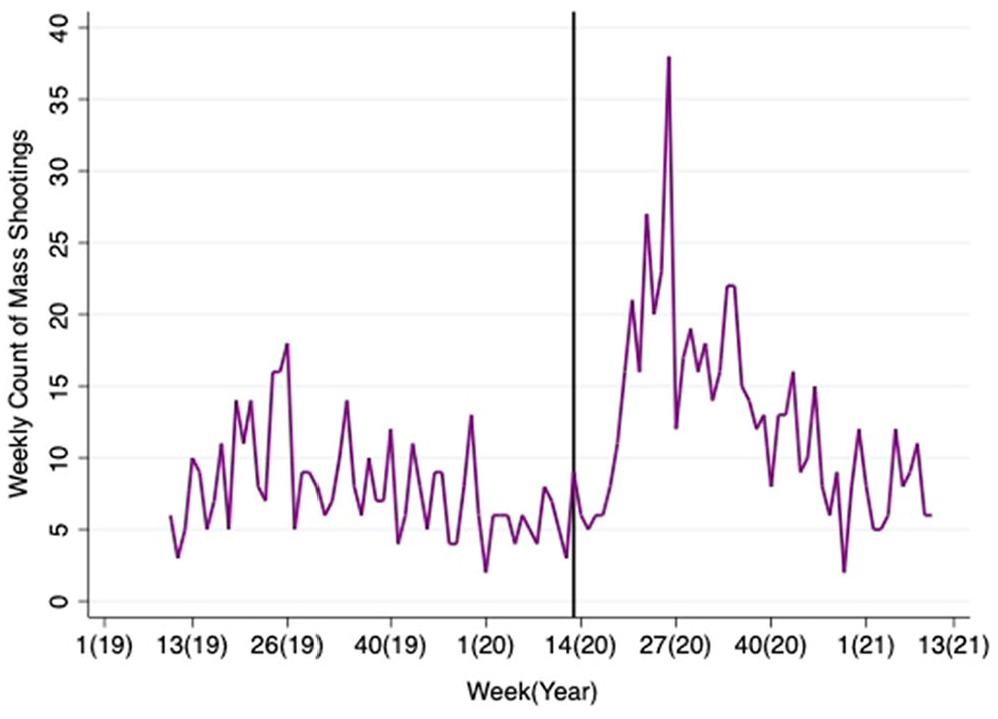
Time series of all mass shootings per week (March 2019–March 2021).

Time series of public and private mass shootings per week (March 2019–March 2021).
To more rigorously evaluate changes in the frequency of mass shootings during the pandemic, ITSA results are presented in Table 1. Recall that these analyses reflect Poisson regression models that account for seasonality, serial correlation, and overdispersion in each mass shooting time series. As seen in Table 1, total, private, and public mass shootings significantly increased following the declaration of COVID-19 as a national emergency. To better determine the magnitude of effects, estimated percent changes in weekly counts of mass shootings were calculated ([exp(b)-1]*100). After the declaration, the estimated mean weekly count of total mass shootings increased by 50.53% (b = 0.409, 95% CI [0.267, 0.552]). For private mass shootings, average weekly counts increased by 53.88% (b = 0.431, 95% CI [0.253, 0.609]), and for public mass shootings, average weekly counts increased by 45.94% (b = 0.378, 95% CI [0.162, 0.594]). Despite the larger effect size for private mass shootings, this coefficient was not statistically different from public mass shootings.
Interrupted Time Series Analysis of Mass Shootings Using Poisson Regression.

Note. N = 104.
January omitted as the reference category.
p < .05. **p < 01. ***p < .001 (two-tailed test).
The results thus far suggest that both public and private mass shootings increased following the declaration of COVID-19 as a national emergency. This emergency declaration marked the onset of a wide range of shelter-in-place and social distancing orders to be issued across the country. That said, there was widespread variation in the timing of these ordinances, with some states not implementing stay-at-home orders until late April 2020 (see Moreland et al., 2020). Accordingly, in supplemental analyses, we varied the weeks chosen to mark the onset of the COVID-19 pandemic. These analyses are summarized in Table 2. As can be seen, regardless of the week chosen to signify the onset of the pandemic between March and April 2020, there still was a significant positive effect on the average weekly counts of total, private, and public mass shootings.
Interrupted Time Series Analysis of Mass Shootings Using Poisson Regression: Varying Dates of Interruption.

Note: All models are specified with one autoregressive lag and monthly indicators of seasonality, consistent with the analyses presented in Table 1. N = 104.
p < .05. **p < .01. ***p < .001 (two-tailed test).
As a related robustness check, we also excluded from the analysis all mass shootings incidents from the following six states that did not implement lockdown orders: Arkansas, Iowa, Nebraska, South Dakota, North Dakota, and Wyoming (n = 29 mass shootings). The analyses were virtually unchanged with these incidents removed. Specifically, the COVID-19 effect was similar in magnitude and statistically significant for all mass shootings (b = 0.390, 95% CI [0.265, 0.516], p < .001), private mass shootings (b = 0.425, 95% CI [0.261, 0.589], p < .001), and public mass shootings (b = 0.342, 95% CI [0.148, 0.535], p = .001).
Another possible source of increases in mass shootings could stem from the murder of George Floyd, an unarmed Black American male, on May 25, 2020. Data analyzed from Gallup before and after his death revealed unprecedented levels of anger and sadness in the population, particularly among Black Americans (Eichstaedt et al., 2021).
Disentangling the impact of COVID-19 from the impact of George Floyd’s murder proved challenging in our time series design, given that variables signifying the onset of the COVID-19 declaration and the murder of George Floyd were highly correlated at .809. However, since George Floyd’s murder occurred after the onset of the COVID-19 declaration, we conducted ITSA using only the post-COVID time period (n = 53 weeks) and used the week of May 25, 2020 as the point of interruption in each time series. These results indicated that George Floyd’s murder had no impact on changes in overall mass shootings (b = 0.354, 95% CI [−0.074, 0.781], p = .105) or private mass shootings (b = 0.125, 95% CI [−0.419, 0.669], p = .652), but that Floyd’s murder was linked to increases in public mass shootings (b = 0.772, 95% CI [0.062, 1.483], p = .033). This finding may be explained by the increases in public routine activities that coincided with nationwide protests over Floyd’s murder, which drew many people out of their homes and back into the public sphere—specifically under conditions of profound sadness, anger, and stress.
In sum, the results indicate the following: (1) that overall, public, and private mass shootings increased after the onset of COVID-19, (2) that these findings were robust to the date of onset of the pandemic, and (3) that the murder of George Floyd—and likely the ensuing protests—also contributed to increases in public mass shootings. These results and their implications are discussed in more detail below.
Discussion
The COVID-19 pandemic led to profound disruptions in the lives of citizens across the globe. In the United States, large scale shifts in routine activities brought on by social distance orders, school closures, and the closing of businesses, meant that more individuals were spending time at home, outside of the public sphere. Not surprisingly, these dramatic shifts in routines impacted crime and violence (Lopez & Rosenfeld, 2021). For mass shootings, however, the nature of this impact was unclear. While some sources stated that the occurrence of fewer mass shootings was a “silver lining” of the pandemic (Pane, 2020), others claimed that mass shootings soared in 2020 (della Cava & Stucka, 2021). In a recent study, Peña and Jena (2021) found that mass shootings increased significantly during the pandemic period, but the authors did not examine whether these patterns varied by location (whether mass shootings took place in private rather than public spaces). 5 To fill this gap, we analyzed all mass shootings occurring in public and private spaces before and after the March 13, 2020 national emergency declaration to understand how the pandemic impacted the prevalence of these events. From our findings, four key conclusions are warranted.
First, the results indicated that mass shootings increased in both private and public spaces. To an extent, these results lend support the hypothesis that private mass shootings increased following the pandemic declaration, when people were spending less time in public spaces. Nevertheless, our hypothesis that the number of public attacks would decrease was not supported. Even though people were spending less time in public places such as schools, bars, restaurants, and workplaces—locations where public mass shootings often occur (Duwe, 2020; Schildkraut, 2021)—we found that many mass shootings still took place in public parks, streets, and open businesses. In part, these findings can be explained by routine activity theory. Specifically, as society’s routine activities shifted in response to the pandemic—where individuals were mostly in their homes—private mass shootings increased. And though many public places were no longer frequented, there still were various areas where individuals congregated. Especially following George Floyd’s murder and the protests that ensued, public mass shootings increased as individuals spent more time outside of their homes. Future research therefore may wish to consider the patterns of incidents disaggregated by specific type of public location and how these “hot spots” for mass shootings may have shifted during the COVID-19 pandemic.
Second, although routine activity theory may help to understand the shift in where mass shootings occurred, this perspective cannot fully explain why these events increased in both public and private spaces during the post-pandemic period. Even when the date of COVID-19 interruption was extended to 6 weeks after the national declaration, significant differences persisted in overall, public, and private mass shootings. Increases in mass shootings also appeared to extend beyond periods of when lockdown orders were in place. Thus, additional perspectives are likely needed that explain these trends via other mechanisms. These perspectives should recognize the influences of increased strain stemming from pandemic-related problems of rising unemployment rates, financial pressures, relationship conflict, exposure to illness and death, and political and racial unrest (Eichstaedt et al., 2021; Hatchimonji, 2020; Kujawa et al., 2020). Increasing levels of stress, coupled with diminished social interactions and reduced social support, may have reduced individuals’ abilities to cope with various pandemic stressors in ways that facilitated mass shootings. Aside from the murder of George Floyd—which coincided with unprecedented levels of anger and sadness in the population (Eichstaedt et al., 2021)—we were unable to take into account such factors in the current study, nor were we able to differentiate between motives or reasons for why mass shootings occurred (e.g., domestic violence, gang dispute). Collectively, these represent important theoretical and methodological directions for future research.
Third, it is important to recognize that our findings must be interpreted in light of the broad definitions of mass shootings that we use. Prior works often use more restrictive definitions of mass shootings (Duwe, 2020; Schildkraut, 2021), typically limiting these events to four or more persons killed by firearm in a public place and excluding incidents that occur in the context of other crimes (e.g., robbery or drug-related offenses) or that stem from domestic violence (Fridel, 2021b; Fox & Levin, 2015; Schildkraut & Elsass, 2016). These definitions eliminate the majority of mass shooting incidents—primarily those that involve women, children, and persons of color as victims. Had we adopted a more limited definition here, we may have erroneously concluded that mass shootings decreased or even “stopped” during the pandemic (see Peterson & Densley, 2021). Public mass shootings, as they are typically thought of (e.g., Columbine, Las Vegas, and El Paso), are rare, yet thousands of people are impacted by public acts of fatal and nonfatal mass gun violence on an annual basis. Researchers, as well as policy makers and even the broader population, may need to reconsider how they define public mass shooting events. Doing so can have important implications for learning how to prevent these incidents in locations other than schools and workplaces.
Fourth, no study is without limitations, and we wish to recognize a few here. First, even though the GVA (n.d.b.) identifies mass shooting cases from more than 7,500 sources using both automated and manual queries, it is possible that there are incidents not included within the population of events. Still, it is believed that this is the most comprehensive data set including cases where four or more individuals, excluding the perpetrator(s), were shot. Second, as noted, we did not specifically disaggregate location type beyond public or private. Given the wide variability of location types, particularly in the context of public incidents, future research may wish to explore these differences further.
Additionally, there were many additional social changes occurring during 2020 that could have influenced mass shootings that we could not account for here. For example, alcohol consumption may have played a role in facilitating mass shootings, given that alcohol retail sales increased substantially during the pandemic period (Castaldelli-Maia et al., 2021). More guns also were sold in 2020 than in any previous year on record (Fisher et al., 2021; Lang & Lang, 2021), and increases in gun ownership have been linked to increases in mass violence (Fridel, 2021a). Lastly, the data extend only through March of 2021. As more data continually are collected beyond the onset of the 2020 pandemic, we will better be able to determine the factors that coincide with increases and decreases in mass shootings over time, and how trends in mass shootings further fluctuate alongside widescale shifts in society’s routine activities.
Research also must continue to strive to understand where and how these events occur to guide prevention efforts and corresponding policy development. Specifically, understanding not only the prevalence of events like mass shootings (e.g., Duwe, 2020; Schildkraut, 2021) but also how their occurrence varies across location and time is vital to inform such efforts, including resource allocation (see also Felson & Poulsen, 2003). Even without a global pandemic, localities (e.g., towns, cities, and counties) and specific places within them (e.g., businesses and neighborhoods) do not have unlimited resources, including money and personnel, at their disposal to be able to work toward preventing and responding to mass shootings, particularly given their rarity of occurrence (Schildkraut et al., 2022). With the pandemic, these resources have undoubtedly become further strained as the nation faced both economic (Bauer et al., 2020) and employment (Falk et al., 2021) crises. As such, focusing on resource allocation is vital to maximizing the “return on investment” relative to prevention and response.
Importantly, these results should not be used to attempt to forecast where or when a mass shooting might occur (Schildkraut et al., 2022). Even with a broader definition than other studies, there still is a low base rate of events that do not yield sufficient power for prediction (Borum et al., 1999; Rocque, 2012). Even so, by better understanding the dynamic nature of mass shootings, including how their occurrence has been and continues to be impacted by the COVID-19 pandemic, we can continue to work toward more evidence-based solutions for prevention, mitigation, and response. Such assessments also will continue to provide important insight about how residential communities, in addition to public locations, are affected by mass shootings.
Footnotes
Declaration of Conflicting Interests
The author(s) declared no potential conflicts of interest with respect to the research, authorship, and/or publication of this article.
Funding
The author(s) received no financial support for the research, authorship, and/or publication of this article.
