




Abstract
Prevailing approaches to individual and group creativity have focused on personal factors that contribute to creative behavior (e.g., personality, intelligence, motivation), and the processes of behaving creatively and appreciating creativity are understood to be largely unrelated. This article uses social identity and self-categorization theories as the basis for a model of creativity that addresses these lacunae by emphasizing the role that groups play in stimulating and shaping creative acts and in determining the reception they are given. We argue that shared social identity (or lack of it) motivates individuals to rise to particular creative challenges and provides a basis for certain forms of creativity to be recognized (or disregarded). Empirical work informed by this approach supports eight novel hypotheses relating to individual, group, and systemic dimensions of the creativity process. These also provide an agenda for future creativity research.
Creativity “involves the development of a novel product, idea, or problem solution that is of value to the individual and/or the larger social group” (Hennessey & Amabile, 2010) and is widely recognized as an important construct for psychologists to explore and understand (Runco, 2004). Indeed, Hennessey and Amabile (2010) describe the study of creativity as “a basic necessity” for “all upon whom civilization depends” (p. 570). For example, in the world of business, the contemporary mantra is that the modern organization has to respond rapidly to the challenges and opportunities of a world that is in perpetual flux (Mumford, Hester, & Robledo, 2012; Puccio & Cabra, 2009; Rickards, 1996). Here the capacity for employees to solve problems creatively and to respond enthusiastically to the creative solutions of others is deemed essential if organizations (and their members) are to survive (and thrive) in a world that lurches from one crisis to the next (Drazin, Glynn, & Kazanjian, 1999; Janssen, van de Vliert, & West, 2004; Perry-Smith & Shalley, 2003).
Yet one could argue that there is a more fundamental importance to creativity, stemming from its functions for humans as a species. For humans possess specific abilities that separate them from other animals in nonphysical ways. In particular, over the course of their evolution, humans have evolved a capacity for culture. As a result, human societies are defined by embedded sets of shared norms and values that serve to create shared meaning for their members (Richerson, 2004). Culture is not only restricted to a set of norms or practices but also comprises social beliefs, customs, systems of sanction and reward, an elaborate set of social institutions, and a range of artefacts ranging from money to art—each of which has an associated social value (Lehman, Chiu, & Schaller, 2004). This capacity for culture epitomizes the fundamental puzzle of humanity. In one sense, for humans to function within a culture, they have to engage in social learning and display conformity. But, for culture to be possible, humans themselves have to be innovative and creative, and be prepared to invent (and, if necessary, reinvent) many aspects of their life. They also have to tolerate, adapt to, and sometimes embrace creativity in others. This conundrum concerning the balance between individual independence and social conformity has long been of interest to philosophers and social scientists, and lies at the heart of the social psychology of creativity.
This conundrum can be exemplified by reflecting on the stone-age frescoes in the Paleolithic caves of Lascaux in south-west France. What kind of social animal could give rise to a society in which certain individuals are liberated from their worldly concerns (hunting, gathering) to create wall displays that are distinguished by their original and stunning beauty (Curtis, 2006)? What social system tolerates and stimulates such exceptional displays of creativity—displays that not only express individual talents for art but simultaneously speak to the success of that society? In this art, one can see clearly what distinguishes humankind from our next-of-kin in the animal kingdom, for it is acts of creativity like these that allow societies to be formed and reformed. The relevance of the scientific study of creativity, then, is not just that it speaks to an important human ability and seeks to harness it for noble ends. Creativity also goes to the heart of the human condition and, as a result, the intellectual issues that surround it constitute master problems for the sciences and humanities alike.
To shed fresh light on this topic, the present review develops a social identity approach to creativity that provides a framework not only for integrating and building upon insights provided by established approaches but also for reconstruing some core aspects of this process by systematically theorizing about the interactive relationship between the individual and the group (in a way that moves beyond relatively vague references to the importance of “social context” as a mediator between these elements). Critically, while prior research has treated the performative and evaluative aspects of creativity as if they were largely unrelated, a core insight of the social identity approach is that these are theoretically linked for the reason that both involve an identity-based relationship between individual creators and the groups that stimulate, appreciate, and respond constructively to their creativity. In these terms, the relationship between a creator and his or her (potential) ingroup is seen to lie at the heart of the creative process as this not only encourages (certain forms of) originality but also determines the reception that originality receives.
A Social Identity Approach to Creativity
According to Amabile (1996), much of the contemporary research into creativity centers on two key questions: (a) What makes creative performance different from ordinary performance? and (b) What factors lead to creative performance? It is generally assumed that the first question can be answered with reference to dispositional characteristics of individuals (and of the groups in which they are found) that bear upon the intrinsic quality of their creations (e.g., Albert & Runco, 1999; Feist, 1998). Likewise, the second question has largely been addressed by pointing to the importance of individual factors (e.g., in personality or upbringing; Hennessey, 2003).
Yet it is also apparent that answers of this form leave quite a lot of the variance in the creative process unexplained. In particular, this is because they often fail to acknowledge its contextual determinants (Csikszentmihalyi, 1994). Critically, then, as the very earliest discussions of this topic recognized (e.g., Galton, 1869), social context provides a frame of reference for the evaluation of creative products that is a major determinant of their success or failure (Csikszentmihalyi, 1988; Floistad, 1993; Gardner, 1993; Hennessey, 2003; Lubart, 1990). Indeed, the importance of social context becomes apparent once one recognizes that the creative process involves at least three steps: (a) the production of ideas, (b) the appraisal of ideas, and (c) the influence of ideas (e.g., Basadur, Basadur, & Licina, 2012; Puccio, & Cabra, 2009).
Dispositional and contextual approaches to creativity play a role at each step of this overall process although their emphases are clearly very different—with dispositional approaches tending to focus more on what are seen to be the earlier production phases and contextual approaches on what are seen as the later evaluation and impact phases. A critical question for the field, therefore, is whether (and, if so, how) there might be scope to advance a social-psychological analysis of creativity that accounts for its individual and its social contextual dimensions. To address this issue, we propose a new analysis of creativity that is informed by insights from social identity and self-categorization theories (Tajfel & Turner, 1979; Turner, Hogg, Oakes, Reicher, & Wetherell, 1987; aka, the social identity approach; Haslam, 2004; Turner, 2004).
One basic premise of the social identity approach is that individuals can categorize themselves either as individual persons (“I,” “me”) or as members of the groups to which they belong (“us,” “we”; Turner, 1985). For example, a surrealist painter, Max, can categorize himself as an individual (i.e., “I, Max”) or as a member of his artistic group (i.e., “us surrealists” or “I, the surrealist, Max”). In the former case, his sense of self is defined in terms of the idiosyncratic characteristics that define his sense of personal identity, and it is these that determine his behavior (Prentice, 2006; Turner, 1982). In relation to creativity, it follows that, other things being equal, when personal identity is salient, individuals’ creations are more likely to reflect their own idiosyncratic style and that their evaluations of other creations are more likely to be guided by personal preferences. Under these circumstances, then, creative behavior is more likely to be informed by individual differences of the form examined in classical approaches to creativity (e.g., Feist, 1998).
In contrast, when social identity is salient, individuals derive relevant aspects of their sense of self from their membership of a particular group and value their own and others’ actions with reference to internalized understandings of that group membership (e.g., so that, as a surrealist, Max is interested in, and appreciates the value of, free association). Put slightly differently, when a particular social identity becomes salient, individuals’ self-perception becomes depersonalized, such that their perceptions, evaluations, and actions are informed more by the shared attributes that define their social group membership and less by their unique individuating characteristics (Turner, 1982, 1991). One direct implication of this for creativity is that when social identity is salient, creative behavior and evaluation are more likely to be informed by group values, preferences, and norms. For example, even though Max may strive for some degree of distinctiveness within the group (Brewer, 1991; Codol, 1975; Jans, Postmes, & van der Zee, 2011; Jetten & Postmes, 2006), when he thinks of himself as a surrealist, he will be more likely to paint and evaluate other paintings in ways that accord with surrealist artistic guidelines and preferences.
In this regard, a key contribution of self-categorization theory (Turner et al., 1987, Turner, Oakes, Haslam, & McGarty, 1994) has been to provide an analysis of social identity salience. Following Bruner (1957), the theory asserts that this is an interactive product of cognitive accessibility (or perceiver readiness) and fit (Oakes, 1987; Oakes, Haslam, & Turner, 1994). Accessibility refers to individuals’ readiness to use a given category. For example, other things being equal, Max is more likely to define himself as a surrealist if he has been a member of a surrealist group for some time, and if he is immersed in a culture in which surrealism is a mainstream movement (e.g., 1920s Paris). Relatedly, accessibility is also determined by individuals’ identification with that category (i.e., the extent to which the group is valued and self-involving, self involving; Doosje & Ellemers, 1997; Doosje, Ellemers, & Spears, 1995; Postmes, Haslam, & Jans, 2012). Accordingly, Max is more likely to self-categorize as a surrealist if he identifies with the surrealist movement.
Fit refers to the match between a given categorization and comparative and normative aspects of reality. The comparative fit of a given social category is increased to the extent that the differences between people in the category are perceived to be smaller than the differences between those people and other noncategory members that are part of the perceiver’s frame of reference (the principle of meta-contrast; Turner, 1985, see also Campbell, 1958). Among other things, this means that a particular social identity is more likely to be salient when members of a group compare themselves with a distinct outgroup (e.g., as surrealists rather than impressionists; Haslam & Turner, 1992). Normative fit is increased to the extent that category content matches a perceiver’s expectations for a specific categorization. For instance, Max’s social identity as a surrealist is more likely to be salient in an art gallery where he and other surrealists are discussing the positive aspects of surrealism than it would be if they had gone to watch a football match together.
Understanding (a) that creativity can be underpinned either by a person’s sense of themselves as a unique individual or by their self-categorization as a group member and (b) that this self-definition varies meaningfully with changes in social context, provides a basis for seeking to reconcile dispositional and contextualist approaches to this topic alluded to above. In particular, this is because the social identity approach clarifies one of the ways in which social context structures creativity (e.g., as argued by Csikszentmihalyi, 1998)—namely, by encouraging individuals to define themselves in terms of an identity that they either share or do not share with others. Significantly too, as Figure 1 suggests, this approach suggests that rather than involving entirely different principles, there is a close theoretical relationship between the two essential components of the creative process: on one hand, acts of creativity (i.e., individual behavior that is celebrated for its originality) and, on the other, the appreciation of creativity (i.e., social judgments of new ideas and products). More specifically, we argue that it is processes of self and identity that connect these two components and that creativity and its appreciation are the product of the dynamic interplay between personal and social identity and the social norms embedded within them.
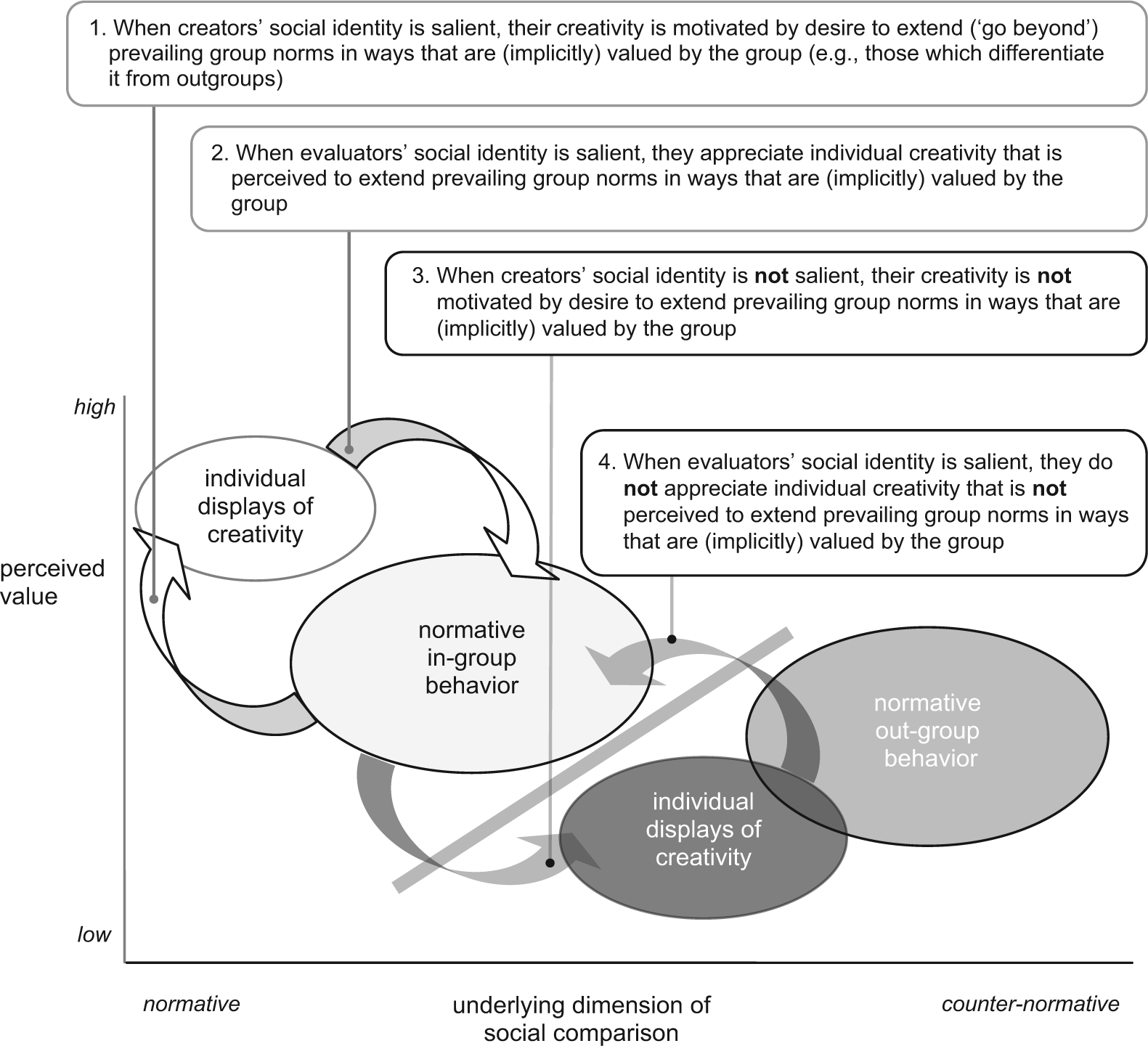
Hypothesized variation in (a) creative motivations and (b) evaluations of creativity as a function of social identity salience.
In practice, of course, these two aspects of the creative process need not be aligned. That is, the groups that have a role in stimulating creative acts will not necessarily be the ones that ultimately evaluate those acts. Not least, this is because the broader contexts of these two processes will often be very different, and separated by place and time. In the case of Picasso, for example, the group influences that shaped his painting were very different from those that ultimately contributed to his reputation because one consequence of his creativity was that it started out as a rejection of one set of particular artistic conventions but ultimately served to embed another set. Indeed, as this example illustrates, the creative process itself will often ensure a lack of alignment between production and reception phases because it is a catalyst for social change and because it is ultimately celebrated for the social change that it produces (Jetten & Hornsey, 2011; Moscovici, 1976).
This analysis integrates a number of significant observations that have previously been made by creativity researchers. In particular, it acknowledges the importance of social recognition (e.g., reputation; Galton, 1869; Howe, 2000) to the creative process, and shows that the source of this lies in social consensus about the perceived value of a creative individual’s acts (Amabile, 1983). In line with systems and network approaches, it also suggests that to be recognized as creative, individuals need to have support (e.g., among potential critics) and be well-positioned within a relevant field (e.g., be aligned with relevant standards and norms and at the center of a relevant social network; Csikszentmihalyi, 1999; Gronum, Verreynne, & Kastelle, 2012; John-Steiner, 2000). This same analysis also suggests that groups themselves can be a stimulus and a site for creativity (Paulus, Brown, & Ortega, 1999) but that the nature of this (and the degree of alignment between these two aspects of the process) depends on the norms of the group (Paulus & Dzindolet, 1993) and the extent to which it is meaningful for potential creators.
The fact that the group norms that inform creativity differ dramatically (e.g., over time, across cultures) also explains why it is often hard to identify objective properties that define something as intrinsically creative (Amabile, 1996; Csikszentmihalyi, 1998) but why this task proves easier in domains where norms and associated social identities are consensually embraced and relatively stable (e.g., in mathematics as opposed to art). Nevertheless, even in hard science, we would argue that these same processes are at play. Here, though, their operation will often only be visible during times of profound upheaval (e.g., during scientific revolution; Kuhn, 1962). An example might be Ueda’s groundbreaking computational work on chaos theory, which his PhD supervisor banned him from publishing for 9 years because it was too avant-garde (Ueda, 2000). For despite being mathematically brilliant, Ueda’s work on the nature of strange attractors was only recognized when a community of scientists was ready and willing to take it on board.
As well as integrating these various observations, a particular strength of the social identity approach is that it provides novel answers to a number of thorny questions in the creativity literature—most obviously, Amabile’s (1996) concern about what makes creative acts different from ordinary ones and what it is that stimulates them. First, the approach argues that creative performance is always defined relative to the norms of ordinary performance from which it deviates. The creativity of the Sex Pistols, for example, was defined relative to the musical and societal norms that it extended. But whether that deviation is valued depends on the identity-based relationship between creators and relevant audiences. So for anarchists in the punk movement, the band were groundbreaking visionaries, while for members of the establishment they were dangerous miscreants (Sabin, 2002).
Accordingly, creativity will generally only be appreciated to the extent that it is (or comes to be) understood to be motivated by the advancement of particular group interests. At the same time, second, it is the identity-based desire to make specific types of advance (those that either embrace or reject a particular group’s values) that also motivates particular acts of creativity. This is seen in the claim by Sid Vicious that his band’s music was inspired by a rallying call to “undermine [the establishment’s] pompous authority, reject their moral standards, make anarchy and disorder your trademarks” (Pelengaris & Khan, 2013, p.188). 1 So, like it or not, the establishment was an essential driver of the Sex Pistols’ creative force.
Testing a Social Identity Approach to Creativity
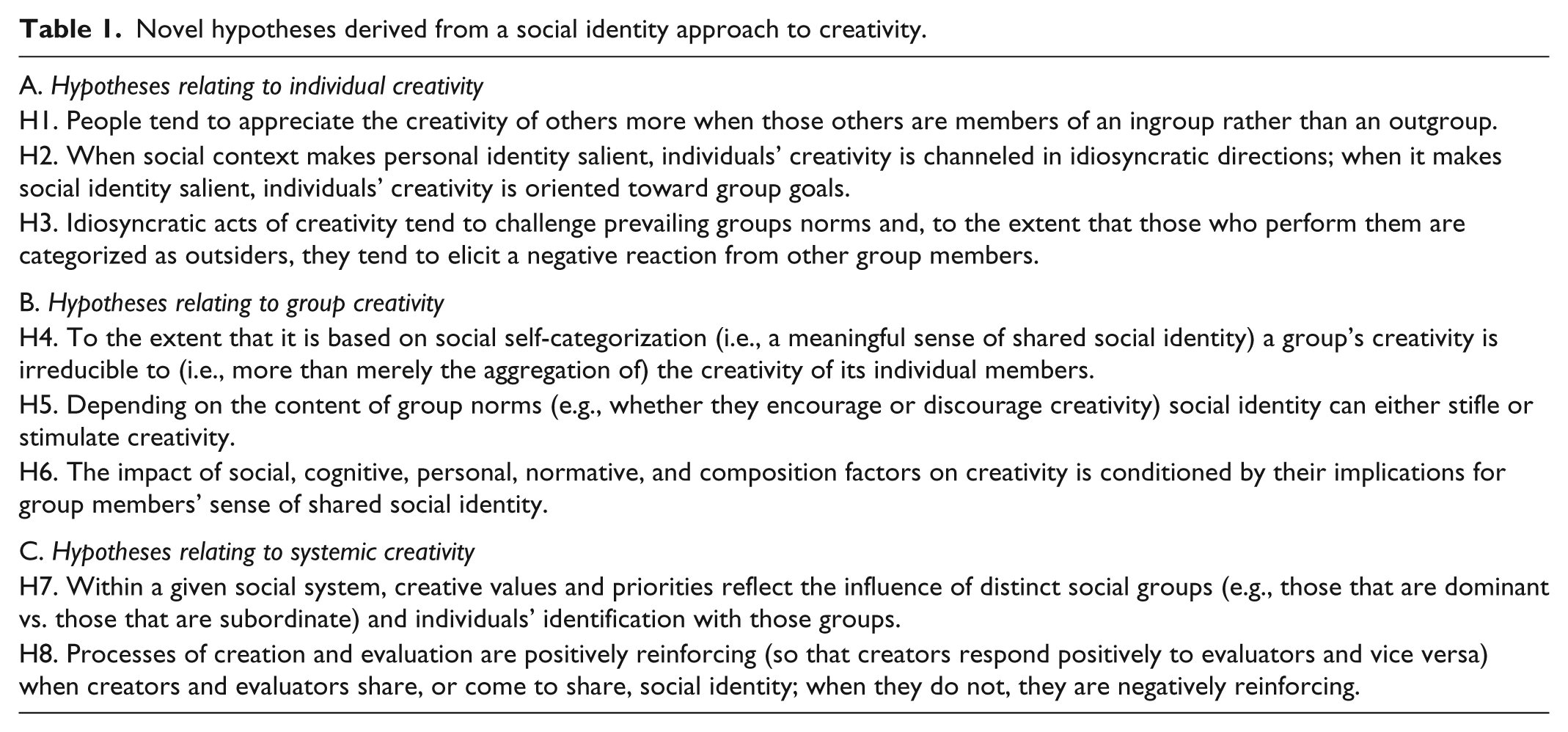
In recent years, the above arguments have been explored within a program of research that has sought to subject them to empirical testing (Adarves-Yorno, Haslam, & Postmes, 2008; Adarves-Yorno, Postmes, & Haslam, 2006, 2007; Haslam et al., 2006; Haslam, Wegge, & Postmes, 2009; Jans et al., 2011; Jans, Postmes, & Van der Zee, 2012; Jans, Postmes, Van der Zee, & Seewald, 2013). More formally, this work can be seen to center on the eight novel hypotheses presented in Table 1. These have formed the basis for three interrelated lines of empirical research that we will now review. These have sought to show (a) that the appreciation of creativity is structured by shared social identity (H1, H3, H4, H7, H8), and that creative efforts are themselves structured by (b) social identity content (H3, H4, H5, H6) and (c) creators’ sensitivity to ingroup standards (H2, H3, H5, H7).
Novel hypotheses derived from a social identity approach to creativity.
Being Seen to Be Creative
In line with the basic tenets of self-categorization theory, it can be hypothesized that there are a number of relational factors that impact upon perceptions of creativity. In particular, these perceptions should be affected (a) by perceivers’ sense that they belong to a particular group (i.e., their self-categorization in terms of a salient social identity), (b) by the nature of a person’s relationship to that group (i.e., their social identification with it), and (c) by the norms associated with a salient social identity. These elements are all interrelated—in particular, because social identification is an aspect of self-category accessibility that determines social identity salience (Haslam, 2004)—but nevertheless, it is helpful to consider the importance of each in turn.
The importance of group membership
Self-categorization theory (Turner et al., 1987) argues that social identity and the recognition of shared group membership are key determinants of people’s orientation toward others (Turner, 1991). In particular, when people consider themselves to belong to the same group (such that they self-categorize as members of a common ingroup), they will be more motivated to engage constructively with other ingroup members. This is because as group members they expect—and therefore strive—to have shared perceptions, understandings, and goals in relation to issues that are relevant to their group membership (Haslam, 1997; Turner, 1991; Turner & Oakes, 1989; see also Haslam, Powell, & Turner, 2000; Postmes, Haslam, & Swaab, 2005). Put slightly differently, shared social self-categorization creates an expectation among group members that, on group-relevant dimensions, their perceptions and behavior will converge (Asch, 1951).
The direct implication of this claim is that any given product is more likely to be perceived as creative and to be regarded favorably when its creator is considered a member of a psychological ingroup. In other words, to dispel the uncertainty that creative products introduce by disrupting the status quo (Mueller, Melwani, & Goncalo, 2012), a creator needs to be seen as “one of us” who is “doing it for us” (Haslam, Reicher, & Platow, 2011; Turner, 1991). This phenomenon is apparent in a range of settings. For example, in organizational domains, “insiders” are often found to be antagonistic toward outsiders’ contributions—leading to what management theorists refer to as Not Invented Here (NIH) syndrome (Katz & Allen, 1982; Lichtenthaler & Holger, 2006; Stein, 2003). Likewise, in artistic domains, people are typically found to display ethnocentric bias when judging others’ creativity (Simonton, 1984). That is, they consider “our” creators and creations to be superior to “theirs,” and also regard creations (and dimensions of creativity) that valorize “us” to be superior to those that valorize “them” (Morton, Haslam, Postmes, & Ryan, 2006). Illustrative of this point, Steffens and colleagues note that while the Oscars awarded by the U.S.-based Academy of Motion Picture Arts and Sciences and the BAFTAs awarded by the British Academy of Film and Television Arts are meant to judge the objective quality of films, since 1968, U.S. actors and actresses have received 80% of the Oscars for best actor/actress but only 47% of the BAFTAs, while British actors and actresses have received 43% of the corresponding BAFTAs but only 13% of the Oscars (Steffens, Haslam, Ryan, & Kessler, 2013). More general evidence of this point also emerges from cross-cultural research that shows that what people actually mean by creativity (and hence how they measure and reward it) varies as a function of their cultural identity (e.g., Paletz & Peng, 2008; Raina, 1993).
In extreme cases, this differential responsiveness to ingroup and outgroup creativity can mean that people refuse to engage with the creative efforts of outgroup members altogether—dismissing them as worthless or else vilifying them as sinful, obscene, and corrupt (as evidenced, for example, in the Nazis’ denunciation of the Bauhaus movement; Amatrudo, 1997). Indeed, as Mahoney (1977) observes, this is an experience that scientists routinely experience in the process of submitting research for peer review (an experience that is no less uncommon when that research is on the topic of creativity). This goes to the heart of the paradox identified by Mueller and colleagues whereby people typically express a desire to embrace the idea of creativity but nevertheless reject the specific forms of creativity that they encounter in practice (Mueller et al., 2012; see also Rietzschel, Nijstad, & Stroebe, 2009).
At the same time, it needs to be understood that the ingroup–outgroup boundaries that structure responses to creativity are flexible and context-dependent rather than in any sense given (Doosje, Haslam, Spears, Oakes, & Koomen, 1998; Haslam & Turner, 1992). For example, the cinematic tastes of a young American woman may be dictated not only by her youth, her nationality, her class, her politics, or her gender, but also by the specific meaning of these (and other) ingroup categories in a given comparative and normative context. So, among other things, this may mean that she explicitly rejects films (and forms of creativity) that are supported by Hollywood studios and is instead a fan of independent or foreign cinema—because, in the context of going to the cinema, it is a particular political identity and not her nationality that provides the primary basis for her self-categorization. Apart from anything else, such dynamics help to explain why creativity is sometimes embraced in what seems to outsiders to be unlikely quarters (e.g., as documented in the Academy Award-winning film Searching for Sugar Man; Bendjelloul, 2012).
To test these predictions, we conducted three experiments that examined variability in the perceived creativity of different products as a function of whether they were believed to emanate from an ingroup rather than an outgroup (Adarves-Yorno, 2005; Adarves-Yorno et al., 2008). In the first study, British students evaluated pictures supposedly painted by either an ingroup (British college students) or an outgroup (Dutch college students). In the second study, British participants evaluated suggestions about how to follow up a television program that was said to have been generated in either an ingroup or an outgroup forum (a British or a Dutch website). In the third study, students evaluated the creativity of advertising material (a pamphlet espousing the value of university life) that had supposedly been created by a student from either their own or a rival university. Despite the fact that they were always evaluating identical products (paintings, ideas, adverts), in all three studies participants perceived those that were thought to have been produced by the ingroup to be significantly more creative than those that were thought to have been produced by an outgroup.
In light of a large literature that shows that people tend to rate ingroup products more highly than those of outgroups (e.g., Hewstone, Rubin, & Willis, 2002), such findings suggest that perceptions of creativity are closely related to displays of ingroup bias. Indeed, in the three studies reported by Adarves-Yorno and colleagues (2008), liking for different products was highly correlated with assessments of their creativity (see also Chen et al., 2002; Hennessey, 1989). Nevertheless, we argue that these constructs are not interchangeable and that belief in the superior creativity of ingroup creations is not simply a manifestation of ingroup favoritism. In particular, this is because, as Amabile (1996) has argued, the two judgments are outcomes of different processes. More specifically, creativity judgments do not only reflect motivations for self-enhancement but are also anchored in group norms. This means that what we see as creative we generally like, but what we like we do not always see as creative.
This claim is supported by evidence that in Adarves-Yorno et al.’s (2006) studies, the effect for perceived creativity was still significant when controlling for participants’ liking of the ideas that were generated by contributors. Moreover, in the second study, while outgroup pamphlets were seen to be less creative than those of the ingroup, they were not seen to be any less beautiful. These results suggest that judgments of creativity are empirically distinguishable from, and irreducible to, judgments of positivity. As other researchers have observed, recognition of a product’s creativity involves more than simply liking it (Amabile, 1979, 1982; Martindale, 1990), and this is no less true when that judgment is conditioned by shared group membership with the creator.
The importance of social identification
Among other things, when someone identifies strongly with a given group, he or she will be more likely to interpret and engage with reality in a manner consistent with the values, norms, and ideology of that group (Turner, 1991). For instance, if Max values his social identity as a surrealist painter, then his identification with the group is likely to be strong, and in turn (a) his paintings are more likely to conform to surrealist conventions and (b) he is more likely to perceive other surrealist paintings to be creative than would be the case if he did not identify with this artistic group. Thus, identification with a group should lead individuals (a) to converge upon views and actions that are normative for the group, (b) to be more committed to those views and actions, and (c) to be more open to influence from ingroup members. All of these elements should in turn impact on perceptions of creativity and reactions to creative products.
Prior research has indicated that identification is indeed related to responses to innovation. In particular, identification with a creator and involvement in the innovation process have been found to influence people’s responses to organizational innovation (King, 2003). A commonly observed corollary is that “outsiders” routinely experience difficulty in getting those who identify with other groups to acknowledge and engage with their creativity. Thus, just as the cubism of Paul Cézanne received an unenthusiastic welcome from members of the 1860s Paris Salon, so the feminist Rosalind Franklin found that there was little receptivity to her insights into the structure of DNA among conservative males in 1950s Cambridge (Lindsay, 1969; Sayre, 1975).
To test these ideas empirically, we conducted a study in which students were asked to complete a three-item measure of social identification with their university and then to evaluate five ideas proposed by a student who was representative of that ingroup (Adarves-Yorno et al., 2006). As predicted, the more students identified with the university, the more they perceived the ideas of the student representative to be creative.
This finding has practical implications for the implementation of changes and innovations that depend on people’s endorsement of creative ideas (Amabile, 1996). Specifically, it suggests that in an environment where people are uncommitted to, and lack identification with, the overall purposes of a group or organization (e.g., because they identify with a nonaligned subgroup), they will generally be less responsive to any innovation that the group or organization attempts to introduce (Mueller et al., 2012). This proposition is supported by a large body of organizational research informed by social identity theorizing (e.g., see Ellemers, 2003; Jetten & Hutchison, 2010; Jetten, O’Brien, & Trindall, 2002; Terry, 2003).
The importance of group norms
Analyzing perceptions of creativity with reference only to group membership and social identification treats the context within which creativity is assessed as if it were relatively value-free—with no one particular course of action or style proscribed as any more desirable than another. In real life, however, such circumstances are rare, if not nonexistent. In most social contexts, normative criteria serve to define the forms of creativity that are acceptable and unacceptable, and these in turn influence people’s perceptions of creativity (Amabile, 1996; for illustrative case studies see Howe, 2000). In short, being creative is not just a matter of being different, but of being different in particular ways.
Interestingly, though, normative criteria are argued to work in opposite ways by different scholars. While some researchers argue that creations need to follow normative criteria to be considered creative (Markus & Kitayama, 1991), others argue that creative products need to deviate from normative criteria (Amabile, 1996; Eisenman, 1990; Simonton, 2000). On the basis of previous theorizing, we suggest that it is possible to reconcile these contradictory observations through recourse to self-categorization principles that suggest that the impact of group norms varies as a function of social identity salience (e.g., Postmes & Spears, 1998; Reicher, 1987; Spears, Lea, & Lee, 1990; Wilder & Shapiro, 1984). More specifically, self-categorization theory predicts that group norms should only inform individuals’ judgments to the extent that this group (rather than a person’s individuality or another group) provides the salient basis for self-definition.
One implication of this analysis is that when social identity is salient, perceivers will tend to consider ideas and products to be more creative if they fall within normative boundaries. However, when their personal identity (or an alternative social identity) is salient and a particular social norm is explicit, people will tend to deviate from (or at least not act in line with) that norm and will therefore be more likely consider an idea to be creative if it too is nonnormative.
To test these ideas, we conducted two experiments that tested the hypothesis that perceptions of creativity are interactively determined by the salience of a given social identity for perceivers and by the content of the group norms to which that identity relates (Adarves-Yorno et al., 2006). The first of these studies explored the impact of identity salience (personal vs. social) and norm content (conservative vs. progressive) on the evaluation of a conservative proposal. More specifically, participants’ social identity as students at a particular university was either made salient or not, and they were led to believe that most students in this institution were either in favor of change or opposed to it. As predicted, results indicated that when social identity was salient, participants’ perceptions of creativity were informed by the group norm such that they perceived conservative ideas to be more creative when they were congruent with the ingroup norm (conservative) rather than incongruent (progressive). In contrast, when personal identity was salient, there was evidence of the opposite pattern: Participants tended to perceive the conservative ideas to be relatively less creative when the group norm was conservative rather than progressive. In other words, participants whose social identity was made salient perceived ideas to be creative when those ideas fell within the boundaries of group norms, and participants whose personal identity was salient perceived ideas to be relatively more creative when they fell outside these boundaries.
However, it could be argued that these effects reflected participants’ approval of particular ideas, rather than their appreciation of creativity per se. As suggested above, we argue that although perceptions of creativity are related to other forms of positive evaluation, they nevertheless reflect different underlying processes—such that creativity judgments are made with reference to specific group norms and values (Amabile, 1996; Martindale, 1990) while judgments of liking reflect general motivations for self-enhancement (Hewstone et al., 2002; Tajfel & Turner, 1979). This leads us to expect that while the perceived positivity of a given creation will primarily be determined by its self-relevance, its creativity will also depend on its relationship to self-defining norms. By way of example, medical innovation is likely to be more self-relevant for medics than for artists and hence should be liked more by medics than by artists; but whether any innovation is seen as creative will also depend upon how that innovation relates to the content of medical norms that lead medics to see some developments (e.g., those made by men) as more creative than others (something that might help explain why less than 5% of the recipients of the Nobel Prize for Physiology or Medicine are women).
To try to disentangle perceived creativity from general positivity, Adarves-Yorno and colleagues (2006) conducted a second study in which social identity salience was kept constant throughout. Here, however, the self-relevance of a given creation and its relationship to group norms were manipulated orthogonally. In the study, all participants were asked to evaluate novel ideas that proposed improving the university (at which they were students) through the use of IT. However, students were recruited from different departments in which the self-relevance of these ideas was either high or low (they were selected either from “protechnology” science departments or from “cultural” humanities departments). They were also given normative information that led them to construe university students in general as either protechnology or proculture. The key prediction here was that while global evaluation of these ideas would primarily reflect the department that the students were drawn from (so that ideas would be evaluated more positively by students in protechnology science departments), judgments of the ideas’ creativity would primarily be determined by participants’ beliefs about student norms (so that ideas would be evaluated more positively when students believed the student norm to be protechnology).
Although these two sets of judgments were again highly correlated (reflecting the fact that, in practice, self-relevance and group norms are hard, if not impossible, to fully disentangle), the pattern of results provided clear support for these predictions. More particularly, group norms had significantly more impact on participants’ judgments of creativity than on their global evaluations, while group membership had significantly more influence on global evaluations than on judgments of creativity. This pattern supports claims that the recognition of creativity is essentially a social judgment (Csikszentmihalyi, 1998; Kasof, 1995) that is grounded not only in a person’s group membership (such that ingroup products are generally seen as more creative than outgroup ones; Adarves-Yorno et al., 2008) but also in the specific normative criteria that are associated with, and define, that group (Amabile, 1996). To be seen—and celebrated—as creative, creators not only have to be seen as “one of us,” but their creations also have to be consonant with group members’ understanding of the form that creativity should take. Indeed, for this reason, it can be very helpful to acknowledge (as Newton did) that one’s creativity arises from “standing on the shoulders of giants” because this makes it clear not only that you share identity with your colleagues but also that you are looking in the same direction.
Being Creative
The importance of the interaction between self-categorization and group norms
Thus far, our analysis has focused on the impact of various factors on perceptions of creativity, yet it is obviously true that researchers in this field are generally interested in actual creative behavior and performance. In this regard, a key assertion of self-categorization theory is that social identity serves not only to regulate individuals’ perceptions but also their behavior. It does this by providing the basis for them to have a shared perspective on social reality and to engage in mutual social influence (Turner, 1987, 1991; see also Haslam, 2004; Haslam & Ellemers, 2005). This means that in a context where two or more individuals perceive themselves to share social identity, they will be motivated to coordinate their behavior with reference to beliefs, values, and norms that define the group’s shared meaning (Haslam, 1997; Postmes, Haslam, et al., 2005; Postmes, Spears, Sakhel, & de Groot, 2001; Postmes, Spears, & Lea, 2000).
For instance, a group of surrealist painters is likely to develop particular artistic sensibilities and guidelines that then provide parameters for what is deemed creative (e.g., images of the unconscious) and members of the artistic group are expected to paint with reference to those rules. In other words, to the extent that they see themselves as members of a distinct movement, individuals are likely to lay down and to follow group norms that define what it means to be “one of us.” In this way, group norms—that are internalized by group members and which describe and prescribe appropriate thought and behavior within the group—have an important social function as powerful regulators of cognition and action (Bechtoldt, De Dreu, Nijstad, & Choi, 2010; Levine & Moreland, 1990; Nijstad & Stroebe, 2006; Turner et al., 1987).
It is important to note that the impact of group norms in shaping expectations and encouraging conformity depends, among other things, on how central the issues in question are for the group (Levine & Moreland, 1990; Postmes & Spears, 1998; Sherif, 1936). The range of acceptable behaviors (i.e., group members’ “latitude of acceptance”; Sherif & Hovland, 1961; Sherif & Sherif, 1969) therefore depends on the centrality of the specific issues for the social identity in question (so that surrealist painters are more likely to conform to surrealist guidelines in their painting than in their cuisine, say). In this way, norms that relate to issues that are central to the group (e.g., painting) will tend to have a very narrow latitude of acceptance—such that the range of acceptable behaviors is quite restricted. However, norms that relate to peripheral aspects of group life (e.g., cuisine) will tend to have broader latitude of acceptance—so that there is a greater tolerance of deviance.
Put slightly differently, when social identity becomes salient, people tend to conform to norms that define their ingroup identity (Reicher, 1987; Spears et al., 1990; Wilder & Shapiro, 1984). Accordingly, a group member whose social identity is salient is likely to behave creatively by conforming to norms. In contrast, someone whose behavior is informed by personal identity is more likely to display creativity by deviating from the prevailing norm (see Postmes et al., 2001).
In line with this rationale, Adarves-Yorno et al. (2007) conducted two experiments that sought to examine the relationship between social identity salience and creative behavior. The first experiment started by manipulating the form in which participants were creative. Specifically, they were asked to create a poster either about “reasons for going to university” or about “fashion at university.” It was assumed that to express possible reasons for going to university, participants would end up using more words than images. In contrast, we assumed that participants creating posters about fashion would tend to use more images than words. This manipulation of preference for word and images was then strengthened with a brief questionnaire that asked leading questions (after Jetten, Spears, & Manstead, 1997). Three hours later, participants were asked to create a University leaflet either individually or in groups. Here our interest was in the extent to which the way they set about this creative task was influenced by the group norm. In line with the principles outlined above, we expected that when participants worked in groups (where their social identity was more salient) creative behavior would reflect the group norm (to use words rather than pictures, or vice versa), but that this would be less true when they worked individually (where personal identity was more salient). Analysis of the percentage of words and images that participants used in their posters confirmed these predictions: group creations tended to conform to group norms, individual creations tended to depart from them.
One potential limitation of this study was that when social identity was salient, groups collaborated on one leaflet, whereas in the personal identity condition, each individual worked on their own. To address this potential confound, a second study was conducted in which the content of the group norm was manipulated using the same procedure as the first study, but social identity was made salient for all participants (by suggesting that their group was in competition with others) and all worked individually on the creative task. Here, then, the key question was simply whether creative behavior would be influenced by content of the group norm. It was. So when the norm was to be creative using words, group members used more words and fewer images than when the norm was to be creative using images.
The findings of these studies support the claim that the nature of a person’s creative activity depends on the content of group norms and the degree to which those norms are self-defining. When their social identity is salient, individuals engage in forms of creativity that involve following ingroup norms; but when their personal identity is salient, their creativity involves departing from those norms. Importantly, this analysis helps explain why creativity can involve acceptance and rejection of normative practices, and divergent thinking (aka, “thinking outside the box”; for example, Mednick & Mednick, 1966; Thompson, 2003) and convergent thinking (“honing in” on a problem; Baer, 2003; Paletz & Schunn, 2010; Puccio & Cabra, 2009). Indeed, even though convergent and divergent thinking can be considered as purely cognitive styles (e.g., after Guilford, 1967), we would argue that both can have social substrates—reflecting a desire to want to think (and believe) that there is one single “best” solution to a given problem rather than multiple solutions all worth considering. It also provides a framework for understanding when these different motivations predominate. Moreover, this analysis also makes it clear that group norms always have a role to play in shaping creativity, but that this role varies dramatically as a function of creators’ self-categorization. When creators act in terms of a social identity that they share with others their creativity involves embracing group norms (and this can encourage either convergent or divergent thinking), but when they act as individuals (or in terms of a different social identity) their creativity centers on departure from those norms.
The importance of social identification
One persistent finding in work on group creativity is that groups tend to be less creative than individuals—such that their creative output is generally observed to be less than the expected sum of their individual parts (e.g., Diehl & Stroebe, 1987; Sternberg & Lubart, 1996). Indeed, most of the work on this topic is actually about group noncreativity, with the result that the very notion of “group creativity” emerges as something of an oxymoron—thereby echoing the sentiment of Edwin Land (cofounder of the Polaroid company) that “there is no such thing as group originality, group creativity or group perspicacity” (cited in Rowan, 1987, p. 89). On the basis of the analysis presented in the previous section, this observation is easier to understand once one recognizes that in much of this research, the groups in question are not particularly meaningful for participants (Hackman, 1998; Harkins & Szymanski, 1989). This is because, to the extent that individuals fail to define themselves in terms of shared social identity, then they should be less likely to engage with a group’s creative task. By the same token, as shared social identity increases, so should group members’ creative endeavor. And although group identification stimulates normative conformity, it is a mistake to assume that this will only manifest itself in acts of slavish reproduction (Haslam & Reicher, 2012a). Indeed, in cases in which they perceive change and innovation to be advantageous for the group, high identifiers should be more likely to embrace them (Packer, 2008).
Support for this suggestion emerges from two lines of research that we conducted to explore the relationship between group member’s social identification and their commitment to innovation. The first involved variations on a task devised by Dietz-Uhler (1996) in which groups were required to engage with proposals to build a new child care center in a nearby town (Haslam et al., 2006). These plans were innovative and original but they also involved a degree of risk. Indeed, as events unfolded over three phases (in which groups were given envelopes containing new information about the state of the project), it became apparent that the project was running into more and more difficulty.
Participants in two studies were randomly assigned to different conditions in which their identification with the group was manipulated either by asking them to focus on what made them different from other group members or what made them similar (following Haslam, Oakes, Reynolds, & Turner, 1999). Our key prediction was that participants would be more likely to engage in the creative challenges of the project and remain committed to its goals to the extent that they were encouraged to act in terms of shared social identity (as confirmed by manipulation check). This prediction was confirmed on attitudinal and behavioral measures. In both studies, participants whose social identity had been made salient maintained positive attitudes to the project and continued to want to give it funding; however, those whose personal identity had been made salient became increasingly less committed. In short, social identification led participants to stick to the group’s creative guns, while lack of it encouraged them to cut and run.
In this way, individuals’ engagement in, and support for, group innovation can be seen to depend upon their identification with the group and its goals. At the same time, though, as noted above, it is apparent that this aspect of group creativity may be hard to recognize and appreciate because it is manifested through convergent thinking and conformity. Indeed, this becomes clearer once one recognizes that Dietz-Uhler’s paradigm was primarily developed to investigate groupthink—a phenomenon that is generally considered to be the very antithesis of creativity (after Janis, 1972). Nevertheless, we would suggest that although they are routinely denigrated, these processes—that allow individuals to cohere around a shared mission—are essential for creative movements to progress. Indeed, revolutionary projects (e.g., in science, industry, politics) could never take hold or bring about social change if individuals always bailed out at the first sign of difficulty (Haslam & Reicher, 2012b).
However, while individuals’ support for creative group projects is an important aspect of creativity, one could argue that it does not constitute creative behavior in itself. Is there any evidence that identification with a group actually motivates group members to be more creative? Most particularly, is there any evidence that social identification structures performance on the brainstorming tasks that are typically used in studies of group creativity? A second line of research that speaks to this question examined the role that group goal setting plays in determining group performance on a task that involved identifying novel uses for standard household objects (e.g., a broom). More specifically, Haslam et al. (2009) conducted two studies that sought to manipulate group members’ social identity by either involving or not involving them in the process of group goal setting.
The key outcome of interest here was the number of creative uses for objects that groups generated as their goals became increasingly challenging. The main prediction was that groups who were involved in the goal-setting process would demonstrate greater creativity as group goals became increasingly challenging (because they would be more highly identified with group goals), but that this would be less true for those who were not involved in this process. And although the procedure did not measure identification, other work has reliably shown that this is increased by involvement in decision making (e.g., Tyler & Blader, 2003). The results of both studies supported our predictions. Thus, procedures that led participants to embrace a high level of creativity as an intrinsic goal generated by their ingroup resulted in increased creativity. However, this was not the case (i.e., creativity declined) when participants were led to see a high level of creativity as an extrinsic goal associated with an outgroup goal setter (a finding that points to the fact that giving groups explicit instructions to be creative can sometimes backfire; see also Goncalo & Staw, 2006). Expressed in slightly different terms, when group members’ social identity was aligned with a demanding goal, this served to stimulate their creativity, but when it was not, their creativity was stifled.
The importance of the formation of social identity
The analysis thus far tends to assume that group members have a good understanding of their social identities and the social norms associated with them. But in many circumstances, these norms are ambiguous. Thus, even if individuals are highly identified and keen to conform, they will not always know how to act. This situation is likely to be quite common, as it is encountered when groups are newly formed, when the group’s external context is highly changeable, and when a group experiences transitions in structure or leadership. Such ambiguity is one of the precursors to what we have referred to as an inductive process of identity formation, wherein group members interact with one another to develop consensus around new group norms and new understandings of shared social identity—thereby constructing these from the bottom up (rather than the top down; Postmes et al., 2000; Postmes, Haslam, et al., 2005; see also Prentice, Miller, & Lightdale, 1994).
With respect to creativity, such processes of induction offer two interesting possibilities. One is that induction is a form of creative construction in its own right—providing multiple group members with the opportunity to contribute to the creation of a new social identity. In line with this idea, research has shown that induction is a process in which individual group members gradually achieve consensus through the discussion of their own distinctive (and sometimes deviant) viewpoints (Postmes, Spears, Lee, & Novak, 2005). Indeed, recent work has confirmed that the process of induction reinforces group members’ feelings of individual distinctiveness and that these in turn predict higher levels of identification and group unity (Jans et al., 2011). Induction, in other words, is a method for safeguarding pluralism and within-group diversity that involves the creation of a new social identity that appears to be less contingent on contrasts between “us” and “them,” and more responsive to the contributions of individual group members.
The second possibility is that by recognizing individual contributions, induction can encourage group members to be creative and develop independent perspectives on group-related matters. This has been confirmed by experimental research that shows that induction of shared social identity not only “locks in” a diversity of viewpoints but also promotes group creativity. For example, two experiments by Jans et al. (2012) showed that a diverse group comprising members who believed their personality to be very different could nonetheless achieve very high levels of group identification if they had induced a shared identity (but not if a shared identity was imposed on them deductively in top-down fashion). Moreover, two further experiments showed that diverse groups who had induced a shared identity were more likely to generate original ideas that went against preexisting social norms (Jans et al., 2013). It thus appears that induction of social identity can lead to the formation of groups that not only harness diversity but also promote pluralism and creativity.
The importance of an audience
In the analysis thus far, being creative and being seen to be creative have been treated as largely distinct process. Nonetheless, it is clear that these elements can have a strong bearing on each other insofar as the norms that shape creators’ behavior will often shape the evaluations of those who judge their creative products (Postmes & Spears, 2002). Indeed, as we have seen, appraisals and acts of creativity have been found to be grounded in the same factors—namely, normative context and self-categorization (see Adarves-Yorno et al., 2006, 2007). Yet, in addition to being underpinned by the same processes, perceptions and behavior should also be linked in particular types of context—in particular, those where creators have a clear sense of the group that is going to evaluate their work. 2
Such contexts abound in everyday life for the simple reason that most creators expect (and want) their creations to be seen and evaluated by others (i.e., an audience of some form). In this, the audience corresponds to what proponents of the systems approach refer to as “the field” and, as Csikszentmihalyi (1999) argues, this has the capacity to both stimulate and stifle creativity. From a social identity perspective, one key reason for this is that the field can be seen to be comprised of others who either share or do not share identity with the creator. In this regard, it is clear that one of the main ways in which audiences influence creators is by establishing norms, criteria, and goals that those creators can use as guides for their creative activity. In line with the principles outlined in previous two sections, these can then serve as a point of reference that creators either orient toward or deviate from.
To investigate these dynamics more closely, we conducted two studies that examined the impact of audience standards on individuals’ creative behavior (Adarves-Yorno, Postmes, & Haslam, 2012). In the first study, standards of evaluation (high vs. low) and audience identity (ingroup vs. outgroup) were manipulated independently between subjects. In line with principles articulated above (e.g., Haslam et al., 2009), it was predicted that audience identity would moderate the impact of standards on creative behavior such that audience standards would only affect participants’ own performance when that audience was an ingroup. Findings supported these predictions. Thus, when audience standards were high, participants tended to be more creative when that audience was an ingroup rather than an outgroup. In contrast, when audience standards were low, participants were less creative when the audience was an ingroup.
To explore whether self-categorization would also underlie the impact of an audience on qualitative aspects of creativity (i.e., the content of creations) in a second experiment, university students’ British identity was made salient and they were asked to draw a series of creative pictures. Before doing this, however, participants were told that British students tend to draw abstract images whereas Dutch students typically draw figurative ones and that the quality of their pictures was going to be assessed by either a British or a Dutch audience. As before, it was expected that participants’ creations would be influenced by ingroup norms (to draw abstract images) to the extent that the audience was an ingroup rather than an outgroup. In line with these predictions, participants indeed created more abstract images when they expected to be evaluated by the British ingroup than when they expected to be evaluated by the Dutch outgroup.
As social comparison theory would suggest, these findings again indicate that the nature of creativity is structured by norms to which creators are sensitive as they set about the task of being creative. Significantly, though, they show that to have positive impact, those norms have to be internalized as part of an ingroup identity (Turner, 1991). Of course, at one level, this observation is entirely unremarkable. For example, as we have already noted, in the mid-1970s, pioneers of punk rock such as The Sex Pistols were encouraged to write and perform punk music by other members of the protopunk movement at the same time that they were deaf to the complaints of the establishment against which they railed discordantly. But given this, what is remarkable is how little attention psychologists have paid to the task of developing a coherent theoretical framework that might explain how “social context” influences the twin processes of being creative and appreciating the creativity of others. In this regard, the key contribution of the social identity approach is that it offers a testable conceptual basis for understanding the interaction between actors, their immediate environment, and the macrolevel social structure—doing so in a way that explains multiple aspects of the creative process that might otherwise appear contradictory.
Using a Social Identity Approach to Think Creatively About Creativity
The research reviewed in the forgoing sections provides initial support for a social identity approach to creativity and, more specifically, for the hypotheses outlined in Table 1. Our sense is that none of these hypotheses is clearly anticipated by prevailing models of creativity (e.g., as reviewed by Runco, 2010) and hence that these constitute distinctive hypotheses against which the adequacy of alternative models can be competitively gauged. At the same time, we would note that exploration of these hypotheses has only just begun, and so this table is less a summary of what has been conclusively proven than an agenda for ongoing research. Most obviously, this is because, at present, evidence of the role that social identity and self-categorization processes play in shaping responses to creative acts is far more abundant (and, in light of prior work in the social identity tradition, more intuitively plausible) than evidence of those same processes at work in the acts themselves. Some of the more interesting ways in which hypothesized processes might interact is also unexplored. For example, one might anticipate that when creativity is displayed through conformity to ingroup norms (and certain forms of convergent thinking), then this creativity would be particularly unlikely to be recognized by outgroup members. Complex possibilities of this form remain to be examined in future empirical work.
We would also stress that our primary claim here is not that the social identity approach replaces or subsumes alternative approaches (many of whose predictions it is fully consistent with), but rather that it provides a new lens through which to understand and integrate significant aspects of the creativity process. For example, there is much in common between our approach and Csikszentmihalyi’s (1988, 1999) systems model, which maintains that creativity results from the interaction between the individual, the field (those who judge creativity), and the domain (the context in which creativity occurs). However, as we have observed, a critical contribution of the social identity approach is to provide a formal social-psychological explanation of exactly why these elements interact, and an associated specification of the complex ways in which they do. At the heart of this analysis is the claim that creativity is an essential motor of social identity advancement through which change to the status quo comes to be recognized, celebrated, and embraced because (and to the extent that) it is seen to be collectively self-enhancing.
Yet while there are significant points of contact between our analysis of creativity and other approaches, we need to recognize that there are also aspects of this process that are encompassed by other approaches but about which our analysis has (at this point) relatively little to say or little to add (e.g., concerning the importance of birth order 3 ; Clark & Rice, 1982; MacKinnon, 1962; Osche, 1990). At the same time, there are features of the process that are not encompassed within the field as it stands but that our approach identifies as interesting and important (e.g., the complex relationship between deviation from convention and the production of social change). It also needs to be acknowledged that there is a long way to go before all the factors that impact on creative perceptions and behavior are empirically and theoretically reconciled (Paulus et al., 1999). For all that, though, we do believe that the social identity approach offers a new appreciation of the creativity process that offers significant prospects for progress in the field.
Again, our core argument here is that to comprehend human creativity, we need to recognize the importance of various sets of countervailing social forces that are characteristic of group behavior at large: conformity and deviance, cooperation and conflict, consent and dissent, stability and change (Coser, 1956; Jetten & Hornsey, 2011). Society cannot progress and rise to meet new challenges if it only ever reproduces itself (Moscovici, 1976; Turner, 1991). Accordingly, the propensity for creativity and innovation is immensely important to us as a species and it is a defining feature of culture (Richerson, 2004), not least because it is a source of vitality and vibrancy. Yet, at the same time, change for change’s sake has little value. Thus, while the idea of creativity is appealing, many (perhaps most) of the concrete forms in which it is displayed will prove unappealing (Mueller et al., 2012; Rietzschel et al., 2009). This is because, for creativity to be useful, it has to advance—and be perceived to advance—some form of collective interest. Unless or until this is the case, it is unlikely to be valued.
Clearly, though, when people actually engage in creative acts, they can be motivated to advance a particular group’s interests but they can also be motivated to challenge them. Creators can do their work for us, but they can also do it against us. Indeed, it is the desire and capacity to resist the normative pressure of one’s peers that is typically (and often unquestioningly) lauded in academic and popular treatments of creativity (Osborne, 2003). Prevailing discourses thus routinely portray creative individuals as mavericks who, freed from group constraint, are able to fly in the face of convention. This is typified by the now-famous address that Steve Jobs (founder and CEO of Apple) delivered to Stanford graduates in June 2005. In this he discussed his own path to creativity and abstracted the following lessons:
Don’t be trapped by dogma—which is living with the results of other people’s thinking. Don’t let the noise of other people’s opinions drown out your own inner voice. And, most important, have the courage to follow your heart and intuition. (“Steve Jobs: Stanford Commencement Address,” 2011)
Testament to the appeal of Jobs’ individualistic rallying call, there are more than 50 books on creativity that cite de Bono’s (1982, p. 1) observation that “creativity involves breaking out of established patterns to look at things in a different way.” Indeed, more broadly, creativity is taken to be the highest example and clearest expression of an individual’s individuality—a view encapsulated in Einstein’s dictum that “Everything that is really great and inspiring is created by the individual who can labor in freedom” (cited in DeMint, 2009, p. 64)—something to be celebrated precisely because it is an alternative to slavish obeisance to the group.
Nevertheless, we contend that too great an emphasis on creativity as a process of “breaking away” risks losing sight of the collective and systemic realities that make breaking away constructive and meaningful (Csikszentmihalyi, 1998). This can be seen in the case of Jobs’ address where there is some irony in the fact that, “a graduation ceremony is an event where the commencement speaker tells thousands of students dressed in identical caps and gowns that ‘individuality’ is the key to success” (Orden, cited in Hirsch & O’Neil, 2009, p. 203). Indeed, like many other popular treatments of creativity, the broader context of Jobs’ address serves to make three important and interrelated points that encourage us to reconceptualize the nature of the topic itself.
First, creativity does not take place in a social or cultural vacuum (Floistad, 1993; Lubart, 1990; Nemeth, 1997). This is because what people create and how they create it depends to a large extent on features of the culture in which they live, and of which they are partially the product. As Hennessey (2003, p. 192) puts it, creativity “is as much a cultural and social accomplishment as it is a psychological event.” Accordingly, it has been observed that artists, writers, and scientists often do their most creative work when collaborating with one or more other people: with like-minded friends, colleagues, and peers (Farrell, 2001; John-Steiner, 2000). Indeed, creativity in society is routinely spearheaded by small groups who champion new ways of approaching traditional activities (e.g., the music of The Beatles, the writing of The Bloomsbury Set, the design of Studio Alchimia, the comedy of Monty Python). In short, creativity is a group process as much as it is an individual one.
Second, if creativity is defined as a challenge to a prevailing norm (Amabile, 1996), then, by definition, any appreciation of creativity presupposes and requires some appreciation of what that norm is (as well as tacit acknowledgment that norms are changeable). Thus, even when the act of creating is performed in “splendid isolation” (as when Wittgenstein went to the Norwegian wilderness to think and write; Karlqvist, 1997, p. 107), the nature of individuals’ creations is generally shaped by the norms and conventions of the community to which they belong (e.g., creative surrealist painters adhered to the artistic rules of surrealism in their painting) as well as by the pressing issues that those communities want to address. In short, despite appearances to the contrary, creativity is necessarily a norm-oriented process.
Third, for the idiosyncratic creativity of individual creators to be celebrated and to make a difference in the world, it has to be enthusiastically embraced by others who behave in a like-minded and nonidiosyncratic way—thus becoming normative in its own right. In other words, as Paletz and Schunn (2010) observe, to gain traction, divergence in the creativity process ultimately has to be followed by convergence. After all, if Jobs had been taken at his word, then all those in attendance might have “refuse[d] to be trapped by the dogma of [someone else’s] thinking” and simply walked out. Indeed, until he could get people interested in the personal computer that he and Steve Wozniak had built, this is precisely the reaction that Jobs himself encountered (Ken Olsen, the founder of Digital Equipment Corp. famously rejecting the idea as absurd, because “there is no reason anyone would want a computer in their home”; cited in Forsyth, 2009, p. 372). In short, conformity is not creativity’s nemesis but rather the means through which it triumphs.
Conclusion: Social Identity as the Beginning and End of Creativity
On the basis of the foregoing arguments and the data that support them, we therefore contend that within the realm of creativity it makes sense to construe group and individual, norm and counternorm, and convergence and divergence as different sides of the same social identity coin. To be creative—and to be celebrated rather than vilified—one needs to know what one is departing from and one needs (at some point) an audience that shares an appreciation of one’s creativity and whose members are willing to conform to the new ways of seeing and behaving that this sets out.
As well as new products, it is thus the creation of new (or transformed) communities that lies at the heart of successful creativity (Adarves-Yorno et al., 2008; Haslam et al., 2011). These provide the basis for collective appreciation of the creator, and they also provide the means to drive forward the social change that creativity envisions and that makes it an essential engine of culture. Lacking such community, Patrick Matthew was unable to generate interest in his formative ideas about natural selection, and Vincent Van Gogh could find no one (other than his brother) to buy his garish paintings. However, once communities had formed that appreciated such work, science and art were never the same again.
In these terms, the true wonder of creativity is not that it shows how great creators are set apart from society, but that it demonstrates how they are a product of societies whose transformation provides a basis for their individuality to be celebrated. Critically, this is a transformation that is made possible by collective identity and which also showcases its power as a social and organizational force (Haslam, Postmes, & Ellemers, 2003; Turner, 2005). But just as social identities provide a motivation for creativity, so too they are also one of its most significant achievements. Indeed, recognizing this allows us to see the truth in Gandhi’s observation that the source of human greatness lies not so much in being able to remake the world, as in being able to remake ourselves.
Footnotes
Acknowledgements
We are grateful to seven anonymous reviewers and a large number of other colleagues for their detailed comments on previous versions of this article.
Declaration of Conflicting Interests
The author(s) declared no potential conflicts of interest with respect to the research, authorship, and/or publication of this article.
Funding
The author(s) disclosed receipt of the following financial support for the research, authorship, and/or publication of this article: This research was funded by grants from the Australian Research Council and the Economic and Social Research Council.