




Abstract
Economic games are well-established experimental paradigms for modeling social decision making. A large body of literature has pointed to the heterogeneity of behavior within many of these games, which might be partly explained by broad interpersonal trait dispositions. Using the Big Five and HEXACO (Honesty-Humility, Emotionality, eXtraversion, Agreeableness, Conscientiousness, Openness to Experience) personality frameworks, we review the role of personality in two main classes of economic games: social dilemmas and bargaining games. This reveals an emerging role for Big Five agreeableness in promoting cooperative, egalitarian, and altruistic behaviors across several games, consistent with its core characteristic of maintaining harmonious interpersonal relations. The role for extraversion is less clear, which may reflect the divergent effects of its underlying agentic and affiliative motivational components. In addition, HEXACO honesty-humility and agreeableness may capture distinct aspects of prosocial behavior outside the bounds of the Five-Factor Model. Important considerations and directions for future studies are discussed within the emerging personality–economics interface.
Keywords
There is growing interest in the theoretical and empirical links between personality psychology and economics. This has given rise to an integrated framework for the study of behavioral heterogeneity from which several avenues of research have emerged (Ferguson, Heckman, & Corr, 2011a; Heckman, 2011). These include the development of economic models of personality to describe the evolution of traits and their interaction with preferences and incentives (Almlund, Duckworth, Heckman, & Kautz, 2011; Borghans, Duckworth, Heckman, & ter Weel, 2008; Ferguson et al., 2011a). Other research has examined the parallels between personality constructs and economic preference parameters (e.g., risk, temporal, and social preferences; Becker, Deckers, Dohmen, Falk, & Kosse, 2012). There is also increasing recognition of the impact of traits on real-world socioeconomic outcomes (Almlund et al., 2011; Borghans et al., 2008; Rustichini, DeYoung, Anderson, & Burks, 2012; see also Ferguson, Heckman, & Corr, 2011b)
One important area where personality psychology and economics intersect concerns the study of individual differences in interpersonal processes captured by economic games. Economic games are social decision-making tasks resembling real-world strategic interactions (Camerer, 2003). They typically feature two or more individuals within an interdependent payoff matrix, who must make decisions given a set of rules and limited information, usually in the absence of knowledge about the other’s intentions. Importantly, individuals’ decisions affect not only their own outcomes, but also the outcomes of others, a defining feature that sets economic games apart from other incentivized decision-making paradigms.
Economic games were originally developed within mathematical theory to analyze strategic decision making among economic agents (von Neumann & Morgenstern, 1944). Later experiments of these games revealed substantial deviation of human behavior from conventional economic assumptions of self-interest and rationality, which has spawned a large literature on the role of social preferences in economic decisions (e.g., Fehr & Schmidt, 1999). These findings also highlighted the psychological and interpersonal processes shaping social economic interactions, including the interplay of emotions, theory of mind, trust, altruism, reciprocity, and retaliation (e.g., Rilling & Sanfey, 2011; Stallen & Sanfey, 2013). Economic games have become widely adopted within the psychological sciences, where they are used to model complex social interactions and allow for rigorous empirical investigations. As behavioral paradigms, they are well-controlled, manipulable, and replicable (Camerer & Fehr, 2004), making them ideal for bridging the gap between theory and naturalistic data. In personality research, they provide behavioral paradigms that may complement and help validate self-report measures, and offer sharp operationalizations of somewhat slippery concepts (e.g., trust; Camerer & Fehr, 2004; Evans & Revelle, 2008).
Economic games can be loosely categorized based on the structure of their payoff matrices and the constructs that they purport to measure. Two major types of games have been used particularly widely. The first is social dilemmas, which characterize a trade-off between immediate self-interest and long-term collective interests, where individuals are tempted to act selfishly even though mutual cooperation leads to better overall outcomes (Dawes, 1980). These games reflect processes relating to decision making under uncertainty, coordination, and trust, as well as motivational tendencies driven by social preferences. The second is bargaining games, in which two players face a fixed total payoff and must divide it between themselves (Forsythe, Horowitz, Savin, & Sefton, 1994; Güth, Schmittberger, & Schwarze, 1982; Kahneman, Knetsch, & Thaler, 1986). These games reveal basic social preferences underlying the tension between selfish and prosocial tendencies, including altruism, fairness, and spite, as well as retaliation following mistreatment.
A common theme in the literature points to the heterogeneity of behavior in many of these games despite their relatively simple designs (e.g., Burlando & Guala, 2005; Camerer, 2003; Engel, 2011). Other studies indicate a lack of consensus regarding preferences for wealth distribution (Daruvala, 2010; van Lange, 1999), while recent research has documented stable and heterogeneous patterns of prosocial behavior that are correlated across different games (Yamagishi et al., 2013). This inter-individual variation might be partly explained by personality constructs capturing long-term patterns of individual differences in the psychological processes that drive behavior in these games. Of particular interest are dispositional sensitivities to gain and loss (Corr & McNaughton, 2012) as well as tendencies toward social dominance, affiliation, and altruism (Ashton & Lee, 2008; Depue & Collins, 1999; Depue & Morrone-Strupinsky, 2005). Although these processes are clearly captured within several broad personality taxonomies, the relation between personality and economic game behavior has received surprisingly little attention.
To date, individual differences in economic game behavior have generally been conceptualized through specific traits considered relevant to cooperation (e.g., locus of control and sensation-seeking; Boone, De Brabander, & van Witteloostuijn, 1999) and maladaptive social behavior (e.g., psychopathy; J. M. Berg, Lilienfeld, & Waldman, 2013; see also studies on borderline personality disorder, King-Casas et al., 2008). A large share of the literature has also concentrated on the role of social value orientation, stable preferences concerning the outcomes of others relative to the self (Deutsch, 1960; Liebrand, Jansen, Rijken, & Suhre, 1986; McClintock, 1972; Messick & McClintock, 1968; Murphy & Ackermann, 2014; van Lange, 1999), which has been found to be a major determinant of behavioral variation in economic games (Au & Kwong, 2004; Balliet, Parks, & Joireman, 2009; Bogaert, Boone, & Declerck, 2008; Karagonlar & Kuhlman, 2013).
One challenge in integrating these studies has been the comparability and assimilation of findings across different measures of individual differences. The focus of much research on narrow and domain-specific constructs may also limit their generalizability to real-world settings, as well as interpretation of these findings in the wider context of interpersonal and psychological constructs. In addition, many measures of social value orientation are essentially decomposed games based on hypothetical allocations of wealth, such that treating them as a source of behavioral heterogeneity in economic games could be tautological. For these reasons, we were specifically interested in the extent to which broad and robust traits from comprehensive personality frameworks could account for behavioral heterogeneity in economic games.
In this article, we synthesize the emerging but somewhat fragmented literature concerning basic personality traits in the context of social dilemmas and bargaining games. 1 We begin the review by highlighting personality taxonomies that provide overlapping yet distinct conceptualizations of interpersonal traits likely to influence these strategic interactions. Of particular interest are agreeableness and extraversion from the Five-Factor Model (Costa & McCrae, 1992a; Digman, 1990; Goldberg, 1993; John & Srivastava, 1999) and related traits from the HEXACO (Honesty-Humility, Emotionality, eXtraversion, Agreeableness, Conscientiousness, Openness to Experience) personality framework (Ashton & Lee, 2007; Ashton et al., 2004), which reflect variations in prosocial tendencies and the processing of rewards. We next review the literature on social dilemmas and bargaining games in light of these personality models. As expected, Big Five agreeableness appears to facilitate cooperative, fair, and benevolent behavior across a range of games, which is consistent with its underlying characteristic of promoting interpersonal harmony. The pattern of results is less clear for extraversion, which may reflect differing motivations driven by its reward-seeking and affiliative components. An alternative account is provided by HEXACO honesty-humility and agreeableness, which appear to contribute differentially to active and reactive forms of prosocial behavior. The findings also indicate variations in the strength of the role of personality across games, consistent with the structural and situational features of these games. Finally, we provide directions for a future research agenda within this personality–economics interface.
Interpersonal Behavior Within Major Personality Models
Interpersonal Domains of the Five-Factor Model
A major achievement in personality psychology was the discovery of a comprehensive taxonomy of personality trait descriptors through the Five-Factor Model or “Big Five” (Costa & McCrae, 1992b; Digman, 1990; Goldberg, 1981). These broad and largely independent dimensions have been recovered from a number of personality measures and taxonomies (McCrae & Costa, 1987), and appear robustly generalizable across languages and cultures (Digman, 1990). By assimilating diverse personality variables into an overarching taxonomy, the Five-Factor Model provides a common currency through which various findings concerning personality and economic games can be organized and interpreted (see Figure 1).
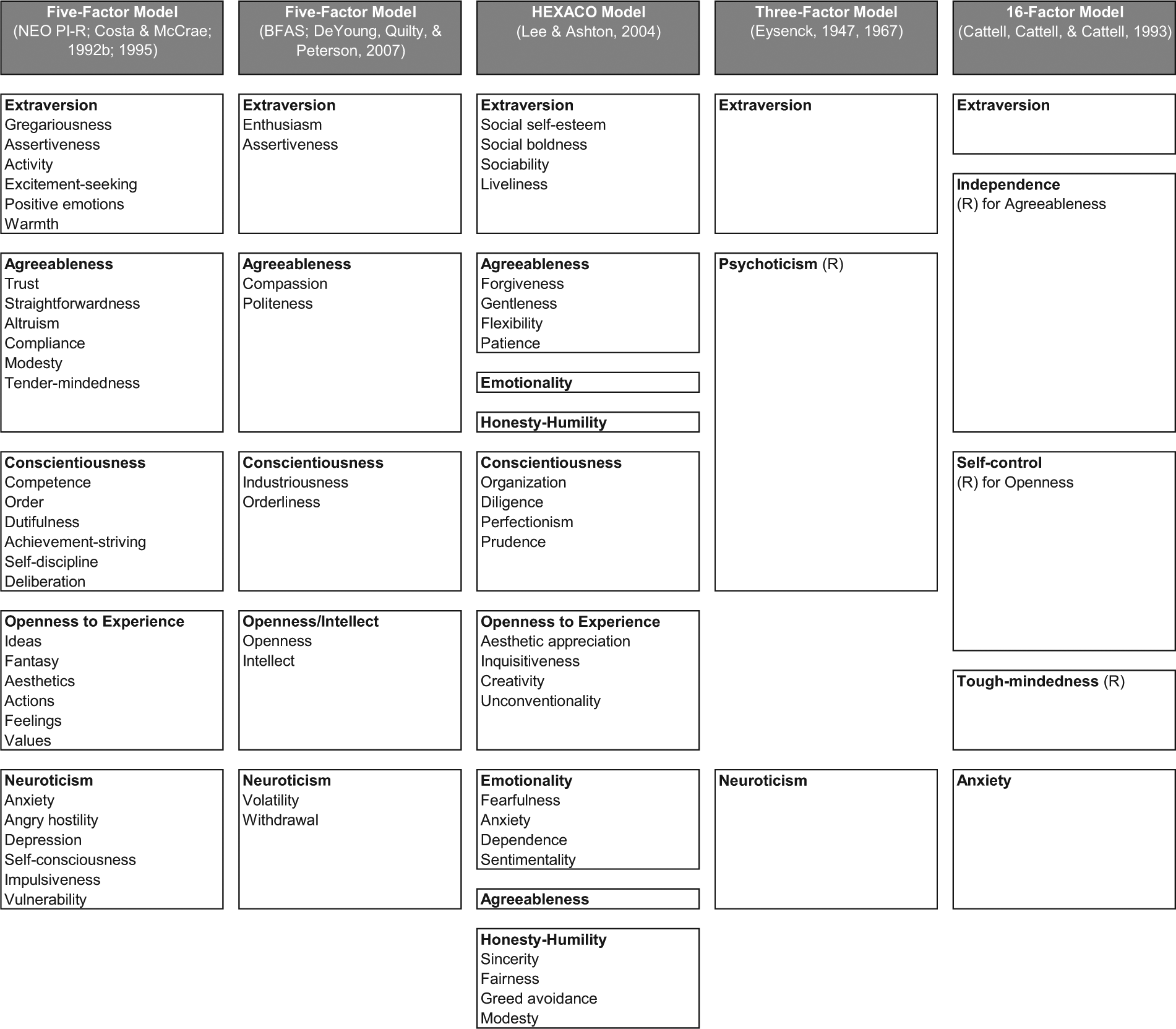
Outline of the Five-Factor Model and its relationships with other personality taxonomies.
While the five broad domains of personality capture the basic structure of personality, much of the descriptive and predictive utility of the model lies in the lower-order tiers of specific characteristics clustering around each factor. These include six correlated facets (Revised NEO Personality Inventory [NEO PI-R]; Costa & McCrae, 1992b, 1995) or two distinct but correlated aspects at the intermediate level (Big Five Aspect Scales [BFAS]; DeYoung, Quilty, & Peterson, 2007). Although the facet structure of the Big Five is somewhat arbitrary, the aspects putatively reflect genetic and neurobiological mechanisms underlying personality, which may also drive divergent behaviors in the context of economic games.
Within the Five-Factor Model, agreeableness (i.e., the tendency to be good-natured, sympathetic, cooperative, kind, and respectful) and extraversion (i.e., the tendency to be lively, sociable, talkative, and bold) are particularly relevant to interpersonal behavior. Both personality traits broadly reflect positive relations with others and are associated with real-world prosocial behaviors, such as charitable giving, volunteering, and health-related philanthropy (Bekkers, 2006, 2010; Elshaug & Metzer, 2001; Ozer & Benet-Martínez, 2006). The theoretical basis of these traits and their proposed associations with economic game behaviors are discussed in the following sections.
Agreeableness
Agreeableness describes the tendency to be considerate of the needs, feelings, and concerns of others, and, in motivational terms, involves the maintenance of positive interpersonal relations (Graziano & Eisenberg, 1997). Its lower-level facets and aspects include altruism, trust, straightforwardness, compliance, modesty, tender-mindedness (NEO PI-R; Costa & McCrae, 1992b), and politeness and compassion (BFAS; DeYoung et al., 2007). In particular, major personality measures show the highest correlations on its altruism facet, suggesting that this quality—marked by selflessness and concern for others (Costa, McCrae, & Dye, 1991)—is central to this trait (John, Naumann, & Soto, 2008).
Although originally identified on empirical grounds, explanatory frameworks identifying potential psychological mechanisms underlying agreeableness have begun to emerge. Within an evolutionary perspective, agreeableness has been linked to the sacrifice of individual interests for the interests of the group (Buss, 1991; Graziano & Eisenberg, 1997). By definition, this would indicate a clear role for promoting a variety of prosocial behaviors in economic games, where there is a trade-off between self- and other-regarding interests. More recently, Graziano and Tobin (2009) have proposed an integrated opponent process model of agreeableness, which is hypothesized to arise from individual differences in the manifestation and suppression of evolutionarily based fight-flight and care systems, and their respective avoidant and approach reactions toward victims in need. In line with this, agreeableness has been linked to dispositional empathy and the expression of other-oriented empathic concern in response to the suffering of others (Batson, 1991; Graziano, Habashi, Sheese, & Tobin, 2007).
Another line of research has identified self-regulatory processes underpinning agreeableness, particularly those involving socially disruptive emotions and behaviors (Tangney, Baumeister, & Boone, 2004; Tobin, Graziano, Vanman, & Tassinary, 2000). These mechanisms are also reflected by the hierarchical structure of the Big Five: Along with conscientiousness and (low) neuroticism, agreeableness is believed to be subsumed within a higher-order factor underpinned by effortful control and regulatory mechanisms for maintaining stability of psychosocial functioning (DeYoung, 2006; DeYoung, Peterson, & Higgins, 2002; Digman, 1997). Consistent with this, personality neuroscience has linked agreeableness with neural systems for social information processing (DeYoung & Gray, 2009; DeYoung et al., 2010), as well as prefrontal regulatory function (Haas, Omura, Constable, & Canli, 2007).
Extraversion
Extraversion is often characterized by positive interpersonal tendencies, with engagement in social behavior, social attention-holding, and the enjoyment of others’ company thought to lie at its core (Ashton, Lee, & Paunonen, 2002; McCrae & Costa, 1987). These qualities, like agreeableness, could promote prosocial and cooperative behavior (although McCrae & Costa, 1987, point out that “liking people does not necessarily make one likable” [p. 87]). Other models have emphasized positive emotionality as the common feature drawing together extraversion’s facets (Tellegen, 1985; Watson & Clark, 1997). Relatedly, a currently dominant explanatory framework emphasizes the reward-sensitive qualities of extraversion (Depue & Collins, 1999; DeYoung, 2013; Lucas, Diener, Grob, Suh, & Shao, 2000; Smillie, 2013), an important consideration given the incentives of potential gains and losses in economic games. This reward-processing theory links extraversion with individual differences in the sensitivity or reactivity of the brain reward system, often termed the Behavioral Approach System (Pickering & Gray, 1999), the Behavioral Activation System (BAS; Fowles, 1980), or the Behavioral Facilitation System (BFS; Collins & Depue, 1992; Depue & Collins, 1999; Depue & Iacono, 1989). A number of studies have shown that extraversion is associated with variation in neural responses to rewarding stimuli (e.g., Cohen, Young, Baek, Kessler, & Ranganath, 2005; Smillie, Cooper, & Pickering, 2011). Extraverts also engage in greater approach behavior toward appetitive stimuli and are more susceptible to approach-related positive affect than introverts (Quilty, DeYoung, Oakman, & Bagby, 2013; Smillie, 2013; Smillie, Cooper, Wilt, & Revelle, 2012; Wilt & Revelle, 2009). Similar findings have been obtained using trait conceptualizations of BAS function (Smillie, Dalgleish, & Jackson, 2007; Zelenski & Larsen, 1999), which can be thought of as a narrow aspect of extraversion (Quilty et al., 2013).
These contrasting reward-sensitive and interpersonal components were initially captured by the conceptual distinction between agentic and affiliative extraversion (Depue & Collins, 1999; Depue & Morrone-Strupinsky, 2005). This corresponds closely to the lower-level aspects of extraversion known as assertiveness (i.e., agency, dominance) and enthusiasm (i.e., positive emotions, sociability), respectively (DeYoung et al., 2007). While agentic extraversion reflects dopamine-mediated reward approach processes (Depue & Collins, 1999), affiliation is characterized by the pleasurable aspects of interpersonal engagement such as warmth and affection. The latter is believed to be related to consummatory pleasure processes mediated by opioid receptor function (Depue & Morrone-Strupinsky, 2005; Machin & Dunbar, 2011; Schweiger, Stemmler, Burgdorf, & Wacker, 2013), and is conceptually related to trait agreeableness.
Indeed, according to later perspectives, trait affiliation may not be as central to extraversion as initially thought (e.g., Depue, 2006). Recently, DeYoung and colleagues (DeYoung, Weisberg, Quilty, & Peterson, 2013) mapped the interpersonal dimensions of the Big Five onto circumplex models of interpersonal behavior, showing that trait affiliation is equally related to the enthusiasm aspect of extraversion and the compassion aspect of agreeableness. The fuzzy boundaries between extraversion and agreeableness have long been apparent, with constructs such as warmth (considered prototypical of affiliation) appearing as facets for measures of both traits (i.e., in the NEO PI-R for extraversion and the Abridged Big Five Circumplex for agreeableness; Costa & McCrae, 1992b; Hofstee, De Raad, & Goldberg, 1992). Other facets, such as trust, altruism, gregariousness, and positive emotions have moderate positive loadings on both traits (John et al., 2008).
In economic games, agentic extraversion and heightened BAS function would be expected to drive the pursuit of personal reward, encouraging behaviors such as defection and free riding, as well as selfish divisions of wealth. Conversely, affiliative extraversion, much like agreeableness, would be expected to drive the opposite pattern of results by promoting prosocial behavior. While some questionnaire measures clearly distinguish between these different aspects (e.g., the BFAS; DeYoung et al., 2007), most do not, which could perhaps lead to inconsistent observed relations.
Interpersonal Domains of the HEXACO Model
The HEXACO model comprises an alternative six-factor structure of personality based on lexical studies of European and Asian languages (Ashton et al., 2004). Notably, it is thought to capture moral or ethical aspects of prosocial behavior outside the bounds of the Big Five (Ashton & Lee, 2007). This may be particularly relevant in economic games, where there are moral undertones to social decisions (i.e., fairness considerations, opportunities for exploitation).
Three HEXACO domains are close analogues of the Big Five: extraversion, conscientiousness, and openness to experience. In addition, HEXACO emotionality and agreeableness are considered rotational variants of their Big Five counterparts: HEXACO emotionality resembles Big Five neuroticism, but excludes anger and includes sentimentality, whereas HEXACO agreeableness excludes sentimentality and includes a lack of anger accompanied by patience and forgiveness (Ashton & Lee, 2007). The model features an additional factor, honesty-humility, reflecting qualities such as trustworthiness, fairness, and a lack of greed. This construct is associated with behaviors driven by high incentive reward in the face of moral or legal considerations (Ashton & Lee, 2008). For example, on the Revised HEXACO Personality Inventory (HEXACO PI-R; Lee & Ashton, 2004), honesty-humility includes items such as “If I knew that I could never get caught, I would be willing to steal a million dollars.” In addition, Weller and Thulin (2012) noted that honesty-humility is negatively associated with a number of risky behaviors reflecting hypersensitivity to reward, such as cheating and stealing. Lastly, an interstitial facet scale (altruism) was later added to reflect an equal blend of these three traits contributing to a general altruistic tendency to be sympathetic and soft-hearted (Lee & Ashton, 2006).
Together, HEXACO honesty-humility, agreeableness, and emotionality are believed to capture divergent constructs relating to evolutionarily based altruistic and antagonistic behavior. Ashton and Lee (2001, 2007) proposed that HEXACO emotionality is related to attachment and empathy toward close others, while HEXACO honesty-humility and agreeableness capture theoretically separate components of reciprocal altruism. Evolutionarily, reciprocal altruism involves long-term mutual cooperation, but is unstable due to the risk of exploitation. Honesty-Humility is therefore considered to play an important role in active cooperation, or the tendency to be fair when dealing with others despite opportunities for exploitation, and agreeableness in reactive cooperation, or the tendency to be forgiving and tolerant of others’ transgressions (Ashton & Lee, 2007). Social situations involving these two processes frequently arise in economic games, which themselves have been used to model reciprocal altruism within an evolutionary framework (Trivers, 1971, 2006).
In contrast, these constructs are not as well differentiated within the Big Five framework, where agreeableness (henceforth referred to as B5 agreeableness) broadly captures most forms of prosocial behavior, consistent with its basic motive for preserving interpersonal relationships. 2 As such, B5 agreeableness more closely resembles the interstitial altruism facet of the HEXACO model, reflecting an equal blend of HEXACO agreeableness, emotionality, and honesty-humility. Therefore, the HEXACO model’s partitioning of similar but distinct prosocial constructs could offer a more complete account of personality and social decision making than the Five-Factor Model.
Summary
The Big Five and HEXACO models both provide useful frameworks for understanding varying patterns of behavior within mixed-motive social interactions. B5 extraversion and agreeableness describe two broad domains of interpersonal processes likely to influence behavior in economic games, while the HEXACO framework offers a more fine-grained delineation of these processes, including the distinction between active (honest-humility) and reactive (agreeableness) forms of prosocial behavior.
Personality Processes in Social Dilemmas
Types of Social Dilemmas
Social dilemmas reflect interdependent situations in which an individual’s immediate self-interest is in conflict with long-term collective interests (Dawes, 1980). There is often an optimal outcome in which collective payoffs are maximized through mutual cooperation, but which is difficult to attain due to the incentive to defect by self-interested individuals. Social dilemmas are useful paradigms for studying real-world problems such as pollution, depletion of common resources, investment of public utilities, and intergroup conflict.
The prisoner’s dilemma—perhaps the most well-known economic game—is a social dilemma in which two players must choose between cooperation or defection (Flood, 1958; Tucker, 1980). Mutual cooperation and defection both result in symmetric payoffs in which the former is greater than the latter for both players. However, if one player defects while the other cooperates, the defecting player receives the highest payoff while the cooperating player receives the lowest (see Figure 2). Conventional economic theory posits that both players will defect as their dominant strategy, leading to a suboptimal joint outcome (von Neumann & Morgenstern, 1944). However, experimental studies indicate mixed levels of cooperation among players (averaging at around 50%), with cooperation increasing in repeated games (for a review, see Sally, 1995).
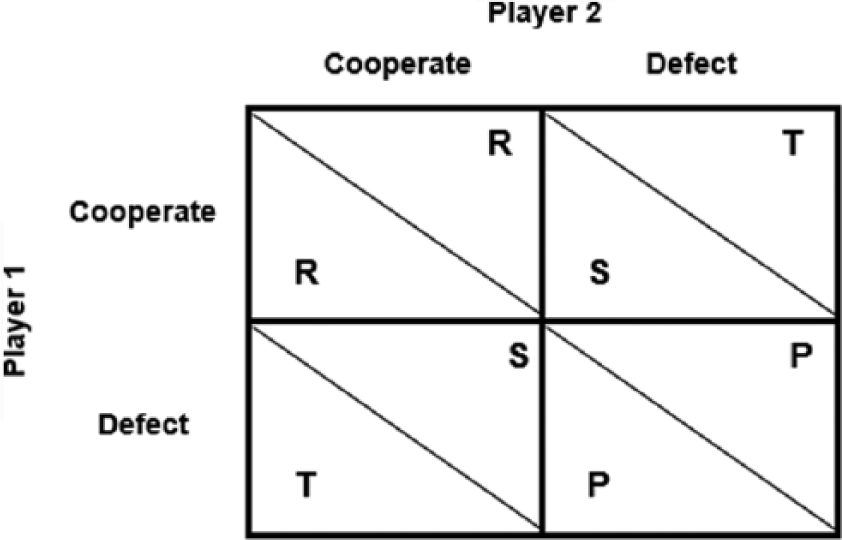
Standard prisoner’s dilemma payoff matrix, where payoff values indicate the following: T(emptation) > R(eward) > P(unishment) > S(ucker).
A multiplayer extension of the prisoner’s dilemma is the public goods game, in which several players decide on a portion of their personal endowment to invest into a public good. The combined amount is then multiplied and distributed equally to all group members. Collectively, the return on the public good is maximized through contributions by all players, although individual players face the temptation of withholding their personal investments (free riding). Experimental studies indicate that players initially contribute on average 40% to 60% of their endowment, although this amount varies between players and across experimental conditions (Fehr & Gächter, 2000; for a review, see Ledyard, 1995).
The trust game is a two-stage game of reciprocity that incorporates elements of both social dilemmas and bargaining games (J. Berg, Dickhaut, & McCabe, 1995). An investor is given an endowment and can choose to invest all or part of this in the trustee. The money is multiplied by a factor in the hands of the trustee, who then splits the new amount with the investor. Therefore, the investor’s and trustee’s actions could be construed as measures of trustfulness and trustworthiness, respectively. Conventional economic theory posits that trustees would maximize their earnings and keep the entire invested amount, while the investor would avoid investing their endowment in anticipation of this. In contrast, experimental findings indicate that investors generally send trustees half of their endowment, while trustees returned more than a third of the joint returns (Johnson & Mislin, 2011). In addition, other two-person response and exchange distributional tasks provide further evidence of positive and negative reciprocity in social interactions (Charness & Rabin, 2002; Dufwenberg & Gneezy, 2000).
The Roles of B5 Agreeableness and Extraversion
What are the psychological processes inherent in social dilemmas and how do they relate to individual differences in these games? Social dilemmas model interactions involving reciprocal exchange under uncertainty, in which players choose to cooperate or defect without knowledge of their partner’s intentions. Given this interdependence, decisions to cooperate rely not only on benevolent other-regarding preferences and altruistic tendencies (i.e., a lack of “greed”), but also on beliefs about the good intentions of others (i.e., a lack of “fear” or “suspicion”; Coombs, 1973; Rapoport, 1967). 3
Agreeableness
In light of the two paths to defection, B5 agreeableness is theorized to be the main personality trait underlying prosocial motivation, and by definition, includes the tendency to be oriented to the needs of others (i.e., a lack of “greed”; Costa, McCrae, & Dye, 1991; Graziano & Eisenberg, 1997; Jensen-Campbell & Graziano, 2001). Its relation to empathy and trust may also engender cooperative tendencies. Both manipulations of empathy (Batson & Ahmad, 2001; Batson & Moran, 1999) and structural modifications of assurance that simulate trust (for a recent review, see Balliet & van Lange, 2013; Dawes, Orbell, Simmons, & Van De Kragt, 1986) have been shown to increase cooperation in social dilemmas, presumably by promoting good intentions toward others and by mitigating the fear of being “suckered,” respectively. Agreeableness has also been linked to cooperative and constructive conflict resolution strategies in social interactions that share the interdependent goal structure of social dilemmas (Graziano, Jensen-Campbell, & Hair, 1996; Jensen-Campbell & Graziano, 2001).
Consistent with this, several studies show that B5 agreeableness is correlated with cooperative behavior in social dilemmas. In one of the first studies applying a comprehensive personality model to economic games, Gillis and Woods (1971) used the 16 Personality Factors Questionnaire (16 PF; R. Cattell, Eber, & Tatsuoka, 1964) to examine prisoner’s dilemma behavior. Although the maximum variance explained by the 16PF was low, decisions to defect were negatively related to the primary factors of dominance on selected trials and rule-consciousness across all trials. Rule-consciousness in particular is characterized by moral values, honesty, and responsibility, which are conceptually related to B5 agreeableness. In a more recent study using the Big Five Inventory (John, Donahue, & Kentle, 1991; John et al., 2008), agreeableness was the only trait linked to a greater likelihood of cooperating in the first stage of a series of repeated prisoner’s dilemma games (Kagel & McGee, 2014).
In public goods games, B5 agreeableness has also been found to be a stable predictor of player contributions. Volk and colleagues (Volk, Thöni, & Ruigrok, 2011) examined individuals’ contributions in public goods games given the contributions of their group members, thereby controlling for the fear route to defection. Two major patterns of behavior emerged: conditional cooperation (i.e., reciprocating group members’ contributions with one’s own contributions) and free riding (i.e., withholding one’s own contributions regardless of group members’ contributions). The only Big Five trait that was significantly different between conditional cooperators and free riders was agreeableness, which was higher in the former group (Volk et al., 2011; a re-analysis also implicated the negative role of openness in cooperation, Volk, Thöni, & Ruigrok, 2012).
In the trust game, prosocial behaviors are reflected by the amount of money an individual sends to a partner (a measure of trustfulness) and the proportion of money returned by this partner (a measure of trustworthiness and positive reciprocity). The former has been associated with high agreeableness (Evans & Revelle, 2008), sometimes in combination with high openness (Becker et al., 2012) and low neuroticism (Müller & Schwieren, 2012). While there are fewer studies reporting significant effects for personality in the role of the second player, agreeableness (and also openness) has also been found to predict a greater proportion of money returned (Becker et al., 2012; Ben-Ner & Halldorsson, 2010). In a similar vein, the tendency to return low investments with comparatively small return-transfers has been observed among individuals displaying a combination of high neuroticism and low agreeableness (Lönnqvist, Verkasalo, Wichardt, & Walkowitz, 2012). This pattern of “ruptured cooperation” has also been associated with borderline personality disorder, the psychopathological equivalent of this trait combination (King-Casas et al., 2008).
Extraversion
Extraversion is the other major trait related to positive interpersonal relations, and its associations with sociability and affiliation may encourage prosocial and cooperative behavior within social dilemmas (Depue & Morrone-Strupinsky, 2005; McCrae & Costa, 1987). In addition, early studies reported a positive relationship between self-reported levels of cooperativeness and extraversion on the Eysenck Personality Questionnaire (Eysenck & Eysenck, 1975), which is considered a relatively pure measure of sociability (Lu & Argyle, 1991; Rocklin & Revelle, 1981). Consistent with this, higher levels of extraversion (Lönnqvist, Verkasalo, & Walkowitz, 2011), in particular its enthusiasm aspect (Hirsh & Peterson, 2009), have been found to predict a greater level of cooperation within the prisoner’s dilemma. Enthusiasm may promote cooperation through its relation to interpersonal warmth and gregariousness, both of which are forms of affiliation lying at the boundaries of extraversion and agreeableness (Depue & Morrone-Strupinsky, 2005; DeYoung et al., 2007, 2013).
In another study, extraversion was found to be a strong predictor of the amount sent to a partner by investors in the trust game (Ben-Ner & Halldorsson, 2010), a role which is likened to that of a player in a prisoner’s dilemma. In both cases, cooperation is based on positive expectations that a partner will reciprocate, which suggests that these behaviors may be driven by a common component of trust, reflecting the willingness to adopt vulnerability to attain a goal. In line with this, Evans and Revelle (2008) reported that trait extraversion was highly correlated with self-report measures of trust.
Other theoretical perspectives have highlighted reward responsiveness (Depue & Collins, 1999; Gray, 1973; Lucas et al., 2000; Smillie, 2013) and positive emotionality (Hermes, Hagemann, Naumann, & Walter, 2011; Tellegen, 1985) as central characteristics of extraversion. Reward and punishment processes are intrinsic to social dilemmas, where opportunities for monetary gains and losses incentivize behavior and drive utility valuation and maximization. Accordingly, individual differences in reward sensitivity captured by extraversion may undermine cooperation by motivating behavior toward strategies maximizing personal gain.
Findings from social dilemmas provide partial support for this hypothesis. Early studies using the Eysenck Personality Inventory (Eysenck & Eysenck, 1964), which offers a notably agentic conceptualization of extraversion, found that competitive individuals in the prisoner’s dilemma also scored higher on extraversion, although the results did not reach statistical significance (Gómez, González, & Cardona, 1976). More recent studies have used Carver and White’s (1994) BAS scale, which can be thought of as a narrow measure of extraversion associated with reward-related approach motivation (Quilty et al., 2013). Specifically, Skatova and Ferguson (2011) demonstrated that BAS reward responsiveness correlated with reduced contributions in public goods games, leading to greater personal gain but lower collective payoffs.
Moderating effects of situation
The opposing effects of B5 agreeableness and extraversion are together illustrated in studies demonstrating the interactions between personality traits and situational variables. In one of the earliest studies to recognize the importance of interpersonal traits in economic behavior, Koole, Jager, van den Berg, Vlek, and Hofstee (2001) used a resource dilemma, in which individuals harvested from a common good that was replenished at a fixed rate. They reported higher levels of harvesting with greater extraversion and lower agreeableness. Furthermore, individuals high in extraversion and low in agreeableness were unresponsive to feedback about depletion of the resource, while their low extraversion–high agreeableness counterparts tailored their harvesting accordingly. In another study, the contrasting effects of these interpersonal traits were elicited under different payoff matrices in the prisoner’s dilemma (Pothos, Perry, Corr, Matthew, & Busemeyer, 2011). Specifically, BAS reward responsiveness predicted defection when the payoff matrix was modified so that defecting was the optimal strategy (particularly when the action of the other player was known), while agreeableness predicted cooperation when cooperating was the optimal strategy.
Other studies have failed to support the role of B5 agreeableness and extraversion in social dilemmas. In a public goods game, Kurzban and Houser (2001) reported relatively weak and inconsistent findings for broad personality traits in general. Similarly, Sagiv, Sverdlik, and Schwarz (2011) found no effects for any personality variables, instead noting that personal values better accounted for behavioral variation in a modified social dilemma. These null findings are rather puzzling, and are perhaps due to the small sample sizes of these studies (n = 57 and 46, respectively).
Honesty-Humility as a Predictor of Strategic Behavior
The six-factor structure of the HEXACO model may shed further light on prosocial processes and related personality traits in social dilemmas. Ashton and Lee (2001) have argued for the differentiated roles of honesty-humility (i.e., fairness vs. exploitation) and agreeableness (i.e., forgiveness vs. retaliation) in overcoming the two routes to defection. Specifically, honesty-humility is believed to override the exploitative temptation to defect when playing against a cooperating partner (the greed route to defection). In contrast, HEXACO agreeableness may be more relevant when dealing with a defecting partner whose non-cooperative behavior could provoke reciprocated non-cooperation, particularly in the form of angry retaliation. A similar analogy has been proposed for public goods games, where greater “tolerance” may underlie continued contributions in the company of free-riding group members (Chen & Bachrach, 2003).
In an application of this hypothesis, Zettler, Hilbig, and Heydasch (2013) reported a Person × Situation interaction in a hypothetical prisoner’s dilemma under differing payoff structures and knowledge about partners’ intentions. When players were informed that their partner was unlikely to cooperate, behavior varied little by personality, with most players defecting. When players were informed that their partner was likely to cooperate, however, those high on honesty-humility increased their decisions to cooperate while their low honesty-humility counterparts continued to defect (thereby exploiting their partners). This example illustrates the moderating effect of situational cues on the relationship between personality and behavior (Mischel, 1977). When a partner is revealed to be an unlikely cooperator, there are strong cues for all individuals to reciprocate by defection to avoid being taken advantage of, in which personality is less likely to affect behavior. However, individual differences become more apparent in the case of a cooperative partner, where the strength of the situation appears to diminish.
A similar situational interaction was reported in a HEXACO study of the public goods game (Hilbig, Zettler, & Heydasch, 2012). Despite the opportunity to exploit others by free riding, players high on honesty-humility made greater contributions to the public good unconditionally. However, their low honesty-humility counterparts varied their behavior opportunistically, engaging in free riding but shifting to contributing when sanctions for free riding were introduced.
While the role of honesty-humility appears to overshadow that of HEXACO agreeableness in the economic games reported here (Hilbig et al., 2012), it is important to note that these studies were based on hypothetical paradigms with imagined partners. Another incentivized study using the HEXACO model has yielded slightly different results, with Perugini, Tan, and Zizzo (2010) reporting a relatively greater role for agreeableness than for honesty-humility. This may reflect the fact that individuals in the incentivized game had to confront the reduced contributions of their team members each round (which was absent in the hypothetical studies), thereby allowing highly agreeable individuals to demonstrate their tolerance for free riders.
Summary
There is some evidence that B5 agreeableness promotes cooperation in social dilemmas, although this appears to be more evident in public goods games. Adding to this, the HEXACO construct of (low) honesty-humility is associated with a strategic pattern of self-serving behavior elicited by situational opportunities for exploitation. While extraversion has occasionally been linked to measures of cooperation in the prisoner’s dilemma and trustfulness in the trust game—roles that reflect the willingness to accept vulnerability on the expectation of positive reciprocity—it is less frequently implicated in public goods games.
One reason for the relatively weaker role of personality in some of these social dilemmas might be due to their more complex mixed-motive context and uncertainties regarding other players’ actions, which may obscure underlying motivations and strategic behavior. As such, they may be less useful in distinguishing between the behaviors of self-interested and other-regarding individuals (Camerer & Fehr, 2004). For example, Skatova and Ferguson (2011) suggested that heightened reward sensitivity could still promote cooperation in repeated games where strategic reputation building yields greater long-term payoffs. In light of these challenges, we next consider a second class of economic games which strips away some of the risk-related and strategic features of social dilemmas, providing a simpler interface for exploring links with personality.
Personality Processes in Bargaining Games
Types of Bargaining Games
Bargaining games typically require two players to divide a sum of money between themselves, which, like social dilemmas, involves a trade-off between self- and other-regarding interests, or fairness. Unlike social dilemmas, where the total payoff varies as a function of player decisions (i.e., it is maximized when everyone cooperates), this amount is typically fixed in bargaining games (i.e., these games are often initially set up as zero-sum situations). While prisoner’s dilemmas have a relatively greater emphasis on coordination, strategic reasoning, and decision making under uncertainty, the allocation of resources in bargaining games reveals social preferences that are relatively less clouded by risk attitudes or anticipation of other’s intentions. Because of their simple designs, bargaining games may provide purer measures of the psychological processes lying at the heart of social dilemmas.
In the ultimatum game, the first player, the proposer, must offer a division of a sum of money to a second player, the responder (Güth et al., 1982). The responder must decide whether to accept this offer (in which both players receive the proposed amount) or reject it (in which neither player receives any money). Conventional economic theory predicts that responders will unconditionally accept any non-zero offer, and that, in anticipation of this, proposers will offer a minimal amount to the responder. However, experiments reveal that proposers rarely offer less than 40% to responders, and that offers around 20% are rejected half of the time (Camerer, 2003).
Ultimatum offers in isolation are difficult to interpret due to the conflation of at least two separate processes: prosocial tendencies and “strategic fairness” in the face of potential rejection. Several variations of the ultimatum game help to control for these motives (see Figure 3). In the dictator game, a proposer must allocate a sum of money between themselves and a second player, a recipient, who must accept this offer (Forsythe et al., 1994; Kahneman et al., 1986). The standard unilateral dictator game is not a true game (and nor does it involve bargaining) due to the lack of veto power from the recipient. However, it has attracted much interest as non-zero offers by the proposer can be construed as a direct measure of prosociality. Like previous games, experimental findings of the dictator game depart from traditional economic theories of self-interest. Dictators typically offer the recipient an amount just under 30% (Camerer, 2003). Furthermore, the degree of behavioral heterogeneity in dictator games is well documented, with considerable variation in proposal sizes across demographic groups and cultures (Engel, 2011).
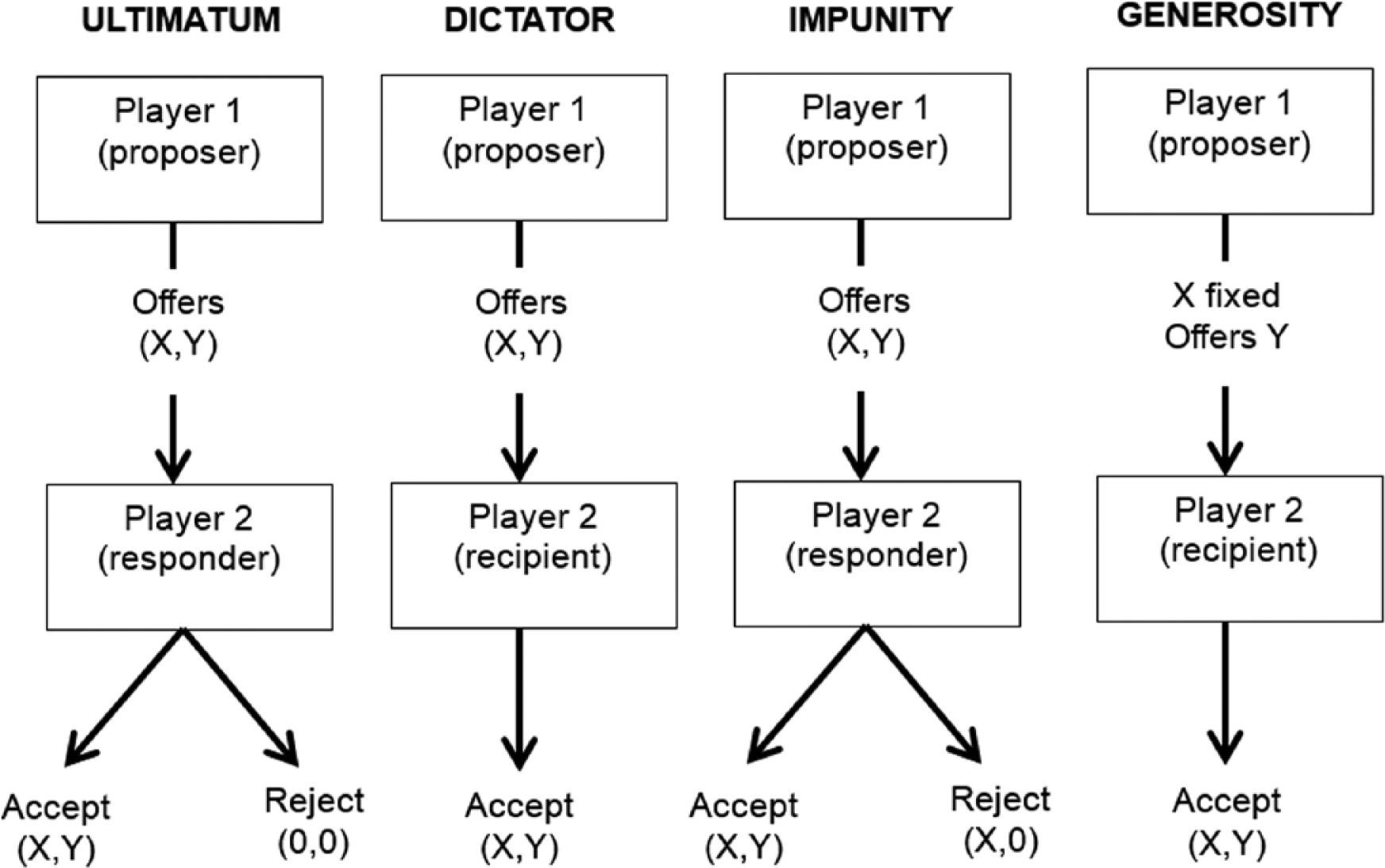
Player decisions in four types of bargaining games.
Additional paradigms have been designed based on variations of these well-known bargaining games. Although there are virtually no studies investigating individual differences in these newer paradigms, we discuss them briefly given their potential for future research.
The impunity game was also developed to examine bargaining behavior in the absence of punishment (Bolton & Zwick, 1995). It is identical to the ultimatum game with one exception: The proposer retains his or her original share regardless of whether the responder rejects the offer, in which case the responder alone will receive nothing. Several studies have revealed a sizable proportion of individuals (30%-40%) who continue to reject unfair offers, even when the decision is kept private from the proposer, which may be associated with assertions of status (Ma et al., 2012; Takagishi et al., 2009; Yamagishi et al., 2009).
The generosity game is a new economic paradigm designed to study individuals’ social preferences in the absence of interdependent payoffs (Güth, 2010; Güth, Levati, & Ploner, 2009). Unlike previous games, the proposer begins with a fixed personal share and must decide on the share allocated to the recipient. In one of the few known experiments of the generosity game, the majority of proposers offered the largest possible endowment to their partner, leading the authors to conclude that “when generosity is costless, most of us try to make the world a better place” (Güth et al., 2009, p. 13).
The Roles of B5 Agreeableness and Extraversion
Unlike social dilemmas, in which all players face the same set of choices and information, and make their decisions simultaneously, bargaining games feature an asymmetric two- (ultimatum) or one- (dictator) step process. In proposers, bargaining games model the allocation of scarce resources between the self and others, reflecting the tension between prosocial tendencies and reward-motivated self-interest. In responders, ultimatum and impunity games model preferences for fairness and reactions to inequity, including retaliation and costly punishment when one is mistreated.
Agreeableness
Consistent with its role as the primary Big Five trait driving prosocial behavior, agreeableness has been associated with both benevolent proposer and responder behavior across bargaining games. In the earliest study of its kind, Brandstätter and Königstein (2001) investigated individual differences in ultimatum bargaining using self-report checklists derived from Cattell’s 16 PF (Schneewind, Schröder, & Cattell, 1983). Among proposers, more selfish offers were made by those high in independence and tough-mindedness. These factors reflect an absence of warmth, sensitivity to others, and social accommodation, which together are conceptually and inversely related to Big Five agreeableness (H. E. P. Cattell, 1995).
More compelling is the positive relationship between B5 agreeableness and generous offers where there is no threat of retaliation. Several studies have shown that higher agreeableness is related to greater allocations of wealth to a partner in the dictator game (Baumert, Schlösser, & Schmitt, 2013; Foschi & Lauriola, 2014; Li & Chen, 2012), sometimes along with other traits (e.g., high openness; Baumert et al., 2013). This has also been observed in real-world applications of the dictator game, where donation sizes to charitable organizations showed the largest correlations with agreeableness (Becker et al., 2012). Trait benevolence, which is conceptually related to agreeableness, has also been associated with fairer offers in the dictator game (Brandstätter & Güth, 2002).
Extraversion
Although extraversion has also been linked to real-world examples of prosocial behavior (e.g., Carlo, Okun, Knight, & de Guzman, 2005; Elshaug & Metzer, 2001), there is considerably less evidence for its role in promoting prosocial bargaining behavior. Rather, some studies suggest that aspects of extraversion concerned with reward sensitivity and social dominance may motivate strategic self-interested actions. In one study, higher extraversion predicted lower offers in the dictator game, although this was only true for men (higher conscientiousness and neuroticism predicted lower offers in women, while higher agreeableness predicted higher offers in both sexes; Ben-Ner, Kong, & Putterman, 2004). Similarly, Scheres and Sanfey (2006) found that higher scores on measures of BAS were associated with a pattern of higher ultimatum offers and lower dictator offers. This discrepancy in proposals indicated a strategy that maximized the probability of reward when there was a threat of rejection and the size of the reward where there was no such threat.
These findings for extraversion are also congruent with individual differences in prosocial orientation as measured by modified response games. In a variation to the studies above, Brocklebank, Lewis, and Bates (2011) ran a series of tasks in which players selected a payoff combination to share with a partner who had previously helped or hurt them. The tendency to select the highest joint payoffs was associated with low extraversion, along with high openness and low neuroticism. Although a positive association was observed with agreeableness, this relation fell short of statistical significance (perhaps due to the relatively small sample size used in this study, n = 67). The authors point to suggestions that agreeableness is linked to a compassion-based system of prosocial behavior, which may have not been elicited in the laboratory environment. Another possibility arises from the fact that the majority of the offers in the games were made after a player was deprived of a higher payoff due to their partner’s previous actions. This may reflect situations of negative reciprocity, where variation in behavior may have been better captured by neuroticism than agreeableness.
Moderating effects of incentivization and social distance
As with social dilemmas (Lönnqvist et al., 2011), discrepancies between incentivized and hypothetical bargaining decisions have been observed, where there are interesting interactions with personality. When asked how much they would donate in a dictator’s game, individuals high on extraversion indicated an average hypothetical amount 1.18 standard deviations above the mean and those high on agreeableness an amount 1.58 standard deviations below the mean (Ben-Ner, Kramer, & Levy, 2008). However, these patterns were reversed in an incentivized game with real money, where extraverts sent an average amount 0.52 standard deviations below the mean and agreeable individuals an amount 0.35 standard deviations above the mean. This pattern of results for extraversion might be explained by a heightened sensitivity to reward in the incentivized scenario and social desirability in hypothetical donations, with the authors noting that extraverts “portray themselves as generous when generosity is costless” (Ben-Ner et al., 2008, p. 1782).
Other situational variables affecting altruistic behavior, such as social distance, are also important through their interactions with stable traits. In a study of the dictator game, personality did not explain the extent of giving to kin, although conscientiousness, agreeableness, extraversion, and neuroticism were all related to giving to non-kin (Ben-Ner & Kramer, 2011). This is similar to real-world examples of prosocial behavior, where the tendency to help was less tied to kinship—and less conditional more generally—for those high on agreeableness (Graziano et al., 2007).
Differential Effects of HEXACO Honesty-Humility and Agreeableness
Hilbig, Zettler, Leist, and Heydasch (2013) have remarked on the inconsistency of earlier studies and attributed it to the limitations of B5 agreeableness, which might conflate theoretically distinct aspects of prosocial behavior. Consistent with the HEXACO account of honesty-humility and agreeableness and their respective roles in active and reactive cooperation, these two dimensions were found to differentially predict behavior across player roles in the ultimatum and dictator games. Hilbig et al. (2013) reported that honesty-humility (but not HEXACO agreeableness) was associated with more generous proposals in the dictator game. In fact, individuals high on honesty-humility made fair offers in the dictator game just as often as they did in the ultimatum game (Hilbig & Zettler, 2009). In contrast, those low on this dimension made less equitable proposals in the dictator game, but increased their offers to an even split in the ultimatum game. This pattern of strategic cooperation is similar to that demonstrated by high BAS individuals in a previous study (Scheres & Sanfey, 2006).
Meanwhile, HEXACO agreeableness, but not honesty-humility, was associated with higher acceptance of unfair offers in the ultimatum game (Hilbig et al., 2013; Thielmann & Hilbig, 2014). This concept of reactive cooperation is also reminiscent of other economic game studies of B5 agreeableness. In an early study using hypothetical money allocations, individuals high on agreeableness and emotional stability demonstrated greater willingness to sacrifice a portion of their personal endowment to a partner who was described as rude, uncooperative, and inconsiderate (Ashton, Paunonen, Helmes, & Jackson, 1998). Similarly, in Li and Chen’s (2012) study of forgiving among school children, B5 agreeableness predicted the tendency to propose fairer offers in the dictator game after receiving an unfair offer from the same partner in the ultimatum game. Furthermore, in a comprehensive study of demographic, cognitive, and personality determinants of ultimatum responses, the trust facet of B5 agreeableness (the tendency to believe that others have good intentions) was the only personality variable related to higher acceptance rates of unfair offers (Nguyen et al., 2011; see also Mehta, 2007). Together, these studies suggest that although individual differences in reactive prosocial behavior following mistreatment directly corresponds to HEXACO agreeableness, they are also subsumed within the broader conceptualization of B5 agreeableness.
Summary
A number of studies have identified B5 agreeableness as a global predictor of benevolent proposer and responder behavior in bargaining games. The HEXACO model offers an alternative framework, in which HEXACO agreeableness pertains specifically to reparative responses following unfair treatment, in the form of reactive cooperation. In addition, honesty-humility and to a lesser extent, the reward-sensitive components of extraversion, have both been associated with proposers’ decisions to allocate wealth to themselves relative to others (reduced active cooperation). These traits both share an underlying drive for incentive reward, sometimes at the cost of moral and prosocial obligations.
Summary of Findings
The aim of this article was to examine the extent to which broad personality traits could account for behavioral heterogeneity in social interactions within economic games. We were particularly interested in the impact of interpersonal traits of extraversion, agreeableness, and honesty-humility, and whether they elicited dissociable patterns of behavior. Consistent with these ideas, a growing number of studies of economic games has demonstrated that the “personality of the player matters” (Boone, De Brabander, & van Witteloostuijn, 1999, p. 367). In one form or another, all of the Big Five personality traits have been implicated in economic games. Most salient are the roles for agreeableness and honesty-humility, in line with theoretical perspectives on these traits. However, the findings also reveal considerable inconsistencies that need to be interpreted in light of important methodological factors and potential moderators. While the direction of the effect of personality was largely congruent with theoretical perspectives, the extent to which personality explained behavior appeared to fluctuate across studies. These may reflect two major sources of methodological inconsistencies, which will be discussed in the following sections: (1) variation in personality measures and corresponding personality models, and (2) variation in task demands across game situations and player roles.
A broad overview of the studies discussed in this article is presented in Tables 1 and 2, which illustrate the global relationships between personality traits and prosocial behaviors across economic games. Where available, zero-order correlation coefficients or their estimated equivalents from these studies have been compiled and presented in Figure 4 (see also supplementary data available from the authors). 4 The effect size statistics presented in Figure 4, as well as those reported in the following sections, are intended to provide a broad snapshot of the emerging picture. Formal meta-analyses of these effect sizes, although ideal, are currently precluded due to the small number of comparable studies, and in light of potential situational interactions and moderating factors. Although there are a sizable number of studies in Tables 1 and 2, these become very scarce when disaggregated by study design, personality measure, game type, and player role. In particular, we note that the 21 studies of broad personality models reviewed for effect sizes employed 9 unique personality measures, some of which were short forms characterized by relatively low internal consistency. Accordingly, we refrain from providing a premature quantitative summary here, a concern that was shared by one of our anonymous reviewers.
Relationships Between Personality Variables and Prosocial Behaviors in Social Dilemmas.
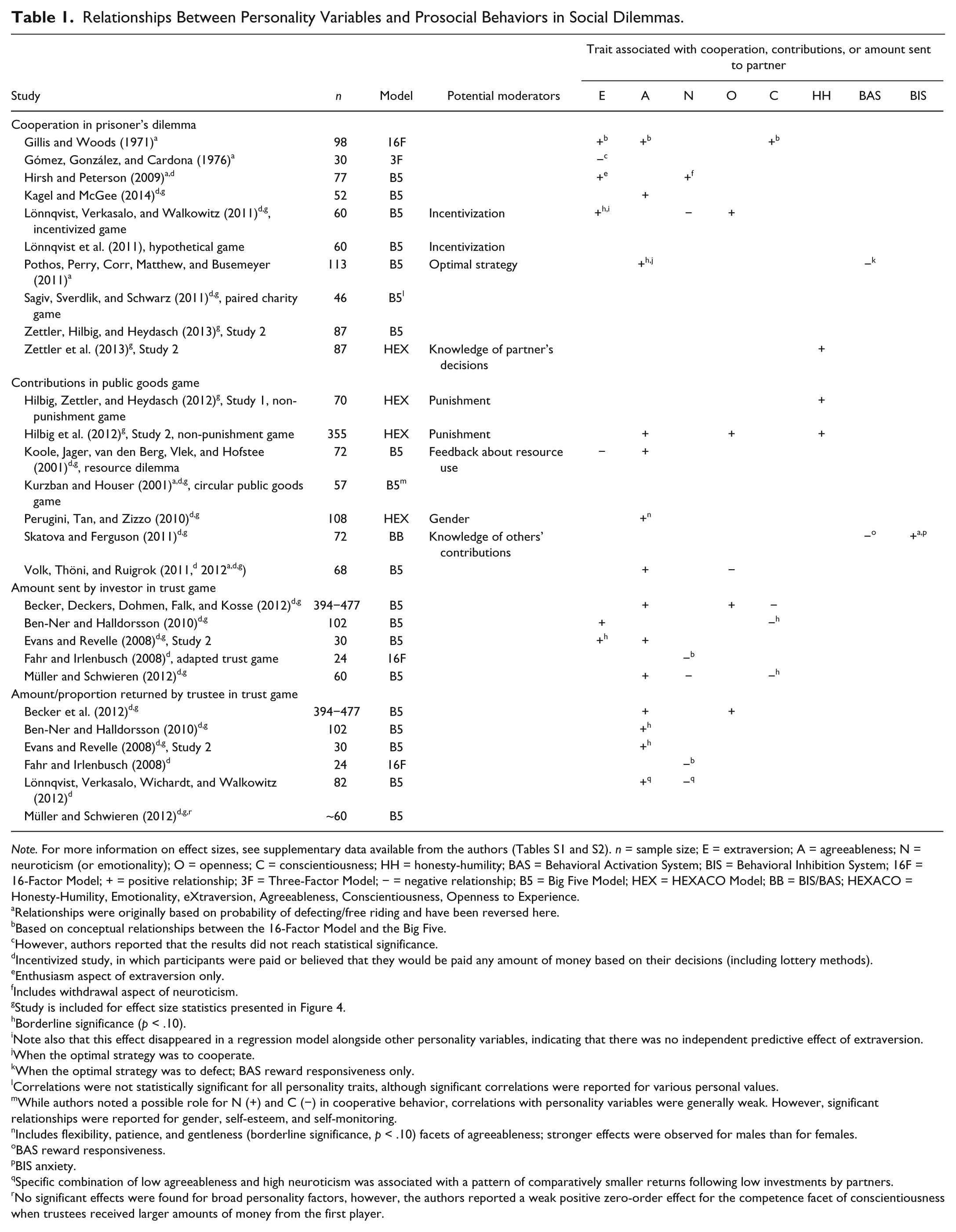
Note. For more information on effect sizes, see supplementary data available from the authors (Tables S1 and S2). n = sample size; E = extraversion; A = agreeableness; N = neuroticism (or emotionality); O = openness; C = conscientiousness; HH = honesty-humility; BAS = Behavioral Activation System; BIS = Behavioral Inhibition System; 16F = 16-Factor Model; + = positive relationship; 3F = Three-Factor Model; − = negative relationship; B5 = Big Five Model; HEX = HEXACO Model; BB = BIS/BAS; HEXACO = Honesty-Humility, Emotionality, eXtraversion, Agreeableness, Conscientiousness, Openness to Experience.
Relationships were originally based on probability of defecting/free riding and have been reversed here.
Based on conceptual relationships between the 16-Factor Model and the Big Five.
However, authors reported that the results did not reach statistical significance.
Incentivized study, in which participants were paid or believed that they would be paid any amount of money based on their decisions (including lottery methods).
Enthusiasm aspect of extraversion only.
Includes withdrawal aspect of neuroticism.
Study is included for effect size statistics presented in Figure 4.
Borderline significance (p < .10).
Note also that this effect disappeared in a regression model alongside other personality variables, indicating that there was no independent predictive effect of extraversion.
When the optimal strategy was to cooperate.
When the optimal strategy was to defect; BAS reward responsiveness only.
Correlations were not statistically significant for all personality traits, although significant correlations were reported for various personal values.
While authors noted a possible role for N (+) and C (−) in cooperative behavior, correlations with personality variables were generally weak. However, significant relationships were reported for gender, self-esteem, and self-monitoring.
Includes flexibility, patience, and gentleness (borderline significance, p < .10) facets of agreeableness; stronger effects were observed for males than for females.
BAS reward responsiveness.
BIS anxiety.
Specific combination of low agreeableness and high neuroticism was associated with a pattern of comparatively smaller returns following low investments by partners.
No significant effects were found for broad personality factors, however, the authors reported a weak positive zero-order effect for the competence facet of conscientiousness when trustees received larger amounts of money from the first player.
Relationships Between Personality Variables and Prosocial Behaviors in Bargaining Games.

Note. For more information on effect sizes, see supplementary data available from the authors (Tables S1 and S2). n = sample size; E = extraversion; A = agreeableness; N = neuroticism (or emotionality); O = openness; C = conscientiousness; HH = honesty-humility; BAS = Behavioral Activation System; B5 = Big Five Model; + = positive relationship; − = negative relationship; 16F = 16-Factor Model; HEX = HEXACO Model; HEXACO = Honesty-Humility, Emotionality, eXtraversion, Agreeableness, Conscientiousness, Openness to Experience.
Incentivized study, in which participants were paid or believed that they would be paid any amount of money based on their decisions (including lottery methods).
Study is included for effect size statistics presented in Figure 4.
Plus HEXACO honesty-humility only.
Borderline significance (p < .10).
Males only.
Females only.
Study reported non-linear, quadratic relationships between personality variables and amount of giving; These findings were also moderated by the recipient of dictator donations (kin versus non-kin).
U-shaped relationship.
Positive diminishing relationship.
Based on conceptual relationships between trait benevolence and agreeableness.
Trust and sympathy facets of agreeableness only.
Trust, morality, and sympathy facets of agreeableness only.
Dictator offers following the receipt of an unfair and unfavorable (under-reward)/favorable (over-reward) offer in the ultimatum game.
BAS reward responsiveness and drive.
Based on conceptual relationships between the 16-Factor Model (independence and tough-mindedness) and the Big Five.
However, BAS drive was significantly positively related to the size of ultimatum offers after controlling for the size of dictator offers.
Relationships were originally based on probability of rejecting offers and have been reversed here.
Based on the positive relationship between reciprocity orientation (specifically, emotionally unstable extraverts and emotionally stable introverts) and higher rates of rejection.
Ultimatum responses following the receipt of an unfair and unfavorable (under-reward)/favorable (over-reward) offer.
Includes trust facet of agreeableness.

Correlations between personality traits and prosocial behaviors across six economic games and player roles.
Can Interpersonal Traits Account for Behavioral Heterogeneity in Economic Games?
B5 agreeableness
Consistent with its core motivation of promoting positive interpersonal relationships, B5 agreeableness repeatedly surfaced across several studies as a predictor of prosocial decision making. In social dilemmas, individuals high on agreeableness were more likely to contribute to a public good and restrict their harvesting of a limited common resource (sample weighted average correlation coefficient, rwa = .17). In bargaining games, agreeable players were more likely to offer more as a dictator proposer (rwa = .18) and reject fewer offers as an ultimatum responder (rwa = −.10 for B5 agreeableness; rwa = −.16 for HEXACO agreeableness). Although these associations appear rather modest, these effect sizes should be considered in relation to the typical effect sizes in social and personality psychology, which equates to an average correlation of .21 (Richard, Bond, & Stokes-Zoota, 2003). Given the fledgling nature of the literature, these effect sizes reflect potentially meaningful relationships that further investigations may draw into sharper focus. Indeed, a number of studies represented in Figure 4 exceed r = .30, and are therefore among the strongest third of effect sizes in psychology (Hemphill, 2003).
These findings indicate that the effect of agreeableness is largely in line with its underlying characteristic of other-regarding concern: An agreeable person may be more likely to donate more in a public goods game, just as they may be more likely to accept an unfair ultimatum offer. Nevertheless, the extent to which agreeableness accounted for behavioral heterogeneity varied across game situations and player roles, a finding that also applied to other traits. This may allude to the moderating effect of situational strength (Mischel, 1977). According to this account, “strong” situations are structured, well-defined, and consist of salient cues, uniform expectancies, and incentives to guide behavior, where personality is believed to have a relatively limited influence. For example, individual differences are less frequently observed in ultimatum proposals, where social norms of fairness and the threat of rejection may dominate decisions of proposal size (and where proposals typically do not stray far from equal divisions; Camerer, 2003). In contrast, personality is likely to exert a stronger influence on behavior in “weak” or ambiguous situations, such as in dictator games, where proposers’ decisions are no longer constrained by their partner’s veto power.
An additional source of heterogeneity in ultimatum paradigms might result from the means of eliciting responses to unfair offers. In some studies (e.g., Baumert et al., 2013), this was approximated by the strategy method, in which a responder indicates his or her minimum acceptable offer. This is typically done to collect the most information without deception, a taboo in economic studies (Camerer & Fehr, 2004). In other studies, participants were directly exposed to unfair offers provided by confederates (Li & Chen, 2012; Mehta, 2007; Nguyen et al., 2011). Evidence from social dilemmas are mixed as to whether behavior differs significantly between “hot” and “cold” methods (Brandts & Charness, 2000; Casari & Cason, 2009). Nevertheless, actual confrontations with unfairness may be more emotionally charged, in which the impact of agreeableness may be more salient given its association with regulating socially disruptive emotions. Consistent with this, larger correlations with rejection rates were evident (rwa = −.18) when studies based on minimum acceptable offers were excluded.
HEXACO honesty-humility and agreeableness
The HEXACO model, which accommodates two largely independent forms of prosocial behavior (fairness vs. exploitation and forgiveness vs. retaliation) may offer an improvement on five-dimensional models in capturing individual differences in the social domain. Through the HEXACO lens, much of the variance in active cooperation (i.e., greater contributions in public goods games and larger offers to partners in bargaining games) appears to be captured by honesty-humility rather than agreeableness, while the opposite was true for reactive cooperation (i.e., responses to unfair ultimatum offers). Here, sample weighted average correlations between honesty-humility and dictator offer sizes or contributions to public goods were both rwa = .24, while they fell to around rwa = .13 for HEXACO agreeableness. Conversely, correlations between HEXACO agreeableness and rejections of ultimatum offers were rwa = −.16, while they were rwa = −.02 for honesty-humility.
Extraversion
The role of extraversion in social decision making was less clear, with correlations between broad measures of extraversion and game decisions revealing relatively little (at best, rwa = .07 for cooperative behavior in the prisoner’s dilemma). While these findings are at odds with our theoretical background, they may partly stem from varying conceptualizations of extraversion across personality measures, which may obscure contrasting relationships for affiliative and agentic components of extraversion.
When narrower aspects of agentic extraversion captured by measures of BAS were studied, negative correlations with public goods contributions and dictator offer sizes were relatively large, ranging from r = −.28 to r = −.34 (BAS reward responsiveness; Scheres & Sanfey, 2006; Skatova & Ferguson, 2011). In addition, Koole et al.’s (2001) findings from the common resource paradigm indicated a negative relationship between extraversion and cooperative behavior, which was the inverse of that observed for agreeableness. In this study, personality was measured using Dutch trait descriptions derived from the Abridged Big Five Circumplex (Hofstee et al., 1992), which contains trait terms consisting of blends of two factors (e.g., where agreeableness may have a negative secondary loading on extraversion), and in which extraversion is characterized by an agentic disposition to engage in approach behavior.
In contrast, measures of extraversion thought to be oriented toward affiliation (and therefore, more strongly correlated with B5 agreeableness) were positively associated with indicators of cooperation in social dilemmas. In the only study to use a measure of extraversion (the BFAS) reflecting its affiliative and agentic division, Hirsh and Peterson (2009) reported that the enthusiasm aspect of extraversion was correlated with a greater likelihood of cooperating in the prisoner’s dilemma, consistent with its proximity to affiliation. Investor sending in the trust game (Ben-Ner & Halldorsson, 2010; but not in a German sample, Becker et al., 2012) was positively associated with extraversion scores on the NEO Five Factor Inventory (Costa & McCrae, 1989), which contains more items relating to positive emotions and warmth and less for assertiveness, compared with other major personality measures (John et al., 2008). However, these relationships were not observed between affiliative measures of extraversion and prosocial offers in bargaining games, suggesting that this may only be true for forms of cooperative behavior that are conditional on a partner’s positive reciprocity.
None of the HEXACO PI-R measures of extraversion, represented by social self-esteem, social boldness, sociability, and liveliness (Ashton & Lee, 2007; Lee & Ashton, 2004), were associated with prosocial behaviors across economic games. However, given that honesty-humility is also negatively correlated with measures of BAS (de Vries, 2013), it may be that individual differences reflecting responsiveness to incentive reward—that would otherwise have been captured by agentic extraversion—were entirely subsumed within honesty-humility. The trait combination of extraversion and honesty-humility warrants further investigation, given findings that extraversion moderates the relationship between honesty-humility and deviant workplace behaviors (Oh, Lee, Ashton, & de Vries, 2011).
Beyond the Interpersonal Domain: The Roles of Neuroticism, Openness, and Conscientiousness
Although they are not inherently concerned with interpersonal behavior, other broad personality domains may be peripherally implicated in social decision making, depending on the contextual features of economic games. Five-dimensional neuroticism and its HEXACO equivalent, emotionality, are characterized by negative affect reactivity and emotional instability (John & Srivastava, 1999; Lee & Ashton, 2004). In economic games, neuroticism’s basis in punishment sensitivity and risk aversion may drive individual differences in the context of uncertainty regarding other players’ actions and the threat of personal losses (Glöckner & Hilbig, 2012; Lauriola & Levin, 2001; Lönnqvist et al., 2011; Nicholson, Soane, Fenton-O’Creevy, & Willman, 2005). In addition, forgiveness, aggression, and angry hostility, particularly relevant to B5 neuroticism (Bettencourt, Talley, Benjamin, & Valentine, 2006; Walker & Gorsuch, 2002), may predict retaliatory behavior in social interactions when there is mistreatment or exploitation by others.
A number of studies have reported effects for neuroticism in social dilemmas, although the direction of these relationships has not been consistent. Hirsh and Peterson (2009) and Skatova and Ferguson (2011, 2013) found positive relationships between neuroticism (particularly its withdrawal aspect) and Behavioral Inhibition System (BIS) anxiety with decisions to cooperate. In contrast, Lönnqvist et al. (prisoner’s; 2011), Müller and Schwieren (trust; 2012), and Fahr and Irlenbusch (trust, based on conceptual relationships with 16PF anxiety; 2008) reported negative relationships between neuroticism and behavioral measures of cooperation, trustfulness, and trustworthiness. A likely explanation for these mixed findings is that it is not the tendency to cooperate or defect per se that is associated with neuroticism, but whether these behaviors are considered risky or are associated with significant losses within the context of the game (Glöckner & Hilbig, 2012). For example, the decision to cooperate could have large negative stakes in two-person exchange tasks (e.g., trust games, prisoner’s dilemmas) where individuals are at the mercy of a partner who could “betray” them. In comparison, these effects are weaker in bargaining games, where neuroticism seems to have very little to do with preferences for fairness.
Meanwhile, openness reflects the tendency to seek and engage with complex and novel information (DeYoung, 2014). It is characterized by intellectual curiosity, imagination, and preferences for variety, and is linked to greater risk taking (Lauriola & Levin, 2001) and liberal political orientation (Carney, Jost, Gosling, & Potter, 2008; Chirumbolo & Leone, 2010). This could in part explain its positive relationships with decisions to cooperate in the prisoner’s dilemma (Lönnqvist et al., 2011), amounts sent and returned in the trust game (Becker et al., 2012; but see Ben-Ner & Halldorsson, 2010), and allocations of wealth in dictator games (Baumert et al., 2013; Becker et al., 2012; Ben-Ner, Putterman, Kong, & Magan, 2004; Hilbig et al., 2013), as well as prosocial choices in two-person exchange tasks (Brocklebank et al., 2011).
Finally, conscientiousness’s links with conservatism and risk aversion (Carney et al., 2008; John & Srivastava, 1999; Nicholson et al., 2005) could account for its negative impact on amounts invested in the trust game (Becker et al., 2012; Müller & Schwieren, 2012) and reduced proposals in the dictator game (Ben-Ner, Kong, & Putterman, 2004). This is also congruent with studies indicating decreased civic engagement and health-related philanthropy with higher levels of conscientiousness (Bekkers, 2005, 2006).
Real-World Analogues of Personality and Social Decision Making
One of the main advantages of economic games concerns their relevance to real-world settings. Although there has been debate regarding their generalizability (see Camerer, in press; Levitt & List, 2007), it is promising that recent research has demonstrated the external validity of individual differences in laboratory games. Participants who displayed other-regarding preferences in dictator games were more likely to have been involved in volunteer work (Baumert et al., 2013) and to engage in prosocial behavior (e.g., returning a lost letter; Franzen & Pointner, 2012). Likewise, the findings concerning the role of personality in economic games, particularly the divergence of agreeableness and extraversion, are paralleled by real-world examples of prosocial behavior. While both traits jointly had an effect on volunteering behavior that was partly mediated by prosocial volunteering motives, only agreeableness had an additional significant direct effect (Carlo et al., 2005). Extraversion appeared to be only indirectly related to volunteering via its relationship with other constructs. In addition to purely altruistic tendencies (which may be entirely subsumed by agreeableness), other aspects of prosocial behavior may motivate extraverts to volunteer, such as positive emotions and social interaction (see also Okun, Pugliese, & Rook, 2007). In well-controlled laboratory experiments of economic games where these factors are absent, extraversion alone may be a weak predictor of other-regarding preferences and behavior.
There are also several examples of real-world behaviors associated with agreeableness and honesty-humility that reflect their roles in bargaining games. The pattern of strategic self-serving behaviors observed for honesty-humility in the dictator and public goods games is mirrored by findings linking this trait to cheating and other dishonest behaviors driven by incentive reward. These include workplace deviance (Lee, Ashton, & Shin, 2005), academic misconduct (Marcus, Lee, & Ashton, 2007), and delinquent behaviors (Dunlop, Morrison, Koenig, & Silcox, 2012). Likewise, agreeableness is positively associated with ethical leadership (Kalshoven, Den Hartog, & De Hoogh, 2010), and its compassion aspect with egalitarian political attitudes (Hirsh, DeYoung, Xu, & Peterson, 2010). Its role in facilitating reparative responses in bargaining games is congruent with research on forgiveness and vengefulness (Berry, Worthington, O’Connor, Parrott, & Wade, 2005; McCullough, 2001; McCullough, Emmons, & Tsang, 2002; Shepherd & Belicki, 2008; Strelan, 2007), for example, it has been found to moderate the relationship between perceived mistreatment and retaliatory behaviors in the workplace (Skarlicki, Folger, & Tesluk, 1999).
Concluding Remarks
We have presented the first synthesis of the nascent literature on the role of personality in social decision making. In doing so, we have demonstrated that basic trait research can be meaningfully integrated with economic game paradigms. The findings indicate that broad and stable interpersonal traits can help explain behavioral heterogeneity across a range of games modeling social interactions. This literature is still in its infancy, and further research is required before the observed links between personality and social decision making could be considered robust. Nevertheless, there does appear to be a role for B5 agreeableness in promoting benevolent and prosocial behavior, consistent with its core feature of maintaining interpersonal harmony. Under the HEXACO model, other-regarding personality traits can be further divided according to dissociable patterns of active and reactive prosocial behavior. The findings concerning extraversion are less clear, but may reflect a mixture of its divergent affiliative and agentic motivational components. Although there are consistencies in the ways through which personality traits drive prosocial behavior, the strength of the role of personality varies across games, depending on structural and situational features, and at times compromised by variation in personality measures and methodologies.
These findings are important for a number of reasons. First, they extend beyond narrow and domain-specific measures of cooperation and prosocial behavior that have previously dominated the literature. Through the common currency of the Big Five, individual differences from economic games can be interpreted within a broader psychological context allowing for explanatory approaches and links to wider behavioral applications. For example, the laboratory findings regarding agreeableness, extraversion, and honesty-humility are largely consistent with real-world behavioral correlates of personality.
Second, these findings demonstrate the predictive and explanatory power of personality trait measures beyond the realm of self-report, providing important evidence for the construct validity of trait measures and the very existence of personality traits. Historically, there has been little overlap between the fields of economics and personality psychology, largely owing to the longstanding tradition of a universal “Homo economicus” and beliefs regarding a lack of cross-situational behavioral consistency (as noted by Almlund et al., 2011; see also Kirman & Teschl, 2010). The studies reviewed here are congruent with a large body of research indicating that broad and stable aspects of personality can influence important social economic outcomes (see Almlund et al., 2011; Borghans et al., 2008). Furthermore, longitudinal studies have demonstrated the consistency of personality effects over time (Baumert et al., 2013; Brocklebank et al., 2011; Volk et al., 2011, 2012), while growing evidence has highlighted the genetic basis of stable individual differences in game behavior (e.g., Cesarini et al., 2008; Reuter et al., 2013).
Furthermore, the studies reviewed here reflect a major shift in trait psychology, from mere description to explanatory models (Ashton & Lee, 2001; DeYoung, 2010). Using economic games, these behavioral approaches have contributed to developing theoretical perspectives concerning the structure of major personality dimensions. Using robustly established behavioral paradigms, the studies reviewed have provided empirical tests of core postulates, for instance, by examining the theoretical division between honesty-humility and agreeableness through their “double dissociation” in dictator and ultimatum games.
Future Directions
We conclude by proposing some future directions to shape the research agenda within this field. Some recommendations have been informed by the methodological challenges that we encountered in preparing this review, while others reflect key questions for the development of theory.
Recommendation 1: Greater attention to methodological rigor and consistency
A priority for future studies is to focus on methodological rigor and consistency, which have been major barriers to drawing clear conclusions in the current review. Practices such as using theoretically relevant and psychometrically appropriate personality measures might go a long way to iron out any extraneous sources of inconsistencies. Researchers should aim to use multiple (or at least comparable) personality measures to facilitate replications and integration with previous studies. The use of well-validated and reliable measures, including limiting the use of short forms unless time is critical, is also recommended. A good example of this has been set by the HEXACO studies (Hilbig & Zettler, 2009; Perugini et al., 2010; Thielmann & Hilbig, 2014; Zettler et al., 2013), which have produced reasonably consistent results that allow for comparisons with Big Five findings.
Methodologically, it would be beneficial for researchers to consider not only the direct impact of traits on game behaviors, but the effect of associations between personality dimensions. This is particularly relevant given the varying relationships between extraversion and agreeableness across personality models, in which they are sometimes positively correlated (e.g., in the NEO FFI; Lee & Ashton, 2013; McCrae & Costa, 2004) and sometimes negatively correlated (e.g., the assertiveness and politeness facets of extraversion and agreeableness in the BFAS; DeYoung et al., 2013). As such, presenting data from both regressions and zero-order correlations may indicate the extent to which the purity of a trait measure determines patterns of findings, including the net effect when inter-correlations between traits are controlled for. 5
Recommendation 2: Better understanding of interactions with incentivization
Researchers should be aware of the nuances in economic games that contribute to irregularities in findings, including the implications of slight variations in game designs (e.g., using the strategy versus game method to elicit ultimatum responses). Incentivization is a particularly important consideration, given that economic games tap into processes of reward-related motivation. Many studies report minimal effects of varying stake sizes in economic games (Carpenter, Verhoogen, & Burks, 2005; Raihani, Mace, & Lamba, 2013). Despite this, the findings by Lönnqvist et al. (2011) and Ben-Ner et al. (2008) suggest that while aggregate behavior may be unchanged, there could be interactions between incentivization and personality, especially for traits reflecting sensitivity to reward. Further research could help clarify the findings from HEXACO studies, which have mostly been conducted using hypothetical paradigms and imagined partners. Recent studies using incentivized measures of social value orientation involving allocations of wealth have supported the above findings (Hilbig, Glöckner, & Zettler, 2014), while other incentivized studies of the public goods and dictator games are less clear (Baumert et al., 2013; Perugini et al., 2010).
Recommendation 3: Systematic examination of situational moderators
Although we have focused on broad and unidirectional relationships between personality and economic game behaviors in this review, some of the findings have alluded to important moderating factors that warrant further investigation. These include systematic examination of the situational conditions under which the effects of different personality traits are elicited and suppressed. Future studies could evaluate the evidence for the strong–weak situation hypothesis across different games and player roles, particularly in light of concerns raised over its conceptual and empirical basis (see Cooper & Withey, 2009). An alternative approach would be to explore the salient situational cues that interact with core features of personality traits (e.g., monetary rewards, interpersonal harmony). Some early examples of this have been led by Pothos et al. (2011) and Skatova and Ferguson (2011, 2013), who demonstrated the varying effects of personality across manipulations of reward and punishment.
Recommendation 4: Investigation of behavioral consistency across economic games
Despite the large body of literature using economic game paradigms in the biological and social sciences, surprisingly few studies have explored the empirical relations between various games. A major goal for future research is to examine whether the behavioral heterogeneity observed in economic games is task specific or a reflection of more general differential processes. Within psychology, studies have only recently begun to demonstrate consistent and stable patterns of responding across several economic games (e.g., Yamagishi et al., 2013). Understanding whether behavioral heterogeneity can be generalized from social dilemmas to bargaining games is particularly important, given that traits are better predictors of aggregate rather than individual behaviors (Epstein, 1979). Moreover, future research could incorporate newer economic game paradigms (e.g., the impunity and generosity games) and examine whether relationships with personality hold.
There is still much to be explored, and the fragmented nature of the literature thus far has presented several challenges, which is not surprising given its cross-disciplinary origins. Nevertheless, we have pieced together an emerging picture of the broad personality contributions to social decision making, drawing on behavioral evidence from economic game paradigms. The recommendations provided here are the next steps in developing these preliminary findings into a theoretically and empirically useful research agenda, and in doing so, will help advance the current approaches and applications of personality psychology.
Footnotes
Acknowledgements
The authors would like to thank Andrew Cooper at Goldsmiths, University of London; Sander Koole at VU University Amsterdam; and three anonymous reviewers for their helpful comments on earlier drafts of this article.
Declaration of Conflicting Interests
The author(s) declared no potential conflicts of interest with respect to the research, authorship, and/or publication of this article.
Funding
The author(s) disclosed receipt of the following financial support for the research, authorship, and/or publication of this article: Kun Zhao was supported by an Australian Postgraduate Award.

Notes
References
Supplementary Material
Please find the following supplemental material available below.
For Open Access articles published under a Creative Commons License, all supplemental material carries the same license as the article it is associated with.
For non-Open Access articles published, all supplemental material carries a non-exclusive license, and permission requests for re-use of supplemental material or any part of supplemental material shall be sent directly to the copyright owner as specified in the copyright notice associated with the article.
