



Abstract
The current article presents a theoretical framework of the short- and long-term processes underlying personality development throughout adulthood. The newly developed TESSERA framework posits that long-term personality development occurs due to repeated short-term, situational processes. These short-term processes can be generalized as recursive sequence of
Keywords
People’s personality shows continuity and at the same time it changes throughout adulthood, often in relation to specific life experiences and transitions (Lodi-Smith & Roberts, 2007; Lüdtke, Roberts, Trautwein, & Nagy, 2011; Roberts & DelVecchio, 2000; Roberts, Walton, & Viechtbauer, 2006). For example, emotional stability increased over the course of 4 years when young adults entered a romantic relationship for the first time, but not when they remained single (Lehnart, Neyer, & Eccles, 2010; Neyer & Asendorpf, 2001). The prevailing explanations of such patterns of development often refer to experiences in daily life that evoke long-term change in personality over time. Yet, details about the nature of such daily experiences, the link to long-term personality development, and reasons why some experiences predict change whereas others predict continuity have not been specified.
The goal of this article is to identify the basic parts and processes
1
of daily experience and behavior leading to patterns of continuity and change in personality over time (i.e., personality development). In the TESSERA framework, these parts are recursive sequences of
Research on the processes of personality development has been called for repeatedly (Durbin & Hicks, 2014; Hopwood et al., 2009). Especially a comprehensive framework on the linkages of short- and long-term processes in personality development in adulthood is currently lacking. Such a framework could guide empirical work on better understanding long-term personality development, and provide a comprehensive theoretical background for interventions that already focus on daily experiences to elicit long-term change, such as during clinical therapy (F. De Fruyt, Van Leeuwen, Bagby, Rolland, & Rouillon, 2006).
In the first section, we briefly summarize the patterns of personality continuity and change from young adulthood to old age. In the second section, we propose a framework for the short- and long-term processes of personality development that incorporates and expands previously proposed developmental and personality processes. Here, we extend social-cognitive behavioral theories (e.g., PERSOC, Back, Baumert, et al., 2011; CAPS, Mischel & Shoda, 1995; AMP, Krampen, 1988) and explicitly link the assumed short-term processes to long-term personality development. 2 Third, we discuss how the proposed framework facilitates the understanding of different patterns of personality development throughout adulthood. Fourth, we address the application of the framework to different personality domains. Finally, we discuss the contribution of the TESSERA framework for understanding personality development, provide unique predictions, and outline future research directions.
Previous Knowledge on Personality Development in Adulthood
As a starting point, we view our process model of personality development as embedded in comprehensive conceptualizations of personality (McAdams & Pals, 2006; McCrae & Costa, 2008; Roberts & Wood, 2006). Accordingly, personality constitutes characteristics that reflect relatively enduring patterns of typical cognition, emotion, motivation, and behavior in which individuals differ from others of the same culture or subpopulation (e.g., DeYoung, 2015; Kandler, Zimmermann, & McAdams, 2014; McCrae & Costa, 2008). Such enduring patterns include general behavioral dispositions (e.g., Big Five traits), motivational orientations (e.g., goals, values, attitudes; DeYoung, 2015; Kandler et al., 2014; McCrae & Costa, 2008), as well as life narratives (i.e., the subjective, integrative “story” of a person’s characteristics and experiences; McAdams & Olson, 2010; McAdams & Pals, 2006; Roberts & Wood, 2006). Personality characteristics manifest and can be measured on different levels: explicit mental representations, implicit associative representations, biological functioning, observable behavior, and reputations, which other people report. For the sake of clarity, we initially focus on explicit, implicit, and behavioral manifestations of dispositions (e.g., Big Five traits) as an example to describe the framework of short- and long-term processes of personality development. In the final sections of this article, we elaborate that the framework applies equally well to other personality domains, such as goals, self-esteem, and narrative descriptions and discuss possible future research directions concerning reputations and biological manifestations.
Nomothetic (variable-oriented) personality development encompasses continuity in relative standing, such as documented in the rank-order stability of personality, as well as persistent, differential changes in absolute mean-level (increases or decreases) over time (Caspi & Roberts, 1999; Roberts & Caspi, 2003). The rank-order stability of, for example, Big Five traits increases from adolescence to adulthood up to r = .60 to .70 and plateaus (Roberts & DelVecchio, 2000). Recent evidence shows that rank-order stability might decrease somewhat in late adulthood (Ardelt, 2000; Lucas & Donnellan, 2011; Wortman, Lucas, & Donnellan, 2012). The normative mean-level change of Big Five traits in young and middle adulthood mainly consists of increases in agreeableness, conscientiousness, emotional stability, and social dominance (Lucas & Donnellan, 2011; Roberts & Mroczek, 2008; Roberts, Walton, & Viechtbauer, 2006). In old age, several studies show a reversed pattern with longitudinal decreases in agreeableness, conscientiousness, emotional stability, and openness (Berg & Johansson, 2014; Kandler, Kornadt, Hagemeyer, & Neyer, 2015; Lucas & Donnellan, 2011; Mõttus, Johnson, Starr, & Deary, 2012).
Such trait changes often occur together with life transitions (Bleidorn, 2012, 2015; Le, Donnellan, & Conger, 2014; Lodi-Smith & Roberts, 2012; Specht, Egloff, & Schmukle, 2011; Zimmermann & Neyer, 2013), and experiences in personal relationships (Mund & Neyer, 2014; for reviews see Neyer, Mund, Zimmermann, & Wrzus, 2014; Wrzus & Neyer, 2016) as well as work experiences (Hudson, Roberts, & Lodi-Smith, 2012; Roberts, Caspi, & Moffitt, 2003). Although several theories address long-term personality development (see Specht et al., 2014, for a comparison of theoretical accounts of personality development), little is known about the underlying short-term processes that lead to long-term continuity and change (Durbin & Hicks, 2014; Roberts, 2009; Specht et al., 2014). We next offer a description of the TESSERA framework of personality development that links short- and long-term processes. 3 Here we draw on previous work from different research traditions such as personality, social, developmental, and clinical psychology.
TESSERA: A Framework of Personality Development Processes
So far, empirical investigations have mainly studied personality trait change over several years and related those changes to single life events, such as new partnership, divorce, or first employment, that had occurred in the intervening years between the typical assessments of personality (Lüdtke et al., 2011; Neyer & Lehnart, 2007; Orth, Robins, & Meier, 2009; Specht, Egloff, & Schmukle, 2011). Such investigations sometimes acknowledge that personality change occurs gradually over time, yet the exact short-term processes of how life events translate into repeated daily situations and experiences, which eventually change behavioral patterns and personality representations, are not examined. We postulate that repeated short-term sequences of Triggering situations, Expectancies, States/State expressions, and Reactions (TESSERA) are the puzzle pieces, that is, tesserae, and reflective and associative processes transfer TESSERA sequences into long-term personality development (Figure 1, Table 1).
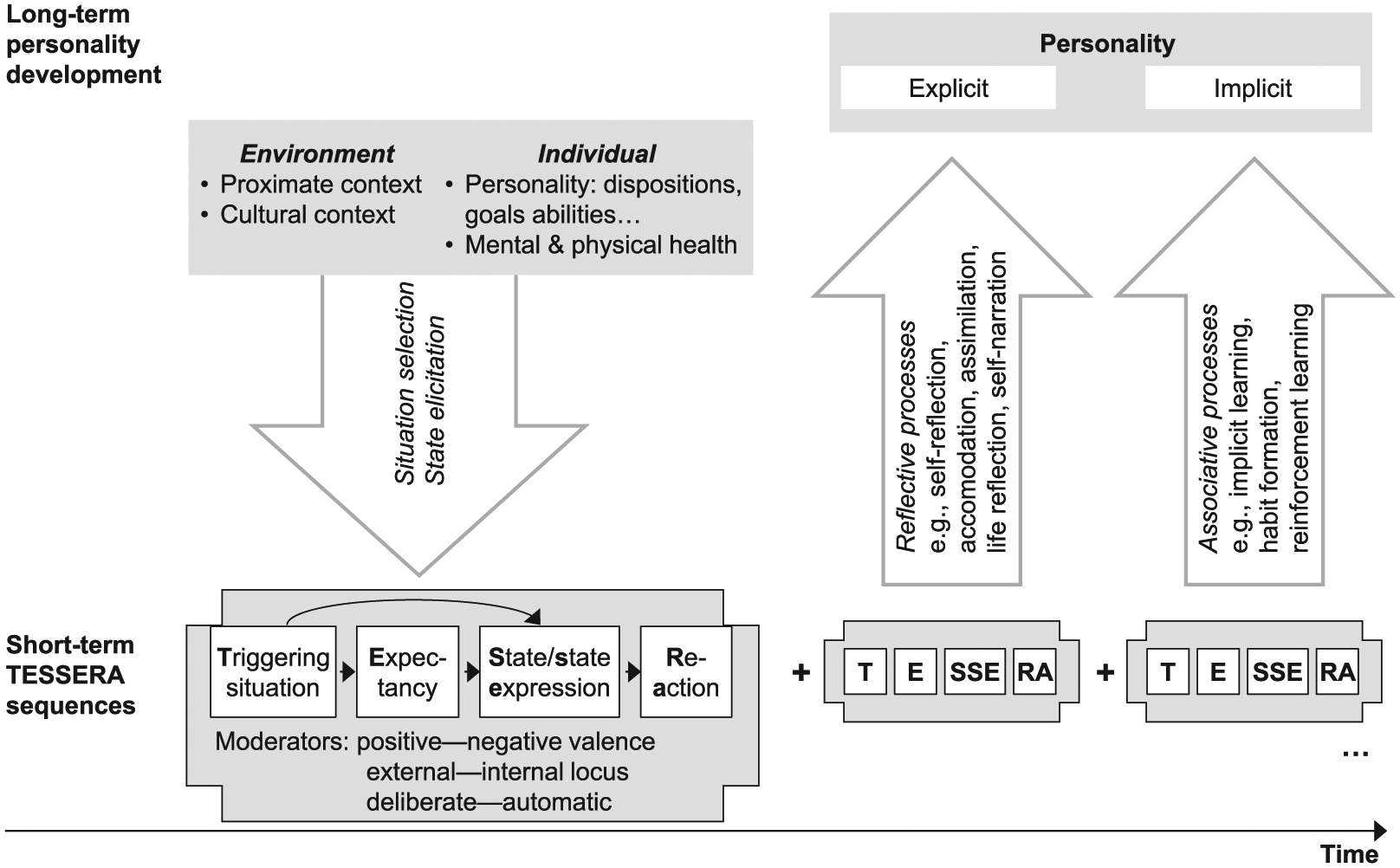
TESSERA framework of adult personality development processes.
Overview on Central Propositions of the TESSERA Framework.

Note. Table 1 summarizes the central propositions of the framework, which are detailed throughout the article. TESSERA =
The Short-Term Components of the TESSERA Framework for Personality Development
One of the key distinctions necessary for making the link between short-term experience and long-term change is to identify processes, which go beyond a single event that perturbs a person’s behavior to a series of events that change a pattern of behavior over time. A recent study (Penton-Voak et al., 2013) provides a provocative example and can be used to better understand the components of the TESSERA framework. Specifically, in their study, aggressive adolescents viewed ambiguous faces on computers [Trigger], perceived and rated the faces as angry or not [State thought and State expression], and received feedback whether the faces were indeed angry [Reaction]. 4 Initially, aggressive adolescents tended to view ambiguous faces as more angry than friendly. After repeated positive feedback when classifying ambiguous faces as more friendly in the experimental group, adolescents’ level of aggressiveness decreased over 2 weeks as indicated by daily self-reports and observed aggressive behavior in daily life (Penton-Voak et al., 2013). Clearly, longer follow-up assessments are needed to examine the psychological processes leading from training to changes in self-descriptions and behavior and lasting changes in trait aggressiveness. Still, the initial changes support the idea behind the TESSERA framework, which is that the accumulation of state change would eventually lead to personality change observable to oneself and others. Now we briefly describe each component of the TESSERA framework (Table 1), relate them to previous research (e.g., PERSOC, Back, Baumert, et al., 2011, Back, Schmukle, & Egloff, 2009; CAPS, Mischel & Shoda, 1995), and highlight how the components contribute to long-term personality development.
Triggering situation
Events or daily situations external to the person and occurring in multiple contexts can serve as triggers. Previous research discussed as contexts for development (a) (life) events that include several experiences (e.g., divorces including conflicts; Filipp, 1990; Holmes & Rahe, 1967); (b) social roles that assemble specific experiences (e.g., supervisors encountering leadership situations; Roberts, 2006; Roberts et al., 2003); (c) interventions or therapies (F. De Fruyt et al., 2006; J. De Fruyt et al., 2012; Magidson, Roberts, Collado-Rodriguez, & Lejuez, 2014; Webb & Sheeran, 2006); and (d) others’ behavior or words (model learning; Bandura, 2003). Thoughts such as about goals to change personality (Hennecke et al., 2014; Hudson & Roberts, 2014; McAdams, Ruetzel, & Foley, 1986; Snyder & Ickes, 1985) are discussed under “Environmental and Personal Factors Contributing to TESSERA Sequences.” Within the TESSERA framework, single situations trigger expectancies and/or states (Figure 1). Thus, when studying personality development associated with larger (life) events, for example marriage, researchers need to zoom in to find out what exactly are the relevant triggering situations (e.g., conflicts in daily interactions and their solution).
The conceptualization and assessment of situations bear some challenges relevant for examining personality development. Situations can be characterized by their physical (e.g., location, activity, persons) and/or psychological properties (e.g., task-related, threatening, pleasant; for reviews see Rauthmann, 2015; Rauthmann, Sherman, & Funder, 2015; Wagerman & Funder, 2009). Although, physical properties can directly elicit states (e.g., emotions, habitual behavior; W. Wood & Neal, 2007), psychological properties seem to predict states better (e.g., Fleeson & Jolley, 2006; Mischel & Shoda, 1995; Rauthmann et al., 2015; Sherman et al., 2015). Second, distinguishing situations seems necessary to understand why some situations, but not others, elicit trait-relevant states. Most researchers concur that situations differ when the physical (Magnusson, 1981) or the psychological environment changed (Rauthmann, 2015; Rauthmann, Sherman, Nave, & Funder, 2015). At the same time, the subjective novelty of a situation might deviate from more objective information. Situations then differ when they cannot be incorporated in existing schemata (broadly related to Block, 1982; Piaget & Inhelder, 1969). The TESSERA framework postulates that triggering situations and their perceived psychological meaning (including novelty) are necessary but not sufficient parts of personality change, which will not occur without trait-relevant states (see Figure 2). Situations can trigger expectancies of how to behave, feel, or think in that situation (D. Wood & Denissen, 2015); alternatively, situations can trigger states directly (e.g., if-then contingencies; Mischel & Shoda, 1995, 1998; Rauthmann et al., 2014; Schmitt et al., 2013; Figure 1).

Conditions under which TESSERA sequences, reflective and associative processes do (not) lead to changes in personality characteristics.
Expectancy
Expectancy refers to the momentary motivational construct that guides which state (i.e., thoughts, feelings, and behavior) occurs after the trigger by “selecting” a response from the variety of possible states (Fleeson & Jayawickreme, 2015; H. Heckhausen & Gollwitzer, 1987; D. Wood, Gardner, & Harms, 2015; W. Wood & Neal, 2007; D. Wood & Roberts, 2006). Thus, the connection between triggering situation and state is not only an “automatic” stimulus-response sequence as behaviorism would propose (Watson, 1913) but can also occur intentionally. Intentions and goals are thought to contribute powerfully to behavior and behavioral change (Aarts & Dijksterhuis, 2000; Bandura, 1977; Durbin & Hicks, 2014; H. Heckhausen & Gollwitzer, 1987; J. Heckhausen, Wrosch, & Schulz, 2010; McCabe & Fleeson, 2016; Mischel & Shoda, 1995; Webb & Sheeran, 2006; D. Wood & Denissen, 2015). Often situations include own and others expectancies (see “Moderators of the TESSERA Components” for distinction) about the possible, appropriate, or useful behavior, or state more generally. Accordingly, appropriate or useful behavior means that the behavior serves to achieve a goal. For example, being in an employee role might repeatedly elicit disciplined and orderly behavior, partly due to expectations about role-appropriate behavior that serves the goal to be a dependable and successful employee (Lodi-Smith & Roberts, 2007; Roberts & Wood, 2006).
Health-behavior models further elaborate the role of expectancies for behavioral change (e.g., the transtheoretical model of change; Marschall & Biddle, 2001; Nigg et al., 1999; Prochaska & DiClemente, 1982). Expectancies guide the behavior toward the anticipated goal, such as quitting smoking or starting exercising, yet they may not always be necessary (Figure 1, see also W. Wood & Neal, 2007). For example, a meta-analysis on health-related behavioral interventions (Webb & Sheeran, 2006) showed that behavior also changed when interventions elicited no change in intentions. Still behavioral change was somewhat larger when interventions increased behavioral intentions, which then elicited behavior change.
State and state expression
Momentary thoughts, feelings, and behavior 5 are the core aspect of personality and personality development as personality characteristics can be defined as individual differences in repeated, relatively time- and situation-consistent behaviors, thoughts, and feelings (Fleeson & Jayawickreme, 2015; Fleeson & Jolley, 2006; Hooker & McAdams, 2003b; Magidson et al., 2014; Mischel & Shoda, 1995; Roberts & Jackson, 2008; W. Wood & Neal, 2007). Personality trait change presumably comes about because repeated states get ingrained and become long-term, consistent patterns (Fleeson & Jayawickreme, 2015; Magidson et al., 2014; Roberts, 2009; W. Wood & Neal, 2007), the processes are detailed in the section “Processes of Transferring Short-Term TESSERA Sequences Into Long-term Personality Development.”
Empirical evidence for the linkage between state change and trait change is beginning to accumulate. First empirical studies showed that repeated experiences of increased momentary negative affect in daily stress situations predicted a longitudinal increase in neuroticism over 6 years (Wrzus, Luong, Wagner, & Riediger, 2016). We assume that only repeated states that differ from one’s typical, trait-like behavior can elicit personality change (Nesselroade & Molenaar, 2010; Roberts & Jackson, 2008). That means a person would have to be more stressed than usual (i.e., increased negative affect after hassles) to explain long-term changes in neuroticism. Otherwise existing trait levels are strengthened leading to personality continuity (see Figure 2).
Behaviors, but also thoughts and feelings, nearly always elicit reactions—either in other individuals (e.g., the partner sulks after being yelled at) or in oneself (e.g., feeling bad after thinking spitefully about the partner). Before other individuals can recognize and react upon thoughts and feelings, they have to be expressed in overt behavior (e.g., words, facial expressions, actions; Back, Baumert, et al., 2011; Mischel & Shoda, 1995).
Reaction
Reactions can come from oneself (reinforcement through emotions) or others (reinforcement and punishment, for example, verbal feedback, facial behavior such as smiling or frowning) in response to states. Others’ reactions need to be perceived to function as reinforcement for individual (e.g., Back, Baumert, et al., 2011). Reinforcement learning through continuous approach toward positive feelings and avoidance of negative feelings is a strong learning mechanism for a multitude of domains including complex behaviors and personality (Caspi & Roberts, 2001; Gerlsma, Emmelkamp, & Arrindell, 1990; Kanfer & Grimm, 1977; Kanfer & Phillips, 1970; Mischel & Shoda, 1995; Roberts & Wood, 2006). Punishment conveys the demand that certain behaviors, thoughts, or feelings need to change and future rewards or punishments would follow if appropriate changes in behavior are or are not made. When such reactions are incongruent with their personality characteristics, individuals are presumably more likely to change (Burke, 1991; Caspi & Roberts, 2001). Thus, reactions perpetuate TESSERA sequences and thus provide one link to how single sequences persist or change over time. Empirical evidence for this type of process is still lacking as no study to our knowledge has tracked the effects of continuous reactions to specific states on personality development.
Repetition of TESSERA sequences
We emphasized before that the crucial factor to link short-term experiences to long-term change is repetition (as indicated by the plus signs in Figure 1). One way of how repetition of similar TESSERA sequences occurs is that previous TESSERA sequences render future similar TESSERA sequences more likely, for example, through reactions or reinforcement learning. In addition, states after specific situations may elicit or create similar situations later on: Feeling anxious increases the likelihood of experiencing or attending to threatening triggers subsequently (MacLeod, Rutherford, Campbell, Ebsworthy, & Holker, 2002), which is discussed as a cycle of developing anxiety disorder. Other individuals also can be “the situation,” and reciprocal behavior among two interaction partners, for example during flirting (Back, Penke, et al., 2011), can be understood as repeated trigger-state sequences: Person A’s flirting behavior elicits flirting behavior in Person B, which serves as trigger to elicit further flirting behavior in A (see also Back, Baumert, et al., 2011). Constant demands of the environment and personality dispositions creating or seeking similar triggering situations can also lead to repeated TESSERA sequences.
Environmental and Personal Factors Contributing to TESSERA Sequences
We assume that environmental factors can influence the TESSERA processes in multiple ways (Figure 1). For example, the proximate and cultural environment (i.e., the rather stable physical and social surroundings compared with temporally varying situations) offers and constrains the kind of situations people experience, the expectations people face, the range of the appropriate behavior, and the external reactions (e.g., reactions by other individuals; Back, Baumert, et al., 2011; Back, Penke, et al., 2011). As much as environments are relatively constant in their expectancies (or push) for specific states, repeated similar TESSERA sequences are elicited. For example, many full-time work environments likely demand accuracy and dependability, eliciting behavior related to conscientiousness in most individuals. Yet, environments can also differ within individuals over time and between individuals (e.g., differences in work or residential environments). One study examined residential factors and changes in trait well-being at the end of life (Gerstorf et al., 2010): Decreases in well-being were exacerbated in socio-structurally problematic environments (e.g., low health care, unemployment), which likely provided more negative daily situations. Cross-cultural research further provides evidence on how environments differ in accepted behavior, for example, in reactions to different intensities of extraversion (Ward, Leong, & Low, 2004), which may limit the possible changes in personality characteristics.
In addition, individuals’ dispositions (e.g., Big Five traits), goals, abilities, or health 6 may constrain the triggers and states they experience (Figure 1) as individuals select or create personality-congruent situations (Buss, 1987; Roberts & Robins, 2004; Wrzus, Wagner, & Riediger, 2016). Personality characteristics also circumscribe potential states: for example, the trait level of extraversion limits how much and how often a person behaves extraverted in specific situations (Fleeson, 2001; Fleeson & Gallagher, 2009). Similarly, goals to change may contribute to, for example, selecting triggers or forming expectancies (Hennecke et al., 2014; Hudson & Fraley, 2015; Hudson & Roberts, 2014; Martin, Oades, & Caputi, 2014; McAdams et al., 1986; Snyder & Ickes, 1985). Finally, internal reactions (e.g., joy or disappointment) partly relate to stable personal factors (e.g., dispositional affect). Personal factors assessed on the level of psychological manifestation (e.g., traits, abilities) influence the processes of personality development (e.g., Wagner, Ram, Smith, & Gerstorf, 2015; Wrzus et al., 2016); yet, personal factors assessed on the level of genetic differences might additionally influence personality development, perhaps partly mediated through psychological manifestations (see “Future Research Directions”).
Moderators of the TESSERA Components: Valence, External–Internal Locus, and Automaticity
So far, the TESSERA framework is generic. Triggering situations can be unpleasant social interactions or pleasant reading in solitude. The same is true for the other TESSERA components. Within the TESSERA framework, this heterogeneity in the components can be described by moderators. Specifically, we propose that TESSERA components may vary on the dimensions of positive–negative valence, external–internal locus, and automatic–deliberate (Table 1). As a consequence, the size or direction of personality development may vary.
Positive–negative valence
All TESSERA components can vary in valence. Regarding triggering situations, research on life transitions shows that (perceived) positivity and negativity of transitions predict diverging patterns of personality trait changes (Lüdtke et al., 2011; Specht et al., 2011). We further assume that differences in valence influence the size of personality development. In general, negative events, states (emotions, behaviors), and reactions have stronger consequences in various domains such as well-being, health, cognition, or interpersonal outcomes (Baumeister, Bratslavsky, Finkenauer, & Vohs, 2001). Accordingly, we assume that negative triggering situations, states, or reactions elicit stronger (not necessarily more favorable) personality development as also predicted from theories about the adaptive 7 value of negative emotions (Carver, 2004). For example, Wrzus et al. (2016) linked increased hassle reactivity in negative affect to longitudinal increases in neuroticism, and we hypothesize that positive affect reactions to pleasant daily events lead to less pronounced changes (i.e., decreases) in neuroticism.
External–internal locus
The TESSERA components can also vary in being external or internal to a person (i.e., internal expectations, thoughts, reactions)—except for triggering situations, which we conceptualize as external. If thoughts about a situation trigger further states, the triggering situation is represented internally, but was external originally. A special case of externality exists, when some of the components are social—outside of a person and related to other persons. For example, the PERSOC framework on the interplay of personality and social relationships (Back, Baumert, et al., 2011) argues that social interactions lead to long-term changes in personality traits and relationship schemas. The TESSERA framework is in line with this prediction and additionally focuses on the inanimate environment (e.g., when landscapes elicit specific thoughts or feelings) as well as internal expectations and reactions (e.g., when own feelings reinforce and own thoughts provide feedback on a certain behavior).
We predict that externality–internality of TESSERA components moderate the size of personality development. For example, social triggers or reactions should lead to larger changes compared with non-social triggers or reactions because previous research showed that social relationships are powerful catalysts of personality development (Finn, Mitte, & Neyer, 2015; Mund & Neyer, 2014). In contrast, external expectations should result in smaller changes compared with internal expectations because intrinsic motivation facilitates behavior and goal attainment more strongly than extrinsic motivation (Ryan & Deci, 2008; Sheldon, Ryan, Deci, & Kasser, 2004; Sheldon & Schüler, 2011).
Automatic–deliberate
The TESSERA components and their links can occur more or less deliberately and with conscious attention. Vast evidence exists that features of situations can be perceived and can elicit states with little or no conscious attention, expectations can influence behavior without conscious attention, and own and others’ reactions can occur automatically (for reviews, see Bargh & Ferguson, 2000; Deutsch & Strack, 2006; Wilson, 2004; W. Wood & Neal, 2007). Also, personality characteristics can influence states both more deliberately and more automatically (Back et al., 2009). Importantly, we distinguish the automaticity of TESSERA components and their links from associative and reflective processes integrating TESSERA sequences into trait development (Figure 1). For example, rather automatically elicited behavior (e.g., bad habits) can be consciously perceived and reflected—altering a person’s explicit self-perception. Also, situations that have been deliberately sought out to experience new levels of states can lead to changes in implicit personality characteristics through implicit learning.
Some recent theoretical work explicitly focuses on deliberate personality development and highlights the active role of the individual in achieving personality continuity and change (Hennecke et al., 2014; Hudson & Roberts, 2014; D. Wood & Roberts, 2006;). Currently, we can only speculate that personality development is more pronounced when TESSERA processes occur more deliberately. For example, two intervention studies showed that the more individuals strived to change personality characteristics, the more their self-perceived traits changed over the next few months (e.g., Hudson & Fraley, 2015; Martin, Oades, & Caputi, 2014).
Processes of Transferring Short-Term TESSERA Sequences Into Long-Term Personality Development
To identify processes of personality development, we conducted a literature search (PsycINFO, ScienceDirect) using the keywords personality development, identity development, attitude change, or behavioral change as well as using backward and forward citations of central theoretical work (e.g., Caspi & Roberts, 2001; McAdams & Olson, 2010; Roberts & Wood, 2006). We focused on theoretical work and clustered the various processes (Table 2) into the often applied broad classes of (a) reflective processes and (b) associative processes (e.g., Back et al., 2009; Gawronski & Bodenhausen, 2006; Rothman, Sheeran, & Wood, 2009; Strack & Deutsch, 2004). This distinction, although not necessarily exclusive, allows linking the processes to different manifestations of personality characteristics (e.g., explicit or propositional, implicit or associative, and behavioral personality manifestations; reputational and biological manifestations of personality are discussed in the section on “Future Research Directions”). When discussing associative and reflective processes next (see also Table 1), we point out similarities among the processes, which are summarized and ordered by time scale in Table 2.
Processes of Personality Development Described in Personality, Developmental, Social or Clinical Psychology.

Note. TESSERA =
Short-term processes occur within seconds, minutes, or hours; medium-term processes last weeks to months; and long-term processes usually cover years and decades (see Gerstorf, Hoppmann, & Ram, 2014).
Associative processes
Repeatedly experiencing TESSERA sequences can lead to changes in implicit personality characteristics through implicit learning processes (Seger, 1994; Table 2). More specifically, repeated behavioral states, trigger–behavior links, or goal–action patterns are encoded in the procedural memory as habitual behavior (i.e., habits; Aarts & Dijksterhuis, 2000; W. Wood & Neal, 2007; Table 2). In addition, states, which are activated repeatedly and together with the concept self, are encoded as implicit associations in the associative memory (Back & Nestler, in press; Back et al., 2009), and become stronger and more accessible with more repetition (Higgins, 1996). For example, repeated attention to negative triggers and consequently experience of intense negative affect is discussed as a pathway for trait anxiety and anxiety disorder (MacLeod et al., 2002; Matthews & Macleod, 2002, 2005; See, MacLeod, & Bridle, 2009). In reversal, repeated attention on pleasant triggers, for instance during cognitive bias modification training, reduces trait anxiety (Hallion & Ruscio, 2011).
Reinforcement learning can add to the implicit learning if states are repeatedly associated with pleasant or unpleasant reactions (e.g., own feeling, other’s verbal or non-verbal reactions). Thus, implicit learning, reinforcement learning, and habit formation are associative processes capable of explaining personality development on the level of implicit representations and behavioral pattern (Table 2). In contrast to implicit learning, reinforcement learning emphasizes the importance of pleasant and unpleasant reactions. Habit formation can result from both implicit and reinforcement learning but focuses on behavior, not cognitive or affective states.
The TESSERA framework does not equate repeated states (i.e., chronic behavior or affect) in response to persisting situations with personality development. Personality development needs to manifest on different levels (e.g., implicit self-concept, others’ perception based on outward behavior), in behavioral domains broader than single behaviors, and across different contexts to be considered personality development. In our initial example of training aggressive adolescents to perceive ambiguous faces as less angry (Penton-Voak et al., 2013), changes in the training group were observed in self-rated and other-rated aggressive behavior in daily life. Thus, the trained state (anger perception of faces) generalized to other states (e.g., verbal and physical aggression), across contexts and across assessments of personality. Presumably, learning to interpret ambiguous faces as neutral (instead of hostile) created new and relatively enduring cognitive schemata for neutral faces. Accordingly, neutrally perceived faces triggered less perceived threat, which reduced spontaneously shown aggressive behavior and the self-perception as aggressive (Penton-Voak et al., 2013). The new schemata could then facilitate future personality development by seeking or creating environments that reinforce the original personality trait (see Corresponsive Principle, Caspi & Roberts, 2001; Roberts & Wood, 2006; for similar arguments on cognitive traits see Dickens & Flynn, 2001; Durbin & Hicks, 2014).
Reflective processes
Reflective processes presumably change and maintain personality by consciously thinking about one’s past experiences, behavior, thoughts, and feelings. Such processes might take place, for example, as part of volitional development (i.e., people as agents of their own development; Greve, Rothermund, & Wentura, 2005; Hennecke et al., 2014; McAdams, 2015) or therapeutic interventions (Tang & DeRubeis, 1999). Remembering, (re)structuring, evaluating, and reappraising experiences are integral parts of reflective processes such as life reflection (Staudinger, 2001), self-narration (Datan, Rodeheaver, & Hughes, 1987; Hooker & McAdams, 2003a; King, 2001; McLean, Pasupathi, & Pals, 2007; Pals, 2006), self-reflection (Bem, 1972; Caspi & Roberts, 2001; Robins & John, 1997; Wilson & Dunn, 2004), accommodation, and assimilation (Brandtstädter, 1989), or specific therapeutic interventions (Mayer, 2004, Table 1). These reflective processes differ in their scope. Reflections can cover very short experiences, such as thinking about a specific stressful interaction or positive experience with one’s spouse, or longer, multiple experiences, such as the progress, the conflicts, and pleasant experiences of the first months of one’s marriage (McLean et al., 2007; Pals, 2006). Life reflections and self-narratives usually cover the time lived so far and most important events (Hooker & McAdams, 2003b; King, 2001; Staudinger, 2001; Table 2).
We propose that single TESSERA sequences are either immediately reflected upon (i.e., remembered, restructured, evaluated) or are recalled later when something or someone triggers to form an explicit account of one’s personality characteristics. For example, when individuals report difficult experiences (i.e., life narratives) they often follow the structure of triggering situations, states, and reactions, 8 although the complexity, coherence, and amount of reflection differ (McAdams, 1995; Pals, 2006). Individuals then integrate the remembered and evaluated TESSERA sequences into the explicit personality characteristics through confirming or adjusting the propositional (i.e., explicit) representation of personality characteristics (Back et al., 2009; Bem, 1972; Gawronski & Bodenhausen, 2006; Krampen, 1988; Figure 1). Depending on what component of the TESSERA sequence is focused on during reflection, generalized views of self-efficiency (Krampen, 1988), attitudes (Gawronski & Bodenhausen, 2006), behavioral dispositions (Back et al., 2009), or self-esteem form (Hutteman, Nestler, Wagner, Egloff, & Back, 2014).
During reflection of TESSERA sequences, the episode is remembered and weighed, the components are restructured and evaluated (Flückiger, Grosse Holtforth, Del Re, & Lutz, 2013; Mayer, 2004; Staudinger, 2001). Theoretical models posit that self-perceptions of trait levels should largely track actual rates of trait-indicative states (e.g., Buss & Craik, 1983; Fleeson & Gallagher, 2009). In addition to achieving accuracy, however, aiming at consistency, self-enhancement, or popularity among others can also govern self-perceptions (Robins & John, 1997; Wilson & Dunn, 2004).
When aiming at achieving accuracy, self-perceptions of state and trait level agree with perceptions of other (accurate) observers. In the case of repeated discrepancy, individuals adjust the propositional trait level to the perceived state level (compare to accommodative processes; Brandtstädter, 1989; Piaget & Inhelder, 1969). When individuals aim at achieving consistency, they (re)interpret or assimilate (Piaget & Inhelder, 1969; Robins & John, 1997; Sadler & Woody, 2003) self-perceptions of states in line with existing propositional trait levels. When seeking self-enhancement, individuals (re)interprete self-perceptions of states in line with more positive propositional trait levels than others hold about the person (Kwan, John, Kenny, Bond, & Robins, 2004; Vazire, 2010). When aiming at popularity, individuals perceive and evaluate the state based on the assumed impression they have on other people (Back & Vazire, 2012; Robins & John, 1997). These different aims during self-perception help to explain why repeated state levels do not necessarily translate into matching changes in trait levels of personality characteristics. Changes in self-perceptions should occur if the discrepancy is unpleasant and if the change in the personality characteristic is perceived as important, desirable, and possible (Brandtstädter & Renner, 1990; see Denissen, van Aken, Penke, & Wood, 2013; Hennecke et al., 2014, for similar arguments).
Since TESSERA sequences are brief and often rather minor situations, it seems unlikely that single sequences elicit lasting personality change (Figure 2). When single (traumatic) experiences predict changes in personality characteristics, such as reported from war veterans (Jongedijk, Carlier, Schreuder, & Gersons, 1996), it is possible that repeated thoughts of the traumatic experience and the accompanying emotions actually drive personality change (Jayawickreme & Blackie, 2014).
In sum, we suggest that repeated short-term sequences of triggering situations, expectancies, states/state expressions, and reactions lead to personality development through associative and/or reflective processes during repetitions of similar TESSERA sequences (Figure 1). Figure 1 omits recursive paths among the TESSERA components to enhance clarity. Still, we acknowledge recursive paths in the framework. For example, thoughts about a situation might act as triggers and elicit further expectancies and states (Fleeson & Jayawickreme, 2015; Lickel et al., 2014; Mischel & Shoda, 1995) before they receive reactions. Such thoughts presumably occur also during reflection and elicit further internal TESSERA sequences, including states and emotional reactions.
A Note on the Direction and Time Course of Personality Development Processes
The prevailing theoretical position is that most people strive for personality development considered positive (Greve et al., 2005; Hennecke et al., 2014). Accordingly, studies on ideal future selves attest people’s desire to change in normatively valued directions (e.g., Markus & Nurius, 1986; Williams & Gilovich, 2008). In addition, the first studies on personality trait change motivation confirm that on average young adults want to increase normatively valued behavioral dispositions (e.g., conscientiousness, emotional stability; Hudson & Fraley, 2015; Hudson & Roberts, 2014). Research on normative personality maturation in young adulthood supports the notion that many people change into the desired direction (Bleidorn, 2015; Roberts, Wood, & Caspi, 2008). These developmental patterns are likely linked to successfully accomplishing normative life transitions such as committing to a stable romantic relationship, assuming parental responsibilities, or engaging in work responsibilities (Hutteman, Bleidorn, et al., 2014; Lodi-Smith & Roberts, 2007; Neyer & Asendorpf, 2001), and the TESSERA framework offers short- and long-term processes to explain such normative development.
The TESSERA framework is also capable of explaining the absence of change or changes considered maladaptive. Personality changes are absent compared to same-aged people when life transitions and associated triggering situations do not occur (Figure 2), for example, when young adults do not engage in committed partnerships (Neyer & Asendorpf, 2001; Wagner, Becker, Trautwein, & Lüdtke, 2015) or regular employment (Lodi-Smith & Roberts, 2007; Lüdtke et al., 2011). In addition, no changes in a certain personality characteristic should occur if the situation does not elicit states relevant for the characteristic or if the state level corresponds to the trait level (Figure 2). For example, stressful situations in daily life repeatedly predicted momentary increases in negative affect, which predicted changes in neuroticism; however, changes in other Big Five traits were not consistently predicted (Wrzus et al., 2016). Also, processes of maintaining one’s self-view or identity might not lead to changes in individuals’ explicit self-representations even when life transitions occur (Brandtstädter & Greve, 1994; Roberts & Caspi, 2003). In such cases, new experiences are (re)interpreted (or assimilated; Piaget & Inhelder, 1969; Robins & John, 1997) in line with existing self-views (Figure 2). Together, these predictions suggest that many steps are necessary for personality change to occur, whereas many “exit points” exist which preclude change (Figure 2; see also Roberts, 2006; Roberts et al., 2008). These differences in paths leading to change and paths precluding change might explain why personality characteristics are often quite stable (i.e., do not change more) and why it is difficult to change characteristics, for instance, motivated by goals to change and during therapy.
Changes considered maladaptive, such as decreases in emotional stability or extraversion, often occur together with life events mostly experienced as unpleasant (e.g., work or financial problems, severe health issues, or depression; Chow & Roberts, 2014; Lüdtke et al., 2011). The unpleasant life events likely contain specific triggering situations for negative states (e.g., Roberts, Walton, Bogg, & Caspi, 2006) or prevent positive states from happening (e.g., enjoying pleasant interactions with friends). In addition, the same life transition can lead to different directions of personality development depending on the valence of the transition. For example, during the transition to parenthood, maladaptive personality development occurred (decreases in conscientiousness and emotional stability) when being a parent was stressful and frustrating, whereas positive personality development occurred (increases in conscientiousness and agreeableness) when feeling competent as parent (Hutteman, Bleidorn, et al., 2014; Paris & Helson, 2002).
Is it possible that implicit and explicit personality representations change in different direction? In theory, associative and reflective processes can be separated and should influence implicit and explicit personality characteristics distinctively (Figure 1). Findings on implicit and explicit attitude change confirm this position (Gawronski & Bodenhausen, 2006). The associative-propositional evaluation (APE) model details conditions under which implicit and explicit attitudes change in the same direction or independently from each other (Gawronski & Bodenhausen, 2006). Both unidirectional and separate change is also plausible for other personality concepts as the rich literature on discrepancies in implicit and explicit self-esteem, motives, and self-concepts indicates (Asendorpf, Banse, & Mücke, 2002; Briñol, Petty, & Wheeler, 2006; Schröder-Abé, Rudolph, & Schütz, 2007; Spalding & Hardin, 1999). Often, however, associative and reflective processes work in concert (Egloff, Weck, & Schmukle, 2008). The usually small association between implicit and explicit personality measures (Hofmann, Gawronski, Gschwendner, Le, & Schmitt, 2005) can be enhanced when information about trait-relevant experiences are actively retrieved (Egloff et al., 2008; Gawronski & Bodenhausen, 2006).
The time course of cumulative change in explicit personality characteristics is theorized to include non-linear changes such as logistic, discontinuous, and reversible patterns (e.g., Durbin, Hicks, Blonigen, & Johnson, 2016; Krampen, 1988; Luhmann, Orth, Specht, Kandler, & Lucas, 2014). First evidence from psychotherapeutic research on depression shows that about one third of clients experience sudden gains, that is, notable decreases in depressive symptoms from one session to the next (Lutz et al., 2013; Tang & DeRubeis, 1999). Such sudden gains often increase further during the therapy and persist in follow-up assessments several months and years later (Tang & DeRubeis, 1999). Still the reasons for sudden gains and possible relations to reflective processes are hardly understood. At the same time, relapses are also common in therapy and very plausible regarding non-clinical levels of neuroticism and other personality characteristics. However, such discontinuous patterns of personality development are rarely seen because relatively many and dense personality assessments would be necessary to detect these patterns. For example, changes in subjective well-being related to marriages and widowhood showed curvilinear patterns that varied between individuals depending on their initial change rate (Bisconti, Bergeman, & Boker, 2004; Lucas, Clark, Georgellis, & Diener, 2003; Luhmann, Hofmann, Eid, & Lucas, 2012).
Associative processes, in contrast, should lead to incremental changes in implicit personality representations because associations built up continuously when the same concepts are activated repeatedly. Only to the extent that inconsistent activation occurs would one expect to find non-linear trajectories. Regarding behavioral patterns, changes in behavior might seem like sudden changes. However, sudden changes in behavior might result from volitional personality processes contributing to behavioral acts, as both impulsive and reflective personality processes influence behavior (Back & Nestler, in press; Back et al., 2009).
Life Span Personality Development Viewed From Within the TESSERA Framework
So far, we described the general framework of personality development processes and referred to previous work, which has focused disproportionately on young adulthood. Next, we examine how the TESSERA framework can foster the understanding of personality development across the adult life span 9 (Table 1). Specifically, we address three broad developmental patterns: increasing maturity during young adulthood, cumulating continuity during middle adulthood, and diversification or differentiation of change during late adulthood (Table 3). We highlight that late adulthood might be a particularly interesting period, which so far has been rarely addressed in personality research.
Overview on Patterns of Personality Development Across the Adult Life Span Viewed From Within the TESSERA Framework.

Note. TESSERA =
Increasing Maturity During Young Adulthood
Across young adulthood, personality mean levels develop toward greater maturity and regulatory resiliency (Roberts & Mroczek, 2008; Roberts, Walton, & Viechtbauer, 2006; Staudinger & Kunzmann, 2005). Roberts and Wood (2006) described the increases in emotional stability, agreeableness, and conscientiousness as the Maturity Principle of personality development. Investing in age-graded social roles (Social Investment Principle) presumably contributes to personality maturity (Bleidorn, 2015; Roberts et al., 2008). During young adulthood investment occurs mainly into new social roles such as spouse, parent, and employee (Hutteman, Hennecke, Orth, Reitz, & Specht, 2014).
In terms of the TESSERA framework (Table 3), new social roles mean that many novel triggering situations and expectancies occur and that these situations and expectancies can elicit personality state intensities outside one’s usual range. For example, students transitioning to their first job may be confronted with situations and demands to fulfill demanding tasks reliably, accurately, and in time, and the consequences of (not) doing so are more severe than during school years (Helson, Mitchell, & Moane, 1984). As many of the new social roles during young adulthood result from age-graded life transitions (Havighurst, 1972; Hutteman, Hennecke, et al., 2014), most members of a population display normative patterns of personality development during this period, as described by the maturity principle. At the same time, missing age-graded roles (e.g., spouse, employee) relates to non-normative personality development such as absent increases in emotional stability and conscientiousness (Lehnart et al., 2010; Roberts, Walton, Bogg, & Caspi, 2006). Presumably, trigger situations and expectancies are absent and cannot elicit states, such as being reliable, finishing tasks on time, which would have led to increases in emotional stability and conscientiousness (see Figure 2).
The differential investment into normative experiences and roles contributes to increases in rank-order stability (Lucas & Donnellan, 2011; Roberts & DelVecchio, 2000) during young adulthood. As even rather normative life transitions are partly shaped by traits and retroact on these traits (Hutteman, Bleidorn, et al., 2014), individual differences in traits consolidate (Niche-Picking Principle; Roberts & Damian, in press).
Cumulating Continuity During Middle Adulthood
Middle adulthood is marked by higher rank-order continuity and less mean-level change than other age periods (Lucas & Donnellan, 2011; Roberts & DelVecchio, 2000; Roberts, Walton, & Viechtbauer, 2006; van Aken, Denissen, Branje, Dubas, & Goossens, 2006). This pattern is described as the Cumulative Continuity Principle (Caspi, Roberts, & Shiner, 2005; Roberts & Wood, 2006). The cumulative continuity of personality likely results from largely stable environments and social roles (Role Continuity Principle; Roberts & Wood, 2006), increasing self-knowledge (Identity Development Principle; Roberts & Wood, 2006), and self-selected life experiences that help to stabilize personality over time (Niche-Picking Principle; Roberts & Damian, in press; see also Dickens & Flynn, 2001, for supporting evidence from the cognitive domain). The TESSERA framework helps to detail the short-term processes associated with these principles (Table 3).
Social roles and environments are considerably more stable in middle adulthood compared with earlier times in life because most transitions to new social roles and experiences occur before middle adulthood (Hutteman, Hennecke, et al., 2014; Specht et al., 2011). During middle adulthood, social roles (e.g., spouse, parent, or employee) and the accompanying environments (e.g., neighborhood, work place) are maintained for longer periods than in young adulthood (Hutteman, Hennecke, et al., 2014). Consequently, daily lives, the situations found therein, and positive and negative events, are more stable and restricted in variety (Brose, Scheibe, & Schmiedek, 2013; Wrzus, Müller, Wagner, Lindenberger, & Riediger, 2013; Wrzus et al., 2016). More stable environments and fewer triggering situations that elicit TESSERA sequences could contribute to the greater personality continuity during middle adulthood.
The strengthening of one’s identity in middle age could further contribute to greater personality continuity (Identity Development Principle; Roberts & Wood, 2006). Throughout the life span, people seek, commit to, and develop their identity, their subjective meta-perception of their characteristics. People do so by reflecting on past experiences in light of their current self-view (McAdams & Pals, 2006; Swann, 1983) and by viewing and interpreting new experiences partly in line with existing personality characteristics to achieve a sense of consistency (Caspi & Roberts, 2001; Roberts et al., 2008; Robins & John, 1997). Studies of identity and self-concept show that clarity of one’s identity peaks in middle age (Diehl & Hay, 2007; Lodi-Smith & Roberts, 2010). One implication of this increasing psychosocial stability is that TESSERA sequences should be more strongly shaped by current personality characteristics in middle adulthood compared with other periods in life.
In addition to viewing experiences in line with existing personality characteristics, new experiences are also partly selected or evoked in line with one’s existing personality characteristics (Buss, 1987; Dickens & Flynn, 2001; Roberts et al., 2008; see also Niche-Picking Principle; Roberts & Damian, in press). One implication of the Niche-Picking Principle is that individuals experience more personality-congruent situations (i.e., triggers) and states with age. Yet so far, this hypothesis is only indirectly supported by research on life experiences (e.g., Denissen, Ulfers, Lüdtke, Muck, & Gerstorf, 2014; Jackson, Thoemmes, Jonkmann, Lüdtke, & Trautwein, 2012; Roberts et al., 2003). An experience-sampling study on personality–situations transactions in daily life confirmed associations between Big Five traits and social situations and activities, but found mixed evidence regarding age differences (Wrzus et al., 2016). Most personality–situation associations did not differ with people’s age, some were more pronounced in adolescence and young adulthood and others in late adulthood (Wrzus et al., 2016).
In sum, we suggest that the greater personality continuity in middle adulthood is linked especially to the short-term TESSERA processes of more stable and unchanging situations (Brose et al., 2013), more personality-congruent states (Noftle & Fleeson, 2010), and identity-confirming reflections. If more personality-congruent situations are sought in middle adulthood and elicit trait-relevant states, associative processes related to habit formation could further contribute to greater personality continuity (Rothman et al., 2009; W. Wood & Neal, 2007).
Plasticity and Diversification During Late Adulthood
During old age, the rank-order stability in personality traits seems to weaken compared with middle adulthood (Ardelt, 2000; Lucas & Donnellan, 2011; Wortman et al., 2012). 10 This likely results from diversification in personality mean-level change (i.e., large variances of mean-level changes, Kandler et al., 2015; Mõttus, Johnson, Starr, & Deary, 2012; Small, Hertzog, Hultsch, & Dixon, 2003): Many older adults experience declines in personality traits (Gerstorf, Ram, Lindenberger, & Smith, 2013; Kandler et al., 2015; Mõttus, Johnson, & Deary, 2012; Specht et al., 2011; Terracciano, McCrae, Brant, & Costa, 2005), some show no pronounced changes (Mõttus, Johnson, & Deary, 2012), and some older adults experience increases in some personality traits (e.g., openness to new experiences; Jackson, Hill, Payne, Roberts, & Stine-Morrow, 2012; Mühlig-Versen, Bowen, & Staudinger, 2012). Thus, the Plasticity Principle (Roberts & Wood, 2006), conveying the potential to adapt to changes, also applies to this stage of life, though the most prevalent changes appear to be negative, such as cognitive decline and increasing morbidity and frailty (McArdle, Ferrer-Caja, Hamagami, & Woodcock, 2002; Smith & Baltes, 1997; Steinhagen-Thiessen & Borchelt, 1999). These declines presumably contribute to decreases in personality traits (e.g., Wagner, Ram, et al., 2015). The TESSERA framework could help to identify the underlying processes of such personality development (Table 3).
Several components of the TESSERA process are likely changed in late adulthood compared with earlier times in life. First, social, health-related, or environmental losses (e.g., death of spouse or friends, illnesses, frailty, moving to a retirement home, giving up activities; Steinhagen-Thiessen & Borchelt, 1999; Wrzus, Hänel, Wagner, & Neyer, 2013) could entail situations triggering further components of the TESSERA sequence. Diversity in personality development could arise because individuals experience such triggering situations at different times or not at all. Second, expectations about the fulfillment of specific social roles are more open as late adulthood is less structured compared with previous life phases (Freund, Nikitin, & Ritter, 2009). Again, this opens up possibilities for diverse patterns of personality development depending on the social, cognitive, and health-related resources and constraints. Finally, general cognitive decline (Ghisletta, Rabbitt, Lunn, & Lindenberger, 2012; McArdle et al., 2002) also impairs processes of remembering and evaluating events, one’s and others’ reaction to that event, and learning efficiency (Hofer & Alwin, 2008; Vukman, 2005). Hence, reflective and associative processes could take on unique patterns compared with younger adulthood, again increasing differences in patterns of personality development in late adulthood.
We propose that, in general, young adulthood is the time of greater change, middle adulthood is the time of greater continuity, and late adulthood is the time of diversity and heterogeneity in terms of personality development. The latter has come to focus only recently because personality continuity and change in old age was not researched much as personality was thought to be largely stable after young adulthood (McCrae et al., 2000, but see also McCrae & Costa, 2008). New findings on the diversity of personality trait development beyond young adulthood and the connection of personality with life span developmental theories suggest that personality characteristics are subject to the same lifelong plasticity as other domains of human functioning (Baltes, 1987).
Applicability of the TESSERA Framework to Different Personality Domains
Most models of personality incorporate more characteristics than traits such as goals, self-esteem, and life narratives (e.g., Dunlop, 2015; Kandler et al., 2014; McAdams & Olson, 2010; McCrae & Costa, 2008; Roberts & Wood, 2006). We propose a generic developmental framework applicable to these different personality characteristics, where the specific contents of the TESSERA sequences might differ: For example, relevant features of triggering situations and specific states might differ for the development of constructs like goals or self-esteem (Leary & Baumeister, 2000; Leary & MacDonald, 2003). Also, modifications regarding reflective and associative processes are plausible: Perhaps changes in self-esteem require fewer repetitions of TESSERA sequences because self-esteem is thought to be somewhat more malleable (i.e., less stable) than traits or abilities (Kandler et al., 2014; Leary & Baumeister, 2000; McCrae & Costa, 2008; Roberts & Wood, 2006; Trzesniewski, Donnellan, & Robins, 2003).
A recent longitudinal study on self-esteem change illustrates the applicability of the TESSERA framework for self-esteem development. Increases in state self-esteem during one academic exchange year predicted differential changes in trait self-esteem over the year (Hutteman, Nestler, et al., 2014). In addition, greater social inclusion prospectively predicted higher state self-esteem and vice versa. From the TESSERA framework’s perspective, social inclusion (social activities) triggered state self-esteem, which was reinforced by future social inclusion. This study did not assess reflective processes and thus cannot distinguish between reflective and associative processes as driving forces for trait self-esteem increases.
Also, self-narration, the process for developing life narratives (Hooker & McAdams, 2003b; King, 2001; McLean et al., 2007; Pals, 2006), can be described in terms of the TESSERA framework: Special situations [Trigger] like a disaster, a birthday, or a person asking about important experience can trigger memories of previous experiences (State thought and State expressions of thoughts). Retelling these memories can garner reactions from other persons (e.g., disdain, humor) or elicit own emotional reactions (e.g., guilt, joy). Pairing these different memories can then lead to a slightly different life story that is told differently the next time. Over time and repeated telling of the story, the life narrative itself changes, partly in content and partly with respect to how it is told (McAdams & Olson, 2010; McLean et al., 2007). As with traits, self-related schemata, and other personality characteristics, the change presumably occurs gradually, not necessarily linearly (see “A Note on the Direction and Time Course of Personality Development Processes”).
An intriguing question concerns the transfer of personality development in one domain to other domains. For example, do increases in self-esteem or in conscientiousness predict subsequent changes in extraversion? First longitudinal evidence finds reciprocal influences among life goals and Big Five traits (Bleidorn et al., 2010) and changes in self-esteem linked to changes in Big Five traits (Wagner, Lüdtke, Jonkmann, & Trautwein, 2013). In contrast, changes in Big Five traits themselves seem largely uncorrelated (Klimstra, Bleidorn, Asendorpf, van Aken, & Denissen, 2013; Mõttus, Johnson, Starr, & Deary, 2012; Soto & John, 2012). Both patterns are consistent with the TESSERA framework. Correlated change among personality characteristics could occur if situations elicit states associated with different characteristics. For example, if repeated pleasant social interactions elicit both higher state self-esteem and higher extraverted behavior repeatedly, but not orderly behavior, both self-esteem and extraversion, but not conscientiousness could increase. This view is consistent with functional perspectives (D. Wood et al., 2015) and network approaches to personality (Cramer et al., 2012): Certain states are more likely to co-occur because they are linked to the same eliciting situation or fulfill compatible functions, whereas other states often preclude each other (e.g., being talkative and getting things done efficiently). Hence, we propose that correlated change in different personality domains can occur if the corresponding states are elicited and reinforced concurrently and repeatedly.
In sum, we propose that the TESSERA framework is equally valuable for studying and understanding the development of other personality characteristics such as self-esteem, goals, or life narratives. In describing the framework and its moderators, we focused on behavioral dispositions because of the richer empirical evidence for continuity and change in this domain. Similar developmental research on the longitudinal development of goals or life narratives is currently still scarce (e.g., Bleidorn et al., 2010; Lüdtke, Trautwein, & Husemann, 2009; Roberts, O’Donnell, & Robins, 2004), especially regarding people in middle and late adulthood (Wrzus & Lang, 2010). Furthermore, as traits, motivational orientations, and life narrative all reside within the same person, examining their reciprocal influence would advance the holistic understanding of personality development (Dunlop, 2015). The TESSERA framework offers conceptualizations on the short- and long-term processes underlying such longitudinal, concurrent development.
Contribution of the TESSERA Framework and Unique Predictions
We see four main contributions of the TESSERA framework for the study of personality development. First, the framework advances previous work, such as the Social Investment Principle (Lodi-Smith & Roberts, 2007) and the Neo-Socioanalytic Model of Personality (Roberts & Wood, 2006), by focusing on short-term processes and their linkage to long-term development. The TESSERA framework resorts to social-cognitive-behavioral models of functioning, yet, such models did not focus on personality development (e.g., Ajzen, 1991; Back, Baumert, et al., 2011; Cervone, 2005; Fleeson, 2012; Kanfer & Phillips, 1970; Mischel & Shoda, 1995, 1998). For example, the CAPS model (Mischel & Shoda, 1995, 1998), which aims at explaining personality and behavioral consistencies, also includes situations and expectancies. Similarly, the PERSOC framework (Back, Baumert, et al., 2011), which focuses on how personality affects interpersonal perception and social behavior, views other people’s behavior as situational cues for interpersonal perception and behavior, which can be reinforced by others. Both models briefly address the development of personality traits through repeated experiences (Back, Baumert, et al., 2011; Back et al., 2009; Mischel & Shoda, 1995). However, neither of these models discusses the role of antecedents, consequences, and moderators for personality development or distinguish associative and reflective processes. Thus, the TESSERA merges a social-cognitive model of personality with a trait model of personality development, which while argued for in many circles (e.g., Roberts, 2009) has not yet been fully accomplished.
Second, the TESSERA identifies specific components of the process that are not addressed and organized in prior theories of personality development (e.g., Hennecke et al., 2014; Roberts & Wood, 2006). Accordingly, measurement burst study designs (Nesselroade, 2004; Sliwinski, 2008) that assess personality characteristics longitudinally and multi-methodologically as well as all short-term components, associative and reflective processes repeatedly would be desirable if not necessary to test the TESSERA framework. For example, Wrzus et al. (2016) linked repeated sequences of momentary hassle situations (triggers) eliciting higher negative affect (state) to long-term change in emotional stability over 6 years. The mere repeated occurrence of hassles did not predict changes in emotional stability. Hutteman, Nestler, et al. (2014) linked repeated monthly experiences of social inclusion and state self-esteem to change in trait self-esteem over 1 year. Yet, adding assessments of expectancies, own and others’ reactions in such situations, different types of reflection about the experiences, as well as implicit or behavioral manifestations of personality characteristics would offer a better understanding on the long-term change in both studies. That means, the current framework specifies exact groups of variables that should be assessed, but researchers nonetheless adjust the variables to the specific personality characteristic being studied (e.g., traits, life narratives).
Third, the generic nature of the TESSERA framework leads to the identification of common processes and potential moderators that previous theorizing could not address due to focusing only on specific domains of personality development (e.g., narrative development, McLean et al., 2007; motivated personality trait development, Hennecke et al., 2014; D. Wood & Denissen, 2015). Through application to various personality characteristics (e.g., traits, goals, life narratives), developmental processes in these characteristics can be compared and linked. For example, considering the TESSERA processes invites questions about when developmental change needs to manifest through explicit factors, implicit factors, or both. For example, are some characteristics, such as self-esteem, more strongly changed through reflective compared with associative processes? Do personality traits and goals differ in the number of repeated TESSERA sequences needed for eliciting personality development? To what extent do the moderators, such as external–internal locus, affect development of certain characteristics differently? Comparing the developmental processes of different personality characteristics by using one framework could provide a more comprehensive understanding the general and unique conditions under which different aspects of personality develop (Hooker & McAdams, 2003a; Hooker & McAdams, 2003b).
Finally, the TESSERA framework leads to novel insights into existing developmental phenomena, which were not addressed in previous theories (e.g., Back, Baumert, et al., 2011; Hennecke et al., 2014; Mischel & Shoda, 1995; Roberts & Wood, 2006), such as why correlated change among Big Five traits and motivational orientations differ and why different patterns of personality continuity and change are observed across the adult life span. In addition to normative patterns of personality development due to normative life transitions with similar situations and expectancies (Bleidorn et al., 2013; Neyer et al., 2014), individual differences in the strength and direction of development can be explained through differences in personal or environmental factors that affect the TESSERA components.
We conclude by presenting three testable sets of predictions that are derived uniquely from the TESSERA framework:
Repeated TESSERA sequences lead to personality development. Reflective processes that reduce the discrepancy between the momentary expectancies or states and one’s current personality characteristics should predict changes in explicit representations, and these changes should be stronger when compared to implicit representations. In contrast, associative processes (i.e., the number of state repetitions together with reactions) should predict changes in implicit representations and these changes should be stronger when compared with explicit representations. Previous theories predicted that repeated states predict personality trait development (Back, Baumert, et al., 2011; Mischel & Shoda, 1995; Roberts, 2006, 2009), hence did not specify associative and reflective processes and did not distinguish development of implicit, behavioral, and explicit trait manifestations.
Substantial personality change can occur in middle and late adulthood, if (a) enough “opportunities” to experience new situations exist (e.g., life experiences typically experienced during young adulthood, entering the work force), (b) more repetitions occur to elicit changes in implicit associations compared with young adulthood, and (c) novel states are reflected as novel instead of personality-congruent like during identity confirmation. At the same time, new situations might affect older people less because older people’s generally higher level of maturity (emotional stability, conscientiousness) facilitates better adaption to the demands of the change. Previous theories on personality development attributed the less pronounced personality change in middle and late adulthood to a more consolidated identity and an increased personality–environment fit (Caspi & Roberts, 1999, 2001; Roberts & Wood, 2006), but the theories made no predictions when substantial change could occur.
Correlated change will be stronger among personality domains that share similar situations and states compared with conflicting situations and states. For example, correlated changes in affiliative goals, extraversion, and general self-esteem should be stronger compared with correlated changes in work-related goals and general self-esteem or conscientiousness and self-esteem because the former relate to social situations and social behavior. Previous theories focused on correlated change among (Big Five) traits and did not consider other aspects of personality, such as motivational orientations. The studies either attributed correlated change to a shared underlying life transition or biological mechanism (Klimstra et al., 2013), or to a shared functionality (i.e., D. Wood et al., 2015).
Future Research Directions
Despite the comprehensive scope of linking short- and long-term changes in personality characteristics, addressing associative as well as reflective processes, and including behavioral, emotional, cognitive, and motivational domains, a number of limitations of the TESSERA framework should be considered. First, biological factors of personality development are only implicitly included in the framework. We discussed characteristics of individuals, such as traits, goals, cognitive abilities, and health, as potential moderators of the TESSERA processes. Undisputable these characteristics have neurobiological and hence genetic underpinnings (e.g., Bouchard & McGue, 1981; DeYoung & Gray, 2009; Johnson, Vernon, & Feiler, 2008; Tucker-Drob, Briley, & Harden, 2013). Accordingly, neurobiological and genetic differences can be viewed as moderators of the TESSERA processes during personality development, albeit on a different measurement and functional level than psychological constructs. Recent studies showed that the genetic influences on personality continuity (i.e., rank-order stability) and differences in personality mean-level changes are important but likely decrease over the life span (Bleidorn, Kandler, & Caspi, 2014; Briley & Tucker-Drob, 2015; Kandler et al., 2015). Environmental influences become more important for both personality continuity and differences in mean-level changes (Bleidorn et al., 2014; Bleidorn, Kandler, Riemann, Angleitner, & Spinath, 2009; Blonigen, Littlefield, Hicks, & Sher, 2010; Briley & Tucker-Drob, 2015; Kandler et al., 2010; Loehlin, 1992). Still, the relative importance of genetic and environmental factors over the life span for personality development is difficult to judge because genetic factors contribute to environmental influences (e.g., life transitions; Bemmels, Burt, Legrand, Iacono, & McGue, 2008) and environmental factors affect the influence of genetic factors (e.g., gene–environment transactions; Caspi et al., 2005; Dickens & Flynn, 2001; Roberts & Jackson, 2008; Tucker-Drob & Briley, 2014). Further work is needed that details processes how biophysiological factors (including genetic variation) contribute to psychological processes of personality development, but also how psychological processes affect biophysiological factors (Roberts & Jackson, 2008; Slavich & Irwin, 2014).
Second, changes in personality characteristics perceived by other people are not depicted in the TESSERA framework. Personality characteristics can be validly assessed using informant reports (e.g., reports from romantic partners, friends, or family members; John, Naumann, & Soto, 2008; Soto & John, 2009). Developmental changes based on informant reports largely mirror the patterns derived from self-reports of personality characteristics (McCrae et al., 2004), and presumably result from repeatedly observing the individuals’ behavior in relevant triggering situations (Back, Baumert, et al., 2011). Thus, the informant (e.g., romantic partner, friend) observes behavioral change and integrates these perceptions into his/her view of the individual (i.e., reputation, Back, Baumert, et al., 2011). The interpersonal perceptions and their integration into the reputation can also be subject to perception biases (e.g., Leising, Gallrein, & Dufner, 2014; Letzring, 2008; A. M. Wood, Brown, Maltby, & Watkinson, 2012). Accordingly, the TESSERA framework could be expanded to changes in reputation, in addition to explicit and implicit representations. Yet, the expended framework would need to consider the personality of the informant as well as perceiver, target, and relationship effects of the interpersonal perception and judgment processes (see PERSOC framework; Back, Baumert, et al., 2011).
Third, we emphasized that long-term personality development should occur as a result of short-term, situational processes lasting only a few minutes and proposed TESSERA sequences as such processes. However, these short-term processes likely have counterparts on the micro-process level (Nesselroade & Molenaar, 2010). In the study on reducing aggression by viewing and interpreting ambiguous faces (Penton-Voak et al., 2013), state anger could be scrutinized regarding micro-processes in face perception and anger elicitation. Similarly, recent theoretical work linked stress reactions to depressive behavior through inflammatory processes on the molecular level (Slavich & Irwin, 2014). Future research might target how the encoding of psychologically relevant situational features, the elicitation of behavior, or affective reactions happen on the micro-level of perceptual or biological processes (e.g., in milliseconds). Linking such micro-level processes to long-term development seems a very challenging endeavor at the moment, as we are still struggling with understanding the short-term processes.
Fourth, future research also could look beyond individual development and address how societal factors influence the TESSERA framework of personality development. We hypothesize that the general TESSERA process is comparable across cultures and cohorts, but the components may differ in level and emphasis. For example, expectations on how to behave, feel, and express feelings differ across cultures and for instance varies with dimensions of individualism–collectivism (Oyserman, Coon, & Kemmelmeier, 2002; Ward et al., 2004).
In sum, we have proposed a framework on personality development that attributes long-term personality development to repeated short-term, so-called TESSERA sequences. According to the proposed framework sequences of Triggering situations, Expectancies, States/State expressions, and Reactions lead up to personality development through associative and reflective processes concerning TESSERA sequences. Review of previous theoretical and empirical work on personality development led to the identification of the components of this generic framework. The framework is capable of explaining both normative patterns and individual differences in personality development on different levels: traits, motivational orientations, and life narratives. Now it awaits empirical work to test its assumptions and provide data on which to evaluate the model, which hopefully lead to positive developments in the coming years.
Footnotes
Acknowledgements
The authors thank Mitja Back, Anna Baumert, Brent Donnellan, Boris Egloff, Jeanette Krohn, Marcus Mund, Martin Quintus, Elliott Tucker-Drob, Jenny Wagner, and the participants of the 2014 SPSP pre-conference “Lifespan Personality Psychology” for their valuable comments on ideas and drafts of this paper.
Declaration of Conflicting Interests
The author(s) declared no potential conflicts of interest with respect to the research, authorship, and/or publication of this article.
Funding
The author(s) received no financial support for the research, authorship, and/or publication of this article.