



Abstract
Researchers have used social dominance, system justification, authoritarianism, and social identity theories to understand how monoracial perceivers’ sociopolitical motives influence their categorization of multiracial people. The result has been a growing understanding of how particular sociopolitical motives and contexts affect categorization, without a unifying perspective to integrate these insights. We review evidence supporting each theory’s predictions concerning how monoracial perceivers categorize multiracial people who combine their ingroup with an outgroup, with attention to the moderating role of perceiver group status. We find most studies cannot arbitrate between theories of categorization and reveal additional gaps in the literature. To advance this research area, we introduce the sociopolitical motive × intergroup threat model of racial categorization that (a) clarifies which sociopolitical motives interact with which intergroup threats to predict categorization and (b) highlights the role of perceiver group status. Furthermore, we consider how our model can help understand phenomena beyond multiracial categorization.
Keywords
“In the 1850s the strong fears of abolition and slave insurrections resulted in growing hostility toward miscegenation, mulattoes, concubinage, passing, manumission, and of the implicit rule granting free mulattoes a special, in-between status in the lower south . . . Thus, the South came together in strong support of [the rule of hypodescent] in order to defend slavery . . .”
Throughout American history, people who descended from multiple racial groups have not been included as members of each of their biological parents’ racial groups, but rather have been ascribed membership in their socially disadvantaged parent group (i.e., categorized according to a rule of hypodescent; Davis, 1991). Contemporary evidence concerning both monoracial perceivers’ categorization of multiracial people and multiracial people’s own perceptions of how well accepted they are, suggests that multiracial people are still often excluded from at least one of their monoracial parent groups, even in the 21st century. Social psychological research on racial categorization shows that Black-White multiracial people continue to be seen as more Black than White by both Black and White people alike (Chen & Ratliff, 2015; Gaither et al., 2016; Ho et al., 2011, 2017; Peery & Bodenhausen, 2008). A smaller body of evidence suggests that Asian-White multiracial people may be excluded and treated as outgroup members by both White and Asian people (Chen et al., 2019; Ho et al., 2011). Multiracial people also appear to perceive that they are not fully accepted. Mirroring findings concerning monoracial perceivers’ categorization of Black-White and Asian-White multiracial people, a 2015 Pew Survey revealed that 74% of Black-White multiracial respondents felt only “somewhat,” “not too,” or “not at all” well accepted by White people, and 42% reported less than full acceptance from Black people (Pew Research Center, 2015). Among Asian-White multiracial people, 37% reported being not fully accepted by White people and 52% felt not fully accepted by Asian people (Pew Research Center, 2015). 1
Why might monoracial people categorize multiracial people with whom they share racial heritage as outgroup members rather than ingroup members? And, to what extent do some of the same factors drive third-party perceivers’ categorization of multiracial targets, despite these perceivers lacking any shared racial heritage with a multiracial target? In the current article, we review and integrate contemporary theories of intergroup relations, considering how these perspectives may help to explain the categorization of multiracial people. In particular, we focus on theories that highlight the importance of perceivers’ sociopolitical motives.
Overview of Sections
We organize our review and theoretical integration into six sections. First, we place research on sociopolitical motives in the context of other approaches to understanding multiracial categorization. In particular, we outline approaches that focus on perceiver sociocognitive factors as well as those that focus on multiracial target factors.
Second, we review what each of several theories of intergroup relations predicts about multiracial categorization. In particular, we outline what theories of social dominance, system justification, right-wing authoritarianism (RWA), and social identity say about (a) what sociopolitical motives perceivers bring to bear in their categorization of multiracial people and (b) how perceiver group membership in high versus lower status groups influences the operation of these motives. We consider what these theories predict both for monoracial perceivers who share racial ancestry with a multiracial target and for third-party perceivers without shared ancestry. In the process, we review empirical evidence supporting each theoretical account, and identify gaps in the literature that future research can address.
Third, following our review of empirical evidence supporting each theoretical account, we draw attention to the fact that many extant studies cannot definitively rule out the possibility that alternative (complementary) theories can explain the patterns of data that are observed.
Fourth, to promote a comprehensive sociopolitical account of multiracial categorization, and to help understand and arbitrate between different accounts of categorization, we advance an integrative model, the sociopolitical motive × intergroup threat (SMIT) model of racial categorization. The SMIT model synthesizes the distinct contributions that theories of intergroup relations make to understanding multiracial categorization. In particular, forwarding a person × situation approach, we outline how multiracial categorization depends both on individual differences in sociopolitical motives and the specific intergroup threats that are situationally salient. Our model explicitly considers how perceiver group status influences the operation of sociopolitical motives.
Fifth, we consider several future directions worthy of empirical attention. Although the extant literature has focused on how monoracial perceivers’ sociopolitical motives can lead them to exclude (vs. include) multiracial people from their ingroup, other categorization outcomes—for example, whether a perceiver is willing to use a multiracial (vs. monoracial) label—could also have important implications for the stability of the racial hierarchy. We therefore consider how our SMIT model can be applied to understand additional forms of categorization (beyond ingroup/outgroup categorization). In addition, we describe how the SMIT model might be used to understand multiracial individuals’ self-categorization.
Sixth, we close by considering other intergroup phenomena that the SMIT model can be applied to. Although the primary goal of the current article is to understand sociopolitical predictors of multiracial categorization, the SMIT model can be applied broadly to understand any phenomenon of relevance to individuals who are motivated to protect the hierarchy and/or their ingroup. In that sense, multiracial categorization can be considered a case study of how the SMIT model can be used to understand intergroup relations. In the closing section, we give an example, demonstrating how the SMIT model can be applied to understand support for Brexit, the United Kingdom’s recent decision to leave the European Union (EU).
Approaches to Understanding Multiracial Categorization
Our review focuses on the sociopolitical antecedents of multiracial categorization. Still, categorization is influenced by more than just sociopolitical factors, and it is important to place the research we review within the context of other approaches emphasizing different factors. Several studies have examined cognitive antecedents of multiracial categorization. For example, Halberstadt et al. (2011) documented the role of a social perceiver’s learning history, arguing that when the phenotypic features of two groups are combined, the features of the group that a perceiver encounters second are more visually salient, because perceivers attend preferentially to the features that distinguish the second group from the first. This particular attention to the features of the second group leads perceivers to categorize targets as members of the later learned group. In their emphasis on the distinctive qualities of multiracial targets, Halberstadt et al.’s findings are consistent with distinctiveness theory (McGuire et al., 1978), which argues that people define themselves in terms of the characteristics that are most informative for distinguishing themselves from others. Consider social perceivers who encounter and learn the phenotypic features of a higher status, majority group first, and only encounter the features of a lower status, minority group later. When these perceivers encounter a multiracial person of combined majority and minority descent, they may pay greater attention to the person’s minority features, which are—for a perceiver with this learning history—more distinctive. According to this perspective, this process would lead this perceiver to a higher probability of categorizing the multiracial target as a member of the lower status minority group. Notably, such cognitive processes may be most influential when a perceiver is making judgments based on phenotype alone, in the absence of information about a target’s ancestry—this perspective cannot as readily account for cases where a perceiver knows about a target’s multiracial ancestry and nevertheless chooses to categorize the target as a member of their lower status parent group (as was often the case when hypodescent was applied historically; Davis, 1991).
In certain cases, cognitive accounts of categorization, such as the learning history account, make different predictions compared with sociopolitical accounts. For example, whereas the learning history account might predict that Black people who first learned the phenotypic features associated with Black people would attend to the White features of a Black-White multiracial person and, therefore, categorize that person as White, several theories of intergroup relations, as discussed below, would predict that Black people would include Black-White multiracial people in the ingroup. Therefore, cognitive and motivational factors may, in some contexts, serve as countervailing forces on categorization.
Whereas some accounts of multiracial categorization prioritize the influence of top-down cognitive processes that may stem from the social perceiver’s life experiences, other research emphasizes features of the target. For example, Freeman et al. (2011) demonstrated that a racially ambiguous Black-White target’s social status could influence race perception, such that targets who appeared to be lower in status (dressed as a janitor) were more likely to be categorized as Black than targets who appeared to be higher in status (dressed in a business suit). Like some cognitive accounts of multiracial categorization, accounts that examine the influence of target characteristics, while providing important insight into social perception processes, cannot in themselves fully explain racial categorization. For example, Kteily et al. (2014) showed that low (vs. high) status, racially ambiguous, targets were more likely to be perceived as Black by individuals who were relatively antiegalitarian but not those who were relatively egalitarian.
Thus, although research on perceiver cognitive factors and on features of racially ambiguous targets has yielded invaluable insight into racial categorization processes (see Chen, 2019, for a review of these factors), a perceiver’s sociopolitical motives need to be taken into account to more fully explain the mechanisms underlying multiracial categorization. Indeed, one cannot gain a complete understanding of multiracial categorization by focusing exclusively on cognitive factors and without accounting for the sociopolitical functions categorization has served over the course of U.S. history and in contemporary society. For example, historically in the United States, when Southern White people who had a vested interest in the slave system feared its collapse in the 1850s, they more stringently enforced the “one-drop rule,” categorizing anyone with “Black blood” (i.e., Black ancestry) as Black. In such cases, it appears to be the dominant group’s interest in maintaining the hierarchical status quo and perceptions of threat to that status quo that drive categorization, more than cognitive biases or particular characteristics of the multiracial person. Thus, a historically contextualized and empirically comprehensive understanding of the process of multiracial categorization requires examining how sociopolitical motives guide monoracial perceivers’ categorization of multiracial people in a top-down fashion. Here, we review and integrate existing social psychological research on the sociopolitical motives underlying multiracial categorization. 2
The Historical Role of Sociopolitical Motives in Multiracial Categorization
Sociopolitical motivations have long played a role in the categorization of multiracial people in the United States. As early as 1662, a statute was passed in colonial Virginia dictating that “[c]hildren got by an Englishman upon a negro woman . . . shall be held bond or free only according to the condition of the mother” (Hickman, 1997, p. 1175). Such laws provided social and economic benefits for White people: For example, White men avoided the social repercussions of assuming responsibility for children conceived during rape, and slave masters benefited from the additional slaves for their plantations (Hickman, 1997).
In the period leading up the U.S. Civil War in 1861, as the opening epigraph explains, hypodescent was used once again for political and economic purposes—that is, to defend slavery (Davis, 1991). In the 1920s and 1930s, during the Jim Crow Era, American states again revived laws that classified Black-White people as Black. For example, in 1924, “a Virginia Act for ‘Preservation of Racial Integrity’ defined a White person as someone with ‘no trace whatsoever of any blood other than Caucasian’” and by 1930, “Virginia defined as colored anyone ‘in whom there is ascertainable any negro blood’” (Hickman, 1997, p. 1187). Thus, at several critical junctures in American race relations—when Black people were first brought to the United States to be slaves, when the system of slavery was threatened prior to the Civil War, and when the racial hierarchy was threatened again during the Jim Crow Era—the rule of hypodescent was enforced.
Although the rule of hypodescent was created by White people to maintain White dominance, sociopolitical considerations have also led racial minority civil rights leaders to categorize multiracial people as members of their minority ingroup in more recent U.S. history. In the 1990s, when the U.S. Census Bureau was considering a change to the census that would have added a multiracial category to the race question, minority civil rights organizations, such as the National Association for the Advancement of Colored People (NAACP), objected to the change because they were concerned that multiracial people would stop categorizing themselves as members of their minority parent group, thereby causing those groups to lose political power (as well as making it more difficult to enforce civil rights provisions that depend on a numerical count of protected groups; Prewitt, 2013). This historical context illuminates the central role that sociopolitical concerns can play in the categorization of multiracial people, among majority and minority group perceivers alike.
Which Sociopolitical Factors Influence Categorization?
Most of the literature in this area has examined multiracial categorization through the lens of major theories of intergroup relations. In particular, researchers have leveraged theories of social dominance, system justification, RWA, and social identity to understand the categorization of multiracial and racially ambiguous individuals. Other researchers have focused specifically on prejudice as a motivator of multiracial categorization. On the basis of their distinct theoretical orientations, researchers from different traditions have often identified how sociopolitical motives specific to their respective theories may operate in combination with theory-relevant threats to affect categorization. The result has been a growing understanding of how particular sociopolitical motives and intergroup threats affect multiracial categorization, but without a unifying perspective to integrate these theoretical insights and results. In the current article, we integrate this body of research to provide a comprehensive theoretical view of how unique sociopolitical motives interact with distinct intergroup threats—that is, those relevant to the concerns of individuals holding particular sociopolitical motives—to affect monoracial perceivers’ categorization of multiracial people. 3 Wherever possible, we will map the threats in previous work to the realistic (material/economic/physical) versus symbolic (cultural/value) threat framework (i.e., integrated threat theory; Stephan et al., 2016). In so doing, we illuminate where one type of threat has been underexplored by one theoretical account or another.
Group status
Another central goal of our integrative review is to examine the important role of perceiver group status in moderating the effects of sociopolitical motives on categorization. The primary focus of the existing intergroup relations literature on multiracial categorization has been to examine what predicts high status group perceivers’ tendency to categorize multiracial people who combine their own group with a lower status group as members of the lower status category (i.e., use hypodescent). But of course, sociopolitical motives and their link to multiracial categorization do not operate in a vacuum. In particular, the status of a perceivers’ group in the social hierarchy may critically affect how their motives shape their categorization tendencies. For example, a Black person strongly identified with their group is likely to care about different things than a White person strongly identified with their group, because their respective group status may make different group concerns (e.g., protecting their group’s standing vs. achieving greater status for their group) more salient. In turn, this may have implications for how racial identification affects Black versus White people’s categorization of multiracial people. Thus, as we review each intergroup relations theory that has been used to understand multiracial categorization, we will discuss what it would predict for (a) high status group perceivers categorizing multiracial people who combine their own group with a lower status group and (b) lower status group perceivers categorizing multiracial people who combine their own group with a higher status group.
We define group status as the “social respect, recognition, importance, and prestige” that a group holds (Fiske, 2010, p. 941). Notably, it is almost always the case that multiracial people combine racial groups that differ in social status, and there is some consensus concerning the rank ordering of different racial groups (Kahn et al., 2009; Sidanius & Pratto, 1999). In the United States, each of White, Asian, Latino, and Black respondents perceive that White people have the highest social status, followed by Asian people, with Latino and Black people at the bottom (Kahn et al., 2009). Still, this represents the average rating of each group’s status, irrespective of context. There can certainly be contextual and temporal variation in group status as well—for example, based on societal stereotypes (Cheng et al., 2016; Lin et al., 2005), Asian Americans might be seen as highest in status in the domain of educational achievement but lower in status in the domain of sports—we consider the ramifications of this point for our model in the supplemental material. In the main text, we focus on each perceiver group’s average social status, for the purposes of making clear theoretical predictions.
Third-party perceivers
Sociopolitical motives can also affect how third-party perceivers categorize multiracial people with whom they do not share racial heritage. For example, an Asian American person who prefers that his society is hierarchically ordered may categorize a Black-White person as Black to preserve extant group boundaries, despite not sharing racial group membership with a Black-White person. We therefore also make predictions for third-party perceivers.
For each theoretical perspective, we will start with a broad theoretical overview, then consider additional theorizing and empirical evidence specific to high status group perceivers, before considering theorizing and empirical evidence specific to lower status group perceivers. As we do so, we will also point out how unique sociopolitical motives interact with unique intergroup threats to affect categorization. Because no work to date has examined third-party perceivers, we only introduce theorizing for these perceivers, and note here that future work is needed to test our theorizing. In reviewing empirical evidence for each theory’s predictions, we also identify gaps in the literature for future research to consider.
Social Dominance Theory (SDT)
Theoretical overview
SDT integrates individual-, group-, and societal-level factors to explain intergroup prejudice, discrimination, and inequality (Sidanius & Pratto, 1999). It observes that members of higher status groups are on average more motivated to maintain the hierarchical status quo than members of lower status groups (Lee et al., 2011; Sidanius & Pratto, 1999), though individuals within groups vary meaningfully in their preference for societies to be organized as group-based hierarchies (i.e., their social dominance orientation [SDO]; Ho, Sidanius, et al., 2015; Pratto et al., 1994). SDT is relevant to understanding multiracial categorization because multiracial people often combine groups that differ in their social status, and thus challenge the status differentiation inherent in the hierarchical status quo (which those high in SDO seek to protect and those low in SDO seek to attenuate).
Additional theoretical background pertaining to high status group perceivers
According to the logic of SDT, when perceivers from higher status groups are categorizing multiracial people who combine their own group with a lower status group, those who are higher in SDO should categorize them as outgroup members (i.e., use hypodescent), particularly when the status hierarchy is threatened and thus requires action for group boundaries to be maintained (Knowles et al., 2009; Thomsen et al., 2008). Indeed, the reemergence of the one-drop rule during the Jim Crow Era of the early 1900s, an era during which White Americans were trying to reassert their dominance, offers a vivid example of how dominant group members who prefer the hierarchical status quo use hypodescent to reinforce the extant hierarchy.
Evidence among high status group perceivers
Ho et al. (2013) applied a social dominance framework to understand why White Americans sometimes categorize Black-White multiracial people according to a rule of hypodescent. In two studies, Ho et al. found that White Americans who were higher (vs. lower) in SDO were most likely to categorize (on a continuous scale) a Black-White multiracial target as more Black than White, particularly when they perceived that the hierarchical status quo was under threat (i.e., when they were experimentally primed with the idea that Black people are rising and White people are sinking in status vs. when the hierarchy was said to be stable; see also Chen, de Paula Couto, et al., 2018, who directly replicated this finding in their study 3). 4 This is consistent with the prediction that individuals who prefer the hierarchical status quo will act in ways to reify extant group boundaries, particularly when the hierarchy is under threat. Of note, this exemplifies how particular sociopolitical motives interact with unique, theoretically relevant threats, to predict multiracial categorization.
Kteily et al. (2014) examined how White individuals higher (vs. lower) on SDO perceived the Whiteness of the Tsarnaev brothers—who planted bombs killing three people and injuring hundreds during the 2013 Boston Marathon—in the immediate aftermath of the bombing. At that point in time, there was a widely publicized debate over their racial group membership: On the one hand, the brothers were originally from the Caucasus region, which gave name to the term “Caucasian”; on the other, they did not share the Western European heritage of prototypical White Americans. Consistent with their argument that high SDO individuals would favor excluding low status ambiguous targets from high status groups (to help maintain status differentiation between groups), these authors found that White perceivers higher versus lower on SDO were less likely to perceive the (low status) brothers as White. In study 3 of their paper, Kteily et al. directly manipulated the status of a racially ambiguous Black-White target (by describing him as a successful entrepreneur vs. an unemployed electrician). Consistent with SDT’s predictions, they found that individuals higher on SDO were more likely to categorize the target as Black (vs. White) when he was portrayed as lower (vs. higher) in status. Like Ho et al. (2013) and Chen, de Paula Couto, et al. (2018), this demonstrates higher SDO perceivers’ sensitivity to maintaining hierarchical differentiation between high and low status groups. Notably, the Ho et al. and Kteily et al. experiments demonstrate that status hierarchies can be threatened in different ways—whereas Ho et al. operationalized hierarchy threat as a higher status group’s loss of resources (and a lower status group’s gain; i.e., as a realistic threat; Stephan et al., 1999; see also Blumer, 1958), Kteily et al. operationalized hierarchy threat as the potential incorporation of a low status target in a high status group (i.e., loss of high status via “contamination”). Notably, this latter operationalization of hierarchy threat might combine elements of both realistic threat—to the extent the incorporation of low status targets can dilute the resources of a high status group’s—as well as symbolic threat, to the extent that a low status target is perceived to have less desirable cultural features. Regardless of how a hierarchy is threatened, SDT predicts that threats to the hierarchical status quo can lead to hypodescent, particularly in the eyes of higher SDO perceivers, a prediction that has now received substantial empirical support (see Ho et al., 2017, studies 1A and 1B, for additional evidence of a positive relation between SDO and hypodescent among White perceivers).
Of note, some work finds evidence consistent with the idea that groups use hypodescent to defend the hierarchy without necessarily finding that this is moderated by levels of SDO. In particular, in three studies (studies 1, 3A, and 3B), Cooley et al. (2018) either presented White participants with a Black-White racially ambiguous target in the context of a Black group or the same target alone. These authors proposed that White perceivers would find biracial targets in the context of a Black group (vs. alone) threatening because that would evoke concerns that White people are losing their numerical majority status. Furthermore, the authors predicted that this would be especially true when perceivers are already primed to think about a “majority-minority” future, but not when they were assured that the proportional representation of White Americans was stable (i.e., White dominance was assured). In line with these expectations (and the general tenets of SDT), White perceivers who were already primed to think about a majority–minority shift, and who were presented with a Black-White target in the context of a Black group, were most likely to use hypodescent. Still, these researchers found no evidence that this pattern depended on perceivers’ levels of SDO (i.e., their motivation to maintain the extant hierarchy), as SDT would have predicted. This result may suggest that the participants in Cooley et al.’s work were specifically motivated to maintain their ingroup’s (i.e., White Americans’) status in the face of a threat to their numerical majority status, rather than being motivated to maintain the extant hierarchy per se (captured by SDO). This highlights the need to differentiate between hierarchy-relevant and group-relevant motives, a point we return to below.
Additional theoretical background pertaining to lower status group perceivers
For high status group perceivers, engaging in hypodescent is compatible both with upholding the social hierarchy and with excluding targets from the ingroup. For low status group perceivers, however, employing hypodescent when categorizing a multiracial target involves inclusion of the target into the ingroup, even as it may also have the consequence of applying a rule that has historically helped uphold racial hierarchy.
This tension helps to explain how theorizing derived from SDT supports opposing possibilities for how SDO might relate to lower status group perceivers’ categorization of multiracial people who combine their own group with a higher status group. On the one hand, lower SDO members of lower status groups might engage in hypodescent (i.e., categorize multiracial people as ingroup members) more than their higher SDO counterparts because for lower status group members, hypodescent involves inclusion into the ingroup, and low SDO individuals might be more inclined to be inclusionary, particularly to the extent that they perceive that multiracial people face discrimination (Craig & Richeson, 2016; for evidence that lower SDO individuals are more sensitive to discrimination, see Ho, Sidanius, et al., 2015; Kteily et al., 2017; Thomsen et al., 2010).
On the other hand, higher SDO members of lower status groups might engage in hypodescent (ingroup categorization) more than their lower SDO counterparts to the extent that hypodescent is part of a suite of conservative policies that help to uphold the hierarchy that higher SDO individuals favor. Indeed, past research has proposed and empirically supported the idea that members of lower status groups who are higher in SDO are more politically conservative, opposing policies that would bring about greater racial equality (despite the fact that such opposition would harm their own group; Ho, Sidanius, et al., 2015).
Evidence among lower status group perceivers
Research supports the idea that those lower in SDO include multiracial people in the ingroup. Ho et al. (2017) found across seven studies with 3,447 African American participants that SDO was consistently negatively related to perceiving discrimination against multiracial people, which in turn was positively related to linked fate (the belief that Black and Black-White multiracial people share a common destiny) and, therefore, a higher likelihood of categorizing Black-White multiracial people as ingroup members (Black). Thus, these data did not support the possibility that lower status group members higher in SDO will use hypodescent as a function of their general tendency toward supporting more conservative policies. It is possible that although hypodescent can be seen as a hierarchy-maintaining categorization rule, that is not the default assumption among perceivers from lower status groups—the default may instead be to see hypodescent as inclusive. An experimental design that frames hypodescent as either an inclusionary phenomenon, or one that maintains the hierarchical status quo, may help identify the conditions under which lower versus higher SDO perceivers from lower status groups use hypodescent. In particular, it may be that when hypodescent is perceived as an inclusionary phenomenon, lower (vs. higher) SDO perceivers will use it more. But when it is seen as a hierarchy-supporting phenomenon, the reverse might be true.
There is also some evidence suggesting the possibility that among members of lower status groups with intermediate status in the racial hierarchy, neither lower nor higher SDO perceivers use hypodescent. Specifically, although Chen et al. (2019) were not focused on the relation between SDO and hypodescent, they reported in three studies that Asian American perceivers’ level of SDO was unrelated to the categorization of Asian-White multiracial people as either ingroup or outgroup members (and furthermore, that Asian people tended to categorize Asian-White multiracial people as more White than Asian). Thus, Asian Americans, who constitute a lower status group that is closer in status to White than to Black Americans (Kahn et al., 2009), do not show the positive relation between SDO and hypodescent found among White Americans, a high status group in the United States. Nor do they show the negative relation between SDO and hypodescent found among Black people, a low status group in the United States. It may be that similar to Black perceivers, Asian perceivers do not see hypodescent as a hierarchy-maintaining categorization rule (at least not by default). At the same time, one reason why lower SDO Asian people might not use hypodescent is because Asian-White multiracial people are relatively well accepted by White people (at least relative to Black-White multiracial people; Ho et al., 2011; Pew Research Center, 2015) and lower SDO Asian people might, therefore, not feel as much linked fate with Asian-White multiracial people as Black people perceiving Black-White multiracial people do. Again, an experimental manipulation that frames hypodescent as either an inclusionary phenomenon or as one that maintains the status quo may interact with SDO, such that SDO will be positively associated with hypodescent when it is seen as a hierarchy maintaining phenomenon but negatively associated when it is seen as an inclusionary phenomenon.
Additional theoretical background pertaining to third-party group perceivers
Individuals who ideologically support group-based hierarchies (those higher in SDO) endorse hierarchy-maintaining measures, regardless of the status of their own group and even regardless of whether their own group is part of the hierarchy under consideration (Ho et al., 2012; Ho, Sidanius, et al., 2015; Kteily et al., 2012). This is consistent with the idea that SDO is a generalized orientation toward intergroup hierarchy and inequality, rather than simply an index of support for ingroup dominance. Because SDO predicts hierarchy-maintaining beliefs, perceptions, and behavior in general, even in cases where one’s own group is not directly affected (and indeed, even when it may harm one’s own group), one would expect higher SDO among third-party perceivers to be related to hierarchy-maintaining multiracial categorization patterns (e.g., categorizing Black-White multiracial people as Black) even when the categorization outcome does not directly affect the perceiver’s group (i.e., when the perceiver is a third-party group member). For example, whereas a higher SDO Asian American perceiver may not use hypodescent when categorizing an Asian-White person—because that entails the inclusion of a target in the ingroup—she may use hypodescent when categorizing a Black-White person, because that does not entail being inclusive, and reifies existing racial group boundaries. Likewise, even a perceiver who resides in a different society, such as a higher SDO European perceiver, might categorize a Black-White American multiracial target as more Black than White to satisfy their preference for hierarchical social arrangements.
System Justification Theory (SJT)
Theoretical overview
SJT proposes that individuals may be motivated to defend existing social arrangements because doing so “addresses—at least subjectively, if not objectively—underlying epistemic motives to reduce uncertainty and ambiguity; existential motives to assuage threat and insecurity; and relational motives to coordinate social relationships and achieve a sense of shared reality” (especially with other system justifiers; Jost, 2019, p. 275). For example, Hennes et al. (2012) found that individuals who were dispositionally higher in epistemic, existential, and relational motives held more politically conservative, system-justifying beliefs. Thus, from a system justification perspective, it follows that social perceivers may engage in hypodescent for two reasons: (a) because doing so reduces some uncertainty and ambiguity in the racial hierarchy that interracial relationships and the existence of multiracial people potentially introduce (i.e., hypodescent addresses the need for order and certainty in the racial order) and (b) because hypodescent may help to stabilize the existing system, and, therefore, lead perceivers high in existential needs for security to be more confident in the system’s ability to defend against threats. It is somewhat less clear how hypodescent might serve relational needs, though endorsing hypodescent might increase a sense of belonging among perceivers embedded in social circles opposed to interracial marriage and “racial mixing” (just as rejecting hypodescent might do the same for those embedded in progressive social circles particularly supportive of interracial relationships). To the extent each of epistemic, existential, and relational needs also leads to a general tendency to defend and bolster the status quo, they may have indirect effects on hypodescent through their effects on general system-justifying beliefs (e.g., negative stereotyping of racial minority groups; we discuss below how this can relate to hypodescent).
One difference between SDT and SJT regards the systems to which they relate. SJT predicts hypodescent only to the extent that engaging in hypodescent helps to maintain one’s own existing social system—because it is only one’s own system that can satisfy the basic needs that lead one to defend the status quo in the first place (Krosch et al., 2013). SDT, however, predicts that hypodescent should emerge as a function of a more general and abstract motivation to maintain hierarchical organization between groups, and thus predicts hypodescent in any system where hypodescent helps to maintain the extant hierarchy. For example, SDO predicts a preference for hierarchy in novel social systems that perceivers are not a part of (Ho et al., 2012; Kteily et al., 2012). 5 Thus, in contrast to predictions from SDT, a system justification perspective would predict that Americans would lack the inclination to categorize Black-White Swedes as more Black than White, because the structure of Sweden’s social system does not impinge directly on the nature of their own (i.e., using hypodescent in this case would fail to satisfy Americans’ epistemic, existential, or relational concerns).
The preceding theoretical overview does not need to be augmented for high status perceivers, so we next turn to evidence among these perceivers.
Evidence among high status group perceivers
In the only paper examining multiracial categorization from a system justification perspective (Krosch et al., 2013), the authors used political conservatism as a proxy for system justification, on account of the fact that conservatives have heightened epistemic, existential, and relational needs to justify the system (Jost et al., 2009). Krosch et al. found that White American participants who were politically conservative were more likely to categorize ambiguous Black-White targets as Black (see also Caruso et al., 2009, who showed that conservatives were more likely than liberals to believe that a darkened image of Barack Obama was more representative of him than a lightened image). Consistent with SJT, this was particularly true when they were making categorization judgments about targets belonging to a motivationally relevant system (the United States) rather than a system that did not affect them (Canada). In another study in the same paper, however, the effects of conservatism on racial categorization were not mediated by the need for structure, an epistemic motive that SJT predicts should have played a role. This is particularly unexpected from the standpoint that from among epistemic, existential, and relational motives, hypodescent arguably most directly serves epistemic needs for order and stability in the racial hierarchy.
More research is needed to test the effects of system justification motives on multiracial categorization. It would be useful for future studies to directly measure motives theorized to underpin system justification (i.e., epistemic, existential, and relational motives) to examine their direct effects on multiracial categorization; to date, only epistemic motives have been measured directly. It would also be useful to include a general measure of system justification (e.g., Kay & Jost, 2003), to examine its effects on hypodescent. Importantly, such research would need to assess system- rather than group-based existential and relational motives (e.g., assess whether an American participant believes that she depends on the U.S. government for her safety and security, or whether she seeks to promote greater harmony among all Americans). Measures that do not specify system-based needs could conflate system justification effects on multiracial categorization with “group justification” effects (e.g., a desire to maintain a strong ethnic ingroup to defend against external threats or a desire for shared reality or cohesion within the ethnic ingroup leading to the rejection of multiracial people).
Additional theoretical background pertaining to lower status group perceivers
Distinguishing it from most other theories, SJT stipulates that lower status group perceivers often justify the existing social system, even though doing so would seem at odds with their own group’s interest. Indeed, SJT was originally formulated to explain why members of lower status groups do not challenge existing social arrangements as much as one might expect if they were primarily interested in their own group’s interests (Jost & Banaji, 1994). Thus, SJT would predict that members of lower status groups should endorse hypodescent, categorizing multiracial people as ingroup members. Importantly, however, SJT would predict that this would obtain not because of any inclusionary tendencies rooted in perceptions of shared discrimination. Rather, from an SJT perspective, low status group members should employ hypodescent to the extent that they believe doing so helps reify extant group boundaries and maintain the system of social stratification, which is perceived to serve epistemic needs for order and existential needs for a stable system to defend against external threats.
Evidence among lower status group perceivers
Research is needed to test predictions derived from SJT concerning the use of hypodescent among lower status perceivers. Notably, based on Ho et al.’s (2017) finding that hypodescent is primarily used by Black perceivers who wish to challenge the system rather than justify it (i.e., those who are lower in SDO), it is possible that perceivers from lower status groups do not construe hypodescent as a means to bolster the status quo, and therefore would not use hypodescent.
Although research is needed to directly test how lower status perceivers who have higher (vs. lower) system justification needs categorize multiracial people in general, there is one study (Stern et al., 2016, study 3) testing the system justification perspective among Black perceivers in a political context. This study examined the perception of a racially ambiguous political candidate that Black American perceivers were led to believe they agreed (vs. disagreed) with, and under conditions where the national office the candidate was running for was said to be unstable (vs. stable). This study found that when the system was portrayed as stable, Black perceivers thought that a darker (vs. lighter) image of a candidate they agreed (vs. disagreed) with was most representative. However, when the system was portrayed as unstable—a realistic threat, which presumably activates the motive to bolster the system (Kay & Friesen, 2011)—Black perceivers chose a lighter (vs. darker) photo of the candidate as most representative. These authors interpreted this pattern to signify that when a threat to the system is salient, lower status group members (like higher status group members) will prefer strong candidates (those they agree with in this case) who are representative of the status quo, which includes preferring whiter or lighter skinned candidates; this would presumably be driven by those individuals who are higher in the epistemic and existential needs theorized to underpin system justification, though that was not assessed in this study.
Additional theoretical background pertaining to third-party group perceivers
From the perspective of SJT, individuals who are motivated to justify the status quo because of epistemic needs for order or existential needs for a stable system should use hypodescent even if they do not share a racial identity with the target, as long as they are embedded within the same social system. For example, an Asian American who wants to bolster racial group boundaries due to needs for order and certainty in such boundaries should, in theory, use hypodescent when categorizing a Latino-White American multiracial individual. If the perceiver resides in a different social system from the target, however, they should not be biased in categorizing the target according to SJT, because categorization biases in this case would not help them bolster a system that meets their personal needs.
RWA
Theoretical overview
Individuals who perceive that the world is a dangerous place are more likely to prioritize deference to ingroup authority figures and social norms, and to support the punishment of norm violators (i.e., endorse right-wing authoritarian values; Altemeyer, 1998; Duckitt et al., 2002). These values are thought to help groups coordinate effectively against perceived threats to the ingroup’s safety and security. Because individuals higher in RWA aim to uphold ingroup norms, they have been shown to express prejudice toward outgroups that are perceived to have norms that differ from the ingroup’s norms, such as immigrant and racial minority outgroups (e.g., Duckitt et al., 2002; Thomsen et al., 2008). Multiracial people may be perceived to be nonnormative for at least two reasons. First, they sometimes combine majority groups with minority groups that are themselves perceived to be nonnormative from the perspective of majority group perceivers. Second, even when their minority parent group is not particularly stigmatized, multiracial people may still be perceived as nonprototypical of the ingroup. Thus, right-wing authoritarians may exclude multiracial people out of concerns that they will insufficiently adhere to ingroup norms (i.e., represent a symbolic threat). Notably, unlike social dominance and system justification motives, which clearly operate at the system level (i.e., they relate to the maintenance of the extant social system), authoritarian motives can operate at the group or system level, depending on whether a perceiver has in mind the subordinate (i.e., racial) or superordinate (i.e., national) ingroup, a point we elaborate on below.
The preceding theoretical overview does not need to be augmented for high status perceivers, so we next turn to evidence among these perceivers.
Evidence among high status group perceivers
In addition to examining SDO’s effect on multiracial categorization, Kteily et al. (2014) also examined the unique effects of RWA among White American participants. These authors expected that RWA would predict the exclusion of racially ambiguous targets over and above any effects of SDO, because beyond being low status, racially ambiguous targets may be seen as norm violators. Consistent with this theorizing, these authors found that RWA predicted the categorization of the (norm-violating) Tsarnaevs as non-White, controlling for the independent effects of SDO. In a subsequent study, they manipulated whether an individual Black-White target was nonconformist (vs. conformist; i.e., a symbolic threat). Consistent with a role for authoritarianism, those high in RWA were especially likely to categorize the target as Black when led to believe he was nonconformist (vs. conformist).
Additional theoretical background differentiating lower (vs. higher) status group perceivers
In theory, regardless of perceiver group status, a perceiver who is motivated to defend ingroup norms may regard multiracial targets with suspicion, because which racial group norms the target subscribes to is uncertain. However, this may lead lower (vs. higher) status group perceivers to arrive at different categorization outcomes, depending on whether the perceiver has in mind national ingroup norms, or racial ingroup norms. This is because for high status group perceivers, national and racial ingroup norms should overlap (e.g., “American = White”; Devos & Banaji, 2005). Thus, regardless of whether a high status group perceiver is thinking about national norms or racial ingroup norms, they should categorize multiracial people as racial outgroup members.
In contrast, for lower status group perceivers, national and racial ingroup norms are less compatible (Devos & Banaji, 2005; Sidanius et al., 1997). Therefore, if a lower status group perceiver wants to protect their racial ingroup norms, they will categorize multiracial people as racial outgroup members; but if they want to protect national ingroup norms, they may categorize multiracial people as members of the lower status racial ingroup (again, because national norms are less compatible with the lower status racial ingroup norms).
Thus, depending on which social context and attendant social norms a higher RWA perceiver from a lower status group has in mind, they may categorize multiracial targets as racial outgroup or ingroup members. For example, an Asian American social perceiver categorizing an Asian-White multiracial target and more focused on the American context would likely perceive the target’s Asian ancestry as counternormative (relative to the national norm, which equates American with White; Devos & Banaji, 2005; Zou & Cheryan, 2017) and thus categorize the target as more Asian than White. In contrast, an Asian American perceiver more focused on Asian norms might instead categorize the same Asian-White multiracial target as an outgroup member (White) because of uncertainty over whether the target adheres to racial ingroup norms. Which category norms are most salient for a perceiver could vary as a function of chronic factors such as level of identification with the respective racial versus national categories and/or on external contextual factors (e.g., whether a perceiver is categorizing a target around the time of Chinese New Year’s or during the Fourth of July).
Evidence among lower status group perceivers
The theory of RWA as applied to the categorization of multiracial targets has only been tested among White Americans. Thus, research is needed to test the hypothesis that higher RWA can lead to categorizing a target as belonging to the high or low status category, depending on what norms are salient in the perceiver’s mind. Future research should examine whether RWA, identification with a lower status ethnic minority group, and national identification interact to predict hypodescent among lower status group perceivers.
Additional theoretical background pertaining to third-party group perceivers
The preceding discussion about RWA effects can theoretically be applied to the case of third-party group members categorizing multiracial people with whom they do not share racial heritage. For example, it is theoretically plausible that an Asian American perceiver higher in RWA categorizing a White–Latino American multiracial target might believe that the target represents a threat to American ingroup norms, insofar as he associates the United States with Whiteness (Devos & Banaji, 2005) and, therefore, sees Latino people as being more “foreign” (Zou & Cheryan, 2017). As in the case of perceivers from lower status groups, whether RWA effects hold for perceivers from third-party racial groups likely depends on the extent to which the perceiver is invested in national norms (i.e., the perceiver is a third-party from the racial group standpoint, but not a third-party from the national standpoint). Because RWA may reflect a desire for individuals to adhere to ingroup norms per se, whether it be national or racial ingroup norms (Duckitt, 1989), third-party perceivers from outside (vs. inside) the multiracial target’s social system may not be biased in their categorization as a function of RWA.
Social Identity Theory
Theoretical overview
At its core, social identity theory proposes that in addition to defining the self in personal terms (e.g., individual traits and attributes), we often define ourselves in terms of our group memberships. Furthermore, to the extent someone sees a group identity as an important part of how they define themselves, they will act to make favorable comparisons between the ingroup and outgroups, to achieve a positive social identity (Ellemers & Haslam, 2012). A natural extension of social identity theory, then, is the ingroup overexclusion hypothesis. This hypothesis holds that because individuals are centrally concerned about the integrity and strength of social groups to which they belong, they are wary about admitting “undesirable outsiders” who may negatively affect the ingroup (Castano et al., 2002; see Yzerbyt et al., 2000, for a review of ingroup overexclusion hypothesis outside the specific context of multiracial categorization). Because multiracial people are not prototypical exemplars of any one racial group, and because they might sometimes combine one’s ingroup with a stigmatized outgroup, it follows that individuals who are highly identified with a group and who are, therefore, most concerned about its strength may be wary of including multiracial people in the ingroup.
In addition, some theorizing in the social identity tradition holds that ingroups are “bounded communities of mutual cooperation and trust” and as such, “in-group behavior is governed by norms and sanctions that reinforce expectations of mutual cooperation and trustworthiness” (Brewer, 2007, p. 732). Thus, another concern that monoracial people may bring to bear in their categorization is whether multiracial people—who may have allegiances with multiple racial groups—will be trustworthy or loyal to the ingroup. Concerns that multiracial people do not identify strongly with the ingroup, and may therefore be disloyal, could in turn lead to the outgroup categorization of multiracial people. Notably, unlike SDT and SJT, which posit that some individuals seek to maintain the social hierarchy irrespective of whether it benefits the ingroup, social identity theory (SIT) focuses on individuals’ concerns about their ingroup per se.
The preceding theoretical overview does not need to be augmented for high status perceivers, so we next turn to evidence among these perceivers.
Evidence among high status group perceivers
As with the other theories reviewed, most of the evidence in support of the ingroup overexclusion account has been conducted among high status group members. In one study consistent with the ingroup overexclusion hypothesis, Castano et al. (2002) found that Northern Italians (a higher status ethnic group) who identified strongly with the ingroup (i.e., those who are theoretically most invested in protecting the ingroup) were more likely than their more weakly identified counterparts to categorize racially ambiguous faces that combined Northern and Southern Italian features as Southern Italian (a lower status ethnic group).
Knowles and Peng (2005) also applied a social identity framework to White Americans’ categorization of Black-White racially ambiguous faces. They measured White participants’ racial identity with an implicit measure called the White Identity Centrality Implicit Association Test. Consistent with Castano et al. (2002), they demonstrated that White perceivers who strongly (vs. weakly) identified as White were more likely to categorize ambiguous faces as Black. Similarly, Gaither et al. (2016) found that White perceivers’ racial identity (collective self-esteem) predicted a tendency to categorize racially ambiguous Black-White faces as Black.
Notably, studies done following the social identity (ingroup overexclusion) approach have not examined moderators of social identification effects. For example, according to this perspective, one might expect that when a target combines a more (vs. less) stigmatized outgroup with the higher status ingroup, strongly identified high status group members might be especially likely to reject the target from the ingroup to protect the ingroup from the entry of a lower status person (because including someone with a stigmatized identity may represent both a realistic and symbolic threat to the ingroup). Thus, studies manipulating the degree to which a multiracial target’s outgroup parent group is stigmatized would provide further evidence that ingroup overexclusion effects stem from a desire to protect the ingroup from undesirable outsiders in particular (rather than all outsiders equally).
Additional theoretical background pertaining to lower status group perceivers
The idea that ingroups are bounded communities of cooperation and trust may predict the exclusion of multiracial people among members of lower status groups under some circumstances. In particular, if monoracial perceivers from a lower status group perceive that a multiracial target may not themselves want to identify with their lower status parent group, and might be disloyal to the ingroup, they might exclude multiracial people out of concerns that including potentially disloyal group members would undermine norms of trust and cooperation (Brewer, 2007).
That said, lower status group members may sometimes want to include rather than exclude multiracial people. This may happen if the inclusion of multiracial people is perceived to strengthen rather than weaken the ingroup, and/or if there is a specific reason to believe that multiracial people will be loyal to the monoracial ingroup. For example, in the 1990s, racial minority civil rights leaders (who presumably identified strongly with their respective racial minority groups) protested the potential addition of a multiracial category to the U.S. Census, for fear that multiracial people would stop identifying with their minority parent group and, therefore, cause those groups to lose political power (Prewitt, 2013).
Furthermore, according to optimal distinctiveness theory (Pickett et al., 2002), an extension of the social identity framework, individuals who feel a need to belong will be motivated to join groups that are inclusive or to perceive their current groups as more inclusive (than they would if the need to belong were not salient). One way to perceive a group as more inclusive is to increase its size (larger groups are perceived to be more inclusive than smaller groups; Pickett et al., 2002). This might be particularly relevant for members of groups that represent a numerical minority, compared with members of numerical majority groups, which may already be seen as inclusive (Gaither et al., 2016). Thus, the need to belong, or feel included, may also lead minority group members to include multiracial people as a means of making their group feel more inclusive.
Evidence among lower status group perceivers
Although some of these theoretical predictions about perceivers from lower status groups, grounded in social identity theory, have not been tested directly, there are some data consistent with each of these ideas. First, Chen et al. (2019) found across five studies that Asian Americans (total N = 1,589) are concerned about the identity preferences of Asian-White multiracial people (i.e., they express uncertainty about whether Asian-White multiracial people actually want to be seen as Asian), and therefore are more likely to distrust them and perceive them to be more White than Asian. This is consistent with the notion that group members will exclude ambiguous others who they perceive to undermine the integrity of the ingroup (Yzerbyt et al., 2000), and that group members prioritize trustworthiness and loyalty (Brewer, 2007). This was especially the case when Asian participants perceived that the ingroup was discriminated against, and consequently questioned the identity preferences and loyalty of Asian-White multiracial people. Theoretically, this analysis would apply to a perceiver from any group who believes that a multiracial person may negatively affect the integrity of the ingroup, but Chen et al. reasoned that the concern may be especially salient among group members perceiving targets who can plausibly “pass” as members of another, higher status, group. 6
Second, supporting the possibility that lower status group members may, under some circumstances, believe that including multiracial people will strengthen the ingroup, Chen et al. (2019; study 2) also found that African Americans who were more (vs. less) strongly identified with being Black were more likely to include rather than exclude Black-White multiracial people from the ingroup. The fact that individuals who are invested in the well-being of the Black ingroup (i.e., those who were most strongly identified) include multiracial people suggests that these perceivers felt that doing so would strengthen the ingroup, or at minimum, that they were not concerned it would hurt it. Third, consistent with optimal distinctiveness theory (Leonardelli et al., 2010), Gaither et al. (2016) found that Black participants who were asked to recall a time they were socially excluded (compared with those who recalled a time they were included, or with those who were not reminded about social inclusion or exclusion), became more likely to categorize a Black-White target as Black. Research demonstrating that including multiracial people leads to perceptions that the ingroup is more inclusive, and more supportive of inclusion needs, would help support this theory. It could also be informative to examine the types of exclusion that were recalled—if in many cases, participants recalled experiences with racial discrimination, these results may also be consistent with work demonstrating that perceptions of discrimination can lead Black people to feel linked fate with multiracial people and thus categorize them as Black.
Additional theoretical background pertaining to third-party group perceivers
Unlike the theories already discussed, social identity theory cannot readily be applied to the categorization of targets that do not share a racial heritage with the perceiver (or to targets who are outside of a perceiver’s social system). This is because this theory was formulated to account for why individuals privilege ingroups specifically, and the categorization of targets that do not share racial heritage does not have any direct implications for the ingroup’s well-being (even if it matters for the stability of the social system).
Racial Prejudice
Theoretical overview
In many cases, a perceiver’s racial prejudice may be caused by the sociopolitical motives we have discussed in the preceding sections (Duckitt et al., 2002; Jost & Banaji, 1994; Sidanius & Pratto, 1999; Tajfel & Turner, 1986). However, much of the literature on multiracial categorization has not specified the source of a perceiver’s prejudice when examining the prejudice–categorization relation. Thus, we review work on the prejudice and categorization relation here, and, in the section “Toward a Theoretical Integration” below, discuss how prejudice might in some cases mediate the effects of SDO, system justification, RWA, and social identity, on categorization.
A long tradition in intergroup relations research has examined how racial prejudice, or the negative evaluation of a social group, can influence downstream beliefs about and behavior toward members of the group, ranging from discriminatory resource allocation to race-based opposition to political candidates (Kurdi et al., 2019; Sears & Henry, 2003). It follows, then, that perceivers who dislike one of a multiracial person’s racial groups may also reject the multiracial person.
Prejudice might lead to outgroup categorization because when perceivers evaluate one of a multiracial target’s parent groups more favorably than the other, they may more heavily weigh the target’s negatively evaluated ancestry (compared with the target’s positively evaluated ancestry) when categorizing the target. This hypothesis derives from a large body of research on “negativity bias,” showing that humans generally give greater weight to negatively evaluated entities compared with positively evaluated ones (e.g., negative events affect one’s mood more than positive events; Skowronski & Carlston, 1989; Taylor, 1991, cited in Rozin & Royzman, 2001).
In addition to exerting a main effect on categorization, a perceiver’s prejudice might interact with other perceiver beliefs and target characteristics to influence categorization. First, perceivers who hold an essentialist view of race—that is, who believe that traits that are stereotypically associated with racial groups can be biologically transmitted to children—may be particularly likely to differentially weigh a disfavored ancestry. This is because they have a conceptual basis for the differential weighing process (i.e., they think in terms of “essences” that are amenable to differential weighing). For example, if a perceiver holds an anti-Black/pro-White bias, and believes that a Black person and a White person who have a child together pass on their “Black essence” and “White essence” (i.e., essentialist reasoning about how racial traits are biologically transmitted), they may then more heavily weigh the child’s Black ancestry and categorize the child as more Black than White (Ho, Roberts, & Gelman, 2015).
Second, a perceiver’s prejudice may interact with a target’s characteristics to predict hypodescent, particularly when the target has stereotypical characteristics. A target’s possession of stereotypical traits or features can, on its own, influence highly consequential outcomes. For example, in a powerful demonstration, Eberhardt et al. (2006) showed that the stereotypicality of Black defendants—whether they had phenotypic features that were stereotypic of Black people—predicted the likelihood they were sentenced to death. Still, stereotypic traits or features of the target may not influence all perceivers equally. In particular, perceivers who are lower in prejudice may be able to control the influence of stereotypical features, avoiding their effects on the perceivers’ perceptions of and behavior toward targets (Devine, 1989; Plant & Devine, 1998). Thus, to take the example of death sentencing, a judge who is relatively low in prejudice may notice a defendant’s stereotypical features but nevertheless go out of her way to avoid being unduly influenced by these features (e.g., strictly focusing instead on the facts of the case and legal precedent). Similarly, whereas a highly prejudiced perceiver may allow stereotypic target features to guide their categorization of the target, perceivers lower in prejudice may attempt to ignore such features, and use other considerations to guide their categorization instead (e.g., consciously reflecting on the fact that target phenotype and behaviors are poor predictors of group membership).
Unlike some of the previous theories, perceiver prejudice should operate similarly across high status, lower status, and third-party perceivers. That is, whereas the group that a perceiver is most prejudiced against might differ as a function of the perceiver’s group status, the manner in which that prejudice may come to influence categorization (e.g., through differential weighing of a target’s ancestry), should be the same (e.g., more heavily weighing a target’s disfavored ancestry). That said, we note one way in which predictions may diverge as a function of perceiver group status below.
The preceding theoretical overview does not need to be augmented for high status perceivers, so we next turn to evidence among these perceivers.
Evidence among high status group perceivers
Consistent with the possibility that prejudice has a main effect on categorization, Kemmelmeier and Chavez (2014) found that explicit prejudice among White participants (here, anti-Black symbolic racism) was related to choosing a darker image of Barack Obama (who is widely known to have one Black and one White parent) as representative of him.
Consistent with the theory that prejudiced perceivers will more heavily weigh entities they perceive as negative (vs. positive)—particularly if they also engage in essentialist reasoning about race—Ho, Roberts, and Gelman (2015) demonstrated that intergroup bias may work in conjunction with biological essentialism to bias categorization. These authors found that White perceivers who believed that racial group membership is biologically determined rather than socially constructed, and who favored White over Black people, weighed a Black-White target’s “Black genes” more heavily than the target’s “White genes” in categorizing the target (we place the term “Black genes” and “White genes” in quotes to indicate that this reflects essentialist reasoning about race rather than scientific reality; Smedley & Smedley, 2005). Interestingly, and further demonstrating the interactive effects of intergroup prejudice and essentialism, White individuals who exhibited a pro-Black/anti-White bias, and who held essentialist beliefs, showed the opposite tendency, categorizing ambiguous targets as White.
Consistent with the theory that perceivers’ prejudice will interact with a target’s attributes to predict hypodescent, several studies have found that implicit prejudice predicts White perceivers’ categorization of racially ambiguous Black-White targets as more Black than White, especially when target faces appear angry rather than happy (Black people are stereotyped as aggressive; Dunham, 2011; Hugenberg & Bodenhausen, 2004; Hutchings & Haddock, 2008; Miller et al., 2010).
Notably, Dunham (2011) argues and empirically demonstrates that this finding may be due to a tendency to negatively stereotype outgroup members in general (rather than being dependent on stereotypes of Black people in particular). Dunham first replicates the finding described in the last paragraph, an effect that was originally documented by Hugenberg and Bodenhausen (2004). He then uses a new memory task, in which participants are first assigned to one of two novel groups that are differentiated by color (i.e., a “red group” or a “blue group”). Following group assignment, participants learn the faces of 10 people in their novel ingroup and 10 that are in the novel outgroup. After the learning phase, participants have to recall which faces were associated with which group, and furthermore, faces are shown with a happy or angry expression. Dunham found that during the recall phase, participants were more likely to incorrectly recall that angry (vs. happy) faces belonged to the novel outgroup rather than the novel ingroup, suggesting that humans associate outgroup members in general with anger, rather than Black people specifically. Furthermore, Dunham demonstrated that implicit novel outgroup prejudice was related to the tendency to associate angry novel group individuals with a novel outgroup. This suggests that humans may generally be predisposed to fear outgroup members (compared with ingroup members), a tendency that can lead to an outgroup categorization bias, particularly when the perceiver is prejudiced against the outgroup and an ambiguous target appears threatening. In a similar vein, Miller et al. (2010) demonstrated that the relationship between implicit prejudice and the tendency to categorize angry faces as Black was especially pronounced among White participants who “felt chronically vulnerable to interpersonal threats” and were experimentally induced to be frightened (by watching Silence of the Lambs).
Stepanova and Strube (2012) also investigated the effects of implicit anti-Black prejudice on the categorization of racially ambiguous targets among a group of majority White participants, demonstrating prejudice interacted with skin color such that when the target was darker, participants who were relatively high in prejudice were more likely than those lower in prejudice to categorize the targets as “African American.” Somewhat unexpectedly, however, when the target was lighter but still ambiguous, higher prejudice participants were actually more likely to categorize the target as Caucasian compared with lower prejudice participants.
Additional theoretical background pertaining to lower status group perceivers
In general, prejudice should influence the outgroup (vs. ingroup) categorization of multiracial people in a similar way among lower status group perceivers. That is, lower status group perceivers who harbor prejudice toward one of the target’s parent groups should similarly give greater weight to a target’s disfavored ancestry in the categorization process, especially if they also tend to use essentialist reasoning about race (Ho, Roberts, & Gelman, 2015). For example, a Black perceiver who is anti-White and uses essentialist reasoning should in theory categorize a Black-White target as White. Furthermore, a lower status group perceiver who is prejudiced against a higher status group and sees an angry multiracial target might similarly categorize the target as a member of the higher status outgroup (Dunham, 2011). However, if a lower status group perceiver holds the same negative stereotypes of the lower status ingroup as higher status group perceivers do, and is prejudiced against the ingroup, they may also associate an ambiguous target that is stereotypic of the ingroup with the ingroup (Hugenberg & Bodenhausen, 2004)
Of note, among Black perceivers in particular, the “angry = outgroup” thesis advanced by Dunham (2011; i.e., the idea that outgroup members are associated with anger because they are more threatening than ingroup members) and the “angry = Black” thesis advanced by Hugenberg and Bodenhausen (2004; i.e., the idea that particular social groups, such as Black people, are associated with anger/threat) lead to different predictions. Specifically, if a Black perceiver categorizing an angry Black-White multiracial target is pro-Black/anti-White, and the perceiver associates outgroup members with anger (Dunham, 2011), one can straightforwardly predict that the perceiver will categorize the target as White. If instead, the perceiver is pro-Black/anti-White but nonetheless associates Black people with anger (due to universal knowledge of group stereotypes; Devine, 1989; Hugenberg and Bodenhausen, 2004), the perceiver’s pro-Black/anti-White prejudice may counteract the effects of the stereotype—in this case, the target’s angry expression and its stereotypical association with Black people would predict Black categorization but the perceiver’s pro-Black/anti-White prejudice would predict White categorization, making the categorization outcome less certain. The fact that a target characteristic such as anger and a perceiver sociopolitical belief such as pro-Black prejudice can pull categorization in opposite directions further reinforces the importance of taking into account both perceiver and target characteristics for a complete understanding of multiracial categorization.
Evidence among lower status group perceivers
To date, there is no research examining whether prejudice does in fact operate in the same fashion to bias multiracial categorization among lower status group perceivers, an important question for future research to address.
Additional theoretical background pertaining to third-party group perceivers
Prejudice against one of a multiracial person’s parent groups should also influence multiracial categorization among third-party group perceivers. For example, an Asian American perceiver categorizing a Black-White multiracial person might categorize the target as Black, if she holds anti-Black prejudice. Furthermore, essentialist reasoning about race (Ho, Sidanius, et al., 2015), and/or an angry (vs. happy) target expression (Hugenberg & Bodenhausen, 2004) might moderate the prejudice–categorization relation among third-party perceivers, as it does among first-party perceivers. Of note—and unlike categorization driven by system justification motives—this reasoning should apply even for perceivers outside of the target’s social system (e.g., a European perceiver categorizing a Black-White American).
Much of the Existing Evidence Fits With (and Fails to Arbitrate Between) Multiple Theories of Intergroup Relations
To a large extent, each of the theoretical perspectives we have reviewed has tested its own propositions in isolation from the other perspectives, generating a body of evidence that provides suggestive evidence for the contribution of a number of sociopolitical motives but failing to integrate them into a holistic model. This approach is understandable but problematic, given that in many cases, different theoretical perspectives make overlapping predictions but on fundamentally distinct grounds. Often, the available empirical evidence within a given study makes it difficult to arbitrate between the theoretical perspective proposed and an alternative account equally compatible with the pattern of data observed.
Indeed, evidence that has been used to support each of the theoretical accounts we have reviewed can often be readily interpreted from the lens of the other theoretical accounts. For example, studies rooted in the social dominance tradition (Chen et al., 2018, study 3; Cooley et al., 2018; Ho et al., 2013, 2017) have found that higher status perceivers (White Americans) who preferred the hierarchical status quo and who perceived that the status quo was threatened were more likely to categorize a Black-White target as more Black than White. However, we know that SDO is positively correlated with each of system justification, RWA, and ethnic identification among high status group perceivers (Ho, Sidanius, et al., 2015; Kteily et al., 2019), and it is thus plausible that what might appear like an effect of SDO is actually being driven by one of these other variables that SDO is correlated with. As another example, whereas Ho et al. (2017) demonstrated that lower SDO was related to the inclusion of multiracial people among Black Americans, Chen et al. (2019) found that social identification with Black people was likewise related to Black perceivers’ inclusion of multiracial people. Thus, it is unclear whether lower SDO, or higher social identification, or both, were responsible for Black perceivers’ inclusion of Black-White multiracial people.
Likewise, on the basis of a correlation between political conservatism and categorization of a Black-White target, Krosch et al. (2013) concluded that their data supported a system justification perspective. Yet, SDO also mediated conservatism’s effect, and we know that conservatism is correlated with RWA and racial identification with White people as well (Duckitt & Sibley, 2016; Ho, Sidanius, et al., 2015; Jardina, 2019; Kteily et al., 2019). Thus, Krosch et al.’s data are consistent with other theoretical perspectives besides SJT. And, whereas several studies suggest that highly identified White perceivers categorize Black-White multiracial people as more Black than White (Castano et al., 2002; Gaither et al., 2016; Knowles & Peng, 2005), it is theoretically plausible that what appeared to be ethnic identification effects were really driven by White ethnic identification’s covariation with SDO, system justification, and/or RWA.
Finally, despite the relative abundance of research demonstrating that prejudice can predict multiracial categorization, research is needed to support theoretical accounts that explicitly specify the source of perceivers’ prejudice. For example, Stepanova and Strube (2012) explicitly reference social identity theory in predicting that White perceivers higher in prejudice will be more cautious when they categorize racially ambiguous targets, and more likely to categorize the target as an outgroup member. It is certainly plausible that some of the White participants in Stepanova and Strube’s study were prejudiced because they were concerned about the status of the White ingroup per se (Tajfel & Turner, 1986), but it is also possible that at least some of these participants were prejudiced because of social dominance, system justification, or authoritarian motives (e.g., Duckitt et al., 2002; Jost et al., 2004; Sidanius & Pratto, 1999). SDT, for example, would similarly predict that White people will be prejudiced against Black people, and that this can lead to hypodescent, but it would root this in a preference for hierarchical social organization, rather than in concern for the ingroup per se.
The lack of definitive empirical support for any one theory suggests that a theoretical integration is needed to design studies aimed at better understanding what intergroup motives influence multiracial categorization, and under what circumstances. We now turn our attention to such an integration.
Toward a Theoretical Integration
We now turn to proposing a model that synthesizes theories of social dominance, system justification, authoritarianism, social identity, and prejudice, to understand the sociopolitical motives underlying why monoracial people categorize multiracial people as members of their lower (vs. higher) status parent group. In the case of monoracial perceivers who share racial heritage with a multiracial target, this model explains why they would categorize multiracial people as outgroup versus ingroup members. We begin by outlining our model—the sociopolitical motive × intergroup threat (SMIT) model of racial categorization—and then elaborate on two major future directions suggested by our theoretical synthesis:
First, by formally combining the pathways predicted by different theories of intergroup relations—as well as incorporating distinct intergroup threats as moderators—our model points out where they make overlapping versus distinct predictions, thereby posing a clear challenge to researchers in each of these areas to build their theories in conversation with other related approaches. Evoking Lewin’s “grand truism” (Kihlstrom, 2013), the SMIT model is best described as a person by situation model, where each of social dominance, system justification, authoritarianism, and social identification represent individual difference, or person variables, and distinct intergroup threats represent situation variables.
Second, by taking into consideration social perceivers across the racial status hierarchy, and revealing where theoretical predictions converge versus diverge for higher and lower status group perceivers (as well as third-party perceivers), we underscore the importance of considering group status in analyses of intergroup perception and behavior. This latter point has scarcely been acknowledged in the multiracial categorization and perception literature, which has primarily focused on perceivers from higher status groups. In short, our model underscores the combined role of sociopolitical motives, intergroup threats, and group status in racial categorization.
Overview of Model
Because the vast majority of research has been conducted on perceivers from a higher status group categorizing targets that combine their group with a lower status group, our integrative model is largely built on empirical findings on these perceivers. Still, as the preceding sections on each theoretical perspective should make clear, this model can be adapted for lower status group perceivers categorizing targets with shared ancestry and for third-party perceivers who do not share racial ancestry with the target. Thus, after outlining how sociopolitical motives and threats might interact to influence categorization among higher status group perceivers, we consider how perceiver group status may moderate the relation between sociopolitical motives and categorization (Figure 1).
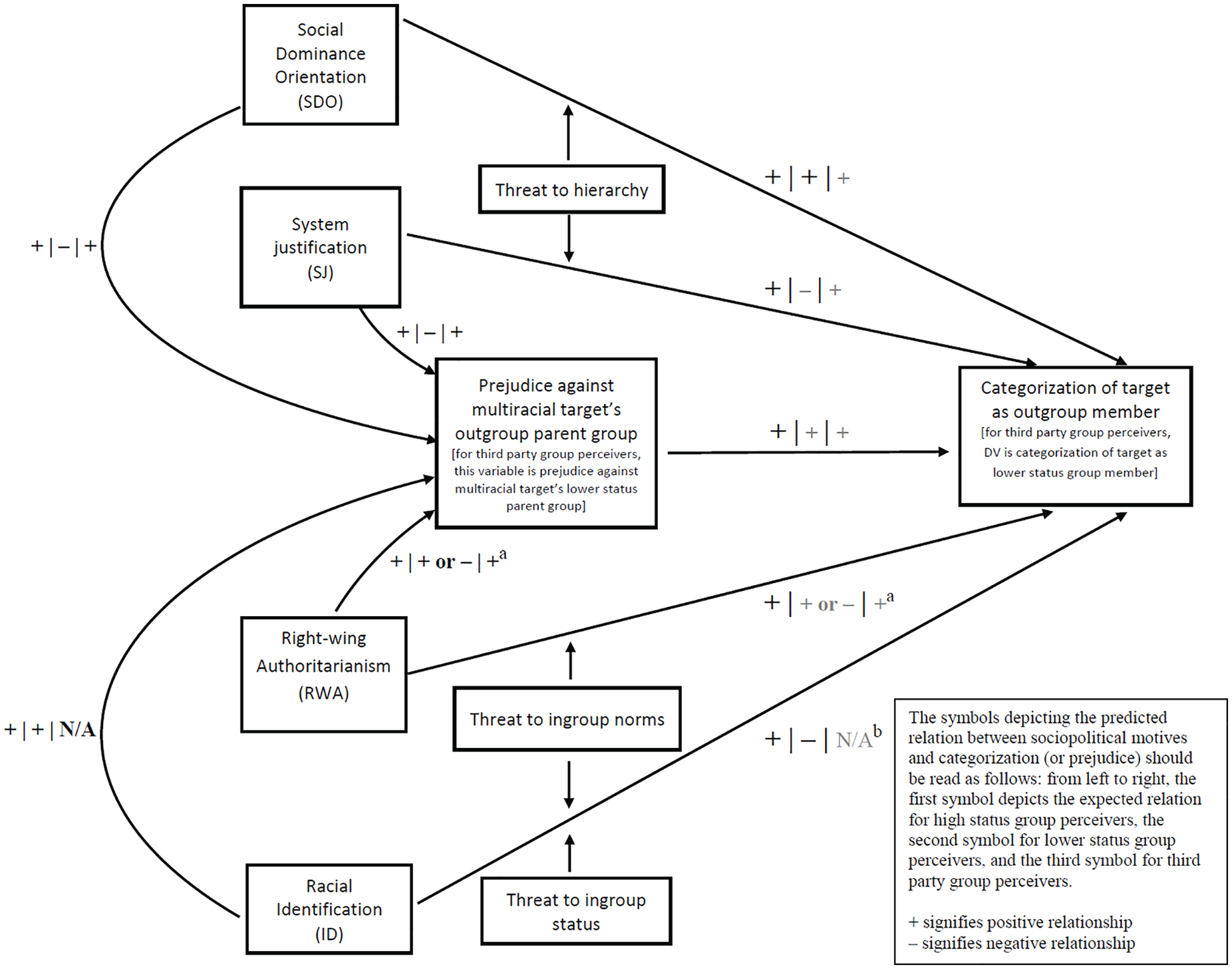
Integrative model combining theories of social dominance, system justification, right-wing authoritarianism, social identity, prejudice, and intergroup threat, to predict monoracial perceivers’ categorization of multiracial people as a function of perceiver group status (the sociopolitical motive × intergroup threat [SMIT] model of racial categorization).
Exogenous intergroup motives and the mediating role of prejudice
Following the extant literature, this model specifies as exogenous variables four sociopolitical motives (person variables) that explain why higher status group perceivers might categorize a target with shared racial ancestry as an outgroup (vs. ingroup) member. In particular, research to date suggests that high status group members exclude multiracial people (categorize them as members of their lower status parent group) because they are
motivated to protect group-based hierarchies (i.e., higher in SDO),
motivated to protect the status quo (i.e., higher in system justification needs),
motivated to protect social norms (i.e., higher in RWA), and
motivated to protect the ingroup (i.e., higher in social identification with a group).
Notably, some work on multiracial categorization has focused on prejudice as a predictor of categorization, with other work emphasizing the direct effect of motives such as SDO, system justification, RWA, and social identification on categorization. A long tradition of research in intergroup relations outside of multiracial categorization has considered how each of these motives can shape prejudice (e.g., Duckitt et al., 2002; Jost & van der Toorn, 2012; Sidanius & Pratto, 1999; Tajfel & Turner, 1986). Putting these together, we argue that SDO, system justification, RWA, and racial identification may shape multiracial categorization both directly as well as indirectly, by shaping prejudice toward a target’s parent racial groups. Hence, we have proposed that perceivers’ prejudice against a target’s outgroup parent group (or lower status parent group among third-party group perceivers) should be considered as endogenous to the four motives outlined above and as a proximate mediator of these motives on categorization. Although we specify prejudice as a possible mediator, in many cases, the four motives will have direct effects as well. For example, a person dispositionally high in system justification motives might, on the one hand, directly use hypodescent to bolster the status quo (i.e., by reifying extant group boundaries). On the other hand, system justification motives may lead to prejudice against a multiracial person’s minority parent group (because the perception that the social system is fair can lead perceivers to attribute a minority group’s disadvantage to internal attributes of group members vs. environmental factors), with this prejudice in turn leading to hypodescent (i.e., an indirect effect from system justification to hypodescent, via prejudice). As another example, a highly identified high status group perceiver might directly categorize a multiracial person as an outgroup member, because categorizing ambiguous targets as outgroup members allows for greater differentiation between the ingroup and outgroups (Knowles & Peng, 2005). In addition, we know that highly identified members of high status groups are often prejudiced against outgroup members (Jardina, 2019), including a multiracial person’s minority parent group (because intergroup prejudice allows for positive differentiation), and this prejudice may mediate the effects of social identification on categorization.
Distinct intergroup threats as moderators
Our model takes into account how situationally salient intergroup threats may (differently) moderate the effects of each motive, leading to outgroup categorization (directly and perhaps also indirectly through prejudice). Thus, our framework of categorization encourages theorizing about which of several motives may be particularly active in driving categorization at any given moment, depending on which particular threats are present and perceived. Specifically, we separately consider threat to hierarchy, threat to ingroup norms, and threats to ingroup status. We note here that threats to the hierarchy and to ingroup status can take the form of either material/economic/physical threats (i.e., realistic threats) or cultural/value threats (i.e., symbolic threats; Stephan et al., 2016). For example, a group can be threatened both realistically, to the extent that it faces economic competition from another group, and symbolically, to the extent that potential new group members hold different cultural values.
Threat to hierarchy
Individuals who prefer hierarchical differentiation between groups are likely to be more affected by salient threats to the extant hierarchy. Indeed, research has demonstrated that a threat to the hierarchy can moderate the effects of SDO on categorization, leading higher SDO individuals to use hypodescent (Ho et al., 2013; Kteily et al., 2014).
Kay and Friesen (2011) have theorized that threats to the (hierarchical) system can also trigger system justification motives. SJT makes predictions about status quo defense in general rather than hierarchy defense in particular, but in societies where hierarchy prevails, a threat to the hierarchy is a threat to the status quo (and most societies are hierarchical; Sidanius & Pratto, 1999). Thus, we should expect that threats to the hierarchy will trigger concerns among those high both on social dominance and on system justification motives (albeit for theoretically distinct reasons, with the former concerned about maintaining a hierarchical structure per se and the latter concerned more generally with maintaining the existing social order, which happens to be hierarchical, to satisfy epistemic, existential, and relational needs).
Because social dominance and system justification effects do not dissociate as a function of threats to the hierarchy being salient, experimental designs that more precisely pinpoint the concerns of those higher in social dominance and system justification motives would help to isolate the effects of each motive. Consider participants exposed to a situation in which multiracialism could change the existing hierarchical system but would result in a new system just as hierarchical as before, for example, because multiracial people are said to hold a status in between each of their parent racial groups but the position of each monoracial group remains the same and stable. In such a scenario, those who are higher in system justification concerns and thus have greater epistemic needs for order and structure may be motivated to use hypodescent to maintain the original structure; in contrast, those who are higher in social dominance concerns, and care mainly that hierarchical differentiation between groups is preserved, may not be particularly motivated to employ hypodescent to help maintain the status quo.
In addition, SDO and system justification effects may be dissociable based on the system that is under consideration. As discussed in the “System Justification Theory” section above, SJT posits that individuals are only motivated to justify systems they belong to, because it is only those systems that can satisfy their epistemic, existential, and relational needs. SDO, however, may be active in driving categorization even when perceivers are not members of the system under consideration, because individuals higher in SDO prefer hierarchical social organization in general, and have been shown to prefer such organization even when thinking about novel systems that do not affect them personally (e.g., Ho et al., 2012).
Threats to ingroup norms
Individuals dispositionally higher (vs. lower) on RWA are more likely to be inclined toward outgroup categorization of multiracial targets when they are exposed to threats to the monoracial ingroup’s norms, given that they prioritize deference to established authorities and cultural norms (Kteily et al., 2014).
Threats to ingroup norms in theory should also moderate the effects of social identification with the ingroup on categorization. That is, when an ingroup’s well-being is threatened, due to threats to its norms and cohesion and hence ability to sustain intragroup cooperation, individuals who strongly identify with that group should act to defend the group (Stephan et al., 2016).
Because authoritarianism and social identification effects may not dissociate as a function of threats to ingroup norms being salient—that is, when there is a threat to ingroup norms, both authoritarianism and social identification concerns may become active and thus drive hypodescent—both of these motives need to be measured simultaneously to examine whether each is having an effect, controlling for one another. In addition, these motives may dissociate when threats to an ingroup’s status (independent of threats to norms) are present, as we describe next.
Threats to ingroup status
Individuals who are strongly identified with a high status ingroup should be attuned to threats to the ingroup’s status. Thus, such status threats should moderate social identification effects. 7 Experiments that manipulate realistic threats to status, but not norms (symbolic threats), would help isolate the effects of social identification; those that manipulate norms, but not status, would isolate the effects of authoritarianism. For example, if a multiracial target is described as low status (e.g., poor) but very respectful of prevailing social norms (e.g., law abiding), social identification but not authoritarian concerns should in theory be activated (because in this case, a realistic threat to status, but not a symbolic, norm-related threat, would be salient). It bears noting that studies that only manipulate status without discussing norms might inadvertently manipulate perceptions of a target’s normativity, as perceivers might automatically associate low status with nonnormativity (Kraus et al., 2011).
The role of perceiver group status
Our model takes into account the ways in which perceiver group status moderates the relation between sociopolitical motives and categorization. First, it highlights that whereas both system- and group-level motives predict outgroup categorization among higher status group perceivers, the effects of sociopolitical motives on categorization are more varied among lower status group perceivers. Second, we note that only system-level motives are relevant for third-party perceivers. We expand on these two points next.
Divergence in what system- versus group-level motives predict for lower (vs. higher) status group members
Our analysis of how theories of intergroup relations can be applied to higher versus lower status group perceivers highlights that whereas system-level (social dominance, system justification, and RWA when societal ingroup norms are salient) and group-level (racial identification and RWA when racial ingroup norms are salient) motives are compatible for higher status group perceivers, they are incompatible for lower status group perceivers (Jost & Thompson, 2000). In particular, among higher status group members, each of SDO, system justification, RWA (irrespective of whether societal vs. racial ingroup norms are salient), and racial identification is positively correlated with the outgroup categorization of multiracial people, because what keeps the racial hierarchy in place also keeps the ingroup on top (Figure 1; + symbol denotes positive correlation).
In contrast, for perceivers from lower status groups, system- and group-level motives may diverge in how they are related to outgroup categorization, because protecting the status quo is incompatible with protecting or promoting the ingroup (i.e., the advancement of a lower status group entails challenging the status quo; Jost & Burgess, 2000; Levin et al., 1998). First, unlike the positive relation between system justification and outgroup categorization found among higher status group perceivers (Krosch et al., 2013), lower status group perceivers who are concerned with justifying the system may categorize multiracial people as members of the lower status ingroup, because doing so reifies extant group boundaries (Figure 1; − symbol represents negative correlation).
Second, lower status group perceivers higher on RWA may categorize targets as outgroup or ingroup members depending on whether they are motivated to protect their societal ingroup norms or racial ingroup norms (Figure 1). Thus, a lower status group perceiver who is motivated to protect societal ingroup norms may categorize a multiracial person as a member of the (lower status) racial ingroup because societal norms are often defined by high status groups and perceived to be less compatible with the norms of lower status groups (Devos & Banaji, 2005; Sidanius et al., 1997). In contrast, a lower status group perceiver who is motivated to promote racial ingroup norms may categorize a multiracial person as a member of their higher status outgroup (particularly if multiracial people are seen as disloyal; Chen et al., 2019).
Third, whereas stronger racial identification predicts outgroup categorization among higher status group perceivers, this is not necessarily the case for lower status group perceivers. Whereas multiracial people can be perceived as a threat to the ingroup among lower status group perceivers (e.g., a threat to ingroup cooperation if multiracial people are perceived as less loyal than monoracial people), leading to their exclusion (e.g., Chen et al., 2019, among Asian perceivers), they may in some cases be perceived as possibly strengthening the ingroup, leading to inclusion (Figure 1). For example, in the 1990s, many monoracial racial minority civil rights leaders (who were surely motivated to raise the status of their respective racial minority groups) objected to the proposed addition of a multiracial category on the U.S. Census, because they wanted to ensure that multiracial people were included in the ingroup for the purposes of civil rights enforcement and other perceived benefits of having a larger constituency (Prewitt, 2013). More broadly, members of lower status groups may see benefit from collective action with multiracial people to the extent they see them as sharing a common goal (Ho et al., 2017), and it is especially highly identified members of disadvantaged groups who seek to engage in collective action the most (van Zomeren et al., 2008). That ingroup motives can manifest in a variety of categorization outcomes, and due to a variety of ingroup concerns (e.g., concerns about ingroup cooperation or status), also highlights that past research from the social identity perspective may have focused too heavily on concerns about ingroup “contamination,” to the exclusion of other ingroup concerns.
Fourth and finally, even when a sociopolitical motive is positively related to the outgroup categorization of multiracial people among both higher and lower status group perceivers, as with SDO (Figure 1), there may be a main effect of perceiver group status. In particular, among high status group social perceivers, a positive correlation between SDO and outgroup categorization is driven by higher SDO perceivers excluding multiracial targets from their ingroup. In contrast, among low status group perceivers, the same positive correlation is driven by lower SDO individuals including multiracial people in their ingroup. Thus, even though there is a positive SDO and outgroup categorization relation among both low and high status group perceivers, only high status group perceivers exclude multiracial people on average, and only low status group perceivers include multiracial people on average (see supplemental material for a reanalysis of data from Ho et al., 2017, supporting this point). Thus, even when perceiver group status does not moderate the relation between a sociopolitical motive and categorization, it may nevertheless affect patterns of categorization.
In sum, one needs to take into account how perceiver social status influences the effects of SDO, system justification, RWA, and social identity (also see section “Which Sociopolitical Factors Influence Categorization?” and Figure 1).
System motives, but not group motives, guide third-party perceivers
A key difference for third-party perceivers is that only system-level motives should be directly relevant for them. Thus, whereas a third-party perceiver might use hypodescent when categorizing a multiracial target to satisfy their preference for hierarchy or for the status quo, they would not be expected to do so to advance their ingroup’s interests. Furthermore, authoritarianism should only affect third-party perceivers to the extent they are motivated to protect the norms of their society, rather than norms of their racial ingroup.
That said, it is possible that how targets without shared ancestry are categorized can indirectly affect an ingroup (which may factor into perceivers’ categorization judgments). For example, if a strongly identified Black perceiver motivated to advance the ingroup’s interests is categorizing a Latino-White target, she may be invested in maintaining a strong coalition of disadvantaged people (to the extent that doing so is seen as beneficial to the ingroup; Craig & Richeson, 2016) and thus may want to think of a Latino-White person as Latino. In the third-party perceiver section for each theory above, we also discuss how and whether each sociopolitical motive might affect perceivers who reside in a different social system than the target.
Two Key Future Directions Derived From the SMIT Model of Racial Categorization
Tests to dissociate the role of distinct sociopolitical motives and threats are needed
In this section, we summarize and underscore an important contribution of our theoretical synthesis, and follow with a detailed empirical example. In particular, our integrative model suggests that to understand the unique contributions of each intergroup motive, and how each motive works in conjunction with distinct intergroup threats, future research should (a) simultaneously assess multiple motives to examine their incremental contribution to multiracial categorization, controlling for one another; and (b) systematically manipulate distinct intergroup threats to reveal dissociations in which threats activate which motives. In doing so, future research can show how distinct motives and distinct threats operate in conjunction to influence monoracial perceivers’ categorization of multiracial people.
Empirical example
Studies 3 and 4 of Kteily et al. (2014) represent examples of this strategy for demonstrating the unique effects of various motives. In these studies, these authors simultaneously measured SDO, RWA, and White ethnic identification, which allowed them to examine the unique effects of each motive in White perceivers’ categorization of a Black-White target, while statistically controlling for the other two. In addition, in study 3, these authors manipulated the status of the racially ambiguous target (the target was described as being high or low in educational achievement and income). Because including a low status target in the high status group represents a situational threat that could affect the degree of hierarchical differentiation between groups, and affect the high status group’s standing, White participants who are high in SDO and high in ethnic identification, respectively, should be attuned to the status of the target. By measuring both of these motives, Kteily et al. (2014) were able to demonstrate that this target status manipulation interacted with SDO, but not ethnic identification, providing support for the possibility that individuals were more likely to categorize the target as Black due to their preference to maintain the intergroup hierarchy per se (rather than due to their concern for the ingroup). Furthermore and as hypothesized, individuals who were higher in RWA were not more likely to categorize the low status (vs. the high status) target as Black, because individuals higher in RWA are most concerned about group norms, and not hierarchical differentiation.
In study 4, Kteily et al. (2014) manipulated whether the target conformed to social norms (or not), and expected this to affect whether people higher in RWA were more likely to categorize the target as Black. They in fact found support for an RWA by target conformity interaction. Furthermore, because they measured ethnic identification, they were able to demonstrate that this was not driving Black categorization in this case, even though that would have been theoretically plausible (individuals higher in ethnic identification may be concerned about including individuals who violate group norms, because that can undermine the group’s ability to coordinate; Brewer, 2007). And, these authors also hypothesized and found that individuals higher in SDO were not responsive to the target conformity manipulation. Thus, Kteily et al. demonstrate that by measuring multiple motives that theoretically can drive hypodescent, and by systematically manipulating situational or target characteristics that may interact with some motives but not others, researchers can gain theoretical clarity on which motives are uniquely responsible for hypodescent, and under what conditions (see also McClanahan et al., 2019, for a similar dissociation showing simultaneous and distinct effects of SDO and ethnic identification predicting attributions about biracial targets).
Notably, there is precedent in the intergroup relations literature more broadly (i.e., outside the context of categorization) for researchers considering how distinct sociopolitical motives (e.g., RWA vs. SDO) are responsive to distinct intergroup threats (e.g., Duckitt et al., 2002; Thomsen et al., 2008). For example, Thomsen et al. (2008) found that whereas higher SDO individuals were threatened by an immigrant who wants to assimilate to the mainstream (because assimilation threatens extant status boundaries), higher RWA individuals were instead threatened by an immigrant who did not want to assimilate (because this threatens extant social norms). The existence of such research in other domains suggests that the SMIT model—which augments such research by considering additional sociopolitical motives and situational threats, as well as perceiver group status—may be applied to understand intergroup phenomena besides racial categorization. We return to this point in the final section.
More research is needed on perceivers from lower status and third-party groups
The possibility that some motives may have different effects for perceivers from lower (vs. higher) status groups, and among third-party perceivers, highlights the need to include ethnic minority research participants when testing theories such as social identity theory’s ingroup overexclusion hypothesis (i.e., the relation between racial identification and outgroup categorization, to take but one example where effects theoretically should diverge). At minimum, investigators need to be clear about whether the theoretical framework they are using should apply to all perceiver groups irrespective of status (and if not, why, in principle, perceiver group status may be an important moderator).
The inclusion of perceivers from different groups could also help to arbitrate between different theoretical accounts. For example, SJT suggests that perceivers from higher status, lower status, and third-party groups should all use hypodescent to maintain the hierarchical status quo. In contrast, an authoritarianism perspective would expect that, when perceivers are motivated to protect racial ingroup norms, (a) members of higher status groups will use hypodescent; (b) members of lower status groups will not use hypodescent, but rather will categorize multiracial people as outgroup members belonging to the higher status outgroup; and (c) third-party perceivers will not be invested in how the target is categorized one way or the other.
Differences between lower status groups occupying different positions in the racial hierarchy
Up to this point, we have discussed differences between high status versus lower status groups. Just as we discussed earlier that status can vary contextually, there may also be additional complexity worth exploring between groups that fall under the broad umbrella of relatively low status groups. Although we do not highlight this in our integrated model because there is only one paper to date directly comparing perceivers from different lower status (nonmajority) groups (i.e., Asian vs. Black Americans; Chen et al., 2019), future research may further reveal that sociopolitical motives operate differently for lower status groups that differ in their position in the racial hierarchy (e.g., lowest status vs. intermediate status). For example, whereas Ho et al. (2017) demonstrated that lower SDO Black Americans were more likely than their higher SDO counterparts to include Black-White multiracial people in the ingroup (due to egalitarians’ tendency to be sensitive to discrimination and, therefore, feel a sense of linked fate with multiracial people), Chen et al. (2019) found (although this was not the focus of their study) that SDO was unrelated to Asian Americans’ categorization of Asian-White multiracial people. It is possible that because Asian-White multiracial people are more accepted by White people compared with Black-White multiracial people (Ho et al., 2011; Pew Research Center, 2015), lower SDO Asian perceivers do not perceive much discrimination against Asian-White multiracial people and thus do not have a basis for including multiracial people based on linked fate. In addition, and again because Asian-White multiracial people are more accepted by White people compared with Black-White multiracial people, Asian perceivers may be more concerned about the allegiances of multiracial targets that combine their own group with White people than Black perceivers are. Thus, future work should examine how differences in status among different lower status groups (e.g., lowest vs. intermediate) can influence the factors that affect their inclusion (vs. exclusion) of multiracial people. 8 Such work would move the extant literature beyond the high status/lower status dichotomy it emphasizes, and thereby shed light on the experiences of groups that occupy different positions along the racial hierarchy continuum.
Discussion
Additional Future Directions
In addition to our call for research that systematically examines the effects of multiple intergroup motives on categorization, and across perceiver groups, several other future directions are worth highlighting. First, existing research has likely underspecified the sociopolitical conditions that are necessary for hypodescent to emerge. Roberts et al. (in press) presented young children (age 4–6 and 7–9 years) and adults with mixed status novel group targets (i.e., targets descended from a higher status novel group and a lower status one) and did not find evidence for hypodescent. This was true even though children (though not adults) preferred the higher status over the lower status group (i.e., were relatively biased against the lower status group and thus could have weighed the target’s lower status ancestry more heavily; Ho, Roberts, & Gelman, 2015). Moreover, hypodescent did not emerge in this context even when participants were assigned to the higher status group, and thus could have been motivated to “overexclude” the mixed-status target (Castano et al., 2002). Thus, it is unlikely that hypodescent is an easily elicited pattern of categorization that emerges spontaneously early in development and applies broadly to any set of groups differing in status (also see Roberts & Gelman, 2015). Rather, a complex web of sociopolitical conditions (e.g., competition between groups, economic scarcity, a strong commitment to cultural norms, or other strong political incentives) appear to be necessary for hypodescent to emerge. Understanding the necessary and sufficient conditions for the emergence of hypodescent is compatible with the need to identify how various intergroup threats (situational factors) and chronic motives (personality factors) work in conjunction to cause hypodescent.
Relatedly, cross-cultural studies that compare how different societies categorize multiracial people and the intergroup dynamics that are relevant to categorization in other contexts would yield further insight into how sociopolitical motives guide racial categorization (see Chen, de Paula Couto et al., 2018). For example, starting in the late 1800s and for much of the 1900s, dominant group members in Brazil, motivated by the racist, misguided belief that the Black population could be improved and eliminated through miscegenation, conferred an intermediate status to Black-White multiracial people (Telles, 2004). Thus, at least during a certain period of Brazilian history, White people who were motivated to maintain White dominance (those who were strongly identified as White and/or higher in SDO) may have been motivated to categorize multiracial people as intermediate between Black and White rather than as Black.
Likewise, during the mid-1900s in South Africa, the ruling political party granted the multiracial population (i.e., “Coloured” people) an intermediate status, for the explicit purpose of appeasing them and preventing collective action with Black South Africans (Marx, 1997). Thus, in this case, as in the Brazilian case, identifying with the dominant group, or a preference for hierarchy, would have been related to ascribing an intermediate status to Coloured people, rather than categorizing them as Black.
These examples suggest that future research can test whether the same sociopolitical motives can lead to different categorization outcomes across contexts, depending on what particular categorization outcomes are thought to best serve the political objectives individuals are motivated to obtain.
Future research should also examine how intergroup motives predict additional categorization outcomes. Here, we have focused on ingroup–outgroup categorization, because that is the outcome examined by most of the extant literature. Some research has also examined the willingness to use the category multiracial (vs. monoracial categories; e.g., Chen & Hamilton, 2012; Chen et al., 2014; Gaither, Chen, et al., 2018; Pauker et al., 2018; Peery & Bodenhausen, 2008; see Chen, 2019, for a review) or the tendency to categorize multiracial people as non-White, but not necessarily as members of their minority parent group (when ancestry is unknown; Chen, Pauker, et al., 2018; Nicolas et al., 2019). Beyond categorization, one paper has also examined perceivers’ attributions about which of a multiracial person’s background was most formative, as a function of the motivation to raise the standing of one group versus another (McClanahan et al., 2019). It would be useful to identify intergroup motives and conditions that give rise to these categorization and attribution patterns too (e.g., if there are similarities to what drives outgroup categorization). It is plausible, for example, that a perceiver who is high in SDO, and who perceives a threat to the existing hierarchy, would not want to “grant” a Black-White multiracial target membership in multiple racial groups (i.e., allow for a multiracial label, assuming that in the political context under consideration, such a category is perceived to erode the extant hierarchy). Instead, such a perceiver might want to ascribe membership in the target’s lower status group per se. If this perceiver did not know the target’s racial background, she might simply be more likely to categorize the target as a member of some racial minority outgroup (e.g., Latino). In general, these other categorization outcomes can also satisfy the concerns of individuals who are motivated to protect the hierarchy and/or their ingroup, and thus the SMIT model should in theory apply to these outcomes too.
The current review has highlighted how theories of intergroup relations can explain perceivers’ categorization of targets that combine any higher status and lower status racial group. However, existing research has focused almost exclusively on the categorization of White-Black or White-Asian multiracial people. Thus, as some examples above highlight, research is needed to demonstrate that these theories can in fact account for the categorization of multiracial people who combine other higher and lower status groups (e.g., one can test the authoritarianism account of hypodescent by examining how RWA predicts Asian perceivers’ categorization of Asian-Latino targets). Research on how such targets are categorized would be practically useful for understanding the experiences of such individuals, and theoretically useful for testing some of the intergroup theories identified above.
In addition, future research can examine whether multiracial individuals’ own intergroup and sociopolitical motives can influence how they self-identify (e.g., whether they show allegiance to their disadvantaged parent group, or instead identify with their higher status parent group). For example, just as lower SDO predicts Black perceivers’ ingroup categorization of Black-White multiracial people on the basis of perceived linked fate, lower SDO might also predict Black-White multiracial individuals’ perception that they share a linked fate with Black people, and lead them to identify as Black themselves. Self-identification as Black could then have downstream consequences for how others perceive them (Wilton et al., 2018).
Finally, whereas we described research focusing on cognitive factors in racial categorization at the outset, before turning our focus to sociopolitical factors influencing categorization, future research could also look at the interplay of sociopolitical and cognitive factors in racial categorization (Ho, Roberts, & Gelman, 2015). As one example of research that has taken such an approach, Ho, Roberts, and Gelman (2015) examined how perceivers’ sociocognitive tendency to perceive race as biologically based (i.e., essentialist reasoning) interacted with their sociopolitical motives (racial bias in this case) to influence categorization. In this research, neither essentialist reasoning nor racial bias had a main effect on categorization, but rather, the impact of each factor was dependent on the other. In other words, not all perceivers differentially weighed a target’s “essences” to the same extent, but rather, this differential weighing process subserved the motivations of individuals who were prejudiced against Black people in particular. Likewise, and as another example, it is possible that the pronounced attention to minority group phenotypic features specified by attention theory (a sociocognitive bias; Halberstadt et al., 2011) may interact with sociopolitical motivations, such that individuals who are most strongly identified with their ingroup (which they presumably encountered first) exhibit the greatest attentional biases (i.e., are most affected in their categorization by the distinguishing features of outgroup targets). Such differential processing of target features as a function of a perceiver’s sociopolitical motivations may not be limited to phenotype—it is possible that perceivers may attend more or less to other stereotypic cues (e.g., a target’s accent or occupation) as a function of their sociopolitical motives. For example, a Chinese perceiver who strongly identifies with her ethnic group, and interacts with a Chinese-Mexican biracial person with a Spanish accent, may be more likely to heavily weigh the accent information (compared with a less strongly identified perceiver) in deciding how to categorize the target.
Sociopolitical Consequences
What sociopolitical consequences result from the patterns of multiracial categorization we have reviewed above? That is, what are the implications for targets of being categorized on the basis of hypodescent? Two papers stand out in demonstrating that multiracial individuals perceived as more Black are less likely to receive votes for political office (Caruso et al., 2009) and receive lower financial allocations in economic games (Krosch & Amodio, 2014). A third paper demonstrated that the Tsarnaevs, the ethnically ambiguous Boston marathon bombers discussed above, were deemed to be more deserving of harsh punishment including the death penalty to the extent they were categorized as outgroup members by White perceivers. These outcomes demonstrate that hypodescent may be functional from the standpoint of perceivers who are motivated to maintain the hierarchical status quo. That is, perceiving a target as a member of his lower status parent group may be a precursor to, or occur in conjunction with, discriminating against that target as a member of that group.
Given the absence of relevant studies, we are not in a position to assess whether hypodescent is functional for perceivers who are motivated to maintain their ingroup norms or standing—those who are higher in RWA or social identification with a high status group. Still, regardless of whether hypodescent is functional in a material sense for such perceivers, it could be psychologically functional, insofar as perceivers believe that their group norms and standing are effectively maintained by excluding ambiguous others from their group. To our knowledge, no current studies demonstrate such a palliative function of hypodescent.
It is likewise difficult given the lack of existing research to assess downstream sociopolitical consequences of minority group members’ inclusion of multiracial people in the ingroup. For example, whereas we know that Black perceivers on average include Black-White multiracial people in the ingroup based on the perception that Black and Black-White multiracial people share a linked fate, it is not clear whether, having been included in the Black ingroup, multiracial people will in fact feel heightened solidarity and commitment to political action on Black people’s behalf (or, perhaps, instead withdraw from political action on behalf of Black people because they feel uniquely multiracial or because their experiences within the group lead them to feel different from the average group member).
Although additional research is needed on sociopolitical consequences of hypodescent, the serious consequences that have been established draw attention to the importance of addressing racial categorization biases, which in turn relies on an understanding of the sociopolitical concerns that perceivers bring to bear in their categorization of multiracial people. 9
The Need for Integrative Theories of Intergroup Relations
The current review highlights that intergroup phenomena, like the exclusion of multiracial individuals from a monoracial ingroup, are multiply determined by several intergroup motives and calls for research that more precisely identifies the cause(s) of exclusion depending on the salience of distinct intergroup threats. It also calls for attention to how an individual’s group status can influence the operation of sociopolitical motives, because group status can make some concerns more relevant than others (e.g., the need to maintain group dominance vs. achieve greater status). Although we have focused on multiracial categorization as an important intergroup phenomenon of interest in the current review, here, we discuss how the SMIT model can be used to understand other intergroup phenomena. Indeed, the SMIT model can be applied to understand any phenomenon that has the potential to challenge the hierarchical status quo, or negatively affect a particular social group.
For example, consider Brexit, or the U.K.’s recent decision to leave the EU. Whereas some research has examined Brexit support using a subset of the theoretical perspectives incorporated in the SMIT model (e.g., Van Assche et al., 2019; Zmigrod et al., 2018), no research has incorporated all of the theoretical perspectives embedded in SMIT in combination (despite the relevance of each of the theories of social dominance, system justification, RWA, and social identity). Relatedly, existing research on Brexit has not examined how the specific intergroup threats made salient (e.g., because of “elite discourse” or news coverage) might activate certain sociopolitical motives (more than others) to drive Brexit support. Beyond its theoretical utility, doing so could help give practical insight into how motivated actors might be leveraging individuals’ psychology to political ends (and, potentially, how to combat it). For example, imagine that a politician conveys that immigrants are eroding British cultural values (i.e., a symbolic, cultural threat to the U.K.). This would likely resonate with constituents who are higher in RWA, increasing their support for Brexit (which would allow the U.K. to establish more restrictive immigration policies). If instead, a politician vents about how the EU interferes with the U.K.’s ability to independently set fiscal policies that it deems beneficial (i.e., a realistic, economic threat to the U.K.), this could activate the concerns of individuals higher in British national identification, increasing their support of Brexit. Our suggestion that the SMIT model can be used to understand Brexit support converges with sociological (Bonikowski, 2017) and political science (Kaufmann, 2019) accounts of how “elite discourse” and media messages can shift Brexit (and related populist) attitudes, depending on a perceiver’s sociopolitical predispositions.
Furthermore, the SMIT framework suggests that a perceiver’s ethnic group status can moderate the effect of their sociopolitical motives, a point that also has ramifications for how we might better understand psychology’s relevance to political debates. For example, a Black British person who is highly identified with her Black ethnic background might oppose Brexit, if she sees the more restrictive immigration policies that it likely involves as negatively impacting potential Black immigrants she wants to support. In contrast, a White British person who is highly identified with her White ethnic background might support Brexit to the extent that she perceives that restrictions on immigration help protect her group’s standing as the dominant ethnic group in British society. Indeed, although past research examined the effect of White versus Black ethnic group membership on Brexit support rather than ethnic identification per se, the results are consistent with this prediction, showing that White British people were 19% more likely than Black British people to believe that the U.K. should leave the EU (Alabrese et al., 2019).
To be sure, the SMIT model does not represent the first attempt to combine theories of intergroup relations to understand a particular intergroup phenomenon. Duckitt and colleagues’ (2002) dual process model of prejudice represents a notable effort to integrate insights from the theories of social dominance and authoritarianism. As another example, Jost et al. (2017) highlighted how theories of social identity and system justification can be combined to understand collective action. Still, the SMIT model extends these efforts, by incorporating additional, major theories of intergroup relations, by placing emphasis on the moderating role of both distinct intergroup threats and of group status, and by explicitly considering third-party perceivers. Furthermore, notwithstanding research inspired by models such as the dual process model of prejudice, many studies in intergroup relations continue to examine issues from a particular theoretical perspective, even when other theories could just as plausibly or perhaps even more plausibly account for a finding. Similarly, many studies in intergroup relations focus on high status group members while remaining silent about how effects might differ across group status. Thus, in highlighting these shortcomings in the context of the multiracial categorization literature (including our own work), and in advancing the SMIT model, we hope to set an example for studies of other intergroup phenomena as well.
Supplemental Material
SupplementalMaterial_final – Supplemental material for Introducing the Sociopolitical Motive × Intergroup Threat Model to Understand How Monoracial Perceivers’ Sociopolitical Motives Influence Their Categorization of Multiracial People
Supplemental material, SupplementalMaterial_final for Introducing the Sociopolitical Motive × Intergroup Threat Model to Understand How Monoracial Perceivers’ Sociopolitical Motives Influence Their Categorization of Multiracial People by Arnold K. Ho, Nour S. Kteily and Jacqueline M. Chen in Personality and Social Psychology Review
Footnotes
Acknowledgements
We thank Spencer Dobbs and Angelina Iannazzi for research assistance, and members of the Psychology of Inequality Lab at the University of Michigan for helpful feedback on an earlier version of this article. We would also like to acknowledge the generous support of the Russell Sage Foundation (RSF). The first draft of this article was written while Arnold K. Ho was a RSF Visiting Scholar during the 2018-19 academic year.
Declaration of Conflicting Interests
The author(s) declared no potential conflicts of interest with respect to the research, authorship, and/or publication of this article.
Funding
The author(s) received no financial support for the research, authorship, and/or publication of this article.
Notes
Supplemental Material
Supplemental material for this article is available online.
References
Supplementary Material
Please find the following supplemental material available below.
For Open Access articles published under a Creative Commons License, all supplemental material carries the same license as the article it is associated with.
For non-Open Access articles published, all supplemental material carries a non-exclusive license, and permission requests for re-use of supplemental material or any part of supplemental material shall be sent directly to the copyright owner as specified in the copyright notice associated with the article.
