




Abstract
Both multiculturalism (which involves recognizing and appreciating differences) and racial/ethnic colorblindness (which can involve emphasizing similarities or individual characteristics) are intended to promote intergroup harmony. Nevertheless, these ideologies can backfire when salient. Although this work has sometimes been interpreted to suggest that dominant group members may perceive salient multiculturalism, and non-dominant group members may perceive salient colorblindness, as threatening, it is unclear what about these interethnic ideologies poses a threat and why. The present article draws upon theories of the self-concept to introduce a framework of
Among the most contentious sources of debate in American politics, organizations, and educational systems are whether and in what capacity racial, ethnic, and cultural differences should be acknowledged. In September 2020, as a response to his perception of a growing emphasis on racism and slavery in high school history curricula, former U.S. President Donald Trump was quoted as saying, “By viewing every issue through the lens of race, they want to impose a new segregation, and we must not allow that to happen” (National Archives Museum, 2020). A year-and-a-half later, the Wall Street Journal editorial board criticized Trump’s successor, President Joe Biden, for his plan to nominate a Black woman to the Supreme Court, claiming that doing so “elevates skin color over qualifications” (The Editorial Board, 2022). Meanwhile, in October 2021, California Governor Gavin Newsom signed a bill requiring high school students in the state to take an ethnic studies course focused on the experiences of marginalized groups (e.g., Asian American, Black/African American, Hispanic/Latino, and Native American people) prior to graduation. The bill will take effect during the 2029–2030 school year (Gecker, 2021).
The above examples reflect two prominent interethnic ideologies, or beliefs about how best to approach relations between ethnic groups, in Western societies (Wolsko et al., 2000). Trump’s and the Wall Street Journal’s arguments that discussing race will do more harm than good and that individual characteristics matter more than group membership, respectively, are both representative of racial/ethnic colorblindness, the notion that intergroup differences should be minimized in favor of emphasizing commonalities. According to proponents of colorblindness, in order for society to function smoothly and to maximize intergroup harmony, people should be treated as individuals rather than as members of particular groups, and similarities between groups carry more meaning than do distinctions (Wolsko et al., 2000; see also Hahn et al., 2015; Rattan & Ambady, 2013). Notably, colorblindness has been conceptualized differently across literatures. For instance, some researchers have discussed color evasion (i.e., denial of meaningful racial differences) and power evasion (i.e., denial of White privilege and racial discrimination) as forms of colorblindness (Neville et al., 2013). However, the power and color evasion conceptions of colorblindness tend to be conflated with constructs such as modern racism (Whitley et al., in press). Thus, the present review will focus primarily on two forms of colorblindness that are generally associated with positive intergroup outcomes (see Whitley et al., in press): emphasizing individual characteristics, and focusing on commonalities between groups. Emphasizing individual characteristics entails treating people according to their unique qualities rather than their group memberships (Rosenthal & Levy, 2010), like the decategorization approach to reducing intergroup prejudice (see Dovidio & Gaertner, 1999). By contrast, focusing on commonalities entails treating people equally across groups, sometimes as members of an overarching or superordinate category (e.g., humans; Rosenthal & Levy, 2010), similar to the recategorization approach to reducing intergroup prejudice (see Dovidio & Gaertner, 1999). Focusing on commonalities need not involve directly pressuring individuals to adapt to the dominant group, although that sometimes happens in practice; it simply involves the assumption that “we are all the same no matter what our cultural background is” (Hahn et al., 2015).
By contrast, California Governor Gavin Newsom’s signing of the bill that will make ethnic studies a high school graduation requirement embodies multiculturalism. As an interethnic ideology aimed at improving intergroup relations in society, multiculturalism acknowledges that meaningful differences between racial, ethnic, and cultural groups exist, and emphasizes the importance of appreciating and celebrating these differences (Rosenthal & Levy, 2010; Wolsko et al., 2000). Although multiculturalism is occasionally discussed in terms of demographic diversity per se (Verkuyten & Yogeeswaran, 2020) or as policies and practices related to diversity (Verkuyten & Yogeeswaran, 2020; Watters et al., 2020), this review will center on multicultural ideologies and philosophies. In addition, some alternatives to multiculturalism have received empirical attention, including all-inclusive multiculturalism (i.e., the explicit notion that multiculturalism includes both dominant and non-dominant group members; Stevens et al., 2008) and multicultural meritocracy (i.e., emphasis on both group differences and the merits and achievements of individuals; Gündemir et al., 2017). These forms of multiculturalism will be discussed briefly at the end of the article. However, multiculturalism will be conceptualized throughout most of this article as the general notion that group differences are important and should be recognized.
I focus the present review on multiculturalism and colorblindness in part because these are perhaps the two most widely discussed and researched interethnic ideologies in the social sciences (see Rattan & Ambady, 2013; Whitley & Webster, 2019). More important, unlike other interethnic ideologies such as segregation (i.e., the notion that groups should occupy separate spheres due to their differences) and assimilation (i.e., the notion that non-dominant groups should adapt to the “mainstream” or dominant group culture), multiculturalism and colorblindness aim to improve relations between groups in principle. According to Hahn and colleagues’ four-factor model of interethnic ideologies, interethnic ideologies can vary along two orthogonal dimensions: Whether group distinctions are emphasized or downplayed, and whether non-dominant groups are evaluated and treated positively or negatively. Multiculturalism involves emphasizing group distinctions and evaluating non-dominant groups positively, colorblindness involves downplaying group distinctions and evaluating non-dominant groups positively, segregation involves emphasizing group distinctions and evaluating non-dominant groups negatively, and assimilation involves downplaying group distinctions and evaluating non-dominant groups negatively. Based on this model, although multiculturalism and colorblindness differ in how much emphasis and importance they place on intergroup differences, the two ideologies are similar in their goals to cultivate intergroup harmony and respond benevolently to non-dominant group members, at least in principle (Hahn et al., 2015). Thus, it is critical to understand how and why even interethnic ideologies associated with positive intentions (i.e., multiculturalism and colorblindness) might engender feelings of threat among some groups, and in turn, how these ideologies can be presented in less threatening ways so as to maximize their effectiveness.
Recent meta-analyses have demonstrated that endorsement of multiculturalism and (to a slightly lesser extent) endorsement of colorblindness are associated with reduced prejudice against, or negative evaluations of, outgroups (Whitley & Webster, 2019; see also Leslie et al., 2020). These relationships generally hold among both dominant and non-dominant group members (Ryan et al., 2007), although the negative multiculturalism-prejudice association is more pronounced for dominant than non-dominant groups (Leslie et al., 2020). In addition, multiculturalism is related to less outgroup discrimination (i.e., negative behavior or behavioral intentions directed toward outgroups), whereas the relationship between colorblindness and outgroup discrimination is nonsignificant, for dominant and non-dominant group members alike (Leslie et al., 2020). The more consistent relationships between endorsement of multiculturalism, relative to colorblindness, and reduced prejudice/discrimination may be partly due to the fact that many existing measures of colorblindness conflate different components of the ideology, such as focusing on individual differences (which tends to predict lower outgroup prejudice) and avoiding any mention of race (which tends to predict greater outgroup prejudice; see Kite & Whitley, 2016). Furthermore, some measures and even manipulations of colorblindness are conflated with assimilation, which predicts more negative rather than positive treatment and evaluation of outgroup members (Hahn et al., 2015; Leslie et al., 2020; Whitley & Webster, 2019).
Despite the implications of multiculturalism and colorblindness for prejudice reduction and positive intergroup relations, each of these ideologies can be met with resistance. In fact, some research suggests that whereas dominant group members (i.e., White Americans) endorse colorblindness more than do non-dominant group members (e.g., Black and Latino Americans) in the United States (Ryan et al., 2007), dominant group members endorse multiculturalism less than do non-dominant group members (Ryan et al., 2007, 2010). Similar relationships have been obtained in other Western countries; for example, Dutch residents of the Netherlands exhibit less support for multiculturalism compared with Turkish residents of the Netherlands (Verkuyten, 2005). Notably, however, these findings should be interpreted with caution given that many measures conflate different aspects of colorblindness (Whitley & Webster, 2019), and non-dominant group members’ attitudes toward interethnic ideologies have been understudied (Gündemir et al., 2019). In addition, although the limited research on non-dominant group members’ attitudes has generally shown greater endorsement of multiculturalism compared with colorblindness (Gale et al., 2021; Rosenthal & Levy, 2012; Ryan et al., 2007, 2010) it is unclear whether dominant group members actually favor colorblindness over multiculturalism (see Hahn et al., 2015). Nevertheless, the obtained differences between dominant and non-dominant group members’ support for multiculturalism and colorblindness may have implications for which groups are relatively more likely to see each ideology as threatening.
In this article, I focus on the threats that multiculturalism or colorblindness can pose when salient (i.e., experimentally manipulated, present in a given context), rather than examine individual differences in preferences for these ideologies. The examples of multiculturalism and colorblindness presented at the beginning of this article suggest that each ideology is regularly made salient in everyday life, from the media to politics to debates about how to approach diversity in schools and organizations. In fact, multiculturalism and colorblindness can even be propagated via nation-wide policies that encourage the expression of particular ideologies (Guimond et al., 2013, 2014). Yet the effects of salient multiculturalism and colorblindness on dominant and (especially) non-dominant group members are not well understood. Indeed, although recent meta-analyses have demonstrated a strong negative relationship between endorsement of multiculturalism and racial/ethnic prejudice (Leslie et al., 2020; Whitley & Webster, 2019, the link between experimentally manipulated multiculturalism and prejudice is less consistent (Whitley & Webster, 2019). One potential explanation, consistent with research on the principle-implementation gap, is that dominant group members may endorse the ideas behind multiculturalism but have mixed feelings about it once it becomes prominent (i.e., salient) in society (Dixon et al., 2007; see also Yogeeswaran & Dasgupta, 2014). Similarly, non-dominant group members may endorse certain aspects of colorblindness (e.g., emphasis on intergroup similarities and individual characteristics) in theory but perceive the ideology as a means of justifying the status quo, in which their group is already disadvantaged, in practice (see Dovidio et al., 2016). Thus, I argue that dominant group members often see salient multiculturalism as more threatening than do non-dominant group members, whereas non-dominant group members often see salient colorblindness as more threatening than do dominant group members.
Introducing the Multiculturalism and Colorblindness as Threats to the Self (MCaTS) Framework
What types of threat might salient multiculturalism and colorblindness pose to members of dominant and non-dominant groups, respectively? Despite that some research has pointed to threat perceptions as a response to interethnic ideologies (e.g., Ginges & Cairns, 2000; Morrison et al., 2010; Ng & Bloemraad, 2015; Plaut et al., 2011; Yogeeswaran & Dasgupta, 2014), this research has not yet been organized into a framework that helps explain why and under what circumstances multiculturalism and colorblindness are considered threatening. In this review, I introduce the MCaTS framework. Specifically, I draw upon Brewer and Gardner’s (1996) conceptualization of the self-concept to argue that multiculturalism (for dominant group members) and colorblindness (for non-dominant group members) can be viewed as threats to the collective, relational, and personal levels of the self. Figure 1 depicts the specific types of threats to each level of the self-concept that dominant and non-dominant group members may perceive from multiculturalism and colorblindness, as well as potential moderators of these effects.
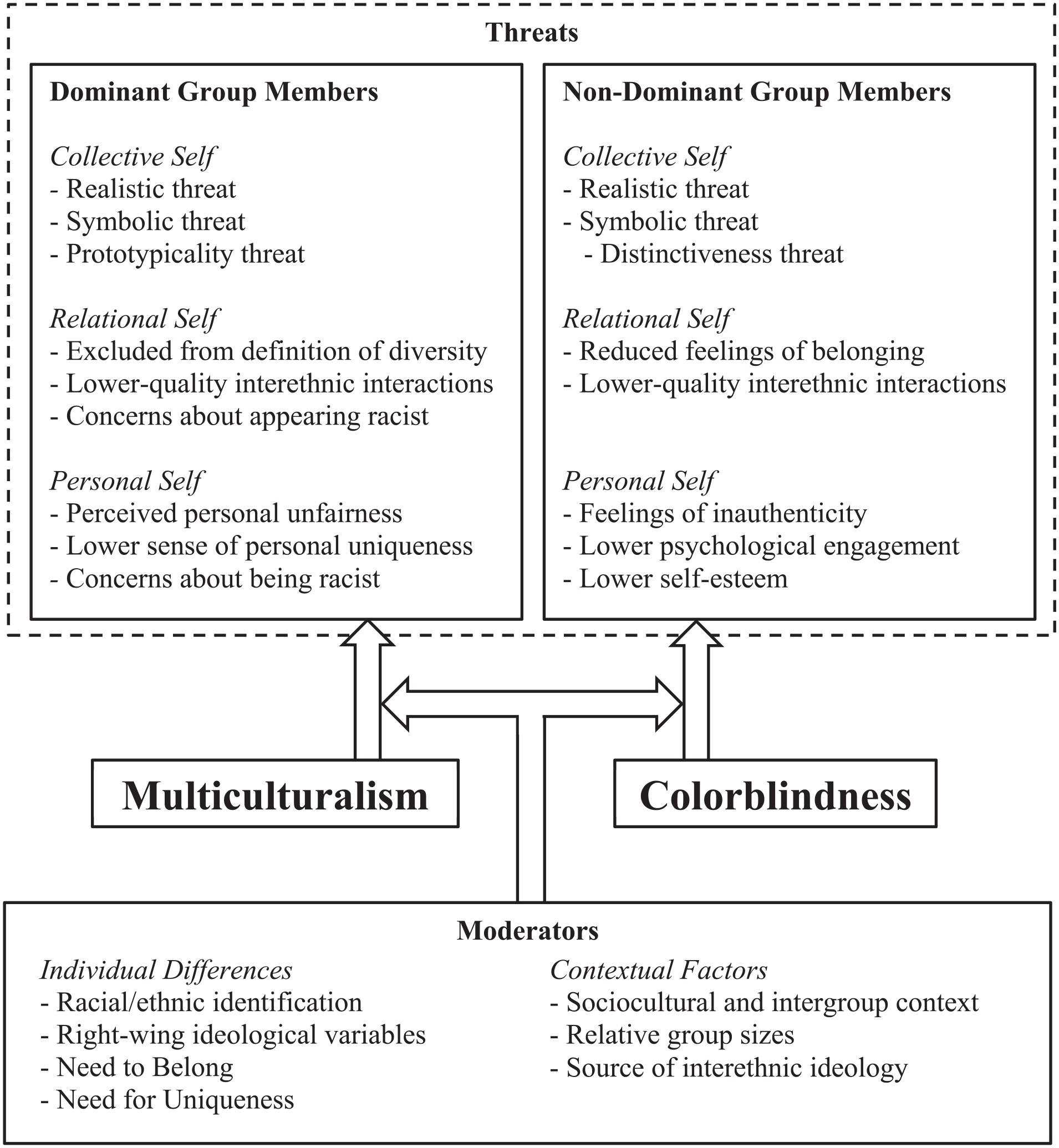
Overview of the MCaTS Framework.
According to Brewer and Gardner (1996), the self-concept comprises three levels of self-definition: personal, relational, and collective. The personal level involves one’s individual attributes and characteristics (e.g., hard-working, compassionate, funny), the relational self involves social roles and interpersonal relationships (e.g., friend, colleague, mentor), and the collective self involves larger, more impersonal social categories (e.g., woman, psychologist, American). Although everybody’s self-concepts contain elements of each of these three levels, individual/cultural differences as well as aspects of the situation can make one level of self-definition more or less salient than others. For example, European American students are more likely than Korean students to spontaneously describe themselves in terms of the personal level of self-definition (i.e., using general traits; Rhee et al., 1995). In addition, randomly assigning participants to read a passage that contains plural (versus singular) pronouns leads to more relational and collective self-descriptions, and vignettes that focus on large group gatherings (e.g., watching a football game with thousands of fans) tend to elicit more collective self-descriptions than vignettes that focus on small-group gatherings (e.g., taking a trip with friends; Brewer & Gardner, 1996; Gardner et al., 1999). Overall, people tend to regard their personal selves as most important, followed by their relational selves and finally their collective selves (Sedikides et al., 2013). The relative salience of each level of self-definition varies across contexts, however, and so distinguishing between these levels remains critical. This article makes no claims about whether multiculturalism (for dominant group members) and colorblindness (for non-dominant group members) most commonly pose threats to the personal, relational, or collective self, but rather highlights how interethnic ideologies can cause threats to any of the three levels of the self-concept. Nevertheless, individual, cross-cultural, and contextual differences, and their implications for when multiculturalism and colorblindness are likely to elicit each level of self-concept threat, will be revisited at the end of the present review.
Brewer and Gardner’s (1996) model of the self-concept is appropriate for organizing the literature on threats related to multiculturalism and colorblindness primarily because it allows for a distinction between relational and collective selves. Several existing frameworks separate personal threats from collective threats but do not clearly differentiate relational and collective threats. For instance, Social Identity Theory has as its basis the notion that the line between the personal and collective self-concepts can be blurred, particularly under conditions of threat (Tajfel & Turner, 1979). Furthermore, a central tenet of Intergroup Threat Theory is that people can experience group-level threats from outgroups (e.g., “they” are pushing their values onto “us,” “they” pose a danger to “us”) or individual-level threats from outgroups (e.g., “they” are disrespecting me as an individual, “they” pose a danger to me as an individual) (Stephan et al., 2009). As a final example, the source model of threat focuses on whether a particular threat comes from within the group, which could potentially be a threat to the personal or relational self, or from outside the group (i.e., a threat to the collective self; Greenaway & Cruwys, 2019). Yet multiculturalism and colorblindness can manifest themselves in broader intergroup/collective contexts (e.g., philosophies about the best way to improve relations between White Americans and people of color in the United States as a whole; Wolsko et al., 2000), interpersonal contexts (e.g., deciding whether to openly address racial/ethnic differences during an interaction with a person of a different background; Holoien & Shelton, 2012), or both. It is thus important to understand not only whether multiculturalism or colorblindness presents a potential intragroup/personal versus intergroup/collective threat but also how such threats are different at the relational and collective levels. Notably, as I argue below, the three types of threat need not be mutually exclusive, and it may be possible for an interethnic ideology to threaten more than one level of the self-definition.
Even though the focus of this article is on dominant and non-dominant group members’ perceptions of threat from salient multiculturalism and colorblindness, respectively, it is important to consider the complexities associated with each type of threat. That is, under certain circumstances, dominant group members may find multiculturalism to be relatively non-threatening, just as non-dominant group members may sometimes find colorblindness to be relatively non-threatening. These boundary conditions, where applicable, will be mentioned as each type of threat is introduced below, but they will be discussed in greater detail in the section on moderators of the MCaTS framework.
Multiculturalism as a Threat to Dominant Group Members
Collective threat
Two widely studied potential threats of multiculturalism to dominant group members’ collective self-definitions, derived from Intergroup Threat Theory (Stephan et al., 2009), are realistic threat and symbolic threat. Realistic threat involves perceptions of threat to the ingroup’s material resources, position in society, or general livelihood and well-being. For dominant group members, reminders of multiculturalism may trigger concerns that their group will incur or is already incurring disadvantages at the expense of outgroups, consistent with relative deprivation theory (see Kite & Whitley, 2016). These zero-sum beliefs (i.e., that more resources for outgroups indicate fewer resources for one’s own group) may be most evident, and racial/ethnic divides in public opinion most pronounced, for concrete policies related to multiculturalism, such as affirmative action programs perceived as specifying quotas based on group membership (Citrin et al., 2001; Haley & Sidanius, 2006). However, perceived threats to dominant group members’ resources can be evoked even when multiculturalism is simply described as an ideology that touts the celebration of diversity. For instance, pro-diversity organizational messages can activate concerns about dominant group members’ status within and hiring prospects at the organization. In two sets of studies, White Americans who read a company recruitment advertisement (Dover et al., 2016) or mission statement (Kaiser et al., 2021) emphasizing the importance of diversity, relative to a control advertisement, subsequently reported greater concerns that the company would discriminate against their racial/ethnic group in favor of minorities. A possible interpretation of these findings is that dominant group members saw the pro-diversity advertisements as jeopardizing their group’s chances of attaining desired resources (i.e., employment; Dover et al., 2016; Kaiser et al., 2021). As another example of the link between multiculturalism and threats to dominant group members’ tangible outcomes, multiculturalism can backfire in high-conflict, zero-sum situations. Specifically, White American students who read a purportedly real campus news article stating that racial/ethnic minority students would receive priority in enrolling for classes initially exhibited more rather than less prejudice after being reminded of multiculturalism, relative to colorblindness. The negative effects of multiculturalism did not persist over time; following a delay, prejudice decreased among those reminded of multiculturalism and increased among those reminded of colorblindness. Nevertheless, this finding suggests that perceptions of realistic threat to material resources may have been at least in part responsible for the short-term effects of multiculturalism on dominant group members’ prejudice (Correll et al., 2008).
Besides threats to material resources, dominant group members may also view multicultural ideologies as posing realistic threats to their group’s overall power or position in society. For example, White Americans tend to see increases in racial equality as losses for their group (Eibach & Keegan, 2006). Although multiculturalism is not the same as promoting equality between groups, a central tenet of multicultural ideology is to acknowledge the contributions of different groups, with a possible implication that no one group’s contributions are superior or inferior to others. Indeed, multiculturalism is considered a hierarchy-attenuating ideology, meaning that it is incompatible with the goal to maintain group-based inequalities (Levin et al., 2012). Dominant group members could thus construe multiculturalism as consistent with racial equality more so than colorblindness, which some researchers have argued glosses over intergroup inequalities (Knowles et al., 2009). Given that, by definition, dominant group members hold an advantaged position in society, the notion that multiculturalism brings about increases in racial equality may engender concerns about other groups usurping the dominant group’s power and status. Similarly, in diverse contexts such as the United States, where racial/ethnic minorities and mixed-race individuals are predicted to outnumber non-Hispanic Whites by the mid-21st century, reminders of multiculturalism elicit perceptions of realistic threat among dominant group members. One potential explanation is that the imminent growth in diversity, especially when combined with explicit recognition of differences between groups, makes the rising power and influence of racial/ethnic minorities in politics, education, and other institutions seem more palpable (Osborn et al., 2020). 1
Multiculturalism can elicit perceptions of symbolic threat in addition to realistic threat. Symbolic threat, broadly speaking, refers to threats to the ingroup’s cultural values, identity, norms, or way of life (Stephan et al., 2009). Even the mere perception of differences between the ingroup and outgroups can trigger feelings of symbolic threat (Stephan et al., 2015). However, the idea that diversity should be acknowledged and celebrated not only highlights group differences but also represents a possible change to the status quo in which dominant group members’ values have prevailed (Citrin et al., 2001). For some dominant group members, multiculturalism could signal a replacement of “mainstream” cultural values and traditions (e.g., the Protestant Work Ethic which is rooted in Western religious traditions, festivals and holidays focusing on European heritage) with those that represent racial/ethnic minorities or more recent immigrant groups (e.g., Black History Month, Cinco de Mayo, arguments in favor of changing Columbus Day to Indigenous Peoples’ Day). Relatedly, multiculturalism could also trigger concerns that the dominant group’s cultural values will no longer be the same as they were in the past (i.e., a threat to identity continuity; Smeekes & Verkuyten, 2015). Indeed, according to cultural inertia theory, dominant group members can be resistant to multicultural ideologies because such ideologies place the onus on their group to accommodate change—that is, to recognize the contributions of other groups instead of assuming that their group’s values and identity are the “default” (Zárate et al., 2019; Zárate & Shaw, 2010). Although the potential replacement of dominant group values may be perceived as jeopardizing the dominant group’s overall position in society and hence as a realistic threat, symbolic threat pertains directly to group values, whereas realistic threat does not. Instead, realistic threat typically involves threats to aspects of the ingroup’s power, status, and resources that are unrelated to values (e.g., economic opportunities, physical safety) (Rios et al., 2018).
In one set of studies that directly tested the effects of multiculturalism on dominant group members’ perceptions of symbolic threat, White American participants were assigned to read a passage about either multiculturalism or colorblindness. Those in the multiculturalism condition perceived higher levels of symbolic threat to White Americans and were less willing to donate to organizations targeted at diversity (e.g., Black Student Union), especially to the extent that their racial/ethnic group was important to their self-definition (Morrison et al., 2010). Furthermore, White Americans tend to see “concrete” forms of multiculturalism that focus on how the ideology could be implemented (e.g., offering foreign languages in schools) as a greater symbolic threat to their national identity than “abstract” forms of multiculturalism that focus on why it is important to appreciate diversity (e.g., learning about cultural differences) (Yogeeswaran & Dasgupta, 2014; see also Mahfud et al., 2018). Thus, even if dominant group members support diversity in theory, they may find it more difficult to do so in practice when recognition of other (non-dominant) cultural identities is explicitly called for.
The symbolic threat posed by multiculturalism may involve opposition to specific values as well as to the possibility of cultural change. For example, Alexander (2013) theorized that the backlash against Islamic immigration to Europe stems largely from the perceived threat of Islam to European democracy. Similarly, other researchers have posited that multiculturalism may be perceived as at odds with Western liberal values, which some immigrant groups are thought to not espouse (e.g., a widespread stereotype of Muslims is that they hold antiquated attitudes toward women and gender equality; Ng & Bloemraad, 2015). Multiculturalism may also be considered a threat to classical liberal values, as multiculturalism focuses on collective concerns (e.g., recognition of cultural differences) that seemingly run counter to the individual justice principles (e.g., equal treatment regardless of group membership) endemic to classical liberalism (Gale & Staerklé, 2019). In other words, multiculturalism may feel threatening to dominant group members because acceptance of diversity entails acceptance of values or traditions that they might find unpalatable or incompatible with those of their group.
In addition to realistic and symbolic threat, the third type of collective threat that multiculturalism may trigger for dominant group members is prototypicality threat, or the notion that non-dominant groups will come to be seen as more representative of the superordinate category (e.g., nationality) than dominant groups (Danbold & Huo, 2015, 2022) Unlike symbolic threat, prototypicality threat need not relate specifically to values. Even surface-level characteristics such as skin color, which are irrelevant to group values, may be used to determine who is seen as “belonging” more versus less to the superordinate category (e.g., people tend to associate “American” more closely with “White” than with other groups; Devos & Banaji, 2005). Another distinction between symbolic threat and prototypicality threat is that dominant group members may experience symbolic threat without necessarily perceiving prototypicality threat. Considering the example of Islam posing a threat to Western values introduced above, Europeans may not feel that Muslims will become the prototypical religious group in the European Union (EU); rather, they may simply not want Islamic values promoted alongside “mainstream” European values.
To date, whether multiculturalism elicits the perceptions of prototypicality threat among dominant group members has not been directly tested. However, Danbold and Huo (2015) have demonstrated that White Americans who read about the growing racial/ethnic diversity in the U.S. report greater feelings of prototypicality threat relative to those who read about a diversity-irrelevant topic. Furthermore, being encouraged to think about diversity (vs. unity) is especially threatening to groups that consider themselves prototypical of the superordinate category (Steffens et al., 2017). In the context of multiculturalism, reminders of the importance of appreciating diversity could evoke concerns that other groups will eventually become more prototypical than the dominant group (see Danbold & Huo, 2022). Supporting this possibility, Hahn and colleagues argued that multiculturalism in Germany was met with backlash among native Germans in part because Germany’s increasing diversity was such a marked deviation from the group prototype (Hahn et al., 2010). Although not based on an empirical study, this argument suggests native Germans were concerned that a heightened emphasis on difference would fundamentally change “what it means to be German”—in other words, that multiculturalism triggered feelings of prototypicality threat.
Relational threat
The notion that salient multiculturalism can pose a threat to dominant group members’ relational self-concepts gained traction after the publication of two articles highlighting the link between multiculturalism and feelings of exclusion (Plaut et al., 2011; Stevens et al., 2008). Specifically, White Americans were faster to pair concepts relevant to multiculturalism (e.g., difference, diversity) with exclusion-related words (e.g., exclude, reject), as well as faster to pair concepts relevant to colorblindness (e.g., similarity, color blind) with inclusion-related words (e.g., include, belong), than they were to make the opposite pairings. Racial/ethnic minorities, by contrast, did not show a bias toward associating multiculturalism with exclusion (Plaut et al., 2011). Similar effects have emerged in organizational contexts. For example, in a study conducted at a Dutch company, perceptions that the company espoused colorblindness (but not multiculturalism) predicted greater feelings of inclusion among employees born in the Netherlands, whereas perceptions that the company espoused multiculturalism (but not colorblindness) predicted felt inclusion among employees born in non-Western countries. Thus, multiculturalism was associated with less positive outcomes for Dutch-born employees than was colorblindness, as well as with less positive outcomes for Dutch-born than foreign-born employees (Jansen et al., 2016). In addition, in one of the studies on White Americans’ heightened perceptions of discrimination from pro-diversity organizational messages (Dover et al., 2016, Study 3), the measure of perceived discrimination actually contained an item about the extent to which participants would feel unwelcome in such an organization, suggesting that participants may have anticipated exclusion (Dover et al., 2016; see also Dover et al., 2020). These weaker associations between multiculturalism and inclusion for dominant group members presumably emerge because, at least in Western societies, both dominant and non-dominant group members consider diversity less applicable to Whites than to racial/ethnic minorities (see Unzueta & Binning, 2010). As a result, dominant group members who are reminded of multiculturalism and diversity may find themselves wondering whether and how they fit into such discussions. In other words, they may feel as though their sense of interpersonal belonging is threatened (Plaut et al., 2011; Stevens et al., 2008).
Of note, a recent set of studies suggested that the effects of multicultural messages on White Americans’ threatened feelings of inclusion may depend on how multiculturalism is described. In these studies, multiculturalism broadly defined (i.e., as valuing group differences) did not lead Whites to feel excluded from organizations. In fact, organizational messages only engendered felt exclusion among dominant group members when multiculturalism was explicitly defined as including racial/ethnic minorities but not Whites (Ballinger & Crocker, 2021). Critically, the studies did not contain a condition in which racial/ethnic minorities were mentioned without referencing Whites at all (e.g., “this company values the contributions of diverse groups of people, such as racial/ethnic minorities”). Stating that racial/ethnic minorities’ contributions were valued and not mentioning Whites’ contributions may have been more ecologically valid than directly stating, as in Ballinger and Crocker (2021), that Whites’ contributions were not valued. However, the former description of multiculturalism still may have dampened dominant group members’ sense of inclusion by rendering them “invisible.” Indeed, dominant group members reported weaker feelings of belonging to the organization the less they believed the organization valued their group (Whites) and included their group in its definition of diversity. In other words, not being part of the way that an organization construes “multiculturalism” may pose a relational threat for dominant group members (Ballinger & Crocker, 2021).
Extant research has not yet fully elucidated the sources of dominant group members’ feelings of social exclusion from multiculturalism, beyond direct organizational statements. However, there are a few possibilities worthy of future investigation. First, dominant group members may simply feel out of place in contexts that emphasize multiculturalism. Because diversity is often viewed as less relevant to dominant than non-dominant group members (Unzueta & Binning, 2010), the former may find it harder to relate to others’ multicultural experiences (e.g., participating in traditions tied to one’s heritage). Thus, dominant group members may believe that they cannot contribute effectively to diversity-related initiatives and discussions.
Second, dominant group members may feel they are able to contribute to diversity and that multiculturalism is personally relevant to them, yet they may be concerned that others will discount their perspectives and experiences. Supporting this idea, people without a vested interest in an issue are often reluctant to engage in relevant social action not because they hold a weak position on the issue, but rather because they worry their participation will be viewed with confusion or suspicion (e.g., men not wanting to openly advocate for funding of research on a disease that primarily affects women, and vice versa; Ratner & Miller, 2001). Similarly, dominant group members may associate multiculturalism with exclusion due to beliefs that others will judge them negatively for their involvement in diversity. For example, dominant group members may worry about being perceived as having ulterior motives (e.g., being performative, or interested in gaining social capital rather than the cause itself), or as being unable to truly understand the lived experiences of non-dominant groups. These possible concerns have some basis in reality: non-dominant group members (e.g., Black people) tend to be suspicious of dominant group members’ attempts at allyship (Burns & Granz, 2022), and White academics who research racial/ethnic prejudice are viewed as less knowledgeable, trustworthy, and legitimate than their Black counterparts (Thai et al., 2021). However, whether and to what extent dominant group members harbor such concerns, and feel excluded from multiculturalism as a result, is an open question.
In addition to triggering feelings of exclusion, multiculturalism may sometimes pose a threat to dominant group members’ relational self-concepts by hampering the quality of dyadic interactions with non-dominant group members. For example, during potentially contentious discussions that involve disagreement on important social issues or rejection from the interaction partner, salient multiculturalism can lead dominant group members to exhibit greater hostility toward outgroup interaction partners (Sasaki & Vorauer, 2013; Vorauer & Sasaki, 2011). The reason is that multiculturalism, due to its focus on intergroup differences, prompts people to really consider why their interaction partner disagrees with them and to make sense of the partner’s attitudes and behaviors (Sasaki & Vorauer, 2013; Vorauer & Sasaki, 2011). Though this focus on the interaction partner can be beneficial in non-threatening circumstances (e.g., getting to know the other person without discussing areas of disagreement; Vorauer et al., 2009), it can exacerbate relational threats in situations conducive to conflict (Sasaki & Vorauer, 2013; Vorauer & Sasaki, 2011). When multiculturalism backfires in this way, dominant group members may come to perceive emphasizing differences as detrimental to their relationships with racial/ethnic minorities.
Yet another form of relational threat that dominant group members may experience from multiculturalism involves concerns about how they are perceived by outgroup members. For many dominant group members, the fear of seeming racist in intergroup interactions looms large, especially when discussing topics relevant to racial/ethnic differences. One representative study demonstrated that, during a two-person game that involved guessing a target person’s identity, White Americans were reluctant to mention the target person’s race when paired with a Black partner, even though doing so would have improved game performance (Norton et al., 2006). In other words, the prospect of acknowledging differences between racial/ethnic groups presumably led dominant group members to attempt to appear non-prejudiced, and hence to adopt a suboptimal strategy of “not seeing race” (i.e., color evasion; Neville et al., 2013), in intergroup interactions. Similarly, White Americans who are assigned to discuss race-related issues (e.g., racial profiling) with Black partners report concerns that their partners will think they are racist, and as a result physically distance themselves from their partners, more so than those assigned to discuss issues unrelated to race (e.g., love and relationships) (Goff et al., 2008). Although these studies did not directly manipulate multiculturalism, they underscore the notion that simply mentioning racial/ethnic differences (a central tenet of multicultural ideology) can activate feelings of relational threat among dominant group members. As noted above, however, this may be especially the case in interactions that are or have the potential to become contentious—for instance, when the discussion topic is controversial (see Sasaki & Vorauer, 2013; Vorauer & Sasaki, 2011).
Personal threat
Multiculturalism can be perceived as a threat to dominant group members’ personal self-definitions in at least three ways. First, as explained earlier, pro-diversity organizational messages—which often make multiculturalism salient by highlighting differences between groups—can lead White Americans to believe that their group may be discriminated against (a collective threat) or that they would not feel welcome or valued in the organization (a relational threat) (Dover et al., 2016, 2020). However, this research also shows that pro-diversity messages can elevate dominant group members’ perceptions of personal unfairness—for instance, that their own chances of securing employment at the organization are compromised (Dover et al., 2016). Furthermore, pro-diversity messages can lead to cardiovascular responses consistent with threat among White men (Dover et al., 2016). These findings, taken together, indicate multicultural ideologies can increase dominant group members’ concerns that they themselves (in addition to their racial/ethnic group as a whole) may be treated unfairly (but see Ballinger & Crocker, 2021). Moving forward, it would be informative to examine what, exactly, the perceptions of unfairness entail. If they involve concerns about one’s personal outcomes (e.g., being hired, receiving a promotion or raise), this would be an example of individual-level realistic threat (see Stephan et al., 2009). By contrast, if they involve concerns about the process by which decisions are made (e.g., taking one’s race/ethnicity into account in hiring), this could indicate perceptions of symbolic threat to one’s individual values. In other words, dominant group members may feel that the organization’s decision-making procedures conflict with what they personally believe is fair.
Second, in part because people from all racial/ethnic backgrounds generally view diversity as less relevant to dominant than non-dominant group members (Unzueta & Binning, 2010), dominant group members may consider multiculturalism a threat to their sense of personal uniqueness. In particular, dominant group members may feel that they lack a distinctive cultural heritage, especially when differences between groups are emphasized and this celebration of differences is often interpreted to mean differences between racial/ethnic minority groups (Plaut et al., 2011). Even though many dominant group members self-identify as members of specific ethnic groups (e.g., Irish American, Italian American), by far the most common label used to describe one’s racial/ethnic background is “White” (Martin et al., 1996). Yet being induced to self-identify as “White” (e.g., on a demographic survey with no other relevant options), versus a label with more cultural connotations, such as “European American,” can reduce dominant group members’ support for multicultural ideologies (Morrison & Chung, 2011). Given that the label “White” tends to connote the absence of a meaningful background (Martin et al., 1996), these findings suggest that dominant group members may resist multiculturalism on the grounds that it makes them feel even less unique, relative to other individuals. That is, identifying as “White” may render it more difficult for dominant group members (who are not labeled in terms of their specific ethnic backgrounds) to differentiate themselves from one another when the pressure to recognize differences between non-dominant groups is salient. Indeed, the effects of the “White” label on reduced support for multiculturalism are strongest among dominant group members who have a high motivation for personal uniqueness, and hence who should be most concerned about the potential threat multiculturalism poses to their distinctiveness (Rios & Mackey, 2022).
Third, just as salient multiculturalism can trigger the relational threat of appearing racist in interactions with non-dominant group members, it may also trigger internal concerns about being racist. Although the first set of studies to experimentally manipulate multiculturalism and colorblindness found that multiculturalism reduced racial/ethnic prejudice, it also demonstrated that multiculturalism increased attributions of stereotype-consistent traits to Black targets (Wolsko et al., 2000). More recently, salient multiculturalism has been shown to elicit more positive evaluations of outgroup members with stereotype-consistent characteristics (e.g., a Black man who enjoys hip-hop music and basketball, as opposed to country music and golf; Gutiérrez & Unzueta, 2010). Furthermore, salient multiculturalism heightens beliefs in racial essentialism—in other words, the notion that differences between racial/ethnic groups are innate, unchangeable, and meaningful (Wilton et al., 2019). 2 It may be that dominant group members are largely not cognizant of their tendencies to use stereotypes in their evaluations and perceptions of outgroups when reminded of multiculturalism. However, in the event that they are aware of these tendencies, their awareness may engender fears that they themselves are (or may become) racist, a possibility that awaits empirical investigation.
The three forms of personal threat from multiculturalism reviewed here—concerns about fairness, concerns about uniqueness, and concerns about being racist—each involve threats that loom large in many Western societies. Fairness and justice are among the core moral foundations, or dimensions on which judgments of right and wrong are made, in North America and Western Europe (Graham et al., 2013). In addition, the value of being a unique individual is seen in Western advertisements, writings, and personal choices (Kim & Markus, 1999). Finally, dominant group members react defensively to feedback that they may be racially biased, even when the feedback is not made public (Howell et al., 2017). Thus, to the extent that multiculturalism triggers perceptions of threat in any of these three domains, the integrity of dominant group members’ personal self-definitions may be compromised.
Colorblindness as a Threat to Non-Dominant Group Members
Most research on interethnic ideologies has focused on dominant group members’ attitudes (Leslie et al., 2020; Whitley & Webster, 2019), with a few exceptions (e.g., Gale et al., 2021; Rosenthal & Levy, 2012; Ryan et al., 2007, 2010). Thus, little is known about how non-dominant group members respond to salient colorblindness and multiculturalism. Some work suggests that interethnic ideologies that emphasize similarities (e.g., colorblindness) have more negative consequences for non-dominant group members than do interethnic ideologies that increase awareness of differences (e.g., multiculturalism; Gündemir et al., 2019). As a result, non-dominant group members may perceive salient colorblindness as threatening, though the reasons underlying such perceptions of threat remain unexplored. Furthermore, several existing studies on non-dominant group members’ reactions to salient interethnic ideologies either conflate colorblindness with assimilation (e.g., Plaut et al., 2009; Wolsko et al., 2000) or do not disentangle the different components of colorblindness (e.g., emphasizing individual characteristics rather than group memberships, emphasizing similarities rather than differences between groups; see Whitley & Webster, 2019). Below, I review the ways in which non-dominant group members may consider salient colorblindness threatening to each level of the self-concept, as well as specific aspects of colorblindness that may elicit these feelings of threat.
Collective threat
Just as salient multiculturalism can be perceived as a threat to dominant group members’ collective selves, some research suggests—albeit indirectly—that salient colorblindness may be viewed as posing a threat to non-dominant group members at the collective level. For instance, when reminded of colorblindness, non-dominant group members may be concerned that their group will have even less power and access to material resources than do dominant group members (see Stephan et al., 2002). In other words, they may see colorblindness as a potential realistic threat. Indeed, despite that the intentions behind colorblindness are often egalitarian and harmony-enhancing (i.e., treating all people as individuals rather than group members, highlighting commonalities between groups), colorblindness can sometimes be used to legitimize existing inequalities in practice. In particular, by claiming that a focus on similarities rather than differences is better for intergroup relations, proponents of colorblindness may overlook the status quo in which some groups remain on the top and others remain on the bottom (Dovidio et al., 2016; Knowles et al., 2009). For non-dominant group members, this could mean that colorblindness affords them little opportunity to improve their group’s position in society, and perhaps even that group-based inequalities—due to their not being addressed—will be exacerbated.
In potential support of the notion that colorblindness may be perceived as a realistic threat to non-dominant group members, Black participants in one study reported feeling less powerful after reading a passage about colorblindness (which primarily focused on the importance of recognizing sameness across groups) than multiculturalism. In addition, although Black participants felt more powerful than White participants in the multiculturalism condition, this difference was eliminated in the colorblindness condition (Vorauer & Quesnel, 2017). Participants responded to the questions about power knowing that they would later interact with someone from a different racial/ethnic background (i.e., a White individual for Black participants). Thus, although the questions pertained to participants’ own feelings of power rather than directly to how much power they felt their group had, group differences in power may also have been salient while participants were answering these questions.
As noted earlier, realistic threat can also involve concerns that one’s group will be discriminated against, and some evidence suggests such concerns can loom large for non-dominant group members in the context of colorblindness. For instance, whereas White Americans tend to anticipate that their group will experience more discrimination at a pro-diversity organization than at a “neutral” organization (i.e., with no references to diversity; Dover et al., 2016), racial/ethnic minorities anticipate more discrimination against their group at a “neutral” relative to pro-diversity organization (Dover et al., 2016). Granted, an organization that does not mention diversity in its promotional materials is not necessarily colorblind. However, a lack of reference to diversity could be interpreted as minimizing racial/ethnic differences, especially among non-dominant group members who often look to such references as cues about whether they would be treated fairly within the organization.
In addition to realistic threat, non-dominant group members may consider colorblindness a symbolic threat to their group’s values, identity, or way of life. However, no studies to date have directly tested the effects of salient colorblindness on non-dominant group members’ perceptions of symbolic threat. The emphasis on similarities inherent in colorblindness could be seen as minimizing not just differences in power and status, but differences in cultural values as well. Although colorblindness is not equivalent to assimilation (i.e., the latter involves explicit pressure on non-dominant group members to adapt to dominant culture; Hahn et al., 2015), colorblindness may still elicit fears that the dominant group’s values will supersede those of non-dominant groups. In other words, non-dominant group members may not perceive highlighting similarities between groups per se as a symbolic threat; rather, they may be concerned that in practice, colorblindness will involve a particular type of “sameness” that contains tacit expectations of assimilation (see Rosenthal & Levy, 2010). For instance, if group differences are deemed so superficial that an organization decides to eliminate references to diversity on its website, or a school eschews celebrations of holidays and events relevant to non-dominant group members (e.g., Black History Month), this could be construed as erasure of non-dominant cultures in favor of the dominant culture.
Even if non-dominant group members do not believe salient colorblindness would result in their cultural identity being outright dismissed, they might perceive colorblindness as a threat to the distinctiveness of their identity (see Branscombe et al., 1999). That is, highlighting similarities between groups may engender concerns that it will become difficult or impossible to differentiate non-dominant groups’ values from those of other groups. 3 For example, suppose that a school in the United States includes both Halloween (a traditional American holiday) and Dia De Los Muertos (a traditional Mexican holiday celebrated by many Americans, including but not limited to those of Mexican descent) on its calendar. However, a philosophy that “we are all the same” may lead to the two holidays being grouped together, and their commonalities (e.g., they each involve spirits and costumes) being overstated, in discussions. Such a construal could be interpreted as losing sight of the unique customs and history that underlie Dia De Los Muertos, relative to other holidays. Although in theory, this could also be true for Halloween, prior research demonstrates that distinctiveness threats are more pronounced among non-dominant group members (who are less able to derive value from their group’s status) than among dominant group members (Turner et al., 1987; see also Mosley & Biernat, 2021). Thus, non-dominant group members should be especially likely to perceive colorblindness as a potential distinctiveness threat.
Unlike realistic and symbolic threats, which are applicable to non-dominant as well as dominant group members, prototypicality threat is less relevant to members of non-dominant than dominant groups. As described earlier, prototypicality threat involves the perception that one’s group will cease to be the standard against which other groups are evaluated (Danbold & Huo, 2015). Dominant group members are, by default, usually considered to embody this prototype and hence should be most vulnerable to prototypicality threat, as non-dominant group members should not feel threatened at the prospect of losing something (i.e., being prototypical) that they did not have in the first place (Danbold & Huo, 2022). However, one exception involves contexts in which non-dominant group members constitute the majority; for example, the prototypical student at historically Black universities is African American, rather than White American. In such rare contexts, multiculturalism may constitute a greater prototypicality threat (and perhaps also a greater realistic and symbolic threat) to non-dominant group members than does colorblindness, as a focus on differences might mean that non-dominant group members will no longer be considered representative of said contexts. Tentatively supporting this possibility, one study demonstrated that both African American students at a historically Black university and White American students at a predominantly White university preferred for their institution to emphasize similarities (rather than differences) across the student body (Hehman et al., 2012). 4 The potential implications of sociocultural context for non-dominant group members’ reactions to colorblindness and multiculturalism will be further discussed at the end of this article.
Relational threat
There are two general forms of relational threat that non-dominant group members may perceive from colorblind ideologies. First, salient colorblindness may hamper non-dominant group members’ feelings of belonging in social institutions and organizations. For instance, ethnic minority employees in the Netherlands feel less included in organizations that they perceive as espousing colorblindness (i.e., with a greater emphasis on personal qualifications than cultural background) than in organizations that they perceive as espousing multiculturalism (Jansen et al., 2016). Similarly, in a correlational study of student workgroups, ethnic minority participants distanced themselves more from the group when their group leaders endorsed colorblindness by highlighting similarities among members, whereas they felt more included in the group when their group leaders endorsed multiculturalism by highlighting differences among members (Meeussen et al., 2014). Such feelings of relational threat among non-dominant group members can persist in the long term: A study conducted with middle school students in Belgium found that the more the school’s mission statement incorporated colorblind values (operationalized as both downplaying cultural differences and emphasizing individual talents/characteristics), the lower ethnic minority students’ feelings of belonging were relative to ethnic majority students. This gap in feelings of belonging between minority and majority students was much smaller to the extent that the school’s mission statement incorporated multicultural values (Celeste et al., 2019).
Some studies suggest that salient colorblindness can affect anticipated as well as actual feelings of belonging among non-dominant group members, although these studies point to important boundary conditions of such effects. For instance, African American participants reported less trust and comfort within an organization that promoted colorblindness (relative to multiculturalism) in its recruitment materials, but only when the organization also had a low proportion of racial/ethnic minority employees. That is, the emphasis on sameness in the recruitment materials, coupled with low minority representation, suggested that participants would not feel welcome in the organization (Purdie-Vaughns et al., 2008). In addition, colorblind (compared with multicultural) organizational messages reduce highly identified Asian Americans’ trust and comfort within the organization, whereas colorblind organizational messages increase weakly identified Asian Americans’ trust and comfort within the organization (Kirby et al., 2020). For non-dominant group members whose race/ethnicity is central to their sense of self, the minimization of group differences in an organization may render it more difficult for them to fit in. By contrast, non-dominant group members who see their race/ethnicity as relatively unimportant may prefer for group differences to be downplayed. Taken together, these findings demonstrate that both group representation and racial/ethnic identification can play critical roles in the extent to which salient colorblindness threatens non-dominant group members’ anticipated belonging.
The second form of relational threat that salient colorblindness may pose to non-dominant group members is a diminished quality of social interactions with dominant group members. If group differences are minimized in favor of similarities or are not discussed at all, non-dominant group members may find it difficult to develop meaningful interpersonal connections, due to a central part of their identity being stifled. Indeed, non-dominant group members usually see their race/ethnicity as more fundamental to their self-definition than do dominant group members (McGuire et al., 1978). Supporting the notion that salient colorblind ideologies may hamper the quality of non-dominant group members’ interactions, racial/ethnic minorities in one study exhibited poorer performance on cognitive tasks following an interracial interaction in which their partner had been exposed to a colorblindness passage. In other words, interacting with White individuals who hold beliefs that racial/ethnic differences are less important than similarities can be stressful for non-dominant group members, for whom such differences are much more salient in everyday life (Holoien & Shelton, 2012). Critically, there were no effects of salient colorblindness on White participants’ cognitive task performance, suggesting that White participants perceived colorblindness as less threatening than did their racial/ethnic minority interaction partners. Furthermore, the relationship between White participants’ exposure to colorblindness and racial/ethnic minority participants’ task performance was mediated by third-party ratings of the White participants’ prejudice, which included an item about whether the White participants “devalued the importance of racial issues” (Holoien & Shelton, 2012). Devaluing the importance of racial issues more closely resembles the color evasion form of colorblindness (which tends to predict greater racial/ethnic prejudice) than the aspects of colorblindness designed to promote equality and reduce prejudice (i.e., emphasizing similarities and individual characteristics; see Whitley et al., 2021). Nevertheless, this mediation suggests that non-dominant group members, despite not being directly primed with colorblindness, may have picked up on and felt threatened by their partners’ minimization of group differences during the interaction.
Another example of how downplaying group differences can jeopardize non-dominant group members’ social relationships with dominant group members comes from research on national origin neglect. This research has shown that Americans of Asian and Latino descent experience more negative emotions when their White interaction partners misperceive or neglect to recognize their national origin identity (e.g., ask them about celebrating Cinco de Mayo, a Mexican holiday, when they are from El Salvador; Flores & Huo, 2013). Even though conflating different nationalities is not perfectly analogous to colorblindness, the nature of the threat—feeling as if dominant group members have dismissed one’s heritage in interpersonal interactions—is the same. On the surface, national origin neglect resembles the above-discussed distinctiveness threat, whereby non-dominant group members are concerned that their group’s identity will be seen as interchangeable with other group identities (Branscombe et al., 1999). However, in the case of national origin neglect, the threat is relational at core (i.e., feeling misunderstood by another person) rather than collective (i.e., wanting to preserve the group’s unique values and traditions).
What specific aspects of colorblind ideologies might be construed as threatening to non-dominant group members’ relational self-concepts? The colorblind measures and manipulations discussed in this section involved emphasizing similarities between groups, focusing on individual characteristics (versus group memberships), or a combination (see Rosenthal & Levy, 2010). Although emphasizing similarities and focusing on individual characteristics are intended to be inclusive and improve intergroup harmony (Whitley et al., 2021), making these components of colorblindness salient may have the opposite effects among non-dominant group members in practice. For instance, an emphasis on similarities does not necessarily involve overt pressure to adapt to the dominant group, as would be the case with assimilationist ideologies (Hahn et al., 2015). Instead, it entails recognition of similarities over differences (e.g., “first and foremost, we are all human beings”). For members of non-dominant groups, however, a focus on similarities may somewhat ironically engender feelings of exclusion, especially if the source of similarity is an overarching, superordinate category (e.g., “American”) in which the dominant group (i.e., “White”) is considered prototypical (Devos & Banaji, 2005; Dovidio et al., 2016). Here, it is not the idea of a superordinate category itself that is threatening, but rather what a superordinate category might look like in the context of colorblindness—for instance, pressuring non-dominant group members to adopt an identity that historically has excluded them, and perhaps to minimize the importance of their cultural heritage. In other words, to non-dominant group members, the emphasis on similarities inherent in colorblindness may have assimilationist implications (see Rosenthal & Levy, 2010). Supporting this possibility, some work has found that non-dominant group members perceive espousing a common group identity as requiring them to adopt the dominant group’s culture (Crisp et al., 2006).
Like emphasizing similarities, focusing on individual characteristics per se may not constitute a relational threat for non-dominant group members. However, this aspect of colorblindness may be perceived as threatening if there is a tacit assumption that the “individual characteristics” should not relate to race/ethnicity. As noted above, non-dominant group members generally consider their race/ethnicity more fundamental to their self-concept than do dominant group members (McGuire et al., 1978). Thus, non-dominant group members may be hard pressed to think of individual characteristics that are irrelevant to their group membership, which in turn may lead to reduced feelings of belonging in social institutions and greater difficulty in interpersonal interactions. For example, a non-dominant group member who identifies as Mexican American could describe themselves as “empathetic” due to their lived experiences with being a target of discrimination and mention “cooking Mexican food” as a hobby. Technically, one’s traits and hobbies are individual characteristics, but in this person’s case, it is difficult if not impossible to disentangle such characteristics from being Mexican American. As a result, they may feel as though potential employers or interaction partners will not value and acknowledge their characteristics as much as those of dominant group members.
Personal threat
Non-dominant group members may see salient colorblindness as threatening not only at the collective and relational levels but also at the personal level. For example, downplaying aspects of one’s self-concept (e.g., when racial/ethnic differences and any related attributes are minimized in a given context) could leave non-dominant group members feeling unable to express certain important elements of their personal identity. Knowledge and expression of the “true self”—that is, those aspects of the self-concept which define who one really is, deep down—are considered critical across cultures (Strohminger et al., 2017). Thus, when people feel inauthentic or disconnected from core aspects of their self-concepts, a sense of personal threat may ensue.
Consistent with this idea is research on the relationship between colorblindness and reduced feelings of authenticity among non-dominant group members. In one set of experiments, highly identified African American participants (i.e., whose ethnicity was central to their self-definition) reported that they were less able to be their “true selves” at a company that emphasized colorblindness (i.e., sameness) than at a company that emphasized multiculturalism (Kirby & Kaiser, 2021). Critically, weakly identified African American participants (i.e., whose ethnicity was less central to their self-definition) reported heightened feelings of authenticity at the colorblind relative to multicultural company. However, because non-dominant group members tend to identify strongly with their ethnicity overall (McGuire et al., 1978), the results of this study suggest that colorblindness may diminish felt authenticity for a significant proportion of non-dominant group members.
Non-dominant group members may also experience lower psychological engagement (i.e., ability and motivation to function at one’s personal best; Kahn, 1990) in response to salient colorblindness. In one relevant study, racial/ethnic minority employees felt less psychologically engaged in the workplace—that is, as though their job was less meaningful and important to them—the more their White American coworkers endorsed colorblindness. By contrast, they felt more psychologically engaged in the workplace to the extent that their White American coworkers endorsed multiculturalism (Plaut et al., 2009). As is the case with much research on interethnic ideologies, some of the “colorblindness” items in this study (e.g., “The organization should encourage racial and ethnic minorities to adapt to mainstream ways”) were closer to assimilation than colorblindness (see Whitley & Webster, 2019). Others, however, did directly assess colorblindness (e.g., “Employees should downplay their racial and ethnic differences”). Furthermore, the Purdie-Vaughns et al. (2008) studies on the negative effects of colorblindness and low racial/ethnic minority representation also contained outcome measures relevant to psychological engagement, such as “I think I would be willing to put in extra effort if my supervisor asked me to.” Thus, at least under some circumstances, colorblindness can indeed compromise non-dominant group members’ psychological engagement.
In addition to diminishing feelings of authenticity and psychological engagement, salient colorblindness may lower non-dominant group members’ self-esteem. As Fryberg and Stephens (2010) noted, one possible consequence of colorblindness for non-dominant group members—particularly those who are also numerical minorities in society—is feelings of invisibility. For example, the notion that racial, ethnic, and cultural differences are less important than similarities may lead to low representation of non-dominant groups in the media and popular culture, to the extent that the dominant group is considered “mainstream.” Such underrepresentation may trigger perceptions among non-dominant group members that their identity has been erased or does not matter in society, which could in turn negatively affect self-evaluations (Fryberg & Stephens, 2010). In potential support of this theorizing, Verkuyten (2009) demonstrated that exposure to a colorblindness passage that touted the importance of individual characteristics (relative to a multiculturalism passage) predicts lower self-esteem among non-dominant group members who identify strongly with their ethnicity. Although Verkuyten (2009) did not show a direct link between salient colorblindness and non-dominant group members’ self-esteem, these findings are suggestive of a link when ethnic identification is high, which is the case for many non-dominant group members (McGuire et al., 1978). Moreover, these findings underscore the possibility that for people whose self-concepts are rooted in their group membership (i.e., highly identified racial/ethnic minorities), a focus on “individual characteristics” may be perceived as threatening. Perhaps, as noted earlier, this is because such a focus tacitly implies that one’s “individual characteristics” can and should be separable from one’s group identity.
Moderators of MCaTS for Dominant and Non-Dominant Group Members
As noted earlier, not all dominant group members feel threatened by multiculturalism, nor do all non-dominant group members feel threatened by colorblindness. Therefore, it is important to consider the individual differences and contextual factors that determine when perceptions of threat from multiculturalism (for dominant group members) and colorblindness (for non-dominant group members) are most salient. It is also critical to examine the conditions under which threats to each level of self-definition (collective, relational, or personal) may be especially pronounced. Doing so will shed light on when and why multicultural or colorblind ideologies, regardless of their intentions, may sometimes backfire.
Individual differences
Racial/ethnic identification
One individual difference that has been shown to affect both dominant and non-dominant group members’ reactions to interethnic ideologies is racial/ethnic identification, or the importance of one’s race/ethnicity to the self-concept (Luhtanen & Crocker, 1992; Sellers et al., 1997). In one set of experiments, highly identified White Americans reported heightened perceptions of symbolic threat to their group’s values, as well as realistic threat to their group’s power and resources, after reading a passage about the benefits of multiculturalism (versus colorblindness). Weakly identified White Americans, by contrast, reported no difference in perceived threat from multiculturalism and colorblindness (Morrison et al., 2010). The effects of racial/ethnic identification on dominant group members’ perceptions of prototypicality threat from multiculturalism have not yet been examined but are likely to emerge, given that prototypicality threat involves concerns about one’s group identity no longer being representative of the superordinate category (Danbold & Huo, 2015). Recent work has shown no relationship between racial/ethnic identification and dominant group members’ perceived relational threat (e.g., feeling excluded) or personal threat (e.g., concerns that one will personally be treated unfairly) from multiculturalism (Ballinger & Crocker, 2021; Dover et al., 2016; Kaiser et al., 2021).
Just as racial/ethnic identification moderates dominant group members’ perceptions of collective threat from salient multiculturalism (Morrison et al., 2010), highly identified non-dominant group members may see salient colorblindness as a collective threat. For instance, highly identified non-dominant group members could feel most invested in improving their racial/ethnic group’s position and thus perceive colorblindness as a realistic threat that in many ways functions to maintain the status quo (see Dovidio et al., 2016; Knowles et al., 2009). They could also perceive colorblindness as a symbolic threat insofar as they feel especially invested in preserving their racial/ethnic group’s core values and distinctive identity. Regarding relational and personal threat, recent work cited above has shown that colorblindness reduces highly identified non-dominant group members’ trust, comfort, and authenticity in organizations, whereas it has the opposite effect among weakly identified non-dominant group members (Kirby & Kaiser, 2021; Kirby et al., 2020). A potential reason racial/ethnic identification moderates non-dominant, but not dominant, group members’ perceptions of relational and personal threat is that for non-dominant group members, one’s group is more closely intertwined with social relationships and the individual self (McGuire et al., 1978; Sellers et al., 1997). As a result, racial/ethnic identification (a variable primarily relevant to the collective self) may have stronger effects on non-dominant group members’ responses to interethnic ideologies, even when the responses are not measured exclusively at the collective level.
Right-wing ideological variables
The second set of individual differences that have been shown to affect dominant group members’ perceptions of threat from multiculturalism and that may affect non-dominant group members’ perceptions of threat from colorblindness, is right-wing ideological variables. These variables include political conservatism; Right-Wing Authoritarianism (RWA), or preferences for social order and tradition (Altemeyer, 1988); and Social Dominance Orientation (SDO), or support for group-based hierarchy and inequality (Pratto et al., 1994). For instance, salient multiculturalism heightens the perceptions of both realistic and symbolic threat among dominant group members high in RWA (Kauff et al., 2013), as well as perceptions of realistic threat among dominant group members high in SDO (Gutiérrez & Saint Clair, 2018). Regarding relational threat, one recent study found that White conservatives in the United States were more likely than Black conservatives, White liberals, and Black liberals to want to avoid interracial discussions about topics such as police treatment of Black Americans and Black NFL players kneeling during the U.S. national anthem (Appiah et al., 2022). Although this study did not directly assess threat, talking about controversial racial issues—which often involves acknowledging differences (i.e., a multicultural mind-set)—could have been perceived as compromising the quality of the interaction (see Sasaki & Vorauer, 2013; Vorauer & Sasaki, 2011). Finally, in the studies demonstrating that high RWA exacerbated dominant group members’ responses to multiculturalism, the threat measure contained items relevant to personal threat (e.g., perceptions that immigrants were threatening one’s own power/resources, and values) as well as collective threat (Kauff et al., 2013). In total, then, right-wing ideological variables tend to increase the likelihood that dominant group members will perceive salient multiculturalism as a collective, relational, and personal threat.
To date, the effects of right-wing ideological variables on non-dominant group members’ perceptions of threat from colorblindness have not been investigated. However, these variables carry different meanings for non-dominant and dominant group members. Given that political conservatism, RWA, and SDO are all hierarchy-enhancing ideologies, meaning they reinforce the status quo (Pratto et al., 1994), endorsing such ideologies is consistent with dominant group members’ interests but inconsistent with non-dominant group members’ interests (Levin et al., 2002). Non-dominant group members high in political conservatism, RWA, or SDO are unlikely to consider colorblindness a threat if they perceive it as perpetuating social inequalities (see Dovidio et al., 2016; Knowles et al., 2009). These individuals tend to endorse “false consciousness” beliefs that run contrary to the interests of their group (Neville et al., 2005). That said, non-dominant group members high in right-wing ideological variables may find colorblindness threatening (potentially to any level of the self-concept) if they instead perceive it as increasing equality between groups, as an emphasis on equality would clash with their hierarchy-enhancing values. Whether and how right-wing ideological variables impact non-dominant group members’ reactions to colorblindness may depend on the specific aspect(s) of colorblindness made salient.
Need to belong
Another individual-differences variable that has been shown to affect dominant group members’ responses to multiculturalism, and that may affect non-dominant group members’ responses to colorblindness, is Need to Belong, or the motivation to fit in with and be connected to others (Leary et al., 2013). Because Need to Belong primarily involves relationships at the interpersonal rather than collective level (e.g., feeling bothered when one is excluded from friends’ or coworkers’ plans), it is especially relevant to perceptions of relational threat. In the first study documenting how Need to Belong can moderate responses to interethnic ideologies, White American participants who scored high in Need to Belong found an organization with a multicultural mission statement less attractive than an organization with a colorblind mission statement. Those who scored low in Need to Belong, by contrast, found both organizations equally attractive (Plaut et al., 2011, Study 5). In addition, Dutch employees in the Netherlands who had high Need to Belong scores anticipated feeling less included in a multicultural company that mentioned valuing the contributions of ethnic minority groups but did not mention the ingroup, compared with a multicultural company that explicitly mentioned valuing the contributions of the Dutch as well as minority groups (Jansen et al., 2015). Although Need to Belong has not yet been tested as a moderator of non-dominant group members’ reactions to interethnic ideologies, it is possible that those high in Need to Belong would feel less included (i.e., greater relational threat) in contexts emphasizing colorblindness than multiculturalism.
Need for uniqueness
Finally, Need for Uniqueness—or the drive to differentiate oneself from others (Snyder & Fromkin, 1977)—may affect dominant group members’ perceptions of personal threat from multiculturalism. In one set of studies, White Americans high in Need for Uniqueness supported multiculturalism less after being induced to self-identify as “White” than “European American,” due to reduced feelings that they were personally included in and could contribute to diversity (Rios & Mackey, 2022). Prior research has shown that the “White” label connotes less distinctiveness, and induces greater feelings of distance from ethnic minorities, relative to the “European American” label (Morrison & Chung, 2011). Thus, for dominant group members who care about being different from others, a threat to their sense of uniqueness (i.e., self-identifying as “White”) leads them to reject multicultural ideologies, which emphasize the need to appreciate distinctions primarily between non-dominant groups. It remains to be seen whether dominant group members high in Need for Uniqueness report heightened perceptions of threat (e.g., feeling that they are unable to express their uniqueness, or that others are more unique than themselves) when multiculturalism is salient. However, this would be a worthwhile avenue for future research. Furthermore, the effects of Need for Uniqueness on non-dominant group members’ reactions to colorblindness have not yet been studied. It is possible that Need for Uniqueness amplifies non-dominant group members’ perceptions of personal threat from colorblind ideologies if they feel that minimizing racial/ethnic differences impedes them from expressing important aspects of their personal identities to others. Alternatively, non-dominant group members high in Need for Uniqueness may appreciate the emphasis on individual characteristics inherent in colorblindness and thus see the ideology as relatively non-threatening.
Contextual variables
Sociocultural and intergroup context
Salient multiculturalism may be less threatening to dominant group members in some sociocultural and intergroup contexts than in others. When a country’s policies are explicitly pro-diversity, dominant group members oftentimes perceive multiculturalism as more consistent with group norms, and hence exhibit less outgroup prejudice when these norms are salient (Guimond et al., 2013). Dominant group members in these countries may, therefore, consider multiculturalism less of a departure from the status quo. Relatedly, it is critical to consider whether multiculturalism aligns with the way dominant group identity has historically been viewed and expressed in the context at hand. In Mauritius, for example, multiculturalism benefits the dominant group (Hindus), who have been able to maintain a strong ethnic identity over time in terms of language, food, customs, and way of life. As a result, although higher ethnic identification predicts greater outgroup prejudice among Mauritian Hindus reminded of colorblindness or in a control condition, ethnic identification is not related to prejudice among Mauritian Hindus reminded of multiculturalism. For Hindus in Mauritius whose ethnicity is important to their self-concept, multiculturalism—which enables them to retain their cultural traditions—may be less threatening than other interethnic ideologies (Ng Tseung-Wong et al., 2018). Finally, dominant group members could be especially likely to view multiculturalism as a threat in contexts that are or have the potential to become contentious. For example, salient multiculturalism heightens White Americans’ perceptions of realistic threat from minority groups when interethnic conflict is high, but not when interethnic conflict is low (Correll et al., 2008). Furthermore, salient multiculturalism increases dominant group members’ hostility toward non-dominant group members during contentious interpersonal interactions, yet salient multiculturalism reduces dominant group members’ hostility toward non-dominant group members during benign interpersonal interactions (Vorauer & Sasaki, 2011).
Much less is known about how non-dominant group members respond to colorblindness and multiculturalism as a function of sociocultural context. In particular, are there any contexts in which non-dominant group members generally feel less threatened by colorblindness than multiculturalism? One possibility is that colorblindness is less threatening to non-dominant group members when their group constitutes the majority. In one study discussed earlier, African American students at a historically Black university preferred for their institution to emphasize similarities rather than differences across the student body (Hehman et al., 2012). Presumably, an emphasis on similarities (which included espousal of colorblindness) would better enable African American students to retain their group’s power and resources, social identity, and prototypicality, as it would require less change on the institution’s part. By contrast, emphasizing differences would mean paying greater attention to the contributions and needs of non-Black students at the university (see also Zárate et al., 2012). Colorblind ideologies could also be less threatening to non-dominant group members when their group is not officially recognized and therefore not legally protected, as is the case with some ethnic minority groups in China (Yin, 2016). In such situations, non-dominant group members may prefer for their differences from the dominant group to be minimized rather than highlighted, at least publicly, given that highlighting differences may bear severe social and legal consequences (e.g., ostracism, persecution).
Relative sizes of the dominant and non-dominant groups
Another contextual variable that may affect responses to interethnic ideologies, even when the dominant group comprises the majority and non-dominant groups are in the minority, is the relative sizes of the dominant and non-dominant groups. For instance, as discussed earlier, colorblind organizational messages are especially aversive to racial/ethnic minorities—and can elicit relational threats (e.g., feelings of exclusion in and distrust of the workplace)—when coupled with cues signaling low representation (Purdie-Vaughns et al., 2008). However, non-dominant group members may also find certain forms of multiculturalism threatening when the representation of their group is extremely low. In a recent set of studies, Black individuals who were underrepresented in an organization suffered greater deficits in task persistence and performance when the organization’s diversity approach focused on differences (rather than equality), suggesting they too perceived relational and/or personal threat. For these employees, a focus on differences may have engendered feelings of tokenism—that is, being evaluated based on one’s membership in a marginalized group. By contrast, Black individuals in organizations where their racial/ethnic group constituted a more sizable minority (and hence who were less vulnerable to tokenism-related feelings) benefited from a focus on differences, relative to equality (Apfelbaum et al., 2016).
Although no research has examined how dominant group members react to interethnic ideologies as a function of current group size, there are at least two possibilities. First, dominant group members may perceive less threat from multiculturalism if they are relatively underrepresented because they feel they have and are able to express a more distinctive identity (see McGuire et al., 1978; Rios & Mackey, 2022). Second, dominant group members may perceive more threat from multiculturalism if they are relatively underrepresented, because they feel their status as prototypical of the superordinate social category is in even greater jeopardy (see Danbold & Huo, 2015, 2022) However, these possibilities need not be mutually exclusive. For example, salient multiculturalism could lower perceptions of personal threat (i.e., enhance feelings of uniqueness), yet it could heighten perceptions of collective threat (e.g., to the group’s prototypicality), among dominant group members when their group’s representation is low.
Source of the interethnic ideology
Finally, the source of the interethnic ideology (i.e., who implements it) can influence perceptions of threat. Given the positive impact of national multicultural policies and related norms on dominant group members’ intergroup attitudes (Guimond et al., 2013), dominant group members may find multiculturalism less threatening to all levels of the self-concept and more palatable if it is advocated by other dominant group members. This idea has yet to be directly tested, however. For non-dominant group members, multicultural ideologies may sometimes be considered threatening when implemented or imposed by dominant group members. For example, Zou and Cheryan (2015) describe three ways in which White Americans’ attempts to be multicultural can backfire from the perspective of non-dominant group members. First, such attempts can increase non-dominant group members’ feelings of tokenism insofar as they believe they are evaluated and treated primarily based on their race/ethnicity (see also Apfelbaum et al., 2016; Plaut et al., 2018). Second, non-dominant group members may feel as though others expect them to embody stereotypical characteristics. Consistent with this possibility, recent work demonstrates that salient multiculturalism increases African American participants’ felt pressure to be prototypical of their race/ethnicity (Kirby & Kaiser, 2021); perhaps this is especially the case for those who interpret the multicultural ideologies as coming from dominant group members. Third, non-dominant group members may feel subjected to identity denial, or as though they are not considered true members of the superordinate category (e.g., “not American enough”; Cheryan & Monin, 2005; Zou & Cheryan, 2015). In other words, if dominant group members overemphasize racial/ethnic differences, non-dominant group members may believe others see them as too different to belong to the superordinate category. All three of these ways in which multiculturalism potentially backfire can be considered threats to non-dominant group members’ relational selves, as they involve concerns about how one is seen by dominant group members and (in the case of identity denial) feelings of exclusion. To date, there is no research on whether perceptions of colorblindness are affected by the source of the ideology, nor on whether these perceptions differ among members of dominant and non-dominant groups.
Other Interethnic Ideologies
As noted earlier, multiculturalism and colorblindness are not the only two interethnic ideologies that have received attention among social science researchers or the public, nor is multiculturalism the only interethnic ideology that emphasizes differences between groups. Furthermore, both multiculturalism and colorblindness can be conceptualized in slightly different ways. Below, some alternative conceptions of multiculturalism and colorblindness, as well as difference-based interethnic ideologies that have recently been introduced as alternatives to multiculturalism, are reviewed, and implications for both dominant and non-dominant group members’ perceptions of threat are discussed.
Alternative conceptions of multiculturalism
Concrete versus abstract construals
Throughout this article, multiculturalism has been described in terms of a general focus on racial, ethnic, and cultural differences. However, multicultural ideologies can vary in whether they are presented in an abstract or concrete way. Abstract construals of multiculturalism involve discussions of why it is important to acknowledge and appreciate group differences (e.g., because learning about different cultures can increase open-mindedness). By contrast, concrete construals of multiculturalism involve discussions of how acknowledgment and appreciation of group differences can be implemented (e.g., offering more opportunities for foreign language study in schools). One set of studies demonstrated that dominant group members in the United States (i.e., White Americans) perceive abstract, relative to concrete, construals of multiculturalism as less threatening to their national (i.e., American) identity. In other words, multiculturalism in the abstract can lower perceptions of symbolic intergroup threat. Importantly, construals of multiculturalism did not affect perceptions of realistic intergroup threat (e.g., to the nation’s power and resources) in these studies, possibly because abstract multiculturalism focuses solely on the recognition of group identities (Yogeeswaran & Dasgupta, 2014). The effects of multiculturalism construal on perceived symbolic threat have since been replicated in France and the Netherlands, with Moroccan immigrants as the outgroup (Mahfud et al., 2018).
Although these results have promising implications for reducing dominant group members’ perceptions of threat from multiculturalism to their collective selves (specifically to their group’s identity), it is unclear how non-dominant group members would respond to abstract construals of multiculturalism. For non-dominant group members, emphasizing group differences may generally be preferable to ignoring group differences (Ryan et al., 2007, 2010). However, if the emphasis on group differences is not accompanied by concrete plans for how to increase respect and appreciation for other cultures, non-dominant group members may wonder about the capacity for abstract construals of multiculturalism to produce actual change. A possible solution, which may reassure non-dominant group members that actual change will occur while mitigating dominant group members’ threat perceptions, is to describe multiculturalism as a learning opportunity for dominant group members. Doing so could introduce specific ways to celebrate diversity, hence increasing the salience of the practical effects of multiculturalism, while making dominant group members feel less threatened and more as though multiculturalism originates from the “bottom-up” (i.e., from dominant group members’ own initiatives to learn about other cultures). Indeed, highly identified White Americans respond more positively to multiculturalism when induced to think of it as a learning opportunity, rather than as a set of policies (Rios & Wynn, 2016).
All-inclusive multiculturalism
An alternative form of multiculturalism that has also received empirical attention is all-inclusive multiculturalism, which proposes explicitly including dominant as well as non-dominant group members in discussions of differences and diversity (Stevens et al., 2008). As noted earlier, part of the reason multiculturalism may pose a threat to dominant group members’ relational self-definitions is that people often view diversity as less relevant to dominant than non-dominant group members (Unzueta & Binning, 2010). Dominant group members may, therefore, feel excluded from definitions of terms like “diversity” and “multiculturalism.” However, in one experiment, presenting White American participants with a description of multiculturalism stating that multiculturalism includes both White Americans and racial/ethnic minorities, relative to a description of multiculturalism without this statement, reduced the strength of participants’ associations between multiculturalism and exclusion (Plaut et al., 2011, Study 2). Similarly, all-inclusive multiculturalism in the workplace led to greater feelings of inclusion and more support for organizational diversity efforts than did standard multiculturalism (i.e., with no reference to dominant group members) among Dutch employees in the Netherlands (Jansen et al., 2015). Other studies, though, have found no effects of all-inclusive (versus standard) multiculturalism on White Americans’ felt inclusion (Ballinger & Crocker, 2021). Thus, more research is needed to discern whether and under what conditions all-inclusive multiculturalism poses less of a threat to dominant group members than other forms of multiculturalism.
Some work has examined how non-dominant group members respond to all-inclusive multiculturalism. In one experiment, reminders of standard multiculturalism increased non-dominant group members’ feelings of power relative to a control condition (in which participants were not reminded of any interethnic ideology), but reminders of all-inclusive multiculturalism had no effect on non-dominant group members’ feelings of power (Vorauer & Quesnel, 2017, Study 4). One possible reason is that by explicitly referencing dominant group members, all-inclusive multiculturalism gives non-dominant group members the impression that their contributions are less valued or important. In other words, all-inclusive multiculturalism may dilute the feelings of power and inclusion they typically experience when group differences are acknowledged. Thus, it is important to consider whether (and how) all-inclusive multiculturalism might be redefined so that it is less threatening to non-dominant, as well as dominant, group members.
Multicultural meritocracy
A third alternative form of multiculturalism, multicultural meritocracy, entails emphasizing differences between groups along with the importance of equal opportunity (e.g., making decisions based on merit). In other words, unlike standard multiculturalism, which involves recognizing group differences without articulating how decisions are made in organizational contexts, multicultural meritocracy focuses both on group differences and on individuals’ qualifications and competence. Research has shown that relative to standard multiculturalism, multicultural meritocracy heightens dominant group members’ feelings of inclusion, perceptions of fairness, and psychological engagement in the workplace (Gündemir et al., 2017). Given that feelings of inclusion are primarily relevant to the relational self, whereas perceptions of fairness are potentially relevant to both the personal and collective selves, multicultural meritocracy seems to alleviate all three levels of threat among dominant group members, without having detrimental effects on non-dominant group members. Indeed, non-dominant group members responded to multicultural meritocracy with comparable feelings of inclusion and psychological engagement as they did to standard multiculturalism (Gündemir et al., 2017).
Importantly, though, multicultural meritocracy is only applicable in settings where merit and achievement are involved. For example, it would be difficult to implement the ideology in extracurricular clubs and organizations that are not merit-based, or through general messages about how to maximize intergroup harmony. Another caveat is that multicultural meritocracy may sometimes be interpreted as a form of colorblindness, or as a combination of colorblindness and multiculturalism, due to the focus on individual achievements along with differences (see Jansen et al., 2016). Thus, despite that non-dominant group members reacted positively to multicultural meritocracy in the above studies (Gündemir et al., 2017), they might view the ideology with skepticism under other circumstances—for example, in organizational contexts with especially low racial/ethnic minority representation (see Purdie-Vaughns et al., 2008). In these contexts, the acknowledgment of differences may be considered insincere or superficial because it does not match the organization’s reality.
Polyculturalism
A relatively new addition to the literature on interethnic ideologies is polyculturalism, which emphasizes the importance of recognizing both group differences and the ways in which groups have influenced and interacted with one another over time (Rosenthal & Levy, 2010). Examples of polyculturalism include fusion cuisine and forms of art that integrate elements from two or more cultures (e.g., reggaeton music, Zumba dance). Experimental work has demonstrated that salient polyculturalism, more so than salient multiculturalism or colorblindness, buffers the effects of growing racial/ethnic diversity on dominant group members’ perceptions of realistic intergroup threats (Osborn et al., 2020). Presumably, this is because dominant group members reminded of mutual cultural influences are less likely to see increases in diversity as jeopardizing their group’s position, and more likely to perceive their group as still being an impactful part of society. Polyculturalism also reduces dominant group members’ concerns about retaining the purity of their own and other cultures and hence increases their willingness to engage in culturally mixed experiences (Cho et al., 2017), suggesting that polyculturalism may mitigate the perceptions of symbolic intergroup threat as well. No research has examined the effects of polyculturalism on dominant group members’ perceptions of relational or personal threat. However, it is likely that polyculturalism’s emphasis on mutual group influence and interaction would boost feelings of inclusion among dominant group members by making them feel as though they have something valuable to contribute to diversity-related discussions.
Non-dominant group members’ reactions to polycultural ideologies have been examined in only one study to date. This study demonstrated that racial/ethnic minorities in the United States endorsed polyculturalism more than assimilation, but marginally less than multiculturalism; endorsement of colorblindness was not assessed (Gale et al., 2021). On one hand, the focus on both differences and reciprocal influence between groups could be less threatening and more palatable to non-dominant group members than colorblindness, which minimizes differences altogether. On the other hand, because dominant group members hold disproportionate power in society, non-dominant group members may sometimes feel as though “mutual influence” is not mutual at all. Blending two or more cultures together, when one culture holds more power than the other, also carries with it the risk of cultural appropriation, defined as misuse of a culture’s products by the dominant group (Mosley & Biernat, 2021). It is, therefore, important in implementing polyculturalism to ensure that the cultures under question wield equal amounts of influence throughout discussions of differences, and that non-dominant groups feel as though their culture is well understood rather than simply borrowed or exoticized.
Interculturalism
Another newly introduced interethnic ideology, interculturalism, combines the elements of multiculturalism, colorblindness, and polyculturalism. There are three components of interculturalism: a sense of unity (i.e., emphasis on belonging together rather than keeping group identities separate), identity flexibility (i.e., emphasis on group identities as malleable rather than fixed), and intergroup dialogue (i.e., emphasis on mutual understanding and cooperation) (Verkuyten & Yogeeswaran, 2020). Sense of unity parallels a dual-identity conception of multiculturalism insofar as it involves recognizing similarities as well as differences between groups (Dovidio et al., 2007); whereas identity flexibility and intergroup dialogue resonate with polyculturalism’s focus on cultural mixing and mutual influence (though intergroup dialogue involves prescriptions as to how groups ought to interact, whereas polyculturalism involves descriptions of how groups have historically interacted; Gale et al., 2021). In a recent set of studies, salient interculturalism improved dominant group members’ intergroup attitudes and behaviors relative to a control condition, and the effects of interculturalism were overall no different from those of salient multiculturalism (Yogeeswaran et al., 2021). Thus, it is unclear whether dominant group members consider salient interculturalism (and each of its three components) less threatening than salient multiculturalism, as perceptions of threat were not examined in these studies. The effects of salient interculturalism on non-dominant group members have not yet been investigated. However, given that racial/ethnic minorities in the United States tend to support some forms of interculturalism (e.g., intergroup dialogue) more than others (e.g., identity flexibility) (Gale et al., 2021), non-dominant group members’ reactions to salient interculturalism likely depend on both the context and the way interculturalism is described.
Alternative conceptions of colorblindness
As noted earlier, the present article reviews the effects of two forms of colorblindness aimed at promoting intergroup harmony, at least in principle: a focus on intergroup similarities and a focus on individual characteristics regardless of group membership (Rosenthal & Levy, 2010; see also Whitley & Webster, 2019). However, colorblindness can also involve color evasion (i.e., denial of racial/ethnic differences) and power evasion (i.e., denial of dominant group privilege; Neville et al., 2013). Color evasion overlaps with focusing on similarities in that both seek to minimize the importance of differences between groups. Critically, however, color evasion involves actively suppressing acknowledgment or discussion of these differences (e.g., “I don’t see color”; Neville et al., 2013), rather than simply shifting the focus from differences to similarities. Furthermore, color evasion and power evasion tend to correlate positively with scores on subtle measures of prejudice (Neville et al., 2000), whereas focusing on similarities or individual differences tends to correlate negatively with racial/ethnic prejudice (Kite & Whitley, 2016). As a result, color evasion and power evasion are likely perceived as even more threatening to non-dominant group members than focusing on similarities or individual differences. It may, therefore, be more effective and informative to investigate how to mitigate non-dominant group members’ feelings of threat in response to the aspects of colorblindness explicitly designed to enhance intergroup harmony, as opposed to examining how color evasion and power evasion (which have been shown to predict more negative intergroup outcomes; Neville et al., 2000) affect non-dominant group members. That said, much research on colorblindness conflates different aspects of the ideology—for example, focusing on similarities versus focusing on individual characteristics—and the need to disentangle these aspects will be discussed in the following section.
Future Directions
How does the MCaTS framework of multiculturalism and colorblindness as threats to dominant and non-dominant group members, respectively, advance knowledge of interethnic ideologies in their current state? On a theoretical level, considering why and under what conditions multiculturalism and colorblindness may be perceived as threatening, and to what levels of the self-concept, could help reconcile seemingly conflicting findings in the literature. On a practical level, investigating the sources of perceived threat from multiculturalism and colorblindness could aid institutions and organizations in framing interethnic ideologies in ways that appeal to both dominant and non-dominant group members. In both cases, pinpointing the nature of the threat is critical for determining which aspects of multicultural and colorblind ideologies may be most problematic for different groups of people and hence may need revision. Below are some future research directions that would help shed light on the above issues, using the MCaTS framework.
Disentangling different aspects of multiculturalism and colorblindness
Multiculturalism
Although broadly speaking, multiculturalism involves acknowledging and appreciating differences between groups (Plaut et al., 2018; Rattan & Ambady, 2013), social scientists have only recently begun to uncover the nuances in the ideology. For instance, which groups are included (or not) in conceptions of “difference”? When considering how salient multiculturalism might affect dominant and non-dominant group members, it is important to consider whether differences are mentioned in general (e.g., “Our organization values diversity”) or in particular forms (e.g., “Our organization values racial/ethnic diversity”). If the latter is the case, are some groups mentioned but not others (e.g., “Our organization values the unique contributions of racial/ethnic minorities”; “We encourage racial/ethnic minorities to apply”)? Research on standard versus all-inclusive multiculturalism examines these types of questions (e.g., Ballinger & Crocker, 2021; Jansen et al., 2015; Plaut et al., 2011; Vorauer & Quesnel, 2017), but with conflicting findings. Specifically, whereas some studies suggest that standard multiculturalism is threatening to dominant group members (Jansen et al., 2015; Plaut et al., 2011) and all-inclusive multiculturalism is threatening to non-dominant group members (Vorauer & Quesnel, 2017), other studies have found no effects of multiculturalism type on dominant group members’ feelings of threat (Ballinger & Crocker, 2021). This may be in part because of the above-mentioned variation in how standard multiculturalism is operationalized; for dominant group members, references to racial/ethnic diversity—or simply diversity—may seem less threatening than references to racial/ethnic diversity in which minorities are mentioned but Whites are not. In addition, certain forms of all-inclusive multiculturalism (e.g., noting that diversity can include gender, sexual orientation, and socioeconomic status as well as race/ethnicity) may pose less of a threat than other forms (e.g., explicitly stating that Whites’ contributions are valued as much as those of racial/ethnic minorities). Investigating these possibilities would help ensure that multiculturalism is palatable to dominant group members, without negatively affecting non-dominant group members in the process.
Colorblindness
Existing research on salient colorblindness tends to confound different aspects of the ideology, including but not limited to the foci of this article: emphasizing similarities rather than differences and emphasizing individual characteristics rather than group memberships (see Whitley & Webster, 2019). What’s more, manipulations of colorblindness sometimes contain references to assimilation as well. For example, in the very first set of studies that primed interethnic ideologies (Wolsko et al., 2000), one sentence from the colorblindness passage reads “. . . at our core, we really are the same.” However, another sentence from the passage reads “We must look beyond skin color and understand the person within, to see each person as an individual who is part of the larger group, ‘Americans.’” The former sentence involves emphasizing similarities, yet the latter sentence involves emphasizing individual characteristics and perhaps also suggests all individuals should assimilate to “American” culture. As a result, it is difficult to discern which elements of colorblindness might pose the greatest threat to non-dominant group members.
In future studies, it would be fruitful to experimentally manipulate each aspect of colorblindness separately, while ensuring that colorblindness is not conflated with assimilation. Disentangling the different components of colorblind ideologies in this way would likely yield informative findings about the nature of colorblindness-induced threat. For instance, is emphasizing similarities between groups more threatening to non-dominant group members overall than emphasizing individual characteristics? On one hand, focusing on similarities and minimizing differences could be especially likely to threaten non-dominant group members’ self-concepts if they feel that “similarities” will in practice equate to “characteristics of the dominant group.” That is, non-dominant group members may interpret a focus on similarities as tacit pressure to assimilate to the dominant group, even if assimilation is not blatantly encouraged. By contrast, a focus on individual characteristics (vs. similarities) may pose less of a threat to non-dominant group members if such a focus means they can highlight what makes them distinctive from others, perhaps including attributes related to group membership.
On the other hand, emphasizing individual characteristics could be just as threatening to non-dominant group members as emphasizing similarities, insofar as they believe it would involve downplaying an important part of their identity. If “individual characteristics” are equated with “characteristics that are irrelevant to race/ethnicity,” non-dominant group members may find it more difficult than dominant group members to disentangle these two aspects of the self-concept. Indeed, non-dominant group members tend to identify more strongly with their race/ethnicity on average than do dominant group members. Such feelings of threat from emphasizing individual characteristics could also be especially pronounced among highly identified (versus weakly identified) non-dominant group members.
Testing specific types of threat at each level
Dominant group members
At the collective level, more work is needed on the specific types of realistic and symbolic threats that dominant group members might perceive from salient multiculturalism. Dominant group members’ perceptions of realistic threat from multiculturalism are often described in terms of competition for power/status or material resources (i.e., zero-sum beliefs; Ballinger & Crocker, 2021; Correll et al., 2008; Morrison et al., 2010). However, the competition may come from outgroup members who are roughly equal to the dominant group in status (e.g., candidates for the same job, students at the same school), or from outgroup members who are much lower in status than the dominant group; and the latter situation is a less often examined form of realistic threat from multiculturalism. Preliminary theorizing indeed suggests that salient multiculturalism can sometimes increase dominant group members’ perceptions that lower-status outgroups are taking more resources from their group. For instance, the notion that it is important to recognize differences may be seen as a gateway to allowing lower-status outgroups more access to social benefits (e.g., welfare), insofar as multiculturalism involves recognizing (and rectifying) differences in society’s power structure (Ng & Bloemraad, 2015). Taking outgroup status into account may shed light on when salient multiculturalism does and does not increase dominant group members’ perceptions of realistic threat. Regarding symbolic threat, multiculturalism could be seen as generally triggering cultural change (Zárate et al., 2019), introducing pressure to acknowledge specific values that conflict with those of the dominant group (e.g., Alexander, 2013; Ng & Bloemraad, 2015), or both. It remains to be seen which possibility looms largest for dominant group members reminded of multicultural ideologies and under what conditions. Finally, the effects of salient multiculturalism on dominant group members’ perceptions of prototypicality threat (Danbold & Huo, 2015, 2022) have not been tested at all.
At the relational level, some research has demonstrated that dominant group members feel excluded from salient multiculturalism (e.g., Dover et al., 2016; Plaut et al., 2011), whereas other research has found no effects of multiculturalism on felt exclusion among dominant group members (e.g., Ballinger & Crocker, 2021). These conflicting results suggest that it may be critical to clarify the potential sources of dominant group members’ feelings of exclusion. For instance, do dominant group members feel excluded from how multiculturalism is defined (see Ballinger & Crocker, 2021), from actual discussions of group differences, or both? If they feel excluded from discussions of group differences, are such feelings the result of self-perceptions (e.g., I do not have any experiences or insights to contribute) or concerns about others’ perceptions (e.g., my peers may view me as lacking the expertise or lived experiences to contribute)? Disentangling these types of exclusion could not only help resolve past, contradictory findings but could also help in designing interventions to maximize dominant group members’ felt inclusion in multiculturalism.
At the personal level, the evidence for whether salient multiculturalism heightens dominant group members’ sense of personal unfairness is mixed, with some studies confirming this possibility (e.g., Dover et al., 2016; Kaiser et al., 2021) and other studies producing no effects (e.g., Ballinger & Crocker, 2021). Like the issues raised above with measures of relational threat, discerning the nature of the perceived personal unfairness could be informative. For instance, dominant group members may feel as though emphasizing differences in an organization’s mission statement conflicts with their personal values, creates unfair outcomes (e.g., being passed over for a job), or a combination. Depending on which is the case, organizations could consider how their mission statements might be reframed to mitigate dominant group members’ feelings of personal threat—of course, while also bearing in mind the needs of non-dominant group members. Prior studies hinting at other forms of personal threat among dominant group members also raise some interesting possibilities for future research. For example, salient multiculturalism has been found to increase dominant group members’ tendencies to stereotype outgroup members (e.g., Gutiérrez & Unzueta, 2010; Wilton et al., 2019). However, it is still unclear whether dominant group members are aware of these tendencies, and whether awareness of these tendencies makes them more concerned about personally being racist. In addition, although one set of studies suggested a link between multiculturalism and threats to feelings of personal uniqueness among dominant group members (Rios & Mackey, 2022), it remains to be seen whether salient multiculturalism actually heightens dominant group members’ concerns about being distinctive from others.
Non-dominant group members
At the collective level, little research has examined the effects of salient colorblindness on non-dominant group members’ threat perceptions, and so this area is ripe for future research. As discussed earlier, among non-dominant group members, exposure to colorblindness could increase perceived realistic threat (e.g., because emphasizing similarities rather than differences reinforces existing inequalities and hence renders their group even less powerful; Dovidio et al., 2016; Knowles et al., 2009). Exposure to colorblindness could also increase perceived symbolic threat (e.g., because their group’s cultural values are either downplayed in importance or seen as indistinguishable from other groups’ values). However, these possibilities need to be directly tested. In so doing, it is also important to specify the types of colorblindness that are especially likely to trigger perceptions of collective threat. For instance, a focus on similarities may elicit greater perceived realistic and symbolic threat than a focus on individual differences, given that the latter are potentially less relevant at the collective level. Again, though, this idea awaits empirical investigation.
At the relational level, non-dominant group members have sometimes been found to feel less included in organizations that do not reference diversity (e.g., are more colorblind) than in organizations that reference diversity and multiculturalism (e.g., Purdie-Vaughns et al., 2008). However, it is unknown which aspects of the former organizations’ diversity statements triggered feelings of exclusion—in particular, whether non-dominant group members felt most threatened by the focus on similarities between employees, the focus on employees’ individual characteristics, or both. Better understanding these processes would help organizations craft mission statements and recruitment materials that non-dominant group members perceive as more inclusive. Investigating the forms of colorblindness that elicit more versus less relational threat among non-dominant group members may also elucidate why research demonstrates clear effects of salient colorblindness on felt exclusion only under certain conditions (e.g., low minority representation; Purdie-Vaughns et al., 2008). For instance, perhaps no references to diversity at all would be interpreted differently from referencing diversity but then claiming that similarities matter more than differences (as in Purdie-Vaughns et al., 2008).
At the personal level, it is also critical to determine whether (and why) non-dominant group members are threatened by colorblind ideologies’ emphasis on similarities, the ideologies’ emphasis on individual characteristics, or both. For instance, emphasizing similarities may make non-dominant group members feel as though they need to downplay or suppress the parts of their personal identity that are distinctive from others. Emphasizing individual characteristics may elicit these feelings as well, but especially among highly identified non-dominant group members who likely find it more difficult to separate their individual characteristics from their race/ethnicity (Kirby & Kaiser, 2021). Existing research on colorblindness and non-dominant group members’ feelings of personal threat (e.g., Kirby & Kaiser, 2021; Plaut et al., 2009; Verkuyten, 2009) has not examined the different aspects of colorblind ideologies systematically. Doing so would advance knowledge of how best to cultivate positive individual-level outcomes among non-dominant group members, such as feelings of authenticity, psychological engagement, and self-esteem.
In general, there is much less research on non-dominant than dominant group members’ reactions to interethnic ideologies. Indeed, dominant group members were the focus of two recent meta-analyses examining the effects of these ideologies (Leslie et al., 2020; Whitley & Webster, 2019). Given the importance of understanding intergroup relations from the perspectives of all groups involved (Shelton, 2000), as well as the growing racial, ethnic, and cultural diversity of many societies (Danbold & Huo, 2015; Osborn et al., 2020), further investigation of how salient colorblindness and multiculturalism affect threat perceptions among non-dominant group members is critical. Moreover, though some past research has suggested that non-dominant group members may construe colorblindness as a tacit form of assimilation (e.g., Rosenthal & Levy, 2010), this possibility awaits empirical testing.
Cultural and temporal context
As noted earlier, most research on salient multiculturalism and colorblindness has been conducted in Western societies (but see Ng Tseung-Wong et al., 2018). In such societies, colorblindness is often viewed as the “default” ideology that represents the current state of interethnic relations (Kirby et al., 2020), whereas multiculturalism is viewed as a newer ideology that demands the most change from dominant group members (Zárate et al., 2012, 2019). The idea that multiculturalism poses a threat to dominant group members, whereas colorblindness poses a threat to non-dominant group members, can thus have one of two meanings. First, dominant group members may generally find emphasizing differences to be threatening, and non-dominant group members may generally find emphasizing similarities to be threatening. Second, an emphasis on differences or similarities may not be threatening per se; rather, whichever ideology puts the greater onus on the ingroup to change may be seen as the greater threat. These two possibilities are often difficult to tease apart. However, the study on multiculturalism and colorblindness in Mauritius, in which dominant group members (Hindus) reacted more positively to salient multiculturalism than salient colorblindness, provides tentative evidence for the latter possibility. Presumably, multiculturalism allowed Hindus in Mauritius to maintain their unique heritage to a greater extent than did colorblindness, which may have entailed suppressing an identity they were accustomed to openly espousing (Ng Tseung-Wong et al., 2018). As Western societies become more diverse, it will be illuminating to see whether colorblindness remains the “default” ideology, and if not, what this means for dominant and non-dominant group members’ feelings of threat. Yet even if multiculturalism becomes less threatening to dominant group members over time (e.g., if it is seen as more in line with the status quo), the MCaTS model can still be used to understand the sources of threat from other interethnic ideologies, as suggested in the above section on alternatives to multiculturalism and colorblindness.
Conclusion
Multiculturalism and colorblindness are salient in many aspects of life, from social institutions (e.g., politics, organizations, schools) to conversations between individuals. Yet most existing work has focused on the predictors and outcomes of endorsement of each ideology (see Leslie et al., 2020; Whitley & Webster, 2019). Investigating both dominant and non-dominant group members’ reactions to salient multiculturalism and colorblindness is imperative, as even ideologies that are well intentioned in theory may backfire when people are exposed to them in practice. For instance, although both multiculturalism and colorblindness are aimed at promoting intergroup harmony, much of the work reviewed in the present article has shown that at least some aspects of the ideologies do not resonate with dominant and non-dominant group members, respectively. Taking a threat approach to studying multiculturalism and colorblindness will help researchers and practitioners alike uncover the nuance in potential sources of resistance to harmony-enhancing ideologies, and hence move toward understanding how best to tackle issues related to diversity in multiple domains.
Footnotes
Acknowledgements
I thank Dominik Mischkowski, Bernard Whitley, and two anonymous reviewers for their helpful comments on earlier drafts of this article.
Declaration of Conflicting Interests
The author(s) declared no potential conflicts of interest with respect to the research, authorship, and/or publication of this article.
Funding
The author(s) received no financial support for the research, authorship, and/or publication of this article.